


A Refined Kano Model Approach to Sustainable Last-Mile Convenience Services and Customer Satisfaction

Abstract
1. Introduction
- The original questioning approach may induce implicit cognitive dissonance, particularly in the case of less familiar or less frequently used services, as it simultaneously requires respondents to evaluate and rank preferences (e.g., like, must-be, can live with, etc.). In contrast, we propose a simpler Likert-based question structure, which reduces cognitive burden and emotional bias.
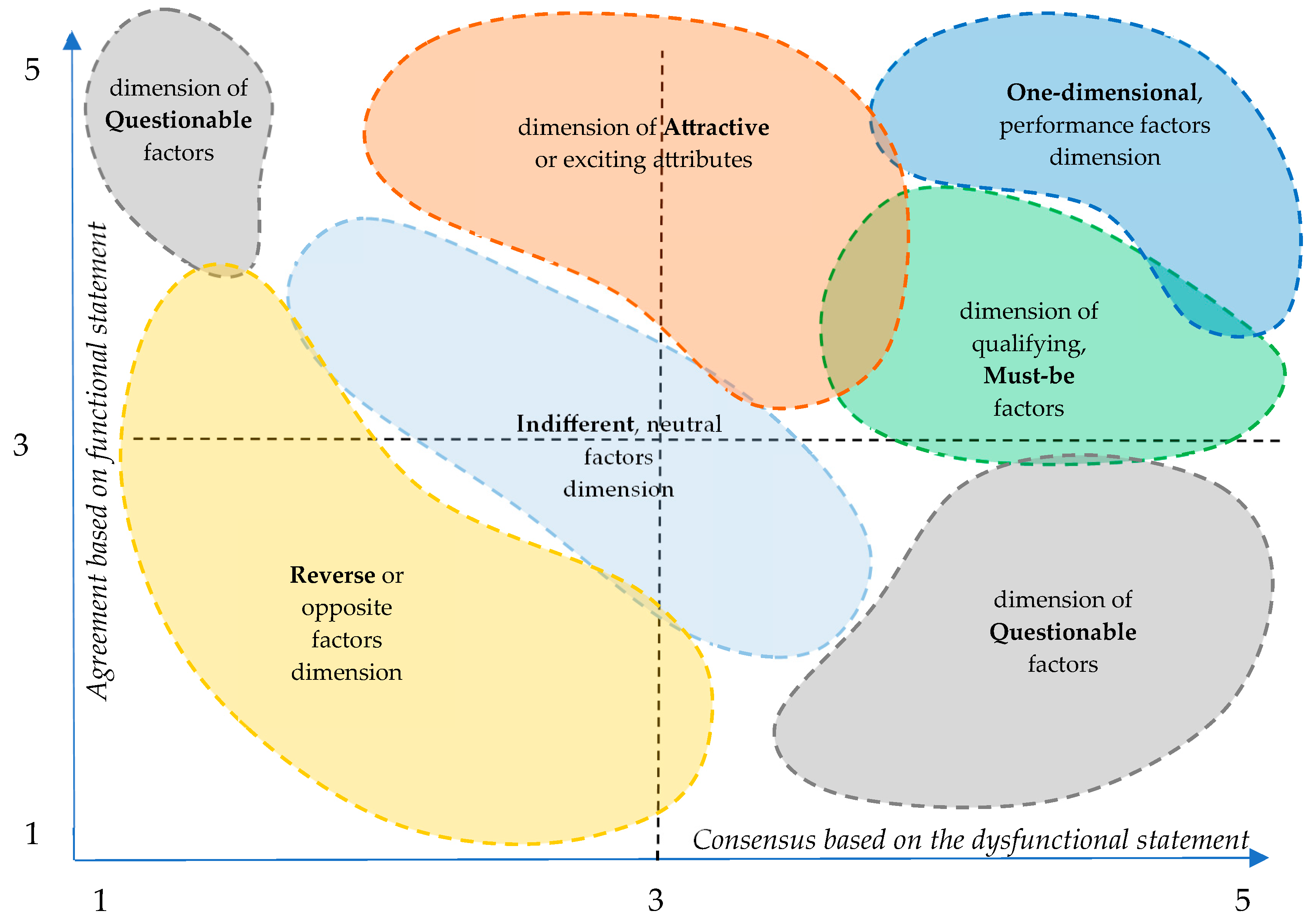
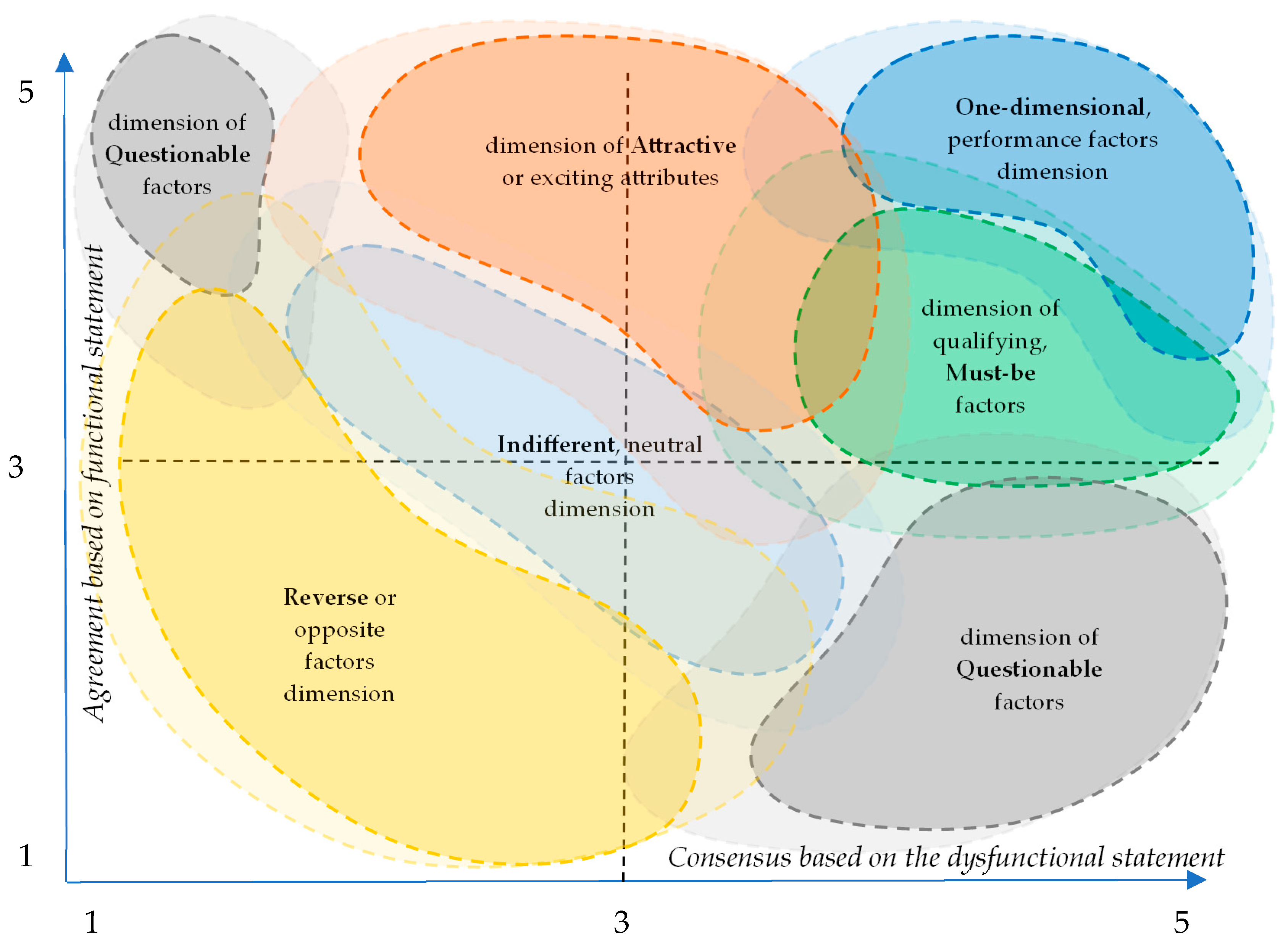
- The contradiction between the qualitative nature of the Kano concept and its discrete, matrix-based classification. To address this, we introduce a continuous two-dimensional agreement surface, which enables a more nuanced interpretation and better aligns with the original qualitative intent of the Kano model.
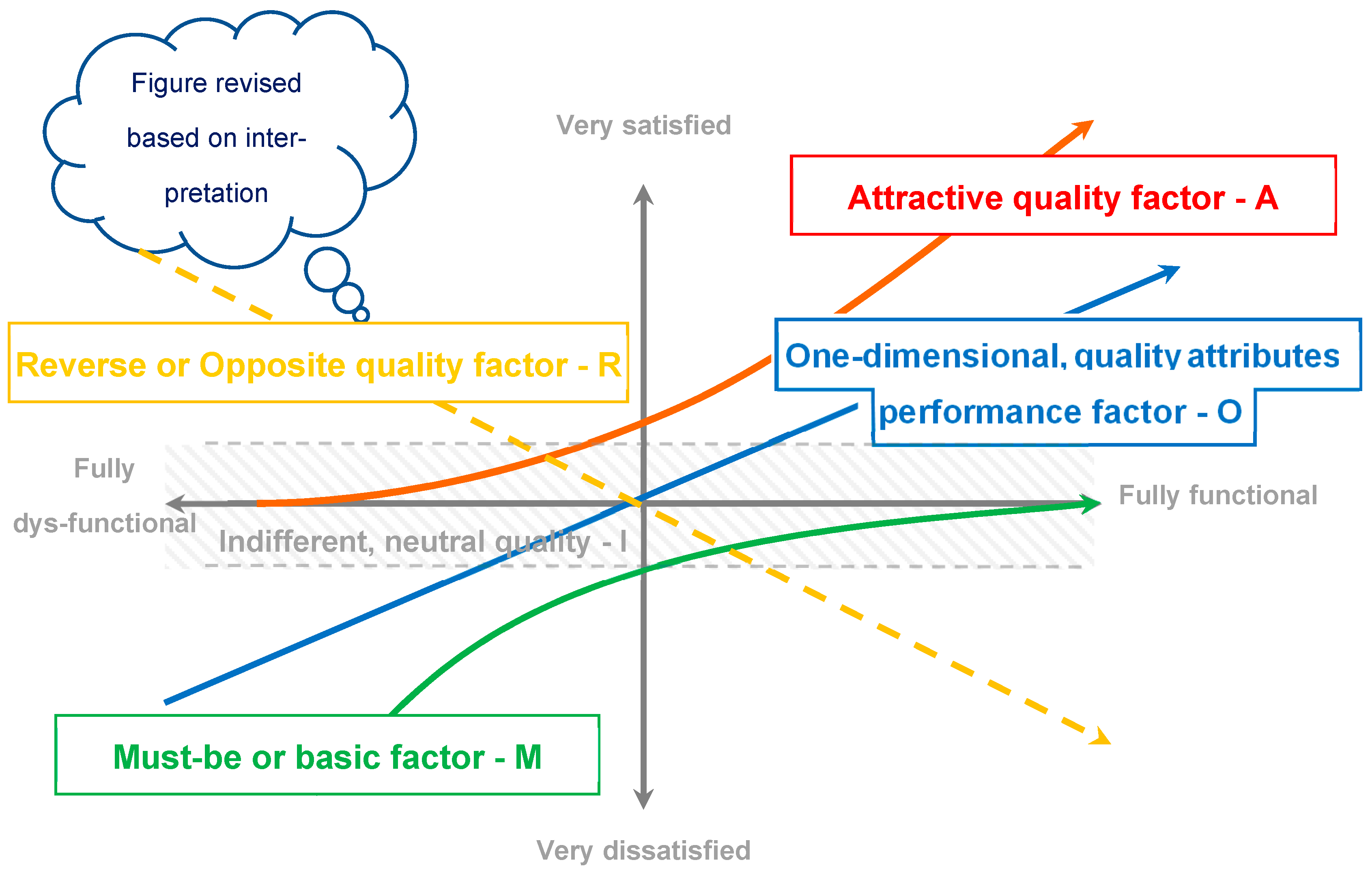
- In our interpretation, Kano categories should not be treated as strictly discrete classes. The evaluation of convenience-related attributes often exhibits transitional characteristics between categories, aggregates multiple layers of consumer perceptions, and may change rapidly in dynamic service environments. Furthermore, the interpretation of attribute positions near category boundaries remains hidden in a purely discrete (crisp) classification framework. For example, in urban e-commerce logistics, attributes such as delivery flexibility, tracking transparency, or sustainability-related solutions may simultaneously exhibit characteristics of Attractive, One-dimensional, or emerging Must-be categories. Therefore, the refined framework interprets Kano categories as overlapping satisfaction domains rather than strictly separated classes.
- RQ1: How can last-mile logistics convenience services—including sustainability-related characteristics—be systematically identified, and to what extent do they influence consumer satisfaction?
- RQ2: How can last-mile logistics convenience service attributes—including sustainability-related characteristics—be classified within the refined Kano framework?
- RQ3: Which convenience services exhibit transitional characteristics?
- RQ4: What role do sustainability-related last-mile solutions play in shaping customer expectations and satisfaction categories?
- RQ5: How do consumers evaluate future-oriented, high-technology last-mile innovations?
- RQ6: How can the methodological framework of the Kano model be refined to better capture transitional and ambiguous satisfaction effects in last-mile logistics convenience services?
- O1: To systematically map and typologize last-mile logistics convenience services including sustainability-related delivery attributes from a consumer perspective.
- O2: To empirically apply the refined Kano model in order to assess how convenience and sustainability-related service attributes influence consumer satisfaction.
- O3: To identify and verify convenience services that currently provide multiplicative and Attractive competitive advantages, as well as those that exhibit transitional characteristics and are beginning to evolve into must-be expectations.
- O4: To examine the actual role of sustainability-related delivery solutions in shaping customer satisfaction and expectation structures in last-mile logistics.
- O5: To investigate the actual impact of future-oriented technological innovations on consumer satisfaction.
- O6: To contribute to the methodological advancement of logistics service quality research and Kano theory by presenting a refined model.
2. Literature Review
2.1. Last-Mile Delivery and Consumer Preferences in Urban Distribution
2.2. Convenience Services in Last-Mile Logistics
2.3. Societal Sustainability Implications of E-Commerce
2.4. Linkages and Research Domains at the Intersection of Last-Mile Logistics, Customer Satisfaction, and Sustainability
3. Materials and Methods
3.1. Description of the Refined Kano Model
- The quality categories defined on a qualitative basis are diffuse; the discrete inclusion table describes fuzzy sets with overlapping regions. The resulting categories are therefore neither clear-cut nor strictly discrete, but rather continuous in nature.
- We assume that the empirical results allow for examining and grouping product or service features without the need to introduce additional subcategories.
- We assume that individual product or service features evolve dynamically over time and that their categorical classification may shift as customer expectations change. While several authors agree on the possible sequence and direction of such transitions (e.g., the notion that quality itself has a life cycle [59]), our interpretation diverges in that we do not consider these transitions to necessarily follow a predetermined path or life cycle. Instead, we posit that they are primarily shaped by the sometimes erratic fluctuations in consumer preferences. We continue to maintain that respondents—even when provided with guidance—may not reliably interpret original Kano type quality categories in relation to product attributes and potential cognitive dissonances, whereas they are able to provide more dependable assessments regarding their level of satisfaction.
- We assume that convenience services in last-mile logistics are fundamentally novel and, apart from the most basic distribution and delivery parameters, do not yet possess established, that is, traditional customer expectations.
3.2. The Author’s Comprehensive Reflections on the Major Shortcomings of the KANO Model
3.3. Questionnaire Respondents
3.4. Sample Profile and Validity Considerations
4. Results
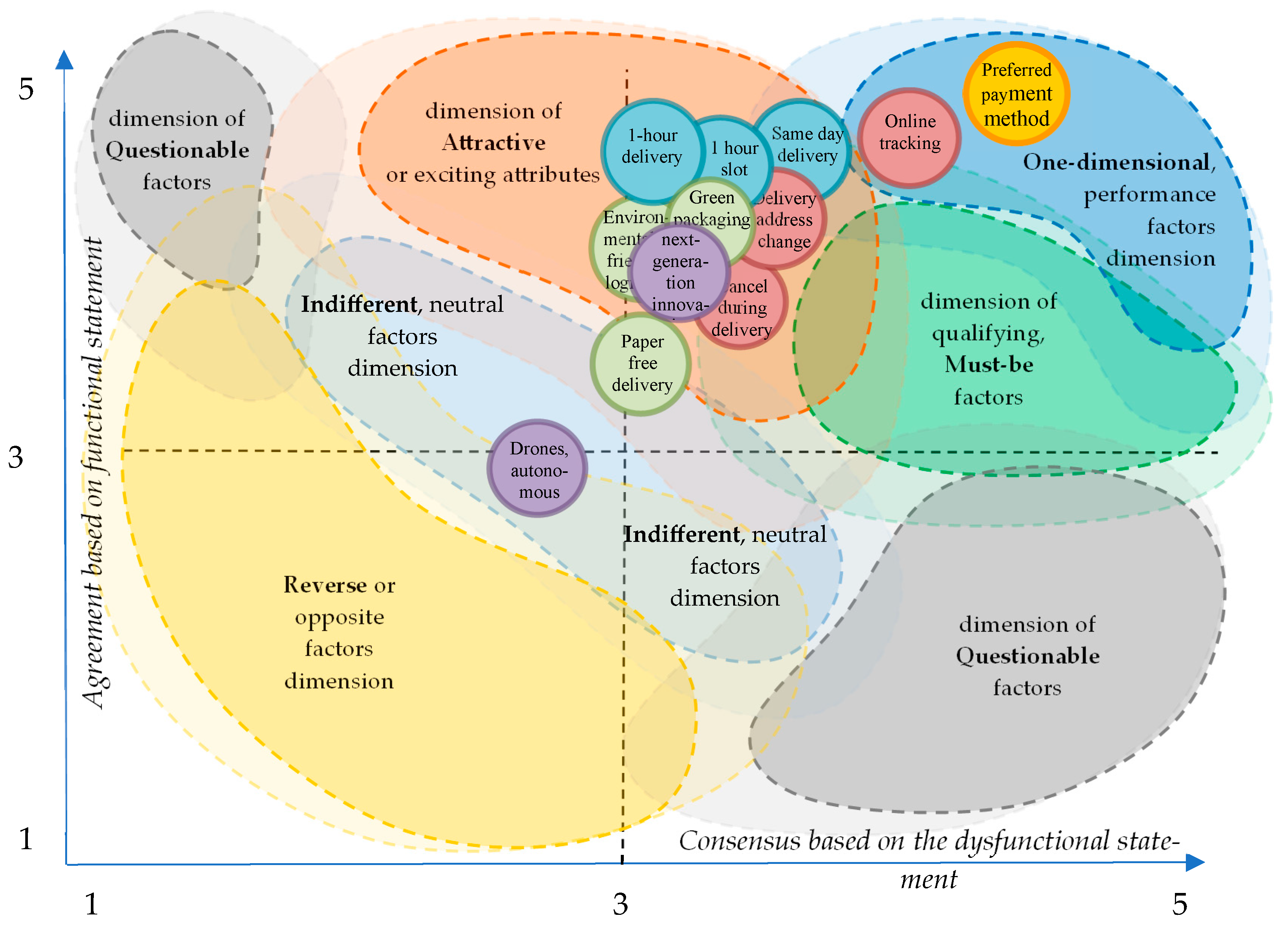
- Blue: time-based embedded services (time dimension);
- Green: eco-friendly and sustainability-related services;
- Purple: future-oriented solutions;
- Brown: services related to flexibility;
- Yellow: pricing- and payment-related flexibility.
5. Discussion
6. Conclusions
6.1. Implications for Supporting Sustainable Service Design in Urban E-Commerce Environments
- Structural market changes;
- Regulatory intervention or political pressure;
- The strengthening of environmental awareness;
- Generational value shifts;
- Technological diffusion and the development of digital platforms.
6.2. Limitations and Potential Directions for Further Development
Author Contributions
Funding
Institutional Review Board Statement
Informed Consent Statement
Data Availability Statement
Conflicts of Interest
References
- Markovic, D. E-Commerce Trends: Trends in E-Commerce Logistics: More Than Just Shipping. Council Post, 18 September 2023. Available online: https://www.forbes.com/councils/forbesbusinesscouncil/2023/09/18/trends-in-e-commerce-logistics-more-than-just-shipping/ (accessed on 9 March 2025).
- Klein, P.; Popp, B. Last-Mile Delivery Methods in E-Commerce: Does Perceived Sustainability Matter for Consumer Acceptance and Usage? Sustainability 2022, 14, 16437. [Google Scholar] [CrossRef] [Scilit]
- Kilibarda, M.; Andrejić, M.; Popović, V. Research in logistics service quality: A systematic literature review. Transport 2020, 35, 224–235. [Google Scholar] [CrossRef] [Scilit]
- Mikulić, J.; Prebežac, D. A critical review of techniques for classifying quality attributes in the Kano model. Manag. Serv. Qual. Int. J. 2011, 21, 46–66. [Google Scholar] [CrossRef] [Scilit]
- Chen, C.-C.; Chuang, M.-C. Integrating the Kano model into a robust design approach to enhance customer satisfaction with product design. Int. J. Prod. Econ. 2008, 114, 667–681. [Google Scholar] [CrossRef] [Scilit]
- Tontini, G. Integrating the Kano Model and QFD for Designing New Products. Total Qual. Manag. Bus. Excell. 2007, 18, 599–612. [Google Scholar] [CrossRef] [Scilit]
- Berger, C.; Blauth, R.E.; Boger, D.; Bolster, C.J.; Burchill, G.; DuMouchel, W.; Pouliot, F.; Richter, R.; Rubinoff, A.; Shen, D.; et al. Kano’s methods for understanding customer-defined quality. Cent. Qual. Manag. J. 1993, 2, 3–35. [Google Scholar]
- McKinsey & Company. The Last-Mile Challenge: Efficient and Sustainable Last-Mile Logistics: Lessons from Japan. 2020. Available online: https://www.mckinsey.com/industries/logistics/our-insights/efficient-and-sustainable-last-mile-logistics-lessons-from-japan (accessed on 20 November 2025).
- Gevaers, R.; Van de Voorde, E.; Vanelslander, T. Characteristics and Typology of Last-mile Logistics from an Innovation Perspective in an Urban Context. In City Distribution and Urban Freight Transport: Multiple Perspectives; Macharis, C., Melo, S., Eds.; Edward Elgar Publishing: Cheltenham, UK, 2011; pp. 13–22. [Google Scholar] [CrossRef] [Scilit]
- Dias, E.G.; Oliveira, L.K.; Isler, C.A. Assessing the effects of delivery attributes on e-shopping consumer behaviour. Sustainability 2022, 14, 13. [Google Scholar] [CrossRef] [Scilit]
- Póka, V.; Lányi, M. Az utolsó száz méter kihívásai az ekereskedelem logisztikában. (en. The challenges of the last hundred meters in e-commerce logistics). Acta Period. 2022, 26, 29–44. [Google Scholar] [CrossRef] [Scilit]
- Olsson, J.; Hellström, D.; Vakulenko, J. Customer experience dimensions in last-mile delivery: An empirical study on unattended home delivery. Int. J. Phys. Distrib. Logist. Manag. 2022, 53, 184–205. [Google Scholar] [CrossRef] [Scilit]
- Karli, H.; Tanyas, M. Innovative Delivery Methods in the Last-Mile: Unveiling Consumer Preference. Future Transp. 2024, 4, 152–173. [Google Scholar] [CrossRef] [Scilit]
- Esper, T.L.; Jensen, T.D.; Turnipseed, F.L.; Burton, S. The last mile: An examination of effects of online retail delivery strategies on consumers. J. Bus. Logist. 2003, 24, 177–203. [Google Scholar] [CrossRef] [Scilit]
- Yang, H.; Fang, M.; Yao, J.; Su, M. Green cooperation in last-mile logistics and consumer loyalty: An empirical analysis of a theoretical framework. J. Retail. Consum. Serv. 2023, 73, 103308. [Google Scholar] [CrossRef] [Scilit]
- White, K.; Habib, R.; Hardisty, D.J. How to SHIFT Consumer Behaviors to Be More Sustainable: A Literature Review and Guiding Framework. J. Mark. 2019, 83, 22–49. [Google Scholar] [CrossRef] [Scilit]
- Edwards, J.B.; McKinnon, A.C.; Cullinane, S.L.; Halldórsson, Á.; Kovács, G.Y. Comparative analysis of the carbon footprints of conventional and online retailing: A “last mile” perspective. Int. J. Phys. Distrib. Logist. Manag. 2010, 40, 103–123. [Google Scholar] [CrossRef] [Scilit]
- European Commission. Communication from the Commission to the European Parliament, the Council, the European Economic and Social Committee and the Committee of the Regions; Decarbonise Corporate Fleets, 5.3.2025 COM(2025) 96 Final; European Commission: Brussels, Belgium, 2025; Available online: https://transport.ec.europa.eu/document/download/1498648c-63fc-4715-975d-ccbc64703da5_en?filename=Communication+-+Decarbonising+corporate+fleets.pdf (accessed on 3 November 2025).
- Jagoda, A.; Kołakowski, T.; Marcinkowski, J.; Cheba, K.; Hajdas, M. E-customer preferences on sustainable last mile deliveries in the e-commerce market: A cross-generational perspective. Equilib. Q. J. Econ. Econ. Policy 2023, 18, 853–882. [Google Scholar] [CrossRef] [Scilit]
- De Souza, R.; Goh, M.; Lau, H.C.; Ng, W.S.; Tan, P.S. Collaborative Urban Logistics—Synchronizing the Last Mile a Singapore Research Perspective. Procedia-Soc. Behav. Sci. 2014, 125, 422–431. [Google Scholar] [CrossRef] [Scilit]
- Koh, L.Y.; Yuen, K.F. Consumer adoption of autonomous delivery robots in cities: Implications on urban planning and design policies. Cities 2023, 133, 104125. [Google Scholar] [CrossRef] [Scilit]
- Adeoye, Y.; Onotole, E.F.; Ogunyankinnu, T.; Aipoh, G.; Osunkanmibi, A.A.; Egbemhenghe, J. Artificial Intelligence in Logistics and Distribution: The function of AI in dynamic route planning for transportation, including self-driving trucks and drone delivery systems. World J. Adv. Res. Rev. 2025, 25, 155–167. [Google Scholar] [CrossRef] [Scilit]
- Dablanc, L. Logistics Sprawl and Urban Freight Planning Issues in a Major Gateway City. In Sustainable Urban Logistics: Concepts, Methods and Information Systems; Gonzalez-Feliu, J., Semet, F., Routhier, J.L., Eds.; EcoProduction; Springer: Berlin/Heidelberg, Germany, 2014; pp. 49–69. [Google Scholar] [CrossRef] [Scilit]
- Gatta, V.; Marcucci, E.; Nigro, M.; Serafini, S. Sustainable Urban Freight Transport Adopting Public Transport-Based Cowdshipping for B2C Deliveries. Eur. Transp. Res. Rev. 2019, 11, 13. [Google Scholar] [CrossRef] [Scilit]
- Sohn, J.; Woo, S.H.; Kim, T.W. Assessment of logistics service quality using the Kano model in a logistics-triadic relationship. Int. J. Logist. Manag. 2017, 28, 680–698. [Google Scholar] [CrossRef] [Scilit]
- Asian, S.; Pool, J.K.; Nazarpour, A.; Tabaeeian, R.A. On the importance of service performance and customer satisfaction in third-party logistics selection, An application of Kano model. Benchmarking Int. J. 2018, 26, 1550–1564. [Google Scholar] [CrossRef] [Scilit]
- Ingaldi, M.; Ulewicz, R. How to Make E-Commerce More Successful by Use of Kano’s Model to Assess Customer Satisfaction in Terms of Sustainable Development. Sustainability 2019, 11, 4830. [Google Scholar] [CrossRef] [Scilit]
- Xu, Y.; Tong, X. Research on the Service Quality of JD Daojia’s Logistics Distribution Based on Kano Model. In Advances in Artificial Systems for Logistics Engineering III; Hu, Z., Zhang, Q., He, M., Eds.; Lecture Notes on Data Engineering and Communications Technologies; Springer: Cham, Switzerland, 2023; Volume 180, pp. 536–546. [Google Scholar] [CrossRef] [Scilit]
- Shan, H.; Fan, X.; Long, S.; Yang, X.; Yang, S. An Optimization Design Method of Express Delivery Service Based on Quantitative Kano Model and Fuzzy QFD Model. Discret. Dyn. Natire Soc. 2022, 2022, 5945908. [Google Scholar] [CrossRef] [Scilit]
- Liu, S.; Li, Y.; Huang, J.; Zhao, X. Understanding the Consumer Satisfaction of the “Last-Mile” Delivery of E-Business Services. In Proceedings of the Computer and Computing Technologies in Agriculture XI, CCTA 2017, Jilin, China, 12–15 August 2017; Li, D., Zhao, C., Eds.; IFIP Advances in Information and Communication Technology; Springer: Cham, Switzerland, 2019; Volume 546. [Google Scholar] [CrossRef] [Scilit]
- Diófási-Kovács, O.; Szilágyi, S. A Magyarországon működő CEP szolgáltatók széndioxid kibocsátásának, komparatív elemzése. In Terms of Greenhouse Gas Emissions Operating on the Hungarian CEP Market; Corvinus University Budapest, Institute of Business Economics: Budapest, Hungary, 2019; Available online: https://unipub.lib.uni-corvinus.hu/4157/1/Diofasi_Szilagyi_176.pdf (accessed on 12 November 2024).
- Harter, A.; Stich, L.; Spann, M. The Effect of Delivery Time on Repurchase Behavior in Quick Commerce. J. Serv. Res. 2025, 28, 211–227. [Google Scholar] [CrossRef] [Scilit]
- Situmorang, M.M.; Fadhilah, M.; Welsa, H.; Lukitaningsih, A. E-Service Quality, Delivery Timeliness, Customer Loyalty and Customer Satisfaction among J&T Service Users. In Mebidangro Metropolitan Area, Proceedings of the 1st International Conference on Social Environment Diversity (ICOSEND 2024), Semarang, Indonesia, 5–6 November 2024; Advances in Social Science, Education and Humanities Research; Atlantis Press part of Springer Nature: Dordrecht, The Netherlands, 2025; Volume 905, pp. 157–166. [Google Scholar] [CrossRef] [Scilit]
- Ivanova, U. Enhancing Last-Mile Delivery Efficiency: A Lean-Based Framework for Sustainable Logistics in the Helsinki Metropolitan Area. Bachelor’s Thesis, Haaga-Helia University of Applied Sciences, Helsinki, Finland, 2025. Available online: https://urn.fi/URN:NBN:fi:amk-202505069403 (accessed on 29 November 2025).
- Póka, V. A last-mile logisztika fő kihívásai és lehetséges jövőbeli irányai. (en. The main challenges and possible future directions of last-mile logistics). Acta Period. 2023, 28, 69–84. [Google Scholar] [CrossRef] [Scilit]
- Calabrò, G.; Le Pira, M.; Giuffrida, N.; Fazio, M.; Inturri, G.; Ignacollo, M. Modelling the Dinamics of Fragmented vs. Consolited Last-Mile E-commerce Deliveries via Agent-Based Model. Transp. Res. Procedia 2022, 62, 155–162. [Google Scholar] [CrossRef] [Scilit]
- Mount, C.; 3PLworldwide. The Future of Last-Mile Delivery: Innovative Strategies and Technologies to Keep an Eye On; 3PL Worldwide: Rancho Cucamonga, CA, USA, 2024; Available online: https://web.archive.org/web/20240810071255/https://www.3plworldwide.com/the-future-of-last-mile-delivery-innovative-strategies-and-technologies-to-keep-an-eye-on/ (accessed on 30 March 2025).
- Mangiaracina, R.; Perego, A.; Segghezi, A.; Tumino, A. Innovative Solutions to Increase Last-Mile Delivery Efficiency in B2C E-commerce: A Literature Review. Int. J. Phys. Distrib. Logist. Manag. 2019, 49, 901–920. [Google Scholar] [CrossRef] [Scilit]
- Lim, S.F.W.; Jin, X.; Srai, J.S. Consumer-driven e-commerce: A literature review, design framework, and research agenda on last-mile logistics models. Int. J. Phys. Distrib. Logist. Manag. 2018, 48, 308–332. [Google Scholar] [CrossRef] [Scilit]
- Siegfried, P.; Michel, A.; Tänzler, J.; Jiyuan, J. Analyzing Sustainability Issues in Urban Logistics in the Context of Growth of E-Commerce. Transp. Sci. 2022, 50, 363–761. [Google Scholar] [CrossRef] [Scilit] [PubMed]
- Caspersen, E.; Navrud, S. The sharing economy and consumer preferences for environmentally sustainable last mile deliveries. Transp. Res. Part D Transp. Environ. 2021, 95, 102863. [Google Scholar] [CrossRef] [Scilit]
- Villa, R.; Monzón, A. A Metro-Based System as Sustainable Alternative for Urban Logistics in the Era of E-Commerce. Sustainability 2021, 13, 4479. [Google Scholar] [CrossRef] [Scilit]
- Ballare, S.; Lin, J. Investigating the Use of Microhubs and Crowdshipping for Last Mile Delivery. Transp. Res. Procedia 2020, 46, 277–284. [Google Scholar] [CrossRef] [Scilit]
- Morganti, E.; Seidel, S.; Blanquart, C.; Dablanc, L.; Lenz, B. The Impact of E-commerce on Final Deliveries: Alternative Parcel Delivery Services in France and Germany. Transp. Res. Procedia 2014, 4, 178–190. [Google Scholar] [CrossRef] [Scilit]
- Vakulenko, Y.; Shams, P.; Hellström, D.; Hjort, K. Online retail experience and customer satisfaction: The mediating role of last mile delivery. Int. Rev. Retail. Distrib. Consum. Res. 2019, 29, 306–320. [Google Scholar] [CrossRef] [Scilit]
- Sahare, S.; Karande, K. Consumer Preferences in Last Mile Delivery Services. Psychol. Educ. J. 2020, 5699–5705. Available online: https://psychologyandeducation.net/pae/index.php/pae/article/view/2494/2174 (accessed on 12 November 2024).
- Choi, Y.; Gao, D. The role of intermediation in the governance of sustainable Chinese web marketing. Sustainability 2014, 6, 4102–4118. [Google Scholar] [CrossRef] [Scilit]
- Popescu, G.H. E-Commerce Effects on Social Sustainability. Econ. Manag. Financ. Mark. 2015, 10, 80–85. [Google Scholar]
- Tiwari, S.; Singh, P. E-Commerce: Prospect or Threat for Environment. Int. J. Environ. Sci. Dev. 2011, 2, 211–217. [Google Scholar] [CrossRef] [Scilit]
- Caspersen, E.; Navrud, S.; Bengtsson, J. Act locally? Are female online shoppers willing to pay to reduce the carbon footprint of last-mile deliveries? Int. J. Sustain. Transp. 2022, 16, 1144–1158. [Google Scholar] [CrossRef] [Scilit]
- Arnold, F.; Cardenas, I.; Sörensen, K.; Dewulf, W. Simulation of B2C e-commerce distribution in Antwerp using cargo bikes and delivery points. Eur. Transp. Res. Rev. 2018, 10, 2. [Google Scholar] [CrossRef] [Scilit]
- Aljohani, K. The Role of Last-Mile Delivery Quality and Satisfaction in Online Retail Experience: An Empirical Analysis. Sustainability 2024, 16, 4743. [Google Scholar] [CrossRef] [Scilit]
- Pourmohammadreza, N.; Jokar, M.R.A.; Van Woensel, T. Last-mile logistics with alternative delivery locations: A systematic literature review. Results Eng. 2023, 25, 104085. [Google Scholar] [CrossRef] [Scilit]
- Mangano, G.; Zenezini, G.; Cagliano, A.C. Value Proposition for Sustainable Last-Mile Delivery. A Retailer Perspective. Sustainability 2021, 13, 3774. [Google Scholar] [CrossRef] [Scilit]
- Belvedere, V.; Kotzab, H.; Martinelli, E.M. Environmental sustainability and information sharing related to delivery options in the B2B2C context of e-commerce: Evidence from a survey. J. Bus. Ind. Mark. 2024, 44, 877–895. [Google Scholar] [CrossRef] [Scilit]
- González-Romero, I.; Bastero-Sellán, J.; Prado-Prado, J.C. Assessing the impact of time windows on last-mile sustainability: A scoreboard-based approach and case study analysis. J. Ind. Eng. Manag. 2025, 18, 100–114. [Google Scholar] [CrossRef] [Scilit]
- Kokkinou, A.; Quak, H.; Mitas, O.; Mandemakers, A. Should I wait or should I go? Encouraging customers to make the more sustainable delivery choice. Res. Transp. Econ. 2025, 103, 101388. [Google Scholar] [CrossRef] [Scilit]
- Kano, N.; Seraku, K.; Takahashi, F.; Tsuji, S. Attractive quality and must-be quality. J. Jpn. Soc. Qual. Control 1984, 14, 39–48. [Google Scholar]
- Shahin, A.; Pourhamidi, M.; Antony, J.; Park, S.H. Typology of Kano Models: A Critical Review of Literature and Proposition of a Revised Model. Int. J. Qual. Reliab. Manag. 2013, 30, 341–358. [Google Scholar] [CrossRef] [Scilit]
- Rivière, P.; Monrozier, R.; Rogeaux, M.; Pages, J.; Saporta, G. Adaptive preference target: Contribution of Kano’s model of satisfaction for an optimized preference analysis using a sequential consumer test. Food Qual. Prefer. 2006, 17, 572–581. [Google Scholar] [CrossRef] [Scilit]
- Nilsson-Witell, L.; Fundin, A. Dynamics of service attributes: A test of Kano’s theory of attractive quality. Int. J. Serv. Ind. Manag. 2005, 16, 152–168. [Google Scholar] [CrossRef] [Scilit]
- Matzler, K.; Hinterhuber, H.H. How to make product development projects more successful by integrating Kano’s model of customer satisfaction into quality function deployment. Technovation 1998, 18, 25–38. [Google Scholar] [CrossRef] [Scilit]
- Yang, C.C. The Refined Kano’s Model and Its Application. Total Qual. Manag. Bus. Excell. 2005, 16, 1127–1137. [Google Scholar] [CrossRef] [Scilit]
- Cheng, F.M.; Wang, J.; Chen, C.; Cao, Z.J. Product design improvement method driven by online product reviews. Nat. Sci. Rep. 2025, 15, 10252. [Google Scholar] [CrossRef] [Scilit] [PubMed]
- Majava, J.; Nuottila, J.; Haapasalo, H.; Law, M.Y.K. Customer Needs in Market-Driven Product Development: Product Management and R&D Standpoints. Technol. Invest. 2014, 5, 16–25. [Google Scholar] [CrossRef]
- Clegg, B.; Wang, T.; Ji, P. Understanding customer needs through quantitative analysis of Kano’s model. Int. J. Qual. Reliab. Manag. 2010, 27, 173–184. [Google Scholar] [CrossRef] [Scilit]
- Sauerwein, E. Experiences with the reliability and validity of the Kano-method: Comparison to alternate forms of classification of product requirements. In Proceedings of the Transactions of the 11th Symposium on QFD, Novi, MI, USA, 12–18 June 1999; QFD Institute: Ann Arbor, MI, USA; Department of Management University of Innsbruck: Innsbruck, Austria, 1999; Available online: https://pdfcoffee.com/kano-model-reliability-and-validity-pdf-free.html (accessed on 30 March 2025).
- Lee, Y.C.; Huang, S.Y. A new fuzzy concept approach for Kano’s model. Expert Syst. Appl. 2009, 36, 4479–4484. [Google Scholar] [CrossRef] [Scilit]
- Eurostat. E-Commerce Statistics for Individuals: Statistics Explained, Data Extracted. 2025. Available online: https://ec.europa.eu/eurostat/statistics-explained/SEPDF/cache/46776.pdf (accessed on 7 February 2025).
- Mishra, S.; Golias, M.M.; Samani, A.R.; Kaisar, E.I.; Figliozzi, M.A. Modeling Household E-Commerce Delivery Rates and Assessing Households Last-Mile Delivery Preferences; Project ID: Y6R2-22; Freight Mobility Research Institute College of Engineering & Computer Science, Florida Atlantic University: Boca Raton, FL, USA, 2023; Available online: https://www.fau.edu/engineering/research/fmri/pdf/research-projects/y6r2-22-uofm-mishra.pdf?utm_source=chatgpt.com (accessed on 3 March 2025).
- Bădîrcea, R.M.; Manta, A.G.; Florea, N.M.; Popescu, J.; Manta, F.L.; Puiu, S. E-Commerce and the Factors Affecting Its Development in the Age of Digital Technology: Empirical Evidence at EU–27 Level. Sustainability 2022, 14, 101. [Google Scholar] [CrossRef] [Scilit]
- Tontini, G.; Søilen, K.S.; Silveira, A. How interactions of service attributes affect customer satisfaction? An analysis based on psychological foundations. Total Qual. Manag. Bus. Excell. 2013, 24, 1253–1271. [Google Scholar] [CrossRef] [Scilit]
- Löfgren, M.; Witell, L.; Gustafsson, A. Theory of attractive quality and life cycles of quality attributes. TQM J. 2011, 23, 235–246. [Google Scholar] [CrossRef] [Scilit]
- Fabio, R.A.; Croce, A.; Calabrese, C. Bridging the green attitude–behavior gap. J. Sustain. Res. 2025, 7, e250059. [Google Scholar] [CrossRef] [Scilit]
- Beatson, A.; Gottlieb, U.; Pleming, K. Green consumption practices for sustainability: An exploration through social practice theory. J. Soc. Mark. 2020, 10, 197–213. [Google Scholar] [CrossRef] [Scilit]
- Neves, C.; Oliveira, T.; Santini, F. Understanding the determinants of sustainable consumption behavior: Insights from a meta and weight analysis. J. Environ. Manag. 2025, 393, 126932. [Google Scholar] [CrossRef] [Scilit] [PubMed]
- Parasuraman, A. Technology Readiness Index (Tri): A Multiple-Item Scale to Measure Readiness to Embrace New Technologies. J. Serv. Res. 2000, 2, 307–320. [Google Scholar] [CrossRef] [Scilit]
- Yoo, W.; Yu, E.; Jung, J. Drone delivery: Factors affecting the public’s attitude and intention to adopt. Telemat. Inform. 2018, 35, 1687–1700. [Google Scholar] [CrossRef] [Scilit]



| Category: | Type: | Interpretation: |
|---|---|---|
| 1. Time-based embedded services (time dimension) |
| In the context of time-based services, expectations regarding delivery speed and accuracy are becoming increasingly demanding, making these factors key determinants of customer satisfaction [32,33,34] |
| 2. Pickup methods, (according to type of contact) |
| The place and mode of delivery constitute one of the most important convenience factors for customers, as they influence both flexibility and delivery costs [11,35]. |
| 3. Pickup methods, (according to place of handover) |
| One of the major challenges in last-mile logistics is the search for an optimal balance between cost and convenience in the relationship between highly diversified end-point oriented deliveries and city logistics systems toward consolidated pickup locations. At the same time, these pickup and collection points allow customers to retrieve their parcels according to their own schedules, while also enabling service providers to optimize delivery routes. Examples include CDP Click-and-Collect services [36], automated parcel locker systems [37], trunk delivery [38,39]. |
| 4. Value-added convenience services during the handover process |
| The handover process offers numerous opportunities to expand convenience services that can enhance customer satisfaction and differentiate the service provider from its competitors. These services can help elevate the brand and create memorable unboxing experiences for customers [40]. |
| 5. Eco-friendly and sustainability-related services |
| Environmentally conscious customers tend to positively prefer environmentally -friendly packaging [41], as well as parcel-tracking and handling conditions that reflect lower environmental impact [24]. They also show a favorable attitude toward other green solutions such as rail-based transport modes [42], electric vehicles, shared delivery networks, crowdshipping [43], and urban distribution centers, all of which help reduce emissions while simultaneously improving efficiency. |
| 6. Flexibility services |
| Flexibility services enable customers to modify the delivery process or its parameters at various stages, thereby increasing satisfaction and reducing the number of failed deliveries. A strong digital presence further supports accurate and error-free operations [44]. |
| 7. Payment and pricing flexibility |
| Payment options—particularly the choice between pre-payment and cash-on-delivery—represent a highly sensitive aspect of the service, as they can either deter or attract a significant share of customers. Dynamic pricing and the ability to choose among various payment and pricing options play a crucial role in fostering customer loyalty [45]. |
| Dysfunctional Form of the Question | ||||||
|---|---|---|---|---|---|---|
| Functional form of the question | Customer Needs | I like this feature omitted | I need this feature omitted | I am neutral about this feature | I can live with omitting this feature | I dislike omitting this feature |
| I like this feature included | Q | A | A | A | O | |
| I need this feature included | R | I | I | I | M | |
| I am neutral about this feature | R | I | I | I | M | |
| I can live with including this feature | R | I | I | I | M | |
| I dislike including this feature | R | R | R | R | Q | |
| Answering a Functional Question | Answering a Dysfunctional Question | Category | Sign |
|---|---|---|---|
| Must-be: I need this feature included | Reverse: I dislike omitting this feature | Must-be as minimum “hygiene” requirements (Must-be) | M |
| Attractive: I would be happy about it. | Reverse: I dislike omitting this feature | Performance factors as (One-dimensional) | O |
| Attractive: I would be happy about it. | Indifferent: I am neutral about this feature & Must-be & One-dimensional | Attractive factors (Attractive) | A |
| Indifferent: I am neutral about this feature | Indifferent: I am neutral about this feature; & Must-be & One-dimensional | Indifferent factors (Indifferent) | I |
| Reverse: I dislike including this feature | One-dimensional: I need this feature omitted & Attractive & Must-be & Indifferent | Reverse factors (Reverse) | R |
| Reverse: I dislike including this feature | Reverse: I dislike omitting this feature | Questionable factors (Questionable) | Q |
| Attractive: I would be happy about it. | Attractive: I would be happy about it. | Questionable factors (Questionable) | Q |
| Dysfunctional Form of the Question | ||||||
|---|---|---|---|---|---|---|
| Functional form of the question | Customer needs | I would be very satisfied | I would be satisfied | I would be neutral | I would be dissatisfied | I would be very dissatisfied |
| I would be very satisfied | Q | A | A | O | O | |
| I would be satisfied | Q | I | A | M | O | |
| I would be neutral | R | R | I | M | M | |
| I would be dissatisfied | R | R | R | I | Q | |
| I would be very dissatisfied | R | R | R | Q | Q | |
| Gender of Respondents | ||
|---|---|---|
| Men | 89 | 41.6% |
| Women | 123 | 57.5% |
| Other | 2 | 0.9% |
| Age of respondents | ||
| Less than 18 | 2 | 0.9% |
| Between 18 and 29 | 41 | 19.2% |
| Between 30 and 39 | 78 | 36.4% |
| Between 40 and 49 | 34 | 15.9% |
| Between 50 and 59 | 40 | 18.7% |
| Over 60 | 19 | 8.9% |
| How often do you order online? | ||
| Several times a week | 11 | 5.1% |
| Weekly | 31 | 14.5% |
| A few times a month | 74 | 34.6% |
| Monthly | 58 | 27.1% |
| Rarely | 40 | 18.7% |
| What type of settlement do you live in? | ||
| Village | 15 | 7.0% |
| Municipality | 20 | 9.3% |
| City | 64 | 29.9% |
| City with County Rights | 7 | 3.3% |
| County seat | 48 | 22.4% |
| Capital | 60 | 28.0% |
| Distribution of respondents by country? | ||
| Hungarian | 214 | 100% |
| Other | 0 | 0% |
| What is your highest educational qualification? | ||
| Primary school education | 3 | 1.4% |
| Vocational school | 10 | 4.7% |
| Secondary school | 66 | 30.8% |
| Degree | 135 | 63.1% |
| What is the average monthly income of your household? | ||
| Less than 300,000 Ft (less than 909$; 1 USD ≈ 330 HUF) | 15 | 7.0% |
| Between 300,001 Ft and 400,000 Ft (909 $–1212 $) | 16 | 7.5% |
| Between 400,001 Ft and 500,000 Ft (1212 $–1515 $) | 33 | 15.4% |
| Between 500,001 Ft and 600,000 Ft (1515 $–1818 $) | 29 | 13.6% |
| Between 600,001 Ft and 700,000 Ft (1818 $–2121 $) | 21 | 9.8% |
| Between 700,001 Ft and 800,000 Ft (2121 $–2424 $) | 27 | 12.6% |
| Over 800,000 Ft (>2424 $) | 73 | 34.1% |
| Question | Category |
|---|---|
| 1. What would you say if the service provider delivering your order used environmentally friendly logistics transport solutions (green vehicles, fuel, electromobility, green transshipment terminal)? | Attractive or exciting factor. |
| 2. What would you say if same-day delivery was available at your chosen webshop or online retailer? | An Attractive or exciting factor that is starting to slip into the One-dimensional performance factor category, but is also close to the qualifying Must-be category. |
| 3. How about you could choose a one-hour time slot and place your order within that time slot? | Attractive or exciting factor. |
| 4. What would you say if you could see if you could track your order online? | It is a One-dimensional performance factor, but it is also close to the qualifying Must-be requirement. |
| 5. What would you say if your preferred payment method was available? (prepayment, cash, apple pay, revolut), at the delivery point? | A clear One-dimensional performance factor. |
| 6. How would you like it if the packaging you receive your order in was green and environmentally friendly (packaging material and method)? | Attractive or exciting factor. |
| 7. What would you say if you could change the address during delivery or request your order to be delivered to a parcel machine? | An Attractive or exciting factor that is close to the qualifying Must-be category. |
| 8. What would you say if you could cancel your order during delivery? | An Attractive or exciting factor that is close to the qualifying Must-be category. |
| 9. What would you say if the delivery was done by drone or autonomous car? | Indifferent, neutral, which is close to the reverse or opposite factor range. |
| 10. How would you like it if delivery was made within an hour of placing the order? | A strong Attractive or attractive factor. |
| 11. What would you say if a bag-free or box-free service was available for the webshop of your choice? | Indifferent, neutral, which is close to the attractive range. Attractive, or exciting factor, which is close to the indifferent range. |
| 12. What would you say if you could choose next-generation innovative convenience solutions during delivery, such as: community solutions, confidential delivery, cooling guarantee, home packaging? | An Attractive or exciting factor that is close to the Indifferent range. |
Disclaimer/Publisher’s Note: The statements, opinions and data contained in all publications are solely those of the individual author(s) and contributor(s) and not of MDPI and/or the editor(s). MDPI and/or the editor(s) disclaim responsibility for any injury to people or property resulting from any ideas, methods, instructions or products referred to in the content. |
© 2026 by the authors. Licensee MDPI, Basel, Switzerland. This article is an open access article distributed under the terms and conditions of the Creative Commons Attribution (CC BY) license.
Share and Cite
Gyenge, B.; Póka, V.; Mészáros, K. A Refined Kano Model Approach to Sustainable Last-Mile Convenience Services and Customer Satisfaction. Logistics 2026, 10, 86. https://doi.org/10.3390/logistics10040086
Gyenge B, Póka V, Mészáros K. A Refined Kano Model Approach to Sustainable Last-Mile Convenience Services and Customer Satisfaction. Logistics. 2026; 10(4):86. https://doi.org/10.3390/logistics10040086
Chicago/Turabian StyleGyenge, Balázs, Viktor Póka, and Kornélia Mészáros. 2026. "A Refined Kano Model Approach to Sustainable Last-Mile Convenience Services and Customer Satisfaction" Logistics 10, no. 4: 86. https://doi.org/10.3390/logistics10040086
APA StyleGyenge, B., Póka, V., & Mészáros, K. (2026). A Refined Kano Model Approach to Sustainable Last-Mile Convenience Services and Customer Satisfaction. Logistics, 10(4), 86. https://doi.org/10.3390/logistics10040086