Article

A Quantitative–Qualitative Framework for Evaluating Blockchain Adoption in PI-Oriented Logistics Systems

1
Department of Business Design and Management, Waseda University, Tokyo 169-8555, Japan
2
Department of Industrial and Management System Engineering, Waseda University, Tokyo 169-8555, Japan
3
Faculty of Engineering, Khon Kaen University, Muang, Khon Kaen 40002, Thailand
*
Authors to whom correspondence should be addressed.
Logistics 2026, 10(3), 59; https://doi.org/10.3390/logistics10030059
Submission received: 27 December 2025 / Revised: 22 February 2026 / Accepted: 2 March 2026 / Published: 9 March 2026

Abstract

Background: Blockchain has emerged as a promising enabler for improving transparency, trust, and operational efficiency in logistics systems. In PI-oriented logistics environments, where openness, interoperability, and streamlined information exchange are emphasized, blockchain offers a decentralized alternative to conventional coordination methods. However, its economic feasibility remains uncertain due to substantial system development and operational costs. Existing literature largely isolates qualitative benefits from quantitative cost structures. Methods: This study proposes a quantitative–qualitative evaluation framework to assess blockchain adoption in PI-oriented logistics systems. Two Mixed-Integer Linear Programming (MILP) cost-minimization models were constructed to represent alternative coordination approaches: PI–BC (blockchain-enabled coordination) and PI–Human (traditional human-centered coordination). The results of the optimization analysis were integrated into an Analytic Hierarchy Process (AHP) evaluation alongside qualitative criteria such as interoperability, reliability, and transparency. Results: Numerical findings show that although PI–BC incurs higher operational costs, it performs considerably better in qualitative dimensions related to information visibility and robustness. Conclusions: These results suggest that blockchain provides particular value in PI-oriented contexts at the adoption stage. However, the framework does not provide a universal recommendation, as the relative advantage of PI–BC is highly contingent on decision-makers’ subjective criterion weight assignments, as revealed by the sensitivity analysis.

1. Introduction

Modern logistics networks involve many independent actors, such as shippers, carriers, and logistics service providers. These actors must coordinate their activities by sharing transportation and transaction data. In reality, however, trust among participants is often limited, and common standards for transparent and reliable data sharing are frequently missing. As a result, coordination still relies on manual checks, bilateral agreements, or centralized intermediaries. These practices increase transaction costs, slow decision making, and limit large-scale collaboration in complex logistics networks.
In recent years, logistics systems have undergone rapid digital transformation, with growing emphasis on interoperable information exchange and decentralized data architectures. These trends are closely aligned with the vision of the Physical Internet (PI), originally proposed by Montreuil (2011) [1], which aims to establish an open, standardized, and seamlessly connected logistics network. Importantly, PI is not only a conceptual framework but is increasingly regarded as a future paradigm for logistics systems. It is being actively promoted through large-scale initiatives and policy agendas in regions such as Europe and China, where open and collaborative logistics networks are viewed as key enablers of efficiency, resilience, and sustainability. Recent systematic reviews on PI and disruptive technologies further highlight that digitalization initiatives are central to enabling collaboration and interoperability in next-generation logistics networks. Within this context, blockchain has attracted significant attention as a potential technological enabler, offering decentralized validation, immutable data records, and a trust mechanism that does not rely on a single authoritative intermediary (Cortes-Murcia 2022 [2]).
As logistics operations become increasingly interconnected, the need for mechanisms that ensure trust, transparency, and consistent data validation across multiple stakeholders continues to grow. Blockchain offers several features that align with these requirements. Its decentralized transaction validation, tamper-resistant data structure, and capacity to automate administrative processes through smart contracts make it a promising pathway toward PI-oriented logistics operations. Blockchain is a key technology for addressing trust, coordination, and data integrity challenges in open and collaborative logistics networks, including PI-based systems. These characteristics suggest that blockchain may complement or partially replace human-centered coordination processes, particularly in settings where multi-party interaction and transparent information flows are critical.
However, existing research has not yet provided a unified evaluation framework to assess such coordination mechanisms at the adoption stage. Prior studies tend to examine blockchain-enabled logistics either through qualitative perspectives, emphasizing trust, transparency, and governance, or through quantitative mathematical models that primarily focus on cost minimization and operational efficiency. As a result, many existing optimization models do not explicitly incorporate qualitative coordination factors such as trust, data credibility, or reliability of information sharing, while multi-criteria decision-making (MCDM) approaches alone are insufficient to represent the economic trade-offs associated with blockchain adoption.
This separation creates a critical gap for decision makers, who must simultaneously evaluate higher implementation costs and non-monetary coordination benefits. Therefore, a quantitative–qualitative integrated framework is necessary. This study aims to assess the potential of blockchain adoption in PI-oriented logistics systems through a quantitative–qualitative integrated framework. Two alternative coordination approaches are examined: PI–BC (blockchain-enabled coordination) and PI–Human (traditional human-centered coordination). By constructing optimization models for each approach and integrating their results into an Analytic Hierarchy Process (AHP) evaluation, this research provides a balanced assessment of blockchain’s economic implications and its qualitative contributions to reliability and transparency. The proposed framework enables a structured comparison of blockchain’s tangible costs and intangible benefits in PI-oriented operational contexts.

2. Related Work

2.1. Blockchain and the Physical Internet in Logistics

The logistics sector has been rapidly evolving toward digital and data-driven operations, leading to increasing attention to decentralized technologies such as blockchain. Early studies such as Hackius and Petersen (2017) [3] and Saberi et al. (2019) [4] emphasized blockchain’s conceptual potential to enhance transparency, trust, and traceability across supply chains. Kshetri (2018) [5] further noted that blockchain can mitigate information asymmetry and improve cooperation among competing logistics firms, while the World Economic Forum (2019) [6] identified implementation cost and interoperability as key challenges hindering large-scale adoption.
Building upon these foundational studies, later research has expanded the focus from conceptual discussions to empirical and interdisciplinary investigations. Rejeb et al. (2021) [7] provided a comprehensive bibliometric review revealing the exponential growth of blockchain-related logistics research. Karakas et al. (2024) [8] presented a structured research agenda linking blockchain adoption with performance improvement, while Idrissi et al. (2024) [9] examined the integration of blockchain, IoT, and AI for intelligent transportation management. Xu and He (2024) [10] contributed case-based insights on blockchain-based logistics information-sharing models and their operational implications. Gupta et al. (2024) [11] introduced a barrier intensity index framework to analyze blockchain adoption for carbon-neutral logistics, whereas Tangsakul and Sureeyatanapas (2024) [12] applied interpretive structural modeling to identify critical adoption barriers within logistics organizations. Aslam et al. (2025) [13] empirically examined blockchain-enabled solutions to overcome operational challenges in logistics and supply chains.
Parallel studies have highlighted blockchain’s synergies with emerging digital technologies and sustainability goals. Mishra et al. (2024) [14] demonstrated the integrated role of blockchain, AI, and IoT in supporting decarbonization, while Ran et al. (2024) [15] explored its contribution to efficiency enhancement. Aslam et al. (2024) [16] and Tan et al. (2024) [17] further linked blockchain to Logistics 4.0, showing its capacity to improve service quality and resource utilization. These recent contributions illustrate how blockchain has evolved from a theoretical construct to a practical infrastructure supporting sustainable, intelligent, and collaborative logistics systems.
Collectively, these studies demonstrate a transition from conceptual to applied research and illustrate blockchain’s growing importance as an enabling infrastructure for the Physical Internet (PI). As proposed by Montreuil (2011) [1], the PI envisions a globally connected, modular, and standardized logistics system where physical goods move like data packets on the Internet. Blockchain supports this paradigm by ensuring data integrity, decentralized trust, and transparent collaboration across competitive logistics actors.

2.2. Multi-Criteria Decision-Making and the Analytic Hierarchy Process

Decision-making in logistics and transportation often requires balancing multiple and sometimes conflicting objectives—such as minimizing costs, improving service quality, and reducing environmental impact. Multi-Criteria Decision-Making (MCDM) techniques enable decision-makers to evaluate such trade-offs systematically. Among these, the Analytic Hierarchy Process (AHP) proposed by Saaty (1980) [18] remains one of the most widely used frameworks due to its ability to incorporate both quantitative and qualitative factors into structured decision models.
Recent studies demonstrate that AHP continues to be widely applied in the evaluation of digital transformation initiatives and advanced logistics technologies, including intelligent transportation systems, information platforms, and blockchain-based solutions. This ongoing adoption indicates that AHP remains a relevant and effective decision-support tool for assessing modern technologies characterized by both economic trade-offs and intangible qualitative benefits. Moreover, recent research has increasingly combined AHP with mathematical optimization models to jointly evaluate the cost efficiency and multi-dimensional performance, providing methodological precedents for integrated quantitative–qualitative evaluation frameworks.
AHP decomposes complex decisions into hierarchical layers, including the goal, criteria, sub-criteria, and alternatives. It applies pairwise comparisons to quantify the relative importance among criteria and aggregates judgments through normalized weight vectors (Chan & Lee, 2019 [19]; Gompf et al., 2021 [20]). In logistics, AHP has been applied to diverse areas such as carrier selection (Jharkharia & Shankar, 2007 [21]), transportation mode evaluation (Macharis et al., 2004 [22]), facility location analysis (Vidal et al., 2001 [23]), and sustainability assessment. Its ability to integrate both subjective assessments and empirical data makes it particularly useful for evaluating emerging technologies like blockchain, whose benefits may include intangible dimensions such as transparency, collaboration, and resilience.

2.3. Research Gap and Motivation

The existing literature demonstrates two distinct but complementary research streams: (1) blockchain’s growing role in logistics and Physical Internet frameworks and (2) the extensive use of AHP and MCDM for multi-criteria evaluation in logistics decision-making. However, few studies combine these perspectives into a unified framework. Most blockchain studies emphasize qualitative benefits such as transparency or trust, while cost-focused quantitative analyses often neglect intangible performance improvements.
This study aims to bridge this gap by integrating mathematical cost optimization with an AHP-based qualitative assessment to provide a holistic evaluation of blockchain adoption in PI-oriented logistics networks (Table 1). By doing so, it contributes to both the methodological advancement of multi-criteria decision-making and the practical understanding of blockchain’s role in enabling the Physical Internet.

3. Methodology

3.1. Integrated Evaluation Framework

3.1.1. Overview of the Proposed AHP Framework

To evaluate the effectiveness of introducing blockchain into Physical Internet (PI)-oriented logistics systems, this study develops an Analytic Hierarchy Process (AHP) framework that integrates both quantitative and qualitative criteria. Two coordination approaches are compared:
  • PI–BC (Blockchain-enabled coordination): a decentralized coordination mechanism in which administrative tasks, information verification, and transaction processing are executed through blockchain infrastructure;
  • PI–Human (Human-centered coordination): a conventional approach relying on organizational procedures, human judgment, and centralized platforms for coordination and data reconciliation.
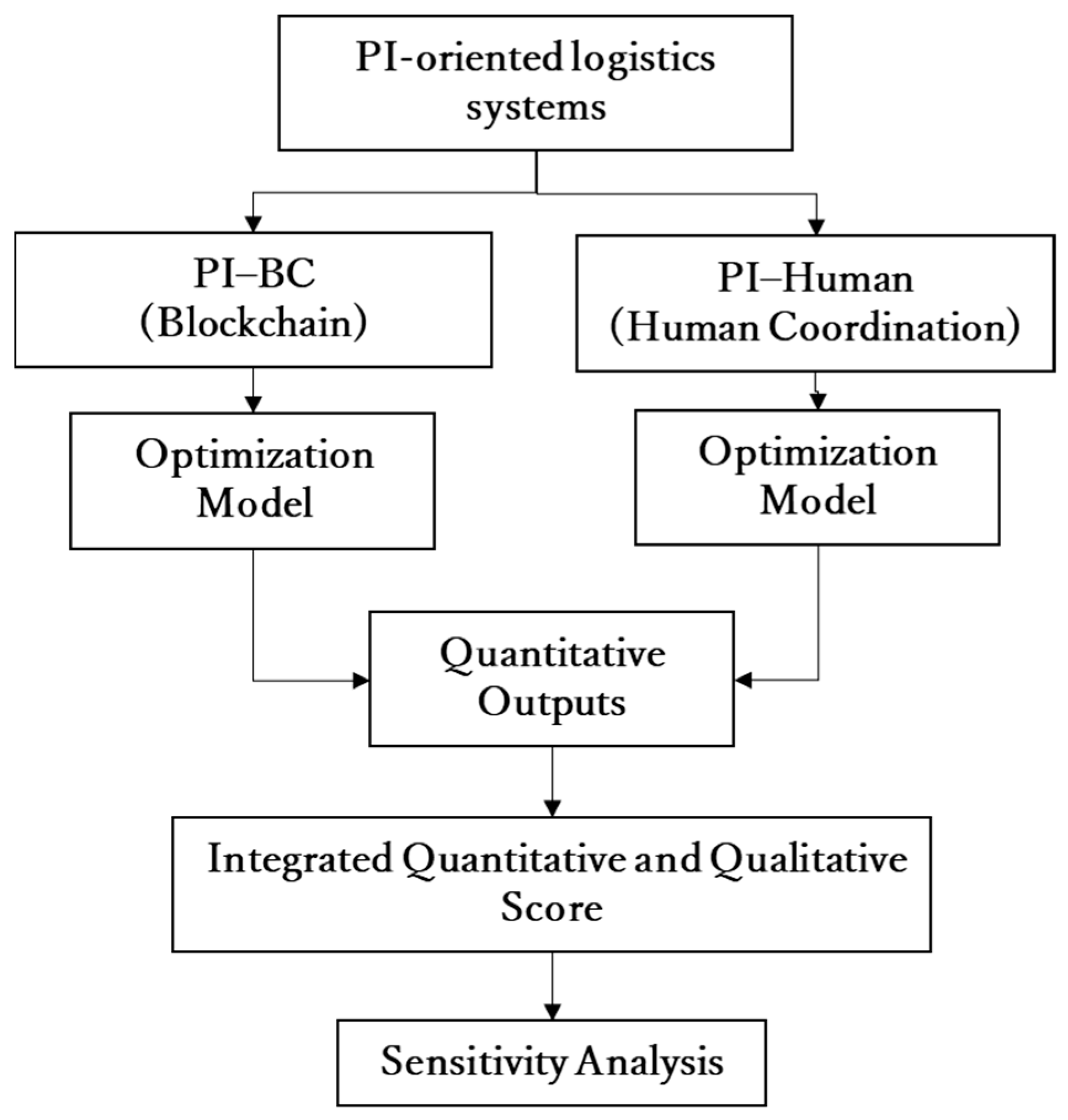
The AHP framework follows four structured steps to combine model-based quantitative results with qualitative assessments, as shown in Figure 1:
Step 1: Define the evaluation goal and alternatives.
The goal is to determine which coordination approach (PI–BC or PI–Human) performs better in a PI-oriented logistics environment.
Step 2: Construct the evaluation hierarchy.
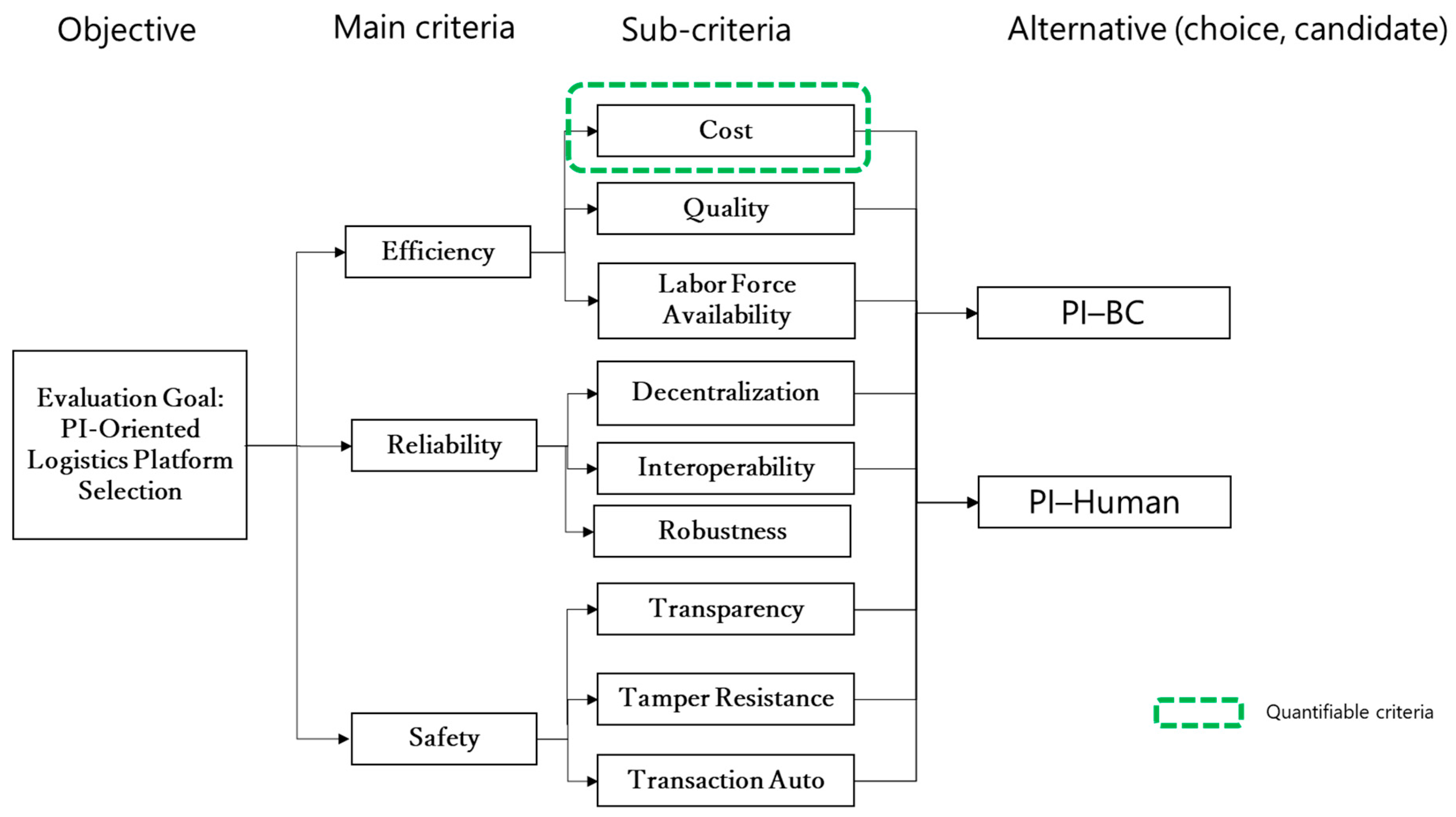
As shown in Figure 2, three main dimensions—Efficiency (A), Reliability (B), and Safety (C), are adopted, each consisting of multiple sub-criteria derived from expert consultation and the prior literature.
In the proposed framework, the MILP models are intentionally used to quantify the Cost sub-criterion, which can be objectively measured based on network structure, demand, capacity, and coordination mechanisms. Other sub-criteria, such as interoperability, robustness, and transparency, represent organizational and institutional attributes that are difficult to quantify reliably at the adoption stage and therefore are evaluated through expert judgment using AHP. This division allows the framework to combine rigorous optimization for quantifiable performance with structured decision-making for qualitative system attributes.
Step 3: Conduct pairwise comparisons and derive criterion weights.
Experts evaluate the relative importance of criteria using Saaty’s 1–9 scale. Pairwise comparison matrices are constructed, and weights are computed after assessing the consistency.
Step 4: Evaluate alternatives under each sub-criterion and compute the final score.
Quantitative model outputs (e.g., total cost) and qualitative assessments (e.g., transparency, interoperability) are normalized and aggregated with the derived weights to obtain the final performance score of PI–BC and PI–Human.
This stepwise structure provides a transparent and systematic procedure for integrating cost optimization results with qualitative criteria, enabling a balanced evaluation of blockchain adoption within PI-oriented logistics systems.

3.1.2. Evaluation Criteria and Definitions

In the context of the Physical Internet, the evaluation criteria are designed to capture both the economic performance and the coordination quality of logistics networks under different coordination mechanisms. Each criterion reflects a specific dimension that influences the validity of blockchain adoption decisions. Efficiency-related criteria assess whether blockchain-enabled coordination can achieve acceptable operational performance under cost and resource constraints. Reliability-related criteria capture the ability of the coordination mechanism to support stable, interoperable, and resilient network operations in highly interconnected PI environments. Safety-related criteria focus on trust, data integrity, and automation capabilities, which are central to blockchain’s proposed advantages over traditional human-centered coordination. The selection of evaluation criteria was informed by prior studies in logistics performance assessment and blockchain adoption in supply chains.
(A)
Efficiency
A1 Cost: This is the total operational cost of the logistics network, including transport, environmental, and administrative expenses; the model details are described in Section 3.2. In the AHP framework, the “Cost” criterion refers to the aggregated monetary-equivalent operational cost obtained from the MILP optimization results. Although the MILP objective function incorporates player-specific preference weights for cost, rigidity, and CO2 emissions, these weights are used only to generate a comparable network-level cost outcome and do not represent system-level evaluation preferences.
A2 Quality: Service quality, accuracy of delivery, and damage rate.
A3 Labor Force Availability: Ability to ensure adequate and safe human resources.
(B)
Reliability
B1 Decentralization: Degree to which operations avoid single points of failure.
B2 Interoperability: Ability to integrate with diverse logistics systems and partners.
B3 Robustness: Resilience to disruptions in network operations.
(C)
Safety
C1 Transparency: Clarity and accessibility of operational and transaction data.
C2 Tamper Resistance: Security against data manipulation and fraud.
C3 Transaction Automation: Extent of smart contract and automated execution capabilities.

3.2. Quantitative Cost Optimization Model

This study considers a multi-company logistics network in which several independent logistics service providers (hereafter referred to as players) must fulfill specific transportation demands between given origin–destination pairs. The network is modeled as a directed graph G = ( N ,   E ) , where N is the set of nodes (e.g., depots, hubs), and E is the set of links between nodes. Each link can support one or more transportation modes m M (e.g., truck, rail), each characterized by its own unit transportation “cost” and maximum capacity.
Each player p P is associated with the following:
  • An origin node s p N and destination node t p N ;
  • A demand volume d p to be shipped from s p to t p ;
  • A set of weight coefficients ( ω p c o s t ,   ω p r i g ,   ω p c o 2 ) representing the relative importance of transportation cost, rigidity, and CO2 emissions in the player’s objective function. These weights reflect player-specific managerial priorities and are normalized to capture relative preference trade-offs rather than absolute valuations. Their values are specified through scenario-based parameterization to represent different strategic and regulatory contexts.
Common operational constraints for both scenarios include the following:
  • Demand satisfaction: Each player’s demand must be fully transported from the origin to the destination.
  • Flow conservation: For intermediate nodes, inflow equals outflow for each player.
  • Capacity limits: The sum of flows from all players on any link–mode combination cannot exceed its capacity.
The main difference between the PI with Blockchain and PI with Human scenarios lies in the additional cost components (Table 2):
(1)
PI–BC:
Organizational coordination costs are assumed to be eliminated due to the trustless and transparent nature of blockchain. Additional blockchain-specific costs are introduced:
  • System Construction and Maintenance Cost C s y s : A fixed cost shared among participants.
  • On-chain Transaction Fee C t x n   : Applied per link used by a player, modeled with a binary usage variable.
  • On-chain Data Storage Cost C s t o r   : Proportional to the transported volume.
(2)
PI–Human:
In addition to transport, rigidity, and CO2 costs, players incur organizational coordination costs C c o o r d   to manage contracts, resolve disputes, and maintain trust among competitive companies in a centralized platform. These costs are proportional to the total flow volume handled for each player.
The cost components introduced in Table 2 are central to differentiating the two coordination paradigms. The organizational coordination cost ( C c o o r d ) in the PI–Human scenario encapsulates expenses related to contract negotiation, manual data reconciliation, dispute resolution, and the maintenance of trust between independent entities. These costs are modeled as proportional to the flow volume, reflecting the increased administrative effort with higher transaction intensity. In contrast, the PI–BC scenario assumes that these human-centric coordination costs are largely eliminated, as blockchain’s core features, decentralized consensus, and immutable records, automate trust and verification. This is the fundamental premise behind the “coordination cost removed” logic. However, this elimination is replaced by technology-specific costs. The system construction and maintenance cost ( C s y s ) represents the fixed investment in blockchain infrastructure. The on-chain transaction fee ( C t x n ) is a variable cost incurred for each state-changing operation on the blockchain, such as recording a shipment event. We model it per edge-mode-player combination to capture the granularity of logistics transactions. The on-chain data storage cost ( C s t o r ) accounts for the expense of storing persistent data on the distributed ledger, which is typically more expensive than centralized storage.
In our numerical experiment, the parameter values ( C s y s = 500 $, C t x n = 1.5 $, C s t o r = 0.2 $, C c o o r d = 0.5 $) are set to represent a reasonable early-stage adoption scenario. At this stage, blockchain technology costs are noticeably higher than traditional coordination costs, but not so high that blockchain becomes completely impractical. We intentionally chose these values to ensure that both options have their own strengths and weaknesses in the AHP evaluation, creating a meaningful trade-off situation rather than a one-sided result.
The sensitivity analysis that follows (Section 4.3) will further explore how changes in these key parameters, especially when decision-makers assign different importance to different criteria, affect the relative advantage of each option. This also helps address the uncertainty inherent in these modeling assumptions.
The MILP model formulation is presented as follows.
Sets
N Set of nodes in the logistics network.
E Set of edges representing transportation links.
P Set of players (logistics participants).
M ( i ,   j ) Set of available transportation modes on edge ( i ,   j ) .
Parameters
d p The demand quantity of player p .
( s p ,   t p ) The start and end nodes for player p .
C i j m The cost per unit transported via mode m on edge ( i ,   j ) .
R i j m The transportation rigidity per unit via mode m on edge ( i ,   j ) .
C O 2 i j m The CO2 emission tax per unit via mode m on edge ( i ,   j ) .
C a p i j m The maximum transportation capacity for mode m on edge ( i ,   j ) .
ω p c o s t ,   ω p r i g ,   ω p c o 2 The weight coefficients for cost, rigidity, and CO2 emissions for player p .
C c o o r d Coordination cost per unit flow.
C s y s Fixed system construction and maintenance cost.
C t x n On-chain transaction fee per used edge–mode–player combination.
C s t o r On-chain storage cost per unit flow.
Decision Variables
x p ,   ( i , j ) m The amount of goods transported by player p via mode m on edge i ,   j .
y p ,   ( i , j ) m Binary variable indicating whether player p uses edge i ,   j with mode m (only for PI–BC scenario).
Objective Function
(a)
PI–BC ( Z B C )
M i n p P ω p c o s t ( i , j ) E m M ( i , j ) C i j m x p ,   ( i , j ) m + ω p r i g i d ( i , j ) E m M ( i , j ) R i j m x p ,   ( i , j ) m                   + ω p c o 2 ( i , j ) E m M ( i , j ) C O 2 i j m x p ,   ( i , j ) m + C s y s                     +   C t x n p P ( i , j ) E m M ( i , j ) y p ,   ( i , j ) m                                                       + C s t o r   p P ( i , j ) E m M ( i , j ) x p ,   ( i , j ) m                                
(b)
PI–Human ( Z H u m a n )
M i n p P ω p c o s t ( i , j ) E m M ( i , j ) C i j m x p ,   ( i , j ) m + ω p r i g i d ( i , j ) E m M ( i , j ) R i j m x p ,   ( i , j ) m + ω p c o 2 ( i , j ) E m M ( i , j ) C O 2 i j m x p ,   ( i , j ) m +   C c o o r d p P ( i , j ) E m M ( i , j ) x p ,   ( i , j ) m        
  • Constraints
Demand Satisfaction at Origins and Destination
j N m M ( s p , j ) x p ,   ( s p , j ) m = d p ,       p P  
i N m M ( i , t p ) x p ,   ( i , t p ) m = d p ,       p P
Flow Conservation at Intermediate Nodes
i N m M ( i , n ) x p ,   ( i , n ) m = j N m M ( n , j ) x p ,   ( n , j ) m ,       p P ,   n N s p , t p  
Capacity Constraints
p P x p ,   ( i , j ) m   C a p i j m ,       i , j E ,   m M i , j
Binary Link Usage (Blockchain scenario)
x p ,   ( i , j ) m   C a p i j m y p ,   i , j m ,             p P ,   i , j E ,   m M i , j
Non-negativity Conditions
x p ,   ( i , j ) m   0
Integrality Conditions
y p ,   ( i , j ) m 0 ,   1  
The optimization model integrates transportation cost, operational factors, and coordination mechanisms into a unified framework for comparing PI–BC and PI–Human systems. The objective functions in Equations (1) and (2) capture the fundamental trade-off between operational efficiency and the cost of maintaining coordination. Equation (1) includes blockchain-specific elements such as system development and maintenance fees, on-chain transaction fees, and distributed data storage costs, reflecting the decentralized architecture of PI–BC. In contrast, Equation (2) incorporates organizational coordination cost, which represents the manual reconciliation, negotiation, and trust-building efforts required in the PI–Human scenario.
The constraints in Equations (3) and (4) ensure that each logistics service provider fully satisfies its transportation demand by enforcing flow completion at the origin and destination nodes. Equation (5) imposes flow conservation at intermediate nodes, preventing artificial creation or loss of goods within the network. Capacity limitations are enforced through Equation (6), which restricts the total flow on each link–mode combination to available infrastructure capacity. The binary-continuous linkage in Equation (7) is included only in the PI–BC formulation and associates flow variables with link-usage indicators, enabling the computation of transaction fees based on actual network utilization. Finally, Equations (8) and (9) define non-negativity and integrality conditions for the decision variables.
Together, Equations (1)–(9) form a coherent mathematical representation of logistics network operations under two distinct coordination paradigms. By solving both models under identical demand, cost, and capacity conditions, the framework provides a consistent basis for evaluating the economic and operational implications of adopting blockchain in PI-oriented logistics environments.
The numerical experiment is conducted on a stylized logistics network consisting of 8 nodes and 9 directed links, representing depots and transportation corridors. Each link supports one or more transportation modes, including truck, rail, and ship, with mode-specific cost, emission, and capacity parameters. The network involves 4 logistics players, each with a predefined origin–destination pair. Player demand levels range from 40 to 70 units. Transportation capacities vary by mode, with typical values of 80 units for truck, 60 units for rail, and 72 units for ship. This network configuration allows for multi-modal routing and capacity sharing while remaining computationally tractable for comparative analysis.


3.3. AHP Integration Procedure

3.3.1. Pairwise Comparison of Criteria

The relative importance of criteria was determined through a structured questionnaire distributed to experts in logistics, supply chain management, and blockchain technology. The pairwise comparisons were conducted with a panel of eight experts, including five academic researchers specializing in logistics and supply chain management and three industry practitioners with experience in logistics operations and digital transformation (including two logistics operations managers and one supply chain digitalization consultant, each with over 10 years of industry experience). Pairwise comparison judgments were collected through a structured questionnaire based on Saaty’s 1–9 scale (1980), where 1 denotes equal importance and 9 denotes extreme importance of one criterion over the other. Individual expert judgments were aggregated using the geometric mean method to form a consolidated pairwise comparison matrix for the group, from which the priority weight vectors were derived.
For each respondent, a pairwise comparison matrix was constructed for the following:
  • Main criteria (A, B, C);
  • Sub-criteria under each main criterion.
The geometric mean of responses was computed to aggregate the expert opinions, and the principal eigenvector of each matrix was normalized to obtain the weight vectors.

3.3.2. Evaluation of Alternatives for Each Criterion

In the next step of AHP, each sub-criterion is used to evaluate the two alternatives (PI–BC, PI–Human).
For qualitative criteria (e.g., Transparency, Robustness), expert scoring was conducted using Saaty’s 1–9 scale. The individual scores for each alternative under a given criterion were then aggregated by calculating the geometric mean across all experts. This resulted in a single group-consensus score for PI–BC and PI–Human for each qualitative criterion. These aggregated scores were then normalized to sum to 1, producing the final “Evaluation score”.
For quantitative criteria (e.g., Cost), numerical results from the optimization models in Section 3.2 were used. For cost-type quantitative criteria, inverse ratio normalization was applied, ensuring that alternatives with lower costs receive higher evaluation scores.
Once all pairwise comparison matrices for both criteria and alternatives are completed, the global weights are calculated by multiplying the criterion weights with the alternative scores for each criterion. The sum of weighted scores for each alternative provides the final AHP score, indicating which scenario offers the better overall performance considering both quantitative and qualitative aspects.

4. Results and Analysis

MILP models were solved using Gurobi Optimizer on a standard personal computer equipped with a 13th Gen Intel Core i7-1360P CPU (2.20 GHz) and 16 GB RAM, running a 64-bit operating system. The test instances involve up to 136 variables and 117 constraints. For the reported experiments, presolve reduced the model size substantially, and optimal solutions were obtained within less than one second. These results indicate that the proposed MILP models are computationally tractable and suitable for practical decision-support applications at the considered network scale.

4.1. Numerical Experiment Results from the Optimization Model

The optimization model described in Section 3.2 was applied to the collaborative logistics network under two scenarios: PI–Human and PI–BC. The objective function minimized the weighted sum of transportation cost, rigidity cost, CO2 emissions, and additional administrative or technological costs as defined in the model formulation.
The results (Table 3) indicate that PI–BC incurs a significantly higher total cost, approximately 75.6% higher than PI–Human. This cost difference can be attributed to several blockchain-specific factors introduced in the PI–BC model:
  • System Development and Maintenance Costs ( C s y s   = 500)
The PI–BC scenario incorporates one-time and recurring expenses for designing, deploying, and maintaining the blockchain infrastructure. These include expenses related to network setup, smart contract development, node operation, and security protocols. Such fixed costs are absent in PI–Human, where coordination is achieved through traditional centralized systems.
  • On-chain Transaction Fees ( C t x n   = 1.5)
Every logistics transaction (e.g., shipment booking, goods transfer, proof of delivery) recorded on the blockchain incurs an on-chain transaction fee. These fees scale with the number of transactions and are independent of shipment volume, contributing to a substantial cumulative cost over the network’s operation.
  • Data Storage Costs ( C s t o r   = 0.2)
Blockchain-based systems store immutable transaction data across multiple nodes, a data storage cost proportional to transported flow. The replication and long-term storage requirements result in higher operational costs compared to conventional centralized databases, which optimize storage more efficiently.
By contrast, the PI–Human model does not incur blockchain-related overheads but instead accounts for organizational coordination costs ( C c o o r d = 0.5 ), including contract negotiation, manual data reconciliation, and risk premiums associated with trust gaps among collaborating companies. This cost scales linearly with transported volume and reflects conventional centralized coordination practices. However, the magnitude of these costs remains lower than the combined technological and operational expenses in PI–BC.
Together, these blockchain-related parameters explain why PI–BC exhibits higher total operational costs in the numerical results, even though organizational coordination costs are eliminated. Importantly, these assumptions are intended to represent an adoption-stage configuration of blockchain-enabled coordination, where technological overheads remain non-negligible, and economies of scale have not yet been fully realized. Although the optimization model indicates that the blockchain-enabled option entails a substantial cost, cost represents only one dimension of the decision-making process; other qualitative factors, as captured by AHP, play a critical role.

4.2. AHP-Based Integrated Evaluation Results

While the model focuses on minimizing the operational costs, the AHP framework captures intangible benefits, providing a more holistic view of value beyond just financial savings. The AHP framework developed in Section 3.1 was applied to integrate the quantitative results from Section 4.1 with the qualitative assessment of other evaluation criteria. Table 4 summarizes the evaluation scores, the assigned weights for each sub-criterion, and the resulting overall score calculation for the two alternatives: PI–BC and PI–Human.
The evaluation score column reflects the relative performance of each alternative under each sub-criterion. For quantitative criteria, such as Cost, the results from the optimization model in Section 4.1 were normalized using the ratio method, where lower values indicate better performance. In this case, PI–Human achieved a lower cost (36.3%) compared to PI–BC (63.7%), which translates into a higher performance score for PI–Human in the Cost criterion.
The other sub-criteria, such as Quality, Labor Force Availability, Decentralization, Interoperability, Robustness, Transparency, Tamper Resistance, and Transaction Automation, were evaluated using expert judgments and literature-based definitions. The expert panel consisted of university researchers specializing in logistics and supply chain management, as well as industry professionals with practical experience in logistics operations and digital transformation. For example, blockchain integration (PI–BC) was rated substantially higher in Labor Force Availability, Transparency, and Interoperability, reflecting blockchain’s capacity to enhance trust, reduce manual verification needs, and streamline multi-party collaboration.
Multiplying the evaluation scores by their respective weights yields the overall score contribution for each sub-criterion. As shown in the “Overall score calculation” columns, PI–BC exhibits particularly strong advantages in Labor Force Availability (0.289 vs. 0.041), Transparency (0.030 vs. 0.004), and Interoperability (0.034 vs. 0.005). Conversely, PI–Human maintains its advantage primarily in the Cost criterion (0.269 vs. 0.153) and Decentralization (0.096 vs. 0.019). Although PI–BC exhibits higher costs, it demonstrates superior performance across multiple criteria simultaneously, and the proposed framework evaluates the overall system preference by balancing the relative weights of these criteria against the cost considerations.

4.3. Sensitivity Analysis

This study conducts a sensitivity analysis to examine how changes in the weights of key sub-criteria affect the overall AHP evaluation of PI–BC (blockchain-enabled Physical Internet collaboration) and PI–Human (traditional human-centered coordination). While the baseline results show PI–BC performing better, it is important to examine how changes in managerial priorities may alter this conclusion. To keep the analysis focused and interpretable, Cost, Labor Force Availability, and Transparency, were selected for detailed illustration because they clearly demonstrate the different types of sensitivity patterns observed (a threshold effect, a low-threshold effect, and no threshold effect). For each, its weight was varied from 0 to 1 while proportionally rescaling the remaining eight criteria to preserve their relative structure. The performance scores of PI–BC and PI–Human remain fixed, ensuring that changes in results reflect only the decision-maker’s emphasis rather than alterations in alternative performance.
(1)
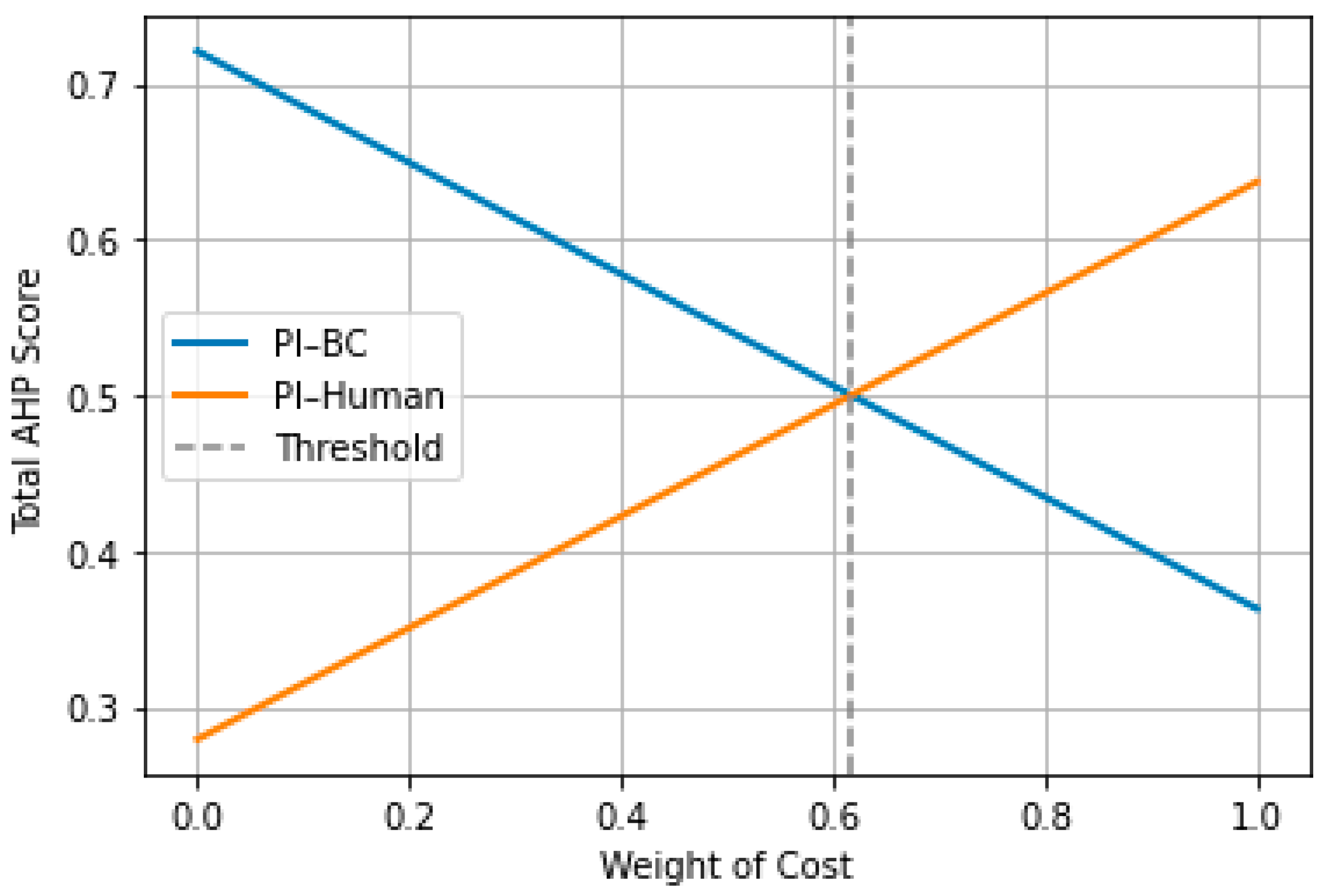
Cost Sensitivity: A Clear Threshold at Approximately 0.617 (Figure 3)
The Cost criterion strongly favors PI–Human, whose cost score (0.637) exceeds that of PI–BC (0.363). As the weight of Cost increases, the score line for PI–Human rises while that for PI–BC declines. The two lines intersect at a cost weight of approximately 0.617, indicating that
  • When Cost < 0.617, PI–BC achieves a higher overall AHP score.
  • When Cost > 0.617, PI–Human becomes the preferred option.
At the baseline weight of 0.422, PI–BC leads with a total score of 0.570 compared to PI–Human’s 0.430. However, once the cost becomes the overwhelmingly dominant corporate objective, the higher technological and operational costs of blockchain shift the advantage toward PI–Human. Because PI–BC incurs higher fixed system costs and transaction-related overheads, increasing the importance of Cost disproportionately penalizes PI–BC. As a result, once cost considerations outweigh qualitative benefits, PI–Human becomes the preferred option.
Managerial insight: If operations are small, standardized, or focused purely on short-term savings, PI–Human often seems better. However, when a company works with many partners or needs higher service quality and visibility, the value of PI–BC increases.
(2)
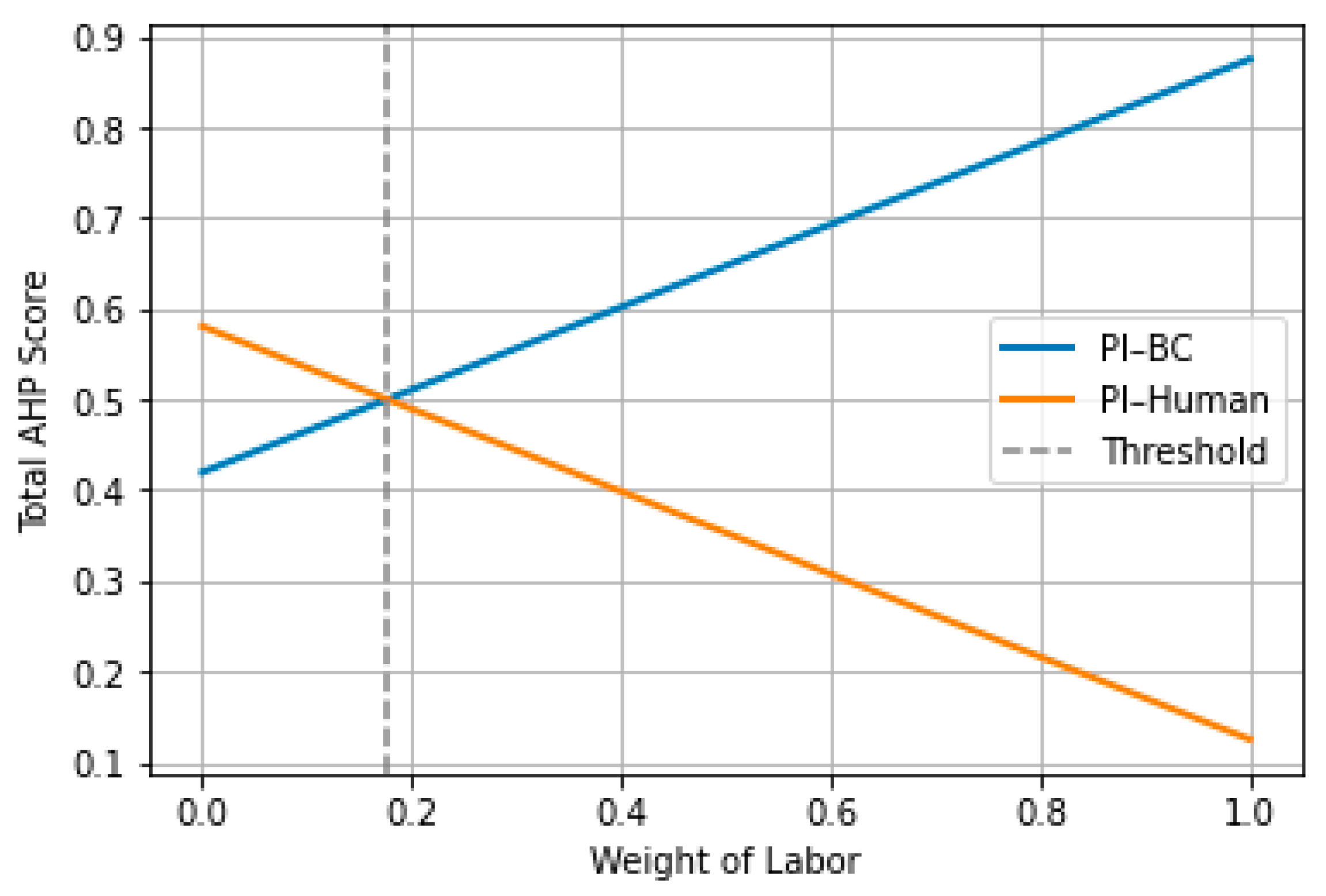
Labor Force Availability Sensitivity: Threshold at Approximately 0.177 (Figure 4)
Labor Force Availability strongly favors PI–BC, which receives a score of 0.875 versus 0.125 for PI–Human. As this criterion’s weight increases, the score gap between the alternatives widens. The threshold at which the two alternatives are equally preferred occurs at a labor weight of approximately 0.177:
  • When Labor > 0.177, PI–BC consistently outperforms PI–Human.
  • When Labor < 0.177, PI–Human may become competitive.
Because the baseline labor weight is already 0.330, well above the threshold, PI–BC’s advantage is robust in labor-constrained environments. Given the increasing shortages of drivers and skilled logistics workers, the benefits of automation, reduced manual verification, and improved coordination offered by PI–BC become especially valuable.
Managerial insight: In markets where labor is difficult to secure, such as regions with an aging workforce, driver shortages, or high recruitment costs, PI–BC becomes especially advantageous because automation reduces dependence on manual coordination. Conversely, in markets where labor is abundant and easy to hire, PI–Human may remain a reasonable and cost-effective choice.
(3)
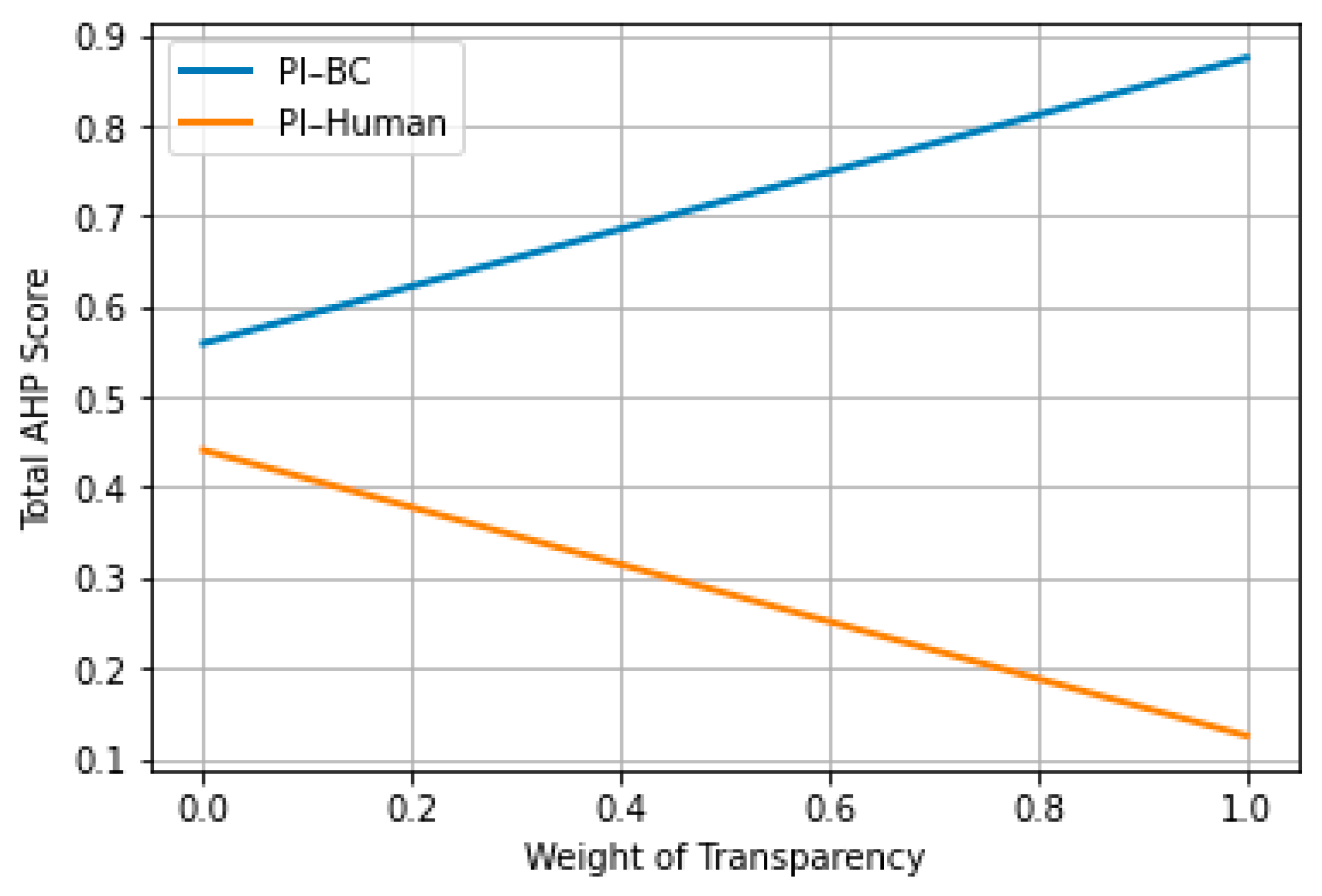
Transparency Sensitivity: No Threshold Observed (Figure 5)
Transparency is another dimension where PI–BC holds a strong advantage (0.875 vs. 0.125). The sensitivity curve shows that as the weight of Transparency increases, PI–BC’s total score rises linearly, while PI–Human’s score decreases linearly. Importantly, the two lines never intersect for weight values in the [0, 1] range, indicating that Transparency does not possess a threshold effect:
  • PI–BC scores higher than PI–Human for all possible weights of Transparency.
  • Increasing the importance of Transparency only amplifies PI–BC’s superiority.
Managerial insight: In practice, Transparency is hard to achieve because many firms still face data-sharing barriers and legacy systems. For this reason, it is often not a main factor when deciding whether to adopt blockchain. Even so, once digital readiness improves, PI–BC naturally gains value by offering more reliable and visible information flows, even if Transparency is not the top priority.
The sensitivity analysis shows that the choice between PI–BC and PI–Human depends on what companies value most. The results suggest a simple message: PI–BC is most valuable when logistics work involves many partners, heavy coordination, labor shortages, or a need for reliable data sharing. In these situations, the benefits of automation and shared information clearly outweigh the higher initial cost. Companies that face such challenges are well positioned to benefit from PI–BC, while firms focused only on minimizing short-term costs may still choose PI–Human.
In summary, the sensitivity analysis helps clarify when blockchain-enabled Physical Internet systems are worth adopting and provides a practical basis for matching technology choices with business priorities.

5. Conclusions

This study proposed an integrated quantitative–qualitative framework to evaluate blockchain adoption in PI-oriented logistics systems. By developing two corresponding optimization models, PI–BC (blockchain-enabled coordination) and PI–Human (human-centered coordination), and incorporating their outputs into an Analytic Hierarchy Process (AHP) evaluation, the research provides a structured and balanced assessment of both the economic and operational implications of blockchain implementation.
The results demonstrate that PI–BC incurs substantially higher operational costs due to system development, on-chain transactions, and data storage requirements. Nevertheless, PI–BC consistently outperforms PI–Human in qualitative dimensions such as transparency, interoperability, robustness, and labor-related benefits in our case study. When quantitative and qualitative factors are jointly considered, PI–BC achieves a higher overall evaluation score, suggesting that blockchain’s intangible advantages can, under certain conditions, offset its higher cost structure in overall evaluations.
Sensitivity analysis further reveals that the preference between PI–BC and PI–Human depends on managerial priorities. PI–BC becomes the superior choice when firms operate in environments characterized by labor shortages, frequent multi-party coordination, or heightened requirements for trustworthy and interoperable information exchange. Conversely, when minimizing short-term operational costs is the dominant priority, PI–Human may remain the more attractive alternative. Accordingly, the proposed framework does not yield an absolute recommendation but rather supports preference-dependent decision-making based on decision-makers’ subjective priority structures.
Overall, this study contributes to the literature by offering a decision-support framework that integrates cost optimization with multi-criteria evaluation, enabling a more nuanced understanding of when blockchain technologies are worth adopting within PI-oriented logistics systems. From a theoretical perspective, this study addresses an identified research gap by integrating cost optimization with multi-criteria evaluation within the context of PI–blockchain systems, thereby demonstrating how economic and non-economic criteria can be jointly assessed. Methodologically, the study develops an integrated and transferable framework that combines MILP with AHP, which can be adapted to other forms of digital coordination technologies in logistics. From a practical perspective, the framework provides practitioners and platform operators with a decision-support tool to identify the conditions under which blockchain adoption is justified by considering several evaluation criteria such as labor availability, coordination complexity, and cost. The findings also offer actionable insights to support informed decision-making when considering a transition toward decentralized coordination mechanisms. The study responds directly to the previously identified lack of structured approaches capable of reconciling blockchain’s qualitative benefits with its quantifiable costs in PI–oriented systems.
This study has several limitations that also suggest directions for future research. First, this study is among the first to systematically introduce blockchain as a coordination mechanism option within the Physical Internet framework. Given that both PI and blockchain are still at relatively early stages of development, the analysis focuses on the adoption-stage decision of whether to use blockchain or not; it should be noted that these results come from a simplified, small-scale network. They depend on the specific cost settings and network structure we used, and the qualitative scores come from the expert panel we consulted. However, as blockchain technologies mature and application scenarios become more differentiated, future decision problems may go beyond a binary adoption choice and involve questions such as to what extent blockchain should be adopted or which blockchain functionalities should be implemented. The current framework does not distinguish different levels or modes of blockchain usage, which limits its ability to support more fine-grained managerial decisions. Second, the results are derived under specific quantitative optimization model structures and parameter settings. Future research may also examine how changes in these assumptions, such as regional characteristics, affect blockchain adoption decisions. Third, while the current study focuses on integrating MILP outputs into the Cost evaluation, the framework is extensible. As more reliable data become available, additional quantitative indicators (e.g., robustness metrics or interoperability scores) can be incorporated into the optimization layer, further strengthening the integration between optimization and multi-criteria evaluation.

Author Contributions

Conceptualization, T.K. and S.O.; Methodology, Q.H. and S.O.; Validation, Q.H.; Formal analysis, Q.H. and T.K.; Investigation, Q.H. and T.K.; Writing—original draft, Q.H. and T.K.; Writing—review and editing, Q.H., S.A. and S.O.; Supervision, S.A. and S.O.; Funding acquisition, Qian Huang. All authors have read and agreed to the published version of the manuscript.

Funding

This research was funded by [JSPS KAKENHI Grants] grant number [23K13518].

Institutional Review Board Statement

Ethical review and approval were waived for this study, because according to the Ethical Guidelines for Medical and Biological Research Involving Human Subjects published by the Japanese Ministry of Education, Culture, Sports, Science and Technology and related ministries, the regulations primarily apply to medical/biological research involving human subjects. Our study, being a non-interventional anonymous expert survey without collection of identifiable personal data, does not fall under these clinical/biological human subject research categories and therefore does not require ethical approval under these national guidelines. https://www.mext.go.jp/a_menu/lifescience/bioethics/seimeikagaku_igaku.html (accessed on 26 December 2025).

Informed Consent Statement

Informed consent was obtained from all subjects involved in the study.

Data Availability Statement

The original contributions presented in this study are included in the article. Further inquiries can be directed to the corresponding authors.

Acknowledgments

The authors would like to thank the logistics practitioners and domain experts who provided valuable feedback and participated in the questionnaire survey for the AHP evaluation. Their insights greatly contributed to the development of the evaluation framework.

Conflicts of Interest

The authors declare no conflicts of interest.

References

  1. Montreuil, B. Toward a Physical Internet: Meeting the global logistics sustainability grand challenge. Logist. Res. 2011, 3, 71–87. [Google Scholar] [CrossRef]
  2. Cortes-Murcia, D.L.; Guerrero, W.J.; Montoya-Torres, J.R. Supply chain management, game-changing technologies, and physical internet: A systematic meta-review of literature. IEEE Access 2022, 10, 61721–61743. [Google Scholar] [CrossRef]
  3. Hackius, N.; Petersen, M. Blockchain in logistics and supply chain: Trick or treat? In Proceedings of the Hamburg International Conference of Logistics (HICL), Hamburg, Germany, 12–13 October 2017; Volume 23, pp. 3–18. [Google Scholar]
  4. Saberi, S.; Kouhizadeh, M.; Sarkis, J.; Shen, L. Blockchain technology and its relationships to sustainable supply chain management. Int. J. Prod. Res. 2019, 57, 2117–2135. [Google Scholar] [CrossRef]
  5. Kshetri, N. Blockchain’s roles in meeting key supply chain management objectives. Int. J. Inf. Manag. 2018, 39, 80–89. [Google Scholar] [CrossRef]
  6. Hewett, N.; Lehmacher, W.; Wang, Y. Inclusive Deployment of Blockchain for Supply Chains. In World Economic Forum Report; World Economic Forum: Geneva, Switzerland, 2019; Available online: https://orca.cardiff.ac.uk/id/eprint/122146/1/white%20paper%20on%20blockchain%20for%20supply%20chains.pdf (accessed on 26 December 2025).
  7. Rejeb, A.; Rejeb, K.; Simske, S.; Treiblmaier, H. Blockchain technologies in logistics and supply chain management: A bibliometric review. Logistics 2021, 5, 72. [Google Scholar] [CrossRef]
  8. Karakas, S.; Acar, A.Z.; Kucukaltan, B. Blockchain adoption in logistics and supply chain: A literature review and research agenda. Int. J. Prod. Res. 2024, 62, 8193–8216. [Google Scholar] [CrossRef]
  9. Idrissi, Z.K.; Lachgar, M.; Hrimech, H. Blockchain, IoT and AI in logistics and transportation: A systematic review. Transp. Econ. Manag. 2024, 2, 275–285. [Google Scholar] [CrossRef]
  10. Xu, X.; He, Y. Blockchain application in modern logistics information sharing: A review and case study analysis. Prod. Plan. Control 2024, 35, 886–900. [Google Scholar] [CrossRef]
  11. Gupta, A.; Singh, R.K.; Kamal, M.M. Blockchain technology adoption for secured and carbon neutral logistics operations: Barrier intensity index framework. Ann. Oper. Res. 2024, 1–34. [Google Scholar] [CrossRef]
  12. Tangsakul, M.; Sureeyatanapas, P. Understanding critical barriers to the adoption of blockchain technology in the logistics context: An interpretive structural modelling approach. J. Open Innov. Technol. Mark. Complex. 2024, 10, 100355. [Google Scholar] [CrossRef]
  13. Aslam, J.; Lai, K.H.; Al Hanbali, A.; Khan, N.T. Blockchain solution for supply chains & logistics challenges: An empirical investigation. Transp. Res. Part E Logist. Transp. Rev. 2025, 198, 104134. [Google Scholar]
  14. Mishra, R.; Singh, R.K.; Daim, T.U.; Wamba, S.F.; Song, M. Integrated usage of artificial intelligence, blockchain and the Internet of Things in logistics for decarbonization through paradox lens. Transp. Res. Part E Logist. Transp. Rev. 2024, 189, 103684. [Google Scholar] [CrossRef]
  15. Ran, L.; Shi, Z.; Geng, H. Blockchain technology for enhanced efficiency in logistics operations. IEEE Access 2024, 12, 152873–152885. [Google Scholar] [CrossRef]
  16. Aslam, J.; Lai, K.H.; Kim, Y.B.; Treiblmaier, H. The implications of blockchain for logistics operations and sustainability. J. Innov. Knowl. 2024, 9, 100611. [Google Scholar] [CrossRef]
  17. Tan, J.; Wong, W.P.; Tan, C.K.; Jomthanachai, S.; Lim, C.P. Blockchain-based Logistics 4.0: Enhancing performance of logistics service providers. Asia Pac. J. Mark. Logist. 2024, 36, 1442–1463. [Google Scholar] [CrossRef]
  18. Saaty, T.L. The Analytic Hierarchy Process; McGraw-Hill: New York, NY, USA, 1980. [Google Scholar]
  19. Chan, P.; Lee, M.H. Prioritizing sustainable city indicators for Cambodia. Urban Sci. 2019, 3, 104. [Google Scholar] [CrossRef]
  20. Gompf, K.; Traverso, M.; Hetterich, J. Using analytical hierarchy process (AHP) to introduce weights to social life cycle assessment of mobility services. Sustainability 2021, 13, 1258. [Google Scholar] [CrossRef]
  21. Jharkharia, S.; Shankar, R. Selection of logistics service provider: An analytic network process (ANP) approach. Omega 2007, 35, 274–289. [Google Scholar] [CrossRef]
  22. Macharis, C.; Springael, J.; De Brucker, K.; Verbeke, A. PROMETHEE and AHP: The design of operational synergies in multicriteria analysis: Strengthening PROMETHEE with ideas of AHP. Eur. J. Oper. Res. 2004, 153, 307–317. [Google Scholar] [CrossRef]
  23. Vidal, C.J.; Goetschalckx, M.; Dogan, K. A global supply chain model with transfer pricing and transportation cost allocation. Eur. J. Oper. Res. 2001, 215, 279–296. [Google Scholar] [CrossRef]
  24. Sarraj, R.; Ballot, E.; Pan, S.; Hakimi, D.; Montreuil, B. Interconnected logistic networks and protocols: Simulation-based efficiency assessment. Int. J. Prod. Res. 2014, 52, 3185–3208. [Google Scholar] [CrossRef]
  25. Crainic, T.G.; Montreuil, B. Physical internet enabled hyperconnected city logistics. Transp. Res. Procedia 2016, 12, 383–398. [Google Scholar] [CrossRef]
  26. Pan, S.; Ballot, E.; Huang, G.Q.; Montreuil, B. Physical Internet and interconnected logistics services: Research and applications. Int. J. Prod. Res. 2017, 55, 2603–2609. [Google Scholar] [CrossRef]
Figure 1. Evaluation steps for PI–BC and PI–Human.
Logistics 10 00059 g001
Figure 2. Integrated quantitative and qualitative framework.
Logistics 10 00059 g002
Figure 3. Sensitivity of AHP scores to cost weight.
Logistics 10 00059 g003
Figure 4. Sensitivity of AHP scores to labor force availability weight.
Logistics 10 00059 g004
Figure 5. Sensitivity of AHP scores to transparency weight.
Logistics 10 00059 g005
Table 1. Comparison of representative studies on blockchain, Physical Internet, and evaluation approaches in logistics.
StudyCost/Network OptimizationQualitative/MCDMPI FocusBlockchain
Montreuil (2011) [1]
Macharis et al. (2004) [22]✓ (AHP)
Jharkharia and Shankar (2007) [21]✓ (AHP)
Sarraj et al. (2014) [24]
Crainic et al. (2016) [25]
Pan et al. (2017) [26]
Kshetri (2018) [5]
Saberi et al. (2019) [4]
This study✓ (AHP)
Note: ✓ indicates that the study includes the corresponding feature; ✗ indicates that it does not.
Table 2. Summarizes the cost components in each scenario.
Cost ComponentPI–BCPI–Human
Transportation cost
Rigidity/time cost
CO2 emission cost
Organizational coordination cost
System construction and maintenance cost
On-chain transaction fee
On-chain data storage cost
Note: ✓ indicates that the study includes the corresponding feature; ✗ indicates that it does not.
Table 3. Summary of the total operational costs for both scenarios (The total operational costs reported below are computed based on the parameter settings and test network described in Section 3.2).
ScenarioTotal Cost
PI–Human2436.40
PI–BC4278.90
Table 4. Score calculation for each alternative.
CriteriaWeightEvaluation ScoreOverall Score Calculation
PI–HumanPI–BCPI–HumanPI–BC
Cost0.4220.6370.3630.2690.153
Quality0.0350.250.750.0090.026
Labor Force Availability0.330.1250.8750.0410.289
Decentralization0.1150.8330.1670.0960.019
Interoperability0.0390.1250.8750.0050.034
Robustness0.0130.1250.8750.0020.011
Transparency0.0340.1250.8750.0040.030
Tamper Resistance0.0090.50.50.0050.005
Transaction Automation0.0030.10.90.0000.003
Sum1.0--0.4300.570
Note: Criterion weights are derived from the aggregated pairwise comparisons of the expert panel. Evaluation scores for qualitative criteria are the normalized geometric means of expert. For the quantitative ‘Cost’ criterion, the score is the inverse-normalized result from the MILP optimization (Section 3.2). The overall score is the sum of the weighted scores, with a higher sum indicating higher overall suitability for the defined goal.
Disclaimer/Publisher’s Note: The statements, opinions and data contained in all publications are solely those of the individual author(s) and contributor(s) and not of MDPI and/or the editor(s). MDPI and/or the editor(s) disclaim responsibility for any injury to people or property resulting from any ideas, methods, instructions or products referred to in the content.