
Systematic Review

Traditional and Innovative Managerial Adaptations in Dairy Supply Chains During COVID-19: A Comprehensive Review

by
Fachri Rizky Sitompul
1,* and
Csaba Borbély
2
1
Doctoral School of Economic and Regional Sciences, Hungarian University of Agriculture and Life Sciences, Páter Károly u. 1, 2100 Gödöllő, Hungary
2
Institute of Agricultural and Food Economics, Hungarian University of Agriculture and Life Sciences, Páter Károly u. 1, 2100 Gödöllő, Hungary
*
Author to whom correspondence should be addressed.
Logistics 2026, 10(3), 58; https://doi.org/10.3390/logistics10030058
Submission received: 17 December 2025 / Revised: 27 February 2026 / Accepted: 2 March 2026 / Published: 9 March 2026

Abstract

Background: The COVID-19 pandemic disrupted global dairy supply chains and threatened business continuity from farms to retail outlets. There is limited understanding of how operational-level managerial decisions supported resilience in this perishable sector. Methods: This study applies a systematic literature review based on PRISMA 2020 guidelines. It analyses 21 peer-reviewed studies published between 2019 and 2025 across 19 countries. Results: The findings identify 8 primary supply chain challenges. Adaptive responses are classified into traditional and innovative managerial adaptations. Traditional adaptations rely on established practices such as production adjustments, cross-training, and product reallocation to stabilise short-term performance. Innovative adaptations involve structural and analytical approaches such as network optimisation, digital coordination, and scenario planning to support long-term resilience. The results also reveal differences between developed and developing economies. Conclusions: Resilient dairy supply chains require both operational continuity and structural innovation. This study proposes a sector-specific classification of managerial adaptations and highlights directions for future research.

1. Introduction

The dairy industry plays a significant role in the global food system, providing essential nutrients for human consumption and creating jobs in rural areas [1]. Milk is a crucial part of the diet, and its production continues to increase due to global demand [2]. Major milk-producing regions such as India, the United States, the EU, China, Pakistan, and Brazil dominate global dairy production and supply chains [3], which are complex and dynamic networks connecting millions of producers, processors, and consumers worldwide [4]. Understanding the scale and importance of these global dairy supply chains is crucial for addressing challenges and designing resilient systems to ensure continuous supply in the face of disruptions [5]. India, for example, produces 23% of the world’s milk, highlighting the sector’s global scale and economic significance [6].
Dairy supply chains are uniquely complex due to the highly perishable nature of milk and dairy products [7], particularly their short shelf lives and the cold-chain logistics required for distribution [8]. These unique supply chain characteristics require rapid processing and distribution to maintain quality and safety [9]. Globally, these supply chains encompass diverse structures, ranging from large industrial processors to smallholder farmers and cooperative networks [10,11]. Additionally, the interaction of long and short supply chains adds influence and complexity to the resilience of dairy supply chain networks, due to geographic proximity and market demands [12].
Natural and man-made disasters consistently jeopardize supply chains [13,14]. In 2020, the WHO characterized the COVID-19 outbreak as a pandemic due to its unprecedented effects across the globe [15]. Dairy farmers, cooperatives, and milk vendors were among the most severely affected [16]. COVID-19 lockdowns and transportation restrictions disrupted every node of the food supply chain, shifting demand trends, leading to higher prices of basic perishable foodstuffs generated from plants and animals [17]. The COVID-19 pandemic significantly disrupted supply chain performance due to several factors such as the inherent vulnerability of supply chains and their inability to adapt quickly to sudden shifts in demand [18] in dairy products. Changes in consumer preferences exacerbated the business situation due to the short shelf life of dairy products caused by the changed circumstances [19].
From the resilience versus efficiency debate during the COVID-19 pandemic, supply chain resilience should be considered for preparing for other supply chain disruptions in the future. Supply chain resilience is the capability to utilize recovery and adaptation strategies to return to target levels [20,21,22]. Supply chain resilience is measured based on its ability to minimize the likelihood of disruptions, shorten their duration, and ensure a more robust post-recovery state [23,24]. Moreover, resilience serves as a foundation for sustainability in the industrial supply chains of critical consumer goods [25]. Sustainability is an important element of contemporary research to ensure business continuity [26,27].
Effective managerial decision-making is critical to enhancing resilience in global dairy supply chains [28]. Firms aspire to achieve resilient and sustainable recovery in their supply chains [29,30]. It is crucial for every dairy supply chain stakeholder to utilize management decision insights to maintain business resilience and sustainability in responding to disruptions caused by the COVID-19 pandemic [31,32].
While this review adopts a global perspective, it is important to recognize regional dynamics within Europe, as most European countries are milk producers [33] and have high dairy product demand among their populations [34,35,36]. This phenomenon illustrates the multi-scale international complexity of managing the resilience of the global milk supply [37,38].
Despite the growing interest in supply chain resilience, there is still a research gap in systematically understanding how operational-level managerial decisions were implemented in the global supply chain of highly perishable dairy products during the COVID-19 pandemic [39,40].
Previous research shows several insights. For instance, Kumar [41] proposed digital frameworks, such as interoperable knowledge graphs, to enhance SME discoverability and supply chain localization. Furthermore, Gidiagba et al. [42] proposed hybrid models integrating machine learning and MCDM techniques for sustainable supplier selection to improve decision-making accuracy in complex supply chains. Next, Rozhkov et al. [43] investigated preparedness and recovery decisions such as inventory pre-positioning and production policies in manufacturing and retail supply chains. Then, Xu et al. [44] analysed disruptions and adaptations such as supplier diversification and digital transformation across global supply chains. After that, Alsakhen et al. [45] highlight how artificial intelligence and other Industry 4.0 technologies can improve supply chain resilience through predictive analytics, data-driven decision-making, and increased transparency. Additionally, Xu et al. [46] present Apple’s response to the COVID-19 outbreak in the electronics manufacturing industry.
The existing reviews provide only general insights into the COVID-19 impact or focus solely on economic impacts, rather than explaining the operational adaptations implemented by stakeholders in the supply chain. A focused understanding of how managers in the dairy sector actually responded to COVID-19 at the operational level is still missing. However, few studies have examined in detail the specific managerial decisions made in the dairy supply chain, how these decisions differ across regions, and how they contribute to resilience and sustainability. This study, therefore, aims to fill this gap by systematically synthesising empirical evidence on operational-level managerial adaptations in global dairy supply chains during the COVID-19 pandemic. By doing so, this study aims to provide practical insights for practitioners and policymakers and expand the theory of supply chain resilience with a sector-specific classification of traditional and innovative adaptations.
To address the research gap, the research is designed to answer the following questions:
RQ1:
What new innovations have emerged among global dairy supply chain stakeholders during the COVID-19 pandemic?
RQ2:
What managerial decisions have been implemented among global dairy supply chain stakeholders during the COVID-19 pandemic?
RQ3:
What policy or decision-making patterns have been seen in common among global dairy supply chain stakeholders during the COVID-19 pandemic?
By answering these questions, this paper was designed to help identify managerial decision-making and adaptive responses in dairy supply chains during the COVID-19 pandemic. This study aims to identify actionable insights into how stakeholders in various regions worldwide are responding to crises through operational-level managerial decisions and to offer an understanding of the mechanisms of resilience and sustainability in the dairy supply chain.
The remainder of this study is organized as follows. Section 2 describes the adopted research methodologies. Section 3 provides an overview of the included studies, and Section 4 presents and discusses the results of this study. Finally, Section 5 concludes the main findings, discussing their implications, and suggesting directions for future research.

2. Materials and Methods

This study employed the PRISMA (Preferred Reporting Items for Systematic Reviews and Meta-Analyses) 2020 guidelines to conduct a systematic literature review. Data were obtained from peer-reviewed journal articles and conference papers indexed in five major databases, namely Scopus, Web of Science Core Collection, ScienceDirect, Wiley Online Library, and Taylor & Francis Online. These databases offer broad coverage of high-quality journals relevant to supply chain, logistics, and agri-food research. The review followed predefined search strategies, eligibility criteria, and a structured screening protocol to ensure transparency, reproducibility, and methodological rigor. The inclusion of Scopus and Web of Science has been recognized as containing high-quality peer-reviewed publications, as they identified the largest and most multidisciplinary number of papers [47,48,49]. The primary goal of PRISMA is to ensure greater transparency, reproducibility, and credible, objective analytical outcomes, while offering researchers and academics a rigorously structured literature review derived from diverse and comprehensive sources [50]. This framework helps to minimize bias and strengthen research reliability through predefined inclusion criteria, systematic search strategies, and a methodical study selection approach [51]. Thus, this study conducted a systematic review in accordance with established selection criteria and a rigorous screening protocol.

2.1. Data Source and Search Strategy

Data were obtained from peer-reviewed journal articles and conference papers indexed in five major databases: Scopus, Web of Science Core Collection, ScienceDirect, Wiley Online Library, and Taylor & Francis Online. These databases served as the primary sources for identifying relevant studies. The database searches were conducted in January 2026 using comparable strategies across all platforms. Across all databases, combinations of the following keywords and phrases were used: “dairy supply chain”, “COVID-19” (and related terms such as “coronavirus” and “pandemic”), “disruption”, and “resilience”, applied to the title, abstract, and author keywords fields. Only publications written in English and available as open-access were considered. The search was limited to the period 2019–2025, corresponding to the emergence and subsequent phases of the COVID-19 pandemic. A similar approach has previously been used by other researchers [52,53,54]. Table 1 displays the Boolean queries.
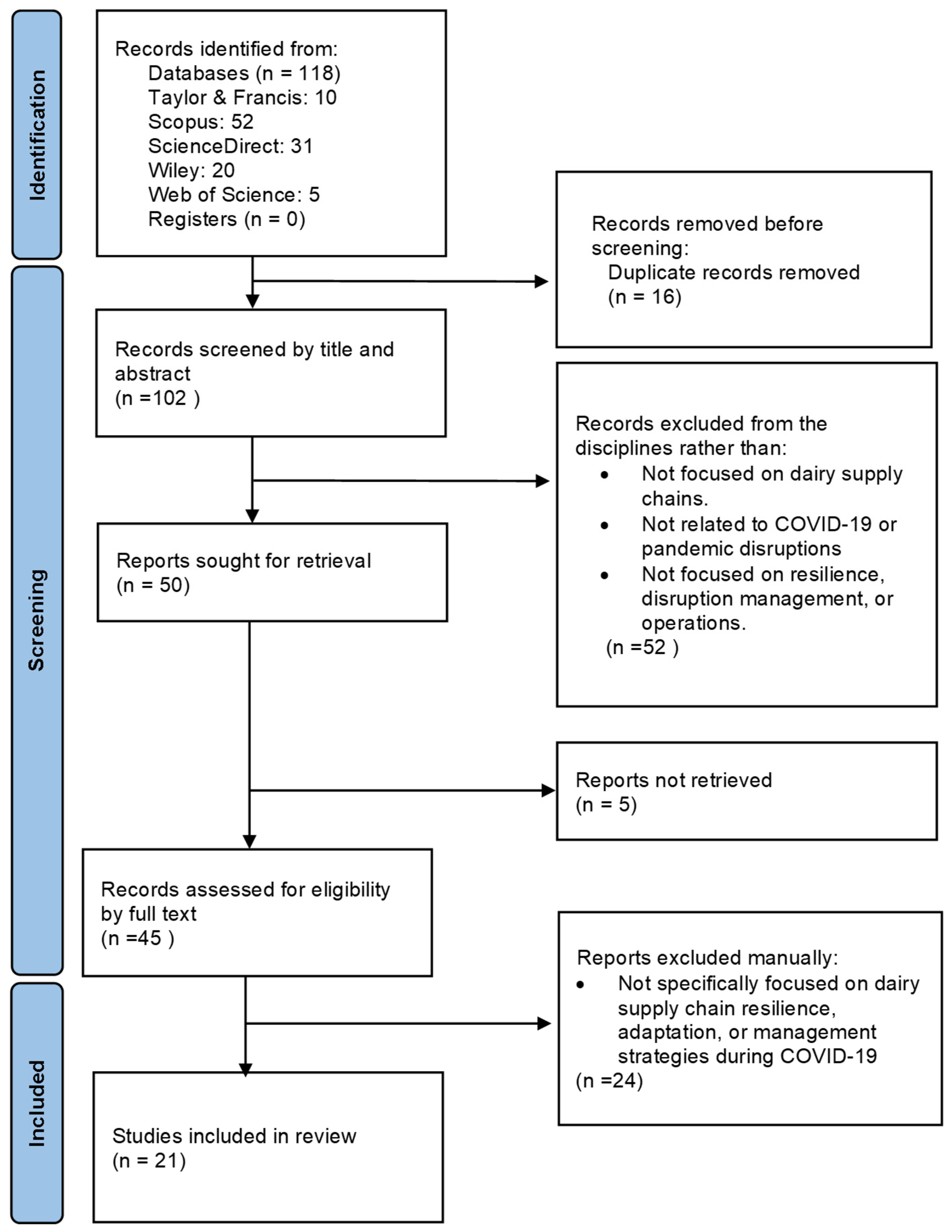
In total, 118 records were identified from the database searches. The papers are 52 from Scopus, 31 from ScienceDirect, 20 from Wiley Online Library, 10 from Taylor & Francis Online, and 5 from Web of Science Core Collection for this investigation. The completed PRISMA 2020 checklist is provided as Supplementary Material.

2.2. Eligibility Criteria

To ensure relevance and consistency, predefined inclusion and exclusion criteria were applied, as shown in Table 2.

2.3. Study Selection and Screening Process

The study selection followed a multi-stage screening protocol aligned with the PRISMA 2020 guidelines. From 118 records retrieved across five databases, 16 duplicates were removed, leaving 102 unique records for title-and-abstract screening. In the second stage, the remaining records were screened against the predefined eligibility criteria. Studies were excluded if they were not focused on dairy supply chains, did not relate to COVID-19 or pandemic-induced disruptions, or did not address resilience, disruption management, operational issues, or managerial decision-making, which led to the exclusion of 52 records and the retention of 50 records for full-text retrieval.
In the third stage, 5 reports could not be retrieved due to access limitations or unavailability, leaving 45 full-text articles for detailed eligibility assessment. In the fourth stage, the inclusion and exclusion criteria were applied to these full texts, and 24 reports were excluded for insufficient focus on dairy supply chain resilience, adaptation, or managerial strategies during COVID-19, or for limited empirical detail. Ultimately, 21 studies met all criteria and were included in the final systematic review.
Figure 1 presents the result of the study selection process following the PRISMA 2020 flow diagram framework. The completed PRISMA 2020 checklist is provided in the Supplementary Materials.

2.4. Data Extraction

Data were manually extracted from each included study using a structured extraction framework. The extracted information included:
(1) Author(s) and year of publication;
(2) Country or geographical context;
(3) Research design and data type;
(4) Identified supply chain challenges;
(5) Managerial decisions and adaptive strategies;
(6) Implications for supply chain resilience and sustainability.

2.5. Data Synthesis and Analysis

Due to the qualitative and heterogeneous nature of the included studies, a narrative and thematic synthesis approach was adopted. The extracted data were analyzed by identifying recurring themes related to supply chain disruptions, managerial decision-making, and adaptive responses. A formal risk-of-bias or quality appraisal was not conducted, as the objective of this systematic review was to provide a qualitative synthesis of managerial adaptations in dairy supply chains rather than to evaluate effect sizes or causal relationships. The review focuses on conceptual synthesis rather than effect-size estimation. This approach is consistent with prior qualitative systematic reviews in supply chain and management research.
The included studies varied widely in design. Data sources, methodological rigour, and no formal risk-of-bias or data quality assessment tool were applied. As a result, the synthesis focuses on identifying recurring patterns and generating conceptual insights rather than on weighing evidence by study quality or performing statistical inference

3. Overview

Although the final sample consists of 21 studies, it still reflects a relatively narrow sectoral focus on dairy supply chains and operational-level managerial decision-making during COVID-19.
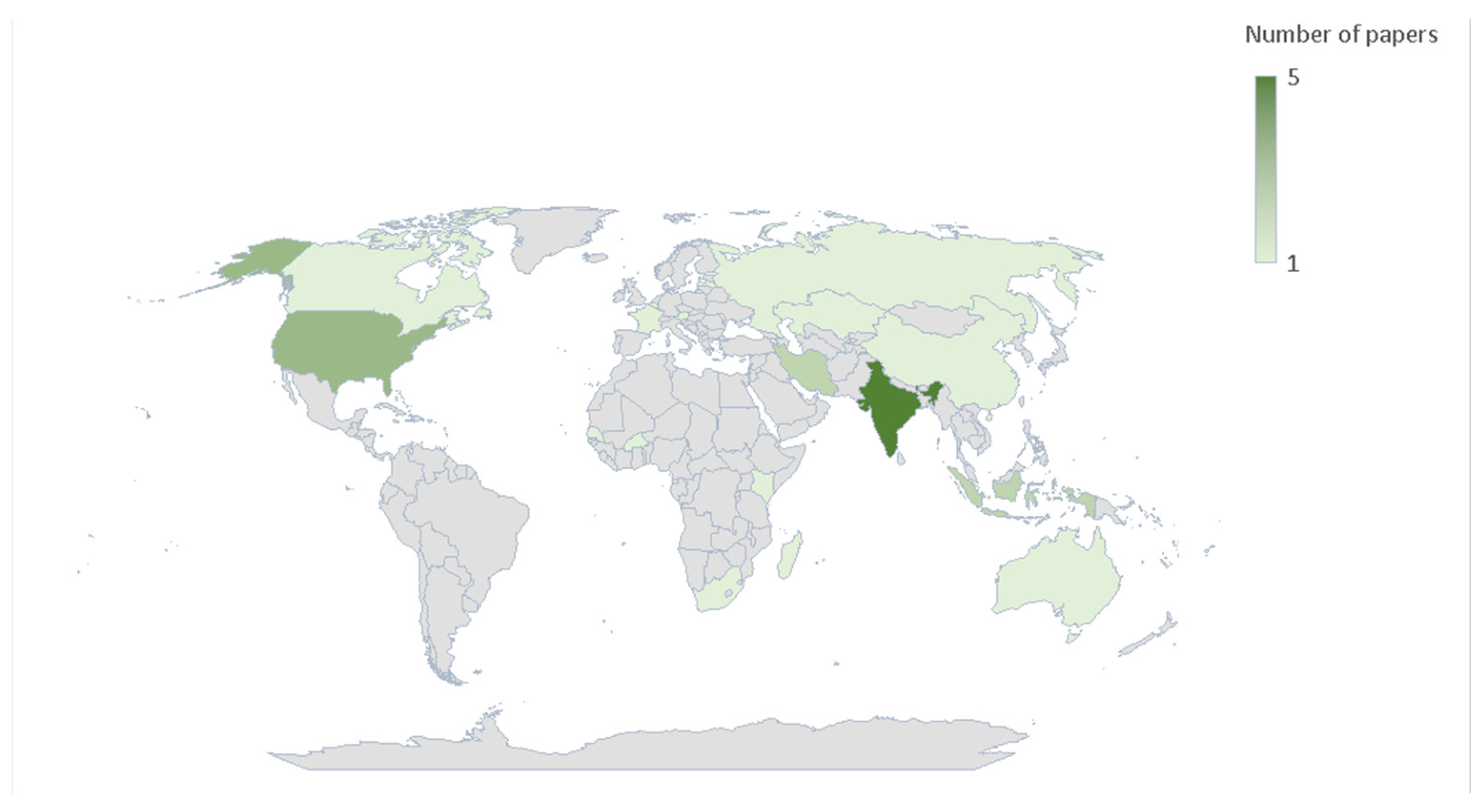
Figure 2 shows geographic diversity in the scientific production on this topic. The studies collectively cover 19 individual countries across Asia, Africa, Europe, and the Americas, indicating considerable geographic diversity in the scientific production on this topic. The selected 19 countries can be grouped into developed and developing economies. Austria, Belgium, France, Latvia, Canada, the United States, Australia, and South Africa are classified as developed economies. Meanwhile, India, China, Iran, Kazakhstan, Indonesia, Armenia, Kenya, Burkina Faso, Senegal, Madagascar, and Russia are classified as developing economies [55,56].
From the reviewed countries, it is found that India is the most frequently represented context with 5 papers, followed by the United States with 3 papers, and Iran and Indonesia with 2 papers each. The remaining countries, which are Austria, Armenia, Australia, Belgium, Burkina Faso, Canada, China, France, Kazakhstan, Kenya, Latvia, Madagascar, Russia, Senegal, and South Africa, are each represented by 1 paper (seen in Figure 2). In addition, several studies rely on primary data collection, such as surveys, interviews, and case study fieldwork. Meanwhile, others are based predominantly on secondary materials such as official statistics, project and NGO documentation, policy reports, and news articles.
Although the scope of this research focuses on the global dairy supply chain, the study found that the research objects were not fully representative of the dairy supply chain in European Union countries. The European Commission has highlighted the urgency of research and innovation to improve the resilience and sustainability of the European Union’s dairy industry supply chain [57,58]. For example, the impact of the COVID-19 pandemic on stakeholders across the dairy supply chain in Hungary has led to significant price volatility and high inflationary pressures [59]. These dynamics underscore the real-world implications and policy relevance of understanding managerial adaptations within the local and regional dairy market situation.

4. Results and Discussion

From an initial screening of 118 publications, 21 papers covering 19 countries were selected for in-depth analysis to explore how dairy supply chain stakeholders sustained operations during COVID-19. The findings address the research question: What new innovations have been introduced among global dairy supply chain stakeholders during the COVID-19 pandemic? (RQ1) What managerial decisions have been implemented among global dairy supply chain stakeholders during the COVID-19 pandemic? (RQ2) and what policy or decision-making patterns have been seen in common among global dairy supply chain stakeholders during the COVID-19 pandemic? (RQ3).
The results indicate that adaptive business strategies and managerial decision-making are crucial for business resilience, emphasising the urgency of creating new innovations during crises. Stakeholders developed and implemented various strategic approaches to combat the impact of COVID-19 on business. Literature analysis identified challenges experienced by stakeholders during COVID-19 in order to maintain business continuity, as shown in Table 3.

4.1. Primary Supply Chain Challenges Experienced by Stakeholders During COVID-19

From the 21 selected papers, researchers classified the strategic patterns adopted by stakeholders as primary supply chain challenges during COVID-19 to maintain business continuity in the dairy supply chain. The literature analysis identified 8 categories, which will be elaborated in more detail below.

4.1.1. Workforce Shortages and Operational Continuity

In Kazakhstan, Russia, Iran, Austria, India, and Indonesia, workforce shortages and inflexible production processes were major concerns caused by the pandemic. To address this, stakeholders implemented cross-training for employees in essential positions. Urban dairy businesses in Russia cross-trained staff in logistics, warehousing, and quality roles so that key tasks could be covered despite illness or quarantine [80]. Similar approaches appeared in India, where cooperative staff in Karnataka and Punjab were trained to handle multiple functions such as milk collection, quality testing, feed distribution, and payment processing. Hence, societies could continue to operate with reduced personnel [61,64]. Austrian dairies also cross-trained employees to operate packaging lines and perform basic maintenance, which proved crucial because packaging and labour were identified as vulnerable nodes in the drinking-milk chain [75]. Cooperative dairy supply chain networks emphasise that explicit modelling of labour shortage risks and flexible network design can enhance operational robustness during pandemics [63].
Another pattern involved maintaining internal labour robustness through family and cooperative labour structures. French organic dairy farms relied heavily on family members who could rotate through essential tasks such as milking, feeding, and basic processing because hired workers were unavailable [70]. In Indonesian cooperatives, stable operations during the pandemic were attributed to experienced cooperative farmers and standardised herd-health and management routines [72]. In Australia, organisations anticipated volunteer shortages and responded by cross-training remaining staff and planning around reduced volunteer availability. Food distribution, including dairy products, could continue to reach vulnerable populations [68].

4.1.2. Market Access Loss and Demand Shifts

Dairy stakeholders adapted the situation by reorienting sales away from food service and institutional buyers toward retail and household markets. In Austria and France, dairies redirected milk and processing capacity from restaurants, hotels, and catering into supermarket and household channels. This strategy increased the share of storable dairy products to match new consumption patterns at home [70,75]. In the United States, processors attempted to repackage bulk dairy products originally destined for schools and food-service into retail-sized formats. They successfully encountered technical and infrastructural limits in plants during the crisis [78].
Furthermore, stakeholders produced value-added commodities with longer shelf life, such as butter, ghee, yoghurt, cheese, and skim milk powder, rather than selling liquid milk products directly to the market. In Punjab, India, dairy farmers facing disrupted supply chains and rising input costs responded by increasing production of ghee, curd, butter, and other simple processed products. These value-added products could be sold more flexibly and stored longer than raw milk. In the end, it protected income when traditional liquid milk markets were unstable [61]. Dairy processors in Kenya shifted their finished products toward ultra-high-temperature (UHT) milk and other long-life dairy products to meet consumer demand for longer shelf life [77]. In Armenia, retail and distribution managers adapted to demand shifts marked by fewer shopping trips and larger basket sizes. They adjusted the stocking strategies and product mixes to accommodate household bulk buying [65].

4.1.3. Supply–Demand Imbalance and Overcapacity

The risk of waste and an oversupply occurred because demand changed quickly, especially in China, Canada, Senegal, Burkina Faso, France, and Latvia. In China, dairy farmers curtailed milking cycles early, adjusted feed rations, and culled cows to reduce surplus milk when transport and demand were constrained. It prevented a long tail of oversupply and liquidity stress [78]. In France, the CNIEL crisis cell coordinated temporary production cuts combined with compensation schemes. French farmers could reduce output without bearing the full financial burden, which helped avoid large-scale milk dumping [70].
In Canada, authorities introduced a “quota-free days” policy for dairy producers, allowing them to exceed production limits without penalty for a temporary policy [74]. In Latvia and Senegal, processors focused on reallocating flows and managing plant capacity. Latvian actors reduced production or increased processing into storable products to limit stockpiles. Meanwhile, Senegalese processors redirected milk to nearby plants and used delivery quotas to manage overcapacity at specific facilities [71,77]. In Burkina Faso, surplus milk was consumed domestically by farming households or donated to vulnerable groups. These actions could minimise waste rates and support food security [77].

4.1.4. Perishability and Shelf-Life Management

In Iran, Austria, Kenya, India, and Canada, shelf-life extension and inventory flexibility were prioritised as dairy products are highly perishable. Many stakeholders chose to shift output from fluid milk into long-life and storable products. Austrian and Kenyan, Indian and Canadian actors increased production of UHT milk, butter, cheese, and other long-life items. These actors across these countries aimed to store and distribute the products over longer periods. Hence. logistical delays and demand volatility could be reduced [74,75,77]. In India, farmers and cooperatives located in Punjab and Karnataka converted surplus fluid milk into ghee, curd, butter, and skim milk powder to reduce the risk of spoilage [61,64]. Austrian and Kenyan processors increased the share of storable products, such as UHT milk and cheese, as value-added products from milk to minimise spoilage risk during disrupted distribution [75,77].

4.1.5. Supply Chain Resilience and Risk Diversification

To enhance business resilience against disruptions, adjusting the multi-supplier strategy emerged as an urgent managerial priority. Iranian dairy supply chain managers diversified supplier networks, utilized subcontracting to mitigate bottlenecks, and employed continuous risk analysis to anticipate disruptions. In the Iranian network design study, managers were advised to introduce subcontracted processing, alternate facilities, and flexible capacity to reduce shortages and maintain service levels during disruptions [79].
Another common pattern was diversifying suppliers and logistics routes to avoid dependence on a single source or corridor. In Belgium, Flemish food supply chains strengthened resilience by diversifying sales channels, reinforcing local sourcing, and improving vertical coordination [62]. Causality and vulnerability analyses recommend expanding the supply base and adding alternate routes. Thus, transportation or supplier failures do not cascade into system-wide breakdowns [67,73]. A systems dynamics approach is applied by combining localisation and digitalisation as a resilience strategy. By shortening supply distances and coordinating via digital systems, the risks associated with long, fragile supply chains can be minimized [69]. In the United States, collaborative knowledge co-production between researchers and practitioners used GIS mapping and workflow analysis to visualise producer–processor distances. It could lead to the design of more distributed and resilient processing configurations for meat and dairy [66].
Additionally, resilience also depended on farm-level buffers and institutions. Latvian and French cases underline the importance of financial and feed reserves. Meanwhile, Indian and Indonesian papers emphasise strong cooperatives and farmer organisations as central risk-sharing mechanisms to stabilise access to markets and inputs [61,70,71,76].

4.1.6. Alternative Local Sales and Community-Based Approaches

Dairy stakeholders relied on informal, community-oriented solutions in regions where formal market access was ineffective, such as Madagascar, Burkina Faso, India, and Victoria. In Punjab, farmers responded to disrupted channels and falling prices by expanding direct-to-household and community sales. Dairy products were directly delivered to neighbourhood consumers to maintain cash flow and reduce dependence on intermediaries [61]. In Madagascar, farmers relied on informal roadside and door-to-door sales to move milk within local communities because of formal markets being constrained [77]. In Burkina Faso, surplus milk was consumed within households or donated to vulnerable groups [77]. In Australia, organisations relied on community and charity networks [68]. Urban cases in Russia framed a reliable dairy supply as a social responsibility. Local companies prioritised community needs and service continuity [80].

4.1.7. Institutional Coordination and Policy Support

Institutional coordination and policy support played an important role in shaping managers’ responses to the COVID-19 disruption. In France, the interprofessional body CNIEL established a crisis cell that coordinated production reductions, logistic adjustments, and compensation measures. Due to this policy, farmers could temporarily reduce output without bearing the full financial burden [70]. This sector-wide mechanism helped avoid large-scale milk dumping and supported stability in the dairy chain.
In Canada, authorities applied quota-free days flexibly within the existing supply-management system to accommodate short-term demand swings without dismantling the long-term quota structure [74]. The governments of China and the United States provided liquidity support and regulatory flexibility to stabilise prices and maintain milk collection and distribution [78]. In Australia, organisations highlighted the need for stronger formal partnerships with commercial supply chains and better data systems to manage sudden demand surges for dairy and other foods [68].
In the United States, New York State’s Climate Impact Assessment identifies the dairy industry as critical infrastructure requiring integrated planning between the public and private sectors to address the combined shocks of climate and pandemic [60].

4.1.8. Product Portfolio Rationalisation

Product portfolio rationalisation emerged as another essential managerial strategy during the pandemic. In France and Austria, dairies temporarily narrowed their product lines to a core set of basic items in order to keep plants manageable with reduced staff and disrupted inputs [70,75]. In Russia, companies applied inventory segmentation and prioritised critical stock-keeping units (SKUs) through redesigning reorder points and ensuring early replenishment for essential products [80]. Global and modelling studies convey a similar logic. Regarding processing capacity, they emphasise prioritising long-life and core-market products to stabilise revenue and limit waste under constraints in labour, packaging, and logistics [69,74].

4.2. Discussion

This study has highlighted the vulnerability in the global dairy supply chain caused by the COVID-19 pandemic. The case studies reveal the extraordinary capacity of stakeholders to maintain company operations through adaptive strategies. In terms of country categorisation into developing and developed countries, the reviewed cases found a clear contrast in how dairy stakeholders in these country categories adapted their supply chains and built resilience during COVID-19.
In developed countries, managerial adaptations frequently leveraged formal institutions and advanced infrastructure, including crisis cells, quota-free days, and other flexible policy tools, integrated modelling and simulation for stress-testing networks, digital platforms for coordination, and relatively robust cold-chain systems. By contrast, in developing countries, resilience relied more heavily on cooperatives and farmer organisations, informal local sales (door-to-door and roadside marketing), household consumption or donation of surplus milk, and basic low-capital processing of fluid milk into ghee, curd, butter, or skim milk powder. These differences indicate that resilience strategies in the dairy farming sector need to be tailored to each country’s infrastructure conditions and institutional quality, rather than assumed to be universally applicable across contexts.
Furthermore, from the eight strategic pattern classifications, analysis of managerial decision-making can be categorised into traditional and innovative managerial adaptations. These two approaches reflect established tactical capabilities and the emergence of new transformative approaches shaped by the crisis. The idea of traditional and innovative adaptation in this study originated from patterns observed by the researchers in several reviewed papers. This idea was also influenced by how other authors described incremental and transformational change. Traditional adaptation is a strategic approach based on the company’s prior practices. This type of strategy adjusts existing routines to keep the supply chain running in the short term. Many authors describe similar incremental or ‘traditional’ adaptations as changes in which existing systems and routines are maintained [81,82].
In contrast, innovative adaptations refer to strategies that introduce more fundamental changes in how the supply chain is organised and managed. They often involve new technologies, new forms of coordination, or new institutional arrangements. Building a long-term structural resilience is the main goal of this adaptation approach [83,84].
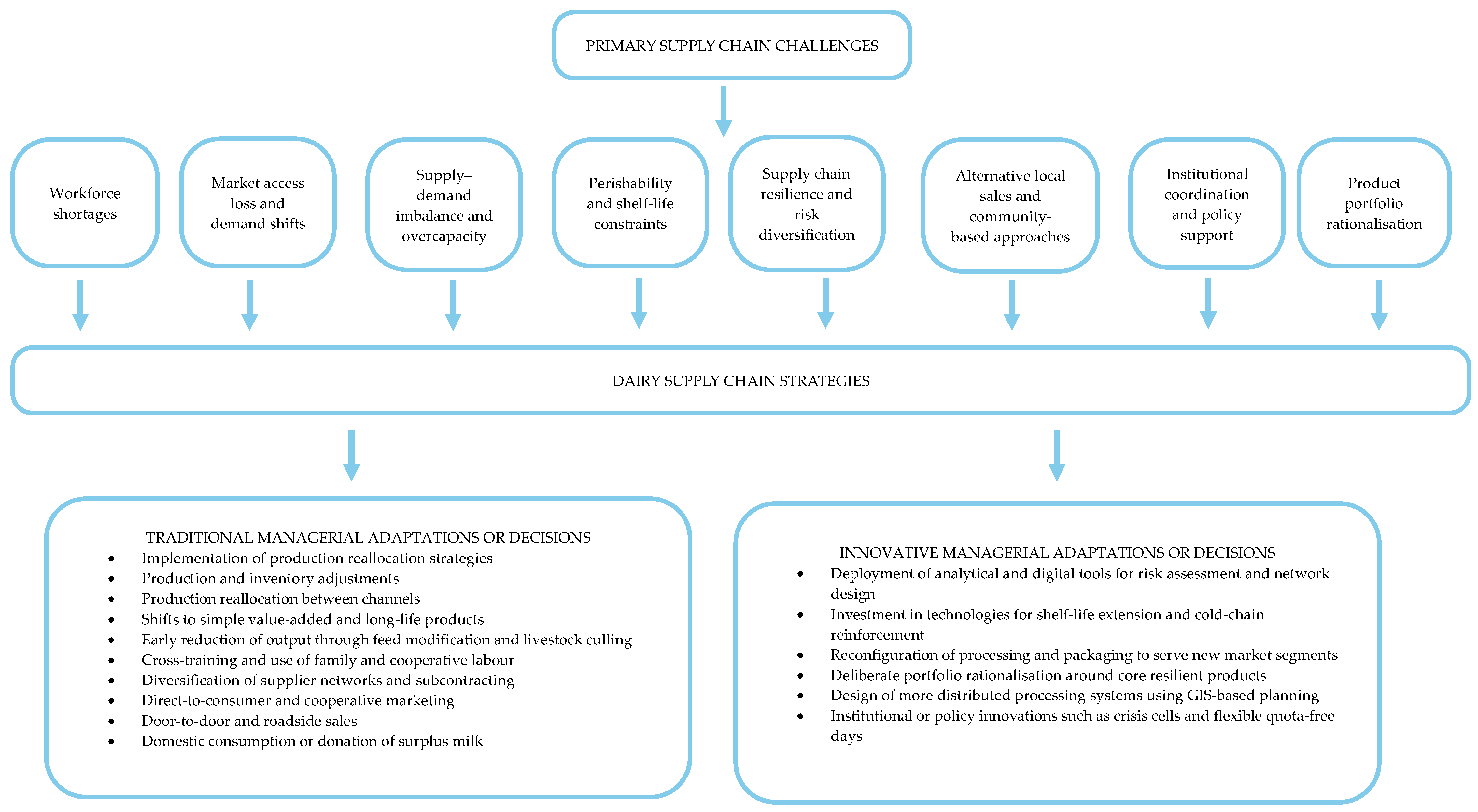
Across the reviewed cases, traditional adaptations include production and inventory adjustments, reallocation of milk between channels, shifts from fluid milk to simple value-added or long-life products, early reduction in output through feed modification and livestock culling, cross-training of staff, reliance on family and cooperative labour, diversification of supplier networks and subcontracting, direct-to-consumer sales and cooperative marketing, door-to-door and roadside sales, and domestic consumption or donation of surplus milk.
Empirical evidence from the reviewed studies illustrates this distinction. Indian cooperatives converted surplus milk into ghee, butter, and skim milk powder to stabilise cash flow under demand disruption [61]. In France, coordinated production reductions through the CNIEL crisis mechanism helped prevent oversupply without restructuring the supply chain [70]. In Austria, dairies relied on cross-training in packaging and maintenance to maintain operational continuity during labour shortages [75]. These measures helped stabilise existing operations. However, they did not fundamentally change the structure of the supply chain.
Meanwhile, innovative adaptations involve the use of advanced modelling and analytical tools for risk assessment and network design, investment in technologies for shelf-life extension and cold-chain reinforcement, reconfiguration of processing and packaging to serve new market segments, deliberate portfolio rationalisation around core and resilient products, design of more distributed processing configurations through GIS-based planning, institutional innovations such as crisis cells and flexible quota-free days, and the framing of dairy as critical infrastructure requiring integrated public–private resilience planning.
Empirical evidence also shows that disruption scenarios were embedded into network optimisation models to redesign plant location in Iran and capacity decisions under pandemic risk [79]. In China and the United States, managers implemented structured scenario planning to rebalance efficiency and flexibility at the system level [78]. In the United States, GIS-based workflow mapping was used to explore more distributed processing configurations [66]. These approaches reflect longer-term structural resilience building rather than short-term operational adjustment.
Figure 3 shows the classification of the key managerial strategies adopted by dairy supply chain stakeholders during the COVID-19 pandemic. This classification expands supply chain resilience theory by explicitly distinguishing between continuity-driven operational adaptations and innovation-driven structural transformations.
The effectiveness of specific adaptations was highly context-dependent. Some adaptations worked well in certain regions but not in others because they depended on local conditions. In countries with strong institutions and infrastructure, such as France, Canada, and Austria, measures such as quota-free days, advanced modelling, and digital coordination were effective because they were supported by reliable organisations, a well-structured cold chain system, and clear regulations. In contrast, in many developing countries, these formal and sometimes expensive solutions were more complicated to implement. Strategies based on cooperatives, informal local sales, household consumption, and donation of surplus milk were more successful. This shows that an adaptation is effective when it fits the local infrastructure, policy environment, and resource constraints.
The main implication for dairy supply chain managers is the need to combine traditional adaptations with innovative strategies rather than treating them as alternatives. Traditional practices remain essential for stabilising operations in the short term by preserving reliability, protecting cash flow, and ensuring the continuity of basic services. At the same time, managers should scale up innovative measures that enhance visibility, flexibility, and learning capacity across the network. Faster responses to future shocks can be systematically prepared through these combined strategies.
For policymakers, the key lesson is to create an enabling environment for resilience by aligning regulations with crisis-response needs and improving coordination across agencies and sectors. In practice, this means ensuring that policy frameworks remain flexible enough to support rapid adjustments in the face of major disruptions. Ultimately, designing structurally innovative strategies will position the dairy industry market to become more resilient and sustainable even during critical times.
The implications of this study can directly contribute to SDG 12 through sustainable consumption and production. It can be done by mitigating food waste, enhancing efficiency, and fostering responsible consumer practices [85]. The managerial adaptations identified in this review are directly linked to SDG 12 on sustainable consumption and production. Many of the adaptations that researchers identified in this study directly reduce waste and improve resource use in the dairy supply chain. Converting surplus milk into longer-life products (such as butter and UHT milk) and donating excess milk helps to avoid food waste. At the same time, measures such as optimising logistics, strengthening the cold chain, and planning production more carefully would make the use of energy, transport, and other resources more efficient.
Building on this foundation, this research underscores the potential for a transformative supply network model in the EU dairy sector that embeds resilience, digitalization, and sustainability within both policy and practice [86]. The findings from the reviewed papers suggest that tools such as network optimisation for stress testing, and data-driven coordination of localisation strategies could also be piloted within such a model [63,67,69]. This strategic model envisions regional clusters of farms [87] and processing facilities to reduce logistics costs and shorten transport distances [88]. Furthermore, this strategy will also cover multi-level supplier networks as a buffer against systemic disruptions [23]. This EU-funded research on digital traceability, shelf-life technologies, and cooperative platforms would help legitimise these measures through official outputs. The results are expected to position the EU dairy sector as a global leader in sustainable and resilient food systems.

5. Conclusions

This paper presents a systematic literature review of managerial adaptations adopted by stakeholders in the global dairy supply chain to mitigate disruptions caused by the COVID-19 pandemic. The review covers 21 studies from 19 countries. Resilience and sustainability in dairy supply chains are strongly shaped by regional context, infrastructure quality, and stakeholders’ capacity for rapid decision-making and process adaptation. The analysis also reveals systematic contrasts between developed and developing economies in how dairy stakeholders responded to the crisis. Resilience strategies cannot be designed as one-size-fits-all solutions but must be adjusted to country-specific structural and institutional conditions.
The key actions identified include both traditional and innovative managerial adaptations. Traditional adaptations draw on established operational practices and previous disruption experience to stabilise the supply chain in the short term. Innovative adaptations, by contrast, reflect more transformative responses that enhance long-term structural resilience. Together, these findings address RQ1 and RQ2 by identifying which managerial innovations were introduced and which decision patterns characterised stakeholder responses during the pandemic.
With respect to RQ3, common patterns emerged across diverse global and local contexts. Stakeholders shifted production and marketing strategies, diversified channels, and activated local and community-based mechanisms to keep milk flowing despite lockdowns and demand shocks. These experiences show that the dairy supply chain must continue to function even under unprecedented conditions. Rapid and adaptive decisions are key to business continuity. The evidence points to the need for a gradual shift from purely efficiency-oriented models toward resilience- and sustainability-oriented configurations, in which redundancy, flexibility, and learning are recognized as strategic assets rather than costs.
For supply chain managers, the main implication is the need to combine traditional adaptations with innovative strategies. Traditional practices remain critical for short-term stability, while innovative measures are required to enhance visibility, flexibility, and adaptive capacity across networks. Hence, organisations can respond more effectively to future shocks. For policymakers, the review highlights the need to create an enabling environment for resilience. Overall, investing in flexibility, scenario planning, and integrating sustainability considerations is essential to building a more adaptive and robust global dairy supply chain that can withstand future systemic disruptions.
This study could serve as a baseline for policymakers to address global disruptions and support the EU’s sustainability goals. The research objective aligns with SDG 12, which promotes sustainable consumption and production patterns. It will also design a transformative EU dairy product network to achieve resilience, digitalisation, and sustainability through regional farming groups, processing, and multi-tiered supplier networks. Ultimately, it will make the EU dairy sector a global leader in sustainable and resilient food systems.
This study has several shortcomings that should be acknowledged. It includes only open-access, English-language studies from 2019 to 2025 and focuses only on how managers adapted in their businesses during the COVID-19 pandemic. Some relevant work may be missing. In addition, no formal risk-of-bias assessment or quantitative meta-analysis was conducted. The findings are based on qualitative interpretation rather than statistical inference. These shortcomings should be considered when applying the results and highlight the need for broader, more detailed future research.
In addition, the studies differ in design and data quality. Researchers did not conduct a formal risk-of-bias or data quality appraisal. Therefore, the findings should be viewed as a qualitative, exploratory synthesis of the available evidence. Future reviews should incorporate structured quality-assessment frameworks to evaluate the robustness and representativeness of primary and secondary data.
The findings of this study are still relevant today. The COVID-19 pandemic served as a real-world stress test, revealing which dairy supply chain strategies are fragile and which are robust. Many adaptations identified by researchers are also needed to address current disruptions, including geopolitical tensions, energy price shocks, and climate-related events. Therefore, the lessons learned from COVID-19 provide a valuable basis for designing resilience and sustainability strategies for current and future crises, not just pandemics. Future research should review papers published before 2019 to give a broader overview of managerial adaptation to global disruptions.

Supplementary Materials

The following supporting information can be downloaded at: https://www.mdpi.com/article/10.3390/logistics10030058/s1, Table S1: PRISMA 2020 Checklist. Ref. [89] is cited in Table S1.

Author Contributions

Conceptualization, F.R.S. and C.B.; methodology, F.R.S. and C.B.; software, F.R.S.; validation, C.B.; formal analysis, F.R.S.; investigation, F.R.S.; resources, F.R.S.; data curation, F.R.S.; writing—original draft preparation, F.R.S.; writing—review and editing, F.R.S.; visualization, F.R.S.; supervision, C.B.; project administration, C.B.; funding acquisition, C.B. All authors have read and agreed to the published version of the manuscript.

Funding

This research received no external funding.

Institutional Review Board Statement

Not applicable.

Informed Consent Statement

Not applicable.

Data Availability Statement

No new data were created or analyzed in this study. Data sharing is not applicable to this article.

Conflicts of Interest

The authors declare no conflicts of interest.

References

  1. Shamsuddoha, M.; Nasir, T.; Hossain, N.U.I. A Sustainable Supply Chain Framework for Dairy Farming Operations: A System Dynamics Approach. Sustainability 2023, 15, 8417. [Google Scholar] [CrossRef]
  2. Montgomery, H.; Haughey, S.A.; Elliott, C.T. Recent food safety and fraud issues within the dairy supply chain (2015–2019). Glob. Food Secur. 2020, 26, 100447. [Google Scholar] [CrossRef] [PubMed]
  3. FAO. FAO Dairy Market Review—Emerging Trends and Outlook in 2023; FAO: Rome, Italy, 2023. [Google Scholar]
  4. Kumar, U.; Shankar, R. Smart dairy: Unleashing emerging ICT-enabled lean dairy supply chains through data-driven decision-making. Int. J. Inf. Manag. Data Insights 2024, 4, 100297. [Google Scholar] [CrossRef]
  5. Lemke, F.; Elgersma, E.; Wagner, B.; McDougall, N. Mitigating the effects of global disruptions on supply chains: Gaining insights from the dairy industry during COVID-19. Prod. Plan. Control 2025, 36, 841–861. [Google Scholar] [CrossRef]
  6. Serrano-Torres, G.J.; López-Naranjo, A.L.; Larrea-Cuadrado, P.L.; Mazón-Fierro, G. Transformation of the Dairy Supply Chain Through Artificial Intelligence: A Systematic Review. Sustainability 2025, 17, 982. [Google Scholar] [CrossRef]
  7. Ali, S.S.; Barman, H.; Kaur, R.; Tomaskova, H.; Roy, S.K. Multi-Product Multi Echelon Measurements of Perishable Supply Chain: Fuzzy Non-Linear Programming Approach. Mathematics 2021, 9, 2093. [Google Scholar] [CrossRef]
  8. Mustafa, M.F.M.S.; Navaranjan, N.; Demirovic, A. Food cold chain logistics and management: A review of current development and emerging trends. J. Agric. Food Res. 2024, 18, 101343. [Google Scholar] [CrossRef]
  9. Bacigale, S.B.; Ayagirwe, R.B.; Mutwedu, V.B.; Mugumaarhahama, Y.; Mugisho, J.Z.; Nziku, Z.; Fofana, M.; Udomkun, P.; Mignouna, J. Assessing milk products quality, safety, and influencing factors along the dairy value chain in eastern Democratic Republic of the Congo. Front. Sustain. Food Syst. 2023, 7, 1105515. [Google Scholar] [CrossRef]
  10. Huang, Y.; Hasuike, T. Comparative Study of Fresh Produce Supply Chain Models Under Contract Farming and Cooperative Markets. J. Adv. Comput. Intell. Intell. Inform. 2025, 29, 480–488. [Google Scholar] [CrossRef]
  11. Mazhar, R.; Xuehao, B.; Viira, A.-H.; Stamenkovska, I.J.; Nacka, M.; Azadi, H.; Wei, Z. Farmers’ Participation in Modern Supply Chains: The Case of Mandarin Profitability in Punjab-Pakistan. Horticulturae 2022, 8, 1041. [Google Scholar] [CrossRef]
  12. Ušča, M.; Tisenkopfs, T. The resilience of short food supply chains during the COVID-19 pandemic: A case study of a direct purchasing network. Front. Sustain. Food Syst. 2023, 7, 1146446. [Google Scholar] [CrossRef]
  13. Rojas-Reyes, J.J.; Rivera-Cadavid, L.; Peña-Orozco, D.L. Disruptions in the food supply chain: A literature review. Heliyon 2024, 10, e34730. [Google Scholar] [CrossRef] [PubMed]
  14. Thomas, D.; Helgeson, J. The effect of natural/human-made hazards on business establishments and their supply chains. Int. J. Disaster Risk Reduct. 2021, 59, 102257. [Google Scholar] [CrossRef] [PubMed]
  15. Burkart, S.; Díaz, M.; Enciso, K.; Charry, A.; Triana, N.; Mena, M.; Urrea-Benítez, J.L.; Gallo Caro, I.; Van Der Hoek, R. The impact of COVID-19 on the sustainable intensification of forage-based beef and dairy value chains in Colombia: A blessing and a curse. Trop. Grassl.-Forrajes Trop. 2022, 10, 237–248. [Google Scholar] [CrossRef]
  16. Das, A.; Sivaram, M.; Thejesh, S. Economic impact of COVID-19 pandemic on dairy sector: A meta-analysis. Indian J. Anim. Sci. 2021, 91, 582–594. [Google Scholar] [CrossRef]
  17. Aday, S.; Aday, M.S. Impact of COVID-19 on the food supply chain. Food Qual. Saf. 2020, 4, 167–180. [Google Scholar] [CrossRef]
  18. Sombultawee, K.; Lenuwat, P.; Aleenajitpong, N.; Boon-itt, S. COVID-19 and Supply Chain Management: A Review with Bibliometric. Sustainability 2022, 14, 3538. [Google Scholar] [CrossRef]
  19. Süle, E. The Role of Time in the Supply Chain. Acta Tech. Jaurinensis 2009, 2, 325–336. [Google Scholar]
  20. Ivanov, D.; Dolgui, A. Viability of intertwined supply networks: Extending the supply chain resilience angles towards survivability. A position paper motivated by COVID-19 outbreak. Int. J. Prod. Res. 2020, 58, 2904–2915. [Google Scholar] [CrossRef]
  21. Ponomarov, S.Y.; Holcomb, M.C. Understanding the concept of supply chain resilience. Int. J. Logist. Manag. 2009, 20, 124–143. [Google Scholar] [CrossRef]
  22. Zhao, K.; Zuo, Z.; Blackhurst, J.V. Modelling supply chain adaptation for disruptions: An empirically grounded complex adaptive systems approach. J. Oper. Manag. 2019, 65, 190–212. [Google Scholar] [CrossRef]
  23. Guo, Y.; Liu, F.; Song, J.-S.; Wang, S. Supply chain resilience: A review from the inventory management perspective. Fundam. Res. 2025, 5, 450–463. [Google Scholar] [CrossRef] [PubMed]
  24. Todo, Y.; Oikawa, K.; Ambashi, M.; Kimura, F.; Urata, S. Robustness and resilience of supply chains during the COVID-19 pandemic. World Econ. 2023, 46, 1843–1872. [Google Scholar] [CrossRef] [PubMed]
  25. Duminy, L.; Grosser, S.N. Resilience as Basis for Sustainability: Shortages in Production Supply Chains for Essential Consumer Goods. In Innovative Solutions for Sustainable Supply Chains; Qudrat-Ullah, H., Ed.; Understanding Complex Systems; Springer International Publishing: Cham, Switzerland, 2018; pp. 223–262. [Google Scholar] [CrossRef]
  26. Boudi, A.A.; Alshaikhmubarak, A. Business Continuity and Sustainability in Government Organisations. Sustainability 2024, 16, 7503. [Google Scholar] [CrossRef]
  27. Ivanov, D. New Drivers for Supply Chain Structural Dynamics and Resilience: Sustainability, Industry 4.0, Self-Adaptation. In Structural Dynamics and Resilience in Supply Chain Risk Management; International Series in Operations Research & Management Science; Springer International Publishing: Cham, Switzerland, 2018; Volume 265, pp. 293–313. [Google Scholar] [CrossRef]
  28. Kettele, M.; Lechner, G. Assessing resilience measures in the Austrian dairy supply chain: A case-based simulation integrating strategic, tactical, and operational decisions. Int. J. Prod. Res. 2025, 63, 3982–4015. [Google Scholar] [CrossRef]
  29. Maleki Vishkaei, B.; De Giovanni, P. The Impact of Business Continuity on Supply Chain Practices and Resilience Due to COVID-19. Logistics 2024, 8, 41. [Google Scholar] [CrossRef]
  30. Orji, I.J.; U-Dominic, C.M. Adaptable solutions for retail supply chain resilience in the post-COVID-19 era. Socioecon. Plann. Sci. 2024, 96, 102090. [Google Scholar] [CrossRef]
  31. FAO. FAO Exposure of Humans or Animals to SARS-CoV-2 from Wild, Livestock, Companion and Aquatic Animals; FAO: Rome, Italy, 2020. [Google Scholar] [CrossRef]
  32. Hayat, K.; JianJun, Z.; Ali, S.; Khan, M.A. Exploring factors of the sustainable supply chain in the post-COVID-19 pandemic: SWARA approach. Environ. Sci. Pollut. Res. 2021, 30, 42457–42475. [Google Scholar] [CrossRef]
  33. Klapkiv, J.; Putsenteilo, P.; Karpenko, V. The Convergence of Factors That Affect the Dairy Product Market: A Comparative Analysis of European Union Countries. Comp. Econ. Res. Cent. East. Eur. 2023, 26, 105–127. [Google Scholar] [CrossRef]
  34. European Dairy Association. Annual Report 2024/2025; European Dairy Association: Brussels, Belgium, 2025; Available online: https://eda.euromilk.org/wp-content/uploads/2025/03/www_Annual_Report_2025_05a_BL.pdf (accessed on 19 November 2025).
  35. European Commission. Eurostat Milk and Milk Product Statistics; European Commission: Brussels, Belgium, 2025; Available online: https://ec.europa.eu/eurostat/statistics-explained/index.php/Milk_and_milk_product_statistics (accessed on 19 November 2025).
  36. Krisciukaitiene, I.; Bathaei, A. Developing a tailored sustainable supply chain framework for dairy SMEs in Lithuania using Best-Worst Method. Transform. Sustain. 2025, 1, 43–62. [Google Scholar] [CrossRef]
  37. Mikulić, D.; Lovrinčević, Ž.; Keček, D. Economic effects of food supply chain re-localization on the Croatian economy. Agric. Food Econ. 2023, 11, 36. [Google Scholar] [CrossRef]
  38. Wicaksono, T.; Illés, C.B. From resilience to satisfaction: Defining supply chain solutions for agri-food SMEs through quality approach. PLoS ONE 2022, 17, e0263393. [Google Scholar] [CrossRef] [PubMed]
  39. Mishra, P.; Singh, S.; Tripathi, S.; Srivastava, A.; Yadav, A.K. Global Supply Chain Disruption During COVID 19. Int. J. Innov. Res. Eng. Manag. 2023, 10, 86–92. [Google Scholar]
  40. Acosta, A.; McCorriston, S.; Nicolli, F.; Venturelli, E.; Wickramasinghe, U.; ArceDiaz, E.; Scudiero, L.; Sammartino, A.; Schneider, F.; Steinfeld, H. Immediate effects of COVID-19 on the global dairy sector. Agric. Syst. 2021, 192, 103177. [Google Scholar] [CrossRef]
  41. Kumar, V. Interoperable Knowledge Graphs for Localized Supply Chains: Leveraging Graph Databases and RDF Standards. Logistics 2025, 9, 144. [Google Scholar] [CrossRef]
  42. Gidiagba, O.J.; Tartibu, L.; Okwu, M. Integrating Machine Learning with Multi-Criteria Decision-Making Models for Sustainable Supplier Selection in Dynamic Supply Chains. Logistics 2025, 9, 152. [Google Scholar] [CrossRef]
  43. Rozhkov, M.; Ivanov, D.; Blackhurst, J.; Nair, A. Adapting supply chain operations in anticipation of and during the COVID-19 pandemic. Omega 2022, 110, 102635. [Google Scholar] [CrossRef]
  44. Xu, Z.; Elomri, A.; Kerbache, L.; El Omri, A. Impacts of COVID-19 on Global Supply Chains: Facts and Perspectives. IEEE Eng. Manag. Rev. 2020, 48, 153–166. [Google Scholar] [CrossRef]
  45. Alsakhen, I.; Buics, L.; Süle, E. AI-driven resilience in revolutionizing supply chain management: A systematic literature review. J. Infrastruct. Policy Dev. 2024, 8, 9474. [Google Scholar] [CrossRef]
  46. Xu, T. Resilience and Sustainability in Global Supply Chains: Case Study of Apples Response to the COVID-19. Adv. Econ. Manag. Polit. Sci. 2025, 158, 55–60. [Google Scholar] [CrossRef]
  47. Singh, V.K.; Singh, P.; Karmakar, M.; Leta, J.; Mayr, P. The journal coverage of Web of Science, Scopus and Dimensions: A comparative analysis. Scientometrics 2021, 126, 5113–5142. [Google Scholar] [CrossRef]
  48. Michel-Villarreal, R.; Hingley, M.; Canavari, M.; Bregoli, I. Sustainability in Alternative Food Networks: A Systematic Literature Review. Sustainability 2019, 11, 859. [Google Scholar] [CrossRef]
  49. Aboah, J.; Wilson, M.M.J.; Rich, K.M.; Lyne, M.C. Operationalising resilience in tropical agricultural value chains. Supply Chain Manag. Int. J. 2019, 24, 271–300. [Google Scholar] [CrossRef]
  50. Xie, L.; Chen, Z.; Wang, H.; Zheng, C.; Jiang, J. Bibliometric and Visualized Analysis of Scientific Publications on Atlantoaxial Spine Surgery Based on Web of Science and VOSviewer. World Neurosurg. 2020, 137, 435–442.e4. [Google Scholar] [CrossRef]
  51. PRISMA-P Group; Moher, D.; Shamseer, L.; Clarke, M.; Ghersi, D.; Liberati, A.; Petticrew, M.; Shekelle, P.; Stewart, L.A. Preferred reporting items for systematic review and meta-analysis protocols (PRISMA-P) 2015 statement. Syst. Rev. 2015, 4, 1. [Google Scholar] [CrossRef]
  52. Monferdini, L.; Bottani, E. Examining the Response to COVID-19 in Logistics and Supply Chain Processes: Insights from a State-of-the-Art Literature Review and Case Study Analysis. Appl. Sci. 2024, 14, 5317. [Google Scholar] [CrossRef]
  53. Younis, H.; Alsharairi, M.; Younes, H.; Sundarakani, B. The impact of COVID-19 on supply chains: Systematic review and future research directions. Oper. Res. 2023, 23, 48. [Google Scholar] [CrossRef]
  54. Chowdhury, P.; Paul, S.K.; Kaisar, S.; Moktadir, M.A. COVID-19 pandemic related supply chain studies: A systematic review. Transp. Res. Part E Logist. Transp. Rev. 2021, 148, 102271. [Google Scholar] [CrossRef]
  55. United Nations, Department of Economic and Social Affairs. Country Classification; United Nations, Department of Economic and Social Affairs: New York, NY, USA, 2014; Available online: https://www.un.org/en/development/desa/policy/wesp/wesp_current/2014wesp_country_classification.pdf (accessed on 31 January 2026).
  56. World Bank. World Bank World Bank Group Income Classifications for FY26; World Bank: Washington, DC, USA, 2025; Available online: https://blogs.worldbank.org/en/opendata/understanding-country-income--world-bank-group-income-classifica (accessed on 31 January 2026).
  57. Marcin, S. Resilience of Global Supply Chains; European Parliament: Brussels, Belgium, 2021; Available online: https://www.europarl.europa.eu/RegData/etudes/BRIE/2021/698815/EPRS_BRI(2021)698815_EN.pdf (accessed on 19 November 2025).
  58. European Parliamentary Research Service. European Parliament EU Feed Autonomy: Closing the Gaps in European Food Security [Think Tank Report]; European Parliamentary Research Service: Brussels, Belgium, 2023; Available online: https://www.europarl.europa.eu/thinktank/en/document/EPRS_BRI(2023)739328 (accessed on 19 November 2025).
  59. Berezvai, Z.; Kónya, M. Price transmission and competition amid a series of crises: Study of the Hungarian milk supply chain. J. Agribus. Dev. Emerg. Econ. 2025. [Google Scholar] [CrossRef]
  60. Aller, D.; Chatrchyan, A.M.; Calixto, A.; Cummings, J.; Ortiz-Bobea, A.; Peck, G.; Schouten, J.; Weikert, B.; Wolters, E.; Stevens, A. New York State Climate Impacts Assessment Chapter 03: Agriculture. Ann. N. Y. Acad. Sci. 2024, 1542, 146–213. [Google Scholar] [CrossRef]
  61. Arora, K.; Kumar, S.; Adhale, P.; Bhoi, P.B.; Vatta, K. Addressing the Impact of COVID-19 on Dairy Value Chains: Evidence from Punjab, India. Curr. Sci. 2023, 124, 570. [Google Scholar] [CrossRef]
  62. Coopmans, I.; Bijttebier, J.; Marchand, F.; Mathijs, E.; Messely, L.; Rogge, E.; Sanders, A.; Wauters, E. COVID-19 impacts on Flemish food supply chains and lessons for agri-food system resilience. Agric. Syst. 2021, 190, 103136. [Google Scholar] [CrossRef]
  63. Goel, V.; Awasthi, S.K. Optimization of Cooperative Dairy Supply Chain Network with Risk Factors under Labor Shortage in The COVID-19 Pandemic. In Proceedings of the 2021 12th International Conference on Computing Communication and Networking Technologies (ICCCNT), Kharagpur, India, 6–8 July 2021; IEEE: New York, NY, USA, 2021; pp. 1–6. [Google Scholar] [CrossRef]
  64. Govindaraj, G.; Mb, S.; Hm, S.; Mohandoss, N.; Shome, B.R.; Rahman, H. Impact of COVID-19 lockdown on various stakeholders associated with dairyfood supply chain in Karnataka, India- An evidence based study. Indian J. Dairy Sci. 2022, 75, 365–375. [Google Scholar] [CrossRef]
  65. Hambardzumyan, G.; Gevorgyan, S. The impact of COVID-19 on the small and medium dairy farms and comparative analysis of customers’ behavior in Armenia. Future Foods 2022, 5, 100110. [Google Scholar] [CrossRef]
  66. Hollander, A.D.; Hoy, C.W.; Armstrong, K.S.; Dimock, M.R.; Huber, P.R.; Jackson-Smith, D.; Quinn, J.F.; Riggle, C.M.; Tomich, T.P. Workflows for Knowledge Co-Production—Meat and Dairy Processing in Ohio and Northern California. Sustainability 2023, 15, 9991. [Google Scholar] [CrossRef]
  67. Karwasra, K.; Soni, G.; Mangla, S.K.; Kazancoglu, Y. Assessing dairy supply chain vulnerability during the COVID-19 pandemic. Int. J. Logist. Res. Appl. 2024, 27, 2378–2396. [Google Scholar] [CrossRef]
  68. McKay, F.H.; Bastian, A.; Lindberg, R. Exploring the Response of the Victorian Emergency and Community Food Sector to the COVID-19 Pandemic. J. Hunger Environ. Nutr. 2021, 16, 447–461. [Google Scholar] [CrossRef]
  69. Munien, I.; Telukdarie, A. COVID-19 supply chain resilience modelling for the dairy industry. Procedia Comput. Sci. 2021, 180, 591–599. [Google Scholar] [CrossRef]
  70. Perrin, A.; Martin, G. Resilience of French organic dairy cattle farms and supply chains to the COVID-19 pandemic. Agric. Syst. 2021, 190, 103082. [Google Scholar] [CrossRef]
  71. Pilvere, I.; Upite, I.; Muska, A.; Zdanovskis, K.; Nipers, A.; Janmere, L. Resilience of Milk Supply Chains during and after the COVID-19 Crisis in Latvia. Rural Sustain. Res. 2021, 45, 53–64. [Google Scholar] [CrossRef]
  72. Setyawan, H.B.; Widianingrum, D.C.; Yulianto, R.; Khasanah, H. Robustness of dairy cattle farming industry against COVID-19 pandemic in business group (KUB) Tirtasari Kresna Gemilang, Malang. IOP Conf. Ser. Earth Environ. Sci. 2021, 759, 012056. [Google Scholar] [CrossRef]
  73. Shafiee, M.; Zare-Mehrjerdi, Y.; Govindan, K.; Dastgoshade, S. A causality analysis of risks to perishable product supply chain networks during the COVID-19 outbreak era: An extended DEMATEL method under Pythagorean fuzzy environment. Transp. Res. Part E Logist. Transp. Rev. 2022, 163, 102759. [Google Scholar] [CrossRef]
  74. Sharma, M.; Sinha, J. Impact of COVID-19 on Global Dairy Supply Chain: A Review. Asian J. Dairy Food Res. 2020, 39, 273–277. [Google Scholar] [CrossRef]
  75. Singer, J.; Kummer, Y.; Weber, C.; Strobl, M.; Burtscher, J.; Domig, K.J.; Hirsch, P. Analysis of the impacts of the COVID-19 pandemic on the drinking milk supply chain in Austria by means of a business process modelling and System Dynamics approach. Bodenkultur 2021, 72, 73–82. [Google Scholar] [CrossRef]
  76. Sulandjari, S. Upgrading Indonesian Dairy Farmer Value Chain based on Economic Resilience Approach during COVID-19. SCMS J. Indian Manag. 2021, 19, 109–122. [Google Scholar]
  77. Vall, E.; Mburu, J.; Ndambi, A.; Sall, C.; Camara, A.D.; Sow, A.; Ba, K.; Corniaux, C.; Diaw, A.; Seck, D.; et al. Early effects of the COVID-19 outbreak on the African dairy industry: Cases of Burkina Faso, Kenya, Madagascar, and Senegal. Cah. Agric. 2021, 30, 14. [Google Scholar] [CrossRef]
  78. Qingbin, W.A.N.G.; Liu, C.-Q.; Zhao, Y.-F.; Kitsos, A.; Cannella, M.; Wang, S.-K.; Han, L. Impacts of the COVID-19 pandemic on the dairy industry: Lessons from China and the United States and policy implications. J. Integr. Agric. 2020, 19, 2903–2915. [Google Scholar] [CrossRef]
  79. Zarei-Kordshouli, F.; Paydar, M.M.; Nayeri, S. Designing a dairy supply chain network considering sustainability and resilience: A multistage decision-making framework. Clean Technol. Environ. Policy 2023, 25, 2903–2927. [Google Scholar] [CrossRef]
  80. Zheng, Y.; Bulatenko, M.; Bykov, A.; Sakulyeva, T.; Bozhko, L. Effective Dairy Supply Chain Management in Big Cities. J. Syst. Manag. Sci. 2022, 12, 131–146. [Google Scholar] [CrossRef]
  81. Field, C.B.; Barros, V.R.; Dokken, D.J.; Mach, K.J.; Mastrandrea, M.D. (Eds.) Adaptation Needs and Options. In Climate Change 2014 Impacts, Adaptation, and Vulnerability; Cambridge University Press: Cambridge, UK, 2014; pp. 833–868. [Google Scholar] [CrossRef]
  82. Kates, R.W.; Travis, W.R.; Wilbanks, T.J. Transformational adaptation when incremental adaptations to climate change are insufficient. Proc. Natl. Acad. Sci. USA 2012, 109, 7156–7161. [Google Scholar] [CrossRef]
  83. Li, P.; Chen, Y.; Guo, X. Digital transformation and supply chain resilience. Int. Rev. Econ. Finance 2025, 99, 104033. [Google Scholar] [CrossRef]
  84. Tian, Y.; Cui, L. Supply chain resilience and digital transformation: Perspectives from a supply chain network. Humanit. Soc. Sci. Commun. 2025, 12, 1738. [Google Scholar] [CrossRef]
  85. Nazibudin, N.A.; Sabri, S.A.M.; Manaf, L.A. Aligning with sustainable development goals (SDG) 12: A systematic review of food waste generation in Malaysia. Clean. Waste Syst. 2025, 10, 100205. [Google Scholar] [CrossRef]
  86. Myshko, A.; Checchinato, F.; Colapinto, C.; Finotto, V.; Mauracher, C. Towards the twin transition in the agri-food sector? Framing the current debate on sustainability and digitalisation. J. Clean. Prod. 2024, 452, 142063. [Google Scholar] [CrossRef]
  87. Díaz De Otálora, X.; Dragoni, F.; Del Prado, A.; Estellés, F.; Wilfart, A.; Krol, D.; Balaine, L.; Anestis, V.; Amon, B. Identification of representative dairy cattle and fodder crop production typologies at regional scale in Europe. Agron. Sustain. Dev. 2022, 42, 94. [Google Scholar] [CrossRef]
  88. Iseppi, L.; Rosa, F.; Taverna, M. Optimize the Transport Cost and Environmental Impact of Whey Collection: A Case Study in the Region Trentino A. A. (Italy). Am. J. Oper. Res. 2017, 7, 153–173. [Google Scholar] [CrossRef]
  89. Page, M.J.; McKenzie, J.E.; Bossuyt, P.M.; Boutron, I.; Hoffmann, T.C.; Mulrow, C.D.; Shamseer, L.; Tetzlaff, J.M.; Akl, E.A.; Brennan, S.E.; et al. The PRISMA 2020 statement: An updated guideline for reporting systematic reviews. BMJ 2021, 372, n71. [Google Scholar] [CrossRef]
Figure 1. Flowchart using PRISMA 2020 guidelines. Source: The authors.
Logistics 10 00058 g001
Figure 2. Distribution studies by country in varying shades of green. Source: The authors.
Logistics 10 00058 g002
Figure 3. Classification of managerial adaptations in the dairy supply chain during the COVID-19 pandemic. Source: The authors.
Logistics 10 00058 g003
Table 1. The Boolean queries.
DatabaseBoolean Queries
ScopusTITLE-ABS-KEY (“dairy” AND “supply chain” AND (COVID-19 OR coronavirus OR pandemic) AND (resilience OR adaptation OR flexibility OR “managerial decision*” OR “management” OR “disruption” OR “operations”)) AND PUBYEAR > 2018 AND PUBYEAR < 2026
ScienceDirect“dairy supply chain” AND (COVID-19) AND (resilience OR adaptation OR flexibility OR “managerial decision” OR management OR disruption OR operations) with filters: article types = review and full-length articles; years = 2019–2025; subject areas = Agricultural and Biological Sciences, Business/Management, Economics/Econometrics/Finance, Social Sciences.
Wiley Online Library“dairy supply chain” anywhere AND “(COVID-19 OR coronavirus OR pandemic)” anywhere AND “(resilience OR disruption OR adaptation OR\”supply chain management\”)” anywhere with years limited to 2019–2025.
Taylor & Francis Online“dairy supply chain” in All Fields AND (COVID-19 OR coronavirus OR pandemic) in All Fields AND (resilience OR disruption OR adaptation OR “supply chain management”) in All Fields; filters: ContentItemType = research article; years after 2019 and before 2025
Web of Science Core
Collection
TS = (“dairy supply chain” OR (dairy NEAR/3 “supply chain”)) AND TS = (COVID-19 OR coronavirus OR pandemic) AND TS = (resilient OR adaptation OR flexibility OR “managerial decisions*” OR management OR disruption OR operations) AND PY = 2019–2025
Table 2. Review inclusion and exclusion criteria.
Inclusion CriteriaExclusion Criteria
(1)
Peer-reviewed journal articles or review papers indexed in Scopus, Web of Science, ScienceDirect, Wiley Online Library, or Taylor & Francis Online. Studies focusing on dairy supply chains
(2)
Studies addressing COVID-19-related disruptions, resilience, or managerial adaptations
(3)
Articles published between 2019 and 2025;
(4)
Articles written in English
(5)
Open-access publications with full text available.
(1)
Studies not related to dairy supply chains or clearly defined agri-food supply chains.
(2)
Articles focusing solely on technical, biological, or nutritional aspects without supply chain relevance
Table 3. Summary of stakeholders’ decision making to maintain business continuity in the dairy supply chain due to COVID-19 per selected papers.
NoTitle of the Selected PaperManagerial
Adaptation/
Decision
The ExplanationRef.
1New York State Climate Impacts Assessment Chapter 03: AgricultureIntegrate compound-shock scenarios; Invest in diversified systems; Strengthen public–private coordinationClimate and pandemic shocks are now recognized as overlapping threats to New York dairy and agriculture. Stakeholders proposed stress-testing farms for simultaneous climate and disease events, diversifying production systems and regional markets, and coordinating emergency support and extension services to maintain food system continuity during crises.[60]
2Addressing the Impact of COVID-19 on Dairy Value Chains: Evidence from Punjab, IndiaCross-training staff; Scenario analyses on market access; Convert surplus to value-added products; Build digital marketing capacityIn Punjab, India, dairy farmers faced feed shortages, labour constraints, and sharp price declines. To adapt, they cross-trained collection-centre staff, used regression models to anticipate income impacts from market disruptions, converted surplus milk into ghee, butter, curd, and SMP when fresh sales collapsed, and built digital capacity for direct marketing to reduce dependence on physical markets.[61]
3COVID-19 Impacts on Flemish Food Supply Chains and Lessons for Agri-Food System ResilienceCross-training across functions; Scenario planning with resilience framework; Diversify marketing channels; Strengthen networksFlemish food supply chains showed varied impacts depending on marketing strategy and flexibility. Firms adapted by cross-training employees to reassign staff when demand shifted from hospitality to retail, conducting structured scenario analyses using anticipatory-coping-responsive capacities, maintaining multiple outlets (wholesale, short chains, direct), and strengthening producer groups and sector platforms for information sharing.[62]
4Optimization of Cooperative Dairy Supply Chain Network with Risk Factors under Labor Shortage in the COVID-19 PandemicIncorporate labour-shortage risk in network models; Contingency plans for reallocating production; Invest in labour flexibility.Labour shortages significantly reduced cooperative dairy profits and service levels. Managers proposed embedding labour risk explicitly into network optimisation models so that plant usage, routing, and capacity decisions account for workforce constraints; designing contingency plans to reallocate production among cooperative plants; and using models to justify investment in cross-training and safety measures.[63]
5Impact of COVID-19 Lockdown on Dairy/Food Supply Chain in Karnataka, IndiaCross-training co-op staff; Scenario planning for feed shortages; Adjust product and pricing policiesKarnataka cooperatives saw increased milk collection but lower farmer incomes due to price drops and reduced demand for value-added products. They adapted by cross-training staff to manage collection, feed, and payments during absences, planning for feed shortages (over 40% of societies faced them) through multiple suppliers and strategic reserves, and adjusting pricing to protect farmer incomes.[64]
6The Impact of COVID-19 on Small and Medium Dairy Farms and Customer Behaviour in ArmeniaPlan for fewer, larger shopping trips; Support local domestic chains; Monitor purchasing patternsArmenia’s small- and medium-sized dairy farms maintained stable production and prices, but consumer behaviour shifted toward fewer shopping trips and larger purchases. Retailers adjusted inventory and restocking for bulk buying, supported local domestic supply chains to maintain farm price stability, and monitored early-crisis purchasing patterns to adapt packaging and delivery modes.[65]
7Workflows for Knowledge Co-Production: Meat and Dairy Processing in Ohio and Northern CaliforniaUse GIS to map vulnerabilities; Co-produce data with stakeholders; Support boundary-spanning rolesSmall and mid-scale dairy producers identified processor concentration and long supply distances as significant vulnerabilities during COVID-19. Stakeholders used GIS-based workflow mapping to identify bottlenecks and explore distributed processing options, engaged producers, processors, and NGOs in co-producing solutions with transparent data governance, and supported extension agents and regional planners who facilitate rapid collective responses.[66]
8Assessing Dairy Supply Chain Vulnerability during the COVID-19 PandemicCross-training to reduce production stoppage risk; Frequent scenario analyses using SCU Index; Expand supply base and align buffer stocks; Prioritize resilience investmentsDairy supply-chain vulnerability stemmed from short product life, small supply base, outsourcing, and pandemic-specific risks (facility closures, demand disruption). Managers cross-trained critical staff, conducted “what-if” stress tests using ISM–Graph Theory models to see how disruptions cascade, enlarged supply bases and aligned safety stocks with vulnerability scores, and used the SCU Index to focus resilience investments where they reduce vulnerability most.[67]
9Exploring the Response of the Victorian Emergency and Community Food Sector to the COVID-19 PandemicFormalize partnerships with commercial chains; Plan for volunteer shortages; Improve real-time data systemsVictorian emergency food agencies faced surging demand, supply-chain disruptions, and volunteer shortages. They strengthened formal partnerships with commercial supply chains to secure reliable dairy and food supplies, planned for volunteer gaps by cross-training remaining staff and building paid backup capacity, and improved data systems for real-time monitoring of demand and inventory.[68]
10COVID-19 Supply Chain Resilience Modelling for the Dairy IndustryInvest in upskilling for digital tools; Run simulation scenarios varying localisation and digitalisation; Redesign network for local processingLocalisation and digitalisation together reduced costs and improved resilience by boosting innovation and responsiveness, but skills shortages limited benefits. Managers invested in cross-training and upskilling workers to use digital tools, ran system-dynamics experiments varying localisation and digitalisation to identify cost-resilient designs, and redesigned networks for more local processing and shorter transport routes coordinated via digital platforms.[69]
11Resilience of French Organic Dairy Cattle Farms and Supply Chains to the COVID-19 PandemicCross-training farm family; Rank multiple farm risks; Narrow product portfolio temporarily; Adjust logistics under crisis cellFrench organic dairy farms experienced zero to moderate impacts, maintaining production and income due to family labour, feed autonomy, and coordinated crisis management (CNIEL). They cross-trained family members in core tasks (milking, feeding, processing, logistics), ranked risks to focus investments in autonomy and diversification, narrowed product portfolios to basic items (milk, cream, butter, plain yogurt), and adjusted logistics (hired retired drivers, bypassed saturated platforms, compensated for production cuts).[70]
12Resilience of Milk Supply Chains during and after the COVID-19 Crisis in LatviaStress-test for export interruptions; Adjust production to avoid stockpiles; Build on-farm financial and feed buffersLatvian dairy faced overproduction, stockpiling, and prices at or below cost due to export restrictions. Managers performed risk analysis and stress testing for price drops and export interruptions, adjusted production by reducing output or increasing storable products to avoid unsustainable inventories, and encouraged farms to build financial and feed buffers proactively rather than relying only on emergency state aid.[71]
13Robustness of Dairy Cattle Farming Industry against COVID-19: KUB Tirtasari Kresna Gemilang, MalangMaintain cooperative feed production; Apply consistent health management; Leverage group experienceThis Indonesian cooperative group maintained stable yields, costs, and prices during COVID-19, thanks to its long experience and cooperative support. They maintained cooperative-level feed production to shield members from external feed shocks, applied consistent health and hygiene practices (sanitation, pre- and post-dipping, vitamins), and leveraged accumulated group experience to mentor newer farmers in crisis management.[72]
14A Causality Analysis of Risks to Perishable Product Supply Chain Networks during the COVID-19 OutbreakCross-training to address labour shortage; Prioritize mitigation of high-influence risks; Apply fuzzy DEMATEL routinelyLabour shortages, transport disruptions, and demand volatility acted as primary “cause” factors triggering other risks in perishable chains. Managers cross-trained and multi-skilled staff to directly address labour-shortage risk (high causal effect), prioritised mitigation of high-influence risks (transport, information delay) because reducing them also reduces downstream risks, and regularly applied DEMATEL-type analyses to update critical-risk hierarchies as conditions evolved.[73]
15Impact of COVID-19 on Global Dairy Supply Chain: A ReviewBuild processing flexibility; Diversify products and markets; Strengthen cold-chain resilienceGlobal dairy sectors in India, the United states, and Canada experienced demand shocks, logistics disruptions, and price declines, but also opportunities around health and nutrition. Managers built flexibility in processing to quickly reconfigure product mixes between food service and retail, diversified portfolios (including health-oriented and functional products) to reduce exposure to single-segment shocks, and strengthened cold-chain and logistics with contingency plans for labour and transport disruptions.[74]
16Analysis of the Impacts of the COVID-19 Pandemic on the Drinking Milk Supply Chain in AustriaCross-train employees in packaging and maintenance; Use business process modelling for stress tests; Adjust packaging inventory policiesAustria’s drinking milk chain remained stable but showed vulnerabilities in packaging supply and staff availability. Dairies cross-trained employees in critical process steps (packaging line operation, basic maintenance), used business process modelling and causal-loop diagrams to stress-test how disruptions in packaging or staff propagate, and adjusted packaging and material inventory policies (higher safety stocks, alternate suppliers) for bottleneck items.[75]
17Upgrading Indonesian Dairy Farmer Value Chain Based on Economic Resilience Approach during COVID-19Strengthen farmer organisations; Promote local processing and diversified sales; Embed resilience metrics in upgradingIndonesian smallholder dairy farmers needed structural value-chain upgrading to withstand pandemic shocks. Stakeholders strengthened farmer organisations and cooperatives so farmers could collectively negotiate prices and secure inputs, promoted local processing and diversified sales outlets (co-ops, retailers, digital platforms) to reduce single-buyer dependence, and embedded economic resilience metrics (income stability, market security, service access) in value-chain upgrading projects.[76]
18Early Effects of the COVID-19 Outbreak on the African Dairy IndustryEnsure essential-service status and travel permits; Support informal chains to formalize; Diversify sourcing; Balance imported and local milkSmall and informal chains in Burkina Faso, Kenya, Madagascar, and Senegal were more severely affected than formal processors. Stakeholders ensured dairy collection received essential-service status and standardised travel permits to avoid spoilage, supported small and informal chains to gain partial formal recognition (registered routes, basic contracts), encouraged processors to diversify sourcing between smallholders and larger farms across regions, and structured balanced use of imported milk powder and local milk.[77]
19Impacts of the COVID-19 Pandemic on the Dairy Industry: Lessons from China and the United StatesBalance efficiency with flexibility; Conduct detailed scenario planning; Strengthen integration with local food systemsChina and the USA experienced decreased farm-gate prices, transport difficulties, worker shortages, and liquidity problems via different channels. Managers designed strategies that deliberately trade maximum efficiency for greater flexibility (more diversified products and channels), conducted detailed scenario planning for different shock types (transport closures, institutional buyer shutdowns, export bans) to tailor policy tools, and strengthened linkages between large integrated chains and local food systems.[78]
20Designing a Dairy Supply Chain Network Considering Sustainability and ResilienceEmbed disruption scenarios in network design; Accept planned redundancy; Apply multi-criteria frameworksWhen resilience and sustainability are included alongside cost, optimal network design includes more redundancy, flexible capacities, and closer facilities. Managers embedded disruption and pandemic scenarios directly into strategic network design so plant locations, capacities, and routes are chosen with resilience as a primary objective, accepted some redundancy (backup plants, alternate routes, flexible capacities) as a planned design feature, and applied multi-criteria decision-making frameworks balancing profitability, environment, social factors, and resilience.[79]
21Effective Dairy Supply Chain Management in Big CitiesCross-training staff for urban distribution; Scenario planning for urban restrictions; Adjust inventory segmentation by criticalityBusinesses in Almaty (Kazakhstan) and Yekaterinburg (Russia) prioritized reliability and community needs during COVID-19, treating dairy supply as a social service. They proposed cross-training staff across logistics, warehousing, and quality functions to maintain urban distribution despite absences; conducting frequent scenario planning for urban transport restrictions, curfews, and demand spikes to pre-position inventory; and adjusting inventory segmentation by classifying products by criticality and spoilage risk, with raised reorder points for core items.[80]
Disclaimer/Publisher’s Note: The statements, opinions and data contained in all publications are solely those of the individual author(s) and contributor(s) and not of MDPI and/or the editor(s). MDPI and/or the editor(s) disclaim responsibility for any injury to people or property resulting from any ideas, methods, instructions or products referred to in the content.