

Sustainable and Safe Last-Mile Delivery: A Multi-Objective Truck–Drone Matheuristic




Abstract
1. Introduction
- A comprehensive multi-objective TDDP model incorporating soft time windows, precise battery constraints, energy costs, and risk assessments;
- A novel matheuristic framework that integrates MILP-guided subproblem solving within a multi-objective metaheuristic structure;
- Extensive computational experiments on synthetic delivery networks of varying sizes (20, 50, and 100 customers) demonstrate the model’s scalability and optimization quality;
- A detailed structural and sensitivity analysis that evaluates the impact of drone endurance, availability, and velocity on system performance.
2. Literature Review
2.1. Classical Vehicle Routing Problems
2.2. Truck–Drone Collaboration Models
2.3. Multi-Objective Optimization in Last-Mile Delivery
2.4. Risk and Energy Constraints in UAV Logistics
2.5. Research Gaps and Novelty of This Work
- Integrated Methodology: Combining MILP for precise subproblem solving with a meta-heuristic for global routing to ensure both scalability and solution quality;
- Realistic Constraints: Integrating detailed energy modeling, soft time windows, and, crucially, a SORA-based risk assessment;
- Scalability: Providing extensive sensitivity and structural analyses to validate the framework across various problem scales and operational settings.
3. Materials and Methods
3.1. Problem Description
- Integrated truck–drone delivery: Each UAV performs one delivery per sortie, departing from the truck at a launch node, traveling to a customer, and returning either to the truck’s later location or the final depot.
- Synchronization: UAVs must launch and land at locations and times consistent with the truck’s route schedule. The truck cannot depart from a launch node until all active UAV assignments are completed.
- Energy and battery limits: UAV flight endurance, minimum return charge, and charging possibilities are captured through dynamic battery-level constraints. Energy consumption is influenced by various factors, including distance, speed, payload, and environmental conditions.
- Time windows: Deliveries are assigned both hard time windows (mandatory) and soft time windows (violations allowed but penalized). Early or late deliveries incur penalty costs.
- SORA-based risk modeling: Operational risks associated with UAV flight paths are quantified using the SORA, incorporating ground population density, airspace type, and no-fly risk-intense zones.
- Multi-objective optimization: The problem minimizes simultaneously: (i) transportation cost, (ii) service time and soft-window penalties, (iii) SORA-based operational risk, and (iv) energy-related expenditures.
- Single-customer UAV deliveries: Each UAV can serve only one customer during each sortie and must return to its base before being dispatched again.
3.2. Mathematical Model
- These constraints define the joint truck–drone routing structure. They ensure that every customer is served exactly once by either a truck or a UAV; each truck departs from and returns to a depot; flow conservation holds at every visited node; and subtours are eliminated. Additional constraints couple truck and UAV routes, guaranteeing that each UAV sortie is compatible with the corresponding truck route, that launch and recovery nodes are visited in the correct sequence, and that each delivery node is assigned to at most one UAV.
- These constraints enforce both hard and soft time windows for trucks and UAVs. They bound the earliest and latest allowable service times, limit deviations from soft windows via penalty variables, and synchronize truck departures with UAV launch and recovery operations. Trucks cannot leave a location before their assigned UAV has completed service and returned, and UAVs are prevented from starting service before the associated truck reaches the launch point.
- These constraints control truck loading and UAV payloads. They ensure that truck loads never exceed vehicle capacity, that loads are updated consistently after deliveries, and that UAVs do not carry more than their allowable payload. Operating-hour limits on trucks and maximum flight durations for UAVs are also imposed so that total service and travel times remain within feasible operational bounds.
- These constraints govern the energy usage and recharging of UAVs. They require a sufficient state of charge before launch and between charging points, model battery consumption along sorties, and enforce minimum and maximum charging levels at recharging stations. Additional constraints limit discharge rates, allow for energy-saving behavior over longer operations, and prevent trucks from waiting indefinitely for UAV recharging.
- These constraints incorporate SORA-based risk considerations and airspace regulations. They restrict UAV flights through high-risk or restricted zones, impose minimum separation between truck routes and UAV trajectories, and prohibit landings at unapproved locations. Emergency rerouting rules are also included to handle battery anomalies or sudden airspace restrictions.
3.3. Proposed Solution Approach
- Decomposition of complexity: The original problem is decomposed into two subproblems—truck routing and drone scheduling—reducing computational complexity and increasing modeling flexibility.
- Effectiveness in multi-objective optimization: Evolutionary algorithms are employed in the routing phase to explore trade-offs among multiple objectives, while the scheduling phase relies on MILP to refine solutions under detailed operational constraints.
- Scalability for real-world scenarios: The combined heuristic–exact structure produces high-quality solutions within practical computation times, making it suitable for large-scale delivery systems.
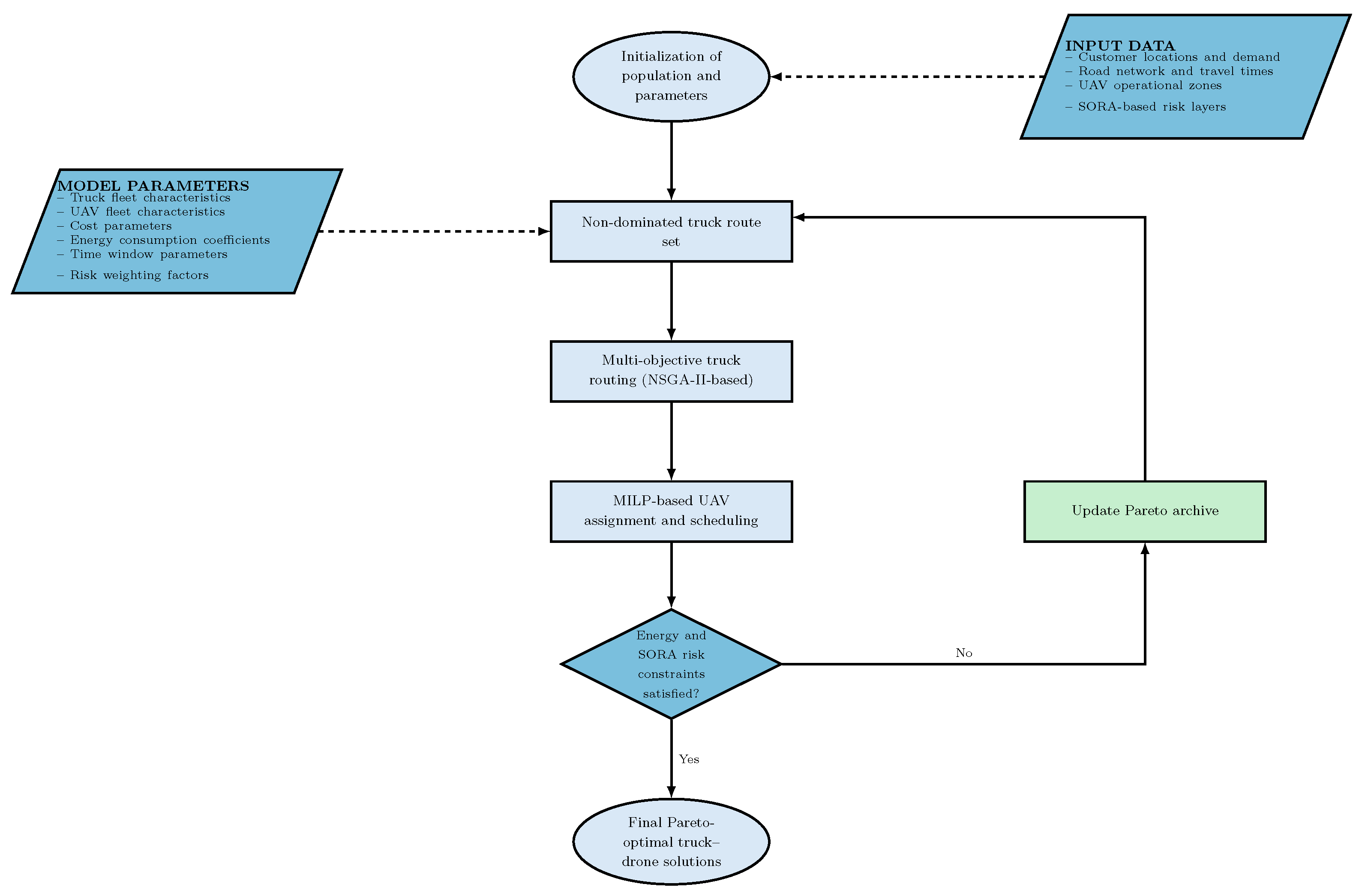
3.3.1. Overall Hybrid Matheuristic Framework
- Step 1: Initialization
- Generate initial delivery routes using NSGA-II or a randomized savings heuristic.
- Produce a diverse set of routing solutions that capture different trade-offs among the four objectives (cost, time, energy, risk).
- Step 2: Evaluation
- Evaluate each routing solution using a multi-objective scorecard (cost, time, energy, risk).
- Eliminate infeasible and strictly dominated routes.
- Step 3: Drone Assignment and Scheduling (DASP)
- For each selected truck route, construct an MILP model to determine the optimal assignments of UAVs and sortie schedules.
- Incorporate detailed constraints on battery dynamics, soft time windows, energy consumption, and risk mitigation.
- Step 4: Solution Selection and Archive Management
- Store all feasible MILP-enhanced solutions in a Pareto archive.
- Maintain and update the archive to keep only non-dominated solutions over successive iterations.
- Step 5: Local Search and Iteration
- Apply local search operators (e.g., 2-opt, node relocation, string exchange) to improve route structure and diversify the solution set.
- Use dominance-based filtering, tabu mechanisms, and MILP refinement to re-assess improved routes and repeat Steps 2–4 until a stopping criterion (convergence or time limit) is reached.
| Algorithm 1 Hybrid Matheuristic Framework for Multi-Objective Truck–Drone Routing |
| Require: Set of customer nodes N, set of trucks , set of UAVs K, set of feasible UAV |
| sorties , model parameters |
| Ensure: Pareto archive A of non-dominated solutions |
| 1: Initialize Pareto archive |
| 2: Initialize incumbent solution |
| 3: Initialize scalarized incumbent value |
| 4: Initialize Tabu list |
| 5: while stopping criterion is not satisfied do |
| 6: Phase 1: Truck routing and initial allocation |
| 7: Routes ← RandomizedSavingsHeuristic(N, TR, Param) |
| 8: Routes ← LocalSearch(Routes) {e.g., 2-opt, relocation, exchange} |
| 9: Routes ← SortByDominanceOrRank(Routes) {multi-objective ordering} |
| 10: for each route do |
| 11: if then |
| 12: continue {skip recently explored routes} |
| 13: end if |
| 14: Phase 2: Drone Assignment and Scheduling (DASP) |
| 15: xπ ← SolveDASP(π, TP, Param, BestObjStop, Cutoff) |
| 16: if is feasible then |
| 17: UpdateParetoArchive(A,xπ) {keep only non-dominated solutions} |
| 18: if then |
| 19: |
| 20: |
| 21: end if |
| 22: end if |
| 23: TabuList ← UpdateTabuList(TabuList, π) |
| 24: end for |
| 25: Routes ← Diversify(Routes) {e.g., mutation/perturbation operators} |
| 26: end while |
| 27: return A |
3.3.2. Operational Details of the Combined Matheuristic Framework
3.3.3. MILP Formulation of the Drone Assignment and Scheduling Problem (DASP)
3.4. Experimental Setup
| Algorithm 2 MILP-Based Drone Assignment and Scheduling Problem (DASP) |
| Require: Truck route (obtained from Phase 1), set of feasible drone sorties , model |
| parameters (battery thresholds, energy costs, time windows, SORA-based risk, etc.) |
| Ensure: MILP-optimized drone assignment and schedule for route , or infeasibility |
| flag |
| Variable definition |
| 2: Define binary variables for all feasible drone sorties |
| Define continuous variables: |
| 4: for drone arrival time of UAV k at node i |
| for battery level of UAV k at node i |
| 6: for soft time-window deviation of UAV k at node i |
| 8: Objective function |
| Construct the MILP objective (Equation (48)) to minimize a weighted sum of: |
| 10: – routing cost |
| – service time penalties |
| 12: – SORA-based risk index |
| – energy consumption |
| 14: |
| Constraints |
| 16: Add assignment constraints (Equation (49)) to ensure each eligible delivery node is |
| served at most once by a UAV |
| Add time-consistency and service sequencing constraints (Equation (50)) |
| 18: Add hard and soft time-window constraints for UAV and truck operations |
| (Equations (51) and (52)) |
| Add battery usage and minimum-reserve constraints (Equations (53) and (54)) |
| 20: Add risk-related constraints derived from SORA (Equation (55)) |
| Add synchronization constraints (Equation (56)) coupling UAV operations with truck |
| arrival and departure times along |
| 22: |
| MILP solution |
| 24: Configure the MILP solver (e.g., Gurobi) with BestObjStop, Cutoff, time limit, and |
| MIP gap |
| Optionally add valid inequalities and cuts to tighten the formulation |
| 26: Solve the MILP model |
| if no feasible solution is found then |
| 28: Mark truck route as infeasible with respect to UAV assignment |
| return infeasibility flag |
| 30: else |
| Extract UAV assignment variables and associated timing and battery variables |
| 32: Compute the corresponding objective vector for route |
| Construct as the MILP-enhanced solution for route |
| 34: return |
| end if |
4. Results
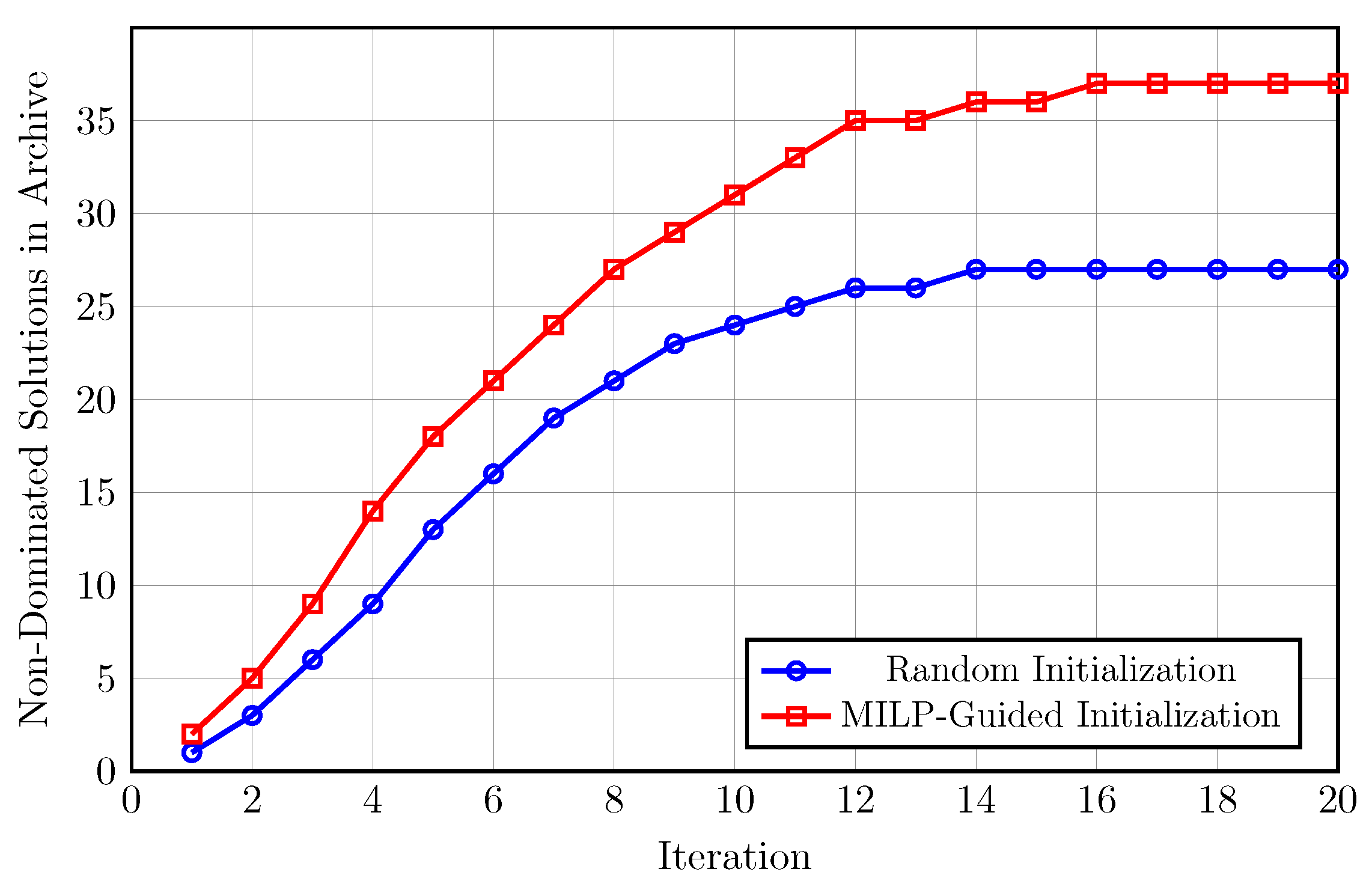
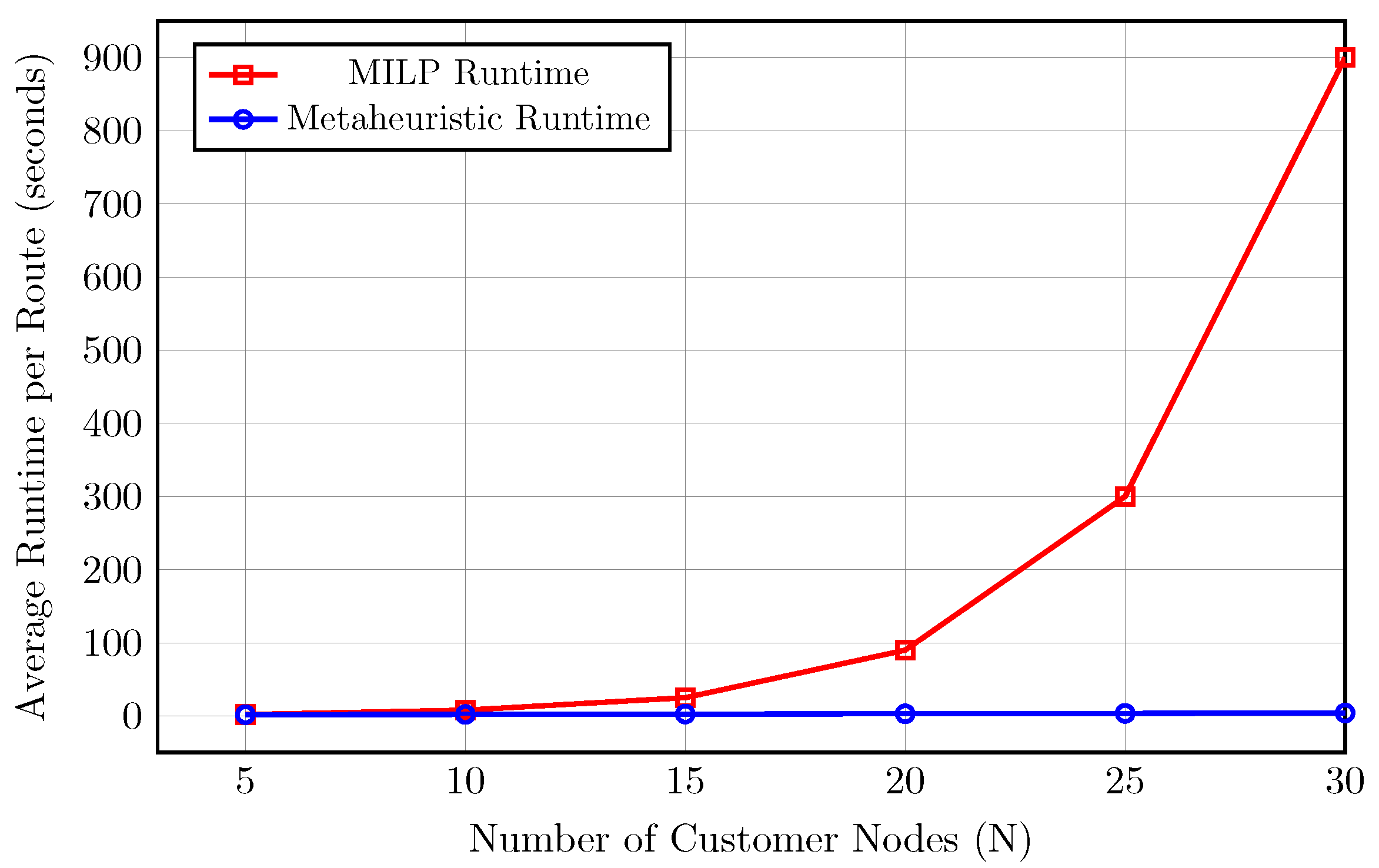
4.1. Performance of the Hybrid Matheuristic
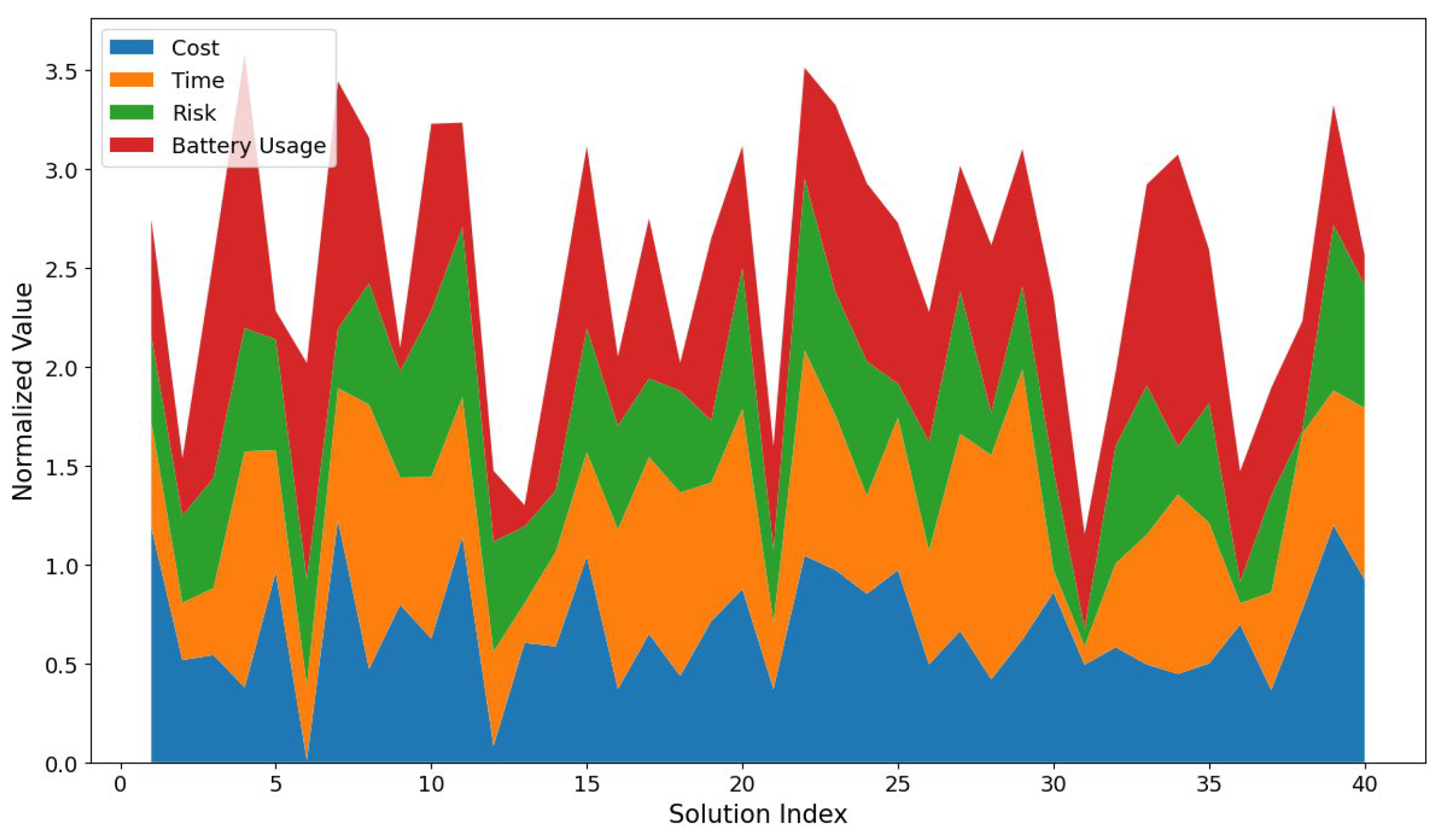
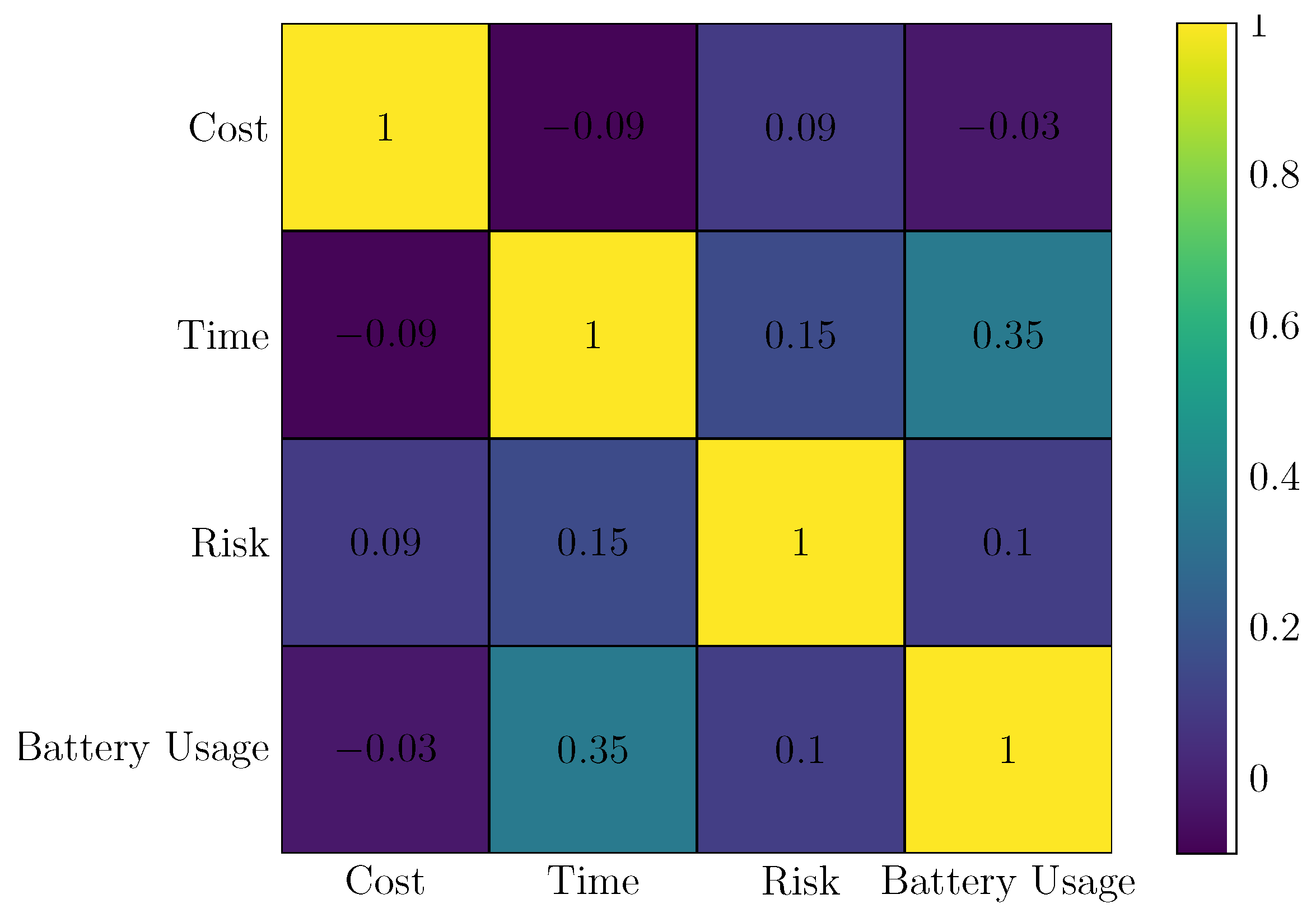
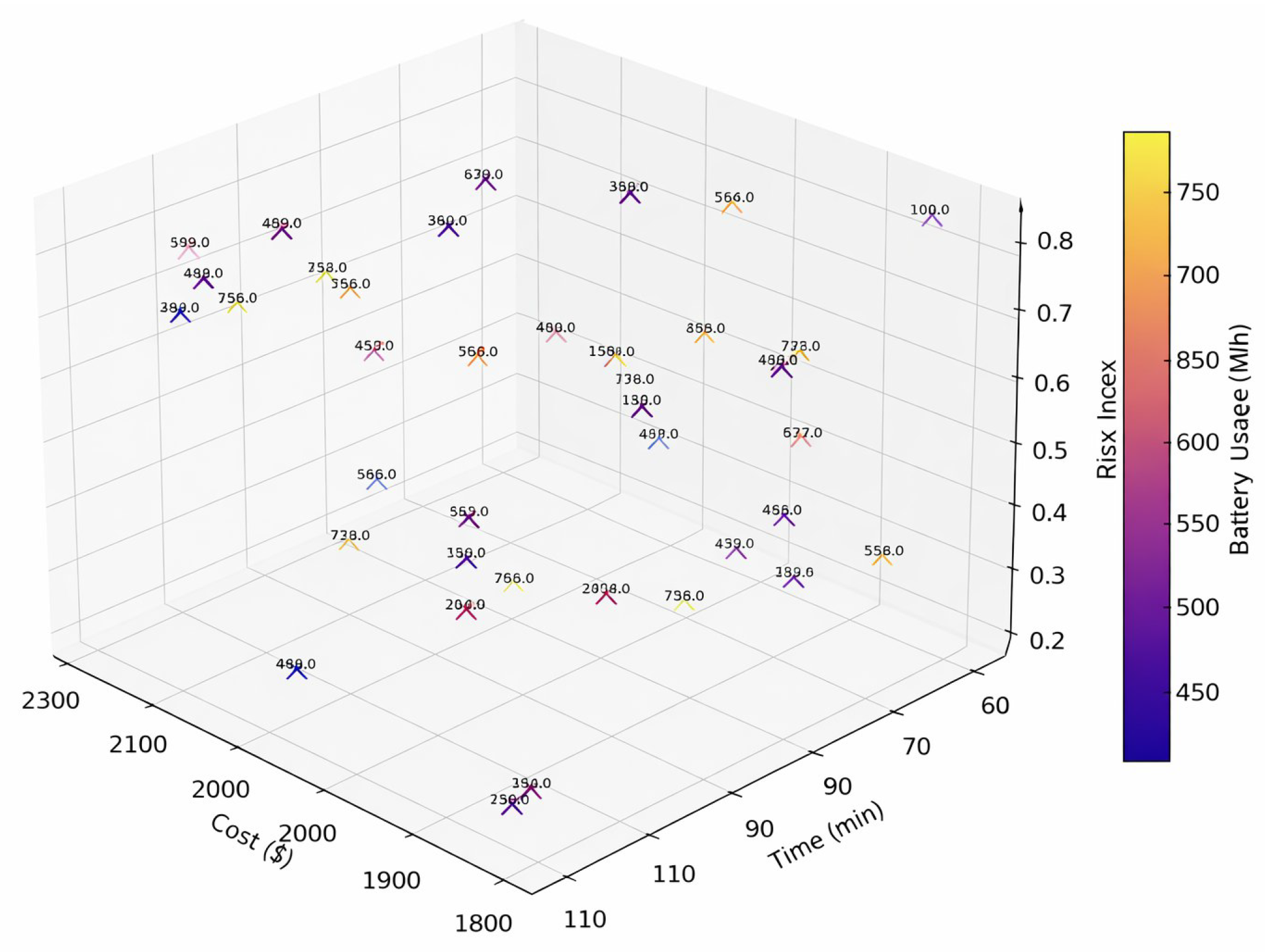
4.2. Pareto Front Structure and Trade-Offs
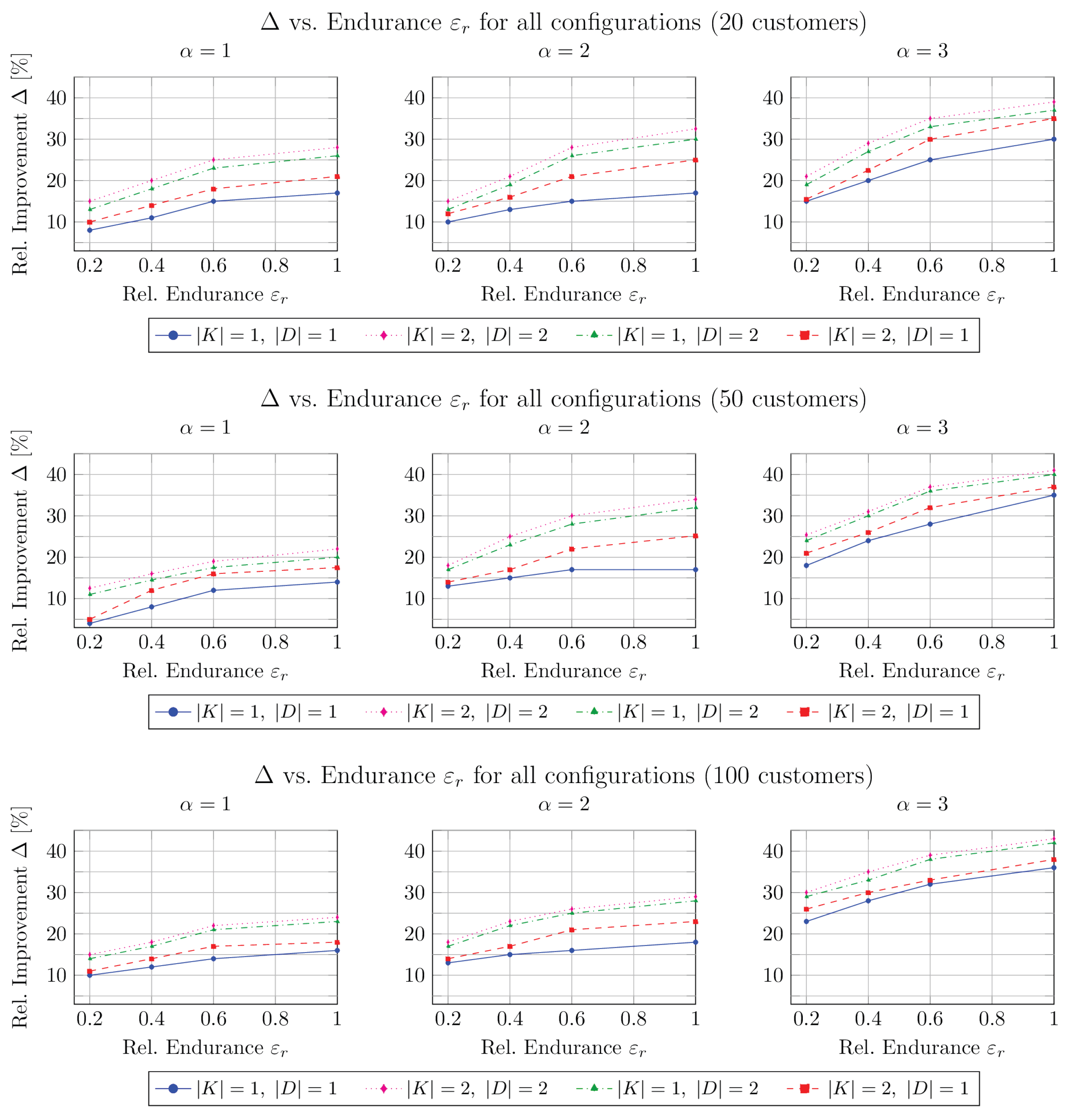
4.3. Structural Behavior and Scalability of the Hybrid Model
- Case 1: |K| = 1, |D| = 1
- Case 2: |K| = 2, |D| = 1
- Case 3: |K| = 1, |D| = 2
- Case 4: |K| = 2, |D| = 2.
4.4. Descriptive Comparison with Baseline Approaches
5. Discussion
5.1. Comparison with Existing Truck–Drone Delivery Studies
5.2. Limitations and Practical Considerations
6. Conclusions
Author Contributions
Funding
Institutional Review Board Statement
Informed Consent Statement
Data Availability Statement
Conflicts of Interest
Abbreviations
| MILP | Mixed-Integer Linear Programming |
| UAV | Unmanned Aerial Vehicle |
| SORA | Specific Operations Risk Assessment |
| JARUS | Joint Authorities for Rulemaking on Unmanned Systems |
| TDDP | Truck–Drone Delivery Problem |
| VRP | Vehicle Routing Problem |
| NSGA-II | Non-dominated Sorting Genetic Algorithm II |
| MOEA/D | Multi-Objective Evolutionary Algorithm based on Decomposition |
| DASP | Drone Assignment and Scheduling Problem |
| KPI | Key Performance Indicator |
| IP | Integer Programming |
| DP | Dynamic Programming |
| SA | Simulated Annealing |
| ALNS | Adaptive Large Neighborhood Search |
| GRASP | Greedy Randomized Adaptive Search Procedure |
| BBN | Bayesian Belief Network |
| RL | Reinforcement Learning |
| HGA | Hybrid Genetic Algorithm |
| FSTSP | Flying Sidekick Traveling Salesman Problem |
Appendix A. Definitions of Variables, Sets, and Parameters

| Symbol | Decision Variables |
|---|---|
| Binary variable equal to 1 if truck moves from node to node with ; 0 otherwise. | |
| Binary variable equal to 1 if the UAV of truck departs from node , flies to , and returns to the end depot or truck at node , with ; 0 otherwise. | |
| Binary variable equal to 1 if customer i is visited at any point before customer j in the route of truck tr; 0 otherwise. | |
| Subtour elimination (position) variable indicating the position of node i in the route of truck tr. | |
| Arrival time of truck at node i (minutes). | |
| Arrival time of the UAV associated with truck at node (minutes). | |
| Amount of load that truck tr carries at node i. | |
| Time deviation from the earliest time allowed to provide service to demand point i in the soft time window. | |
| Time deviation from the latest time allowed to provide service to demand point i in the soft time window. | |
| Amount of battery charge of the UAV associated with truck tr at node i. | |
| arrival time of drone k at node i | |
| remaining battery level of UAV k after servicing node i | |
| penalty variable representing soft time-window violation of UAV k at node i. |
| Symbol | Sets Description |
|---|---|
| D | Set of distributor candidate locations (potential distribution facility sites). |
| Set of all possible departure (pickup) nodes, either truck or UAV, e.g., . | |
| Subset of service nodes that can be served by UAV k; . | |
| Set of all service (customer) nodes, . | |
| N | Set of all nodes in the network (including depots), |
| Set of all possible truck arrival (delivery) nodes, . | |
| Set of all possible UAV arrival (delivery) nodes, . | |
| Set of UAV sortie triplets of the form , representing launch node i, service node j, and recovery node k (3-node UAV sorties). | |
| F | Set of all pickup nodes, . |
| P | Set of all delivery nodes, . |
| Set of delivery nodes where UAV battery recharging is available. | |
| Set of delivery nodes where UAV battery recharging is not available. | |
| K | Set of UAVs. |
| Set of trucks. | |
| U | Set of scenarios considered in the model (e.g., for uncertainty in speed, endurance, or risk). |
| Symbol | Parameters Description |
|---|---|
| Amount of delivery demand at delivery node i. | |
| Amount of pickup demand at delivery node i. | |
| Loading capacity (payload capacity) of each UAV k. | |
| Weight (load) of truck after visiting node i (kg). | |
| Remaining load on UAV k after serving demand point j. | |
| Center demand (or aggregated demand) associated with distributor candidate location d. | |
| Capacity of distributor candidate location d. | |
| Capacity of pickup node f. | |
| Load amount on UAV k when leaving the distributor (initial payload). | |
| Distance between node i and node j. | |
| Probability of occurrence of scenario u. | |
| Velocity of UAV k in event/scenario u. | |
| Start time of providing service to demand point i in scenario u. | |
| Nominal speed of a UAV of type k. | |
| Number of UAVs of type k that a single operator can operate simultaneously. | |
| Position index of node in the route of truck . | |
| Truck speed (miles per hour). | |
| Truck load capacity when serving location i with a UAV (kg). | |
| M | A sufficiently large positive constant (big-M). |
| Symbol | Parameters Description |
|---|---|
| Cost per unit time deviation from the earliest time allowed in the soft time window. | |
| Cost per unit time deviation from the latest time allowed in the soft time window. | |
| Fixed cost of using UAV k. | |
| C | Cost of one unit of charging energy. |
| Cost per unit of energy. | |
| Wage (cost per unit time) of a UAV operator. | |
| Amortized cost of UAV k. | |
| Maintenance cost of a UAV of type k. | |
| Cost for truck to travel from node to node ($). | |
| Cost to operate a UAV between nodes , and return to node ($). | |
| Amortized cost of the battery of UAV k. | |
| Preparation cost per unit at pickup node f. | |
| Cost of constructing (opening) distributor candidate location d. | |
| Cost associated with energy consumption. |
| Symbol | Parameters Description |
|---|---|
| Minimum amount of charging required for UAV k. | |
| UAV battery consumption when flying from node i to node j. | |
| Battery charging capacity (full charge level). | |
| Amount of battery energy available on the UAV k at node i. | |
| Energy consumption for a UAV k to fly from location i to location j. | |
| Time required to replace the battery of a UAV of type k. | |
| Initial energy in the battery of a UAV of type k. | |
| Minimum remaining energy required in the battery of a UAV of type k. | |
| Maximum energy capacity of the battery for a UAV of type k. | |
| Additional charge gained at charging point j. | |
| Remaining battery energy of a UAV after returning from delivery location i. |
| Symbol | Parameters Description |
|---|---|
| Risk of route segment from node i to node j when traversed by UAV k. | |
| Risk of route segment from node i to node j when traversed by truck tr. |
| Symbol | Parameters Description |
|---|---|
| Time when truck starts providing service at delivery node i (minutes). | |
| Time when UAV k of truck reaches node (minutes). | |
| Earliest time that UAV k is allowed to provide service to distributor i in the hard time window. | |
| Latest time that UAV k is allowed to provide service to distributor i in the hard time window. | |
| Earliest time UAV k is allowed to provide service to distributor i in the soft time window. | |
| Latest time UAV k is allowed to provide service to distributor i in the soft time window. | |
| Earliest time truck tr is allowed to provide service to distributor i in the hard time window. | |
| Latest time truck tr is allowed to provide service to distributor i in the hard time window. | |
| Earliest time truck tr is allowed to provide service to distributor i in the soft time window. | |
| Latest time truck tr is allowed to provide service to distributor i in the soft time window. | |
| Scaling factor for deviations from the earliest start time in the soft time window. | |
| Scaling factor for deviations from the latest start time in the soft time window. | |
| Time at which the route of UAV k is completed (end time of its route). | |
| Time deviation from the earliest allowed service time at demand point i in the soft time window in scenario u. | |
| Time deviation from the latest allowed service time at demand point i in the soft time window in scenario u. | |
| Length of the working day (planning horizon). | |
| Latest permissible time for a UAV k to provide service at location i. | |
| Latest permissible time for a UAV k to provide service at delivery location j. | |
| Latest permissible time for truck tr to provide service at location i. | |
| Latest permissible time for truck tr to provide service at delivery location j. | |
| Travel time between locations i and j. | |
| Earliest possible pickup time at location i. | |
| Time required for truck to move from node to node (minutes). | |
| Analogous travel time for a UAV k between nodes , and return to node (minutes). | |
| Time at which a UAV k picks up the package for delivery location i at the depot. | |
| Time needed to load a UAV before launch (minutes). | |
| Time needed to recover a UAV upon rendezvous (minutes). | |
| Truck service duration at node (minutes). | |
| UAV service duration at node (minutes). |
References
- Bao, D.; Yan, Y.; Li, Y.; Chu, J. The Future of Last-Mile Delivery: Lifecycle Environmental and Economic Impacts of Drone-Truck Parallel Systems. Drones 2025, 9, 54. [Google Scholar] [CrossRef] [Scilit]
- Lu, J.; Liu, Y.; Jiang, C.; Wu, W. Truck-drone joint delivery network for rural area: Optimization and implications. Transp. Policy 2025, 163, 273–284. [Google Scholar] [CrossRef] [Scilit]
- Dudek, T.; Kaśkosz, K. Optimizing drone logistics in complex urban industrial infrastructure. Transp. Res. Part D Transp. Environ. 2025, 140, 104610. [Google Scholar] [CrossRef] [Scilit]
- Mahmoodi, A.; Hashemi, L.; Laliberte, J.; Sajadi, S.M. Optimizing energy and CO2 efficiency in last-mile delivery using hybrid fleet models. Sustain. Futures 2025, 10, 101089. [Google Scholar] [CrossRef] [Scilit]
- Dai, D.; Cai, H.; Ye, L.; Shao, W. Two-Stage Delivery System for Last Mile Logistics in Rural Areas: Truck–Drone Approach. Systems 2024, 12, 121. [Google Scholar] [CrossRef] [Scilit]
- Badshah, I.; Bridgelall, R.; Thompson, E.A. GIS-Enabled Truck–Drone Hybrid Systems for Agricultural Last-Mile Delivery: A Multidisciplinary Review with Insights from a Rural Region. Drones 2025, 9, 868. [Google Scholar] [CrossRef] [Scilit]
- Dai, D.; Cai, H.; Wang, S. Optimization of a Cooperative Truck–Drone Delivery System in Rural China: A Sustainable Logistics Approach for Diverse Terrain Conditions. Sustainability 2025, 17, 6390. [Google Scholar] [CrossRef] [Scilit]
- Mokhtari-Moghadam, A.; Salhi, A.; Yang, X.; Nguyen, T.T.; Pourhejazy, P. A multi-objective approach for the integrated planning of drone and robot assisted truck operations in last-mile delivery. Expert Syst. Appl. 2025, 269, 126434. [Google Scholar] [CrossRef] [Scilit]
- Mahmoodi, A.; Sajadi, S.M.; Sadeq, A.M.; Narenji, M.; Eshaghi, M.; Jasemi, M. Enhancing unmanned aerial vehicles logistics for dynamic delivery: A hybrid non-dominated sorting genetic algorithm II with Bayesian belief networks. In Annals of Operations Research; Springer: Berlin/Heidelberg, Germany, 2025; pp. 1–57. [Google Scholar] [CrossRef] [Scilit]
- Cen, X.; Zhou, G.; Ji, B.; Yu, S.S.; Zhang, Z.; Fang, X. Modelling and heuristically solving three-dimensional loading constrained vehicle routing problem with cross-docking. Adv. Eng. Inform. 2023, 57, 102029. [Google Scholar] [CrossRef] [Scilit]
- Cheimanoff, N.; Fontane, F.; Kitri, M.N.; Tchernev, N. Exact and heuristic methods for the integrated berth allocation and specific time-invariant quay crane assignment problems. Comput. Oper. Res. 2022, 141, 105695. [Google Scholar] [CrossRef] [Scilit]
- Shuaibu, A.S.; Mahmoud, A.S.; Sheltami, T.R. A Review of Last-Mile Delivery Optimization: Strategies, Technologies, Drone Integration, and Future Trends. Drones 2025, 9, 158. [Google Scholar] [CrossRef] [Scilit]
- Rejeb, A.; Rejeb, K.; Simske, S.J.; Treiblmaier, H. Drones for supply chain management and logistics: A review and research agenda. Int. J. Logist. Res. Appl. 2023, 26, 708–731. [Google Scholar] [CrossRef] [Scilit]
- Wei, S.; Fan, H.; Ren, X.; Diao, X. Time-Dependent Vehicle Routing Problem with Drones Under Vehicle Restricted Zones and No-Fly Zones. Appl. Sci. 2025, 15, 2207. [Google Scholar] [CrossRef] [Scilit]
- Otto, A.; Agatz, N.; Campbell, J.; Golden, B.; Pesch, E. Optimization approaches for civil applications of unmanned aerial vehicles (UAVs) or aerial drones: A survey. Networks 2018, 72, 411–458. [Google Scholar] [CrossRef] [Scilit]
- Boysen, N.; Fedtke, S.; Schwerdfeger, S. Last-mile delivery concepts: A survey from an operational research perspective. OR Spectr. 2021, 43, 1–58. [Google Scholar] [CrossRef] [Scilit]
- Ding, X.; Liu, T. A History Information-Guided Evolutionary Algorithm for the Multiobjective Vehicle Routing Problem with Time Windows. IEEE Sens. J. 2024, 24, 35787–35800. [Google Scholar] [CrossRef] [Scilit]
- Vargas-Quintero, A.; Morillo-Torres, D.; Escobar, J.W. Two-stage linear stochastic programming formulations for the Stochastic Vehicle Routing Problem with Backhauls and Time Windows. Int. J. Syst. Sci. Oper. Logist. 2025, 12, 2451223. [Google Scholar] [CrossRef] [Scilit]
- Chen, B.; Zhang, R.; Long, S.; Sakdanuphab, R. A Multi-Objective Multi-Period Low-Carbon Location-Routing Problem: Improved NSGA-II Approach. IEEE Access 2024, 12, 51590–51605. [Google Scholar] [CrossRef] [Scilit]
- Maroof, A.; Ayvaz, B.; Naeem, K. Logistics Optimization Using Hybrid Genetic Algorithm (HGA): A Solution to the Vehicle Routing Problem with Time Windows (VRPTW). IEEE Access 2024, 12, 36974–36989. [Google Scholar] [CrossRef] [Scilit]
- Murray, C.C.; Chu, A.G. The flying sidekick traveling salesman problem: Optimization of drone-assisted parcel delivery. Transp. Res. Part C Emerg. Technol. 2015, 54, 86–109. [Google Scholar] [CrossRef] [Scilit]
- Wang, X.; Poikonen, S.; Golden, B. The vehicle routing problem with drones: Several worst-case results. Optim. Lett. 2017, 11, 679–697. [Google Scholar] [CrossRef] [Scilit]
- Sacramento, D.; Pisinger, D.; Ropke, S. An adaptive large neighborhood search metaheuristic for the vehicle routing problem with drones. Transp. Res. Part C Emerg. Technol. 2019, 102, 289–315. [Google Scholar] [CrossRef] [Scilit]
- Schermer, D.; Moeini, M.; Wendt, O. A matheuristic for the vehicle routing problem with drones and its variants. Transp. Res. Part C Emerg. Technol. 2019, 106, 166–204. [Google Scholar] [CrossRef] [Scilit]
- Gu, Q.; Fan, T.; Han, W. Optimization of hybrid delivery by vehicle and drones. Electron. Commer. Res. Appl. 2024, 66, 101411. [Google Scholar] [CrossRef] [Scilit]
- She, R.; Ouyang, Y. Hybrid truck–drone delivery under aerial traffic congestion. Transp. Res. Part B Methodol. 2024, 185, 102970. [Google Scholar] [CrossRef] [Scilit]
- Boysen, N.; Briskorn, D.; Fedtke, S.; Schwerdfeger, S. Drone delivery from trucks: Drone scheduling for given truck routes. Networks 2018, 72, 506–527. [Google Scholar] [CrossRef] [Scilit]
- Carlsson, J.G.; Song, S. Coordinated logistics with a truck and a drone. Manag. Sci. 2018, 64, 4052–4069. [Google Scholar] [CrossRef] [Scilit]
- Di Puglia Pugliese, L.; Guerriero, F. Last-mile deliveries by using drones and classical vehicles. In Proceedings of the International Conference on Optimization and Decision Science; Springer: Berlin/Heidelberg, Germany, 2017; pp. 557–565. [Google Scholar] [CrossRef] [Scilit]
- Hong, F.; Wu, G.; Wang, Y.; Luo, Q.; Wang, L.; Shi, J. Multi-Objective Multi-Drone Collaborative Routing Problem with Heterogeneous Delivery and Pickup Service. IEEE Trans. Intell. Transp. Syst. 2025, 26, 6084–6100. [Google Scholar] [CrossRef] [Scilit]
- Ma, H.; Tsang, Y.; Lee, C. Optimizing multi-objective instant logistics with trucks and drones for the quick commerce order fulfilment. J. Ind. Prod. Eng. 2025, 42, 516–532. [Google Scholar] [CrossRef] [Scilit]
- Ha, Q.M.; Deville, Y.; Pham, Q.D.; Hà, M.H. On the min-cost Traveling Salesman Problem with Drone. Transp. Res. Part C Emerg. Technol. 2018, 86, 597–621. [Google Scholar] [CrossRef] [Scilit]
- Es Yurek, E.; Ozmutlu, H.C. A decomposition-based iterative optimization algorithm for traveling salesman problem with drone. Transp. Res. Part C Emerg. Technol. 2018, 91, 249–262. [Google Scholar] [CrossRef] [Scilit]
- Gao, J.; Guo, X. Collaborative routing optimization for heterogeneous trucks–drones under urban regional restrictions. Asia-Pac. J. Oper. Res. 2025, 42, 2440016. [Google Scholar] [CrossRef] [Scilit]
- Xiao, Q.; Gao, J. Resilient Last-Mile Logistics in Smart Cities Through Multi-Visit and Time-Dependent Drone–Truck Collaboration. Drones 2025, 9, 782. [Google Scholar] [CrossRef] [Scilit]
- Wang, F.; Li, H.; Xiong, H. Truck–drone routing problem with stochastic demand. Eur. J. Oper. Res. 2025, 322, 854–869. [Google Scholar] [CrossRef] [Scilit]
- Kong, J.; Wang, H.; Xie, M. Autonomous delivery vehicle routing problem with drones based on multiple delivery modes. Comput. Oper. Res. 2025, 179, 107032. [Google Scholar] [CrossRef] [Scilit]
- Jin, Z.; Lu, M.; Li, X.; Zhang, S.; Hsu, S.C. Multi-objective optimization of two-echelon delivery with autonomous delivery vehicles and electric two-wheelers. Comput. Ind. Eng. 2025, 203, 110999. [Google Scholar] [CrossRef] [Scilit]
- De Armas, J.; Moreno-Pérez, J.A. A survey on variable neighborhood search for sustainable logistics. Algorithms 2025, 18, 38. [Google Scholar] [CrossRef] [Scilit]
- Wen, X.; Wu, G.; Li, S.; Wang, L. Ensemble multi-objective optimization approach for heterogeneous drone delivery problem. Expert Syst. Appl. 2024, 249, 123472. [Google Scholar] [CrossRef] [Scilit]
- Khalaj Rahimi, S.; Rahmani, D. A hybrid multi-objective solution approach for a reliable truck-drone routing problem integrated with pickup and delivery services. Transp. Lett. 2025, 17, 230–248. [Google Scholar] [CrossRef] [Scilit]
- Mohammed, Y.I.; Hassan, R.; Hasan, M.K.; Abbas, H.S.; Khan, M.A.; Baili, J.; Gupta, D. Optimizing UAV-assisted IoT sensor networks: A multi-objective approach to data collection and routing. Alex. Eng. J. 2025, 115, 47–56. [Google Scholar] [CrossRef] [Scilit]
- Resat, H.G. Design and Analysis of Novel Hybrid Multi-Objective Optimization Approach for Data-Driven Sustainable Delivery Systems. IEEE Access 2020, 8, 90280–90293. [Google Scholar] [CrossRef] [Scilit]
- Peng, W.; Wang, D.; Yin, Y.; Cheng, T. Multi-agent deep reinforcement learning-based truck-drone collaborative routing with dynamic emergency response. Transp. Res. Part E Logist. Transp. Rev. 2025, 195, 103974. [Google Scholar] [CrossRef] [Scilit]
- He, L.; Gong, X.; Zheng, J.; Wang, Y.; Cui, Y. A Flexible Combinatorial Auction Algorithm (FCAA) for Multi-Task Collaborative Scheduling of Heterogeneous UAVs. Drones 2025, 9, 870. [Google Scholar] [CrossRef] [Scilit]
- Liu, Z.; Li, L.; Zhang, X.; Tang, W.; Yang, Z.; Yang, X. Considering both energy effectiveness and flight safety in UAV trajectory planning for intelligent logistics. Veh. Commun. 2025, 52, 100885. [Google Scholar] [CrossRef] [Scilit]
- Zheng, B.; Zhou, W.; Ma, X. Quantitative Study on UAV Operational Risk Based on Specific Operation Risk Assessment Model. In Quality and Reliability Engineering International; Wiley: Hoboken, NJ, USA, 2025. [Google Scholar] [CrossRef] [Scilit]
- Millar, R.C.; Hashemi, L.; Mahmoodi, A.; Meyer, R.W.; Laliberte, J. Integrating unmanned and manned UAVs data network based on combined Bayesian belief network and multi-objective reinforcement learning algorithm. Drone Syst. Appl. 2023, 11, 1–17. [Google Scholar] [CrossRef] [Scilit]
- Cicek, D.; Simsek, M.; Kantarci, B. Machine Learning-Driven Truck–Drone Collaborative Delivery for Time- and Energy-Efficient Last-Mile Deliveries. Electronics 2025, 14, 2026. [Google Scholar] [CrossRef] [Scilit]
- Teng, Y.; Wang, X.; Wang, L.; Yao, M. The Safety Risk Assessment Method for Logistics UAV Considering Environmental Impacts. In Proceedings of the 2024 IEEE International Conference on Unmanned Systems (ICUS), Nanjing, China, 18–20 October 2024; pp. 219–224. [Google Scholar] [CrossRef] [Scilit]
- Sun, X.; Hu, Y.; Qin, Y.; Zhang, Y. Risk assessment of unmanned aerial vehicle accidents based on data-driven Bayesian networks. Reliab. Eng. Syst. Saf. 2024, 248, 110185. [Google Scholar] [CrossRef] [Scilit]
- Mahmoodi, A.; Hashemi, L.; Laliberté, J.; Millar, R.C. Secured Multi-Dimensional Robust Optimization Model for Remotely Piloted Aircraft System (RPAS) Delivery Network Based on the SORA Standard. Designs 2022, 6, 55. [Google Scholar] [CrossRef] [Scilit]
- Zong, Z.; Li, D.; Dong, X.; Cui, Y.; Yang, B.; Xiang, J.; Tu, Z. Risk-Aware Enabled Path Planning for Drones Flight in Unknown Environment. J. Intell. Robot. Syst. 2025, 111, 47. [Google Scholar] [CrossRef] [Scilit]
- Mahmoodi, A.; Hashemi, L.; Laliberte, J.; Millar, R.C.; Walter Meyer, R. Revolutionizing RPAS logistics and reducing CO2 emissions with advanced RPAS technology for delivery systems. Clean. Logist. Supply Chain 2024, 12, 100166. [Google Scholar] [CrossRef] [Scilit]
- Franco, J.L.; Curtis, V.V.; Senne, E.L.F.; Verri, F.A.N. An exact method and a heuristic for last-mile delivery drones routing with centralized graph-based airspace control. Comput. Oper. Res. 2025, 178, 107006. [Google Scholar] [CrossRef] [Scilit]
- Boccia, M.; Mancuso, A.; Masone, A.; Sterle, C. Exact and heuristic approaches for the Truck–Drone Team Logistics Problem. Transp. Res. Part C Emerg. Technol. 2024, 165, 104691. [Google Scholar] [CrossRef] [Scilit]
- Agatz, N.; Bouman, P.; Schmidt, M. Optimization Approaches for the Traveling Salesman Problem with Drone. Transp. Sci. 2018, 52, 965–981. [Google Scholar] [CrossRef] [Scilit]





| Reference | Trucks | Drones | Objective | Method | Vertices |
|---|---|---|---|---|---|
| [21] | 1 | 1 | Time | MILP, heuristic | 10–20 |
| [22] | n | m | Time | Theoretical Insights | 10–50 |
| [29] | n | m | Time | MILP | 5–10 |
| [57] | 1 | 1 | Time | IP, DP, heuristic | 10–100 |
| [28] | 1 | m | Time | Heuristic | 25–500 |
| [33] | 1 | 1 | Time | Heuristic | 10–20 |
| [27] | 1 | m | Time | MILP, SA | 5–100 |
| [32] | 1 | 1 | Cost/Time | MILP, GRASP | 10–100 |
| [23] | n | 1 | Time | MILP, ALNS | 6–200 |
| [24] | n | m | Time | MILP, Matheuristic | 10–50 |
| [43] | n | m | Cost/Time/Risk | Hybrid MO | 10–100 |
| [11] | n | m | Time | Exact/Heuristic | 10–50 |
| [52] | n | m | Cost/Time/Risk | Robust Opt. | 10–100 |
| [10] | n | m | Time | Heuristic | 10–100 |
| [48] | n | m | Cost/Time/Risk | BBN + RL | 10–100 |
| [40] | n | m | Cost/Time/Risk | MOEA Ensemble | 10–100 |
| [54] | n | m | Cost/Time/Risk | RL | 25–500 |
| [17] | n | m | Cost/Time/Risk | Evolutionary | 10–100 |
| [20] | n | m | Time | HGA | 10–100 |
| [19] | n | m | Cost/Time/Risk | NSGA-II | 10–100 |
| [25] | n | m | Time | MILP | 10–200 |
| [26] | n | m | Cost/Time/Risk | MILP | 10–100 |
| [50] | n | m | Time | Impact-based | 25–200 |
| [51] | n | m | Time | Bayesian | 10–100 |
| [56] | n | m | Cost/Time | Exact/Heuristic | 10–50 |
| [3] | n | m | Cost/Time/Risk | Heuristic | 10–100 |
| [2] | n | m | Cost/Time/Risk | MILP | 10–100 |
| [9] | n | m | Time/Cost/Risk/Energy | NSGA-II + BBN | 10–100 |
| [18] | n | m | Cost/Time/Risk | Stochastic LP | 25–200 |
| [31] | n | m | Cost/Time/Risk | MILP | 10–50 |
| [30] | n | m | Cost/Time/Risk | Heuristic | 10–100 |
| [38] | n | m | Cost/Time/Risk | Stochastic IP | 10–100 |
| [39] | n | m | - | Survey | 10–100 |
| [41] | n | m | Cost/Time/Risk | Hybrid Heuristic | 10–100 |
| [42] | n | m | Time/Cost/Risk/Energy | MO | 10–100 |
| [2] | n | m | Cost/Time/Risk | Heuristic | 10–100 |
| [47] | n | m | Time | Quantitative | 10–100 |
| [55] | n | m | Time | Exact/Heuristic | 10–50 |
| [8] | n | m | Cost/Time/Risk | Hybrid | 25–200 |
| This Study | n | m | Time/Cost/Risk/Energy | Matheuristic (MILP+NSGA-II) | 10–100 |
| Equation | Objective | Plain-Language Interpretation |
|---|---|---|
| (1) | Minimize total operational cost | Minimizes the combined transportation cost of truck routes and UAV sorties, including fixed deployment and variable travel-related costs. |
| (2) | Minimize service time deviation | Minimize the deviation from customer time windows using soft penalties to capture service quality degradation. |
| (3) | Minimize UAV energy consumption | Minimizes total UAV energy usage, accounting for flight distance, payload-dependent consumption, and endurance limitations. |
| (4) | Minimize operational risk (SORA-based) | Minimizes aggregated SORA-based operational risk by considering ground risk exposure along UAV flight paths. |
Disclaimer/Publisher’s Note: The statements, opinions and data contained in all publications are solely those of the individual author(s) and contributor(s) and not of MDPI and/or the editor(s). MDPI and/or the editor(s) disclaim responsibility for any injury to people or property resulting from any ideas, methods, instructions or products referred to in the content. |
© 2026 by the authors. Licensee MDPI, Basel, Switzerland. This article is an open access article distributed under the terms and conditions of the Creative Commons Attribution (CC BY) license.
Share and Cite
Mahmoodi, A.; Davoodi, M.; Easa, S.M.; Sajadi, S.M. Sustainable and Safe Last-Mile Delivery: A Multi-Objective Truck–Drone Matheuristic. Logistics 2026, 10, 38. https://doi.org/10.3390/logistics10020038
Mahmoodi A, Davoodi M, Easa SM, Sajadi SM. Sustainable and Safe Last-Mile Delivery: A Multi-Objective Truck–Drone Matheuristic. Logistics. 2026; 10(2):38. https://doi.org/10.3390/logistics10020038
Chicago/Turabian StyleMahmoodi, Armin, Mehdi Davoodi, Said M. Easa, and Seyed Mojtaba Sajadi. 2026. "Sustainable and Safe Last-Mile Delivery: A Multi-Objective Truck–Drone Matheuristic" Logistics 10, no. 2: 38. https://doi.org/10.3390/logistics10020038
APA StyleMahmoodi, A., Davoodi, M., Easa, S. M., & Sajadi, S. M. (2026). Sustainable and Safe Last-Mile Delivery: A Multi-Objective Truck–Drone Matheuristic. Logistics, 10(2), 38. https://doi.org/10.3390/logistics10020038