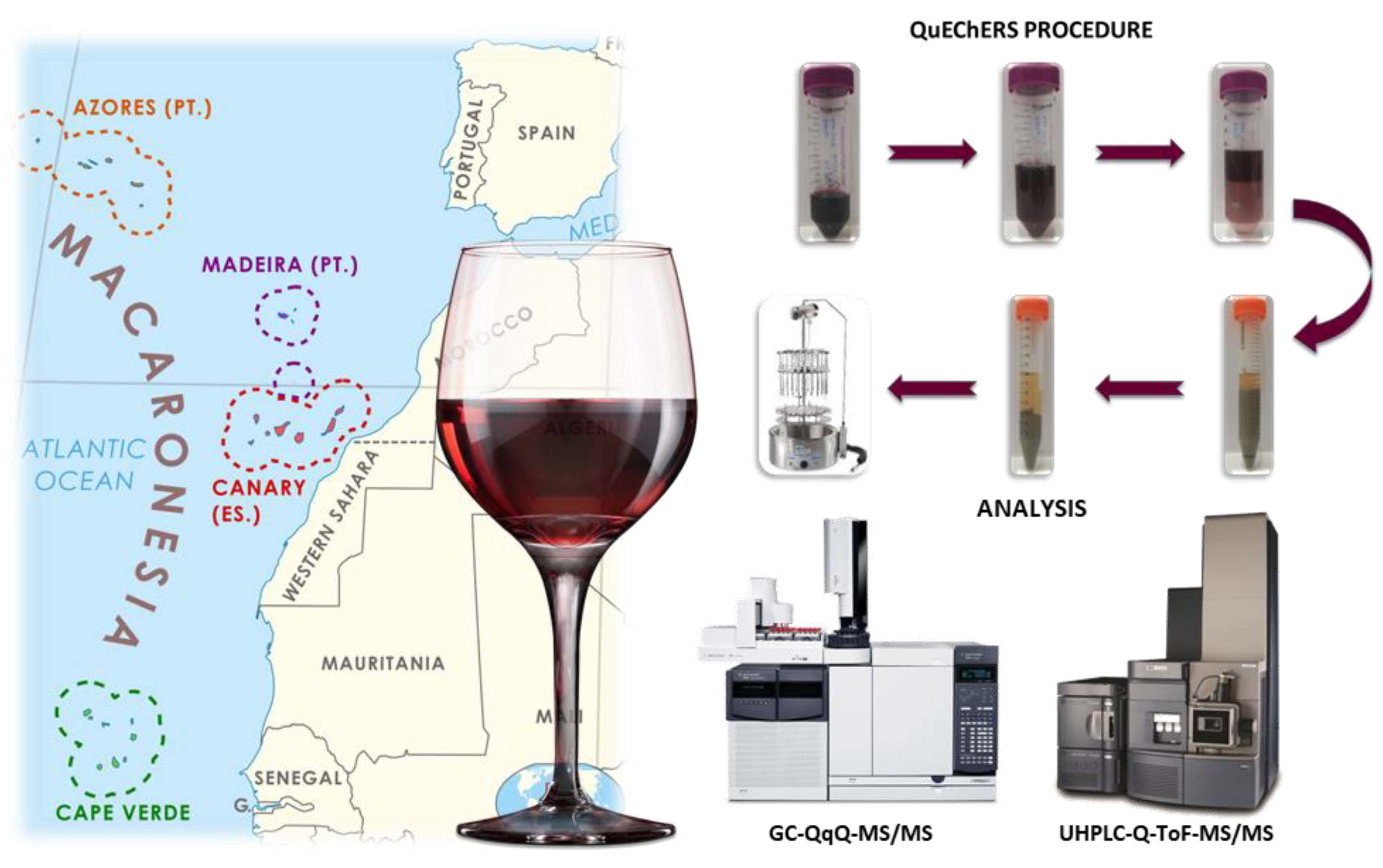
Comparison of Pesticide Residue Levels in Red Wines from Canary Islands, Iberian Peninsula, and Cape Verde


 ,
, 

Abstract
1. Introduction
2. Materials and Methods
2.1. Chemicals and Reagents
2.2. QuEChERS Extraction Procedure
2.3. UHPLC-MS/MS Analysis
2.4. GC-MS/MS Analysis
2.5. Statistical Analysis
2.6. Wine Samples
3. Results and Discussion
3.1. Validation of Analytical Methods for Pesticide Residues
3.2. Evaluation of Pesticide Residues Occurrence in Red Wine Samples
3.3. Potential Toxicity of Pesticide Residues by the Red Wine Consumption
4. Conclusions
Supplementary Materials
Author Contributions
Funding
Acknowledgments
Conflicts of Interest
References
- Özkara, A.; Akyil, D.; Konuk, M. Pesticides, Environmental Pollution, and Health. In Environmental Health Risk—Hazardous Factors to Living Species; Larramendy, M.L., Soloneski, S., Eds.; IntechOpen: London, UK, 2016; pp. 3–27. ISBN 978-953-51-2402-3. [Google Scholar]
- Liu, Y.; Li, S.; Ni, Z.; Qu, M.; Zhong, D.; Ye, C.; Tang, F. Pesticides in persimmons, jujubes and soil from China: Residue levels, risk assessment and relationship between fruits and soils. Sci. Total Environ. 2016, 542, 620–628. [Google Scholar] [CrossRef] [PubMed]
- Allsop, M.; Huxdorff, C.; Johnston, P.; Santillo, D.; Thompson, K. Pesticides and our Health, A Growing Concern. Greenpeace 2015, 2, 1–56. [Google Scholar]
- López-Cervantes, M.; Torres-Sánchez, L.; Tobías, A.; López-Carrillo, L. Dichlorodiphenyldichloroethane Burden and Breast Cancer Risk: A Meta-Analysis of the Epidemiologic Evidence. Environ. Health Perspect. 2003, 112, 207–214. [Google Scholar] [CrossRef]
- Luzardo, O.P.; Goethals, M.; Zumbado, M.; Álvarez-León, E.E.; Cabrera, F.; Serra-Majem, L.; Boada, L.D. Increasing serum levels of non-DDT-derivative organochlorine pesticides in the younger population of the Canary Islands (Spain). Sci. Total Environ. 2006, 367, 129–138. [Google Scholar] [CrossRef] [PubMed]
- Henríquez-Hernández, L.A.; Luzardo, O.P.; Almeida-González, M.; Álvarez-León, E.E.; Serra-Majem, L.; Zumbado, M.; Boada, L.D. Background levels of polychlorinated biphenyls in the population of the Canary Islands (Spain). Environ. Res. 2011, 111, 10–16. [Google Scholar] [CrossRef] [PubMed]
- Mostafalou, S.; Abdollahi, M. Pesticides and human chronic diseases: Evidences, mechanisms, and perspectives. Toxicol. Appl. Pharmacol. 2013, 268, 157–177. [Google Scholar] [CrossRef] [PubMed]
- Dirección General de Biodiversidad y Calidad Ambiental. Perfil Ambiental de España 2017. Informe Basado en Indicadores; Ministerio para la Transición Ecológica y el Reto Demográfico: Madrid, Spain, 2018. [Google Scholar]
- Burillo-Putze, G.; Luzardo, O.P.; García, C.P.; Zumbado, M.; Yanes, C.; Del Mar Trujillo-Martín, M.; Boada Fernández del Campo, C.; Boada, L.D. Exposure to persistent and non-persistent pesticides in a non-occupationally exposed population in Tenerife Island (Spain). Gac. Sanit. 2014, 28, 301–304. [Google Scholar] [CrossRef] [PubMed][Green Version]
- Boada, L.D.; Henríquez-Hernández, L.A.; Zumbado, M.; Almeida-González, M.; Álvarez-León, E.E.; Navarro, P.; Luzardo, O.P. Organochlorine Pesticides Exposure and Bladder Cancer: Evaluation from a Gene-Environment Perspective in a Hospital-Based Case-Control Study in the Canary Islands (Spain). J. Agromed. 2016, 21, 34–42. [Google Scholar] [CrossRef] [PubMed]
- European Commission Implementing Regulation (EU) 2018/555 of 9 April 2018 concerning a coordinated multiannual control programme of the Union for 2019, 2020 and 2021 to ensure compliance with maximum residue levels of pesticides and to assess the consumer exposure. OJEU 2018, 2016, 48–119.
- The Australian Wine Research Institute. Maximum Residue Limits (MRLS). Available online: https://www.awri.com.au/industry_support/viticulture/agrochemicals/mrls/ (accessed on 23 October 2020).
- Ravelo-Pérez, L.M.; Hernández-Borges, J.; Borges-Miquel, T.M.; Rodríguez-Delgado, M.Á. Solid-phase microextraction and sample stacking micellar electrokinetic chromatography for the analysis of pesticide residues in red wines. Food Chem. 2008, 111, 764–770. [Google Scholar] [CrossRef]
- Castro, G.; Pérez-Mayán, L.; Carpinteiro, I.; Ramil, M.; Cela, R.; Rodríguez, I. Residues of anilinopyrimidine fungicides and suspected metabolites in wine samples. J. Chromatogr. A 2020, 1622, 461104. [Google Scholar] [CrossRef] [PubMed]
- Pérez-Mayán, L.; Cobo-Golpe, M.; Ramil, M.; Cela, R.; Rodríguez, I. Evaluation of supercritical fluid chromatography accurate mass spectrometry for neonicotinoid compounds determination in wine samples. J. Chromatogr. A 2020, 1620. [Google Scholar] [CrossRef] [PubMed]
- Rodríguez-Cabo, T.; Rodríguez, I.; Ramil, M.; Silva, A.; Cela, R. Multiclass semi-volatile compounds determination in wine by gas chromatography accurate time-of-flight mass spectrometry. J. Chromatogr. A 2016, 1442, 107–117. [Google Scholar] [CrossRef] [PubMed]
- Pérez-Ortega, P.; Gilbert-López, B.; García-Reyes, J.F.; Ramos-Martos, N.; Molina-Díaz, A. Generic sample treatment method for simultaneous determination of multiclass pesticides and mycotoxins in wines by liquid chromatography-mass spectrometry. J. Chromatogr. A 2012, 1249, 32–40. [Google Scholar] [CrossRef] [PubMed]
- Romero-González, R.; Garrido Frenich, A.; Martínez Vidal, J.L.; Prestes, O.D.; Grio, S.L. Simultaneous determination of pesticides, biopesticides and mycotoxins in organic products applying a quick, easy, cheap, effective, rugged and safe extraction procedure and ultra-high performance liquid chromatography-tandem mass spectrometry. J. Chromatogr. A 2011, 1218, 1477–1485. [Google Scholar] [CrossRef] [PubMed]
- British Standard. BS EN 15662:2018 Foods of Plant Origin. Multimethod for the Determination of Pesticide Residues Using GC- and LC-Based Analysis Following Acetonitrile Extraction/Partitioning and Clean-up by Dispersive SPE. Modular QuEChERS-Method; BSI: London, UK, 2018. [Google Scholar]
- SANTE/12682/2019 Analytical Quality Control and Method Validation Procedures for Pesticides Residues Analysis in Food and Feed; EU Reference Laboratories for Residues of Pesticides: Brussels, Belgium, 2019; pp. 1–49.
- Castro, G.; Pérez-Mayán, L.; Rodríguez-Cabo, T.; Rodríguez, I.; Ramil, M.; Cela, R. Multianalyte, high-throughput liquid chromatography tandem mass spectrometry method for the sensitive determination of fungicides and insecticides in wine. Anal. Bioanal. Chem. 2018, 410, 1139–1150. [Google Scholar] [CrossRef] [PubMed]
- Nordberg, M.; Duffus, J.H.; Templeton, D.M. Glossary of terms used in toxicokinetics (IUPAC Recommendations 2003). Pure Appl. Chem. 2004, 76, 1033–1082. [Google Scholar] [CrossRef]
- Alcoholic Beverages. Available online: https://ec.europa.eu/jrc/en/health-knowledge-gateway/promotion-prevention/alcohol (accessed on 10 September 2020).
- European Commission. Final Renewal Report for the Active Substance Iprodione Finalised in the STANDING Committee on Plants, Animals, Food and Feed at Its Meeting on 6 October 2017 in View of the Non-Renewal of the Approval of XXX as Active Substance in Accordance with Regulat; OJEU: Brussels, Belgium, 2017. [Google Scholar]

| (i) Pesticide | Calibration Data (n = 7) | Relative Recovery a (n = 5) (RSD, %) | LOQmethod b (µg/kg) | |
| Range of Concentration Studied (µg/L) | R2 | |||
| Azoxystrobin | 10–150 | 0.9950 | 94 (13) | 11.76 |
| Carbendazim d | 10–150 | 0.9970 | 89 (14) | 12.13 |
| Carbofuran d | 2–150 | 0.9996 | 89 (14) | 2.60 |
| Diethofencarb | 10–150 | 0.9982 | 84 (13) | 13.18 |
| Dimethomorph I e | 10–150 | 0.9951 | 76 (20) | 15.42 |
| Dimethomorph II e | 10–150 | 0.9946 | 85 (11) | 12.76 |
| Fenhexamid | 10–150 | 0.9989 | 88 (12) | 12.41 |
| Imidacloprid | 10–150 | 0.9961 | 80 (15) | 14.82 |
| Iprovalicarb | 15–150 | 0.9957 | 94 (12) | 17.66 |
| Methoxyfenozide | 10–150 | 0.9982 | 91 (14) | 12.47 |
| Pyraclostrobin | 10–150 | 0.9936 | 85 (14) | 13.35 |
| Thiophanate-methyl | 10–150 | 0.9982 | 75 (12) | 15.57 |
| (ii) Pesticide | Calibration Data (n = 7) | Relative Recovery c (n = 10) (RSD, %) | LOQmethod b (µg/kg) | |
| Range of Concentration Studied (µg/L) | R2 | |||
| Benalaxyl | 10–200 | 0.9940 | 79 (10) | 12.85 |
| Boscalid | 10–200 | 0.9970 | 85 (15) | 12.10 |
| Chlorpyrifos-methyl | 10–200 | 0.9921 | 79 (13) | 13.19 |
| Cyprodinil | 10–200 | 0.9991 | 77 (12) | 13.53 |
| Difenoconazole | 10–200 | 0.9946 | 83 (15) | 12.75 |
| Fenbuconazole | 10–200 | 0.9919 | 80 (12) | 12.89 |
| Fludioxonil | 10–200 | 0.9949 | 77 (13) | 13.17 |
| Iprodione d | 10–200 | 0.9983 | 91 (11) | 11.18 |
| Kresoxim-methyl | 10–200 | 0.9975 | 94 (13) | 11.01 |
| Metalaxyl | 10–200 | 0.9994 | 115 (19) | 9.35 |
| Metrafenone | 10–200 | 0.9937 | 99 (8) | 10.31 |
| Myclobutanil | 10–200 | 0.9969 | 96 (17) | 10.73 |
| Nuarimol d | 10–200 | 0.9972 | 89 (14) | 11.69 |
| Oxadixyl d | 10–200 | 0.9968 | 83 (14) | 12.43 |
| Penconazole f | 10–200 | 0.9965 | 84 (14) | 12.52 |
| Pyrimethanil | 10–200 | 0.9980 | 111 (17) | 9.22 |
| Tebuconazole | 10–200 | 0.9989 | 95 (15) | 11.37 |
| Tetraconazole | 10–200 | 0.9990 | 83 (15) | 11.69 |
| Triadimefon d | 10–200 | 0.9913 | 86 (14) | 12.01 |
| Triadimenol d,g | 10–200 | 0.9964 | 87 (13) | 11.90 |
| Pesticide | X ± SD a | pb | ||
|---|---|---|---|---|
| Total (n = 78) | Canary Islands (n = 48) | Iberian Peninsula (n = 30) | ||
| Boscalid | 0.010 ± 0.014 (51.3%) | 0.014 ± 0.017 (58.3%) | 0.005 ± 0.007 (40.0%) | 0.022 |
| Carbendazim | 0.055 ± 0.139 (51.3%) | 0.076 ± 0.165 (68.8%) | 0.021 ± 0.074 (23.3%) | 0.000 |
| Dimethomorph | 0.003 ± 0.008 (21.8%) | 0.003 ± 0.009 (20.8%) | 0.003 ± 0.008 (23.3%) | 0.853 |
| Iprodione | 0.038 ± 0.076 (46.2%) | 0.061 ± 0.089 (72.9%) | 0.001 ± 0.005 (3.3%) | 0.000 |
| Metalaxyl | 0.033 ± 0.066 (51.3%) | 0.047 ± 0.080 (60.4%) | 0.010 ± 0.015 (36.7%) | 0.013 |
| Pyrimethanil | 0.028 ± 0.084 (41.0%) | 0.044 ± 0.104 (64.6%) | 0.001 ± 0.007 (3.3%) | 0.000 |
| Tebuconazole | 0.010 ± 0.032 (35.9%) | 0.014 ± 0.040 (41.7%) | 0.004 ± 0.009 (26.7%) | 0.131 |
| Thiophanate-methyl | 0.038 ± 0.159 (29.5%) | 0.056 ± 0.200 (41.7%) | 0.009 ± 0.031 (10.0%) | 0.006 |
| Pesticide | TDI (mg/kg·bw·Day) b | Canary Islands | Iberian Peninsula | ||
|---|---|---|---|---|---|
| Chronic Toxicity (%) c | |||||
| Lower Approach d | Upper Approach e | Lower Approach d | Upper Approach e | ||
| Azoxystrobin | 0.2 | 0.011 | 0.018 | - | 0.009 |
| Benalaxyl | 0.04 | - | 0.003 | - | 0.005 |
| Boscalid | 0.04 | 0.203 | 0.238 | 0.080 | 0.120 |
| Carbendazim a | 0.02 | 2.269 | 2.313 | 0.640 | 0.740 |
| Carbofuran a | 0.00015 | 0.917 | 0.917 | - | - |
| Chlorpyrifos-methyl a | 0.01 | - | 0.013 | - | - |
| Cyprodinil | 0.03 | 0.242 | 0.263 | - | 0.040 |
| Diethofencarb | 0.43 | - | - | - | 0.0005 |
| Difenoconazole | 0.01 | 0.013 | 0.013 | - | - |
| Dimethomorph | 0.05 | 0.040 | 0.075 | 0.040 | 0.080 |
| Fenbuconazole | 0.006 | - | - | - | 0.033 |
| Fenhexamid | 0.2 | 0.032 | 0.034 | 0.002 | 0.002 |
| Fludioxonil | 0.37 | - | 0.0003 | 0.0011 | 0.0043 |
| Imidacloprid | 0.06 | 0.017 | 0.025 | 0.030 | 0.047 |
| Iprodione a | 0.02 | 1.819 | 1.838 | 0.030 | 0.060 |
| Iprovalicarb | 0.015 | - | 0.017 | - | 0.027 |
| Kresoxim-methyl | 0.4 | 0.0003 | 0.003 | - | 0.001 |
| Metalaxyl | 0.08 | 0.352 | 0.363 | 0.075 | 0.083 |
| Methoxyfenozide | 0.1 | 0.001 | 0.001 | 0.036 | 0.036 |
| Metrafenone | 0.25 | 0.0005 | 0.005 | - | 0.001 |
| Myclobutanil | 0.025 | 0.010 | 0.075 | - | 0.064 |
| Nuarimol a | - | - | - | - | - |
| Oxadixyl a | - | - | - | - | - |
| Penconazole | 0.03 | 0.004 | 0.017 | - | - |
| Pyraclostrobin | 0.03 | 0.008 | 0.008 | - | - |
| Pyrimethanil | 0.17 | 0.156 | 0.158 | 0.005 | 0.009 |
| Tebuconazole | 0.03 | 0.275 | 0.346 | 0.087 | 0.173 |
| Tetraconazole | 0.004 | 0.125 | 0.438 | - | 0.100 |
| Thiophanate-methyl | 0.08 | 0.420 | 0.438 | 0.068 | 0.085 |
| Triadimefon a | 0.03 | - | - | - | 0.007 |
| Triadimenol a | 0.05 | 0.030 | 0.035 | 0.008 | 0.008 |
Publisher’s Note: MDPI stays neutral with regard to jurisdictional claims in published maps and institutional affiliations. |
© 2020 by the authors. Licensee MDPI, Basel, Switzerland. This article is an open access article distributed under the terms and conditions of the Creative Commons Attribution (CC BY) license (http://creativecommons.org/licenses/by/4.0/).
Share and Cite
Santana-Mayor, Á.; Rodríguez-Ramos, R.; Socas-Rodríguez, B.; Díaz-Romero, C.; Rodríguez-Delgado, M.Á. Comparison of Pesticide Residue Levels in Red Wines from Canary Islands, Iberian Peninsula, and Cape Verde. Foods 2020, 9, 1555. https://doi.org/10.3390/foods9111555
Santana-Mayor Á, Rodríguez-Ramos R, Socas-Rodríguez B, Díaz-Romero C, Rodríguez-Delgado MÁ. Comparison of Pesticide Residue Levels in Red Wines from Canary Islands, Iberian Peninsula, and Cape Verde. Foods. 2020; 9(11):1555. https://doi.org/10.3390/foods9111555
Chicago/Turabian StyleSantana-Mayor, Álvaro, Ruth Rodríguez-Ramos, Bárbara Socas-Rodríguez, Carlos Díaz-Romero, and Miguel Ángel Rodríguez-Delgado. 2020. "Comparison of Pesticide Residue Levels in Red Wines from Canary Islands, Iberian Peninsula, and Cape Verde" Foods 9, no. 11: 1555. https://doi.org/10.3390/foods9111555
APA StyleSantana-Mayor, Á., Rodríguez-Ramos, R., Socas-Rodríguez, B., Díaz-Romero, C., & Rodríguez-Delgado, M. Á. (2020). Comparison of Pesticide Residue Levels in Red Wines from Canary Islands, Iberian Peninsula, and Cape Verde. Foods, 9(11), 1555. https://doi.org/10.3390/foods9111555