3.1. Single-Factor Experimental Analysis
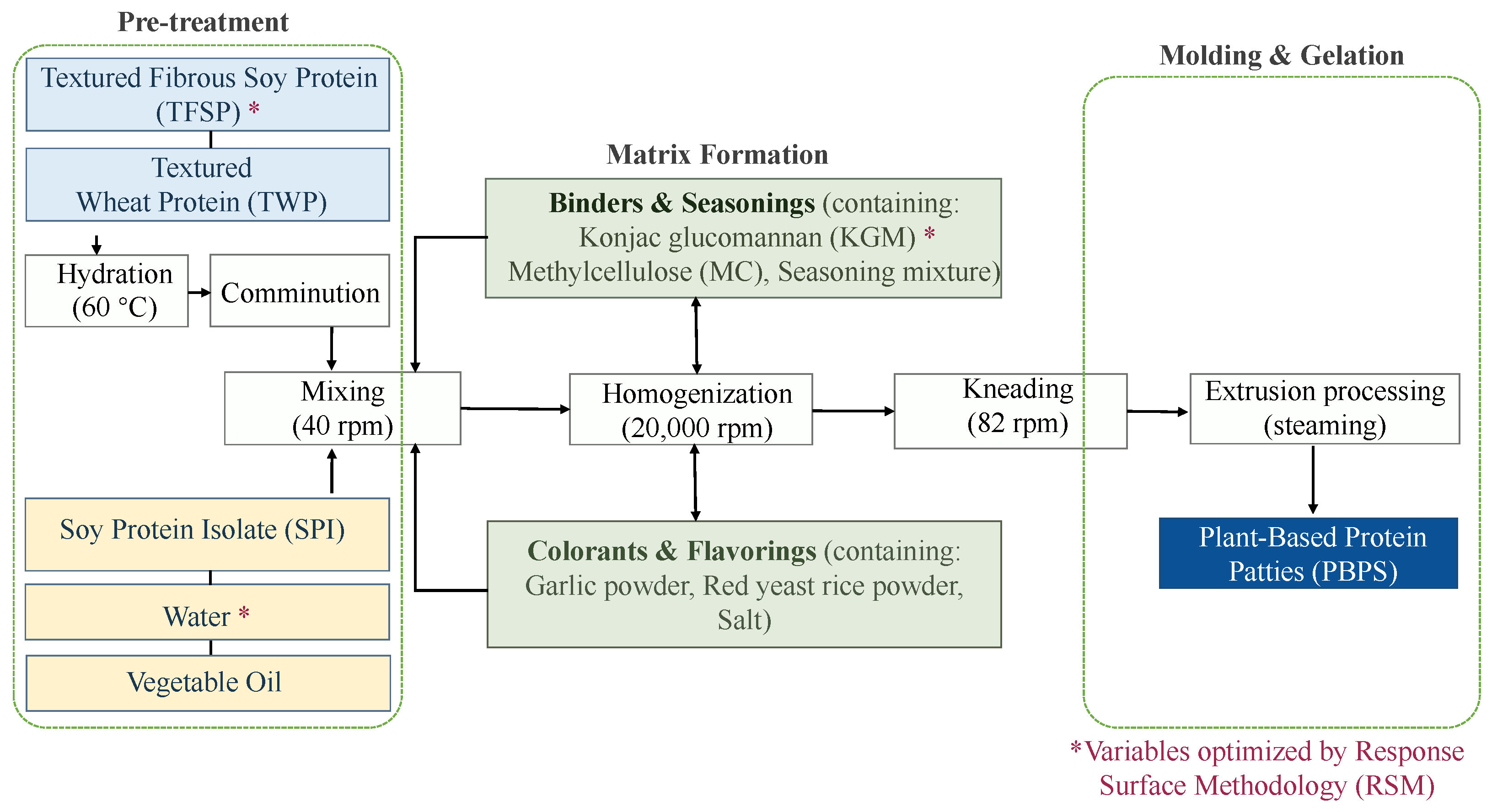
To systematically determine the optimal formulation parameters for the PBPs prior to response surface modeling, the independent effects of TFSP, water, and KGM on the composite textural properties were investigated. The textural profile, particularly springiness and cohesiveness, directly dictates the structural integrity and the simulation of authentic meat mouthfeel in plant-based alternatives.
3.1.1. Effect of TFSP Addition
The influence of TFSP addition on the texture of the PBPs is summarized in
Table 2. As the addition level increased from 15 g to 60 g, both springiness and cohesiveness exhibited an initial upward trend, reaching peak values of 1.56 mm and 0.28, respectively. Conversely, hardness decreased significantly (
p < 0.05) from 22.80 N to 4.53 N across the tested range. Mechanistically, an addition of approximately 60 g provided an optimal ratio for the hydrated fibrillar proteins to interweave comprehensively with other matrix components, such as soy protein isolate and the polysaccharide hydrocolloid. This interweaving process is primarily driven by intermolecular forces, including hydrophobic associations and hydrogen bonding, which facilitate the filling of structural voids and the compaction of the microstructural network [
20]. Consequently, the gel elasticity and internal binding capacity were maximized. When the addition level deviated from this optimal threshold, particularly exceeding 60 g, the cross-linking density of the protein molecules was observed to be either insufficient or excessively aggregated. Excessive addition likely disrupted the stability of the gel network due to the over-swelling of the protein fibers, thereby diminishing both springiness and cohesiveness.
Regarding the secondary TPA parameters, chewiness and gumminess both decreased monotonically as TFSP addition increased from 15 g to 90 g, declining from 4.00 mJ to 0.94 mJ and from 3.93 N to 1.07 N, respectively. This trend is consistent with the concomitant reduction in hardness, as chewiness and gumminess are mathematically derived from hardness and cohesiveness [
21]. Adhesiveness also declined significantly with increasing TFSP (from 4.46 mJ to 1.48 mJ,
p < 0.05), suggesting that higher protein fiber density reduces the surface stickiness of the matrix, likely due to reduced free water availability at the patty surface as the fibrillar network becomes more compact [
22]. Considering the textural optimization results, a baseline of 60 g of TFSP was selected as the central point for subsequent response surface modeling.
3.1.2. Effect of Water Addition
Water acts as a critical plasticizer and solvent within the composite gel system. As presented in
Table 3, springiness and hardness varied significantly with water addition, where springiness peaked at an addition level of 15 g (1.51 mm). An appropriate hydration environment is essential to ensure the adequate dissolution and uniform dispersion of methylcellulose and KGM. This structural hydration facilitates the formation of a robust hydrocolloid gel driven by subsequent dehydration characteristics during thermal processing. A stable aqueous phase effectively prevents moisture migration and loss during cooking, thereby imparting a juicy texture analogous to real meat [
23]. Furthermore, an optimal water level prevents the excessive swelling of textured proteins, thereby maintaining structural stability. Conversely, excessive water addition beyond 15 g resulted in a diluted matrix, leading to a loose structural network and a substantial decline in overall textural attributes. Notably, cohesiveness increased progressively with water content (from 0.19 at 5 g to 0.31 at 55 g), which may appear counterintuitive. This phenomenon can be attributed to the plasticizing effect of excess water on the biopolymer chains: while the overall network becomes mechanically weaker, the increased molecular mobility allows the matrix to deform more uniformly under compression without fracturing, yielding a higher ratio of the second compression force to the first and thus an apparent increase in cohesiveness [
24]. This finding suggests that cohesiveness and springiness respond differently to hydration, and that springiness—rather than cohesiveness—is the more discriminating indicator of structural integrity in this system.
With respect to the secondary TPA parameters, chewiness, gumminess, and adhesiveness all decreased as water addition increased beyond 15 g (
Table 3). Chewiness declined from 2.11 mJ at 5 g water to 0.74 mJ at 55 g, and gumminess followed a similar downward trend from 1.37 N to 0.83 N. This is mechanistically consistent with the progressive dilution of the gel network, which reduces the energy required for mastication [
25]. Adhesiveness also decreased with excess water (from 4.40 mJ to 1.56 mJ), indicating that over-hydration reduces interfacial stickiness, possibly due to disruption of the hydrocolloid surface film formed by KGM and MC under optimal hydration conditions. Collectively, these results confirm that 15 g represents the optimal water addition level, balancing hydration of structural components with maintenance of network integrity across all TPA parameters.
3.1.3. Effect of KGM Addition
The incorporation of KGM significantly influenced the structural network of the patties. As shown in
Table 4, springiness and cohesiveness increased to maximum values of 1.53 mm and 0.30, respectively, at a dosage of 10 g before decreasing at higher concentrations. KGM is a neutral polysaccharide composed of β-1,4-linked D-glucose and D-mannose units. Upon thermal processing under the mildly alkaline conditions generated by the seasoning matrix, partial deacetylation of the acetyl substituents exposes hydrophobic domains along the KGM backbone. These exposed domains facilitate intermolecular aggregation through hydrophobic stacking and hydrogen bonding, producing a thermo-irreversible three-dimensional gel network that resists re-melting upon cooling [
26]. Within the composite soy protein-KGM system, the high molecular weight and hydrodynamic volume of KGM generate a macromolecular crowding effect: KGM chains occupy a substantial portion of the aqueous phase, effectively increasing the local concentration of soy protein fibers in the continuous phase. This thermodynamic crowding drives accelerated protein-protein aggregation and cross-linking, resulting in a denser, more elastically resilient interpenetrating network. Consequently, springiness and cohesiveness increased markedly from 2.5 g to 10 g KGM, as the growing network density enhanced the elastic recovery capacity of the gel upon deformation. Beyond 10 g, however, excessive KGM concentration likely introduced phase separation effects, where over-concentrated polysaccharide chains competed with protein fibers for available water, disrupting the homogeneity of the network and reducing springiness. The superior water-holding capacity of KGM additionally retarded moisture loss during steaming, preserving gel plasticity and mitigating the thermal hardening that commonly occurs in protein-only systems [
27].
The secondary TPA parameters followed distinct trends with increasing KGM. Chewiness and gumminess increased monotonically from 0.58 mJ and 0.77 N at 2.5 g KGM to 1.76 mJ and 1.60 N at 15 g, respectively, reflecting the progressive consolidation of the biopolymer gel network. Adhesiveness also increased substantially with KGM dosage (from 2.20 mJ to 4.54 mJ), which is directly attributable to the exceptional water-holding capacity of KGM that creates a viscous, adherent surface layer on the patty. This elevated adhesiveness may be considered a functional advantage in plant-based applications, as it promotes cohesion between the patty and coating materials during commercial processing. Therefore, 10 g was identified as the appropriate KGM inclusion level for the formulation, at which springiness and cohesiveness were maximized without the adverse phase separation effects associated with higher concentrations.
3.3. Validation of the Optimized Formulation
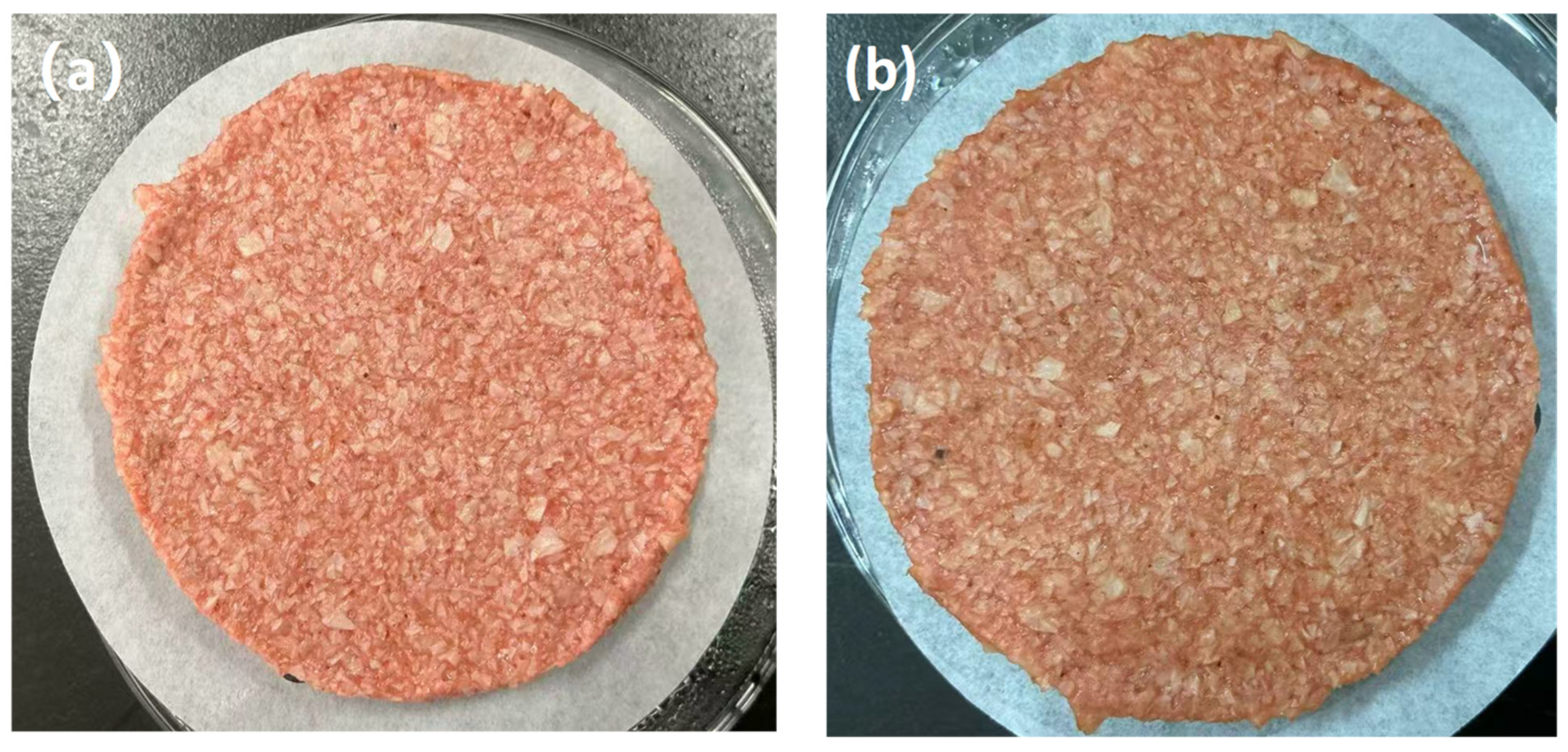
To validate the predictive model, three independent batches of plant-based patties were prepared using the optimized ingredient levels (63.36 g TFSP, 14.39 g water, and 8.57 g KGM) following the identical preparation protocol described in
Section 2.2, including the same hydration, emulsification, mixing, kneading, molding, and steaming parameters. All other formulation components were held constant at the baseline levels specified in
Section 2.2. Textural properties of the three validation batches were measured in five replicates per batch using the TPA protocol described in
Section 2.3, and results are reported as mean ± standard deviation.
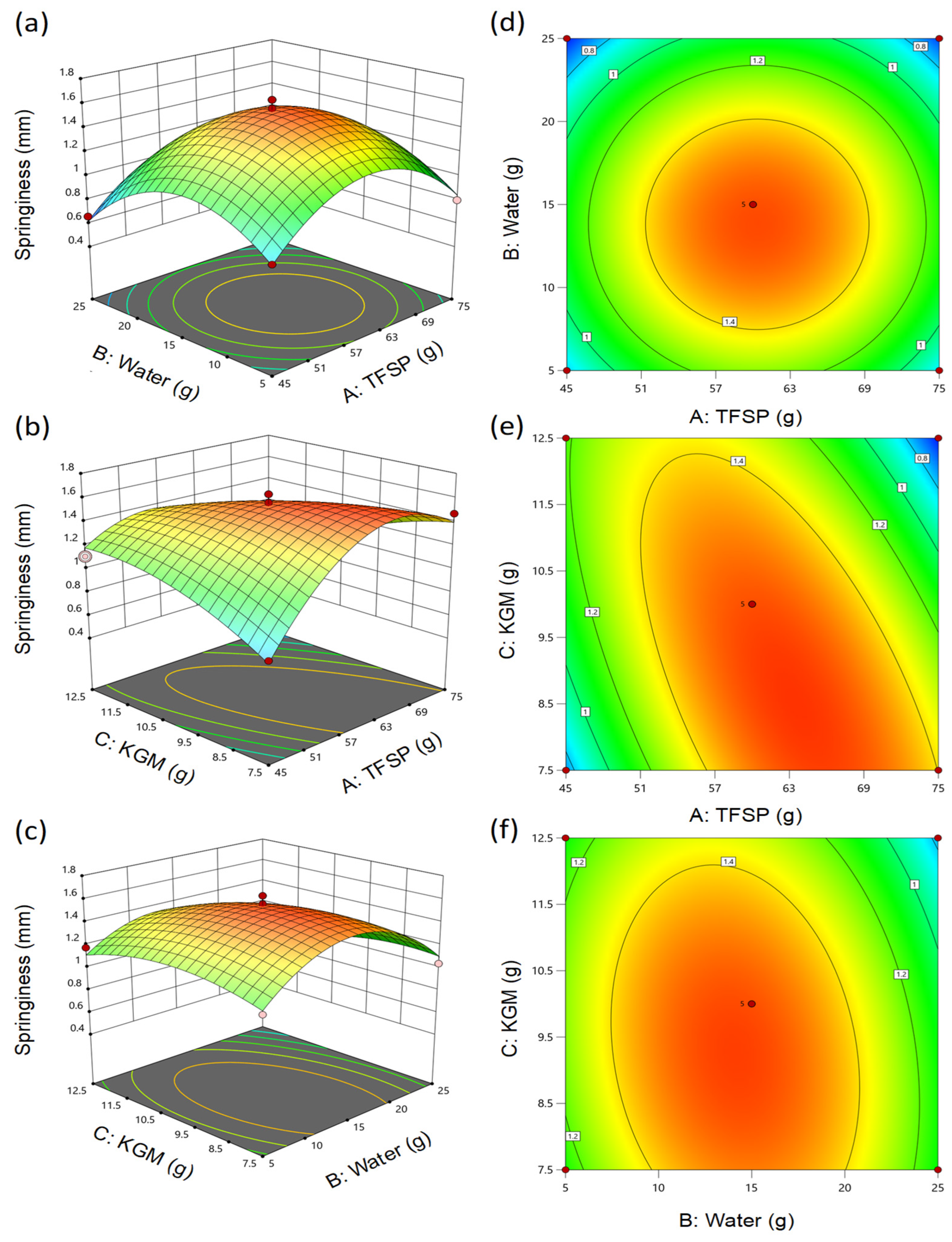
The fundamental objective of utilizing response surface methodology in this study was to identify the precise compositional ratio that maximizes the springiness of the plant-based patties, as this specific rheological parameter serves as a critical determinant of masticatory satisfaction and structural resilience. By mathematically solving the established second-order polynomial regression equation, the optimal formulation was derived. In the numerical optimization procedure conducted using Design-Expert, the goal for springiness was set to “maximize”, with the lower bound defined as the minimum observed experimental value (0.59 mm) and the upper bound as the maximum observed value (1.63 mm). The “maximize” criterion was selected—rather than a specific target value—because the primary objective of this study was to identify the formulation that achieves the highest attainable springiness within the tested compositional range, consistent with the goal of maximizing meat-like elastic recovery. The desirability function value for the identified optimal formulation (63.36 g TFSP, 14.39 g water, 8.57 g KGM) was 0.952, indicating a high degree of optimization confidence and confirming that this solution closely approaches the theoretical maximum springiness within the defined experimental space.
The empirical springiness value was determined to be 1.56 ± 0.05 mm (
Table 8). A comparative analysis between the theoretical prediction (1.58 mm) and the experimental outcome (1.56 mm) reveals a remarkable concordance, yielding a negligible relative error of approximately 1.27%. This exceptionally high degree of fitting effectively verifies that no significant overfitting occurred during the statistical modeling process. Furthermore, it substantiates the high precision and adequacy of the Box–Behnken design in capturing the complex, non-linear ternary interactions among the protein fibrous backbone, the aqueous plasticizer, and the polysaccharide binder. Consequently, the validated regression model is confirmed to be highly robust, providing standardized engineering parameters and a reliable theoretical framework for the industrial scale-up manufacturing of premium vegetarian meat products with targeted textural profiles.
Table 8.
Predicted and experimental values of springiness under optimal process conditions.
Table 8.
Predicted and experimental values of springiness under optimal process conditions.
| Item | Springiness (mm) |
|---|
| Experimental value | 1.56 ± 0.05 |
| Predicted value | 1.58 |
3.4. Comparison of the Optimized Plant-Based Patties with Conventional Animal Meat Patties
To comprehensively evaluate the textural fidelity of the optimized plant-based patties (PBPs), a comparative analysis was conducted against conventional animal meat patties (beef, chicken, and lamb) using Texture Profile Analysis (TPA) parameters sourced from recent literature.
Table 9 presents the experimental TPA values of the optimized PBP alongside the literature-derived values for conventional beef [
30], chicken [
31], and lamb patties [
32]. As noted by Bohrer [
33], achieving the precise textural characteristics of traditional meat analogues remains a formidable challenge due to the distinct physicochemical behavior of plant proteins compared to myofibrillar proteins during thermal gelation.
It is important to note that while springiness was designated as the primary optimization response variable in this study, the comparative analysis presented in this section encompasses the full TPA profile of the optimized PBP. This approach is intentional and scientifically justified: RSM optimization was performed targeting springiness because it was identified as the most sensitive and discriminating parameter for formulation development, exhibiting the clearest non-linear response to all three formulation variables within the experimental domain. However, a comprehensive evaluation of the optimized product against conventional meat benchmarks necessarily involves all measurable textural attributes, as consumers and industry evaluators assess meat quality holistically rather than on a single parameter. Regarding springiness specifically, the optimized PBP achieved a value of 1.56 ± 0.05 mm, which falls within the range reported for conventional beef patties in the literature (typically 0.80–1.80 mm depending on fat content and cooking method), indicating that the optimized formulation successfully replicates the elastic recovery characteristics of conventional meat to a satisfactory degree. However, we acknowledge that direct numerical comparison of springiness with the three reference studies cited in
Table 9 was not possible, as these studies did not report springiness values under comparable measurement conditions. The remaining TPA parameters are therefore discussed below to provide a complete textural profile and contextual understanding of how the optimized PBP performs relative to conventional meat benchmarks.
The optimized PBP exhibited a hardness of 5.51 ± 0.03 N, which is generally lower than the conventional beef (9.97 N) [
30] and lamb patties (16.41 N) [
32], and significantly softer than typical commercial chicken patties (54.58 N) [
31]. This indicates that while the KGM and TFSP successfully formed a cohesive interpenetrating gel, the resulting matrix presents a more tender masticatory profile compared to the dense actomyosin networks in real meat. The cohesiveness of the PBP (0.23 ± 0.02) was slightly lower than that of the animal meat counterparts (typically ranging from 0.35 to 0.45). This variation is characteristic of the fibrous but less highly cross-linked nature of textured soy matrices, which lack the continuous myofibrillar architecture responsible for the high structural cohesion observed in genuine muscle tissue.
Furthermore, the chewiness (1.98 ± 0.02 mJ) and gumminess (1.27 ± 0.15 N) of the PBP were correspondingly lower than the conventional meat references. Since these secondary TPA parameters are mathematically derived from hardness and cohesiveness, the tender nature of the PBP directly translates to a reduced energy requirement for mastication. Interestingly, the adhesiveness of the PBP (3.25 ± 0.04 mJ) was notably higher than that of the reference animal meat models (e.g., chicken at 0.16 mJ). This unique attribute can be directly ascribed to the strong water-binding capacity and viscous gelation properties of the KGM binder acting within the interstitial spaces of the soy protein network. Overall, the optimized formulation provides a highly acceptable, tender, and cohesive structural matrix that effectively simulates the sensory bite of conventional meat patties, whilst offering a customizable structural platform for targeted textural modifications.
It is important to acknowledge that the relatively low hardness (5.51 N) and cohesiveness (0.23) of the optimized PBP, compared to conventional meat patties, may raise practical concerns regarding shape retention and structural stability during cooking and handling. In theory, reduced cohesiveness increases the susceptibility of the matrix to fragmentation under mechanical stress, particularly during pan-frying or grilling where thermal shrinkage forces are considerable. However, in the present study, the thermo-irreversible gelation of KGM plays a critical compensatory role: upon heating, KGM undergoes irreversible network consolidation via deacetylation-driven hydrogen bonding, which effectively locks the interpenetrating biopolymer architecture and mitigates deformation [
26]. Furthermore, the inclusion of MC as a co-binder provides additional thermal gelation capacity, as MC exhibits a reverse thermal gelation behavior that increases gel strength precisely during the cooking phase, thereby maintaining patty integrity under heat [
20]. The molding geometry (50 mm diameter, 10 mm thickness) and the controlled steaming protocol (5 min at 800–1000 W) further support dimensional stability by avoiding the mechanical agitation associated with direct-contact cooking methods.
Nonetheless, we acknowledge that long-term cold storage stability and the effects of repeated freeze–thaw cycles on cohesiveness warrant systematic investigation in future work. Reformulation strategies such as increasing MC concentration, incorporating transglutaminase as a protein cross-linking agent, or introducing structured plant fiber networks could be explored to further improve shape fidelity and handling robustness for commercial applications.




 ,
,