Global Regulatory Mandates as Drivers for Advanced Chemical Analysis in Food Safety




Abstract
1. Introduction
1.1. Global Regulatory Context and Aims of the Review
1.2. Review Methodology and Scope
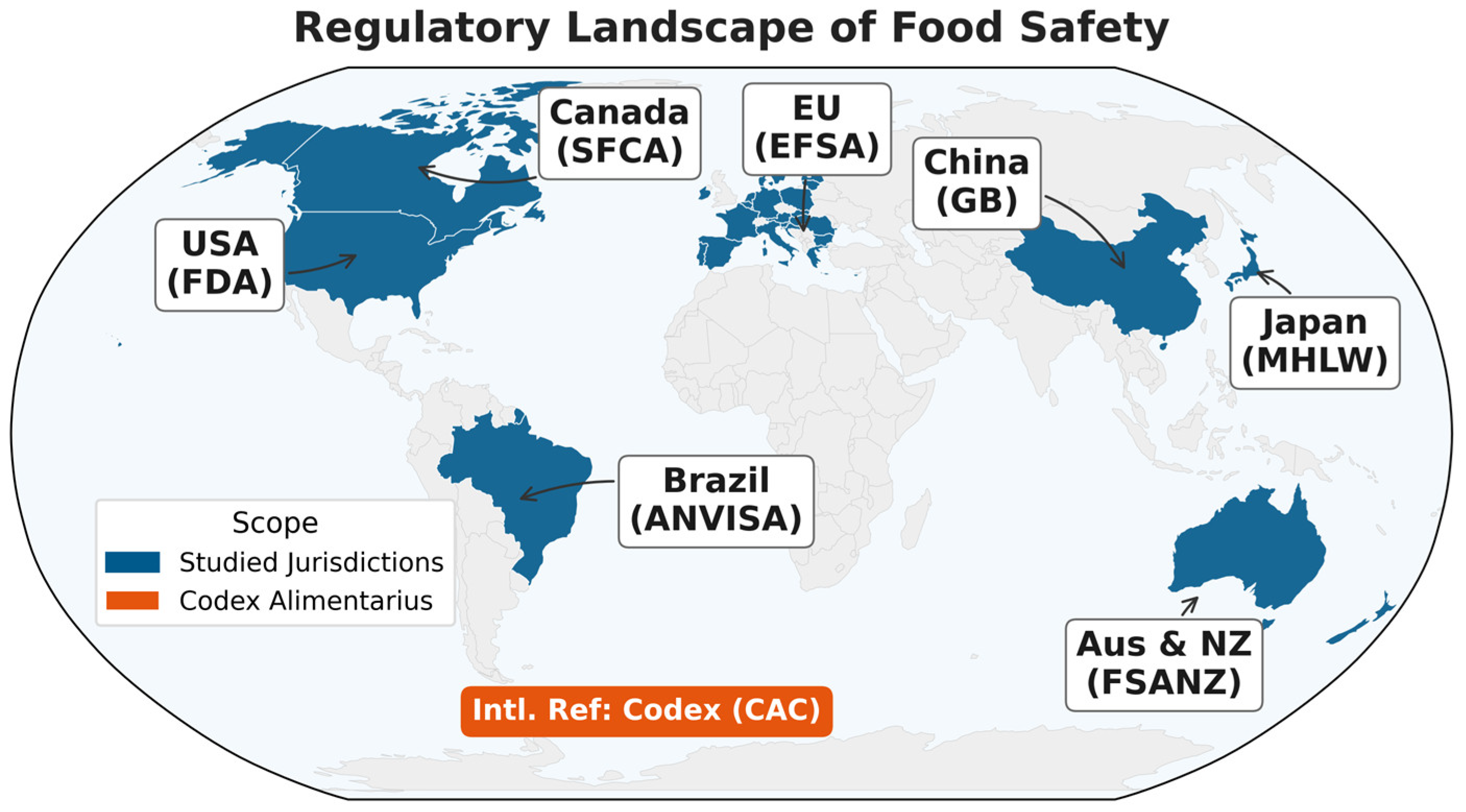
1.2.1. Rationale for the Selected Jurisdictions
1.2.2. Information Acquisition Strategy and Selection Criteria
2. The Legislative Mandate: Translating Preventive Policy into Analytical Requirements
2.1. The Evolution from Reaction to Prevention
2.2. Key Statutes: Global Convergence and Regional Heterogeneity
2.3. The Mandate for Verification and Its Analytical Implications
2.3.1. Maximum Residue Limits (MRLs) and Method Sensitivity
2.3.2. Scope of Regulation and Multi-Residue Methods (MRMs)
2.3.3. Legal Defensibility and Method Validation
3. Regulatory and Laboratory Infrastructure for Chemical Analysis
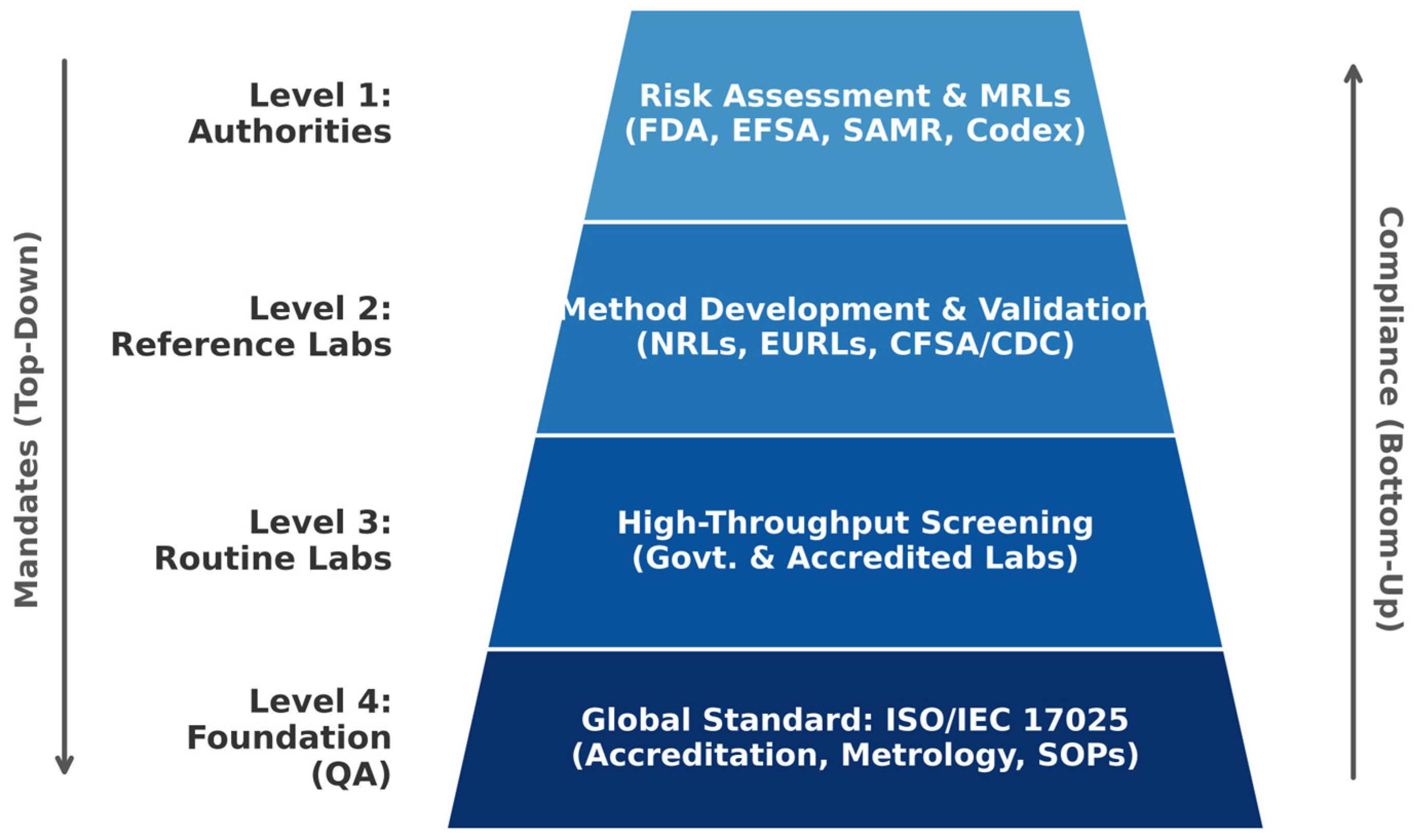
3.1. Governance Models and Their Analytical Mandates
3.2. The Role of National Reference Laboratories in Method Standardization
3.3. Routine Control Laboratories: The Primary Analytical Network
3.4. Quality Assurance and ISO/IEC 17025 Accreditation
4. Regulatory Frameworks as the Foundation for Chemical Analysis
4.1. Regulatory Paradigms: Risk-Based vs. Hazard-Based Approaches
4.2. The Analytical Scope: From Negative to Positive List Systems
4.3. Expanding Positive Lists: Driving High-Throughput MRMs and Sample Preparation
4.4. The “Zero Tolerance” Imperative: MRPLs and the Push for Ultra-Trace Analysis
4.5. The Matrix Reality: Validation Bottlenecks in Ultra-Trace Validation
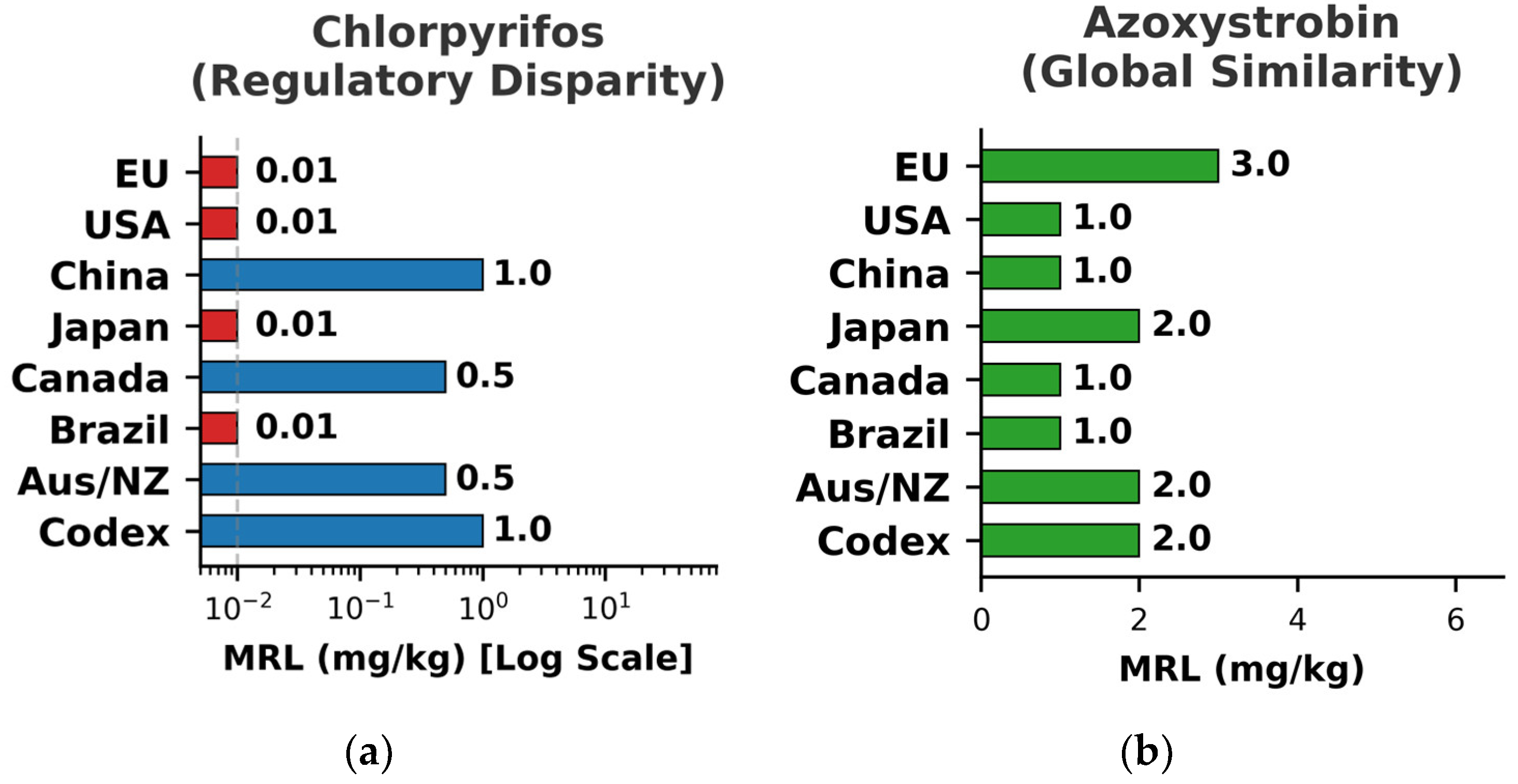
4.6. Global Compliance Benchmarks and Regulatory Asymmetry
4.6.1. The 0.01 mg/kg Default Limit: Regional Mandates as Global Performance Baselines
4.6.2. Asynchronous Standards and Defensive Technological Redundancy
5. Risk Assessment: The Toxicological and Dietary Origins of Analytical Limits
5.1. The Toxicological Foundation: ADI and ARfD
5.2. The Role of Dietary Exposure
5.3. From MRL to LOQ: Deriving the Analytical Requirement
5.4. Method Validation: Ensuring Data Reliability and Comparability
5.5. The Instrumental Imperative for Tandem Mass Spectrometry
6. Limitations of Current Frameworks and Future Analytical Trajectories
6.1. The Operational and Economic Burden of Regulatory Asymmetry
6.2. The Environmental Footprint of Ultra-Trace Analysis
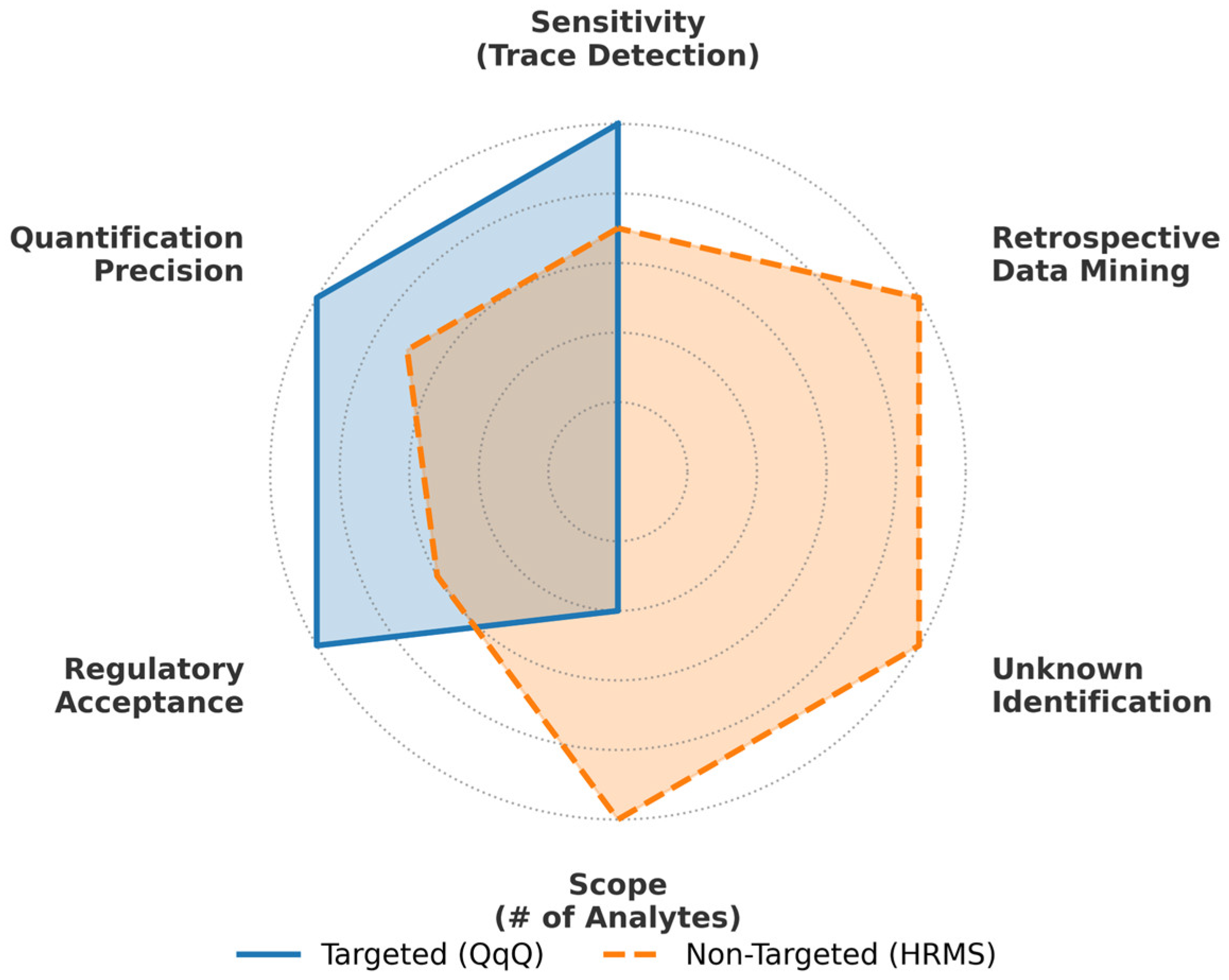
6.3. Transitioning from Targeted Monitoring to Non-Targeted Screening (HRMS)
6.4. Analytical Challenges for Emerging Contaminants and Novel Foods
7. Conclusions
Author Contributions
Funding
Institutional Review Board Statement
Informed Consent Statement
Data Availability Statement
Acknowledgments
Conflicts of Interest
Abbreviations
| ADI | Acceptable Daily Intake |
| ALARA | As Low As Reasonably Achievable |
| ANVISA | Brazilian Health Regulatory Agency (Agência Nacional de Vigilância Sanitária) |
| ARfD | Acute Reference Dose |
| CAC | Codex Alimentarius Commission |
| CDC | Center for Disease Control and Prevention (China) |
| CFIA | Canadian Food Inspection Agency |
| CFSA | China National Center for Food Safety Risk Assessment |
| EFSA | European Food Safety Authority |
| EMA | Economically Motivated Adulteration |
| EPA | Environmental Protection Agency (USA) |
| EU | European Union |
| EURL | European Union Reference Laboratory |
| FDA | Food and Drug Administration (USA) |
| FSANZ | Food Standards Australia New Zealand |
| FSMA | Food Safety Modernization Act (USA) |
| GAP | Good Agricultural Practice |
| GC-MS/MS | Gas Chromatography-Tandem Mass Spectrometry |
| HBGV | Health-Based Guidance Value |
| HRMS | High-Resolution Mass Spectrometry |
| ICP-MS | Inductively Coupled Plasma Mass Spectrometry |
| ISO | International Organization for Standardization |
| LC-MS/MS | Liquid Chromatography-Tandem Mass Spectrometry |
| LOD | Limit of Detection |
| LOQ | Limit of Quantitation |
| MAPA | Ministry of Agriculture, Livestock and Food Supply (Brazil) |
| MHLW | Ministry of Health, Labour and Welfare (Japan) |
| ML | Maximum Level |
| MPL | Minimum Performance Limit |
| MRL | Maximum Residue Limit |
| MRM | Multi-Residue Method |
| MRPL | Minimum Required Performance Limit |
| NFSS | National Food Safety Standards (China) |
| NRL | National Reference Laboratory |
| PT | Proficiency Testing |
| Q-TOF | Quadrupole Time-of-Flight Mass Spectrometry |
| QuEChERS | Quick, Easy, Cheap, Effective, Rugged, and Safe (extraction method) |
| RSD | Relative Standard Deviation |
| SAMR | State Administration for Market Regulation (China) |
| SFCA | Safe Food for Canadians Act |
| SPS | Sanitary and Phytosanitary Agreement (WTO) |
| SRM | Single-Residue Method |
| STMR | Supervised Trial Median Residue |
| USDA | United States Department of Agriculture |
| WTO | World Trade Organization |
References
- Keener, L.; Nicholson-Keener, S.M.; Koutchma, T. Harmonization of Legislation and Regulations to Achieve Food Safety: US and Canada Perspective. J. Sci. Food Agric. 2014, 94, 1947–1953. [Google Scholar] [CrossRef] [PubMed]
- Handford, C.E.; Elliott, C.T.; Campbell, K. A Review of the Global Pesticide Legislation and the Scale of Challenge in Reaching the Global Harmonization of Food Safety Standards. Integr. Environ. Assess. Manag. 2015, 11, 525–536. [Google Scholar] [CrossRef]
- Okunola, A.; Dennis, E.; Beghin, J. Are Veterinary Drug Maximum Residue Limits Protectionist? International Evidence. Appl. Econ. Perspect. Policy 2025, 47, 1209–1231. [Google Scholar] [CrossRef]
- Bureau, J.-C.; Swinnen, J. EU Policies and Global Food Security. Glob. Food Secur. 2018, 16, 106–115. [Google Scholar] [CrossRef]
- Fiankor, D.-D.D.; Curzi, D.; Olper, A. Trade, Price and Quality Upgrading Effects of Agri-Food Standards. Eur. Rev. Agric. Econ. 2021, 48, 835–877. [Google Scholar] [CrossRef]
- Liu, X. International Perspectives on Food Safety and Regulations—A Need for Harmonized Regulations: Perspectives in China. J. Sci. Food Agric. 2014, 94, 1928–1931. [Google Scholar] [CrossRef]
- Wu, D.; Ding, H.; Chen, J.; Fan, Y. A Delphi Approach to Develop an Evaluation Indicator System for the National Food Safety Standards of China. Food Control 2021, 121, 107591. [Google Scholar] [CrossRef]
- Shao, Y.; Wang, J.; Chen, X.; Wu, Y. The Consolidation of Food Contaminants Standards in China. Food Control 2014, 43, 213–216. [Google Scholar] [CrossRef]
- Ghosh, D. Food Safety Regulations in Australia and New Zealand Food Standards. J. Sci. Food Agric. 2014, 94, 1971–1973. [Google Scholar] [CrossRef] [PubMed]
- Halabi, S.; Lin, C.-F. Assessing the Relative Influence and Efficacy of Public and Private Food Safety Regulation Regimes: Comparing Codex and Global GAP Standards. Food Drug Law J. 2017, 72, 262–295. [Google Scholar]
- Russ, K.; Baker, P.; Byrd, M.; Kang, M.; Siregar, R.N.; Zahid, H.; McCoy, D. What You Don’t Know About the Codex Can Hurt You: How Trade Policy Trumps Global Health Governance in Infant and Young Child Nutrition. Int. J. Health Policy Manag. 2021, 10, 983–997. [Google Scholar] [CrossRef]
- Liu, Z.; Mutukumira, A.N.; Chen, H. Food Safety Governance in China: From Supervision to Coregulation. Food Sci. Nutr. 2019, 7, 4127–4139. [Google Scholar] [CrossRef]
- Łozowicka, B.; Kaczyński, P.; Wołejko, E.; Jankowska, M.; Iwaniuk, P.; Hrynko, I.; Rutkowska, E.; Łuniewski, S.; Ilyasova, G.; Jabłońska-Trypuć, A.; et al. Comprehensive Toxicological Multi-Year Study on Pesticides in Apples: Control, Trends and Dietary Risk Assessment. Food Chem. 2025, 464, 141897. [Google Scholar] [CrossRef]
- Jankowska, M.; Kaczyński, P.; Absatarova, D.; Iwaniuk, P.; Hrynko, I.; Konecki, R.; Łozowicka, B.; Łuniewski, S.; Pietkun, M.; Rutkowska, E.; et al. The Pesticide Residue Status in Fruits and Fashionable Smoothies in the Context of Acute Exposure and Cumulative Health Risk. Food Control 2026, 181, 111739. [Google Scholar] [CrossRef]
- Rutkowska, E.; Kaczyński, P.; Iwaniuk, P.; Łozowicka, B.; Hrynko, I.; Jankowska, M.; Konecki, R.; Rogowska, W.; Rusiłowska, J.; Pietkun, M.; et al. An Extensive Pesticide Residue Study in Minor Polish Vegetables Based on Critical Consumer Diets. Food Control 2025, 176, 111383. [Google Scholar] [CrossRef]
- Li, Y.; Beghin, J.C. Protectionism Indices for Non-Tariff Measures: An Application to Maximum Residue Levels. Food Policy 2014, 45, 57–68. [Google Scholar] [CrossRef]
- Pang, X.-N.; Li, Z.-J.; Chen, J.-Y.; Gao, L.-J.; Han, B.-Z. A Comprehensive Review of Spirit Drink Safety Standards and Regulations from an International Perspective. J. Food Prot. 2017, 80, 431–442. [Google Scholar] [CrossRef]
- Kay, J.F. Effective Management Tools for Participants at Codex Committee on Residues of Veterinary Drugs Meetings. Drug Test. Anal. 2016, 8, 445–447. [Google Scholar] [CrossRef] [PubMed]
- Konings, E.J.M.; Roux, A.; Reungoat, A.; Nicod, N.; Campos-Giménez, E.; Ameye, L.; Bucheli, P.; Alloncle, S.; Dey, J.; Daix, G.; et al. Challenge to Evaluate Regulatory Compliance for Nutrients in Infant Formulas with Current State-of-the-Art Analytical Reference Methods. Food Control 2021, 119, 107423. [Google Scholar] [CrossRef]
- World Trade Organization. World Trade Statistical Review 2023; World Trade Organization: Geneva, Switzerland, 2023; p. 72. [Google Scholar]
- Malik, S.; Krishnaswamy, K.; Mustapha, A. Hazard Analysis and Risk-Based Preventive Controls (HARPC): Current Food Safety and Quality Standards for Complementary Foods. Foods 2021, 10, 2199. [Google Scholar] [CrossRef] [PubMed]
- Zhang, Z.; Godefroy, S.B.; Lyu, H.; Sun, B.; Fan, Y. Transformation of China’s Food Safety Standard Setting System—Review of 50 Years of Change, Opportunities and Challenges Ahead. Food Control 2018, 93, 106–111. [Google Scholar] [CrossRef]
- Micallef, S.A.; Buchanan, R.L. Regulatory Issues Associated with Preharvest Food Safety: United States Perspective. Microbiol. Spectr. 2017, 5. [Google Scholar] [CrossRef]
- Spink, J.; Fortin, N.D.; Moyer, D.C.; Miao, H.; Wu, Y. Food Fraud Prevention: Policy, Strategy, and Decision-Making—Implementation Steps for a Government Agency or Industry. Chimia 2016, 70, 321–328. [Google Scholar] [CrossRef] [PubMed]
- U.S. Food and Drug Administration. FDA Food Safety Modernization Act; Pub. L. No. 111-353, 124 Stat. 3885; U.S. Food and Drug Administration: Silver Spring, MD, USA, 2011.
- EFSA Panel on Contaminants in the Food Chain (CONTAM). Effect on Public Health of a Possible Increase of the Maximum Level for ‘Aflatoxin Total’ from 4 to 10 Μg/Kg in Peanuts and Processed Products Thereof, Intended for Direct Human Consumption or Use as an Ingredient in Foodstuffs. EFSA J. 2018, 16, 5175. [Google Scholar] [CrossRef] [PubMed]
- Food and Agriculture Organization. Regulation (EC) No 178/2002 of the European Parliament and of the Council of 28 January 2002 Laying down the General Principles and Requirements of Food Law, Establishing the European Food Safety Authority and Laying down Procedures in Matters of Food Safety; Food and Agriculture Organization: Rome, Italy, 2002; Volume 31. [Google Scholar]
- Standing Committee of the National People’s Congress. Food Safety Law of the People’s Republic of China; Standing Committee of the National People’s Congress: Beijing, China, 2025.
- Boatwright, M.; Lawrence, M.; Carriedo, A.; Slater, S.; McCoy, D.; Northcott, T.; Baker, P. Understanding the Politics of Food Regulation and Public Health: An Analysis of Codex Standard-Setting Processes on Food Labelling. Int. J. Health Policy Manag. 2024, 13, 8310. [Google Scholar] [CrossRef]
- Liu, Z.; Liu, B.; Chen, G. Retrospective Analysis of the Development History of the Chinese Food Additive Standards System Based on the CODEX Principles. npj Sci. Food 2019, 3, 27–32. [Google Scholar] [CrossRef]
- Parliament of Canada. Safe Food for Canadians Act; Vol. S.C. 2012, c. 24; Government of Canada: Ottawa, ON, Canada, 2012.
- Food Sanitation Act-English-Japanese Law Translation. Available online: https://www.japaneselawtranslation.go.jp/en/laws/view/3687/en (accessed on 19 March 2026).
- Law No. 14.785 on the Control of Pesticides. Available online: https://www.planalto.gov.br/ccivil_03/_ato2023-2026/2023/lei/l14785.htm (accessed on 19 March 2026). (In Portuguese)
- Australasian Legal Information Institute. Food Standards Australia New Zealand Act 1991 (Compilation No. 29, 2024); Act No. 118 of 1991; Australasian Legal Information Institute: Ultimo, Australia, 1991. [Google Scholar]
- FAO; WHO. General Principles of Food Hygiene; FAO: Rome, Italy; WHO: Geneva, Switzerland, 2023. [Google Scholar]
- European Food Safety Authority (EFSA). The 2019 European Union Report on Pesticide Residues in Food. EFSA J. 2021, 19, e06491. [Google Scholar] [CrossRef] [PubMed]
- Xhaferaj, M.; Alves, T.O.; Ferreira, M.S.L.; Scherf, K.A. Recent Progress in Analytical Method Development to Ensure the Safety of Gluten-Free Foods for Celiac Disease Patients. J. Cereal Sci. 2020, 96, 103114. [Google Scholar] [CrossRef]
- Ding, H.; Wu, D.; Lyu, H.; Zhang, X.; Fan, Y.; Tian, J. Developing a Quality Index and an Evaluation Indicator System for the National Food Safety Standard Framework in China. J. Public Health Policy 2026, 47, 99–112. [Google Scholar] [CrossRef]
- Buncic, S.; Alban, L.; Blagojevic, B. From Traditional Meat Inspection to Development of Meat Safety Assurance Programs in Pig Abattoirs—The European Situation. Food Control 2019, 106, 106705. [Google Scholar] [CrossRef]
- Donley, N. The USA Lags behind Other Agricultural Nations in Banning Harmful Pesticides. Environ. Health 2019, 18, 44–55. [Google Scholar] [CrossRef]
- European Food Safety Authority (EFSA). Reporting Data on Pesticide Residues in Food and Feed According to Regulation (EC) No 396/2005 (2016 Data Collection). EFSA J. 2017, 15, e04792. [Google Scholar] [CrossRef] [PubMed][Green Version]
- European Food Safety Authority (EFSA). Review of the Existing Maximum Residue Levels for 2-Phenylphenol According to Article 12 of Regulation (EC) No 396/2005. EFSA J. 2017, 15, e04696. [Google Scholar] [CrossRef][Green Version]
- Ren, X.; Wang, Y.; Sun, J.; Liang, K.; Zhu, H.; Li, Y.; Gao, J.; Zhang, Y.; Huang, S.; Zhu, D. Legal Standards for Selenium Enriched Foods and Agricultural Products: Domestic and International Perspectives. Nutrients 2024, 16, 3659. [Google Scholar] [CrossRef]
- Han, R.-W.; Yu, Z.-N.; Zhen, T.-Y.; Wang, J. Survey of Veterinary Drug Residues in Raw Milk in Hebei Province, China. J. Food Prot. 2017, 80, 1890–1896. [Google Scholar] [CrossRef]
- European Food Safety Authority (EFSA). The 2020 European Union Report on Pesticide Residues in Food. EFSA J. 2022, 20, e07215. [Google Scholar] [CrossRef] [PubMed]
- Berendsen, B.J.A.; Meijer, T.; Mol, H.G.J.; Van Ginkel, L.; Nielen, M.W.F. A Global Inter-Laboratory Study to Assess Acquisition Modes for Multi-Compound Confirmatory Analysis of Veterinary Drugs Using Liquid Chromatography Coupled to Triple Quadrupole, Time of Flight and Orbitrap Mass Spectrometry. Anal. Chim. Acta 2017, 962, 60–72. [Google Scholar] [CrossRef]
- Baynes, R.E.; Dedonder, K.; Kissell, L.; Mzyk, D.; Marmulak, T.; Smith, G.; Tell, L.; Gehring, R.; Davis, J.; Riviere, J.E. Health Concerns and Management of Select Veterinary Drug Residues. Food Chem. Toxicol. 2016, 88, 112–122. [Google Scholar] [CrossRef]
- European Food Safety Authority (EFSA). Use of EFSA Pesticide Residue Intake Model (EFSA PRIMo Revision 3). EFSA J. 2018, 16, e05147. [Google Scholar] [CrossRef]
- European Food Safety Authority (EFSA). Establishment of Cumulative Assessment Groups of Pesticides for Their Effects on the Thyroid. EFSA J. 2019, 17, e05801. [Google Scholar] [CrossRef]
- European Food Safety Authority (EFSA). Scientific Support for Preparing an EU Position in the 53rd Session of the Codex Committee on Pesticide Residues (CCPR). EFSA J. 2022, 20, e06766. [Google Scholar] [CrossRef]
- European Food Safety Authority (EFSA). Review of the Existing Maximum Residue Levels for Dithiocarbamates According to Article 12 of Regulation (EC) No 396/2005. EFSA J. 2023, 21, e07987. [Google Scholar] [CrossRef]
- European Food Safety Authority (EFSA). Panel on Plant Protection Products and their Residues (PPR) Scientific Opinion on Pesticides in Foods for Infants and Young Children. EFSA J. 2018, 16, e05286. [Google Scholar] [CrossRef]
- Sun, H.; Luo, F.; Zhang, X.; Zhou, L.; Lou, Z.; Chen, Z. Residue Analysis and Dietary Exposure Risk Assessment of Acibenzolar-S-Methyl and Its Metabolite Acibenzolar Acid in Potato, Garlic, Cabbage, Grape and Tomato. Ecotoxicol. Environ. Saf. 2021, 207, 111178. [Google Scholar] [CrossRef]
- Usman, M.; Morsi, R.; Ghoudi, K.; Sayed Yaqoub, K.; Alblooshi, M.; Alneyadi, A.; Al Hashemi, S.; Ayyash, M.; Meetani, M.A. Ultra-Trace Detection of Carbamate Pesticides and Their Metabolites in Camel Milk Using Ultra-High-Performance Liquid Chromatography: A Food Safety Perspective. J. Dairy Sci. 2025, 108, 9238–9249. [Google Scholar] [CrossRef]
- Rodríguez-Ramos, R.; Santana-Mayor, Á.; Herrera-Herrera, A.V.; Socas-Rodríguez, B.; Rodríguez-Delgado, M.Á. Evaluation of Pesticide Residues in Rice Marketed in Cape Verde by QuEChERS-LC/GC-MS Analysis. Microchem. J. 2024, 202, 110795. [Google Scholar] [CrossRef]
- European Food Safety Authority (EFSA). Scientific Support for Preparing an EU Position in the 49th Session of the Codex Committee on Pesticide Residues (CCPR). EFSA J. 2017, 15, e04929. [Google Scholar] [CrossRef]
- European Food Safety Authority (EFSA). Scientific Support for Preparing an EU Position in the 50th Session of the Codex Committee on Pesticide Residues (CCPR). EFSA J. 2018, 16, e05306. [Google Scholar] [CrossRef]
- Tanaka, R. Setting of Maximum Residue Limits (MRLs) for Pesticides in Foods. Yakugaku Zasshi 2025, 145, 95–99. [Google Scholar] [CrossRef] [PubMed]
- Castiñeira-Landeira, A.; Sasse, S.; Broeren, M.; Sterk, S.S.; Arrizabalaga-Larrañaga, A. Method Development and Validation for the Simultaneous Determination of 21 Antiviral Drugs by Ultra-High Performance Liquid Chromatography-Tandem Mass Spectrometry in Chicken Muscle and Liver. J. Chromatogr. A 2025, 1743, 465711. [Google Scholar] [CrossRef] [PubMed]
- Valverde, A.; Aguilera, A.; Valverde-Monterreal, A. Practical and Valid Guidelines for Realistic Estimation of Measurement Uncertainty in Multi-Residue Analysis of Pesticides. Food Control 2017, 71, 1–9. [Google Scholar] [CrossRef]
- Berendsen, B.J.A.; Meijer, T.; Wegh, R.; Mol, H.G.J.; Smyth, W.G.; Armstrong Hewitt, S.; Van Ginkel, L.; Nielen, M.W.F. A Critical Assessment of the Performance Criteria in Confirmatory Analysis for Veterinary Drug Residue Analysis Using Mass Spectrometric Detection in Selected Reaction Monitoring Mode. Drug Test. Anal. 2016, 8, 477–490. [Google Scholar] [CrossRef]
- Anastassiades, M.; Lehotay, S.J.; Štajnbaher, D.; Schenck, F.J. Fast and Easy Multiresidue Method Employing Acetonitrile Extraction/Partitioning and “Dispersive Solid-Phase Extraction” for the Determination of Pesticide Residues in Produce. J. AOAC Int. 2003, 86, 412–431. [Google Scholar] [CrossRef]
- Sharma, A.; Dubey, J.K.; Katna, S.; Shandil, D.; Brar, G.S.; Singh, S. Validation of Analytical Methods Used for Pesticide Residue Detection in Fruits and Vegetables. Food Anal. Methods 2021, 14, 1919–1926. [Google Scholar] [CrossRef]
- Lehotay, S.J.; Kok, A.D.; Hiemstra, M.; Bodegraven, P.V. Validation of a Fast and Easy Method for the Determination of Residues from 229 Pesticides in Fruits and Vegetables Using Gas and Liquid Chromatography and Mass Spectrometric Detection. J. AOAC Int. 2005, 88, 595–614. [Google Scholar] [CrossRef] [PubMed]
- Chen, X.; Liu, X.; Dong, B.; Hu, J. Simultaneous Determination of Pyridaben, Dinotefuran, DN and UF in Eggplant Ecosystem under Open-Field Conditions: Dissipation Behaviour and Residue Distribution. Chemosphere 2018, 195, 245–251. [Google Scholar] [CrossRef] [PubMed]
- European Food Safety Authority (EFSA). Modification of the Existing Maximum Residue Levels for Picloram in Animal Commodities and Honey. EFSA J. 2024, 22, e9067. [Google Scholar] [CrossRef]
- Do Rego, E.C.P.; Guimarães, E.D.F.; Dos Santos, A.L.M.; Mothé, E.D.S.M.; Rodrigues, J.M.; Pereira Netto, A.D. The Validation of a New High Throughput Method for Determination of Chloramphenicol in Milk Using Liquid–Liquid Extraction with Low Temperature Partitioning (LLE-LTP) and Isotope-Dilution Liquid Chromatography Tandem Mass Spectrometry (ID-LC-MS/MS). Anal. Methods 2015, 7, 4699–4707. [Google Scholar] [CrossRef]
- European Commission. Analytical Quality Control and Method Validation Procedures for Pesticide Residues Analysis in Food and Feed—SANTE/11312/2021 V2026; European Commission: Brussels, Belgium, 2025. [Google Scholar]
- Gavage, M.; Delahaut, P.; Gillard, N. Suitability of High-Resolution Mass Spectrometry for Routine Analysis of Small Molecules in Food, Feed and Water for Safety and Authenticity Purposes: A Review. Foods 2021, 10, 601. [Google Scholar] [CrossRef]
- Eskola, M.; Kos, G.; Elliott, C.T.; Hajšlová, J.; Mayar, S.; Krska, R. Worldwide Contamination of Food-Crops with Mycotoxins: Validity of the Widely Cited ‘FAO Estimate’ of 25%. Crit. Rev. Food Sci. Nutr. 2020, 60, 2773–2789. [Google Scholar] [CrossRef]
- Xu, R.; Wu, J.; Liu, Y.; Zhao, R.; Chen, B.; Yang, M.; Chen, J. Analysis of Pesticide Residues Using the Quick Easy Cheap Effective Rugged and Safe (QuEChERS) Pesticide Multiresidue Method in Traditional Chinese Medicine by Gas Chromatography with Electron Capture Detection. Chemosphere 2011, 84, 908–912. [Google Scholar] [CrossRef]
- U.S. Food and Drug Administration. Foods Program Methods Validation Processes and Guidelines; U.S. Food and Drug Administration: Silver Spring, MD, USA, 2024.
- Directorate-General for Health and Food Safety, European Commission. EU Pesticides Database. Available online: https://food.ec.europa.eu/plants/pesticides/eu-pesticides-database_en (accessed on 19 March 2026).
- Environmental Protection Agency (EPA). Tolerances and Exemptions for Pesticide Chemical Residues in Food. Available online: https://www.ecfr.gov/current/title-40/chapter-I/subchapter-E/part-180/subpart-C?toc=1 (accessed on 19 March 2026).
- USDA Foreign Agricultural Service. Translation of Maximum Residue Limits for Pesticides in Foods; USDA Foreign Agricultural Service: Beijing, China, 2021.
- The Japan Food Chemical Research Foundation. Pesticide Residue Reference Value Search System. Available online: https://db.ffcr.or.jp/front/ (accessed on 19 March 2026).
- Health Canada, Pest Management Regulatory Agency. Pesticide Product Information—Maximum Residue Limit (MRL) Search. Available online: https://lutte-antiparasitaire.canada.ca/registre-antiparasitaire/fr/recherche-lrm.html (accessed on 19 March 2026).
- Brazilian Health Regulatory Agency (ANVISA). Authorized Pesticide Monographs. Available online: https://www.gov.br/anvisa/pt-br/setorregulado/regularizacao/agrotoxicos/monografias/monografias-autorizadas/c (accessed on 19 March 2026).
- Food Standards Australia New Zealand (FSANZ). Australia New Zealand Food Standards Code—Schedule 20—Maximum Residue Limits; Food Standards Australia New Zealand (FSANZ): Wellington, New Zealand, 2025.
- Codex Alimentarius Commission (CAC). Codex Pesticides Residues in Food Online Database. Available online: https://www.fao.org/fao-who-codexalimentarius/codex-texts/dbs/pestres/en/ (accessed on 19 March 2026).
- Van Der Fels-Klerx, H.J.; Van Asselt, E.D.; Raley, M.; Poulsen, M.; Korsgaard, H.; Bredsdorff, L.; Nauta, M.; D’agostino, M.; Coles, D.; Marvin, H.J.P.; et al. Critical Review of Methods for Risk Ranking of Food-Related Hazards, Based on Risks for Human Health. Crit. Rev. Food Sci. Nutr. 2018, 58, 178–193. [Google Scholar] [CrossRef]
- Dearfield, K.L.; Hoelzer, K.; Kause, J.R. Review of Various Approaches for Assessing Public Health Risks in Regulatory Decision Making: Choosing the Right Approach for the Problem. J. Food Prot. 2014, 77, 1428–1440. [Google Scholar] [CrossRef]
- Medina-Pastor, P.; Valverde, A.; Pihlström, T.; Masselter, S.; Gamon, M.; Mezcua, M.; Rodríguez-Torreblanca, C.; Fernández-Alba, A.R. Comparative Study of the Main Top-down Approaches for the Estimation of Measurement Uncertainty in Multiresidue Analysis of Pesticides in Fruits and Vegetables. J. Agric. Food Chem. 2011, 59, 7609–7619. [Google Scholar] [CrossRef] [PubMed]
- Ambrus, Á.; Doan, V.V.N.; Szenczi-Cseh, J.; Szemánné-Dobrik, H.; Vásárhelyi, A. Quality Control of Pesticide Residue Measurements and Evaluation of Their Results. Molecules 2023, 28, 954. [Google Scholar] [CrossRef] [PubMed]
- Kruve, A.; Rebane, R.; Kipper, K.; Oldekop, M.-L.; Evard, H.; Herodes, K.; Ravio, P.; Leito, I. Tutorial Review on Validation of Liquid Chromatography–Mass Spectrometry Methods: Part I. Anal. Chim. Acta 2015, 870, 29–44. [Google Scholar] [CrossRef] [PubMed]
- State Administration for Market Regulation of the PRC National Public Service Platform for Standards Information. Available online: https://std.samr.gov.cn/ (accessed on 13 April 2026).
- Pesticides|CODEXALIMENTARIUS FAO-WHO. Available online: https://www.fao.org/fao-who-codexalimentarius/thematic-areas/pesticides/en/ (accessed on 19 March 2026).
- Testing Methods for Substances That Are Components of Agricultural Chemicals, Feed Additives or Veterinary Drugs Remaining in Foods. Available online: https://www.mhlw.go.jp/stf/seisakunitsuite/bunya/kenkou_iryou/shokuhin/zanryu/zanryu3/siken.html (accessed on 19 March 2026). (In Japanese)
- Ministério da Agricultura e Pecuária (MAPA); Sistema de Defesa Agropecuária (SDA). Manual of Analytical Quality Assurance; Secretaria de Defesa Agropecuária (SDA): Brasília, Brazil, 2011. (In Portuguese)
- National Center for Food Safety Risk Assessment Food Safety National Standard Data Retrieval Platform. Available online: https://sppt.cfsa.net.cn:8086/db (accessed on 13 April 2026). (In Chinese)
- Wang, Z.; Cang, T.; Wu, S.; Wang, X.; Qi, P.; Wang, X.; Zhao, X. Screening for Suitable Chemical Acaricides against Two-Spotted Spider Mites, Tetranychus Urticae, on Greenhouse Strawberries in China. Ecotoxicol. Environ. Saf. 2018, 163, 63–68. [Google Scholar] [CrossRef]
- Puhač Bogadi, N.; Uršulin-Trstenjak, N.; Šarkanj, B.; Dodlek Šarkanj, I. Food and Agriculture Defense in the Supply Chain: A Critical Review. Appl. Sci. 2025, 15, 11020. [Google Scholar] [CrossRef]
- Wong, J.W.; Wang, J.; Chow, W.; Carlson, R.; Jia, Z.; Zhang, K.; Hayward, D.G.; Chang, J.S. Perspectives on Liquid Chromatography–High-Resolution Mass Spectrometry for Pesticide Screening in Foods. J. Agric. Food Chem. 2018, 66, 9573–9581. [Google Scholar] [CrossRef]



| Top 10 Exporters | Export Value (Billion USD) | Top 10 Importers | Import Value (Billion USD) |
|---|---|---|---|
| European Union | 693 | European Union | 653 |
| United States | 185 | China | 224 |
| Brazil | 132 | United States | 220 |
| China | 88 | Japan | 80 |
| Canada | 71 | United Kingdom | 74 |
| Indonesia | 58 | Canada (1) | 48 |
| Argentina | 54 | Korea, Republic of | 44 |
| India | 50 | Mexico (1) | 38 |
| Mexico | 48 | India | 34 |
| Australia | 45 | Saudi Arabia, Kingdom of | 28 |
| Jurisdiction & Agency | Key Statute/Regulation | Core Regulatory Approach | Implications for Chemical Analysis |
|---|---|---|---|
| United States (FDA) | Food Safety Modernization Act (FSMA, 2011) [25] | Preventive controls (HARPC); Risk-based verification. | Mandates testing by accredited laboratories (LAAF rule); Focus on environmental monitoring and allergen control. |
| European Union (EFSA) | Regulation (EC) No 178/2002 (General Food Law) [27] | “Farm-to-Fork” traceability; Precautionary Principle. | Requires high-sensitivity Multi-Residue Methods (MRMs); Stringent method validation per SANTE guidelines. |
| China (SAMR) | Food Safety Law (2015 Amendment) [28] | “Strictest supervision”; Integrated national standards. | Consolidation of analytical standards (GB Standards); Heavy penalties drive demand for rapid screening and confirmatory testing. |
| Canada (CFIA) | Safe Food for Canadians Act (SFCA, 2012) [31] | Outcome-based; Preventive control plans (PCPs). | Emphasis on traceability; Flexible method selection provided performance criteria (LOD/LOQ) are met. |
| Japan (MHLW) | Food Sanitation Law (2018 Amendment) [32] | Positive List System. | Default limit (0.01 ppm) for unlisted chemicals necessitates high-sensitivity screening (e.g., GC-MS/MS, LC-MS/MS). |
| Brazil (ANVISA) | Law No. 11.346; ANVISA Resolutions (RDC) [33] | Risk-based inspection; Equivalency with EU/US. | Focus on mycotoxins and pesticide residues in export commodities; Harmonization with Codex MRLs. |
| Australia & NZ (FSANZ) | Food Standards Code (FSANZ Act 1991) [34] | Bi-national standard setting; Risk analysis. | Shared analytical protocols; Focus on dietary exposure assessment and total diet studies. |
| Codex (Intl.) | General Principles of Food Hygiene (CXC 1-1969) [35] | Science-based risk analysis. | Establishes global benchmark MRLs; Defines criteria for method validation and sampling (CAC/GL 27). |
| Regulatory Logic | Target Hazard Category | Key Control Metric | Primary Analytical Strategy | Critical Analytical Challenge |
|---|---|---|---|---|
| Positive List System (Substances allowed only if explicitly listed) | Pesticides; Approved Veterinary Drugs | MRLs (Default limit: 0.01 mg/kg) | Multi-Residue Methods (MRMs) (e.g., QuEChERS + LC-MS/MS) | High-throughput screening of hundreds of analytes; Managing “sum of residues” definitions (parent + metabolites). |
| Zero Tolerance (Substances strictly prohibited due to severe risk) | Banned Veterinary Drugs (e.g., Nitrofurans, Chloramphenicol) | RPA/MRPL (Reference Point for Action) | Ultra-Trace Analysis (Targeted, High-Sensitivity) | Achieving extremely low LODs (ppb/ppt level) to prove absence; Preventing false positives in trace analysis. |
| Risk-Based/ALARA (Contaminants managed to As Low As Reasonably Achievable) | Environmental Contaminants (Mycotoxins, Heavy Metals) | Maximum Levels (MLs) (Matrix-specific limits) | Matrix-Specific Methods (Rigorous extraction & cleanup) | Overcoming severe matrix interferences (e.g., Cadmium in rice); Complex validation (e.g., dry weight basis). |
| Validation Parameter | Definition/Role | General Acceptance Criteria (Quantitative Methods) | Key Regulatory References |
|---|---|---|---|
| Accuracy (Trueness/Recovery) | The closeness of the experimental value to the true value, typically measured via spiking experiments. | Mean recovery: 70–120% (Expanded range 50–120% often acceptable for difficult matrices or levels < 10 μg/kg) | EU SANTE/11312/2021 v2026 [68] United States FDA ORA-LAB.5.10 [72] China GB/T 27404-2008 [86] |
| Precision (Repeatability) | The consistency of results under the same conditions (same analyst/instrument/short time). | RSD ≤ 20% (Stricter RSD ≤ 15% often required for higher concentrations) | EU SANTE/11312/2021 v2026 [68] Codex CAC/GL 40-1993 [87] Japan MHLW Notification [88] |
| Limit of Quantification (LOQ) | The lowest concentration that can be quantified with acceptable recovery and precision. | LOQ ≤ MRL (Ideally LOQ ≤ 0.5 × MRL to ensure compliance reliability) | EU Reg. 396/2005 [42] Brazil MAPA Manual [89] China GB 2763 [90] |
| Selectivity/Specificity | The ability to differentiate the analyte from matrix interferences (e.g., co-eluting peaks). | No interfering peaks > 30% of LOQ (At the retention time of the target analyte) | EU SANTE/11312/2021 v2026 [68] US FDA Bioanalytical Method Validation Guidance |
Disclaimer/Publisher’s Note: The statements, opinions and data contained in all publications are solely those of the individual author(s) and contributor(s) and not of MDPI and/or the editor(s). MDPI and/or the editor(s) disclaim responsibility for any injury to people or property resulting from any ideas, methods, instructions or products referred to in the content. |
© 2026 by the authors. Licensee MDPI, Basel, Switzerland. This article is an open access article distributed under the terms and conditions of the Creative Commons Attribution (CC BY) license.
Share and Cite
Guo, L.; Dong, X.; Zhou, H.; Liu, Z.; Xiong, X. Global Regulatory Mandates as Drivers for Advanced Chemical Analysis in Food Safety. Foods 2026, 15, 1454. https://doi.org/10.3390/foods15081454
Guo L, Dong X, Zhou H, Liu Z, Xiong X. Global Regulatory Mandates as Drivers for Advanced Chemical Analysis in Food Safety. Foods. 2026; 15(8):1454. https://doi.org/10.3390/foods15081454
Chicago/Turabian StyleGuo, Lin, Xiaoxiao Dong, Heng Zhou, Zilong Liu, and Xingchuang Xiong. 2026. "Global Regulatory Mandates as Drivers for Advanced Chemical Analysis in Food Safety" Foods 15, no. 8: 1454. https://doi.org/10.3390/foods15081454
APA StyleGuo, L., Dong, X., Zhou, H., Liu, Z., & Xiong, X. (2026). Global Regulatory Mandates as Drivers for Advanced Chemical Analysis in Food Safety. Foods, 15(8), 1454. https://doi.org/10.3390/foods15081454