Germination as a Bioprocess: Unraveling Its Impact on the Nutritional and Flavor Profile in Four Quinoa Beer Varieties

 and
and 
Abstract
1. Introduction
2. Materials and Methods
2.1. Materials
2.2. Quinoa Germination
- (1)
- Steeping:
- (2)
- Germination:
- (3)
- Kilning:
2.3. Quinoa Beer Manufacture
2.4. The Alcohol Content
2.5. The Total Phenolic and Flavonoid Content of Quinoa Beers
2.6. Antioxidant Activity of Quinoa Beers
2.7. γ-Aminobutyric Acid Content and Free Amino Acids Content of Quinoa Beers
2.8. Protein Content of Quinoa Beers
2.9. Anti-Nutritional Factors in Quinoa Beers
2.9.1. Phytic Acid and Tannin Content
2.9.2. Trypsin Inhibitor Activity
2.9.3. Saponin Content
2.10. Flavor Analysis of Quinoa Beers
2.11. Statistical Analysis
3. Results and Discussion
3.1. Effect of Different Germination Times on the Polyphenol and Flavonoid Concentration in Quinoa Beers
3.2. Effect of Different Germination Times on the DPPH Free Radical Scavenging Rate of Quinoa Beers
3.3. Effect of Different Germination Times on the γ-Aminobutyric Acid Concentration
3.4. Effects of Different Germination Times on the Protein and Amino Acid Contents of Quinoa Beers
3.5. Effects of Germination on the Anti-Nutritional Factors of Quinoa Beers
3.5.1. Effect of Different Germination Times on the Phytic Acid in Quinoa Beers
3.5.2. Effect of Different Germination Times on the Tannin Acid Concentration in Quinoa Beers
3.5.3. Effect of Different Germination Times on the Trypsin Inhibitor Activity of Quinoa Beers
3.5.4. Effect of Different Germination Times on the Saponin Concentration in Quinoa Beers
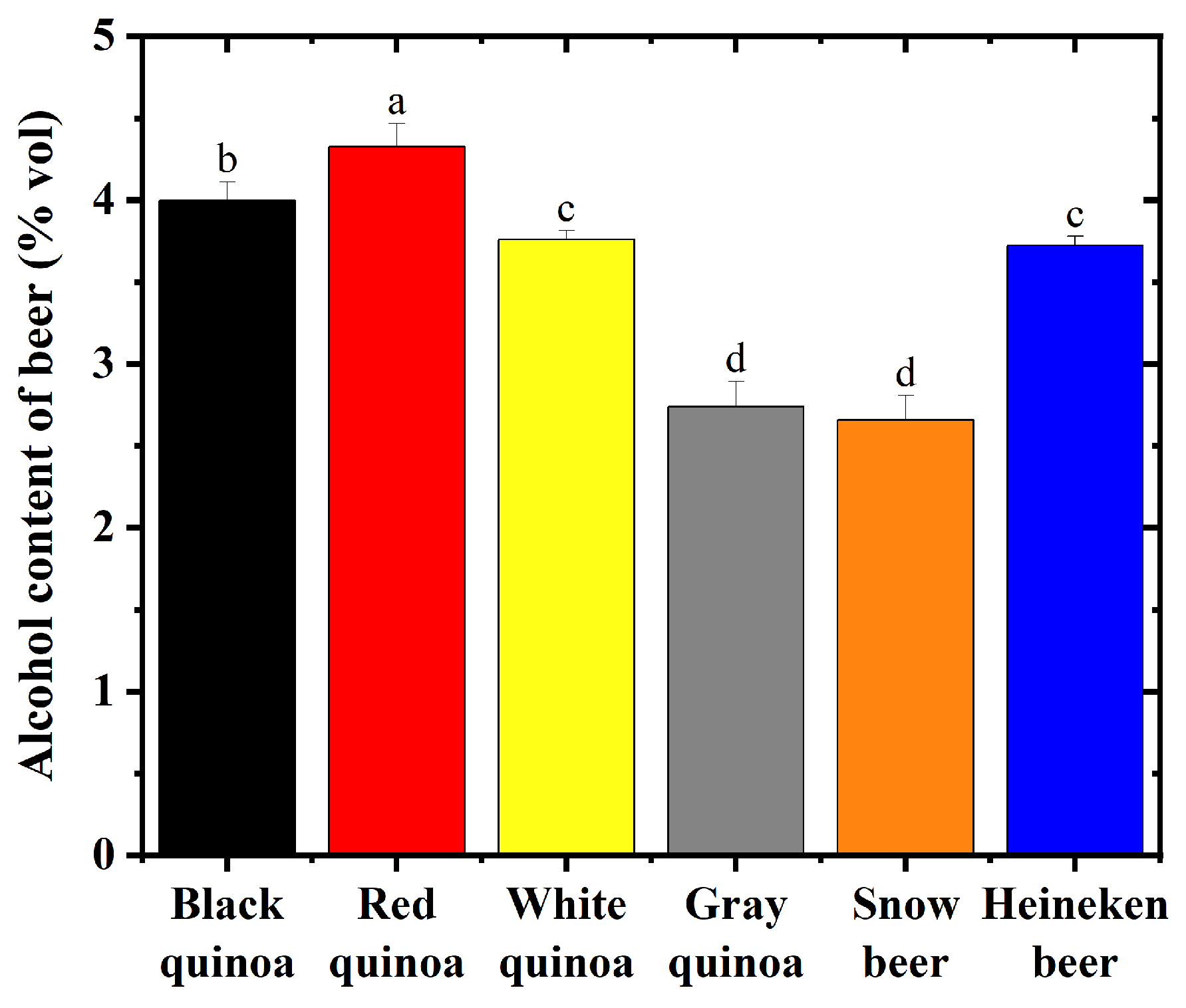
3.6. Alcohol Content of Quinoa Beers and Commercial Beers
3.7. Aroma Compound Analysis of Quinoa Beers and Two Commercial Beers
4. Conclusions
Author Contributions
Funding
Institutional Review Board Statement
Informed Consent Statement
Data Availability Statement
Conflicts of Interest
References
- Prasad, P.; Sahu, J.K. Effect of soaking and germination on grain matrix and glycaemic potential: A comparative study on white quinoa, proso and foxtail millet flours. Food Biosci. 2023, 56, 103105. [Google Scholar] [CrossRef]
- Chen, X.; Zhang, Y.; Cao, B.; Wei, X.; Shen, Z.; Su, N. Assessment and comparison of nutritional qualities of thirty quinoa (Chenopodium quinoa Willd.) seed varieties. Food Chem. X 2023, 19, 100808. [Google Scholar] [CrossRef] [PubMed]
- Kaczyński, P.; Iwaniuk, P.; Hrynko, I.; Łuniewski, S.; Łozowicka, B. The effect of the multi-stage process of wheat beer brewing on the behavior of pesticides according to their physicochemical properties. Food Control 2024, 160, 110356. [Google Scholar] [CrossRef]
- Parsons, R.F. Incidence and ecology of very fast germination. Seed Sci. Res. 2012, 22, 161–167. [Google Scholar] [CrossRef]
- Lan, Y.; Zhang, W.; Liu, F.; Wang, L.; Yang, X.; Ma, S.; Wang, Y.; Liu, X. Recent advances in physiochemical changes, nutritional value, bioactivities, and food applications of germinated quinoa: A comprehensive review. Food Chem. 2023, 426, 136390. [Google Scholar] [CrossRef]
- Chen, Y.; Zhu, Y.; Qin, L. The cause of germination increases the phenolic compound contents of Tartary buckwheat (Fagopyrum tataricum). J. Future Foods 2022, 2, 372–379. [Google Scholar] [CrossRef]
- Sun, J.; He, X.; Cheng, K.; Wang, X.; Liao, Z.; Ye, J.; Li, H. Research progress of quinoa beer. Food Res. Dev. 2021, 42, 199–204. [Google Scholar] [CrossRef]
- Cela, N.; Galgano, F.; Perretti, G.; Di Cairano, M.; Tolve, R.; Condelli, N. Assessment of brewing attitude of unmalted cereals and pseudocereals for gluten free beer production. Food Chem. 2022, 384, 132621. [Google Scholar] [CrossRef]
- Iara Gomes de Oliveira, L.; Karoline Almeida da Costa, W.; de Candido de Oliveira, F.; França Bezerril, F.; Priscila Alves Maciel Eireli, L.; dos Santos Lima, M.; Fontes Noronha, M.; Cabral, L.; Wagner, R.; Colombo Pimentel, T.; et al. Ginger beer derived from back-slopping: Volatile compounds, microbial communities on activation and fermentation, metabolites and sensory characteristics. Food Chem. 2024, 435, 137640. [Google Scholar] [CrossRef]
- Guardianelli, L.M.; Salinas, M.V.; Brites, C.; Puppo, M.C. Germination of White and Red Quinoa Seeds: Improvement of Nutritional and Functional Quality of Flours. Foods 2022, 11, 3272. [Google Scholar] [CrossRef]
- GB/T 4928-2008; Method for Analysis of Beer, General Administration of Quality Supervision. Inspection and Quarantine of the People’s Republic of China (AQSIQ), Standardization Administration of China (SAC): Beijing, China, 2008.
- Yang, D.; Gao, X. Progress of the use of alternatives to malt in the production of gluten-free beer. Crit. Rev. Food Sci. Nutr. 2022, 62, 2820–2835. [Google Scholar] [CrossRef] [PubMed]
- Złotek, U.; Dziki, U.G.; Dziki, D.; Świeca, M.; Nowak, R.; Martinez, E. Influence of Drying Temperature on Phenolic Acids Composition and Antioxidant Activity of Sprouts and Leaves of White and Red Quinoa. J. Chem. 2019, 2019, 7125169. [Google Scholar] [CrossRef]
- Hirose, Y.; Fujita, T.; Ishii, T.; Ueno, N. Antioxidative properties and flavonoid composition of Chenopodium quinoa seeds cultivated in Japan. Food Chem. 2010, 119, 1300–1306. [Google Scholar] [CrossRef]
- Zhang, D.; Wei, X.; Liu, Z.; Wu, X.; Bao, C.; Sun, Y.; Su, N.; Cui, J. Transcriptome Analysis Reveals the Molecular Mechanism of GABA Accumulation during Quinoa (Chenopodium quinoa Willd.) Germination. J. Agric. Food Chem. 2021, 69, 12171–12186. [Google Scholar] [CrossRef]
- Dakhili, S.; Abdolalizadeh, L.; Hosseini, S.M.; Shojaee-Aliabadi, S.; Mirmoghtadaie, L. Quinoa protein: Composition, structure and functional properties. Food Chem. 2019, 299, 125161. [Google Scholar] [CrossRef]
- Wang, R.; Guo, S. Phytic acid and its interactions: Contributions to protein functionality, food processing, and safety. Compr. Rev. Food Sci. Food Saf. 2021, 20, 2081–2105. [Google Scholar] [CrossRef]
- Pizzi, A.; Laborie, M.P.; Candan, Z. A Review on Sources, Extractions and Analysis Methods of a Sustainable Biomaterial: Tannins. J. Renew. Mater. 2024, 12, 397–425. [Google Scholar] [CrossRef]
- Janeiro, E.; Guimarães, J.; Stenman, U.-H.; Catarino, M.; Itkonen, O. Validation and comparison of tumor-associated trypsin inhibitor (TATI) immunoassays. Clin. Chim. Acta 2012, 413, 1244–1248. [Google Scholar] [CrossRef]
- Jin, Z.; Zhou, A.; Wang, S.; Zhao, Y.; Shu, J.; Song, Y.; Liu, M.; Tian, C. Study on the extraction process, chemical compositions, and anti-inflammatory activity of total saponins extract from Anemone raddeana Regel. Pharmacol. Res. Mod. Chin. Med. 2023, 9, 100332. [Google Scholar] [CrossRef]
- Riu-Aumatell, M.; Miró, P.; Serra-Cayuela, A.; Buxaderas, S.; López-Tamames, E. Assessment of the aroma profiles of low-alcohol beers using HS-SPME–GC-MS. Food Res. Int. 2014, 57, 196–202. [Google Scholar] [CrossRef]
- Mai, Z.; Su, H.; Zhang, S. Characterization of a Metagenome-Derived β-Glucosidase and Its Application in Conversion of Polydatin to Resveratrol. Catalysts 2016, 6, 35. [Google Scholar] [CrossRef]
- Lan, Y.; Wang, X.; Wang, L.; Zhang, W.; Song, Y.; Zhao, S.; Yang, X.; Liu, X. Change of physiochemical characteristics, nutritional quality, and volatile compounds of Chenopodium quinoa Willd. during germination. Food Chem. 2024, 445, 138693. [Google Scholar] [CrossRef] [PubMed]
- Paśko, P.; Bartoń, H.; Zagrodzki, P.; Gorinstein, S.; Fołta, M.; Zachwieja, Z. Anthocyanins, total polyphenols and antioxidant activity in amaranth and quinoa seeds and sprouts during their growth. Food Chem. 2009, 115, 994–998. [Google Scholar] [CrossRef]
- Ramos-Pacheco, B.S.; Choque-Quispe, D.; Ligarda-Samanez, C.A.; Solano-Reynoso, A.M.; Palomino-Rincón, H.; Choque-Quispe, Y.; Peralta-Guevara, D.E.; Moscoso-Moscoso, E.; Aiquipa-Pillaca, Á.S. Effect of Germination on the Physicochemical Properties, Functional Groups, Content of Bioactive Compounds, and Antioxidant Capacity of Different Varieties of Quinoa (Chenopodium quinoa Willd.) Grown in the High Andean Zone of Peru. Foods 2024, 13, 417. [Google Scholar] [CrossRef]
- Melini, V.; Melini, F.; Acquistucci, R. Phenolic Compounds and Bioaccessibility Thereof in Functional Pasta. Antioxidants 2020, 9, 343. [Google Scholar] [CrossRef]
- Acosta-Estrada, B.A.; Gutiérrez-Uribe, J.A.; Serna-Saldívar, S.O. Bound phenolics in foods, a review. Food Chem. 2014, 152, 46–55. [Google Scholar] [CrossRef]
- Bhinder, S.; Singh, N.; Kaur, A. Impact of germination on nutraceutical, functional and gluten free muffin making properties of Tartary buckwheat (Fagopyrum tataricum). Food Hydrocoll. 2022, 124, 107268. [Google Scholar] [CrossRef]
- Guo, N.; Zhu, Y.; Jiang, Y.; Li, H.; Liu, Z.; Wang, W.; Shan, C.; Fu, Y. Improvement of flavonoid aglycone and biological activity of mulberry leaves by solid-state fermentation. Ind. Crop. Prod. 2020, 148, 112287. [Google Scholar] [CrossRef]
- Boronat, A.; Soldevila-Domenech, N.; Rodríguez-Morató, J.; Martínez-Huélamo, M.; Lamuela-Raventós, R.M.; de la Torre, R. Beer Phenolic Composition of Simple Phenols, Prenylated Flavonoids and Alkylresorcinols. Molecules 2020, 25, 2582. [Google Scholar] [CrossRef]
- Nardini, M. An Overview of Bioactive Phenolic Molecules and Antioxidant Properties of Beer: Emerging Trends. Molecules 2023, 28, 3221. [Google Scholar] [CrossRef]
- Tang, Y.; Li, X.; Chen, P.X.; Zhang, B.; Hernandez, M.; Zhang, H.; Marcone, M.F.; Liu, R.; Tsao, R. Characterisation of fatty acid, carotenoid, tocopherol/tocotrienol compositions and antioxidant activities in seeds of three Chenopodium quinoa Willd. genotypes. Food Chem. 2015, 174, 502–508. [Google Scholar] [CrossRef]
- Zhou, C.; Sun, C.; Chen, K.; Li, X. Flavonoids, Phenolics, and Antioxidant Capacity in the Flower of Eriobotrya japonica Lindl. Int. J. Mol. Sci. 2011, 12, 2935–2945. [Google Scholar] [CrossRef] [PubMed]
- Nardini, M.; Foddai, M.S. Phenolics Profile and Antioxidant Activity of Special Beers. Molecules 2020, 25, 2466. [Google Scholar] [CrossRef] [PubMed]
- Sikand, V.; Tong, P.S.; Roy, S.; Rodriguez-Saona, L.E.; Murray, B.A. Solubility of commercial milk protein concentrates and milk protein isolates. J. Dairy Sci. 2011, 94, 6194–6202. [Google Scholar] [CrossRef] [PubMed]
- Choque-Quispe, D.; Ligarda-Samanez, C.A.; Ramos-Pacheco, B.S.; Leguía-Damiano, S.; Calla-Florez, M.; Zamalloa-Puma, L.M.; Colque-Condeña, L. Phenolic compounds, antioxidant capacity, and protein content of three varieties of germinated quinoa (Chenopodium quinoa Willd). Ing. Investig. 2021, 41, e89831. [Google Scholar] [CrossRef]
- He, Y.; Song, S.; Li, C.; Zhang, X.; Liu, H. Effect of germination on the main chemical compounds and 5-methyltetrahydrofolate metabolism of different quinoa varieties. Food Res. Int. 2022, 159, 111601. [Google Scholar] [CrossRef]
- Jansen, G.R. Lysine in Human Nutrition. J. Nutr. 1962, 76, 1–35. [Google Scholar] [CrossRef]
- Ruan, L.; Liu, R.; Xu, X.; Shi, H. Molecular cloning and characterization of a threonine/serine protein kinase lvakt from Litopenaeus vannamei. Chin. J. Oceanol. Limnol. 2014, 32, 792–798. [Google Scholar] [CrossRef]
- Ardö, Y. Flavour formation by amino acid catabolism. Biotechnol. Adv. 2006, 24, 238–242. [Google Scholar] [CrossRef]
- Reis Lima, M.J.; Santos, A.O.; Falcão, S.; Fontes, L.; Teixeira-Lemos, E.; Vilas-Boas, M.; Veloso, A.C.A.; Peres, A.M. Dataset on free amino acids contents of Serra da Estrela PDO cheeses determined by UPLC-DAD-MS/MS. Data Brief 2020, 28, 104908. [Google Scholar] [CrossRef]
- Bhinder, S.; Kumari, S.; Singh, B.; Kaur, A.; Singh, N. Impact of germination on phenolic composition, antioxidant properties, antinutritional factors, mineral content and Maillard reaction products of malted quinoa flour. Food Chem. 2021, 346, 128915. [Google Scholar] [CrossRef] [PubMed]
- Avezum, L.; Rondet, E.; Mestres, C.; Achir, N.; Madode, Y.; Gibert, O.; Lefevre, C.; Hemery, Y.; Verdeil, J.-L.; Rajjou, L. Improving the nutritional quality of pulses via germination. Food Rev. Int. 2023, 39, 6011–6044. [Google Scholar] [CrossRef]
- Maldonado-Alvarado, P.; Abarca-Robles, J.; Pavón-Vargas, D.J.; Valencia-Chamorro, S.; Haros, C.M. Effect of Quinoa Germination on Its Nutritional Properties. Biol. Life Sci. Forum 2022, 17, 7. [Google Scholar] [CrossRef]
- Singh, A.; Sharma, S. Bioactive components and functional properties of biologically activated cereal grains: A bibliographic review. Crit. Rev. Food Sci. Nutr. 2017, 57, 3051–3071. [Google Scholar] [CrossRef]
- Panda, D.; Padhi, S.K.; Nanda, M.; Nayak, J.K. Toxic and Antinutritional Substances in Traditional Food Plants. In Biotoxins: Biotechnological and Therapeutic Applications; Prasad, M.N.V., Tetali, S.D., Bennetau-Pelissero, C., Eds.; Springer Nature: Cham, Switzerland, 2025; pp. 279–299. [Google Scholar] [CrossRef]
- Elmaki, H.B.; Babiker, E.E.; El Tinay, A.H. Changes in chemical composition, grain malting, starch and tannin contents and protein digestibility during germination of sorghum cultivars. Food Chem. 1999, 64, 331–336. [Google Scholar] [CrossRef]
- Shimelis, E.A.; Rakshit, S.K. Effect of processing on antinutrients and in vitro protein digestibility of kidney bean (Phaseolus vulgaris L.) varieties grown in East Africa. Food Chem. 2007, 103, 161–172. [Google Scholar] [CrossRef]
- Bhargava, A.; Srivastava, S. Quinoa: Botany, Production and Uses; CABI: Oxfordshire, UK, 2013. [Google Scholar] [CrossRef]
- Hu, M.; Du, X.; Liu, G.; Zhang, S.; Wu, H.; Li, Y. Germination improves the functional properties of soybean and enhances soymilk quality. Int. J. Food Sci. Technol. 2021, 57, 3892–3902. [Google Scholar] [CrossRef]
- Jyothi, T.C.; Sindhu Kanya, T.C.; Appu Rao, A.G. Influence of germination on saponins in soybean and recovery of soy sapogenol i. J. Food Biochem. 2007, 31, 1–13. [Google Scholar] [CrossRef]
- Guajardo-Flores, D.; García-Patiño, M.; Serna-Guerrero, D.; Gutiérrez-Uribe, J.A.; Serna-Saldívar, S.O. Characterization and quantification of saponins and flavonoids in sprouts, seed coats and cotyledons of germinated black beans. Food Chem. 2012, 134, 1312–1319. [Google Scholar] [CrossRef]
- Gee, J.M.; Wortley, G.M.; Johnson, I.T.; Price, K.R.; Rutten, A.A.J.J.L.; Houben, G.F.; Penninks, A.H. Effects of saponins and glycoalkaloids on the permeability and viability of mammalian intestinal cells and on the integrity of tissue preparations in vitro. Toxicology In Vitr. 1996, 10, 117–128. [Google Scholar] [CrossRef]
- Koistinen, V.M.; Tuomainen, M.; Lehtinen, P.; Peltola, P.; Auriola, S.; Jonsson, K.; Hanhineva, K. Side-stream products of malting: A neglected source of phytochemicals. npj Sci. Food 2020, 4, 21. [Google Scholar] [CrossRef] [PubMed]
- Setyorini, D.; Antarlina, S.S. Secondary metabolites in sorghum and its characteristics. Food Sci. Technol. 2022, 42, e49822. [Google Scholar] [CrossRef]
- Chavan, S.M.; Khadatkar, A.; Hasan, M.; Ahmad, D.; Kumar, V.; Jain, N.K. Quinoa (Chenopodium quinoa Willd.): Paving the way towards nutraceuticals and value-added products for sustainable development and nutritional security. Appl. Food Res. 2025, 5, 100673. [Google Scholar] [CrossRef]
- Dularia, C.; Sashikala Vadakkoot, B.; Hossain, S. Effect of different processes on physicochemical, antinutritional and textural properties of quinoa seeds and flour. Food Humanit. 2024, 2, 100246. [Google Scholar] [CrossRef]
- Bastian, S.; Liu, X.; Meyerowitz, J.T.; Snow, C.D.; Chen, M.M.Y.; Arnold, F.H. Engineered ketol-acid reductoisomerase and alcohol dehydrogenase enable anaerobic 2-methylpropan-1-ol production at theoretical yield in Escherichia coli. Metab. Eng. 2011, 13, 345–352. [Google Scholar] [CrossRef]
- Zhang, B.; Xu, D.; Duan, C.; Yan, G. Synergistic effect enhances 2-phenylethyl acetate production in the mixed fermentation of Hanseniaspora vineae and Saccharomyces cerevisiae. Process Biochem. 2020, 90, 44–49. [Google Scholar] [CrossRef]
- Parker, D.K. 6—Beer: Production, sensory characteristics and sensory analysis. In Alcoholic Beverages; Piggott, J., Ed.; Woodhead Publishing: Sawston, UK, 2012; pp. 133–158. [Google Scholar] [CrossRef]
- Cao, K.; Wu, J.; Wan, X.; Hou, Y.; Zhang, C.; Wang, Y.; Zhang, L.; Yang, W.; He, Y.; Wu, R. Impact of non-Saccharomyces yeasts derived from traditional fermented foods on beer aroma: Analysis based on HS-SPME-GC/MS combined with chemometrics. Food Res. Int. 2024, 187, 114366. [Google Scholar] [CrossRef]
- Wang, X.; Dang, C.; Liu, Y.; Ge, X.; Suo, R.; Ma, Q.; Wang, J. Effect of indigenous Saccharomyces cerevisiae strains on microbial community successions and volatile compounds changes during Longyan wine fermentation. Food Biosci. 2024, 57, 103595. [Google Scholar] [CrossRef]
- Tressl, R.; Friese, L.; Fendesack, F.; Koeppler, H. Gas chromatographic-mass spectrometric investigation of hop aroma constituents in beer. J. Agric. Food Chem. 1978, 26, 1422–1426. [Google Scholar] [CrossRef]



| Flours | Fructose (%) | Glucose (%) | Sucrose (%) | Starch (%) |
|---|---|---|---|---|
| WQ | 0.22 ± 0.04 a | 0.91 ± 0.01 a | 0.80 ± 0.10 a | 57.72 ± 0.78 a |
| WQ 18 | 0.34 ± 0.03 b | 1.49 ± 0.01 b | 0.92 ± 0.06 ab | 57.72 ± 0.82 a |
| WQ 24 | 0.44 ± 0.02 c | 1.53 ± 0.02 bc | 0.96 ± 0.12 ab | 59.63 ± 0.53 b |
| WQ 48 | 0.53 ± 0.02 d | 1.58 ± 0.01 c | 1.00 ± 0.08 b | 57.06 ± 0.84 a |
| RQ | 0.18 ± 0.01 a | 0.80 ± 0.00 a | 0.61 ± 0.10 a | 53.11 ± 1.71 b |
| RQ 18 | 0.30 ± 0.01 b | 1.46 ± 0.01 b | 0.89 ± 0.10 b | 56.2 ± 1.5 c |
| RQ 24 | 0.37 ± 0.01 c | 1.51 ± 0.07 b | 0.98 ± 0.05 b | 54.93 ± 0.91 b |
| RQ 48 | 0.48 ± 0.01 d | 1.52 ± 0.01 b | 0.96 ± 0.07 b | 48.97 ± 0.98 a |
| Percentage (%) | |||||||||
|---|---|---|---|---|---|---|---|---|---|
| No. | Name | Odor Description | Black Quinoa Beer | Red Quinoa Beer | White Quinoa Beer | Gray Quinoa Beer | Snow Beer | Heineken Beer | |
| Alcohols | 1 | 1-pentanol | mild fermented aroma | 3.68 a | 5.00 a | / | / | 4.05 a | 3.24 a |
| 2 | 3-methyl-1-butanol | banana, liqueur and malty aroma | 17.60 a | 12.24 c | 14.66 b | 4.95 e | 9.16 d | / | |
| 3 | α-methyl-benzenemethanol | floral, woody, sweet and warm | / | 0.39 b | 1.44 b | 0.16 b | 21.98 a | 0.24 b | |
| 4 | 1-octanol | citrusy aroma | 0.06 a | 0.07 a | / | 0.09 a | 0.08 a | / | |
| 5 | phenylethyl alcohol | rose fragrance and sweetness | 9.40 c | 8.00 c | 30.23 b | 36.69 a | / | 34.84 a | |
| Aldehyde | 1 | nonanal | citrus aroma | 0.13 a | 0.13 a | 0.15 a | 0.15 a | 0.25 a | 0.20 a |
| 2 | decanal | fresh orange and orange peel aroma | 0.06 b | 0.05 b | 0.06 b | 0.05 b | 0.15 a | 0.12 ab | |
| 3 | 3,4-dimethylbenzaldehyde | sweet almond aroma | / | 10.15 c | / | 0.36 d | 23.12 a | 21.35 b | |
| 4 | pentadecanal | soft and fruity | 0.02 a | 0.15 a | 0.06 a | 0.18 a | / | / | |
| 5 | 3,5-di-tert-butyl-4-hydroxybenzaldehyde | stable aromatic aroma | 0.22 a | 0.26 a | 0.18 a | 0.18 a | / | / | |
| Alkenes | 1 | (1r,3e,7e,11r)-1,5,5,8-tetramethyl-12-oxabicyclo [9.1.0]dodeca-3,7-diene | herbaceous and woody aroma | 0.98 a | 1.00 a | 1.05 a | 2.75 a | / | / |
| 2 | humulene epoxide i | the herbal aroma of hops | / | 0.36 a | / | 0.30 ab | 0.10 b | 0.26 ab | |
| 3 | humulenol-ii | woody notes combined with herbal notes | 7.25 a | 7.52 a | 6.12 ab | 4.96 b | / | / | |
| 4 | 14-hydroxycaryophyllene | complex spice aroma | 0.19 a | 0.36 a | 0.17 a | 0.30 a | / | / | |
| Esters | 1 | ethyl acetate | fruity aroma | 0.44 b | / | 0.32 bc | 0.22 c | 0.77 a | 0.31 bc |
| 2 | 1-butanol, 3-methyl-, acetate | sweet fruity notes of a ripe banana | 0.26 c | 0.09 c | 0.44 c | 0.33 c | 5.68 a | 3.21 b | |
| 3 | hexanoic acid, ethyl ester | sweet fruity notes of green apple and pineapple | 0.25 bc | 0.11 cd | 0.44 a | 0.27 b | 0.12 cd | 0.07 d | |
| 4 | octanoic acid, ethyl ester | tropical fruit aromas such as pineapple or mango | 1.88 a | 1.10 a | 1.88 a | 1.96 a | / | / | |
| 5 | acetic acid, 2-phenylethyl ester | sweet honey and rose scent | 6.58 e | 9.18 d | 11.93 c | 7.51 de | 28.30 a | 26.12 b | |
| 6 | ethyl 9-decenoate | sweet pear and apple aromas | 0.18 b | 0.21 b | 0.20 b | 0.43 a | / | / | |
| 7 | dodecanoic acid, ethyl ester | coconut and creamy aroma, slightly fatty | 0.55 b | 3.76 a | 3.87 a | 4.00 a | / | / | |
| 8 | tetradecanoic acid, ethyl ester | mild creamy aroma with fatty notes | 1.17 c | 4.06 b | 1.22 c | 5.01 a | / | 0.04 d | |
| 9 | 1,2-benzenedicarboxylic acid, bis(2-methylpropyl) ester | floral aroma with sweetness | / | 0.26 a | 0.22 a | / | 0.19 a | 0.18 a | |
| 10 | pentadecanoic acid, ethyl ester | creamy with faint fruity notes | 0.17 b | 0.35 b | 0.24 b | 0.69 a | / | / | |
| 11 | ethyl 9-hexadecenoate | creamy and floral notes | 4.87 a | 5.30 a | 3.93 a | 4.44 a | / | / | |
| 12 | hexadecanoic acid, ethyl ester | waxy and creamy aroma | 23.50 a | 22.50 a | 13.58 c | 17.20 b | 1.20 e | 4.39 d | |
| 13 | octadecanoic acid, ethyl ester | soft fatty acid aroma and sweet | 17.64 a | 2.87 bc | 2.97 b | 2.22 bcd | 0.24 d | 0.92 cd | |
| Ketone | 1 | 3,5-di-tert-butyl-4-hydroxyacetophenone | soft vanilla aroma | 0.22 a | 0.26 a | 0.18 a | 0.18 a | / | / |
| Phenol | 1 | 2,4-di-tert-butylphenol | woodsy scent | 2.69 a | 4.28 a | 4.48 a | 4.42 a | 4.61 a | 4.51 a |
Disclaimer/Publisher’s Note: The statements, opinions and data contained in all publications are solely those of the individual author(s) and contributor(s) and not of MDPI and/or the editor(s). MDPI and/or the editor(s) disclaim responsibility for any injury to people or property resulting from any ideas, methods, instructions or products referred to in the content. |
© 2026 by the authors. Licensee MDPI, Basel, Switzerland. This article is an open access article distributed under the terms and conditions of the Creative Commons Attribution (CC BY) license.
Share and Cite
Xu, J.; Zhang, Y.; Liu, Z.; Wu, C.; Wang, W.; Feng, X.; Fu, C. Germination as a Bioprocess: Unraveling Its Impact on the Nutritional and Flavor Profile in Four Quinoa Beer Varieties. Foods 2026, 15, 1443. https://doi.org/10.3390/foods15081443
Xu J, Zhang Y, Liu Z, Wu C, Wang W, Feng X, Fu C. Germination as a Bioprocess: Unraveling Its Impact on the Nutritional and Flavor Profile in Four Quinoa Beer Varieties. Foods. 2026; 15(8):1443. https://doi.org/10.3390/foods15081443
Chicago/Turabian StyleXu, Jiachen, Yanling Zhang, Zhiyu Liu, Chaosheng Wu, Wei Wang, Xiao Feng, and Caili Fu. 2026. "Germination as a Bioprocess: Unraveling Its Impact on the Nutritional and Flavor Profile in Four Quinoa Beer Varieties" Foods 15, no. 8: 1443. https://doi.org/10.3390/foods15081443
APA StyleXu, J., Zhang, Y., Liu, Z., Wu, C., Wang, W., Feng, X., & Fu, C. (2026). Germination as a Bioprocess: Unraveling Its Impact on the Nutritional and Flavor Profile in Four Quinoa Beer Varieties. Foods, 15(8), 1443. https://doi.org/10.3390/foods15081443