


Abstract
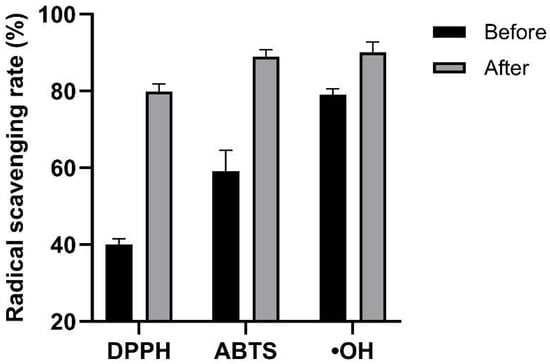
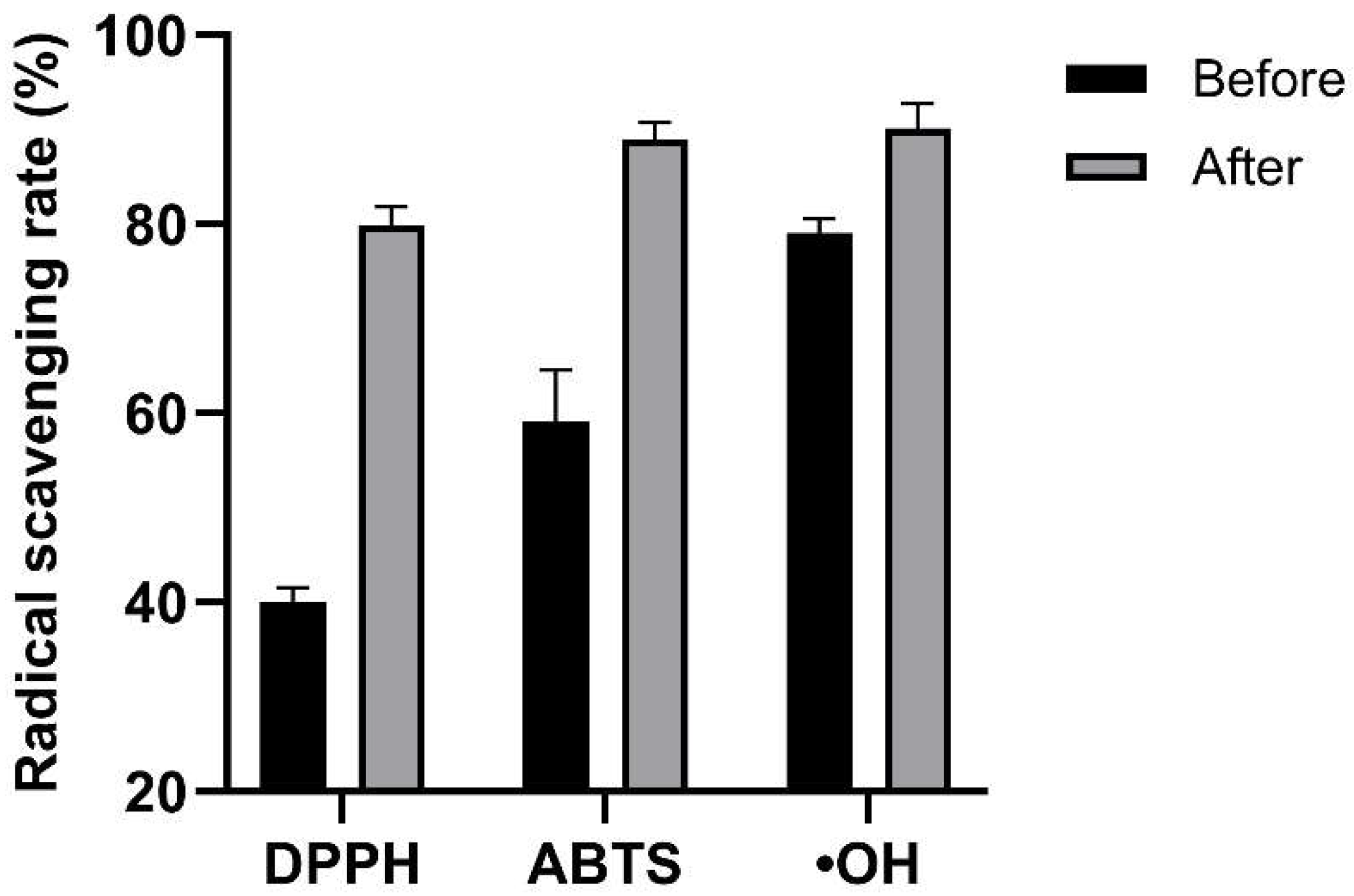
Lycium barbarum–Polygonatum cyrtonema composite jiaosu (LBPCJ) was prepared by sequential dual-species fermentation and evaluated in a mouse model of alcohol-induced liver injury. Following process optimization, a yeast-first sequential strategy with intermediate pasteurization was selected, comprising an initial Saccharomyces cerevisiae fermentation step, intermediate pasteurization, and a subsequent Lactiplantibacillus plantarum fermentation step. Fermentation reduced pH from 4.68 to 3.51 and increased total acidity from 61.06 to 135.39 g LA/L and total phenolic content from 3.01 to 9.39 mg GAE/mL. In vitro antioxidant-related activities were also higher after fermentation, with DPPH, ABTS, and •OH scavenging rates increasing by 39.90%, 29.78%, and 11.10%, respectively. In mice, LBPCJ administration was associated with lower liver index and serum aminotransferase levels, together with attenuated hepatic histopathological alterations, with the high-dose group (15 mL/kg BW) showing the clearest response. These changes were accompanied by higher hepatic SOD and GSH levels and lower MDA, TNF-α, IL-1β, and IL-6 levels. LBJ and PCJ also improved several measured indicators, while LBPCJ showed changes across multiple endpoints under the tested conditions. Overall, sequential fermentation markedly altered the physicochemical and antioxidant-related properties of LBPCJ, and LBPCJ administration improved multiple indicators related to alcohol-induced liver injury in mice, although the specific constituents and underlying mechanisms remain to be clarified.
1. Introduction
Alcohol-associated liver disease (ALD) poses a significant global public health concern, primarily arising from long-term and excessive alcohol intake. It encompasses a progressive spectrum of liver injury, ranging from steatosis and alcohol-associated hepatitis to fibrosis and cirrhosis, and may ultimately increase the risk of hepatocellular carcinoma [1]. Recent global statistical data indicate that alcohol consumption was responsible for approximately 2.6 million deaths in 2019, representing 4.7% of total global mortality [2,3]. In China, the burden of ALD has also increased with rising alcohol consumption. A systematic review and meta-analysis covering studies published from 2001 to 2022 reported a pooled prevalence of 4.8%, with an increasing trend over recent decades [4].
Since the liver is the principal tissue responsible for ethanol metabolism, it is highly sensitive to alcohol-induced damage, and alcohol-induced liver injury (ALI) represents an early and experimentally tractable stage in ALD progression. Ethanol metabolism promotes reactive oxygen species (ROS) generation through alcohol dehydrogenase (ADH), aldehyde dehydrogenase (ALDH), and the CYP2E1-dependent microsomal ethanol-oxidizing system (MEOS), thereby contributing to oxidative stress, lipid metabolic disturbance, and mitochondrial dysfunction [5]. In parallel, alcohol disturbs the gut-liver axis by impairing intestinal barrier integrity and altering the gut microbiota, which facilitates the portal translocation of bacterial products such as lipopolysaccharide (LPS) [6]. In the liver, LPS can trigger the activation of the TLR4/NF-κB signaling pathway in Kupffer cells, promoting inflammatory cytokine production, immune cell recruitment, and tissue injury [7,8]. Owing to its multifactorial pathogenesis and marked inter-individual heterogeneity, effective disease-specific therapies for ALD remain limited. Current clinical management still relies primarily on abstinence, nutritional support, and control of complications [9]. Corticosteroids provide only limited short-term benefit in selected patients with severe alcohol-associated hepatitis, while liver transplantation is generally reserved for advanced disease [10].
Given these limitations, dietary interventions and natural products have attracted increasing attention as complementary approaches for the management of ALD [11]. Microbial fermentation is of particular interest because it can alter plant matrices and is often associated with changes in the composition and properties of the final product [12]. Jiaosu, a traditional fermented product derived from fruits, vegetables, and edible-medicinal plants, has therefore attracted growing attention as a plant-derived fermented food matrix. As a complex fermentation system, jiaosu may contain organic acids, polyphenols, polysaccharides, amino acids, and other constituents associated with its overall properties [13]. Fermented plant products have shown favorable results in experimental liver injury models [14,15]. However, direct evidence for jiaosu in ALI-related outcomes remains limited, and head-to-head comparisons between composite jiaosu formulations and their corresponding single-plant products are still scarce.
Lycium barbarum and Polygonatum cyrtonema are two medicinal and edible plant resources with distinct yet potentially complementary phytochemical profiles. Lycium barbarum (L. barbarum, commonly referred to as goji berry or wolfberry) is rich in polysaccharides, polyphenols, flavonoids, carotenoids, and amino acids and has been widely reported to exhibit antioxidant, anti-inflammatory, immunomodulatory, and hepatoprotective activities [16,17,18]. Fermented L. barbarum products have also shown protective potential in alcohol-related injury models. For instance, lactic acid-fermented goji berry alleviated acute alcohol-induced liver injury and modulated the gut microbiota and its metabolites in mice [19]. Polygonatum cyrtonema (P. cyrtonema) has likewise been reported to contain polysaccharides, steroidal saponins, flavonoids, and alkaloids [20]. Available evidence indicates that its extracts, particularly the polysaccharide fraction, possess antioxidant, hepatoprotective, anti-inflammatory, and lipid-regulatory activities in experimental models of liver and metabolic disorders [21,22]. Given these compositional differences, combining L. barbarum and P. cyrtonema may provide a broader substrate basis for fermentation, which could influence the properties of the final product. Previous work has demonstrated that L. barbarum–P. cyrtonema compound wine can be successfully produced and exhibits favorable in vitro antioxidant properties [23]. However, whether a composite jiaosu derived from these two materials differs from the corresponding single-plant fermented products in vivo ALI-related outcomes remains unclear.
Therefore, this study aimed to develop Lycium barbarum–Polygonatum cyrtonema composite jiaosu (LBPCJ) through sequential dual-species fermentation and to assess its effects in a mouse model of ALI, with direct comparison to the corresponding single-plant jiaosu preparations derived from L. barbarum and P. cyrtonema. Intervention outcomes were evaluated using liver injury-related biochemical indices, serum lipid parameters, hepatic oxidative stress-related markers, inflammatory cytokine levels, and histopathological changes, in order to characterize the response patterns of the composite and single-plant fermented preparations across the measured endpoints.
2. Materials and Methods
2.1. Materials and Reagents
Dried L. barbarum fruits with uniform size, intact morphology, and absence of visible defects were sourced from Qinghai Dehao Breeding and Cultivation Co., Ltd. (Qinghai, China). P. cyrtonema rhizomes, processed using a traditional nine-cycle steaming-and-drying procedure, were obtained from Jiuhua Mountain, Chizhou City, Anhui Province, China. Starter strains Saccharomyces cerevisiae CICC 31735 and Lactiplantibacillus plantarum CICC 22696 were acquired from the China Center of Industrial Culture Collection (CICC, Beijing, China). D-glucose was supplied by Hefei Bomei Biotechnology Co., Ltd. (Hefei, China). Rutin and gallic acid standards were supplied by Adamas Life Technology Co., Ltd. (Shanghai, China) and Shanghai Yuanye Biotechnology Co., Ltd. (Shanghai, China), respectively. 2,2-Diphenyl-1-picrylhydrazyl (DPPH) and 2,2′-azino-bis(3-ethylbenzothiazoline-6-sulfonic acid) diammonium salt (ABTS) were bought from Med Chem Express (Monmouth Junction, NJ, USA). HPLC-grade acetonitrile, methanol, ethanol, and n-propanol were obtained from Macklin Biochemical Co., Ltd. (Shanghai, China). All remaining chemicals and reagents were of analytical grade unless otherwise specified.
2.2. Preparation of L. barbarum–P. cyrtonema Slurry
L. barbarum fruits and P. cyrtonema rhizomes were mixed at a mass ratio of 3:2 and homogenized with distilled water at a solid-to-liquid ratio of 1:6 (w/v) to yield a homogeneous slurry. The initial pH of the slurry was adjusted to 4.6 ± 0.1 using 0.1 mol/L citrate buffer. An enzyme preparation containing cellulase and pectinase (6.03:3.97, w/w; Shanghai Yuanye Biotechnology Co., Ltd., Shanghai, China) was added at a final concentration of 0.605% (w/v), and the mixture was hydrolyzed at 40 °C for 1.5 h. Subsequently, the slurry was subjected to ultrasonic-assisted treatment using a SCIENTZ-II D ultrasonic processor (Ningbo Scientz Biotechnology Co., Ltd., Ningbo, China) at 249 W for 10 min. After ultrasonication, the slurry was pasteurized at 65 °C for 30 min, cooled to 25 °C, and used for subsequent fermentation.
2.3. LBPCJ Fermentation
S. cerevisiae and L. plantarum were cultivated in Yeast Extract–Peptone–Dextrose (YPD) broth at 28 °C and de Man, Rogosa and Sharpe (MRS) broth at 37 °C, respectively, until reaching the exponential growth phase. After centrifugation at 3000 rpm and 4 °C for 10 min, cells were collected and rinsed twice using sterile saline solution (0.9% NaCl, w/v) and resuspended to a final concentration of approximately 8.0 log CFU/mL for inoculation.
For single-strain fermentation, S. cerevisiae fermentation (SCF) and L. plantarum fermentation (LPF) were optimized separately prior to the establishment of the dual-species fermentation process. For mixed-strain fermentation, four sequential inoculation strategies were designed, namely S. cerevisiae followed by L. plantarum (SC-LP), L. plantarum followed by S. cerevisiae (LP-SC), S. cerevisiae followed by intermediate pasteurization and then L. plantarum (SC-P-LP), and L. plantarum followed by intermediate pasteurization and then S. cerevisiae (LP-P-SC). In pasteurized sequential fermentation, P denotes an intermediate pasteurization step, during which the broth from the first fermentation stage was heated at 65 °C for 30 min, cooled to 25 °C, and subsequently inoculated with the second microorganism. This step was introduced to terminate microbial activity from the first stage and minimize its interference with the subsequent fermentation stage.
2.4. Optimization of Fermentation Conditions
Fermentation conditions were optimized based on strain-specific response indicators during single-strain fermentations. All fermentations were conducted statically in 100 mL flasks, and the working volume was adjusted according to the designated filling ratio. Each experimental condition was performed in triplicate. The filling ratio was defined as the percentage of liquid volume to bottle volume (% v/v) and was used to regulate the headspace during fermentation. For S. cerevisiae, superoxide dismutase (SOD) activity was selected as the response indicator as the objective was to identify fermentation conditions associated with enhanced antioxidant-related functional properties of the product. Accordingly, the effects of inoculation rate (0.5%, 1.0%, 1.5%, 2.0% and 2.5%), fermentation time (12, 24, 36, 48 and 60 h), fermentation temperature (25, 28, 31, 34 and 37 °C), and filling ratio (20%, 30%, 40%, 50% and 60%) on SOD activity were evaluated during process optimization. For L. plantarum, viable counts were selected as the response indicator because sufficient bacterial viability is essential for the efficiency and stability of the second-stage fermentation. Therefore, the effects of inoculation rate (1%, 2%, 3%, 4% and 5%), fermentation time (12, 24, 36, 48 and 60 h), and fermentation temperature (28, 31, 34, 37 and 40 °C) on viable counts were assessed in the same manner, with the filling ratio fixed at 30%. After single-strain optimization, four sequential inoculation strategies were compared under their respective optimized conditions using SOD activity as a unified evaluation index. Once SC-P-LP was identified as the preferred fermentation mode, the duration of the S. cerevisiae stage was fixed at 24 h, and the duration of the L. plantarum stage was further adjusted so that the total fermentation time reached 36, 48, 60, 72, 84 or 96 h. SOD activity and viable cell count were used as evaluation indices.
Viable counts were determined using the plate counting method [24]. Samples were serially diluted in sterile saline, spread onto MRS agar plates, incubated at 37 °C, and results were expressed as CFU/mL. SOD activity was determined using a commercially available assay kit (Nanjing Jiancheng Bioengineering Institute Co., Ltd., Nanjing, China) following the manufacturer’s protocol.
2.5. Physicochemical Properties
The pH value was determined using a portable pH meter (PHB-1, Hangzhou Qiwei Instrument Co., Ltd., Hangzhou, China). Total acidity was determined by potentiometric titration using a pH meter according to the National Standard of the People’s Republic of China (GB 12456-2021 [25]), and expressed as lactic acid equivalents (g LA/L). Ethanol concentration was quantified as previously described [26], using an internal standard calibration curve.
2.6. Bioactive Components
Reducing sugar (RS) content was determined by the 3,5-dinitrosalicylic acid (DNS) method [27], with a modified sample aliquot volume, and results were expressed as glucose standard equivalents (GE) based on a D-glucose standard curve. Total polysaccharide (TPS) content was assayed by the phenol-sulfuric acid method [28], with modified color development conditions, and results were expressed as glucose equivalents (GE) based on a D-glucose standard curve. Total phenolic content (TPC) was determined using the Folin–Ciocalteu colorimetric method [29], with absorbance measured at 765 nm and results were expressed as gallic acid equivalents (GAE). Total flavonoid content (TFC) was determined using the sodium nitrite-aluminum chloride colorimetric method [30], with a 5 min standing step after NaOH addition, and results were expressed as rutin equivalents (RE).
2.7. In Vitro Antioxidant Activities
The in vitro antioxidant capacity of LBPCJ supernatants was investigated using three chemical radical-scavenging assays, namely DPPH, ABTS, and hydroxyl radical (•OH) scavenging. DPPH radical-scavenging activity was determined according to Guo et al. [31], with reaction against 0.1 mmol/L DPPH solution in ethanol at 25 °C in the dark for 30 min and absorbance measured at 517 nm. ABTS radical-scavenging activity was determined with minor adjustments to a previously reported method [32], using an ABTS working solution adjusted to an absorbance of 0.70 ± 0.02 at 734 nm, followed by reaction with diluted supernatant at 25 °C in the dark for 30 min and measurement at 734 nm. Hydroxyl (•OH) radical scavenging activity was evaluated using a modified method [33], based on the salicylic acid-FeSO4-H2O2 reaction system, with incubation at 37 °C for 1 h and absorbance measured at 510 nm. All results were expressed as percentage inhibition relative to the corresponding control and blank.
2.8. Animal Experiment
Five-week-old male C57BL/6J mice were purchased from Jiangsu Jicui Yaokang Biotechnology Co., Ltd. (Nanjing, China). All animals were housed under standardized conditions (23 ± 2 °C, 55 ± 5% relative humidity, 12 h light/dark cycle) with ad libitum access to standard chow and water. Following one week of acclimatization, mice were randomly assigned into eight groups (n = 6): a control group (CTRL), an alcohol model group (EtOH), a positive control group (Sil), low-, medium-, and high-dose LBPCJ groups (L-LBPCJ, M-LBPCJ, and H-LBPCJ), an L. barbarum jiaosu group (LBJ), and a P. cyrtonema jiaosu group (PCJ).
The animal experimental protocol was designed with reference to previous studies employing fermented plant-based liquid products in alcohol-induced liver injury models [34,35]. Mice in the CTRL group were orally administered normal saline (10 mL/kg body weight, BW) once daily throughout the experiment. From week 2 to week 5, EtOH and treatment groups received 56% (v/v) Erguotou liquor (Beijing Erguotou Co., Ltd., Beijing, China) at 10 mL/kg BW by daily gavage. After two weeks of ethanol administration, interventions were initiated and maintained for the final two weeks. Specifically, mice in the Sil group were given silymarin (50 mg/kg BW; Tianjin Xi’en Biochemical Technology Co., Ltd., Tianjin, China) once daily by gavage. Meanwhile, mice in the L-LBPCJ, M-LBPCJ, and H-LBPCJ groups received LBPCJ at 5, 10, and 15 mL/kg BW, respectively, while those in the LBJ and PCJ groups were administered LBJ (10 mL/kg BW) and PCJ (10 mL/kg BW). All test formulations were administered 1 h prior to ethanol gavage, and all gavages were performed at a fixed time each day. Body weight was measured and recorded every 3 days throughout the experimental period.
Following the last gavage, mice were fasted for 12 h while being allowed free access to water, and then anesthetized with isoflurane (Hebei Jindafu Pharmaceutical Co., Ltd., Hebei, China), and blood samples were collected from the orbital venous plexus. Mice were then euthanized, and livers were immediately harvested, rinsed with saline to remove residual blood, dried with filter paper, and weighed. Portions of liver tissue were fixed in 4% neutral paraformaldehyde for histological analysis, and the remaining tissue was snap-frozen in liquid nitrogen and stored at −80 °C for subsequent biochemical analyses. The liver index was calculated as follows:
All animal experimental procedures were performed in strict compliance with the relevant guidelines for the care and use of laboratory animals, and approved by the Biomedical Ethics Committee of Hefei University of Technology (Approval No. HFUT20251125001).
2.9. Biochemical Analysis
Blood samples were stored at 4 °C overnight, followed by centrifugation at 3000 rpm for 15 min at 4 °C to obtain serum. Serum levels of alanine aminotransferase (ALT), aspartate aminotransferase (AST), total cholesterol (TC), and triglycerides (TG) were deterimined using an automated biochemical analyzer (Chemray 800, Shenzhen Rayto Life and Analytical Sciences Co., Ltd., Shenzhen, China) according to the manufacturer instructions. The corresponding commercial assay kits were purchased from the same manufacturer.
Liver tissues were homogenized on ice in 0.9% (w/v) saline at a tissue-to-liquid ratio of 1:9 (w/v) to prepare 10% homogenates. After centrifugation at 3000 rpm for 10 min at 4 °C, the resulting supernatants were collected for further biochemical assays. According to the manufacturer protocols, SOD activity, malondialdehyde (MDA) content and reduced glutathione (GSH) level were determined using commercial assay kits (Wuhan Servicebio Technology Co., Ltd., Wuhan, China). Hepatic interleukin-1β (IL-1β), interleukin-6 (IL-6), and tumor necrosis factor-α (TNF-α) levels were quantified using ELISA kits (Thermo Fisher Scientific, Waltham, MA, USA) according to the kit protocols.
2.10. Histopathological Analysis
Liver tissues were fixed in 4% neutral paraformaldehyde, processed for paraffin embedding, sectioned, and stained with hematoxylin and eosin (H&E). Histopathological alterations were then observed and evaluated under a light microscope. Semi-quantitative scoring was performed based on previously established liver histology scoring approaches for steatosis and intralobular inflammatory cell infiltration [36,37]. Specifically, each parameter was scored from 0 to 3 (0 = none, 1 = mild, 2 = moderate, 3 = severe), and the total score reflected the overall extent of liver injury.
2.11. Statistical Analysis
All determinations were carried out in triplicate, and experimental results are presented as the mean ± standard deviation (SD, n = 3). For the animal experiments, data are shown as mean ± SD with six biological replicates (n = 6). Statistical processing was performed using GraphPad Prism 10.0 software. Before parametric tests, the Shapiro–Wilk test was applied to verify the normality of data obtained from animal studies. Comparisons among multiple groups were conducted using one-way analysis of variance (ANOVA) accompanied by Tukey’s post hoc test. A p-value less than 0.05 was regarded as statistically significant.
3. Results and Discussion
3.1. Optimization of LBPCJ Fermentation Conditions
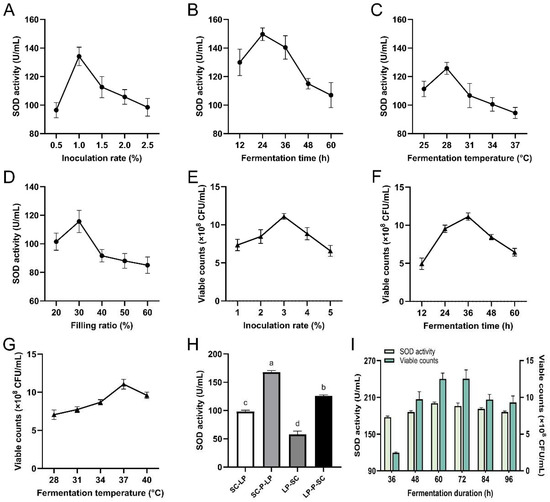
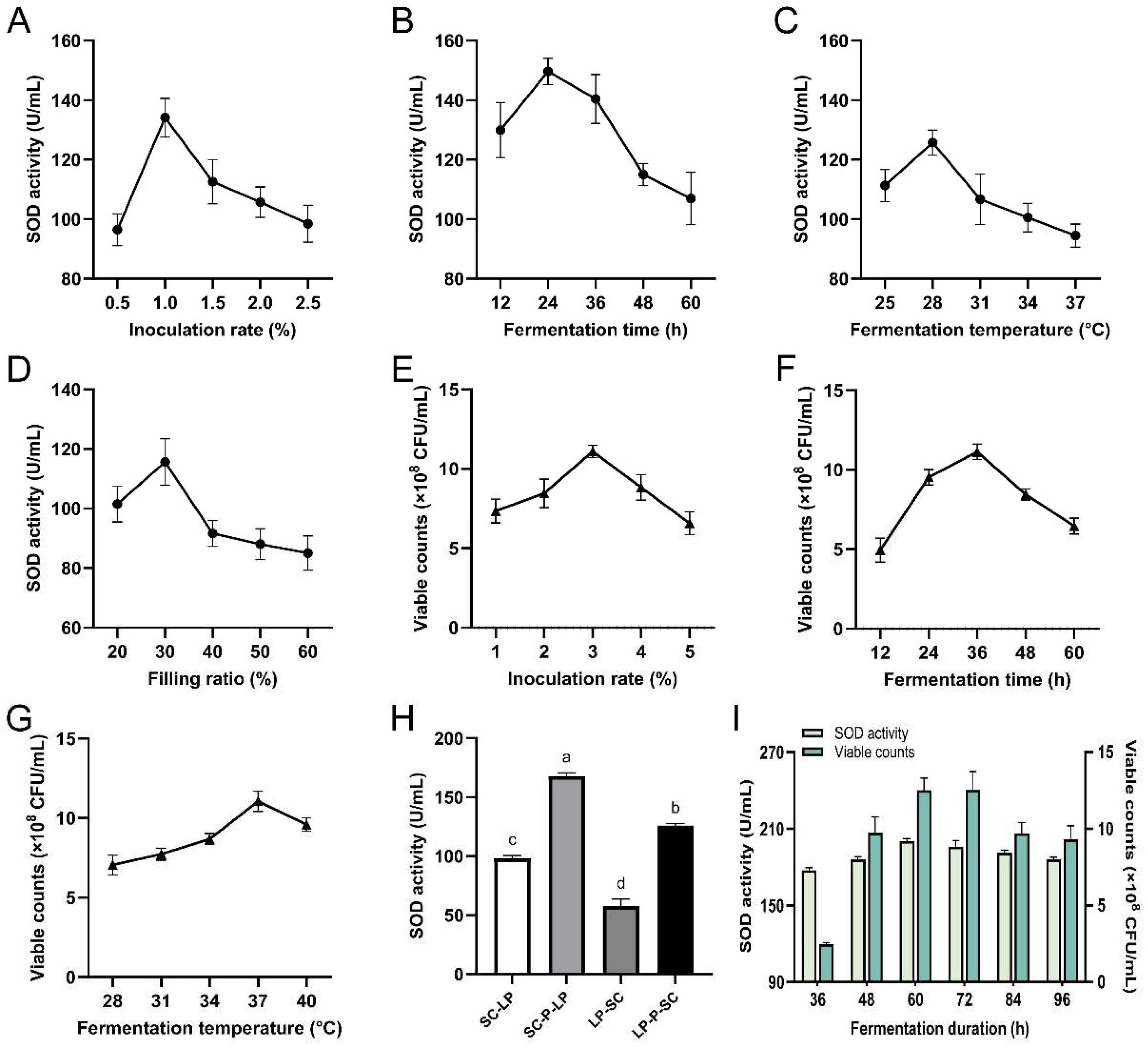
Single-strain fermentation conditions were first optimized using strain-specific response indicators, with SOD activity for the S. cerevisiae stage and viable counts for the L. plantarum stage (Figure 1A–G). For S. cerevisiae, SOD activity increased with inoculation rate and peaked at 1.0% (v/v), reaching 134.15 ± 6.47 U/mL, and then declined at higher inoculation levels (Figure 1A). SOD activity reached a maximum at 24 h, after which it decreased (Figure 1B), possibly reflecting progressive substrate consumption and metabolite accumulation during fermentation [38]. Temperature significantly influenced the response, with maximal SOD activity of 125.77 ± 4.20 U/mL observed at 28 °C, as shown in Figure 1C. The filling ratio (liquid volume/bottle volume, % v/v) also exerted a marked effect, with the highest SOD activity at 30% (v/v) and lower values at higher ratios (Figure 1D), which may be partly related to differences in headspace and oxygen availability under static fermentation conditions [39].
Figure 1.
Optimization of fermentation conditions for LBPCJ. Effects of inoculation rate (A), fermentation time (B), fermentation temperature (C) and filling ratio (D) on SOD activity during fermentation of L. barbarum–P. cyrtonema composite slurry by S. cerevisiae. Effects of inoculation rate (E), fermentation time (F), and fermentation temperature (G) on viable counts of L. plantarum. (H) Comparisons of different sequential fermentation strategies based on SOD activity. SC-LP, S. cerevisiae followed by L. plantarum; SC-P-LP, S. cerevisiae followed by pasteurization and L. plantarum; LP-SC, L. plantarum followed by S. cerevisiae; LP-P-SC, L. plantarum followed by pasteurization and S. cerevisiae. (I) Effects of total fermentation duration on SOD activity and viable counts under the SC-P-LP strategy. S. cerevisiae fermentation was fixed at 24 h, followed by pasteurization and L. plantarum fermentation for varying durations to achieve the designated total fermentation times. Data were expressed as mean ± SD (n = 3). One-way analysis of variance (ANOVA) combined with Tukey’s multiple comparisons test was employed to evaluate statistical differences among multiple groups. Different lowercase letters denoted significant differences among groups (p < 0.05).
For L. plantarum, viable counts increased with the inoculation rate up to 3% (v/v) and then declined at higher levels (Figure 1E). Similar reductions at excessive inoculum levels have been attributed to accelerated substrate depletion and intensified acidification, which compromise viability in fermented fruit matrices [40]. Viable counts of L. plantarum peaked at 36 h, reaching 11.13 ± 0.50 × 10⁸ CFU/mL, and were maximized at 37 °C at 11.05 ± 0.65 × 10⁸ CFU/mL (Figure 1F,G). Comparable temperature ranges have also been reported in plant-based fermentation optimization studies involving lactic acid bacteria [41,42].
Based on the single-strain results, four sequential fermentation strategies were further compared using SOD activity as a unified index (Figure 1H). Among these, the SC-P-LP group exhibited the highest SOD activity (167.91 ± 2.80 U/mL) and was significantly higher than the other tested strategies according to the post hoc comparison, followed by LP-P-SC (125.90 ± 1.67 U/mL) and SC-LP (97.98 ± 2.60 U/mL), whereas LP-SC yielded the lowest value (57.70 ± 5.86 U/mL). These results indicated that both inoculation order and intermediate pasteurization substantially affected the measured fermentation response under the tested conditions. One possible explanation is that different inoculation sequences established different fermentation environments before second-stage inoculation, which may have contributed to the observed differences in SOD activity. Similar differences among yeast-LAB fermentation strategies have also been reported in previous studies [43]. In addition, intermediate pasteurization may have improved stage separation by limiting carryover activity from the first-stage microorganism before inoculation of the second strain. Under the tested conditions, SC-P-LP was therefore selected as the preferred sequential fermentation strategy.
The total fermentation time for SC-P-LP was then determined by monitoring SOD activity and viable counts over time (Figure 1I). SOD activity increased from 36 h, reached a maximum at 60 h, remained at a comparably high level at 72 h, and then declined thereafter. Similarly, viable counts increased sharply from 36 h, peaked at 60–72 h, and decreased at 84–96 h. Accordingly, 60 h was selected as the total fermentation duration for SC-P-LP, as it represented the earliest time point at which SOD activity reached its maximum while viable counts remained within the peak range. This selection balanced the measured response with fermentation time under the tested conditions.
3.2. Physicochemical Properties Before and After Fermentation
LBPCJ underwent pronounced physicochemical changes after sequential fermentation (Table 1.). The pH decreased from 4.68 ± 0.04 to 3.51 ± 0.11, total acidity increased from 61.06 ± 2.55 to 135.39 ± 2.16 g LA/L, and ethanol concentration rose from 0.72 ± 0.03% to 2.72 ± 0.13% (v/v), indicating marked acidification and ethanol accumulation during fermentation. Similar physicochemical changes have been reported in mixed S. cerevisiae-L. plantarum fermentation systems [43] and in plant-based fermented beverages, in which microbial combination and fermentation strategy affected pH, organic acid composition, ethanol content, and related quality traits [44]. Overall, the marked decrease in pH and increase in total acidity indicate substantial physicochemical changes in LBPCJ during sequential fermentation.
Table 1.
Physicochemical properties of LBPCJ before and after fermentation.
3.3. Bioactive Components Before and After Fermentation
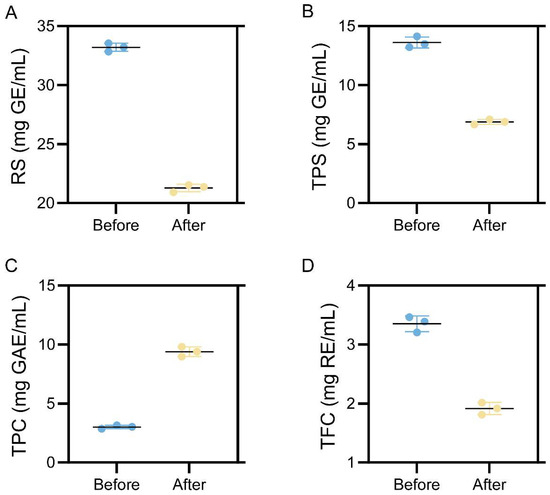
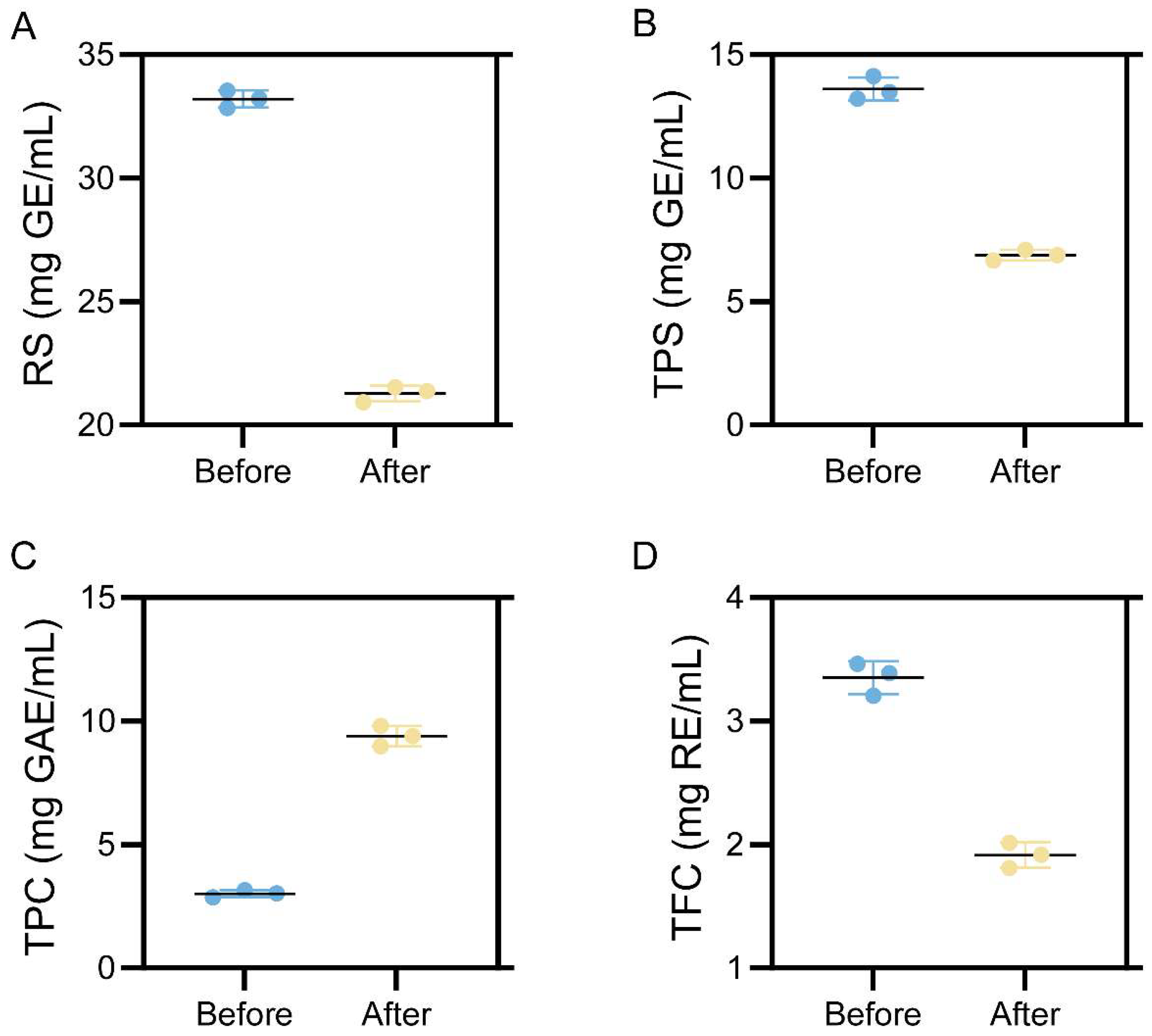
Carbohydrate-related indices declined after fermentation (Figure 2A,B). Reducing sugar content decreased from 33.20 ± 0.35 to 21.28 ± 0.31 mg GE/mL, consistent with its consumption as a readily available carbon source during microbial fermentation [45]. Total polysaccharide content also decreased from 13.61 ± 0.47 to 6.88 ± 0.21 mg GE/mL, suggesting that fermentation involved not only the utilization of free sugars but also changes in matrix-associated polysaccharides [46]. In contrast, phenolic-related indices changed in opposite directions after fermentation (Figure 2C,D). TPC increased from 3.01 ± 0.15 to 9.39 ± 0.42 mg GAE/mL, whereas TFC decreased from 3.35 ± 0.13 to 1.91 ± 0.10 mg RE/mL. These opposite trends indicate that sequential fermentation was associated with substantial changes in phenolic-related indices, rather than uniform increases across all measured classes.
Figure 2.
Changes in bioactive components of LBPCJ before and after fermentation. (A) reducing sugar (RS), (B) total polysaccharide (TPS), (C) total phenolic content (TPC), and (D) total flavonoid content (TFC). RS and TPS are expressed as D-glucose equivalents (mg GE/mL), TPC as gallic acid equivalents (mg GAE/mL), and TFC as rutin equivalents (mg RE/mL). Data are presented as mean ± SD (n = 3).
3.4. In Vitro Antioxidant Activities Before and After Fermentation
Sequential fermentation enhanced the in vitro antioxidant activity of LBPCJ across all radical-scavenging assays (Figure 3). DPPH, ABTS, and •OH scavenging rates increased by 39.90%, 29.78%, and 11.10%, respectively. The greater increases observed in the DPPH and ABTS assays were consistent with the concurrent increase in total phenolic content. In contrast, the smaller increase in •OH scavenging activity may reflect the greater system dependence of hydroxyl radical assays and the fact that relationships between phenolic content and radical-scavenging responses can vary across assay systems and sample matrices [47,48]. Overall, sequential fermentation was associated with improved in vitro antioxidant-related activity of LBPCJ, with the most pronounced enhancement observed in the DPPH and ABTS assay systems.
Figure 3.
In vitro antioxidant activities of LBPCJ before and after fermentation. DPPH, ABTS, and hydroxyl radical (•OH) scavenging activities were measured to evaluate in vitro antioxidant capacity. Data were presented as mean ± SD (n = 3).
3.5. Effects of LBPCJ on Liver Injury-Related Parameters in Mice with Alcohol-Induced Liver Injury
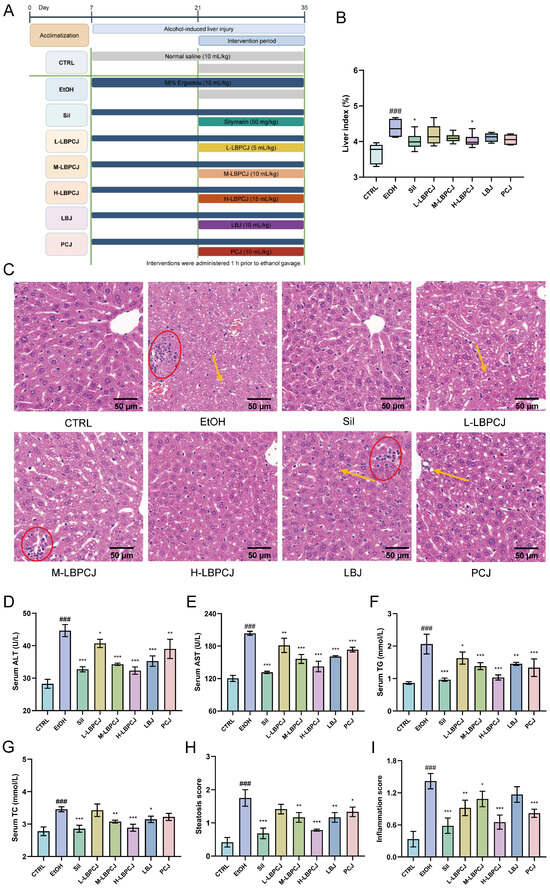
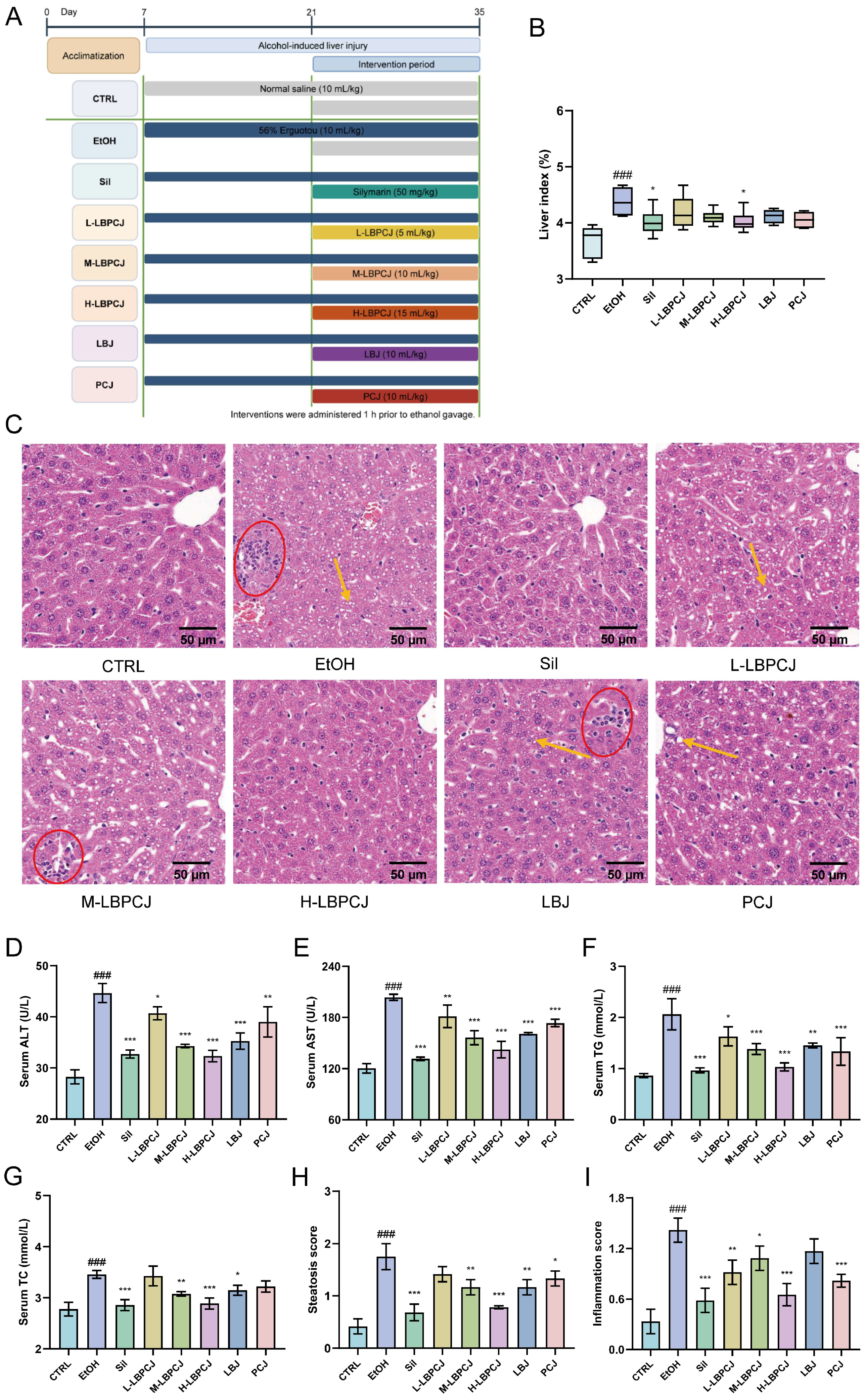
Following ethanol challenge (Figure 4A), the EtOH group showed a typical alcohol-induced liver injury phenotype compared with the CTRL group. Liver index was significantly increased (Figure 4B; ###, p < 0.001), accompanied by marked elevations in serum ALT and AST (Figure 4D,E; ###, p < 0.001), indicating substantial hepatocellular injury. Serum TG and TC were also significantly increased (Figure 4F,G; ###, p < 0.001), suggesting disturbed hepatic lipid metabolism after ethanol exposure. Histopathological examination further confirmed these changes: the EtOH group showed obvious hepatocellular steatosis and inflammatory cell infiltration on H&E staining (Figure 4C), together with significant increases in steatosis and inflammation scores (Figure 4H,I; ###, p < 0.001). These biochemical and histological alterations confirmed the successful establishment of the alcohol-induced liver injury model.
Figure 4.
Effects of LBPCJ on hepatic injury in mice with alcohol-induced liver injury. (A) Experimental design and treatment timeline. (B) Liver index. (C) Representative H&E-stained liver sections. Serum ALT (D), AST (E), TG (F), and TC (G) levels. (H) Steatosis score. (I) Inflammation score. Data were presented as mean ± SD (n = 6). Statistical differences among multiple groups were analyzed using one-way ANOVA followed by Tukey’s multiple comparisons test. ### p < 0.001 vs. CTRL group; * p < 0.05, ** p < 0.01, *** p < 0.001 vs. EtOH group. Red circles indicate intralobular inflammatory cell infiltration, and yellow arrows indicate hepatic steatosis.
The silymarin group showed clear improvement, supporting the responsiveness of the model [49]. LBPCJ administration also improved liver injury-related parameters, with the high-dose group showing the clearest overall response. Relative to the EtOH group, H-LBPCJ significantly reduced liver index (*, p < 0.05), ALT (***, p < 0.001), AST (***, p < 0.001), TG (***, p < 0.001), and TC (***, p < 0.001), as well as steatosis and inflammation scores. M-LBPCJ also produced clear improvements across most endpoints, whereas L-LBPCJ showed weaker effects. Histologically, both medium- and high-dose LBPCJ alleviated hepatocellular vacuolation, steatotic changes, and inflammatory infiltration. LBJ and PCJ also attenuated these abnormalities to some extent. Overall, LBPCJ treatment corresponded to improvement across multiple biochemical and histopathological endpoints in this model.
3.6. Effects of LBPCJ on Hepatic Oxidative Stress-Related Indices in Mice with Alcohol-Induced Liver Injury
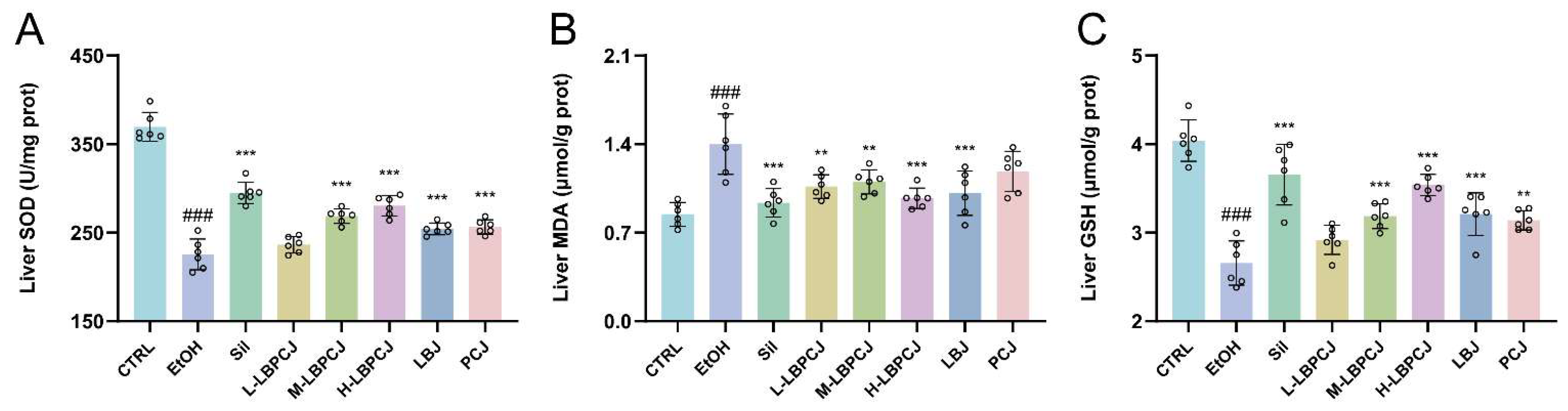
Hepatic SOD activity and GSH content were measured as antioxidant-related indices, whereas MDA was used as an index of lipid peroxidation. Ethanol challenge markedly disrupted hepatic redox homeostasis (Figure 5). Compared with the CTRL group, the EtOH group showed significantly decreased SOD activity and GSH content, together with higher MDA levels (Figure 5A–C; ###, p < 0.001), indicating enhanced oxidative stress and lipid peroxidation. Silymarin significantly reversed these changes. LBPCJ supplementation also improved all three indices, with the high-dose group showing the clearest response. Relative to the EtOH group, H-LBPCJ significantly increased SOD and GSH and reduced MDA (***, p < 0.001), with changes of approximately +24.3%, +33.2%, and −30.6%, respectively. M-LBPCJ also produced clear improvements, whereas L-LBPCJ was less effective. LBJ and PCJ partially corrected these abnormalities as well. Taken together, LBPCJ treatment coincided with concurrent improvement in all three measured oxidative stress-related indices.
Figure 5.
Effects of LBPCJ on hepatic oxidative stress-related indices in mice with alcohol-induced liver injury. Hepatic SOD activity (A), MDA content (B), and GSH levels (C) were determined after the intervention. Data were presented as mean ± SD (n = 6). Statistical differences among multiple groups were analyzed using one-way ANOVA followed by Tukey’s multiple comparisons test. ### p < 0.001 vs. CTRL group; ** p < 0.01, *** p < 0.001 vs. EtOH group.
3.7. Effects of LBPCJ on Hepatic Pro-Inflammatory Cytokine Levels in Mice with Alcohol-Induced Liver Injury
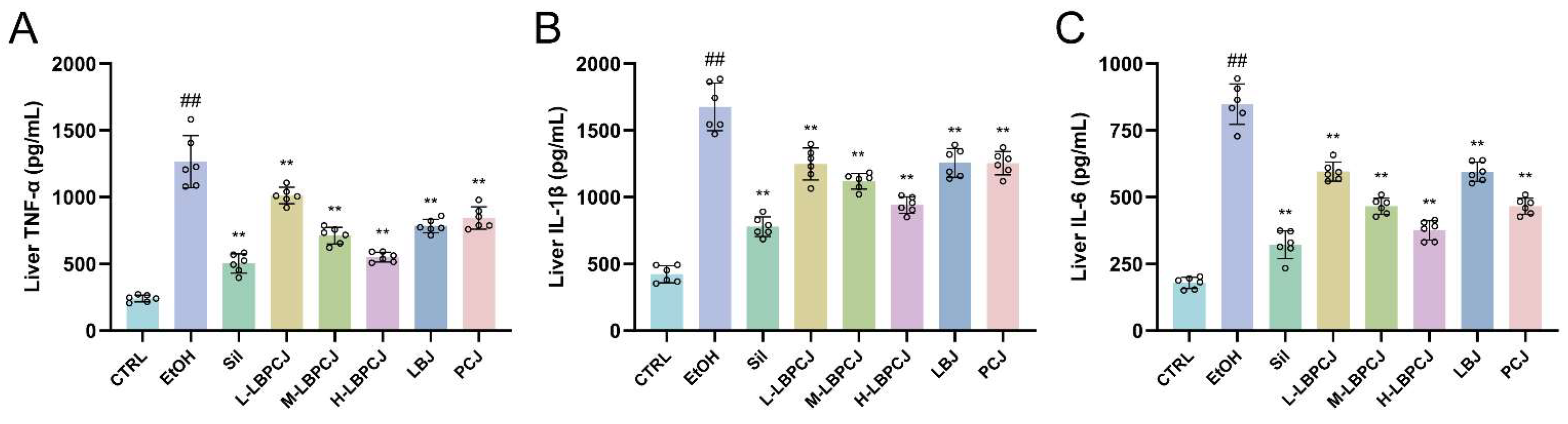
Ethanol challenge significantly elevated hepatic TNF-α, IL-1β, and IL-6 levels compared with the CTRL group (Figure 6A–C; ##, p < 0.01), indicating a pronounced inflammatory response in the injured liver. Silymarin significantly reduced all three cytokines. LBPCJ treatment also suppressed hepatic inflammation, with the high-dose group showing the largest reductions. Compared with the EtOH group, H-LBPCJ reduced TNF-α, IL-1β, and IL-6 by approximately 56.5%, 43.9%, and 55.8%, respectively (**, p < 0.01). M-LBPCJ also showed clear anti-inflammatory activity, whereas L-LBPCJ was less effective. LBJ and PCJ also lowered these cytokines to some extent. Together with the oxidative stress-related results, these findings indicate that LBPCJ treatment was accompanied by changes in both inflammatory and liver injury-related markers in ethanol-exposed mice.
Figure 6.
Effects of LBPCJ on hepatic pro-inflammatory cytokine levels in mice with alcohol-induced liver injury. Hepatic levels of TNF-α (A), IL-1β (B), and IL-6 (C) were determined after the intervention. Data were presented as mean ± SD (n = 6). Statistical differences among multiple groups were analyzed using one-way ANOVA followed by Tukey’s multiple comparisons test. ## p < 0.01 vs. CTRL group; ** p < 0.01 vs. EtOH group.
Taken together, the present results showed that sequential dual-species fermentation markedly altered the physicochemical and compositional characteristics of LBPCJ. The decrease in pH, increase in total acidity, and accumulation of ethanol indicated active microbial transformation of the composite substrate during fermentation, whereas the reductions in reducing sugar and total polysaccharide content were consistent with substantial substrate utilization. Similar shifts in acidity, sugar metabolism, and antioxidant-related properties have also been reported in fruit-based matrices fermented with Saccharomyces cerevisiae and Lactiplantibacillus plantarum. For example, sequential fermentation of apple juice with S. cerevisiae followed by L. plantarum altered physicochemical indices and improved antioxidant-related properties [50], whereas different yeast-LAB inoculation strategies in cider produced distinct quality and antioxidant profiles depending on the fermentation mode [43]. In the specific context of Lycium barbarum–Polygonatum cyrtonema products, Wang et al. reported that fermentation strategy influenced product quality and in vitro antioxidant-related activity in compound wine [23].
The compositional indices and in vitro antioxidant-related assays further showed that fermentation did not affect all measured parameters in the same direction. In the present study, TPC increased markedly, whereas TFC decreased, and these changes were accompanied by higher DPPH, ABTS, and •OH radical-scavenging activities after fermentation. A similar pattern was reported in LAB-fermented jujube-wolfberry composite juice, in which total phenolics increased whereas total flavonoids decreased, together with improved antioxidant capacity [51]. A comparable trend was also observed in jujube juice fermented by L. plantarum, where total polyphenols increased while reducing sugar and total flavonoids declined, alongside enhanced biological activity and metabolic profile changes [52]. However, not all fermented fruit systems exhibit the same response pattern. In mulberry wine fermented with L. plantarum and S. cerevisiae, both phenolics and flavonoids declined during fermentation, despite improvement in some antioxidant-related properties [53]. Recent evidence further indicates that the magnitude and direction of these changes depend strongly on the food matrix, microbial strains, and process conditions [54,55].
In the ethanol-exposed mouse model, LBPCJ treatment improved multiple liver injury-related endpoints. Compared with the EtOH group, LBPCJ, particularly at the high dose, was accompanied by lower liver index, ALT, AST, TG, and TC levels, attenuated steatosis and inflammatory infiltration, higher hepatic SOD and GSH levels, lower MDA levels, and reduced TNF-α, IL-1β, and IL-6 levels. A generally similar response pattern has been reported for fermented goji-based products in alcohol-induced liver injury models [19]. In addition, polysaccharides derived from P. cyrtonema have been reported to ameliorate acute alcohol-induced liver damage and to improve oxidative stress- and inflammation-related parameters in mice [22]. In the present study, LBJ and PCJ also improved several endpoints, while LBPCJ showed improvement across multiple measured indicators.
Nevertheless, these findings should be interpreted within the limits of the current study. First, the chemical characterization of LBPCJ remained at the level of global compositional indices rather than compound-specific identification and quantification. Therefore, the present data do not indicate which constituents were altered most substantially during fermentation or which components were most closely associated with the observed in vivo responses. Second, although LBJ and PCJ also improved several endpoints, the present comparative data do not support formal inference regarding superiority or synergism of LBPCJ relative to the corresponding single-plant jiaosu preparations. Third, the parallel changes in fermentation-related composition, in vitro antioxidant-related activity, and in vivo liver injury-related indicators should be interpreted as associative rather than mechanistic. Fourth, the present findings were obtained in an ethanol-exposed mouse model under the current dosing and experimental conditions and therefore should not be directly extrapolated to human alcohol-associated liver disease or longer-term clinical outcomes. Future studies should combine targeted or untargeted chemical profiling with fraction-based validation and pathway-level experiments to identify the fermentation-derived constituents and biological processes most relevant to the observed effects.
4. Conclusions
In the present study, LBPCJ was successfully developed through sequential dual-species fermentation. Fermentation markedly altered the physicochemical characteristics of the product and enhanced in vitro antioxidant capacity. In the mouse model of alcohol-induced liver injury, LBPCJ administration improved liver index, serum aminotransferase levels, lipid-related indices, histopathological alterations, hepatic SOD and GSH levels, MDA content, and pro-inflammatory cytokine levels. LBJ and PCJ also improved several of these indicators, whereas LBPCJ showed changes across multiple measured endpoints, with the high-dose group showing the clearest overall response. However, because the present study did not identify specific bioactive compounds or establish mechanistic pathways, these findings should be interpreted as associative rather than causal. The current results provide preliminary experimental evidence supporting further chemical characterization and mechanistic investigation of LBPCJ in the context of alcohol-induced liver injury, but they do not support direct health or functional claims, and extrapolation to human applications requires further validation.
Author Contributions
S.Y.: Investigation, Methodology, Formal analysis, Writing—Original Draft. B.L.: Investigation, Methodology, Formal analysis. H.G.: Investigation, Methodology. Z.Y.: Investigation, Methodology. W.X.: Investigation, Methodology. C.H.: Methodology, Resources, Funding acquisition. A.Z.: Formal analysis, Resources. W.Z.: Conceptualization, Formal analysis, Resources, Supervision. Z.W.: Conceptualization, Data curation, Writing—Review and Editing, Supervision, Funding acquisition. All authors have read and agreed to the published version of the manuscript.
Funding
This research was funded by the National Key R&D Program of China (2024YFD2101000), the Science and Technology Achievements Cultivation Project of the Intelligent Manufacturing Institute of HFUT (IMIPY2022015), the Key Research and Development Program of Anhui Province (2023j11020006), the Fundamental Research Funds for the Central Universities of China (PA2024GDGP0037 and PA2025GDGP0026) and an enterprise project (W2017JSKF0682).
Institutional Review Board Statement
All animal experimental procedures were performed in strict compliance with the relevant guidelines for the care and use of laboratory animals and approved by the Biomedical Ethics Committee of Hefei University of Technology (Approval No. HFUT20251125001; 25 November 2025).
Informed Consent Statement
Not applicable.
Data Availability Statement
The original contributions presented in this study are included in the article. Further inquiries can be directed to the corresponding authors.
Conflicts of Interest
The authors declare no conflicts of interest.
References
- Bajaj, J.S.; Nagy, L.E. Natural History of Alcohol-Associated Liver Disease: Understanding the Changing Landscape of Pathophysiology and Patient Care. Gastroenterology 2022, 163, 840–851. [Google Scholar] [CrossRef] [Scilit]
- Shield, K.; Franklin, A.; Wettlaufer, A.; Sohi, I.; Bhulabhai, M.; Farkouh, E.K.; Radu, I.-G.; Kassam, I.; Munnery, M.; Remtulla, R.; et al. National, regional, and global statistics on alcohol consumption and associated burden of disease 2000-20: A modelling study and comparative risk assessment. Lancet Public Health 2025, 10, e751–e761. [Google Scholar] [CrossRef] [Scilit] [PubMed]
- World Health Organization. Alcohol [EB/OL]. (28 June 2024). Available online: https://www.who.int/news-room/fact-sheets/detail/alcohol (accessed on 31 January 2026).
- Tang, Z.; Ding, Y.; Zhang, W.; Zhang, R.; Zhang, L.; Wang, M.; Wang, M.; Chen, Y.; Wang, J. Epidemiological characteristics of alcohol-related liver disease in China: A systematic review and meta-analysis. BMC Public Health 2023, 23, 1276. [Google Scholar] [CrossRef] [Scilit] [PubMed]
- Osna, N.A.; Donohue, T.M., Jr.; Kharbanda, K.K. Alcoholic Liver Disease: Pathogenesis and Current Management. Alcohol. Res. 2017, 38, 147–161. [Google Scholar] [CrossRef] [Scilit] [PubMed]
- Raya Tonetti, F.; Eguileor, A.; Mrdjen, M.; Pathak, V.; Travers, J.; Nagy, L.E.; Llorente, C. Gut-liver axis: Recent concepts in pathophysiology in alcohol-associated liver disease. Hepatology 2024, 80, 1342–1371. [Google Scholar] [CrossRef] [Scilit]
- Szabo, G. Gut-liver axis in alcoholic liver disease. Gastroenterology 2015, 148, 30–36. [Google Scholar]
- Mandrekar, P.; Mandal, A. Pathogenesis of Alcohol-Associated Liver Disease. Clin. Liver Dis. 2024, 28, 647–661. [Google Scholar] [CrossRef] [Scilit]
- Jophlin, L.L.; Singal, A.K.; Bataller, R.; Wong, R.J.; Sauer, B.G.; Terrault, N.A.; Shah, V.H. ACG Clinical Guideline: Alcohol-Associated Liver Disease. Am. J. Gastroenterol. 2024, 119, 30–54. [Google Scholar]
- Arab, J.P.; Addolorato, G.; Mathurin, P.; Thursz, M.R. Alcohol-Associated Liver Disease: Integrated Management with Alcohol Use Disorder. Clin. Gastroenterol. Hepatol. 2023, 21, 2124–2134. [Google Scholar] [CrossRef] [Scilit]
- Prince, D.S.; Nash, E.; Liu, K. Alcohol-Associated Liver Disease: Evolving Concepts and Treatments. Drugs 2023, 83, 1459–1474. [Google Scholar] [CrossRef] [Scilit]
- Dissanayake, I.H.; Tabassum, W.; Alsherbiny, M.; Chang, D.; Li, C.G.; Bhuyan, D.J. Lactic acid bacterial fermentation as a biotransformation strategy to enhance the bioavailability of phenolic antioxidants in fruits and vegetables: A comprehensive review. Food Res. Int. 2025, 209, 116283. [Google Scholar] [CrossRef] [Scilit] [PubMed]
- Dai, J.; Sha, R.; Wang, Z.; Cui, Y.; Fang, S.; Mao, J. Edible plant Jiaosu: Manufacturing, bioactive compounds, potential health benefits, and safety aspects. J. Sci. Food Agric. 2020, 100, 5313–5323. [Google Scholar] [CrossRef] [Scilit] [PubMed]
- Ren, J.; Yang, S.; Shen, N.; Wang, X.; Li, H.; Chen, Y.; Gao, Z. Screening alcohol degrading function probiotics and protective effect of fermented apple juice on alcoholic liver injury in mice. Food Biosci. 2024, 58, 103786. [Google Scholar] [CrossRef] [Scilit]
- Guo, M.; Mao, B.; Sadiq, F.A.; Hao, Y.; Cui, S.; Yi, M.; Hong, Q.; Lee, Y.-K.; Zhao, J. Effects of noni fruit and fermented noni juice against acute alcohol induced liver injury in mice. J. Funct. Foods 2020, 70, 103995. [Google Scholar] [CrossRef] [Scilit]
- Hu, S.; Xu, Y.; Shadrack, S.M.; Zhang, J.; Xu, L.; Wang, Y.; Wang, F.; Cao, C.; Xu, X.; Yuan, B. Lycium barbarum (goji berry): A comprehensive review of chemical composition, bioactive compounds, health-promoting activities, and applications in functional foods and beyond. Food Chem. 2025, 496, 146588. [Google Scholar] [CrossRef] [Scilit]
- Teixeira, F.; Silva, A.M.; Delerue-Matos, C.; Rodrigues, F. Lycium barbarum Berries (Solanaceae) as Source of Bioactive Compounds for Healthy Purposes: A Review. Int. J. Mol. Sci. 2023, 24, 4777. [Google Scholar] [CrossRef] [Scilit]
- Kwok, S.S.; Bu, Y.; Lo, A.C.; Chan, T.C.; So, K.F.; Lai, J.S.; Shih, K.C. A Systematic Review of Potential Therapeutic Use of Lycium Barbarum Polysaccharides in Disease. Biomed. Res. Int. 2019, 2019, 4615745. [Google Scholar] [CrossRef] [Scilit]
- Duan, W.; Zhou, L.; Ren, Y.; Liu, F.; Xue, Y.; Wang, F.Z.; Lu, R.; Zhang, X.J.; Shi, J.S.; Xu, Z.H.; et al. Lactic acid fermentation of goji berries (Lycium barbarum) prevents acute alcohol liver injury and modulates gut microbiota and metabolites in mice. Food Funct. 2024, 15, 1612–1626. [Google Scholar] [CrossRef] [Scilit]
- Xue, T.; Zhao, M.; Chen, J.; Chen, Y.; Zhang, C.; Li, B. Revealing the mechanisms of the bioactive ingredients accumulation in Polygonatum cyrtonema by multiomics analyses. Front. Plant Sci. 2022, 13, 1055721. [Google Scholar] [CrossRef] [Scilit]
- Liu, W.; Shao, T.; Tian, L.; Ren, Z.; Gao, L.; Tang, Z.; Fang, Z.; Yuan, P.; Liu, C.; Li, J. Structural elucidation and anti-nonalcoholic fatty liver disease activity of Polygonatum cyrtonema Hua polysaccharide. Food Funct. 2022, 13, 12883–12895. [Google Scholar] [CrossRef] [Scilit]
- Gui, Y.; Zheng, B.; Huang, H.; Xie, J.; Chen, Y.; Shan, J.; Chang, X.; Hu, X.; Yu, Q. Protective effects of polysaccharides from Polygonatum cyrtonema on the acute alcohol induced liver damage. Food Biosci. 2024, 61, 104879. [Google Scholar] [CrossRef] [Scilit]
- Wang, J.-J.; Zhang, W.-W.; Guan, Z.-J.; Thakur, K.; Hu, F.; Zhang, J.-G.; Wei, Z.-J. Effect of fermentation methods on the quality and in vitro antioxidant properties of Lycium barbarum and Polygonatum cyrtonema compound wine. Food Chem. 2023, 409, 135277. [Google Scholar] [CrossRef] [Scilit] [PubMed]
- Süle, J.; Kõrösi, T.; Hucker, A.; Varga, L. Evaluation of culture media for selective enumeration of bifidobacteria and lactic acid bacteria. Braz. J. Microbiol. 2014, 45, 1023–1030. [Google Scholar] [CrossRef] [Scilit] [PubMed]
- GB 12456-2021; National Food Safety Standard—Determination of Total Acid in Foods. Standardization Administration of China: Beijing, China, 2021.
- Zhang, M.; Wu, X.; Mu, D.; Xu, B.; Xu, X.; Chang, Q.; Li, X. Profiling the influence of physicochemical parameters on the microbial community and flavor substances of zaopei. J. Sci. Food Agric. 2021, 101, 6300–6310. [Google Scholar] [CrossRef] [Scilit]
- Neira Monsalve, V.A.; Devia Valenzuela, B.B.; Peña Arias, A.I.; Schalchli Sáez, H.L.; Melo, P.S.; de Souza Moreira, C.; de Oliveira Sartori, A.G.; Vergara Ojeda, C.A.; de Alencar, S.M.; Scheuermann Salinas, E.S. Valorization of Brewer’s Spent Grain Liquid Fraction for the Development of a Pasteurized Strawberry-Based Blend Juice. Foods 2025, 14, 4053. [Google Scholar] [CrossRef] [Scilit]
- Sawangwan, T.; Kajadman, D.; Kulchananimit, R. Determination of prebiotic properties of rice bran extract. Biosci. Microbiota Food Health 2024, 43, 222–226. [Google Scholar] [CrossRef] [Scilit]
- Assawarachan, R. Drying of Grade-Out Cape Gooseberry (Physalis peruviana Linn.) with Mild Hydrostatic Osmotic Pretreatment Using Rotary Tray Dryer: A Case Study at Mae Hae Royal Project Development Center, Chiang Mai Province. Processes 2025, 13, 1790. [Google Scholar] [CrossRef] [Scilit]
- Wei, X.; Chang, Q.-Y.; Liu, Y.; Hua, H.-N.; Liu, Y.-N.; Tang, Z.-H.; Mu, L.-Q. Influence of Wild and Cultivated Environments on the Antioxidant and Medicinal Components of Rhodiola sachalinensis A. Boriss. Plants 2024, 13, 3544. [Google Scholar] [CrossRef] [Scilit]
- Guo, H.; Zhang, W.; Jiang, Y.; Wang, H.; Chen, G.; Guo, M. Physicochemical, Structural, and Biological Properties of Polysaccharides from Dandelion. Molecules 2019, 24, 1485. [Google Scholar] [CrossRef] [Scilit]
- Peng, X.; Liu, J.; Tang, N.; Deng, J.; Liu, C.; Kan, H.; Zhao, P.; Zhang, X.; Shi, Z.; Liu, Y. Sequential extraction, structural characterization, and antioxidant activity of polysaccharides from Dendrocalamus brandisii bamboo shoot shell. Food Chem. X 2023, 17, 100621. [Google Scholar] [CrossRef] [Scilit]
- Liu, Y.; Chen, S.; Zhang, J.; Gao, M.; Li, L. Purification of Polysaccharide Produced by the Haploid Yeast Strain of Tremella sanguinea and Its Antioxidant and Prebiotic Activities. Molecules 2023, 28, 5391. [Google Scholar] [CrossRef] [Scilit] [PubMed]
- Xiang, J.; Zhu, W.; Li, Z.; Ling, S. Effect of juice and fermented vinegar from Hovenia dulcis peduncles on chronically alcohol-induced liver damage in mice. Food Funct. 2012, 3, 628–634. [Google Scholar] [CrossRef] [Scilit] [PubMed]
- Chang, Y.Y.; Lin, Y.L.; Yang, D.J.; Liu, C.W.; Hsu, C.L.; Tzang, B.S.; Chen, Y.C. Hepatoprotection of noni juice against chronic alcohol consumption: Lipid homeostasis, antioxidation, alcohol clearance, and anti-inflammation. J. Agric. Food Chem. 2013, 61, 11016–11024. [Google Scholar] [CrossRef] [Scilit] [PubMed]
- Kleiner, D.E.; Brunt, E.M.; Van Natta, M.; Behling, C.; Contos, M.J.; Cummings, O.W.; Ferrell, L.D.; Liu, Y.C.; Torbenson, M.S.; Unalp-Arida, A.; et al. Design and validation of a histological scoring system for nonalcoholic fatty liver disease. Hepatology 2005, 41, 1313–1321. [Google Scholar] [CrossRef] [Scilit]
- Das, S.; Song, Z.; Han, H.; Ge, X.; Desert, R.; Athavale, D.; Babu Komakula, S.S.; Magdaleno, F.; Chen, W.; Lantvit, D.; et al. Intestinal Osteopontin Protects from Alcohol-induced Liver Injury by Preserving the Gut Microbiome and the Intestinal Barrier Function. Cell. Mol. Gastroenterol. Hepatol. 2022, 14, 813–839. [Google Scholar] [CrossRef] [Scilit]
- Zhao, L.; Maimaitiyiming, R.; Hong, J.; Wang, L.; Mu, Y.; Liu, B.; Zhang, H.; Chen, K.; Aihaiti, A. Optimization of tomato (Solanum lycopersicum L.) juice fermentation process and analysis of its metabolites during fermentation. Front. Nutr. 2024, 11, 1344117. [Google Scholar]
- Rosenfeld, E.; Beauvoit, B.; Blondin, B.; Salmon, J.-M. Oxygen Consumption by Anaerobic Saccharomyces cerevisiae under Enological Conditions: Effect on Fermentation Kinetics. Appl. Environ. Microbiol. 2003, 69, 113–121. [Google Scholar] [CrossRef] [Scilit]
- Chen, Y.; Liu, F.; Chen, J.; Chen, J.; Chen, S.; Wu, D.; Ye, X.; Cheng, H. Effects of fermentation conditions on physicochemical properties and flavor quality of fermented bayberry juice. Food Qual. Saf. 2022, 6, fyac023. [Google Scholar] [CrossRef] [Scilit]
- Yang, S.; Hou, M.; Tan, W.; Chen, Y.; Li, H.; Song, J.; Wang, X.; Ren, J.; Gao, Z. Lactic acid bacteria sequential fermentation improves viable counts and quality of fermented apple juice via generating two logarithmic phases. Food Chem. 2025, 464, 141635. [Google Scholar] [CrossRef] [Scilit]
- Yin, X.; Huang, S.; Xiong, T.; Peng, F. Effects of Lactobacillus plantarum NCU1546 fermentation on active components, in vitro uric acid lowering activity and flavor of Lilium. Food Biosci. 2025, 65, 106112. [Google Scholar] [CrossRef] [Scilit]
- Chen, X.; Lin, M.; Hu, L.; Xu, T.; Xiong, D.; Li, L.; Zhao, Z. Research on the Effect of Simultaneous and Sequential Fermentation with Saccharomyces cerevisiae and Lactobacillus plantarum on Antioxidant Activity and Flavor of Apple Cider. Fermentation 2023, 9, 102. [Google Scholar] [CrossRef] [Scilit]
- Zhou, Y.; Chao, Y.; Huang, C.; Li, X.; Yi, Z.; Zhu, Z.; Yan, L.; Ding, Y.; Peng, Y.; Xie, C. Influence of Lactiplantibacillus plantarum and Saccharomyces cerevisiae Individual and Collaborative Inoculation on Flavor Characteristics of Rose Fermented Beverage. Foods 2025, 14, 1868. [Google Scholar] [CrossRef] [Scilit] [PubMed]
- Xie, H.; Gao, P.; Lu, Z.-M.; Wang, F.-Z.; Chai, L.-J.; Shi, J.-S.; Zhang, H.-L.; Geng, Y.; Zhang, X.-J.; Xu, Z.-H. Changes in physicochemical characteristics and metabolites in the fermentation of goji juice by Lactiplantibacillus plantarum. Food Biosci. 2023, 54, 102881. [Google Scholar] [CrossRef] [Scilit]
- Cheng, Y.; Huang, X.; Li, L.; Liu, L.; Zhang, C.; Fan, X.; Xie, Y.; Zou, Y.; Geng, Z.; Huang, C. Effects of Solid Fermentation on Polygonatum cyrtonema Polysaccharides: Isolation, Characterization and Bioactivities. Molecules 2023, 28, 5498. [Google Scholar] [CrossRef] [Scilit]
- Abramovič, H.; Grobin, B.; Poklar Ulrih, N.; Cigić, B. Relevance and Standardization of In Vitro Antioxidant Assays: ABTS, DPPH, and Folin–Ciocalteu. J. Chem. 2018, 2018, 4608405. [Google Scholar] [CrossRef] [Scilit]
- Rangani, S.C.; Marapana, R.A.U.J.; Senanayake, G.S.A.; Perera, P.R.D.; Pathmalal, M.M.; Amarasinghe, H.K. Correlation analysis of phenolic compounds, antioxidant potential, oxygen radical scavenging capacity, and alkaloid content in ripe and unripe Areca catechu from major cultivation areas in Sri Lanka. Appl. Food Res. 2023, 3, 100361. [Google Scholar] [CrossRef] [Scilit]
- Song, Z.; Deaciuc, I.; Song, M.; Lee, D.Y.; Liu, Y.; Ji, X.; McClain, C. Silymarin protects against acute ethanol-induced hepatotoxicity in mice. Alcohol. Clin. Exp. Res. 2006, 30, 407–413. [Google Scholar] [CrossRef] [Scilit]
- Li, H.; Huang, J.; Wang, Y.; Wang, X.; Ren, Y.; Yue, T.; Wang, Z.; Gao, Z. Study on the nutritional characteristics and antioxidant activity of dealcoholized sequentially fermented apple juice with Saccharomyces cerevisiae and Lactobacillus plantarum fermentation. Food Chem. 2021, 363, 130351. [Google Scholar] [CrossRef] [Scilit]
- Zhao, X.; Tang, F.; Cai, W.; Peng, B.; Zhang, P.; Shan, C. Effect of fermentation by lactic acid bacteria on the phenolic composition, antioxidant activity, and flavor substances of jujube–wolfberry composite juice. LWT 2023, 184, 114884. [Google Scholar] [CrossRef]
- Zhou, Y.; Wei, Y.; Wang, Y.; An, Z.; Ma, Q.; Yi, H.; Zhang, Z. Study on the physicochemical properties, biological activities and metabolic profile alterations of jujube juice fermented by Lactiplantibacillus plantarum. Food Chem. X 2025, 31, 103195. [Google Scholar] [CrossRef] [Scilit]
- Hu, J.; Vinothkanna, A.; Wu, M.; Ekumah, J.-N.; Akpabli-Tsigbe, N.D.K.; Ma, Y. Tracking the dynamic changes of a flavor, phenolic profile, and antioxidant properties of Lactiplantibacillus plantarum- and Saccharomyces cerevisiae-fermented mulberry wine. Food Sci. Nutr. 2021, 9, 6294–6306. [Google Scholar] [CrossRef] [Scilit]
- Hur, S.J.; Lee, S.Y.; Kim, Y.C.; Choi, I.; Kim, G.B. Effect of fermentation on the antioxidant activity in plant-based foods. Food Chem. 2014, 160, 346–356. [Google Scholar] [CrossRef] [Scilit]
- Sarıtaş, S.; Portocarrero, A.C.M.; Miranda López, J.M.; Lombardo, M.; Koch, W.; Raposo, A.; El-Seedi, H.R.; de Brito Alves, J.L.; Esatbeyoglu, T.; Karav, S.; et al. The Impact of Fermentation on the Antioxidant Activity of Food Products. Molecules 2024, 29, 3941. [Google Scholar] [CrossRef] [Scilit]

Disclaimer/Publisher’s Note: The statements, opinions and data contained in all publications are solely those of the individual author(s) and contributor(s) and not of MDPI and/or the editor(s). MDPI and/or the editor(s) disclaim responsibility for any injury to people or property resulting from any ideas, methods, instructions or products referred to in the content. |
© 2026 by the authors. Licensee MDPI, Basel, Switzerland. This article is an open access article distributed under the terms and conditions of the Creative Commons Attribution (CC BY) license.