Fibre-Enriched Pasta from Wet Milled Royal Quinoa: Technological and Nutritional Characterisation


Abstract
1. Introduction
2. Materials and Methods
2.1. Raw Materials
2.2. Wet Milling Procedure and Dietary Fibre Isolation
2.3. Pasta Production
2.4. Proximate Composition of Fresh Pasta Samples
2.5. Cooking Properties
2.6. Determination of Colour
2.7. Determination of Phytate
2.8. Determination of Minerals
2.9. Statistical Analysis
3. Results and Discussion
3.1. Fresh Pasta Composition
3.2. Effect of Quinoa Flour and Quinoa Fibres on Technological Parameters of Cooked Pasta
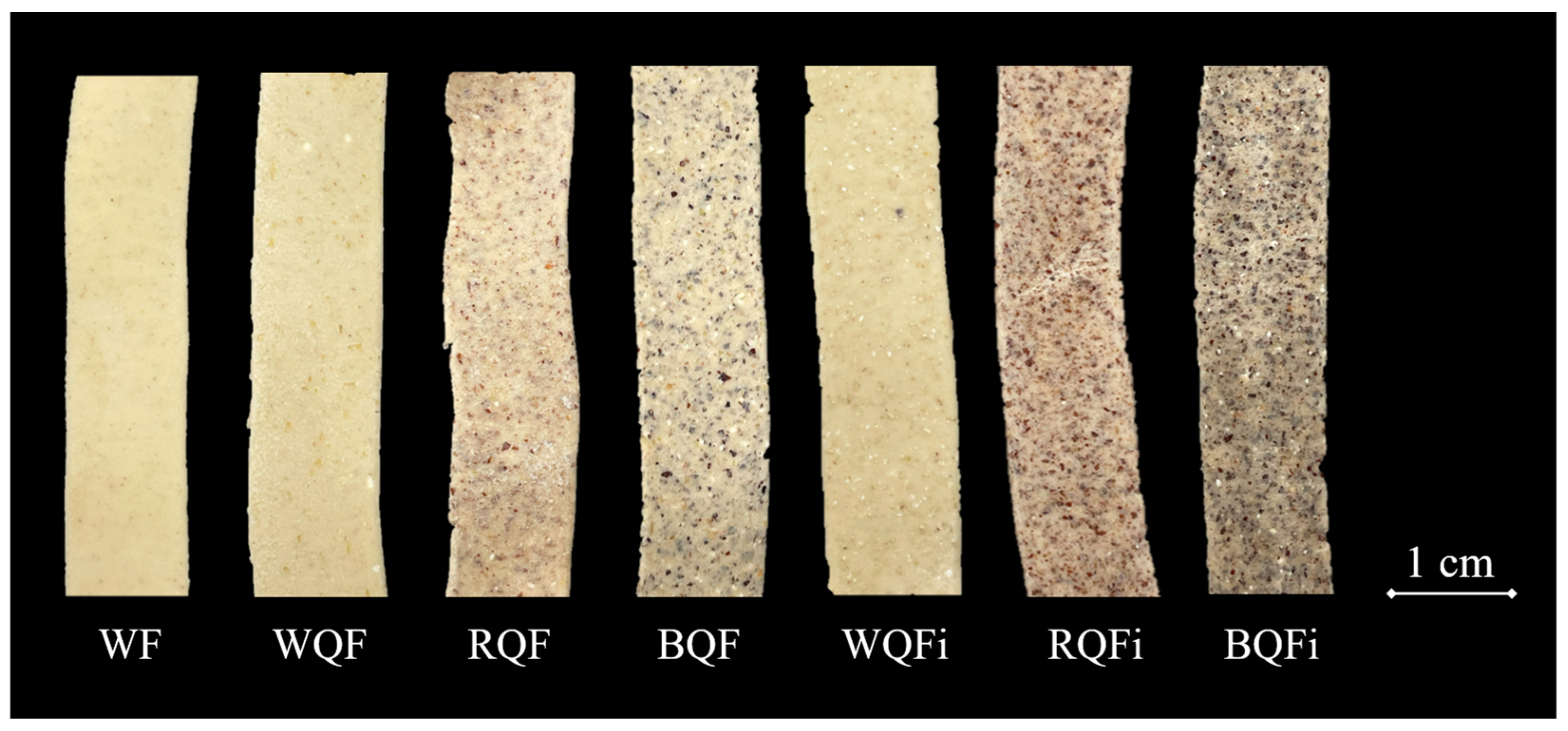
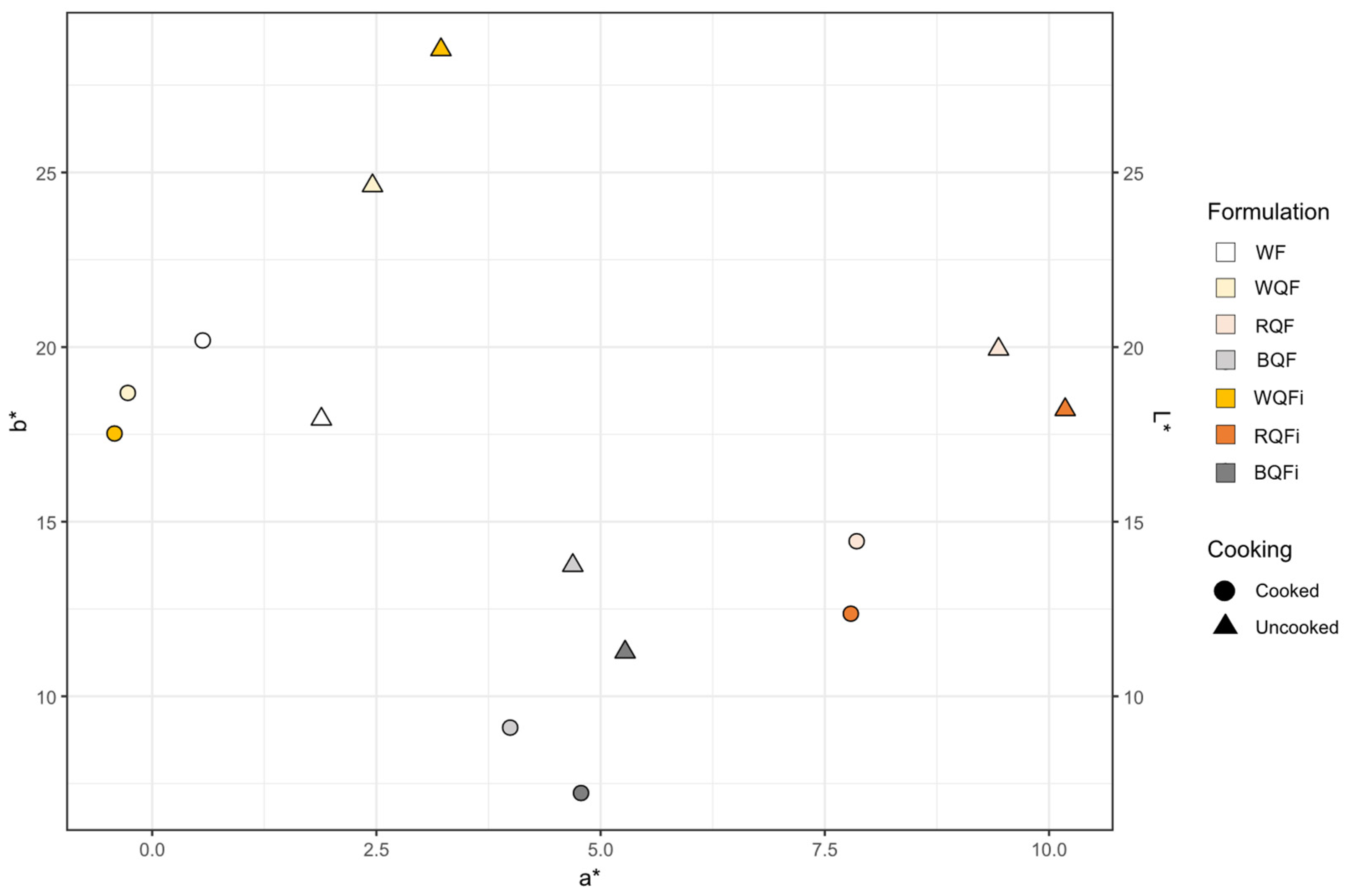
3.3. Colour
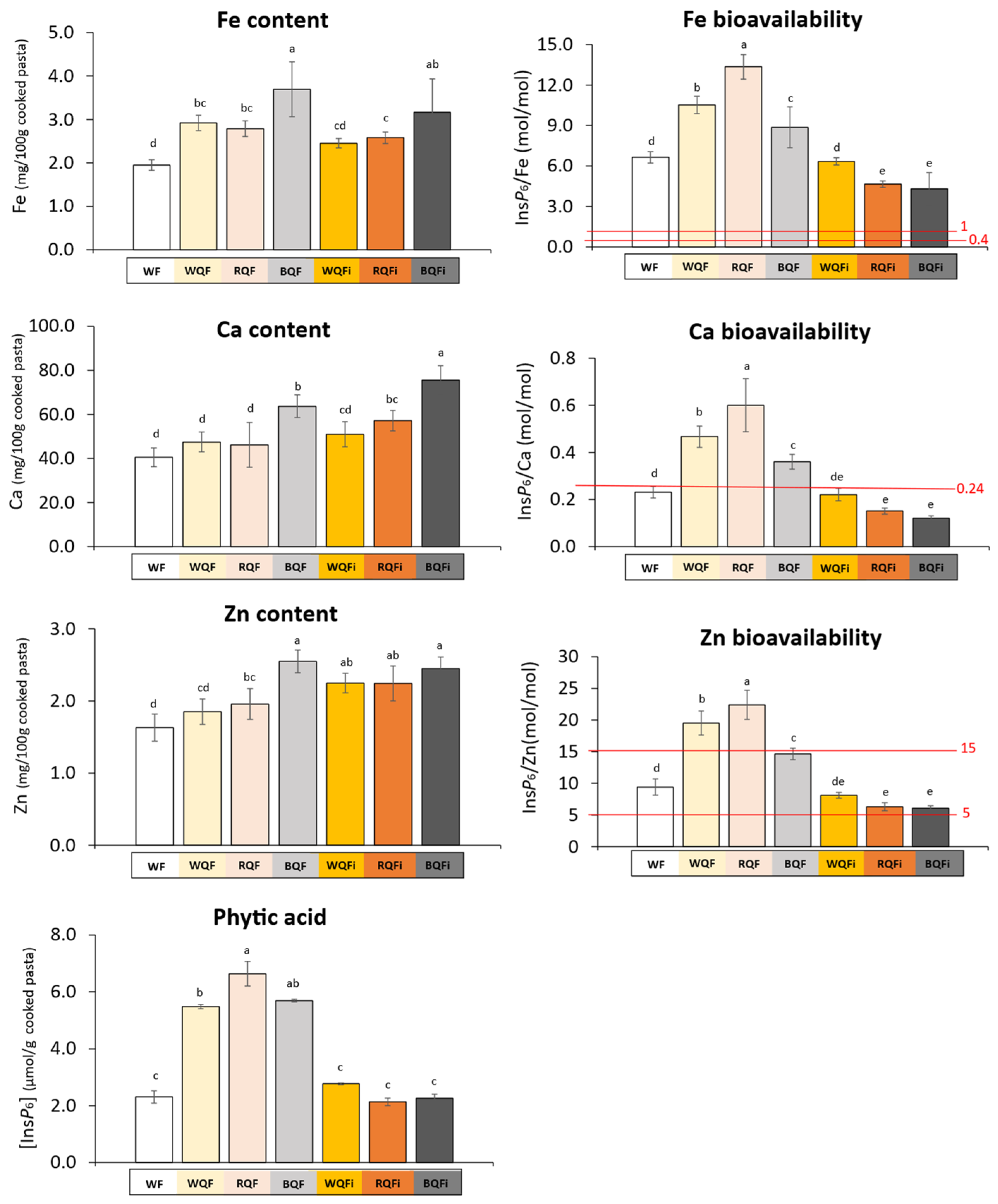
3.4. Mineral Content and Recommended Daily Allowances (RDAs)/Population Reference Intakes (PRIs)
3.5. Phytate Impact on Mineral Absorption

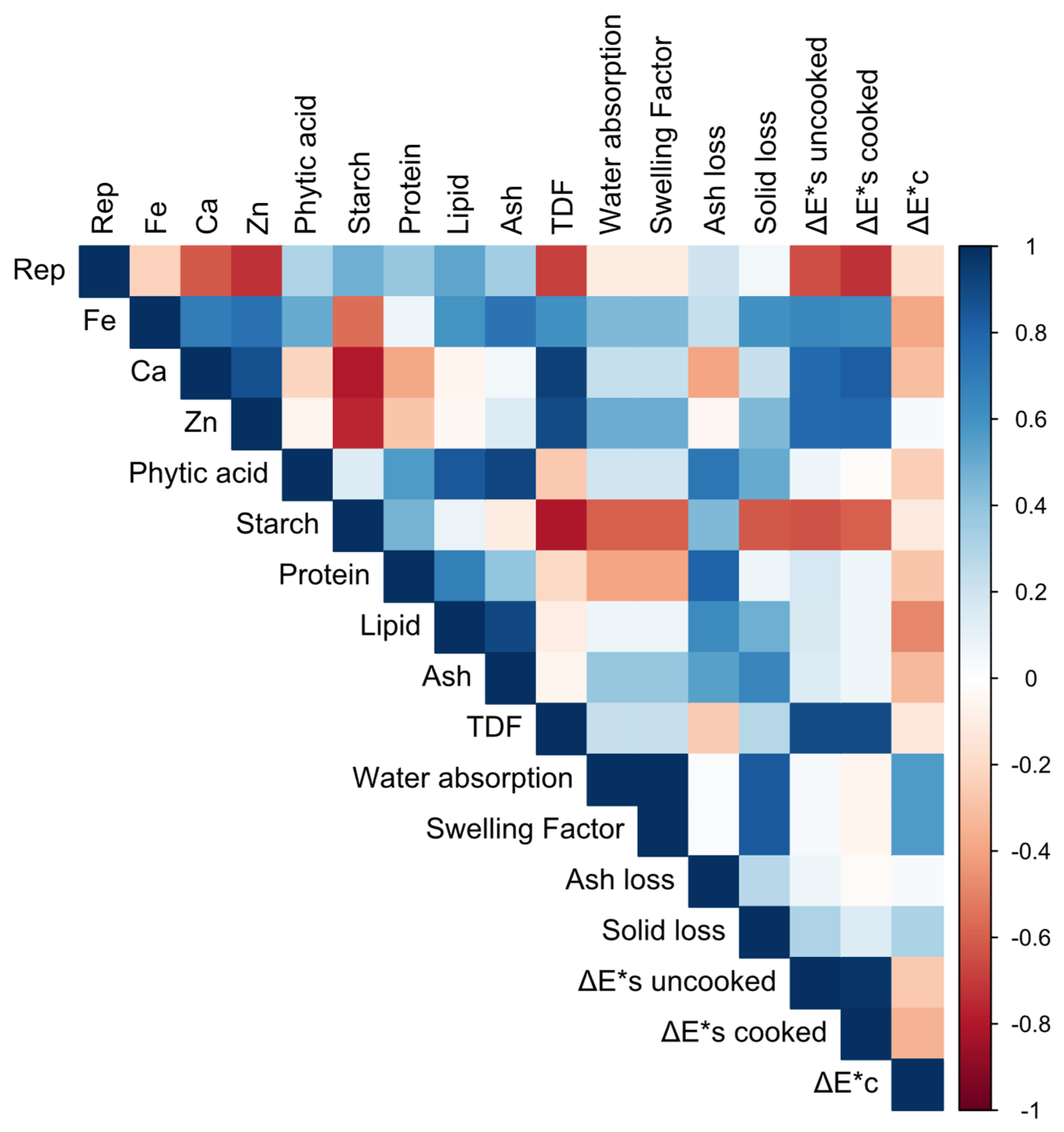
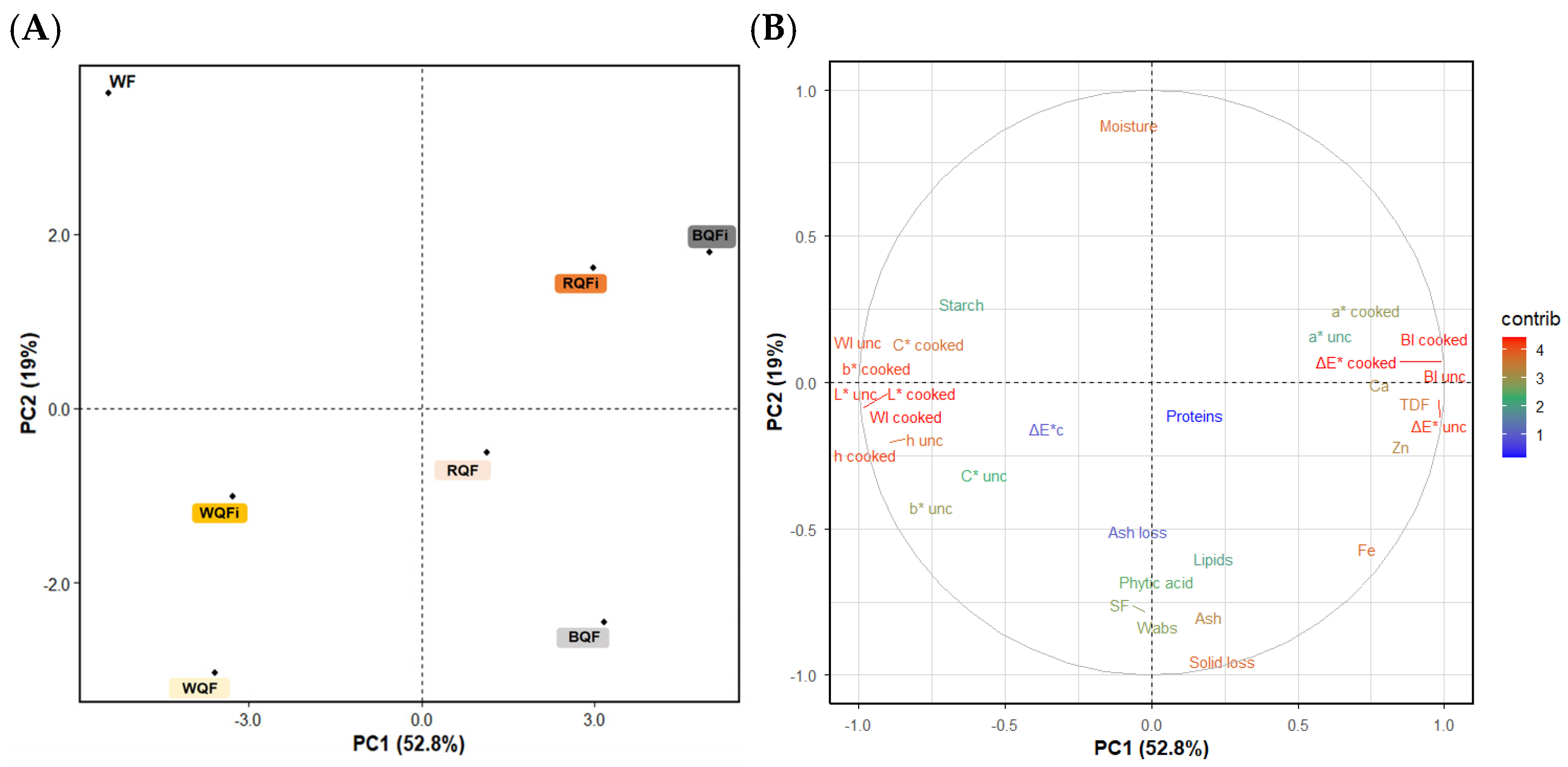
3.6. Multivariate Analysis (Correlation and PCA)
4. Conclusions
Author Contributions
Funding
Institutional Review Board Statement
Informed Consent Statement
Data Availability Statement
Acknowledgments
Conflicts of Interest
References
- Borczak, B.; Marqués, J.M.C.; Paredes-López, O.; Haros, C.M. Structure and Composition of Latin-American Crops. In Latin-American Seeds, 1st ed.; CRC Press: New York, NY, USA, 2023; pp. 119–159. [Google Scholar] [CrossRef]
- Haros, C.M.; Sanz-Penella, J.M. Food uses of whole pseudocereals. In Pseudocereals: Chemistry and Technology; John Wiley & Sons, Ltd.: Hoboken, NJ, USA, 2017; pp. 163–192. [Google Scholar] [CrossRef]
- Mu, H.; Xue, S.; Sun, Q.; Shi, J.; Zhang, D.; Wang, D.; Wei, J. Research progress of quinoa seeds (Chenopodium quinoa Wild.): Nutritional components, technological treatment, and application. Foods 2023, 12, 2087. [Google Scholar] [CrossRef]
- Reguera, M.; Haros, C.M. Structure and composition of kernels. In Pseudocereals: Chemistry and Technology; John Wiley & Sons, Ltd.: Hoboken, NJ, USA, 2017; pp. 28–48. [Google Scholar] [CrossRef]
- Ballester-Sánchez, J.; Fernández-Espinar, M.T.; Haros, C.M. Isolation of red quinoa fibre by wet and dry milling and application as a potential functional bakery ingredient. Food Hydrocoll. 2020, 101, 105513. [Google Scholar] [CrossRef]
- Escribano, J.; Cabanes, J.; Jiménez-Atiénzar, M.; Ibañez-Tremolada, M.; Gómez-Pando, L.R.; García-Carmona, F.; Gandía-Herrero, F. Characterization of betalains, saponins and antioxidant power in differently colored quinoa (Chenopodium quinoa) varieties. Food Chem. 2017, 234, 285–294. [Google Scholar] [CrossRef] [PubMed]
- Tang, Y.; Li, X.; Zhang, B.; Chen, P.X.; Liu, R.; Tsao, R. Characterisation of phenolics, betanins and antioxidant activities in seeds of three Chenopodium quinoa Willd. genotypes. Food Chem. 2015, 166, 380–388. [Google Scholar] [CrossRef]
- Xi, X.; Fan, G.; Xue, H.; Peng, S.; Huang, W.; Zhan, J. Harnessing the potential of quinoa: Nutritional profiling, bioactive components, and implications for health promotion. Antioxidants 2024, 13, 829. [Google Scholar] [CrossRef] [PubMed]
- Ballester-Sánchez, J.; Gil, J.V.; Haros, C.M.; Fernández-Espinar, M.T. Effect of incorporating white, red or black quinoa flours on free and bound polyphenol content, antioxidant activity and colour of bread. Plant Foods Hum. Nutr. 2019, 74, 185–191. [Google Scholar] [CrossRef]
- Alonso-Álvarez, A.; Haros, C.M. Quinoa fibre isolated by wet milling as a new ingredient for food enrichment: Nutritional value and technological properties. Plant Foods Hum. Nutr. 2025, 80, 175. [Google Scholar] [CrossRef] [PubMed]
- Haros, C.M.; Wronkowska, M. Pseudocereal dry and wet milling: Processes, products and applications. In Pseudocereals: Chemistry and Technology; John Wiley & Sons, Ltd.: Hoboken, NJ, USA, 2017; pp. 140–162. [Google Scholar] [CrossRef]
- Reynolds, A.N.; Cummings, J.; Tannock, G.; Mann, J. Dietary fibre as an essential nutrient. Nat. Food 2026, 7, 4–5. [Google Scholar] [CrossRef]
- World Health Organization. Carbohydrate Intake for Adults and Children: WHO Guideline; World Health Organization: Geneva, Switzerland, 2023.
- Anandakumar, A.; Bhandari, M.; Singh, J. Micronutrient enriched pasta. In Advances in Pasta Technology; Springer Nature: Cham, Switzerland, 2025; pp. 197–221. [Google Scholar] [CrossRef]
- Dziki, D. Current trends in enrichment of wheat pasta: Quality, nutritional value and antioxidant properties. Processes 2021, 9, 1280. [Google Scholar] [CrossRef]
- Gaikwad, P.S.; Oswal, M.; Malini, S.H.; Supreetha, S. Fiber-enriched pasta. In Advances in Pasta Technology; Springer Nature: Cham, Switzerland, 2025; pp. 175–196. [Google Scholar] [CrossRef]
- Li, M.; Zhu, K.; Guo, X.; Brijs, K.; Zhou, H. Natural additives in wheat-based pasta and noodle products: Opportunities for enhanced nutritional and functional properties. Comp. Rev. Food Sci. Food Saf. 2014, 13, 347–357. [Google Scholar] [CrossRef]
- Ballester-Sánchez, J.; Gil, J.V.; Fernández-Espinar, M.T.; Haros, C.M. Quinoa wet-milling: Effect of steeping conditions on starch recovery and quality. Food Hydrocoll. 2019, 89, 837–843. [Google Scholar] [CrossRef]
- Association of Official Analytical Chemists (AOAC). Official Methods of Analysis, 15th ed.; Methods 925.09: Solids (Total) and Moisture in Flour, Method 945.16: Oil in Cereal Adjuncts, Method 991.43: Total, Soluble, and Insoluble Dietary Fiber in Foods. Method 996.11: Starch (Total) in Cereal Products, Amyloglucosidase/α-Amylase; AOAC International: Arlington, VA, USA, 1996. [Google Scholar]
- ISO/TS16634; Food Products—Determination of the Total Nitrogen Content by Combustion According to the Dumas Principle and Calculation of the Crude Protein Content—Part 1 and 2: Cereals, Pulses and Milled Cereal Products. International Organization for Standardization (ISO): Geneva, Switzerland, 2016.
- Association of Official Analytical Chemists (AOAC). Official Methods of Analysis, 18th ed.; Method 2003.05: Crude Fat in Feeds, Cereal Grains, and Forages—Randall/Soxtec/Diethyl Ether Extraction-Submersion Method; AOAC International: Gaithersburg, MD, USA, 2005. [Google Scholar]
- American Association of Cereal Chemist (AACC). AACC Approved Methods of Analysis, 11th ed.; Method 08-03: Total Ash, Method 46-13: Crude Protein—Micro-Kjeldahl Method, in Approved Methods of American Association of Cereal Chemistry; American Association of Cereal Chemistry: Saint Paul, MN, USA, 1995. [Google Scholar]
- American Association of Cereal Chemist (AACC). Approved Methods of Analysis, 10th ed.; Method 66-50.01: Pasta and Noodle Cooking Quality-Firmness, in Approved Methods of American Association of Cereal Chemistry; American Association of Cereal Chemistry: Saint Paul, MN, USA, 2000. [Google Scholar]
- Alonso-Álvarez, A.; Haros, C.M. Revalorization of protein-rich or fibre-rich chia by-products from defatted flours, as nutritional ingredients in the production of fresh pasta. Eur. Food Res. Technol. 2025, 251, 3793–3806. [Google Scholar] [CrossRef]
- Konica Minolta. Chroma Meter CR-400/410 Instruction Manual; Konica Minolta Publication: Osaka, Japan, 2002; pp. 143–151. [Google Scholar]
- Pathare, P.B.; Opara, U.L.; Al-Said, F.A.-J. Colour measurement and analysis in fresh and processed foods: A review. Food Bioprocess Technol. 2013, 6, 36–60. [Google Scholar] [CrossRef]
- Zhu, K.; Kanu, P.J.; Claver, I.P.; Zhu, K.; Qian, H.; Zhou, H. A method for evaluating Hunter whiteness of mixed powders. Adv. Powder Technol. 2009, 20, 123–126. [Google Scholar] [CrossRef]
- Shevell, S.K. Color Appearance. In The Science of Color; Elsevier Science Ltd.: Amsterdam, The Netherlands, 2003; pp. 149–190. [Google Scholar] [CrossRef]
- Association of Official Analytical Chemists (AOAC). Official Methods of Analysis, 15th ed.; Method 986.11: Phytate in Foods. Anion Exchange Method; AOAC International: Arlington, VA, USA, 1990. [Google Scholar]
- Sánchez, A.; Vélez, D.; Devesa, V. Processes influencing the toxicity of microplastics ingested through the diet. Food Chem. 2024, 456, 139947. [Google Scholar] [CrossRef]
- European Parliament and Council of the European Union. Regulation (EC) No 1924/2006 of the European Parliament and of the Council of 20 December 2006 on nutrition and health claims made on foods. Off. J. Eur. Union 2006, L404, 9–25. Available online: http://data.europa.eu/eli/reg/2006/1924/oj (accessed on 10 March 2026).
- Espinosa-Solís, V.; Zamudio-Flores, P.B.; Tirado-Gallegos, J.M.; Ramírez-Mancinas, S.; Olivas-Orozco, G.I.; Espino-Díaz, M.; Hernández-González, M.; García-Cano, V.G.; Sánchez-Ortíz, O.; Buenrostro-Figueroa, J.J.; et al. Evaluation of cooking quality, nutritional and texture characteristics of pasta added with oat bran and apple flour. Foods 2019, 8, 299. [Google Scholar] [CrossRef] [PubMed]
- Petitot, M.; Boyer, L.; Minier, C.; Micard, V. Fortification of pasta with split pea and faba bean flours: Pasta processing and quality evaluation. Food Res. Int. 2010, 43, 634–641. [Google Scholar] [CrossRef]
- Jongrattanavit, K.; Pinkaew, P. Development of nutrient-enriched gluten-free pasta using brown rice flour and green leafy vegetables as natural sources of calcium and dietary fiber. Discov. Food 2025, 5, 240. [Google Scholar] [CrossRef]
- Ronda, F.; Rivero, P.; Caballero, P.A.; Quilez, J. High insoluble fibre content increases in vitro starch digestibility in partially baked breads. Int. J. Food Sci. Nutr. 2012, 63, 971–977. [Google Scholar] [CrossRef]
- Sudha, M.L.; Baskaran, V.; Leelavathi, K. Apple pomace as a source of dietary fiber and polyphenols and its effect on the rheological characteristics and cake making. Food Chem. 2007, 104, 686–692. [Google Scholar] [CrossRef]
- Bianchi, F.; Tolve, R.; Rainero, G.; Bordiga, M.; Brennan, C.S.; Simonato, B. Technological, nutritional and sensory properties of pasta fortified with agro-industrial by-products: A review. Int. J. Food Sci. Technol. 2021, 56, 4356–4366. [Google Scholar] [CrossRef]
- Atzler, J.J.; Crofton, E.C.; Sahin, A.W.; Ispiryan, L.; Gallagher, E.; Zannini, E.; Arendt, E.K. Effect of fibre fortification of low FODMAP pasta. Int. J. Food Sci. Nutr. 2024, 75, 293–305. [Google Scholar] [CrossRef]
- Namir, M.; Iskander, A.; Alyamani, A.; Sayed-Ahmed, E.T.A.; Saad, A.M.; Elsahy, K.; El-Tarabily, K.A.; Conte-Junior, C.A. Upgrading common wheat pasta by fiber-rich fraction of potato peel byproduct at different particle sizes: Effects on physico-chemical, thermal, and sensory properties. Molecules 2022, 27, 2868. [Google Scholar] [CrossRef]
- Dey, D.; Richter, J.K.; Ek, P.; Gu, B.-J.; Ganjyal, G.M. Utilization of food processing by-products in extrusion processing: A review. Front. Sustain. Food Syst. 2021, 4, 603751. [Google Scholar] [CrossRef]
- Itusaca-Maldonado, Y.M.; Apaza-Humerez, C.R.; Pumacahua-Ramos, A.; Mayta Pinto, E. Technological and textural properties of gluten-free quinoa-based pasta (Chenopodium quinoa Wild). Heliyon 2024, 10, e28363. [Google Scholar] [CrossRef]
- Repo-Carrasco-Valencia, R.; Hellström, J.K.; Pihlava, J.-M.; Mattila, P.H. Flavonoids and other phenolic compounds in Andean indigenous grains: Quinoa (Chenopodium quinoa), kañiwa (Chenopodium pallidicaule) and kiwicha (Amaranthus caudatus). Food Chem. 2010, 120, 128–133. [Google Scholar] [CrossRef]
- Torres, O.L.; Lema, M.; Galeano, Y.V. Effect of using quinoa flour (Chenopodium quinoa Willd.) on the physicochemical characteristics of an extruded pasta. Int. J. Food Sci. 2021, 2021, 8813354. [Google Scholar] [CrossRef]
- Carcea, M.; Narducci, V.; Turfani, V.; Giannini, V. Polyphenols in raw and cooked cereals/pseudocereals/legume pasta and couscous. Foods 2017, 6, 80. [Google Scholar] [CrossRef]
- Patras, A.; Brunton, N.P.; O’Donnell, C.; Tiwari, B.K. Effect of thermal processing on anthocyanin stability in foods; mechanisms and kinetics of degradation. Trends Food Sci. Technol. 2010, 21, 3–11. [Google Scholar] [CrossRef]
- Vega-Gálvez, A.; Miranda, M.; Vergara, J.; Uribe, E.; Puente, L.; Martínez, E.A. Nutrition facts and functional potential of quinoa (Chenopodium quinoa willd.), an ancient Andean grain: A review. J. Sci. Food Agric. 2010, 90, 2541–2547. [Google Scholar] [CrossRef]
- Ozturk, L.; Yazici, M.A.; Yucel, C.; Torun, A.; Cekic, C.; Bagci, A.; Ozkan, H.; Braun, H.J.; Sayers, Z.; Cakmak, I. Concentration and localization of zinc during seed development and germination in wheat. Physiol. Plant 2006, 128, 144–152. [Google Scholar] [CrossRef]
- Steadman, K.J.; Burgoon, M.S.; Lewis, B.A.; Edwardson, S.E.; Obendorf, R.L. Buckwheat seed milling fractions: Description, macronutrient composition and dietary fibre. J. Cereal Sci. 2001, 33, 271–278. [Google Scholar] [CrossRef]
- FAO; WHO. Human Vitamin and Mineral Requirements. Report of a Joint FAO/WHO Expert Consultation; Food and Agriculture Organization of the United Nations: Rome, Italy; World Health Organization: Geneva, Switzerland, 2001.
- EFSA Panel on Dietetic Products, Nutrition and Allergies (NDA). Scientific Opinion on Dietary Reference Values for calcium. EFSA J. 2015, 13, 4101. [CrossRef]
- EFSA Panel on Dietetic Products, Nutrition and Allergies (NDA). Scientific Opinion on Dietary Reference Values for iron. EFSA J. 2015, 13, 4254. [CrossRef]
- EFSA Panel on Dietetic Products, Nutrition and Allergies (NDA). Scientific Opinion on Dietary Reference Values for zinc. EFSA J. 2014, 12, 3844. [CrossRef]
- Hallberg, L.; Brune, M.; Rossander, L. Iron absorption in man: Ascorbic acid and dose-dependent inhibition by phytate. Am. J. Clin. Nutr. 1989, 49, 140–144. [Google Scholar] [CrossRef] [PubMed]
- Barbro, N.; Brittmarie, S.; Åke, C. Reduction of the phytate content of bran by leavening in bread and its effect on zinc absorption in man. Br. J. Nutr. 1985, 53, 47–53. [Google Scholar] [CrossRef]
- Turnlund, J.R.; King, J.C.; Keyes, W.R.; Gong, B.; Michel, M.C. A stable isotope study of zinc absorption in young men: Effects of phytate and a-cellulose. Am. J. Clin. Nutr. 1984, 40, 1071–1077. [Google Scholar] [CrossRef] [PubMed]
- Gibson, R.S. Zinc: The missing link in combating micronutrient malnutrition in developing countries. Proc. Nutr. Soc. 2006, 65, 51–60. [Google Scholar] [CrossRef]
- Ma, G.; Jin, Y.; Piao, J.; Kok, F.; Guusje, B.; Jacobsen, E. Phytate, calcium, iron, and zinc contents and their molar ratios in foods commonly consumed in China. J. Agric. Food Chem. 2005, 53, 10285–10290. [Google Scholar] [CrossRef] [PubMed]
- Morris, E.R.; Ellis, R. Bioavailability of Dietary Calcium. Nutritional Bioavailability of Calcium; ACS Publications: Washington, DC, USA, 1985; Chapter 6; pp. 63–72. [Google Scholar] [CrossRef]
- Hurrell, R.F. Phytic acid degradation as a means of improving iron absorption. Int. J. Vitam. Nutr. Res. 2004, 74, 445–452. [Google Scholar] [CrossRef] [PubMed]



| Ingredients | Units | Wheat Flour-Based Pasta Formulations | ||||||
|---|---|---|---|---|---|---|---|---|
| WF | WQF | RQF | BQF | WQFi | RQFi | BQFi | ||
| Wheat flour | g | 200 | 150 | 150 | 150 | 177 | 186 | 188 |
| Quinoa ingredient | g | - | 50 | 50 | 50 | 23 | 14 | 12 |
| Fresh egg yolk | g | 16 | 16 | 16 | 16 | 16 | 16 | 16 |
| Distilled water | mL | 62 | 62 | 62 | 62 | 78 | 80 | 80 |
| Substitution rate | % (in wheat flour basis) | - | 25 | 25 | 25 | 12 | 7 | 6 |
| Parameter | Units 2 | Wheat Flour-Based Pasta Formulations | ||||||
|---|---|---|---|---|---|---|---|---|
| WF | WQF | RQF | BQF | WQFi | RQFi | BQFi | ||
| Moisture 3 | g/100 g | 37.6 ± 0.8 a | 31.4 ± 0.8 c | 32.8 ± 0.6 bc | 32.2 ± 0.2 bc | 35.3 ± 0.7 ab | 36.9 ± 0.3 a | 36.2 ± 0.5 a |
| Starch | g/100 g | 74.7 ± 1.9 a | 72.1 ± 4.3 a | 73.1 ± 2.1 a | 72.3 ± 3.5 a | 71.7 ± 8.5 a | 72.0 ± 2.7 a | 70.6 ± 2.1 a |
| Proteins | g/100 g | 12.3 ± 0.4 a | 12.4 ± 0.3 a | 12.8 ± 0.2 a | 12.5 ± 0.1 a | 11.8 ± 0.4 a | 12.7 ± 0.1 a | 11.8 ± 0.6 a |
| Lipids | g/100 g | 3.1 ± 0.3 c | 4.2 ± 0.2 a | 3.9 ± 0.3 ab | 4.1 ± 0.1 a | 2.7 ± 0.3 c | 3.4 ± 0.2 bc | 3.1 ± 0.1 c |
| Ash | g/100 g | 0.769 ± 0.083 b | 1.097 ± 0.014 a | 1.025 ± 0.003 a | 1.102 ± 0.045 a | 0.824 ± 0.003 b | 0.790 ± 0.025 b | 0.867 ± 0.008 b |
| TDF | g/100 g | 4.3 ± 0.3 e | 5.6 ± 0.5 de | 5.8 ± 0.2 b | 7.8 ± 0.4 abc | 6.4 ± 0.2 bcd | 8.1 ± 0.4 ab | 9.1 ± 0.3 a |
| Parameter | Units | Wheat Flour-Based Pasta Formulations | ||||||
|---|---|---|---|---|---|---|---|---|
| WF | WQF | RQF | BQF | WQFi | RQFi | BQFi | ||
| Cooking properties | ||||||||
| Water absorption 3,4 | % | 82.19 ± 0.36 d | 96.20 ± 0.0 2 ab | 86.92 ± 0.81 cd | 96.16 ± 0.27 ab | 100.86 ± 2.48 a | 88.44 ± 0.39 c | 90.18 ± 2.30 bc |
| Swelling factor | - | 1.8219 ± 0.0036 d | 1.9620 ± 0.0002 ab | 1.8692 ± 0.0081 cd | 1.9616 ± 0.0027 ab | 2.0086 ± 0.0248 a | 1.8844 ± 0.0039 c | 1.9018 ± 0.0230 bc |
| Ash loss | % | 0.0140 ± 0.0024 b | 0.0149 ± 0.0004 ab | 0.0186 ± 0.0028 a | 0.0192 ± 0.0015 a | 0.0136 ± 0.0006 bc | 0.0158 ± 0.0011 ab | 0.0090 ± 0.0025 c |
| Solid loss | % | 0.23 ± 0.03 b | 0.35 ± 0.02 a | 0.30 ± 0.02 ab | 0.32 ± 0.02 a | 0.32 ± 0.02 a | 0.30 ± 0.07 ab | 0.29 ± 0.05 ab |
| Parameter 2 | Cooking | Wheat Flour-Based Pasta Formulations | ||||||
|---|---|---|---|---|---|---|---|---|
| WF | WQF | RQF | BQF | WQFi | RQFi | BQFi | ||
| L* | Uncooked | 81.66 ± 1.79 a | 73.87 ± 0.52 b | 55.40 ± 3.44 de | 51.74 ± 1.52 ef | 74.24 ± 0.10 b | 47.48 ± 0.14 fg | 46.87 ± 0.01 fg |
| Cooked | 76.4 ± 1.4 ab | 74.9 ± 1.0 b | 57.3 ± 0.9 d | 54.4 ± 2.0 de | 68.8 ± 0.2 c | 52.5 ± 1.7 e | 46.7 ± 1.1 g | |
| a* | Uncooked | 1.89 ± 0.09 g | 2.46 ± 0.12 fg | 9.44 ± 0.71 a | 4.69 ± 0.19 cd | 3.22 ± 0.12 ef | 10.18 ± 0.01 a | 5.27 ± 0.01 c |
| Cooked | 0.56 ± 0.03 h | −0.27 ± 0.14 h | 7.86 ± 0.36 b | 3.99 ± 0.26 de | −0.42 ± 0.02 h | 7.79 ± 0.55 b | 4.78 ± 0.22 c | |
| b* | Uncooked | 17.9 ± 0.2 cd | 24.6 ± 0.3 b | 19.9 ± 1.6 c | 13.7 ± 0.5 ef | 28.5 ± 0.4 a | 18.2 ± 0.1 cd | 11.3 ± 0.1 fg |
| Cooked | 20.2 ± 0.5 c | 18.7 ± 0.6 cd | 14.4 ± 0.9 e | 9.1 ± 0.9 gh | 17.5 ± 0.4 d | 12.4 ± 1.2 f | 7.2 ± 0.8 h | |
| C* | Uncooked | 18.0 ± 0.2 def | 24.7 ± 0.3 b | 22.1 ± 1.8 c | 14.5 ± 0.5 gh | 28.8 ± 0.4 a | 20.9 ± 0.1 cd | 12.4 ± 0.1 h |
| Cooked | 20.2 ± 0.5 cde | 18.7 ± 0.6 de | 16.4 ± 0.9 fg | 9.9 ± 0.9 i | 17.5 ± 0.4 ef | 14.6 ± 1.3 gh | 8.7 ± 0.7 i | |
| h° | Uncooked | 84.0 ± 0.3 c | 84.3 ± 0.2 bc | 64.7 ± 0.2 e | 71.2 ± 0.7 d | 83.6 ± 0.1 c | 60.8 ± 0.2 fg | 64.9 ± 0.2 ef |
| Cooked | 88.4 ± 0.1 ab | 90.2 ± 1.1 a | 61.4 ± 0.7 f | 66.2 ± 1.7 e | 91.4 ± 0.1 a | 57.6 ± 2.0 gh | 56.4 ± 2.7 h | |
| ΔE* | Uncooked | 0.00 h | 10.30 ± 0.23 fg | 27.51 ± 2.99 cd | 30.35 ± 1.53 bc | 12.99 ± 0.27 f | 35.17 ± 0.14 a | 35.59 ± 0.02 a |
| Cooked | 0.00 h | 2.4 ± 0.9 h | 21.2 ± 0.9 e | 24.8 ± 2.1 d | 8.1 ± 0.1 g | 26.2 ± 1.8 d | 32.7 ± 1.3 ab | |
| ΔE*c | - | 6.0 ± 1.1 cd | 6.7 ± 0.4 c | 6.1 ± 1.0 c | 5.8 ± 0.5 c | 12.8 ± 0.3 a | 8.3 ± 0.8 b | 4.3 ± 0.6 d |
| BI | Uncooked | 18.34 ± 1.79 g | 26.13 ± 0.52 f | 44.61 ± 3.44 cd | 48.26 ± 1.52 bc | 26.76 ± 0.10 f | 52.52 ± 0.14 ab | 53.13 ± 0.01 ab |
| Cooked | 23.6 ± 1.4 fg | 25.1 ± 1.0 f | 42.7 ± 0.9 d | 45.6 ± 2.0 cd | 31.2 ± 0.2 e | 47.5 ± 1.7 c | 53.4 ± 1.1 a | |
| WI | Uncooked | 74.26 ± 1.42 a | 64.01 ± 0.20 c | 50.14 ± 2.34 e | 49.60 ± 1.35 e | 61.44 ± 0.24 c | 43.49 ± 0.10 f | 45.43 ± 0.04 f |
| Cooked | 68.9 ± 0.8 b | 68.7 ± 0.5 b | 54.2 ± 1.0 d | 53.4 ± 1.8 d | 64.2 ± 0.3 c | 50.3 ± 1.4 e | 45.9 ± 1.0 f | |
| Parameter | Units 2 | Wheat Flour-Based Pasta Formulations | |||||||
|---|---|---|---|---|---|---|---|---|---|
| WF | WQF | RQF | BQF | WQFi | RQFi | BQFi | |||
| % RDA or PRI contribution 2 (male/female) | mg/day | ||||||||
| Ca | FAO | 1000/1000 | 4/4 | 5/5 | 5/5 | 6/6 | 5/5 | 6/6 | 8/8 |
| EFSA | 950/950 | 4/4 | 5/5 | 5/5 | 7/7 | 5/5 | 6/6 | 8/8 | |
| Fe | FAO5 | 27.4/58.8 | 7/3 | 11/5 | 10/5 | 13/6 | 9/4 | 9/4 | 12/5 |
| FAO10 | 13.7/29.4 | 14/7 | 21/10 | 20/9 | 27/13 | 18/8 | 19/9 | 23/11 | |
| FAO12 | 11.4/24.5 | 17/8 | 26/12 | 24/11 | 32/15 | 21/10 | 23/11 | 28/13 | |
| FAO15 | 9.1/19.6 | 21/10 | 32/15 | 31/14 | 41/19 | 27/13 | 28/13 | 35/16 | |
| EFSA | 11/16 | 18/12 | 27/18 | 25/17 | 34/23 | 22/15 | 23/16 | 29/20 | |
| Zn | FAOhigh | 4.2/3 | 39/54 | 44/62 | 47/65 | 61/85 | 54/75 | 53/75 | 58/82 |
| FAOmoderate | 7/4.9 | 23/33 | 26/38 | 28/40 | 36//52 | 32/46 | 32/46 | 35/50 | |
| FAOlow | 14/9.8 | 12/17 | 13/19 | 14/20 | 18/26 | 16/23 | 16/23 | 17/25 | |
| EFSA300 | 9.4/7.5 | 17/22 | 20/25 | 21/26 | 27/34 | 24/30 | 24/30 | 26/33 | |
| EFSA600 | 11.7/9.3 | 14/18 | 16/20 | 17/21 | 22/27 | 19/24 | 19/24 | 21/26 | |
| EFSA900 | 14.0/11.0 | 12/15 | 13/17 | 14/18 | 18/23 | 16/20 | 16/20 | 17/22 | |
| EFSA1200 | 16.3/12.7 | 10/13 | 11/15 | 12/15 | 16/20 | 14/18 | 14/18 | 15/19 | |
| % Adequate fibre intake contribution 3 | 16 | 20 | 21 | 28 | 23 | 31 | 33 | ||
Disclaimer/Publisher’s Note: The statements, opinions and data contained in all publications are solely those of the individual author(s) and contributor(s) and not of MDPI and/or the editor(s). MDPI and/or the editor(s) disclaim responsibility for any injury to people or property resulting from any ideas, methods, instructions or products referred to in the content. |
© 2026 by the authors. Licensee MDPI, Basel, Switzerland. This article is an open access article distributed under the terms and conditions of the Creative Commons Attribution (CC BY) license.
Share and Cite
Alonso-Álvarez, A.; Haros, C.M. Fibre-Enriched Pasta from Wet Milled Royal Quinoa: Technological and Nutritional Characterisation. Foods 2026, 15, 1374. https://doi.org/10.3390/foods15081374
Alonso-Álvarez A, Haros CM. Fibre-Enriched Pasta from Wet Milled Royal Quinoa: Technological and Nutritional Characterisation. Foods. 2026; 15(8):1374. https://doi.org/10.3390/foods15081374
Chicago/Turabian StyleAlonso-Álvarez, Andrea, and Claudia Monika Haros. 2026. "Fibre-Enriched Pasta from Wet Milled Royal Quinoa: Technological and Nutritional Characterisation" Foods 15, no. 8: 1374. https://doi.org/10.3390/foods15081374
APA StyleAlonso-Álvarez, A., & Haros, C. M. (2026). Fibre-Enriched Pasta from Wet Milled Royal Quinoa: Technological and Nutritional Characterisation. Foods, 15(8), 1374. https://doi.org/10.3390/foods15081374