Article

Challenge Test Analysis of Salmonella Behavior During Sardinian Fermented Sausage Production and Storage †

Department of Veterinary Medicine, University of Sassari, Via Vienna, 2, 07100 Sassari, Italy
*
Author to whom correspondence should be addressed.
This article is part of the PhD thesis of Giuliana Siddi.
Foods 2026, 15(6), 986; https://doi.org/10.3390/foods15060986
Submission received: 11 February 2026 / Revised: 2 March 2026 / Accepted: 5 March 2026 / Published: 11 March 2026
(This article belongs to the Section Food Microbiology)

Abstract

This study evaluated Salmonella behavior during Sardinian fermented sausage (SFS) production through a challenge test on experimentally inoculated raw meat. The objectives were to (i) determine the survival and reduction kinetics of Salmonella during fermentation and ripening and (ii) evaluate the relationship between pathogen behavior and the evolution of key chemical-physical parameters (pH, water activity). Three batches of SFS were produced, and the meat mixture was inoculated with a three-strain Salmonella cocktail (reference and field strains) to 102 CFU/g. After 20 days of ripening, sausages were vacuum-packed and stored under refrigerated conditions (+4 ± 2 °C). For each batch, triplicate samples were collected and analyzed at different production stages (mixing, after overnight rest, and 24 h after stuffing) and during shelf life (days 6, 21, 30, and 40). Analyses included Salmonella detection and enumeration by direct plating, aerobic colony count, Enterobacteriaceae, staphylococci, lactic acid bacteria, molds and yeasts, as well as pH, water activity, and gross composition. Salmonella counts increased by approximately one log unit after stuffing, before the onset of acidification. During fermentation and ripening, pathogen levels declined but remained detectable, even after prolonged refrigerated storage. These findings indicate that although ripening, and particularly fermentation, significantly (p < 0.05) reduce Salmonella levels, complete inactivation is not achieved. The study highlights the importance of controlling initial contamination levels, validating fermentation and ripening conditions, and the application of additional post-process hurdles to ensure product safety.

1. Introduction

“Salsiccia Sarda,” or Sardinian fermented sausage (SFS), is a traditional ready-to-eat (RTE) pork meat product typical of Sardinia (Italy) and included in the National List of traditional food products [1]. It is a Mediterranean-style, dry-fermented sausage made of minced pork meat and fat [2]. The production process involves the selection, chopping, and mincing of pork meat and fat, followed by mixing with curing ingredients, spices, and authorized additives, including nitrates and nitrites [3]. After overnight refrigerated storage, the mixture is stuffed in a bowel. The fermentation stage continues during the next steps of initial dipping (20–22 °C for 24 h) and drying (2–3 days). Ripening is carried out for about 20 days in storerooms at 15 °C [4,5].
SFS is produced throughout the whole region of Sardinia in numerous and different production realities, ranging from small and artisanal establishments to larger plants with industrial processing. The production is still heavily influenced by customs and family recipes, resulting in a high degree of variability in the manufacturing process [5]. For this reason, SFS’s safety is dependent on the application of multiple parameters as well as physicochemical conditions and “hurdles” at various phases of the fermentation and ripening process. A production process conducted in a targeted and correct way can guarantee proper acidification and drying, which result in final products with pH values ranging between 5.3 and 5.5 and aw values ≤ 0.920 [5,6]. These hurdles, mainly established during drying and ripening, are critical in limiting Salmonella survival and supporting compliance with the qualitative microbiological EU criterion for Salmonella (absence in 25 g) [7].
Although traditionally considered low-risk products [8], fermented sausages are increasingly gaining attention due to their frequent involvement in recalls and outbreaks in Europe and the US, often linked to the presence of Salmonella [9,10,11,12,13,14]. Particularly, SFS is characterized by a short ripeningperiod and lacks microbicidal steps, which may allow pathogen survival. The risk of Salmonella is supported by market recalls of SFS, including a recent national recall [15] involving an SFS, as well as a European notification [16] concerning Salmonella in pork sausage. The detection of Salmonella both at the end of acidification and at the end of ripening is also consistent with previous findings from SFS facilities, where 24% of products after acidification and 2% after ripening tested positive [6].
The Challenge test is a tool designed to simulate the behavior and distribution of pathogens in food during production, under expected storage conditions, and during handling [17]. It involves a laboratory investigation in which the food is artificially contaminated with a known concentration of a specific pathogenic microorganism. The objectives are to assess the effectiveness of the production process in eliminating pathogens and to evaluate whether the ready-to-eat food provides conditions that support their growth [18]. However, the findings of these studies are specific to the food product and storage conditions tested, meaning the results of a growth potential study cannot be generalized to other products or storage conditions [19]. In this regard, previous studies have examined the survival of pathogens like Listeria monocytogenes in SFS [20]. However, there is limited evidence in the literature on how the production process impacts the initial contamination of meat with enteric pathogens such as Salmonella. In this framework, this study aimed to evaluate the influence of the production process and the final chemical-physical properties of SFS in controlling Salmonella, providing data to support the management of “Salmonella risk” within the production facility.

2. Materials and Methods

The protocol for the challenge test was defined according to [21]. The test was performed in a pilot plant located at the Department of Veterinary Medicine (University of Sassari) on three different batches of SFS, with experimental production of two types of samples per batch: (1) samples produced from minced meat contaminated with Salmonella strains during the mixing phase and (2) samples produced from meats without inoculation of Salmonella strains (control samples).

2.1. Inoculum Preparation

A total of three strains of Salmonella were used to create the pathogen inoculum, consisting of one reference strain and two field strains. The strains selected for inoculation were the following: Salmonella enterica serovar Braenderup H9812 strain (ATCC BAA-664), which accounted for the reference strain, S. Typhimurium monophasic variant (ST34), and S. Goldcoast (ST358), both isolated from pigs. The inoculum was prepared according to [20]. Briefly, the strains, stored frozen (−80 °C) in Brain Heart Infusion broth (BHI; Biolife, Milan, Italy) supplemented with 20% glycerol, were transferred (1% inoculum) to BHI and incubated at 37 °C for 24 h in aerobic conditions to ensure reaching the stationary phase. To acclimate the cells to the expected environmental conditions for the challenge test, the bacterial suspensions were stored at +4 °C for 7 days. The initial concentration of vegetative cells in the culture was 108 CFU/mL. Serial decimal dilutions were prepared, and counts were confirmed by direct inoculation on Xylose Lysine Desoxycholate (XLD) agar (Microbiol, Cagliari, Italy) plates. Before use, the individual strains were combined in equal volumes in order to obtain a multi-strain cocktail and inoculated into the sausage mix to achieve a concentration of 102 CFU/g. The artificial inoculation performed in this study was intended solely for challenge test purposes, not to assess regulatory compliance of experimentally inoculated products, and does not reflect the microbiological status of commercial products. This inoculum level was selected in accordance with [21], which recommends using contamination levels representative of realistic conditions and sufficiently low to avoid altering the natural microbial ecosystem and fermentation process while still allowing reliable pathogen enumeration. This inoculation level is also consistent with values commonly used in challenge tests on fermented meat products to evaluate process effectiveness under conditions representative of industrial production [22,23].

2.2. SFS Production

In the pilot producing plant, n. 3 batches of SFSs were produced. Two types of samples for each batch were produced: (1) negative control samples (C); (2) inoculated treatment group, including samples inoculated with Salmonella broth culture during the mixing step.
SFSs were manufactured according to the technological process applied by producing plants representative of the sector [5]. Briefly, the production process involved the selection, chopping, and mincing of pork meat and fat, followed by mixing with curing ingredients, spices, and authorized additives, including nitrates and nitrites. In this regard, at the time the experiments were conducted, the maximum permitted level of nitrites in meat products was 150 mg/kg, in accordance with [3]. This limit was subsequently revised to 90 and 80 mg/kg, applicable from 9 October 2025. The present study was performed in compliance with the regulatory limits in force at the time of production. A commercial starter culture consisting of lactic acid bacteria (LAB) and nitrate-reducing coagulase-negative staphylococci (CNS) was added during the mixing step according to the manufacturer’s instructions. In detail, the composition of the starter culture included Latilactobacillus curvatus, Latilactobacillus sakei, Staphylococcus xylosus, Staphylococcus carnosus, and Mammaliicoccus vitulinus. According to the manufacturer’s instructions, the starter culture was applied at a rate of 0.1 g/kg of meat mixture.
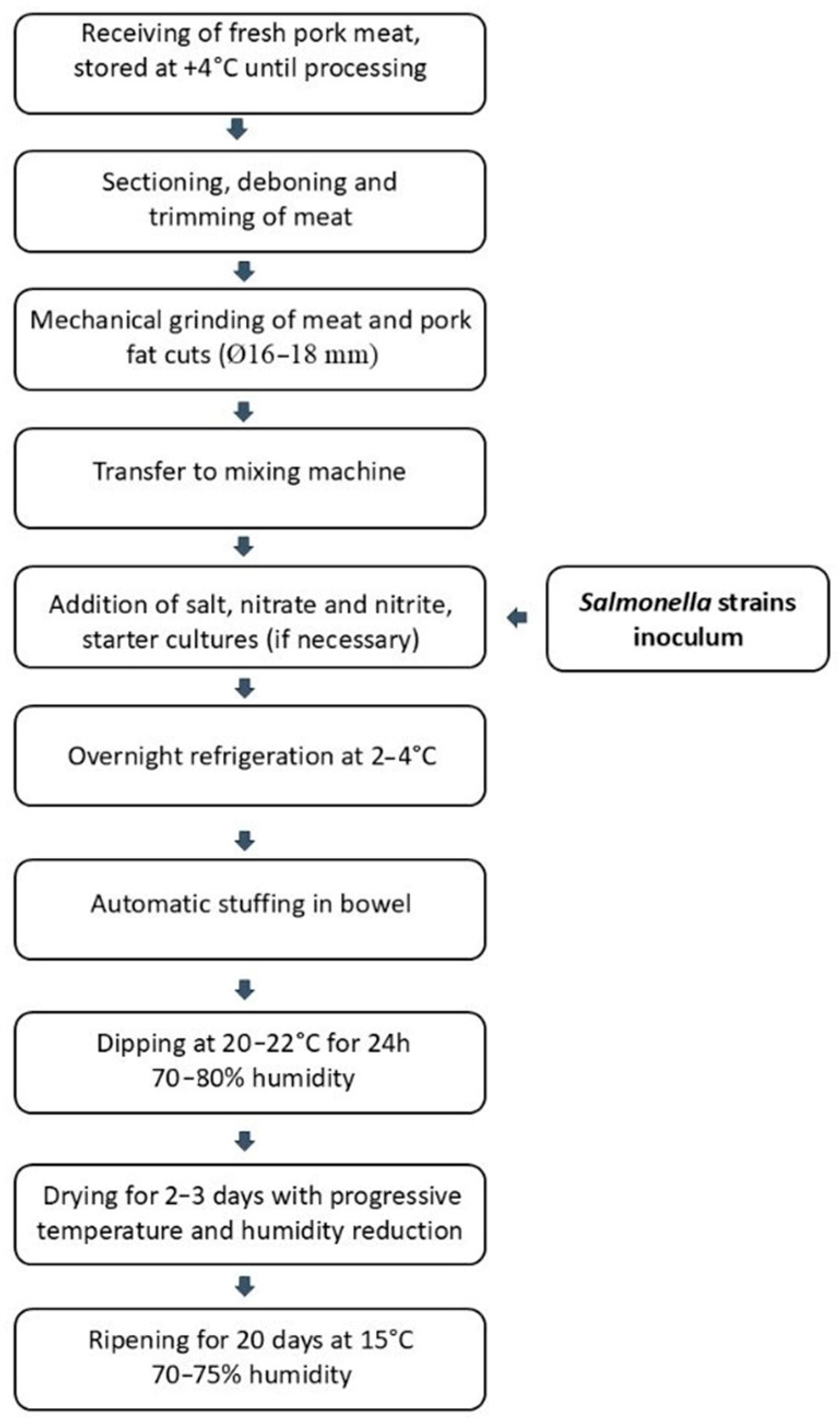
In the inoculated treatment group, the inoculum with Salmonella broth culture was added during the mixing step. After overnight refrigerated storage, the mixture was stuffed in natural bowel. The fermentation stage continued during the next steps of initial dipping (20–22 °C for 24 h) and drying (2–3 days). Ripening was carried out for 20 days in the storerooms at 15 °C. The production process of contaminated SFS is summarized in Figure 1.
In order to account for the typical techniques applied in industrial production plants, after 20 days of ripening, SFSs were vacuum-packed and stored at refrigeration temperature (+4 ± 1 °C). Each SFS was regarded as a sample.
Triplicate samples of each of the three batches of SFS were analyzed during the production process and during the shelf life of the vacuum-packed product at the following analysis times:
-
minced meat at the end of the mixing phase (T0),
-
minced mixture before the stuffing phase, following an overnight rest phase (T1),
-
24 h after stuffing (T2),
-
6 days after stuffing, at the end of the acidification (T7),
-
21 days after stuffing, at the end of ripening (T21),
-
30 days after stuffing, after refrigeration storage (T30),
-
40 days after stuffing, after refrigeration storage (T40).
Since, as it will be discussed further, the pathogen was present after 40 days, further analysis times were added until T100 (100 days after stuffing and after refrigeration storage).

2.3. Physico-Chemical and Composition Analysis

On each sample and at each time point, pH and water activity (aw) values were determined using a pH meter GLP 22 (Crison Instruments SA, Barcelona, Spain) and Aqualab CX3 (Decagon, Pullman, WA, USA). Moisture, fat, and protein (expressed as %) were determined by the FoodScanLab (FOSS Analytic, Hillerød, Denmark) using the Near-Infrared Transmittance (NIT) technology and a previously set calibration curve. Analyses were performed in triplicate on a homogenized sample representative of the product.

2.4. Microbiological Profile

At each time-point, Salmonella qualitative detection [24] was carried out on both control and treated samples. Salmonella count was performed by serial dilution and direct surface plating onto XLD agar. Samples in which Salmonella was not detected by the enumeration method were reported as below the detection limit (<1.0 log CFU/g). Moreover, the evaluation of the microbiological profile of the samples included the determination of the aerobic colony count [25], Enterobacteriaceae count [26], coagulase-positive and coagulase-negative staphylococci [27], mesophilic lactic acid bacteria [28], molds, and yeasts [29].

2.5. Pulsed-Field Gel Electrophoresis

To confirm the genetic relatedness between Salmonella isolates recovered during the challenge test and the strains included in the inoculum cocktail, pulsed-field gel electrophoresis (PFGE) was performed. PFGE analysis was performed using the ECDC standardized protocol [30]. PFGE analysis was performed on representative Salmonella isolates recovered at each sampling time throughout production and extended shelf life, including early, intermediate, and late stages of storage. At each sampling time, a minimum of two Salmonella isolates per sample were randomly selected to ensure representativeness. Overall, a total of 16 isolates recovered during the challenge test were subjected to PFGE and compared with the strains included in the inoculum cocktail. The comparison was performed by BioNumerics software v7.1 (Applied Maths, Saint-Martens-Platen, Belgium). Cluster analysis was performed by the Dice similarity coefficient, with 1% optimization and 5% tolerance using the unweighted pair group method with arithmetic mean (UPGMA).

2.6. Statistical Analysis

Differences among pH, aw, and microbiological counts (log CFU/g) between control and inoculated samples at every time point were compared using the analysis of variance (ANOVA) model with post hoc Tukey HSD test for comparing multiple treatments. Salmonella counts (log CFU/g) were analyzed using a linear mixed-effects model, with sampling time as a fixed effect and batch as a random effect, to account for repeated measurements within batches. Values below the limit of detection (LOD = 1.0 log CFU/g) were treated as censored and replaced with LOD/2 for quantitative analysis. Post hoc pairwise comparisons between time points were performed with appropriate adjustment for multiple comparisons. Statistical significance was set at p < 0.05. Statistical analyses were performed with Statgraphics Centurion XIX software Version 19 (Stat Point Technologies, Warrenton, VA, USA).

3. Results

All PFGE profiles obtained from Salmonella isolates recovered at different sampling times were indistinguishable from those of the inoculum strains, indicating that the recovered isolates were genetically consistent with the strains used for inoculation and that no evidence of contamination by unrelated Salmonella strains was observed during processing and storage.
As shown in Table 1 and Table 2, no significant differences in pH, aw, and microbiological counts were observed between control and Salmonella-inoculated samples. As for physico-chemical characteristics, in both sample types, the stuffing and acidification/drying phases resulted in a progressive reduction in pH and water activity, with the lowest values recorded after 7 days. During ripening, pH slightly increased, whereas aw further decreased and remained stable at low levels throughout refrigerated storage.
A significant effect of sampling time on Salmonella levels was observed (p < 0.05). After inoculation, Salmonella counts showed a slight increase after stuffing, followed by a reduction during the acidification/drying phase (p < 0.05), with the lowest levels recorded after 7 days. At the end of ripening, Salmonella remained detectable, and similar concentrations were observed during refrigerated storage under vacuum, although a further decrease was noted at the end of the storage period. No statistically significant differences were observed between initial contamination levels and levels measured at the end of ripening. Enrichment [21] results reflected the positivity in XLD agar direct plating, and all samples were also positive after plating on MSRV agar. Since Salmonella remained detectable at T40, further analyses were carried out during extended refrigerated storage. After 100 days, mean Salmonella counts were markedly reduced. While direct enumeration on XLD agar frequently resulted in non-detectable levels after 40 days, the pathogen was consistently detected by enrichment.
Microbial populations exhibited trends consistent with the fermentation and ripening process. The variability observed in LAB counts at T0 reflects the dispersion among replicate samples immediately after starter culture addition, prior to microbial stabilization during fermentation, due to the physiological state of the starter cultures and the complex structure of the meat matrix, which can influence cell recovery and enumeration efficiency [31]. LAB showed a marked increase during fermentation and stabilized thereafter, whereas total aerobic counts, Enterobacteriaceae, and non-aureus staphylococci displayed more limited variations. Molds and yeasts increased during ripening. No significant differences were detected between control and contaminated samples for any microbial group.
The centesimal composition of the starting mixture and products is reported in Table 3.
Ripening affected the centesimal composition of SFSs. The progressive decrease in moisture was associated with a concentration of fat and proteins, which reached their highest values after ripening and remained stable during storage. Sodium chloride levels increased during processing and showed limited variations thereafter.

4. Discussion

The safety of fermented sausages relies on the combination of multiple intrinsic and extrinsic hurdles to control pathogenic and spoilage microorganisms, including acidification, reduction in water activity (aw), addition of salt and curing agents, competitive activity of starter cultures, and oxygen depletion during fermentation and ripening [32]. Specifically, in fermented sausages produced at temperatures above 20 °C, such as SFS, pH reduction is generally regarded as the primary hurdle limiting pathogen growth [33]. This effect is due to the lactic acid produced by the starter cultures, which are generally added during the mixing phase and expected to reach 108–109 CFU/g [34]. Water availability is another key factor for the growth and survival of pathogens in dry fermented sausages. In this type of product, moisture loss during ripening and water binding by salt and other components progressively reduce aw to levels increasingly unfavorable for microbial growth [32].
In our study, pH and aw values reached 5.27 ± 0.35 and 0.95 ± 0.01 after 7 days from bagging, and after ripening, pH values increased to 5.45 ± 0.18, and aw dropped to 0.814 ± 0.02. These values are lower than those typically reported for commercially available SFS samples [5,6] and represent advanced fermentation and drying conditions, as they create particularly restrictive conditions for microbial survival. This progressive dehydration was also reflected in compositional changes, with proportional increases in fat and protein percentages due to moisture loss, as values were expressed on a wet weight basis. This effect reflects the concentration of solid components during ripening [35,36]. A further slight decrease in moisture was observed after vacuum packaging, which may reflect ongoing moisture redistribution and equilibration within the product matrix [37].
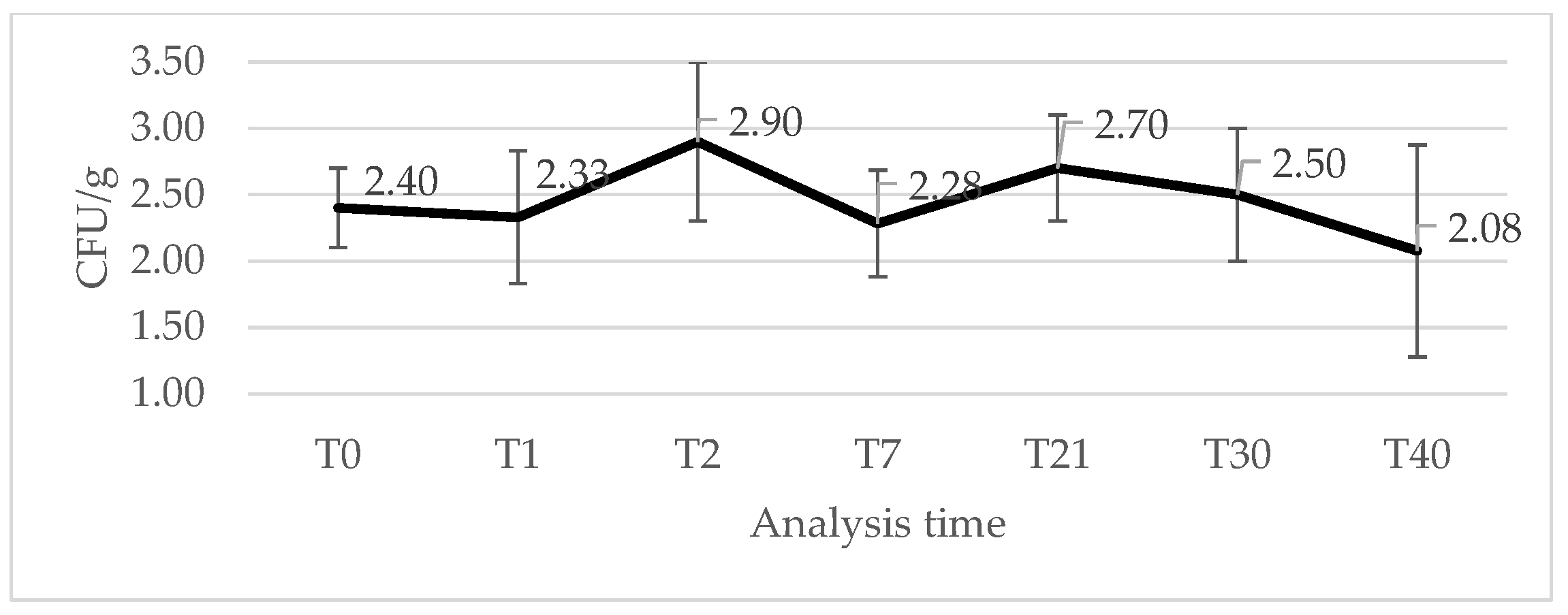
Despite the application of said hurdles, Salmonella was not completely eliminated. The temporal evolution of Salmonella levels (Figure 2) reflected the changing physicochemical conditions of the product.
After the inoculation and the overnight rest (T1), concentrations (2.33 ± 0.60 CFU/g) were relatively stable. During the very early stages of production, characterized by high pH and aw and before stabilization of the fermentative microbiota, a slight increase in Salmonella counts was observed (T2: 2.90 ± 0.70 log CFU/g). This behavior is consistent with previous studies showing that early fermentation conditions may temporarily support pathogen growth [8,38,39,40]. However, this rise did not persist: by day 7, counts had decreased to 2.30 ± 0.80 log CFU/g, indicating a downward shift that corresponds with the concurrent pH reduction to 5.27 ± 0.35. Although this pH value does not fall within the no-growth range for Salmonella [41], acidification can impose sublethal stress and restrict its ability to multiply. Several studies demonstrate that Salmonella growth becomes progressively compromised as pH declines toward 5.3–5.0, with reduced growth rates and extended lag phases [38,42]. The observed reduction in viable counts is therefore consistent with the onset of acid-driven inhibition occurring, combined with increasing competition from lactic acid bacteria during the first week of ripening [8,40]. Together, these factors explain the downward trend observed at this stage of the process. A slight increase in Salmonella counts was observed between T7 and T21; however, this fluctuation is unlikely to reflect true bacterial proliferation. Rather, it could reflect the recovery of sub-lethally injured bacterial cells following the acute acid stress associated with fermentation [43]. At T7, the product is still at the end of the most intense drop in pH, a condition known to impose substantial acid stress on Salmonella and to reduce the culturability of cells on selective media [44]. Under such sublethal injury, a fraction of Salmonella cells may temporarily lose culturability on selective media while remaining viable [43,45,46]. The increase in pH observed during ripening may have reduced environmental stress and facilitated the recovery of sublethally injured cells, resulting in an apparent increase in CFU without actual population growth. Acidic conditions during fermentation can disrupt cellular homeostasis, including membrane integrity, enzyme activity, and intracellular pH regulation, resulting in sublethal injury and reduced culturability. Subsequent increases in pH may reduce environmental stress and allow cellular repair mechanisms to restore physiological functions and culturability [45]. Similar recovery phenomena following acid stress have been described in Salmonella and other Enterobacteriaceae in fermented and low-moisture foods [46,47]. Although this mechanism was not directly investigated in the present study, it represents a plausible explanation for the observed increase in counts during storage. This hypothesis is worth further targeted experimental approaches. Moreover, alternative explanations, including localized microenvironmental growth niches, cannot be excluded.
At the end of ripening, Salmonella levels (T21: 2.68 ± 0.40 log CFU/g) were close to those measured immediately after inoculation, indicating that while growth was effectively restricted, complete inactivation was not achieved. Subsequent vacuum packaging and refrigerated storage led to a gradual decline in counts, reflecting the additional stress imposed by low oxygen availability, low aw, and refrigeration. The relatively high variability of low Salmonella levels observed in samples during storage, highlighted by standard deviation values, is expected in challenge test studies, as small differences in bacterial counts translate into larger differences on a logarithmic scale [48]. The heterogeneous structure of fermented sausages may also result in localized differences in environmental conditions influencing pathogen survival [38].
As mentioned, Salmonella remained detectable throughout the shelf life and prolonged storage at 4 °C. The limited reduction observed during processing (approximately 0.4 log CFU/g), despite decreases in pH and aw, is consistent with the well-documented resistance of Salmonella in low-moisture fermented meat matrices [49,50]. Although acidification and drying represent important hurdles, pH values above 5.0 and low aw primarily inhibit bacterial growth rather than ensuring rapid inactivation. While Salmonella cannot grow at aw values below 0.930, it can persist for extended periods in low-moisture, high-fat foods, particularly under refrigeration [51,52,53]. In addition, exposure to sublethal stress during fermentation may induce adaptive responses that enhance pathogen tolerance [54].
The persistence of low-level contamination observed in this study is in line with previous investigations of SFS. A study on SFSs [6] reported Salmonella in finished products after ripening (2% prevalence). Another study on SFSs [5] found Salmonella in 2.8% of fully ripened SFS sampled across eight establishments.
Similar observations have been reported in both observational and challenge-test studies conducted on Italian fermented salami produced under comparable technological conditions. A study [55] examined 150 batches of dry-cured Italian salami manufactured from Salmonella-positive ground raw meat and found that, after ripening (20–86 days depending on the batch), approximately 13% of products remained Salmonella-positive. Other authors [8] inoculated Salmonella enterica into “Cacciatore” and “Felino” salami and reported very limited reductions during processing (approximately 1.1–1.6 log CFU/g), resulting in detectable levels of Salmonella at the end of the product. Additionally, challenge tests have been conducted on Italian salami from ten production facilities [56], monitoring time, temperature, pH, aw, and Salmonella counts throughout production. The authors showed that the production process alone does not always guarantee the commonly desired 5-log reduction, especially in salami with marginal hurdle conditions (higher pH, higher aw, shorter ripening), which supports the plausibility of detecting Salmonella in the final product under suboptimal conditions. The presence of Salmonella along the production chain of fermented sausages and in finished products has also been reported in studies conducted in Spain and France [57].
Overall, the data consistently show that while processing steps markedly limit pathogen growth, they do not ensure complete inactivation. Rather than indicating a limitation of fermentation as a control measure, these findings highlight that its effectiveness depends on the interaction of multiple intrinsic and extrinsic factors, including initial contamination levels, product composition, and processing conditions [33]. Fermentation and ripeningshould be regarded as important hurdles that contribute to pathogen control through acidification, reduction in aw, and microbial competition. However, these factors typically result in variable log reductions rather than complete pathogen elimination, with effectiveness influenced by initial contamination levels and technological conditions. Similar considerations are supported by documented Salmonella outbreaks and recalls associated with fermented meat products [15,16]. Consequently, the microbiological quality of raw materials represents a critical determinant of fermented sausage safety, as the effectiveness of fermentation largely depends on the initial contamination level. Preventing Salmonella contamination in raw meat through effective hygienic practices and supply chain control is therefore essential.
Moreover, in the absence of microbiocidal steps in traditional SFS production, additional hurdles may be considered to further enhance safety. For instance, the product composition may influence pathogen persistence: the high fat content typical of fermented sausages can exert a protective effect on bacterial cells by limiting exposure to inhibitory factors [49,50]. Although not directly investigated in this study, the influence of fat content on Salmonella survival warrants further investigation. Similarly, acidification is widely recognized as the primary hurdle limiting pathogen growth in fermented sausages produced at temperatures above 20 °C, such as SFS [33]. In the present study, no fermentable carbohydrates were added, as the formulation was designed to reflect traditional SFS production, recognized as a traditional agri-food product. While carbohydrate supplementation may enhance acidification kinetics and influence pathogen behavior [58,59], its potential role in improving pathogen control in traditional SFS requires further investigation. Finally, given the absence of microbiocidal steps in traditional SFS production, post-process interventions may offer an additional safety margin without altering traditional formulation. Among these, high-pressure processing (HPP) has been shown to effectively reduce Salmonella in fermented meat products and is increasingly applied in the meat industry [56,60]. Further research and development are needed to refine these methods and ensure the feasibility of HPP in traditional SFS production.

5. Conclusions

The challenge test results highlighted the complex interaction of physicochemical and microbiological factors influencing the microbiological safety of Sardinian fermented sausages. Among the hurdles applied, acidification during early fermentation appeared to play a major role in reducing Salmonella levels, while aw reduction and vacuum storage mainly contributed to growth inhibition rather than pathogen inactivation. Although a reduction in Salmonella was observed throughout fermentation and ripening, complete elimination was not achieved. These findings emphasize the critical importance of controlling the microbiological quality of raw materials, particularly in the absence of microbiocidal steps during production. Establishing clear guidelines for acceptable Salmonella levels in raw meat intended for fermented sausage production would represent a key preventive measure. In addition, incorporating additional hurdles could further improve the safety of the final product. Some limitations of the study should be acknowledged, including the use of pilot-scale production and artificial inoculation, which may not fully reflect industrial variability and natural contamination scenarios. In addition, although possible mechanisms and additional hurdles were discussed, these aspects were not directly investigated, and they warrant further targeted studies to further improve the understanding of Salmonella behavior in fermented sausages.
Overall, this study provides evidence-based insights into the factors governing Salmonella persistence in SFS and supports a comprehensive, hurdle-based approach to risk management. The results may assist producers in identifying critical control points along the supply chain and processing stages, contributing to improved safety and reliability of fermented sausage production.

Author Contributions

Conceptualization, E.P.L.D.S., C.S. and F.P.; methodology, E.P.L.D.S., C.S. and F.P.; formal analysis, C.S. and F.P.; investigation, G.S., M.P.M., M.M., M.C. (Mario Cuccu), M.C. (Myriam Casula), F.M. and F.S.; data curation, G.S.; writing—original draft preparation, G.S.; writing—review and editing, G.S., M.P.M., M.M., F.P. and C.S.; supervision, E.P.L.D.S. and C.S. All authors have read and agreed to the published version of the manuscript.

Funding

This research received no external funding.

Institutional Review Board Statement

Not applicable.

Informed Consent Statement

Not applicable.

Data Availability Statement

The original contributions presented in this study are included in the article. Further inquiries can be directed to the corresponding author.

Acknowledgments

This article is part of the PhD thesis of Giuliana Siddi, titled Enteric pathogens in the pig and wild boar meat chain in Sardinia, University of Sassari, Sassari, Italy, 9 May 2025.

Conflicts of Interest

The authors declare no conflicts of interest.

References

  1. Ministero dell’Agricoltura, della Sovranità Alimentare e delle Foreste (MASAF). XXV Revisione Dell’elenco Dei Prodotti Agroalimentari Tradizionali; Ministero dell’Agricoltura, della Sovranità Alimentare e delle Foreste (MASAF): Rome, Italy, 2025. Available online: https://www.masaf.gov.it/flex/cm/pages/ServeBLOB.php/L/IT/IDPagina/22781 (accessed on 6 February 2026).
  2. Agenzia Laore Sardegna Salsiccia Sarda, Prodotto Agroalimentare Tradizionale Della Sardegna. 2021. Available online: https://www.agenzialaore.it/documenti/14_43_20090522135455.pdf (accessed on 6 February 2026).
  3. Document 32008R1333; Regulation (EC) No 1333/2008 of the European Parliament and of the Council of 16 December 2008 on Food Additives. European Union: Brussel, Belgium, 2008. Available online: http://data.europa.eu/eli/reg/2008/1333/oj (accessed on 6 February 2026).
  4. Ruggeri, A.; Carraro, V.; Succa, S.; Meloni, B.; Sanna, A.; Sanna, C.; Espa, A.; Pinna, A.; Carrucciu, G.; Grosso, M.; et al. Influence of water activity on Listeria monocytogenes growth in “Salsiccia Sarda” fermented sausage. Ital. J. Food Sci. 2018, 30, 142–154. [Google Scholar] [CrossRef] [Scilit]
  5. Siddi, G.; Piras, F.; Meloni, M.P.; Spanu, V.; Carta, N.; Cuccu, M.; Spanu, C.; Di Salvo, R.; Piga, C.; De Santis, E.P.L.; et al. Sardinian Fermented Sausage Traditional Production Process: A Preliminary Survey in Eight Establishments. Ital. J. Food Saf. 2024, 13, 12203. [Google Scholar] [CrossRef] [Scilit]
  6. Piras, F.; Spanu, C.; Mocci, A.M.; Demontis, M.; De Santis, E.P.L.; Scarano, C. Occurrence and Traceability of Salmonella spp. in Five Sardinian Fermented Sausage Facilities. Ital. J. Food Saf. 2019, 8, 8011. [Google Scholar] [CrossRef] [Scilit]
  7. Document 02005R2073-20200308; Commission Regulation (EC) No 2073/2005 of 15 November 2005 on Microbiological Criteria for Foodstuffs. European Union: Brussel, Belgium, 2008. Available online: http://data.europa.eu/eli/reg/2005/2073/2020-03-08 (accessed on 6 February 2026).
  8. Mataragas, M.; Bellio, A.; Rovetto, F.; Astegiano, S.; Decastelli, L.; Cocolin, L. Risk-Based Control of Food-Borne Pathogens Listeria monocytogenes and Salmonella enterica in the Italian Fermented Sausages Cacciatore and Felino. Meat Sci. 2015, 103, 39–45. [Google Scholar] [CrossRef] [Scilit]
  9. Emberland, K.E.; Nygård, K.; Heier, B.T.; Aavitsland, P.; Lassen, J.; Stavnes, T.L.; Gondrosen, B. Outbreak of Salmonella Kedougou in Norway Associated with Salami, April-June 2006. Euro Surveill. 2006, 11, 2995. [Google Scholar] [CrossRef] [Scilit]
  10. Luzzi, I.; Galetta, P.; Massari, M.; Rizzo, C.; Dionisi, A.M.; Filetici, E.; Cawthorne, A.; Tozzi, A.; Argentieri, M.; Bilei, S.; et al. An Easter Outbreak of Salmonella Typhimurium DT 104A Associated with Traditional Pork Salami in Italy. Euro Surveill. 2007, 12, 11–12. [Google Scholar] [CrossRef] [Scilit]
  11. Centers for Disease Control and Prevention (CDC); Julian, E.; MacDonald, K.; Marsden-Haug, N.; Saathoff-Huber, L.; Bonavolante, R.; Otero, S.; Nosari, J.; Austin, C.; Von Stein, D.; et al. Salmonella Montevideo Infections Associated with Salami Products Made with Contaminated Imported Black and Red Pepper—United States, July 2009–April 2010; Morbidity and Mortality Weekly Report (MMWR); Centers for Disease Control and Prevention: Atlanta, GA, USA, 2010; pp. 1647–1650. Available online: https://www.cdc.gov/mmwr/preview/mmwrhtml/mm5950a3.htm (accessed on 6 February 2026).
  12. Kuhn, K.; Torpdahl, M.; Frank, C.; Sigsgaard, K.; Ethelberg, S. An Outbreak of Salmonella Typhimurium Traced Back to Salami, Denmark, April to June 2010. Euro Surveill. 2011, 16, 19863. [Google Scholar] [CrossRef] [Scilit]
  13. Arnedo-Pena, A.; Sabater-Vidal, S.; Herrera-León, S.; Bellido-Blasco, J.B.; Silvestre-Silvestre, E.; Meseguer-Ferrer, N.; Yague-Muñoz, A.; Gil-Fortuño, M.; Romeu-García, A.; Moreno-Muñoz, R. An Outbreak of Monophasic and Biphasic Salmonella Typhimurium, and Salmonella Derby Associated with the Consumption of Dried Pork Sausage in Castellon (Spain). Enfermedades Infecc. Microbiol. Clínica 2016, 34, 544–550. [Google Scholar] [CrossRef] [Scilit]
  14. Andreoli, G.; Merla, C.; Valle, C.D.; Corpus, F.; Morganti, M.; D’incau, M.; Colmegna, S.; Marone, P.; Fabbi, M.; Barco, L.; et al. Foodborne Salmonellosis in Italy: Characterization of Salmonella enterica Serovar Typhimurium and Monophasic Variant 4,[5],12:I—Isolated from Salami and Human Patients. J. Food Prot. 2017, 80, 632–639. [Google Scholar] [CrossRef] [Scilit]
  15. Italian Ministry of Health. Recall Notice: Dry-Cured Sausage—Salmonella Spp.; Food Safety Alerts: Rome, Italy, 2025. Available online: https://www.salute.gov.it/new/it/ext-avviso-sicurezza-alimentare/salsiccia-stagionata-5/ (accessed on 6 February 2026).
  16. Rapid Alert System for Food and Feed (RASFF). Notification 2025.8048: Salmonella Spp. in Pork Salami; European Commission: Brussel, Belgium, 2025. Available online: https://webgate.ec.europa.eu/rasff-window/screen/notification/797128 (accessed on 6 February 2026).
  17. Codex Alimentarius Commission (CAC). Guidelines for the Validation of Food Safety Control Measures (CAC/RCP 69-2008); Codex Alimentarius Commission (CAC): Rome, Italy, 2008; p. 10. Available online: https://www.fao.org/fao-who-codexalimentarius/sh-proxy/en/?lnk=1&url=https%253A%252F%252Fworkspace.fao.org%252Fsites%252Fcodex%252FStandards%252FCXG%2B69-2008%252FCXG_069e.pdf (accessed on 6 February 2026).
  18. Food Standards Australia New Zealand (FSANZ). How to Determine the Shelf Life of Food: A Guidance Document; Food Standards Australia New Zealand (FSANZ): Canberra, Australia; Wellington, New Zealand, 2016. Available online: https://www.mpi.govt.nz/dmsdocument/12540-How-to-determine-the-shelf-life-of-food-Guidance-document (accessed on 6 February 2026).
  19. Doyle, M.P.; Buchanan, R.L. Food Microbiology: Fundamentals and Frontiers; ASM Press: Washington, DC, USA, 2012; ISBN 978-1-68367-058-2. [Google Scholar] [CrossRef] [Scilit]
  20. Siddi, G.; Piras, F.; Spanu, V.; Meloni, M.P.; Sanna, R.; Carta, N.; Errico, M.; Cuccu, M.; De Santis, E.P.L.; Scarano, C. Selection of Commercial Protective Cultures to Be Added in Sardinian Fermented Sausage to Control Listeria monocytogenes. Ital. J. Food Saf. 2022, 11, 10368. [Google Scholar] [CrossRef] [Scilit]
  21. ISO 20976:2022; Microbiology of the Food Chain—Requirements and Guidelines for Conducting Challenge Tests of Food and Feed Products. International Organization for Standardization (ISO): Geneva, Switzerland, 2022. Available online: https://www.iso.org/standard/79327.html (accessed on 6 February 2026).
  22. Haouet, M.; Altissimi, M.; Mercuri, M.; Baldassarri, C.; Osimani, A.; Clementi, F.; Ortenzi, R. Evaluation of the Safety of Milano-Type Dry Fermented Sausages Produced by a Fast Drying Technology. Ital. J. Food Sci. 2017, 29, 550. [Google Scholar] [CrossRef] [Scilit]
  23. Christieans, S.; Picgirard, L.; Parafita, E.; Lebert, A.; Gregori, T. Impact of Reducing Nitrate/Nitrite Levels on the Behavior of Salmonella Typhimurium and Listeria monocytogenes in French Dry Fermented Sausages. Meat Sci. 2018, 137, 160–167. [Google Scholar] [CrossRef] [Scilit]
  24. ISO 6579:2017; Microbiology of the Food Chain—Horizontal Method for the Detection, Enumeration and Serotyping of Salmonella. International Organization for Standardization (ISO): Geneva, Switzerland, 2020. Available online: https://www.iso.org/standard/56712.html (accessed on 6 February 2026).
  25. ISO 4833:2013; Microbiology of the Food Chain—Horizontal Method for the Enumeration of Microorganisms—Part 1: Colony Count at 30 °C by the Pour Plate Technique. International Organization for Standardization (ISO): Geneva, Switzerland, 2013. Available online: https://www.iso.org/standard/53728.html (accessed on 6 February 2026).
  26. ISO 21528-2:2017; Microbiology of the Food Chain—Horizontal Method for the Detection and Enumeration of Enterobacteriaceae—Part 2: Enumeration of Enterobacteriaceae. International Organization for Standardization (ISO): Geneva, Switzerland, 2017. Available online: https://www.iso.org/standard/63504.html (accessed on 6 February 2026).
  27. ISO 6888:2021; Microbiology of the Food Chain—Horizontal Method for the Enumeration of Coagulase-Positive Staphylococci (Staphylococcus Aureus and Other Species). International Organization for Standardization (ISO): Geneva, Switzerland, 2021. Available online: https://www.iso.org/standard/76672.html (accessed on 6 February 2026).
  28. ISO 15214:1998; Microbiology of Food and Animal Feeding Stuffs—Horizontal Method for the Enumeration of Mesophilic Lactic Acid Bacteria. International Organization for Standardization (ISO): Geneva, Switzerland, 1998. Available online: https://www.iso.org/standard/26853.html (accessed on 6 February 2026).
  29. ISO 21527:2008; Microbiology of Food and Animal Feeding Stuffs—Horizontal Method for the Enumeration of Yeasts and Moulds. International Organization for Standardization (ISO): Geneva, Switzerland, 2008. Available online: https://www.iso.org/standard/38275.html (accessed on 6 February 2026).
  30. PNL05; PulseNet USA Standard Operating Procedures for PFGE. Centers for Disease Control and Prevention (CDC): Atlanta, GA, USA, 2013. Available online: https://www.pulsenetinternational.org/assets/PulseNet/uploads/pfge/PNL05_Ec-Sal-ShigPFGEprotocol.pdf (accessed on 6 February 2026).
  31. Leroy, F.; Verluyten, J.; De Vuyst, L. Functional Meat Starter Cultures for Improved Sausage Fermentation. Int. J. Food Microbiol. 2006, 106, 270–285. [Google Scholar] [CrossRef] [Scilit] [PubMed]
  32. Holck, A.L.; Axelsson, L.; Rode, T.M.; Høy, M.; Måge, I.; Alvseike, O.; L’Abée-Lund, T.M.; Omer, M.K.; Granum, P.E.; Heir, E. Reduction of Verotoxigenic Escherichia coli in Production of Fermented Sausages. Meat Sci. 2011, 89, 286–295. [Google Scholar] [CrossRef] [Scilit]
  33. Leistner, L.; Gould, G.W. Hurdle Technologies: Combination Treatments for Food Stability, Safety and Quality; Food Engineering Series; Springer Science + Business Media: New York, NY, USA, 2002; ISBN 978-1-4613-5220-4. [Google Scholar] [CrossRef] [Scilit]
  34. Nissen, H.; Holck, A. Survival of Escherichia coli O157:H7, Listeria monocytogenes and Salmonella Kentucky in Norwegian Fermented, Dry Sausage. Food Microbiol. 1998, 15, 273–279. [Google Scholar] [CrossRef] [Scilit]
  35. Fanco, I.; Prieto, B.; Cruz, J.M.; López, M.; Carballo, J. Study of the Biochemical Changes during the Processing of Androlla, a Spanish Dry-Cured Pork Sausage. Food Chem. 2002, 78, 339–345. [Google Scholar] [CrossRef] [Scilit]
  36. Ordóñez, J.A.; Hierro, E.M.; Bruna, J.M.; de la Hoz, L. Changes in the Components of Dry-Fermented Sausages during Ripening. Crit. Rev. Food Sci. Nutr. 1999, 39, 329–367. [Google Scholar] [CrossRef] [Scilit]
  37. Liaros, N.G.; Katsanidis, E.; Bloukas, J.G. Effect of the Ripening Time under Vacuum and Packaging Film Permeability on Processing and Quality Characteristics of Low-Fat Fermented Sausages. Meat Sci. 2009, 83, 589–598. [Google Scholar] [CrossRef] [Scilit]
  38. Theys, T.E.; Geeraerd, A.H.; Verhulst, A.; Poot, K.; Van Bree, I.; Devlieghere, F.; Moldenaers, P.; Wilson, D.; Brocklehurst, T.; Van Impe, J.F. Effect of pH, Water Activity and Gel Micro-Structure, Including Oxygen Profiles and Rheological Characterization, on the Growth Kinetics of Salmonella Typhimurium. Int. J. Food Microbiol. 2008, 128, 67–77. [Google Scholar] [CrossRef] [Scilit]
  39. Scientific Committee on Veterinary Measures Relating to Public Health (SCVPH). Opinion on Salmonellae in Foodstuffs (Adopted on 14–15 April 2003); Scientific Committee on Veterinary Measures Relating to Public Health (SCVPH): Brussels, Belgium, 2003; Available online: https://food.ec.europa.eu/document/download/16b607d9-fa92-4491-90a9-bdb00e1ec110_en?filename=sci-com_scv_out66_en.pdf (accessed on 6 February 2026).
  40. Patarata, L.; Novais, M.; Fraqueza, M.J.; Silva, J.A. Influence of Meat Spoilage Microbiota Initial Load on the Growth and Survival of Three Pathogens on a Naturally Fermented Sausage. Foods 2020, 9, 676. [Google Scholar] [CrossRef] [Scilit]
  41. ICMSF (International Commission on Microbiological Specifications for Foods). Microorganisms in Foods 6: Microbial Ecology of Food Commodities, 2nd ed.; Kluwer Academic/Plenum Publishers: New York, NY, USA, 2010; ISBN 978-1-4419-3465-9. [Google Scholar] [CrossRef] [Scilit]
  42. Koutsoumanis, K.P.; Kendall, P.A.; Sofos, J.N. Modeling the Boundaries of Growth of Salmonella Typhimurium in Broth as a Function of Temperature, Water Activity, and pH. J. Food Prot. 2004, 67, 53–59. [Google Scholar] [CrossRef] [Scilit]
  43. Álvarez-Ordóñez, A.; Prieto, M.; Bernardo, A.; Hill, C.; López, M. The Acid Tolerance Response of Salmonella spp.: An Adaptive Strategy to Survive in Stressful Environments Prevailing in Foods and the Host. Food Res. Int. 2012, 45, 482–492. [Google Scholar] [CrossRef] [Scilit]
  44. Akkermans, S.; Verheyen, D.; Smet, C.; Van Impe, J.F.M. A Population Balance Model to Describe the Evolution of Sublethal Injury. Foods 2021, 10, 1674. [Google Scholar] [CrossRef] [Scilit]
  45. Schottroff, F.; Fröhling, A.; Zunabovic-Pichler, M.; Krottenthaler, A.; Schlüter, O.; Jäger, H. Sublethal Injury and Viable but Non-Culturable (VBNC) State in Microorganisms During Preservation of Food and Biological Materials by Non-Thermal Processes. Front. Microbiol. 2018, 9, 2773. [Google Scholar] [CrossRef] [Scilit]
  46. Wuytack, E.Y.; Phuong, L.D.T.; Aertsen, A.; Reyns, K.M.F.; Marquenie, D.; De Ketelaere, B.; Masschalck, B.; Van Opstal, I.; Diels, A.M.J.; Michiels, C.W. Comparison of Sublethal Injury Induced in Salmonella enterica Serovar Typhimurium by Heat and by Different Nonthermal Treatments. J. Food Prot. 2003, 66, 31–37. [Google Scholar] [CrossRef] [Scilit] [PubMed]
  47. Shao, L.; Sun, Y.; Zou, B.; Zhao, Y.; Li, X.; Dai, R. Sublethally Injured Microorganisms in Food Processing and Preservation: Quantification, Formation, Detection, Resuscitation and Adaption. Food Res. Int. 2023, 165, 112536. [Google Scholar] [CrossRef] [Scilit]
  48. EU Reference Laboratory for Listeria monocytogenes; Bergis, H.; Bonanno, L.; Asséré, A.; Lombard, B. Technical Guidance Document on Challenge Tests and Durability Studies for Assessing Shelf-Life of Ready-to-Eat Foods Related to Listeria monocytogenes; Version 4; ANSES: Maisons-Alfort, France, 2021. Available online: https://food.ec.europa.eu/system/files/2021-07/biosafety_fh_mc_tech-guide-doc_listeria-in-rte-foods_en_0.pdf (accessed on 20 February 2026).
  49. Rubio, B.; Martínez, B.; García-Cachán, M.D.; Rovira, J.; Jaime, I. The Effects of High Pressure Treatment and of Storage Periods on the Quality of Vacuum-Packed “Salchichón” Made of Raw Material Enriched in Monounsaturated and Polyunsaturated Fatty Acids. Innov. Food Sci. Emerg. Technol. 2007, 8, 180–187. [Google Scholar] [CrossRef] [Scilit]
  50. De Souza, J.; Ahmed, R.; Strange, P.; Barbut, S.; Balamurugan, S. Effect of Caliber Size and Fat Level on the Inactivation of E. coli O157:H7 in Dry Fermented Sausages. Int. J. Food Microbiol. 2018, 266, 167–172. [Google Scholar] [CrossRef] [Scilit]
  51. Batt, C.A.; Tortorello, M.L. Encyclopedia of Food Microbiology, 2nd ed.; Academic Press, Elsevier, Ltd.: Cambridge, MA, USA, 2014; ISBN 978-0-12-384733-1. [Google Scholar]
  52. Beuchat, L.R.; Komitopoulou, E.; Beckers, H.; Betts, R.P.; Bourdichon, F.; Fanning, S.; Joosten, H.M.; Ter Kuile, B.H. Low—Water Activity Foods: Increased Concern as Vehicles of Foodborne Pathogens. J. Food Prot. 2013, 76, 150–172. [Google Scholar] [CrossRef] [Scilit]
  53. Podolak, R.; Enache, E.; Stone, W.; Black, D.G.; Elliott, P.H. Sources and Risk Factors for Contamination, Survival, Persistence, and Heat Resistance of Salmonella in Low-Moisture Foods. J. Food Prot. 2010, 73, 1919–1936. [Google Scholar] [CrossRef] [Scilit]
  54. Tiganitas, A.; Zeaki, N.; Gounadaki, A.S.; Drosinos, E.H.; Skandamis, P.N. Study of the Effect of Lethal and Sublethal pH and aw Stresses on the Inactivation or Growth of Listeria monocytogenes and Salmonella Typhimurium. Int. J. Food Microbiol. 2009, 134, 104–112. [Google Scholar] [CrossRef] [Scilit]
  55. Bonardi, S.; Bruini, I.; Bolzoni, L.; Cozzolino, P.; Pierantoni, M.; Brindani, F.; Bellotti, P.; Renzi, M.; Pongolini, S. Assessment of Salmonella Survival in Dry-Cured Italian Salami. Int. J. Food Microbiol. 2017, 262, 99–106. [Google Scholar] [CrossRef] [Scilit]
  56. Bonilauri, P.; Grisenti, M.S.; Daminelli, P.; Merialdi, G.; Ramini, M.; Bardasi, L.; Taddei, R.; Cosciani-Cunico, E.; Dalzini, E.; Frustoli, M.A.; et al. Reduction of Salmonella Spp. Populations in Italian Salami during Production Process and High Pressure Processing Treatment: Validation of Processes to Export to the U.S. Meat Sci. 2019, 157, 107869. [Google Scholar] [CrossRef] [Scilit]
  57. Ferrer-Bustins, N.; Yvon, C.; Martín, B.; Leclerc, V.; Leblanc, J.-C.; Corominas, L.; Sabaté, S.; Tolosa-Muñoz, E.; Chacón-Villanueva, C.; Bover-Cid, S.; et al. Genomic Insights of Salmonella Isolated from Dry Fermented Sausage Production Chains in Spain and France. Sci. Rep. 2024, 14, 11660. [Google Scholar] [CrossRef] [Scilit]
  58. Vignolo, G.M.; de Ruiz Holgado, A.P.; Oliver, G. Use of Bacterial Cultures in the Ripening of Fermented Sausages. J. Food Prot. 1989, 52, 787–791. [Google Scholar] [CrossRef] [Scilit]
  59. García-Díez, J.; Patarata, L. Influence of Salt Level, Starter Culture, Fermentable Carbohydrates, and Temperature on the Behaviour of Listeria monocytogenes in Sliced Chouriço during Storage. Acta Aliment. 2017, 46, 206–213. [Google Scholar] [CrossRef] [Scilit]
  60. Bolumar, T.; Orlien, V.; Sikes, A.; Aganovic, K.; Bak, K.H.; Guyon, C.; Stübler, A.; De Lamballerie, M.; Hertel, C.; Brüggemann, D.A. High-pressure Processing of Meat: Molecular Impacts and Industrial Applications. Compr. Rev. Food Sci. Food Saf. 2021, 20, 332–368. [Google Scholar] [CrossRef] [Scilit]
Figure 1. The production process of artificially contaminated SFS.
Foods 15 00986 g001
Figure 2. Mean Salmonella counts (log CFU/g) at each sampling time, with corresponding standard deviation error bars.
Foods 15 00986 g002
Table 1. pH and aw values and microbiological counts in SFS control samples.
TimepHawSalmonellaACCENTCNSLABYM
T05.89 ± 0.040.978 ± 0.01<LOD6.45 ± 0.342.69 ± 0.776.34 ± 0.133.85 ± 2.902.10 ± 0.10
T15.85 ± 0.040.974 ± 0.02<LOD6.41 ± 0.233.34 ± 1.046.12 ± 0.235.29 ± 0.482.98 ± 0.78
T25.59 ± 0.150.974 ± 0.02<LOD7.99 ± 0.554.29 ± 0.856.74 ± 0.557.74 ± 0.914.52 ± 0.45
T75.12 ± 0.140.950 ± 0.01<LOD7.51 ± 0.773.97 ± 1.196.89 ± 0.658.48 ± 0.344.34 ± 0.60
T215.52 ± 0.140.834 ± 0.02<LOD7.58 ± 0.593.15 ± 0.656.80 ± 0.818.34 ± 0.384.72 ± 0.53
T305.53 ± 0.230.840 ± 0.02<LOD7.74 ± 0.623.58 ± 0.747.02 ± 0.278.23 ± 0.193.97 ± 0.55
T405.69 ± 0.200.841 ± 0.02<LOD7.84 ± 1.043.02 ± 0.487.20 ± 0.338.30 ± 0.103.51 ± 0.37
ACC: aerobic colony count; ENT: Enterobacteriaceae count; CNS: coagulase-negative staphylococci; LAB: lactic acid bacteria; YM: yeasts and molds; <LOD: below limit of detection.
Table 2. pH and aw mean values and microbiological counts in SFS artificially contaminated with Salmonella in the three batches.
TimepHawSalmonellaACCENTCNSLABYM
T05.89 ± 0.090.978 ± 0.052.45 ± 0.33 ab6.33 ± 0.433.21 ± 0.656.38 ± 0.065.43 ± 0.482.47 ± 0.86
T15.87 ± 0.040.974 ± 0.022.33 ± 0.60 ab6.49 ± 0.213.48 ± 0.856.07 ± 0.205.33 ± 0.503.34 ± 0.28
T25.63 ± 0.140.973 ± 0.022.90 ± 0.69 a7.52 ± 0.414.54 ± 0.956.77 ± 0.577.50 ± 0.754.20 ± 0.10
T75.27 ± 0.350.948 ± 0.012.30 ± 0.85 b8.24 ± 0.214.24 ± 0.787.50 ± 0.428.54 ± 0.093.97 ± 0.57
T215.45 ± 0.180.814 ± 0.022.68 ± 0.43 ab7.79 ± 0.543.72 ± 1.017.32 ± 0.218.40 ± 0.124.28 ± 1.01
T305.54 ± 0.300.833 ± 0.012.50 ± 0.54 ab7.69 ± 0.593.95 ± 0.857.12 ± 0.328.33 ± 0.093.84 ± 0.79
T405.53 ± 0.150.828 ± 0.022.07 ± 0.80 b7.47 ± 0.413.50 ± 0.886.88 ± 0.208.30 ± 0.073.47 ± 0.89
T1005.73 ± 0.290.823 ± 0.040.95 ± 0.85 c7.82 ± 0.832.07 ± 0.346.50 ± 0.588.24 ± 0.263.46 ± 0.22
ACC: aerobic colony count; ENT: Enterobacteriaceae count; CNS: coagulase-negative staphylococci; LAB: lactic acid bacteria; YM: yeasts and molds. Values are expressed as mean ± standard deviation. Different letters within the same column indicate statistically significant differences among sampling times (p < 0.05).
Table 3. Composition values (expressed as mean percentages) in SFS artificially contaminated with Salmonella in the three batches.
FatsNaClProteinsHumidity
T029.29 ± 3.883.58 ± 0.0518.83 ± 2.2146.44 ± 2.28
T229.10 ± 5.563.59 ± 0.0620.42 ± 0.9745.84 ± 2.41
T736.23 ± 3.397.03 ± 9.2519.97 ± 2.1839.92 ± 1.78
T2139.26 ± 11.124.92 ± 0.2126.79 ± 7.4628.16 ± 5.58
T3047.79 ± 5.755.12 ± 0.3021.07 ± 3.9127.46 ± 2.50
T4047.09 ± 9.184.57 ± 0.3224.56 ± 6.0623.44 ± 3.03
Disclaimer/Publisher’s Note: The statements, opinions and data contained in all publications are solely those of the individual author(s) and contributor(s) and not of MDPI and/or the editor(s). MDPI and/or the editor(s) disclaim responsibility for any injury to people or property resulting from any ideas, methods, instructions or products referred to in the content.