Systematic Review

Criteria for the Characterization of Seafood Byproducts to Allow Tracing Their Geographic Origin


by
Cláudia P. Passos
1,*,
Fernando Ricardo
2 and
Ricardo Calado
2,*
1
LAQV-REQUIMTE, Departamento de Química, Universidade de Aveiro, Campus Universitário de Santiago, 3010-193 Aveiro, Portugal
2
ECOMARE, CESAM, Departamento de Biologia, Universidade de Aveiro, Campus Universitário de Santiago, 3810-193 Aveiro, Portugal
*
Authors to whom correspondence should be addressed.
Foods 2026, 15(6), 1073; https://doi.org/10.3390/foods15061073
Submission received: 11 January 2026 / Revised: 17 February 2026 / Accepted: 7 March 2026 / Published: 18 March 2026

Abstract

Marine byproducts generated from seafood processing represent valuable reservoirs of structurally and functionally distinct biomolecules, whose composition reflects species, habitat, and processing history. This systematic review identified which marine byproducts have been most extensively studied between 2020 and 2025, with emphasis on their composition, valorisation, and suitability for tracing their geographic origin. Following the PRISMA protocol, 6443 publications were initially retrieved, of which 96 peer-reviewed studies were included for data extraction and analysis. The five most frequently investigated byproducts—skin, bones, scales, shells, and roe—were identified as rich sources of proteins (collagen and gelatin), minerals (hydroxyapatite and calcium carbonate), polysaccharides (chitin), lipids (notably polyunsaturated fatty acids (PUFAs), docosahexaenoic acid (DHA) and eicosapentaenoic acid (EPA)), and vitamin B12. Collagen properties, particularly imino acid content, hydroxylation degree, crosslinking density, and thermal stability, correlate more strongly with environmental temperature than taxonomy, supporting their potential as markers for tracing geographic origin. The mineral fractions, dominated by hydroxyapatite in bones and scales, or calcium carbonate in shells, provided complementary inorganic fingerprints based on calcium-to-phosphorus ratios, carbonate substitution, trace element composition, and thermal analyses. While the lipid profile alone could not completely discriminate fish roe, proteomic techniques, such as MALDI-TOF MS, make it possible to reliably identify species. Collectively, these byproducts offer complementary organic and inorganic markers that support integrated strategies that allow tracing their origin and fostering their sustainable valorisation, overcoming a key technical bottleneck for their use. However, their large-scale conversion into market-ready products remains limited by technical complexity, process variability, and cost-related constraints.

1. Introduction

The growth of the global population has led to a substantial increase in food demand. In parallel, global fish production has risen markedly, from 19 million tonnes (Mt) in the early 1950s [1] to 160 Mt in 2010, 214 Mt in 2020, and 223 Mt in 2022 [2]. Currently, the global production of aquatic animals is almost evenly distributed between capture fisheries (49%) and aquaculture (51%), making it a significant component of the global food industry and a major contributor to fulfilling human nutritional needs [3,4,5,6]. Correspondingly, the apparent annual per capita consumption of aquatic animals increased from 9.1 kg in the 1960s to an estimated 20.7 kg in 2022 [2,7]. In 2021, the United Nations Food and Agriculture Organization (FAO) launched the “Blue Transformation Roadmap”, outlining objectives for the development of aquaculture and fisheries, while emphasising the importance of integrated value chains that ensure social, economic, and environmental sustainability, with the ultimate goal of maximising aquatic food systems. However, the FAO also highlighted in the Blue Transformation Roadmap a lack of reliable traceability systems, which hinders innovation and sustainable trade within value chains and limits the ability to fully ensure product quality, safety, legality, and sustainability [2].
The expansion in production and consumption has been accompanied by a substantial increase in waste generation. The production of fish-related waste is estimated to have risen from 56 Mt in 2010 to 75 Mt in 2020 [6]. At the processing stage, approximately 30–85% of fish catches result in byproducts unsuitable for direct human consumption, including bycatch [4]. These byproducts typically account for 30–40% of the total weight of fresh fish and include heads (~10%), skin (~3%), bones (~15%), viscera (12–18%), and scales (~5%) [4,5,8,9,10,11]. The proportion of byproducts varies according to seafood species and size, as well as fishing season and geographic location [5,12]. In contrast to terrestrial resources, which have achieved recycling rates of approximately 60% from both animal- and plant-based feedstocks, marine bioresources recovery remains comparatively low, with estimates suggesting that only about one-third is currently recovered [6].
Owing to its high microbial load and the activity of endogenous enzymes, seafood deteriorates rapidly if not subjected to appropriate processing and storage conditions, posing significant technological challenges for the food industry [13]. To manage quality and market suitability, many commercially harvested seafood species are classified using a three-level grading system (Extra, A, and B), particularly in industrial-scale fisheries [14]. This system enables sorting based on quality attributes (e.g., size and fat content), freshness indicators (e.g., colour and texture), and intended end use. Species typically subjected to this grading system include Atlantic and Pacific cod, Pollock, Haddock, Hake, Hoki, Whiting and Blue whiting, Mackerel, and Horse mackerel [14]. At the lowest grading level, seafood often exhibits visible defects, discolouration, softer flesh, or early-stage degradation caused by delayed processing, all of which are indicative of incipient decomposition [15]. Consequently, these organisms are frequently diverted from the human food chain and become an additional source of byproducts, sometimes leading to partial or total discarding as waste [16]. Importantly, seafood byproducts require the same stringent processing and storage conditions as whole fish to prevent further deterioration. Despite this requirement, approximately 35% of processed fish is currently classified as “special waste,” a category closely associated with substantial environmental impacts [17]. At present, the predominant uses of seafood byproducts include surimi (fish paste), pet food, fishmeal and low-grade fish oil [2], and fertilisers [17].
Beyond conventional applications, as described above, increasing attention has been directed towards the valorisation of seafood byproducts as renewable natural resources for higher value uses. Their exploitation in pharmaceutical and nutraceutical applications represents a promising strategy for “greening” the chemical product life cycle, while advancing sustainability and environmental protection goals [4]. This shift also requires a reassessment of the term “byproduct” itself. Depending on process adaptability and technological control, materials initially regarded as waste can be transformed into value-added outputs. Under well-established and controlled processing conditions, such materials may generate new revenue streams and be more appropriately defined as “co-products” rather than byproducts [18,19].
Among the most valuable compounds recovered from marine byproducts are biopolymers, notably chitin [12,20] and collagen [3,21]. Chitin is a structurally important polysaccharide and represents the second most abundant biopolymer on Earth after cellulose when total available biomass is considered [22]. For most industrial applications, chitin is deacetylated to produce chitosan, which constitutes the primary commercial derivative [12,20]. Collagen, in contrast, is the main structural protein obtained from both marine and terrestrial sources and can be further processed into gelatin or enzymatically hydrolysed into bioactive peptides [3,8]. Historically, collagen has been sourced predominantly from terrestrial animals, with >90% of commercial gelatin being derived from porcine skin (46%), bovine skin (30%), and bovine bone (24%) collagen hydrolysis [23,24]. However, religious constraints (both Judaism and Islam forbid the consumption of any pork-related products, while Hindus do not consume cow-related products) together with concerns related to zoonotic diseases associated with terrestrial animal sources—such as tuberculosis and bovine spongiform encephalopathy in cattle, and leptospirosis and swine influenza in pigs—have intensified interest in marine-derived alternatives [25]. Although most studies report no incidence of zooanthroponoses associated with seafood [26], the possibility of zoonotic transmission cannot be entirely excluded. Consequently, rigorous processing, hygiene, and safety measures for fish byproducts remain as essential as those applied to terrestrial raw materials.
In addition to safety considerations, allergenicity represents another important factor influencing the utilisation of any source of protein that may be recognised as an allergen, so seafood-derived proteins incorporated into food products must also be carefully assessed in this matter. One effective mitigation strategy involves enzymatic hydrolysis, which converts proteins into shorter peptides, typically with average molecular weights below 3 kDa [7]. These extensively hydrolysed peptides lack antigenic epitopes capable of activating immune responses, thereby substantially reducing allergenic potential [27]. As a result, protein hydrolysates from seafood byproducts are increasingly explored as hypoallergenic ingredients for specialised food formulations and dietary supplements [7,28].
Seafood byproducts also present advantages in the context of specific dietary preferences and religious restrictions, including vegetarian-oriented diets and kosher or halal dietary requirements [25,29]. In halal food systems, seafood is generally permitted; however, certification demands detailed information regarding processing conditions, hygiene standards, and traceability of origin [30,31]. A prominent example of this application is the substitution of mammalian collagen. Collagen, which constitutes approximately 30% of total protein in mammals, is a major component of skin, tendons, connective tissues, and bones [3]. While traditionally extracted from porcine and bovine sources, collagen can also be recovered from seafood byproducts, such as skin, scales, and cartilage. The structure of collagen has been well characterised, with a reported genetic variety of up to 28 types, based on its structure, including fibrous (I, II, III, V and XI) and non-fibrillar (such as IV, VI and VII) [17]. Among fibrillar collagens, which show similar characteristics between marine and human origin, type I collagen (a heterotrimer, consisting of two identical α1 chains (I) and one α2 chain (I)) is the most common [3]. Collagen’s unique structure is attributed to the entanglement of its three polypeptide chains forming a characteristic right-handed triple helix that self-assembles into insoluble fibres of tensile strength [21].
Although marine collagen (as well as in collagen mammal sources) lacks certain essential amino acids and, therefore, cannot serve as a complete nutritional protein, this limitation has not diminished its demand or functional relevance [25,26]. Notably, its lower content of proline and hydroxyproline—key residues governing collagen structure and stability—results in reduced thermal stability [21], but enhanced digestibility [3]. These properties render marine collagen particularly attractive for nutraceutical applications and dietary supplements, especially for consumers seeking alternatives to bovine or porcine products.
Beyond the biopolymers detailed above, fish byproducts are an important source of minerals, including macroelements and trace elements, such as phosphorus (P), potassium (K), calcium (Ca), magnesium (Mg), iron (Fe), zinc (Zn), and strontium (Sr) [3]. Seafood tissues are especially rich in Ca and P, and the Ca:P ratio is frequently reported as a characteristic parameter [17]. Mineral composition is strongly influenced by species, habitat, and feeding regime, suggesting that mineral profiling may serve as a complementary tool for origin traceability when supported by comprehensive reference databases [32].
In parallel with valorisation efforts, food fraud has emerged as a critical issue affecting fisheries and aquaculture products, with implications extending beyond economic losses to encompass public health, social trust, and sustainability [33]. Common fraudulent practices include masking of poor quality, substitution of product constituents, species replacement, mislabelling of geographical origin, repackaging, and tax evasion [34]. These challenges have intensified the demand for rapid, reliable, and cost-effective analytical tools to support fraud detection [33]. Traditional anatomical and morphological analyses are often insufficient due to interspecies similarities and the loss of distinguishing features during the processing of seafood [35]. Consequently, identifying compositional markers within fish byproducts has become a key objective for enhancing traceability.
While advanced analytical approaches, such as DNA barcoding, are sometimes indispensable—particularly for high-value seafood products—their cost and complexity limit their applicability to low-value byproducts. Therefore, the development of simpler, more accessible analytical methodologies, based on more affordable technologies, is essential to enable routine verification and strengthen confidence across seafood value chains.
In the present review, we identify which marine organisms that are either captured or farmed (e.g., tuna, cod, salmon, and shrimp) more strongly contribute to the production of seafood. Subsequently, we surveyed the scientific literature to identify which were the most prevalent byproducts produced (e.g., skin, scales, bones, shell, roe) and relate them to the world distribution of the species from which they are derived (e.g., cold-water, temperate or tropical marine species) to better understand how these can shape their composition. Finally, each of these seafood byproducts was examined based on its intrinsic features and compositional richness to identify features that can be used for tracing their geographic origin.

2. Materials and Methods

2.1. Search Strategies

The search strategy applied in this systematic review was designed to address the following research question: Can strategies be defined to trace the origin of marine byproducts with valorisation potential? To systematically answer this question, three core conceptual domains were identified for keyword development: Concept 1, origin traceability; Concept 2, marine byproducts; and Concept 3, valorisation.
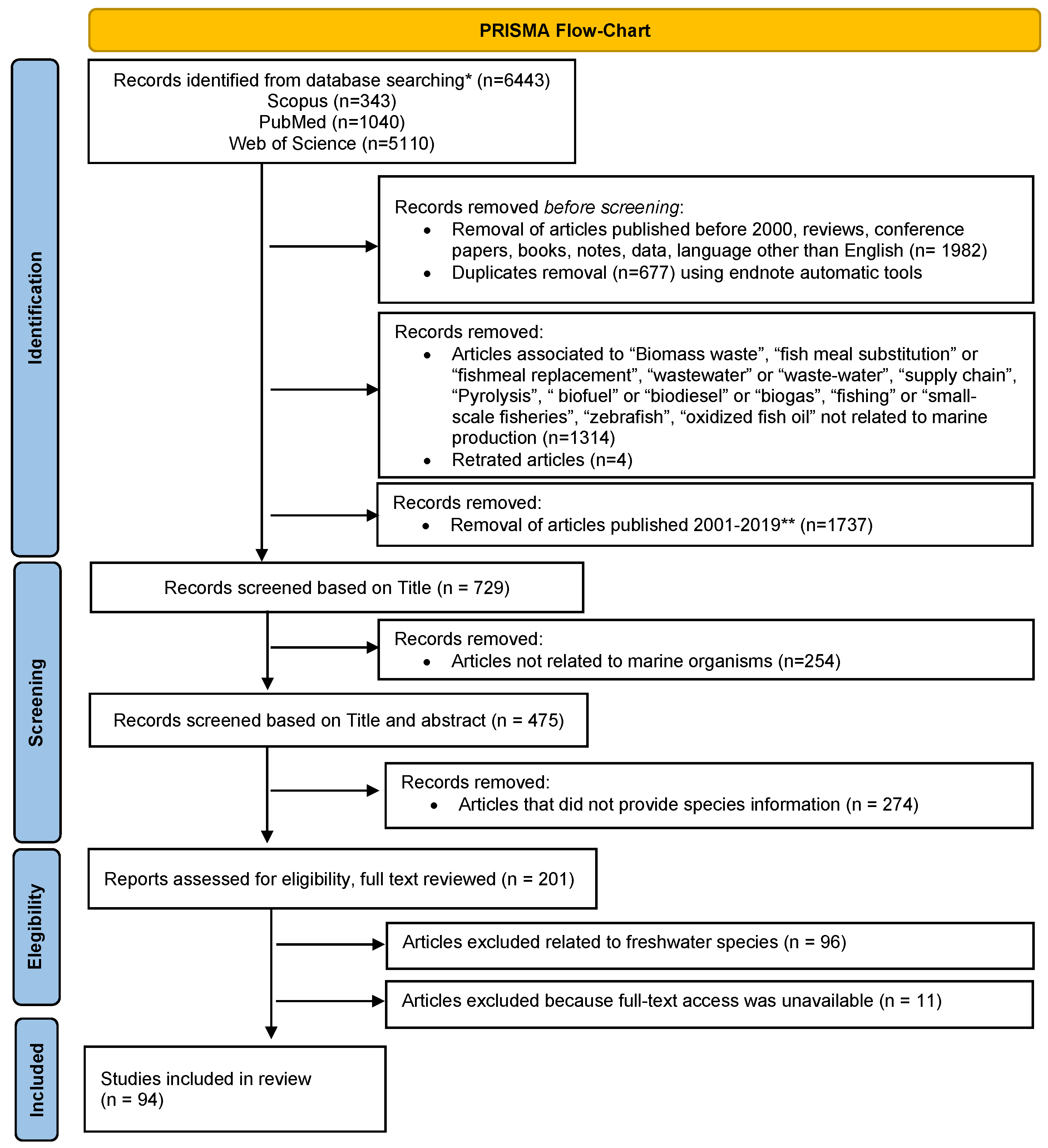
The literature search was performed using combinations of keywords derived from these concepts, specifically pairing origin traceability with marine byproducts and marine byproducts with valorisation. A detailed description of the keywords and search strings employed is provided in the Supplementary Materials. The article collection included publications available up to 20 August 2025. The study selection process followed the PRISMA guidelines, and the corresponding PRISMA flowchart summarising the screening and inclusion steps is presented in Figure 1.
A total of 6443 publications were initially identified through searches of three bibliographic databases: Scopus, PubMed, and Web of Science. Publications released prior to 2000, as well as review articles, conference proceedings, books, and articles written in languages other than English, were excluded. All retrieved records were imported into an EndNote library, where duplicate entries were identified and removed.
A preliminary screening of article titles from a subset of the records retrieved enabled the identification of misleading or non-relevant keywords, including “biomass waste,” “fish meal substitution” or “fishmeal replacement,” “wastewater” or “waste-water,” “supply chain,” “pyrolysis,” “biofuel,” “biodiesel,” “biogas,” “fishing” or “small-scale fisheries,” “zebrafish,” and “oxidized fish oil,” which were considered to be outside the scope of the present review. Retracted articles were also excluded at this stage. Despite the exclusions, the number of remaining records was still substantial. Therefore, the search criteria were further restricted to publications from the last five years, yielding a final dataset of 729 articles. Subsequent screening based on titles and abstracts identified 201 articles that reported information on seafood byproducts and corresponding species, which were then subjected to a full-text review.
Following full-text assessment, only 94 articles met the eligibility criteria by providing explicit information on marine byproducts with clear species identification and were therefore selected for data extraction [1,3,4,5,6,7,8,9,10,11,12,16,17,20,21,23,24,28,36,37,38,39,40,41,42,43,44,45,46,47,48,49,50,51,52,53,54,55,56,57,58,59,60,61,62,63,64,65,66,67,68,69,70,71,72,73,74,75,76,77,78,79,80,81,82,83,84,85,86,87,88,89,90,91,92,93,94,95,96,97,98,99,100,101,102,103,104,105,106,107,108,109,110,111,112,113].

2.2. Exclusion Criteria Explained

The 729 articles identified after database filtering were screened based on title information, and records not related to the marine context were excluded. Given that the primary objective of this review was to investigate whether and how it is possible to trace the origin of marine byproducts, studies that did not provide explicit information on the species being addressed were excluded. Consequently, of the 475 articles initially remaining after removing those that did not address marine organisms, an additional 274 articles were also excluded for not detailing the seafood species being studied. During the eligibility phase, two authors independently reviewed the titles and abstracts of the remaining 201 articles. Studies identified as focusing exclusively on freshwater species were once more excluded, as they fell outside the scope of the present review. In addition, articles for which full-text access was unavailable (n = 11) were removed from the dataset. The remaining 94 articles were subsequently assessed through full-text review.
At all stages of the selection process, any disagreements between the two reviewers were resolved through discussion until consensus was reached, and articles were either included or excluded in accordance with the predefined eligibility criteria.

2.3. Data Processing

The Alluvial diagrams presented in this manuscript were generated with the open-source software RAWGraphs 2.0, an open-source data visualisation framework project, led and maintained by the DensityDesign Research Lab (Politecnico di Milano) with the goal of making the visual representation of complex data easy for everyone (https://www.rawgraphs.io/).

3. Results and Discussion

3.1. Global Data Analysis for Captured and Farmed Seafood and Relevant Case Studies

Before discussing the literature survey on marine byproducts derived from seafood processing, this section presents a global data analysis of fish production, recognising that byproducts originate from both wild-caught fisheries and aquaculture, and their corresponding processing streams. According to the FAO, food loss and waste occur at all stages of fisheries and aquaculture value chains, including harvesting or farming (and post-catch), processing, distribution (transport, wholesale, and retail), and final consumption [114].
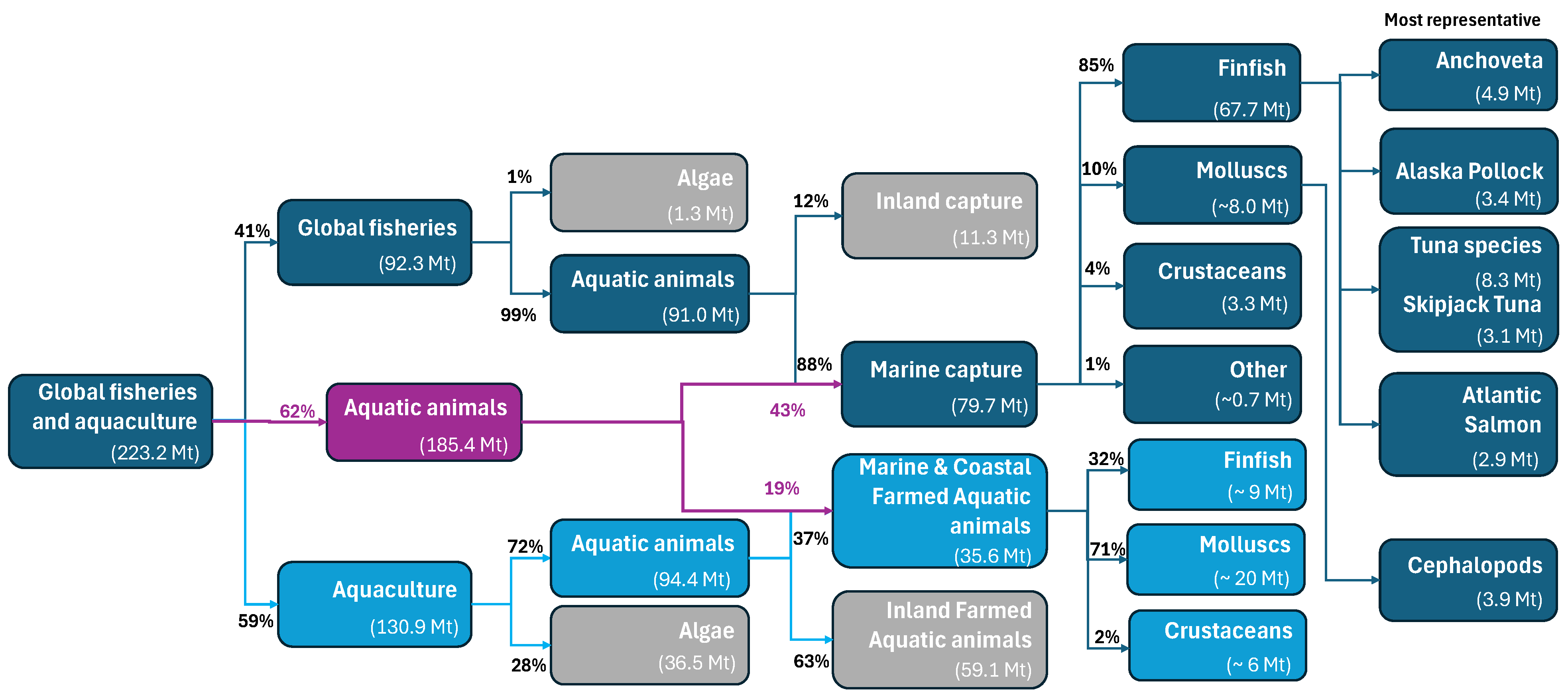
Identifying global production volumes, as presented in Figure 2 for the 2022 fishing season [2], helps direct valorisation efforts toward major production sectors and their associated processing activities, where most recoverable byproducts are generated.
According to FAO data, global fisheries and aquaculture reached a record production of 223.2 Mt in 2022, of which 185.4 Mt corresponded to aquatic animals (purple line, Figure 2). Marine production was distributed between capture fisheries (43%, 79.7 Mt) and aquaculture (31%, 35.6 Mt) [115]. Finfish—aquatic vertebrates with fins and gills and a bony or cartilaginous skeleton (e.g., salmon, tuna, cod)—accounted for approximately 85% of total marine capture production (67.4 Mt). The most representative species were Anchoveta (Engraulis ringens, 4.9 Mt), Alaska pollock (Gadus chalcogrammus, 3.4 Mt), Skipjack tuna (Katsuwonus pelamis, 3.1 Mt), and Atlantic salmon (Salmo salar, 2.9 Mt). Additionally, cephalopods (3.9 Mt) and crustaceans (3.3 Mt), mainly shrimp and lobsters, made substantial contributions to capture fisheries [115]. Within marine and coastal farmed aquaculture, finfish accounted for approximately 32% of total marine production, crustaceans for about 2%, and molluscs represented the largest share (approximately 71%) (Figure 2).
The contribution of different value-chain stages to food loss and waste varies considerably by region. In highly developed regions, such as Europe, North America, and Oceania, processing is among the least significant contributors, largely because byproducts are recovered to a greater extent than in other sectors [114]. Consequently, marine processing plants provide one of the most reliable estimates of effective byproduct utilisation, especially considering that about 70% of the total catch is processed [116]. This observation is particularly relevant in high-income countries, where aquatic foods are predominantly consumed in processed form. Recent FAO reports indicate that 34% of fishmeal and 53% of fish oil are now produced from fish byproducts, reflecting a substantial shift toward circular resource use [2].
Industrial examples demonstrating the feasibility and benefits of maximising byproduct utilisation are increasingly emerging. Based on the global production distribution shown in Figure 2, selected case studies of major relevance to marine fisheries and aquaculture are presented below.

3.1.1. Case Study: Wild-Caught Fisheries—Tuna (Thunnus spp.)

Tuna represents one of the most commercially important marine fish groups and is widely distributed in tropical waters—such as skipjack (Katsuwonus pelamis), yellowfin (Thunnus albacares), and bigeye (Thunnus obesus)—as well as temperate waters, including albacore (Thunnus alalunga) and bluefin species (Thunnus thynnus, Thunnus orientalis, and Thunnus maccoyii). Global catches of the principal tuna market species increased from 4.3 Mt in 2010 [117] to 8.3 Mt in 2022, with skipjack tuna (Katsuwonus pelamis) alone accounting for 3.1 Mt (Figure 2).
Tuna is primarily marketed fresh, chilled, frozen, or canned. Canning and loin processing, which represent the main industrial processing routes for tuna, generate substantial amounts of byproducts, accounting for up to 70% of the original biomass [7]. These include belly flaps, off-cut meat, bone-adhered mince, blood meat, heads, viscera, tails, skin, and bones [1,5,117]. Most solid tuna-processing residues—particularly heads, fins, bones, and dark (red) meat (this last one representing approximately 9–11% of total body weight)—are currently commonly converted into fishmeal for animal feed [117]. Despite its high protein content, dark meat has limited applications due to its colour, susceptibility to oxidation, and off-flavour development [117]. An additional waste stream, corresponding to 5–10% of initial tuna weight, consists of meat fragments that are undersized, oversized, or deformed for canning [7]. Processing operations such as cooking induce protein denaturation, leading to reduced solubility. In addition to solid byproducts, tuna processing generates liquid effluents, including cooking juice (broth), stick water, and washing water, which may contain approximately 4% soluble proteins [117]. These streams can be recovered, concentrated (protein levels exceeding 65% qualify as fish protein concentrates [7]) and further processed into protein hydrolysates.
Indirect valorisation pathways for tuna byproducts include silage production, obtained by acidification of whole fish or fish parts, enabling enzymatic liquefaction by endogenous enzymes [118]. Fish silage is primarily used as an alternative to the production of fishmeal, for both terrestrial and aquaculture feeds. Tuna viscera also represent a valuable source of digestive enzymes, while tuna bones may be processed into calcium-rich materials following deproteinization and lipid removal [117].

3.1.2. Case Study: Wild-Caught Fisheries—Icelandic Cod (Gadus morhua)

A prominent example of high-value byproduct valorisation within the blue bioeconomy is provided by the Iceland Ocean Cluster, which established the Codland initiative. This private-sector-driven model aims to maximise value extraction from all parts of wild-caught cod through integrated processing strategies [19]. The initiative emerged in response to strict catch limitations, which limited revenue and necessitated maximising value rather than volume. As a result, the economic value of cod catches reportedly increased by approximately 40% [119].
A key success factor was the co-location of processing facilities near ports and cod-drying plants, minimising transportation costs and enabling efficient side-stream utilisation. The processing approach relies heavily on biotechnological methods, including enzymatic hydrolysis to recover collagen and partially hydrolysed collagen peptides [19]. The overarching objective is full (100%) utilisation of all byproducts, including liver- and viscera-derived fish oil, dried products, and fishmeal [19]. End-use applications span agriculture (organic fertilisers), food and agro-industry (omega-3 supplements and nutraceuticals), healthcare (calcium-based mineral supplements), and biopharmaceutical sectors (collagen-derived peptides for skin-care applications) [119].

3.1.3. Case Study: Aquaculture—Atlantic salmon (Salmo salar)

Norway was among the first countries to recognise the economic and environmental value of seafood byproducts. Currently, the Norwegian Atlantic salmon industry processes over 1.5 Mt annually (the world’s largest producer with ~50% of global production), primarily from farmed Atlantic salmon (Salmo salar), and recovers approximately 90% of all byproducts it generates [119,120]. Chile, the world’s second-largest salmon producer (about half the volume of Norway), reports similarly high recovery rates; however, most Chilean byproducts are still converted into lower-value products, such as fishmeal and fish oil [105]. Although higher-value applications require greater capital investment, their market prices can outweigh initial costs.
One standardised valorisation pathway in Norway is silage production through acid-enzymatic hydrolysis, primarily used for animal feed, including for fur-bearing animals [121]. More technologically advanced processes involve the extraction of collagen, gelatin, and their hydrolysates. Despite existing constraints, industrial-scale implementations of such technologies are reported in regions including Alaska, Scotland, and Norway (e.g., Bergen) [121]. In contrast, the Chilean salmon sector faces ongoing challenges related to environmental, health, and logistical aspects of byproduct management [121].
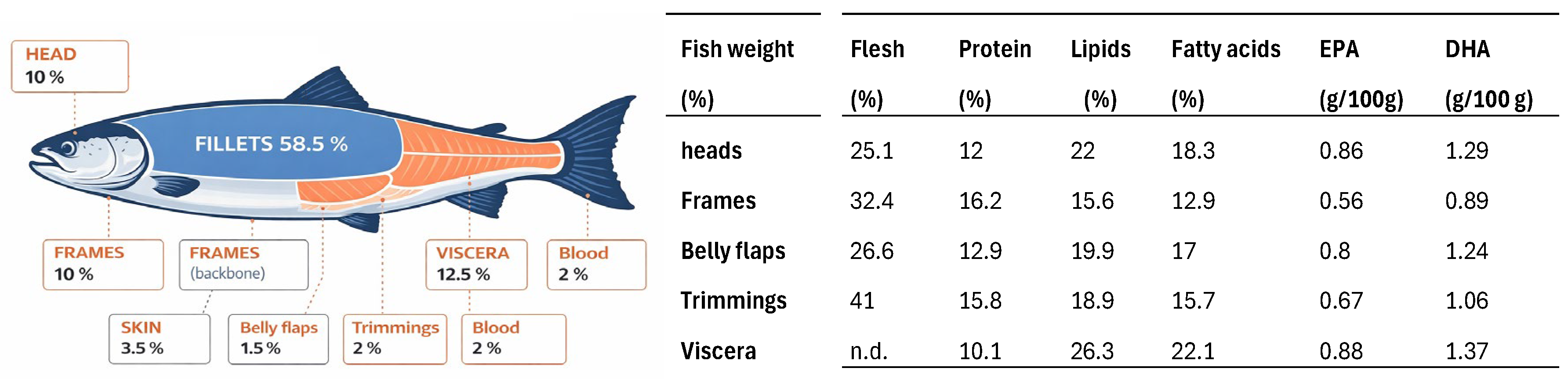
Farmed salmon are harvested, slaughtered, and bled before undergoing primary processing to produce head-on gutted fish. Secondary processing generates trimmings (2%), heads (10%), frames (10%), skin (3.5%), and belly flaps (1.5%), with these byproducts being schematically represented in Figure 3 [116,119]. FAO reports indicate that salmon byproducts may display high nutritional value, featuring levels of valuable fatty acids (e.g., DHA) comparable to those present in fillets [119].
In automated filleting operations, fillets represent approximately 59–63% of body weight, while heads (10–12%) and spines (9–15%) are generated as byproducts [11,113]. Although most salmon byproducts are recovered, the economic return depends strongly on the technological investments made.
Theoretical modelling of Atlantic salmon (Salmo salar) aquaculture suggests that strategic byproduct management could increase food production by up to 60% from the same farming output, corresponding to an 803% revenue increase derived from byproduct utilisation alone [119]. Valorisation pathways include applications in agriculture (10% for fuel and organic fertilisers) and predominantly food and feed sectors, distributed among human consumption (15%), pet food (22%), livestock feed (46%), and aquafeed (7%) [119]. While many applications rely on mechanical processing (e.g., fishmeal and oil production), advanced technologies, such as protein hydrolysis for collagen and peptide recovery, play an increasingly important role [44].

3.1.4. Case Study: Marine Coastal Aquaculture—Shrimp

Shrimp byproduct valorisation represents another mature example of near-zero-waste processing, particularly in crustacean industries. Global shrimp production was approximately 3.4 Mt in 2008 [20] and remained relatively stable at around 3.1 Mt in 2022 (Figure 2). Processing typically generates byproducts corresponding to 50–60% of total biomass [122].
In shrimp, the primary byproduct is the cephalothorax (head), which accounts for approximately 45–56% of body weight, depending on species [5,12]. Shrimp are commonly exported frozen, either with or without their exoskeleton (often termed as shells for simplicity), resulting in byproducts composed of heads, viscera, and shells. Many studies do not specify which residues are used for compound recovery; however, the entire cephalothorax is most often processed. As a whole, shrimp heads contain approximately 54% protein, 21% minerals, 12% lipids, 7% chitin, 9% vitamins, and small amounts of carotenoids, particularly astaxanthin [5]. When only the carapace is considered, purified chitin recovery can reach up to 23% (w/w), approximately three times higher than when processing the entire cephalothorax (e.g., from Xiphopenaeus kroyeri) [20].
Similar to tuna processing, shrimp processing generates liquid effluents, such as cooking wastewater, stick water, and washing water, which contain soluble proteins suitable for concentration and conversion into protein hydrolysates [122]. A notable industrial example of shrimp byproduct valorisation is a biorefinery implemented in India, with technological support from the Central Institute of Fisheries Technology, producing chitin, chitosan, and protein hydrolysates for agricultural, pharmaceutical, and cosmetic applications [123].

3.2. Literature Survey

Markets for byproducts derived from seafood are increasing, as the desire for these products grows, supported by new technologies able to better use these bioresources. Examples include composting, generation of energy, and greenhouse gas emission reduction [114], which this review has not considered; food and other non-food technological applications are reviewed in the following sections.
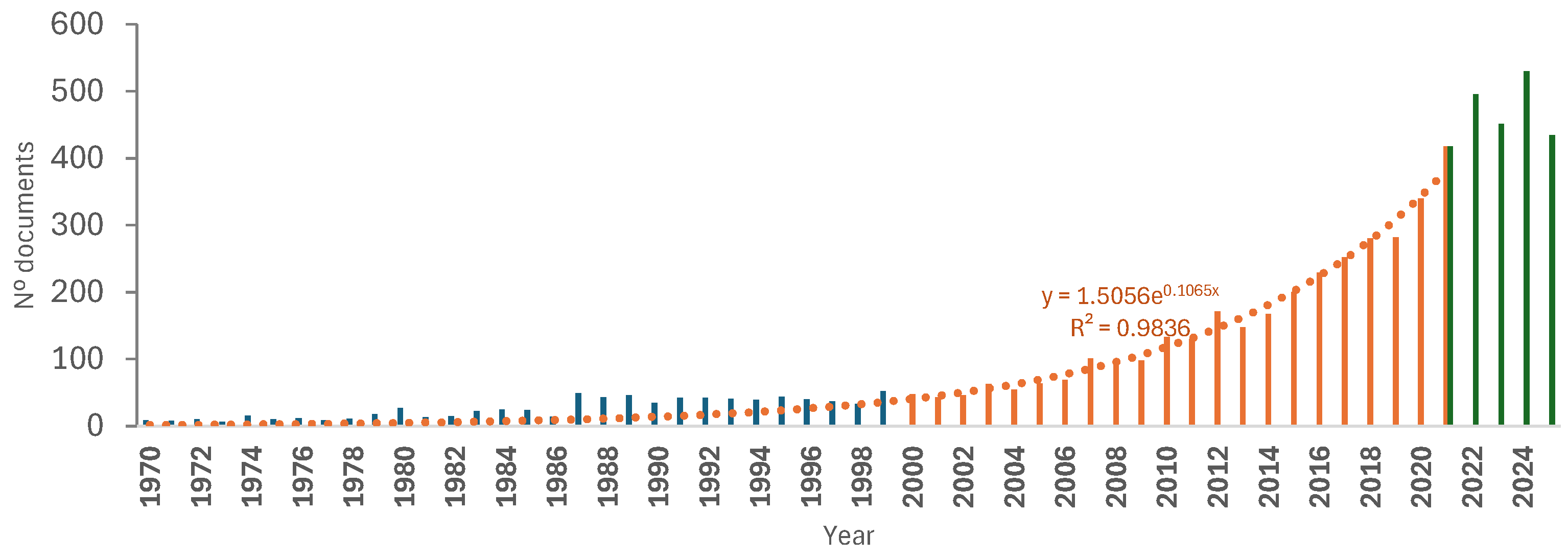
From the 6443 publications initially retrieved through searches of three bibliographic databases—Scopus, PubMed, and Web of Science—Figure 4 illustrates the exponential increase in the number of studies addressing seafood byproducts reported over the last half century, up to 2020. In contrast, during the most recent five-year period (2020–2025), this upward trend appears to have stabilized at approximately 500 publications per year.
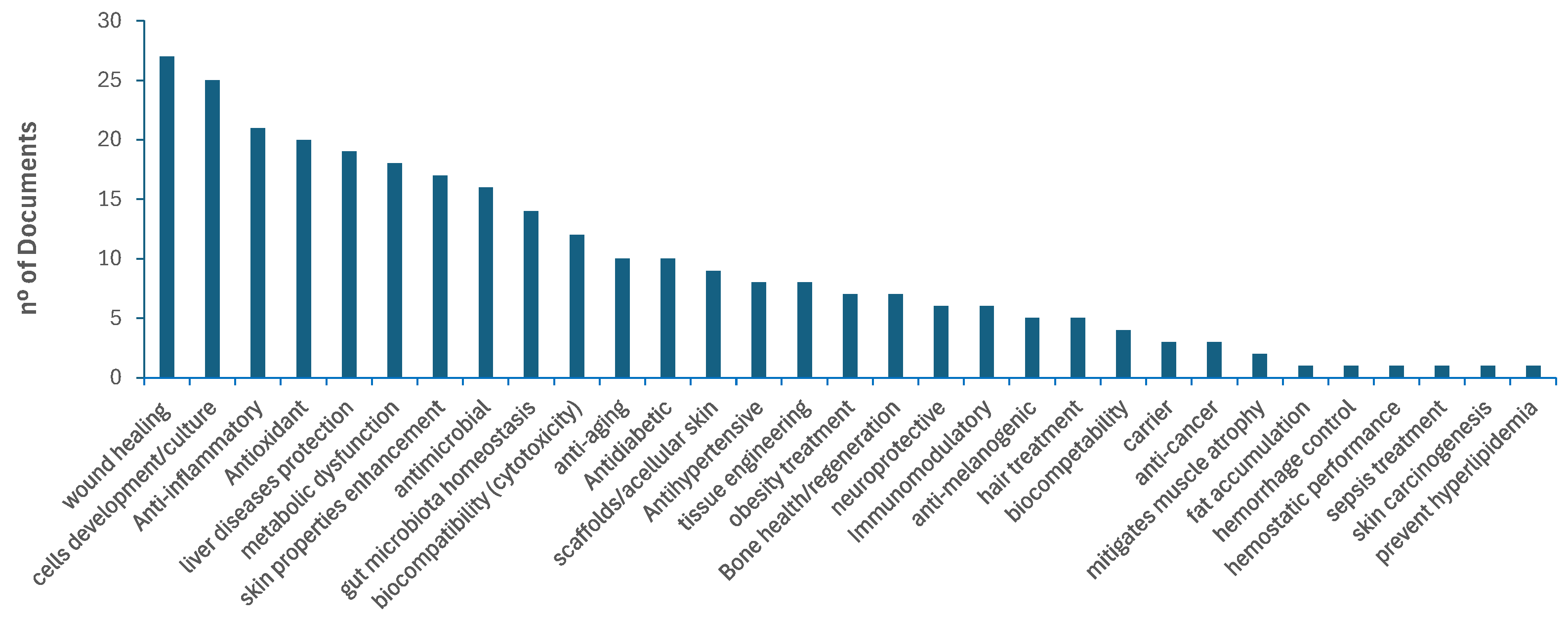
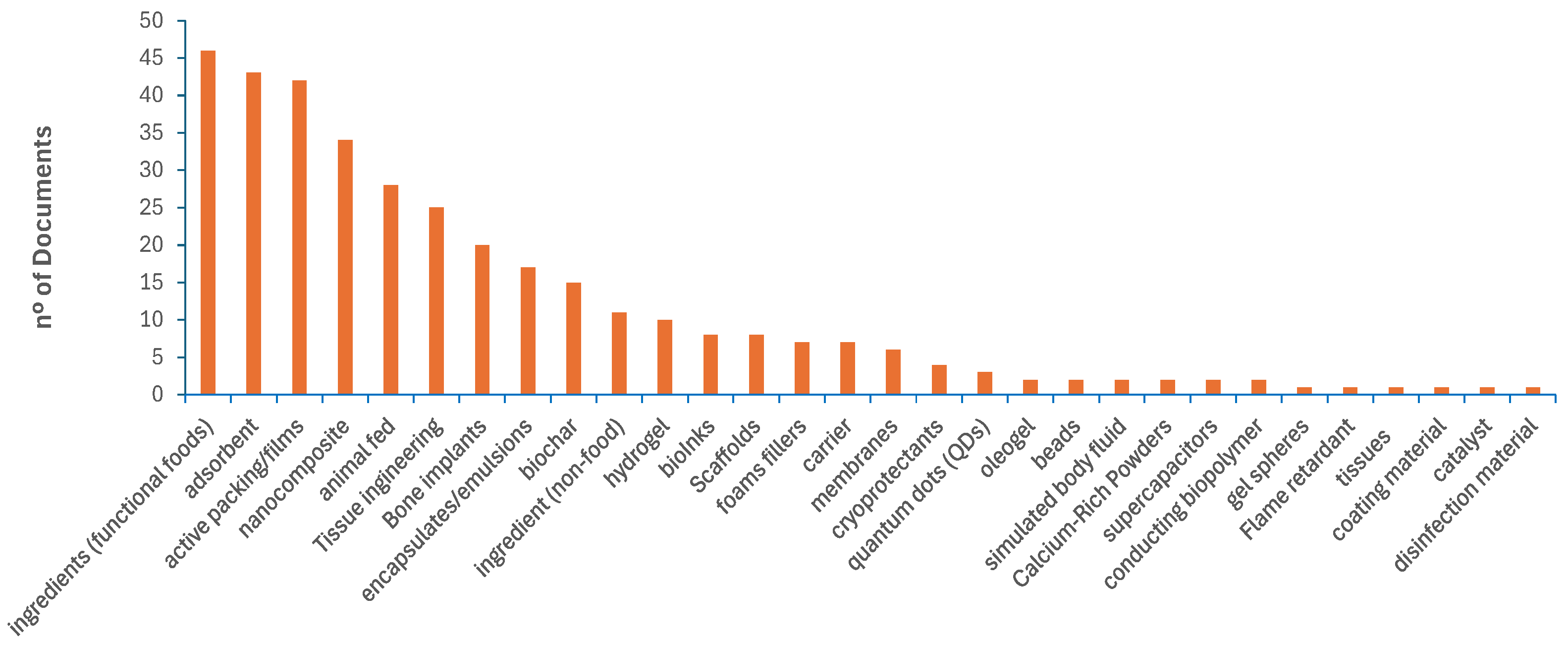
The screening phase, based on titles and abstracts, allowed a simplified overview of literature represented in Figure 5 and Figure 6, respectively showing the corresponding distribution of articles according to the potential biological activities and applications reported, associated with seafood byproducts, as identified in this systematic review.
The FAO has recognised the importance of maximising the utilisation and processing of aquatic products, with food uses accounting for 89% of global aquatic animal production (185.4 Mt) in 2022 [2]. The remaining fraction may be directed toward non-food applications. However, despite the substantial volume of scientific literature on byproducts derived from seafood over recent decades (Figure 4), the wide range of bioactivities reported associated with their major components (Figure 5), and the diversity of potential applications described in the literature (Figure 6), most commercially relevant uses of targeting these byproducts remain largely confined to fishmeal and fish oil production [2].
The extraction of biologically active compounds—such as proteins [9], bioactive peptides [4,41,105], carbohydrates [12], fatty acids [66], and minerals [3]—offers significant potential to reduce waste, while also making it possible to increase the availability of value-added ingredients for human consumption, either as food or functional extracts. The identification of health-related bioactivities in seafood byproducts has become increasingly prominent in the literature, as illustrated in Figure 5. These activities have been reported for minimally processed byproducts (e.g., liver oil [107] and fish oil [48]), crude extracts (e.g., lipidic and aqueous extracts [98,124]), enriched fractions such as protein hydrolysates [4,8,95,111,113,125], and purified individual components, including collagen [21] and hydroxyapatite [57,101,108]. Among the most frequently reported health-related bioactivities are antimicrobial (including antibacterial, antifungal, and antiviral) effects [1,93,107], antioxidant activity [7,8], antihypertensive effects [8,95], immunomodulatory activity [49], skin anti-ageing potential [126], anti-obesity effects [79,87], and antidiabetic activity [24,56]. Collectively, these findings highlight the growing relevance of marine byproducts as sources of functional and bioactive compounds.
When food-related applications are not feasible, marine byproducts may also be directed toward non-food uses. These include applications in packaging materials [12,23,36], tissue engineering [57,101,108], wound healing [51,99,101], nanocomposites [101], and adsorbent materials [38,71,104,108,110], among others. Examples of the most frequently reported applications in the literature over the last five years (2020–2025) are summarised in Figure 6. Notably, some approaches combine multiple byproduct-derived components to enhance functionality, such as the synergistic use of gelatin matrices reinforced with nanohydroxyapatite to improve mechanical and adsorptive properties [45] or the development of composite films based on collagen combined with chitosan to enhance material performance [9].
The following section presents information retrieved from the full-text assessment of the 94 articles that fulfil all eligibility criteria by providing explicit information on marine byproducts with a clear identification of the species being addressed, thus allowing successful data extraction.

3.3. Byproducts’ Prevalence and Composition

Fish-processing waste can be broadly categorised into highly perishable byproducts (e.g., viscera and blood) and relatively stable byproducts (e.g., bones, heads, scales, and skin) [4]. This distinction is primarily associated with differences in moisture content and biochemical composition. Stable byproducts generally exhibit lower moisture levels and reduced enzymatic activity, which limits microbial growth and delays spoilage [5]. When multiple byproducts are combined, additional stabilisation treatments, such as drying, have been proposed to preserve matrix integrity and prevent degradation [7]. Shell-derived byproducts are typically more stable than viscera or blood but contain higher moisture levels than bones or scales and, therefore, require careful handling. The presence of chitin in shrimp and crab shells contributes to their hydrophilic properties, which increase water retention and influences the storage stability of the derived products [5].
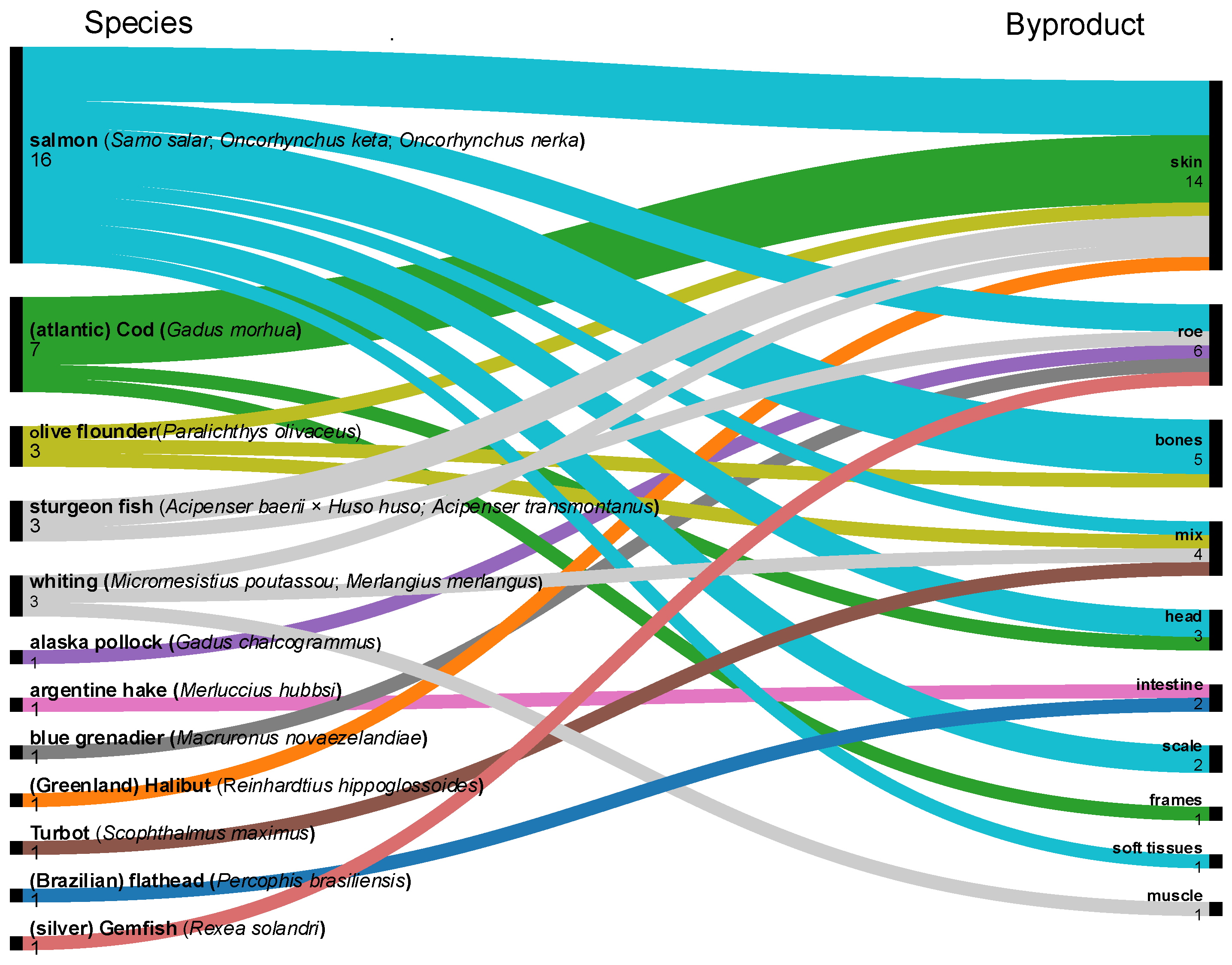
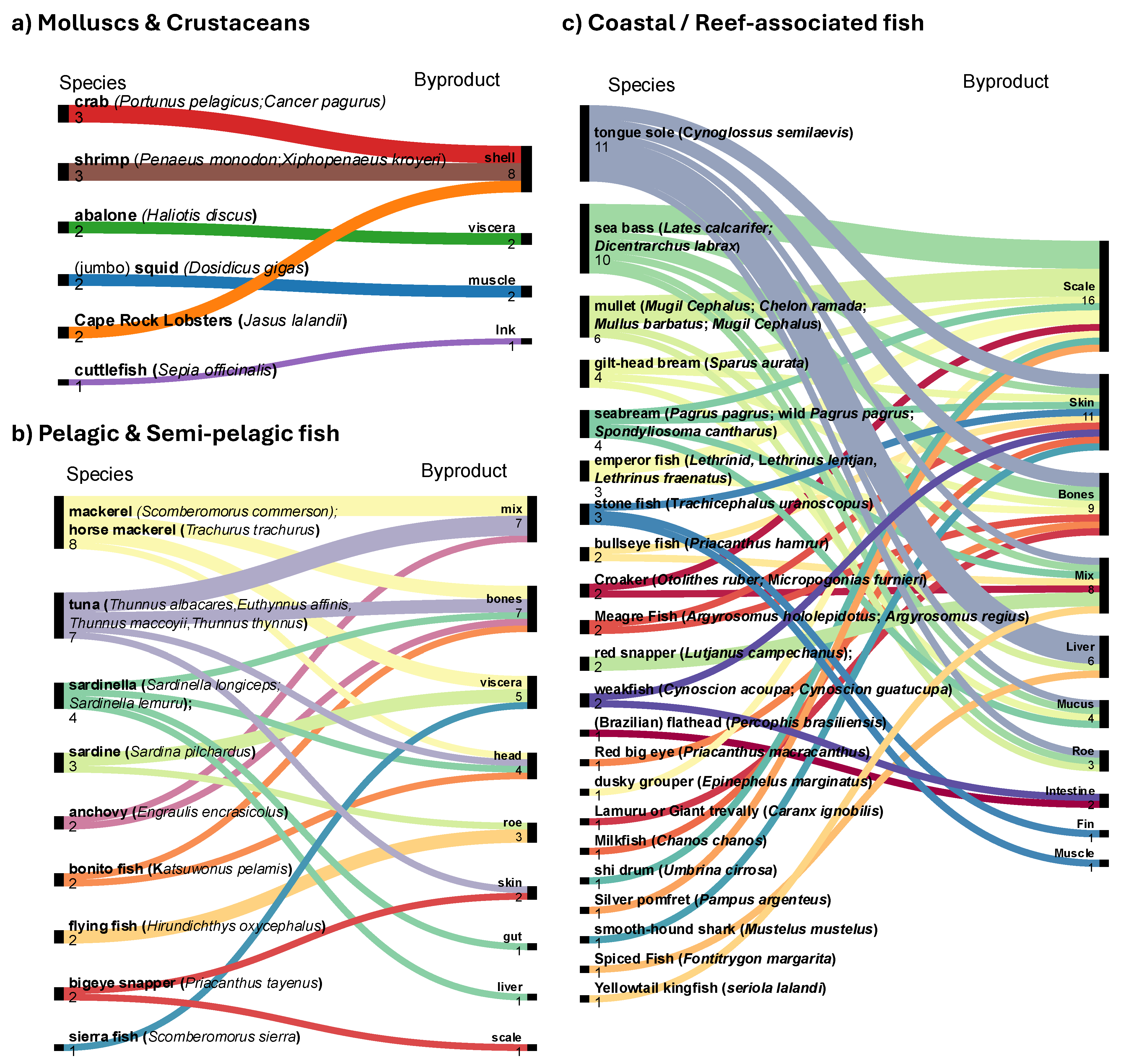
Based on data extracted from the 94 articles identified through the PRISMA screening process, the marine byproducts most frequently reported in the literature across all species (Figure 7 and Figure 8) were, in descending order of publication frequency: skin (26 documents), bones (21), scales (18), mixed byproducts (19; undefined combinations of multiple tissues), roe (12), shells (8), viscera (7), heads (7), liver (7), mucus (4), muscle (4), intestine (3), frames (1), ink (1), gut (1), soft tissues (1), and fins (1).
Figure 7 and Figure 8 summarise the distribution of byproducts across 50 identified marine species, categorised according to their thermal habitat. Cold-water species inhabiting polar, subpolar, boreal, and cold-temperate regions are presented in Figure 7. Temperate and tropical species are shown in Figure 8, further subdivided into (a) molluscs and crustaceans, (b) pelagic and semi-pelagic fish, and (c) coastal and reef-associated fish. When available, information on subspecies is included to reflect taxonomic diversity.
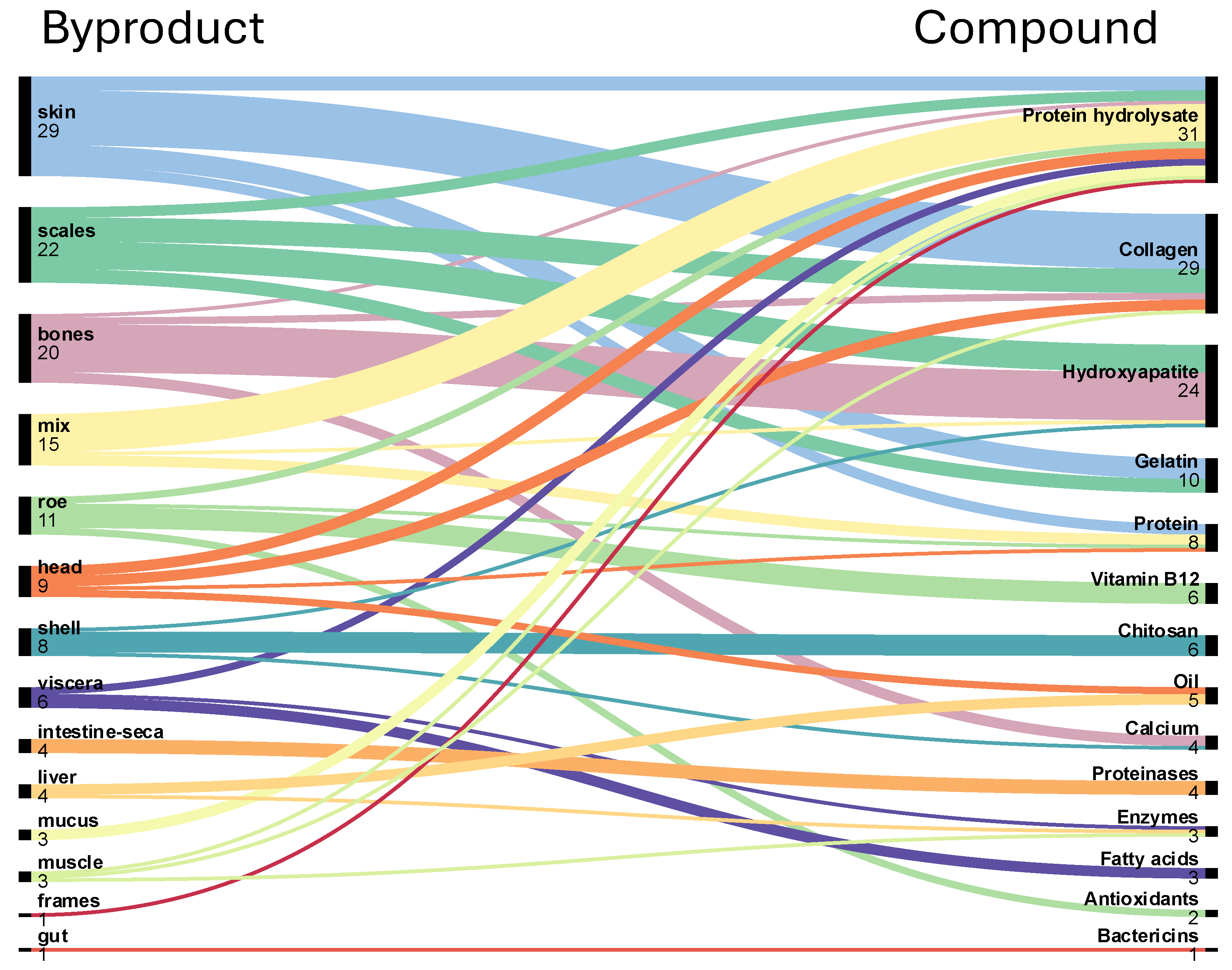
In addition, seafood byproducts were correlated with the bioactive compounds extracted from them (Figure 9). Based on frequency and relevance, the five most cited byproducts—skin, bones, scales, roe, and shells—were selected for detailed discussion in subsequent sections. The most common analytical methods used to characterise these compounds are listed in Table 1. Mixed byproducts were excluded from this analysis due to their heterogeneous composition and limited interpretability.

3.3.1. Skin, Scales, and Bones as Sources of Collagen

Fish skin, bones, and scales are among the most important seafood byproducts for protein recovery, particularly collagen [3,8,21]. Collagen extraction from these matrices has been achieved using chemical methods (acidic and/or alkaline treatments) [4,96,97], hydrothermal processes [4], enzymatic approaches, or combinations thereof [127]. Typically, collagen extraction protocols include low-temperature (0–4 °C) pretreatment steps to preserve the native triple-helix structure. These pretreatments commonly involve two sequential operations: (i) deproteinization using dilute alkaline solutions to remove non-collagenous proteins and endogenous proteases, and (ii) demineralisation or decalcification, primarily using dilute acidic solutions [4,96,97,128]. Deproteinization is particularly critical, as endogenous collagenases can degrade collagen during subsequent extraction steps, thereby altering molecular integrity and yield [129]. Demineralisation mainly affects inorganic components such as calcium and is especially relevant for bones and scales. Temperature control is essential, particularly for collagen derived from cold- and temperate-water species (Figure 7), such as cod and salmon, whose collagen denaturation temperature (TD) is approximately 15 °C. Consequently, all extraction steps must be performed under strictly controlled low-temperature conditions.
The initial alkaline treatment generally does not solubilise collagen, which remains embedded within connective tissues [4]. Subsequent acid treatment—most commonly with acetic acid, although citric acid has also been reported as an alternative [128]—induces tissue swelling and softening by disrupting non-covalent bonds and allowing solvent penetration into collagen fibres. This process increases collagen solubility and facilitates extraction [56]. Collagen precipitation is commonly achieved through salting-out, followed by centrifugation [128]. Sodium chloride has also been suggested to reduce collagen thermal stability. Extraction becomes more complex in lipid-rich species, such as salmon (Table 1), where lipid–protein aggregates reduce protein digestibility [16] and increase susceptibility to oxidative degradation, potentially causing off-odours [55]. In such cases, defatting steps prior to protein extraction are required [121]. While some studies report that alkaline pretreatment alone is sufficient to remove lipids [129], others include solvent-based defatting (e.g., isopropanol) [55], indicating that protocol optimisation must be species- and matrix-specific. Additional hydrothermal or enzymatic treatments may be applied when gelatin or collagen-derived protein hydrolysates are the target products.
Gelatin is produced through partial hydrolysis and denaturation of collagen. Compared with collagen, gelatin extraction is generally simpler, is less costly, and results in materials with improved stability and processability [17]. Beyond gelatin, shorter protein hydrolysates (PH) derived mainly from collagen disruption have also been obtained, although their characterisation is often less detailed. Hydrolysis destabilises the collagen triple helix by disrupting hydrogen bonds and cross-links [4]. Enzymatic hydrolysis is the most common approach, using proteases such as papain [4], pepsin [21], trypsin, alcalase [16], or pancreatin [65]. However, because enzyme specificity and source matrix strongly influence peptide profiles, comparative interpretation becomes complex; therefore, detailed discussion of enzymatic hydrolysis strategies falls outside the scope of the present review.
Table 2 and Table 3 summarise the proximate composition and amino acid profiles of skin, bone, scale, and cartilage-derived collagen and gelatin from several marine species. Cartilage was considered separately from bone due to compositional differences, but included for comparison, because of similar collagen extraction yields. Representative examples include cold-water species (e.g., cod and salmon, Figure 7) and temperate–tropical species (e.g., bigeye snapper and sharks, Figure 8).
Baltic cod skin (Gadus morhua callarias) collagen extracted under acidic conditions (acid-soluble collagen, ASC) [128] was compared with gelatin recovered from Atlantic cod (Gadus morhua) after thermal treatment (soluble gelatin, SG) or enzymatic hydrolysis (pancreatin-soluble gelatin, PSG) [65]. Amino acid profiles indicated that extraction severity influenced molecular integrity but not base composition (Table 3). Similarly, salmon (Salmo salar) byproducts exhibited higher lipid content (Table 2) than cod (Gadus morhua), affecting extraction efficiency and requiring additional defatting steps [121]. Comparisons between skin, bone, and scale collagen revealed matrix-dependent differences in yield and amino acid composition [21,121,129]. Across species, skin consistently yielded higher collagen recovery than bones or scales. For example, collagen extraction yields from bigeye snapper (Priacanthus tayenus) reached 10.9% (wet basis) for skin and only 1.6% for bone [130]. Furthermore, normalised compositional parameters, such as hydroxyproline content expressed per gram of protein, minimised methodological bias and highlighted species- and habitat-related differences.
Collagen thermal stability, measured by differential scanning calorimetry (DSC), viscosity, or circular dichroism, is strongly influenced by amino acid composition, particularly imino acid content (proline + hydroxyproline) [127,131]. Collagen denaturation temperature (TD) is an irreversible process reflecting triple-helix unwinding, whereas gelatin gelling (Tgel) and melting temperatures (TM,gel) are reversible transitions associated with partial helix reformation [53]. It is important to note that TD can be identified by the temperature at which 50% of collagen molecules are denatured, and viscosity is reduced by half [132]. After gel formation, Tgel and TM,gel is related to the physical changes occurring and measured respectively, when cooling or heating the gel. Cold-water species, such as cod (Gadus morhua) and Atlantic salmon (Salmo salar), exhibit lower TD and gelatin melting temperatures (TM,gel) than temperate and tropical species (Table 3), reflecting lower imino acid content. This relationship is well-established and correlates strongly with habitat temperature, rather than taxonomy. For example, sockeye salmon (Oncorhynchus nerka) collagen [55] exhibits imino acid contents closer to cod (Gadus morhua) than to Atlantic salmon (Salmo salar) [129], consistent with colder habitat exposure. In contrast, shark cartilage collagen displays much higher imino acid content and thermal stability, approaching values observed in mammalian collagen, which explains its higher commercial value [133].
Extraction conditions can significantly affect the properties of collagen being recovered. In shark cartilage, differences between acid-soluble (ASC) and pepsin-soluble collagen (PSC) were higher than differences between species (Carcharhinus limbatus vs. Chiloscyllium punctatum), indicating that extraction methodology may outweigh biological variability [127]. This highlights the importance of standardising protocols when using collagen as a potential origin-tracing marker.
Hydroxyproline hydroxylation also contributes to collagen stability through hydrogen bonding and water-mediated interactions [127]. Differences in hydroxylation degree were observed between species and byproduct types and may serve as additional discriminatory parameters. Lysine hydroxylation (Table 3) further contributes to intermolecular crosslinking and fibril stabilisation. The higher degrees of hydroxylation, particularly in bone-derived collagen, may be justified by a higher requirement for a more stabilised triple helix [130].
Type I collagen is predominant in marine species, although other fibrillar and non-fibrillar collagens also occur (Table 4). Origin tracers were more difficult to identify in gelatin or protein hydrolysates when compared to the original collagen. Beyond amino acid composition, collagen subunit profiles (α, β, and γ chains typically identified with 125 kDa, 250 kDa, and 375 kDa, respectively [129]) provide additional tracing potential. Some literature reports have been able to further distinguish α-1 and α-2 chains [63]; others did not [69]. The short N- and C-terminal regions (called telopeptides) do not form triple helices, since they mainly consist of lysine and hydroxylysine residues and their derivatives [65]. These are linked by both intra- and intermolecular covalent cross-links, thus being important for crosslinking and stabilising the collagen fibril structure [21]. The richness in inter- and intra-molecular cross-linked components, β and γ components respectively, can be used to trace fish-eating habits. Crosslinked β and γ components reflect nutritional status and feeding behaviour, with starved fish exhibiting higher crosslink density, particularly in connective tissues, maintaining the amino acid composition (Table 3), while new collagen is added to the existing one, providing stronger collagen [128,132]. These structural adaptations enhance muscle contraction efficiency during nutrient deprivation.
Analytical variability remains a major limitation in cross-study comparisons. Protein quantification depends strongly on conversion factors (e.g., N × 6.25, N × 5.5, or Hyp × 14.7), and inappropriate molecular weight standards in SDS–PAGE, using globular proteins which do not compensate for the difference from collagenous proteins (which contain a higher content of relatively small amino acids residues (Gly and Ala)), can lead to chain misidentification [17,21,134]. These methodological inconsistencies emphasise the need for normalisation and protocol harmonisation when collagen-based markers are considered for tracing origin. Overall, collagen composition, thermal stability, crosslinking degree, and collagen-type distribution collectively offer strong potential as origin-tracing tools. However, extraction and analytical procedures must be carefully standardised to avoid misleading interpretations.

3.3.2. Scales and Bones as Sources of Hydroxyapatite (HAp) and Calcium

In addition to proteins, seafood byproducts are an important source of minerals, as summarised in Table 5 [3]. The mineral composition of seafood tissues—and consequently of their byproducts—is closely linked to species, habitat, and feeding regime. This variability provides an additional analytical dimension that may be exploited for origin traceability. Unlike skin, which is predominantly proteinaceous (approximately 70% on a dry basis), fish scales and bones exhibit a complex composite structure composed of both organic components (mainly collagen, keratin, and mucin) and inorganic minerals, primarily calcium phosphates [17,41,99,116]. As such, these matrices can be exploited as dual sources of proteins and minerals. In fish scales, organic material represents approximately 30–50% of the total mass [41], while the remaining fraction consists mainly of calcium phosphate compounds, with hydroxyapatite (HAp) accounting for up to 95% of the mineral content [86]. It is noteworthy that, in protein-rich matrices subjected to extensive hydrolysis, the release of free amino acids can induce a salting-out effect, negatively affecting calcium bioaccessibility [3]. Fish bones and scales typically display a low-fat content (Table 5), as most of the fat in fish is concentrated in the flesh rather than the bones.
Fish bones typically consist of approximately 30% organic matter and 70% inorganic material, with HAp comprising around 60–70% of the total mineral fraction [5,69,99]. Bones are separated from the skeletal frame following muscle removal and are subsequently dried and milled to obtain bone powder [5]. This mineral fraction is rich not only in Ca, which exhibits high bioavailability [5], but also in P and Mg, as well as trace elements such as Fe, Zn, and Sr (Table 5).
Calcium phosphates recovered from seafood byproducts can exist primarily as β-tricalcium phosphate (β-TCP; Ca3(PO4)2) or hydroxyapatite (HAp; Ca10(PO4)6(OH)2), both of which are widely used as biomaterials. While β-TCP is more resorbable and degrades faster under physiological conditions, HAp is more stable and is commonly applied in bone regeneration and substitution applications [69]. In some biomedical contexts, blends of β-TCP and HAp are employed to balance stability and resorbability [88]. A key descriptor of calcium phosphate materials is the calcium-to-phosphorus atomic ratio (Ca/P), which is 1.5 for β-TCP and 1.67 for stoichiometric HAp. Ca/P ratios lower than 1.67 indicate calcium-deficient hydroxyapatite, which can be converted into β-TCP or HAp under controlled conditions [88,104]. Conversely, elevated Ca/P ratios may indicate non-stoichiometric or defective HAp structures [108]. One such variant is B-type hydroxyapatite, in which carbonate ions (CO32−) substitute for phosphate ions (PO43−) within the crystal lattice. This substitution results in calcium-deficient HAp, as charge neutrality is maintained by the removal of Ca2+ ions [99]. B-type HAp closely resembles biological apatite found in bones and teeth, where carbonate content typically ranges from 5–9% (w/w) [108]. For example, Ca/P ratios estimated for mullet and seabass scales (Table 5) exceeded typical literature values, suggesting carbonate substitution within the apatite lattice. This interpretation was confirmed by FTIR analysis, which revealed characteristic carbonate absorption bands at 881, 1403, and 1455 cm−1 [17,96]. These findings underscore the importance of combining elemental analysis with spectroscopic techniques such as FTIR to accurately characterize mineral phases. Energy-dispersive X-ray (EDX) analysis further supports mineral purity assessment and contaminant detection. In seabass scales, EDX revealed lower Ca/P ratios, consistent with the presence of collagen matrices entrapping apatite crystals [96].
The dual organic–inorganic nature of scales and bones dictates the extraction strategy applied. When hydroxyapatite is the primary target, aggressive deproteinization—often involving acidic treatment at elevated temperatures—is used to remove all organic matter, including collagen. Although HAp is mostly synthesized artificially, it can also be recovered from natural marine sources. Traditional preparation involves high-temperature calcination (800–1000 °C), though alternative low-energy and environmentally friendly methods have recently been proposed [99]. The resulting natural HAp is typically non-stoichiometric and contains trace ions (e.g., Na+, Zn2+, Mg2+, potassium (K+), silicon (Si), barium (Ba2+), fluoride (F), CO32−) that resemble human bone composition and may confer enhanced biological performance [10,99]. These trace elements may also serve as potential tracers for species identification and/or origin.
Thermal analysis techniques, including thermogravimetric analysis (TGA), derivative thermogravimetry (DTG), and differential thermal analysis (DTA), provide valuable compositional fingerprints when combined with chemical characterization. Typical thermal profiles show an initial mass loss at 100–120 °C due to free water evaporation, followed by losses at 130–200 °C associated with chemisorbed water. Organic components decompose mainly between 200 and 500 °C, including processed gelatin [17], and collagen denaturation [96,109], with similar Tmax ~350 °C. Carbonate decomposition typically occurs between 550 and 800 °C, whereas hydroxyapatite remains thermally stable below 800 °C REF. Bone samples, due to their high mineral content, often require thermal analysis up to 1000 °C [10]. While temperature depends on the nature of the compound, the weight loss at each step reflects the content of each component, such that the final total loss represents a unique signature of the composition. Reported total mass losses vary widely among species, reflecting differences in organic content: 36% for White seabass scales (Lates calcarifer) [96], approximately 40% for Atlantic cod (Gadus morhua) and Japanese sea bream (Sparus aurata) bones, and over 60% for Sardine (Sardina pilchardus) bones [10]. Higher losses (60–70%) have been reported for Horse mackerel (Trachurus trachurus), tuna, Greater amberjack (Seriola dumerili), and Yellowtail or Japanese amberjack (Seriola quinqueradiata) bones [135]. Such variability reinforces the potential of thermogravimetric profiles as supplementary tools for tracing the origin of byproducts when combined with compositional data.

3.3.3. Shells as Sources of Chitin and Calcium Carbonate

Compared with fish bones and scales, crustacean shells present a more complex composition due to the presence of a third major component—chitin—strongly interconnected with proteins and mineral fractions [12,20]. Chitin is a linear polysaccharide composed of N-acetyl-D-glucosamine units and can also be sourced from fungi and algae; however, commercial production currently relies almost exclusively on crustacean shell waste from shrimp, crab, lobster, crayfish, and prawn processing [5,20,80]. The primary commercial derivative is chitosan, the deacetylated form of chitin [12,20].
Several biological, enzymatic, and microbial methods have been investigated for chitin extraction [20] to generate chitosan [80]. Nevertheless, chemically based processes remain the most widely adopted to achieve higher yields at lower costs. These processes typically involve sequential steps, namely: demineralization (to remove calcium carbonate), deproteinization, optional decolorization/depigmentation, and deodorization, followed by alkaline deacetylation to produce chitosan [12,20,43]. Deacetylation is commonly performed using concentrated sodium or potassium hydroxide under elevated temperatures, although enzymatic deproteinization steps have also been incorporated in some processes [20,80]. The complexity and severity of chemical processing largely obscure original biological signatures, making it extremely difficult to trace the origin of chitosan based solely on its physicochemical properties. However, complementary information may still be derived from residual mineral components present in shell-derived materials.
Unlike fish bones and scales, crustacean shells are predominantly mineralized with calcium carbonate (CaCO3), mainly in the form of calcite or aragonite, and typically do not contain hydroxyapatite. The mineralized CaCO3 layer is tightly associated with the epicuticle and outer shell surface, with trace amounts of MgCO3 also reported. Mineral content varies by species, reaching approximately 48% in shrimp heads and up to 70% in crab shells [108]. Demineralization processes generate a characteristic porous microstructure by removing mineral phases and opening previously blocked pores [12,42]. This porosity enhances properties, such as ion exchange, adsorption capacity, and potential biomedical performance (e.g., vascularization and bone ingrowth) [108]. Organic components (chitin and proteins) form the remaining matrix, while CaCO3 constitutes the dominant inorganic fraction, accounting for 70–90% of total minerals [12,42].
Shell powders can also be subjected to calcination, which transforms CaCO3 into CaO or Ca(OH)2 [46]. Because carbonate phases are less thermally stable than HAp, lower calcination temperatures (650–700 °C) are typically applied to preserve carbonate content [108]. Some studies further convert calcined shell-derived CaO into HAp via chemical treatment with phosphoric acid [109]; however, such materials should not be considered natural hydroxyapatite. Carbonate-substituted HAp detected in shell-derived materials is generally B-type HAp formed during processing [108].
Thermogravimetric analysis of shrimp shells shows that degradation temperatures and mass-loss patterns are strongly influenced by mineral content. For example, raw shrimp (Penaeus monodon) shells exhibited approximately 50% mass loss at 355.9 °C, associated with decomposition of chitin [12], followed by a maximum of 62.6% at 439.0 °C for carbonate decomposition and a total weight loss of 67.23% [12]. Purified chitin and chitosan showed distinct thermal profiles with lower mass loss due to reduced mineral content, but also showed differences from each other, with a maximum of 67.2% (Tmax 399.7 °C) and 62.6% (Tmax 409.9 °C), respectively. In the brown crab (Cancer pagurus) carapace, TGA revealed a first mass loss (11.3%) at 266–343 °C corresponding to CaCO3 decomposition to CaO, followed by a larger loss (39.2%) at 600–740 °C associated with calcite decarboxylation [42]. Activation and processing reduced total mass loss, reflecting increased inorganic content and improved thermal stability [42]. When processing history, organic/inorganic ratios, and species-specific composition are known, such thermal and compositional characteristics may contribute valuable information for tracing the origin of crustacean shell-derived materials.

3.3.4. Roe as a Source of Proteins, PUFAs, and Vitamin B12

Although the terms eggs and roe are often used interchangeably, a distinction is commonly made between biological and commercial contexts. In biology, eggs refer to individual ova, whereas roe denotes the collective mass of eggs, a term more frequently used in culinary and commercial applications [136]. Fish roe is also known by different regional names, such as bottarga (Italy), karasumi (Japan), caviar (Russia), and ikura, tarako, or tobiko (Japan) [75,137]. A notable example is flying fish roe, commonly referred to as tobiko, which accounts for approximately 20–30% of Indonesia’s total fish roe exports to Asian markets [74].
Historically, fish roe was often regarded as a processing waste. In recent decades, however, it has gained recognition as a high-value food product due to its rich nutritional profile, including high-quality proteins, unsaturated fatty acids, particularly omega-3 PUFAs, water- and fat-soluble vitamins (particularly Vitamin B12), antioxidants (e.g., glutathione and gadusol), and trace elements [66]. Despite this high value, a significant fraction of harvested roe fails to meet premium quality standards. Physical damage caused by rough handling frequently results in rupture of egg sacs, bleeding, discoloration, soft or degraded texture (mushy or watery), and off-odors [16]. In addition, small or underdeveloped eggs are typically classified as low-grade (grade III) roe, which is often diverted to byproduct streams or discarded as waste [16]. Low-grade roe represents an important secondary raw material for the recovery of valuable compounds, particularly proteins, protein hydrolysates, and vitamin B12.
Marine-derived vitamin B12 (Table 6) obtained from roe (can also be obtained from viscera) is of particular interest because it predominantly contains biologically active forms of the vitamin, with only negligible amounts of inactive corrinoids such as pseudo-vitamin B12 or B12 dicarboxylic acids [75]. This represents a significant advantage over alternative sources, such as edible insects, in which up to 95% of extractable B12 may occur in inactive forms. The different contents of vitamin B12 identified in roe from different fish can also be used as a potential tracing tool. Besides the examples presented in Table 6, vitamin B12 has been quantified in white sturgeon (caviar, 14.7%), mullet (bottarga, 21.6%), and salmon (sujiko, 34.7 ± 4.7), this last being different from Ikura because it maintains the roe inside the original ovarian sac membrane [75].
From a traceability perspective, morphological identification of fish eggs presents substantial challenges. Early-stage eggs of most marine species exhibit few distinguishing features beyond egg diameter and the size and number of oil droplets in the yolk. Typical egg diameters range from 0.6 to 2.0 mm, with oil droplets measuring approximately 0.1–0.4 mm, a range that overlaps across numerous species [35]. As a result, species identification based solely on morphology is most unreliable. This limitation has fostered the adoption of molecular approaches, such as cytochrome c oxidase subunit I (COI) barcoding, for fish egg identification.
An alternative and increasingly promising technique is matrix-assisted laser desorption/ionisation time-of-flight mass spectrometry (MALDI-TOF MS), which relies on species-specific proteome fingerprints. MALDI-TOF MS has been widely applied in food fraud detection, particularly for seafood species authentication, and has recently been extended to fish egg identification [35]. Compared with DNA barcoding, this technique offers lower operational costs, faster sample preparation, and high identification accuracy [35]. In one study, 210 fish egg samples were initially analysed using COI barcoding, with 178 subsequently validated for a reference library using MALDI-TOF MS. Proteomic clusters derived from mass spectra were congruent with DNA-based groupings, supporting MALDI-TOF MS as a reliable and cost-effective alternative for species identification in ichthyoplankton surveys and traceability studies [35].
Protein-based markers present additional challenges for tracing the origin of roe. Protein content varies not only among species, but also with roe quality grade and seasonality, with lower-grade roe typically exhibiting reduced protein levels [16]. Although proximate composition alone is therefore insufficient for reliable discrimination, electrophoretic techniques such as SDS–PAGE have demonstrated some discriminatory potential. However, high lipid content complicates protein analysis, as lipid–protein aggregates formed through covalent interactions can distort electrophoretic profiles, particularly in low-molecular-weight regions [16,139]. While delipidation steps may partially mitigate this effect, they can also compromise protein integrity, limiting analytical reliability [16]. Furthermore, lipid hydrolysis and oxidation may alter membrane permeability and enzyme activity [140], indirectly influencing protein hydrolysis behaviour [16].
Lipid composition has also been explored as a potential discriminant for roe origin. Comparative studies revealed species-specific differences in fatty acid profiles (Table 6), notably the significantly low contents of EPA (C20:5, n-3) and DHA (C22:6, n-3) in Kina roe. In all other fish roe, the EPA and DHA together exceed 26%, reaching up to 41% in Tarako, the roe from Pollock fish. The relative proportions of saturated fatty acids (SFA), monounsaturated fatty acids (MUFAs), and PUFAs also differed significantly between species. Phospholipid content, particularly phosphatidylcholine (Table 6), also provides statistically robust discrimination.

4. Commercial Examples and Future Perspectives

Growing consumer awareness of the unsustainability of linear consumption chains has driven the market towards circular economy approaches, with industry increasingly emphasising the sustainability of production models that utilise byproducts as raw materials [141]. Today, there are already companies that fully use marine byproducts, demonstrating that upcycling is a tangible reality in several marine-based sectors. Table 7 presents high-volume success cases, with commercial products that range from human nutrition to pet food, as well as biofertilizers for agriculture. These examples illustrate how industry is increasingly concerned with resource utilisation, while simultaneously demonstrating how technological solutions can be effectively adapted.
At the same time, the growing presence of these products on the market reflects a shift in consumer perception—from the previously negative association with “waste” towards broader acceptance of byproducts as valuable raw materials in new product lines [142]. This new approach towards seafood by-products highlights the need to develop suitable traceability pathways and validate which existing protocols for seafood in general can be replicated.
Table 7. Examples of companies that have a high impact on marine byproduct utilisation and their commercial products.
Company/
Marine Byproducts
(Estimated Utilisation)
Commercial Products
Biomega Group [143]
(Norway)
Salmon byproducts
(~36,000 t/year)
Human Nutrition Ingredients:
   SalMe Peptides (salmon protein isolate)
   SalMe Collagen Peptides (collagen peptides sourced from salmon)
   SalMe Salmon Oil (Food-grade salmon oil)
Pet Food Ingredients:
   Salmigo® Protect L60
   Salmigo® Active (highly digestible salmon protein powder)
   Salmigo® Salmon Oil
Aquaculture Feed Ingredients:
   Salmon Oil for Aquafeed (omega-rich feed ingredient)
Hofseth BioCare [144]
(Norway)
Salmon byproducts
(16,145 t/2024)
   OmeGo® (salmon oil)
   ProGo® (protein hydrolysate)
   CalGo® (calcium/collagen)
   PetGo™ (non-soluble protein)
Thai Union Ingredients [145]
(Thailand) [145]
Tuna waste
(15,000 t/year) *
   ThalaCol™ (Marine Collagen Peptides)
    UniQ™DHA (Omega-3 Oils)
   UniQ®COL (Protein Hydrolysates)
   UniQ®BONE (Tuna bone powder, source of calcium, phosphorus and collagen)
TripleNine Group [146]
(Denmark) [146]
Trimmings from various fisheries **
(~110,000 t/year, TripleNine Lota, Chile)
Marine ingredients for the aquaculture:
   SUPERPRIME fishmeal
   PRIME fishmeal
    STANDARD fishmeal
Valora Marine Ingredients [147]
(Spain)
Seafood processing byproducts ***
Functional ingredients for food, pharmaceutical, and cosmetic industries
Natural seasonings & flavour enhancers
Pet Food/animal ingredients
Ingredients for agriculture
Bio-Marine [148]
(Ireland)
Blue whiting and other under-utilised species (~14,000 t/year raw marine processing, Monaghan, Ireland)
Nutritional and functional ingredients:
   ProAtlantic (hydrolysed protein isolate (~95%) for human nutrition)
   Proshore (protein concentrates (55–90%) for pet food and aquaculture nutrition)
   WhiteCal (products rich in calcium from fish bones)
   Omega-Blue and lipid powders (lipid/oil fractions for food/pet foods/aquaculture)
   ProGlas (Biofertilisers for agriculture)
* This value was estimated using the 1500 t/year of marine collagen from tuna skin output, a assuming a typical collagen yield recovery of 10%. ** The processed feedstook is partially coming from byproducts according to certified traceability information (e.g., MarinTrust). *** The Valora company operates within the Jealsa group processing ecosystem, where ≈20% of raw materials are directed to new valorisation processes, however the amount of processed raw materials is not available.
Besides the companies mentioned above, there are also several initiatives and projects focused on the utilisation of marine byproducts, particularly aimed at the production of sustainable, high-value food and feed ingredients from underutilised marine biomass that may result in sustainable solutions for the future, with some being outlined below.
The FOODIMAR Project [149] (Sustainable climate-friendly quality food ingredients from marine side-streams) is currently testing three pilot-scale approaches. The first pilot focuses on the utilisation of fisheries side-streams from Atlantic cod (Gadus morhua), Saithe (Pollachius virens), and Haddock (Melanogrammus aeglefinus), aiming at the recovery of collagen, gelatin, and glycosaminoglycans. The side-streams are mainly processed via silage, resulting in feed ingredients for human consumption in markets such as Africa. The second pilot evaluates the utilisation of jellyfish by-catch, targeting Moon jellyfish (Aurelia aurita) and Comb jellyfish (Mnemiopsis leidyi). This pilot is particularly relevant because jellyfish in Denmark are currently neither consumed nor utilised, resulting in an immature, exploratory, and non-regulated value chain. The objectives of this pilot include identifying both opportunities and obstacles, as well as the full characterization of jellyfish-derived ingredients. Potentially, this pilot may contribute to the creation of a new supply chain for the seafood sector. The third pilot includes both aquaculture side-streams and jellyfish by-catch, targeting Seabream (Sparus aurata) and jellyfish (Aurelia aurita, Rhizostoma pulmo, Rhopilema nomadica, and Pelagia noctiluca). This pilot pursues aims like those of the previous pilots, focusing on ingredient recovery and valorisation pathways.
Another relevant example of marine sustainability initiatives is MARMADE [150] (Marine biomass valorization for food and feed innovation), a Circular Bio-based Europe–funded project that utilises shrimp shells, blue crabs, and other crustaceans. The project aims to establish advanced biorefinery processes for the extraction of compounds such as peptides, prebiotics, lipids, and vitamins.
The BLUE BIOECONOMY PACT [151] is a Portuguese consortium that has embraced the challenge of reindustrializing national industries through the integration of blue biotechnology solutions into value chains. The initiative leverages the sustainable use of marine bioresources to increase added value through decarbonising innovation. Among its transversal initiatives, the pact includes overarching projects such as a digital platform dedicated to the valorisation of seafood byproducts, with an emphasis on their traceability, including the confirmation of their geographic origin.
Finally, the LIFE REFISH Project [152] (Flexible biorefinery to valorise discards and byproducts of the European fish and seafood production, 2022–2025) addresses the entire value chain, from determining optimal storage conditions to demo-scale biorefinery testing (300 kg byproducts. h−1), identifying potential commercial value, and preparing an industrial-scale process (4 t. h−1) for commercialisation.
Rather than viewing so-called “byproducts” as waste, this review reinforces the need to recognise them as potential co-products that, when processed appropriately, can generate significant added value and new revenue streams. Through cascading and multi-stage valorisation approaches, a single biomass source can yield multiple co-products, transforming food loss and waste from an environmental and economic burden into an opportunity for sustainable production [142]. Such strategies contribute to income diversification for producers without increasing primary production pressure and provide additional food and material resources to meet growing global demand. Importantly, cascading use of biomass can also reduce competition among end-use sectors, if byproducts are sufficiently characterised to enable their targeted and safe application—an aspect closely linked to food security, for which traceability of geographic origin is essential [153]. Given their high content of valuable components, seafood byproducts should therefore be prioritised for upcycling valorisation rather than simple recycling. As future challenges, no process can be considered complete or successful without incorporating techno-economic analysis and life cycle assessment (LCA) studies, which are essential for fully understanding the economic feasibility and environmental impacts of the developed processes [154].

5. Conclusions

The central question addressed in the present work is whether the geographic origin of marine byproducts can be reliably traced using their composition, particularly in the absence of reliable information from where they were farmed or captured. The answer is affirmative, but not in a direct or straightforward manner. The reliable tracing of geographic origin of seafood byproducts requires critical control and interpretation of all processing steps, as each one of them holds the potential to induce significant shifts to the compositional and structural features of the markers selected. When sufficient and well-characterised data are made available, these changes may be effectively modelled, hence enabling a prediction of a specific origin. However, this requires a careful balance between the complexity of information obtained from minimally processed materials—which may include confounding contributions from heterogeneous structures—and the cleaner, but potentially altered, information derived from purified extracts. A comprehensive approach must therefore integrate multiple layers of information to reconstruct the processing pathway, often as far back as to its original source.
The first essential step to trace the origin of a given seafood byproduct is the characterisation of the byproduct itself. Although mixed byproducts may be analysed, the contribution of each component should be considered individually. In this study, four key stages were identified as critical when aiming to trace the origin of a seafood byproduct: (1) overview of the byproduct, (2) compositional analysis, (3) direct analysis and/or extraction conditions, and (4) purification.
Step 1—Overview of the byproduct. This stage defines subsequent analytical choices. Water content is a critical initial parameter, as it determines byproduct stability and the need for stabilisation strategies [7]. Because byproducts consist of living or recently living tissues, time and moisture strongly influence compositional integrity [155]. High-moisture matrices deteriorate rapidly if not processed promptly, leading to loss of traceable features [32]. Scales and bones are generally more stable and display lower moisture levels, whereas skin exhibits higher and more variable water content depending on species and initial processing. Crustacean shells are initially low in moisture, but their recovered products, namely chitin, may absorb water during storage, requiring controlled handling conditions [156].
Step 2—Composition. Overall composition can be assessed using complementary analytical techniques. TGA provides an overview of water content, organic decomposition, and inorganic residue, offering a first compositional fingerprint [109]. FTIR enables identification of functional groups that can be correlated to the major families of components—proteins, lipids, carbohydrates, and minerals—and provides structural information related to key compounds such as collagen and HAp [17,96]. EDX can reflect organic–inorganic interactions, for example, through deviations in Ca/P ratios caused by collagen-entrapped Hap [96]. Collagen is most commonly extracted from skin due to higher yields and milder extraction requirements, whereas gelatin can be recovered from skin, bones, and scales under harsher conditions. Chitin and the derivatised chitosan can be retrieved from crustacean shells, while minerals are present in all byproducts, with bones and scales serving as phosphate sources and shells as carbonate sources. Lipids are particularly abundant in roe and in the skin of oil-rich species. While oil recovery is often a primary objective in conventional processing, advanced valorisation strategies aim to control lipid interference to enable the extraction of higher-value compounds such as proteins [55,121].
Step 3—Direct analysis and extraction conditions. Whenever feasible, direct analysis of minimally treated samples is preferred to trace the origin of seafood byproducts, as it preserves intrinsic features. However, most analytical techniques require some degree of purity, making extraction unavoidable. Extraction conditions must therefore be carefully selected, as they influence both yield and structural integrity. Collagen extraction requires deproteinization and demineralization, whereas chitin/chitosan recovery involves additional depigmentation and deacetylation steps [12,20,43]. Lipid-rich matrices pose particular challenges, as lipids interfere with protein extraction and characterisation [55]. Chemical and enzymatic treatments not only affect yield but also modify molecular structure, which must be considered when interpreting markers for traceability. Notably, peptide composition often remains informative even when higher-order structures are altered [65].
Step 4—Purification. Purification further alters compositional balance and impacts analytical outputs. For example, TGA profiles are strongly influenced by organic–inorganic ratios, with characteristic mass losses associated with water evaporation, organic decomposition, and mineral stability at higher temperatures [109]. These patterns can serve as fingerprints that help tracing origin when the composition and processing history are known. It may be hypothesised that with sufficient data, modelling approaches may eventually allow the prediction of byproduct behaviour under non-purified conditions, approximating the original material state.
Among compositional markers, collagen emerges as a key indicator due to its abundance in skin, bones, and scales. Parameters such as nitrogen content, imino acid composition (proline and hydroxyproline), crosslinking density, and thermal stability provide valuable information when aiming to trace the origin of seafood byproducts when extraction-induced shifts are carefully controlled. Collagen denaturation temperature, measurable by viscosity or thermal techniques, reflects habitat conditions. Mineral-based markers from bones and scales further complement protein-based approaches. Variations in hydroxyapatite composition—such as Ca/P ratio, carbonate substitution, trace element content, and thermal behaviour—generate inorganic fingerprints linked to species, habitat, and diet. Crustacean shells, characterized by chitin and calcium carbonate rather than hydroxyapatite, retain mineral features detectable by thermal and spectroscopic methods, despite extensive chemical processing. Fish roe represents a nutritionally rich byproduct and a major source of biologically active vitamin B12; while morphological identification is unreliable, proteomic tools such as MALDI-TOF MS provide rapid and cost-effective species discrimination to reinforce the information that can be retrieved from the lipid profile.
Overall, no single compositional marker is sufficient to ensure the reliable tracing of the geographic origin of seafood byproducts. The integration of complementary organic and inorganic markers with well-documented processing conditions and multi-analytical strategies will most likely be required. A thorough understanding of composition, combined with targeted industrial and commercial strategies, is essential to fully harness the value of marine byproducts framed within circular bioeconomy models.

Supplementary Materials

The following supporting information can be downloaded at: https://www.mdpi.com/article/10.3390/foods15061073/s1. Keyword information for Prisma analysis. PRISMA 2020 Main Checklist. Reference [157] is cited in the Supplementary Materials.

Author Contributions

Conceptualisation, C.P.P. and R.C.; software, C.P.P.; validation, C.P.P. and F.R.; investigation, C.P.P.; data curation, F.R.; writing—original draft preparation, C.P.P.; writing—review and editing, F.R. and R.C.; visualization, R.C.; supervision, R.C.; project administration, R.C.; funding acquisition, R.C. All authors have read and agreed to the published version of the manuscript.

Funding

This work was funded under the scope of the project “BLUE BIOECONOMY PACT” (Project Nº C644915664-00000026), co-funded by the Next Generation EU European Fund, under the incentive line “Agendas for Business Innovation” whitin Component 5—Capitalization and Business Innovation of the Portuguese Recovery and Resilience Plan (PRR), specifically under the transversal Co-Products Valorisation Platform (WP8). This work was also funded by national funds through FCT—Fundação para a Ciência e a Tecnologia I.P., under the project CESAM-Centro de Estudos do Ambiente e do Mar, references UID/50017/2025 (doi.org/10.54499/UID/50017/2025) and LA/P/0094/2020 (doi.org/10.54499/LA/P/0094/2020).

Institutional Review Board Statement

Not applicable.

Informed Consent Statement

Not applicable.

Data Availability Statement

No new data were created or analyzed in this study. Data sharing is not applicable to this article.

Acknowledgments

Cláudia Passos acknowledges her research contract funded under the project “BLUE BIOECONOMY PACT” (Project Nº C644915664-00000026). Thanks are also due to LAQV REQUIMTE/University of Aveiro (UID/50006-Laboratório Associado para a Química Verde-Tecnologias e Processos Limpos). The authors acknowledge the use of ChatGPT-5.2 for sentence restructuring. Elements of Figure 3 were assembled and refined with assistance from ChatGPT (OpenAI).

Conflicts of Interest

The authors declare no conflicts of interest. The authors declare that they have no known competing financial interests or personal relationships that could have appeared to influence the work reported in this paper.

References

  1. Salerno, T.M.G.; Coppolino, C.; Arena, P.; Aichouni, A.; Cerrato, A.; Capriotti, A.L.; Rigano, F.; Donnarumma, D.; Donato, P.; Mondello, A.; et al. Circular economy in the food chain: Retrieval and characterization of antimicrobial peptides from fish waste hydrolysates. Food Anal. Methods 2024, 17, 178–199. [Google Scholar] [CrossRef]
  2. FAO. In Brief to The state of World Fisheries and Aquaculture 2024. Blue Transformation in Action; FAO: Rome, Italy, 2024. [Google Scholar]
  3. Wang, M.; Liu, Y.; Pallarés, N.; El Marsni, Z.; Kousoulaki, K.; Barba, F.J. Determination of collagen types and mineral contents in fish skin and collagen-containing skin-derived protein hydrolysates before and after in vitro simulated digestion. Food Funct. 2025, 16, 1032–1040. [Google Scholar] [CrossRef] [PubMed]
  4. Jena, A.; Sivaraman, B.; Ganesan, P.; Shalini, R.; Renuka, V.; Arisekar, U. Extraction and antioxidative, antihypertensive, and antidiabetic properties of gelatin hydrolysates from lethrinid fish scales. J. Food Process. Preserv. 2025, 2025, 5577122. [Google Scholar] [CrossRef]
  5. Antu, M.A.R.; Ali, M.S.; Ferdous, M.J.; Ahmed, M.T.; Ali, M.R.; Suraiya, S.; Pangestuti, R.; Haq, M. Recovery and characterization of calcium-rich mineral powders obtained from fish and shrimp waste: A smart valorization of waste to treasure. Sustainability 2024, 16, 6045. [Google Scholar] [CrossRef]
  6. Hyun, J.; Amarasiri, R.; Lee, S.W.; Je, J.G.; Nagahawatta, D.P.; Lee, Y.J.; Jeong, S.; Qian, Z.J.; Ryu, B.; Jeon, Y.J. Valorization of fishery byproducts: Large-scale production of olive flounder functional protein ingredients and their effects on muscle regeneration. Food Res. Int. 2025, 204, 115931. [Google Scholar] [CrossRef]
  7. Grasso, F.; Martínez, M.M.A.; Turrini, F.; Paz, D.M.; Sobrado, R.V.; Orlandi, V.; Jenssen, M.; Lian, K.R.; Rombi, J.; Tiso, M.; et al. Antioxidant marine hydrolysates isolated from tuna mixed byproducts: An example of fishery side streams upcycling. Antioxidants 2024, 13, 1011. [Google Scholar] [CrossRef]
  8. Baraiya, R.; Renuka, V.; Rabindranath, R.R.S.; George, J.C. Eco-sustainable production of bioactive peptides: Antioxidant and antihypertensive potential of Priacanthus hamrur fish skin waste hydrolysate using protamex enzyme. Int. J. Biol. Macromol. 2025, 320, 146129. [Google Scholar] [CrossRef]
  9. Mao, Q.; Zhuo, Y.J.; Luo, S.; Li, J.H.; Hu, F.Q.; Zhao, Q. Preparation and characterisation of fish skin collagen-chitosan-cinnamon essential oil composite film. Int. J. Food Sci. Technol. 2024, 59, 6087–6101. [Google Scholar] [CrossRef]
  10. Aydin, G.; Terzioglu, P.; Ögüt, H.; Kalemtas, A. Production, characterization, and cytotoxicity of calcium phosphate ceramics derived from the bone of meagre fish, Argyrosomus regius. J. Aust. Ceram. Soc. 2021, 57, 37–46. [Google Scholar] [CrossRef]
  11. Bas, M.; Daglilar, S.; Kuşkonmaz, N.; Kalkandelen, C.; Erdemir-Cilasun, G.; Erdem-Kuruca, S.E.; Tulyaganov, D.; Yoshioka, T.; Gunduz, O.; Ficai, D. Mechanical and biocompatibility properties of calcium phosphate bioceramics derived from salmon fish bone wastes. Int. J. Mol. Sci. 2020, 21, 8082. [Google Scholar] [CrossRef]
  12. Rahman, M.M.; Maniruzzaman, M.; Saha, R.K. A green route of antibacterial films production from shrimp (Penaeus monodon) shell waste biomass derived chitosan: Physicochemical, thermomechanical, morphological and antimicrobial activity analysis. South. Afr. J. Chem. Eng. 2025, 51, 153–169. [Google Scholar] [CrossRef]
  13. Nie, X.; Zhang, R.; Cheng, L.; Zhu, W.; Li, S.; Chen, X. Mechanisms underlying the deterioration of fish quality after harvest and methods of preservation. Food Control 2022, 135, 108805. [Google Scholar] [CrossRef]
  14. FAO. Guide to Good Practice for the Handling, Distribution and Storage of Fresh Fish and Fishery Products—Freshness Grading Rules (E, A, B); FAO: Rome, Italy, 1995. [Google Scholar]
  15. Corradini, M.G. Shelf Life of Food Products: From Open Labeling to Real-Time Measurements. Annu. Rev. Food Sci. Technol. 2018, 9, 251–269. [Google Scholar] [CrossRef] [PubMed]
  16. Li, S.X.; Carne, A.; Bekhit, A.E.A. Investigation of Antioxidant Activity of Protein Hydrolysates from New Zealand Commercial Low-Grade Fish Roes. Mar. Drugs 2024, 22, 364. [Google Scholar] [CrossRef]
  17. Segato, J.; Calmanti, R.; Gnoato, G.; Cavarzerani, E.; Rizzolio, F.; Crestini, C.; Perosa, A.; Gigli, M.; Selva, M. Fish Scales for Wearable Patches: Tailoring Films Assembled From Fish Waste Gelatin, Carbon Dots and Chitin Nanocrystals. Adv. Sustain. Syst. 2024, 8, 2400413. [Google Scholar] [CrossRef]
  18. Passos, C.P.; Coimbra, M.A. Microwave extraction of bioactive compounds from industrial by-products. In Microwave Chemistry; De Gruyter: Berlin, Germany, 2017; pp. 302–333. [Google Scholar]
  19. Gomes San Juan, M.; Bogdanski, A.; Dubois, O. Towards Sustainable Bioeconomy—Lessons Learned from Case Studies; FAO: Rome, Italy, 2019; p. 132. [Google Scholar]
  20. Wegner, L.; Kinoshita, A.; de Paiva, F.F.G.; Soares, P.N.D.; Santana, W.; Pinto, E.M. Only carapace or the entire cephalothorax: Which is best to obtain chitosan from shrimp fishery waste? J. Mater. Cycles Waste Manag. 2021, 23, 1831–1837. [Google Scholar] [CrossRef]
  21. Tziveleka, L.A.; Kikionis, S.; Karkatzoulis, L.; Bethanis, K.; Roussis, V.; Ioannou, E. Valorization of fish waste: Isolation and characterization of acid- and pepsin-soluble collagen from the scales of mediterranean fish and fabrication of collagen-based nanofibrous scaffolds. Mar. Drugs 2022, 20, 664. [Google Scholar] [CrossRef]
  22. Elieh-Ali-Komi, D.; Hamblin, M.R. Chitin and Chitosan: Production and application of versatile biomedical nanomaterials. Int. J. Adv. Res. 2016, 4, 411–427. [Google Scholar]
  23. Rostami, P.; Taheri, A.; Ghaffari, M. Properties, Antioxidant and antibacterial activity of southern meagre fish (Argyrosomus hololepidotus) skin gelatin reinforced with clove bud extract. Gels 2025, 11, 21. [Google Scholar] [CrossRef]
  24. Munawaroh, H.S.H.; Pratiwi, R.N.; Gumilar, G.G.; Aisyah, S.; Rohilah, S.; Nurjanah, A.; Ningrum, A.; Susanto, E.; Pratiwi, A.; Arindita, N.P.Y.; et al. Synthesis, modification and application of fish skin gelatin-based hydrogel as sustainable and versatile bioresource of antidiabetic peptide. Int. J. Biol. Macromol. 2023, 231, 123248. [Google Scholar] [CrossRef]
  25. Karim, A.A.; Bhat, R. Fish gelatin: Properties, challenges, and prospects as an alternative to mammalian gelatins. Food Hydrocoll. 2009, 23, 563–576. [Google Scholar] [CrossRef]
  26. Coppola, D.; Oliviero, M.; Vitale, G.A.; Lauritano, C.; D’Ambra, I.; Iannace, S.; de Pascale, D. Marine collagen from alternative and sustainable sources: Extraction, processing and applications. Mar. Drugs 2020, 18, 214. [Google Scholar] [CrossRef] [PubMed]
  27. Levin, M.E.; Blackhurst, D.M.; Kirstein, F.; Kok, D.; Van der Watt, G.F.; Marais, A.D. Residual allergenicity of amino acid-based and extensively hydrolysed cow’s milk formulas. South Afr. Med. J. 2017, 107, 763–767. [Google Scholar] [CrossRef] [PubMed][Green Version]
  28. Fimbres-Romero, M.J.; Cabrera-Chávez, F.; Ezquerra-Brauer, J.M.; Márquez-Ríos, E.; Suárez-Jiménez, G.M.; Del Toro-Sanchez, C.L.; Ramírez-Torres, G.I.; Torres-Arreola, W. Utilisation of collagenolytic enzymes from sierra fish (Scomberomorus sierra) and jumbo squid (Dosidicus gigas) viscera to generate bioactive collagen hydrolysates from jumbo squid muscle. J. Food Sci. Technol. 2021, 58, 2725–2733. [Google Scholar] [CrossRef]
  29. Jannat, B.; Ghorbani, K.; Kouchaki, S.; Sadeghi, N.; Eslamifarsani, E.; Rabbani, F.; Beyramysoltan, S. Distinguishing tissue origin of bovine gelatin in processed products using LC/MS technique in combination with chemometrics tools. Food Chem. 2020, 319, 126302. [Google Scholar] [CrossRef]
  30. OIC/SMIIC 1:2019; General Requirements for Halal Food. Organization of Islamic Cooperation: Jeddah, Saudi Arabia, 2019. Available online: https://smiic.org/standards (accessed on 7 February 2026).
  31. Chaudry, M.M.; Hussaine, M.M.; Jackson, M.A.; Riaz, M.N. Halal Manual, 4th ed.; J&M Food Products Company: Deerfield, IL, USA, 2000; Available online: https://www.halalrc.org/images/Research%20Material/Report/Halal%20Industrial%20production.pdf (accessed on 8 January 2026).
  32. Leal, M.C.; Pimentel, T.; Ricardo, F.; Rosa, R.; Calado, R. Seafood traceability: Current needs, available tools, and biotechnological challenges for origin certification. Trends Biotechnol. 2015, 33, 331–336. [Google Scholar] [CrossRef]
  33. Hassoun, A.; Måge, I.; Schmidt, W.F.; Temiz, H.T.; Li, L.; Kim, H.Y.; Nilsen, H.; Biancolillo, A.; Aït-Kaddour, A.; Sikorski, M.; et al. Fraud in Animal Origin Food Products: Advances in emerging spectroscopic detection methods over the past five years. Foods 2020, 9, 1069. [Google Scholar] [CrossRef]
  34. Freitas, J.; Silva, P.; Perestrelo, R.; Vaz-Pires, P.; Câmara, J.S. Improved approach based on MALDI-TOF MS for establishment of the fish mucus protein pattern for geographic discrimination of Sparus aurata. Food Chem. 2022, 372, 131237. [Google Scholar] [CrossRef]
  35. Rossel, S.; Barco, A.; Kloppmann, M.; Arbizu, P.M.; Huwer, B.; Knebelsberger, T. Rapid species level identification of fish eggs by proteome fingerprinting using MALDI-TOF MS. J. Proteom. 2021, 231, 103993. [Google Scholar] [CrossRef]
  36. Albuquerque, G.A.; Bezerra, F.W.F.; de Oliveira, M.S.; da Costa, W.A.; de Carvalho, R.N., Jr.; Joele, M. Supercritical CO2 Impregnation of Piper divaricatum Essential Oil in Fish (Cynoscion acoupa) Skin Gelatin Films. Food Bioprocess. Technol. 2020, 13, 1765–1777. [Google Scholar] [CrossRef]
  37. Atef, M.; Ojagh, S.M.; Latifi, A.M.; Esmaeili, M.; Udenigwe, C.C. Biochemical and structural characterization of sturgeon fish skin collagen (Huso huso). J. Food Biochem. 2020, 44, e13256. [Google Scholar] [CrossRef] [PubMed]
  38. Athinarayanan, J.; Periasamy, V.S.; Alshatwi, A.A. Simultaneous fabrication of carbon nanodots and hydroxyapatite nanoparticles from fish scale for biomedical applications. Mater. Sci. Eng. C 2020, 117, 111313. [Google Scholar] [CrossRef] [PubMed]
  39. Inguglia, L.; Chiaramonte, M.; Di Stefano, V.; Schillaci, D.; Cammilleri, G.; Pantano, L.; Mauro, M.; Vazzana, M.; Ferrantelle, V.; Nicolosi, R.; et al. Salmo salar fish waste oil: Fatty acids composition and antibacterial activity. Peerj 2020, 8, e9299. [Google Scholar] [CrossRef] [PubMed]
  40. Kida, M.; Nakamura, T.; Murata, T. A novel eicosapentaenoic acid-derived anti-inflammatory lipid mediator 5,6-DiHETE is abundant in blue back fish intestines. J. Food Sci. 2020, 85, 1983–1987. [Google Scholar] [CrossRef] [PubMed]
  41. Lin, Y.L.; Cai, X.X.; Wu, X.P.; Lin, S.N.; Wang, S.Y. Fabrication of snapper fish scales protein hydrolysate-calcium complex and the promotion in calcium cellular uptake. J. Funct. Foods 2020, 65, 103717. [Google Scholar] [CrossRef]
  42. Pap, S.; Kirk, C.; Bremner, B.; Sekulic, M.T.; Gibb, S.W.; Maletic, S.; Taggart, M.A. Synthesis optimisation and characterisation of chitosan-calcite adsorbent from fishery-food waste for phosphorus removal. Environ. Sci. Pollut. Res. 2020, 27, 9790–9802. [Google Scholar] [CrossRef]
  43. Sundararaman, S.; Deivasigamani, P.; Gopakumaran, N.; Kumar, J.A.; Balasubramaniam, J.S.; Kumar, N.M. Amalgamation and application of nano chitosan cross-linked with fish scales based activated carbon as an adsorbent for the removal of reactive dye (RB9). IET Nanobiotechnol. 2020, 14, 289–299. [Google Scholar] [CrossRef]
  44. Vázquez, J.A.; Rodríguez-Amado, I.; Sotelo, C.G.; Sanz, N.; Perez-Martin, R.I.; Valcárcel, J. Production, characterization, and bioactivity of fish protein hydrolysates from aquaculture turbot (Scophthalmus maximus) wastes. Biomolecules 2020, 10, 310. [Google Scholar] [CrossRef]
  45. Wijedasa, N.P.; Broas, S.M.; Daso, R.E.; Banerjee, I.A. Varying fish scale derived hydroxyapatite bound hybrid peptide nanofiber scaffolds for potential applications in periodontal tissue regeneration. Mater. Sci. Eng. C Mater. Biol. Appl. 2020, 109, 110540. [Google Scholar] [CrossRef]
  46. Wu, D.Y.; Wang, S.S.; Wu, C.S. Antibacterial properties and cytocompatibility of biobased nanofibers of fish scale gelatine, modified polylactide, and freshwater clam shell. Int. J. Biol. Macromol. 2020, 165, 1219–1228. [Google Scholar] [CrossRef]
  47. Zhu, Z.W.; Zhang, B.Y.; Cai, Q.H.; Ling, J.J.; Lee, K.; Chen, B. Fish Waste Based Lipopeptide Production and the Potential Application as a Bio-Dispersant for Oil Spill Control. Front. Bioeng. Biotechnol. 2020, 8, 734. [Google Scholar] [CrossRef] [PubMed]
  48. Atef, M.; Chait, Y.A.; Ojagh, S.M.; Latifi, A.M.; Esmaeili, M.; Hammami, R.; Udenigwe, C.C. Anti-salmonella activity and peptidomic profiling of peptide fractions produced from sturgeon fish skin collagen (Huso huso) using commercial enzymes. Nutrients 2021, 13, 2657. [Google Scholar] [CrossRef]
  49. Damaiyanti, D.W.; Sari, R.P.; Mulawarmanti, D. Characterization and acute toxicity bioactive compound canning waste of lemuru fish oil as potential immunomodulator. Pharmacogn. J. 2021, 13, 376–382. [Google Scholar] [CrossRef]
  50. Gaikwad, S.B.; More, P.R.; Sonawane, S.K.; Arya, S.S. Antioxidant and anti-hypertensive bioactive peptides from indian mackerel fish waste. Int. J. Pept. Res. Ther. 2021, 27, 2671–2684. [Google Scholar] [CrossRef]
  51. Kotronoulas, A.; De Lomana, A.L.G.; Karvelsson, S.T.; Heijink, M.; Stone, R.; Giera, M.; Rolfsson, O. Lipid mediator profiles of burn wound healing: Acellular cod fish skin grafts promote the formation of EPA and DHA derived lipid mediators following seven days of treatment. Prostaglandins Leukot. Essent. Fat. Acids 2021, 175, 102358. [Google Scholar] [CrossRef]
  52. Lapi, I.; Kolliniati, O.; Aspevik, T.; Deiktakis, E.E.; Axarlis, K.; Daskalaki, M.G.; Dermitzaki, E.; Tzardi, M.; Kampranis, S.C.; Marsni, Z.E.; et al. Collagen-containing fish sidestream-derived protein hydrolysates support skin repair via chemokine induction. Mar. Drugs 2021, 19, 396. [Google Scholar] [CrossRef]
  53. Li, Y.J.; Tang, C.M.; He, Q.F. Effect of orange (Citrus sinensis L.) peel essential oil on characteristics of blend films based on chitosan and fish skin gelatin. Food Biosci. 2021, 41, 100927. [Google Scholar] [CrossRef]
  54. Likittrakulwong, W.; Moonsatan, S.; Incharoen, T. Enhancement of tibia bone and eggshell hardness through the supplementation of bio-calcium derived from fish bone mixed with chelated trace minerals and vitamin D3 in laying duck diet. Vet. Anim. Sci. 2021, 14, 100204. [Google Scholar] [CrossRef]
  55. Nilsuwan, K.; Chantakun, K.; Chotphruethipong, L.; Benjakul, S. Development of hydrolysis and defatting processes for production of lowered fishy odor hydrolyzed collagen from fatty skin of sockeye salmon (Oncorhynchus nerka). Foods 2021, 10, 2257. [Google Scholar] [CrossRef]
  56. Nur, S.; Wierson, Y.; Yulia, Y.; Sami, F.J.; Megawati; Aisyah, A.N.; Marwati; Gani, S.A. Characterization, antioxidant and α-glucosidase inhibitory activity of collagen hydrolysate from lamuru (Caranx ignobilis) fishbone. Sains Malays. 2021, 50, 2329–2341. [Google Scholar] [CrossRef]
  57. Prado, J.P.D.; Yamamura, H.; Magri, A.M.P.; Ruiz, P.L.M.; Prado, J.L.D.; Renno, A.C.M.; Ribeiro, D.A.; Granito, R.N. In vitro and in vivo biological performance of hydroxyapatite from fish waste. J. Mater. Sci. Mater. Med. 2021, 32, 109. [Google Scholar] [CrossRef]
  58. Rodrigues, D.P.; Calado, R.; Ameixa, O.; Valcarcel, J.; Vázquez, J.A. Valorisation of Atlantic codfish (Gadus morhua) frames from the cure-salting industry as fish protein hydrolysates with in vitro bioactive properties. LWT—Food Sci. Technol. 2021, 149, 111840. [Google Scholar] [CrossRef]
  59. Saidumohamed, B.E.; Baburaj, A.P.; Johny, T.K.; Sheela, U.B.; Sreeranganathan, M.; Bhat, S.G. A magainin-2 like bacteriocin BpSl14 with anticancer action from fish gut Bacillus safensis SDG14. Anal. Biochem. 2021, 627, 114261. [Google Scholar] [CrossRef] [PubMed]
  60. Saleh, M.; Alhameli, M.; Chalermthai, B.; Giwa, A.; Taher, H. Remediation of crude oil-contaminated saline water using novel dispersants from fish and lobster wastes. Results Eng. 2021, 10, 100236. [Google Scholar] [CrossRef]
  61. Selvakumar, G.; Kuttalam, I.; Mukundan, S.; Suguna, S. Valorization of toxic discarded fish skin for biomedical application. J. Clean. Prod. 2021, 323, 129147. [Google Scholar] [CrossRef]
  62. Surya, P.; Nithin, A.; Sundaramanickam, A.; Sathish, M. Synthesis and characterization of nano-hydroxyapatite from Sardinella longiceps fish bone and its effects on human osteoblast bone cells. J. Mech. Behav. Biomed. Mater. 2021, 119, 104501. [Google Scholar] [CrossRef]
  63. Tayel, A.A.; Ghanem, R.A.; Al-Saggaf, M.S.; Elebeedy, D.; Maksoud, A.I.A. Application of fish collagen-nanochitosan-henna extract composites for the control of skin pathogens and accelerating wound healing. Int. J. Polym. Sci. 2021, 2021, 1907914. [Google Scholar] [CrossRef]
  64. Campalani, C.; Causin, V.; Selva, M.; Perosa, A. Fish-waste-derived gelatin and carbon dots for biobased uv-blocking films. ACS Appl. Mater. Interfaces 2022, 14, 35148–35156. [Google Scholar] [CrossRef]
  65. Derkach, S.R.; Kolotova, D.S.; Kuchina, Y.A.; Shumskaya, N.V. Characterization of fish gelatin obtained from atlantic cod skin using enzymatic treatment. Polymers 2022, 14, 751. [Google Scholar] [CrossRef]
  66. Guedes, M.; Vieira, S.F.; Reis, R.L.; Ferreira, H.; Neves, N.M. Potent antioxidant and anti-inflammatory bioactivities of fish roe-derived extracts. Innov. Food Sci. Emerg. Technol. 2022, 82, 103198. [Google Scholar] [CrossRef]
  67. Ho, K.H.L.; Dao, V.H.; Pham, X.K.; Nguyen, P.A.; Phan, B.V.; Doan, T.T.; Lam, T.H. Physicochemical properties, acute and subchronic toxicity of nano-hydroxyapatite obtained from Lates calcarifer fish bone. Reg. Stud. Mar. Sci. 2022, 55, 102560. [Google Scholar] [CrossRef]
  68. Kaynarca, G.B.; Gümüs, T.; Kamer, D.D.A. Rheological properties of fish (Sparus aurata) skin gelatin modified by agricultural wastes extracts. Food Chem. 2022, 393, 102560. [Google Scholar] [CrossRef] [PubMed]
  69. Kim, S.C.; Heo, S.Y.; Oh, G.W.; Yi, M.; Jung, W.K. A 3d-printed polycaprolactone/marine collagen scaffold reinforced with carbonated hydroxyapatite from fish bones for bone regeneration. Mar. Drugs 2022, 20, 344. [Google Scholar] [CrossRef]
  70. Korkmaz, K.; Tokur, B. Optimization of hydrolysis conditions for the production of protein hydrolysates from fish wastes using response surface methodology. Food Biosci. 2022, 45, 101312. [Google Scholar] [CrossRef]
  71. Lestari, S.; Nurhadi, M.; Kusumawardani, R.; Saputro, E.; Pujisupiati, R.; Muskita, N.S.; Fortuna, N.; Purwandari, A.S.; Aryani, F.; Lai, S.Y.; et al. Comparative adsorption performance of carbon-containing hydroxyapatite derived tenggiri (Scomberomorini) and belida (Chitala) fish bone for methylene blue. Bull. Chem. React. Eng. Catal. 2022, 17, 565–576. [Google Scholar] [CrossRef]
  72. Tran, T.N.; Doan, C.T.; Nguyen, V.B.; Nguyen, A.D.; Wang, S.L. Conversion of fishery waste to proteases by streptomyces speibonae and their application in antioxidant preparation. Fishes 2022, 7, 140. [Google Scholar] [CrossRef]
  73. Verdian, R.; Sari, N.R.; Ferbriansyah, F.; Affi, J.; Ridwan, F. Utilisation of natural hydroxyapatite from white barramundi fish (Lates Calcarifer) scales for coating titanium alloy (Ti6al4v Eli) using dip coating method to improve bioactivity in biomedical application. Ceram.-Silik. 2022, 66, 555–561. [Google Scholar] [CrossRef]
  74. Wahyudi, V.A.; Harini, N.; Manshur, H.A.; Wachid, M.; Aini, A.N. Study of protein concentrate from flying fish roe filament and its application for nutrified rice-corn milk. Curr. Res. Nutr. Food Sci. 2022, 10, 766–776. [Google Scholar] [CrossRef]
  75. Yamanaka, T.; Namura, M.; Koseki, K.; Bito, T.; Umebayashi, Y.; Watanabe, F. Characterization of vitamin B12 compounds from commercially available fish roe products. Fish. Sci. 2022, 88, 815–820. [Google Scholar] [CrossRef]
  76. Chaklader, M.R.; Howieson, J.; Foysal, M.J.; Hanif, M.A.; Abdel-Latif, H.M.R.; Fotedar, R. Fish waste to sustainable additives: Fish protein hydrolysates alleviate intestinal dysbiosis and muscle atrophy induced by poultry by-product meal in Lates calcarifer juvenile. Front. Nutr. 2023, 10, 1145068. [Google Scholar] [CrossRef]
  77. Fekih-Zaghbib, S.; Ksouri, A.; Bouhaouala-Zahar, B. Differences in fish mucus proteomes identify potential antimicrobial peptide biomarkers. Dev. Comp. Immunol. 2023, 145, 104730. [Google Scholar] [CrossRef]
  78. Friedman, I.S.; Fernández-Gimenez, A.V.; Contreras, E.M. Kinetic characterization of digestive proteinases extracted from the processing waste of South Atlantic fish. Bioresour. Technol. Rep. 2023, 23, 101563. [Google Scholar] [CrossRef]
  79. Geetha, V.; Suresh Kumar, G. Glycosaminoglycans from fish waste alleviate high fat diet induced obesity via modulating plasma biomarkers and fatty acid profile of obese C57BL/6 mice. Biomedicine 2023, 43, 72–78. [Google Scholar] [CrossRef]
  80. Igberase, E.; Moropeng, M.L.; Washington, M. Chitosan biopolymer membranes produced from fishery waste for the adsorption-based removal of lead ions from aqueous systems. EQA-Int. J. Environ. Qual. 2023, 56, 36–51. [Google Scholar] [CrossRef]
  81. Martins, E.; Reis, R.L.; Silva, T.H. In vivo skin hydrating efficacy of fish collagen from greenland halibut as a high-value active ingredient for cosmetic applications. Mar. Drugs 2023, 21, 57. [Google Scholar] [CrossRef]
  82. Reda, F.; Kjartansson, H.; Jeffery, S.L.A. Use of fish skin graft in management of combat injuries following military drone assaults in field-like hospital conditions. Mil. Med. 2023, 188, e3377–e3381. [Google Scholar] [CrossRef]
  83. Rusinek, K.; Słysz, A.; Dȩbski, T.; Siennicka, K.; Zołocińska, A.; Miszkiewicz-Jasińska, J.; Aleksandrowicz, A.; Pojda, Z. Evaluation of the biocompatibility of fish skin collagen with the mesenchymal stem cells in in vitro cultures. J. Appl. Biomater. Funct. Mater. 2023, 21, 22808000231211423. [Google Scholar] [CrossRef]
  84. Sekarina, A.S.; Supriyadi; Munawaroh, H.S.H.; Susanto, E.; Show, P.L.; Ningrum, A. Effects of edible coatings of chitosan-fish skin gelatine containing black tea extract on quality of minimally processed papaya during refrigerated storage. Carbohydr. Polym. Technol. Appl. 2023, 5, 100287. [Google Scholar] [CrossRef]
  85. Trigo, M.; Paz, D.; Bote, A.; Aubourg, S.P. Antioxidant activity of an aqueous extract of cuttlefish ink during fish muscle heating. Antioxidants 2023, 12, 1996. [Google Scholar] [CrossRef]
  86. Ulzanah, N.; Wahjuningrum, D.; Widanarni, W.; Kusumaningtyas, E. Peptide hydrolysate from fish skin collagen to prevent and treat Aeromonas hydrophila infection in Oreochromis niloticus. Vet. Res. Commun. 2023, 47, 487–494. [Google Scholar] [CrossRef]
  87. Venkatesh, G.; Das, M.; Ramakrishna, C.; Kumar, G.S. Development and characterization of functional low calorie gelatin gummies enriched with glycosaminoglycans extracted from mackerel fish waste. J. Aquat. Food Product. Technol. 2023, 32, 599–613. [Google Scholar] [CrossRef]
  88. Alshemary, A.Z.; Cheikh, L.; Çardakli, I.S. Extraction and degradation rate analysis of calcium phosphate from diverse fish Bones: A comparative study. J. Saudi Chem. Soc. 2024, 28, 101859. [Google Scholar] [CrossRef]
  89. Baraiya, K.G.; Bojayanaik, M.; Taral, P.V.; Surasani, V.K.R.; Krishnamoorthy, E.; Shetty, V. Utilizing Bullseye fish processing frame waste to produce edible proteins and quality assessment of the recovered proteins. Environ. Sci. Pollut. Res. 2024, 31, 62296–62304. [Google Scholar] [CrossRef] [PubMed]
  90. Buradagunta, R.S.; Madiga, J.; Dumpala, R. Producing calcium deficient nano-hydroxyapatite from silver pomfret fish bones for biomedical applications. Lett. Appl. NanoBioScience 2024, 13, 130. [Google Scholar] [CrossRef]
  91. Eliuz, E.E.; Yabalak, E.; Ayas, D. Inhibition performance of almond shell hydrochar-based fish oil emulsion gel on Klebsiella pneumonia inoculated fish skin and its characteristics. Int. J. Biol. Macromol. 2024, 264, 130529. [Google Scholar] [CrossRef]
  92. Geonzon, L.C.; Takagi, H.; Hayano, Y.; Draget, K.I.; Nordgard, C.T.; Matsukawa, S. Elucidating the rheological and thermal properties of mixed fish and pork skin gelatin gels: Effects of cooling conditions and incubation times. Food Hydrocoll. 2024, 156, 110317. [Google Scholar] [CrossRef]
  93. Heo, J.H.; Kim, E.A.; Kang, N.; Heo, S.Y.; Ahn, G.; Heo, S.J. The antioxidant effects of trypsin-hydrolysate derived from abalone viscera and fishery by-products, and the angiotensin-i converting enzyme (ACE) inhibitory activity of its purified bioactive peptides. Mar. Drugs 2024, 22, 461. [Google Scholar] [CrossRef]
  94. Hossain, N.; Chowdhury, M.S.; Munsi, M.S.; Islam, M.S.; Islam, S.; Mim, J.J.; Chowdhury, M.A. Synthesis and characterization of nano-hydroxyapatite from hilsha fish bone for biomedical applications. Nano 2024, 19, 2450057. [Google Scholar] [CrossRef]
  95. Kang, N.; Kim, E.A.; Heo, S.Y.; Heo, J.H.; Ahn, G.; Heo, S.J. Moisturizing effects of alcalase hydrolysate fractions from haliotis discus viscera, a marine organism, on human dermal fibroblasts, hacat keratinocytes, and reconstructed human skin tissues. Mar. Drugs 2024, 22, 503. [Google Scholar] [CrossRef]
  96. Kongthong, K.; Trongnit, J.; Sriwoon, R.; Sukolrat, A.; Kaewtatip, K. Characterization of hydroxyapatite from recycled fish scale and its application as a filler in a biodegradable food tray. Int. J. Appl. Ceram. Technol. 2024, 21, 1231–1241. [Google Scholar] [CrossRef]
  97. Kord, Z.; Taheri, A.; Ghaffari, M.; Sharifian, S. Incorporation of prosopis cineraria extract improved the mechanical, barrier and antioxidant properties but not the antibacterial activity of tigertooth croaker fish scale gelatin film. Foods 2024, 13, 538. [Google Scholar] [CrossRef] [PubMed]
  98. Mutamimah, D.; Arista, Y.L.V.; Untari, D.; Liasari, A. Nutritional enrichment from bali sardinella (Sardinella lemuru) head meal in fish crackers as emergency food. J. Pengolah. Has. Perikan. Indones. 2024, 27, 1146–1155. [Google Scholar] [CrossRef]
  99. Ramakrishnan, R.; Yuvaraj, D.; Mathan Muthu, C.M.M.; Ashwin, R.; Kaarthikeyan, K.; Kumar, V.V.; Jothiramalingam, R.J.; Al-Lohedan, H.; Koteswara Reddy, K. Extraction and characterization of biocompatible hydroxyapatite (Hap) from red big eye fish bone: Potential for biomedical applications and reducing biowastes. Sustain. Chem. Environ. 2024, 7, 100142. [Google Scholar] [CrossRef]
  100. Salem, A.; Abdelhedi, O.; Ben Taheur, F.; Mansour, C.; Skhiri, S.S.; Sebai, H.; Jridi, M.; Zouari, N.; Fakhfakh, N. Novel garden cress-fish gelatin based ointment: Improvement of skin wound healing in rats through modulation of anti-inflammatory and antioxidant states. Heliyon 2024, 10, e33048. [Google Scholar] [CrossRef] [PubMed]
  101. Salian, A.; Prakash, A.K.; Gulladi, G.; Andiappan, S.; Surasani, V.K.R.; Varadaraju, R.C. Valorization of emperor fish (Lethrinus fraenatus) filleting waste in to fishbone hydroxyapatite by thermal calcination method. Biomass Convers. Biorefinery 2024, 15, 27671–27678. [Google Scholar] [CrossRef]
  102. Szymczak, M.; Kaminski, P.; Szymczak, B.; Shen, C.L.; Matak, K.E.; Jaczynski, J. Process scale-up for the application of fish protein isolate obtained from processing co-products by isoelectric solubilization/precipitation. Food Bioprocess Technol. 2024, 17, 3114–3129. [Google Scholar] [CrossRef]
  103. Tarif, C.M.; Das, P.; Sarkar, T.; Datta, P.; Mukherjee, P.; Mondal, S.; Roy, S.; Basak, P.; Kundu, B.; Nandi, S.K. Waste-derived Bhetki Fish (Lates calcarifer) dermal collagen and Mn, Zn doped bioactive glass composite electrospun mats as a synergistic approach to enhance wound healing. Mater. Today Sustain. 2024, 28, 100979. [Google Scholar] [CrossRef]
  104. Truong, T.B.T.; Nguyen, Y.N.; Nguyen, T.T.V.; Nguyen, P.A.; Nguyen, T.T.T.; Do, B.L.; Tran, P.N.N.; Ha, H.K.P.; Ho, T.G.T.; Tri, N. Low-cost and sustainable nanosilver decorated on hydroxyapatite from fishbone for effective reduction of organic compounds in aqueous solution. Mater. Today Sustain. 2024, 25, 100688. [Google Scholar] [CrossRef]
  105. Vázquez, J.A.; Comesaña, S.; Soengas, J.L.; Pérez, M.; Bermúdez, R.; Rotllant, J.; Valcarcel, J. Optimal and sustainable production of tailored fish protein hydrolysates from tuna canning wastes and discarded blue whiting: Effect of protein molecular weight on chemical and bioactive properties. Sci. Total Environ. 2024, 939, 173461. [Google Scholar] [CrossRef]
  106. Cappuccinelli, R.; Fiordelmondo, E.; Magi, G.E.; Mariotti, F.; Sanna, M.; Galosi, L.; Roggio, T.; Roncarati, A. Fish protein hydrolysates from rainbow trout processing in replacement of feed protein sources: Effects on growth performances, liver status and body composition of gilthead sea bream, Sparus aurata L., juveniles. J. World Aquac. Soc. 2025, 56, e13100. [Google Scholar] [CrossRef]
  107. Djeuya, E.D.; Koualiagnigni, J.P.M.; Dongmo, F.F.D.; Tchabong, S.R.; Nkepndep, S.D.N.; Noutsa, B.S.; Tchoupe, A.G.T.; Essola, J.; Etame, R.M.E.; Sameza, M.L. Bacteriological profile of diabetic wounds at laquintinie hospital douala and the antimicrobial potential of spiced fish (Fontitrygon margarita) liver oil against multiresistant isolates. Biomed. Res. Int. 2025, 2025, 3158942. [Google Scholar] [CrossRef] [PubMed]
  108. Ho, K.H.L.; Dao, V.H.; Pham, X.K.; Nguyen, P.A.; Phan, B.V.; Doan, T.T.; Tran, X.V. Characterization, cytotoxicity and cell proliferation of two Hydroxyapatite products from Lates calcarifer fish bones via thermal calcination. Mater. Res. Express 2025, 12, 025402. [Google Scholar] [CrossRef]
  109. Kaveri, M.; Dhanaraj, G. Facile synthesis of Ficus carica fruit extract incorporated blue crab shells biowaste derived nanohydroxyapatite/marine fish collagen biocomposite: Evaluation on in vitro antibacterial and anticancer activities. J. Polym. Environ. 2025, 33, 4446–4471. [Google Scholar] [CrossRef]
  110. Liu, C.X.; Lan, X.Y.; Wang, Y.Z.; Li, W.J.; Ding, J.; Pu, Y. Biohybrid multifunctional Ag3PO4 loaded natural nano-hydroxyapatite from salmon bones for disposal of wastewater. J. Mater. Sci. 2025, 60, 5834–5846. [Google Scholar] [CrossRef]
  111. Pérez-Gálvez, R.; Espejo-Carpio, F.J.; García-Moreno, P.J.; Guadix, A.; Guadix, E.M. Processing of tuna head by-products into antioxidant peptide ingredients for aquaculture feeds. Antioxidants 2025, 14, 770. [Google Scholar] [CrossRef]
  112. Qin, K.; Sun, X.; Liu, J.; Wang, R.; Huang, X.; Wang, Y.; Wang, H.; Yang, J.; Wang, S. A rosmarinic acid-fish skin protein-chitosan hybrid nano-delivery system with excellent sustained-release and antioxidant performances. Food Chem. 2025, 491, 145316. [Google Scholar] [CrossRef]
  113. Volpe, E.; Surendran, P.R.; Naldi, M.; Errani, F.; Cuesta, A.; Parma, L.; Benini, E.; Bonaldo, A.; Ciulli, S. Evaluation of the immunomodulatory effect of fish protein hydrolysates obtained from atlantic salmon (Salmo salar) by-products using Dicentrarchus labrax brain cell line. Aquac. Res. 2025, 2025, 6013553. [Google Scholar] [CrossRef]
  114. FAO. FAO Report: Food Loss and Waste in Fish Value Chains; FAO: Rome, Italy, 2025. [Google Scholar]
  115. FAO. FAO Report: Global Fisheries and Aquaculture Production Reaches a New Record High; FAO: Rome, Italy, 2024. [Google Scholar]
  116. Bubel, F.; Dobrzański, Z.; Bykowski, P.J.; Chojnacka, K.; Opaliński, S.; Trziszka, T. Production of calcium preparations by technology of saltwater fish by product processing. Open Chem. 2015, 13, 000010151520150146. [Google Scholar] [CrossRef]
  117. Gamarro, E.g.; Orawattanamateekul, W.; Sentina, J.; Gopal, S. FAO Report: By-Products of Tuna Processing; FAO: Rome, Italy, 2013; p. 48. [Google Scholar]
  118. Ramasubburayan, R.; Iyapparaj, P.; Subhashini, K.J.; Chandran, M.N.; Palavesam, A.; Immanuel, G. Characterization and nutritional quality of formic acid silage developed from marine fishery waste and their potential utilization as feed stuff for common carp Cyprinus carpio fingerlings. Turk. J. Fish. Aquat. Sci. 2013, 13, 281–289. [Google Scholar] [CrossRef]
  119. Stevens, J.R.; Newton, R.W.; Tlusty, M.; Little, D.C. The rise of aquaculture by-products: Increasing food production, value, and sustainability through strategic utilisation. Mar. Policy 2018, 90, 115–124. [Google Scholar] [CrossRef]
  120. Myhre, M.S.; Skavang, P.K.; Remme, J.; Wolff, R.; Carvajal, A. Mapping of marine rest raw material in the norwegian seafood industry: A decade of results. J. Aquat. Food Product. Technol. 2023, 32, 554–569. [Google Scholar] [CrossRef]
  121. Ramirez, A. Salmon by-Products Proteins; FAO: Rome, Italy, 2007; p. 31. [Google Scholar]
  122. Nirmal, N.P.; Santivarangkna, C.; Rajput, M.S.; Benjakul, S. Trends in shrimp processing waste utilization: An industrial prospective. Trends Food Sci. Technol. 2020, 103, 20–35. [Google Scholar] [CrossRef]
  123. ICAR–Central Institute of Fisheries Technology (CIFT). Pioneering India’s First Shrimp Shell Biorefinery; Indian Council of Agricultural Research (ICAR): Cochin, India; Available online: https://www.cift.res.in/pioneering-india-first-shrimp-shell-biorefinery (accessed on 8 January 2026).
  124. Guedes, M.; Gonçalves, V.M.F.; Tiritan, M.E.; Reis, R.L.; Ferreira, H.; Neves, N.M. Aqueous extracts of fish roe as a source of several bioactive compounds. Separations 2022, 9, 210. [Google Scholar] [CrossRef]
  125. Kaveh, S.; Mahoonak, A.S.; Erfanimoghadam, V.; Ghorbani, M.; Gholamhosseinpour, A.; Reisi, M. Evaluation the antioxidant properties of purified bioactive peptides from the wastes of skipjack fish (Katsuwonus pelamis) processing, by pepsin and trypsin digestive enzymes. J. Food Sci. Technol. 2023, 20, 200–222. [Google Scholar] [CrossRef]
  126. Seong, S.H.; Lee, Y.I.; Lee, J.; Suk, J.; Kim, I.A.; Baeg, C.; Kim, J.; Lee, J.H. Oral consumption of Bonito fish-derived elastin peptide (VGPG Elastin®) improves biophysical properties in aging skin: A randomized, double-blinded, placebo-controlled study. Skin. Res. Technol. 2024, 30, e13634. [Google Scholar] [CrossRef] [PubMed]
  127. Kittiphattanabawon, P.; Benjakul, S.; Visessanguan, W.; Shahidi, F. Isolation and characterization of collagen from the cartilages of brownbanded bamboo shark (Chiloscyllium punctatum) and blacktip shark (Carcharhinus limbatus). LWT—Food Sci. Technol. 2010, 43, 792–800. [Google Scholar] [CrossRef]
  128. Sadowska, M.; Kołodziejska, I.; Niecikowska, C. Isolation of collagen from the skins of Baltic cod (Gadus morhua). Food Chem. 2003, 81, 257–262. [Google Scholar] [CrossRef]
  129. Enrione, J.; Char, C.; Pepczynska, M.; Padilla, C.; González-Muñoz, A.; Olguín, Y.; Quinzio, C.; Iturriaga, L.; Díaz-Calderón, P. Rheological and structural study of salmon gelatin with controlled molecular weight. Polymers 2020, 12, 1587. [Google Scholar] [CrossRef]
  130. Kittiphattanabawon, P.; Benjakul, S.; Visessanguan, W.; Nagai, T.; Tanaka, M. Characterisation of acid-soluble collagen from skin and bone of bigeye snapper (Priacanthus tayenus). Food Chem. 2005, 89, 363–372. [Google Scholar] [CrossRef]
  131. Duan, R.; Zhang, J.; Du, X.; Yao, X.; Konno, K. Properties of collagen from skin, scale and bone of carp (Cyprinus carpio). Food Chem. 2009, 112, 702–706. [Google Scholar] [CrossRef]
  132. Love, R.M.; Yamaguchi, K.; Créac’h, Y.; Lavéty, J. The connective tissues and collagens of cod during starvation. Comp. Biochem. Physiol. Part B Comp. Biochem. 1976, 55, 487–492. [Google Scholar] [CrossRef] [PubMed]
  133. Jeevithan, E.; Bao, B.; Bu, Y.; Zhou, Y.; Zhao, Q.; Wu, W. Type II collagen and gelatin from silvertip shark (Carcharhinus albimarginatus) cartilage: Isolation, purification, physicochemical and antioxidant properties. Mar. Drugs 2014, 12, 3852–3873. [Google Scholar] [CrossRef] [PubMed]
  134. Muyonga, J.H.; Cole, C.G.B.; Duodu, K.G. Fourier transform infrared (FTIR) spectroscopic study of acid soluble collagen and gelatin from skins and bones of young and adult Nile perch (Lates niloticus). Food Chem. 2004, 86, 325–332. [Google Scholar] [CrossRef]
  135. Goto, T.; Sasaki, K. Effects of trace elements in fish bones on crystal characteristics of hydroxyapatite obtained by calcination. Ceram. Int. 2014, 40, 10777–10785. [Google Scholar] [CrossRef]
  136. Rizzo, E.; Bazzoli, N. Reproduction and embryogenesis. In Biology and Physiology of Freshwater Neotropical Fish; Baldisserotto, B., Urbinati, E.C., Cyrino, J.E.P., Eds.; Academic Press: Cambridge, MA, USA, 2020. [Google Scholar]
  137. Shirai, N.; Higuchi, T.; Suzuki, H. Analysis of lipid classes and the fatty acid composition of the salted fish roe food products, Ikura, Tarako, Tobiko and Kazunoko. Food Chem. 2006, 94, 61–67. [Google Scholar] [CrossRef]
  138. Vlieg, P.; Body, D.R. Lipid contents and fatty acid composition of some New Zealand freshwater finfish and marine finfish, shellfish, and roes. New Zealand J. Mar. Freshw. Res. 1988, 22, 151–162. [Google Scholar] [CrossRef]
  139. Pokhariyal, R.; Basnet, B.; Gupta, A.K.; Sehrawat, U.; Jain, S.K.; Hariprasad, G. Effect of lipid on gel based electrophoretic proteomic experiments. J. Proteins Proteom. 2014, 5, 121–124. [Google Scholar]
  140. Palsdottir, H.; Hunte, C. Lipids in membrane protein structures. Biochim. Et Biophys. Acta (BBA)—Biomembr. 2004, 1666, 2–18. [Google Scholar] [CrossRef]
  141. Biomega Group (Norway). Biomega Group. Available online: https://biomegagroup.com (accessed on 10 February 2026).
  142. Henriques, R.; Figueiredo, F.; Nunes, J. Consumers’ Perspectives on Circular Economy: Main Tendencies for Market Valorization. Sustainability 2023, 15, 14292. [Google Scholar] [CrossRef]
  143. Polyportis, A.; Mugge, R.; Magnier, L. Consumer acceptance of products made from recycled materials: A scoping review. Resour. Conserv. Recycl. 2022, 186, 106533. [Google Scholar] [CrossRef]
  144. Hofseth BioCare (Norway). Hofseth BioCare Supplier Page. Available online: https://www.dkshdiscover.com/en/supplier/hofseth-biocare (accessed on 10 February 2026).
  145. Thai Union Ingredients (Thailand). Our Products—Thai Union Ingredients. Available online: https://www.thaiunion.com/en/products-and-brands/our-products/thai-union-ingredient (accessed on 10 February 2026).
  146. TripleNine Group (Denmark). TripleNine. Available online: https://www.999.dk/ (accessed on 10 February 2026).
  147. Valora Marine Ingredients (Spain). Valora Ingredients. Available online: https://www.valoraingredients.com (accessed on 10 February 2026).
  148. Bio-Marine (Ireland). Bio-Marine Ingredients Ireland. Available online: https://www.biomarine.ie/ (accessed on 10 February 2026).
  149. FOODIMAR. Sustainable Climate-Friendly Quality Food Ingredients from Marine Side-Streams (2024–2027). Available online: https://foodimar.eu/pilots/ (accessed on 10 February 2026).
  150. MARMADE (Italy). Marine Biomass Valorization for Food and Feed Innovation (2026). Available online: https://circulareconomy.europa.eu/platform/en/news-and-events/all-news/marmade-new-eu-project-making-food-and-feed-ingredients-crustacean-residue-and-seaweed (accessed on 10 February 2026).
  151. INOVAMAR. Blue Bioeconomy Pact (Portugal, 2022–2025). Available online: https://inovamar.pt/en/blue-bioeconomy-pact.html (accessed on 10 February 2026).
  152. LIFE-REFISH. Flexible Biorefinery to Valorise Discards and By-Products of the European Fish and Seafood Production (2022–2025). Available online: https://www.valoraingredients.com/reseach-and-projects/life-refish/ (accessed on 10 February 2026).
  153. OECD/EU. Bioeconomy and the Sustainability of the Agriculture and Food System; Reflection Paper, Leadership Group on Food Waste, Food Systems and the Bioeconomy; Circular Economy Stakeholder Platform: Brussels, Belgium, 2021; Available online: https://circulareconomy.europa.eu/platform/sites/default/files/leadership_group_on_food_waste_food_systems_and_the_bioeconomy_2021_reflection_paper.pdf (accessed on 10 February 2026).
  154. Osman, A.; Fang, B.; Zhang, Y.; Liu, Y.; Yu, J.; Farghali, M.; Rashwan, A.; Chen, Z.; Chen, L.; Ihara, I.; et al. Life cycle assessment and techno-economic analysis of sustainable bioenergy production: A review. Environ. Chem. Lett. 2024, 22, 1115–1154. [Google Scholar] [CrossRef]
  155. Waqar, M.; Sajjad, N.; Ullah, Q.; Vasanthkumar, S.S.; Ahmed, F.; Panpipat, W.; Aluko, R.E.; Kaur, L.; Chaijan, M.; Ageru, T.A. Fish By-Products Utilization in Food and Health: Extraction Technologies, Bioactive, and Sustainability Challenges. Food Sci. Nutr. 2025, 13, e71184. [Google Scholar] [CrossRef]
  156. Szymańska, E.; Winnicka, K. Stability of chitosan-a challenge for pharmaceutical and biomedical applications. Mar. Drugs 2015, 13, 1819–1846. [Google Scholar] [CrossRef]
  157. Page, M.J.; McKenzie, J.E.; Bossuyt, P.M.; Boutron, I.; Hoffmann, T.C.; Mulrow, C.D.; Shamseer, L.; Tetzlaff, J.M.; Akl, E.A.; Brennan, S.E.; et al. The PRISMA 2020 statement: An updated guideline for reporting systematic reviews. BMJ 2021, 372, n71. [Google Scholar] [CrossRef]
Figure 1. Scheme of the adopted PRISMA flow-chart. * The literature search was performed using combinations of keywords derived from these concepts, specifically pairing origin traceability with marine byproducts, and marine byproducts with valorisation. ** Due to the large number of publications retrieved, the screening was restricted to the last 5 years (2020–2025).
Foods 15 01073 g001
Figure 2. Global fisheries (dark blue line) and aquaculture production (light blue line): data retrieved from the FAO 2024 report [2]. Also represented is the global production of aquatic animals (purple line) with contributions from both wild-caught fisheries and aquaculture. Grey is referenced for algae and aquatic animals from inland capture/production, which are not considered in the present review.
Foods 15 01073 g002
Figure 3. Atlantic salmon (Salmo salar) processing byproducts (% of whole fish weight) and byproduct distribution and nutritional analysis [119]. Figure elements were assembled from [119] and refined with assistance from ChatGPT (OpenAI), with all scientific content being confirmed by the authors. n.d.—not determined.
Foods 15 01073 g003
Figure 4. Temporal distribution of publications on seafood byproducts indexed in the Scopus, PubMed, and Web of Science databases using the keyword combinations defined in the systematic review search strategy in accordance with PRISMA guidelines. Publications issued prior to 2000 are represented by blue bars, those published between 2000 and 2020 by orange bars, and those published during the most recent five-year period (2020–2025) by green bars. The exponential growth trend in the number of publications up to 2020 is illustrated by the exponential fit (orange dots), highlighting the marked increase in research activity before stabilization in the most recent five-year period.
Foods 15 01073 g004
Figure 5. Distribution of scientific articles according to the potential biological activities reported associated with seafood byproducts, as identified in the present review.
Foods 15 01073 g005
Figure 6. Distribution of scientific articles according to the potential applications reported for seafood byproducts, including food, nutraceutical, pharmaceutical, packaging, biomedical, and other non-food uses, as identified in the present review.
Foods 15 01073 g006
Figure 7. Distribution of cold-water marine fish species (polar, subpolar, boreal, and cold-temperate regions) by number of documents, in relation to the byproducts addressed (skin, roe, bones, mixed byproducts, intestine, scales, head, frames, soft tissues, and muscle). The width of each category reflects the number of publications and the strength of connections between species and byproduct types. When more than one subspecies was reported, all identified taxa are represented.
Foods 15 01073 g007
Figure 8. Distribution of temperate and tropical marine species by number of documents, in relation to the byproducts addressed (shells, viscera, muscle, ink, mixed byproducts, bones, heads, roe, gut, liver, skin, scales, intestine, frames, mucus, and fins). The width of each category reflects publication frequency and connectivity between species and byproduct types. Subfigures represent: (a) molluscs and crustaceans; (b) pelagic and semi-pelagic fish; and (c) coastal and reef-associated fish. When available, subspecies information is included.
Foods 15 01073 g008
Figure 9. Correlation between seafood byproducts (skin, scales, bones, roe, heads, shells, viscera, intestine, liver, mucus, muscle, frames, and gut) and extracted bioactive compounds of interest, including collagen, gelatin, protein hydrolysates and proteins (generic), hydroxyapatite, vitamin B12, chitosan, oils, enzymes (particularly proteinases), calcium, fatty acids, antioxidants, and bacteriocins. The width of each category reflects the number of publications and the strength of associations between byproducts and bioactive compounds.
Foods 15 01073 g009
Table 1. Analytical techniques used for composition characterization.
CompoundAnalytical Characterization
Protein hydrolysate(Skin) UPLC-MS [113]; HPLC, UV-Vis, FTIR, SEM, DSC, XRD, ELS [8]
(Roe) GC-FID [16]; HPLC [74]
(Mix) UPLC [1]; HPLC, ATR-FTIR, SEC [7]
Collagen(Skin) LC-MS/MS [3]; SDS-PAGE, FTIR [63]; SDS–PAGE, FTIR [61] SDS-PAGE, Ho, DLS, LC-MS/MS [48];
(Bones) SDS-PAGE, UV-Vis [69]; SDS-PAGE, FTIR, UV-Vis [56]
(Scales) SEM, FTIR, UV-Vis, XRD, TGA, SDS–PAGE [21]
Gelatin(Skin) UPLC, SEM, FTIR [24]; HPLC, LC-MS, FTIR [65]
(Scales) FTIR, UPLC [4]; TGA, FTIR, DLS, ELS, SEM [17]; SDS–PAGE, GPC, Viscoelastic studies [64]; FTIR, XRD, TEM-EDS, BET, TGA [46]; High-Speed Amino Acid Analyzer, UPLC, FTIR, SEM, ELS,1H NMR, TG-DSC [41];
Minerals(Skin) ICP-MS [3]
(Scales) ICP-OES [17]
Hydroxyapatite(Bones) TEM, XDR, FTIR, ESR [110]; XRD, EDS, BET, SEM, HR-TEM, ELS [104]; FTIR, XRD, SEM, FTIR [99]; UV-Vis, FTIR, TEM, XRD [94]; SEM, TEM, EDS, XRD [90]; XRD, FTIR, TEM [88]; WDXRF, FTIR, XRD, SEM-EDX, BET [71]; FTIR, XRD, SEM [69]; XRD, FTIR, SEM, TEM, ICP-MS [67]; SEM, FTIR, XRD, AFM [62]; TG-DTA, FTIR, XRD, SEM-EDX, XRF [10]
(Scales) XRD, FTIR, TGA, SEM, EDX [96], SEM [73]; XRD, EDS [45];
(Shells) SEM [12]; DLS, FTIR, XRD, FESEM, EDAX, HRTEM, TG, DTA, AFM, ELS [109]
Calcium(Bones) XRD, SEM, EDX, FTIR [11]
(Shells) FE-SEM, EDX, FTIR [5]
Chitosan(Shells) FTIR-ATR, 13C CPMAS NMR, SEM, TGA, DTG, DTA [12]; FTIR, XRD, TGA, EDX [80]; FTIR [20]; FTIR, XRD, SEM, BET [43]; SEM, EDX, BET, FTIR, XRD, TGA [42]
Vitamin B12(Roe) LC–MS/MS [75]
Phospholipids(Roe) 31P NMR [16]
Spectroscopy-based methods: 13C CPMAS NMR—Carbon-13 Cross-Polarization Magic-Angle Spinning Nuclear Magnetic Resonance; 1H NMR—Proton Nuclear Magnetic Resonance; 31P NMR—Phosphorus-31 Nuclear Magnetic Resonance; ESR—Electron Spin Resonance; FTIR-ATR—Fourier Transform Infrared Spectroscopy (Attenuated Total Reflectance); UV-Vis—Ultraviolet–Visible Spectroscopy. Microscopy-based methods: AFM—Atomic Force Microscopy; FESEM—Field Emission Scanning Electron Microscopy; HRTEM—High-Resolution Transmission Electron Microscopy; SEM—Scanning Electron Microscopy. Chromatography-based methods: LC-MS/MS—Liquid Chromatography–Tandem Mass Spectrometry; SEC—Size Exclusion Chromatography; UPLC-MS—Ultra-Performance Liquid Chromatography–Mass Spectrometry. Molecular characterization: SDS-PAGE—Sodium Dodecyl Sulfate–Polyacrylamide Gel Electrophoresis. Elemental analysis: EDX—Energy-Dispersive X-ray Spectroscopy; ICP-MS—Inductively Coupled Plasma–Mass Spectrometry; ICP-OES—Inductively Coupled Plasma–Optical Emission Spectroscopy; WDXRF—Wavelength-Dispersive X-ray Fluorescence; XRF—X-ray Fluorescence Spectroscopy. Thermal analysis: DSC—Differential Scanning Calorimetry; DTG—Derivative Thermogravimetry; DTA—Differential Thermal Analysis; TGA—Thermogravimetric Analysis; TG-DTA—Thermogravimetric–Differential Thermal Analysis. Interfacial properties: BET—Brunauer–Emmett–Teller adsorption–desorption; DLS—Dynamic Light Scattering; ELS—Electrophoretic Light Scattering (zeta potential); Ho—Surface Hydrophobicity. Other: XRD—X-ray Diffraction.
Table 2. Proximate composition and extraction yields of skin, bone, scale, and cartilage-derived collagen and gelatin from marine species.
Cold-Water Marine Fish Species Temperate and Tropical Marine Species
Cod (Gadus morhua)Atlantic salmon (Salmo salar) Bigeye snapper
(Priacanthus tayenus)
Blacktip shark
(Carcharhinus limbatus)
Brownbanded bamboo shark
(Chiloscyllium punctatum)
Skin
ASC
[128]
Skin
SG
[65]
Skin
PSG
[65]
Skin

[121]
Skin L/M/H
ASG
[129]
Bones

[121]
Scales
ASC
[21]
Scales
PSC
[21]
Skin

[130]
Skin
ASC
[130]
Bone

[130]
Bone
ASC
[130]
Cart.

[127]
Cart.
ASC
[127]
Cart.
PSC
[127]
Cart.

[127]
Cart.
ASC
[127]
Cart.
PSC
[127]
Moisture9.74.86.852.76.6/4.0/3.964.3 64.087.0662.2711.5770.297.858.0766.846.546.62
Protein (%)
C/non-C
(dry weight)
26.4
21.5/4.9
(71.2/16.3)
94.4

92.0

20.0

87/94/99

14.1

32.0

94.0

13.3

84.2

14.85

90.47

90.18

14.01

90.70

90.91

Ash (dw)(12)0.91.11.00.8/0.6/0.66.4 3.230.6814.400.88(12.09)(0.76)(0.70)(15.79)(0.81)(0.74)
Fat (dw)(1) 26.3 15.2 0.980.338.770.48(0.21)(0.38)(0.34)(0.23)(0.42)(0.46)
Yield
(g/100 g sample)

0.87

2.03
10.94 1.59

1.04
10.3

1.27

9.59
Collagen/gelatin
extractability
(g/100 g protein)
855158
Mw (kDa) 15997 65/95/173
Hyp
(mg/g sample)
14.6n.d.n.d. 67.5/63.2/81.4

35.1

58.4
19.558.55.7142.5
13.4

85.8
88.9
11.4

103.7

104.5
(mg/g protein)55.3n.d.n.d. 58.7/59.4/80.6 60.962.242.950.590.594.898.681.2114.3114.9
Abbreviations: ASC, acid-soluble collagen; PSC, pepsin-soluble collagen; SG, soluble gelatin (40 °C); PSG, pancreatin-soluble gelatin; ASG, acid-soluble gelatin; Cart., cartilage; Mw, molecular weight; L/M/H, low-, medium-, and high-molecular-weight gelatin. C, Collagen; non-C, Non-collagenous proteins; Protein content calculated using N × 6.25 or Hyp × 14.7, or N × 5.5.
Table 3. Amino acid composition and thermal properties of collagen, gelatin, and collagen-derived protein hydrolysates from skin, bone, and cartilage (residues per 1000 residues).
Cold-Water Marine Fish Species Temperate and Tropical Marine Species
Amino
Acids
Atlantic cod (Gadus morhua)Salmon (Salmo salar)Salmon
(Oncorhynchus
nerka)
Bigeye snapper
(Priacanthus
tayenus)
BTS
(Carcharhinus
limbatus)
BBS
(Chiloscyllium
punctatum)
Skin
ASC

[131]
Skin
ASC
(Control)
[132]
Skin
ASC
(Starved)
[132]
Skin
SG

[65]
Skin
PSG

[65]
Skin
ASG-L

[129]
Skin
ASG-M

[129]
Skin
ASG-H

[129]
Skin
PH

[55]
Skin
ASC

[130]
Bone
ASC

[130]
Cart.
ASC

[127]
Cart.
PSC

[127]
Cart.
ASC

[127]
Cart.
PSC

[127]
Gly342347333342298423402457359 286361317316317317
Pro10310310610388989812593 11695109106105110
Ala1071071071071271141159280 136129104118119104
Glu807472808393908965 787478777777
Arg545757547052575552 604651545451
Asp/Asn535351536555624155 514742434243
Ser596967597049495250 363441313041
Leu222021223517181132 242524262525
Thr232524232919201732 292523222124
Phe121212121812131114 151214131413
Lys293027293834342743 312528262727
Val1915151928913524 221725262625
Met151618151514151115 12813141412
Ile1299121889514 5518201919
Tyr45448n.d.n.d.n.d.8 423333
His89981346214 1067887
Hyp515254n.d.n.d.75748444 776894919194
Hyl7n.d.n.d.n.d.n.d.n.d.n.d.n.d.5 10207877
Cysn.d.n.d.n.d.n.d.n.d.n.d.n.d.n.d.n.d. n.d.n.d.1111
PDH33.133.834.0n.d.n.d.53.253.253.232.1 39.941.746.346.246.446.1
Ia154155160n.d.n.d.174172208137 193163203197196204
TD15.0 112.2 212.7 2 31.035.536.334.636.736.0
Tgel 7.4 3−0.3 33.3 2/2.8 36.9 2/7.0 310.3 2/10.3 3
TM,gel 16.4 310.1 3
1 determined using the half viscosity measurement [131]. 2 determined using differential scanning calorimetry [127]. 3 determined using the dynamic viscoelastic profile [65]. Abbreviations: BTS, blacktip shark (Carcharhinus limbatus); BBS, brownbanded bamboo shark (Chiloscyllium punctatum); ASC, acid-soluble collagen; PSC, pepsin-soluble collagen; SG, soluble gelatin (40 °C); PSG, pancreatin-soluble gelatin; ASG, acid-soluble gelatin; PH, collagen-derived protein hydrolysates; PDH, proline degree of hydroxylation; Cart., cartilage; Mw, molecular weight; L/M/H, low-, medium-, and high-molecular-weight gelatin; Ia, imino acids (Pro + Hyp); TD, collagen denaturation temperature; Tgel, gelatin gelling temperature; TM,gel, gelatin melting temperature; n.d., not determined.
Table 4. Collagen types identified in raw fish skin and corresponding collagen-derived protein hydrolysates using emPAI analysis [3].
Atlantic Cod
(Gadus morhua)
Atlantic salmon
(Salmo salar)
White Fish
(Platichthys flesus)
Type of collagenSkin PH Skin PH Skin PH
Type I, [α1(I)]2 + α2 (I)
Collagen α1 (I)0.143 0.2180.0810.219
Collagen α2 (I)0.1820.8220.5130.3740.0610.066
Ratio (α1/α2) (I)0.800-0.4000.2003.600-
Type II, [(α-1(II)]30.035 0.030
Type III, [(α-1(III)]3 0.0390.059
Type V
Collagen α-1 (V)
0.023 0.049
Type XII
Collagen α-1 (XII)
0.006 0.014
Type XV
Collagen α-1 (XV)
0.056 0.035 0.035
Collagen types include fibrillar (I, II, III), FACIT (XII), and multiplexin collagens (XIII, XV). Abbreviations: PH, collagen derived Protein Hydrolysates.
Table 5. Estimated elements (%) content in seafood skin, scales, bones, and shells.
SkinScalesBonesShell
Atlantic
cod
(Gadus morhua)
Atlantic
salmon
(Salmo salar)
Mullet
(Mugil cephalus)
Seabass
(Dicentrarchus
labrax)
Seabass
(Lates
calcarifer)
Baltic cod
(Gadus morhua
callarias)
Atlantic
salmon
(Salmo salar)
Gilthead
seabream
(Sparus aurata)
Yellowfin
tuna
(Thunnus
albacares)
Shrimp
(Penaeus monodon)
[3][3][17][17][96][116][116][88][5][5]
Moisture
(%, db)
RawSGRawRawRawPRawPPP
1011111078.425.9765.455.34 0.983.45
Protein (%,db) (52) (44) 15.2714.2018.0210.78 30.2837.78
Ash (%, db) (35) (40) 5.9173.284.0970.15 62.6336.58
Lipid (%,db) (0.4) (0.9) 0.760.2512.30.12 7.702.67
Major (bulk)
elements
(g/kg)
C 231392213389 221.9162.9221.9545.4
H 446644
N 8315071
S 4504 -
O 526 368.8495.5368.8345.4
Macrominerals
(g/kg)
P105 4 40 134.0 125.0120.0138.512.6
Ca2.03.9 5 38 277.9 249.2190.0245.275.8
Na 12.3 10.06.5819.015.3
Mg0.750.5 6.6 4.620.66.43.7
K2.43.0 0.30 0.27 0.21.4
Microminerals
(mg/kg)
Trace
elements
(µg/kg)
Fe450012,900 24,000 11,000 2040
Cu600600 62,000 3900
Zn5025 50,000 57,000
Ca/P ratio 2.17 2.160.74 1.99 2.071.571.776.01
Abbreviations: SG, soluble gelatin; P, preparate.
Table 6. Moisture, protein, Vitamin B12, and lipid contents, and fatty acid distribution (%) in Roe.
Hoki

(Macruronis
novaezelandiae)
Gemfish

(Rexea
solandri)
Blue
Mackerel
(Scomber
australasicus)
Kina
(Sea Urchin)
(Evechinus chloroticus)
Red Cod

(Pseudophycis bacchus)
Chum Salmon
“Ikura”
(Oncorhynchus
keta)
Alaska Pollock
“Tarako”
(Gadus
chalcogrammus)
Flying Fish
“Tobiko”
(Hirundichthys oxycephalus)
Pacif Herring
“Kazunoko”
(Clupea
pallasii)
[16][138][16][138][138][138][137][137][137][137]
Moisture (%)68.8 ± 0.38 63.2 ± 0.70
Protein (%)17.9 ± 0.72 23.8 ± 0.74
Ash (%)1.3 ± 0.12 1.3 ± 0.83
Carb. (%)1.9 ± 0.83 4.2 ± 0.64
B12
(µg/100 g)
14.2 ± 6.44.7 ± 0.33.9 ± 0.2
PL (%) 5.51 ± 0.122.28 ± 0.232.39 ± 0.192.14 ± 0.26
PC (%, of PL)28.7 ± 6.2 34.6 ± 6.5 77.9 ± 0.168.5 ± 0.576.6 ± 0.965.2 ± 5.8
Lipids (%)10.1 ± 0.6512.37.6 ± 0.037.35.39.614.5 ± 0.73.7 ± 0.43.2 ± 0.23.0 ± 0.3
Fatty acid (%)
C14:03.0 ± 0.092.91.4 ± 0.092.919.81.84.6 ± 0.12.4 ± 0.11.4 ± 0.02.3 ± 0.2
C16:014.8 ± 0.315.012.5 ± 0.3018.214.514.411.6 ± 0.221.8 ± 0.525.5 ± 0.226.3 ± 0.5
C18:02.4 ± 0.262.14.4 ± 0.264.22.31.74.6 ± 0.12.4 ± 0.09.8 ± 0.12.6 ± 0.4
C20:00.6 ± 0.12Tr.0.3 ± 0.080.10.4tr.
C22:01.4 ± 0.30 1.2 ± 0.09
C22:00.3 ± 0.03 0.4 ± 0.04
Others 0.9 ± 0.20.4 ± 0.02.9 ± 0.00.8 ± 0.2
SFA (total)23.7 ± 1.35 20.9 ± 0.62 21.6 ± 0.226.9 ± 0.639.6 ± 0.332.0 ± 1.3
C14:14.8 ± 0.20.3 0.21.30.2
C16:10.6 ± 0.067.90.3 ± 0.015.16.45.9
C16:1 n-9 0.4 ± 0.00.5 ± 0.00.3 ± 0.00.6 ± 0.0
C16:1 n-7 5.6 ± 0.13.3 ± 0.01.9 ± 0.04.8 ± 0.3
C18:1 n-12 1.9 ± 0.00.9 ± 0.0 0.5 ± 0.0
C18:1 n-113.9 ± 0.25 4.3 ± 0.28
C18:1 n-923.7 ± 1.9428.829.4 ± 0.6121.69.929.317.9 ± 0.29.3 ± 0.18.9 ± 0.112.1 ± 0.1
C18:1 n-7 3.1 ± 0.15.4 ± 0.12.4 ± 0.15.2 ± 1.0
C18:1 n-5 0.6 ± 0.00.6 ± 0.0 0.5 ± 0.0
C20:14.7 ± 0.585.33.6 ± 0.211.815.18.42.4 ± 0.03.1 ± 0.00.5 ± 0.00.7 ± 0.0
C22:10.4 ± 0.051.90.3 ± 0.0042.19.53.2
C22:1 n-90.3 ± 0.10 0.3 ± 0.02
MUFA (total)40.2 ± 1.0158.641.5 ± 4.4069.348.076.633.1 ± 0.425.0 ± 0.314.4 ± 0.125.0 ± 0.9
C18:2 n-61.2 ± 0.031.51.1 ± 0.082.01.61.41.0 ± 0.01.0 ± 0.01.1 ± 0.00.7 ± 0.1
C18:3 n-30.5 ± 0.03 0.6 ± 0.05 0.7 ± 0.00.4 ± 0.00.7 ± 0.00.4 ± 0.0
C18:4 n-3 0.8 ± 0.00.8 ± 0.00.4 ± 0.00.4 ± 0.0
C20:20.3 ± 0.02 0.2 ± 0.03
C20:3 n-30.9 ± 0.15 1.7 ± 0.04
C20:4 n-6 1.0 ± 0.01.3 ± 0.03.0 ± 0.11.1 ± 0.1
C20:4 n-3 2.1 ± 0.00.6 ± 0.00.5 ± 0.00.4 ± 0.0
C20:5 n-3
(EPA)
8.1 ± 0.908.25.7 ± 0.4110.13.76.613.6 ± 0.118.8 ± 0.37.0 ± 0.115.0 ± 0.6
C22:4 0.9 0.80.21.2
C22:4 n-6 0.2 ± 0.0 0.2 ± 0.0
C22:5 n-31.9 ± 0.301.54.3 ± 0.201.8 1.55.6 ± 0.01.3 ± 0.02.8 ± 0.01.3 ± 0.1
C22:6 n-3
(DHA)
18.6 ± 1.6319.221.4 ± 0.5922.60.219.817.4 ± 0.222.2 ± 0.427.9 ± 0.322.6 ± 1.0
Others 2.0 ± 0.21.5 ± 0.12.2 ± 0.00.6 ± 0.3
PUFA (total)31.8 ± 1.31 35.1 ± 1.12 44.6 ± 0.547.5 ± 0.945.50 ± 0.442.7 ± 0.3
EPA+DHA26.727.427.132.73.926.431.041.039.340.1
n-330.0 ± 0.9127.433.8 ± 0.9132.73.926.440.244.139.340.1
n-61.36 ± 0.03 1.84 ± 0.03 2.22.34.12.0
n-6/n-30.045 0.054 0.0550.0520.1040.050
Abbreviations: Carb., Carbohydrates; PL, Phospholipids; PC, Phosphatidylcholine; EPA, eicosapentaenoic acid; DHA, Docosahexaenoic acid; SFA, saturated fatty acids; MUFA, monounsaturated fatty acids; PUFA, polyunsaturated fatty acids; tr, traces.
Disclaimer/Publisher’s Note: The statements, opinions and data contained in all publications are solely those of the individual author(s) and contributor(s) and not of MDPI and/or the editor(s). MDPI and/or the editor(s) disclaim responsibility for any injury to people or property resulting from any ideas, methods, instructions or products referred to in the content.