Unveiling the Potential of Functional Components in Hull-Less Barley Grains: Health Benefits, Structural Composition, and Genetic Advancements

 ,
,
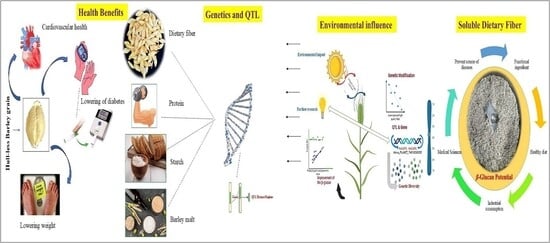
Abstract
1. Introduction
1.1. Health-Promoting Benefits of Barley
1.2. Purpose of the Review: Objectives and Scope
2. Functional Components of Barley
2.1. Dietary Fibers
β-Glucan
2.2. Barley β-Glucan
2.3. Barley Protein
2.4. Presence of Starch in Hull-Less Barley
2.5. Barley Malt
The Conversion of Barley into Malt
3. Structural Composition of Barley Grain
3.1. Caryopsis
3.2. Embryo
3.3. Endosperm
3.4. Variations in Grain Size and Shape
4. Genomics and Molecular Approaches to Enhancing Hull-Less Barley-Grain Quality
Transcriptomic and Metabolomic Approaches in Barley Research
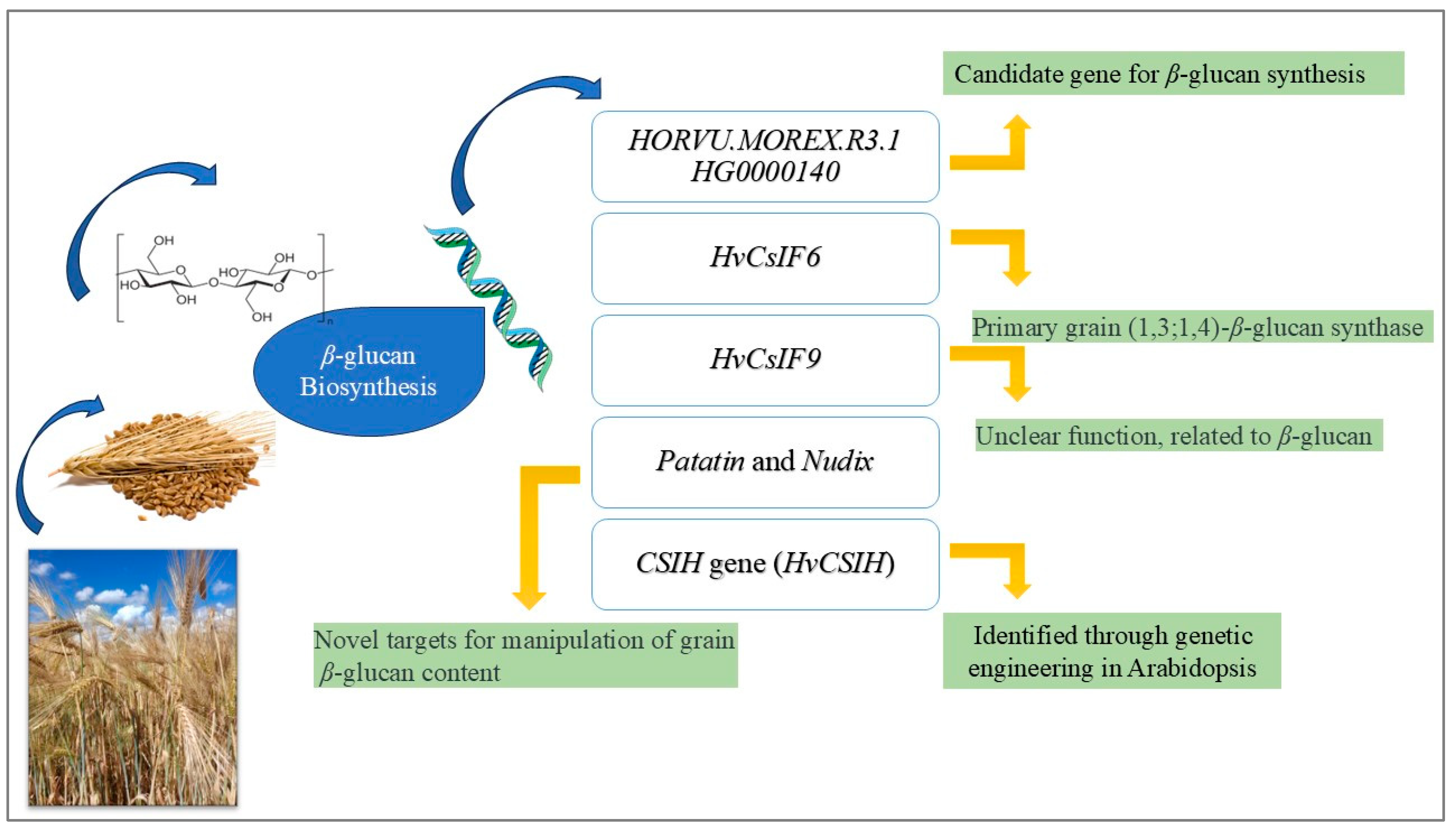
5. Genetic and Molecular Mechanisms of β-Glucan Biosynthesis in Barley
6. Genetic and Molecular Mechanisms Underlying Protein and Starch Biosynthesis in Barley
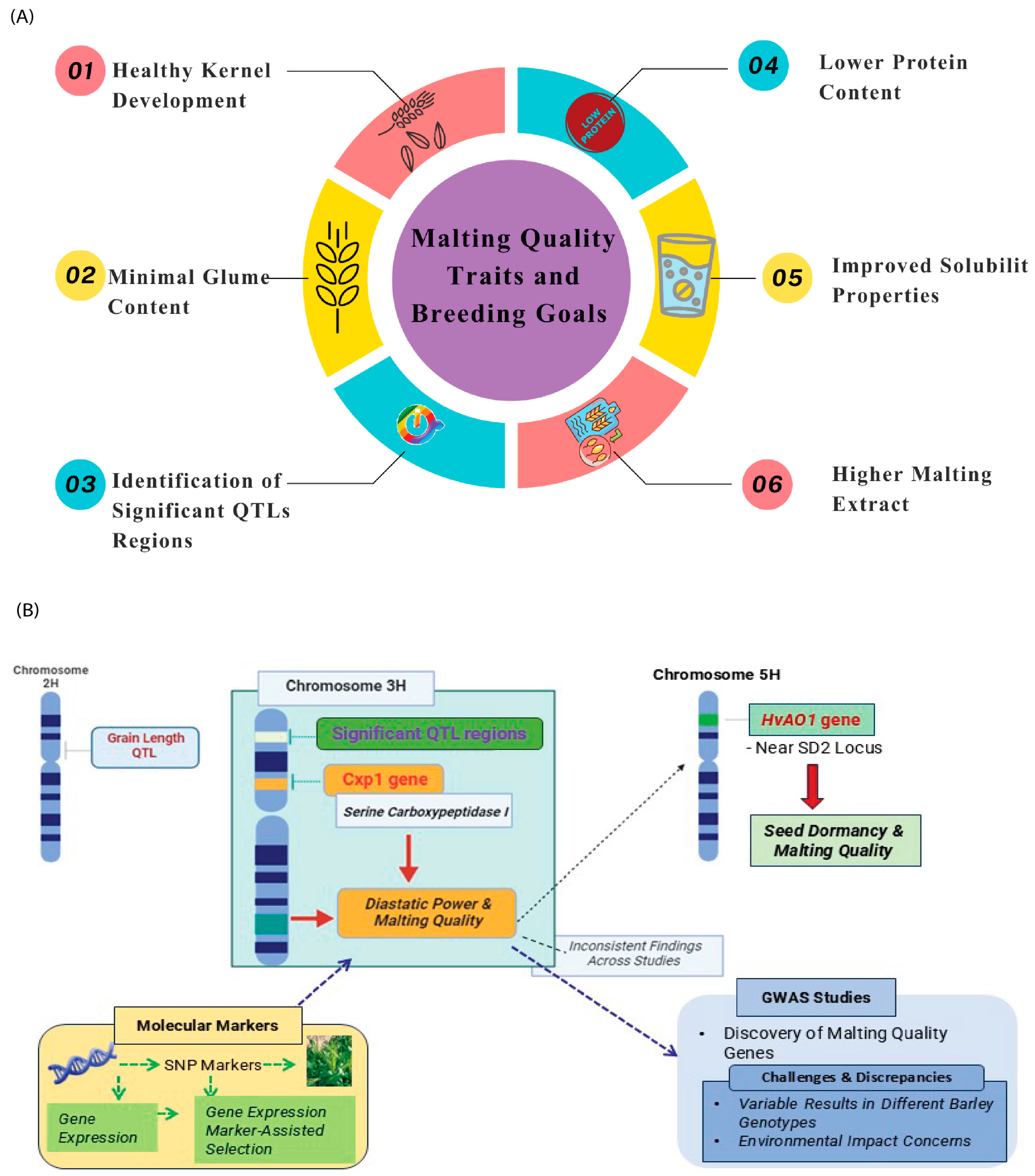
7. QTL Hotspot Regions and Genes Associated with Barley Malting Quality
8. Conclusions
9. Future Perspectives
- Functional Food Development: the future of HB bioactives lies in the development of functional foods and dietary supplements. Bioactive compounds, such as β-glucan and antioxidants, have demonstrated potential in reducing the risk of chronic diseases, like type 2 diabetes, cardiovascular disease, and obesity. Future research should focus on enhancing the bioactive potential of HB through targeted genetic breeding programs. Specifically, efforts should aim at increasing β-glucan content, improving antioxidant levels, and exploring barley’s potential in diverse functional food products, such as barley-based snacks and beverages that combine health benefits with consumer convenience.
- Health-Promoting Properties: it has been well noted that phenolic compounds in barley, in combination with β-glucan, offer enhanced health benefits, including improved cellular signaling and enhanced intestinal defense. Future studies should focus on how the complex mixture of these bioactive compounds in whole-grain barley can offer synergistic health benefits compared to isolated components. Additionally, studies should investigate the mechanisms underlying these synergistic effects and their implications for barley-based food products in promoting human health.
- Quality Assessment: there is a need for standardized methods to assess the quality of both HB grains and malt. Additional research should aim at developing reliable quality-control protocols that can be applied across the food and brewing industries. Additionally, studies should investigate how the quality of barley grains and malt influences the end products, including alcoholic beverages and foodstuffs, and how to develop policies to mitigate undesirable effects during processing.
- Enhancing Barley Protein Quality and Stability: barley protein is renowned for its high amylose and lysine content. Expression of both hordeins and glutelin genes ensures nitrogen-use efficiency, and directly influences the functional and nutritional properties of barley grains. Various strategies can also be employed to enhance ethe stability and bioavailability of prolamins (e.g., hollow nanoparticles and glycosylation). Future research should focus on optimizing sustainable agronomic practices to improve protein content in HB, while minimizing the negative impacts of excessive nitrogen fertilization. Innovations in genetic engineering approaches, such as gene-editing techniques and RNA interference (RNAi), could be crucial for enhancing protein quality by silencing specific genes that affect prolamin stability and bioavailability.
- Barley Starch Optimization for Health and Functional Foods: the ratio of amylose to amylopectin in barley starch plays a key role in the formation of RS, which has significant health benefits, such as glycemic control and gut health improvement. Future studies should focus on optimizing the amylose/amylopectin ratio in barley through breeding or genetic modification. Additionally, research should explore how the incorporation of RS into barley-based foods can enhance their texture and sensory properties, providing new opportunities for functional food development.
- Forward Genetics: understanding the genetic mechanisms underlying the biosynthesis of traits related to functionality, such as β-glucan, protein content, and starch composition, is essential for optimizing barley-malt quality. Future research should utilize forward genetics and genomic tools, such as CRISPR/Cas9, to identify key genes and QTL associated with these desirable traits. By manipulating these genes, researchers can enhance barley’s functional properties and improve its suitability for diverse food applications.
- Breeding Schemes and Goals: the development of HB varieties should align with breeding objectives that focus on optimizing levels of DFs, protein, and starch to meet the needs of both health-conscious consumers and the brewing industry. Molecular breeding approaches, such as marker-assisted selection and gene editing, should be employed to increase these traits while decreasing anti-nutritional factors. Finally, research should also focus on the role of HB in sustainable diets, with particular consideration given to its potential as a source of plant-based protein and DF for addressing global food-security challenges and climate resilience.
Author Contributions
Funding
Institutional Review Board Statement
Informed Consent Statement
Data Availability Statement
Conflicts of Interest
Abbreviations
| β-glucan | (1→3, 1→4)-beta-glucan |
| HB | Hull-less barley |
| GWAS | Genome-wide association study |
| SNP | Single-nucleotide polymorphism |
| QTL | Quantitative trait loci |
| Csl | cellulose synthase-like |
| DF | Dietary fiber |
| SSPs | Seed-storage proteins |
| RS | Resistant starch |
| RNA-seq | Ribonucleic acid sequence |
| MLG | Mixed-linkage glucan |
| GPC | Grain-protein content |
| SSs | Starch synthases |
| SBE2b | Starch-branching enzymes 2b |
| SD | Seed dormancy |
| SCFAs | Short-chain fatty acids |
References
- Kour, J.; Saxena, D.C.; Singh, S. Extraction and Enrichment of Beta-D-Glucans from Different Varieties of Barley. J. Agric. Eng. Food Technol. 2015, 2, 209–212. [Google Scholar]
- Heuzé, V.; Tran, G.; Nozière, P.; Noblet, J.; Renaudeau, D.; Lessire, M.; Lebas, F. Barley Grain. In Feedipedia: A Programme by INRAE, CIRAD, AFZ and FAO. 2016. Available online: https://feedipedia.org/node/227 (accessed on 10 June 2025).
- Baik, B.-K.; Ullrich, S.E. Barley for Food: Characteristics, Improvement, and Renewed Interest. J. Cereal Sci. 2008, 48, 233–242. [Google Scholar] [CrossRef]
- Li, W.; Cui, S.W.; Wang, Q.; Yada, R.Y. Studies of Aggregation Behaviours of Cereal β-Glucans in Dilute Aqueous Solutions by Light Scattering: Part I. Structure Effects. Food Hydrocoll. 2011, 25, 189–195. [Google Scholar] [CrossRef]
- Liu, B.; Ma, G.; Bussmann, R.W.; Bai, K.; Li, J.; Cao, W.; Long, C. Determining Factors for the Diversity of Hulless Barley Agroecosystem in the Himalaya Region—A Case Study from Northwest Yunnan, China. Glob. Ecol. Conserv. 2019, 18, e00600. [Google Scholar] [CrossRef]
- Yao, X.; Wu, K.; Yao, Y.; Bai, Y.; Ye, J.; Chi, D. Construction of a High-Density Genetic Map: Genotyping by Sequencing (GBS) to Map Purple Seed Coat Color (Psc) in Hulless Barley. Hereditas 2018, 155, 37. [Google Scholar] [CrossRef] [PubMed]
- Eshghi, R.; Akhundova, E. Genetic Diversity in Hulless Barley Based on Agromorphological Traits and RAPD Markers and Comparison with Storage Protein Analysis. Afr. J. Agric. Res. 2010, 5, 97–107. [Google Scholar]
- Dai, F.; Nevo, E.; Wu, D.; Comadran, J.; Zhou, M.; Qiu, L.; Chen, Z.; Beiles, A.; Chen, G.; Zhang, G. Tibet Is One of the Centers of Domestication of Cultivated Barley. Proc. Natl. Acad. Sci. USA 2012, 109, 16969–16973. [Google Scholar] [CrossRef]
- Kang, S.H.; Zhao, K.; Hou, L. Hulless Barley Leaf Stripe Pathogen of Genetic Diversity and Its Pathogenic Variance Analysis. Mol. Plant Breed. 2022, 22, 5725–5735. [Google Scholar]
- Tan, Z.; Zhang, S.; Qu, Y.; Kang, S.; Fang, S.; Hou, L. Identification of Leaf Stripe Resistance Genes in Hulless Barley Landrace Teliteqingke from Qinghai-Tibet Plateau. Int. J. Mol. Sci. 2025, 26, 1133. [Google Scholar] [CrossRef]
- Wu, H.; Liu, E.; Jin, T.; Liu, B.; Gopalakrishnan, S.; Zhou, J.; Shao, G.; Mei, X.; Delaplace, P.; De Clerck, C. Crop Rotation Increases Tibetan Barley Yield and Soil Quality on the Tibetan Plateau. Nat. Food 2025, 6, 151–160. [Google Scholar] [CrossRef]
- Economic Research Service U.S. Department of Agriculture. Feed Outlook: December 2025; Economic Research Service U.S. Department of Agriculture: Washington, DC, USA, 2025.
- Baker, B.P.; Meints, B.M.; Hayes, P.M. Organic Barley Producers’ Desired Qualities for Crop Improvement. Org. Agric. 2020, 10, 35–42. [Google Scholar] [CrossRef]
- Pejcz, E.; Czaja, A.; Wojciechowicz-Budzisz, A.; Gil, Z.; Spychaj, R. The Potential of Naked Barley Sourdough to Improve the Quality and Dietary Fibre Content of Barley Enriched Wheat Bread. J. Cereal Sci. 2017, 77, 97–101. [Google Scholar] [CrossRef]
- Šterna, V.; Zute, S.; Jansone, I.; Kantane, I. Chemical Composition of Covered and Naked Spring Barley Varieties and Their Potential for Food Production. Pol. J. Food Nutr. Sci. 2017, 67, 151–158. [Google Scholar] [CrossRef]
- Geng, L.; He, X.; Ye, L.; Zhang, G. Identification of the Genes Associated with β-Glucan Synthesis and Accumulation during Grain Development in Barley. Food Chem. Mol. Sci. 2022, 5, 100136. [Google Scholar] [CrossRef]
- Mir, S.A.; Manickavasagan, A.; Shah, M.A. Whole Grains; Mir, S.A., Manickavasagan, A., Shah, M.A., Eds.; CRC Press: Boca Raton, FL, USA, 2019; ISBN 9781351104760. [Google Scholar]
- Reidzane, S.; Gramatina, I.; Galoburda, R.; Komasilovs, V.; Zacepins, A.; Bljahhina, A.; Kince, T.; Traksmaa, A.; Klava, D. Composition of Polysaccharides in Hull-Less Barley Sourdough Bread and Their Impact on Physical Properties of Bread. Foods 2022, 12, 155. [Google Scholar] [CrossRef]
- Ghaffaripour, S.; Karimizadeh, R.; Mohammadi, M.; Suq, H.S.; Shefazadeh, M.K.; Mohammadi, N. Karyotypic Studies on Some Genotypes of Hull-Less Barley (Hordeum vulgare L.). Turk. J. Field Crops 2011, 16, 245–250. [Google Scholar]
- Vaishnavi; Sandal, A. Physical and Nutritional Evaluation of Hulled and Hulless Barley. Int. J. Adv. Biochem. Res. 2024, 8, 233–237. [Google Scholar] [CrossRef]
- Ross, A.S.; Meints, B.M.; Bunting, J.S. Barley. In ICC Handbook of 21st Century Cereal Science and Technology; Elsevier: Amsterdam, The Netherlands, 2023; pp. 153–160. [Google Scholar]
- Šimić, G.; Lalić, A.; Horvat, D.; Zdunić, Z.; Koceva Komlenić, D.; Bucić-Kojić, A.; Planinić, M.; Tišma, M. Production and Analysis of the Flour from the Hull-Less Barley. J. Food Meas. Charact. 2021, 15, 2679–2687. [Google Scholar] [CrossRef]
- Henry, R.J. The Carbohydrates of Barley Grains—A Review. J. Institude Brew. 1988, 94, 71–78. [Google Scholar] [CrossRef]
- Özen, S.; Ünlü, A.; Özbek, H.N.; Göğüş, F. β-Glucan Extraction from Hull-Less Barley by a Novel Approach: Microwave-Assisted Pressurized CO2/H2O. Food Bioproc. Tech. 2024, 17, 4781–4793. [Google Scholar] [CrossRef]
- Abebaw, G. Review on Structure, Functional and Nutritional Composition of Barley (Hordeum vulgare). Nutr. Food Process. 2021, 4, 405–413. [Google Scholar] [CrossRef]
- Hager, A.-S.; Ryan, L.A.M.; Schwab, C.; Gänzle, M.G.; O’Doherty, J.V.; Arendt, E.K. Influence of the Soluble Fibres Inulin and Oat β-Glucan on Quality of Dough and Bread. Eur. Food Res. Technol. 2011, 232, 405–413. [Google Scholar] [CrossRef]
- Raj, R.; Shams, R.; Pandey, V.K.; Dash, K.K.; Singh, P.; Bashir, O. Barley Phytochemicals and Health Promoting Benefits: A Comprehensive Review. J. Agric. Food Res. 2023, 14, 100677. [Google Scholar] [CrossRef]
- Yan, W.; Yao, H.; Nie, S.; Li, Y. Mineral Analysis of Hulless Barley Grown in Different Areas and Its β-Glucan Concentrates. Cogent Food Agric. 2016, 2, 1186139. [Google Scholar] [CrossRef]
- Fincher, G.B.; Stone, B.A. Cell Walls and Their Components in Cereal Technology. Adv. Cereal Sci. Technol. 1986, 8, 207–295. [Google Scholar]
- Hübner, F.; O’Neil, T.; Cashman, K.D.; Arendt, E.K. The Influence of Germination Conditions on Beta-Glucan, Dietary Fibre and Phytate during the Germination of Oats and Barley. Eur. Food Res. Technol. 2010, 231, 27–35. [Google Scholar] [CrossRef]
- Mudgil, D. The Interaction Between Insoluble and Soluble Fiber. In Dietary Fiber for the Prevention of Cardiovascular Disease; Elsevier: Amsterdam, The Netherlands, 2017; pp. 35–59. [Google Scholar]
- Williams, B.A.; Mikkelsen, D.; Flanagan, B.M.; Gidley, M.J. “Dietary Fibre”: Moving beyond the “Soluble/Insoluble” Classification for Monogastric Nutrition, with an Emphasis on Humans and Pigs. J. Anim. Sci. Biotechnol. 2019, 10, 45. [Google Scholar] [CrossRef]
- Chen, X.; Long, H.; Gao, P.; Deng, G.; Pan, Z.; Liang, J.; Tang, Y.; Tashi, N.; Yu, M. Transcriptome Assembly and Analysis of Tibetan Hulless Barley (Hordeum vulgare L. Var. Nudum) Developing Grains, with Emphasis on Quality Properties. PLoS ONE 2014, 9, e98144. [Google Scholar] [CrossRef] [PubMed]
- Ariyarathna, P.; Mizera, P.; Walkowiak, J.; Dziedzic, K. Physicochemical and Functional Properties of Soluble and Insoluble Dietary Fibers in Whole Grains and Their Health Benefits. Foods 2025, 14, 2447. [Google Scholar] [CrossRef] [PubMed]
- Dhingra, D.; Michael, M.; Rajput, H.; Patil, R.T. Dietary Fibre in Foods: A Review. J. Food Sci. Technol. 2012, 49, 255–266. [Google Scholar] [CrossRef] [PubMed]
- Bhatty, R.S. The Potential of Hull-Less Barley-A Review. Cereal Chem. 1999, 76, 589–599. [Google Scholar] [CrossRef]
- Yangcheng, H.; Gong, L.; Zhang, Y.; Jane, J. Pysicochemical Properties of Tibetan Hull-Less Barley Starch. Carbohydr. Polym. 2016, 137, 525–531. [Google Scholar] [CrossRef]
- Sharma, P.; Tejinder, S. Extraction of Starch from Hulled and Hull-Less Barley with Papain and Aqueous Sodium Hydroxide. J. Food Sci. Technol. 2014, 51, 3870–3877. [Google Scholar] [CrossRef] [PubMed]
- Zheng, X.; Qi, J.; Hui, H.; Lin, L.; Wang, F. Starch Accumulation in Hulless Barley during Grain Filling. Bot. Stud. 2017, 58, 30. [Google Scholar] [CrossRef]
- Hu, X.; Xiyue, Y.; Lidan, L.; Yanan, C.; Lianxin, P.; Liang, Z.; Yuanhang, R.; Gang, Z. Progress on Nutritional Function and High-Value Utilization of Hulless Barley. Sci. Technol. Food Ind. 2022, 43, 403–413. [Google Scholar] [CrossRef]
- Sun, W.; Shahrajabian, M.H. Therapeutic Potential of Phenolic Compounds in Medicinal Plants—Natural Health Products for Human Health. Molecules 2023, 28, 1845. [Google Scholar] [CrossRef]
- Meints, B.; Vallejos, C.; Hayes, P. Multi-Use Naked Barley: A New Frontier. J. Cereal Sci. 2021, 102, 103370. [Google Scholar] [CrossRef]
- Agu, R.C.; Bringhurst, T.A.; Brosnan, J.M.; Pearson, S. Potential of Hull-Less Barley Malt for Use in Malt and Grain Whisky Production. J. Inst. Brew. 2009, 115, 128–133. [Google Scholar] [CrossRef]
- Habschied, K.; Lalić, A.; Horvat, D.; Mastanjević, K.; Lukinac, J.; Jukić, M.; Krstanović, V. β-Glucan Degradation During Malting of Different Purpose Barley Varieties. Fermentation 2020, 6, 21. [Google Scholar] [CrossRef]
- Petre, A. 9 Impressive Health Benefits of Barley. Healthline. 2023. Available online: https://www.healthline.com/nutrition/barley-benefits (accessed on 20 July 2025).
- Brennan, C.S.; Cleary, L.J. The Potential Use of Cereal (1→3,1→4)-β-d-Glucans as Functional Food Ingredients. J. Cereal Sci. 2005, 42, 1–13. [Google Scholar] [CrossRef]
- Khaleghdoust, B.; Esmaeilzadeh-Salestani, K.; Korge, M.; Alaru, M.; Möll, K.; Värnik, R.; Koppel, R.; Tamm, Ü.; Kurg, M.; Altosaar, I.; et al. Barley and Wheat Beta-Glucan Content Influenced by Weather, Fertilization, and Genotype. Front. Sustain. Food Syst. 2024, 7, 1326716. [Google Scholar] [CrossRef]
- Singla, A.; Gupta, O.P.; Sagwal, V.; Kumar, A.; Patwa, N.; Mohan, N.; Ankush; Kumar, D.; Vir, O.; Singh, J.; et al. Beta-Glucan as a Soluble Dietary Fiber Source: Origins, Biosynthesis, Extraction, Purification, Structural Characteristics, Bioavailability, Biofunctional Attributes, Industrial Utilization, and Global Trade. Nutrients 2024, 16, 900. [Google Scholar] [CrossRef]
- Wang, Y.; Harding, S.V.; Eck, P.; Thandapilly, S.J.; Gamel, T.H.; Abdel-Aal, E.-S.M.; Crow, G.H.; Tosh, S.M.; Jones, P.J.; Ames, N.P. High-Molecular-Weight β-Glucan Decreases Serum Cholesterol Differentially Based on the CYP7A1 Rs3808607 Polymorphism in Mildly Hypercholesterolemic Adults. J. Nutr. 2016, 146, 720–727. [Google Scholar] [CrossRef]
- Mio, K.; Yamanaka, C.; Ichinose, Y.; Kohyama, N.; Yanagisawa, T.; Aoe, S. Effects of Barley Β-glucan with Various Molecular Weights Partially Hydrolyzed by Endogenous Β-glucanase on Glucose Tolerance and Lipid Metabolism in Mice. Cereal Chem. 2020, 97, 1056–1065. [Google Scholar] [CrossRef]
- April Benshosan, M.S. 5 “Bad” Grains You Should Eat for Better Cholesterol, According to Dietitians. Available online: https://www.eatingwell.com/bad-grains-for-better-cholesterol-8641487 (accessed on 4 February 2026).
- EFSA Panel on Dietetic Products, Nutrition and Allergies (NDA). Scientific Opinion on the Substantiation of a Health Claim Related to Barley Beta-Glucans and Lowering of Blood Cholesterol and Reduced Risk of (Coronary) Heart Disease Pursuant to Article 14 of Regulation (EC) No 1924/2006. EFSA J. 2011, 9, 2471. [Google Scholar] [CrossRef]
- Åman, P. Cholesterol-Lowering Effects of Barley Dietary Fibre in Humans: Scientific Support for a Generic Health Claim. Scand. J. Food Nutr. 2006, 50, 173–176. [Google Scholar] [CrossRef]
- Zhu, F. Anthocyanins in Cereals: Composition and Health Effects. Food Res. Int. 2018, 109, 232–249. [Google Scholar] [CrossRef]
- Zeng, Y.; Pu, X.; Yang, J.; Du, J.; Yang, X.; Li, X.; Li, L.; Zhou, Y.; Yang, T. Preventive and Therapeutic Role of Functional Ingredients of Barley Grass for Chronic Diseases in Human Beings. Oxid. Med. Cell. Longev. 2018, 2018, 3232080. [Google Scholar] [CrossRef]
- Nishino, H.; Murakoshi, M.; Mou, X.Y.; Wada, S.; Masuda, M.; Ohsaka, Y.; Satomi, Y.; Jinno, K. Cancer Prevention by Phytochemicals. Oncology 2005, 69, 38–40. [Google Scholar] [CrossRef] [PubMed]
- Biswas, S.; Ansari, M.J. Health-Endorsing Properties of Cereal Grains, 1st ed.; CRC Press: Boca Raton, FL, USA, 2023; ISBN 9781003252023. [Google Scholar]
- Gani, A.; SM, W.; FA, M. Whole-Grain Cereal Bioactive Compounds and Their Health Benefits: A Review. J. Food Process. Technol. 2012, 3, 3–10. [Google Scholar] [CrossRef]
- Liu, R.H. Potential Synergy of Phytochemicals in Cancer Prevention: Mechanism of Action. J. Nutr. 2004, 134, 3479S–3485S. [Google Scholar] [CrossRef]
- Mubai, N.H.; de Oliveira Monte, M.; de Lima Costa, I.H.; Colussi, R.; Vanier, N.L.; Elias, M.C. Nutritional Composition and Phenolic Compounds in Barley (Hordeum vulgare L.): A Review of the Effects of Drying, Storage, and Processing. Food Res. Int. 2025, 219, 116973. [Google Scholar] [CrossRef] [PubMed]
- Yiblet, Y.; Misganaw, W.; Adamu, E. Nutritional and Functional Composition of Barley Varieties From Legambo District, Ethiopia. Sci. World J. 2024, 2024, 1367540. [Google Scholar] [CrossRef]
- Casiraghi, M.C.; Garsetti, M.; Testolin, G.; Brighenti, F. Post-Prandial Responses to Cereal Products Enriched with Barley β-Glucan. J. Am. Coll. Nutr. 2006, 25, 313–320. [Google Scholar] [CrossRef] [PubMed]
- Ibrahim, O.; Menkovska, M. Dietary Fibers-Classification, Properties, Analysis and Function: A Review. Adv. Biosci. Biotechnol. 2022, 13, 527–544. [Google Scholar] [CrossRef]
- Shimizu, C.; Wakita, Y.; Kihara, M.; Kobayashi, N.; Tsuchiya, Y.; Nabeshima, T. Association of Lifelong Intake of Barley Diet with Healthy Aging: Changes in Physical and Cognitive Functions and Intestinal Microbiome in Senescence-Accelerated Mouse-Prone 8 (SAMP8). Nutrients 2019, 11, 1770. [Google Scholar] [CrossRef]
- Thomason, W.E.; Brooks, W.S.; Griffey, C.A.; Vaughn, M.E. Hulless Barley Seeding Rate Effects on Grain Yield and Yield Components. Crop Sci. 2009, 49, 342–346. [Google Scholar] [CrossRef]
- Wang, L.; Wang, J.; Wang, J.; Guo, Z.; Li, Z.; Qiu, J.; Wang, L. Soluble and Insoluble Dietary Fiber at Different Ratios: Hydration Characteristics, Rheological Properties, and Ameliorative Effects on Constipation. Food Chem. X 2024, 24, 101996. [Google Scholar] [CrossRef]
- Lahouar, L.; Achour, L.; Latiri, I. Talbina as a Functional Food and a Source of Health-Beneficial Ingredients: A Narrative Review. N. Afr. J. Food Nutr. Res. 2021, 5, 139–151. [Google Scholar] [CrossRef]
- Sullivan, P.; Arendt, E.; Gallagher, E. The Increasing Use of Barley and Barley By-Products in the Production of Healthier Baked Goods. Trends Food Sci. Technol. 2013, 29, 124–134. [Google Scholar] [CrossRef]
- Opperman, C.; Majzoobi, M.; Farahnaky, A.; Shah, R.; Van, T.T.H.; Ratanpaul, V.; Blanch, E.W.; Brennan, C.; Eri, R. Beyond Soluble and Insoluble: A Comprehensive Framework for Classifying Dietary Fibre’s Health Effects. Food Res. Int. 2025, 206, 115843. [Google Scholar] [CrossRef] [PubMed]
- O’Grady, J.; O’Connor, E.M.; Shanahan, F. Review Article: Dietary Fibre in the Era of Microbiome Science. Aliment. Pharmacol. Ther. 2019, 49, 506–515. [Google Scholar] [CrossRef] [PubMed]
- Classen, H.L.; Campbell, G.L.; Rossnagel, B.G.; Bhatty, R.; Reichert, R.D. Studies on the use of hulless barley in chick diets: Deleterious effects and methods of alleviation. Can. J. Anim. Sci. 1985, 65, 725–733. [Google Scholar] [CrossRef]
- Burkus, Z.; Temelli, F. Rheological Properties of Barley β-Glucan. Carbohydr. Polym. 2005, 59, 459–465. [Google Scholar] [CrossRef]
- Hesselman, K.; Elwinger, K.; Nilsson, M.; Thomke, S. The Effect of β-Glucanase Supplementation, Stage of Ripeness, and Storage Treatment of Barley in Diets Fed to Broiler Chickens. Poult. Sci. 1981, 60, 2664–2671. [Google Scholar] [CrossRef]
- Mikstas, C. Health Benefits of Beta Glucan. WebMD. 2024. Available online: https://www.webmd.com/diet/health-benefits-beta-glucan (accessed on 12 July 2025).
- Sun, B.; Prates, L.L.; Yu, P. Interactive Curve-Linear Relationship Between Alteration of Carbohydrate Macromolecular Structure Traits in Hulless Barley (Hordeum vulgare L.) Grain and Nutrient Utilization, Biodegradation, and Bioavailability. Int. J. Mol. Sci. 2019, 20, 1366. [Google Scholar] [CrossRef]
- Kumbhar, R.A.; Yang, K.; Mari Baloch, S.N.; Memon, S.; Liu, Y.; Zhao, H.; Feng, Z. Exploring the Significance of β-Glucan in Grains of Hulless Barley. Plant Mol. Biol. Rep. 2025, 43, 954–966. [Google Scholar] [CrossRef]
- Holtekjølen, A.K.; Uhlen, A.K.; Bråthen, E.; Sahlstrøm, S.; Knutsen, S.H. Contents of Starch and Non-Starch Polysaccharides in Barley Varieties of Different Origin. Food Chem. 2006, 94, 348–358. [Google Scholar] [CrossRef]
- Yang, L.; Christensen, D.A.; McKinnon, J.J.; Beattie, A.D.; Yu, P. Effect of Altered Carbohydrate Traits in Hulless Barley (Hordeum vulgare L.) on Nutrient Profiles and Availability and Nitrogen to Energy Synchronization. J. Cereal Sci. 2013, 58, 182–190. [Google Scholar] [CrossRef]
- Friero, I.; Martínez-Subirà, M.; Romero, M.-P.; Moralejo, M. Improving Functional and Nutritional Profiles of Barley Flours with Diverse Starch Types through Pearling. Food Chem. 2024, 460, 140611. [Google Scholar] [CrossRef]
- Yang, L.; McKinnon, J.J.; Christensen, D.A.; Beattie, A.D.; Yu, P. Characterizing the Molecular Structure Features of Newly Developed Hulless Barley Cultivars with Altered Carbohydrate Traits (Hordeum vulgare L.) by Globar-Sourced Infrared Spectroscopy in Relation to Nutrient Utilization and Availability. J. Cereal Sci. 2014, 60, 48–59. [Google Scholar] [CrossRef]
- Zhang, H.; Zhang, N.; Xiong, Z.; Wang, G.; Xia, Y.; Lai, P.; Ai, L. Structural Characterization and Rheological Properties of β-D-Glucan from Hull-Less Barley (Hordeum vulgare L. Var. Nudum Hook. f.). Phytochemistry 2018, 155, 155–163. [Google Scholar] [CrossRef]
- Hussain, A.; Ali, S.; Hussain, A.; Hussain, Z.; Manzoor, M.F.; Hussain, A.; Ali, A.; Mahmood, T.; Abbasi, K.S.; Karrar, E.; et al. Compositional Profile of Barley Landlines Grown in Different Regions of Gilgit-Baltistan. Food Sci. Nutr. 2021, 9, 2605–2611. [Google Scholar] [CrossRef]
- Rico, D.; Peñas, E.; del Carmen García, M.; Martínez-Villaluenga, C.; Rai, D.K.; Birsan, R.I.; Frias, J.; Martín-Diana, A.B. Sprouted Barley Flour as a Nutritious and Functional Ingredient. Foods 2020, 9, 296. [Google Scholar] [CrossRef]
- Andersson, R.; Fransson, G.; Tietjen, M.; Åman, P. Content and Molecular-Weight Distribution of Dietary Fiber Components in Whole-Grain Rye Flour and Bread. J. Agric. Food Chem. 2009, 57, 2004–2008. [Google Scholar] [CrossRef]
- Yusuf, M.K.E.; Abu-El Hawa, S.H.; Abdul-Rahamman, A.M. Different Moisture Contents of Tempered Hulled and Hull-Less Barley Grains Prior to Milling. Assiut J. Agric. Sci. 2016, 47, 443–459. [Google Scholar] [CrossRef]
- Roman, O.B. Studies of Process Intensification for the Recovery of High Molecular Weight Beta-Glucan from Cereals. Doctoral Dissertation, Universidad de Valladolid, Valladolid, Spain, 2013. [Google Scholar]
- Zhang, G.; Chen, J.; Wang, J.; Ding, S. Cultivar and Environmental Effects on (1→3,1→4)-β-D-Glucan and Protein Content in Malting Barley. J. Cereal Sci. 2001, 34, 295–301. [Google Scholar] [CrossRef]
- Zhang, G.; Junmei, W.; Jinxin, C. Analysis of β-Glucan Content in Barley Cultivars from Different Locations of China. Food Chem. 2002, 79, 251–254. [Google Scholar] [CrossRef]
- Šimić, G.; Horvat, D.; Lalić, A.; Koceva Komlenić, D.; Abičić, I.; Zdunić, Z. Distribution of β-Glucan, Phenolic Acids, and Proteins as Functional Phytonutrients of Hull-Less Barley Grain. Foods 2019, 8, 680. [Google Scholar] [CrossRef] [PubMed]
- Kaur, S.; Kaur, H.; Singh, P.; Cheema, B.S.; Kumar, V. Genetic Variation and Evaluation of Exotic Barley (Hordeum vulgare L.) Genotypes for Grain Protein Content, Starch Content and Agronomic Traits. Electron. J. Plant Breed. 2016, 7, 1114. [Google Scholar] [CrossRef]
- Guo, G.; Dondup, D.; Zhang, L.; Hu, S.; Yuan, X.; Zhang, J. Identification of SNPs in Barley (Hordeum vulgare L.) by Deep Sequencing of Six Reduced Representation Libraries. Crop J. 2014, 2, 419–425. [Google Scholar] [CrossRef][Green Version]
- Shewry, P.R.; Halford, N.G. Cereal Seed Storage Proteins: Structures, Properties and Role in Grain Utilization. J. Exp. Bot. 2002, 53, 947–958. [Google Scholar] [CrossRef]
- Cai, S.; Yu, G.; Chen, X.; Huang, Y.; Jiang, X.; Zhang, G.; Jin, X. Grain Protein Content Variation and Its Association Analysis in Barley. BMC Plant Biol. 2013, 13, 35. [Google Scholar] [CrossRef]
- Hu, Y.; Barmeier, G.; Schmidhalter, U. Genetic Variation in Grain Yield and Quality Traits of Spring Malting Barley. Agronomy 2021, 11, 1177. [Google Scholar] [CrossRef]
- Roustan, V.; Roustan, P.-J.; Weidinger, M.; Reipert, S.; Kapusi, E.; Shabrangy, A.; Stoger, E.; Weckwerth, W.; Ibl, V. Microscopic and Proteomic Analysis of Dissected Developing Barley Endosperm Layers Reveals the Starchy Endosperm as Prominent Storage Tissue for ER-Derived Hordeins Alongside the Accumulation of Barley Protein Disulfide Isomerase (HvPDIL1-1). Front. Plant Sci. 2018, 9, 1248. [Google Scholar] [CrossRef] [PubMed]
- Geng, L.; Li, M.; Zhang, G.; Ye, L. Barley: A Potential Cereal for Producing Healthy and Functional Foods. Food Qual. Saf. 2022, 6, fyac012. [Google Scholar] [CrossRef]
- Jaeger, A.; Zannini, E.; Sahin, A.W.; Arendt, E.K. Barley Protein Properties, Extraction and Applications, with a Focus on Brewers’ Spent Grain Protein. Foods 2021, 10, 1389. [Google Scholar] [CrossRef] [PubMed]
- Osborne, T.B.; Voorhees, C.L. Proteids of the wheat kernel. 1. J. Am. Chem. Soc. 1894, 16, 524–535. [Google Scholar] [CrossRef]
- Osborne, T.B.; Mendel, L.B.; Ferry, E.L.; Wakeman, A.J. Nutritive properties of proteins of the maize kernel. J. Biol. Chem. 1914, 18, 1–16. [Google Scholar] [CrossRef]
- Landry, J.; Sutton, A.; Tafrov, S.T.; Heller, R.C.; Stebbins, J.; Pillus, L.; Sternglanz, R. The Silencing Protein SIR2 and Its Homologs Are NAD-Dependent Protein Deacetylases. Proc. Natl. Acad. Sci. USA 2000, 97, 5807–5811. [Google Scholar] [CrossRef]
- Kumar, A.; Gururani, K.; Gupta, S.; Tiwari, A.; Tripathi, M.K.; Pandey, D. Seed Storage Proteins and Amino Acids Synthetic Pathways and Their Regulation in Cereals with Reference to Biologically and Nutritionally Important Proteins and Bioactive Peptides in Millets. In Millets and Millet Technology; Springer: Singapore, 2021; pp. 161–189. [Google Scholar]
- Cao, H.; Duncan, O.; Millar, A.H. The Molecular Basis of Cereal Grain Proteostasis. Essays Biochem. 2022, 66, 243–253. [Google Scholar] [CrossRef]
- Ibl, V.; Stoger, E. The Formation, Function and Fate of Protein Storage Compartments in Seeds. Protoplasma 2012, 249, 379–392. [Google Scholar] [CrossRef] [PubMed]
- Wakasa, Y.; Takaiwa, F. Seed Storage Proteins. In Brenner’s Encyclopedia of Genetics; Elsevier: Amsterdam, The Netherlands, 2013; pp. 346–348. [Google Scholar]
- Chen, J.; Dai, F.; Wei, K.; Zhang, G. Relationship between Malt Qualities and β-Amylase Activity and Protein Content as Affected by Timing of Nitrogen Fertilizer Application. J. Zhejiang Univ. Sci. B 2006, 7, 79–84. [Google Scholar] [CrossRef] [PubMed]
- Yousif, A.M.; Evans, D.E. The Impact of Barley Nitrogen Fertilization Rate on Barley Brewing Using a Commercial Enzyme (Ondea Pro). J. Inst. Brew. 2018, 124, 132–142. [Google Scholar] [CrossRef]
- Jin, Y.; Du, J.; Zhang, K.; Xie, L.; Li, P. Relationship between Kolbach Index and Other Quality Parameters of Wheat Malt. J. Inst. Brew. 2012, 118, 57–62. [Google Scholar] [CrossRef]
- Yu, W.; Tan, X.; Zou, W.; Hu, Z.; Fox, G.P.; Gidley, M.J.; Gilbert, R.G. Relationships between Protein Content, Starch Molecular Structure and Grain Size in Barley. Carbohydr. Polym. 2017, 155, 271–279. [Google Scholar] [CrossRef]
- Marquez-Cedillo, L.A.; Hayes, P.M.; Jones, B.L.; Kleinhofs, A.; Legge, W.G.; Rossnagel, B.G.; Sato, K.; Ullrich, S.E.; Wesenberg, D.M.; North American Barley Genome Mappin QTL. Analysis of Malting Quality in Barley Based on the Doubled-Haploid Progeny of Two Elite North American Varieties Representing Different Germplasm Groups. Theor. Appl. Genet. 2000, 101, 173–184. [Google Scholar] [CrossRef]
- Clarke, B.; Liang, R.; Morell, M.K.; Bird, A.R.; Jenkins, C.L.D.; Li, Z. Gene Expression in a Starch Synthase IIa Mutant of Barley: Changes in the Level of Gene Transcription and Grain Composition. Funct. Integr. Genom. 2008, 8, 211–221. [Google Scholar] [CrossRef]
- Seung, D. Amylose in Starch: Towards an Understanding of Biosynthesis, Structure and Function. New Phytol. 2020, 228, 1490–1504. [Google Scholar] [CrossRef]
- Cornejo-Ramírez, Y.I.; Martínez-Cruz, O.; Del Toro-Sánchez, C.L.; Wong-Corral, F.J.; Borboa-Flores, J.; Cinco-Moroyoqui, F.J. The Structural Characteristics of Starches and Their Functional Properties. CyTA-J. Food 2018, 16, 1003–1017. [Google Scholar] [CrossRef]
- Brust, H.; Orzechowski, S.; Fettke, J. Starch and Glycogen Analyses: Methods and Techniques. Biomolecules 2020, 10, 1020. [Google Scholar] [CrossRef] [PubMed]
- Li, W.; Xiao, X.; Zhang, W.; Zheng, J.; Luo, Q.; Ouyang, S.; Zhang, G. Compositional, Morphological, Structural and Physicochemical Properties of Starches from Seven Naked Barley Cultivars Grown in China. Food Res. Int. 2014, 58, 7–14. [Google Scholar] [CrossRef]
- Li, L.; Liu, Z.; Wang, T.; Wang, B.; Zhang, W.; Li, G.; Guo, Z.; Zhang, Y.; Xue, B.; Luo, Z. Starch Isolated from Different Hulless Barley Cultivars Differs in Their Chemical and Structural Characteristics. Food Sci. Nutr. 2019, 7, 2374–2380. [Google Scholar] [CrossRef]
- Li, J.H.; Vasanthan, T.; Rossnagel, B.; Hoover, R. Starch from Hull-Less Barley: I. Granule Morphology, Composition and Amylopectin Structure. Food Chem. 2001, 74, 395–405. [Google Scholar] [CrossRef]
- Baptista, N.T.; Dessalles, R.; Illner, A.-K.; Ville, P.; Ribet, L.; Anton, P.M.; Durand-Dubief, M. Harnessing the Power of Resistant Starch: A Narrative Review of Its Health Impact and Processing Challenges. Front. Nutr. 2024, 11, 1369950. [Google Scholar] [CrossRef]
- Nguyen, S.N.; Drawbridge, P.; Beta, T. Resistant Starch in Wheat-, Barley-, Rye-, and Oat-Based Foods: A Review. Starch-Stärke 2023, 75, 2100251. [Google Scholar] [CrossRef]
- Devi, R.; Singh, A.; Dutta, D.; Sit, N. Physicochemical Properties of Barley Starch and Effect of Substitution of Wheat Flour with Barley Starch on Texture and Sensory Properties of Bread. eFood 2024, 5, e132. [Google Scholar] [CrossRef]
- MacGregor, A.W.; Fincher, G.B. Barley Chemistry and Technology. In Barley Chemistry and Technology; MacGregor, A.W., Bhatty, R.S., Eds.; American Association of Cereal Chemists: St. Paul, MN, USA, 1993; pp. 73–130. [Google Scholar]
- Yoshimoto, Y. Molecular Structure and Some Physicochemical Properties of Waxy and Low-Amylose Barley Starches. Carbohydr. Polym. 2002, 47, 159–167. [Google Scholar] [CrossRef]
- Gray, D.; Abdel-Aal, E.-S.M.; Seetharaman, K.; Kakuda, Y. Differences in Viscosity and Textural Properties of Selected Barley Cultivars as Influenced by Pearling and Cooking. Food Chem. 2010, 120, 402–409. [Google Scholar] [CrossRef]
- Raigond, P.; Dutt, S.; Singh, B. Resistant Starch in Food. In Bioactive Molecules in Food; Springer: Berlin/Heidelberg, Germany, 2019; pp. 815–846. [Google Scholar]
- Tian, S.; Sun, Y. Influencing Factor of Resistant Starch Formation and Application in Cereal Products: A Review. Int. J. Biol. Macromol. 2020, 149, 424–431. [Google Scholar] [CrossRef]
- Joye, I.J. Starch. In Encyclopedia of Food Chemistry; Elsevier: Amsterdam, The Netherlands, 2019; pp. 256–264. [Google Scholar]
- Aribas, M.; Kahraman, K.; Koksel, H. In Vitro Glycemic Index, Bile Acid Binding Capacity and Mineral Bioavailability of Spaghetti Supplemented with Resistant Starch Type 4 and Wheat Bran. J. Funct. Foods 2020, 65, 103778. [Google Scholar] [CrossRef]
- Homayouni, A.; Amini, A.; Keshtiban, A.K.; Mortazavian, A.M.; Esazadeh, K.; Pourmoradian, S. Resistant Starch in Food Industry: A Changing Outlook for Consumer and Producer. Starch-Stärke 2014, 66, 102–114. [Google Scholar] [CrossRef]
- Fuentes-Zaragoza, E.; Sánchez-Zapata, E.; Sendra, E.; Sayas, E.; Navarro, C.; Fernández-López, J.; Pérez-Alvarez, J.A. Resistant Starch as Prebiotic: A Review. Starch-Stärke 2011, 63, 406–415. [Google Scholar] [CrossRef]
- Karunarathna, S.; Wickramasinghe, I.; Truong, T.; Brennan, C.; Navaratne, S.B.; Chandrapala, J. Development of Low-Calorie Food Products with Resistant Starch-Rich Sources—A Review. Food Rev. Int. 2024, 40, 814–831. [Google Scholar] [CrossRef]
- Li, J.; Deng, F.; Han, P.; Ding, Y.; Cao, J. Preparation of Resistant Starch Types III + V with Moderate Amylopullulanase and Its Effects on Bread Properties. Foods 2024, 13, 1251. [Google Scholar] [CrossRef]
- Li, L.; Liu, Z.; Zhang, W.; Xue, B.; Luo, Z. Production and Applications of Amylose-Lipid Complexes as Resistant Starch: Recent Approaches. Starch-Stärke 2021, 73, 2000249. [Google Scholar] [CrossRef]
- Photinam, R.; Moongngarm, A.; Detchewa, P.; Wang, Y.-J. Improvement of Amylose–Lipid Complex and Starch Digestibility Profiles of Corn Starch Added with Rice Bran Oil or Linoleic Acid Using Ultrasonic and Microwave Treatment. J. Food Sci. Technol. 2024, 61, 2287–2298. [Google Scholar] [CrossRef]
- Hasjim, J.; Ai, Y.; Jane, J. Novel Applications of Amylose-Lipid Complex as Resistant Starch Type 5. In Resistant Starch; Wiley: Hoboken, NJ, USA, 2013; pp. 79–94. [Google Scholar]
- Shen, L.; Li, J.; Li, Y. Resistant Starch Formation in Rice: Genetic Regulation and Beyond. Plant Commun. 2022, 3, 100329. [Google Scholar] [CrossRef] [PubMed]
- Fox, G.P. Beer and Arabinoxylan. In Beer in Health and Disease Prevention; Elsevier: Amsterdam, The Netherlands, 2009; pp. 309–316. [Google Scholar]
- Mills, A.; Ketterings, Q.; Verbeten, B.; Ganoe, K.; Sorrells, M. Storage Conditions for Malting Barley (Fact Sheet 82). Cornell University Cooperative Extension. 2014. Available online: https://nmsp.cals.cornell.edu/publications/factsheets/factsheet82.pdf (accessed on 11 August 2025).
- Rani, H.; Bhardwaj, R.D. Quality Attributes for Barley Malt: “The Backbone of Beer”. J. Food Sci. 2021, 86, 3322–3340. [Google Scholar] [CrossRef]
- Kihara, M.; Okada, Y.; Iimure, T.; Ito, K. Accumulation and Degradation of Two Functional Constituents, GABA and β-Glucan, and Their Varietal Differences in Germinated Barley Grains. Breed. Sci. 2007, 57, 85–89. [Google Scholar] [CrossRef]
- Stuart, I.M.; Loi, L.; Fincher, G.B. Varietal and Environmental Variations in (1→3,1→4)-β-Glucan Levels and (1→3,1→4)-β-Glucanase Potential in Barley: Relationships to Malting Quality. J. Cereal Sci. 1988, 7, 61–71. [Google Scholar] [CrossRef]
- Sohrabvandi, S.; Mortazavian, A.M.; Rezaei, K. Health-Related Aspects of Beer: A Review. Int. J. Food Prop. 2012, 15, 350–373. [Google Scholar] [CrossRef]
- Narwal, S.; Gupta, O.P.; Pandey, V.; Kumar, D.; Ram, S. Effect of Storage and Processing Conditions on Nutrient Composition of Wheat and Barley. In Wheat and Barley Grain Biofortification; Elsevier: Amsterdam, The Netherlands, 2020; pp. 229–256. [Google Scholar]
- Schwarz, P.; Li, Y. Malting and Brewing Uses of Barley. In Barley; Wiley: Hoboken, NJ, USA, 2010; pp. 478–521. [Google Scholar]
- Briggs, D.E.; Stevens, R.; Young, T.W.; Hough, J.S. Malt and Sweet Wort: Malting and Brewing Science, 2nd ed.; Springer: Berlin/Heidelberg, Germany, 1981. [Google Scholar]
- European Brewery Convention. Analytica—EBC Section 4 Colour of Malt. Spectrophotometric Method (RM) Method 4.7.1; European Brewery Convention: Nürnberg, Germany, 2000. [Google Scholar]
- de Carvalho, G.R.; Polachini, T.C.; Darros-Barbosa, R.; Bon, J.; Telis-Romero, J. Effect of Intermittent High-Intensity Sonication and Temperature on Barley Steeping for Malt Production. J. Cereal Sci. 2018, 82, 138–145. [Google Scholar] [CrossRef]
- Guido, L.F.; Ferreira, I.M. The Role of Malt on Beer Flavour Stability. Fermentation 2023, 9, 464. [Google Scholar] [CrossRef]
- Edney, M.J.; Izydorczyk, M.S. MALT|Malt Types and Products. In Encyclopedia of Food Sciences and Nutrition; Elsevier: Amsterdam, The Netherlands, 2003; pp. 3671–3677. [Google Scholar]
- Kalb, V.; Seewald, T.; Hofmann, T.; Granvogl, M. The Malting Parameters: Steeping, Germination, Withering, and Kilning Temperature and Aeration Rate as Possibilities for Styrene Mitigation in Wheat Beer. Eur. Food Res. Technol. 2022, 248, 69–84. [Google Scholar] [CrossRef]
- Howe, S. Raw Materials. In The Craft Brewing Handbook: A Practical Guide to Running a Successful Craft Brewery; Smith, C., Ed.; Woodhead Publishing, Elsevier: Amsterdam, The Netherlands, 2020; Volume 1–46. [Google Scholar]
- Holopainen-Mantila, U. Composition and Structure of Barley (Hordeum vulgare L.) Grain in Relation to End Uses; University of Helsinki: Helsinki, Finland, 2015. [Google Scholar]
- Perera, W.N.U.; Abdollahi, M.R.; Zaefarian, F.; Wester, T.J.; Ravindran, V. Barley, an Undervalued Cereal for Poultry Diets: Limitations and Opportunities. Animals 2022, 12, 2525. [Google Scholar] [CrossRef]
- Jadhav, S.J.; Lutz, S.E.; Ghorpade, V.M.; Salunkhe, D.K. Barley: Chemistry and Value-Added Processing. Crit. Rev. Food Sci. Nutr. 1998, 38, 123–171. [Google Scholar] [CrossRef] [PubMed]
- Jääskeläinen, A.-S.; Holopainen-Mantila, U.; Tamminen, T.; Vuorinen, T. Endosperm and Aleurone Cell Structure in Barley and Wheat as Studied by Optical and Raman Microscopy. J. Cereal Sci. 2013, 57, 543–550. [Google Scholar] [CrossRef]
- Meng, G.; Rasmussen, S.K.; Christensen, C.S.L.; Fan, W.; Torp, A.M. Molecular Breeding of Barley for Quality Traits and Resilience to Climate Change. Front. Genet. 2023, 13, 1039996. [Google Scholar] [CrossRef]
- Duan, R.; Xiong, H.; Wang, A.; Chen, G. Molecular Mechanisms Underlying Hull-Caryopsis Adhesion/Separation Revealed by Comparative Transcriptomic Analysis of Covered/Naked Barley (Hordeum vulgare L.). Int. J. Mol. Sci. 2015, 16, 14181–14193. [Google Scholar] [CrossRef]
- Wabila, C.; Neumann, K.; Kilian, B.; Radchuk, V.; Graner, A. A Tiered Approach to Genome-Wide Association Analysis for the Adherence of Hulls to the Caryopsis of Barley Seeds Reveals Footprints of Selection. BMC Plant Biol. 2019, 19, 95. [Google Scholar] [CrossRef]
- Brennan, M.; Shepherd, T.; Mitchell, S.; Topp, C.F.E.; Hoad, S.P. Husk to Caryopsis Adhesion in Barley Is Influenced by Pre- and Post-Anthesis Temperatures through Changes in a Cuticular Cementing Layer on the Caryopsis. BMC Plant Biol. 2017, 17, 169. [Google Scholar] [CrossRef] [PubMed]
- Hu, X.; Gilbert, R.G. Value Adding to Barley Byproducts: A Perspective of Bran and Husk in the Food Industry. Compr. Rev. Food Sci. Food Saf. 2025, 24, e70316. [Google Scholar] [CrossRef]
- Jeanty, A.; Bouby, L.; Bonhomme, V.; Balfourier, F.; Debiton, C.; Dham, C.; Ivorra, S.; Ros, J.; Evin, A. Barley Systematics and Taxonomy Foreseen by Seed Morphometric Variation. PLoS ONE 2023, 18, e0285195. [Google Scholar] [CrossRef] [PubMed]
- Evers, T.; Millar, S. Cereal Grain Structure and Development: Some Implications for Quality. J. Cereal Sci. 2002, 36, 261–284. [Google Scholar] [CrossRef]
- Tchameni, Z.F.N.; Kaur, N. A Review of the Effect of Processing on the Nutritional Composition of Barley. Pharma Innov. 2023, 12, 2302–2309. [Google Scholar]
- Fincher, G.B. Morphology and Chemical Composition of Barley Endosperm Cell Walls. J. Inst. Brew. 1975, 81, 116–122. [Google Scholar] [CrossRef]
- Vasanthan, T.; Gaosong, J.; Yeung, J.; Li, J. Dietary Fiber Profile of Barley Flour as Affected by Extrusion Cooking. Food Chem. 2002, 77, 35–40. [Google Scholar] [CrossRef]
- Chandra, G.S.; Proudlove, M.O.; Baxter, E.D. The Structure of Barley Endosperm–an Important Determinant of Malt Modification. J. Sci. Food Agric. 1990, 79, 37–46. [Google Scholar] [CrossRef]
- Gan, Y.; Stobbe, E.H. Seedling Vigor and Grain Yield of ‘Roblin’ Wheat Affected by Seed Size. Agron. J. 1996, 88, 456–460. [Google Scholar] [CrossRef]
- Walker, C.K.; Panozzo, J.F. Development of a Small Scale Method to Determine Volume and Density of Individual Barley Kernels, and the Relationship between Grain Density and Endosperm Hardness. J. Cereal Sci. 2011, 54, 311–316. [Google Scholar] [CrossRef]
- Sadras, V.O. Evolutionary Aspects of the Trade-off between Seed Size and Number in Crops. Field Crops Res. 2007, 100, 125–138. [Google Scholar] [CrossRef]
- Motuzaite Matuzeviciute, G.; Mir-Makhamad, B.; Spengler, R.N. Interpreting Diachronic Size Variation in Prehistoric Central Asian Cereal Grains. Front. Ecol. Evol. 2021, 9, 633634. [Google Scholar] [CrossRef]
- Indore, N.S.; Karunakaran, C.; Jayas, D.S. Synchrotron Tomography Applications in Agriculture and Food Sciences Research: A Review. Plant Methods 2022, 18, 101. [Google Scholar] [CrossRef]
- Jeanty, A.; Bouby, L.; Mureau, C.; D’Oliveira, L.; Dham, C.; Lecomte, C.; Bonhomme, V.; Ivorra, S.; Martinez, N.A.; Antolín, F.; et al. Archaeobiological Evolution of Barley (Hordeum vulgare) over the Last Eight Millennia in the Northwestern Mediterranean Basin. Philos. Trans. R. Soc. B Biol. Sci. 2025, 380, 20240194. [Google Scholar] [CrossRef]
- Massman, C.; Meints, B.; Hernandez, J.; Kunze, K.; Smith, K.P.; Sorrells, M.E.; Hayes, P.M.; Gutierrez, L. Genomic Prediction of Threshability in Naked Barley. Crop Sci. 2023, 63, 674–689. [Google Scholar] [CrossRef]
- Zeng, X.; Long, H.; Wang, Z.; Zhao, S.; Tang, Y.; Huang, Z.; Wang, Y.; Xu, Q.; Mao, L.; Deng, G.; et al. The Draft Genome of Tibetan Hulless Barley Reveals Adaptive Patterns to the High Stressful Tibetan Plateau. Proc. Natl. Acad. Sci. USA 2015, 112, 1095–1100. [Google Scholar] [CrossRef]
- Gerasimova, S.V.; Hertig, C.; Korotkova, A.M.; Kolosovskaya, E.V.; Otto, I.; Hiekel, S.; Kochetov, A.V.; Khlestkina, E.K.; Kumlehn, J. Conversion of Hulled into Naked Barley by Cas Endonuclease-Mediated Knockout of the NUD Gene. BMC Plant Biol. 2020, 20, 255. [Google Scholar] [CrossRef]
- Taketa, S.; Amano, S.; Tsujino, Y.; Sato, T.; Saisho, D.; Kakeda, K.; Nomura, M.; Suzuki, T.; Matsumoto, T.; Sato, K.; et al. Barley Grain with Adhering Hulls Is Controlled by an ERF Family Transcription Factor Gene Regulating a Lipid Biosynthesis Pathway. Proc. Natl. Acad. Sci. USA 2008, 105, 4062–4067. [Google Scholar] [CrossRef] [PubMed]
- Zang, Y.; Gong, Q.; Xu, Y.; Liu, H.; Bai, H.; Li, N.; Du, L.; Ye, X.; Lan, C.; Wang, K. Production of Conjoined Transgenic and Edited Barley and Wheat Plants for Nud Genes Using the CRISPR/SpCas9 System. Front. Genet. 2022, 13, 873850. [Google Scholar] [CrossRef]
- Pourkheirandish, M.; Komatsuda, T. The Importance of Barley Genetics and Domestication in a Global Perspective. Ann. Bot. 2007, 100, 999–1008. [Google Scholar] [CrossRef] [PubMed]
- Cho, M.-J.; Wong, J.H.; Marx, C.; Jiang, W.; Lemaux, P.G.; Buchanan, B.B. Overexpression of Thioredoxin h Leads to Enhanced Activity of Starch Debranching Enzyme (Pullulanase) in Barley Grain. Proc. Natl. Acad. Sci. USA 1999, 96, 14641–14646. [Google Scholar] [CrossRef] [PubMed]
- Burger, W.C.; LaBerge, L.D. Malting and Brewing Quality. In Rasmus; ASA, CSSA, SSSA: Madison, WI, USA, 1985. [Google Scholar]
- Brennan, C.S.; Harris, N.; Smith, D.; Shewry, P.R. Structural Differences in the Mature Endosperms of Good and Poor Malting Barley Cultivars. J. Cereal Sci. 1996, 24, 171–177. [Google Scholar] [CrossRef]
- Du, B.; Wu, J.; Wang, M.; Wu, J.; Sun, C.; Zhang, X.; Ren, X.; Wang, Q. Detection of Consensus Genomic Regions and Candidate Genes for Quality Traits in Barley Using QTL Meta-Analysis. Front. Plant Sci. 2024, 14, 1319889. [Google Scholar] [CrossRef]
- Sommer, L.; Spiller, M.; Stiewe, G.; Pillen, K.; Reif, J.C.; Schulthess, A.W. Proof of Concept to Unmask the Breeding Value of Genetic Resources of Barley (Hordeum vulgare) with a Hybrid Strategy. Plant Breed. 2020, 139, 536–549. [Google Scholar] [CrossRef]
- Patt, A.; Siddiqui, J.; Zhang, B.; Mathé, E. Integration of Metabolomics and Transcriptomics to Identify Gene-Metabolite Relationships Specific to Phenotype. Methods Mol. Biol. 2019, 1928, 441–468. [Google Scholar]
- Qin, Y.; Fan, K.; Yimamu, A.; Zhan, P.; Lv, L.; Li, G.; Liu, J.; Hu, Z.; Yan, X.; Hu, X.; et al. Integrated Genetic Diversity and Multi-Omics Analysis of Colour Formation in Safflower. Int. J. Mol. Sci. 2025, 26, 647. [Google Scholar] [CrossRef] [PubMed]
- Zhang, L.; Miao, L.; He, J.; Li, H.; Li, M. The Transcriptome and Metabolome Reveal the Potential Mechanism of Lodging Resistance in Intergeneric Hybrids between Brassica Napus and Capsella Bursa-Pastoris. Int. J. Mol. Sci. 2022, 23, 4481. [Google Scholar] [CrossRef]
- Wang, N.; Huo, Y.-X. Using Genome and Transcriptome Analysis to Elucidate Biosynthetic Pathways. Curr. Opin. Biotechnol. 2022, 75, 102708. [Google Scholar] [CrossRef]
- Wang, Z.; Gerstein, M.; Snyder, M. RNA-Seq: A Revolutionary Tool for Transcriptomics. Nat. Rev. Genet. 2009, 10, 57–63. [Google Scholar] [CrossRef]
- Walling, J.G.; Sallam, A.H.; Steffenson, B.J.; Henson, C.; Vinje, M.A.; Mahalingam, R. Quantitative Trait Loci Impacting Grain Β-glucan Content in Wild Barley (Hordeum vulgare ssp. Spontaneum) Reveals Genes Associated with Cell Wall Modification and Carbohydrate Metabolism. Crop Sci. 2022, 62, 1213–1227. [Google Scholar] [CrossRef]
- Zhang, P.; Yu, H.; Huang, Z.; Yang, P.; Li, H.; Huang, G.; Tang, L.; Zhong, Z.; Hu, G.; Yu, G.; et al. Combined Analysis of Transcriptome and Metabolome Reveals the Heat Stress Resistance of Dongxiang Wild Rice at Seedling Stage. Plants 2025, 14, 1192. [Google Scholar] [CrossRef]
- Mascher, M.; Gundlach, H.; Himmelbach, A.; Beier, S.; Twardziok, S.O.; Wicker, T.; Radchuk, V.; Dockter, C.; Hedley, P.E.; Russell, J.; et al. A Chromosome Conformation Capture Ordered Sequence of the Barley Genome. Nature 2017, 544, 427–433. [Google Scholar] [CrossRef]
- Shvachko, N.A.; Loskutov, I.G.; Semilet, T.V.; Popov, V.S.; Kovaleva, O.N.; Konarev, A.V. Bioactive Components in Oat and Barley Grain as a Promising Breeding Trend for Functional Food Production. Molecules 2021, 26, 2260. [Google Scholar] [CrossRef]
- Swanston, J.S.; Russell, J.R.; Perez-Vendrell, A.M.; Moralejo, M.; Elia, M.; Molina-Cano, J.L. Efficient Selection of β-Glucan Content Enhances Wider Utilisation of Barley Grain. In Cereal Science and Technology for Feeding Ten Billion People: Genomics Era and Beyond; Molina-Cano, J.L., Christou, P., Graner, A., Hammer, K., Jouve, N., Keller, B., Lasa, J.M., Powell, W., Royo, C., Shewry, P., et al., Eds.; CIHEAM/ITRA: Zaragoza, Spain, 2008; pp. 277–281. [Google Scholar]
- Tonooka, T.; Aoki, E.; Yoshioka, T.; Taketa, S. A Novel Mutant Gene for (1-3, 1-4)-.BETA.-D-Glucanless Grain on Barley (Hordeum vulgare L.) Chromosome 7H. Breed. Sci. 2009, 59, 47–54. [Google Scholar] [CrossRef][Green Version]
- Taketa, S.; Yuo, T.; Tonooka, T.; Tsumuraya, Y.; Inagaki, Y.; Haruyama, N.; Larroque, O.; Jobling, S.A. Functional Characterization of Barley Betaglucanless Mutants Demonstrates a Unique Role for CslF6 in (1,3;1,4)-β-D-Glucan Biosynthesis. J. Exp. Bot. 2012, 63, 381–392. [Google Scholar] [CrossRef]
- Bain, M.; van de Meene, A.; Costa, R.; Doblin, M.S. Characterisation of Cellulose Synthase Like F6 (CslF6) Mutants Shows Altered Carbon Metabolism in β-D-(1,3;1,4)-Glucan Deficient Grain in Brachypodium Distachyon. Front. Plant Sci. 2021, 11, 602850. [Google Scholar] [CrossRef]
- Qi, B.; Ji, M.; He, Z. Using Transcriptome Sequencing (RNA-Seq) to Screen Genes Involved in β-Glucan Biosynthesis and Accumulation during Oat Seed Development. PeerJ 2024, 12, e17804. [Google Scholar] [CrossRef]
- Garcia-Gimenez, G.; Russell, J.; Aubert, M.K.; Fincher, G.B.; Burton, R.A.; Waugh, R.; Tucker, M.R.; Houston, K. Barley Grain (1,3;1,4)-β-Glucan Content: Effects of Transcript and Sequence Variation in Genes Encoding the Corresponding Synthase and Endohydrolase Enzymes. Sci. Rep. 2019, 9, 17250. [Google Scholar] [CrossRef]
- Houston, K.; Russell, J.; Schreiber, M.; Halpin, C.; Oakey, H.; Washington, J.M.; Booth, A.; Shirley, N.; Burton, R.A.; Fincher, G.B.; et al. A Genome Wide Association Scan for (1,3;1,4)-β-Glucan Content in the Grain of Contemporary 2-Row Spring and Winter Barleys. BMC Genom. 2014, 15, 907. [Google Scholar] [CrossRef]
- Gianinetti, A.; Ghizzoni, R.; Desiderio, F.; Morcia, C.; Terzi, V.; Baronchelli, M. QTL Analysis of β-Glucan Content and Other Grain Traits in a Recombinant Population of Spring Barley. Int. J. Mol. Sci. 2024, 25, 6296. [Google Scholar] [CrossRef]
- Lu, Z.-H.; Si, E.-J.; Ye, P.-Y.; Wang, J.-C.; Yao, L.-R.; Ma, X.-L.; Li, B.-C.; Wang, H.-J.; Shang, X.-W.; Meng, Y.-X. Genome-Wide Association Analysis and Candidate Genes Prediction of β-Glucan Content in Barley Grains. Acta Agron. Sin. 2024, 50, 2483–2492. [Google Scholar] [CrossRef]
- Schreiber, M.; Wright, F.; MacKenzie, K.; Hedley, P.E.; Schwerdt, J.G.; Little, A.; Burton, R.A.; Fincher, G.B.; Marshall, D.; Waugh, R.; et al. The Barley Genome Sequence Assembly Reveals Three Additional Members of the CslF (1,3;1,4)-β-Glucan Synthase Gene Family. PLoS ONE 2014, 9, e90888. [Google Scholar] [CrossRef]
- Burton, R.A.; Jobling, S.A.; Harvey, A.J.; Shirley, N.J.; Mather, D.E.; Bacic, A.; Fincher, G.B. The Genetics and Transcriptional Profiles of the Cellulose Synthase-Like HvCslF Gene Family in Barley. Plant Physiol. 2008, 146, 1821–1833. [Google Scholar] [CrossRef]
- Doblin, M.S.; Pettolino, F.A.; Wilson, S.M.; Campbell, R.; Burton, R.A.; Fincher, G.B.; Newbigin, E.; Bacic, A. A Barley Cellulose Synthase-like CSLH Gene Mediates (1,3;1,4)-β- d -Glucan Synthesis in Transgenic Arabidopsis. Proc. Natl. Acad. Sci. USA 2009, 106, 5996–6001. [Google Scholar] [CrossRef]
- Choi, S.; Yoon, Y.-M.; Jin-CheonPark; On-SookHur; Kim, C. Genetic Exploration of β-Glucan and Cellulose Synthesis in Barley. Korean J. Breed. Sci. 2025, 57, 159–173. [Google Scholar] [CrossRef]
- Nemeth, C.; Freeman, J.; Jones, H.D.; Sparks, C.; Pellny, T.K.; Wilkinson, M.D.; Dunwell, J.; Andersson, A.A.M.; Åman, P.; Guillon, F.; et al. Down-Regulation of the CSLF6 Gene Results in Decreased (1,3;1,4)- β-d -Glucan in Endosperm of Wheat. Plant Physiol. 2010, 152, 1209–1218. [Google Scholar] [CrossRef]
- Lim, W.L.; Collins, H.M.; Singh, R.R.; Kibble, N.A.J.; Yap, K.; Taylor, J.; Fincher, G.B.; Burton, R.A. Method for Hull-less Barley Transformation and Manipulation of Grain Mixed-linkage Beta-glucan. J. Integr. Plant Biol. 2018, 60, 382–396. [Google Scholar] [CrossRef]
- Wu, H.-Y.; Chen, S.-L.; Hu, J.; Mao, N.-W.; Zhang, B.-Q.; Ma, T.-B.; Chen, X.-L.; Cheng, S.-H. Progress on Molecular Biology of β-Glucan Content in Hull-Less Barley. Nucl. Agric. Sci. 2014, 28, 398–403. [Google Scholar] [CrossRef]
- Eagles, H.; Bedggood, A.; Panozzo, J.; Martin, P. Cultivar and Environmental Effects on Malting Quality in Barley. Aust. J. Agric. Res. 1995, 46, 831. [Google Scholar] [CrossRef]
- Emebiri, L.C.; Moody, D.B.; Horsley, R.; Panozzo, J.; Read, B.J. The Genetic Control of Grain Protein Content Variation in a Doubled Haploid Population Derived from a Cross between Australian and North American Two-Rowed Barley Lines. J. Cereal Sci. 2005, 41, 107–114. [Google Scholar] [CrossRef]
- Hu, V.W.; Addington, A.; Hyman, A. Novel Autism Subtype-Dependent Genetic Variants Are Revealed by Quantitative Trait and Subphenotype Association Analyses of Published GWAS Data. PLoS ONE 2011, 6, e19067. [Google Scholar] [CrossRef]
- Jamar, C.; Loffet, F.; Frettinger, P.; Ramsay, L.; Fauconnier, M.-L.; du Jardin, P. NAM-1gene Polymorphism and Grain Protein Content in Hordeum. J. Plant Physiol. 2010, 167, 497–501. [Google Scholar] [CrossRef]
- Uauy, C.; Distelfeld, A.; Fahima, T.; Blechl, A.; Dubcovsky, J. A NAC Gene Regulating Senescence Improves Grain Protein, Zinc, and Iron Content in Wheat. Science (1979) 2006, 314, 1298–1301. [Google Scholar] [CrossRef]
- Hagenblad, J.; Vanhala, T.; Madhavan, S.; Leino, M.W. Protein Content and HvNAM Alleles in Nordic Barley (Hordeum vulgare) during a Century of Breeding. Hereditas 2022, 159, 12. [Google Scholar] [CrossRef]
- Han, A.; Xu, Z.; Cai, Z.; Zheng, Y.; Chen, M.; Wu, L.; Shen, Q. Genome-Wide Identification and Expression Analysis of the G-Protein Gene Family in Barley Under Abiotic Stresses. Plants 2024, 13, 3521. [Google Scholar] [CrossRef]
- Williams, J.L.; Lamb, P.F.; Lutgen, G.; Lachowiec, J.; Cook, J.P.; Jensen, J.; Bourgault, M.; Sherman, J.D. QTL Mapping Reveals Malt Barley Quality Improvement in Two Dryland Environments Associated with Extended Grain Fill and Seminal Root Traits. Crop Sci. 2024, 64, 2126–2142. [Google Scholar] [CrossRef]
- Distelfeld, A.; Korol, A.; Dubcovsky, J.; Uauy, C.; Blake, T.; Fahima, T. Colinearity between the Barley Grain Protein Content (GPC) QTL on Chromosome Arm 6HS and the Wheat Gpc-B1 Region. Mol. Breed. 2008, 22, 25–38. [Google Scholar] [CrossRef]
- Zhang, X.; Shabala, S.; Koutoulis, A.; Shabala, L.; Zhou, M. Meta-Analysis of Major QTL for Abiotic Stress Tolerance in Barley and Implications for Barley Breeding. Planta 2017, 245, 283–295. [Google Scholar] [CrossRef]
- Fan, C.; Zhai, H.; Wang, H.; Yue, Y.; Zhang, M.; Li, J.; Wen, S.; Guo, G.; Zeng, Y.; Ni, Z.; et al. Identification of QTLs Controlling Grain Protein Concentration Using a High-Density SNP and SSR Linkage Map in Barley (Hordeum vulgare L.). BMC Plant Biol. 2017, 17, 122. [Google Scholar] [CrossRef]
- Collins, H.M.; Betts, N.S.; Dockter, C.; Berkowitz, O.; Braumann, I.; Cuesta-Seijo, J.A.; Skadhauge, B.; Whelan, J.; Bulone, V.; Fincher, G.B. Genes That Mediate Starch Metabolism in Developing and Germinated Barley Grain. Front. Plant Sci. 2021, 12, 641325. [Google Scholar] [CrossRef]
- Cuesta-Seijo, J.A.; Nielsen, M.M.; Marri, L.; Tanaka, H.; Beeren, S.R.; Palcic, M.M. Structure of Starch Synthase I from Barley: Insight into Regulatory Mechanisms of Starch Synthase Activity. Acta Crystallogr. D Biol. Crystallogr. 2013, 69, 1013–1025. [Google Scholar] [CrossRef]
- Nielsen, M.M.; Ruzanski, C.; Krucewicz, K.; Striebeck, A.; Cenci, U.; Ball, S.G.; Palcic, M.M.; Cuesta-Seijo, J.A. Crystal Structures of the Catalytic Domain of Arabidopsis thaliana Starch Synthase IV, of Granule Bound Starch Synthase From CLg1 and of Granule Bound Starch Synthase I of Cyanophora paradoxa Illustrate Substrate Recognition in Starch Synthases. Front. Plant Sci. 2018, 9, 1138. [Google Scholar] [CrossRef]
- Matsushima, R.; Hisano, H.; Kim, J.-S.; McNelly, R.; Oitome, N.F.; Seung, D.; Fujita, N.; Sato, K. Mutations in Starch BRANCHING ENZYME 2a Suppress the Traits Caused by the Loss of ISOAMYLASE1 in Barley. Theor. Appl. Genet. 2024, 137, 212. [Google Scholar] [CrossRef]
- Tang, Y.; Zeng, X.; Wang, Y.; Bai, L.; Xu, Q.; Wei, Z.; Yuan, H.; Nyima, T. Transcriptomics Analysis of Hulless Barley during Grain Development with a Focus on Starch Biosynthesis. Funct. Integr. Genom. 2017, 17, 107–117. [Google Scholar] [CrossRef][Green Version]
- Radchuk, V.V.; Borisjuk, L.; Sreenivasulu, N.; Merx, K.; Mock, H.-P.; Rolletschek, H.; Wobus, U.; Weschke, W. Spatiotemporal Profiling of Starch Biosynthesis and Degradation in the Developing Barley Grain. Plant Physiol. 2009, 150, 190–204. [Google Scholar] [CrossRef]
- Zhang, Y.; Luan, H.; Zang, H.; Yang, H.; Xu, X.; Chen, H.; Qiao, H.; Shen, H. Identification of Molecular Markers for Starch Content in Barley (Hordeum vulgare L.) by Genome-Wide Association Studies Based on Bulked Samples. Plant Genet. Resour. 2020, 18, 111–119. [Google Scholar] [CrossRef]
- Genievskaya, Y.; Almerekova, S.; Abugalieva, S.; Chudinov, V.; Blake, T.; Abugalieva, A.; Turuspekov, Y. Identification of SNP Markers Associated with Grain Quality Traits in a Barley Collection (Hordeum vulgare L.) Harvested in Kazakhstan. Agronomy 2022, 12, 2431. [Google Scholar] [CrossRef]
- Borém, A.; Mather, D.E.; Rasmusson, D.C.; Fulcher, R.G.; Hayes, P.M. Mapping Quantitative Trait Loci for Starch Granule Traits in Barley. J. Cereal Sci. 1999, 29, 153–160. [Google Scholar] [CrossRef]
- Zhang, G.; Yang, K.; Xue, W.; Zeng, X.; Xu, Q.; Wang, Y.; Yuan, H.; Zhang, Y.; Nyima, T. Comparative Proteomic Analysis of Hulless Barley Cultivars (Hordeum vulgare L.) Differing Distinctly in β-Glucan Content. LWT–Food Sci. Technol. 2020, 133, 110085. [Google Scholar] [CrossRef]
- Li, M.; Geng, L.; Xie, S.; Wu, D.; Ye, L.; Zhang, G. Genome-Wide Association Study on Total Starch, Amylose and Amylopectin in Barley Grain Reveals Novel Putative Alleles. Int. J. Mol. Sci. 2021, 22, 553. [Google Scholar] [CrossRef]
- Matthies, I.E.; Malosetti, M.; Röder, M.S.; van Eeuwijk, F. Genome-Wide Association Mapping for Kernel and Malting Quality Traits Using Historical European Barley Records. PLoS ONE 2014, 9, e110046. [Google Scholar] [CrossRef][Green Version]
- Kochevenko, A.; Jiang, Y.; Seiler, C.; Surdonja, K.; Kollers, S.; Reif, J.C.; Korzun, V.; Graner, A. Identification of QTL Hot Spots for Malting Quality in Two Elite Breeding Lines with Distinct Tolerance to Abiotic Stress. BMC Plant Biol. 2018, 18, 106. [Google Scholar] [CrossRef] [PubMed]
- Leišová-Svobodová, L.; Psota, V.; Zavřelová, M.; Kříž, M.; Mařík, P.; Nesvadba, Z. Malting Quality Molecular Markers for Barley Breeding. Czech J. Genet. Plant Breed. 2024, 60, 70–78. [Google Scholar] [CrossRef]
- Wang, J.; Wu, X.; Yue, W.; Zhao, C.; Yang, J.; Zhou, M. Identification of QTL for Barley Grain Size. PeerJ 2021, 9, e11287. [Google Scholar] [CrossRef] [PubMed]
- Xu, L.; Wang, P.; Zhang, X.; Zhang, Q.; Wang, P.; Xu, Y.; Li, C.; Zhang, W. Natural Variations in a Barley Aldehyde Oxidase 1 Gene Affect Seed Germination and Malting Quality. Crop J. 2025, 13, 299–303. [Google Scholar] [CrossRef]
- Bayer, M.M.; Rapazote-Flores, P.; Ganal, M.; Hedley, P.E.; Macaulay, M.; Plieske, J.; Ramsay, L.; Russell, J.; Shaw, P.D.; Thomas, W.; et al. Development and Evaluation of a Barley 50k ISelect SNP Array. Front. Plant Sci. 2017, 8, 1792. [Google Scholar] [CrossRef]
- Jiang, C.; Kan, J.; Gao, G.; Dockter, C.; Li, C.; Wu, W.; Yang, P.; Stein, N. Barley2035: A Decadal Vision for Barley Research and Breeding. Mol. Plant 2025, 18, 195–218. [Google Scholar] [CrossRef] [PubMed]
- Potokina, E.; Caspers, M.; Prasad, M.; Kota, R.; Zhang, H.; Sreenivasulu, N.; Wang, M.; Graner, A. Functional Association between Malting Quality Trait Components and CDNA Array Based Expression Patterns in Barley (Hordeum vulgare L.). Mol. Breed. 2004, 14, 153–170. [Google Scholar] [CrossRef]
- Potokina, E.; Prasad, M.; Malysheva, L.; Röder, M.S.; Graner, A. Expression Genetics and Haplotype Analysis Reveal Cis Regulation of Serine Carboxypeptidase I (Cxp1), a Candidate Gene for Malting Quality in Barley (Hordeum vulgare L.). Funct. Integr. Genom. 2006, 6, 25–35. [Google Scholar] [CrossRef]
- Pauli, D.; Muehlbauer, G.J.; Smith, K.P.; Cooper, B.; Hole, D.; Obert, D.E.; Ullrich, S.E.; Blake, T.K. Association Mapping of Agronomic QTLs in U.S. Spring Barley Breeding Germplasm. Plant Genome 2014, 7. [Google Scholar] [CrossRef]
- Jia, Y.; Westcott, S.; He, T.; McFawn, L.A.; Angessa, T.; Hill, C.; Tan, C.; Zhang, X.; Zhou, G.; Li, C. Genome-Wide Association Studies Reveal QTL Hotspots for Grain Brightness and Black Point Traits in Barley. Crop J. 2021, 9, 154–167. [Google Scholar] [CrossRef]
- Alvi, M.; Saleem, M.N. A Systematic Review of Barley (Hordeum vulgare Linn.) in Unani Medicine with Recent Advances. J. Drug Deliv. Ther. 2024, 14, 201–214. [Google Scholar] [CrossRef]
- Hansson, M.; Komatsuda, T.; Stein, N.; Muehlbauer, G.J. Molecular Mapping and Cloning of Genes and QTLs. In The Barley Genome; Springer: Berlin/Heidelberg, Germany, 2018; pp. 139–154. [Google Scholar]
- Jayakodi, M.; Lu, Q.; Pidon, H.; Rabanus-Wallace, M.T.; Bayer, M.; Lux, T.; Guo, Y.; Jaegle, B.; Badea, A.; Bekele, W.; et al. Structural Variation in the Pangenome of Wild and Domesticated Barley. Nature 2024, 636, 654–662. [Google Scholar] [CrossRef] [PubMed]



| Trait | Gene/Protein Involved | QTL Regions | References |
|---|---|---|---|
| GPC | HvNAM1, HvNAM2, HvGα1, HvGβ1, HvGγ1, HvGγ2, HvGγ3, HvXLG1, HvXLG2, HvXLG3 | Chromosome 6H (nud locus), Chromosome 7H (QGpc.ZiSc-7H) | [93,208,212] |
| Starch Biosynthesis | Starch Synthetases (SSs), HvBE2a, Sucrose Synthase, ADP-Glucose Pyrophosphorylase, SBE2b | Chromosomes 1H, 4H (qSC1-1, qSC4-1), Chromosome 3H (uzh gene) | [218,221,222,228] |
| Starch Granule Traits | NAC transcription factor TtNAM-B1 (associated with Gpc-B1) | Chromosomes 4H and 5H (QTL_Q12, QTL-Q29) | [215,225,226] |
Disclaimer/Publisher’s Note: The statements, opinions and data contained in all publications are solely those of the individual author(s) and contributor(s) and not of MDPI and/or the editor(s). MDPI and/or the editor(s) disclaim responsibility for any injury to people or property resulting from any ideas, methods, instructions or products referred to in the content. |
© 2026 by the authors. Licensee MDPI, Basel, Switzerland. This article is an open access article distributed under the terms and conditions of the Creative Commons Attribution (CC BY) license.
Share and Cite
Kumbhar, R.A.; Memon, S.; Hussain, M.; Liu, Y.; Feng, Z.; Zhao, H. Unveiling the Potential of Functional Components in Hull-Less Barley Grains: Health Benefits, Structural Composition, and Genetic Advancements. Foods 2026, 15, 861. https://doi.org/10.3390/foods15050861
Kumbhar RA, Memon S, Hussain M, Liu Y, Feng Z, Zhao H. Unveiling the Potential of Functional Components in Hull-Less Barley Grains: Health Benefits, Structural Composition, and Genetic Advancements. Foods. 2026; 15(5):861. https://doi.org/10.3390/foods15050861
Chicago/Turabian StyleKumbhar, Rizwan Ali, Sadaf Memon, Muzamil Hussain, Yajie Liu, Zongyun Feng, and Hui Zhao. 2026. "Unveiling the Potential of Functional Components in Hull-Less Barley Grains: Health Benefits, Structural Composition, and Genetic Advancements" Foods 15, no. 5: 861. https://doi.org/10.3390/foods15050861
APA StyleKumbhar, R. A., Memon, S., Hussain, M., Liu, Y., Feng, Z., & Zhao, H. (2026). Unveiling the Potential of Functional Components in Hull-Less Barley Grains: Health Benefits, Structural Composition, and Genetic Advancements. Foods, 15(5), 861. https://doi.org/10.3390/foods15050861