Effects of Storage Temperature on the Microbial Flora, Odor, and Quality of Shucked Pacific Oysters Under Mimicked Commercial Shipping Conditions

 , ,
, , 
Abstract
1. Introduction
2. Materials and Methods
2.1. Sample Preparation and Storage Conditions
2.2. Viable Bacterial Count
2.3. Microbial Flora Analysis
2.4. Determination of pH, TVB-N, and TMA
2.5. Sensory Evaluation and Odor Sensor Analysis
2.6. Identification and Quantification of VOCs
2.7. Statistical Analysis
3. Results and Discussion
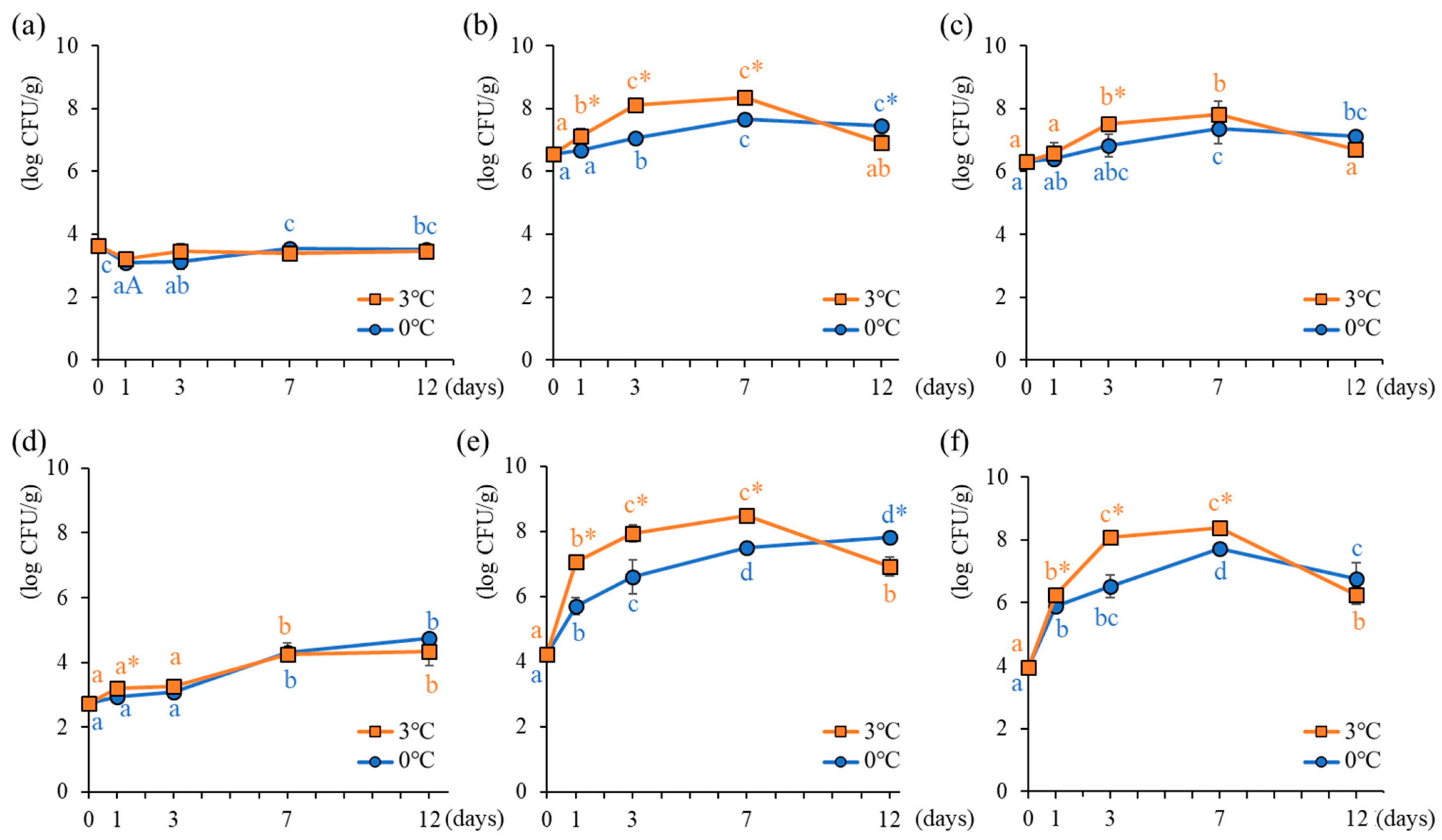
3.1. Viable Bacterial Counts
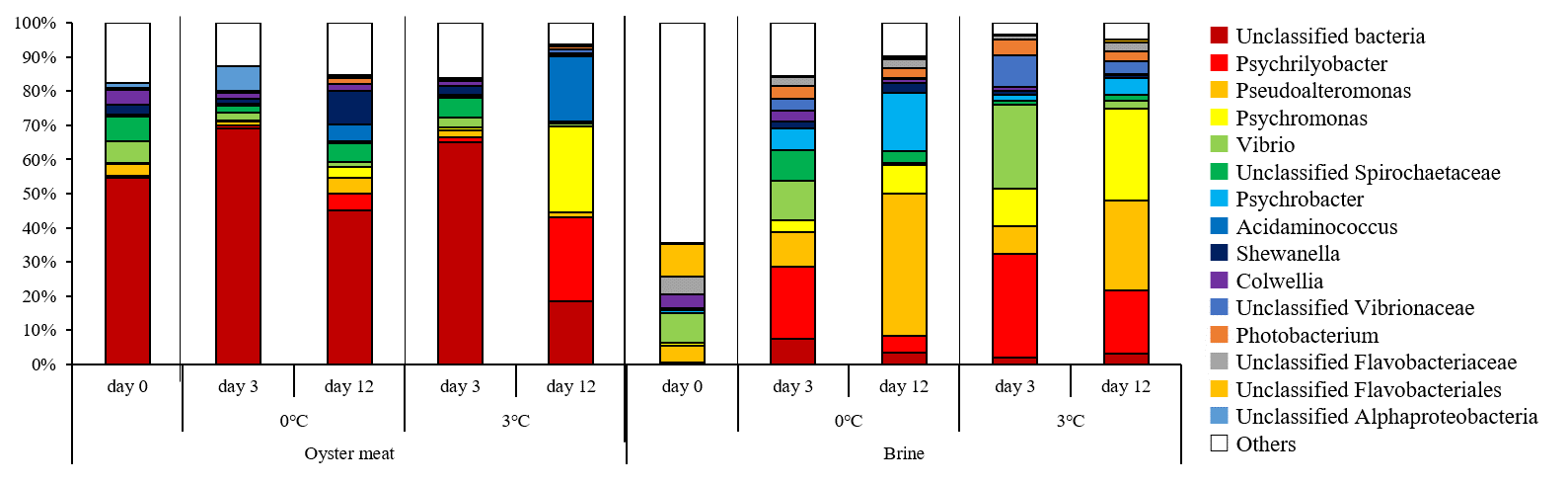
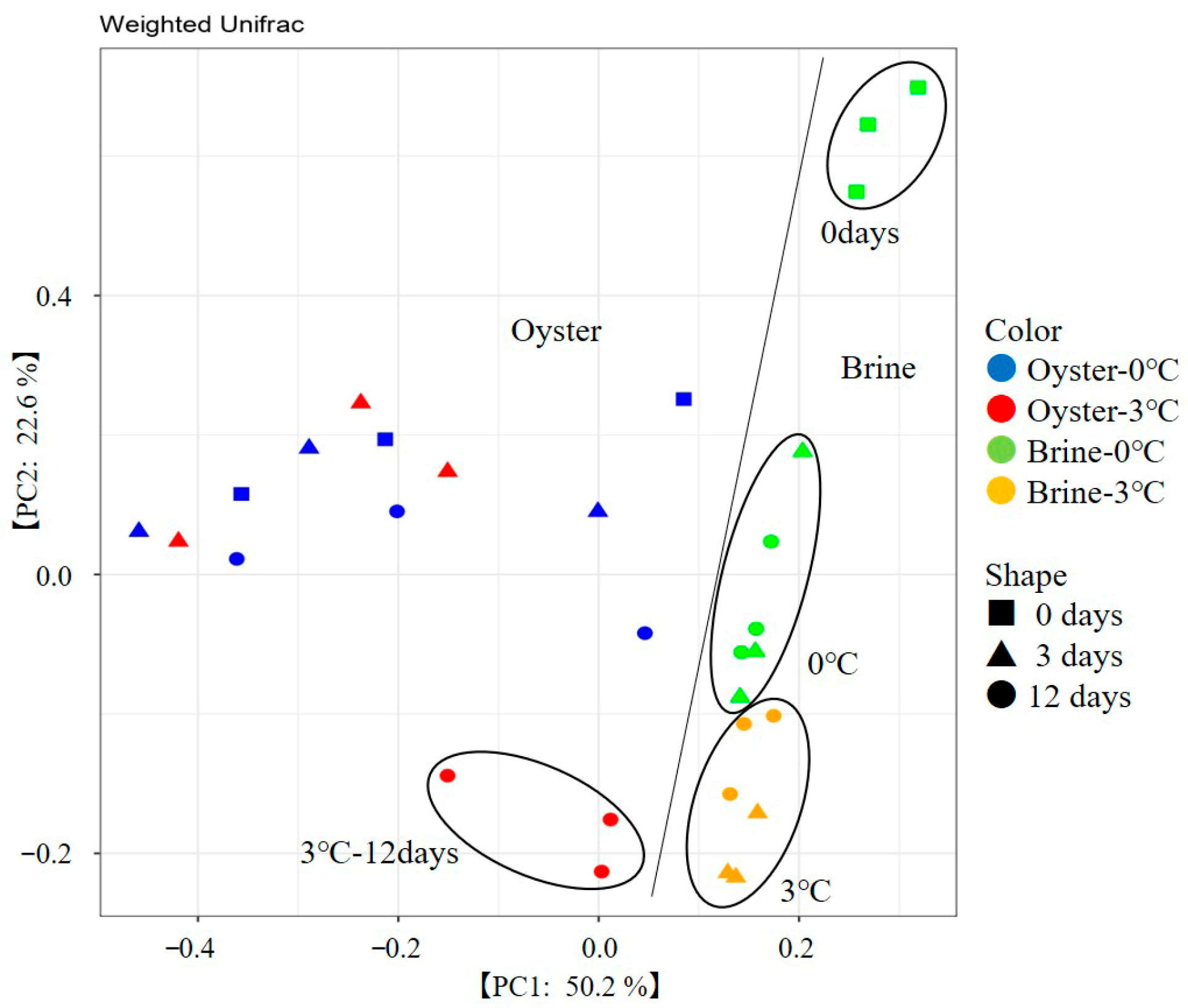
3.2. Bacterial Community Structure
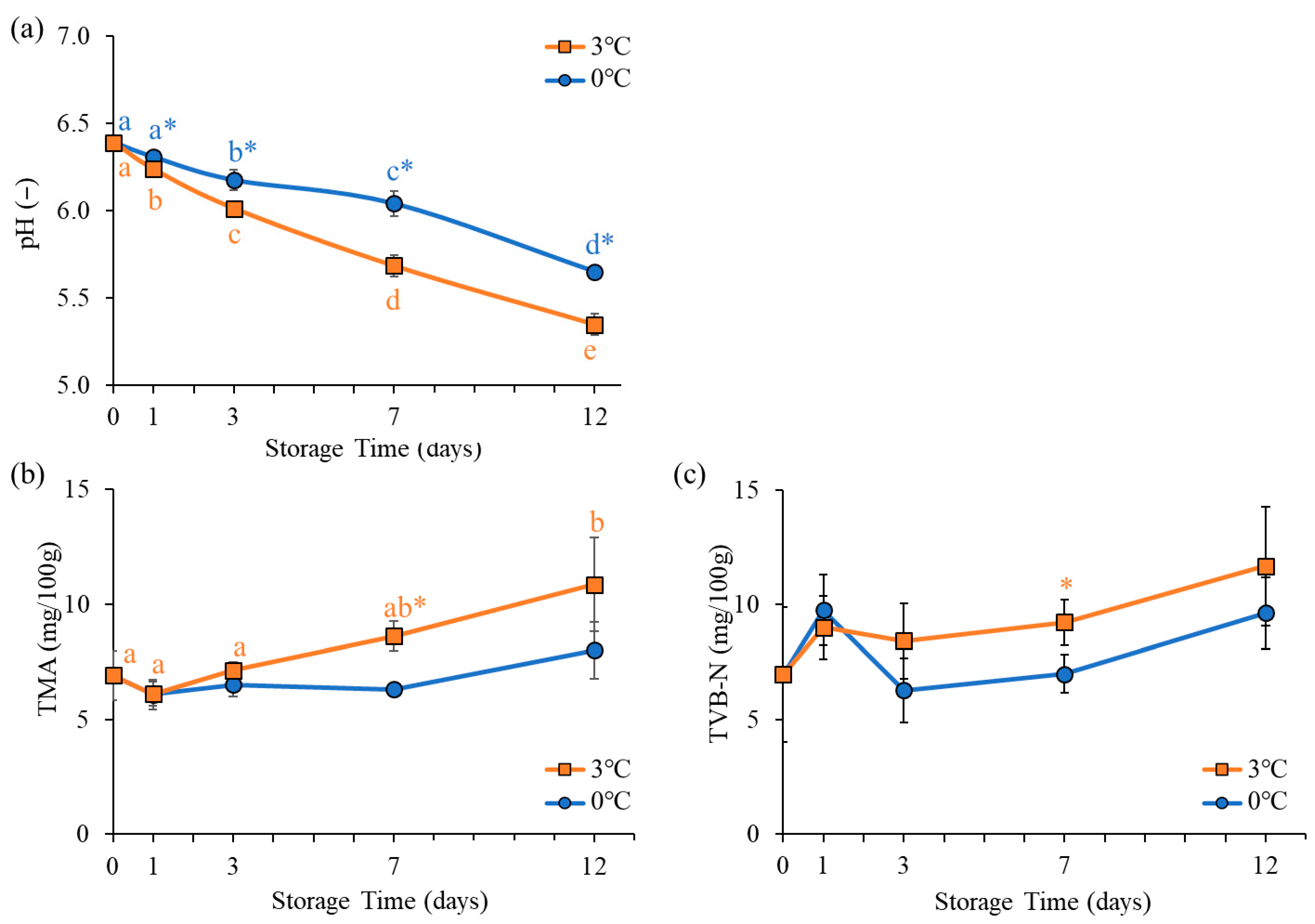
3.3. pH, TMA, and TVB-N
3.4. Sensory Evaluation and Odor Sensor Analysis
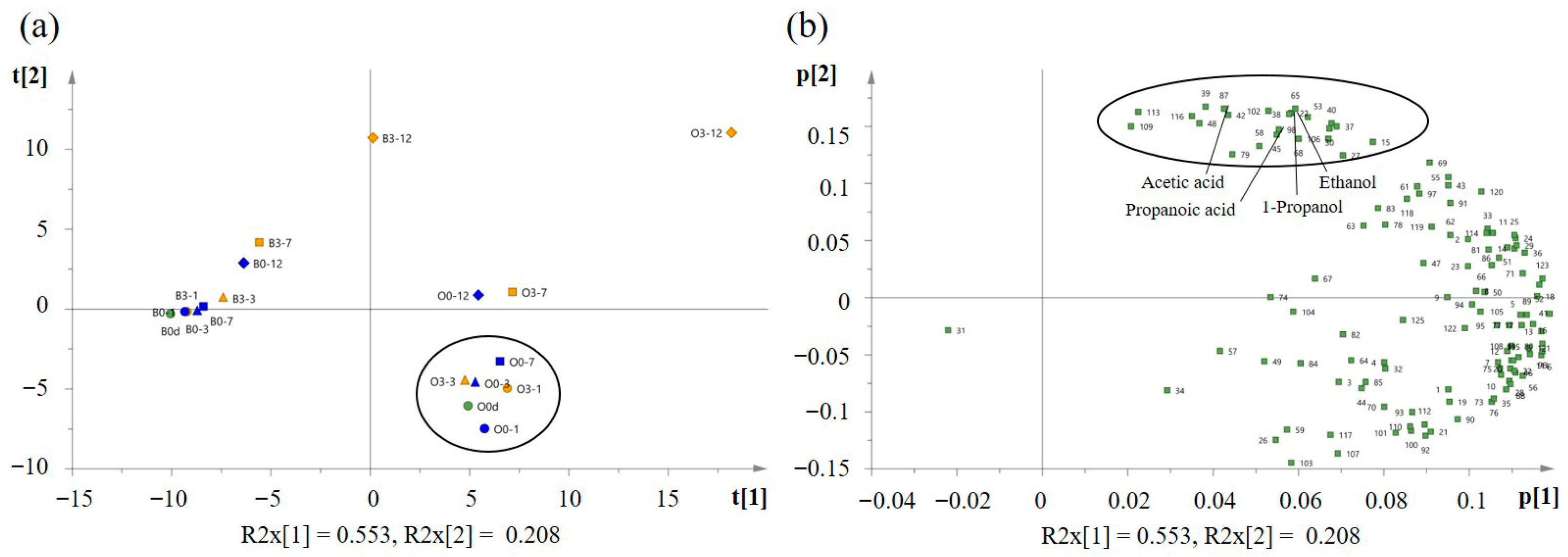
3.5. Volatile Component Analysis
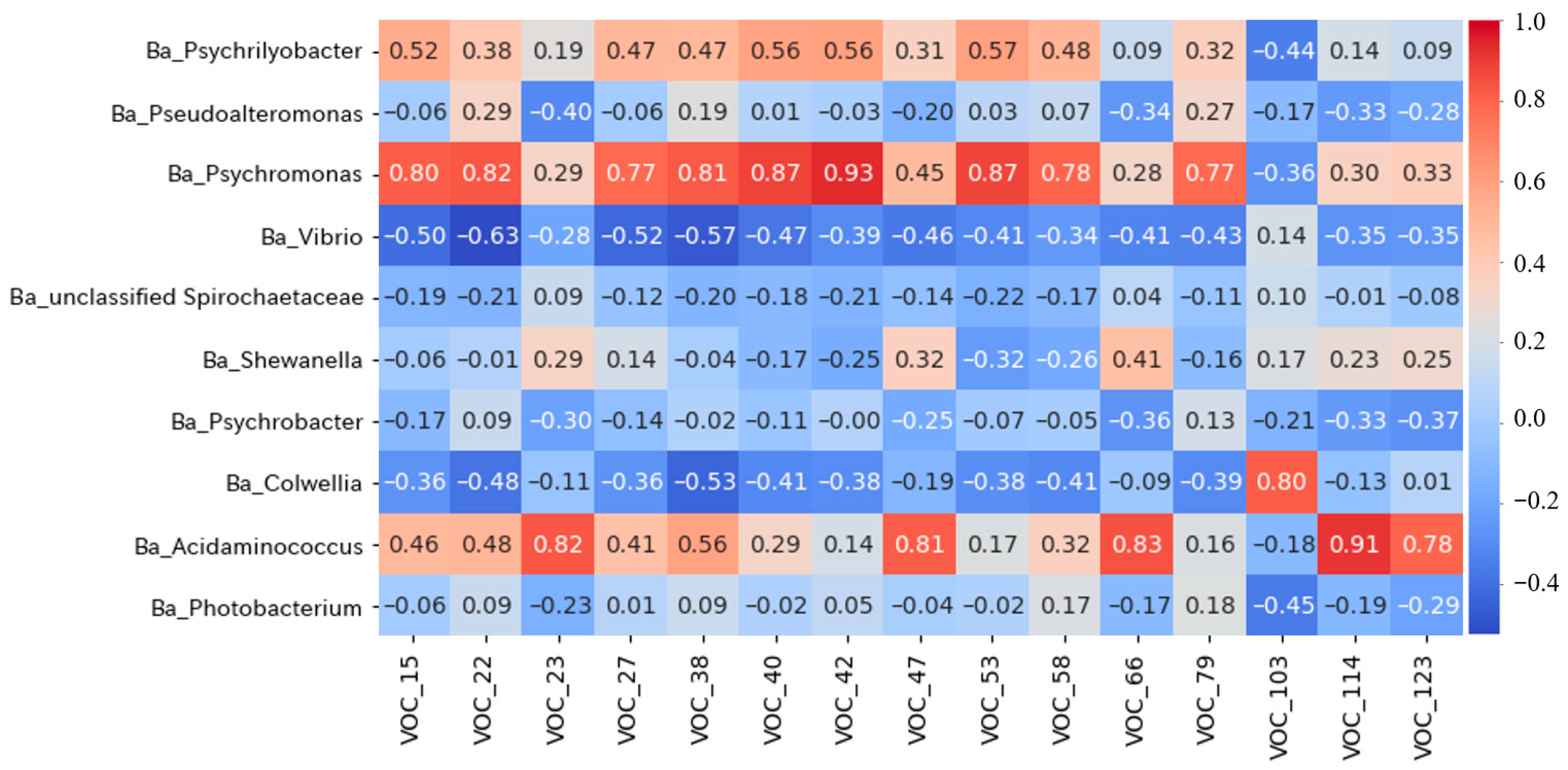
3.6. Correlation Between Bacteria and VOCs
4. Conclusions
Supplementary Materials
Author Contributions
Funding
Institutional Review Board Statement
Informed Consent Statement
Data Availability Statement
Acknowledgments
Conflicts of Interest
Abbreviations
| ANOVA | one-way analysis of variance |
| ASV | amplicon sequence variant |
| CFU | colony-forming units |
| GC-MS | gas chromatography–mass spectrometry |
| PC1 | first principal component |
| PC2 | second principal component |
| PCA | principal component analysis |
| PCoA | principal coordinate analysis |
| PCR | polymerase chain reaction |
| TMA | trimethylamine |
| TMA-O | trimethylamine oxide |
| TVB-N | total volatile basic nitrogen |
| VOCs | volatile organic compounds |
References
- Hicks, D.T. Seafood safety and quality: The consumer’s role. Foods 2016, 5, 71. [Google Scholar] [CrossRef] [Scilit]
- Wheaton, F.; Hall, S. Research needs for automated oyster shucking. Aquac. Eng. 2007, 37, 67–72. [Google Scholar] [CrossRef] [Scilit]
- Loose, S.M.; Peschel, A.; Grebitus, C. Quantifying effects of convenience and product packaging on consumer preferences and market share of seafood products: The case of oysters. Food Qual. Prefer. 2013, 28, 492–504. [Google Scholar] [CrossRef] [Scilit]
- Intarakul, C.; Panutrakul, S.; Thungkao, S. Bacterial Contamination in Raw Shucked Oysters in Shucking Houses and Retail Shops in Chon Buri Province, Thailand. J. Public Health 2011, 41, 184–198. [Google Scholar]
- Nagai, T.; Nakamori, M.; Mizuno, K.; Takatuji, H.; Wakano, M. Effect of bacterial growth on the quality of shucked oysters stored at low temperature. Nippon Suisan Gakkaishi 2013, 79, 1020–1022. (In Japanese) [Google Scholar] [CrossRef] [Scilit]
- Nagai, T.; Nakamori, M. Characterization of bacterial floras in immersion seawater of the shucked oysters. Bull. Fish. Mar. Technol. Cent. Hiroshima Prefect. Technol. Res. Inst. 2018, 5, 15–20. (In Japanese) [Google Scholar]
- Tanimoto, S.; Kawakami, K.; Morimoto, S. Changes in the free amino acid content of the shucked oyster Crassostrea gigas stored in salt water at 3 °C. Fish. Aquat. Sci. 2013, 15, 63–69. [Google Scholar] [CrossRef] [Scilit]
- Hosoi, M.; Sugihara, S.; Kato, K.; Mizuta, S.; Yokoyama, Y. Effects of immersion salinity on the food properties of shucked oysters. Fish. Sci. 2014, 80, 819–825. [Google Scholar] [CrossRef] [Scilit]
- Inoue, N.; Tsunoda, K.; Sugahara, T. Effect of Hypochlorous Acid on Oyster based on Dehydrogenase Activity. J. Integr. Study Diet. Habits 1999, 10, 59–63, (In Japanese with English abstract). [Google Scholar] [CrossRef] [Scilit]
- Hiroshima Prefecture’s Handling Guidelines for Raw Oysters. Available online: https://www.pref.hiroshima.lg.jp/soshiki/58/1291003977219.html (accessed on 16 October 2025).
- Tanimoto, S.; Aoyama, Y.; Okazaki, T. Changes in ATP and its related compounds and organic acid in oyster soaked in salt water at 3 °C. Bull. Hiroshima Prefect. Food Technol. Res. Cent. 2004, 23, 9–14, (In Japanese with English abstract). [Google Scholar]
- Watakabe, N.; Sato, Y.; Matsumoto, A.; Furuta, A.; Okazaki, T.; Tanimoto, S. Changes in quality, bacterial flora, and odor of Pacific oysters Magallana gigas under mimicked commercial shipping conditions at 4 °C. Fish. Sci. 2025, 91, 1013–1024. [Google Scholar] [CrossRef] [Scilit]
- Fu, R.; Su, J.; He, Y.; Wang, S. A study on the formation and change of Yesso Scallop odor characteristics by GC-O-MS, sensory evaluation, and flavor-precursor analysis. Aquac. Res. 2023, 2023, 1319841. [Google Scholar] [CrossRef] [Scilit]
- Gram, L.; Dalgaard, P. Fish spoilage bacteria—Problems and solutions. Curr. Opin. Biotechnol. 2002, 13, 262–266. [Google Scholar] [CrossRef] [Scilit] [PubMed]
- Lokmer, A.; Wegner, K.M. Hemolymph microbiome of Pacific oysters in response to temperature, temperature stress and infection. ISME J. 2015, 9, 670–682. [Google Scholar] [CrossRef] [Scilit] [PubMed]
- Chen, B.; Huang, J.; Liu, Y.; Liu, H.; Zhao, Y.; Wang, J.J. Effects of the curcumin-mediated photodynamic inactivation on the quality of cooked oysters with Vibrio parahaemolyticus during storage at different temperature. Int. J. Food Microbiol. 2021, 345, 109152. [Google Scholar] [CrossRef] [Scilit]
- Mudoh, M.F.; Parveen, S.; Schwarz, J.; Rippen, T.; Chaudhuri, A. The effects of storage temperature on the growth of Vibrio parahaemolyticus and organoleptic properties in oysters. Front. Public Health 2014, 2, 45. [Google Scholar] [CrossRef] [Scilit]
- Chiou, T.K.; Lin, J.F.; Shiau, C.Y. Changes in extractive components and glycogen in the edible meat of hard clam Meretrix lusoria during storage at different temperature. Fish. Sci. 1998, 64, 115–120. [Google Scholar] [CrossRef] [Scilit]
- Kawabe, S.; Murakami, H.; Usui, M.; Miyasaki, T. Changes in volatile compounds of living Pacific oyster Crassostrea gigas during air-exposed storage. Fish. Sci. 2019, 85, 747–755. [Google Scholar] [CrossRef] [Scilit]
- Liu, C.; Gu, Z.; Lin, X.; Wang, Y.; Wang, A.; Sun, Y.; Shi, Y. Effects of high hydrostatic pressure (HHP) and storage temperature on bacterial counts, color change, fatty acids and non-volatile taste active compounds of oysters (Crassostrea ariakensis). Food Chem. 2022, 372, 131247. [Google Scholar] [CrossRef] [Scilit]
- Sanitation Measures for Raw Oysters. Available online: https://www.mhlw.go.jp/web/t_doc?dataId=00ta5900&dataType=1&pageNo=1 (accessed on 16 October 2025).
- Tanimoto, S.; Hirata, Y.; Ishizu, S.; Wang, R.; Furuta, A.; Mabuchi, R.; Okada, G. Changes in the quality and microflora of yellowtail Seriola quinqueradiata muscles during cold storage. Foods 2024, 13, 1086. [Google Scholar] [CrossRef] [Scilit]
- Patterns of Microbial Growth in Food: Phases and Influencing Factors. Available online: https://agriculture.institute/meat-science-fundamentals/microbial-growth-in-food-phases-factors/ (accessed on 16 January 2026).
- Nunal, S.N.; Monaya, K.J.M.; Mueda, C.R.T.; Leon, S.M.S. Microbiological Quality of Oysters and Mussels Along Its Market Supply Chain. J. Food Prot. 2023, 86, 100263. [Google Scholar] [CrossRef] [Scilit]
- Cao, R.; Xue, C.H.; Liu, Q.; Xue, Y. Microbiological, chemical, and sensory assessment of Pacific oysters (Crassostrea gigas) stored at different temperatures. Czech J. Food Sci. 2009, 27, 102–108. [Google Scholar] [CrossRef] [Scilit]
- Liu, T.; Liu, J.; Wang, P.; Li, X.; Zhong, Y.; Yan, W.; Guan, W.; Cai, L. Effect of slurry ice on quality characteristics and microbiota composition of Pacific white shrimp during refrigerated storage. J. Agric. Food Res. 2023, 14, 100792. [Google Scholar] [CrossRef] [Scilit]
- Ji, Y.; Ishizu, S.; Matsumoto, A.; Furuta, A.; Okada, G.; Tanimoto, S. Changes in bacterial flora and quality of Yellowtail (Seriola quinqueradiata) muscle stored at different temperatures. Appl. Sci. 2025, 15, 2996. [Google Scholar] [CrossRef] [Scilit]
- Pelikan, C.; Wasmund, K.; Glombitza, C.; Hausmann, B.; Herbold, C.W.; Fileder, M.; Loy, A. Anaerobic bacterial degradation of protein and lipid macromolecules in subarctic marine sediment. ISME J. 2021, 15, 833–847. [Google Scholar] [CrossRef] [Scilit]
- Kawasaki, K.; Nogi, Y.; Hishinuma, M.; Nodasaka, Y.; Matsuyama, H.; Yumoto, I. Psychromonas marina sp. nov., a novel halophilic, facultatively psychrophilic bacterium isolated from the coast of the Okhotsk Sea. Int. J. Syst. Evol. Microbiol. 2002, 52, 1455–1459. [Google Scholar] [CrossRef] [Scilit]
- Zarkasi, K.Z.; Nazari, T.F. Molecular characterisation of microbial diversity associated with oysters within a commercial oyster farm. Turk. J. Fish. Aquat. Sci. 2018, 18, 191–197. [Google Scholar] [CrossRef] [PubMed]
- Basdeki, E.; Vasilaki, S.E.; Sensi, M.; Flemetakis, E.; Biscarini, F.; Power, D.; Tsironi, T. Reviewing the correlation of fish quality alteration and in-package headspace composition: Evidence from a pH freshness indicator case study. Int. J. Food Sci. 2025, 2025, 3576183. [Google Scholar] [CrossRef] [Scilit]
- Lee, K.M.; Son, M.; Kang, J.H.; Kim, D.; Hong, S.; Park, T.H.; Chun, H.S.; Choi, S.S. A triangle study of human, instrument and bioelectronic nose for non-destructive sensing of seafood freshness. Sci. Rep. 2018, 8, 547. [Google Scholar] [CrossRef] [Scilit]
- Fu, B.; Fang, C.; Li, Z.; Zeng, Z.; He, Y.; Chen, S.; Yang, H. The effect of heat stress on sensory properties of fresh oysters: A comprehensive study using E-Nose, E-Tongue, sensory evaluation, HS–SPME–GC–MS, LC–MS, and transcriptomics. Foods 2024, 13, 2004. [Google Scholar] [CrossRef] [Scilit]
- Zhang, Z.; Li, T.; Wang, D.; Zhang, L.; Chen, G. Study on the volatile profile characteristics of oyster Crassostrea gigas during storage by a combination sampling method coupled with GC/MS. Food Chem. 2009, 115, 1150–1157. [Google Scholar] [CrossRef] [Scilit]
- Chu, Y.; Mei, J.; Xie, J. Exploring the effects of lipid oxidation and free fatty acids on the development of volatile compounds in grouper during cold storage based on multivariate analysis. Food Chem. X 2023, 20, 100968. [Google Scholar] [CrossRef] [Scilit]
- Chu, Y.; Wang, J.; Xie, J. Exploring the correlation of microbial community diversity and succession with protein degradation and impact on the production of volatile compounds during cold storage of grouper (Epinephelus coioides). Food Chem. 2024, 460, 140469. [Google Scholar] [CrossRef] [Scilit] [PubMed]
- Odeyemi, O.A.; Burke, C.M.; Bolch, C.C.J.; Stanley, R. Seafood spoilage microbiota and associated volatile organic compounds at different storage temperatures and packaging conditions. Int. J. Food Microbiol. 2018, 280, 87–99. [Google Scholar] [CrossRef] [Scilit]
- Fan, M.; Rakotondrabe, T.F.; Chen, G.; Guo, M. Advances in microbial analysis: Based on volatile organic compounds of microorganisms in food. Food Chem. 2023, 418, 135950. [Google Scholar] [CrossRef] [Scilit] [PubMed]
- Broekaert, K.; Noseda, B.; Heyndrickx, M.; Vlaemynck, G.; Devileghere, F. Volatile compounds associated with Psychrobacter spp. and Pseudoalteromonas spp., the dominant microbiota of brown shrimp (Crangon crangon) during aerobic storage. Int. J. Food Microbiol. 2013, 166, 487–493. [Google Scholar] [CrossRef] [Scilit]
- Ratnawati, S.E.; Kuuliala, L.; Walgraeve, C.; Demeestere, K.; Devlieghere, F. Real time and non-destructive quantification of volatile organic compounds associated with spoilage bacteria in packed blue mussels (Mytilus edulis) using SIFT-MS. Food Res. Int. 2025, 220, 117159. [Google Scholar] [CrossRef] [Scilit] [PubMed]
- Shen, Y.; Wu, Y.; Wang, Y.; Li, L.; Li, C.; Zhao, Y.; Yang, S. Contribution of autochthonous microbiota succession to flavor formation during Chinese fermented mandarin fish (Siniperca chuatsi). Food Chem. 2021, 348, 129107. [Google Scholar] [CrossRef] [Scilit]
- Kruis, A.J.; Bohnenkamp, A.C.; Patinios, C.; Nuland, T.M.; Levisson, M.; Mars, A.E.; Berg, C.; Kengen, S.W.M.; Weusthuis, R.A. Microbial production of short and medium chain esters: Enzymes, pathways, and applications. Biotechnol. Adv. 2019, 37, 107407. [Google Scholar] [CrossRef] [Scilit]



| Sensory Evaluation Score | ||||||
|---|---|---|---|---|---|---|
| 1 | 2 | 3 | 4 | 5 | ||
| Oyster | Odor intensity | very weak | weak | normal | strong | very strong |
| Spoilage odor intensity | very weak | weak | normal | strong | very strong | |
| (object of reference) | (OY; day 0) | (OY; 3 °C, day 12) | ||||
| Odor palatability | very unpalatable | unpalatable | normal | palatable | very palatable | |
| (object of reference) | (OY; day 0) | |||||
| Brine | Odor intensity | very weak | weak | normal | strong | very strong |
| (object of reference) | (BR; day 0) | |||||
| Alpha Diversity | Storage Temperature | Oyster Meat | Brine | ||||
|---|---|---|---|---|---|---|---|
| 0 (Days) | 3 (Days) | 12 (Days) | 0 (Days) | 3 (Days) | 12 (Days) | ||
| Good’s coverage | 0 °C | 1.0 ± 0.0 | 1.0 ± 0.0 | 1.0 ± 0.0 | 1.0 ± 0.0 | 1.0 ± 0.0 | 1.0 ± 0.0 |
| 3 °C | 1.0 ± 0.0 | 1.0 ± 0.0 | 1.0 ± 0.0 | 1.0 ± 0.0 | 1.0 ± 0.0 | 1.0 ± 0.0 | |
| ASV | 0 °C | 91.0 ± 20.5 | 74.0 ± 15.4 | 94.0 ± 24.1 | 153 ± 38.2 | 113 ± 13.7 * | 95 ± 14 * |
| 3 °C | 91.0 ± 20.5 | 82.7 ± 13.0 | 84.7 ± 15.3 | 153 ± 38.2 a | 74 ± 8.1 b | 81 ± 8 b | |
| ACE | 0 °C | 91.4 ± 20.6 | 74.0 ± 15.4 | 94.7 ± 24.2 | 153 ± 38.6 | 114 ± 13.1 * | 97 ± 14 |
| 3 °C | 91.4 ± 20.6 | 83.0 ± 12.5 | 85.7 ± 16.2 | 153 ± 38.6 a | 74 ± 8.9 b | 83 ± 12 b | |
| Chao1 | 0 °C | 91.3 ± 20.5 | 74.0 ± 15.4 | 94.7 ± 24.2 | 143 ± 48.5 | 104 ± 22.6 * | 104 ± 8 |
| 3 °C | 91.3 ± 20.5 | 83.0 ± 12.5 | 85.7 ± 16.3 | 129 ± 65.3 a | 77 ± 8.1 b | 85 ± 16 b | |
| Shannon | 0 °C | 3.9 ± 0.8 | 3.2 ± 1.0 | 4.1 ± 1.1 | 6.0 ± 0.2 a | 5.0 ± 0.3 b* | 4.6 ± 0.4 b |
| 3 °C | 3.9 ± 0.8 | 3.4 ± 0.7 | 4.2 ± 0.4 | 6.0 ± 0.2 a | 4.2 ± 0.2 b | 4.4 ± 0.3 b | |
| Simpson | 0 °C | 0.8 ± 0.1 | 0.8 ± 0.2 | 0.8 ± 0.1 | 1.0 ± 0.0 | 0.9 ± 0.0 | 0.9 ± 0.0 |
| 3 °C | 0.8 ± 0.1 | 0.8 ± 0.1 | 0.9 ± 0.0 | 1.0 ± 0.0 | 0.9 ± 0.0 | 0.9 ± 0.0 | |
| Samples | Evaluation Items | Storage Temperature | 0 (Days) | 1 (Days) | 3 (Days) | 7 (Days) | 12 (Days) | |
|---|---|---|---|---|---|---|---|---|
| Sensory score | Oyster meat | Odor intensity | 0 °C | 2.5 ± 1.4 | 2.1 ± 1.2 | 2.4 ± 1.2 | 2.4 ± 1.3 | 2.8 ± 1.1 |
| 3 °C | 2.5 ± 1.4 a | 2.9 ± 1.1 ab* | 2.6 ± 1.0 ab | 2.4 ± 1.2 a | 3.6 ± 1.2 b* | |||
| Spoilage odor intensity | 0 °C | 2.5 ± 1.3 | 2.0 ± 1.1 | 2.4 ± 1.2 | 2.1 ± 1.2 | 2.8 ± 1.3 | ||
| 3 °C | 2.5 ± 1.3 a | 2.5 ± 1.1 a | 2.9 ± 1.1 ab | 2.7 ± 1.2 a | 3.6 ± 1.3 b* | |||
| Odor palatability | 0 °C | 3.5 ± 1.3 | 3.7 ± 1.1 | 3.7 ± 1.1 | 3.7 ± 1.1 | 3.3 ± 1.2 | ||
| 3 °C | 3.5 ± 1.3 a | 3.6 ± 1.0 a | 3.0 ± 1.1 ab | 3.3 ± 1.2 ab | 2.5 ± 1.3 b* | |||
| Brine | Odor intensity | 0 °C | 1.4 ± 0.8 a | 2.4 ± 1.1 b | 2.1 ± 1.0 b | 2.5 ± 1.2 b | 3.4 ± 1.1 c | |
| 3 °C | 1.4 ± 0.8 a | 2.4 ± 1.2 b | 2.3 ± 1.1 b | 3.6 ± 1.2 c* | 3.9 ± 1.1 c | |||
| Odor sensor | Oyster meat | Odor intensity | 0 °C | 16.8 ± 2.0 | 17.4 ± 2.6 | 18.4 ± 2.3 | 19.2 ± 3.1 | 22.0 ± 0.7 |
| 3 °C | 16.8 ± 2.0 a | 16.9 ± 1.2 a | 20.3 ± 2.1 ab | 22.6 ± 1.6 bc | 25.3 ± 0.8 c* | |||
| Brine | Odor intensity | 0 °C | 0.4 ± 0.7 a | 3.3 ± 1.7 ab | 4.2 ± 0.9 b | 12.0 ± 2.2 c | 22.4 ± 0.8 d | |
| 3 °C | 0.4 ± 0.7 a | 4.2 ± 0.9 b | 14.0 ± 0.2 c* | 22.1 ± 0.9 d* | 24.9 ± 0.6 e |
Disclaimer/Publisher’s Note: The statements, opinions and data contained in all publications are solely those of the individual author(s) and contributor(s) and not of MDPI and/or the editor(s). MDPI and/or the editor(s) disclaim responsibility for any injury to people or property resulting from any ideas, methods, instructions or products referred to in the content. |
© 2026 by the authors. Licensee MDPI, Basel, Switzerland. This article is an open access article distributed under the terms and conditions of the Creative Commons Attribution (CC BY) license.
Share and Cite
Watakabe, N.; Sakaguchi, K.; Tomatsu, M.; Matsumoto, A.; Furuta, A.; Okazaki, T.; Tanimoto, S. Effects of Storage Temperature on the Microbial Flora, Odor, and Quality of Shucked Pacific Oysters Under Mimicked Commercial Shipping Conditions. Foods 2026, 15, 603. https://doi.org/10.3390/foods15040603
Watakabe N, Sakaguchi K, Tomatsu M, Matsumoto A, Furuta A, Okazaki T, Tanimoto S. Effects of Storage Temperature on the Microbial Flora, Odor, and Quality of Shucked Pacific Oysters Under Mimicked Commercial Shipping Conditions. Foods. 2026; 15(4):603. https://doi.org/10.3390/foods15040603
Chicago/Turabian StyleWatakabe, Nao, Kazuho Sakaguchi, Mikiko Tomatsu, Akane Matsumoto, Ayumi Furuta, Takashi Okazaki, and Shota Tanimoto. 2026. "Effects of Storage Temperature on the Microbial Flora, Odor, and Quality of Shucked Pacific Oysters Under Mimicked Commercial Shipping Conditions" Foods 15, no. 4: 603. https://doi.org/10.3390/foods15040603
APA StyleWatakabe, N., Sakaguchi, K., Tomatsu, M., Matsumoto, A., Furuta, A., Okazaki, T., & Tanimoto, S. (2026). Effects of Storage Temperature on the Microbial Flora, Odor, and Quality of Shucked Pacific Oysters Under Mimicked Commercial Shipping Conditions. Foods, 15(4), 603. https://doi.org/10.3390/foods15040603