Exploring the Role of Food and Food-Related Compounds in Parkinson’s Disease
 ,
,  ,
,  ,
,  and
and 
Abstract
1. Introduction
2. Methods
3. Meat and Its Derivatives
4. Seafood and Heavy Metals
5. Dairy Products
6. Dietary Fat Intake
7. Pesticides
8. Urate Levels
9. Flavonoids
10. Coffee
11. Nicotine and Other Components of Edible Solanaceae and Tobacco
12. Dietary Patterns and Parkinson’s Disease Risk
12.1. Mediterranean Diets
12.2. Ketogenic Diets
12.3. MIND (Mediterranean-DASH Intervention for Neurodegenerative Delay) Diet
12.4. Vegetarian (Lacto-Ovo-Vegetarian and Vegan) Diets
13. Foods Containing Dopamine and Levodopa
14. An Ideal Nutritional Approach to PD Patients
15. Limitations
16. Conclusions
Author Contributions
Funding
Institutional Review Board Statement
Informed Consent Statement
Data Availability Statement
Conflicts of Interest
Abbreviations
| PD | Parkinson’s Disease |
| LBD | Lewy Body Dementia |
| LNAAs | Large Neutral Amino Acids |
| VF | Vicia faba |
| MP | Mucuna pruriens |
| BBB | Blood–Brain Barrier |
| UA | Uric Acid |
References
- Attuquayefio, T.; Stevenson, R.J.; Oaten, M.J.; Francis, H.M. A Four-Day Western-Style Dietary Intervention Causes Reductions in Hippocampal-Dependent Learning and Memory and Interoceptive Sensitivity. PLoS ONE 2017, 12, e0172645. [Google Scholar] [CrossRef]
- Baym, C.L.; Khan, N.A.; Monti, J.M.; Raine, L.B.; Drollette, E.S.; Moore, R.D.; Scudder, M.R.; Kramer, A.F.; Hillman, C.H.; Cohen, N.J. Dietary Lipids Are Differentially Associated with Hippocampal-Dependent Relational Memory in Prepubescent Children. Am. J. Clin. Nutr. 2014, 99, 1026–1032. [Google Scholar] [CrossRef]
- Gibson, E.L.; Barr, S.; Jeanes, Y.M. Habitual Fat Intake Predicts Memory Function in Younger Women. Front. Hum. Neurosci. 2013, 7, 838. [Google Scholar] [CrossRef]
- Hoscheidt, S.; Sanderlin, A.H.; Baker, L.D.; Jung, Y.; Lockhart, S.; Kellar, D.; Whitlow, C.T.; Hanson, A.J.; Friedman, S.; Register, T.; et al. Mediterranean and Western Diet Effects on Alzheimer’s Disease Biomarkers, Cerebral Perfusion, and Cognition in Mid-Life: A Randomized Trial. Alzheimer’s Dement. 2022, 18, 457–468. [Google Scholar] [CrossRef]
- Knight, E.; Geetha, T.; Burnett, D.; Babu, J.R. The Role of Diet and Dietary Patterns in Parkinson’s Disease. Nutrients 2022, 14, 4472. [Google Scholar] [CrossRef] [PubMed]
- Kalia, L.V.; Lang, A.E. Parkinson’s Disease. Lancet 2015, 386, 896–912. [Google Scholar] [CrossRef]
- Ascherio, A.; Schwarzschild, M.A. The Epidemiology of Parkinson’s Disease: Risk Factors and Prevention. Lancet Neurol. 2016, 15, 1257–1272. [Google Scholar] [CrossRef]
- Braak, H.; Del Tredici, K.; Rüb, U.; de Vos, R.A.I.; Jansen Steur, E.N.H.; Braak, E. Staging of Brain Pathology Related to Sporadic Parkinson’s Disease. Neurobiol. Aging 2003, 24, 197–211. [Google Scholar] [CrossRef] [PubMed]
- Rodrigues, P.V.; de Godoy, J.V.P.; Bosque, B.P.; Amorim Neto, D.P.; Tostes, K.; Palameta, S.; Garcia-Rosa, S.; Tonoli, C.C.C.; de Carvalho, H.F.; de Castro Fonseca, M. Transcellular Propagation of Fibrillar α-Synuclein from Enteroendocrine to Neuronal Cells Requires Cell-to-Cell Contact and Is Rab35-Dependent. Sci. Rep. 2022, 12, 4168. [Google Scholar] [CrossRef]
- Svensson, E.; Horváth-Puhó, E.; Thomsen, R.W.; Djurhuus, J.C.; Pedersen, L.; Borghammer, P.; Sørensen, H.T. Vagotomy and Subsequent Risk of Parkinson’s Disease. Ann. Neurol. 2015, 78, 522–529. [Google Scholar] [CrossRef]
- Bianchi, V.E.; Rizzi, L.; Somaa, F. The Role of Nutrition on Parkinson’s Disease: A Systematic Review. Nutr. Neurosci. 2023, 26, 605–628. [Google Scholar] [CrossRef]
- Trinh, J.; de Vries, N.M.; Chan, P.; Dekker, M.C.J.; Helmich, R.C.; Bloem, B.R. The Role of Lifestyle Interventions in Symptom Management and Disease Modification in Parkinson’s Disease. Lancet Neurol. 2026, 25, 90–102. [Google Scholar] [CrossRef]
- Cassotta, M.; Geerts, H.; Harbom, L.; Outeiro, T.F.; Pediaditakis, I.; Reiner, O.; Schildknecht, S.; Schwamborn, J.C.; Bailey, J.; Herrmann, K.; et al. The Future of Parkinson’s Disease Research: A New Paradigm of Human-Specific Investigation Is Necessary… and Possible. ALTEX 2022, 39, 694–709. [Google Scholar] [CrossRef]
- Georgiou, A.; Demetriou, C.A.; Christou, Y.P.; Heraclides, A.; Leonidou, E.; Loukaides, P.; Yiasoumi, E.; Pantziaris, M.; Kleopa, K.A.; Papacostas, S.S.; et al. Genetic and Environmental Factors Contributing to Parkinson’s Disease: A Case-Control Study in the Cypriot Population. Front. Neurol. 2019, 10, 1047. [Google Scholar] [CrossRef]
- Shermon, S.; Goldfinger, M.; Morris, A.; Harper, B.; Leder, A.; Santella, A.J.; Krishnamachari, B. Effect of Modifiable Risk Factors in Parkinson’s Disease: A Case-Control Study Looking at Common Dietary Factors, Toxicants, and Anti-Inflammatory Medications. Chronic Illn. 2022, 18, 849–859. [Google Scholar] [CrossRef]
- Veronese, N.; Nova, A.; Fazia, T.; Riggi, E.; Yang, L.; Piccio, L.; Huang, B.-H.; Ahmadi, M.; Barbagallo, M.; Notarnicola, M.; et al. Contribution of Nutritional, Lifestyle, and Metabolic Risk Factors to Parkinson’s Disease. Mov. Disord. 2024, 39, 1203–1212. [Google Scholar] [CrossRef]
- Johnson, C.C.; Gorell, J.M.; Rybicki, B.A.; Sanders, K.; Peterson, E.L. Adult Nutrient Intake as a Risk Factor for Parkinson’s Disease. Int. J. Epidemiol. 1999, 28, 1102–1109. [Google Scholar] [CrossRef]
- Kamel, F.; Goldman, S.M.; Umbach, D.M.; Chen, H.; Richardson, G.; Barber, M.R.; Meng, C.; Marras, C.; Korell, M.; Kasten, M.; et al. Dietary Fat Intake, Pesticide Use, and Parkinson’s Disease. Park. Relat. Disord. 2014, 20, 82–87. [Google Scholar] [CrossRef] [PubMed]
- Hantikainen, E.; Roos, E.; Bellocco, R.; D’Antonio, A.; Grotta, A.; Adami, H.-O.; Ye, W.; Trolle Lagerros, Y.; Bonn, S. Dietary Fat Intake and Risk of Parkinson Disease: Results from the Swedish National March Cohort. Eur. J. Epidemiol. 2022, 37, 603–613. [Google Scholar] [CrossRef] [PubMed]
- Turesky, R.J. Formation and Biochemistry of Carcinogenic Heterocyclic Aromatic Amines in Cooked Meats. Toxicol. Lett. 2007, 168, 219–227. [Google Scholar] [CrossRef]
- Felton, J.S.; Knize, M.G.; Wu, R.W.; Colvin, M.E.; Hatch, F.T.; Malfatti, M.A. Mutagenic Potency of Food-Derived Heterocyclic Amines. Mutat. Res. 2007, 616, 90–94. [Google Scholar] [CrossRef]
- Griggs, A.M.; Agim, Z.S.; Mishra, V.R.; Tambe, M.A.; Director-Myska, A.E.; Turteltaub, K.W.; McCabe, G.P.; Rochet, J.-C.; Cannon, J.R. 2-Amino-1-Methyl-6-Phenylimidazo[4,5-b]Pyridine (PhIP) Is Selectively Toxic to Primary Dopaminergic Neurons in Vitro. Toxicol. Sci. 2014, 140, 179–189. [Google Scholar] [CrossRef] [PubMed]
- Gonzalez-Freire, M.; Semba, R.D.; Ubaida-Mohien, C.; Fabbri, E.; Scalzo, P.; Højlund, K.; Dufresne, C.; Lyashkov, A.; Ferrucci, L. The Human Skeletal Muscle Proteome Project: A Reappraisal of the Current Literature. J. Cachexia Sarcopenia Muscle 2017, 8, 5–18. [Google Scholar] [CrossRef]
- Jackson, A.; Forsyth, C.B.; Shaikh, M.; Voigt, R.M.; Engen, P.A.; Ramirez, V.; Keshavarzian, A. Diet in Parkinson’s Disease: Critical Role for the Microbiome. Front. Neurol. 2019, 10, 1245. [Google Scholar] [CrossRef]
- Hajare, S.; Kulkarni, Y.A. Parkinson’s Disease and the Gut-Brain Connection: Unveiling Pathways, Mechanisms and Promising Therapies. Brain Res. 2025, 1868, 149975. [Google Scholar] [CrossRef]
- Perez-Pardo, P.; Kliest, T.; Dodiya, H.B.; Broersen, L.M.; Garssen, J.; Keshavarzian, A.; Kraneveld, A.D. The Gut-Brain Axis in Parkinson’s Disease: Possibilities for Food-Based Therapies. Eur. J. Pharmacol. 2017, 817, 86–95. [Google Scholar] [CrossRef]
- Bai, F.; You, L.; Lei, H.; Li, X. Association between Increased and Decreased Gut Microbiota Abundance and Parkinson’s Disease: A Systematic Review and Subgroup Meta-Analysis. Exp. Gerontol. 2024, 191, 112444. [Google Scholar] [CrossRef]
- Tomova, A.; Bukovsky, I.; Rembert, E.; Yonas, W.; Alwarith, J.; Barnard, N.D.; Kahleova, H. The Effects of Vegetarian and Vegan Diets on Gut Microbiota. Front. Nutr. 2019, 6, 47. [Google Scholar] [CrossRef]
- Bazinet, R.P.; Layé, S. Polyunsaturated Fatty Acids and Their Metabolites in Brain Function and Disease. Nat. Rev. Neurosci. 2014, 15, 771–785. [Google Scholar] [CrossRef]
- McCarty, M.F.; Lerner, A. Nutraceuticals Targeting Generation and Oxidant Activity of Peroxynitrite May Aid Prevention and Control of Parkinson’s Disease. Int. J. Mol. Sci. 2020, 21, 3624. [Google Scholar] [CrossRef] [PubMed]
- Avallone, R.; Vitale, G.; Bertolotti, M. Omega-3 Fatty Acids and Neurodegenerative Diseases: New Evidence in Clinical Trials. Int. J. Mol. Sci. 2019, 20, 4256. [Google Scholar] [CrossRef]
- Liu, B.; Zhang, Y.; Yang, Z.; Liu, M.; Zhang, C.; Zhao, Y.; Song, C. ω-3 DPA Protected Neurons from Neuroinflammation by Balancing Microglia M1/M2 Polarizations through Inhibiting NF-κB/MAPK P38 Signaling and Activating Neuron-BDNF-PI3K/AKT Pathways. Mar. Drugs 2021, 19, 587. [Google Scholar] [CrossRef]
- Lin, F.; Shi, Y.; Zheng, J.; Li, Y.; Chen, X.; Zou, X.; Hong, Y.; Chen, K.; Zeng, Y.; Ye, Q.; et al. Fish Oil Supplementation, Physical Activity and Risk of Incident Parkinson’s Disease: Results of Longitudinal Analysis from the UK Biobank. Front. Aging Neurosci. 2023, 15, 1304629. [Google Scholar] [CrossRef]
- Dhapola, R.; Kumari, S.; Sharma, P.; Paidlewar, M.; Vellingiri, B.; Medhi, B.; HariKrishnaReddy, D. Cytokine Associated Neuroinflammation in Parkinson’s Disease: Molecular Pathways, Therapeutic Targets, and Translational Insights. Cytokine Growth Factor. Rev. 2026, 88, 1–17. [Google Scholar] [CrossRef] [PubMed]
- Wu, F.; Wang, D.-D.; Shi, H.-H.; Wang, C.-C.; Xue, C.-H.; Wang, Y.-M.; Zhang, T.-T. N-3 PUFA-Deficiency in Early Life Exhibits Aggravated MPTP-Induced Neurotoxicity in Old Age While Supplementation with DHA/EPA-Enriched Phospholipids Exerts a Neuroprotective Effect. Mol. Nutr. Food Res. 2021, 65, e2100339. [Google Scholar] [CrossRef]
- Chitre, N.M.; Wood, B.J.; Ray, A.; Moniri, N.H.; Murnane, K.S. Docosahexaenoic Acid Protects Motor Function and Increases Dopamine Synthesis in a Rat Model of Parkinson’s Disease via Mechanisms Associated with Increased Protein Kinase Activity in the Striatum. Neuropharmacology 2020, 167, 107976. [Google Scholar] [CrossRef]
- Green, A.J.; Planchart, A. The Neurological Toxicity of Heavy Metals: A Fish Perspective. Comp. Biochem. Physiol. C Toxicol. Pharmacol. 2018, 208, 12–19. [Google Scholar] [CrossRef]
- Gorell, J.M.; Johnson, C.C.; Rybicki, B.A.; Peterson, E.L.; Kortsha, G.X.; Brown, G.G.; Richardson, R.J. Occupational Exposure to Manganese, Copper, Lead, Iron, Mercury and Zinc and the Risk of Parkinson’s Disease. Neurotoxicology 1999, 20, 239–247. [Google Scholar]
- Scheuhammer, A.M.; Cherian, M.G. Effects of Heavy Metal Cations, Sulfhydryl Reagents and Other Chemical Agents on Striatal D2 Dopamine Receptors. Biochem. Pharmacol. 1985, 34, 3405–3413. [Google Scholar] [CrossRef]
- Miller, K.; Ochudło, S.; Opala, G.; Smolicha, W.; Siuda, J. Parkinsonism in chronic occupational metallic mercury intoxication. Neurol. Neurochir. Pol. 2003, 37, 31–38. [Google Scholar]
- Rai, A.; Maurya, S.K.; Khare, P.; Srivastava, A.; Bandyopadhyay, S. Characterization of Developmental Neurotoxicity of As, Cd, and Pb Mixture: Synergistic Action of Metal Mixture in Glial and Neuronal Functions. Toxicol. Sci. 2010, 118, 586–601. [Google Scholar] [CrossRef]
- Karri, V.; Schuhmacher, M.; Kumar, V. Heavy Metals (Pb, Cd, As and MeHg) as Risk Factors for Cognitive Dysfunction: A General Review of Metal Mixture Mechanism in Brain. Environ. Toxicol. Pharmacol. 2016, 48, 203–213. [Google Scholar] [CrossRef]
- Lane, K.; Derbyshire, E.; Li, W.; Brennan, C. Bioavailability and Potential Uses of Vegetarian Sources of Omega-3 Fatty Acids: A Review of the Literature. Crit. Rev. Food Sci. Nutr. 2014, 54, 572–579. [Google Scholar] [CrossRef]
- Hughes, K.C.; Gao, X.; Kim, I.Y.; Wang, M.; Weisskopf, M.G.; Schwarzschild, M.A.; Ascherio, A. Intake of Dairy Foods and Risk of Parkinson Disease. Neurology 2017, 89, 46–52. [Google Scholar] [CrossRef]
- Chen, H.; Zhang, S.M.; Hernán, M.A.; Willett, W.C.; Ascherio, A. Diet and Parkinson’s Disease: A Potential Role of Dairy Products in Men. Ann. Neurol. 2002, 52, 793–801. [Google Scholar] [CrossRef]
- Sääksjärvi, K.; Knekt, P.; Lundqvist, A.; Männistö, S.; Heliövaara, M.; Rissanen, H.; Järvinen, R. A Cohort Study on Diet and the Risk of Parkinson’s Disease: The Role of Food Groups and Diet Quality. Br. J. Nutr. 2013, 109, 329–337. [Google Scholar] [CrossRef]
- Kyrozis, A.; Ghika, A.; Stathopoulos, P.; Vassilopoulos, D.; Trichopoulos, D.; Trichopoulou, A. Dietary and Lifestyle Variables in Relation to Incidence of Parkinson’s Disease in Greece. Eur. J. Epidemiol. 2013, 28, 67–77. [Google Scholar] [CrossRef] [PubMed]
- Chen, H.; O’Reilly, E.; McCullough, M.L.; Rodriguez, C.; Schwarzschild, M.A.; Calle, E.E.; Thun, M.J.; Ascherio, A. Consumption of Dairy Products and Risk of Parkinson’s Disease. Am. J. Epidemiol. 2007, 165, 998–1006. [Google Scholar] [CrossRef] [PubMed]
- Jiang, W.; Ju, C.; Jiang, H.; Zhang, D. Dairy Foods Intake and Risk of Parkinson’s Disease: A Dose-Response Meta-Analysis of Prospective Cohort Studies. Eur. J. Epidemiol. 2014, 29, 613–619. [Google Scholar] [CrossRef]
- Waliszewski, S.M.; Pardio, V.T.; Waliszewski, K.N.; Chantiri, J.N.; Infanzon, R.M.; Rivera, J. Detection of Some Organochlorine Pesticides in Cow’s Milk. Food Addit. Contam. 1996, 13, 231–235. [Google Scholar] [CrossRef]
- Wang, A.; Cockburn, M.; Ly, T.T.; Bronstein, J.M.; Ritz, B. The Association between Ambient Exposure to Organophosphates and Parkinson’s Disease Risk. Occup. Environ. Med. 2014, 71, 275–281. [Google Scholar] [CrossRef]
- Abbott, R.D.; Ross, G.W.; Petrovitch, H.; Masaki, K.H.; Launer, L.J.; Nelson, J.S.; White, L.R.; Tanner, C.M. Midlife Milk Consumption and Substantia Nigra Neuron Density at Death. Neurology 2016, 86, 512–519. [Google Scholar] [CrossRef]
- Bulut, S.; Akkaya, L.; Gök, V.; Konuk, M. Organochlorine Pesticide (OCP) Residues in Cow’s, Buffalo’s, and Sheep’s Milk from Afyonkarahisar Region, Turkey. Environ. Monit. Assess. 2011, 181, 555–562. [Google Scholar] [CrossRef] [PubMed]
- Ciscato, C.H.P.; Gebara, A.B.; de Spinosa, H.S. Pesticide Residues in Cow Milk Consumed in São Paulo City (Brazil). J. Environ. Sci. Health B 2002, 37, 323–330. [Google Scholar] [CrossRef] [PubMed]
- Chebli, A.I.; Zergui, A.; Amziane, A.; Zebbiche, Y.; Abdennour, S. Metals in Honey, Cow’s Milk and Eggs in North-East Algeria and Health Risk. Food Addit. Contam. Part B Surveill. 2025, 18, 55–64. [Google Scholar] [CrossRef]
- Kistner, A.; Krack, P. Parkinson’s Disease: No Milk Today? Front. Neurol. 2014, 5, 172. [Google Scholar] [CrossRef] [PubMed]
- Tacoma, R.; Fields, J.; Ebenstein, D.B.; Lam, Y.-W.; Greenwood, S.L. Characterization of the Bovine Milk Proteome in Early-Lactation Holstein and Jersey Breeds of Dairy Cows. J. Proteom. 2016, 130, 200–210. [Google Scholar] [CrossRef]
- Milk and Parkinson Disease: Could Galactose Be the Missing Link—Anna Rita Sarni, Luciana Baroni, 2019. Available online: https://journals.sagepub.com/doi/10.3233/MNM-180234 (accessed on 29 September 2025).
- Choi, H.K.; Atkinson, K.; Karlson, E.W.; Willett, W.; Curhan, G. Purine-Rich Foods, Dairy and Protein Intake, and the Risk of Gout in Men. N. Engl. J. Med. 2004, 350, 1093–1103. [Google Scholar] [CrossRef]
- Weisskopf, M.G.; O’Reilly, E.; Chen, H.; Schwarzschild, M.A.; Ascherio, A. Plasma Urate and Risk of Parkinson’s Disease. Am. J. Epidemiol. 2007, 166, 561–567. [Google Scholar] [CrossRef]
- Chen, H.; Zhang, S.M.; Hernán, M.A.; Willett, W.C.; Ascherio, A. Dietary Intakes of Fat and Risk of Parkinson’s Disease. Am. J. Epidemiol. 2003, 157, 1007–1014. [Google Scholar] [CrossRef]
- Logroscino, G.; Marder, K.; Cote, L.; Tang, M.X.; Shea, S.; Mayeux, R. Dietary Lipids and Antioxidants in Parkinson’s Disease: A Population-Based, Case-Control Study. Ann. Neurol. 1996, 39, 89–94. [Google Scholar] [CrossRef]
- Mosley, R.L.; Benner, E.J.; Kadiu, I.; Thomas, M.; Boska, M.D.; Hasan, K.; Laurie, C.; Gendelman, H.E. Neuroinflammation, Oxidative Stress and the Pathogenesis of Parkinson’s Disease. Clin. Neurosci. Res. 2006, 6, 261–281. [Google Scholar] [CrossRef]
- Gao, X.; Zhang, B.; Zheng, Y.; Liu, X.; Rostyslav, P.; Finiuk, N.; Sik, A.; Stoika, R.; Liu, K.; Jin, M. Neuroprotective Effect of Chlorogenic Acid on Parkinson’s Disease like Symptoms through Boosting the Autophagy in Zebrafish. Eur. J. Pharmacol. 2023, 956, 175950. [Google Scholar] [CrossRef]
- de Lau, L.M.L.; Bornebroek, M.; Witteman, J.C.M.; Hofman, A.; Koudstaal, P.J.; Breteler, M.M.B. Dietary Fatty Acids and the Risk of Parkinson Disease: The Rotterdam Study. Neurology 2005, 64, 2040–2045. [Google Scholar] [CrossRef]
- Abbott, R.D.; Ross, G.W.; White, L.R.; Sanderson, W.T.; Burchfiel, C.M.; Kashon, M.; Sharp, D.S.; Masaki, K.H.; Curb, J.D.; Petrovitch, H. Environmental, Life-Style, and Physical Precursors of Clinical Parkinson’s Disease: Recent Findings from the Honolulu-Asia Aging Study. J. Neurol. 2003, 250, iii30–iii39. [Google Scholar] [CrossRef]
- Tan, L.C.; Methawasin, K.; Tan, E.-K.; Tan, J.H.; Au, W.-L.; Yuan, J.-M.; Koh, W.-P. Dietary Cholesterol, Fats and Risk of Parkinson’s Disease in the Singapore Chinese Health Study. J. Neurol. Neurosurg. Psychiatry 2016, 87, 86–92. [Google Scholar] [CrossRef]
- Abbott, R.D.; Petrovitch, H.; White, L.R.; Masaki, K.H.; Tanner, C.M.; Curb, J.D.; Grandinetti, A.; Blanchette, P.L.; Popper, J.S.; Ross, G.W. Frequency of Bowel Movements and the Future Risk of Parkinson’s Disease. Neurology 2001, 57, 456–462. [Google Scholar] [CrossRef] [PubMed]
- Gao, X.; Chen, H.; Schwarzschild, M.A.; Ascherio, A. A Prospective Study of Bowel Movement Frequency and Risk of Parkinson’s Disease. Am. J. Epidemiol. 2011, 174, 546–551. [Google Scholar] [CrossRef] [PubMed]
- Yan, D.; Zhang, Y.; Liu, L.; Shi, N.; Yan, H. Pesticide Exposure and Risk of Parkinson’s Disease: Dose-Response Meta-Analysis of Observational Studies. Regul. Toxicol. Pharmacol. 2018, 96, 57–63. [Google Scholar] [CrossRef]
- Tanner, C.M.; Kamel, F.; Ross, G.W.; Hoppin, J.A.; Goldman, S.M.; Korell, M.; Marras, C.; Bhudhikanok, G.S.; Kasten, M.; Chade, A.R.; et al. Rotenone, Paraquat, and Parkinson’s Disease. Environ. Health Perspect. 2011, 119, 866–872. [Google Scholar] [CrossRef]
- Costa, L.G. The Neurotoxicity of Organochlorine and Pyrethroid Pesticides. Handb. Clin. Neurol. 2015, 131, 135–148. [Google Scholar] [CrossRef]
- Zeliger, H.I. Exposure to Lipophilic Chemicals as a Cause of Neurological Impairments, Neurodevelopmental Disorders and Neurodegenerative Diseases. Interdiscip. Toxicol. 2013, 6, 103–110. [Google Scholar] [CrossRef]
- Liu, X.; Ma, T.; Qu, B.; Ji, Y.; Liu, Z. Pesticide-Induced Gene Mutations and Parkinson Disease Risk: A Meta-Analysis. Genet. Test. Mol. Biomark. 2013, 17, 826–832. [Google Scholar] [CrossRef]
- Heusinkveld, H.J.; van den Berg, M.; Westerink, R.H.S. In Vitro Dopaminergic Neurotoxicity of Pesticides: A Link with Neurodegeneration? Vet. Q. 2014, 34, 120–131. [Google Scholar] [CrossRef] [PubMed]
- Kulcsarova, K.; Bang, C.; Berg, D.; Schaeffer, E. Pesticides and the Microbiome-Gut-Brain Axis: Convergent Pathways in the Pathogenesis of Parkinson’s Disease. J. Parkinson’s Dis. 2023, 13, 1079–1106. [Google Scholar] [CrossRef] [PubMed]
- Malisch, R.; Kotz, A. Dioxins and PCBs in Feed and Food--Review from European Perspective. Sci. Total Environ. 2014, 491–492, 2–10. [Google Scholar] [CrossRef]
- Schecter, A.; Startin, J.; Wright, C.; Kelly, M.; Päpke, O.; Lis, A.; Ball, M.; Olson, J. Dioxins in U.S. Food and Estimated Daily Intake. Chemosphere 1994, 29, 2261–2265. [Google Scholar] [CrossRef]
- Schecter, A.; Cramer, P.; Boggess, K.; Stanley, J.; Päpke, O.; Olson, J.; Silver, A.; Schmitz, M. Intake of Dioxins and Related Compounds from Food in the U.S. Population. J. Toxicol. Environ. Health A 2001, 63, 1–18. [Google Scholar] [CrossRef]
- Dickman, M.D.; Leung, C.K.; Leong, M.K. Hong Kong Male Subfertility Links to Mercury in Human Hair and Fish. Sci. Total Environ. 1998, 214, 165–174. [Google Scholar] [CrossRef]
- James, K.A.; Hall, D.A. Groundwater Pesticide Levels and the Association with Parkinson Disease. Int. J. Toxicol. 2015, 34, 266–273. [Google Scholar] [CrossRef] [PubMed]
- Wen, M.; Zhou, B.; Chen, Y.-H.; Ma, Z.-L.; Gou, Y.; Zhang, C.-L.; Yu, W.-F.; Jiao, L. Serum Uric Acid Levels in Patients with Parkinson’s Disease: A Meta-Analysis. PLoS ONE 2017, 12, e0173731. [Google Scholar] [CrossRef] [PubMed]
- Grażyńska, A.; Adamczewska, K.; Antoniuk, S.; Bień, M.; Toś, M.; Kufel, J.; Urbaś, W.; Siuda, J. The Influence of Serum Uric Acid Level on Non-Motor Symptoms Occurrence and Severity in Patients with Idiopathic Parkinson’s Disease and Atypical Parkinsonisms-A Systematic Review. Medicina 2021, 57, 972. [Google Scholar] [CrossRef]
- Seifar, F.; Dinasarapu, A.R.; Jinnah, H.A. Uric Acid in Parkinson’s Disease: What Is the Connection? Mov. Disord. 2022, 37, 2173–2183. [Google Scholar] [CrossRef]
- Parkinson Study Group SURE-PD3 Investigators; Schwarzschild, M.A.; Ascherio, A.; Casaceli, C.; Curhan, G.C.; Fitzgerald, R.; Kamp, C.; Lungu, C.; Macklin, E.A.; Marek, K.; et al. Effect of Urate-Elevating Inosine on Early Parkinson Disease Progression: The SURE-PD3 Randomized Clinical Trial. JAMA 2021, 326, 926–939. [Google Scholar] [CrossRef] [PubMed]
- Ames, B.N.; Cathcart, R.; Schwiers, E.; Hochstein, P. Uric Acid Provides an Antioxidant Defense in Humans against Oxidant- and Radical-Caused Aging and Cancer: A Hypothesis. Proc. Natl. Acad. Sci. USA 1981, 78, 6858–6862. [Google Scholar] [CrossRef]
- Davies, K.J.; Sevanian, A.; Muakkassah-Kelly, S.F.; Hochstein, P. Uric Acid-Iron Ion Complexes. A New Aspect of the Antioxidant Functions of Uric Acid. Biochem. J. 1986, 235, 747–754. [Google Scholar] [CrossRef]
- Crotty, G.F.; Ascherio, A.; Schwarzschild, M.A. Targeting Urate to Reduce Oxidative Stress in Parkinson Disease. Exp. Neurol. 2017, 298, 210–224. [Google Scholar] [CrossRef] [PubMed]
- Farstad, M.; Haug, J.O.; Lindbak, H.; Skaug, O.E. Uric Acid in the Cerebrospinal Fluid in Cerebral Atrophy. Acta Neurol. Scand. 1965, 41, 52–58. [Google Scholar] [CrossRef]
- McFarland, N.R.; Burdett, T.; Desjardins, C.A.; Frosch, M.P.; Schwarzschild, M.A. Postmortem Brain Levels of Urate and Precursors in Parkinson’s Disease and Related Disorders. Neurodegener. Dis. 2013, 12, 189–198. [Google Scholar] [CrossRef]
- Devgun, M.S.; Dhillon, H.S. Importance of Diurnal Variations on Clinical Value and Interpretation of Serum Urate Measurements. J. Clin. Pathol. 1992, 45, 110–113. [Google Scholar] [CrossRef]
- Hallfrisch, J. Metabolic Effects of Dietary Fructose. FASEB J. 1990, 4, 2652–2660. [Google Scholar] [CrossRef]
- Faller, J.; Fox, I.H. Ethanol-Induced Hyperuricemia: Evidence for Increased Urate Production by Activation of Adenine Nucleotide Turnover. N. Engl. J. Med. 1982, 307, 1598–1602. [Google Scholar] [CrossRef]
- Kaneko, K.; Aoyagi, Y.; Fukuuchi, T.; Inazawa, K.; Yamaoka, N. Total Purine and Purine Base Content of Common Foodstuffs for Facilitating Nutritional Therapy for Gout and Hyperuricemia. Biol. Pharm. Bull. 2014, 37, 709–721. [Google Scholar] [CrossRef]
- Dalbeth, N.; Palmano, K. Effects of Dairy Intake on Hyperuricemia and Gout. Curr. Rheumatol. Rep. 2011, 13, 132–137. [Google Scholar] [CrossRef]
- Zhang, M.; Lin, L.; Liu, H. Acute Effect of Soy and Soy Products on Serum Uric Acid Concentration among Healthy Chinese Men. Asia Pac. J. Clin. Nutr. 2018, 27, 1239–1242. [Google Scholar] [CrossRef]
- Campion, E.W.; Glynn, R.J.; DeLabry, L.O. Asymptomatic Hyperuricemia. Risks and Consequences in the Normative Aging Study. Am. J. Med. 1987, 82, 421–426. [Google Scholar] [CrossRef] [PubMed]
- Katsiki, N.; Karagiannis, A.; Athyros, V.G.; Mikhailidis, D.P. Hyperuricaemia: More than Just a Cause of Gout? J. Cardiovasc. Med. 2013, 14, 397–402. [Google Scholar] [CrossRef] [PubMed]
- Schmidt, J.A.; Crowe, F.L.; Appleby, P.N.; Key, T.J.; Travis, R.C. Serum Uric Acid Concentrations in Meat Eaters, Fish Eaters, Vegetarians and Vegans: A Cross-Sectional Analysis in the EPIC-Oxford Cohort. PLoS ONE 2013, 8, e56339. [Google Scholar] [CrossRef]
- Zgaga, L.; Theodoratou, E.; Kyle, J.; Farrington, S.M.; Agakov, F.; Tenesa, A.; Walker, M.; McNeill, G.; Wright, A.F.; Rudan, I.; et al. The Association of Dietary Intake of Purine-Rich Vegetables, Sugar-Sweetened Beverages and Dairy with Plasma Urate, in a Cross-Sectional Study. PLoS ONE 2012, 7, e38123. [Google Scholar] [CrossRef] [PubMed]
- Dalbeth, N.; Horne, A.; Gamble, G.D.; Ames, R.; Mason, B.; McQueen, F.M.; Bolland, M.J.; Grey, A.; Reid, I.R. The Effect of Calcium Supplementation on Serum Urate: Analysis of a Randomized Controlled Trial. Rheumatology 2009, 48, 195–197. [Google Scholar] [CrossRef]
- Meng, X.; Munishkina, L.A.; Fink, A.L.; Uversky, V.N. Effects of Various Flavonoids on the α-Synuclein Fibrillation Process. Parkinson’s Dis. 2010, 2010, 650794. [Google Scholar] [CrossRef]
- Khorsand, F.R.; Dabirmanesh, B.; Khajeh, K. Therapeutic Potential of Flavonoids against α-Synuclein Aggregation in Parkinson’s Disease: Integrative in Silico and in Vitro Analysis. Eur. J. Pharmacol. 2025, 1002, 177829. [Google Scholar] [CrossRef]
- Meng, X.; Munishkina, L.A.; Fink, A.L.; Uversky, V.N. Molecular Mechanisms Underlying the Flavonoid-Induced Inhibition of Alpha-Synuclein Fibrillation. Biochemistry 2009, 48, 8206–8224. [Google Scholar] [CrossRef]
- Wang, Y.; Wu, S.; Li, Q.; Lang, W.; Li, W.; Jiang, X.; Wan, Z.; Chen, J.; Wang, H. Epigallocatechin-3-Gallate: A Phytochemical as a Promising Drug Candidate for the Treatment of Parkinson’s Disease. Front. Pharmacol. 2022, 13, 977521. [Google Scholar] [CrossRef]
- Javed, H.; Ojha, S.; Javed, H.; Ojha, S. Therapeutic Potential of Baicalein in Parkinson’s Disease: Focus on Inhibition of α-Synuclein Oligomerization and Aggregation. In Synucleins-Biochemistry and Role in Diseases; IntechOpen: London, UK, 2019; ISBN 978-1-78984-588-4. [Google Scholar]
- Jiang, M.; Porat-Shliom, Y.; Pei, Z.; Cheng, Y.; Xiang, L.; Sommers, K.; Li, Q.; Gillardon, F.; Hengerer, B.; Berlinicke, C.; et al. Baicalein Reduces E46K Alpha-Synuclein Aggregation in Vitro and Protects Cells against E46K Alpha-Synuclein Toxicity in Cell Models of Familiar Parkinsonism. J. Neurochem. 2010, 114, 419–429. [Google Scholar] [CrossRef] [PubMed]
- Zheng, Z.V.; Cheung, C.Y.; Lyu, H.; Chan, H.Y.; Li, Y.; Bian, Z.X.; Wang, K.K.W.; Poon, W.S. Baicalein Enhances the Effect of Low Dose Levodopa on the Gait Deficits and Protects Dopaminergic Neurons in Experimental Parkinsonism. J. Clin. Neurosci. 2019, 64, 242–251. [Google Scholar] [CrossRef]
- Jung, U.J.; Kim, S.R. Effects of Naringin, a Flavanone Glycoside in Grapefruits and Citrus Fruits, on the Nigrostriatal Dopaminergic Projection in the Adult Brain. Neural Regen. Res. 2014, 9, 1514–1517. [Google Scholar] [CrossRef] [PubMed]
- Silva Dos Santos, J.; Gonçalves Cirino, J.P.; de Oliveira Carvalho, P.; Ortega, M.M. The Pharmacological Action of Kaempferol in Central Nervous System Diseases: A Review. Front. Pharmacol. 2020, 11, 565700. [Google Scholar] [CrossRef] [PubMed]
- Han, X.; Zhao, S.; Song, H.; Xu, T.; Fang, Q.; Hu, G.; Sun, L. Kaempferol Alleviates LD-Mitochondrial Damage by Promoting Autophagy: Implications in Parkinson’s Disease. Redox Biol. 2021, 41, 101911. [Google Scholar] [CrossRef]
- Jin, S.; Zhang, L.; Wang, L. Kaempferol, a Potential Neuroprotective Agent in Neurodegenerative Diseases: From Chemistry to Medicine. Biomed. Pharmacother. 2023, 165, 115215. [Google Scholar] [CrossRef]
- Strathearn, K.E.; Yousef, G.G.; Grace, M.H.; Roy, S.L.; Tambe, M.A.; Ferruzzi, M.G.; Wu, Q.-L.; Simon, J.E.; Lila, M.A.; Rochet, J.-C. Neuroprotective Effects of Anthocyanin- and Proanthocyanidin-Rich Extracts in Cellular Models of Parkinson׳s Disease. Brain Res. 2014, 1555, 60–77. [Google Scholar] [CrossRef]
- Gao, X.; Cassidy, A.; Schwarzschild, M.A.; Rimm, E.B.; Ascherio, A. Habitual Intake of Dietary Flavonoids and Risk of Parkinson Disease. Neurology 2012, 78, 1138–1145. [Google Scholar] [CrossRef]
- Lotito, S.B.; Zhang, W.-J.; Yang, C.S.; Crozier, A.; Frei, B. Metabolic Conversion of Dietary Flavonoids Alters Their Anti-Inflammatory and Antioxidant Properties. Free Radic. Biol. Med. 2011, 51, 454–463. [Google Scholar] [CrossRef]
- Kopalli, S.R.; Behl, T.; Kyada, A.; Rekha, M.M.; Kundlas, M.; Rani, P.; Nathiya, D.; Satyam Naidu, K.; Gulati, M.; Bhise, M.; et al. Synaptic Plasticity and Neuroprotection: The Molecular Impact of Flavonoids on Neurodegenerative Disease Progression. Neuroscience 2025, 569, 161–183. [Google Scholar] [CrossRef] [PubMed]
- Pokimica, B.; García-Conesa, M.-T. Critical Evaluation of Gene Expression Changes in Human Tissues in Response to Supplementation with Dietary Bioactive Compounds: Moving Towards Better-Quality Studies. Nutrients 2018, 10, 807. [Google Scholar] [CrossRef]
- Cheatham, C.L.; Nieman, D.C.; Neilson, A.P.; Lila, M.A. Enhancing the Cognitive Effects of Flavonoids with Physical Activity: Is There a Case for the Gut Microbiome? Front. Neurosci. 2022, 16, 833202. [Google Scholar] [CrossRef]
- Westfall, S.; Pasinetti, G.M. The Gut Microbiota Links Dietary Polyphenols with Management of Psychiatric Mood Disorders. Front. Neurosci. 2019, 13, 1196. [Google Scholar] [CrossRef]
- Marques, C.; Fernandes, I.; Meireles, M.; Faria, A.; Spencer, J.P.E.; Mateus, N.; Calhau, C. Gut Microbiota Modulation Accounts for the Neuroprotective Properties of Anthocyanins. Sci. Rep. 2018, 8, 11341. [Google Scholar] [CrossRef] [PubMed]
- Guo, T.; Song, D.; Cheng, L.; Zhang, X. Interactions of Tea Catechins with Intestinal Microbiota and Their Implication for Human Health. Food Sci. Biotechnol. 2019, 28, 1617–1625. [Google Scholar] [CrossRef] [PubMed]
- Açar, Y.; Ağagündüz, D.; De Cicco, P.; Capasso, R. Flavonoids: Their Putative Neurologic Roles, Epigenetic Changes, and Gut Microbiota Alterations in Parkinson’s Disease. Biomed. Pharmacother. 2023, 168, 115788. [Google Scholar] [CrossRef]
- Martini, D.; Del Bo’, C.; Tassotti, M.; Riso, P.; Del Rio, D.; Brighenti, F.; Porrini, M. Coffee Consumption and Oxidative Stress: A Review of Human Intervention Studies. Molecules 2016, 21, 979. [Google Scholar] [CrossRef]
- Yenisetti, S.C.; Muralidhara. Beneficial Role of Coffee and Caffeine in Neurodegenerative Diseases: A Minireview. AIMS Public Health 2016, 3, 407–422. [Google Scholar] [CrossRef]
- Paul, K.C.; Chuang, Y.-H.; Shih, I.-F.; Keener, A.; Bordelon, Y.; Bronstein, J.M.; Ritz, B. The Association between Lifestyle Factors and Parkinson’s Disease Progression and Mortality. Mov. Disord. 2019, 34, 58–66. [Google Scholar] [CrossRef]
- Zhao, Y.; Lai, Y.; Konijnenberg, H.; Huerta, J.M.; Vinagre-Aragon, A.; Sabin, J.A.; Hansen, J.; Petrova, D.; Sacerdote, C.; Zamora-Ros, R.; et al. Association of Coffee Consumption and Prediagnostic Caffeine Metabolites with Incident Parkinson Disease in a Population-Based Cohort. Neurology 2024, 102, e209201. [Google Scholar] [CrossRef] [PubMed]
- Belvisi, D.; Pellicciari, R.; Fabbrini, G.; Tinazzi, M.; Berardelli, A.; Defazio, G. Modifiable Risk and Protective Factors in Disease Development, Progression and Clinical Subtypes of Parkinson’s Disease: What Do Prospective Studies Suggest? Neurobiol. Dis. 2020, 134, 104671. [Google Scholar] [CrossRef]
- Hong, C.T.; Chan, L.; Bai, C.-H. The Effect of Caffeine on the Risk and Progression of Parkinson’s Disease: A Meta-Analysis. Nutrients 2020, 12, 1860. [Google Scholar] [CrossRef]
- Qi, H.; Li, S. Dose-Response Meta-Analysis on Coffee, Tea and Caffeine Consumption with Risk of Parkinson’s Disease. Geriatr. Gerontol. Int. 2014, 14, 430–439. [Google Scholar] [CrossRef] [PubMed]
- Chen, J.-F.; Cunha, R.A. The Belated US FDA Approval of the Adenosine A2A Receptor Antagonist Istradefylline for Treatment of Parkinson’s Disease. Purinergic Signal. 2020, 16, 167–174. [Google Scholar] [CrossRef] [PubMed]
- Khodadadi, M.; Javadi, B. A Review of the Protective Effects of Alkaloids against Alpha-Synuclein Toxicity in Parkinson’s Disease. Mini Rev. Med. Chem. 2025, 25, 112–127. [Google Scholar] [CrossRef]
- Ludwig, I.A.; Clifford, M.N.; Lean, M.E.J.; Ashihara, H.; Crozier, A. Coffee: Biochemistry and Potential Impact on Health. Food Funct. 2014, 5, 1695–1717. [Google Scholar] [CrossRef]
- Nakayama, T.; Oishi, K. Influence of Coffee (Coffea Arabica) and Galacto-Oligosaccharide Consumption on Intestinal Microbiota and the Host Responses. FEMS Microbiol. Lett. 2013, 343, 161–168. [Google Scholar] [CrossRef]
- Paz-Graniel, I.; Babio, N.; Becerra-Tomás, N.; Toledo, E.; Camacho-Barcia, L.; Corella, D.; Castañer-Niño, O.; Romaguera, D.; Vioque, J.; Alonso-Gómez, Á.M.; et al. Association between Coffee Consumption and Total Dietary Caffeine Intake with Cognitive Functioning: Cross-Sectional Assessment in an Elderly Mediterranean Population. Eur. J. Nutr. 2021, 60, 2381–2396. [Google Scholar] [CrossRef]
- Cho, B.-H.; Choi, S.-M.; Kim, J.-T.; Kim, B.C. Association of Coffee Consumption and Non-Motor Symptoms in Drug-Naïve, Early-Stage Parkinson’s Disease. Park. Relat. Disord. 2018, 50, 42–47. [Google Scholar] [CrossRef]
- Cho, B.-H.; Choi, S.-M.; Kim, B.C. Gender-Dependent Effect of Coffee Consumption on Tremor Severity in de Novo Parkinson’s Disease. BMC Neurol. 2019, 19, 194. [Google Scholar] [CrossRef]
- Postuma, R.B.; Lang, A.E.; Munhoz, R.P.; Charland, K.; Pelletier, A.; Moscovich, M.; Filla, L.; Zanatta, D.; Rios Romenets, S.; Altman, R.; et al. Caffeine for Treatment of Parkinson Disease: A Randomized Controlled Trial. Neurology 2012, 79, 651–658. [Google Scholar] [CrossRef]
- Postuma, R.B.; Anang, J.; Pelletier, A.; Joseph, L.; Moscovich, M.; Grimes, D.; Furtado, S.; Munhoz, R.P.; Appel-Cresswell, S.; Moro, A.; et al. Caffeine as Symptomatic Treatment for Parkinson Disease (Café-PD): A Randomized Trial. Neurology 2017, 89, 1795–1803. [Google Scholar] [CrossRef] [PubMed]
- Li, X.; Li, W.; Liu, G.; Shen, X.; Tang, Y. Association between Cigarette Smoking and Parkinson’s Disease: A Meta-Analysis. Arch. Gerontol. Geriatr. 2015, 61, 510–516. [Google Scholar] [CrossRef]
- Searles Nielsen, S.; Gallagher, L.G.; Lundin, J.I.; Longstreth, W.T.; Smith-Weller, T.; Franklin, G.M.; Swanson, P.D.; Checkoway, H. Environmental Tobacco Smoke and Parkinson’s Disease. Mov. Disord. 2012, 27, 293–296. [Google Scholar] [CrossRef]
- di Biase, L.; Pecoraro, P.M.; Carbone, S.P.; Alessi, F.; Di Lazzaro, V. Smoking Exposure and Parkinson’s Disease: A UK Brain Bank Pathology-Validated Case-Control Study. Park. Relat. Disord. 2024, 125, 107022. [Google Scholar] [CrossRef] [PubMed]
- Rose, K.N.; Schwarzschild, M.A.; Gomperts, S.N. Clearing the Smoke: What Protects Smokers from Parkinson’s Disease? Mov. Disord. 2024, 39, 267–272. [Google Scholar] [CrossRef]
- Castagnoli, K.; Murugesan, T. Tobacco Leaf, Smoke and Smoking, MAO Inhibitors, Parkinson’s Disease and Neuroprotection; Are There Links? Neurotoxicology 2004, 25, 279–291. [Google Scholar] [CrossRef]
- Banerjee, C.; Tripathy, D.; Kumar, D.; Chakraborty, J. Monoamine Oxidase and Neurodegeneration: Mechanisms, Inhibitors and Natural Compounds for Therapeutic Intervention. Neurochem. Int. 2024, 179, 105831. [Google Scholar] [CrossRef] [PubMed]
- Quik, M. Smoking, Nicotine and Parkinson’s Disease. Trends Neurosci. 2004, 27, 561–568. [Google Scholar] [CrossRef]
- Hong, D.-P.; Fink, A.L.; Uversky, V.N. Smoking and Parkinson’s Disease: Does Nicotine Affect Alpha-Synuclein Fibrillation? Biochim. Biophys. Acta (BBA)-Proteins Proteom. 2009, 1794, 282–290. [Google Scholar] [CrossRef]
- Nielsen, S.S.; Franklin, G.M.; Longstreth, W.T.; Swanson, P.D.; Checkoway, H. Nicotine from Edible Solanaceae and Risk of Parkinson Disease. Ann. Neurol. 2013, 74, 472–477. [Google Scholar] [CrossRef]
- Schütte-Borkovec, K.; Heppel, C.W.; Heling, A.-K.; Richter, E. Analysis of Myosmine, Cotinine and Nicotine in Human Toenail, Plasma and Saliva. Biomarkers 2009, 14, 278–284. [Google Scholar] [CrossRef] [PubMed]
- Siegmund, B.; Leitner, E.; Pfannhauser, W. Determination of the Nicotine Content of Various Edible Nightshades (Solanaceae) and Their Products and Estimation of the Associated Dietary Nicotine Intake. J. Agric. Food Chem. 1999, 47, 3113–3120. [Google Scholar] [CrossRef]
- Brody, A.L.; Mandelkern, M.A.; London, E.D.; Olmstead, R.E.; Farahi, J.; Scheibal, D.; Jou, J.; Allen, V.; Tiongson, E.; Chefer, S.I.; et al. Cigarette Smoking Saturates Brain Alpha 4 Beta 2 Nicotinic Acetylcholine Receptors. Arch. Gen. Psychiatry 2006, 63, 907–915. [Google Scholar] [CrossRef]
- Paris, D.; Beaulieu-Abdelahad, D.; Abdullah, L.; Bachmeier, C.; Ait-Ghezala, G.; Reed, J.; Verma, M.; Crawford, F.; Mullan, M. Anti-Inflammatory Activity of Anatabine via Inhibition of STAT3 Phosphorylation. Eur. J. Pharmacol. 2013, 698, 145–153. [Google Scholar] [CrossRef]
- Sasahara, I.; Furuhata, Y.; Iwasaki, Y.; Inoue, N.; Sato, H.; Watanabe, T.; Takahashi, M. Assessment of the Biological Similarity of Three Capsaicin Analogs (Capsinoids) Found in Non-Pungent Chili Pepper (CH-19 Sweet) Fruits. Biosci. Biotechnol. Biochem. 2010, 74, 274–278. [Google Scholar] [CrossRef] [PubMed]
- Quik, M.; Perez, X.A.; Bordia, T. Nicotine as a Potential Neuroprotective Agent for Parkinson’s Disease. Mov. Disord. 2012, 27, 947–957. [Google Scholar] [CrossRef]
- Hutchins-Wiese, H.L.; Bales, C.W.; Porter Starr, K.N. Mediterranean Diet Scoring Systems: Understanding the Evolution and Applications for Mediterranean and Non-Mediterranean Countries. Br. J. Nutr. 2022, 128, 1371–1392. [Google Scholar] [CrossRef]
- Rees, J.; Ryan, J.; Laws, M.; Devine, A. A Comprehensive Examination of the Evidence for Whole of Diet Patterns in Parkinson’s Disease: A Scoping Review. Nutr. Neurosci. 2024, 27, 547–565. [Google Scholar] [CrossRef]
- Okubo, H.; Miyake, Y.; Sasaki, S.; Murakami, K.; Tanaka, K.; Fukushima, W.; Kiyohara, C.; Tsuboi, Y.; Yamada, T.; Oeda, T.; et al. Dietary Patterns and Risk of Parkinson’s Disease: A Case-Control Study in Japan. Eur. J. Neurol. 2012, 19, 681–688. [Google Scholar] [CrossRef]
- Bohnen, J.L.B.; Albin, R.L.; Bohnen, N.I. Ketogenic Interventions in Mild Cognitive Impairment, Alzheimer’s Disease, and Parkinson’s Disease: A Systematic Review and Critical Appraisal. Front. Neurol. 2023, 14, 1123290. [Google Scholar] [CrossRef] [PubMed]
- Norwitz, N.G.; Hu, M.T.; Clarke, K. The Mechanisms by Which the Ketone Body D-β-Hydroxybutyrate May Improve the Multiple Cellular Pathologies of Parkinson’s Disease. Front. Nutr. 2019, 6, 63. [Google Scholar] [CrossRef] [PubMed]
- Grammatikopoulou, M.G.; Tousinas, G.; Balodimou, C.; Anastasilakis, D.A.; Gkiouras, K.; Dardiotis, E.; Evangeliou, A.E.; Bogdanos, D.P.; Goulis, D.G. Ketogenic Therapy for Parkinson’s Disease: A Systematic Review and Synthesis without Meta-Analysis of Animal and Human Trials. Maturitas 2022, 163, 46–61. [Google Scholar] [CrossRef] [PubMed]
- Tidman, M.M.; White, D.; White, T. Effects of an Low Carbohydrate/Healthy Fat/Ketogenic Diet on Biomarkers of Health and Symptoms, Anxiety and Depression in Parkinson’s Disease: A Pilot Study. Neurodegener. Dis. Manag. 2022, 12, 57–66. [Google Scholar] [CrossRef]
- Krikorian, R.; Shidler, M.D.; Summer, S.S.; Sullivan, P.G.; Duker, A.P.; Isaacson, R.S.; Espay, A.J. Nutritional Ketosis for Mild Cognitive Impairment in Parkinson’s Disease: A Controlled Pilot Trial. Clin. Park. Relat. Disord. 2019, 1, 41–47. [Google Scholar] [CrossRef]
- Corley, J. Adherence to the MIND Diet Is Associated with 12-Year All-Cause Mortality in Older Adults. Public Health Nutr. 2022, 25, 358–367. [Google Scholar] [CrossRef]
- Kheirouri, S.; Alizadeh, M. MIND Diet and Cognitive Performance in Older Adults: A Systematic Review. Crit. Rev. Food Sci. Nutr. 2022, 62, 8059–8077. [Google Scholar] [CrossRef] [PubMed]
- Metcalfe-Roach, A.; Yu, A.C.; Golz, E.; Cirstea, M.; Sundvick, K.; Kliger, D.; Foulger, L.H.; Mackenzie, M.; Finlay, B.B.; Appel-Cresswell, S. MIND and Mediterranean Diets Associated with Later Onset of Parkinson’s Disease. Mov. Disord. 2021, 36, 977–984. [Google Scholar] [CrossRef] [PubMed]
- Fox, D.J.; Park, S.J.; Mischley, L.K. Comparison of Associations between MIND and Mediterranean Diet Scores with Patient-Reported Outcomes in Parkinson’s Disease. Nutrients 2022, 14, 5185. [Google Scholar] [CrossRef]
- Orlich, M.J.; Singh, P.N.; Sabaté, J.; Jaceldo-Siegl, K.; Fan, J.; Knutsen, S.; Beeson, W.L.; Fraser, G.E. Vegetarian Dietary Patterns and Mortality in Adventist Health Study 2. JAMA Intern. Med. 2013, 173, 1230–1238. [Google Scholar] [CrossRef] [PubMed]
- McCarty, M.F. Does a Vegan Diet Reduce Risk for Parkinson’s Disease? Med. Hypotheses 2001, 57, 318–323. [Google Scholar] [CrossRef]
- Tresserra-Rimbau, A.; Thompson, A.S.; Bondonno, N.; Jennings, A.; Kühn, T.; Cassidy, A. Plant-Based Dietary Patterns and Parkinson’s Disease: A Prospective Analysis of the UK Biobank. Mov. Disord. 2023, 38, 1994–2004. [Google Scholar] [CrossRef]
- Zheng, X.; Liu, J.; Wang, S.; Xiao, Y.; Jiang, Q.; Li, C.; Shang, H. Total Physical Activity, Plant-Based Diet and Neurodegenerative Diseases: A Prospective Cohort Study of the UK Biobank. Park. Relat. Disord. 2024, 128, 107125. [Google Scholar] [CrossRef]
- Hegelmaier, T.; Lebbing, M.; Duscha, A.; Tomaske, L.; Tönges, L.; Holm, J.B.; Bjørn Nielsen, H.; Gatermann, S.G.; Przuntek, H.; Haghikia, A. Interventional Influence of the Intestinal Microbiome Through Dietary Intervention and Bowel Cleansing Might Improve Motor Symptoms in Parkinson’s Disease. Cells 2020, 9, 376. [Google Scholar] [CrossRef]
- McCarty, M.F.; Lerner, A. Perspective: Low Risk of Parkinson’s Disease in Quasi-Vegan Cultures May Reflect GCN2-Mediated Upregulation of Parkin. Adv. Nutr. 2021, 12, 355–362. [Google Scholar] [CrossRef]
- Gao, X.; Chen, H.; Fung, T.T.; Logroscino, G.; Schwarzschild, M.A.; Hu, F.B.; Ascherio, A. Prospective Study of Dietary Pattern and Risk of Parkinson Disease. Am. J. Clin. Nutr. 2007, 86, 1486–1494. [Google Scholar] [CrossRef]
- Baroni, L.; Bonetto, C.; Tessan, F.; Goldin, D.; Cenci, L.; Magnanini, P.; Zuliani, G. Pilot Dietary Study with Normoproteic Protein-Redistributed Plant-Food Diet and Motor Performance in Patients with Parkinson’s Disease. Nutr. Neurosci. 2011, 14, 1–9. [Google Scholar] [CrossRef]
- Kanazawa, K.; Sakakibara, H. High Content of Dopamine, a Strong Antioxidant, in Cavendish Banana. J. Agric. Food Chem. 2000, 48, 844–848. [Google Scholar] [CrossRef]
- Briguglio, M.; Dell’Osso, B.; Panzica, G.; Malgaroli, A.; Banfi, G.; Zanaboni Dina, C.; Galentino, R.; Porta, M. Dietary Neurotransmitters: A Narrative Review on Current Knowledge. Nutrients 2018, 10, 591. [Google Scholar] [CrossRef]
- Rabey, J.M.; Vered, Y.; Shabtai, H.; Graff, E.; Harsat, A.; Korczyn, A.D. Broad Bean (Vicia faba) Consumption and Parkinson’s Disease. Adv. Neurol. 1993, 60, 681–684. [Google Scholar] [PubMed]
- Ramírez-Moreno, J.M.; Salguero Bodes, I.; Romaskevych, O.; Duran-Herrera, M.C. Broad Bean (Vicia faba) Consumption and Parkinson’s Disease: A Natural Source of L-Dopa to Consider. Neurologia 2015, 30, 375–376. [Google Scholar] [CrossRef]
- Rabey, J.M.; Vered, Y.; Shabtai, H.; Graff, E.; Korczyn, A.D. Improvement of Parkinsonian Features Correlate with High Plasma Levodopa Values after Broad Bean (Vicia faba) Consumption. J. Neurol. Neurosurg. Psychiatry 1992, 55, 725–727. [Google Scholar] [CrossRef] [PubMed]
- Burbano, C.; Cuadrado, C.; Muzquiz, M.; Cubero, J.I. Variation of Favism-Inducing Factors (Vicine, Convicine and L-DOPA) during Pod Development in Vicia faba L. Plant Foods Hum. Nutr. 1995, 47, 265–275. [Google Scholar] [CrossRef] [PubMed]
- Khalil, A.H.; Mansour, E.H. The Effect of Cooking, Autoclaving and Germination on the Nutritional Quality of Faba Beans. Food Chemistry 1995, 54, 177–182. [Google Scholar] [CrossRef]
- Ladha, S.S.; Walker, R.; Shill, H.A. Case of Neuroleptic Malignant-like Syndrome Precipitated by Abrupt Fava Bean Discontinuance. Mov. Disord. 2005, 20, 630–631. [Google Scholar] [CrossRef]
- SM, M.M.; Golshani, B. Simultaneous Determination of Levodopa and Carbidopa from Fava Bean, Green Peas and Green Beans by High Performance Liquid Gas Chromatography. J. Clin. Diagn. Res. 2013, 7, 1004–1007. [Google Scholar] [CrossRef]
- Sarrafchi, A.; Bahmani, M.; Shirzad, H.; Rafieian-Kopaei, M. Oxidative Stress and Parkinson’s Disease: New Hopes in Treatment with Herbal Antioxidants. Curr. Pharm. Des. 2016, 22, 238–246. [Google Scholar] [CrossRef]
- Rijntjes, M. Knowing Your Beans in Parkinson’s Disease: A Critical Assessment of Current Knowledge about Different Beans and Their Compounds in the Treatment of Parkinson’s Disease and in Animal Models. Park. Dis. 2019, 2019, 1349509. [Google Scholar] [CrossRef]
- Umezawa, H.; Tobe, H.; Shibamoto, N.; Nakamura, F.; Nakamura, K. Isolation of Isoflavones Inhibiting DOPA Decarboxylase from Fungi and Streptomyces. J. Antibiot. 1975, 28, 947–952. [Google Scholar] [CrossRef]
- Nagashima, Y.; Kondo, T.; Sakata, M.; Koh, J.; Ito, H. Effects of Soybean Ingestion on Pharmacokinetics of Levodopa and Motor Symptoms of Parkinson’s Disease--In Relation to the Effects of Mucuna pruriens. J. Neurol. Sci. 2016, 361, 229–234. [Google Scholar] [CrossRef]
- Wolz, M.; Schleiffer, C.; Klingelhöfer, L.; Schneider, C.; Proft, F.; Schwanebeck, U.; Reichmann, H.; Riederer, P.; Storch, A. Comparison of Chocolate to Cacao-Free White Chocolate in Parkinson’s Disease: A Single-Dose, Investigator-Blinded, Placebo-Controlled, Crossover Trial. J. Neurol. 2012, 259, 2447–2451. [Google Scholar] [CrossRef] [PubMed]
- Zahra, W.; Birla, H.; Singh, S.S.; Rathore, A.S.; Dilnashin, H.; Singh, R.; Keshri, P.K.; Gautam, P.; Singh, S.P. Neuroprotection by Mucuna pruriens in Neurodegenerative Diseases. Neurochem. Res. 2022, 47, 1816–1829. [Google Scholar] [CrossRef]
- Lieu, C.A.; Kunselman, A.R.; Manyam, B.V.; Venkiteswaran, K.; Subramanian, T. A Water Extract of Mucuna pruriens Provides Long-Term Amelioration of Parkinsonism with Reduced Risk for Dyskinesias. Park. Relat. Disord. 2010, 16, 458–465. [Google Scholar] [CrossRef] [PubMed]
- Rai, S.N.; Chaturvedi, V.K.; Singh, P.; Singh, B.K.; Singh, M.P. Mucuna pruriens in Parkinson’s and in Some Other Diseases: Recent Advancement and Future Prospective. 3 Biotech 2020, 10, 522. [Google Scholar] [CrossRef]
- Sakata, M.; Miyamoto, K.; Koh, J.; Nagashima, Y.; Kondo, T.; Ito, H. Japanese Mucuna pruriens (Hasshou Beans) Showed Fast-Acting and Long-Lasting Effects in Parkinson’s Disease. Intern. Med. 2024, 63, 2773–2779. [Google Scholar] [CrossRef]
- Katzenschlager, R.; Evans, A.; Manson, A.; Patsalos, P.N.; Ratnaraj, N.; Watt, H.; Timmermann, L.; Van der Giessen, R.; Lees, A.J. Mucuna pruriens in Parkinson’s Disease: A Double Blind Clinical and Pharmacological Study. J. Neurol. Neurosurg. Psychiatry 2004, 75, 1672–1677. [Google Scholar] [CrossRef] [PubMed]
- Cilia, R.; Laguna, J.; Cassani, E.; Cereda, E.; Pozzi, N.G.; Isaias, I.U.; Contin, M.; Barichella, M.; Pezzoli, G. Mucuna pruriens in Parkinson Disease: A Double-Blind, Randomized, Controlled, Crossover Study. Neurology 2017, 89, 432–438. [Google Scholar] [CrossRef]
- Cilia, R.; Laguna, J.; Cassani, E.; Cereda, E.; Raspini, B.; Barichella, M.; Pezzoli, G. Daily Intake of Mucuna pruriens in Advanced Parkinson’s Disease: A 16-Week, Noninferiority, Randomized, Crossover, Pilot Study. Park. Relat. Disord. 2018, 49, 60–66. [Google Scholar] [CrossRef]
- Caronni, S.; Del Sorbo, F.; Barichella, M.; Fothergill-Misbah, N.; Denne, T.; Laguna, J.; Urasa, S.; Dekker, M.C.J.; Akpalu, A.; Sarfo, F.S.; et al. Mucuna pruriens to Treat Parkinson’s Disease in Low-Income Countries: Recommendations and Practical Guidelines from the Farmer to Clinical Trials. Paving the Way for Future Use in Clinical Practice. Park. Relat. Disord. 2024, 124, 106983. [Google Scholar] [CrossRef]
- Siddhuraju, P.; Vijayakumari, K.; Janardhanan, K. Chemical Composition and Protein Quality of the Little-Known Legume, Velvet Bean (Mucuna pruriens (L.) DC.). J. Agric. Food Chem. 1996, 44, 2636–2641. [Google Scholar] [CrossRef]
- Manyam, B.V.; Dhanasekaran, M.; Hare, T.A. Neuroprotective Effects of the Antiparkinson Drug Mucuna pruriens. Phytother. Res. 2004, 18, 706–712. [Google Scholar] [CrossRef]
- Prakash, D.; Niranjan, A.; Tewari, S.K. Some Nutritional Properties of the Seeds of Three Mucuna Species. Int. J. Food Sci. Nutr. 2001, 52, 79–82. [Google Scholar] [CrossRef] [PubMed]
- Rachsee, A.; Chiranthanut, N.; Kunnaja, P.; Sireeratawong, S.; Khonsung, P.; Chansakaow, S.; Panthong, A. Mucuna pruriens (L.) DC. Seed Extract Inhibits Lipopolysaccharide-Induced Inflammatory Responses in BV2 Microglial Cells. J. Ethnopharmacol. 2021, 267, 113518. [Google Scholar] [CrossRef] [PubMed]
- Lennernäs, H.; Nilsson, D.; Aquilonius, S.M.; Ahrenstedt, O.; Knutson, L.; Paalzow, L.K. The Effect of L-Leucine on the Absorption of Levodopa, Studied by Regional Jejunal Perfusion in Man. Br. J. Clin. Pharmacol. 1993, 35, 243–250. [Google Scholar] [CrossRef] [PubMed]
- Simon, N.; Gantcheva, R.; Bruguerolle, B.; Viallet, F. The Effects of a Normal Protein Diet on Levodopa Plasma Kinetics in Advanced Parkinson’s Disease. Park. Relat. Disord. 2004, 10, 137–142. [Google Scholar] [CrossRef]
- Bracco, F.; Malesani, R.; Saladini, M.; Battistin, L. Protein Redistribution Diet and Antiparkinsonian Response to Levodopa. Eur. Neurol. 1991, 31, 68–71. [Google Scholar] [CrossRef]
- Astarloa, R.; Mena, M.A.; Sánchez, V.; de la Vega, L.; de Yébenes, J.G. Clinical and Pharmacokinetic Effects of a Diet Rich in Insoluble Fiber on Parkinson Disease. Clin. Neuropharmacol. 1992, 15, 375–380. [Google Scholar] [CrossRef]
- Pincus, J.H.; Barry, K.M. Plasma Levels of Amino Acids Correlate with Motor Fluctuations in Parkinsonism. Arch. Neurol. 1987, 44, 1006–1009. [Google Scholar] [CrossRef] [PubMed]
- Spillantini, M.G.; Schmidt, M.L.; Lee, V.M.; Trojanowski, J.Q.; Jakes, R.; Goedert, M. Alpha-Synuclein in Lewy Bodies. Nature 1997, 388, 839–840. [Google Scholar] [CrossRef]
- Morris, H.R.; Spillantini, M.G.; Sue, C.M.; Williams-Gray, C.H. The Pathogenesis of Parkinson’s Disease. Lancet 2024, 403, 293–304. [Google Scholar] [CrossRef]
- Dias, V.; Junn, E.; Mouradian, M.M. The Role of Oxidative Stress in Parkinson’s Disease. J. Park. Dis. 2013, 3, 461–491. [Google Scholar] [CrossRef]
- Guo, J.-D.; Zhao, X.; Li, Y.; Li, G.-R.; Liu, X.-L. Damage to Dopaminergic Neurons by Oxidative Stress in Parkinson’s Disease (Review). Int. J. Mol. Med. 2018, 41, 1817–1825. [Google Scholar] [CrossRef]
- Lucchesi, M.; Biso, L.; Bonaso, M.; Longoni, B.; Buchignani, B.; Battini, R.; Santorelli, F.M.; Doccini, S.; Scarselli, M. Mitochondrial Dysfunction in Genetic and Non-Genetic Parkinson’s Disease. Int. J. Mol. Sci. 2025, 26, 4451. [Google Scholar] [CrossRef] [PubMed]
- Subramaniam, S.R.; Chesselet, M.-F. Mitochondrial Dysfunction and Oxidative Stress in Parkinson’s Disease. Prog. Neurobiol. 2013, 106–107, 17–32. [Google Scholar] [CrossRef] [PubMed]
- Navarro-Romero, A.; Montpeyó, M.; Martinez-Vicente, M. The Emerging Role of the Lysosome in Parkinson’s Disease. Cells 2020, 9, 2399. [Google Scholar] [CrossRef]
- Dehay, B.; Martinez-Vicente, M.; Caldwell, G.A.; Caldwell, K.A.; Yue, Z.; Cookson, M.R.; Klein, C.; Vila, M.; Bezard, E. Lysosomal Impairment in Parkinson’s Disease. Mov. Disord. 2013, 28, 725–732. [Google Scholar] [CrossRef]
- Bellucci, A.; Mercuri, N.B.; Venneri, A.; Faustini, G.; Longhena, F.; Pizzi, M.; Missale, C.; Spano, P. Review: Parkinson’s Disease: From Synaptic Loss to Connectome Dysfunction. Neuropathol. Appl. Neurobiol. 2016, 42, 77–94. [Google Scholar] [CrossRef] [PubMed]



| Mechanisms | Description | Consequences |
|---|---|---|
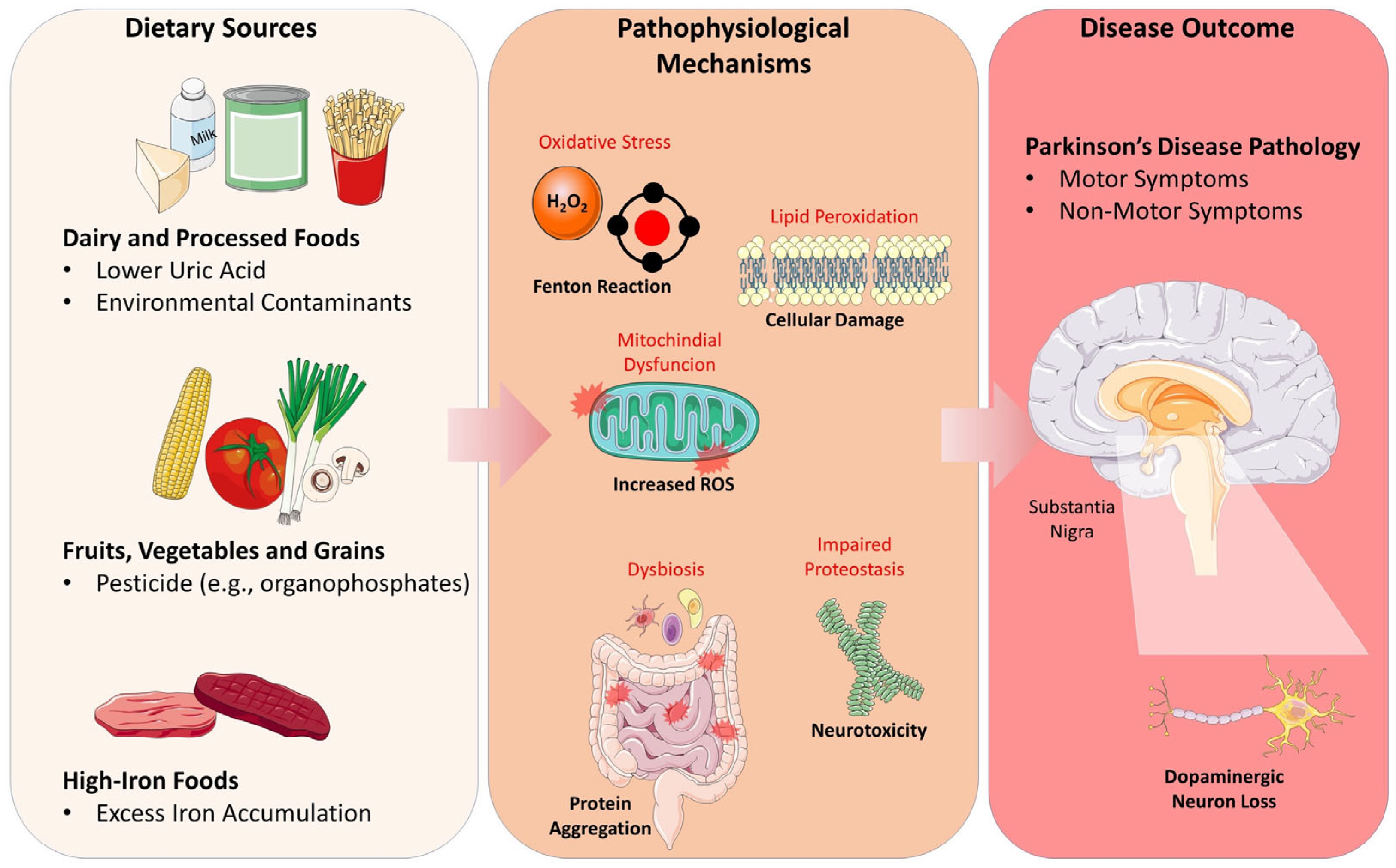
| Dopaminergic neuron loss | Degeneration of dopaminergic neurons located in the SNpc of the mesencephalus. | Striatal dopamine loss and PD motor and non-motors symptoms development [8]. |
| α-synuclein aggregation | Pathologic misfolded α-synuclein aggregation form Lewy bodies [205]. | Synaptic dysfunction and neuronal death [206]. |
| Oxidative stress | ROS formation and oxidation of macromolecules including lipids, proteins and nucleic acids [207]. | Mitocondrial dysfunction, neuroinflammation and neuronal damage [208]. |
| Mitochondrial dysfunction | Impaired endo-lysosomal-proteasome system functioning [209]. | Decline mitochondrial bioenergetics and the subsequent triggering of stress-mediated apoptotic cascade [210]. |
| Endolysosomal impairment | Caused by oxidative stress, GBA1 mutations and α-synuclein aggregation [211]. | Disruption of proteostasis, autophagy, and mitophagy, leading to the accumulation of misfolded proteins such as α-synuclein and damaged mitochondria with consequent neurodegeneration [212]. |
| Synaptic dysfunction | As a consequence of the aforementioned mechanisms but especially α-synuclein deposition [213]. | Axonal damage, connectome dysfunction and neurodegeneration [213]. |
| Nutritional Risk Factors | Mechanisms |
|---|---|
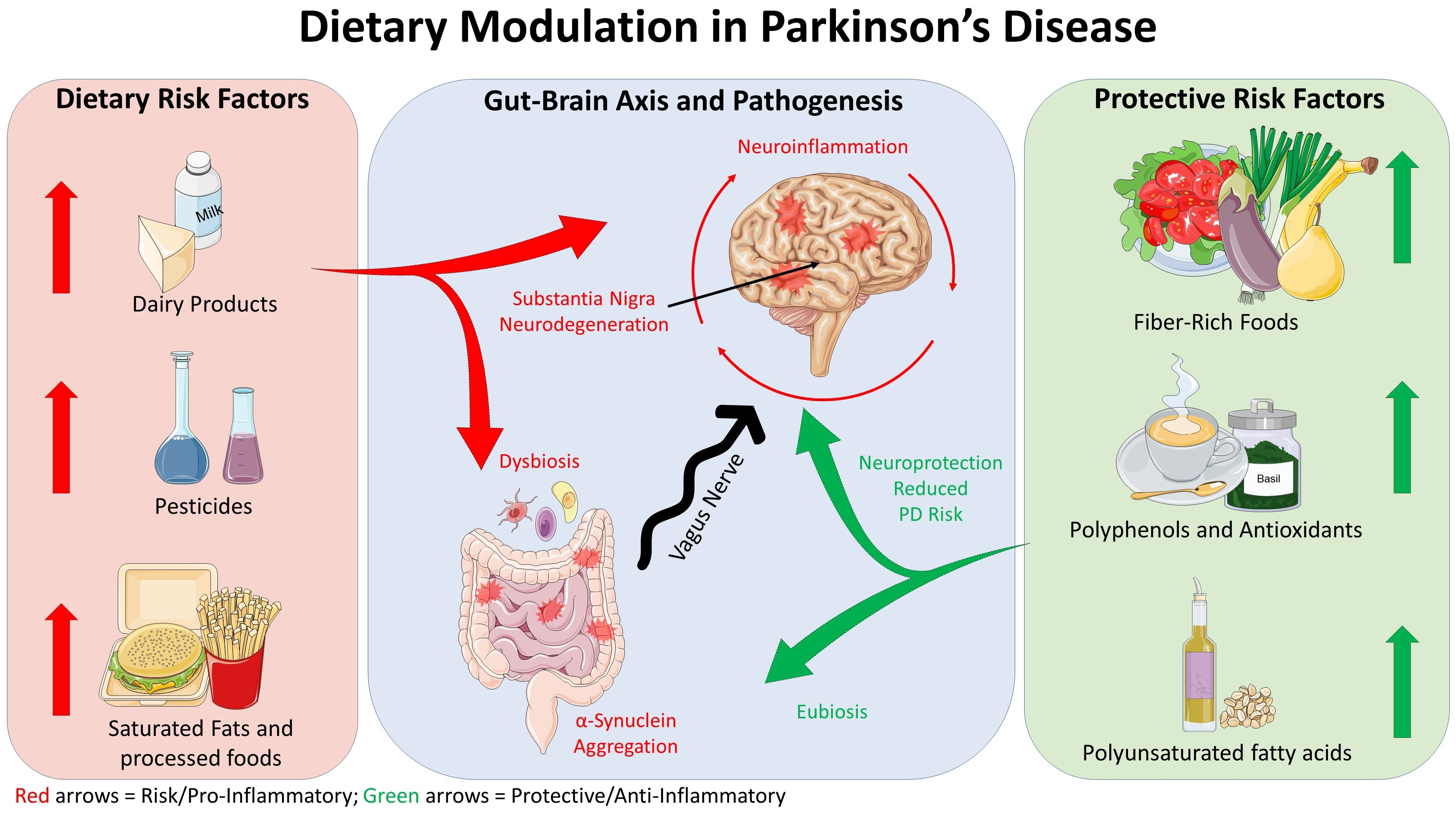
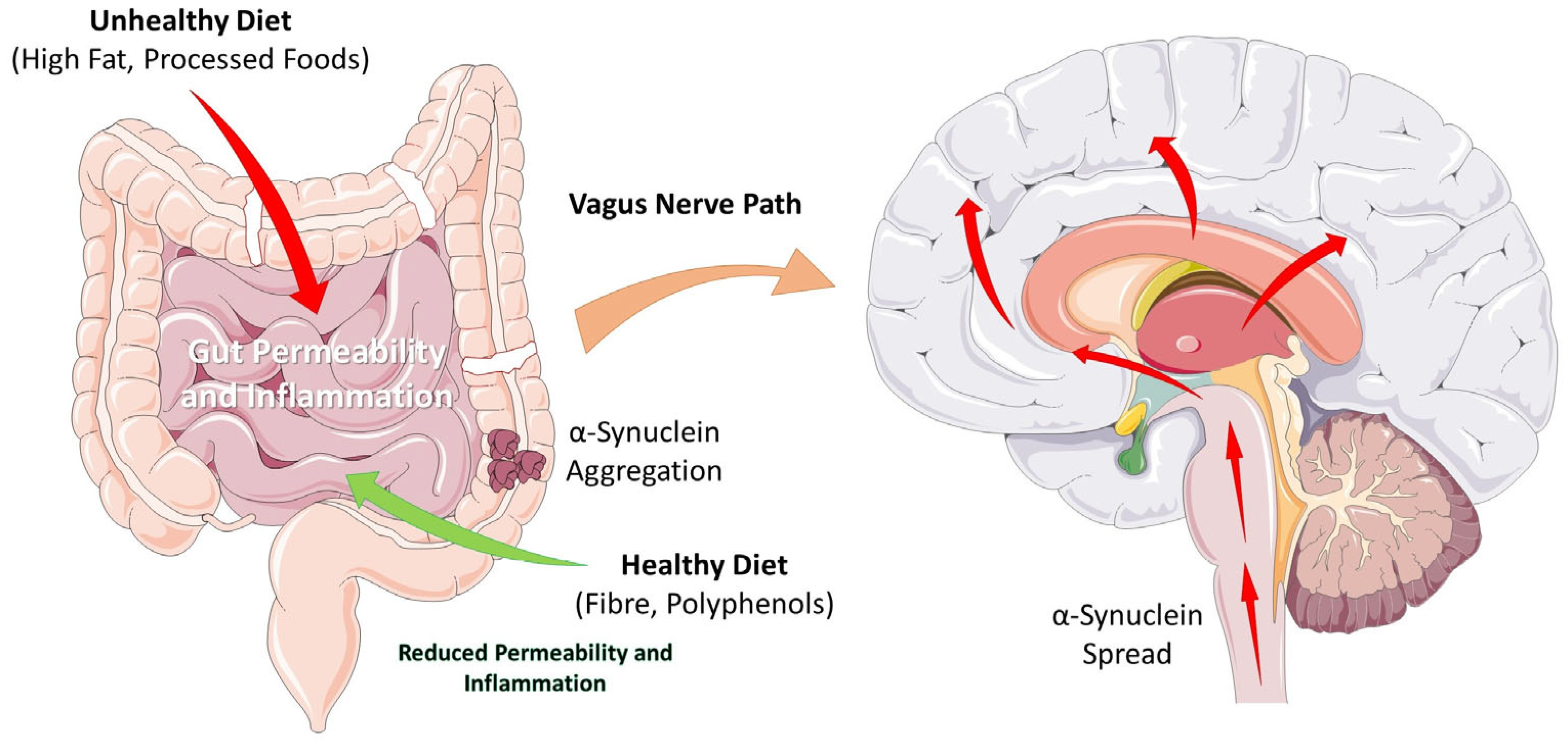
| Meat and its derivatives | Several dietary factors linked to animal-based products have been implicated in PD, including saturated fatty acids (SFAs) [18] and heterocyclic amines (HCAs), which demonstrate specific neurotoxicity toward dopaminergic (DA) neurons [22]. Additionally, these dietary sources may facilitate the introduction of exogenous α-synuclein [23] and promote gut microbiota dysbiosis [26], thereby fostering a pro-inflammatory environment conducive to neurodegeneration. |
| Seafoods | Chronic exposure to elevated levels of heavy metals may significantly contribute to PD pathogenesis through several mechanisms. Specifically, these contaminants exhibit high affinity for dopamine D2 receptors [39], and promote the misfolding and presynaptic aggregation of α-synuclein [40]. Furthermore, heavy metal-induced disruption of blood–brain barrier (BBB) integrity [41] exacerbate neuronal vulnerability by allowing systemic toxins penetrating the brain parenchyma. |
| Dairy products and low UA levels | The association between dairy intake and PD may be driven by a synergistic toxicological profile. This includes exposure to bioaccumulated pesticides and D-galactose induced mitochondrial dysfunction [58]. Moreover, dairy protein intake can lead to a significant reduction in serum uric acid (UA) concentrations [59], reducing the amount of circulating antioxidants that can counteract dopaminergic loss. |
| Dietary fat intake | Dietary saturated fatty acids (SFAs) can act as potent triggers for low-grade chronic inflammation [19,61]. This proinflammatory environment fuels oxidative stress [63], further contributing to DA neuron degeneration. |
| Pesticides | Some pesticides can act like neurotoxicants: paraquat, rotenone, and several organochlorines have been identified as significant environmental risk factors for PD [71,72]. Their mechanisms of action include mitochondrial dysfunction, inflammation, DNA methylation, altered calcium transient [75] and intestinal dysbiosis [76], with all mechanisms further contributing to neurodegeneration. |
| Nutritional Protective Factors | Mechanisms |
|---|---|
| Flavonoids | Neuroprotective phytonutrients are capable of reducing α-synuclein aggregation [103] and mitigating oxidative stress. These compounds also promote a healthy gut microbiota composition [123]. Specifically, anthocyanins exhibit significant neuroprotective properties toward dopaminergic (DA) neurons by enhancing mitochondrial bioenergetics, scavenging reactive oxygen species (ROS), and preserving membrane integrity, which collectively contribute to the rescue of DA neurons in PD models [114]. |
| Coffee | The neuroprotective role of caffeine is primarily attributed to its antagonism on adenosine A2A receptors, a mechanism that mitigates neuroinflammation and excitotoxicity in DA neurons [131]. Additionally, caffeine can contribute to proteostasis by inhibiting α-synuclein aggregation [132], and can enhance cellular defenses through its intrinsic antioxidant properties [133]. |
| Edible Solanaceae | Nicotine has been found to suppress α-synuclein aggregation [147], while various other alkaloids identified in dietary sources demonstrated significant neuroprotective and anti-inflammatory properties [146,153]. |
Disclaimer/Publisher’s Note: The statements, opinions and data contained in all publications are solely those of the individual author(s) and contributor(s) and not of MDPI and/or the editor(s). MDPI and/or the editor(s) disclaim responsibility for any injury to people or property resulting from any ideas, methods, instructions or products referred to in the content. |
© 2026 by the authors. Licensee MDPI, Basel, Switzerland. This article is an open access article distributed under the terms and conditions of the Creative Commons Attribution (CC BY) license.
Share and Cite
Trezzi, I.; Rizzo, G.; Giampieri, F.; Battino, M.; Baroni, L. Exploring the Role of Food and Food-Related Compounds in Parkinson’s Disease. Foods 2026, 15, 514. https://doi.org/10.3390/foods15030514
Trezzi I, Rizzo G, Giampieri F, Battino M, Baroni L. Exploring the Role of Food and Food-Related Compounds in Parkinson’s Disease. Foods. 2026; 15(3):514. https://doi.org/10.3390/foods15030514
Chicago/Turabian StyleTrezzi, Ilaria, Gianluca Rizzo, Francesca Giampieri, Maurizio Battino, and Luciana Baroni. 2026. "Exploring the Role of Food and Food-Related Compounds in Parkinson’s Disease" Foods 15, no. 3: 514. https://doi.org/10.3390/foods15030514
APA StyleTrezzi, I., Rizzo, G., Giampieri, F., Battino, M., & Baroni, L. (2026). Exploring the Role of Food and Food-Related Compounds in Parkinson’s Disease. Foods, 15(3), 514. https://doi.org/10.3390/foods15030514