Article

Study of Fermentation Conditions Optimization for Xylanase Production by Aspergillus tubingensis FS7Y52 and Application in Agricultural Wastes Degradation


1
School of Food and Health, Beijing Technology and Business University, Beijing 100048, China
2
Guangxi Key Laboratory of Agricultural Resources Chemistry and Biotechnology, Yulin 537000, China
*
Authors to whom correspondence should be addressed.
Foods 2026, 15(2), 399; https://doi.org/10.3390/foods15020399
Submission received: 9 November 2025 / Revised: 8 December 2025 / Accepted: 13 December 2025 / Published: 22 January 2026

Abstract

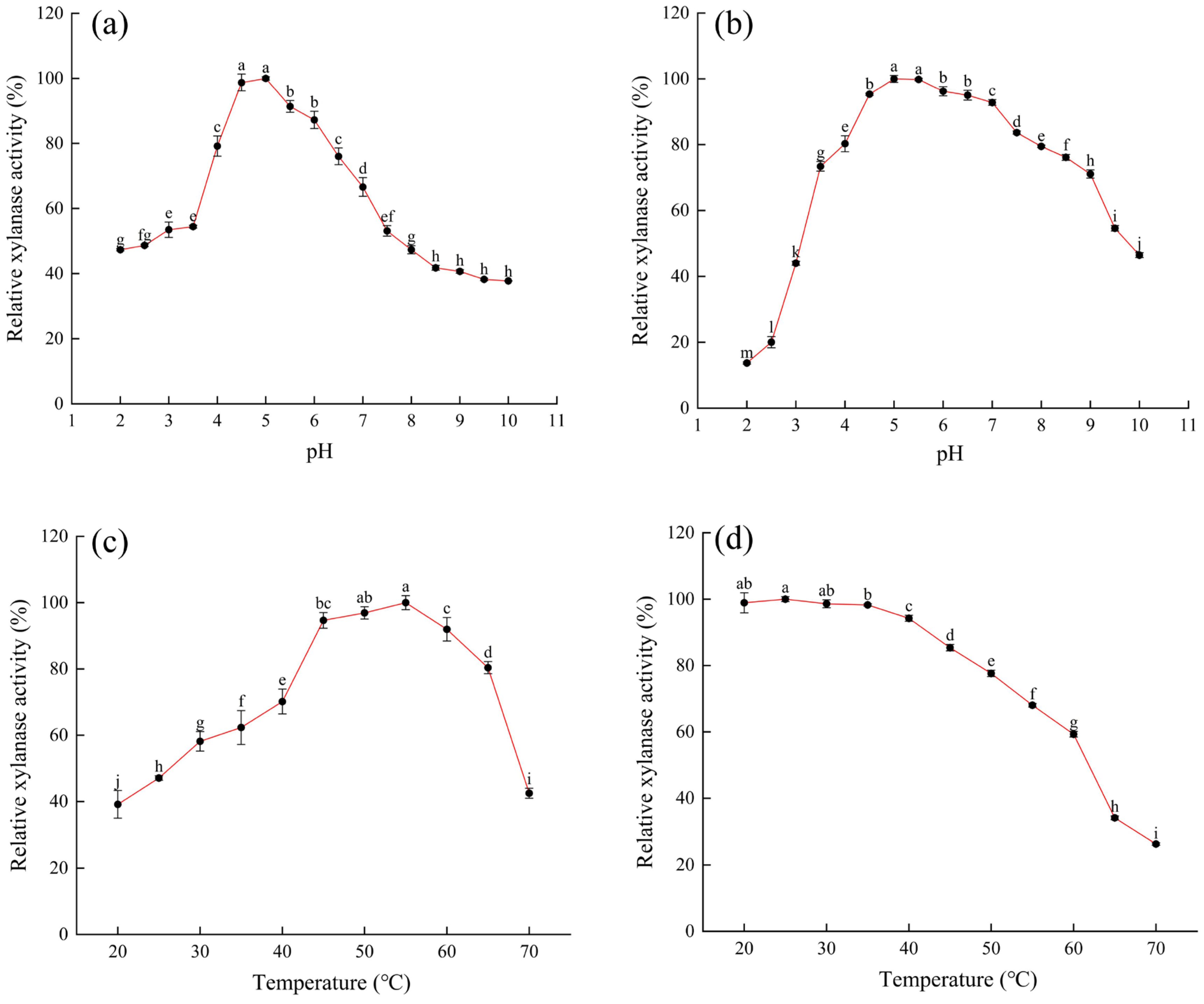
This study aimed to systematically optimize the fermentation process for xylanase production by Aspergillus tubingensis FS7Y52, elucidate its enzymatic properties, and evaluate its application potential in the biodegradation of agricultural wastes. Key influencing factors were initially identified through single-factor experiments, followed by the screening of significant factors using the Plackett–Burman design. The optimal values were then approached employing the steepest ascent path method and Response Surface Methodology. The final determined optimal fermentation conditions were: corn husk (20–40 mesh) 40 g/L, tryptone 13.7 g/L, Tween-20 0.75 g/L, pH 6.5, fermentation temperature 42.1 °C, fermentation time 2 days, shaking speed 140 rpm, inoculum size 1 × 10⁷ spores/30 mL, and liquid loading volume 30 mL/250 mL. Under these conditions, xylanase activity reached 115.23 U/mL, representing a significant increase of 90.7% compared to pre-optimization levels. Studies on enzymatic properties revealed that the enzyme exhibited maximum activity at pH 5.0 and 55 °C, and demonstrated good stability within the pH range of 4.5–7.0 and at temperatures below 50 °C. In the degradation of agricultural waste, the enzyme system produced by this strain exhibits significant degradation effects on agricultural waste. A pronounced additive effect exists between xylanase and cellulase. When the dosages were 2430 U/g and 15.7 U/g for xylanase and cellulase, respectively, the maximum reducing sugar release reached 23.3%. The degradation rates of cellulose, hemicellulose, and lignin reached 57.8%, 51.9%, and 55.0%, respectively. Additionally, the strain itself exhibits significant degradation effects on substances such as cellulose in agricultural waste, achieving degradation rates of 78.8%, 70.8%, and 52.5% for cellulose, hemicellulose, and lignin, respectively. This study provides a solid theoretical foundation and technical support for the efficient production of xylanase by A. tubingensis and its industrial application in the resource utilization of agricultural wastes. From an economic perspective, the optimized strategy significantly enhances enzyme production efficiency while reducing substrate consumption and operational costs per unit of enzyme produced. This makes the resulting enzyme mixture more economically viable for large-scale applications. The utilization of this enzyme system to convert tobacco stems into sugars represents a compelling case for agricultural wastes reuse. It transforms residual biomass into high-value products, contributing to a circular bioeconomy by reducing waste and creating new renewable alternatives to conventional products. It provides an economically viable solution for the high-value utilization of woody lignocellulosic biomass.
Keywords: optimization; fermentation conditions; xylanase; Aspergillus tubingensis; agricultural waste degradation optimization; fermentation conditions; xylanase; Aspergillus tubingensis; agricultural waste degradation