Meat Analog Products: Current Worldwide Scenario and Future Perspectives in Consumption and Regulation

 , , and
Abstract
1. Introduction
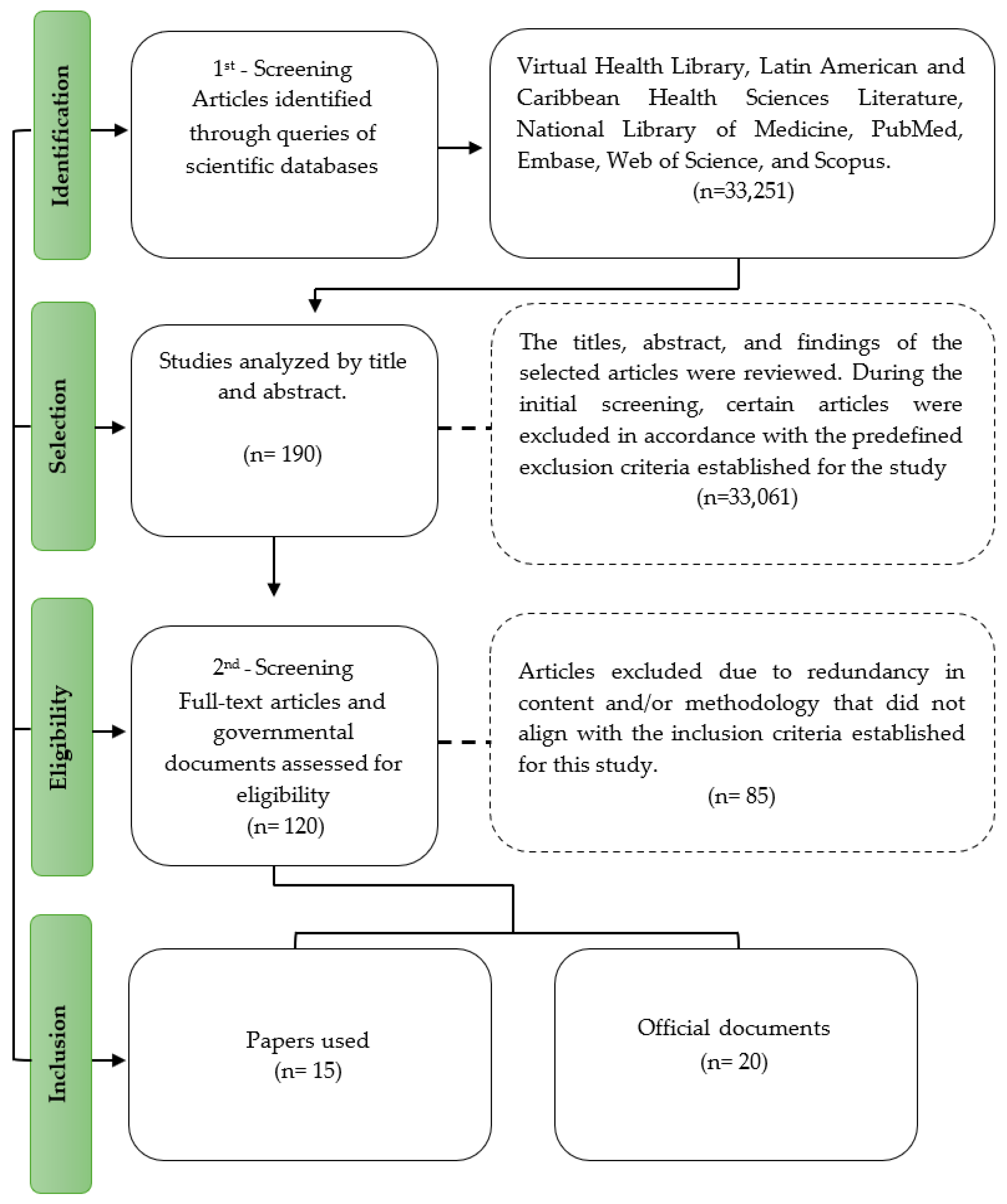
2. Methodology
3. Changes in Adherence to Plant-Based Diets
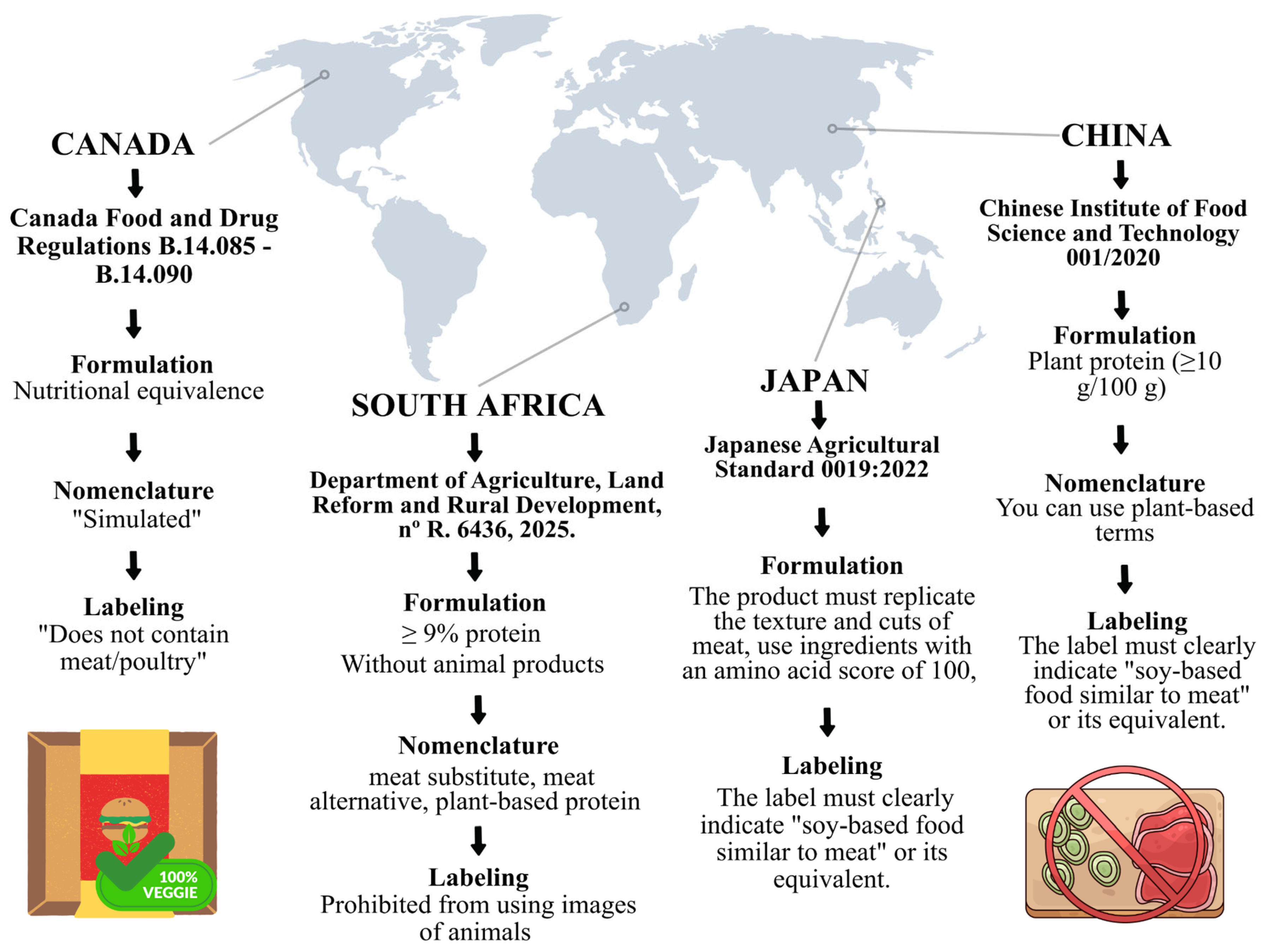
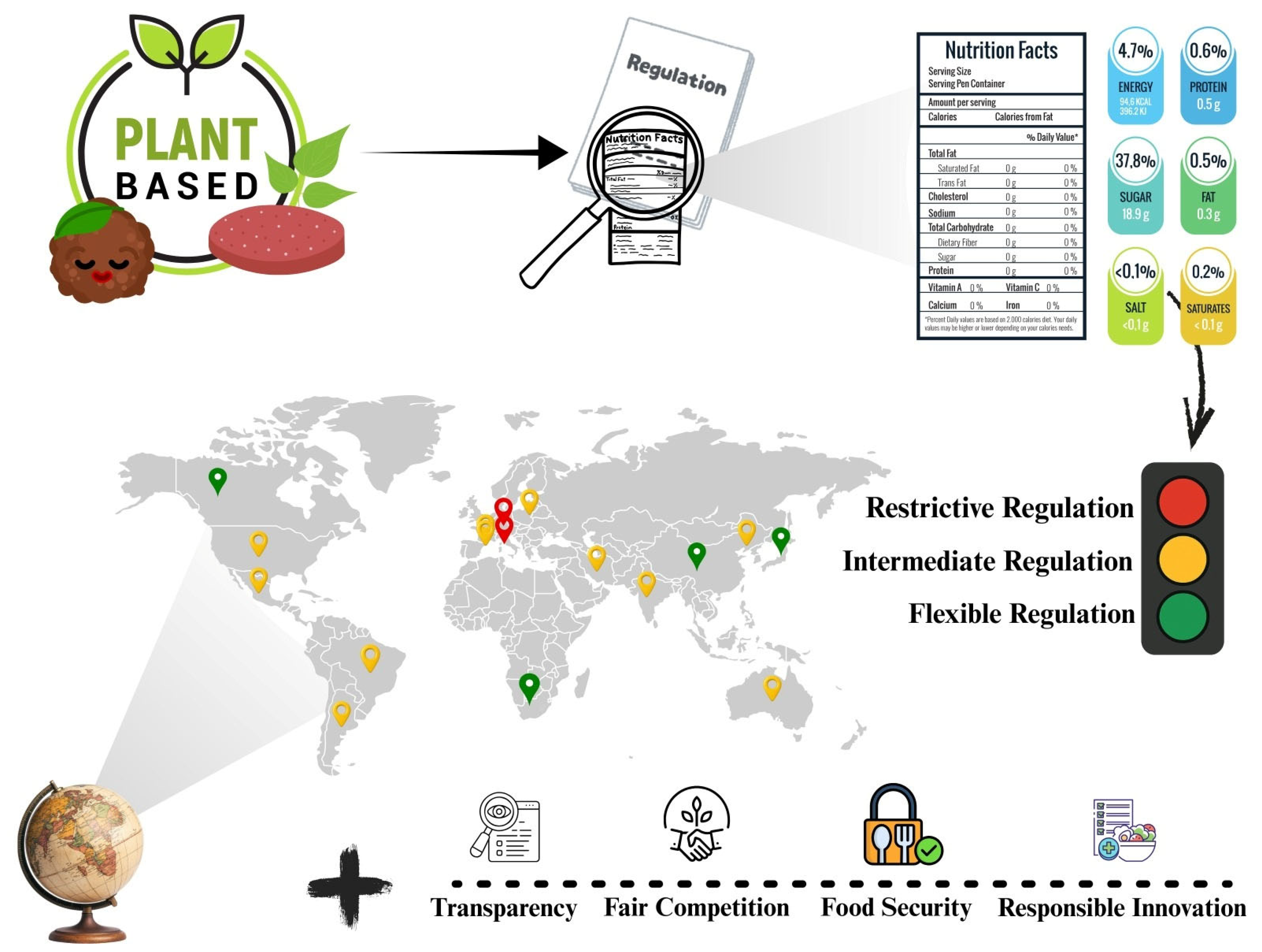
4. Regulation for Meat Analogs
5. Study Limitations and Future Perspectives
6. Final Considerations
Author Contributions
Funding
Institutional Review Board Statement
Informed Consent Statement
Data Availability Statement
Conflicts of Interest
References
- FAO. Food-Based Dietary Guidelines; Food and Agriculture Organization of the United Nations: Rome, Italy, 2022; Available online: https://www.fao.org/nutrition/nutrition-education/food-dietary-guidelines/en/ (accessed on 18 July 2024).
- Pintado, T.; Delgado-Pando, G. Towards More Sustainable Meat Products: Extenders as a Way of Reducing Meat Content. Foods 2020, 9, 1044. [Google Scholar] [CrossRef] [Scilit]
- Kononiuk, A.D.; Karwowska, M. Bioactive Compounds in Fermented Sausages Prepared from Beef and Fallow Deer Meat with Acid Whey Addition. Molecules 2020, 25, 2429. [Google Scholar] [CrossRef] [Scilit] [PubMed]
- Parlasca, M.C.; Qaim, M. Meat Consumption and Sustainability. Annu. Rev. Resour. Econ. 2022, 14, 17–41. [Google Scholar] [CrossRef] [Scilit]
- EAT Forum. Diets for a Better Future—The EAT-Lancet Commission on Food, Planet, Health. 2020. Available online: https://eatforum.org/wp-content/uploads/2025/08/Diets-for-a-Better-Future_G20_National-Dietary-Guidelines.pdf (accessed on 15 October 2025).
- FAO. Meat Market Review: Overview of Global Meat Market in 2023; Food and Agriculture Organization of the United Nations: Rome, Italy, 2024; Available online: https://openknowledge.fao.org/handle/20.500.14283/cd0465en (accessed on 25 July 2024).
- Capasso, M.; Guidetti, M.; Bianchi, M.; Cavazza, N.; Caso, D. Enhancing intentions to reduce meat consumption: An experiment comparing the role of self-and social pro-environmental identities. J. Environ. Psychol. 2025, 101, 102494. [Google Scholar] [CrossRef] [Scilit]
- Alcorta, A.; Porta, A.; Tárrega, A.; Alvarez, M.D.; Vaquero, M.P. Foods for Plant-Based Diets: Challenges and Innovations. Foods 2021, 10, 293. [Google Scholar] [CrossRef] [Scilit]
- Aschemann-Witzel, J.; Gantriis, R.F.; Fraga, P.; Perez-Cueto, F.J.A. Plant-based food and protein trend from a business perspective: Markets, consumers, and the challenges and opportunities in the future. Crit. Rev. Food Sci. Nutr. 2021, 61, 3119–3128. [Google Scholar] [CrossRef] [Scilit]
- Lantern. The Green Revolution 2019. Available online: http://www.lantern.es/papers/the-green-revolution-2019 (accessed on 27 October 2025).
- Begho, T.; Zhu, Y. Where are we now with meat alternatives? Global insights and strategic lessons for UK’s net-zero goals through agri-food system transition. Clean. Food Syst. 2025, 1, 100001. [Google Scholar] [CrossRef] [Scilit]
- Chen, L.; Lin, X.; Xia, Y. Plant-based meat alternatives: Advancements in ingredients, processing, consumer perception, and future directions. J. Future Foods 2025, 6, 374–388. [Google Scholar] [CrossRef] [Scilit]
- Curtain, F.; Grafenauer, S. Plant-Based Meat Substitutes in the Flexitarian Age: An Audit of Products on Supermarket Shelves. Nutrients 2019, 11, 2603. [Google Scholar] [CrossRef] [Scilit]
- Clark, M.A.; Springmann, M.; Hill, J.; Tilman, D. Multiple health and environmental impacts of foods. Proc. Natl. Acad. Sci. USA 2019, 116, 23357–23362. [Google Scholar] [CrossRef] [Scilit]
- De Camargos, F.C.; Carvalho, N.B.; Ribeiro, B.G.S.; Muniz, L.d.S.; da Silva, V.M. Alimentos plant based: Análise da percepção do consumidor pelo uso de Word Association. Braz. J. Dev. 2023, 9, 16915–16934. [Google Scholar] [CrossRef] [Scilit]
- Ishaq, A.; Irfan, S.; Sameen, A.; Khalid, N. Plant-based meat analogs: A review with reference to formulation and gastrointestinal fate. Curr. Res. Food Sci. 2022, 5, 973–983. [Google Scholar] [CrossRef] [Scilit] [PubMed]
- Da Conceicao das Mercês, Z.; Maldaner Salvadori, N.; Melo Evangelista, S.; Barbieri Cochlar, T.; de Oliveira Rios, A.; Ruffo de Oliveira, V. Hybrid and Plant-Based Burgers: Trends, Challenges, and Physicochemical and Sensory Qualities. Foods 2024, 13, 3855. [Google Scholar] [CrossRef] [Scilit] [PubMed]
- Hocquette, J.F.; Chriki, S.; Fournier, D.; Ellies-Oury, M.P. Review: Will “cultured meat” transform our food system towards more sustainability? Animal 2025, 19, 101145. [Google Scholar] [CrossRef] [Scilit]
- Kłobukowski, F.; Śmiechowska, M.; Skotnicka, M. Edible Insects from the Perspective of Sustainability—A Review of the Hazards and Benefits. Foods 2025, 14, 1382. [Google Scholar] [CrossRef] [Scilit]
- Da Conceicao das Mercês, Z.; Maldaner Salvadori, N.M.; Melo Evangelista, S.; Barbieri Cochlar, T.; da Silva Medeiros, C.; Hermeliono Lima, R.G.; Soares Bandeira, A.; Fortunato de Souza, A.K.; de Oliveira Rios, A.; Ruffo de Oliveira, V. Plant-Based Burgers Made with Green Banana Biomass (GBB) Associated with Teff and Chickpea Derivatives. Foods 2025, 14, 1782. [Google Scholar] [CrossRef] [Scilit]
- Salvadori, N.M.; da Conceição das Mercês, Z.; Melo Evangelista, S.; da Silva Medeiros, C.; Barbieri Cochlar, T.; Bandeira, A.S.; Hermelino Lima, R.G.; Fortunato de Souza, A.K.; de Oliveira Rios, A.; Ruffo de Oliveira, V. Physico-chemical and sensory quality of plant-based burgers made with pine nuts (Araucaria angustifolia) and green banana (Musa spp.) biomass. Int. J. Gastron. Food Sci. 2025, 41, 101254. [Google Scholar] [CrossRef] [Scilit]
- Sogari, G.; Grasso, S.; Caputo, V.; Gómez, M.I.; Mora, C.; Schouteten, J.J. Sensory, emotional, and appropriateness of plant- and meat-based burgers. J. Food Sci. 2024, 89, 2974–2990. [Google Scholar] [CrossRef] [Scilit]
- Konrad, T.; Ha, M.; Ronquest-Ross, L.; Smyth, H.E.; Moura Nadolny, J. Plant-based mince texture: A review of the sensory literature with view to informing new product development. J. Food Sci. 2024, 89, 8197–8214. [Google Scholar] [CrossRef] [Scilit]
- Talens, C.; Lago, M.; Illanes, E.; Baranda, A.; Ibargüen, M.; Santa Cruz, E. Development of the lexicon, trained panel validation and sensory profiling of new ready-to-eat plant-based “meatballs” in tomato sauce. Open Res. Eur. 2022, 2, 145. [Google Scholar] [CrossRef] [Scilit]
- Shireen, A.; Wright, A.J. The meat of the matter: Plant-based meat analogue versus traditional meat product nutritional quality. Food Sci. Hum. Wellness 2024, 13, 3110–3125. [Google Scholar] [CrossRef] [Scilit]
- Zhang, K.; Zang, M.; Wang, S.; Zhang, Z.; Li, D.; Li, X. Development of meat analogs: Focus on the current status and challenges of regulatory legislation. Compr. Rev. Food Sci. Food Saf. 2023, 22, 1006–1029. [Google Scholar] [CrossRef] [Scilit] [PubMed]
- Musa-Veloso, K.; Juana, J. Regulation and labeling of plant-based beverages and simulated meat, poultry, and egg products in Canada and the United States. Cereal Foods World 2020, 65, 44. Available online: https://www.cerealsgrains.org/publications/cfw/2020/July-August/Pages/CFW-65-4-0044.aspx (accessed on 31 July 2024). [CrossRef] [Scilit]
- Correa Garcia, E.E.; Nabeshima, E.H.; Sadahira, M.S.; Aparecida Ferrari, R.; da Silva, N.; Sarantopoulos, C.I.G.L.; Aparecida Berbari, S.; Bartoldo Pacheco, M.T. Estudo Regulatório Sobre Proteínas Alternativas no Brasil-Proteínas Vegetais. 2022. Available online: https://gfi.org.br/wp-content/uploads/2022/11/Estudo-Regulatorio-Proteinas-Vegetais-GFI-Brasil.pdf (accessed on 27 September 2023).
- Goncalves Pereira, C.; de Castro Moreira, R.E.; Afonso, P.A.; Sales Silva, A.R.C.; de Paula Penna e Palhares, M.; Carvalho de Souza, S.V.; Anastácio, L.R. Plant-based products: Analysis of international regulations and strategies used for designation and labeling in Brazil. LWT 2024, 200, 115980. [Google Scholar] [CrossRef] [Scilit]
- Yan, D.; Ahmad, S.Z.; Yang, D. Matthew effect, ABC analysis and project management of scale-free information systems. J. Syst. Softw. 2013, 86, 247–254. [Google Scholar] [CrossRef] [Scilit]
- Strasburg, V.J.; Jahno, V.D. Application of eco-efficiency in the assessment of raw materials consumed by university restaurants in Brazil: A case study. J. Clean. Prod. 2017, 161, 178–187. [Google Scholar] [CrossRef] [Scilit]
- Strasburg, V.J.; da Silva, L.Y.; Eberhardt, D.; de Sousa, B.J.; Feil, A.A.; Zandonadi, R.P. Eco-efficiency and demand of enteral diets used in patients of a Brazilian public hospital before and during the COVID-19 pandemic. Environ. Dev. Sustain. 2024, 27, 8893–8907. [Google Scholar] [CrossRef] [Scilit]
- Strasburg, V.J.; Dergazarián, S.; Nacaratto, S.; Suárez, C. Impactos Ambientales de los Patrones del Menú de un Hospital Universitario en Uruguay. Rev. Contexto Saúde 2024, 24, e14133. [Google Scholar] [CrossRef] [Scilit]
- Sullivan, V.K.; Martínez-Steele, E.; Garcia-Larsen, V.; Rebholz, C.M. Trends in Plant-Based Diets among United States Adults, 1999–March 2020. J. Nutr. 2024, 154, 3575–3584. [Google Scholar] [CrossRef] [Scilit]
- Strässner, A.-M.; Hartmann, C. Gradual behaviour change towards meat reduction: Development and validation of a novel decisional balance scale. Appetite 2023, 186, 106537. [Google Scholar] [CrossRef] [Scilit]
- Rizzo, G.; Testa, R.; Cubero Dudinskaya, E.; Mandolesi, S.; Solfanelli, F.; Zanoli, R.; Schifani, G.; Migliore, G. Understanding the consumption of plant-based meat alternatives and the role of health-related aspects. A study of the Italian market. Int. J. Gastron. Food Sci. 2023, 32, 100690. [Google Scholar] [CrossRef] [Scilit]
- Jeżewska-Zychowicz, M.; Sajdakowska, M.; Gębski, J.; Kosicka-Gębska, M.; Gutkowska, K. Predictors of Eating Less Meat and More Plant-Based Food in the Polish Sample. Nutrients 2024, 16, 1646. [Google Scholar] [CrossRef] [Scilit] [PubMed]
- Ford, H.; Gould, J.; Danner, L.; Bastian, S.E.P.; Yang, Q. “I guess it’s quite trendy”: A qualitative insight into young meat-eaters’ sustainable food consumption habits and perceptions towards current and future protein alternatives. Appetite 2023, 190, 107025. [Google Scholar] [CrossRef] [Scilit] [PubMed]
- Tan, N.P.-J.; Graça, J.; Hopwood, C.J. Familiarity and satisfaction with plant-based meat alternatives around the world. Future Foods 2025, 11, 100597. [Google Scholar] [CrossRef] [Scilit]
- Lima, D.C.; Noguera, N.H.; Rezende-de-Souza, J.H.; Pflanzer, S.B. What are Brazilian plant-based meat products delivering to consumers? A look at the ingredients, allergens, label claims, and nutritional value. J. Food Compos. Anal. 2023, 121, 105406. [Google Scholar] [CrossRef] [Scilit]
- Demartini, E.; Vecchiato, D.; Finos, L.; Mattavelli, S.; Gaviglio, A. Would you buy vegan meatballs? The policy issues around vegan and meat-sounding labelling of plant-based meat alternatives. Food Policy 2022, 111, 102310. [Google Scholar] [CrossRef] [Scilit]
- Lähteenmäki-Uutela, A.; Rahikainen, M.; Lonkila, A.; Yang, B. Alternative proteins and EU food law. Food Control 2021, 130, 108336. [Google Scholar] [CrossRef] [Scilit]
- Monaco, A. Regulatory Barriers and Incentives for Alternative Proteins in the European Union and Australia–New Zealand. Br. Food J. 2025, 127, 171–189. [Google Scholar] [CrossRef] [Scilit]
- Visagie, J. The Regulation of Product Names for Meat Analogue Foods in South America. THRHR 2024, 87, 156. [Google Scholar]
- Codex Alimentarius. General Standard for Vegetable Protein Products (CXS 174-1989, Rev. 2022). Food and Agriculture Organization of the United Nations (FAO). 2022. Available online: https://www.fao.org/fao-who-codexalimentarius/sh-proxy/en/?lnk=1&url=https%3A%2F%2Fworkspace.fao.org%2Fsites%2Fcodex%2FStandards%2FCXS%2B174-1989%2FCXS_174e.pdf (accessed on 28 September 2024).
- ISO 23662:2021; Definitions and Technical Criteria for Foods and Food Ingredients Suitable for Vegetarians or Vegans and for Labelling and Claims. International Organization for Standardization: Geneva, Switzerland, 2021.
- Joint Resolution 5/2022 of the Secretariat of Health Quality and the Secretariat of Food, Bioeconomy and Regional Development, Republic of Argentina—Official Gazette of the Argentine Republic. 28 July 2022. Available online: https://www.boletinoficial.gob.ar/#!DetalleNorma/267781/20220802 (accessed on 1 August 2024).
- F2021C00202, C04; Standard 1.2.3—Information Requirements—Warning Statements, Advisory Statements and Declarations. Australia New Zealand Food Standards: Canberra, Australia, 2021.
- Brazil Ministry of Agriculture, Livestock and Supply, Secretariat of Agricultural Defense. Ordinance No. 1176, of 4 September 2024; No. 174; Official Gazette of the Union: Brasília, Brazil, 2024; p. 45. [Google Scholar]
- European Union. Regulation (EU) No 1169/2011 of the European Parliament and of the Council on the provision of food information to consumers. Off. J. Eur. Union 2011, L 304, 18–63. Available online: https://eur-lex.europa.eu/eli/reg/2011/1169/oj/eng (accessed on 19 October 2024).
- Decree No. 2022-947 of 21 February 2022, France: Prohibiting the Use of Specific Meat and Fish Terminology for Plant-Based Products. Legifrance. 2022. Available online: https://www.legifrance.gouv.fr/jorf/id/JORFTEXT000046026687 (accessed on 22 August 2024).
- France. Decree No. 2022-144 of 29 June 2022, Prohibiting the Use of Terms Such as “ham,” “meat,” “fillet,” and “entrecôte” to Designate Plant-Based Products. Legifrance. 2022. Available online: https://www.legifrance.gouv.fr (accessed on 22 August 2024).
- Eurofins. Guidelines for Vegan and Vegetarian Meat Substitutes. Eurofins Food Testing. 2024. Available online: https://www.eurofins.de/food-analysis/food-news/food-testing-news/guidelines-for-vegan-and-vegetarian-meat-substitutes/ (accessed on 24 October 2025).
- Ikigai Law. Labelling of Plant-Based Meats: Regulatory Landscape. Ikigai Law. 2022. Available online: https://www.ikigailaw.com/article/165/labelling-of-plant-based-meats-regulatory-landscape (accessed on 5 October 2025).
- Food Safety and Standards Authority of India. Food Safety and Standards (Vegan Foods) Regulations, 2022 (Notification No. F. No. Std/SP-08/Amd.02/FOOD). The Gazette of India. 2022. Available online: https://fssai.gov.in/upload/notifications/2022/06/62ac3f9dba33cGazette_Notification_Vegan_Food_17_06_2022.pdf (accessed on 26 June 2024).
- National Agency of Drug and Food Control (BPOM). Regulation No. 31/2018 on Processed food Labeling; National Agency of Drug and Food Control (BPOM): Jakarta, Indonesia, 2018. [Google Scholar]
- Ministry of Trade Indonesia. Regulation No. 29/2021 on the Labeling of Packaged Food Products; Ministry of Trade: Jakarta, Indonesia, 2021.
- Law No. 172 of 1 December 2023: Provisions on the Prohibition of Production and Placing on the Market of Food and Feed Consisting of, Isolated or Produced from Cell Cultures or Tissues Derived from Vertebrate Animals, as Well as on the Prohibition of the Designation of Meat for Processed Products Containing Vegetable Proteins—Gazzetta Ufficiale della Repubblica Italiana. Available online: https://www.gazzettaufficiale.it/eli/id/2023/12/01/23G00188/sg (accessed on 26 June 2024).
- Norma Oficial Mexicana, Especificaciones Generales de Etiquetado para Alimentos y Bebidas no Alcohólicas Preenvasados—Información Comercial y Sanitaria (NOM-051-SCFI/SSA1-2010); Secretaría de Economía e Secretaría de Salud: Ciudad de Mexico, Mexico, 2020.
- Ayala, D. Russian Federation: Food and Agricultural Import Regulations and Standards Country Report—United States Department of Agriculture, Foreign Agricultural Service. 2021. Available online: https://agriexchange.apeda.gov.in/ImportRegulations/FoodandAgriculturalImportRegulationsandStandardsReportMoscowRussianFederation2132019.pdf (accessed on 16 August 2024).
- Labeling of Prepackaged Food Stuff (GSO 9/2013), Saudi Arabia—Food and Drug Authority. 2013. Available online: https://servicio.mapama.gob.es/cexgan/DocumentacionPublica/GSO-9-2013-E.pdf (accessed on 2 August 2024).
- Neo, P. Legislation Development: South Korea Launches Public Consultation on Food Standards for Alternative Protein Products—Food Navigator. 2023. Available online: https://www.foodnavigator-asia.com/Article/2023/02/01/south-korea-launches-public-consultation-on-food-standards-for-alternative-protein-products (accessed on 20 October 2024).
- Türk Gida Kodeksi Yönetmeliği Birinci Bölüm Amaç, Kapsam, Dayanak ve Tanımlar—Food and Agriculture Organization of the United Nations. 2020. Available online: https://faolex.fao.org/docs/pdf/tur193956.pdf (accessed on 20 October 2024).
- PAS 224:2020; 100% Plant-Based Foods: Characteristics and Composition. Code of Practice. British Standards Institution: London, UK, 2020. Available online: https://knowledge.bsigroup.com/products/100-plant-based-foods-characteristics-and-composition-code-of-practice (accessed on 5 August 2024).
- United Nations. World Population Prospects—Population Division—United Nations. Un.org; United Nations—Department of Economic and Social Affairs. 2019. Available online: https://population.un.org/wpp (accessed on 5 October 2025).
- United States Congress. Real Marketing Edible Artificials Truthfully Act of 2019. Available online: https://www.congress.gov/116/bills/s3016/BILLS-116s3016is.xml (accessed on 5 August 2024).
- Seehafer, A.; Bartels, M. Meat 2.0—The regulatory environment of plant-based and cultured meat. Eur. Food Feed Law Rev. 2019, 14, 323–331. Available online: https://effl.lexxion.eu/article/EFFL/2019/4/5 (accessed on 28 October 2024).
- Kumar, P.; Mehta, N.; Abubakar, A.A.; Verma, A.K.; Kaka, U.; Sharma, N.; Sazili, A.Q.; Pateiro, M.; Kumar, M.; Lorenzo, J.M. Potential alternatives of animal proteins for sustainability in the food sector. Food Rev. Int. 2023, 39, 5703–5728. [Google Scholar] [CrossRef] [Scilit]
- Laureati, M.; de Boni, A.; Saba, A.; Lamy, E.; Minervini, F.; Delgado, A.M.; Sinesio, F. Determinants of Consumers’ Acceptance and Adoption of Novel Food in View of More Resilient and Sustainable Food Systems in the EU: A Systematic Literature Review. Foods 2024, 13, 1534. [Google Scholar] [CrossRef] [Scilit] [PubMed]
- Baker, P.; Machado, P.; Santos, T.; Sievert, K.; Backholer, K.; Hadjikakou, M.; Russell, C.; Huse, O.; Bell, C.; Scrinis, G.; et al. Ultra-processed foods and the nutrition transition: Global, regional and national trends, food systems transformations and political economy drivers. Obes. Rev. Off. J. Int. Assoc. Study Obes. 2020, 21, e13126. [Google Scholar] [CrossRef] [Scilit]
- Caputo, V.; Sun, J.; Staples, A.J.; Taylor, H. Market outlook for meat alternatives: Challenges, opportunities, and new developments. Trends Food Sci. Technol. 2024, 148, 104474. [Google Scholar] [CrossRef] [Scilit]
- Kraak, V.; Kapur, M.; Thamilselvan, V.; Lartey, A. Policy Insights from High-Income Countries to Guide Safe, Nutritious, and Sustainable Alternative Proteins for Low-and Middle-Income Countries. Curr. Dev. Nutr. 2024, 8, 101995. [Google Scholar] [CrossRef] [Scilit]
- Karmaus, A.L.; Jones, W. Future foods symposium on alternative proteins: Workshop proceedings. Trends Food Sci. Technol. 2021, 107, 124–129. [Google Scholar] [CrossRef] [Scilit]



| (“meat substitute*” OR “meat substitutes*” OR “meat analog*” OR “meat analogue*” OR “meat alternative*” OR “meat alternatives*” OR “meat-free product*” OR “meat free product*” OR “simulated meat*” OR “meat-like” OR “meat-like product*” OR “plant-based” OR “plant based” OR “plant-based meat*” OR “vegetable protein*” OR “non-animal protein*” OR “non animal protein*” OR “alternative protein*” OR “unconventional protein*” OR vegan*) |
| “Meat Substitutes” [Mesh] OR “meat analog*” OR “meat analogue*” OR “meat substitute*” OR “meat alternative*” OR “plant-based meat*”) AND (“Legislation, Food” [Mesh] OR “Food Standards” [Mesh] OR legislat* OR law* OR regulat* OR “food regulation*” OR regulament*) |
| (“meat analog*” OR “meat analogue*” OR “meat substitute*” OR “meat alternative*” OR “meat-free product*” OR “plant-based meat*” OR “simulated meat*” OR “meat-like product*”) AND (“food packaging” OR packaging OR label* OR labelling OR labeling OR “nutrition label*” OR “nutrition labelling” OR “nutritional inform*” OR “nutrition facts” OR “nutritional facts” OR “nutrition declaration” OR “front-of-pack*” OR “front of pack”) |
| (“meat analog*” OR “meat analogue*” OR “plant-based meat*” OR “meat substitute*”) AND (label* OR “nutrition label*” OR “nutritional inform*” OR “nutrition facts”) |
| (“Meat Substitutes” [Mesh] OR “Plant-Based Diet” [Mesh] OR “meat analog*” OR “meat substitute*” OR “plant-based meat*”) AND (“Food Consumption” [Mesh] OR “Consumer Behavior” [Mesh] OR “Feeding Behavior” [Mesh] OR “consumer trend*” OR “consumer perception*” OR “purchase intention*”) |
| References/Year/Country | Studies | Consumption Indicator | Key Findings |
|---|---|---|---|
| Sullivan et al. [34] United States | Cross-sectional series (National Health and Nutrition Examination Survey 1999–2020; n = 51,698). | Time-based evolution of plant-based diets (≥50% plant protein) according to 24 h dietary recall. | The proportion of adults in the United States consuming plant-based diets increased from 14.4%. The quality of plant-based diets, as measured by Healthy Eating Index (HEI)-2020 scores, improved from 52.1% to 55.8%. |
| Strässner et al. [35] Germany | Validation/scale studies with consumers. | Behavioral changes to reduce meat consumption and adopt plant-based diets. | The study presents evidence on the effectiveness of a new Power Dialogue (PD) scale in reducing meat consumption, supported by psychometric validation. The research identified two superior factors and five inferior factors, suggesting that highlighting the benefits of a plant-based diet and minimizing perceived disadvantages may be effective strategies for motivating consumers to reconsider their eating habits in relation to meat. Among the barriers are health, legitimacy, and viability barriers of plant-based products. |
| Rizzo et al. [36] Italy | Consumer study (focus on habits) | Consumption of plant-based meat alternatives | The survey was conducted with people over the age of 18 and had 1142 participants. Among eligible participants (n = 874), 176 (20.14%) reported consuming these products at least two to three times a week. The survey emphasized the importance of public policies, marketing strategies, and labeling related to plant-based products. The results indicate that these dimensions play a key role in how consumers perceive and select plant-based products. |
| Jeżewska-Zychowicz et al. [37] Poland | Survey with adults (n = 1003) | Demonstration of interest in reducing meat consumption and increasing plant intake. | The regular frequency of plant-based food consumption, the negative feelings toward meat, and the environmental identity stimulated the consumer’s intention to consume more plant-based foods and less meat. On the other hand, the pleasure of eating animal meat was reduced. |
| Ford et al. [38] United Kingdom | Focus groups (young consumers) | Current habits: reduction in meat consumption and use of alternative proteins | Reducing and/or eliminating meat consumption was the most frequently mentioned change in eating habits, reported by 63% of participants. They increased their consumption of plant-based foods as meat substitutes. Some participants mentioned that nutritional values are considered a problem for full adherence to a plant-based diet, but it was mentioned that it would be easier to reduce meat consumption since there are some very satisfactory substitutes on the market. |
| Tan et al. [39] Switzerland | Argentina, Brazil, Canada, Chile, China, Colombia, France, Germany, India, Indonesia, Italy, Japan, Malaysia, Mexico, Netherlands, Poland, Russia, Singapore, South Korea, Spain, Thailand, United Kingdom, and United States (n = 20,966). | Relationship between meat consumption and familiarity/satisfaction with plant-based products | Moderate meat consumers have greater knowledge and satisfaction with plant-based products. Variations were observed between countries, with factors such as age and meat consumption having less influence on the acceptance of these foods in Asian countries, as plant-based products are part of local food traditions. These results are relevant to better understand the factors influencing the consumption of plant-based foods and identifying effective strategies to promote plant-based diets worldwide. |
| Country | Documents | Strategies and Action Plans | Authors/Year |
|---|---|---|---|
| Argentina | Joint Resolution of the Secretary of Health Quality and the Secretary of Food, Bioeconomy, and Regional Development No. 5/2022 | Nomenclature: The use of official designations for animal-derived foods is prohibited, except to indicate aroma or flavor, and it is permitted to use terms that merely evoke them. Labeling: Products without animal-derived ingredients can display labels such as “100% plant-based,” provided that this indication appears prominently on the main face, alongside the product name. | Republic of Argentina [47] |
| Australia | Food Standards Australia New Zealand (ANZFS)—Information Requirements—Warning Statements, Advisory Statements, and Statements/2021 | Nomenclature: It is mandatory to declare any other name by which this food is known. Labeling: Any food sold must include the phrase “based on a protein substitute” on the front of the packaging. | Australia [48] |
| Brazil | Final version of analogous products (in public consultation until 24 September 2024) SDA MAPA Ordinance No. 1176, 4 September 2024. | Nomenclature: The labeling must be clear, precise, and in Portuguese, in accordance with the legislation. Labeling: On the main panel, use “Vegetal analog of [name of animal product]”, accompanied by the phrase “this product does not replace the corresponding animal origin product”. It is prohibited to claim sustainability, health, GMO-free, natural, or organic, except as provided by law or proven. | Brazil [49] |
| European Union | Food Information for Consumers (European Union) No. 1169/2011 | Labeling: The information on the packaging should not mislead consumers, and it should not be ambiguous or confusing. | European Union [50] |
| France | Decree nº 2022-144 | Nomenclature: Prohibits the marketing of plant-based products labeled with terms related to meat and meat products, such as “sausage,” “steak,” and “bacon”; it also prohibits the use of terms like “ham,” “meat,” “fillet,” and “loin” to designate plant-based products. | France [51,52] |
| Germany | FIC (UE) n.º 1169/2011 | Nomenclature: Terms such as “meatball” or “hamburger” can be used if there is a resemblance to the meat product. Labeling: “Vegetable meats” can only be included after a positive sensory test for appearance, taste, texture, and aroma. | Eurofins [53] Garcia et al. [28] Brazil Ikigai Law [54] |
| India | Food Safety and Standards Authority of India | Manufacturing: The production of vegan foods must occur in places free of non-vegan substances; when there is shared production line usage, complete cleaning is mandatory to avoid cross contamination. Labeling: It must comply with safety and food standards and display the approved vegan logo on the front of the packaging. | Food Safety and Standards Authority of India [55] |
| Indonesia | Regulation 25/2021 Regulation 31/2018 | Labeling: Packaged products, including meat substitutes, must have clear labels with ingredients, nutritional information, and allergens. In meat substitutes, the absence of animal meat and the list of additives and preservatives must be indicated. | Indonesia [56,57] |
| Italy | Law 172/2023 | Nomenclature: Prohibits the use of names, terms, or references related to meat, animal species, anatomy, butcher shops, delicatessens, fish markets, or animal-derived foods in non-meat products. | Italy [58] |
| Mexico | Official Mexican Standard 051-SCFI/SSA1-2010 | Nomenclature: Allows the use of additional terms to avoid consumer deception. Imitation products must display “imitation” prominently in the upper left corner of the label. The term is not allowed on items with a protected designation of origin or a recognized geographical indication. | Mexico [59] |
| Russia | The country reported on regulations and standards for the import of food and agricultural products. | No regulations were found for meat analogs. The labeling rules are governed by general food legislation. | Ayala [60] |
| Saudi Arabia | Saudi Food and Drug Authority—FD/GSO 9: 2013-2013 | Nomenclature: Products that imitate meat must contain clear information to avoid confusion with animal-origin products. Labeling: The information on the label must be presented in Arabic. | Saudi Arabia [61] |
| South Korea | Ministry of Food and Drug Safety | Updates on the establishment of legislation for alternative protein sources, including definition, specification, labeling, and safety assessment of technologies, including cultivated meat, should be implemented in 2024. | Neo [62] |
| Turkey | Food Code—2020 | No specific regulation for meat analogs. The Codex restricts products that give the impression that cheese is produced with vegetable oil or other food ingredients. | Turkey [63] |
| United Kingdom | British Standard Institution—Public Specification Available 224/2020 | Formulation: For those formulated with whole grains, nuts, seeds, and fruits, the use of any ingredient or product of animal origin is restricted. | British Standards Institution [64] |
| USA | Real Marketing Comestible Artificially Truthfully Act of 2019. | Nomenclature: meat imitation products can only be sold if the label prominently features the word “imitation” alongside the name and declares that they do not contain meat. Alternative foods are defined as “special dietary and nutritional additives,” including “plant-based edibles,” “soy-based,” or “plant protein products.” | United Nations. [65] United States Congress [66] |
| Regulatory Dimension | Main Challenges Identified | Implications for Consumption Standards and Regulatory Frameworks | References/ Year/ Country |
|---|---|---|---|
| Nomenclature and denomination of the product | Lack of standardized criteria for the use of expressions referring to meat analogs products. | Consumer confusion, lack of safety, barriers to international trade, and declining market confidence. | Demartini et al. [41], Italy. Zhang et al. [26], China. Musa-Veloso & Juana [27], Canada. Seehafer & Bartels [60], Germany Caputo et al. [71], United States |
| Labeling transparency | General guidelines for food labeling often show inadequacies for new categories of meat analog products. | Misconceptions regarding the equivalence of meat analog products in relation to animal meat can compromise the intentional choice of consumers. | Lähteenmäki-Uutela et al. [42] Finland Pereira et al. [28] Brazil. Aschemann-Witzel et al. [8], Denmark. Laureati et al. [62], Italy. |
| Product identity and definition | Lack of defined criteria determining what characterizes meat analog products. | Difficulty in comparing products, regulatory oversight challenges, and limitations on innovation. | Zhang et al. [26], China. Monaco [43], Germany. Kumar et al. [68], India. Karmaus & Jones [73], United States. |
| Nutritional composition and claims | High variety in the ingredients of the formulations and lack of important nutritional parameters. | Risks associated with misleading health claims, nutritional imbalance and security concerns. | Lima et al. [40] Brazil. Shireen & Wright [24] Canada. |
| The speed of Regulation in contrast to technological innovation | Regulatory frameworks progress more gradually than technological innovation. | Insecurity and slowness in accessing the market, in addition to differences in regulatory protection among nations. | Monaco [43], Germany. Karmaus & Jones [73], United States. |
Disclaimer/Publisher’s Note: The statements, opinions and data contained in all publications are solely those of the individual author(s) and contributor(s) and not of MDPI and/or the editor(s). MDPI and/or the editor(s) disclaim responsibility for any injury to people or property resulting from any ideas, methods, instructions or products referred to in the content. |
© 2026 by the authors. Licensee MDPI, Basel, Switzerland. This article is an open access article distributed under the terms and conditions of the Creative Commons Attribution (CC BY) license.
Share and Cite
Cochlar, T.B.; Mercês, Z.d.C.d.; Salvadori, N.M.; Evangelista, S.M.; Strasburg, V.J.; Oliveira, V.R.d. Meat Analog Products: Current Worldwide Scenario and Future Perspectives in Consumption and Regulation. Foods 2026, 15, 376. https://doi.org/10.3390/foods15020376
Cochlar TB, Mercês ZdCd, Salvadori NM, Evangelista SM, Strasburg VJ, Oliveira VRd. Meat Analog Products: Current Worldwide Scenario and Future Perspectives in Consumption and Regulation. Foods. 2026; 15(2):376. https://doi.org/10.3390/foods15020376
Chicago/Turabian StyleCochlar, Tatiana Barbieri, Ziane da Conceição das Mercês, Natalia Maldaner Salvadori, Sabrina Melo Evangelista, Virgílio José Strasburg, and Viviani Ruffo de Oliveira. 2026. "Meat Analog Products: Current Worldwide Scenario and Future Perspectives in Consumption and Regulation" Foods 15, no. 2: 376. https://doi.org/10.3390/foods15020376
APA StyleCochlar, T. B., Mercês, Z. d. C. d., Salvadori, N. M., Evangelista, S. M., Strasburg, V. J., & Oliveira, V. R. d. (2026). Meat Analog Products: Current Worldwide Scenario and Future Perspectives in Consumption and Regulation. Foods, 15(2), 376. https://doi.org/10.3390/foods15020376