Consumption of Ultra-Processed Foods and Biochemical Markers Predictive of Type 2 Diabetes Mellitus in a Self-Selected Pilot Sample of Muslim Adolescents in Melilla

 ,
,  ,
,  , ,
, ,  and
and
Abstract
1. Introduction
2. Materials and Methods
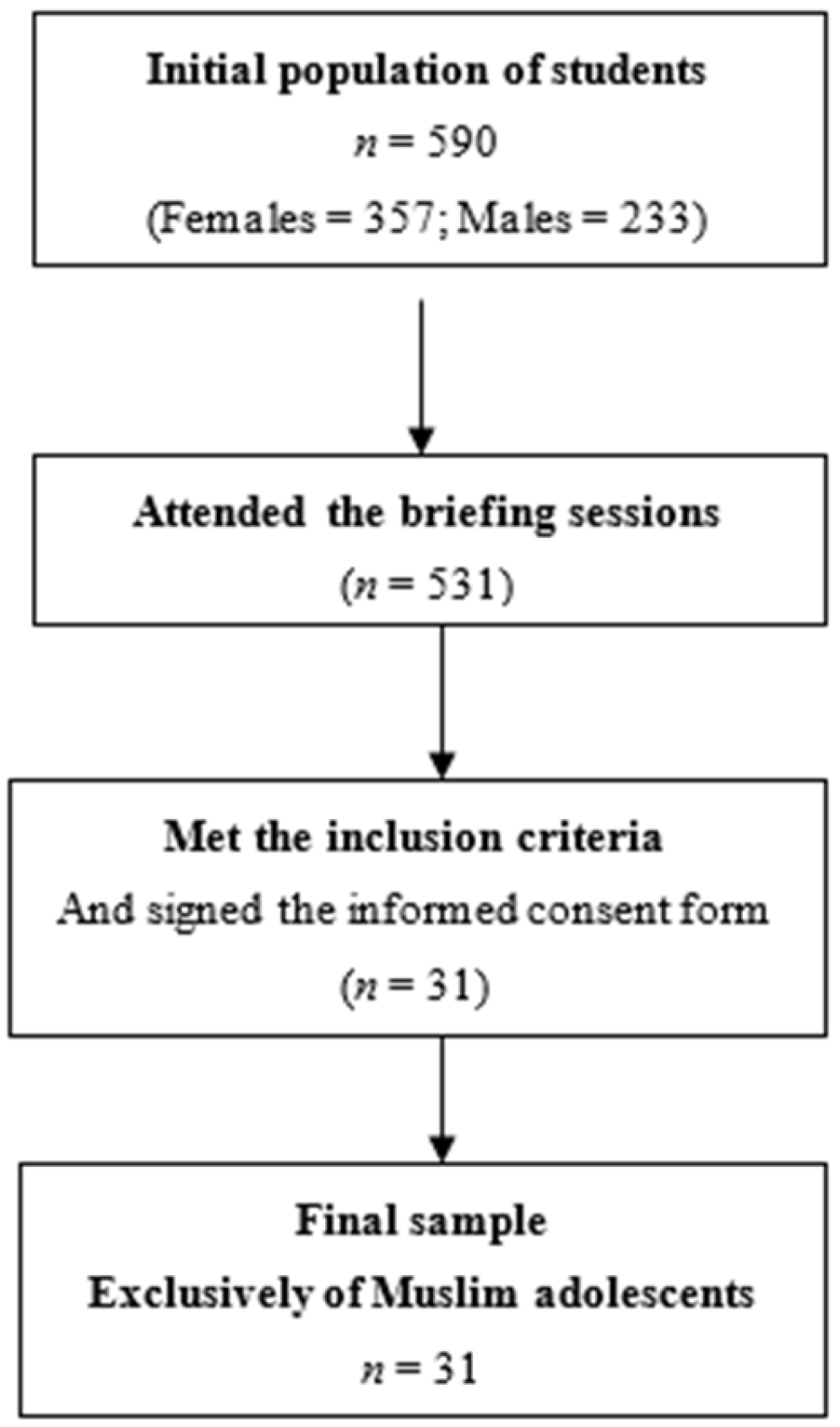
2.1. Study Design and Subjects
2.2. Data Collection
2.3. Blood Pressure
2.4. Dietary Intake
2.5. Anthropometric Measurements
2.6. Physical Activity
2.7. Biochemical Analysis
2.8. Religion
2.9. Statistical Analysis
3. Results and Discussion
3.1. Sociodemographic, Physical, and Biochemical Characteristics of the Participating Students
3.2. Association Between UPF Intake and Risk Factors for Developing T2DM and Inflammation
3.3. Strengths and Limitations
4. Conclusions
Author Contributions
Funding
Institutional Review Board Statement
Informed Consent Statement
Data Availability Statement
Acknowledgments
Conflicts of Interest
References
- Azzam, A. Is the world converging to a ‘Western diet’? Public Health Nutr. 2021, 24, 309–317. [Google Scholar] [CrossRef]
- Popkin, B.M.; Ng, S.W. The nutrition transition to a stage of high obesity and noncommunicable disease prevalence dominated by ultra-processed foods is not inevitable. Obes. Rev. 2022, 23, e13366. [Google Scholar] [CrossRef]
- Baraldi, L.G.; Martinez Steele, E.; Canella, D.S.; Monteiro, C.A. Consumption of ultra-processed foods and associated sociodemographic factors in the USA between 2007 and 2012: Evidence from a nationally representative cross-sectional study. BMJ Open 2018, 8, e020574. [Google Scholar] [CrossRef]
- da Rocha, B.R.S.; Rico-Campà, A.; Romanos-Nanclares, A.; Ciriza, E.; Barbosa, K.B.F.; Martínez-González, M.Á.; Martín-Calvo, N. Adherence to Mediterranean diet is inversely associated with the consumption of ultra-processed foods among Spanish children: The SENDO project. Public Health Nutr. 2021, 24, 3294–3303. [Google Scholar] [CrossRef]
- Reales-Moreno, M.; Tonini, P.; Escorihuela, R.M.; Solanas, M.; Fernández-Barrés, S.; Romaguera, D.; Contreras-Rodríguez, O. Ultra-Processed Foods and Drinks Consumption Is Associated with Psychosocial Functioning in Adolescents. Nutrients 2022, 14, 4831. [Google Scholar] [CrossRef]
- Mohatar-Barba, M.; González-Jiménez, E.; López-Olivares, M.; Fernández-Aparicio, Á.; Schmidt-RioValle, J.; Enrique-Mirón, C. Cross-Sectional Study on the Influence of Religion on the Consumption of Ultra-Processed Food in Spanish Schoolchildren in North Africa. Nutrients 2025, 17, 251. [Google Scholar] [CrossRef]
- Vázquez, C.; Escalante, A.; Huerta, J.; Villarreal, M.E. Efectos de la frecuencia de consumo de alimentos ultraprocesados y su asociación con los indicadores del estado nutricional de una población económicamente activa en México. Rev. Chil. Nutr. 2021, 48, 852–861. [Google Scholar] [CrossRef]
- Vitale, M.; Costabile, G.; Testa, R.; D’Abbronzo, G.; Nettore, I.C.; Macchia, P.E.; Giacco, R. Ultra-Processed Foods and Human Health: A Systematic Review and Meta-Analysis of Prospective Cohort Studies. Adv. Nutr. 2024, 15, 100121. [Google Scholar] [CrossRef] [PubMed]
- Navarro-Prado, S.; Schmidt-RioValle, J.; Fernández-Aparicio, Á.; Montero-Alonso, M.Á.; Perona, J.S.; González-Jiménez, E. Assessing the Impact of Religion and College Life on Consumption Patterns of Ultra-Processed Foods by Young Adults: A Cross-Sectional Study. Nutrients 2024, 16, 1619. [Google Scholar] [CrossRef] [PubMed]
- Payares, N.V.; Chávez Vivas, M.; Del Cristo Martínez, A.; Tascón, A.J. Niveles plasmáticos de citocinas pro y anti inflamatorias como biomarcadores de diabetes mellitus tipo 2. Rev. Fed. Argent. Cardiol. 2023, 52, 122–128. [Google Scholar] [CrossRef]
- UNICEF Informe Sobre Nutrición Infantil 2025. UNICEF. Available online: https://www.unicef.es/sites/unicef.es/files/communication/Informe_nutricion_infantil_2025.pdf (accessed on 26 September 2025).
- Cole, T.J. Establishing a standard definition for child overweight and obesity worldwide: International survey. BMJ 2000, 320, 1240. [Google Scholar] [CrossRef]
- Declaración de Helsinki. Available online: https://www.wma.net/es/policies-post/declaracion-de-helsinki-de-la-amm-principios-eticos-para-las-investigaciones-medicas-en-seres-humanos/ (accessed on 1 October 2022).
- Kempen, T.G.H.; Hedström, M.; Olsson, H.; Johansson, A.; Ottosson, S.; Al-Sammak, Y.; Gillespie, U. Assessment tool for hospital admissions related to medications: Development and validation in older patients. Int. J. Clin. Pharm. 2019, 41, 198–206. [Google Scholar] [CrossRef]
- Marcos Suarez, V.; Rubio Mañas, J.; Sanchidrián Fernández, R.; Robledo de Dios, T. Spanish National dietary survey on children and adolescents. EFSA Support. Publ. 2015, 12, 900E. [Google Scholar] [CrossRef]
- Rodríguez, V.M.; Elbusto-Cabello, A.; Alberdi-Albeniz, M.; De la Presa-Donado, A.; Gómez-Pérez de Mendiola, F.; Portillo-Baquedano, M.P.; Churruca-Ortega, I. New pre-coded food record form validation. Rev. Española Nutr. Humana Dietética 2014, 18, 118–126. [Google Scholar] [CrossRef]
- Sociedad Internacional Para el Avance de la Cineantropometría (ISAK) La cineantropometría Como Ciencia. Available online: https://www.isak.global/ (accessed on 1 June 2024).
- Mantilla Toloza, S.C.; Gómez-Conesa, A. El Cuestionario Internacional de Actividad Física. Un instrumento adecuado en el seguimiento de la actividad física poblacional. Rev. Iberoam. Fisioter. Kinesiol. 2007, 10, 48–52. [Google Scholar] [CrossRef]
- Orozco-Parra, C.L.; Domínguez-Espinosa, A.D.C. Diseño y validación de la Escala de Actitud Religiosa. Rev. Psicol. 2014, 23, 3–11. [Google Scholar] [CrossRef][Green Version]
- OMS Healthy Diet. Available online: https://www.who.int/news-room/fact-sheets/detail/healthy-diet (accessed on 8 June 2024).
- IBM Corporation. IBM SPSS Statistics for Windows, Version 28.0; IBM Corp.: Armonk, NY, USA, 2021. [Google Scholar]
- Allalou, A.; Peng, J.; Robinson, G.A.; Marruganti, C.; D’Aiuto, F.; Butler, G.; Jury, E.C.; Ciurtin, C. Impact of puberty, sex determinants and chronic inflammation on cardiovascular risk in young people. Front. Cardiovasc. Med. 2023, 10, 1191119. [Google Scholar] [CrossRef] [PubMed]
- Linton, M.F.; Yancey, P.G.; Davies, S.S.; Jerome, W.G.; Linton, E.F.; Song, W.L.; Doran, A.C.; Vickers, K.C. The Role of Lipids and Lipoproteins in Atherosclerosis. Endotext 2019, 111, 166–186. [Google Scholar]
- Eissa, M.A.; Mihalopoulos, N.L.; Holubkov, R.; Dai, S.; Labarthe, D.R. Changes in Fasting Lipids during Puberty. J. Pediatr. 2016, 170, 199–205. [Google Scholar] [CrossRef]
- Cho, K.-H.; Kim, J.-R. Rapid Decrease in HDL-C in the Puberty Period of Boys Associated with an Elevation of Blood Pressure and Dyslipidemia in Korean Teenagers: An Explanation of Why and When Men Have Lower HDL-C Levels Than Women. Med. Sci. 2021, 9, 35. [Google Scholar] [CrossRef]
- Borloz, S.; Bucher Della Torre, S.; Collet, T.-H.; Jotterand Chaparro, C. Consumption of Ultraprocessed Foods in a Sample of Adolescents With Obesity and Its Association With the Food Educational Style of Their Parent: Observational Study. JMIR Pediatr. Parent. 2021, 4, e28608. [Google Scholar] [CrossRef]
- Lee, G.; Lim, J.H.; Joung, H.; Yoon, D. Association Between Ultraprocessed Food Consumption and Metabolic Disorders in Children and Adolescents with Obesity. Nutrients 2024, 16, 3524. [Google Scholar] [CrossRef] [PubMed]
- Neri, D.; Steele, E.M.; Khandpur, N.; Cediel, G.; Zapata, M.E.; Rauber, F.; Marrón-Ponce, J.A.; Machado, P.; da Costa Louzada, M.L.; Andrade, G.C.; et al. Ultraprocessed food consumption and dietary nutrient profiles associated with obesity: A multicountry study of children and adolescents. Obes. Rev. 2022, 23, e13387. [Google Scholar] [CrossRef]
- Robles, B.; Mota-Bertran, A.; Saez, M.; Solans, M. Association between ultraprocessed food consumption and excess adiposity in children and adolescents: A systematic review. Obes. Rev. 2024, 25, e13796. [Google Scholar] [CrossRef]
- Juul, F.; Vaidean, G.; Lin, Y.; Deierlein, A.L.; Parekh, N. Ultra-Processed Foods and Incident Cardiovascular Disease in the Framingham Offspring Study. J. Am. Coll. Cardiol. 2021, 77, 1520–1531. [Google Scholar] [CrossRef] [PubMed]
- Mendonça, R.d.D.; Pimenta, A.M.; Gea, A.; de la Fuente-Arrillaga, C.; Martinez-Gonzalez, M.A.; Lopes, A.C.S.; Bes-Rastrollo, M. Ultraprocessed food consumption and risk of overweight and obesity: The University of Navarra Follow-Up (SUN) cohort study. Am. J. Clin. Nutr. 2016, 104, 1433–1440. [Google Scholar] [CrossRef]
- Tsalamandris, S.; Antonopoulos, A.S.; Oikonomou, E.; Papamikroulis, G.-A.; Vogiatzi, G.; Papaioannou, S.; Deftereos, S.; Tousoulis, D. The Role of Inflammation in Diabetes: Current Concepts and Future Perspectives. Eur. Cardiol. Rev. 2019, 14, 50–59. [Google Scholar] [CrossRef] [PubMed]
- ter Horst, R.; van den Munckhof, I.C.L.; Schraa, K.; Aguirre-Gamboa, R.; Jaeger, M.; Smeekens, S.P.; Brand, T.; Lemmers, H.; Dijkstra, H.; Galesloot, T.E.; et al. Sex-Specific Regulation of Inflammation and Metabolic Syndrome in Obesity. Arterioscler. Thromb. Vasc. Biol. 2020, 40, 1787–1800. [Google Scholar] [CrossRef]
- Ognjanovic, S.; Jacobs, D.R.; Steinberger, J.; Moran, A.; Sinaiko, A.R. Relation of chemokines to BMI and insulin resistance at ages 18–21. Int. J. Obes. 2013, 37, 420–423. [Google Scholar] [CrossRef]
- Roth, C.L.; Kratz, M.; Ralston, M.M.; Reinehr, T. Changes in adipose-derived inflammatory cytokines and chemokines after successful lifestyle intervention in obese children. Metabolism 2011, 60, 445–452. [Google Scholar] [CrossRef]
- Ramseyer, V.D.; Gonzalez-Vicente, A.; Carretero, O.A.; Garvin, J.L. Angiotensin II-induced hypertension blunts thick ascending limb NO production by reducing NO synthase 3 expression and enhancing threonine 495 phosphorylation. Am. J. Physiol. Physiol. 2015, 308, F149–F156. [Google Scholar] [CrossRef]
- Williams, A.; Greene, N.; Kimbro, K. Increased circulating cytokine levels in African American women with obesity and elevated HbA1c. Cytokine 2020, 128, 154989. [Google Scholar] [CrossRef]
- Makiel, K.; Suder, A.; Targosz, A.; Maciejczyk, M.; Haim, A. Exercise-Induced Alternations of Adiponectin, Interleukin-8 and Indicators of Carbohydrate Metabolism in Males with Metabolic Syndrome. Biomolecules 2023, 13, 852. [Google Scholar] [CrossRef]
- Kim, J.S.; Lê, K.-A.; Mahurkar, S.; Davis, J.N.; Goran, M.I. Influence of elevated liver fat on circulating adipocytokines and insulin resistance in obese Hispanic adolescents. Pediatr. Obes. 2012, 7, 158–164. [Google Scholar] [CrossRef] [PubMed]
- Breslin, W.L.; Johnston, C.A.; Strohacker, K.; Carpenter, K.C.; Davidson, T.R.; Moreno, J.P.; Foreyt, J.P.; McFarlin, B.K. Obese Mexican American Children Have Elevated MCP-1, TNF-α, Monocyte Concentration, and Dyslipidemia. Pediatrics 2012, 129, e1180–e1186. [Google Scholar] [CrossRef]
- Mauras, N.; DelGiorno, C.; Kollman, C.; Bird, K.; Morgan, M.; Sweeten, S.; Balagopal, P.; Damaso, L. Obesity without Established Comorbidities of the Metabolic Syndrome Is Associated with a Proinflammatory and Prothrombotic State, Even before the Onset of Puberty in Children. J. Clin. Endocrinol. Metab. 2010, 95, 1060–1068. [Google Scholar] [CrossRef] [PubMed]
- Kim, J.; Bhattacharjee, R.; Kheirandish-Gozal, L.; Khalyfa, A.; Sans Capdevila, O.; Tauman, R.; Gozal, D. Insulin Sensitivity, Serum Lipids, and Systemic Inflammatory Markers in School-Aged Obese and Nonobese Children. Int. J. Pediatr. 2010, 2010, 846098. [Google Scholar] [CrossRef]
- Johnson, A.M.F.; Olefsky, J.M. The Origins and Drivers of Insulin Resistance. Cell 2013, 152, 673–684. [Google Scholar] [CrossRef] [PubMed]


| All (n = 31) | Boys (n = 17) | Girls (n = 14) | ||
|---|---|---|---|---|
| Age (years) | 15.67 ± 0.62 | 15.76 ± 0.66 | 15.51 ± 0.64 | |
| Height (cm) | 167.87 ± 8.70 | 171.05 ± 9.20 | 164.00 ± 6.40 | |
| Weight (kg) | 63.09 ± 15.63 | 68.13 ± 18.63 ** | 56.97 ± 7.95 | |
| BMI (kg/m2) | 22.19 ± 4.69 | 23.16 ± 5.95 ** | 21.00 ± 2.11 | |
| Nutritional status | ||||
| Underweight | 6 | 6 | 0 | |
| Normal weight | 17 | 4 | 13 ** | |
| Overweight | 5 | 4 | 1 | |
| Obese | 3 | 3 | 0 | |
| Waist circumference (cm) | 72.53 ± 9.96 | 76.05 ± 11.04 * | 68.25 ± 6.53 | |
| Hip circumference (cm) | 97.58 ± 10.35 | 98.88 ± 13.11 ** | 96.00 ± 5.56 | |
| WHI * | 0.74 ± 0.06 | 0.77 ± 0.06 | 0.71 ± 0.05 | |
| WHT ** | 0.43 ± 0.05 | 0.44 ± 0.05 * | 0.41 ± 0.03 | |
| Cardiometabolic risk | ||||
| No risk (ICA < 0.5) | 29 | 15 | 14 | |
| At risk (ICA > 0.5) | 2 | 2 | -- | |
| Fat mass (kg) | 12.93 ± 8.06 | 13.32 ± 10.53 ** | 12.47 ± 3.58 | |
| Body fat (%) | 19.18 ± 9.71 | 17.00 ± 11.69 | 21.82 ± 5.96 * | |
| Lean mass (kg) | 50.53 ± 11.39 | 55.42 ± 11.82 * | 44.60 ± 7.65 | |
| Muscle mass (kg) | 47.60 ± 10.47 | 52.05 ± 10.87 * | 42.20 ± 7.08 | |
| Heart rate | 78.48 ± 9.85 | 79.29 ± 11.53 | 77.50 ± 7.66 | |
| SBP (mmHg) | 115 ± 17.63 | 120.35 ± 16.78 | 109.85 ± 17.49 | |
| DBP (mmHg) | 74.06 ± 13.90 | 76.00 ± 14.68 | 71.71 ± 13.04 | |
| MAP (mmHg) | 94.83 ± 14.32 | 98.17 ± 13.61 | 90.78 ± 14.60 | |
| BP level | ||||
| Normal | 26 | 13 | 13 | |
| Prehypertensive | 3 | 2 | 1 | |
| Hypertensive | 2 | 2 | -- | |
| Variables | All (n = 31) | Boys (n = 17) | Girls (n = 14) | |
|---|---|---|---|---|
| Ultra-processed food intake (% total energy) | 50.80 ± 11.60 | 51.47 ± 8.37 | 50.00 ± 14.94 | |
| Total energy intake (kcal) | 2382.11 ± 449.11 | 2539.63 ± 534.52 * | 2190.82 ± 204.88 | |
| Physical activity (min/day) | 67.25 ± 45.15 | 93.92 ± 71.21 ** | 34.88 ± 19.10 | |
| Lipid profile | ||||
| TG (mg/dL) | 67.90 ± 30.58 | 60.05 ± 18.57 | 77.42 ± 39.43 * | |
| TC (mg/dL) | 141.48 ± 24.80 | 138.94 ± 24.03 | 144.57 ± 26.27 | |
| VLDLc (mg/dL) | 13.58 ± 6.11 | 12.01 ± 3.71 | 15.48 ± 7.88 * | |
| LDLc (mg/dL) | 86.61 ± 20.77 | 85.17 ± 19.80 | 88.35 ± 22.53 | |
| HDLc (mg/dL) | 47.34 ± 9.89 | 46.64 ± 7.45 | 49.64 ± 12.54 * | |
| Non-HDL cholesterol (mg/dL) | 94.83 ± 20.51 | 92.29 ± 19.48 | 97.92 ± 22.03 | |
| CT/HDLc ratio | 3.12 ± 0.68 | 2.99 ± 0.35 | 3.27 ± 0.94 * | |
| HDLc/LDLc ratio | 0.56 ± 0.16 | 0.56 ± 0.10 | 0.56 ± 0.21 | |
| Glucose (mg/dL) | 80.13 ± 15.03 | 73.65 ± 7.50 | 88.00 ± 18.19 | |
| Insulin (µIU/mL) | 8.43 ± 4.65 | 6.83 ± 4.11 | 10.24 ± 4.68 * | |
| C-peptide (ng/mL) | 1.75 ± 1.74 | 1.25 ± 0.57 | 2.37 ± 2.42 | |
| Lipoprotein (a) (mg/dL) | 14.01 ± 18.20 | 13.42 ± 21.96 | 14.73 ± 13.05 | |
| Apo A1 (mg/dL) | 86.13 ± 29.57 | 82.99 ± 23.22 | 89.95 ± 36.41 | |
| Apo B (mg/dL) | 37.66 ± 11.63 | 36.07 ± 11.40 | 39.60 ± 12.03 | |
| Apo B/Apo A1 | 0.45 ± 0.13 | 0.43 ± 0.07 | 0.48 ± 0.17 * | |
| β | IC95% | p | Q-Value (FDR) | |
|---|---|---|---|---|
| IMC (kg/m2) | 0.105 | 0.070, 0.141 | 0.025 | 0.041 |
| Grasa corporal (%) | 0.061 | 0.002, 0.120 | 0.041 | 0.041 |
| Perímetro cintura (cm) | 0.017 | 0.002, 0.031 | 0.024 | 0.041 |
| ICA | 0.015 | 0.002, 0.028 | 0.023 | 0.041 |
| TAS (mmHg) | −0.210 | −0.530, −0.120 | 0.018 | - |
| TAD (mmHg) | 0.100 | −0.080, −0.280 | 0.274 | - |
| TG (mg/dL) | 1.050 | −0.013, 0.072 | 0.096 | - |
| CT (mg(dL) | −0.330 | −0.124, 0.321 | 0.364 | - |
| c-HDL (mg/dL) | −0.351 | −0.239, −0.125 | 0.134 | - |
| c-LDL (mg/dL) | −0.117 | −0.830, 0.429 | 0.552 | - |
| Apo A1 (mg/dL) | −0.005 | −0.056, −0.014 | 0.334 | - |
| Apo B (mg/dL) | 0.001 | −0.020, −0.019 | 0.476 | - |
| Glucosa (mg/dL) | 0.032 | 0.022, 0.620 | 0.034 | 0.041 |
| Insulina (µUI/mL) | 0.028 | −0.021, 0.125 | 0.345 | - |
| IL-1β | IL-7 | IL-8 | IL-10 | IL-12p | IL-17 | MCP-1 | MIB-1B | |
|---|---|---|---|---|---|---|---|---|
| SBP (mmHg) | −0.140 | −0.541 * | 0.257 | −0.191 | −0.158 | −0.007 | 0.018 | -- |
| DBP (mmHg) | −0.059 | −0.185 | 0.099 | −0.010 | −0.097 | −0.106 | −0.145 | 0.014 |
| Waist circumference (cm) | 0.156 | −0.258 | 0.440 * | −0.264 | −0.001 | −0.069 | 0.199 | 0.099 |
| WHT | −0.077 | −0.194 | 0.471 * | −0.175 | 0.109 | −0.073 | 0.136 | 0.148 |
| BMI (kg/m2) | −0.081 | −0.183 | 0.468 * | −0.167 | 0.010 | −0.158 | 0.088 | 0.188 |
| Physical activity (min/day) | −0.174 | −0.208 | −0.005 | −0.155 | −0.200 | 0.139 | −0.008 | 0.063 |
| Ultra-processed food intake (% total energy) | −0.101 | 0.224 | 0.038 | 0.026 | 0.105 | −0.056 | 0.142 | 0.180 |
| Total energy intake (kcal) | 0.035 | −0.048 | 0.053 | −0.090 | 0.024 | −0.027 | 0.083 | 0.078 |
| ApoA1 | −0.003 | 0.104 | 0.004 | 0.246 | 0.274 | −0.166 | −0.587 * | 0.113 |
| Apo B | −0.092 | −0.066 | −0.239 | 0.054 | −0.027 | −0.224 | −0.221 | 0.061 |
| Apo B/Apo A1 | −0.099 | −0.229 | −0.272 | −0.266 | −0.461 * | −0.095 | 0.325 | −0.066 |
| TC | 0.042 | 0.219 | −0.314 | 0.170 | −0.016 | −0.095 | −0.516 * | −0.190 |
| HDLc | 0.027 | 0.287 | 0.078 | 0.241 | 0.202 | 0.028 | −0.689 ** | −0.178 |
| LDLc | 0.004 | 0.125 | −0.536 * | 0.034 | −0.197 | −0.126 | −0.270 | −0.146 |
| HDLc/LDLc ratio | 0.028 | 0.051 | 0.645 ** | 0.080 | 0.285 | 0.087 | −0.242 | 0.022 |
| Glucose (mg/dL) | 0.084 | 0.065 | −0.181 | 0.132 | −0.075 | −0.129 | −0.058 | −0.147 |
| Insulin (µIU/mL) | 0.134 | 0.113 | −0.193 | 0.189 | −0.021 | −0.125 | −0.059 | 0.051 |
Disclaimer/Publisher’s Note: The statements, opinions and data contained in all publications are solely those of the individual author(s) and contributor(s) and not of MDPI and/or the editor(s). MDPI and/or the editor(s) disclaim responsibility for any injury to people or property resulting from any ideas, methods, instructions or products referred to in the content. |
© 2026 by the authors. Licensee MDPI, Basel, Switzerland. This article is an open access article distributed under the terms and conditions of the Creative Commons Attribution (CC BY) license.
Share and Cite
Mohatar-Barba, M.; López-Olivares, M.; González-Jiménez, E.; García-González, A.; Perona, J.S.; Enrique-Mirón, C. Consumption of Ultra-Processed Foods and Biochemical Markers Predictive of Type 2 Diabetes Mellitus in a Self-Selected Pilot Sample of Muslim Adolescents in Melilla. Foods 2026, 15, 319. https://doi.org/10.3390/foods15020319
Mohatar-Barba M, López-Olivares M, González-Jiménez E, García-González A, Perona JS, Enrique-Mirón C. Consumption of Ultra-Processed Foods and Biochemical Markers Predictive of Type 2 Diabetes Mellitus in a Self-Selected Pilot Sample of Muslim Adolescents in Melilla. Foods. 2026; 15(2):319. https://doi.org/10.3390/foods15020319
Chicago/Turabian StyleMohatar-Barba, Miriam, María López-Olivares, Emilio González-Jiménez, Aída García-González, Javier S. Perona, and Carmen Enrique-Mirón. 2026. "Consumption of Ultra-Processed Foods and Biochemical Markers Predictive of Type 2 Diabetes Mellitus in a Self-Selected Pilot Sample of Muslim Adolescents in Melilla" Foods 15, no. 2: 319. https://doi.org/10.3390/foods15020319
APA StyleMohatar-Barba, M., López-Olivares, M., González-Jiménez, E., García-González, A., Perona, J. S., & Enrique-Mirón, C. (2026). Consumption of Ultra-Processed Foods and Biochemical Markers Predictive of Type 2 Diabetes Mellitus in a Self-Selected Pilot Sample of Muslim Adolescents in Melilla. Foods, 15(2), 319. https://doi.org/10.3390/foods15020319