Unlocking the Antioxidant Potential of Pigeon Peas (Cajanus cajan L.) via Wild Fermentation and Extraction Optimization

 , ,
, ,  and
and
Abstract
1. Introduction
2. Materials and Methods
2.1. Sample Preparation
2.2. Optimization of Extraction Conditions
2.2.1. Solvent Selection Study
2.2.2. Temperature Optimization Study
2.2.3. Time-Course Extraction Study
2.3. Sample Extraction
2.4. Antioxidant Activity Assays
2.4.1. Total Phenolic Content (TPC)
2.4.2. DPPH Radical Scavenging Activity
2.4.3. Ferric Reducing Antioxidant Power (FRAP)
2.4.4. ABTS Radical Cation Decolorization Assay
2.5. Statistical Analysis
3. Results
3.1. Antioxidant Activities in Unfermented and Fermented Pigeon Peas Using Conventional Method
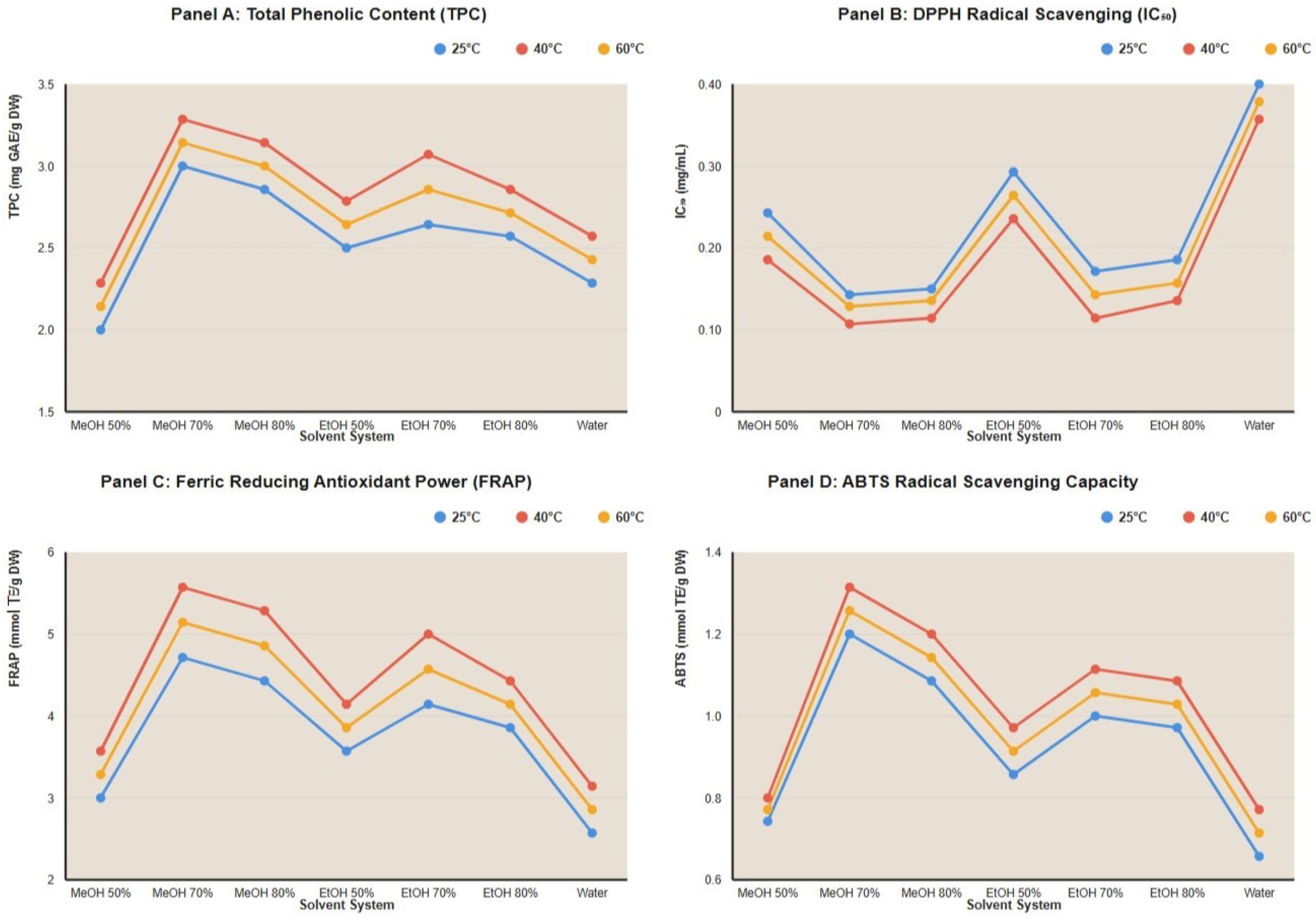
3.2. Effect of Solvent Type and Concentration on Antioxidant Recovery
3.3. Influence of Extraction Temperature on Bioactive Compound Recovery
3.4. Time-Dependent Changes in Antioxidant Extraction
3.5. Solvent–Temperature Interaction Effects
3.6. Optimization Summary and Protocol Validation
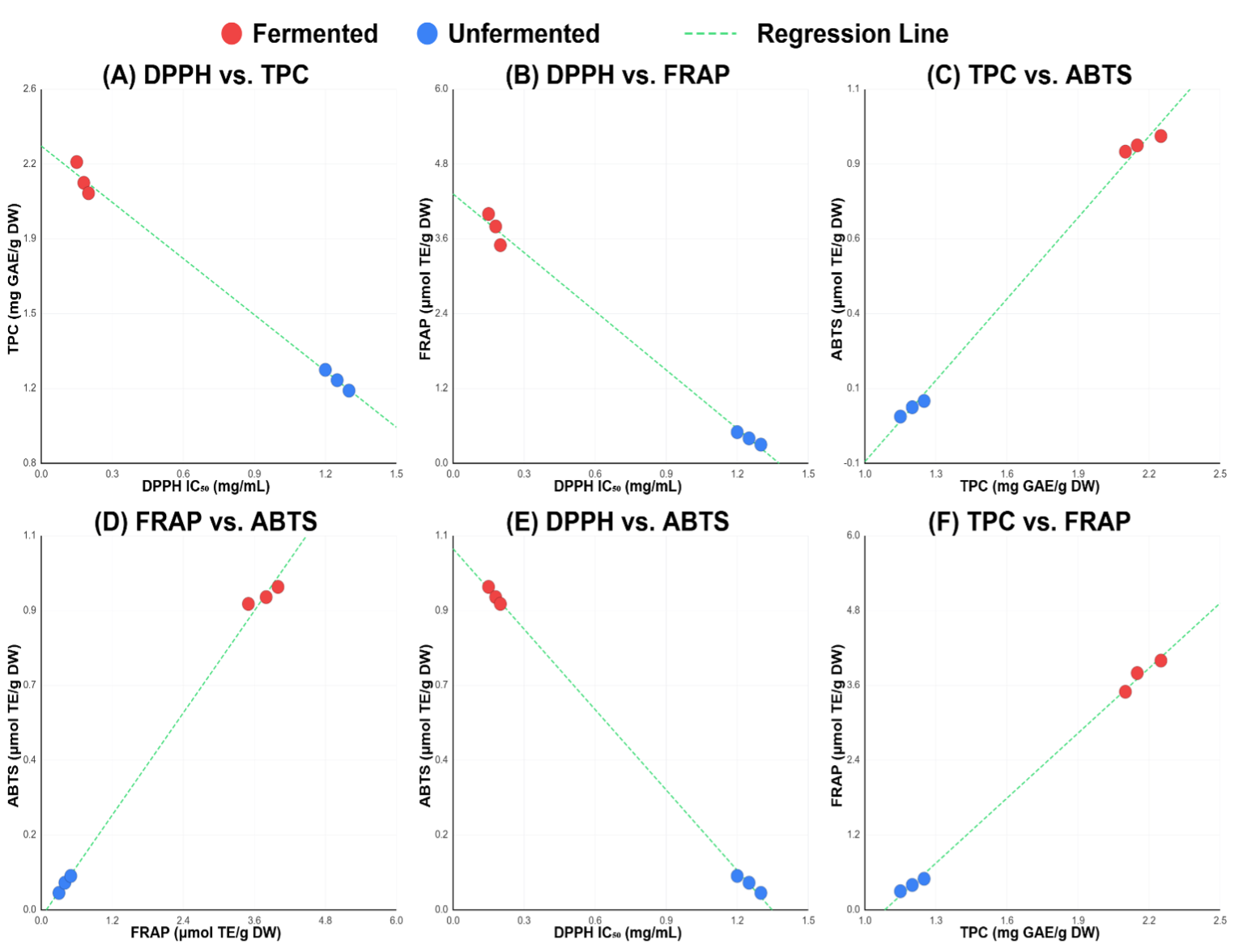
3.7. Correlation Between Assays
4. Discussion
5. Conclusions
Author Contributions
Funding
Institutional Review Board Statement
Informed Consent Statement
Data Availability Statement
Acknowledgments
Conflicts of Interest
Abbreviations
| ABTS | 2,2′-azinobis-(3-ethylbenzothiazoline-6-sulfonic acid) |
| ANOVA | Analysis of variance |
| DW | Dry weight |
| EtOH | Ethanol |
| DPPH | 2,2-diphenyl-1-picrylhydrazyl |
| FRAP | Ferric Reducing Antioxidant Power |
| GAE | Gallic acid equivalent |
| HDPE | High density polyethylene |
| HSD | Honestly Significant Difference |
| IC50 | Half maximal inhibitory concentration |
| MeOH | Methanol |
| OFAT | One factor at a time |
| ROS | Reactive oxygen species |
| SD | Standard deviation |
| TE | Trolox equivalent |
| TPC | Total phenolic content |
| TPTZ | 2,4,6-tripyridyl-s-triazine |
| UV | Ultraviolet |
| Vs | Versus |
References
- Garcia-Llorens, G.; El Ouardi, M.; Valls-Belles, V. Oxidative Stress Fundamentals: Unraveling the Pathophysiological Role of Redox Imbalance in Non-Communicable Diseases. Appl. Sci. 2025, 15, 10191. [Google Scholar] [CrossRef]
- Dash, U.C.; Bhol, N.K.; Swain, S.K.; Samal, R.R.; Nayak, P.K.; Raina, V.; Panda, S.K.; Kerry, R.G.; Duttaroy, A.K.; Jena, A.B. Oxidative stress and inflammation in the pathogenesis of neurological disorders: Mechanisms and implications. Acta Pharm. Sin. B 2025, 15, 15–34. [Google Scholar] [CrossRef]
- Sachdev, S.; Ansari, S.A.; Ansari, M.I.; Fujita, M.; Hasanuzzaman, M. Abiotic stress and reactive oxygen species: Generation, signaling, and defense mechanisms. Antioxidants 2021, 10, 277. [Google Scholar] [CrossRef]
- Akbari, B.; Baghaei-Yazdi, N.; Bahmaie, M.; Mahdavi Abhari, F. The role of plant-derived natural antioxidants in reduction of oxidative stress. BioFactors 2022, 48, 611–633. [Google Scholar] [CrossRef] [PubMed]
- Maluwa, C.; Zinan’dala, B.; Chuljerm, H.; Parklak, W.; Kulprachakarn, K. Watercress (Nasturtium officinale) as a Functional Food for Non-Communicable Diseases Prevention and Management: A Narrative Review. Life 2025, 15, 1104. [Google Scholar] [CrossRef] [PubMed]
- Yang, S.-E.; Vo, T.-L.T.; Chen, C.-L.; Yang, N.-C.; Chen, C.-I.; Song, T.-Y. Nutritional composition, bioactive compounds and functional evaluation of various parts of Cajanus cajan (L.) Millsp. Agriculture 2020, 10, 558. [Google Scholar] [CrossRef]
- Jeevarathinam, G.; Chelladurai, V. Pigeon pea. In Pulses: Processing and Product Development; Springer: Berlin/Heidelberg, Germany, 2020; pp. 275–296. [Google Scholar]
- Haji, A.; Teka, T.A.; Yirga Bereka, T.; Negasa Andersa, K.; Desalegn Nekera, K.; Geleta Abdi, G.; Lema Abelti, A.; Makiso Urugo, M. Nutritional Composition, Bioactive Compounds, Food Applications, and Health Benefits of Pigeon Pea (Cajanus cajan L. Millsp.): A Review. Legume Sci. 2024, 6, e233. [Google Scholar] [CrossRef]
- Goswami, D.; Bala, M.; Mridula, D.; Vishwakarma, R.K.; Guru, P. Green solvent extraction of health boosting phenolics from pigeon pea husk. Sci. Rep. 2025, 15, 30002. [Google Scholar] [CrossRef]
- Wiesinger, J.A.; Marsolais, F.; Glahn, R.P. Health implications and nutrient bioavailability of bioactive compounds in dry beans and other pulses. In Dry Beans and Pulses: Production, Processing, and Nutrition; Wiley Online Library: Hoboken, NJ, USA, 2022; pp. 505–529. [Google Scholar]
- Hashimoto, E.H.; de Cassia Campos Pena, A.; da Cunha, M.A.A.; de Freitas Branco, R.; de Lima, K.P.; Couto, G.H.; Binder Pagnoncelli, M.G. Fermentation-mediated sustainable development and improvement of quality of plant-based foods: From waste to a new food. Syst. Microbiol. Biomanuf. 2025, 5, 69–100. [Google Scholar] [CrossRef]
- Kårlund, A.; Gómez-Gallego, C.; Korhonen, J.; Palo-Oja, O.-M.; El-Nezami, H.; Kolehmainen, M. Harnessing microbes for sustainable development: Food fermentation as a tool for improving the nutritional quality of alternative protein sources. Nutrients 2020, 12, 1020. [Google Scholar] [CrossRef]
- Zhao, Y.-S.; Eweys, A.S.; Zhang, J.-Y.; Zhu, Y.; Bai, J.; Darwesh, O.M.; Zhang, H.-B.; Xiao, X. Fermentation affects the antioxidant activity of plant-based food material through the release and production of bioactive components. Antioxidants 2021, 10, 2004. [Google Scholar] [CrossRef]
- Adebo, O.A.; Gabriela Medina-Meza, I. Impact of fermentation on the phenolic compounds and antioxidant activity of whole cereal grains: A mini review. Molecules 2020, 25, 927. [Google Scholar] [CrossRef]
- Zhang, L.; Li, A.; Liu, H.; Mo, Q.; Zhong, Z. Effects of Lactic Acid Bacteria Fermentation on the Release and Biotransformation of Bound Phenolics in Ma Bamboo Shoots (Dendrocalamus latiflorus Munro). Foods 2025, 14, 2573. [Google Scholar] [CrossRef] [PubMed]
- Kumar, A.; Saranyadevi, S.; Thirumalaisamy, S.K.; Dapana Durage, T.T.; Jaiswal, S.G.; Kavitake, D.; Wei, S. Phenolic acids in fermented foods: Microbial biotransformation, antioxidant mechanisms, and functional health implications. Front. Mol. Biosci. 2025, 12, 1678673. [Google Scholar] [CrossRef] [PubMed]
- Ferreira, L.M.; Mendes-Ferreira, A.; Benevides, C.M.; Melo, D.; Costa, A.S.; Mendes-Faia, A.; Oliveira, M.B.P. Effect of controlled microbial fermentation on nutritional and functional characteristics of cowpea bean flours. Foods 2019, 8, 530. [Google Scholar] [CrossRef] [PubMed]
- Shabbir, U.; Tyagi, A.; Ham, H.J.; Elahi, F.; Oh, D.-H. Effect of fermentation on the bioactive compounds of the black soybean and their anti-Alzheimer’s activity. Front. Nutr. 2022, 9, 880361. [Google Scholar] [CrossRef]
- Mudoor Sooresh, M.; Willing, B.P.; Bourrie, B.C. Opportunities and challenges of understanding community assembly in spontaneous food fermentation. Foods 2023, 12, 673. [Google Scholar] [CrossRef]
- Munteanu, I.G.; Apetrei, C. Analytical methods used in determining antioxidant activity: A review. Int. J. Mol. Sci. 2021, 22, 3380. [Google Scholar] [CrossRef]
- Girish, Y.R.; Sharath Kumar, K.S.; Prashantha, K.; Rangappa, S.; Sudhanva, M.S. Significance of antioxidants and methods to evaluate their potency. Mater. Chem. Horiz. 2023, 2, 93–112. [Google Scholar]
- Skroza, D.; Šimat, V.; Vrdoljak, L.; Jolić, N.; Skelin, A.; Čagalj, M.; Frleta, R.; Generalić Mekinić, I. Investigation of antioxidant synergisms and antagonisms among phenolic acids in the model matrices using FRAP and ORAC methods. Antioxidants 2022, 11, 1784. [Google Scholar] [CrossRef]
- Ulewicz-Magulska, B.; Wesolowski, M. Total phenolic contents and antioxidant potential of herbs used for medical and culinary purposes. Plant Foods Hum. Nutr. 2019, 74, 61–67. [Google Scholar] [CrossRef]
- Kalaskar, M.; Yele, S.U.; Ayyanar, M.; Gurav, N.; Beldar, V.; Surana, S.J. Methods of Extraction. In Pharmacognosy and Phytochemistry: Principles, Techniques, and Clinical Applications; Wiley: Hoboken, NJ, USA, 2025; pp. 121–142. [Google Scholar]
- Selvaraj, K.; Theivendren, P.; Pavadai, P.; Sureshbabu, R.k.P.; Ravishankar, V.; Palanisamy, P.; Gopal, M.; Dharmalingam, S.R.; Sankaranarayanan, M. Impact of physicochemical parameters on effective extraction of bioactive compounds from natural sources: An overview. Curr. Bioact. Compd. 2022, 18, 11–27. [Google Scholar] [CrossRef]
- Saharan, P.; Sadh, P.K.; Duhan, S.; Duhan, J.S. Bio-enrichment of phenolic, flavonoids content and antioxidant activity of commonly used pulses by solid-state fermentation. J. Food Meas. Charact. 2020, 14, 1497–1510. [Google Scholar] [CrossRef]
- Sadh, P.; Saharan, P.; Duhan, S.; Suneja, P.; Duhan, J. Assessment of fermentation processing effect on phenolic, flavonoids contents and antioxidant activity of commonly used pulses. Res. J. Biotechnol. 2022, 17, 5. [Google Scholar] [CrossRef]
- Fleming, H.; McFeeters, R.; Daeschel, M.; Humphries, E.; Thompson, R.L. Fermentation of cucumbers in anaerobic tanks. J. Food Sci. 1988, 53, 127–133. [Google Scholar] [CrossRef]
- Chaturvedi, S.; Chakraborty, S. Optimization of extraction process for legume-based synbiotic beverages, followed by their characterization and impact on antinutrients. Int. J. Gastron. Food Sci. 2022, 28, 100506. [Google Scholar] [CrossRef]
- Singleton, V.L.; Rossi, J.A. Colorimetry of total phenolics with phosphomolybdic-phosphotungstic acid reagents. Am. J. Enol. Vitic. 1965, 16, 144–158. [Google Scholar] [CrossRef]
- Chaves, N.; Santiago, A.; Alías, J.C. Quantification of the antioxidant activity of plant extracts: Analysis of sensitivity and hierarchization based on the method used. Antioxidants 2020, 9, 76. [Google Scholar] [CrossRef] [PubMed]
- Benzie, I.F.; Strain, J.J. The ferric reducing ability of plasma (FRAP) as a measure of “antioxidant power”: The FRAP assay. Anal. Biochem. 1996, 239, 70–76. [Google Scholar] [CrossRef]
- Re, R.; Pellegrini, N.; Proteggente, A.; Pannala, A.; Yang, M.; Rice-Evans, C. Antioxidant activity applying an improved ABTS radical cation decolorization assay. Free Radic. Biol. Med. 1999, 26, 1231–1237. [Google Scholar] [CrossRef]
- Cohen, J. Statistical Power Analysis for the Behavioral Sciences; Routledge: Abingdon, UK, 2013. [Google Scholar]
- Verni, M.; Verardo, V.; Rizzello, C.G. How fermentation affects the antioxidant properties of cereals and legumes. Foods 2019, 8, 362. [Google Scholar] [CrossRef]
- Tsimogiannis, D.; Oreopoulou, V. Classification of phenolic compounds in plants. In Polyphenols in Plants; Elsevier: Amsterdam, The Netherlands, 2019; pp. 263–284. [Google Scholar]
- Shahidi, F.; Hossain, A. Importance of insoluble-bound phenolics to the antioxidant potential is dictated by source material. Antioxidants 2023, 12, 203. [Google Scholar] [CrossRef]
- Venkatesan, T.; Choi, Y.-W.; Kim, Y.-K. Impact of different extraction solvents on phenolic content and antioxidant potential of Pinus densiflora bark extract. BioMed Res. Int. 2019, 2019, 3520675. [Google Scholar] [CrossRef] [PubMed]
- Mahasuari, N.P.S.; Paramita, N.; Putra, A. Effect of methanol concentration as a solvent on total phenolic and flavonoid content of beluntas leaf extract (Pulchea indica L.). J. Pharm. Sci. Appl. 2020, 2, 77. [Google Scholar] [CrossRef]
- Oancea, S. A review of the current knowledge of thermal stability of anthocyanins and approaches to their stabilization to heat. Antioxidants 2021, 10, 1337. [Google Scholar] [CrossRef] [PubMed]
- Ling, J.K.U.; Sam, J.H.; Jeevanandam, J.; Chan, Y.S.; Nandong, J. Thermal degradation of antioxidant compounds: Effects of parameters, thermal degradation kinetics, and formulation strategies. Food Bioprocess Technol. 2022, 15, 1919–1935. [Google Scholar] [CrossRef]
- Oreopoulou, A.; Tsimogiannis, D.; Oreopoulou, V. Extraction of polyphenols from aromatic and medicinal plants: An overview of the methods and the effect of extraction parameters. In Polyphenols in Plants; Academic Press: Cambridge, MA, USA, 2019; pp. 243–259. [Google Scholar]
- Gil-Martín, E.; Forbes-Hernández, T.; Romero, A.; Cianciosi, D.; Giampieri, F.; Battino, M. Influence of the extraction method on the recovery of bioactive phenolic compounds from food industry by-products. Food Chem. 2022, 378, 131918. [Google Scholar] [CrossRef]
- Sukackas, J.; Žilius, M.; Šaltytė, G.; Raudonė, L. Optimisation of Phenolic Compound Extraction from Agrimonia eupatoria L. Using Response Surface Methodology for Enhanced Yield of Different Phenolics and Maximised Antioxidant Activity. Antioxidants 2025, 14, 831. [Google Scholar] [CrossRef]
- Ji, X.; Hou, C.; Yan, Y.; Shi, M.; Liu, Y. Comparison of structural characterization and antioxidant activity of polysaccharides from jujube (Ziziphus jujuba Mill.) fruit. Int. J. Biol. Macromol. 2020, 149, 1008–1018. [Google Scholar] [CrossRef] [PubMed]
- Gao, F.; Wang, S.; Wang, Z.; Li, Z.; Liu, J. Phenolic Compounds in Cereals: Advances and Challenges in the Extraction, Detection, and Health Implications. Food Rev. Int. 2025, 1–39. [Google Scholar] [CrossRef]
- Esfandi, R.; Walters, M.E.; Tsopmo, A. Antioxidant properties and potential mechanisms of hydrolyzed proteins and peptides from cereals. Heliyon 2019, 5, e01538. [Google Scholar] [CrossRef]
- da Costa Maia, I.; dos Santos D’Almeida, C.T.; Freire, D.M.G.; Cavalcanti, E.d.A.C.; Cameron, L.C.; Dias, J.F.; Ferreira, M.S.L. Effect of solid-state fermentation over the release of phenolic compounds from brewer’s spent grain revealed by UPLC-MSE. LWT 2020, 133, 110136. [Google Scholar] [CrossRef]
- Akanni, G.B.; Adebo, O.A. Metabolite perturbations in fermented legumes as elucidated using metabolomics: A review. Int. J. Food Sci. Technol. 2024, 59, 4234–4250. [Google Scholar] [CrossRef]
- Erskine, E.; Ozkan, G.; Lu, B.; Capanoglu, E. Effects of Fermentation Process on the Antioxidant Capacity of Fruit Byproducts. ACS Omega 2023, 8, 4543–4553. [Google Scholar] [CrossRef]
- Siriporn, B.; Thongkorn, P.; Waraporn, S.; Wiriyaporn, S.; Sinee, S.; Chiramet, A.; Aluko, R. Antioxidant polypeptides derived from pigeon pea (Cajanus cajan (L) Mill sp.) by enzymatic hydrolysis. Food Res. 2024, 8, 182–189. [Google Scholar] [CrossRef]
- Li, Y.; Xu, L.; Guo, S. Effects of solid-state fermentation with the Ganoderma spp. and Coriolus versicolor on the total phenol contents and antioxidant properties on black soybean. J. Chem. 2023, 2023, 9462748. [Google Scholar] [CrossRef]
- Vuolo, M.M.; Lima, V.S.; Junior, M.R.M. Phenolic compounds: Structure, classification, and antioxidant power. In Bioactive Compounds; Elsevier: Amsterdam, The Netherlands, 2019; pp. 33–50. [Google Scholar]
- Maraveas, C.; Bayer, I.S.; Bartzanas, T. Recent advances in antioxidant polymers: From sustainable and natural monomers to synthesis and applications. Polymers 2021, 13, 2465. [Google Scholar] [CrossRef]
- Chan, S.T.; Padam, B.S.; Chye, F.Y. Effect of fermentation on the antioxidant properties and phenolic compounds of Bambangan (Mangifera pajang) fruit. J. Food Sci. Technol. 2023, 60, 303–314. [Google Scholar] [CrossRef] [PubMed]
- Sarkar, C.; Chaudhary, P.; Jamaddar, S.; Janmeda, P.; Mondal, M.; Mubarak, M.S.; Islam, M.T. Redox activity of flavonoids: Impact on human health, therapeutics, and chemical safety. Chem. Res. Toxicol. 2022, 35, 140–162. [Google Scholar] [CrossRef]
- Khawula, S.; Gokul, A.; Niekerk, L.-A.; Basson, G.; Keyster, M.; Badiwe, M.; Klein, A.; Nkomo, M. Insights into the effects of hydroxycinnamic acid and its secondary metabolites as antioxidants for oxidative stress and plant growth under environmental stresses. Curr. Issues Mol. Biol. 2023, 46, 81–95. [Google Scholar] [CrossRef]
- Sarıtaş, S.; Portocarrero, A.C.M.; Miranda López, J.M.; Lombardo, M.; Koch, W.; Raposo, A.; El-Seedi, H.R.; de Brito Alves, J.L.; Esatbeyoglu, T.; Karav, S. The impact of fermentation on the antioxidant activity of food products. Molecules 2024, 29, 3941. [Google Scholar] [CrossRef]
- Lee, K.J.; Kim, G.-H.; Lee, G.-A.; Lee, J.-R.; Cho, G.-T.; Ma, K.-H.; Lee, S. Antioxidant activities and total phenolic contents of three legumes. Korean J. Plant Resour. 2021, 34, 527–535. [Google Scholar]
- Borges-Martínez, E.; Gallardo-Velázquez, T.; Cardador-Martínez, A.; Moguel-Concha, D.; Osorio-Revilla, G.; Ruiz-Ruiz, J.C.; Martínez, C.J. Phenolic compounds profile and antioxidant activity of pea (Pisum sativum L.) and black bean (Phaseolus vulgaris L.) sprouts. Food Sci. Technol. 2022, 42, e46920. [Google Scholar] [CrossRef]
- Forman, H.J.; Zhang, H. Targeting oxidative stress in disease: Promise and limitations of antioxidant therapy. Nat. Rev. Drug Discov. 2021, 20, 689–709. [Google Scholar] [CrossRef]
- de Jager, I.; Borgonjen-van den Berg, K.J.; Giller, K.E.; Brouwer, I.D. Current and potential role of grain legumes on protein and micronutrient adequacy of the diet of rural Ghanaian infants and young children: Using linear programming. Nutr. J. 2019, 18, 12. [Google Scholar] [CrossRef] [PubMed]
- Popoola, J.O.; Aworunse, O.S.; Ojuederie, O.B.; Adewale, B.D.; Ajani, O.C.; Oyatomi, O.A.; Eruemulor, D.I.; Adegboyega, T.T.; Obembe, O.O. The exploitation of orphan legumes for food, income, and nutrition security in Sub-Saharan Africa. Front. Plant Sci. 2022, 13, 782140. [Google Scholar] [CrossRef] [PubMed]
- Kuraz Abebe, B. The dietary use of pigeon pea for human and animal diets. Sci. World J. 2022, 2022, 4873008. [Google Scholar] [CrossRef] [PubMed]



| Replicate | DPPH (IC50 mg/mL) | TPC (mg GAE/g DW) | FRAP (μmol TE/g DW) | ABTS (μmol TE/g DW) | ||||
|---|---|---|---|---|---|---|---|---|
| Fermented | Unfermented | Fermented | Unfermented | Fermented | Unfermented | Fermented | Unfermented | |
| 1 | 0.118 ± 0.009 | 1.329 ± 0.024 | 2.254 ± 0.039 | 1.175 ± 0.013 | 3.538 ± 0.014 | 0.345 ± 0.001 | 0.890 ± 0.039 | 0.043 ± 0.001 |
| 2 | 0.132 ± 0.008 | 1.378 ± 0.047 | 2.218 ± 0.040 | 1.155 ± 0.023 | 3.920 ± 0.019 | 0.442 ± 0.003 | 0.884 ± 0.021 | 0.044 ± 0.001 |
| 3 | 0.226 ± 0.015 | 1.346 ± 0.031 | 2.143 ± 0.065 | 1.273 ± 0.011 | 3.849 ± 0.024 | 0.437 ± 0.004 | 0.941 ± 0.035 | 0.116 ± 0.032 |
| Solvent System | TPC (mg GAE/g DW) | DPPH IC50 (mg/mL) | FRAP (μmol TE/g DW) | ABTS (μmol TE/g DW) | ||||
|---|---|---|---|---|---|---|---|---|
| Unfermented | Fermented | Unfermented | Fermented | Unfermented | Fermented | Unfermented | Fermented | |
| Methanol 50% | 0.985 ± 0.042 a | 1.876 ± 0.067 a | 1.623 ± 0.089 a | 0.245 ± 0.021 a | 0.312 ± 0.018 a | 2.987 ± 0.145 a | 0.052 ± 0.006 a | 0.743 ± 0.039 a |
| Methanol 70% | 1.312 ± 0.058 b | 2.487 ± 0.089 b | 1.289 ± 0.067 b | 0.142 ± 0.015 b | 0.475 ± 0.028 b | 4.156 ± 0.198 b | 0.078 ± 0.009 b | 0.998 ± 0.047 b |
| Methanol 80% | 1.201 ± 0.061 c | 2.205 ± 0.056 c | 1.351 ± 0.025 c | 0.159 ± 0.054 c | 0.408 ± 0.049 c | 3.769 ± 0.191 c | 0.068 ± 0.041 c | 0.905 ± 0.030 c |
| Ethanol 50% | 0.896 ± 0.051 d | 1.734 ± 0.078 d | 1.758 ± 0.102 d | 0.287 ± 0.034 d | 0.289 ± 0.022 d | 2.678 ± 0.132 d | 0.048 ± 0.007 d | 0.687 ± 0.041 d |
| Ethanol 70% | 1.187 ± 0.068 c | 2.134 ± 0.094 c | 1.398 ± 0.076 c | 0.178 ± 0.019 e | 0.423 ± 0.031 c | 3.598 ± 0.167 e | 0.071 ± 0.008 c | 0.876 ± 0.052 c |
| Ethanol 80% | 1.098 ± 0.059 e | 1.987 ± 0.071 e | 1.467 ± 0.083 e | 0.198 ± 0.024 f | 0.387 ± 0.026 e | 3.234 ± 0.154 f | 0.063 ± 0.009 d | 0.812 ± 0.044 d |
| Water (100%) | 0.734 ± 0.047 f | 1.456 ± 0.063 f | 2.012 ± 0.118 f | 0.398 ± 0.042 g | 0.234 ± 0.019 f | 2.187 ± 0.112 g | 0.039 ± 0.005 e | 0.543 ± 0.036 e |
| Temperature (°C) | TPC (mg GAE/g DW) | DPPH IC50 (mg/mL) | FRAP (μmol TE/g DW) | ABTS (μmol TE/g DW) | ||||
|---|---|---|---|---|---|---|---|---|
| Unfermented | Fermented | Unfermented | Fermented | Unfermented | Fermented | Unfermented | Fermented | |
| 25 (Room temp) | 1.312 ± 0.058 a | 2.487 ± 0.089 a | 1.289 ± 0.067 a | 0.142 ± 0.015 a | 0.475 ± 0.028 a | 4.156 ± 0.198 a | 0.078 ± 0.009 a | 0.998 ± 0.047 a |
| 40 | 1.623 ± 0.071 b | 3.089 ± 0.112 b | 1.087 ± 0.052 b | 0.098 ± 0.011 b | 0.612 ± 0.037 b | 5.234 ± 0.245 b | 0.102 ± 0.012 b | 1.287 ± 0.063 b |
| 60 | 1.445 ± 0.083 c | 2.756 ± 0.134 c | 1.198 ± 0.074 c | 0.123 ± 0.018 c | 0.523 ± 0.041 c | 4.567 ± 0.223 c | 0.087 ± 0.013 c | 1.098 ± 0.058 c |
| Extraction Time (h) | TPC (mg GAE/g DW) | DPPH IC50 (mg/mL) | FRAP (μmol TE/g DW) | ABTS (μmol TE/g DW) | ||||
|---|---|---|---|---|---|---|---|---|
| Unfermented | Fermented | Unfermented | Fermented | Unfermented | Fermented | Unfermented | Fermented | |
| 12 | 1.187 ± 0.063 a | 2.234 ± 0.097 a | 1.456 ± 0.078 a | 0.167 ± 0.019 a | 0.423 ± 0.031 a | 3.789 ± 0.176 a | 0.071 ± 0.010 a | 0.912 ± 0.051 a |
| 24 | 1.623 ± 0.071 b | 3.089 ± 0.112 b | 1.087 ± 0.052 b | 0.098 ± 0.011 b | 0.612 ± 0.037 b | 5.234 ± 0.245 b | 0.102 ± 0.012 b | 1.287 ± 0.063 b |
| 48 | 1.598 ± 0.085 b | 3.012 ± 0.134 b | 1.098 ± 0.061 b | 0.102 ± 0.014 b | 0.601 ± 0.043 b | 5.167 ± 0.267 b | 0.098 ± 0.015 b | 1.256 ± 0.072 b |
| Extraction Protocol | TPC (mg GAE/g DW) | DPPH IC50 (mg/mL) | FRAP (μmol TE/g DW) | ABTS (μmol TE/g DW) | ||||
|---|---|---|---|---|---|---|---|---|
| Unfermented | Fermented | Unfermented | Fermented | Unfermented | Fermented | Unfermented | Fermented | |
| Original Protocol (80% MeOH, 25 °C, 24 h) | 1.201 ± 0.062 a | 2.205 ± 0.056 a | 1.351 ± 0.025 a | 0.159 ± 0.056 a | 0.408 ± 0.049 a | 3.769 ± 0.191 a | 0.068 ± 0.041 a | 0.905 ± 0.030 a |
| Optimized Protocol (70% MeOH, 40 °C, 24 h) | 1.623 ± 0.071 b | 3.089 ± 0.112 b | 1.087 ± 0.052 b | 0.098 ± 0.011 b | 0.612 ± 0.037 b | 5.234 ± 0.245 b | 0.102 ± 0.012 b | 1.287 ± 0.063 b |
| Improvement (%) | +35.1% | +40.1% | −19.5% * | −38.4% * | +50.0% | +38.9% | +50.0% | +42.2% |
| Effect Size (Cohen’s d) | 5.98 | 8.63 | −4.76 | −1.39 | 5.16 | 6.62 | 2.99 | 6.68 |
| p-value | <0.001 for all comparisons | |||||||
| Variable | DPPH | TPC | FRAP | ABTS | ||||
|---|---|---|---|---|---|---|---|---|
| r | p-Value | r | p-Value | r | p-Value | r | p-Value | |
| DPPH | 1.000 | - | −0.998 *** | <0.001 | −0.993 *** | <0.001 | −0.993 *** | <0.001 |
| TPC | −0.998 *** | <0.001 | 1.000 | - | 0.990 *** | <0.001 | 0.994 *** | <0.001 |
| FRAP | −0.993 *** | <0.001 | 0.990 *** | <0.001 | 1.000 | - | 0.996 *** | <0.001 |
| ABTS | −0.993 *** | <0.001 | 0.994 *** | <0.001 | 0.996 *** | <0.001 | 1.000 | - |
Disclaimer/Publisher’s Note: The statements, opinions and data contained in all publications are solely those of the individual author(s) and contributor(s) and not of MDPI and/or the editor(s). MDPI and/or the editor(s) disclaim responsibility for any injury to people or property resulting from any ideas, methods, instructions or products referred to in the content. |
© 2026 by the authors. Licensee MDPI, Basel, Switzerland. This article is an open access article distributed under the terms and conditions of the Creative Commons Attribution (CC BY) license.
Share and Cite
Machinjili, T.; Maluwa, C.; Raungsri, C.; Chuljerm, H.; Tridtitanakiat, P.C.; Salvador, E.M.; Kulprachakarn, K. Unlocking the Antioxidant Potential of Pigeon Peas (Cajanus cajan L.) via Wild Fermentation and Extraction Optimization. Foods 2026, 15, 310. https://doi.org/10.3390/foods15020310
Machinjili T, Maluwa C, Raungsri C, Chuljerm H, Tridtitanakiat PC, Salvador EM, Kulprachakarn K. Unlocking the Antioxidant Potential of Pigeon Peas (Cajanus cajan L.) via Wild Fermentation and Extraction Optimization. Foods. 2026; 15(2):310. https://doi.org/10.3390/foods15020310
Chicago/Turabian StyleMachinjili, Tamara, Chikondi Maluwa, Chawanluk Raungsri, Hataichanok Chuljerm, Pavalee Chompoorat Tridtitanakiat, Elsa Maria Salvador, and Kanokwan Kulprachakarn. 2026. "Unlocking the Antioxidant Potential of Pigeon Peas (Cajanus cajan L.) via Wild Fermentation and Extraction Optimization" Foods 15, no. 2: 310. https://doi.org/10.3390/foods15020310
APA StyleMachinjili, T., Maluwa, C., Raungsri, C., Chuljerm, H., Tridtitanakiat, P. C., Salvador, E. M., & Kulprachakarn, K. (2026). Unlocking the Antioxidant Potential of Pigeon Peas (Cajanus cajan L.) via Wild Fermentation and Extraction Optimization. Foods, 15(2), 310. https://doi.org/10.3390/foods15020310