


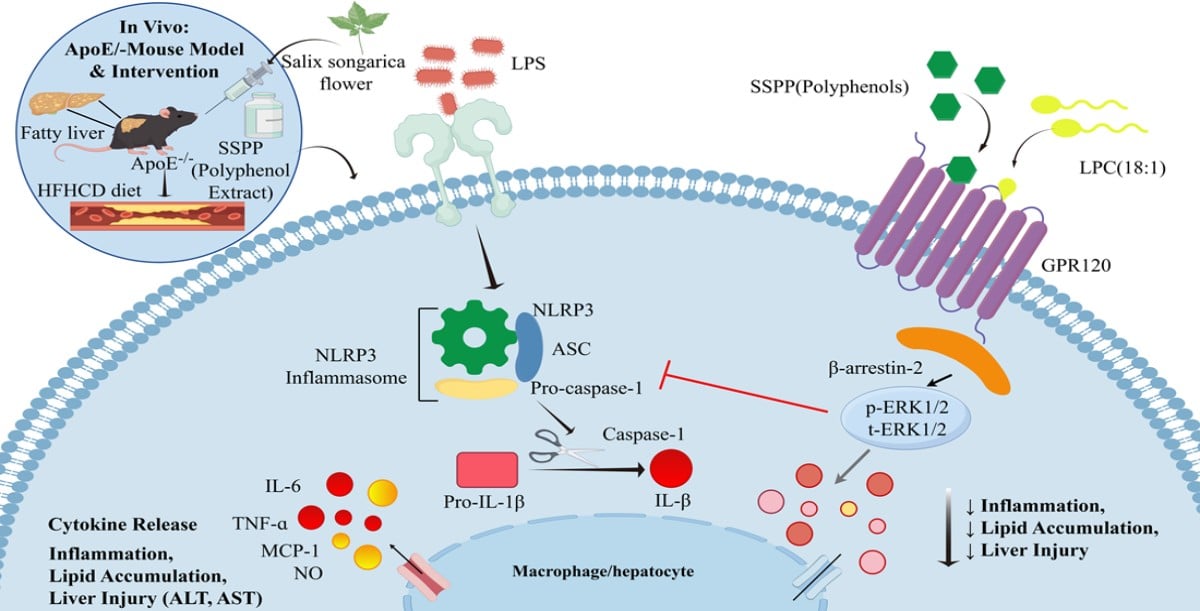
The Polyphenol-Enriched Salix songarica Extract Alleviate High-Fat, High-Cholesterol Diet-Induced Inflamma-tion via the LPC18:1/GPR120/β-Arrestin-2/NLRP3 Signaling Pathway


Abstract
Share and Cite
Li, H.; Ma, N.; Dai, X.; Lin, R.; Yao, Z.; Yan, X.; Xu, S.; Hu, Y.; Zhang, W.; Wang, H.; et al. The Polyphenol-Enriched Salix songarica Extract Alleviate High-Fat, High-Cholesterol Diet-Induced Inflamma-tion via the LPC18:1/GPR120/β-Arrestin-2/NLRP3 Signaling Pathway. Foods 2026, 15, 3010. https://doi.org/10.3390/foods15173010
Li H, Ma N, Dai X, Lin R, Yao Z, Yan X, Xu S, Hu Y, Zhang W, Wang H, et al. The Polyphenol-Enriched Salix songarica Extract Alleviate High-Fat, High-Cholesterol Diet-Induced Inflamma-tion via the LPC18:1/GPR120/β-Arrestin-2/NLRP3 Signaling Pathway. Foods. 2026; 15(17):3010. https://doi.org/10.3390/foods15173010
Chicago/Turabian StyleLi, Hao, Nuoyu Ma, Xuemei Dai, Ruixin Lin, Zhuo Yao, Xiaoqi Yan, Shangzhi Xu, Yunhua Hu, Wenwen Zhang, Haixia Wang, and et al. 2026. "The Polyphenol-Enriched Salix songarica Extract Alleviate High-Fat, High-Cholesterol Diet-Induced Inflamma-tion via the LPC18:1/GPR120/β-Arrestin-2/NLRP3 Signaling Pathway" Foods 15, no. 17: 3010. https://doi.org/10.3390/foods15173010
APA StyleLi, H., Ma, N., Dai, X., Lin, R., Yao, Z., Yan, X., Xu, S., Hu, Y., Zhang, W., Wang, H., Yang, Q., Guo, X., & Zhang, L. (2026). The Polyphenol-Enriched Salix songarica Extract Alleviate High-Fat, High-Cholesterol Diet-Induced Inflamma-tion via the LPC18:1/GPR120/β-Arrestin-2/NLRP3 Signaling Pathway. Foods, 15(17), 3010. https://doi.org/10.3390/foods15173010
