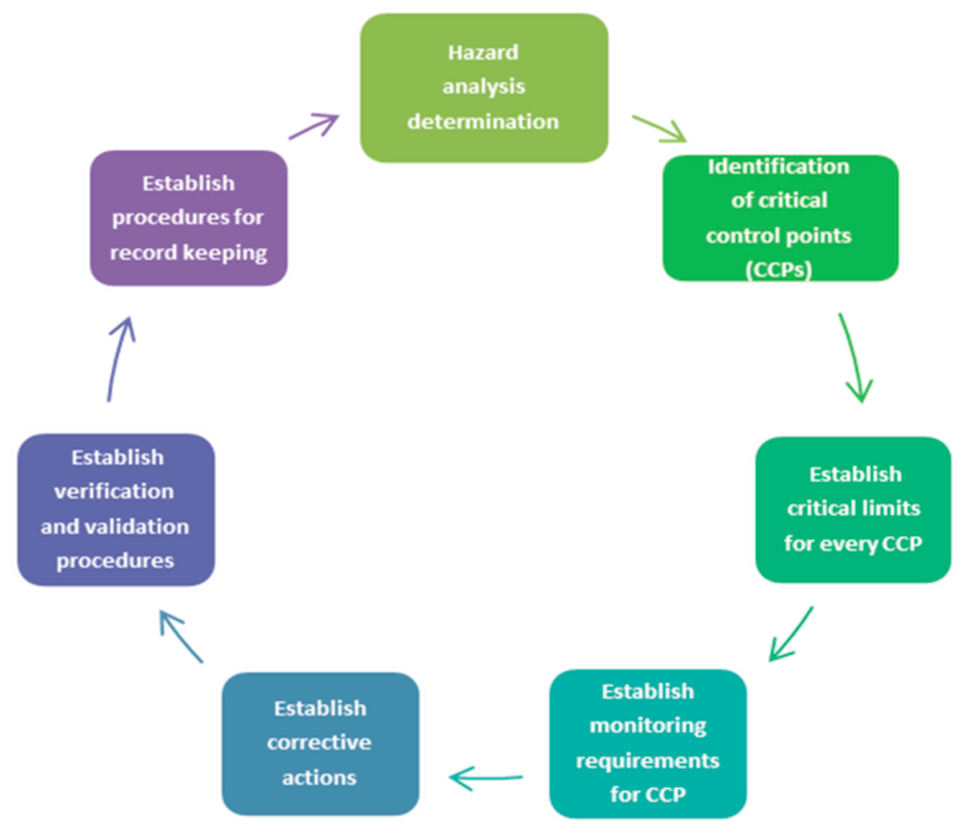
Can ChatGPT Reflect Professional HACCP Judgments? A Comparative Study in Hospitality Food Safety

 , , ,
, , ,  ,
,  and
and
Abstract
1. Introduction
2. Materials and Methods
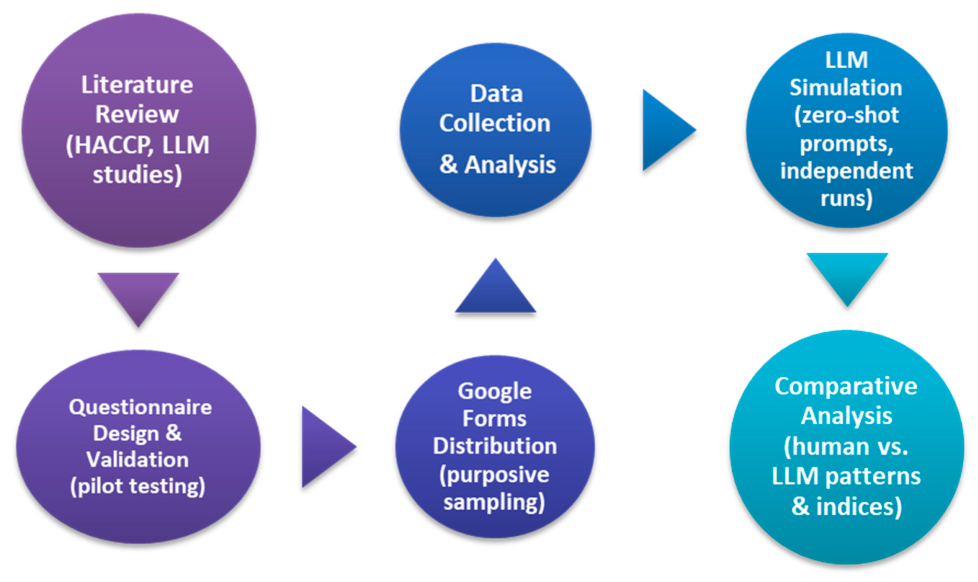
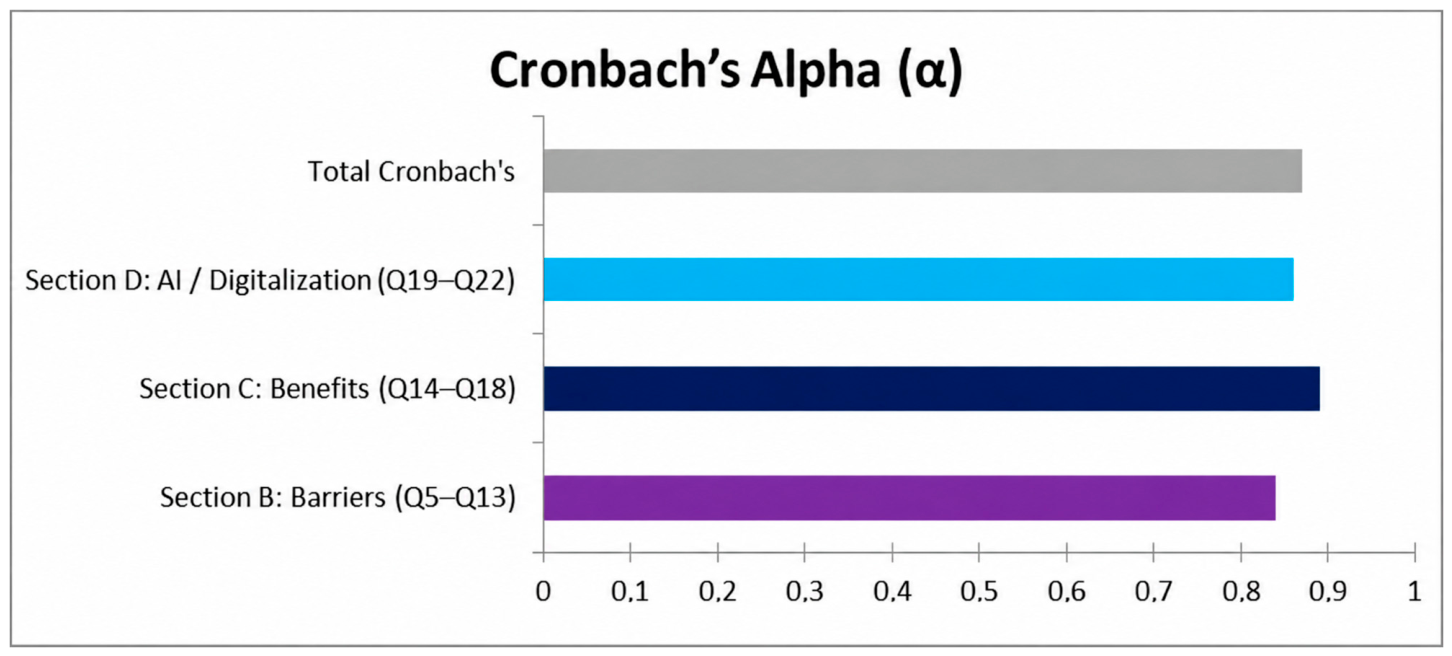
2.1. HACCP Questionnaire Design and Data Collection Procedures
- Barriers to HACCP implementation,
- Benefits of HACCP implementation,
- AI and Digitalization.
2.2. Standardised ChatGPT Simulation Protocol and Comparative Statistical Analysis of Human and AI-Generated Responses
3. Results
3.1. Professional Survey Outcomes and ChatGPT Simulation Outputs
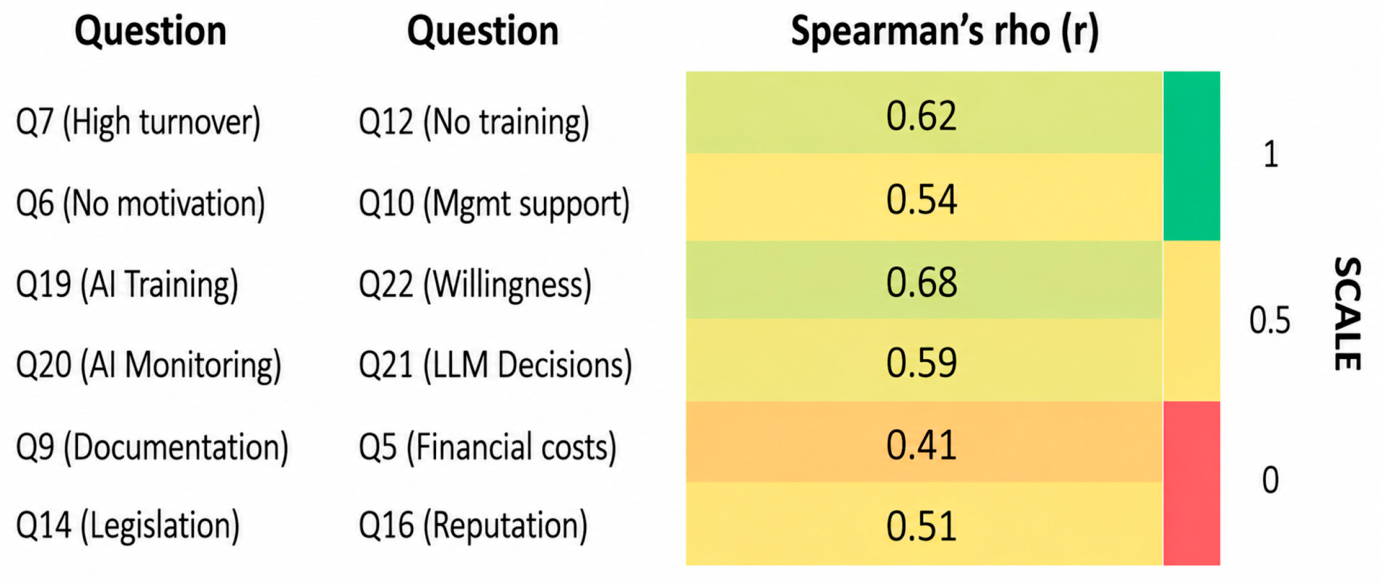
3.2. Benchmarking Model-Human Consistency
4. Discussion
5. Conclusions and Limitations
Supplementary Materials
Author Contributions
Funding
Institutional Review Board Statement
Informed Consent Statement
Data Availability Statement
Acknowledgments
Conflicts of Interest
References
- Aslam, M.U.; Aslam, E.; Shahbaz, M.; Aslam, M.U.; Shahbaz, M. Emerging trends in food safety and quality management. Insights J. Health Rehabil. 2025, 3, 851–859. [Google Scholar] [CrossRef] [Scilit]
- Błaszczyk, I. The management of food safety in beverage industry. In Safety Issues in Beverage Production; Grumezescu, A.M., Holban, A.M., Eds.; Academic Press: London, UK, 2020; pp. 1–38. [Google Scholar] [CrossRef] [Scilit]
- Hyde, R.; Hoflund, A.B.; Pautz, M. One HACCP, two approaches: Experiences with HACCP food safety management systems in the United States and the EU. Adm. Soc. 2016, 48, 962–987. [Google Scholar] [CrossRef] [Scilit]
- Zarid, M. The green HACCP approach: Advancing food safety and sustainability. Sustainability 2025, 17, 7834. [Google Scholar] [CrossRef] [Scilit]
- Sariq, M. The effectiveness of HACCP and FSMS in enhancing food safety in meat industry. Int. J. Res. Appl. Sci. Eng. Technol. 2025, 13, 2945–2952. [Google Scholar] [CrossRef] [Scilit]
- Uzoigwe, D.; Kongolo, D. Integration of hazard analysis and critical control points with maintenance practices: Enhancing food safety in the food and beverage industry. Int. J. Latest Technol. Eng. Manag. Appl. Sci. 2024, 13, 88–101. [Google Scholar] [CrossRef] [Scilit]
- Radu, E.; Dima, A.; Dobrota, E.M.; Badea, A.M.; Madsen, D.Ø.; Dobrin, C.; Stanciu, S. Global trends and research hotspots on HACCP and modern quality management systems in the food industry. Heliyon 2023, 9, e18232. [Google Scholar] [CrossRef] [Scilit] [PubMed]
- Dervilly, G.; Besselink, H.; Bover, S.; Hou, J.; Rantsiou, K.; Yue, M.; Zwietering, M.H.; Engel, E. The SAFFI project: Fostering alignment and collaboration in EU-China food safety management. Food Res. Int. 2025, 213, 116600. [Google Scholar] [CrossRef] [Scilit] [PubMed]
- Osimani, A.; Milanović, V.; Aquilanti, L.; Polverigiani, S.; Garofalo, C.; Clementi, F. Hygiene auditing in mass catering. Public Health 2018, 159, 17–20. [Google Scholar] [CrossRef] [Scilit] [PubMed]
- Cenci-Goga, B.T.; Ortenzi, R.; Bartocci, E.; Codega de Oliveira, A.; Clementi, F.; Vizzani, A. Implementation of HACCP and microbiological quality of meals. Foodborne Pathog. Dis. 2005, 2, 138–145. [Google Scholar] [CrossRef] [Scilit] [PubMed]
- Worsfold, D.; Worsfold, P. Increasing HACCP awareness. J. R. Soc. Promot. Health 2005, 125, 129–135. [Google Scholar] [CrossRef] [Scilit] [PubMed]
- Jevšnik, M.; Hlebec, V.; Raspor, P. Barriers identification during HACCP implementation. Acta Aliment. 2006, 35, 319–353. [Google Scholar] [CrossRef] [Scilit]
- Casolani, N.; Signore, A. Factors influencing HACCP applications in HoReCa sector. Br. Food J. 2016, 118, 1195–1207. [Google Scholar] [CrossRef] [Scilit]
- Fletcher, S.; Maharaj, S.; James, K. Food safety systems in hotels. J. Travel Med. 2009, 16, 35–41. [Google Scholar] [CrossRef] [Scilit] [PubMed]
- FAO. Hazard Analysis and Critical Control Point System. Available online: https://www.fao.org/3/w8088e/w8088e05.htm (accessed on 20 November 2025).
- Moreira, A.; Léon, M.; Coda Moscarola, F.; Roumpakis, A. In the eye of the storm… again! Social policy responses to COVID-19 in Southern Europe. Soc. Policy Adm. 2021, 55, 339–357. [Google Scholar] [CrossRef] [Scilit]
- Vagionaki, T. Linking compliance and policy learning. The case of EU soft law in Greece and Spain. Int. Rev. Public Policy 2022, 4, 219–240. [Google Scholar] [CrossRef] [Scilit]
- McClements, D.J.; Barrangou, R.; Hill, C.; Kokini, J.L.; Lila, M.A.; Meyer, A.S.; Yu, L.L. Building a resilient, sustainable, and healthier food supply through innovation and technology. Annu. Rev. Food Sci. Technol. 2020, 12, 1–28. [Google Scholar] [CrossRef] [Scilit] [PubMed]
- Galanakis, C.M.; Rizou, M.; Aldawoud, T.M.; Ucak, I.; Rowan, N.J. Innovations and technology disruptions in the food sector within the COVID-19 pandemic and post-lockdown era. Trends Food Sci. Technol. 2021, 110, 193–200. [Google Scholar] [CrossRef] [Scilit] [PubMed]
- Laurence, T.; Harris, J.; Loman, L.; Douglas, A.; Chan, Y.; Hounsome, L.; Larkin, L.; Borowitz, M. Review GIDE—Restaurant review gastrointestinal illness detection and extraction with large language models. arXiv 2025, arXiv:2503.09743. [Google Scholar]
- Salekpay, F.; van den Bergh, J.; Savin, I. Comparing advice on climate policy between academic experts and ChatGPT. Ecol. Econ. 2024, 226, 108352. [Google Scholar] [CrossRef] [Scilit]
- Charalampidou, S.; Zeleskidis, A.; Dokas, I.M. Hazard analysis in the era of AI: Assessing the usefulness of ChatGPT4 in STPA hazard analysis. Saf. Sci. 2024, 178, 106608. [Google Scholar] [CrossRef] [Scilit]
- Chen, Y.; Yin, R.; Guo, L.; Zhao, D.; Sun, B. Consumer sensory evaluation scale for pale lager beer. Foods 2025, 14, 2834. [Google Scholar] [CrossRef] [Scilit] [PubMed]
- Shen, C.; Meng, W.; Chen, X.; Liu, K.; Wu, X.; Yu, Q. Consumers’ perception of food safety risks. Foods 2025, 14, 3463. [Google Scholar] [CrossRef] [Scilit] [PubMed]
- Yuan, X.; Chen, Y.; Yin, R.; Guo, L.; Song, Y.; Zhong, B.; Zhao, D. Relationship between personal characteristics and alcohol consumption. Foods 2025, 14, 3536. [Google Scholar] [CrossRef] [Scilit] [PubMed]
- Pînzariu, S.; Pînzariu, A. HACCP standards in military feeding services. Knowl. Based Organ. 2025, 31, 166–170. [Google Scholar] [CrossRef] [Scilit]
- Xia, T.; Shen, X.; Li, L. AI food and consumer trust. Foods 2024, 13, 2983. [Google Scholar] [CrossRef] [Scilit] [PubMed]
- Wang, W.; Chen, Z.; Kuang, J. Artificial Intelligence-Driven Recommendations and Functional Food Purchases: Understanding Consumer Decision-Making. Foods 2025, 14, 976. [Google Scholar] [CrossRef] [Scilit] [PubMed]
- Górska, P.; Górna, I.; Miechowicz, I.; Przysławski, J. Eating behaviour during COVID-19 pandemic. Foods 2021, 10, 1624. [Google Scholar] [CrossRef] [Scilit] [PubMed]
- Alzhrani, W.F.; Shatwan, I.M. Food safety knowledge of restaurant handlers. Foods 2024, 13, 2176. [Google Scholar] [CrossRef] [Scilit] [PubMed]
- Hertzog, M.A. Considerations in determining sample size for pilot studies. Res. Nurs. Health 2008, 31, 180–191. [Google Scholar] [CrossRef] [Scilit] [PubMed]
- Willis, G.B. Cognitive Interviewing. In Sage Research Methods; SAGE Publications, Inc.: Thousand Oaks, CA, USA, 2005. [Google Scholar] [CrossRef] [Scilit]
- Pourhoseingholi, M.A.; Vahedi, M.; Rahimzadeh, M. Sample size calculation in medical studies. Gastroenterol. Hepatol. Bed Bench 2013, 6, 14–17. [Google Scholar] [PubMed]
- Awuchi, C.G. HACCP, quality, and food safety management in food and agricultural systems. Cogent Food Agric. 2023, 9, 2176280. [Google Scholar] [CrossRef] [Scilit]
- Lee, J.C.; Darabă, A.; Voidarou, C.; Rozos, G.; El Enshasy, H.A.; Varzakas, T. Implementation of food safety management systems along with other management tools (HAZOP, FMEA, Ishikawa, Pareto): The case study of Listeria monocytogenes and correlation with microbiological criteria. Foods 2021, 10, 2169. [Google Scholar] [CrossRef] [Scilit] [PubMed]
- Mutua, A. Role of food management systems on food safety in hotels. J. Food Sci. 2021, 2, 37–50. [Google Scholar] [CrossRef] [Scilit]
- Salavelis, A.; Pavlovsky, S.; Lazarenko, N. Obstacles to the implementation of HACCP in small food industry enterprises and in restaurant business establishments. Sci. Messenger LNU Vet. Med. Biotechnol. 2025, 27, 103. [Google Scholar] [CrossRef] [Scilit]
- Jevšnik, M.; Raspor, P. Food safety knowledge and behaviour among food handlers in catering establishments: A case study. Br. Food J. 2021. Epub ahead of printing. [Google Scholar] [CrossRef] [Scilit]
- Arvanitoyannis, I.; Samourelis, K.; Kotsanopoulos, K.V. A critical analysis of ISO audits results. Br. Food J. 2016, 118, 2126–2139. [Google Scholar] [CrossRef] [Scilit]
- Gkrintzali, G.; Pexara, E.; Carayanni, V.; Boskou, G. Consumer protection and food safety in Greece. J. Hell. Vet. Med. Soc. 2018, 69, 965–972. [Google Scholar] [CrossRef] [Scilit]
- Rizzo, C.E.; Venuto, R.; Genovese, G.; Squeri, R.; Genovese, C. Food hygiene non-compliance assessment. Foods 2025, 14, 3364. [Google Scholar] [CrossRef] [Scilit] [PubMed]
- Agkoli, P. SDGs strategies in Greek hospitality SMEs: Overcoming barriers to sustainability implementations. HAPSc Policy Briefs Ser. 2024, 5, 132–138. [Google Scholar] [CrossRef] [Scilit]
- Chatzimpyrou, O.; Chaidoutis, E.; Keramydas, D.; Papalexis, P.; Thomaidis, N.S.; Pitiriga, V.C.; Langi, P.; Koutsiari, F.; Drikos, L.; Giannari, M.; et al. Health inspections of restaurants in Greece. J. Food Prot. 2025, 88, 100452. [Google Scholar] [CrossRef] [Scilit] [PubMed]
- Mellou, K.; Mplougoura, A.; Mandilara, G.; Papadakis, A.; Chochlakis, D.; Psaroulaki, A.; Mavridou, A. Swimming pool regulations in the COVID-19 era. Assessing acceptability and compliance in Greek hotels in two consecutive summer touristic periods. Water 2022, 14, 796. [Google Scholar] [CrossRef] [Scilit]
- Vaithinathan, A.G.; Anwar, N.; Sulieman, A.; AlAlawi, F.; Mohammed, M.Y.; Ahmed, S. Coronavirus disease and food safety in hospitality sector. In Handbook of Research on the Impacts of COVID-19 on Tourism; IGI Global: Hershey, PA, USA, 2021; pp. 603–626. [Google Scholar] [CrossRef] [Scilit]
- Varotsis, N. Quality standards in hospitality industry. J. Hosp. Tour. Manag. 2019, 8, 417. [Google Scholar]
- Osman, N.E.; Abdallah, M.A. Difficulties and barriers for the implementing of HACCP and food safety systems in food businesses in Khartoum-Sudan. Total Qual. Manag. 2018, 19, 73–79. [Google Scholar]
- Marule, L.; Du Rand, G.; Marx-Pienaar, N. Gauteng’s managers’ implementation of food safety protocols and practices in their QSR environments. J. Food Consum. Sci. 2024, 1, 172–188. [Google Scholar] [CrossRef] [Scilit]
- Psomatakis, M.; Papadimitriou, K.; Souliotis, A.; Drosinos, E.H.; Papadopoulos, G. Food Safety and Management System Audits in Food Retail Chain Stores in Greece. Foods 2024, 13, 457. [Google Scholar] [CrossRef] [Scilit] [PubMed]
- Dzwolak, W.; Anim, B. Barriers hindering maintenance of standardised HACCP-based food safety management systems in small Polish food businesses. Food Control 2025, 168, 110849. [Google Scholar] [CrossRef] [Scilit]
- Nicolaisen, A.; Bogh, S.B.; Churruca, K.; Ellis, L.A.; Braithwaite, J.; von Plessen, C. Managers’ perceptions of the effects of a national mandatory accreditation program in Danish hospitals: A cross-sectional survey. Int. J. Qual. Health Care 2019, 31, 331–337. [Google Scholar] [CrossRef] [Scilit] [PubMed]
- de Groot, K.; de Veer, A.J.E.; Munster, A.M.; Francke, A.L.; Paans, W. Nursing documentation and its relationship with perceived nursing workload: A mixed-methods study among community nurses. BMC Nurs. 2022, 21, 34. [Google Scholar] [CrossRef] [Scilit] [PubMed]
- Weinroth, M.D.; Belk, A.D.; Belk, K.E. History, development, and current status of food safety systems worldwide. Anim. Front. 2018, 8, 9–15. [Google Scholar] [CrossRef] [Scilit] [PubMed]
- Noor Hasnan, N.Z.; Kadir, R.; Mohd Amin, N.A.; Aziz, N.; Mohd Ramli, S.H. Analysis of the most frequent nonconformance aspects related to GMP among SMEs in the food industry and their main factors. Food Control 2022, 141, 109205. [Google Scholar] [CrossRef] [Scilit]
- Galstyan, S.; Harutyunyan, T. Barriers and facilitators of HACCP adoption in the Armenian dairy industry. Br. Food J. 2016, 118, 2676–2691. [Google Scholar] [CrossRef] [Scilit]
- Borovčanin, D.; Kilibarda, N. Assuring good food handling practices in hospitality: Financial costs and employees’ attitudes—A case study from Serbia. Meat Technol. 2020, 61, 82–94. [Google Scholar] [CrossRef] [Scilit]
- Fotopoulos, C.; Kafetzopoulos, D.; Psomas, E.L. Assessing the critical factors and their impact on the effective implementation of a food safety management system. Int. J. Qual. Reliab. Manag. 2009, 26, 894–910. [Google Scholar] [CrossRef] [Scilit]
- Semos, A.; Kontogeorgos, A. HACCP implementation in Northern Greece. Br. Food J. 2007, 109, 5–19. [Google Scholar] [CrossRef] [Scilit]
- Bertella, G. Rethinking sustainability and food in tourism. Ann. Tour. Res. 2020, 84, 103005. [Google Scholar] [CrossRef] [Scilit] [PubMed]
- Molina-Collado, A.; Santos-Vijande, M.L.; Gómez-Rico, M.; Madera, J.M. Sustainability in hospitality and tourism. Int. J. Contemp. Hosp. Manag. 2022, 34, 3029–3064. [Google Scholar] [CrossRef] [Scilit]
- Ruiz-Molina, M.E.; Belda-Miquel, S.; Hytti, A.; Gil-Saura, I. Addressing sustainable food management in hotels. Br. Food J. 2022, 124, 462–492. [Google Scholar] [CrossRef] [Scilit]
- Zhylenko, K.; Yarovenko, T.; Stavytska, A.; Samoilenko, A. Sustainable development of hotel and restaurant business. Econ. Financ. Law 2024, 5, 64–67. [Google Scholar] [CrossRef] [Scilit]
- Ibrahim, A.Z.; Megahed, M.; Farida, A.; Tamer, A. Investigating the effect of food safety practices on hotel performance. Int. J. Tour. Hosp. Manag. 2021, 4, 243–264. [Google Scholar] [CrossRef] [Scilit]
- Peistikou, M. Restaurants industry in the COVID-19 era: Challenge or opportunity? In Strategic Innovative Marketing and Tourism in the COVID-19 Era; Springer Proceedings in Business and Economics; Kavoura, A., Havlovic, S.J., Totskaya, N., Eds.; Springer: Berlin/Heidelberg, Germany, 2021; pp. 153–162. [Google Scholar]
- Hassani, S. Enhancing legal compliance and regulation analysis with large language models. In Proceedings of the 2024 IEEE 32nd International Requirements Engineering Conference (RE), Reykjavik, Iceland, 24–28 June 2024; pp. 507–511. [Google Scholar]
- Hassani, S.; Sabetzadeh, M.; Amyot, D. An empirical study on LLM-based classification of requirements-related provisions in food-safety regulations. Empir. Softw. Eng. 2025, 30, 3. [Google Scholar] [CrossRef] [Scilit]
- Görgen, L.; Müller, E.; Triller, M.; Nast, B.; Sandkuhl, K. Large language models in enterprise modeling: Case study and experiences. In Proceedings of the 12th International Conference on Model-Based Software and Systems Engineering (MODELSWARD 2024), Rome, Italy, 21–23 February 2024. [Google Scholar]
- Collier, Z.A.; Gruss, R.; Abrahams, A.S. How good are large language models at product risk assessment? Risk Anal. 2025, 45, 766–789. [Google Scholar] [CrossRef] [Scilit] [PubMed]
- Esposito, M.; Palagiano, F.; Lenarduzzi, V. Beyond words: On large language models actionability in mission-critical risk analysis. In Proceedings of the 18th ACM/IEEE International Symposium on Empirical Software Engineering and Measurement, Catalunya, Spain, 20–25 October 2024. [Google Scholar]
- Huang, Y.; Song, J.; Wang, Z.; Chen, H.; Ma, L. Look before you leap: An exploratory study of uncertainty measurement for large language models. arXiv 2023, arXiv:2307.10236. [Google Scholar]
- Kattamreddy, A.R.; Chinnam, H. The future of large language models in toxicological risk assessment: Opportunities and challenges. Public Health Toxicol. 2025, 5, 3. [Google Scholar] [CrossRef] [Scilit]
- Ma, P.; Tsai, S.; He, Y.; Jia, X.; Zhen, D.; Yu, N.; Wang, Q.; Ahuja, J.K.; Wei, C.-I. Large language models in food science: Innovations, applications, and future. Trends Food Sci. Technol. 2024, 148, 104488. [Google Scholar] [CrossRef] [Scilit]
- Ahmed, N.; Kour, R.; Jan, T.; Sharma, S.; Singh, T.P.; Chauhan, P.; Ghanghas, S.; Sheikh, I.; Rafatullah, M.; Setyawan, H.Y.; et al. The intersection of artificial intelligence and food systems: Exploring technological breakthroughs and data-driven agriculture. Cogent Food Agric. 2026, 12, 2615165. [Google Scholar] [CrossRef] [Scilit]
- Abdi, Y.H.; Bashir, S.G.; Abdullahi, Y.B.; Abdi, M.S.; Ahmed, N.I. Artificial intelligence applications for strengthening global food safety systems. Discov. Food 2025, 5, 391. [Google Scholar] [CrossRef] [Scilit]
- Harikrishnan, S.; Kaushik, D.; Rasane, P.; Kumar, A.; Kaur, N.; Reddy, C.K.; Proestos, C.; Oz, F.; Kumar, M. Artificial intelligence in sustainable food design: Technological, ethical consideration, and future. Trends Food Sci. Technol. 2025, 163, 105152. [Google Scholar] [CrossRef] [Scilit]
- Dokas, I. From hallucinations to hazards: Benchmarking LLMs for hazard analysis in safety-critical systems. Saf. Sci. 2025, 194, 107056. [Google Scholar] [CrossRef] [Scilit]
- Fan, L.; Li, L.; Ma, Z.; Lee, S.; Yu, H.; Hemphill, L. A bibliometric review of large language models research from 2017 to 2023. ACM Trans. Intell. Syst. Technol. 2023, 15, 1–25. [Google Scholar] [CrossRef] [Scilit]
- Yu, H.; Fan, L.; Li, L.; Zhou, J.; Ma, Z.; Xian, L.; Hua, W.; He, S.; Jin, M.; Zhang, Y.; et al. Large language models in biomedical and health informatics: A review with bibliometric analysis. J. Healthc. Inform. Res. 2024, 8, 658–711. [Google Scholar] [CrossRef] [Scilit] [PubMed]
- Sindhu, B.; Prathamesh, R.P.; Sameera, M.B.; Kumaraswamy, S. The evolution of large language model: Models, applications and challenges. In Proceedings of the 2024 International Conference on Current Trends in Advanced Computing (ICCTAC), Bengaluru, India, 8–9 May 2024; pp. 1–8. [Google Scholar]



| Question No | Item | Consultant | Production Staff | Manager/ Owner | Auditor | Researcher/ Academic | Average Score |
|---|---|---|---|---|---|---|---|
| SECTION B— BARRIERS | |||||||
| Q5 | Financial constraints/Equipment renewal costs | 4.63 | 4.37 | 4.87 | 4.47 | 4.70 | 4.61 |
| Q6 | Lack of staff motivation and commitment | 4.70 | 4.87 | 4.43 | 4.60 | 4.50 | 4.62 |
| Q7 | High staff turnover | 4.80 | 4.77 | 4.70 | 4.80 | 4.77 | 4.77 |
| Q8 | Limited technical expertise of staff | 4.53 | 4.67 | 4.33 | 4.70 | 4.43 | 4.53 |
| Q9 | Time required for documentation (record keeping) | 3.90 | 4.83 | 3.50 | 4.07 | 3.23 | 3.91 |
| Q10 | Management support and commitment | 4.23 | 4.43 | 4.53 | 4.50 | 4.73 | 4.48 |
| Q11 | Insufficient prerequisite programs (PRPs) | 4.30 | 4.10 | 4.17 | 4.87 | 4.67 | 4.42 |
| Q12 | Inability to ensure continuous training | 4.67 | 4.73 | 4.40 | 4.77 | 4.83 | 4.68 |
| Q13 | Lack of specialized technical consultants | 4.13 | 3.87 | 3.97 | 4.23 | 4.33 | 4.11 |
| SECTION C— BENEFITS | |||||||
| Q14 | Improves compliance with legislation | 4.70 | 4.40 | 4.60 | 4.97 | 4.90 | 4.71 |
| Q15 | Reduces the likelihood of customer complaints | 4.53 | 4.30 | 4.77 | 4.67 | 4.50 | 4.55 |
| Q16 | Enhances business reputation and credibility | 4.87 | 4.53 | 4.90 | 4.87 | 4.83 | 4.80 |
| Q17 | Increases customer satisfaction and trust | 4.73 | 4.47 | 4.77 | 4.63 | 4.60 | 4.64 |
| Q18 | Promotes food safety culture among employees | 4.63 | 4.40 | 4.73 | 4.87 | 4.93 | 4.71 |
| SECTION D— AI/DIGITALIZATION | |||||||
| Q19 | AI can contribute to staff HACCP training | 4.40 | 3.97 | 4.10 | 4.57 | 4.77 | 4.36 |
| Q20 | AI systems can assist with automatic monitoring of CCPs and PRPs | 4.70 | 4.27 | 4.63 | 4.83 | 4.80 | 4.65 |
| Q21 | Large Language Models (LLMs) can support HACCP decision-making | 4.37 | 3.90 | 4.13 | 4.67 | 4.73 | 4.36 |
| Q22 | Willingness to participate in AI-utilizing HACCP training program | 4.23 | 3.7 | 4.07 | 4.33 | 4.6 | 4.19 |
| Average Score | 4.50 | 4.37 | 4.42 | 4.63 | 4.60 | 4,5 |
| Category | Characteristic | Percentage (%)/ Frequency |
|---|---|---|
| Experience in HACCP | <1 year | 8% |
| 1–3 years | 15% | |
| 4–7 years | 22% | |
| 8–10 years | 18% | |
| >10 years | 37% | |
| Organization Type | Mass Catering/Catering Units | 42% |
| Hotel Units | 35% | |
| Consulting/Auditing Firms | 12% | |
| Public Authorities/Regulatory Bodies | 11% | |
| Training | Certified HACCP Training | 82% |
| No Official Certification | 18% | |
| Professional role | HACCP Consultant/Auditor | 33 |
| Quality or Food Safety Manager | 32 | |
| Manager/Business Owner | 10 | |
| Researcher/Academic | 7 | |
| Production/Kitchen Staff | 5 | |
| Other food safety–related roles (e.g., regulatory authority staff, assistants, inspectors): | 3 | |
| Geographical region of professional activity | Attica | 38 |
| Central Macedonia | 24 | |
| Eastern Macedonia and Thrace | 6 | |
| Peloponnese | 5 | |
| Crete | 4 | |
| Ionian islands | 4 | |
| Other regions (Sterea Ellada, North Aegean, South Aegean, Thessaly, Western Greece, Epirus, Western Macedonia) | 9 |
| Question No | Item | Consultant | Production Staff | Manager/ Owner | Auditor | Researcher/ Academic | Average Score |
|---|---|---|---|---|---|---|---|
| SECTION B— BARRIERS | |||||||
| Q5 | Financial constraints/Equipment renewal costs | 4.15 | 3.85 | 4.3 | 4.1 | 3.95 | 4.07 |
| Q6 | Lack of staff motivation and commitment | 4.4 | 4.2 | 4.15 | 4.5 | 4.35 | 4.32 |
| Q7 | High staff turnover | 4.55 | 4.6 | 4.45 | 4.7 | 4.65 | 4.59 |
| Q8 | Limited technical expertise of staff | 4.2 | 4.1 | 3.95 | 4.35 | 4.25 | 4.17 |
| Q9 | Time required for documentation (record keeping) | 4.1 | 4.45 | 4.25 | 4.15 | 3.8 | 4.15 |
| Q10 | Management support and commitment | 4.35 | 4.05 | 4.4 | 4.55 | 4.45 | 4.36 |
| Q11 | Insufficient prerequisite programs (PRPs) | 3.9 | 3.75 | 3.85 | 4.2 | 4.1 | 3.96 |
| Q12 | Inability to ensure continuous training | 4.45 | 4.3 | 4.2 | 4.6 | 4.55 | 4.42 |
| Q13 | Lack of specialized technical consultants | 3.65 | 3.4 | 3.55 | 3.8 | 3.75 | 3.63 |
| SECTION C— BENEFITS | |||||||
| Q14 | Improves compliance with legislation | 4.85 | 4.65 | 4.75 | 4.9 | 4.95 | 4.82 |
| Q15 | Reduces the likelihood of customer complaints | 4.6 | 4.5 | 4.7 | 4.75 | 4.65 | 4.64 |
| Q16 | Enhances business reputation and credibility | 4.75 | 4.6 | 4.85 | 4.8 | 4.8 | 4.76 |
| Q17 | Increases customer satisfaction and trust | 4.7 | 4.55 | 4.8 | 4.75 | 4.7 | 4.7 |
| Q18 | Promotes food safety culture among employees | 4.5 | 4.35 | 4.45 | 4.7 | 4.8 | 4.56 |
| SECTION D— AI/DIGITALIZATION | |||||||
| Q19 | AI can contribute to staff HACCP training | 4.1 | 3.8 | 3.9 | 4.25 | 4.45 | 4.1 |
| Q20 | AI systems can assist with automatic monitoring of CCPs and PRPs | 4.35 | 3.95 | 4.15 | 4.5 | 4.6 | 4.31 |
| Q21 | Large Language Models (LLMs) can support HACCP decision-making | 3.85 | 3.5 | 3.7 | 4.1 | 4.3 | 3.89 |
| Q22 | Willingness to participate in AI-utilizing HACCP training program | 4.2 | 3.9 | 4.05 | 4.3 | 4.5 | 4.19 |
| Average Score | 4.50 | 4.37 | 4.42 | 4.63 | 4.60 | 4.5 |
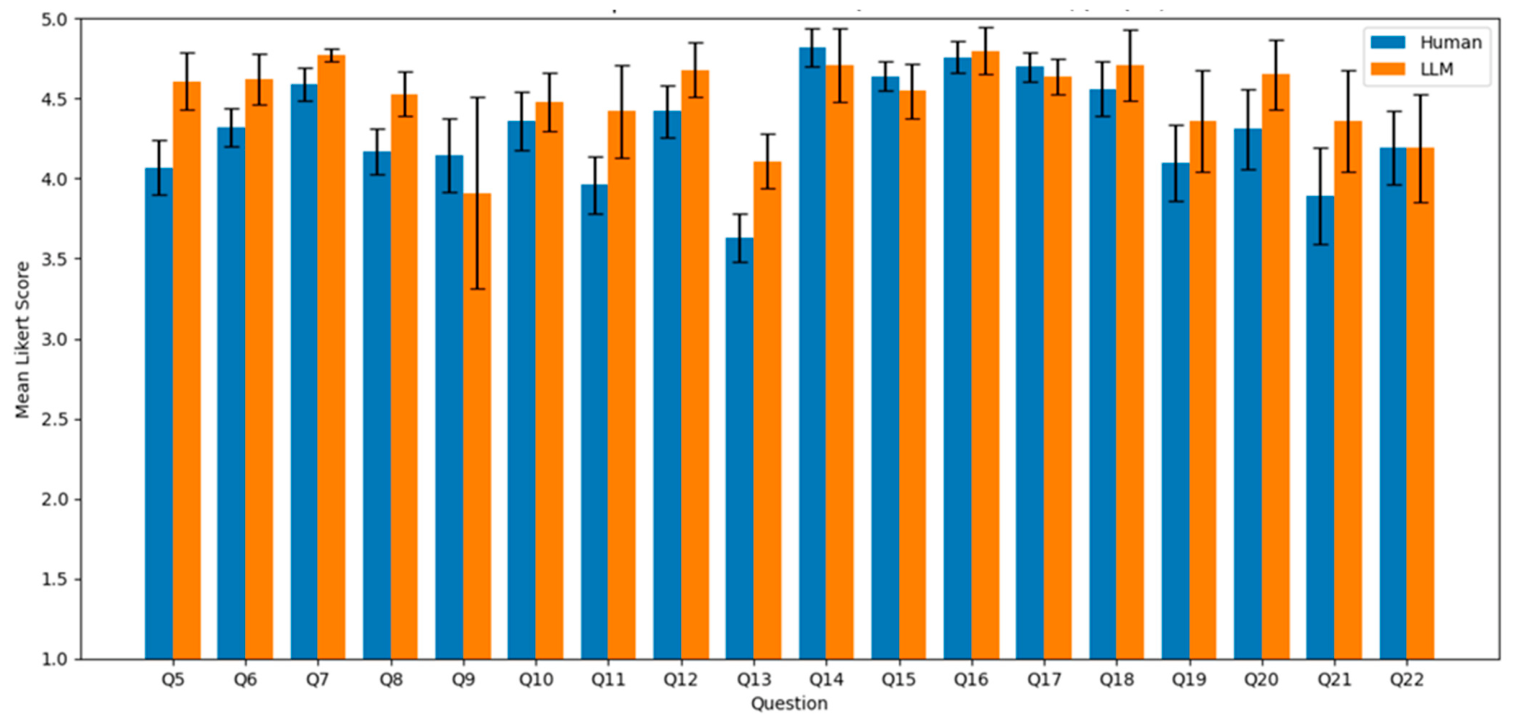
| Question No | Item Description | LLM Average | Human Average | Δ (LLM − Human) |
|---|---|---|---|---|
| SECTION B— BARRIERS | ||||
| Q5 | Financial constraints/Equipment renewal costs | 4.61 | 4.07 | 0.54 |
| Q6 | Lack of staff motivation and commitment | 4.62 | 4.32 | 0.3 |
| Q7 | High staff turnover | 4.77 | 4.59 | 0.18 |
| Q8 | Limited technical expertise of staff | 4.53 | 4.17 | 0.36 |
| Q9 | Time required for documentation (record keeping) | 3.91 | 4.15 | −0.24 |
| Q10 | Management support and commitment | 4.48 | 4.36 | 0.12 |
| Q11 | Insufficient prerequisite programs (PRPs) | 4.42 | 3.96 | 0.46 |
| Q12 | Inability to ensure continuous training | 4.68 | 4.42 | 0.26 |
| Q13 | Lack of specialized technical consultants | 4.11 | 3.63 | 0.48 |
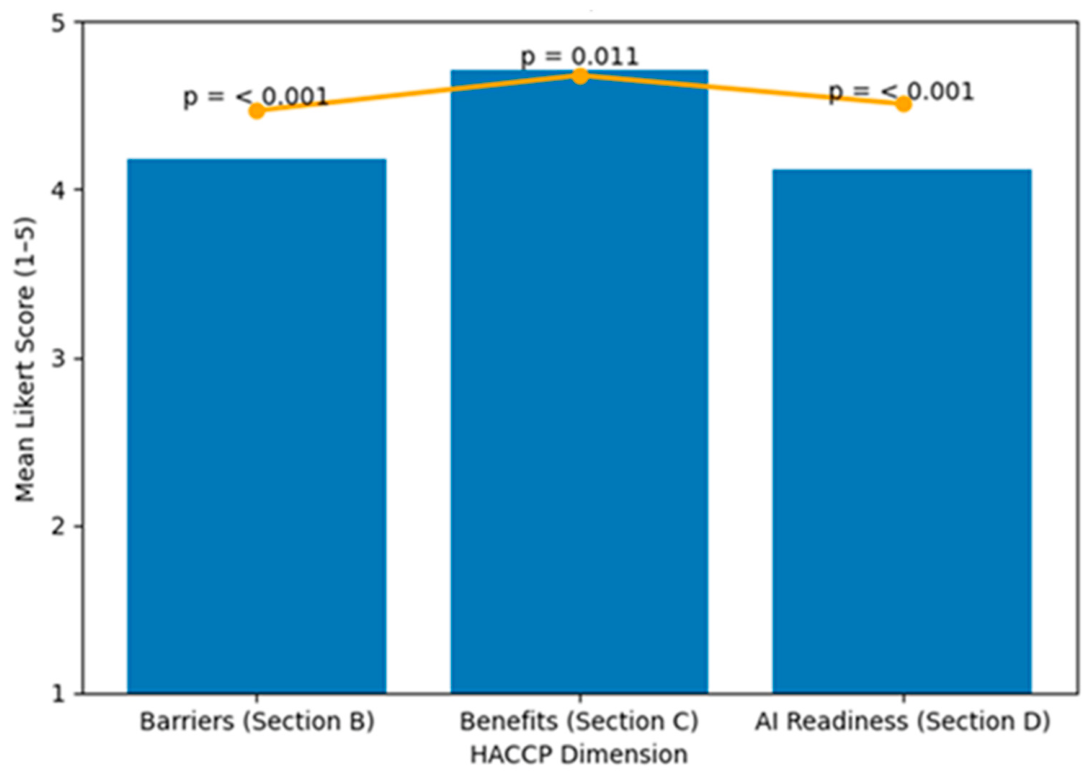
| Average | 4.45 | 4.18 | ||
| SECTION C— BENEFITS | ||||
| Q14 | Improves compliance with legislation | 4.71 | 4.82 | −0.11 |
| Q15 | Reduces the likelihood of customer complaints | 4.55 | 4.64 | −0.09 |
| Q16 | Enhances business reputation and credibility | 4.8 | 4.76 | 0.04 |
| Q17 | Increases customer satisfaction and trust | 4.64 | 4.7 | −0.06 |
| Q18 | Promotes food safety culture among employees | 4.71 | 4.56 | 0.15 |
| Average | 4.62 | 4.69 | ||
| SECTION D— AI/DIGITALIZATION | ||||
| Q19 | AI can contribute to staff HACCP training | 4.36 | 4.1 | 0.26 |
| Q20 | AI systems can assist with automatic monitoring of CCPs and PRPs | 4.65 | 4.31 | 0.34 |
| Q21 | Large Language Models (LLMs) can support HACCP decision-making | 4.36 | 3.89 | 0.47 |
| Q22 | Willingness to participate in AI-utilizing HACCP training program | 4.19 | 4.19 | 0 |
| Average | 4.39 | 4.12 | 0.19 |
Disclaimer/Publisher’s Note: The statements, opinions and data contained in all publications are solely those of the individual author(s) and contributor(s) and not of MDPI and/or the editor(s). MDPI and/or the editor(s) disclaim responsibility for any injury to people or property resulting from any ideas, methods, instructions or products referred to in the content. |
© 2026 by the authors. Licensee MDPI, Basel, Switzerland. This article is an open access article distributed under the terms and conditions of the Creative Commons Attribution (CC BY) license.
Share and Cite
Konstantinidi, D.M.; Stavropoulou, E.; Stavropoulos, A.; Voidarou, C.; Tsigalou, C.; Pitiriga, V.; Stefanis, C. Can ChatGPT Reflect Professional HACCP Judgments? A Comparative Study in Hospitality Food Safety. Foods 2026, 15, 2916. https://doi.org/10.3390/foods15162916
Konstantinidi DM, Stavropoulou E, Stavropoulos A, Voidarou C, Tsigalou C, Pitiriga V, Stefanis C. Can ChatGPT Reflect Professional HACCP Judgments? A Comparative Study in Hospitality Food Safety. Foods. 2026; 15(16):2916. https://doi.org/10.3390/foods15162916
Chicago/Turabian StyleKonstantinidi, Despoina Maria, Elisavet Stavropoulou, Agathangelos Stavropoulos, Chrysoula (Chrysa) Voidarou, Christina Tsigalou, Vassiliki Pitiriga, and Christos Stefanis. 2026. "Can ChatGPT Reflect Professional HACCP Judgments? A Comparative Study in Hospitality Food Safety" Foods 15, no. 16: 2916. https://doi.org/10.3390/foods15162916
APA StyleKonstantinidi, D. M., Stavropoulou, E., Stavropoulos, A., Voidarou, C., Tsigalou, C., Pitiriga, V., & Stefanis, C. (2026). Can ChatGPT Reflect Professional HACCP Judgments? A Comparative Study in Hospitality Food Safety. Foods, 15(16), 2916. https://doi.org/10.3390/foods15162916