Consumers’ Attitudes Towards Functional Foods in the North-West Region of Romania (Transylvania)
 ,
,  ,
,  ,
,
Abstract
1. Introduction
1.1. The Concept of Functional Foods
1.2. The Functional Foods Market
1.3. Psychological Aspects in the Consumption of Functional Foods: Motivation, Preference, Attitude, Behavior
1.4. The Functional Foods Situation in Romania
2. Materials and Methods
2.1. Analysis Parameters of Functional Foods in Purchase and Consumption Decisions
2.2. Methodology
- O1. Analysis of functional-food choice behaviors;
- O2. Analysis of consumer confidence in the health benefits of functional foods;
- O3. Analysis of functional-product factors—packaging, taste, brand, and scientific certifications.
3. Results
- The contribution of functional foods to the prevention of a disease or for prophylactic consumption (for example, in the questionnaire, on a simple flu);
- Trust in the benefits of functional foods to improve general health;
- Trust in the benefits of functional foods to prevent some diseases.
- The null hypothesis is that family structure does not influence awareness, health or the preference in consumption and the alternative hypothesis is that it does. The results show that family structure influences the importance of these components.
- The null hypothesis is that the family structure does not influence the importance of the package, taste or brand, and the alternative hypothesis is that it does. The results show that the family structure does not influence the importance of these components.
- The null hypothesis is that gender does not influence the importance of taste, and the alternative hypothesis is that it does. The results show that gender does not influence the importance of taste, so regardless of gender, taste remains a critical factor in the decision-making process.
4. Discussion
5. Limitations and Future Research Directions
6. Conclusions
Author Contributions
Funding
Institutional Review Board Statement
Informed Consent Statement
Data Availability Statement
Conflicts of Interest
Abbreviations
| FF | Functional Foods |
Appendix A. Questionnaire Structure
References
- Gibson, G.; Williams, C. Functional Foods; CRC Press: Boca Raton, FL, USA, 2003; p. 9. [Google Scholar]
- Anton, D.T.; Coman, A.E. Role of Functional Foods in Health Promotion in Children; Medical Practice; University of Medicine and Pharmacy “Gr.T.Popa”: Iasi, Romania, 2011; Volume VI. [Google Scholar]
- Betoret, E.; Betoret, N.; Vidal, D.; Fito, P. Functional foods development: Trends and technologies. Trends Food Sci. Technol. 2011, 22, 498–508. [Google Scholar] [CrossRef] [Scilit]
- Khan, R.S.; Grigor, J.; Winger, R.; Win, A. Functional food product development—Opportunities and challenges for food manufacturers. Trends Food Sci. Technol. 2013, 30, 27–37. [Google Scholar] [CrossRef] [Scilit]
- Gök, I. Functional potential of several Turkish fermented traditional foods: Biotic properties, bioactive compounds, and health benefits. Food Rev. Int. 2023, 39, 2568–2593. [Google Scholar] [CrossRef] [Scilit]
- Frumuzachi, O.; Rohn, S.; Mocan, A. Fermented black chokeberry (Aronia melanocarpa (Michx.) Elliott)—A systematic review of composition and current scientific evidence on possible health benefits. Food Res. Int. 2024, 196, 115094. [Google Scholar] [CrossRef] [Scilit] [PubMed]
- Kalita, P.; Chakrabarti, S.; Bhattacharjee, B.; Paul, S.; Dutta, P.P.; Pachuau, L. Recent advances in improving the delivery, bioavailability and bioactivity of polyphenolic compounds through encapsulation: A comprehensive review. Food Chem. 2025, 490, 145087. [Google Scholar] [CrossRef] [Scilit] [PubMed]
- Scientific Concepts of Functional Foods in Europe Consensus Document. Br. J. Nutr. 1999, 81, S1–S27. [CrossRef] [Scilit]
- Van de Kaa, E.J. Prospect Theory and Choice Behaviour Strategies: Review and Synthesis of Concepts from Social and Transport Sciences. Eur. J. Trans. Inf. Res. 2010, 10, 299–329. [Google Scholar] [CrossRef] [Scilit]
- Brătianu, C. Chapter 5. The trust. In Strategic Thinking; Pro Universitaria Publishing House: Bucharest, Romania, 2015. [Google Scholar]
- Arai, S. Global view on functional foods: Asian perspectives. Br. J. Nutr. 2002, 88, S139–S143. [Google Scholar] [CrossRef] [Scilit] [PubMed]
- Voidarou, C.; Antoniadou, M.; Rozos, G.; Tzora, A.; Skoufos, I.; Varzakas, T.; Lagiou, A.; Bezirtzoglou, E. Fermentative foods: Microbiology, biochemistry, potential human health benefits and public health issues. Foods 2021, 10, 69. [Google Scholar] [CrossRef] [Scilit] [PubMed]
- Rahman, M.M.; Dhar, P.S.; Sumaia Anika, F.; Ahmed, L.; Islam, M.R.; Sultana, N.A.; Cavalu, S.; Pop, O.; Rauf, A. Exploring the plant-derived bioactive substances as antidiabetic agent: An extensive review. Biomed. Pharmacother. 2022, 152, 113217. [Google Scholar] [CrossRef] [Scilit] [PubMed]
- Verbeke, W. Consumer acceptance of functional foods: Sociodemographic, cognitive and attitudinal developments. Food Qual. Prefer. 2005, 16, 45–57. [Google Scholar] [CrossRef] [Scilit]
- Urala, N.; Lahteenmaki, L. Consumers changing attitudes towards functional foods. Food Qual. Prefer. 2007, 18, 1–12. [Google Scholar] [CrossRef] [Scilit]
- Siegrist, M.; Stampfli, N.; Kastenholz, H. Consumers’ willingness to buy functional foods. The influence of carrier, benefit and trust. Appetite 2008, 51, 526–529. [Google Scholar] [CrossRef] [Scilit] [PubMed]
- Huang, L.; Bai, L.; Zhang, X.; Gong, S. Re-understanding the antecedents of functional foods purchase: Mediating effect of purchase attitude and moderating effect of food neophobia. Food Qual. Prefer. 2019, 73, 266–275. [Google Scholar] [CrossRef] [Scilit]
- Ravoniarison, A. Senior consumers and risk/benefit trade-off in functional foods. Br. Food J. 2017, 119, 1232–1246. [Google Scholar] [CrossRef] [Scilit]
- Bech-Larsen, T.; Scholderer, J. Functional foods in Europe: Consumer research, market experiences and regulatory aspects. Trends Food Sci. Technol. 2007, 18, 231–234. [Google Scholar] [CrossRef] [Scilit]
- Vicentini, A.; Liberatore, L.; Mastrocola, D. Functional Foods: Trends and Development of the Global Market. Ital. J. Food Sci. 2016, 28, 338–351. [Google Scholar] [CrossRef] [Scilit]
- Castellini, A.; Canavari, M.; Pirazzoli, C. Functional foods in the European Union: An overview of the sector’s main issues. In Proceedings of the 8th Joint Conference on Food, Agriculture and the Environment, Barron, WI, USA, 25–28 August 2002. [Google Scholar]
- Bagchi, D.; Nair, S. Development of New Functional Food and Nutraceutical Products; Academic Press: Londra, UK, 2017. [Google Scholar]
- Fuller, G.W. New Food Product Development: From Concept to Marketplace, 3rd ed.; CRC Press: Boca Raton, FL, USA, 2016. [Google Scholar]
- Gilbert, L. The consumer market for functional foods. J. Nutr. Func. Med. Foods 1998, 1, 5–21. [Google Scholar] [CrossRef] [Scilit]
- Mark-Herbert, C. The innovation of a new product category—Functional foods. Technovation 2004, 24, 713–719. [Google Scholar] [CrossRef] [Scilit]
- Williams, M.; Pehu, E.; Ragasa, C. Functional Foods: Opportunities and Challenges for Developing Countries. In Agricultural and Rural Development Notes; World Bank Group: Washington, DC, USA, 2006. [Google Scholar]
- Siro, I.; Kapolna, E.; Kapolna, B.; Lugasi, A. Functional food. Product development, marketing and consumer acceptance—A review. Appetite 2008, 51, 456–467. [Google Scholar] [CrossRef] [Scilit] [PubMed]
- Kotilainen, L.; Rajalahti, R.; Ragasa, C.; Pehu, E. Health enhancing foods: Opportunities for strengthening the sector in developing countries. In Agriculture and Rural Development Discussion Paper 30; World Bank: Washington, DC, USA, 2006; Available online: http://documents.worldbank.org/curated/en/314421468324275640/pdf/370670Health1E1s1ARD1DP13001PUBLIC1.pdf (accessed on 7 August 2026).
- Lalor, F.; Madden, C.; Mckenzie, K.; Wall, P.G. Health claims on foodstuffs: A focus group study of consumer attitudes. J. Funct. Foods 2011, 3, 56–59. [Google Scholar] [CrossRef] [Scilit]
- Bhaskaran, S.; Hardley, F. Buyer beliefs, attitudes and behavior: Foods with therapeutic claims. J. Consum. Mark. 2002, 19, 591–606. [Google Scholar] [CrossRef] [Scilit]
- Chen, M.F. The joint moderating effect of health consciousness and healthy lifestyle on consumers’ willingness to use functional foods in Taiwan. Appetite 2011, 57, 253–262. [Google Scholar] [CrossRef] [Scilit] [PubMed]
- Aschemann-Witzel, J.; Zielke, S. Can’t buy me green? A review of consumer perceptions of and behavior toward the price of organic food. J. Consum. Aff. 2017, 51, 211–251. [Google Scholar] [CrossRef] [Scilit]
- Koen, N.; Wentzel-Viljoen, E.; Blaauw, R. Price rather than nutrition information the main influencer of consumer food purchasing behaviour in South Africa: A qualitative study. Int. J. Consum. Stud. 2018, 42, 409–418. [Google Scholar] [CrossRef] [Scilit]
- Horská, E.; Predanócyová, K.; Šedík, P.; Grunert, K.G.; Hupková, D. Consumer perception of functional foods and determinants of functional food consumption in the Slovak Republic. Br. Food J. 2023, 125, 2478–2492. [Google Scholar] [CrossRef] [Scilit]
- Ajzen, I. The theory of planned behavior. Organ. Behav. Hum. Decis. Process 1991, 50, 179–211. [Google Scholar] [CrossRef] [Scilit]
- Rosenstock, I.M. Historical origins of the Health Belief Model. Health Educ. Monogr. 1974, 2, 328–335. [Google Scholar] [CrossRef] [Scilit]
- Dean, M.; Lampila, P.; Shepherd, R.; Arvola, A.; Saba, A.; Vassallo, M.; Claupein, E.; Winkelmann, M.; Lähteenmäki, L. Perceived relevance and foods with health-related claims. Food Qual. Prefer. 2012, 24, 129–135. [Google Scholar] [CrossRef] [Scilit]
- Cabal-Prieto, A.; Herrera-Corredor, J.A.; Vega-Carreño, M.I.; Chay-Canul, A.J.; Chareo-Benítez, B.; Juarez-Barrientos, J.M.; Hernández-Salinas, G.; Guerrero-Ortíz, C.A.; Armida-Lozano, J.; Ramírez-Rivera, E.J. Analysis of sensory and cognitive performance of generational consumers using artisan tortillas. J. Sens. Stud. 2024, 39, e12920. [Google Scholar] [CrossRef] [Scilit]
- Uliano, A.; Lerro, M. Generational Preferences and Willingness to Pay for Antioxidant-Rich Pomegranates: Insights into Consumer Behavior and Market Potential. Agriculture 2025, 15, 1162. [Google Scholar] [CrossRef] [Scilit]
- Kumar, N.; Kapoor, S. Do labels influence purchase decisions of food products? Study of young consumers of an emerging market. Brit Food J. 2017, 119, 218–229. [Google Scholar] [CrossRef] [Scilit]
- Ares, G.; Gambaro, A. Influence of gender, age and motives underlying food choice on perceived healthiness and willingness to try functional foods. Appetite 2007, 49, 148–158. [Google Scholar] [CrossRef] [Scilit] [PubMed]
- Hanspal, S.; Devasagayam, P.R. Impact of Consumers’ Self-Image and Demographics on Preference for Healthy Labeled Foods. Sage Open 2017, 7. [Google Scholar] [CrossRef] [Scilit]
- Gould, S.J. Consumer attitudes toward health and health care: A differential perspective. J. Consum. Aff. 1988, 22, 96–118. [Google Scholar] [CrossRef] [Scilit]
- Michaelidou, N.; Hassan, L. The role of health consciousness, food safety concern and ethical self-identity on attitudes and intentions towards organic food. Int. J. Consum. Stud. 2008, 32, 163–170. [Google Scholar] [CrossRef] [Scilit]
- Puhakka, R.; Valve, R.; Sinkkonen, A. Older consumers’ perceptions of functional foods and non-edible health-enhancing innovations. Int. J. Consum. Stud. 2017, 42, 111–119. [Google Scholar] [CrossRef] [Scilit]
- Landstrom, E.; Koivisto Hursti, U.-K.; Becker, W.; Magnusson, M. Use of functional foods among Swedish consumers is related to health-consciousness and perceived effect. Br. J. Nutr. 2007, 98, 1058–1069. [Google Scholar] [CrossRef] [Scilit] [PubMed]
- Niva, M. Can we predict who adopts health-promoting foods? Users of FF in Finland. Scand. J. Food Nutr. 2006, 50, 13–24. [Google Scholar] [CrossRef] [Scilit]
- Barreiro-Hurlé, J.; Colombo, S.; Cantos-Villar, E. Is there a market for functional wines? Consumer preferences and willingness to pay for resveratrol-enriched red wine. Food Qual. Prefer. 2008, 19, 360–371. [Google Scholar] [CrossRef] [Scilit]
- Childs, N.M. Functional Foods and the Food Industry. J. Nutr. Func. Med. Foods 1997, 1, 25–43. [Google Scholar] [CrossRef] [Scilit]
- Wrick, K.L. Consumer issues and expectations for functional foods. Crit. Rev. Food Sci. Nutr. 1995, 35, 167–173. [Google Scholar] [CrossRef] [Scilit] [PubMed]
- Niva, M. Consumers, functional foods and everyday knowledge. In Proceedings of the Conference of Nutritionists Meet Food Scientists and Technologists, Porto, Portugal, 12–14 April 2000. [Google Scholar]
- Falguera, V.; Aliguer, N.; Falguera, M. An integrated approach to current trends in food consumption: Moving toward functional and organic products? Food Control 2012, 26, 274–281. [Google Scholar] [CrossRef] [Scilit]
- Hilliam, M. Functional foods: The Western consumer viewpoint. Nutr. Rev. 1996, 54, S189–S194. [Google Scholar] [PubMed]
- Pop, N.A.; Dabija, D.-C. Development of an organic food market in Romania. Amfiteatru Econ. 2013, 15, 738–754. [Google Scholar]
- Petrescu, D.C.; Petrescu-Mag, R.M. Organic food perception: Fad, or healthy and environmentally friendly? A case on Romanian consumers. Sustainability 2015, 7, 12017–12031. [Google Scholar] [CrossRef] [Scilit]
- Oroian, C.F.; Safirescu, C.O.; Harun, R.; Chiciudean, G.O.; Arion, F.H.; Mureșan, I.C.; Bordeanu, B.M. Consumers’ attitudes towards organic products and sustainable development: A case study of Romania. Sustainability 2017, 9, 1559. [Google Scholar] [CrossRef] [Scilit]
- Voinea, L.; Vrânceanu, D.M.; Filip, A.; Popescu, D.V.; Negrea, T.M.; Dina, R. Research on food behavior in Romania from the perspective of supporting healthy eating habits. Sustainability 2019, 11, 5255. [Google Scholar] [CrossRef] [Scilit]
- Precup, G.; Pocol, C.B.; Teleky, B.-E.; Vodnar, D.C. Awareness, knowledge, and interest about prebiotics—A study among Romanian consumers. Int. J. Environ. Res. Public Health 2022, 19, 1208. [Google Scholar] [CrossRef] [Scilit] [PubMed]
- National Institute of Public Health. Situation Analysis—Cardiovascular Diseases (Data for 2023). National Campaign for the Prevention of Cardiovascular Diseases. Bucharest. 2024. Available online: https://insp.gov.ro (accessed on 15 March 2026).
- Government of Romania. National Strategy for Combating Cardiovascular and Cerebrovascular Diseases 2025–2030; Approved by Government Decision 582/2025, Official Gazette no. 678 bis, 21 July 2025; Ministry of Health: Bucharest, Romania, 2025.
- European Parliament and Council. Regulation (EC) No 1924/2006 on Nutrition and Health Claims Made on Foods. Official Journal of the European Union. 2006. Available online: https://eur-lex.europa.eu/eli/reg/2006/1924/oj/eng (accessed on 7 August 2026).
- European Parliament and Council. Regulation (EU) 2015/2283 on Novel Foods. Official Journal of the European Union. 2015. Available online: https://eur-lex.europa.eu/eli/reg/2015/2283/oj/eng (accessed on 7 August 2026).
- European Parliament and Council. Regulation (EU) No 1169/2011 on the Provision of Food Information to Consumers. Official Journal of the European Union. 2011. Available online: https://eur-lex.europa.eu/eli/reg/2011/1169/oj/eng (accessed on 7 August 2026).
- Trigui, I.T.; Giraud, G. Brand Proneness versus experiential effect? Explaining consumer preferences towards labeled food products. J. Glob. Sch. Mark. Sci. 2012, 22, 145–162. [Google Scholar] [CrossRef] [Scilit]
- Mohd Daud, N.; Ramli, L.; Jemahdi, N.; Husna Razalli, R. Examining critical success factors of consumers’ attitude towards nutritional labelling of SMEs products in Malaysia. Aust. J. Basic Appl. Sci. 2011, 5, 944–950. [Google Scholar]
- Lagerkvist, C.J. Consumer preference for food labelling attributes: Comparing direct ranking and best-worst scaling for measurement of attribute importance, preference intensity and attribute dominance. Food Qual. Prefer. 2013, 29, 77–88. [Google Scholar] [CrossRef] [Scilit]
- Van Boxsteal, S.; Devlieghere, F.; Berkvens, D.; Vermeulen, A.; Uyttendaele, M. Understanding and attitude regarding the shelf life labels and dates on prepackaged food products by Belgian consumers. Food Control 2014, 37, 85–92. [Google Scholar] [CrossRef] [Scilit]
- Steinhauser, J.; Janssen, M.; Hamm, U. Consumers’ purchase decisions for products with nutrition and health claims: What role do product category and gaze duration on claims play? Appetite 2019, 141, 104337. [Google Scholar] [CrossRef] [Scilit] [PubMed]
- Belei, N.; Geyskens, K.; Goukens, C.; Ramanathan, S.; Lemmink, J. The best of both worlds? Effects of attribute-induced goal conflict on consumption of healthful indulgences. J. Mark. Res. 2012, 49, 900–909. [Google Scholar] [CrossRef] [Scilit]
- Gravel, K.; Doucet, É.; Peter Herman, C.; Pomerleau, S.; Bourlaud, A.-S.; Provencher, V. “Healthy,” “diet,” or “hedonic”. How nutrition claims affect food-related perceptions and intake? Appetite 2012, 59, 877–884. [Google Scholar] [CrossRef] [Scilit] [PubMed]
- Larkin, D.; Martin, C.R. Caloric estimation of healthy and unhealthy foods in normal-weight, overweight and obese participants. Eat. Behav. 2016, 23, 91–96. [Google Scholar] [CrossRef] [Scilit] [PubMed]
- Orquin, J.L.; Scholderer, J. Consumer judgments of explicit and implied health claims on foods: Misguided but not misled. Food Policy 2015, 51, 144–157. [Google Scholar] [CrossRef] [Scilit]
- Otterbring, T.; Gidlöf, K.; Rolschau, K.; Shams, P. Cereal Deal: How the Physical Appearance of Others Affects Attention to Healthy Foods. Perspect. Behav. Sci. 2020, 43, 451–468. [Google Scholar] [CrossRef] [Scilit] [PubMed]
- Vila-López, N.; Küster-Boluda, I.; Sarabia-Sánchez, F. Designing a packaging to promote healthy and low-fat foods: Adolescents versus young-adults. Food Res. Int. 2017, 99, 815–820. [Google Scholar] [CrossRef] [Scilit] [PubMed]
- Küster, I.; Vila, N. Health/Nutrition food claims and low-fat food purchase: Projected personality influence in young consumers. J. Funct. Foods 2017, 38, 66–76. [Google Scholar] [CrossRef] [Scilit]
- Taghavi, M.-S.; Seyedsalehi, A. The effect of packaging and brand on children’s and parents’ purchasing decisions and the moderating role of pester power. Brit Food J. 2015, 117, 2017–2038. [Google Scholar] [CrossRef] [Scilit]
- Rettie, R.; Brewer, C. The verbal and visual components of package design. J. Prod. Brand Manag. 2000, 9, 56–70. [Google Scholar] [CrossRef] [Scilit]
- Prendergast, P.G.; Pitt, L. Packaging, marketing, logistics and the environment: Are there trade-offs? Int. J. Phys. Distrib. Log. 1996, 26, 60–72. [Google Scholar] [CrossRef] [Scilit]
- Ferreira, B.M. Packaging texture influences product taste and consumer satisfaction. J. Sens. Stud. 2019, 34, e12532. [Google Scholar] [CrossRef] [Scilit]
- Gelici-Zeko, M.M.; Lutters, D.; Klooster, R.T.; Weijzen, P.L.G. Studying the Influence of Packaging Design on Consumer Perceptions (of Dairy Products) Using Categorizing and Perceptual Mapping. Packag. Technol. Sci. 2012, 26, 215–228. [Google Scholar] [CrossRef] [Scilit]
- Vella, M.N.; Stratton, L.M.; Sheeshka, J.; Duncan, A.M. Exploration of functional food consumption in older adults in relation to food matrices, bioactive ingredients, and health. J. Nutr. Gerontol. Geriatr. 2013, 32, 122–144. [Google Scholar] [CrossRef] [Scilit] [PubMed]
- Van Kleef, E.; Van Trijp, H.C.M.; Luning, P. Functional foods: Health claim-food product compatibility and the impact of health claim framing on consumer evaluation. Appetite 2005, 44, 299–308. [Google Scholar] [CrossRef] [Scilit] [PubMed]
- Rybanská, J.; Nagyová, Ľ. The sense of taste. In Sensory and Aroma Marketing; Wageningen Academic Publishers: Wageningen, The Netherlands, 2017; pp. 107–126. [Google Scholar]
- Bratanova, B.; Kervyn, N.; Klein, O. Tasteful Brands: Products of Brands Perceived to be Warm and Competent Taste Subjectively Better. Psychol. Belg. 2015, 55, 57–70. [Google Scholar] [CrossRef] [Scilit] [PubMed]
- Glanz, K.; Basil, M.; Maibach, E.; Goldberg, J.; Snyder, D.A.N. Why Americans eat what they do: Taste, nutrition, cost, convenience, and weight control concerns as influences on food consumption. J. Am. Diet. Assoc. 1998, 98, 1118–1126. [Google Scholar] [PubMed]
- Shepherd, R.; Sparks, P. Modelling food choice. In Measurement of Food Preferences; MacFie, H., Thomson, D., Eds.; Blackie Academic and Professional: London, UK, 1994; pp. 202–206. [Google Scholar]
- De Jong, N.; Ocke, M.C.; Branderhorst, H.A.C.; Friele, R. Demographic and lifestyle characteristics of functional food consumers and dietary supplement users. Brit J. Nutr. 2003, 89, 273–281. [Google Scholar] [CrossRef] [Scilit] [PubMed]
- Pascal, G. Functional Foods in the European Union. Nutr. Rev. 2009, 54, S29–S32. [Google Scholar] [CrossRef] [Scilit] [PubMed]
- Foxall, G.R.; Yan, J.; Oliveira-Castro, J.M.; Wells, V.K. Brand-related and situational influences on demand elasticity. J. Bus. Res. 2013, 66, 73–81. [Google Scholar] [CrossRef] [Scilit]
- Pieters, R.; Warlop, L. Visual attention during brand choice: The impact of time pressure and task motivation. Int. J. Res. Mark. 1999, 16, 1–16. [Google Scholar] [CrossRef] [Scilit]
- Iyer, P.P.; Paswan, A.K.; Davari, A. Brands, love and family. J. Prod. Brand Manag. 2016, 25, 69–83. [Google Scholar] [CrossRef] [Scilit]
- Morais, C.D.; Afonso, C.; Almeida, M.D. Ageing and food consumption in Portugal: New or old paradigms? Brit Food J. 2010, 112, 511–521. [Google Scholar] [CrossRef]
- Sudbury, L.; Simcock, P. A multivariate segmentation model of senior consumers. J. Consum. Mark. 2009, 26, 251–262. [Google Scholar] [CrossRef] [Scilit]
- Van Der Zanden, L.D.T.; Van Kleef, E.; De Wijk, R.A.; Van Trijp, H.C.M. Examining heterogeneity in elderly consumers’ acceptance of carriers for protein-enriched food: A segmentation study. Food Qual. Prefer. 2015, 42, 130–138. [Google Scholar] [CrossRef] [Scilit]
- Yoon, C.; Cole, C.A. Aging and consumer behavior. In Handbook of Consumer Psychology; Haugtvedt, C.P., Herr, P.M., Kardes, F.R., Eds.; Psychology Press: New York, NY, USA, 2008; pp. 247–270. [Google Scholar]
- Herath, D.; Cranfield, J.; Henson, S. Who consumes functional foods and nutraceuticals in Canada? Results of cluster analysis of the 2006 survey of Canadians’ demand for food products supporting health and wellness. Appetite 2008, 5, 256–265. [Google Scholar]
- Krystallis, A.; Maglaras, G.; Mamalis, S. Motivations and cognitive structures of consumers in their purchasing of functional foods. Food Qual. Prefer. 2008, 19, 525–538. [Google Scholar] [CrossRef] [Scilit]
- Sloan, A.E. Demographic directions: Mixing up the market- state of the industry report. Food Technol. 2005, 59, 34–35. [Google Scholar]
- Richards, A.; Kattelmann, K.K.; Ren, C. Motivating 18 to 24 years-old to increase their fruit and vegetable consumption. J. Am. Diet. Assoc. 2006, 106, 1405–1411. [Google Scholar] [CrossRef] [Scilit] [PubMed]
- Kamenidou, I.E.; Stavrianea, A.; Bara, E.Z. Generational Differences toward Organic Food Behavior: Insights from Five Generational Cohorts. Sustainability 2020, 12, 2299. [Google Scholar] [CrossRef] [Scilit]
- Juscius, V.; Viskantaite, I. Consumer behavior models for Internet marketing. Manag. Theor. Stud. Rural. Bus. Dev. 2010, 24, 63–70. [Google Scholar]
- Zitkus, L.; Puskoriute, N. Consumer behaviour and its influence on consumer rights violations. Eur. Integr. Stud. 2013, 7, 222–229. [Google Scholar] [CrossRef] [Scilit]
- Kushwaha, G.S.; Sharma, N.K. Factors Influencing Young Entrepreneurial Aspirant’s Insight Towards Sustainable Entrepreneurship. Iran. J. Manag. Stud. 2017, 10, 435–466. [Google Scholar] [CrossRef] [Scilit]
- Kolstad, I.; Wiig, A. Education and entrepreneurial success. Small Bus. Econ. 2015, 44, 783–796. [Google Scholar] [CrossRef] [Scilit]
- Hessels, J.; van Gelderen, M.; Thurik, R. Entrepreneurial motivations, aspirations and their drivers. Small Bus. Econ. 2008, 31, 323–339. [Google Scholar] [CrossRef] [Scilit]
- Cohen, J. Statistical Power Analysis for the Behavioral Sciences, 2nd ed.; Lawrence Erlbaum Associates: Hillsdale, NJ, USA, 1988. [Google Scholar]


| Attribute | Not Important at All | Little Important | Somewhat Important | Important | Very Important |
|---|---|---|---|---|---|
| Package | 6.98% (95% CI 4.27–11.19%) | 18.60% (95% CI 13.97–24.34%) | 30.70% (95% CI 24.92–37.16%) | 30.23% (95% CI 24.48–36.67%) | 13.49% (95% CI 9.56–18.70%) |
| Taste | 0.47% (95% CI 0.08–2.59%) | 2.79% (95% CI 1.29–5.95%) | 4.65% (95% CI 2.55–8.35%) | 20.00% (95% CI 15.20–25.85%) | 72.09% (95% CI 65.75–77.66%) |
| Brand | 6.05% (95% CI 3.57–10.07%) | 19.53% (95% CI 14.79–25.35%) | 35.35% (95% CI 29.27–41.94%) | 29.30% (95% CI 23.62–35.71%) | 9.77% (95% CI 6.48–14.47%) |
| Scientific certifications | 6.51% (95% CI 3.92–10.63%) | 12.56% (95% CI 8.78–17.65%) | 26.00% (95% CI 20.64–32.30%) | 34.42% (95% CI 28.39–40.99%) | 20.51% (95% CI 15.61–26.35%) |
| Degree of Importance | Significance of Interpretation of Results |
|---|---|
| Not important at all | The attribute never influences the final purchase decision of the functional food. |
| Little important | The attribute is not that important, so most of the time it is not an influential factor in the purchase decision. |
| Somewhat important | The attribute can influence the purchase decision, but only sometimes. |
| Important | Most of the time the attribute presents itself as an influential factor in the purchase and consumption decision. |
| Very important | The attribute always plays a role in the final purchase decision. |
| Degree of Preference | |||
|---|---|---|---|
| Analysis Parameter | 33.95% (95% CI 27.95–40.52%) | 24.65% (95% CI 19.37–30.82%) | 41.40% (95% CI 35.02–48.07%) |
| The contribution of FF to the prevention of a mild disease | 86.05% (95% CI 80.78–90.05%) | 13.95% (95% CI 9.95–19.22%) | 0.00% |
| 78.14% (95% CI 72.15–83.14%) | 18.14% (95% CI 13.56–23.83%) | 3.72% (95% CI 1.90–7.17%) | |
| The belief that FF can improve overall health | 86.05% | 13.95% | - |
| believes that the consumption of FF can improve overall health | unsure of these health effects | no participant reported complete disbelief | |
| Confidence in the effects of FF on disease prevention | 78.14% | 18.14% | 3.72% |
| confident that the consumption of FF can prevent disease | not sure of these beneficial effects | firmly believe that eating FF does not have these effects on the body | |
| Generation Z 18–25 Years | Generation Y 26–40 Years | Generation X 41–55 Years | Baby Boomers 56–76 Years | |||||||||||
|---|---|---|---|---|---|---|---|---|---|---|---|---|---|---|
| Age | 38.14% (95% CI 31.91–44.79%) | 24.19% (95% CI 18.95–30.33%) | 20.00% (95% CI 15.20–25.85%) | 17.67% (95% CI 13.16–23.33%) | ||||||||||
| Gender | Female | Male | ||||||||||||
| 62.33% (95% CI 55.69–68.53%) | 37.67% (95% CI 31.47–44.31%) | |||||||||||||
| Family with kids | No kids | At least 1 kid | ||||||||||||
| 54.42% (95% CI 47.74–60.94%) | 45.58% (95% CI 39.06–52.26%) | |||||||||||||
| Education level | Secondary school | Vocational or technical school | High school | Bachelor’s degree | Post-graduate | Masters | PhD | |||||||
| 2.33% (95% CI 1.00–5.33%) | 4.19% (95% CI 2.22–7.76%) | 25.58% (95% CI 20.21–31.81%) | 26.98% (95% CI 21.49–33.28%) | 6.51% (95% CI 3.92–10.63%) | 20.47% (95% CI 15.61–26.35%) | 13.95% (95% CI 9.95–19.22%) | ||||||||
| Parameter | χ2 | df | p Value | Cramér V | Interpretation Result |
|---|---|---|---|---|---|
| Awareness | 19.140 | 6 | 0.0039 | 0.211 | At a 95% confidence level, age definitely influences awareness of FF concept. |
| Package | 29.536 | 12 | 0.0033 | 0.214 | With a 95% confidence level age influences packaging. All generations, regardless of age, pay attention to packaging. |
| Taste | 14.769 | 12 | 0.2543 | 0.151 | Regardless of age, taste is a critical factor in the decision-making process. |
| Certifications | 31.320 | 12 | 0.0018 | 0.220 | Certifications are important to all participants. For each older generation, this component becomes more important, due to the trend towards healthier consumption as they age. |
| Nutritional information | 38.027 | 12 | 0.0002 | 0.243 | Generation Z does not place much importance on this component, and Baby Boomers do not consider it as much as Generation X and Y read relevant information before making a final decision. |
| Preference for consumption during periods of flu | 20.146 | 6 | 0.0026 | 0.216 | Gen Z are more inclined to supplement or do nothing rather than functional foods during flu season. The other generations tend to consume functional foods and trust the health benefits of their food choices. |
| Parameter | χ2 | df | p Value | Cramér V | Interpretation Result |
|---|---|---|---|---|---|
| Awareness | 33.263 | 12 | 0.0009 | 0.278 | With a 95% confidence level, education influences awareness of the concept of FF. |
| Package | 41.011 | 24 | 0.0166 | 0.218 | Education influences the type of packaging. |
| Brand | 38.331 | 24 | 0.0321 | 0.211 | Consumers with a lower level of education are not as influenced by the brand as those with a higher level of education. |
| Certifications | 36.780 | 24 | 0.0460 | 0.207 | Consumers with higher levels of education consider the presence of certifications more important. |
| Impact on health | 30.519 | 12 | 0.0023 | 0.266 | Participants with higher levels of education have more confidence in functional products, with small differences between those with master’s and doctoral degrees. |
| Perception and confidence to prevent disease | 22.764 | 12 | 0.0298 | 0.230 | With a 95% confidence level, education influences consumer perception and trust. |
| Preference for consumption during periods of flu | 15.209 | 12 | 0.2302 | 0.188 | Education does not influence what participants consume during flu seasons, so regardless of education level, consumer preferences do not change. |
| Nutritional information | 37.877 | 24 | 0.0357 | 0.210 | Education influences the importance of nutrition information and all participants consider it important, but those with higher levels of education tend to be more influenced. |
| Parameter | χ2 | df | p Value | Cramér V | Interpretation Result |
|---|---|---|---|---|---|
| Awareness | 13.632 | 2 | 0.0011 | 0.252 | With a 95% confidence level, family structure influences consumer awareness of the concept. Families with children know the concept of FF better than those without children. |
| Package | 5.831 | 4 | 0.2122 | 0.116 | Family structure does not influence the importance of packaging. Families with or without children put the same emphasis on packaging, which is important but not critical in the final purchase decision. |
| Taste | 2.235 | 4 | 0.6926 | 0.072 | Family structure does not influence the importance of taste, so the presence of children in a family does not change the importance that taste has for the final purchase decision. |
| Brand | 8.786 | 4 | 0.0667 | 0.143 | With a confidence level of 95%, family structure does not influence brand importance. Children do not influence their parents to buy products with well-known brands. |
| Health component of the products | 23.262 | 4 | 0.0001 | 0.233 | Family structure influences the importance of this component. Families with children consider health more important than families without children. |
| Preference in consumption during flu periods. | 13.665 | 2 | 0.0011 | 0.252 | Family structure influences preferences. Families with children consume more functional foods to boost their immune systems, and families without children take fewer steps and tend to do nothing to protect themselves. |
| The influence of gender on taste | 6.085 | 4 | 0.1929 | 0.168 | Gender does not influence the importance of taste, so regardless of gender, taste remains a critical factor in the decision-making process. |
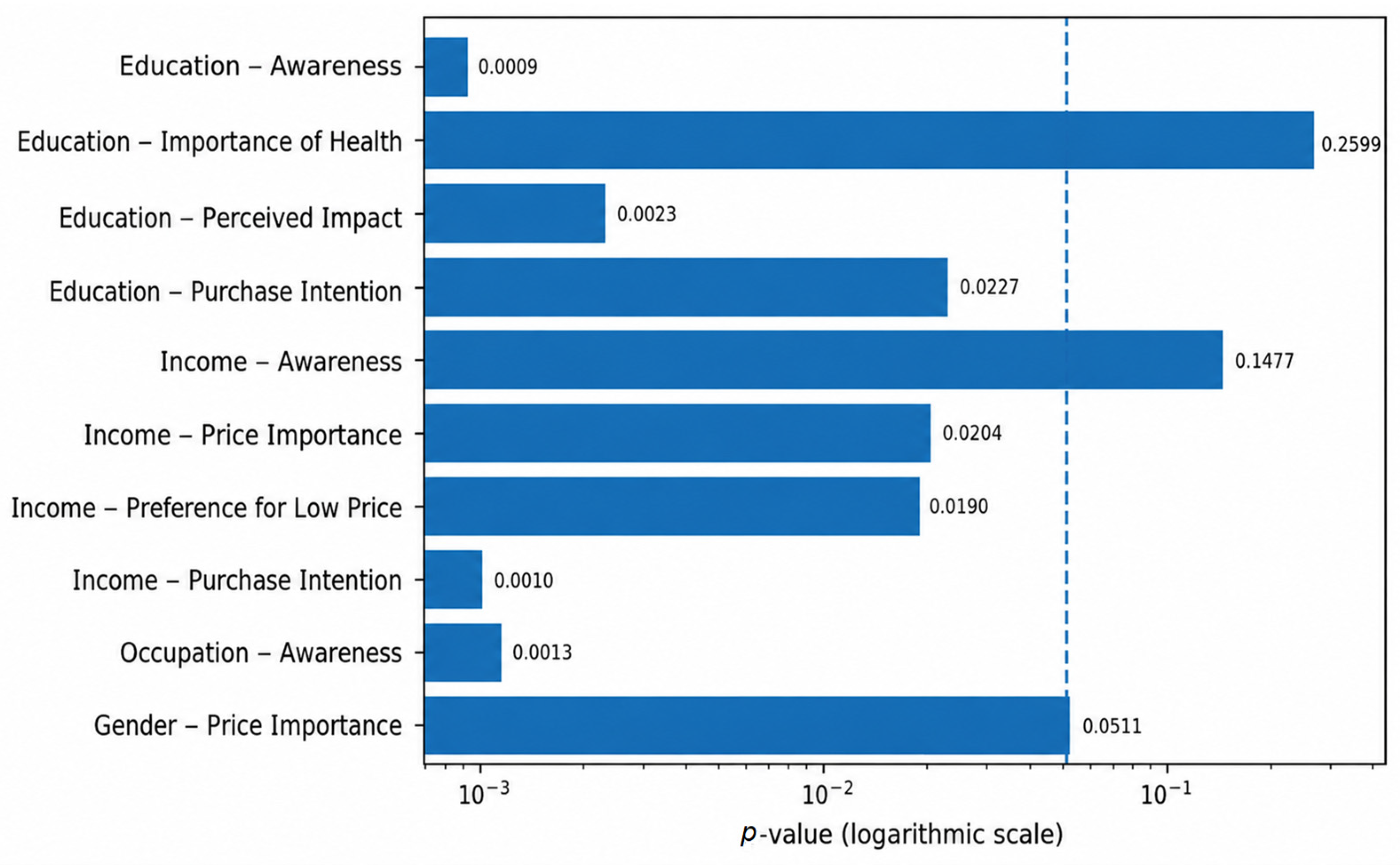
| Parameter | Statistics (χ2) | Df | p Value | Cramér V | Conclusion |
|---|---|---|---|---|---|
| Awareness | 33,263 | 12 | 0.0009 | 0.28 | Significant association |
| Importance of health | 27,769 | 24 | 0.2699 | 0.18 | No significant association |
| Perceive health impact | 30,519 | 12 | 0.0023 | 0.27 | Significant association |
| Purchase intention | 39,756 | 24 | 0.0227 | 0.21 | Significant association |
| Parameter | Statistics (χ2) | Df | p Value | Cramér V | Conclusion |
|---|---|---|---|---|---|
| Awareness | 12,079 | 8 | 0.1477 | 0.17 | No significant association |
| Price importance | 29,570 | 16 | 0.0204 | 0.19 | Significant association |
| Preference for low price | 29,807 | 16 | 0.0190 | 0.19 | Significant association |
| Purchase intention | 39,376 | 16 | 0.0010 | 0.21 | Significant association |
| Parameter | χ2 | Df | p Value | Cramér V | Conclusion |
|---|---|---|---|---|---|
| Profession (Occupation)—Awareness | 25,409 | 8 | 0.0013 | 0.24 | Significant association |
| Gender—Price importance | 9434 | 4 | 0.0511 | 0.21 | No significant association |
Disclaimer/Publisher’s Note: The statements, opinions and data contained in all publications are solely those of the individual author(s) and contributor(s) and not of MDPI and/or the editor(s). MDPI and/or the editor(s) disclaim responsibility for any injury to people or property resulting from any ideas, methods, instructions or products referred to in the content. |
© 2026 by the authors. Licensee MDPI, Basel, Switzerland. This article is an open access article distributed under the terms and conditions of the Creative Commons Attribution (CC BY) license.
Share and Cite
Chira, D.C.; Arion, F.H.; Mihăilă, M.; Roman, I.A.; Roman, R.A.; Vac, C.S. Consumers’ Attitudes Towards Functional Foods in the North-West Region of Romania (Transylvania). Foods 2026, 15, 2861. https://doi.org/10.3390/foods15162861
Chira DC, Arion FH, Mihăilă M, Roman IA, Roman RA, Vac CS. Consumers’ Attitudes Towards Functional Foods in the North-West Region of Romania (Transylvania). Foods. 2026; 15(16):2861. https://doi.org/10.3390/foods15162861
Chicago/Turabian StyleChira, Dana C., Felix H. Arion, Mioara Mihăilă, Ioana A. Roman, Raluca A. Roman, and Călin S. Vac. 2026. "Consumers’ Attitudes Towards Functional Foods in the North-West Region of Romania (Transylvania)" Foods 15, no. 16: 2861. https://doi.org/10.3390/foods15162861
APA StyleChira, D. C., Arion, F. H., Mihăilă, M., Roman, I. A., Roman, R. A., & Vac, C. S. (2026). Consumers’ Attitudes Towards Functional Foods in the North-West Region of Romania (Transylvania). Foods, 15(16), 2861. https://doi.org/10.3390/foods15162861