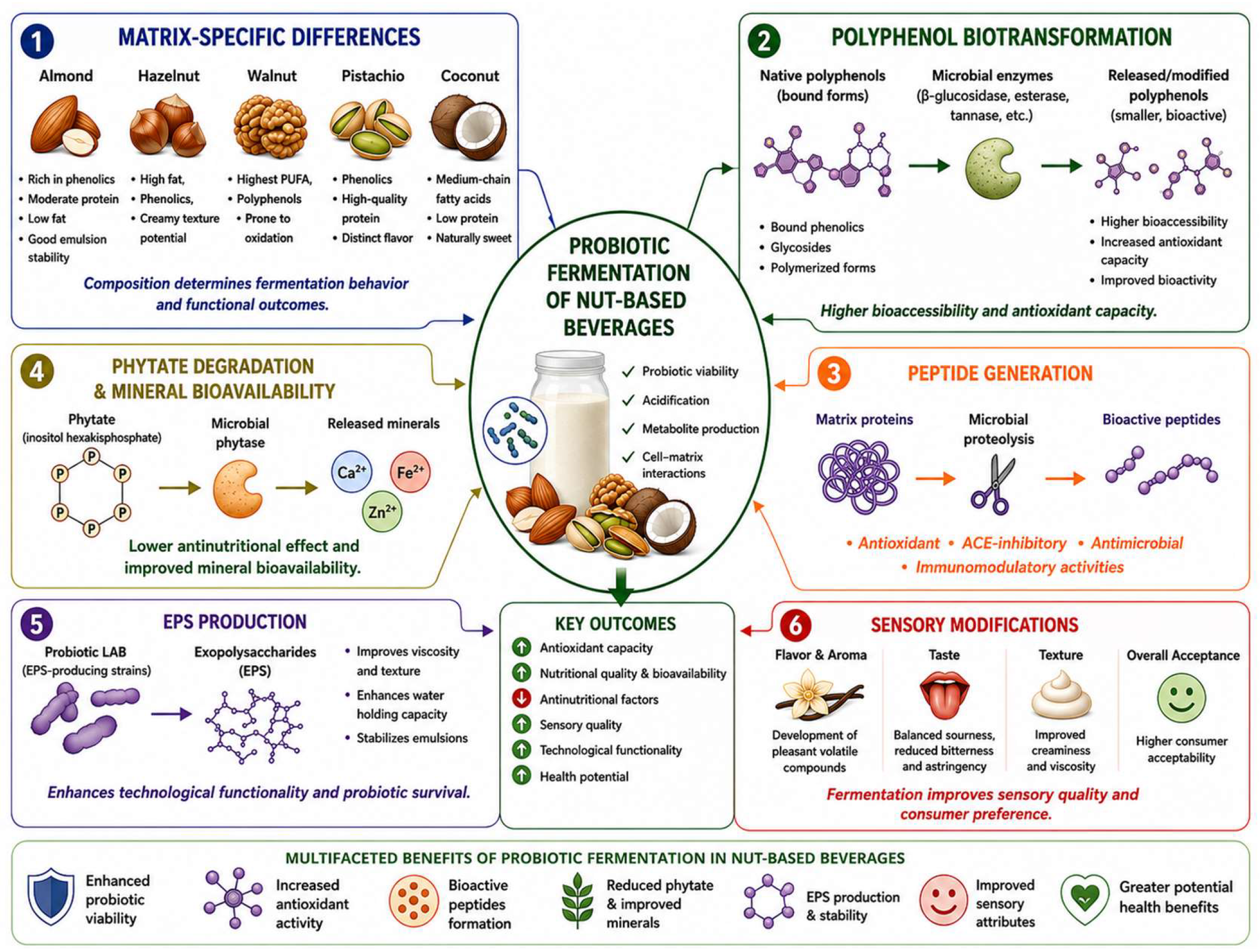
Updated Insights into Probiotic Nut-Based Dairy Alternatives: Microbiological, Antioxidant, and Sensory Aspects




Abstract
1. Introduction
2. Production Processes and Nutritional Properties of Nut Beverages
2.1. Manufacturing Stages: From Raw Material to Aqueous Extract
2.1.1. Pretreatments and Nut-Specific Processing
2.1.2. Aqueous Extraction
2.1.3. Formulation and Stabilization
2.1.4. Homogenization and Preservation
2.1.5. Packaging, Dehydration, and Storage
2.2. Impact of Processing on Bioactive Compounds
2.3. Nutritional Composition and Comparison with Cow Milk

| Beverage Type | Energy (kcal) | Protein (g) | Fat (g) | Carbohydrates (g) | Fiber (g) | Key Bioactives Reported | Ref. |
|---|---|---|---|---|---|---|---|
| Cow milk | Caseins, whey proteins, bioactive peptides derived from digestion/processing (casokinins, lactoferricin) | [11,13,15] | |||||
| All types | 69.0–118.0 | 2.90–6.00 | 3.60–6.40 | 3.20–5.40 | |||
| Standard | 60–70 | 3.2–3.5 | 3.2–4.0 | 4.7–5.0 | |||
| Almond | 15–38 | 0.42–0.59 | 1.04–1.10 | 0.58–6.59 | 0.0–0.40 | α-Tocopherol, arabinose, flavonoids, phytosterols | [3,11] |
| Coconut | 50–92 | 0.59–2.0 | 4.12–6.0 | 3.75–9.41 | Lauric acid, medium-chain triglycerides, α-linolenic acid, α-tocopherol | [11,13] | |
| Hazelnut | 70–74 | 1.0 | 7.3 | 1.0–3.0 | β-Sitosterol, α-tocopherol, catechin, mono- and oligomeric flavan-3-ols | [7,11] | |
| Pistachio | 50–99 | 1.6–2.5 | 4.6–8.3 | 0.2–1.9 | 2.1–2.9 | Tocopherols, β-sitosterol, phenolic compounds | [7,11] |
| Walnut | 72–92 | 0.8–2.9 | 3.2–7.5 | 0.4–4.8 | PUFAs, ellagitannins, phenolic antioxidants | [7,11] |
2.4. Nut Beverages as Substrates for Probiotic Growth
3. Probiotication of Nut Beverages, Antioxidant Activity and Sensory Properties
3.1. Almond Milk (Prunus dulcis)
3.2. Coconut Milk (Cocos nucifera)
3.3. Hazelnut Milk (Corylus avellana)
3.4. Pistachio Milk (Pistachio vera)
3.5. Walnut Milk (Juglans regia)
4. Discussion
5. Conclusions
Author Contributions
Funding
Institutional Review Board Statement
Informed Consent Statement
Data Availability Statement
Acknowledgments
Conflicts of Interest
Abbreviations
| ABTS | 2′-Azino-bis(3-ethylbenzothiazoline-6-sulfonic acid) |
| CAGR | Compound annual growth rate |
| CFUs | Colony-forming units |
| DPPH | 2,2-Diphenyl-1-picrylhydrazyl |
| EPSs | Exopolysaccharides |
| GAE | Gallic acid equivalent |
| LAB | Lactic acid bacteria |
| NBB | Nut-based beverage |
| PBB | Plant-based beverage |
| PBMAs | Plant-based milk alternatives |
| PEFs | Pulsed electric fields |
| PUFAs | Polyunsaturated fatty acids |
| QE | Quercetin equivalent |
| TE | Trolox equivalent |
| TFC | Total flavonoid content |
| TPC | Total phenolic content |
| UHPH | Ultra-high pressure homogenization |
| UHT | Ultra-high temperature |
| VCCs | Viable cell counts |
References
- Sethi, S.; Tyagi, S.K.; Anurag, R.K. Plant-based milk alternatives: An emerging segment of functional beverages: A review. J. Food Sci. Technol. 2016, 53, 3408–3423. [Google Scholar] [CrossRef] [Scilit] [PubMed]
- Antunes, I.C.; Bexiga, R.; Pinto, C.; Martins, L.L.; Mourato, M.; Pereira, G.; Vieira, E.; Delerue-Matos, C.; Quaresma, M. Mineral profile of cow milk and plant-based milk alternatives. J. Dairy Sci. 2025, 108, 3324–3333. [Google Scholar] [CrossRef] [Scilit] [PubMed]
- Reyes-Jurado, F.; Soto-Reyes, N.; Dávila-Rodríguez, M.; Lorenzo-Leal, A.C.; Jiménez-Munguía, M.T.; Mani-López, E.; López-Malo, A. Plant-based milk alternatives: Types, processes, benefits, and characteristics. Food Rev. Int. 2023, 39, 2320–2351. [Google Scholar] [CrossRef] [Scilit]
- Pérez-Rodríguez, M.L.; Serrano-Carretero, A.; García-Herrera, P.; Cámara-Hurtado, M.; Sánchez-Mata, M.C. Plant-based beverages as milk alternatives? Nutritional and functional approach through food labelling. Food Res. Int. 2023, 173, 113244. [Google Scholar] [CrossRef] [Scilit] [PubMed]
- Court of Justice of the European Union. Judgment of the Court (Seventh Chamber) of 14 June 2017. Verband Sozialer Wettbewerb eV v TofuTown.com GmbH. Case C-422/16. Available online: https://eur-lex.europa.eu/legal-content/EN/TXT/?uri=celex:62016CJ0422 (accessed on 22 May 2024).
- Kaur, H.; Kaur, K.; Arora, D. Advancing plant-based milk alternatives: Challenges, opportunities, and the role of innovative processing technologies. Food Control 2025, 169, 111671. [Google Scholar] [CrossRef] [Scilit]
- Di Renzo, T.; Garzón, A.G.; Nazzaro, S.; Marena, P.; Carboni, A.D.; Puppo, M.C.; Drago, S.R.; Reale, A. An overview of the microbiological, nutritional, sensory and potential health aspects of tree nut-based beverages. Beverages 2025, 11, 144. [Google Scholar] [CrossRef] [Scilit]
- Aydar, E.F.; Tutuncu, S.; Ozcelik, B. Plant-based milk substitutes: Bioactive compounds, conventional and novel processes, bioavailability studies, and health effects. J. Funct. Foods 2020, 70, 103975. [Google Scholar] [CrossRef] [Scilit]
- McClements, D.J. Development of next-generation nutritionally fortified plant-based milk substitutes: Structural design principles. Foods 2020, 9, 421. [Google Scholar] [CrossRef] [Scilit] [PubMed]
- Asif, N.; Anwar, O.; Arif, S.; Anwar, Z.; Ercisli, S.; Mugabi, R.; Nayik, G.A. The rise of plant-based milk alternatives: Exploring nutritional, health, and sustainability impacts. Food Chem. X 2026, 29, 103528. [Google Scholar] [CrossRef] [Scilit] [PubMed]
- Sethi, S.; Panwar, P. Chapter 5—Nut based milk alternatives: Composition, processing, and quality attributes. In Alternative Dairy Products and Technologies; Academic Press: Cambridge, MA, USA, 2026; pp. 143–179. [Google Scholar] [CrossRef] [Scilit]
- Silva, A.R.; Silva, M.M.; Ribeiro, B.D. Health issues and technological aspects of plant-based alternative milk. Food Res. Int. 2020, 131, 108972. [Google Scholar] [CrossRef] [Scilit] [PubMed]
- Paul, A.A.; Kumar, S.; Kumar, V.; Sharma, R. Milk Analog: Plant based alternatives to conventional milk, production, potential and health concerns. Crit. Rev. Food Sci. Nutr. 2020, 60, 3005–3023. [Google Scholar] [CrossRef] [Scilit] [PubMed]
- Thivya, P.; Bhanu Prakash Reddy, N.; Deotale, S.; Vanmathi Mugasundari, A. Fermentation of pseudocereals: Exposing innovative prospects in the development of plant-based dairy alternatives. Food Rev. Int. 2026, 42, 920–956. [Google Scholar] [CrossRef] [Scilit]
- Vashisht, P.; Sharma, A.; Awasti, N.; Wason, S.; Singh, L.; Sharma, S.; Charles, A.P.R.; Sharma, S.; Gill, A.; Khattra, A.K. Comparative review of nutri-functional and sensorial properties, health benefits and environmental impact of dairy (bovine milk) and plant-based milk (soy, almond, and oat milk). Food Humanit. 2024, 2, 100301. [Google Scholar] [CrossRef] [Scilit]
- Antunes, I.C.; Bexiga, R.; Pinto, C.; Roseiro, L.C.; Quaresma, M.A.G. Cow’s milk in human nutrition and the emergence of plant-based milk alternatives. Foods 2022, 12, 99. [Google Scholar] [CrossRef] [Scilit] [PubMed]
- Hidalgo-Fuentes, B.; de Jesús-José, E.; Cabrera-Hidalgo, A.D.J.; Sandoval-Castilla, O.; Espinosa-Solares, T.; González-Reza, R.M.; Zambrano-Zaragoza, M.L.; Liceaga, A.M.; Aguilar-Toalá, J.E. Plant-based fermented beverages: Nutritional composition, sensory properties, and health benefits. Foods 2024, 13, 844. [Google Scholar] [CrossRef] [Scilit] [PubMed]
- Emkani, M.; Oliete, B.; Saurel, R. Effect of lactic acid fermentation on legume protein properties, a review. Fermentation 2022, 8, 244. [Google Scholar] [CrossRef] [Scilit]
- Al Zahrani, A.J.; Shori, A.B. Viability of probiotics and antioxidant activity of soy and almond milk fermented with selected strains of probiotic Lactobacillus spp. LWT 2023, 176, 114531. [Google Scholar] [CrossRef] [Scilit]
- Al Zahrani, A.J.; Shori, A.B.; Altammar, K.A. Synergistic evaluation of Lactobacilli on probiotic viability and antioxidant properties in almond and cow milk. Fermentation 2025, 11, 616. [Google Scholar] [CrossRef] [Scilit]
- Muncey, L.; Hekmat, S. Development of probiotic almond beverage using Lacticaseibacillus rhamnosus GR-1 fortified with short-chain and long-chain inulin fibre. Fermentation 2021, 7, 90. [Google Scholar] [CrossRef] [Scilit]
- García-Barón, S.E.; Carmona-Escutia, R.P.; Herrera-López, E.J.; Leyva-Trinidad, D.A.; Gschaedler-Mathis, A. Consumers’ drivers of perception and preference of fermented food products and beverages: A systematic review. Foods 2025, 14, 713. [Google Scholar] [CrossRef] [Scilit] [PubMed]
- Khalil, O.S.; Ismail, H.A.; Elkot, W.F. Physicochemical, functional and sensory properties of probiotic yoghurt flavored with white sapote fruit (Casimiroa edulis). J. Food Sci. Technol. 2022, 59, 3700–3710. [Google Scholar] [CrossRef] [Scilit] [PubMed]
- Lipan, L.; Rusu, B.; Sendra, E.; Hernández, F.; Vázquez-Araújo, L.; Vodnar, D.C.; Carbonell-Barrachina, Á.A. Spray drying and storage of probiotic-enriched almond milk: Probiotic survival and physicochemical properties. J. Sci. Food Agric. 2020, 100, 3697–3708. [Google Scholar] [CrossRef] [Scilit] [PubMed]
- Duran, G.; Cevik, M. Investigation of the changes in rheological properties and some quality characteristics of probiotic fermented almond milk with added different ratios of orange juice. J. Food Process. Preserv. 2022, 46, e16562. [Google Scholar] [CrossRef] [Scilit]
- Al Zahrani, A.J.; Shori, A.B.; Al-Judaibi, E. Fermented Soymilk with probiotic Lactobacilli and Bifidobacterium strains ameliorates dextran-sulfate-sodium-induced colitis in rats. Nutrients 2024, 16, 3478. [Google Scholar] [CrossRef] [Scilit] [PubMed]
- Lahrairi, M.; Waddi, K.; Radi Benjelloun, G.; Jmaili, K.; Bahlaouan, B.; Bessi, H.; Boutaleb, N. Characterisation of a novel kefir-fermented almond milk from Moroccan Prunus dulcis varieties: Physico-chemical, nutritional, antioxidant, and sensorial analysis. Int. J. Environ. Stud. 2025, 82, 2047–2063. [Google Scholar] [CrossRef] [Scilit]
- Kılınç, G.E.; Keser, A.; Özer, H.B. Determination of nutritional value, antioxidant activities, microbiological and sensory properties of almond, soy and oat based fermented beverages. J. Cul. Sci. Technol. 2026, 24, 16–32. [Google Scholar] [CrossRef] [Scilit]
- Santos, B.N.; Pereira, A.L.F.; Fonteles, T.V.; Rodrigues, S. Development and evaluation of potential probiotic coconut water beverages: Fermentation, storage, and consumer perception. Processes 2025, 13, 2554. [Google Scholar] [CrossRef] [Scilit]
- Han, C.E.; Ewe, J.A.; Kuan, C.S.; Yeo, S.K. Growth characteristic of probiotic in fermented coconut milk and the antibacterial properties against Streptococcus pyogenes. J. Food Sci. Technol. 2022, 59, 3379–3386. [Google Scholar] [CrossRef] [Scilit] [PubMed]
- Yoon, B.K.; Jackman, J.A.; Kim, M.C.; Cho, N.J. Spectrum of membrane morphological responses to antibacterial fatty acids and related surfactants. Langmuir 2015, 31, 10223–10232. [Google Scholar] [CrossRef] [Scilit] [PubMed]
- Vitheejongjaroen, P.; Phettakhu, P.; Arsayot, W.; Taweechotipatr, M.; Pachekrepapol, U. The ability of Lacticaseibacillus paracasei MSMC 36-9 strain with probiotic potential to ferment coconut milk and produce a yogurt-type beverage. Beverages 2024, 10, 30. [Google Scholar] [CrossRef] [Scilit]
- Goveas, L.C.; Ashwath, K.S.; Nazerath, B.R.; Dsouza, O.; Umesh, A.; Muddappa, V.S. Development of coconut water-based exopolysaccharide rich functional beverage by fermentation with probiotic Lactobacillus plantarum SVP2. Biocatal. Agric. Biotechnol. 2021, 34, 102030. [Google Scholar] [CrossRef] [Scilit]
- Ajibola, O.O.; Lihan, S.; Hussaini, A.; Hipolito, C.N.; Octavio, C.Z.; Sarbini, S.R.; Mohamad, S.A.S. Cell viability, physicochemical and sensory characteristics of probiotic coconut juice during cold storage. J. Sustain. Sci. Manag. 2021, 16, 1–13. [Google Scholar] [CrossRef] [Scilit]
- Aher, A.; Binsuwaidan, R.; Adnan, M.; Alshammari, N.; Ibrahim, A.M.; Patel, M. Development and health impact assessment of a novel functional probiotic beverage by fermenting hibiscus tea with coconut water. Food Chem. X 2025, 27, 102474. [Google Scholar] [CrossRef] [Scilit] [PubMed]
- Senjaliya, D.P.; Georrge, J.J. Functional characterization of Lactobacillus plantarum isolated from cow milk and the development of fermented coconut and carrot juice mixed beverage. Curr. Microbiol. 2023, 80, 139. [Google Scholar] [CrossRef] [Scilit] [PubMed]
- Kantachote, D.; Ratanaburee, A.; Hayisama-Ae, W.; Sukhoom, A.; Nunkaew, T. The use of potential probiotic Lactobacillus plantarum DW12 for producing a novel functional beverage from mature coconut water. J. Funct. Foods 2017, 32, 401–408. [Google Scholar] [CrossRef] [Scilit]
- Zhao, Q.; Wang, Z.; Yu, Z.; Gao, Z.; Mu, G.; Wu, X. Influence on physical properties and digestive characters of fermented coconut milk with different loading proportion of skimmed coconut drink using Lactiplantibacillus plantarum MWLp-4 from human milk mixing with commercial bacteria. Food Biosci. 2023, 53, 102598. [Google Scholar] [CrossRef] [Scilit]
- Bernat, N.; Chafer, M.; Rodríguez-García, J.; Chiralt, A.; González-Martínez, C. Effect of high pressure homogenisation and heat treatment on physical properties and stability of almond and hazelnut milks. LWT-Food Sci. Technol. 2015, 62, 488–496. [Google Scholar] [CrossRef] [Scilit]
- Shin, J.-S.; Kim, B.-H.; Baik, M.-Y. Applicable plant proteins and dietary fibers for simulate plant-based yogurts. Foods 2021, 10, 2305. [Google Scholar] [CrossRef] [Scilit] [PubMed]
- Kalkan, S.; Balpetek Külcü, D. Comparing the quality properties of cow milk and hazelnut milk fermented by viili yogurt culture. J. Cul. Sci. Technol. 2024, 22, 1008–1024. [Google Scholar] [CrossRef] [Scilit]
- Bernat, N.; Cháfer, M.; Chiralt, A.; González-Martínez, C. Hazelnut milk fermentation using probiotic Lactobacillus rhamnosus GG and inulin. Int. J. Food Sci. Technol. 2014, 49, 2553–2562. [Google Scholar] [CrossRef] [Scilit]
- Gocer, E.M.C.; Koptagel, E. Production and evaluation of microbiological & rheological characteristics of kefir beverages made from nuts. Food Biosci. 2023, 52, 102367. [Google Scholar] [CrossRef] [Scilit]
- Gocer, E.M.C.; Koptagel, E. Production of milks and kefir beverages from nuts and certain physicochemical analysis. Food Chem. 2023, 402, 134252. [Google Scholar] [CrossRef] [Scilit] [PubMed]
- Erem, E.; Kilic-Akyilmaz, M. Development of a stable fermented creamy structure from hazelnut in the scope of plant-based food production. Food Bioprod. Process. 2024, 145, 128–135. [Google Scholar] [CrossRef] [Scilit]
- Akalın, H.; Kınık, Ö.; Şatır, G. Manufacturing plant-based non-dairy and probiotic frozen desserts and their impact on physicochemical, sensory and functional aspects. J. Food Sci. Technol. 2024, 61, 1874–1883. [Google Scholar] [CrossRef] [Scilit] [PubMed]
- Maleki, N.; Khodaiyan, F.; Mousavi, S.M. Antioxidant activity of fermented hazelnut milk. Food Sci. Biotechnol. 2015, 24, 107–115. [Google Scholar] [CrossRef] [Scilit]
- Mertdinc, Z.; Aydar, E.F.; Kadı, İ.H.; Demircan, E.; Çetinkaya, S.K.; Özçelik, B. A new plant-based milk alternative of Pistacia vera geographically indicated in Türkiye: Antioxidant activity, in vitro bio-accessibility, and sensory characteristics. Food Biosci. 2023, 53, 102731. [Google Scholar] [CrossRef] [Scilit]
- Ramos, I.M.; Rodríguez García, S.; Poveda, J.M. Development and characterization of pistachio yogurt analog: A healthy, sustainable, and innovative plant-based alternative. Fermentation 2025, 11, 467. [Google Scholar] [CrossRef] [Scilit]
- Di Renzo, T.; Osimani, A.; Marulo, S.; Cardinali, F.; Mamone, G.; Puppo, C.; Garzón, A.G.; Drago, S.R.; Laurino, C.; Reale, A. Insight into the role of lactic acid bacteria in the development of a novel fermented pistachio (Pistacia vera L.) beverage. Food Biosci. 2023, 53, 102802. [Google Scholar] [CrossRef] [Scilit]
- Reale, A.; Puppo, M.C.; Boscaino, F.; Garzon, A.G.; Drago, S.R.; Marulo, S.; Di Renzo, T. Development and evaluation of a fermented pistachio-based beverage obtained by colloidal mill. Foods 2024, 13, 2342. [Google Scholar] [CrossRef] [Scilit] [PubMed]
- Gonçalves, G.C.V.; Costa, G.N.; Okagawa, T.; Somera, T.; da Silva, G.H.R.; Romani, L.C.; Bertan, L.C. Development of fermented beverage based on pistachio (Pistacia vera) extract: Effect of functional compounds on kefir growth and microbial metabolism. Food Biosci. 2025, 71, 107051. [Google Scholar] [CrossRef] [Scilit]
- Di Renzo, T.; Garzón, A.G.; Sciammaro, L.P.; Puppo, M.C.; Drago, S.R.; Reale, A. Influence of fermentation and milling processes on the nutritional and bioactive properties of pistachio-based beverages. Fermentation 2025, 11, 429. [Google Scholar] [CrossRef] [Scilit]
- Qazi, H.J.; Ye, A.; Acevedo-Fani, A.; Singh, H. Delivery of encapsulated bioactive compounds within food matrices to the digestive tract: Recent trends and future perspectives. Crit. Rev. Food Sci. Nutr. 2025, 65, 2921–2942. [Google Scholar] [CrossRef] [Scilit] [PubMed]
- Liu, W.; Pu, X.; Sun, J.; Shi, X.; Cheng, W.; Wang, B. Effect of Lactobacillus plantarum on functional characteristics and flavor profile of fermented walnut milk. LWT 2022, 160, 113254. [Google Scholar] [CrossRef] [Scilit]
- Al-Subaie, F.A.; Shori, A.B. Enhancing probiotic viability and functional properties of walnut-based products through fermentation. Discov. Food 2026, 6, 12. [Google Scholar] [CrossRef] [Scilit]
- Zhong, H.; Li, B.; Fan, Z.; Fang, Z.; Li, Y.; Lu, S.; Liu, C.; Li, H.; Zhang, R. Isolation, purification, characterization, and analysis of the antioxidant activity of antioxidant peptides from walnut milk fermented with Lactobacillus paracasei SMN-LBK. Food Biosci. 2024, 61, 104547. [Google Scholar] [CrossRef] [Scilit]
- Li, W.; Zhi, T.; Li, S.; Xia, J.; Tian, Y.; Ma, A.; Jia, Y. Untargeted metabolomics revealed the product formation rules of two fermented walnut milk. Food Agric. Immunol. 2023, 34, 2236807. [Google Scholar] [CrossRef] [Scilit]
- Ma, L.; Chang, D.; Lv, J.; Yan, Y.; Zheng, A.; Wang, X.; Leng, Y.; Jiang, B.; Ren, D.; Wang, J. Lactiplantibacillus plantarum JLAU103 Fermented walnut-milk dual-protein yogurt: Physicochemical property, volatile flavor profile, antioxidant activity, and isolation of neuroprotective peptides targeting Aβ1-42 oligomers. Food Biosci. 2026, 76, 108260. [Google Scholar] [CrossRef] [Scilit]
- Cui, X.H.; Chen, S.J.; Wang, Y.; Han, J.R. Fermentation conditions of walnut milk beverage inoculated with kefir grains. LWT-Food Sci. Technol. 2013, 50, 349–352. [Google Scholar] [CrossRef] [Scilit]
- Cui, R.; Huai, L.; Sun, Q.; Tuo, L.; Liu, B.; Xiao, Y.; Zhang, L.; Wang, H.; Song, L. A fermented plant milk composition of chestnut and walnut protein: Focusing on the effects of different strains on physicochemical properties and flavor. J. Agric. Food Res. 2026, 27, 102896. [Google Scholar] [CrossRef] [Scilit]
- Karoui, R.; Bouaicha, I. A review on nutritional quality of animal and plant-based milk alternatives: A focus on protein. Front. Nutr. 2024, 11, 1378556. [Google Scholar] [CrossRef] [Scilit] [PubMed]
- Walther, B.; Guggisberg, D.; Badertscher, R.; Egger, L.; Portmann, R.; Dubois, S.; Haldimann, M.; Kopf-Bolanz, K.; Rhyn, P.; Zoller, O.; et al. Comparison of nutritional composition between plant-based drinks and cow’s milk. Front. Nutr. 2022, 9, 988707. [Google Scholar] [CrossRef] [Scilit] [PubMed]
- Samtiya, M.; Aluko, R.E.; Dhewa, T. Plant antinutritional factors and their reduction strategies: An overview. Food Prod. Process. Nutr. 2020, 2, 6. [Google Scholar] [CrossRef] [Scilit]
- Ermiş, E.; Güneş, R.; Zent, İ.; Çağlar, M.Y.; Yılmaz, M.T. Characterization of hazelnut milk fermented by Lactobacillus delbrueckii subsp. bulgaricus and Streptococcus thermophilus. Gida 2018, 43, 677–686. [Google Scholar] [CrossRef] [Scilit]
- Bocker, R.; Silva, E.K. Innovative technologies for manufacturing plant-based non-dairy alternative milk and their impact on nutritional, sensory and safety aspects. Future Foods 2022, 5, 100098. [Google Scholar] [CrossRef] [Scilit]
- Burgain, J.; Gaiani, C.; Linder, M.; Scher, J. Encapsulation of probiotic living cells: From laboratory scale to industrial applications. J. Food Eng. 2011, 104, 467–483. [Google Scholar] [CrossRef] [Scilit]
- Corcoran, B.M.; Stanton, C.; Fitzgerald, G.F.; Ross, R. Survival of probiotic lactobacilli in acidic environments is enhanced in the presence of metabolizable sugars. Appl. Environ. Microbiol. 2005, 71, 3060–3067. [Google Scholar] [CrossRef] [Scilit] [PubMed]
- Zhao, Y.-S.; Eweys, A.S.; Zhang, J.-Y.; Zhu, Y.; Bai, J.; Darwesh, O.M.; Zhang, H.-B.; Xiao, X. Fermentation affects the antioxidant activity of plant-based food material through the release and production of bioactive components. Antioxidants 2021, 10, 2004. [Google Scholar] [CrossRef] [Scilit] [PubMed]
- CXS 206-1999; Codex Alimentarius Commission. General Standard for the Use of Dairy Terms. FAO/WHO: Rome, Italy, 1999.

| Beverage | Pretreatment/Processing | Impact on Nutritional Composition | Techno-Functional Effects | Ref. |
|---|---|---|---|---|
| Almond | Roasting (95–100 °C) | Alters the sterol profile (increases β-sitosterol-β-D-glucoside; decreases stigmasterol). | Reduces concentrations of benzaldehyde and pyrazines to develop desirable aroma. | [6,7,8,10] |
| Thermosonication (45 °C; 40 min) | Does not degrade amino acids; preserves the nutritional composition. | Improve self-life and stability. | ||
| UHPH (350 MPa; 85 °C) | Eliminates the allergenic potential of almond proteins. | |||
| PEF | Successfully preserves heat-sensitive antioxidants and vitamins. | Effectively inactivates spoilage microorganisms and quality-degrading enzymes; no thermal damage. | ||
| Coconut | Blanching or steam cooking; aqueous extraction (80 °C; 10 min) | Preserves lipid components such as lauric acid and medium-chain triglycerides. | Achieves endogenous enzyme inactivation and microbial reduction. | [7,10] |
| Microfiltration (no-heat sterilization) | Serves as a non-thermal alternative that avoids heat-induced chemical degradation. | Efficiently removes microorganisms and increases shelf life. | ||
| Homogenization | Ensures structural stability; enhances the milk white color and clarity. | |||
| 0.3% pectin + 30 ppm SO2 + homogenization (13,000 rpm; 2 min) + pasteurization (100 °C; 5 min) | nr | Minimizes sedimentation; provides emulsion stability; significantly lowers pH; eliminates yeasts, molds, and bacteria. | ||
| Hazelnut | Roasting (95–100 °C) | nr | Develops aroma. | [6,8,10,12] |
| Aqueous extraction | Significantly reduces TPC. | nr | ||
| Advanced thermosonication (60% amplitude; 25 min or 80% amplitude; 15 min) or homogenization (100 MPa) | Better retains amino acids and bioactive compounds compared to conventional heat treatments. | Eliminates microorganisms (yeasts, molds, total aerobic bacteria); optimizes structure (minimizes syneresis/sedimentation, improves consistency and viscosity). | ||
| Pistachio | Grinding soaked kernels + blending in hot water (80 °C) with traditional filtration | nr | Generates significant waste (fibrous outer skins) during filtration. | [7,11] |
| Milling roasted kernels in a colloid mill (3000 rpm; 5–10 min) at pH 8.5 and thermal treatment (70 °C) | Increases protein, fat, dry matter, and total soluble solids. Colloid milling with recirculation ensures richness in essential amino acids and releases bioactive peptides with ACE and DPP-4 inhibition activities. | Generates no processing waste; yields a physically stable beverage with minimal sedimentation; minimizes microbial counts; provides the highest sensory acceptability. | ||
| Walnut | Chemical pellicle removal (using 2% citric acid; 90 °C; 2–3 min or 1% NaOH; 90 °C; 10 min) | Results in loss of antioxidant activity, as the majority of antioxidants are concentrated in the skin. | Reduces bitterness caused by tannins and other phenolics, improving sensory properties. | [7,8] |
| Two-stage homogenization (40 MPa) and/or high-temperature thermal treatment (120 °C; 10 min) | nr | Two-stage homogenization breaks down large droplets but they tend to flocculate. | ||
| High-temperature thermal treatment increases particle size and forms larger oil droplet aggregates. | ||||
| Combining both methods further increases particle size, resulting in more floating layer and less precipitate. |
| Probiotic Strains | Strain Viability (log CFU/mL) | TPC (mg GAE/mL) | TFC | Antioxidant Activity | Ref. |
|---|---|---|---|---|---|
| L. rhamnosus; L. acidophilus; L. plantarum; L. casei | ~6 | Increased | Increased (highest with L. rhamnosus) | Increased | [19] |
| L. rhamnosus; L. acidophilus; L. plantarum; L. casei in almond/cow milk blends | 5.9–6.8 | Increased | Increased | Increased | [20] |
| L. rhamnosus GR-1 + short- and long-chain inulin | ≥7 | nr | nr | nr | [21] |
| L. plantarum ATCC 8014 | >7 | nr | nr | nr | [24] |
| L. acidophilus + orange juice supplementation | 7.58–7.95 | nr | nr | nr | [25] |
| Kefir grains (LAB consortium) | 8 | 0.95 | nr | Increased (62–66% DPPH inhibition) | [27] |
| S. thermophilus; L. delbrueckii subsp. bulgaricus; L. acidophilus NCFM; B. lactis HM019TM | >6 (except B. lactis) | nr | nr | Increased (0.72–0.75 mmol TE/L) | [28] |
| Probiotic Strains | Strain Viability (log CFU/mL) | TPC | TFC | Antioxidant Activity | Ref. |
|---|---|---|---|---|---|
| B. animalis B-41406; B. bifidum B-41410; B. breve B-41408; B. longum subsp. infantis B-41661 | >6 (up to 42 days, 4 °C) | nr | nr | nr | [29] |
| S. salivarius ATCC 13419 , K12; L. casei ATCC 393; L. rhamnosus ATCC 53103; L. acidophilus ATCC 314; L. fermentum ATCC 14931; L. fructivorans | S. salivarius, highest among tested strains | nr | nr | Up to 67% inhibition against S. pyogenes depending on strain | [30] |
| L. paracasei MSMC 36-9 | 12–13 (21 days, 4 °C) | nr | nr | Higher antioxidant activity than commercial yogurt starter culture | [32] |
| L. plantarum SVP2 | ~8 (7 days, 4 °C) | nr | nr | nr | [33] |
| L. casei; L. plantarum; L. rhamnosus; Lactococcus lactis IO-1 | Up to 8.4 (during storage, 4 °C) | Increased during storage | nr | Increased during storage | [34] |
| L. acidophilus 10307 | 6.32 (28 days, 4 °C) | 7.8–14 mg GAE/mL | 26.5–87.7 mg QE/mL | Strong radical scavenging (DPPH, H2O2) | [35] |
| L. plantarum CMGC2, CMJC7 | >8 (48 h fermentation) | nr | nr | nr | [36] |
| L. plantarum DW12 | 8.4 (48 h fermentation) | 134 μg GAE/mL | nr | ABTS 75%; DPPH 55% | [37] |
| Probiotic Strains | Strain Viability (log CFU/mL) | TPC | Antioxidant Activity | Ref. |
|---|---|---|---|---|
| Viili microbiota | Up to 7.91 | nr | nr | [41] |
| L. rhamnosus GG | 7.9–8.3 (28 days, 4 °C) | nr | nr | [42] |
| Kefir grains | 9.5% decrease in LAB during storage | nr | nr | [43] |
| Yogurt culture (LAB) | >6 (per g or mL depending on matrix) | nr | nr | [45] |
| L. acidophilus (frozen dessert system) | 3.22–8.99 | 42.3–44.7 (mg GAE/g) | 43.8–72.2 mM TE | [46] |
| Kefir grains | nr | 91.8 mg GAE/100 mL | Increased DPPH activity (50.5% → 81.7%) | [47] |
| Probiotic Strains | Strain Viability (log CFU/mL) | TPC | Antioxidant Activity | Ref. |
|---|---|---|---|---|
| L. pseudomesenteroides PD4; L. plantarum PT1/PV-2; C. kimchi PU2; C. alimentarius PG3; L. paraplantarum PN4 | 8 | nr | nr | [51] |
| Water kefir grains (LAB and yeasts consortium) | nr | Increased | Increased | [52] |
| L. pseudomesenteroides; C. paralimentarius | 8–10 | nr | nr | [50] |
| Proteolytic LAB strains | nr | nr | 40% reduction in radical scavenging | [53] |
| Commercial yogurt starter culture | nr | nr | nr | [49] |
| Probiotic Strains | Strain Viability (log CFU/mL) | TPC (mg GAE/L) | Antioxidant Activity | Ref. |
|---|---|---|---|---|
| L. paracasei SMN-LBK | nr | nr | 77% DPPH; 93% ABTS; 79% metal chelation | [57] |
| L. plantarum (before/after proteolysis) | 9.46–9.97 | nr | Increased after proteolysis | [58] |
| L. plantarum JLAU103 | ≥7(storage stability) | nr | Enhanced | [59] |
| Kefir grains | 7.91 lactococci; 8.04 lactobacilli; 6 yeasts | nr | nr | [60] |
| L. rhamnosus and L. casei co-culture | 9.15 | 11.10 to 20.21 increase | 32% increase in DPPH scavenging | [61] |
| Nut Matrix | Probiotic Viability | Functional/Antioxidant Enhancement | Sensory Acceptance | Technological Constraints | Industrial Feasibility |
|---|---|---|---|---|---|
| Almond | 6–8 log CFU/mL during fermentation and storage [19,21,24,27,28] | Consistent increase in TPC and AA via release of bound phenolics and microbial metabolism [19,20,27,28] | Generally high acceptability, improved flavor profile and reduced raw plant notes [25,27,28] | Moderate emulsion instability; requires homogenization and stabilizers for optimal texture [9,39] | High; well-studied matrix; strong probiotic support; scalable processing |
| Pistachio | >8 log CFU/mL depending on strain and fermentation conditions [48,49,50,51,52] | Enhanced AA and bioactive peptide formation; responses are strain- and process-dependent [50,53] | Improved sensory quality; reduction in grassy notes; formation of dairy-like volatiles [51,53] | Susceptible to oxidative changes under agitation; emulsion stability depends on processing conditions [49,51] | High; moderate functional matrix requiring process optimization |
| Walnut | 7–9 log CFU/mL [55,58,59,60,61] | Increased AA via peptides and phenolics; strong bioactivity but variable oxidative stability [57,58,61] | Limited acceptability without optimization due to lipid-derived off-flavors [55] | High lipid oxidation susceptibility and volatile rancidity during storage [55,58] | Moderate; nutritionally rich but constrained by oxidative stability |
| Hazelnut | ≥6 log CFU/mL during storage [41,42,47] | Moderate AA and TPC enhancement [44,47] | Moderate to good acceptance; improved creaminess and texture [41,45] | Rheological changes and risk of overacidification affecting stability [65] | Moderate; good lipid profile; requires fermentation control |
| Coconut | ≥6 log CFU/mL; stability with EPS-producing LAB strains [29,33,37] | Increased AA and phenolic release; EPS contributes to functional properties [33,35] | Variable acceptance; strongly dependent on sweetness–acidity balance [29,34] | Low intrinsic emulsifying capacity; phase separation unless structurally stabilized [33,38] | Moderate; requires hydrocolloid/EPS-assisted stabilization |
| General NBBs | 6–9 log CFU/mL; strain-dependent [19,24,29,41,50,58] | Fermentation enhances phenolics, peptides, and AA; effects are highly variable [53,55,58] | Sensory outcomes highly variable; improvement linked to volatile modulation and formulation strategy [22,27] | Key limitations: emulsion instability, oxidation, ANFs, shelf-life variability, and lack of standardization [6,64,66] | Promising; needs standardization; limited by variability and regulatory, safety and sustainability constraints |
Disclaimer/Publisher’s Note: The statements, opinions and data contained in all publications are solely those of the individual author(s) and contributor(s) and not of MDPI and/or the editor(s). MDPI and/or the editor(s) disclaim responsibility for any injury to people or property resulting from any ideas, methods, instructions or products referred to in the content. |
© 2026 by the authors. Licensee MDPI, Basel, Switzerland. This article is an open access article distributed under the terms and conditions of the Creative Commons Attribution (CC BY) license.
Share and Cite
Mantzourani, I.; Adamopoulou, V.; Bekatorou, A.; Plessas, S. Updated Insights into Probiotic Nut-Based Dairy Alternatives: Microbiological, Antioxidant, and Sensory Aspects. Foods 2026, 15, 2505. https://doi.org/10.3390/foods15142505
Mantzourani I, Adamopoulou V, Bekatorou A, Plessas S. Updated Insights into Probiotic Nut-Based Dairy Alternatives: Microbiological, Antioxidant, and Sensory Aspects. Foods. 2026; 15(14):2505. https://doi.org/10.3390/foods15142505
Chicago/Turabian StyleMantzourani, Ioanna, Vasiliki Adamopoulou, Argyro Bekatorou, and Stavros Plessas. 2026. "Updated Insights into Probiotic Nut-Based Dairy Alternatives: Microbiological, Antioxidant, and Sensory Aspects" Foods 15, no. 14: 2505. https://doi.org/10.3390/foods15142505
APA StyleMantzourani, I., Adamopoulou, V., Bekatorou, A., & Plessas, S. (2026). Updated Insights into Probiotic Nut-Based Dairy Alternatives: Microbiological, Antioxidant, and Sensory Aspects. Foods, 15(14), 2505. https://doi.org/10.3390/foods15142505