Article

Rapid Non-Destructive Assessment of Aquatic Products Freshness by Gas Sensor Based on Morphology-Controlled SnO2 Hollow Nanosphere

1
College of Food Science and Technology, Shanghai Ocean University, Shanghai 201306, China
2
Henan Railway Food Safety Management Engineering Technology Research Center, Zhengzhou Railway Vocational & Technical College, Zhengzhou 450000, China
*
Authors to whom correspondence should be addressed.
These authors contributed equally to this work.
Foods 2026, 15(12), 2123; https://doi.org/10.3390/foods15122123
Submission received: 22 April 2026 / Revised: 26 May 2026 / Accepted: 4 June 2026 / Published: 12 June 2026

Abstract

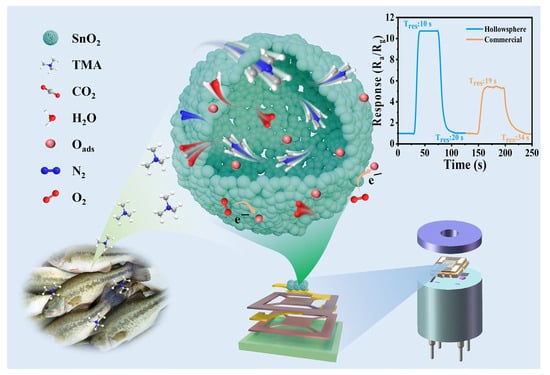
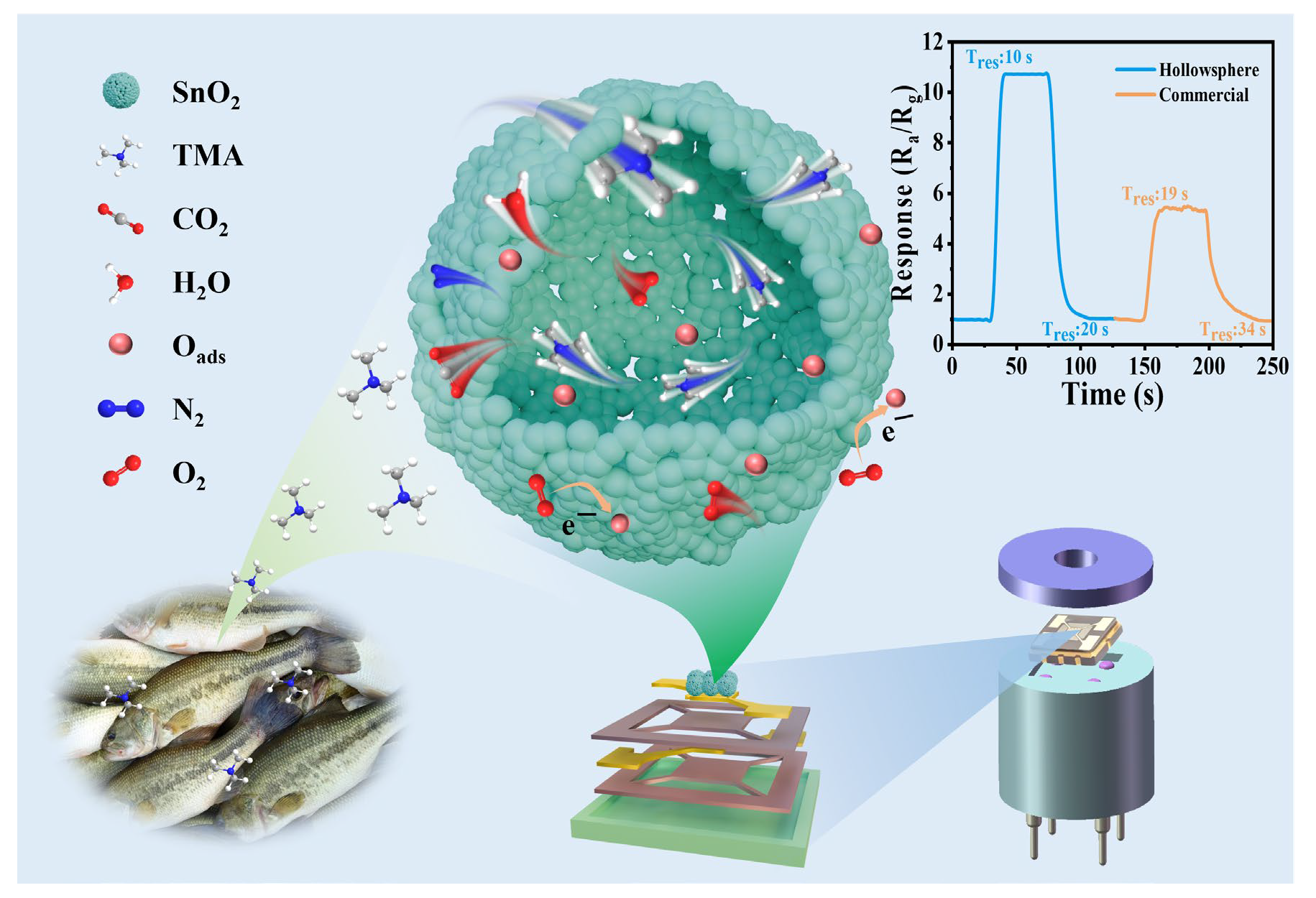
Trimethylamine (TMA), a characteristic volatile biogenic amine generated during aquatic product spoilage, has a concentration that quantitatively reflects product freshness. Therefore, developing a rapid and accurate method for TMA detection is important for food safety control. Herein, this study synthesized high-performance hollow SnO2 nanospheres via a hydrothermal method, aiming to develop a rapid, non-destructive gas sensor for TMA detection and evaluate its feasibility for assessing aquatic product freshness. The material exhibited a high response (Ra/Rg = 10.5@100 ppm), rapid response-recovery kinetics (10 s/20 s), and good selectivity. These properties were attributed to the high specific surface area, efficient gas diffusion channels, and abundant active sites provided by the hollow structure, which enhances the sensor’s response rate. Ultraviolet–visible diffuse reflectance spectroscopy further showed that the hollow structure narrows the bandgap of SnO2, which may facilitate electron transfer and contribute to the enhanced response to TMA. In practical applications, a MEMS sensor based on SnO2 hollow nanospheres successfully detected TMA concentration changes from sea bass during 0–8 days of refrigerated storage, demonstrating its potential reliability for rapid freshness assessment of aquatic products and providing a technological route for quality evaluation.

Graphical Abstract

1. Introduction

Aquatic products are popular among consumers for being high in protein but low in fat. However, they are easily spoiled by microorganisms during storage and transportation [1]. Trimethylamine (TMA) is a typical volatile organic compound produced from spoiled aquatic products. Its level directly reflects freshness: below 1 mg/100 g for fresh samples, 1–5 mg/100 g for early spoilage, and above 6 mg/100 g for severely spoiled ones [2]. At room temperature, TMA is a colorless and volatile gas with an unpleasant fishy smell. As its concentration rises, the odor becomes pungent, similar to high-concentration ammonia [3]. TMA readily enters the human body through inhalation, skin contact, or oral intake. Low-level TMA exposure can result in ocular, nasal, and respiratory irritation. Extended contact may lead to cytotoxicity and weakened immune responses, which clearly pose a risk to human health [4]. However, during the early stage of spoilage, the TMA concentration is still at a low level and is susceptible to interference from other volatile organic compounds in the aquatic product matrix, as well as environmental humidity and temperature, making accurate detection with high specificity and sensitivity a serious challenge [5]. Therefore, it is of great practical importance and urgent application need to develop a detection method. This method should be capable of sensitively identifying low-concentration TMA during the early stage of spoilage. It must also possess excellent anti-interference ability. Such a technique would enable early warning and accurate assessment of aquatic product freshness, thereby helping to ensure food safety.
Currently, detection methods for TMA mainly include gas chromatography [6], spectrophotometry [7], chemiluminescence [8], and gas sensor technology [9,10]. Among these, although gas chromatography and chemiluminescence have high sensitivities, they are limited by expensive equipment and complex operation, preventing their use in rapid field testing. Spectrophotometry is susceptible to interference from other amine gases and suffers from a long response time. However, micro-electromechanical system (MEMS) gas sensors present several benefits, including low cost, rapid response, and ease of integration [11]. In addition, MEMS heaters have low thermal mass and consume low power (e.g., <50 mW in pulsed mode), enabling portable use [12]. With proper insulation, they are safe for food applications. These features make them highly promising for the rapid evaluation of the freshness of aquatic products. The working principle of this sensor type relies on the interaction between the target gas and the sensing material. As gas molecules reach the material surface, processes of adsorption and desorption take place. These processes lead to a change in electrical resistance. By measuring this resistance variation, the concentration of the target gas can be determined quantitatively [13,14]. Although various materials are used for TMA detection, existing studies still have several limitations. For example, Liu et al. [15] synthesized α-Fe2O3 nanoparticles, but the response/recovery time was as long as 60 s/24 s, indicating slow response and recovery, and the detection limit was only 1 ppm. Wang et al. [16] prepared spherical V2O5 hierarchical structures, which exhibited a response value of only 2.8 at 100 ppm TMA, showing low sensitivity, and the detection limit was as high as 10 ppm, making it difficult to meet the requirements for low-concentration detection. Cheng et al. [5] constructed a Ce-MOF-808-GO-based QCM sensor, whose response decreased significantly when the relative humidity exceeded 35%, as water molecules tended to compete for adsorption active sites, causing signal interference and poor humidity resistance, which made it difficult to operate stably in high-humidity real-world food storage and transportation environments. In contrast, the morphology-controlled SnO2 hollow nanospheres synthesized in this work exhibit high sensitivity, a low detection limit, and good selectivity, and are capable of effectively detecting trimethylamine in high-humidity environments.
For MEMS gas sensors, the sensing material is the key factor that determines their performance [17]. Among various gas-sensing materials, SnO2 is a typical n-type semiconducting metal oxide. It offers good chemical stability, high electron mobility, and a sensitive response to reducing gases. As a result, it has been widely used in gas sensing applications [18,19,20]. However, conventional SnO2 materials have obvious limitations in sensing performance. They struggle to meet practical demands for high sensitivity, high selectivity, and fast detection. It is well recognized that the microstructure, crystal structure, and surface properties of sensing materials play key roles in determining their performances [21]. Morphology engineering not only increases the specific surface area, providing more active sites for gas adsorption, but also refines surface adsorption energy and charge transport pathways. These factors together contribute to better gas-sensing performance [22]. For example, Ge et al. [23] found that ZnFe2O4 hollow microspheres made of nanoparticles showed a higher response to isopropanol than those made of nanosheets. This was mainly due to their larger specific surface area and wider pore size, which allowed faster gas diffusion and more active reaction sites. Zhu et al. [24] synthesized α-Fe2O3 hollow nanocube sensors. These devices had a response/recovery time of only 9 s/11 s, outperforming the 13 s/24 s observed for solid cubes. Their detection limit reached as low as 1 ppm. The improved performance was attributed to the hollow structure, which effectively promoted the diffusion and release of TMA molecules, thus enhancing molecular transport efficiency. Therefore, carefully designing the morphology and structure of sensing materials provides an effective strategy for achieving superior gas-sensing performance.
In this work, a simple hydrothermal method was used to successfully synthesize SnO2 hollow nanospheres and SnO2 solid nanospheres. Based on these materials, MEMS gas sensors were constructed for the rapid detection of TMA in aquatic products, achieving both high sensitivity and good selectivity. Adsorption performance evaluation showed that the SnO2 hollow nanosphere sensor exhibited the highest TMA adsorption capacity (0.81 wt%) and the fastest adsorption and desorption rates (0.081/0.041 wt%·s−1). Gas sensing tests revealed the optimal performance of all materials at the 300 °C operating temperature. Among these materials, the SnO2 hollow nanospheres exhibited the highest response to TMA (10.5@100 ppm), along with good selectivity, reproducibility, and long-term stability. Furthermore, systematic analysis of the microstructure and surface chemistry of these sensing materials was conducted using multiple characterization techniques. Based on these results, the underlying gas sensing mechanism was thoroughly investigated. This study complements existing research perspective for enhancing the gas-sensing performance of sensing materials and provides a novel technical route for the rapid and effective assessment of aquatic product freshness.

2. Materials and Methods

2.1. Materials and Reagents

All analytically pure chemicals and solvents were directly used without additional purification, exactly as received. K2SnO3·3H2O (95%), urea (99%), SnCl4·5H2O (98%), NaOH (96%), absolute ethanol (99.9%), and hydrochloric acid (36%) were purchased from Sinopharm Chemical Reagent Co., Ltd. (Shanghai, China).

2.2. Synthesis of SnO2 Hollow Nanospheres

A hydrothermal method was adopted to prepare SnO2 hollow nanospheres [25]. In a typical synthesis, 0.384 g of K2SnO3·3H2O and 0.48 g of urea were thoroughly combined. Subsequently, this mixture was gradually introduced into a solvent system consisting of 50 mL of distilled water and 30 mL of absolute ethanol. The solution was stirred continuously until the solid materials became completely dissolved, forming a well-dispersed precursor solution. This resulting liquid was then transferred into a 100 mL Teflon-lined stainless steel autoclave. After being sealed, the autoclave was placed in an oven at 200 °C and maintained there for 24 h. Upon completion of the reaction, the autoclave was left to cool down naturally to ambient temperature. The white precipitate that formed was collected by centrifugation and rinsed repeatedly with absolute ethanol so as to remove impurities and any unreacted precursors. After the rinsing steps, the resulting product was allowed to dry overnight in an oven with a constant temperature set at 60 °C.

2.3. Synthesis of SnO2 Solid Nanospheres

A hydrothermal method was employed to prepare SnO2 solid nanospheres [26]. In a typical procedure, 0.351 g of SnCl4·5H2O and 4.00 g of NaOH were dissolved into 50 mL of a 50% (v/v) aqueous ethanol solution. This particular solvent system was created by combining 25 mL of absolute ethanol with 25 mL of deionized water. Following magnetic stirring for 5 min, the solid materials became completely dissolved, resulting in a transparent and colorless precursor solution. This solution was subsequently transferred into a 100 mL Teflon-lined autoclave. The autoclave was then sealed and positioned inside an oven at 200 °C for a period of 24 h. After the autoclave had cooled down naturally to room temperature, the precipitate that formed was collected by means of centrifugation. It was subsequently rinsed alternately with deionized water and absolute ethanol to eliminate any residual ionic impurities. In the final step, the resultant product was dried at 60 °C for 12 h, yielding solid SnO2 nanosphere powder.

2.4. Instruments and Characterization

To characterize the as-synthesized materials, a series of analytical techniques were applied. X-ray diffraction (XRD, Rigaku Ultimate IV, Rigaku Corporation, Tokyo, Japan) with Cu Kα radiation (λ = 1.5418 Å) at 25 °C was used to determine the phase composition and crystalline structure of the SnO2 nanomaterials. Scanning electron microscopy (SEM, Gemini SEM 500, Carl Zeiss AG, Oberkochen, Germany) and transmission electron microscopy (TEM, FEI Tecnai G20, FEI Company, Hillsboro, OR, USA) were employed to examine the morphological features, including the size, shape, and hollow/solid structures of the samples. Surface area measurements based on the BET method were conducted on a BELSORP-mini II analyzer (BEL Japan, Inc., Osaka, Japan) at 77 K with N2 as the probe gas to determine the specific surface area and pore size distribution, which are critical for gas adsorption. Diffuse reflectance spectra in the solid-state UV–vis range were obtained using a Shimadzu UV-VIS 2550 spectrophotometer (Kyoto, Japan) equipped with an integrating sphere over the range of 200–800 nm to evaluate the optical bandgap of the SnO2 nanomaterials. X-ray photoelectron spectroscopy (XPS, PHI-5000CESCA, ULVAC-PHI, Inc., Chigasaki, Kanagawa, Japan) with an Al Kα X-ray source (1486.6 eV) was used to analyze the surface chemical composition, elemental valence states, and oxygen vacancy-related defects of the materials.

2.5. Sensor Fabrication

This study employed a MEMS sensor integrating a microheater and interdigitated electrodes (Figure S1) [27,28]. The microheater provides thermal activation to the sensing material, while the interdigitated electrodes detect resistance changes caused by gas adsorption and desorption [29]. The gas-sensing material was thoroughly ground with absolute ethanol in an agate mortar, producing a homogeneous paste-like suspension. A fine brush was then used to evenly coat this slurry onto the electrode surface of the MEMS chip. After coating, the sensor was dried and subsequently thermally aged at 300 °C. This step improved interfacial adhesion stability and ensured reliable device operation. Real-time resistance changes in the sensor were monitored using a static testing system, allowing evaluation of its gas-sensing properties. The operating temperature could be adjusted by controlling the heating voltage. All gas-sensing tests were conducted at 45% RH (relative humidity) and at 25 °C. Humidity was regulated with a humidifier, and temperature was controlled by an air conditioning system. To ensure reproducibility, each experimental condition was tested at least three times.

2.6. Determination of TVB-N Content

TVB-N content was determined according to GB 5009.228-2016 [30] using an automatic Kjeldahl nitrogen analyzer [31]. Briefly, 10 g of sea bass muscle was mixed with 100 mL of distilled water, shaken for 30 min, and filtered. Then, 5 mL of the filtrate was distilled with 1.0 g of MgO solid. The distillate was automatically absorbed in 30 mL of 2% boric acid solution and titrated with 0.1000 mol/L HCl. Each sample was measured in triplicate.

3. Results

3.1. Characterizations of Materials

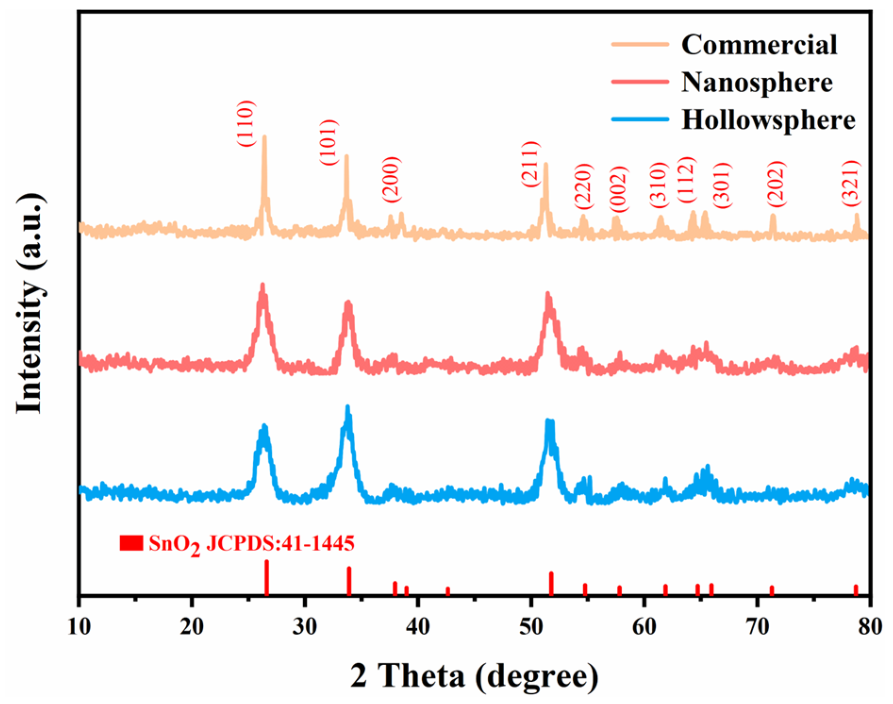
XRD analysis was performed to determine the crystal structures of the three samples, namely SnO2 hollow nanospheres, SnO2 solid nanospheres, and commercial SnO2 nanoparticles. Representative diffraction patterns are presented in Figure 1. All three materials exhibited sharp characteristic diffraction peaks, indicating their excellent crystallinity. The diffraction peak positions of all samples were in full agreement with the standard card for rutile SnO2 (JCPDS No. 41-1445) [32], and no impurity diffraction peaks were detected, confirming that all products were phase-pure SnO2.
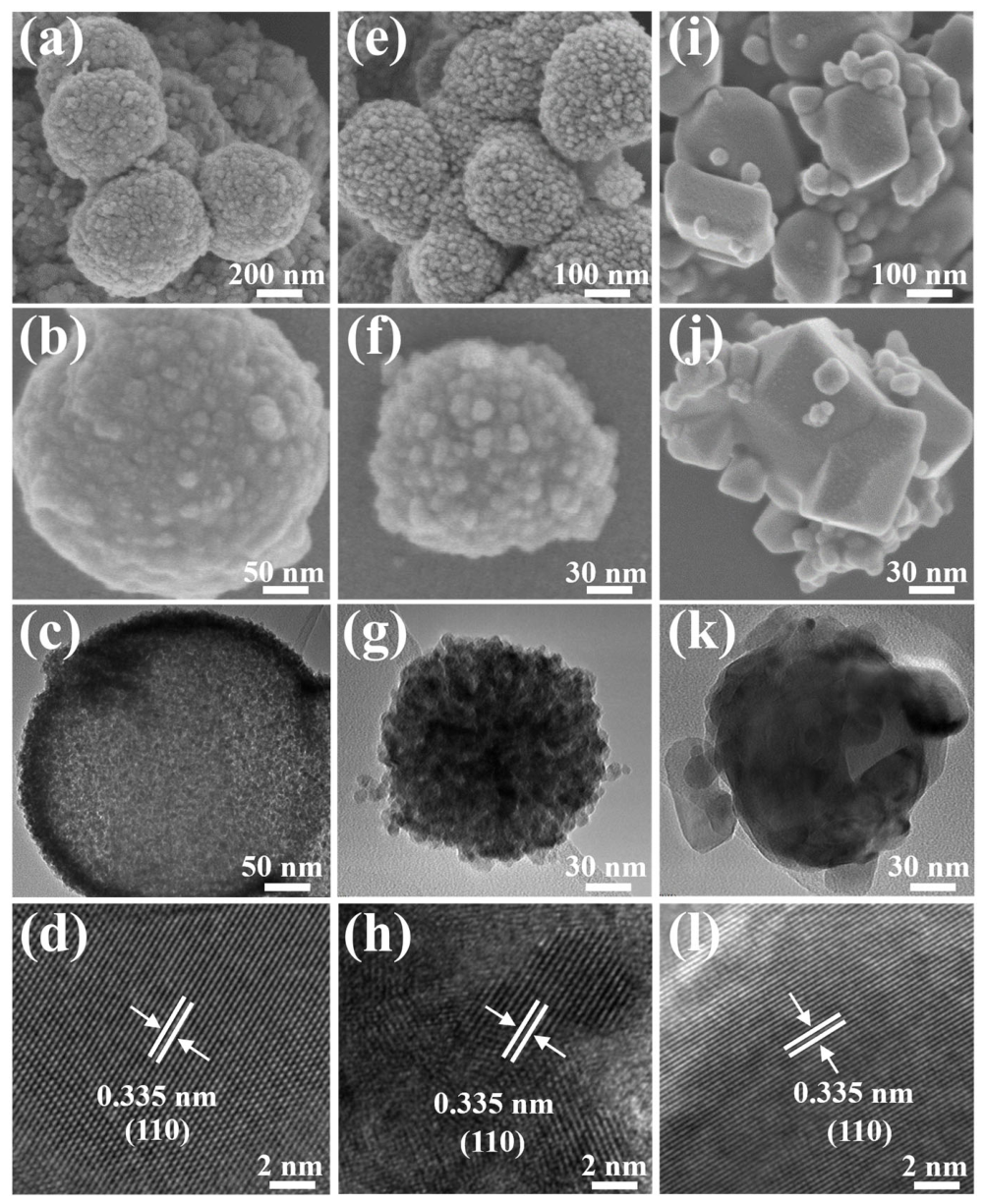
Further analysis of the material morphology and structure was carried out via SEM and TEM. As illustrated in Figure 2a–c, the SnO2 hollow nanospheres exhibited a homogeneous morphology, with diameters falling between 300 and 400 nm. Stacked nanoparticles formed the surface, and the interior revealed a hollow cavity. Figure 2e–g display SnO2 solid nanospheres with diameters of 150–200 nm, which were well-dispersed and consist of solid spheres formed by particle accumulation. In contrast, commercial SnO2 nanoparticles showed an irregular, disordered polyhedral structure (Figure 2i–k). Figure 2d,h,l presented the high-resolution TEM images of the three materials. A lattice fringe spacing of approximately 0.355 nm was observed for all materials, corresponding to the (110) plane of tetragonal rutile SnO2. These results confirm the excellent crystallinity of the synthesized materials, corroborating the XRD results [33].
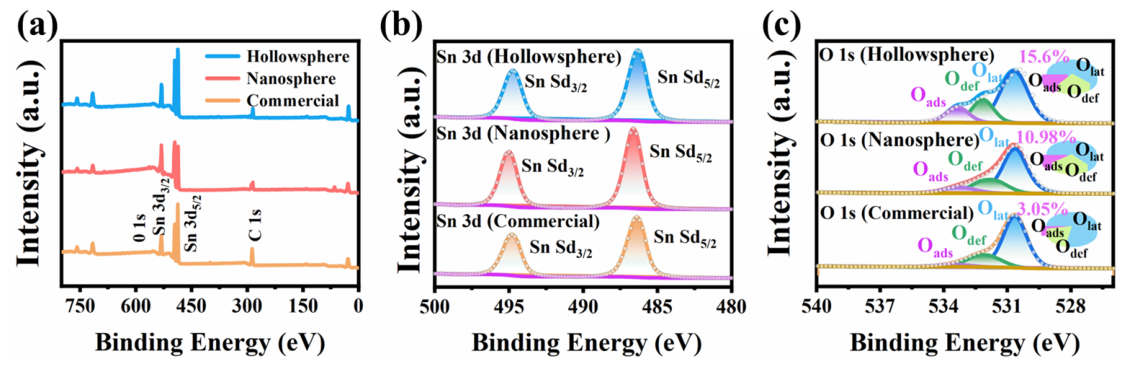
XPS analysis was conducted to examine the chemical states of the three samples. The survey spectrum (Figure 3a) revealed distinct signals corresponding to Sn 3d, O 1s, and C 1s, suggesting that the materials possess high purity [34]. For all three samples, the Sn 3d spectra (Figure 3b) exhibited the typical spin–orbit split doublet characteristic of Sn4+, which corresponds to the Sn 3d3/2 and Sn 3d5/2 orbitals, respectively [35]. The O 1s XPS spectra (Figure 3c) showed three well-resolved deconvoluted peaks, attributed to lattice oxygen (Olat), defect oxygen (Odef), and adsorbed oxygen (Oads). Among these, lattice oxygen is structurally stable and not easily involved in gas-sensing reactions. In contrast, the chemisorbed oxygen species on the semiconductor surface show high chemical activity and can react with the target gas, modulating surface carrier density via redox reactions. Consequently, a higher fraction of adsorbed oxygen contributes favorably to the gas-sensing performance of the material [36,37]. Based on the deconvolution results, the adsorbed oxygen percentages for the three samples were determined and were presented as a pie chart in Figure 3c. The SnO2 hollow nanospheres had the highest proportion of adsorbed oxygen (15.6%), followed by SnO2 solid nanospheres (10.98%), and commercial SnO2 nanoparticles (3.05%). This discrepancy is primarily attributable to morphological variations, which affected specific surface area [22].
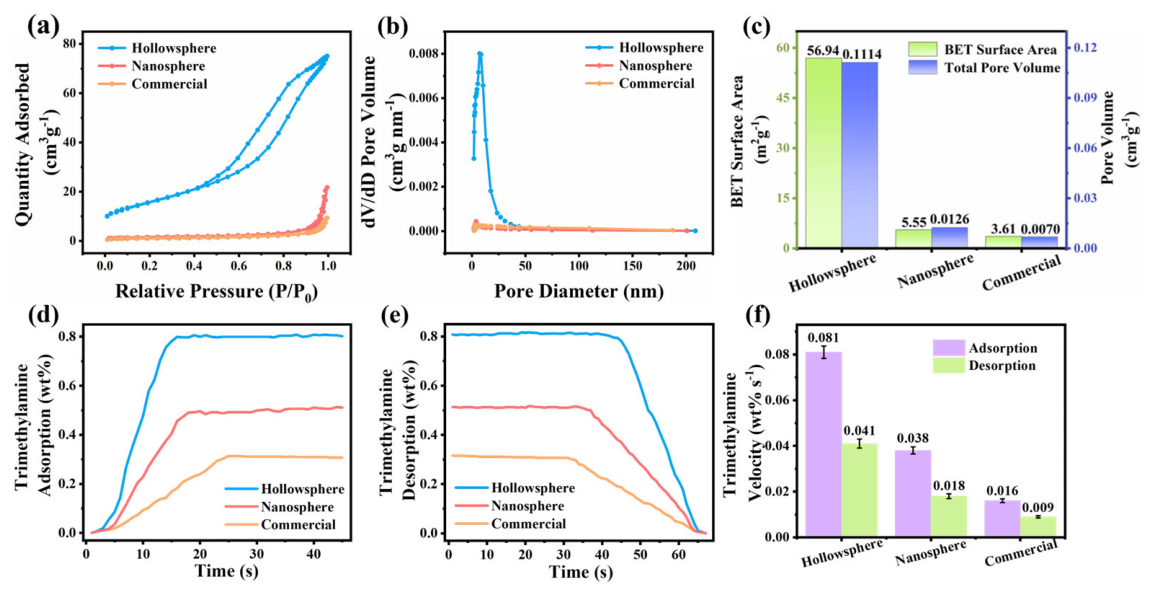
BET analysis was performed on the three samples to evaluate how morphology engineering influences their specific surface area and pore size. As shown in Figure 4a, the SnO2 hollow nanospheres exhibit a typical type IV isotherm with a distinct hysteresis loop, indicating a well-defined mesoporous structure [38]. In contrast, the SnO2 solid nanospheres and commercial SnO2 nanoparticles show a type III isotherm without an obvious hysteresis loop, indicating a non-porous or macroporous structure with low specific surface area [39]. Pore size distribution analysis (Figure 4b) revealed that the pores of SnO2 hollow nanospheres were mainly concentrated in the mesoporous range of 5–20 nm, showing a sharp peak. This indicated a narrow pore size distribution and excellent uniformity. In contrast, no distinct characteristic peaks were observed for SnO2 solid nanospheres or commercial SnO2 nanoparticles, further confirming their non-porous structure. As shown in Figure 4c, the SnO2 hollow nanospheres possessed the largest specific surface area (56.94 m2 g−1) and pore volume (0.1114 cm3 g−1), which were significantly larger than those of SnO2 solid nanospheres and commercial SnO2 nanoparticles. These results demonstrated that the construction of a hollow nanostructure significantly optimized the pore structure of SnO2, greatly increased its specific surface area and pore volume, and supplied abundant active adsorption sites and diffusion channels for gas molecules. This laid a structural foundation for its excellent gas-sensing performance [40]. The influence of morphology on gas adsorption–desorption performance was further investigated using a quartz crystal microbalance (QCM). The TMA adsorption–desorption behaviors of the three samples were presented in Figure 4d–f and Figure S2, which also provided the corresponding adsorption capacities and desorption rates for each material. The results showed that SnO2 hollow nanospheres exhibited the highest adsorption capacity for TMA (0.81 wt%), followed by SnO2 solid nanospheres (0.49 wt%), while the SnO2 hollow nanospheres had the fastest average adsorption and desorption rates (0.081 wt%·s−1 and 0.041 wt%·s−1, respectively), whereas commercial SnO2 nanoparticles exhibited the slowest rates. These findings align well with the data obtained from BET analysis: When the specific surface area is larger, a greater number of active sites become available for adsorption, which in turn leads to an enhancement in adsorption capacity. Meanwhile, the abundant mesoporous and hollow structures of SnO2 hollow nanospheres facilitate rapid gas diffusion, allowing TMA molecules to reach the adsorption sites more quickly. A larger specific surface area contributes to a greater number of active adsorption sites and thus a higher capacity. Meanwhile, the abundant mesoporous structure and hollow interior of the SnO2 hollow nanospheres accelerate gas diffusion, allowing TMA molecules to reach the active sites more rapidly [21].

3.2. Gas Sensitivity Performance

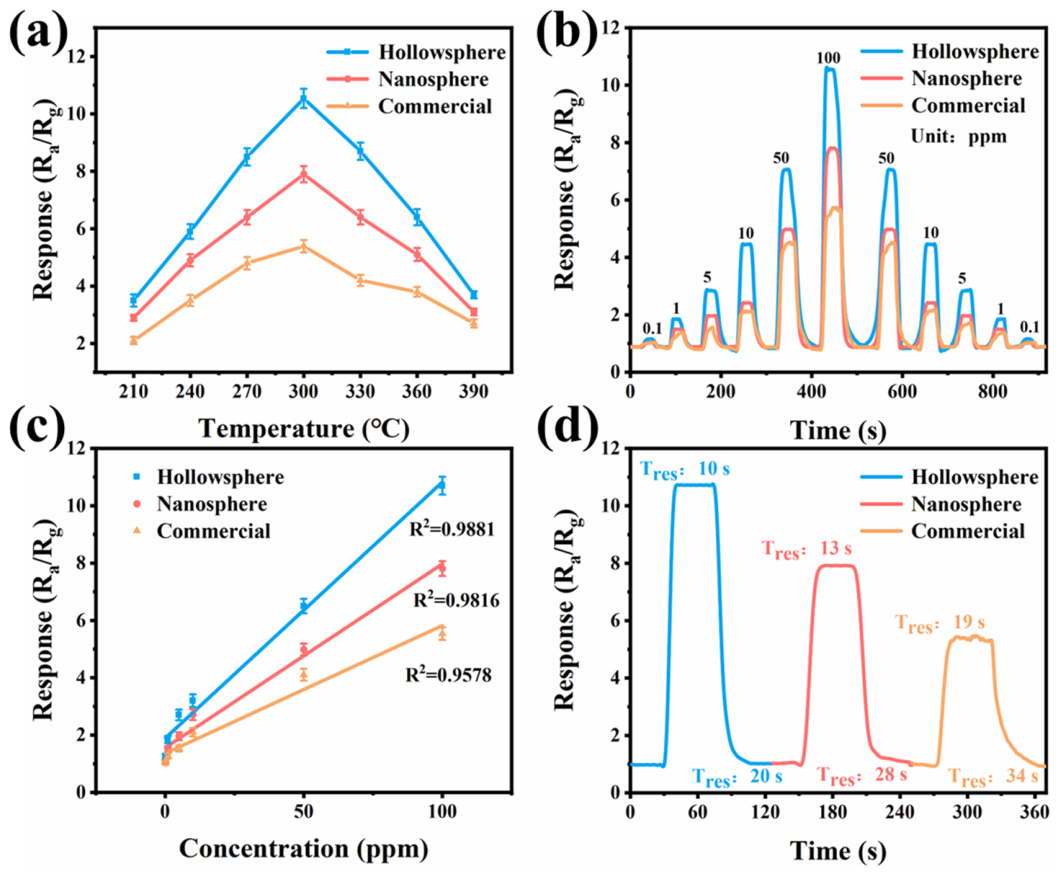
MEMS gas sensors were fabricated from the three SnO2 nanomaterials with distinct morphologies, and the TMA sensing properties of these SnO2 nanostructures were systematically evaluated. Measurements of the three sensors’ responses to 100 ppm TMA were carried out at operating temperatures varying from 210 °C to 390 °C. As shown in Figure 5a, all sensors reached their maximum response at 300 °C. The response gradually increased as the operating temperature rose to 300 °C, and then sharply decreased upon further temperature increase. Moreover, the SnO2 hollow nanospheres exhibited the highest sensitivity (Ra/Rg = 10.5), followed by SnO2 solid nanospheres (Ra/Rg = 7.8), while commercial SnO2 nanoparticles showed the lowest response (Ra/Rg = 5.1). Compared with the solid architecture, the hollow structure possesses a larger specific surface area, which is more conducive to gas redox reactions and thus yields a higher sensitivity [41]. At 300 °C, the three sensors were then tested for their dynamic responses to TMA concentrations ranging from 0.1 to 100 ppm. Figure 5b clearly showed that as the TMA concentration increased from 0.1 ppm to 100 ppm, the response values of all three sensors increased accordingly; when the concentration decreased, the response values also decreased, indicating that these gas sensors possessed good reversibility and repeatability [22]. It was worth noting that a discernible response was observed for the SnO2 hollow nanosphere sensor even at a TMA level of only 0.1 ppm (Figure S3). For practical use, the quantitative dependence of the sensor signal on gas concentration, along with the response and recovery behavior, represented essential performance parameters [42]. Figure 5c demonstrated a favorable linear relationship between the response and TMA concentration, supporting the practical utility of the sensor for quantitative TMA detection (fitting equations are provided in Table S1) [43]. The response and recovery behavior of the three sensors toward 100 ppm TMA was illustrated in Figure 5d. Compared with SnO2 solid nanospheres (13 s/28 s) and commercial SnO2 nanoparticles (19 s/34 s), the SnO2 hollow nanospheres exhibited a faster response/recovery speed (10 s/20 s). The enhancement in sensing performance was ascribed to the hollow nanospheres’ larger specific surface area than the solid nanospheres, increasing the reactive area for the sensor. Meanwhile, their mesoporous structure also enabled target molecules to diffuse freely inside the SnO2 hollow nanospheres [44]. Consequently, under the same test conditions, the SnO2 hollow nanospheres gave both the highest response and the fastest response-recovery time for the target gas.
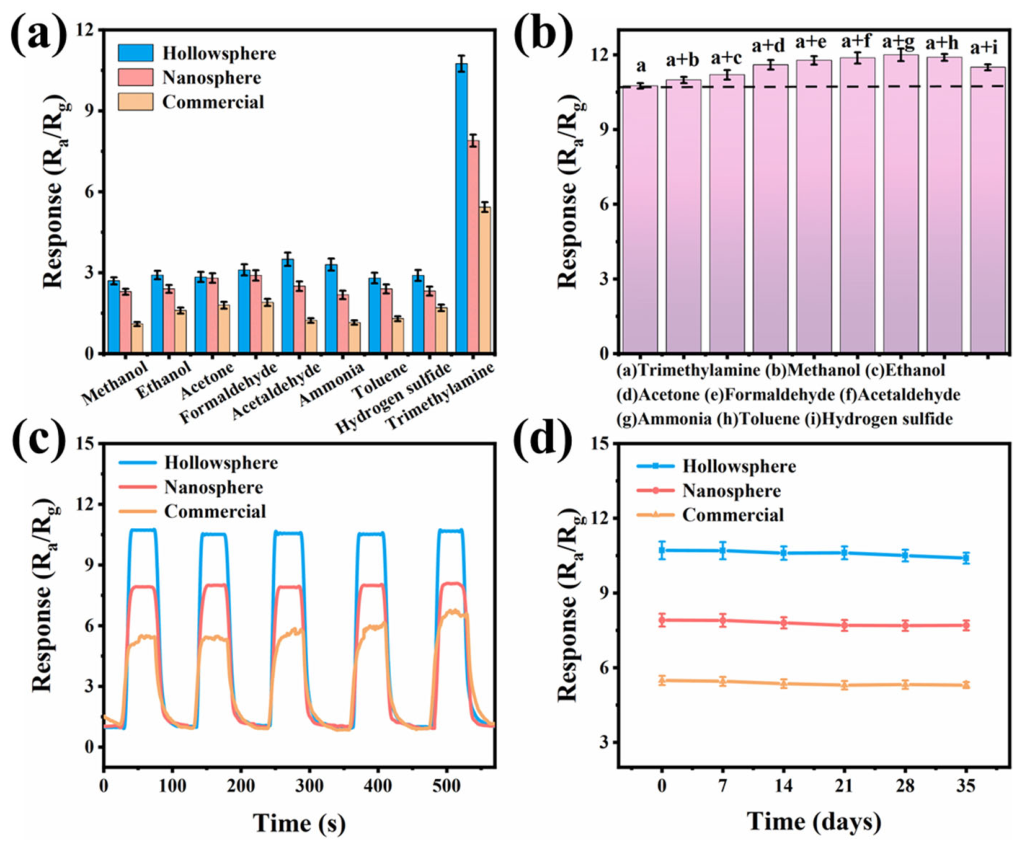
Selectivity is crucial for gas sensor applications [45,46]. At 300 °C, the three SnO2-based sensors were tested towards several common interfering gases of 100 ppm, including acetone, ethanol, methanol, formaldehyde, and ammonia, as shown in Figure 6a. Each sensor exhibited substantially stronger response to TMA than the interferents, with SnO2-based hollow nanospheres showing superior selectivity. Further investigation of anti-interference performance (Figure 6b) revealed that even when TMA coexisted with multiple interfering gases, the SnO2 hollow nanosphere sensor maintained excellent stability with a response fluctuation of less than 10%, demonstrating strong resistance to interfering gases and broad application prospects [47]. The sensor presented in this work is designed for rapid detection of TMA as the key spoilage marker, offering advantages of simple structure, fast response, and low cost. Future work may benefit from machine-learning-assisted sensing approaches [48,49] to discriminate target gas signals in complex food matrices. The three sensors were also subjected to repeatability and long-term stability assessments, as presented in Figure 6c,d. Five consecutive measurements of 100 ppm TMA under the same conditions confirmed that the sensors have good repeatability [50]. During one month of continuous testing, all sensors showed only slight fluctuations in their responses to 100 ppm TMA at 300 °C, indicating that the as-fabricated SnO2 nanomaterial-based sensors possess good long-term stability. As a key indicator of environmental adaptability, the humidity resistance was systematically evaluated through a gradient humidity experiment from 40% to 90%, and the influence of water molecules on sensor performance was analyzed. Figure S4 showed that despite the competitive adsorption between water molecules and the target gas on the sensor surface under elevated humidity, which led to a modest decrease in response, the maximum deviation was still confined to ±5% [51]. This excellent humidity tolerance was primarily attributed to the large specific surface area and abundant mesoporous structure of the hollow SnO2, which facilitated rapid adsorption and desorption of water molecules [37]. This inhibited excessive accumulation of surface hydroxyl groups and effectively mitigated the influence of humidity on baseline resistance and gas response. Furthermore, at the operating temperature of 300 °C, partial desorption of water molecules occurred, further reducing the interference of humidity on sensor performance [3]. This controllable humidity tolerance mechanism enables the sensor to operate stably in high-humidity environments, expanding its application range in humidity-sensitive fields such as the harvesting, processing, and transportation of aquatic products. Finally, Table S2 compares the TMA sensing performance of the SnO2 hollow nanosphere-based sensor developed in this study with that of previously reported MEMS sensors. As shown in the table, the SnO2 hollow nanosphere-based sensor exhibited higher sensitivity, faster response/recovery time, and a lower discernible concentration for TMA, demonstrating significant potential for practical applications.

3.3. Gas-Sensing Mechanism

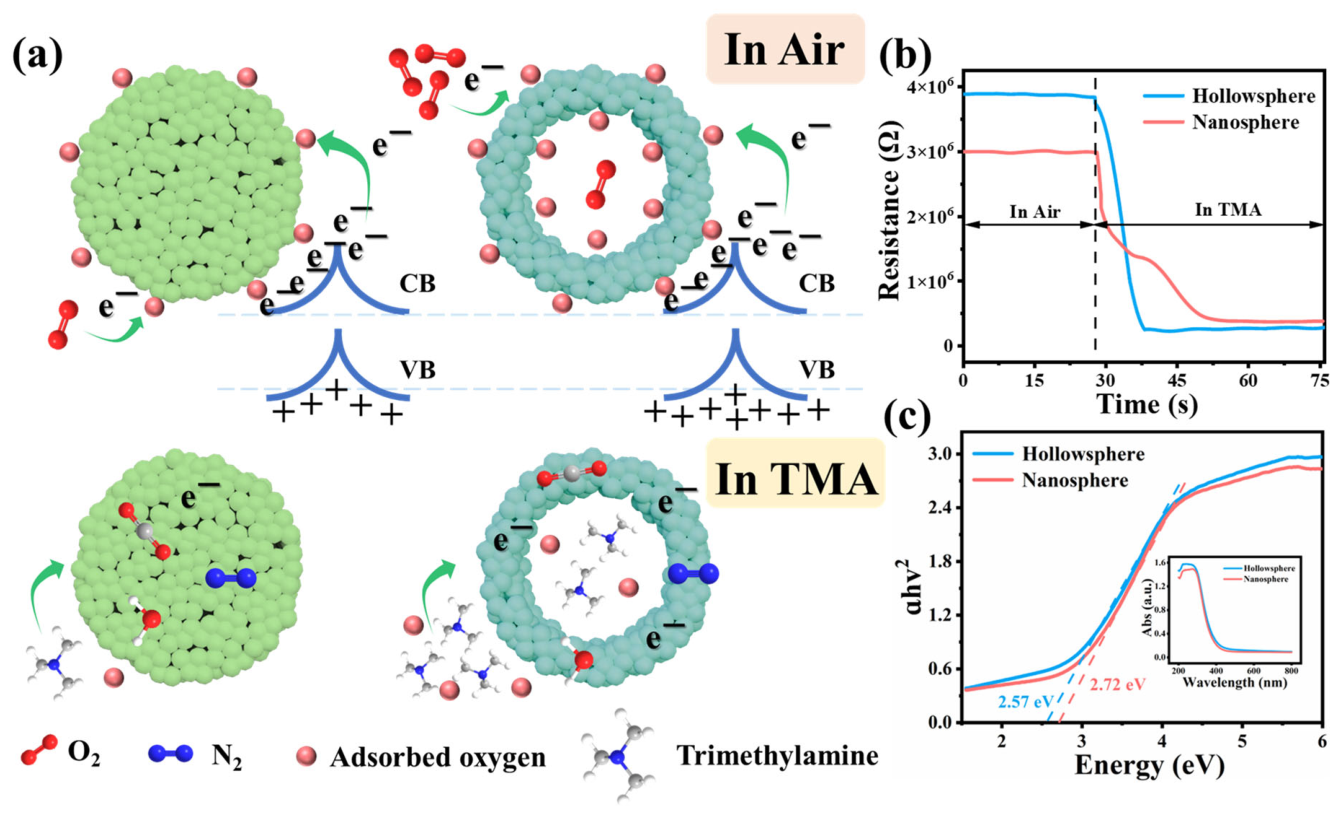
SnO2 is a classic n-type semiconductor, and its electrical conductivity is primarily governed by electrons occupying in the conduction band [18,52]. For SnO2-based gas sensors, the sensing mechanism follows a surface-controlled model [53], meaning that any resistance variation in the material is determined by the specific metal oxide and the surrounding gas composition. Figure 7a depicts how TMA is detected through surface-mediated reactions occurring between the sensing layer and incoming gas molecules. Upon exposure to ambient air, oxygen molecules extract electrons from the SnO2 conduction band, generating multiple types of chemisorbed oxygen ions [54]. At the same time, an electron-depleted layer forms at the surface of the sensing material reducing carrier concentration, thereby increasing the baseline resistance of the SnO2 nanostructure [55]. These processes are summarized by the following reactions:
O 2 ( g a s ) O 2 ( a d s )
O 2 ( a d s ) + e O 2 ( a d s )
O 2 ( a d s ) + e 2 O ( a d s )
O ( a d s ) + e O 2 ( a d s )
When the SnO2 nanomaterial is brought into contact with TMA, a reducing gas, the chemisorbed oxygen species residing on its surface drive the oxidation of TMA molecules. As this oxidative process continues, the electrons, which have been previously trapped by the adsorbed oxygen, are released to the conduction band of the sensing material. This electron release alters the band structure, reduces the thickness of the electron depletion layer, and consequently lowers the material’s resistance. The overall surface reaction is described by the following equation [56]:
2 N ( C H 3 ) 3 ( a d s )   +   21 O ( a d s )     9 H 2 O   +   6 CO 2   +   N 2   +   21 e
Several factors account for the superior gas-sensing behavior of SnO2 hollow nanospheres, including their robust crystal structure and mesoporous hollow configuration. This hollow architecture, combined with a large specific surface area, supplies plentiful active sites across both the external surface and the interior cavity, facilitating oxygen adsorption and enabling the above reactions to proceed more efficiently. Under identical conditions, compared with solid nanospheres, the hollow counterparts return a greater number of electrons to the conduction band, which leads to a more pronounced change in resistance (Figure 7b) [21].
The optical bandgap was determined using the Tauc plot method according to the following equation [57]:
( α h v ) 2 = A ( h v E g )
where α is the absorption coefficient, h is Planck’s constant, v is the photon frequency, A is a constant, Eg is the optical bandgap, and the exponent n depends on the nature of the electronic transition (for SnO2, n = 1/2 for a direct allowed transition). The bandgap width of SnO2 solid nanospheres was measured to be 2.72 eV by UV–vis diffuse reflectance spectroscopy (Figure 7c), whereas that of SnO2 hollow nanospheres was only 2.57 eV. A reduced bandgap may facilitate electron transition from the valence band to the conduction band [57]. Consequently, a substantial quantity of charge carriers can be more easily injected into the conduction band of the SnO2 hollow nanospheres, resulting in a more pronounced variation in the material’s electrical conductivity [58]. Thus, the sensor based on SnO2 hollow nanospheres exhibits superior gas-sensing performance toward TMA.

3.4. Practical Application

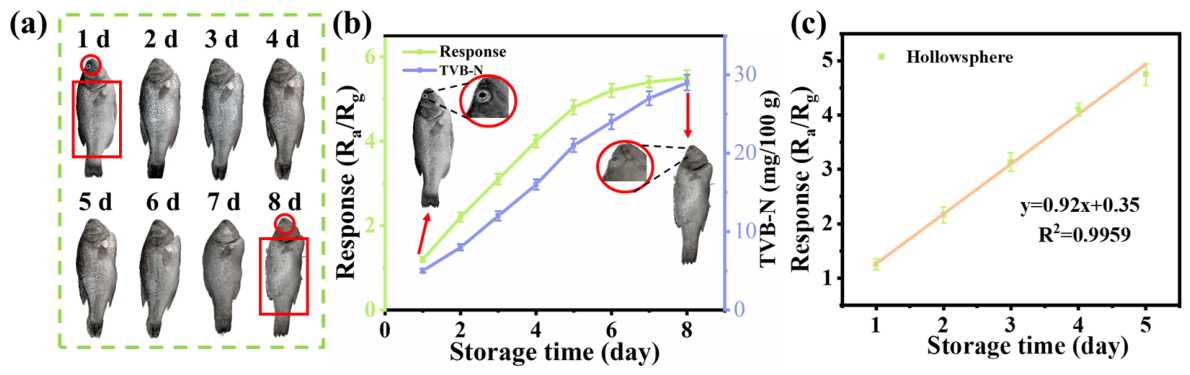
With the aim of evaluating the practical performance of the SnO2 hollow nanosphere-based MEMS sensor, chilled sea bass (approximately 500 g) was selected as a sample to detect the TMA concentration released during refrigerated storage (0–4 °C) [25]. Figure 8a records the quality changes in sea bass stored at 0–4 °C for 1–8 days. During the first 1–4 days of storage, the surface gloss of the fish gradually diminished, the tail shape remained intact, with slightly turbid eyes. During 5–8 days of storage, the fish skin gradually became sticky, the scales loosened, the eye turbidity significantly intensified, and the abdomen became distended, with spoilage characteristics becoming markedly more severe as storage time extended. As shown in Figure 8b, both the sensor response and the total volatile basic nitrogen (TVB-N) content increased progressively with storage time. The TVB-N content, a widely recognized standard indicator for meat and aquatic product freshness [59,60], increased from an initial value of 5 mg/100 g to 29 mg/100 g after 8 days, which directly corresponded to the spoilage degree of sea bass and the rising sensor response. This correlation confirms the reliability of the sensor for freshness assessment. Further analysis revealed that under 0–4 °C conditions, the sensor response was linearly correlated with storage time (first 5 days), with R2 = 0.9959. Notably, when the storage time exceeded 5 days, the response value exceeded 4.5, corresponding to a TMA concentration of 10 ppm, indicating an early spoilage stage [61]. The gradual increase in response accurately reflects the continuous accumulation of TMA, a microbial metabolite, during the spoilage process. It should be noted that the current validation was performed only on sea bass, and further studies on other aquatic products are needed. Therefore, the MEMS sensor based on SnO2 hollow nanospheres offers broad application prospects for real-time and rapid assessment of aquatic product freshness.

4. Conclusions

In this study, characteristic SnO2 hollow nanospheres and SnO2 solid nanospheres are successfully synthesized via a hydrothermal reaction. Compared with commercial SnO2 nanoparticles, their gas-sensing behaviors influenced by morphological differences are systematically investigated. XRD, BET, TEM, and XPS are employed to characterize the prepared materials, revealing their crystalline phase, specific surface area, morphology, and elemental composition. According to gas-sensing analysis, the SnO2 hollow nanosphere sensor shows a high response (10.5@100 ppm), rapid response/recovery (10 s/20 s), favorable selectivity, and a discernible response at 0.1 ppm. The superior sensitivity of the SnO2 hollow structure is mainly attributed to its larger specific surface area providing abundant reaction sites for target molecules, significantly amplifying the resistance change in the sensor, while also facilitating efficient gas adsorption and desorption. Furthermore, the sensor is successfully applied to the reliable detection of TMA in sea bass, showing promising potential for practical application. This work presents a rapid and field-deployable method for assessing aquatic product freshness, with great significance for food safety.

Supplementary Materials

The following supporting information can be downloaded at: https://www.mdpi.com/article/10.3390/foods15122123/s1, Figure S1: (a) Measuring circuit of MEMS gas sensor. (b) The panoramic views of the MEMS gas sensor test system. (c) The exploded views of the MEMS gas sensor.; Figure S2: Maximum adsorption capacity of SnO2 hollow nanospheres, SnO2 solid nanospheres, and commercial SnO2 nanoparticles for trimethylamine; Figure S3: Limit of detection of SnO2 hollow nanospheres toward 0.1 ppm trimethylamine at 300 °C; Figure S4: Response of SnO2 hollow nanospheres-based sensors to 100 ppm trimethylamine at different humidity levels; Table S1: Fitting equations for the relationship between the response of gas sensors and trimethylamine concentration; Table S2: Comparison of gas-sensing performance of MEMS sensors toward trimethylamine. References [62,63,64,65,66] are cited in the supplementary materials.

Author Contributions

Conceptualization; methodology, H.L. and Y.D.; software, Z.F.; validation, H.Z.; formal analysis, W.W.; investigation, Y.Z.; resources, Y.Z.; data curation, Y.D.; writing—original draft preparation, H.L. and Y.D.; writing—review and editing, H.L. and Y.D.; visualization, H.Z.; supervision, C.Z. and Y.Z. All authors have read and agreed to the published version of the manuscript.

Funding

This research was funded by the Natural Science Foundation of Henan (252300423660).

Institutional Review Board Statement

Not applicable.

Informed Consent Statement

Not applicable.

Data Availability Statement

The original contributions presented in the study are included in the. article/Supplementary Materials, further inquiries can be directed to the corresponding authors.

Acknowledgments

The authors would like to thank the editor and reviewers for their assistance and valuable comments.

Conflicts of Interest

The authors declare no conflicts of interest.

Abbreviations

The following abbreviations are used in this manuscript:
BETBrunauer–Emmett–Teller
HRTEMHigh-resolution transmission electron microscopy
MEMSMicro-Electro-Mechanical Systems
OlatLattice oxygen
OadsAdsorbed oxygen
OdefDefect oxygen
QCMQuartz crystal microbalance
SEMScanning electron microscopy
SnO2Tin dioxide
TEMTransmission electron microscopy
TMATrimethylamine
UV-Vis Ultraviolet–visible
XPSX-ray photoelectron spectroscopy
XRDX-ray diffraction

References

  1. Wu, K.; Debliquy, M.; Zhang, C. Metal–Oxide–Semiconductor Resistive Gas Sensors for Fish Freshness Detection. Compr. Rev. Food Sci. Food Saf. 2023, 22, 913–945. [Google Scholar] [CrossRef] [PubMed]
  2. Chen, Q.; Zheng, J.; Liu, X.; Zhang, X.; Kang, W.; Chen, C. First-Principles Investigations on the Mechanism of Highly Sensitive and Selective Trimethylamine Sensing in MoO3. Appl. Surf. Sci. 2020, 524, 146520. [Google Scholar] [CrossRef]
  3. Ji, Y.; Pan, Z.; Ma, T.; Wang, K.; Zhao, X.; Jin, Q. Hierarchical Porous Spindle-Shaped MIL-88B@Fe2O3 with Core-Shelled Structure for Conductometric Trimethylamine Detection. Sens. Actuators B Chem. 2024, 417, 136103. [Google Scholar] [CrossRef]
  4. Zhao, C.; Shen, J.; Xu, S.; Wei, J.; Liu, H.; Xie, S.; Pan, Y.; Zhao, Y.; Zhu, Y. Ultra-Efficient Trimethylamine Gas Sensor Based on Au Nanoparticles Sensitized WO3 Nanosheets for Rapid Assessment of Seafood Freshness. Food Chem. 2022, 392, 133318. [Google Scholar] [CrossRef] [PubMed]
  5. Cheng, G.; Wang, Z.; Li, Y.; Chen, W.; Ren, L. A QCM Gas Sensor Based on Ce-MOF-808 and Graphene Oxide Nanocomposite for Rapid and Sensitive Detection of Trimethylamine. J. Food Compos. Anal. 2025, 148, 108604. [Google Scholar] [CrossRef]
  6. Lim, K.J.; Kim, Y.G.; Heo, Y.J.; Shin, H. Development of Freshness Indicator (FI) for Skate Sashimi (Zearaja chilensis) to Detect Trimethylamine Content During Storage. Biosensors 2025, 15, 659. [Google Scholar] [CrossRef]
  7. Pena-Pereira, F.; Lavilla, I.; Bendicho, C. Colorimetric Assay for Determination of Trimethylamine-Nitrogen (TMA-N) in Fish by Combining Headspace-Single-Drop Microextraction and Microvolume UV-Vis Spectrophotometry. Food Chem. 2010, 119, 402–407. [Google Scholar] [CrossRef]
  8. Praoboon, N.; Siriket, S.; Taokaenchan, N.; Kuimalee, S.; Phaisansuthichol, S.; Pookmanee, P.; Satienperakul, S. Paper-Based Electrochemiluminescence Device for the Rapid Estimation of Trimethylamine in Fish via the Quenching Effect of Thioglycolic Acid-Capped Cadmium Selenide Quantum Dots. Food Chem. 2022, 366, 130590. [Google Scholar] [CrossRef] [PubMed]
  9. Chen, S.; Duan, X.; Liu, C.; Liu, S.; Li, P.; Su, D.; Sun, X.; Guo, Y.; Chen, W.; Wang, Z. La-Ce-MOF Nanocomposite Coated Quartz Crystal Microbalance Gas Sensor for the Detection of Amine Gases and Formaldehyde. J. Hazard. Mater. 2024, 467, 133672. [Google Scholar] [CrossRef]
  10. Chen, S.; Duan, X.; Li, P.; Su, D.; Sun, X.; Guo, Y.; Chen, W.; Wang, Z. UiO-66/Multiwalled Carbon Nanotube Nanocomposite-Coated Quartz Crystal Microbalance Gas Sensor for Discriminating Amine and Formaldehyde. ACS Appl. Nano Mater. 2024, 7, 4120–4129. [Google Scholar] [CrossRef]
  11. Tsai, M.F.; Ding, R.Y.; Hsueh, T.J. Optimized Gallium Oxide/MEMS Gas Sensor for H2S Gas Detection that Exhibits Increased Sensitivity and Stability. Appl. Surf. Sci. 2025, 696, 162944. [Google Scholar] [CrossRef]
  12. Zhang, C.; Wang, T.; Zhang, G.; Gao, R.; Gao, C.; Wang, Z.; Xuan, F. Rational Design and Fabrication of MEMS Gas Sensors with Long–Term Stability: A Comprehensive Review. Adv. Sci. 2025, 12, e11555. [Google Scholar] [CrossRef] [PubMed]
  13. Mousavi, M.; Alzgool, M.; Davaji, B.; Towfighian, S. High Signal-to-Noise Ratio Event-Driven MEMS Motion Sensing. Small 2024, 20, e2304591. [Google Scholar] [CrossRef]
  14. Bulemo, P.M.; Kim, D.; Shin, H.; Cho, H.; Koo, W.; Choi, S.; Park, C.; Ahn, J.; Güntner, A.; Penner, R.; et al. Selectivity in Chemiresistive Gas Sensors: Strategies and Challenges. Chem. Rev. 2025, 125, 4111–4183. [Google Scholar] [CrossRef]
  15. Liu, L.; Fu, S.; Lv, X.; Yue, L.; Fan, L.; Yu, H.; Gao, X.; Zhu, W.; Zhang, W.; Li, X.; et al. A Gas Sensor with Fe2O3 Nanospheres Based on Trimethylamine Detection for the Rapid Assessment of Spoilage Degree in Fish. Front. Bioeng. Biotechnol. 2020, 8, 567584. [Google Scholar] [CrossRef]
  16. Wang, D.; Gu, K.; Zhao, Q.; Zhai, C.; Yang, T.; Lu, Q.; Zhang, J.; Zhang, M. Synthesis and Trimethylamine Sensing Properties of Spherical V2O5 Hierarchical Structures. New J. Chem. 2018, 42, 14188–14193. [Google Scholar] [CrossRef]
  17. Hong, S.; Kim, Y.; Huang, S.; Seo, H.; Lim, S. Effect of Morphology of ZnO on Colorimetric Hydrogen Sensitivity of PdO@ZnO Hybrids. Int. J. Hydrogen Energy 2024, 57, 717–726. [Google Scholar] [CrossRef]
  18. Shin, K.; Mirzaei, A.; Kaewmaraya, T.; Bang, J.; Oum, W.; Kim, E.; Kim, H.; Hussain, T.; Kim, S.; Kim, H. Proton-Irradiation on Graphene-SnO2 Hybrid Nanocomposites to Boost NO2 Gas Sensing Properties. Ceram. Int. 2024, 50, 38228–38241. [Google Scholar] [CrossRef]
  19. Sun, Q.; Xu, Y.; Wang, W.; Sun, J.; Li, J.; Li, J.; Wu, Z.; Duan, H. Room-Temperature Trimethylamine Gas Sensor with Biomass Carbon Microtubule-Grown SnO2 Nanosheets for Efficient Assessment of Fish Freshness. Ceram. Int. 2025, 51, 27413–27422. [Google Scholar] [CrossRef]
  20. Cai, Z.; Park, S. Fabrication of Selective and Highly Sensitive Triethylamine Gas Sensor Using In2O3–SnO2 Hollow Nanospheres in Room Temperature Activated by UV Irradiation. J. Mater. Res. Technol. 2023, 26, 6581–6596. [Google Scholar] [CrossRef]
  21. Wang, X.; Liu, P.; Cai, H.; Li, M.; Deng, C.; Zhao, Y.; Zhang, Z.; Zhu, Y. PdRh Bimetallic-Loaded α-Fe2O3 Nanospindles with Ppb-Limit of 3-Hydroxy-2-Butanone Biomarker Detection: Particle Dimension Regulation and Oxygen Spillover Effect. Chem. Eng. J. 2025, 512, 162686. [Google Scholar] [CrossRef]
  22. Wu, W.; Yang, Y.; Zhao, C.; Wang, X.; Xie, Y.; Jiang, K.; Feng, H.; Zhu, Y. Controlled Synthesis of Tungsten Oxide Nanomaterials with Different Morphologies and Their Gas-Sensing Properties for Formaldehyde in Vegetables. Biosensors 2025, 15, 400. [Google Scholar] [CrossRef] [PubMed]
  23. Ge, S.; Li, M.; Li, X.; Mou, C.; Zhu, H.; Wei, G. Template-Free and Controlled Synthesis of ZnFe2O4 Microspheres and Enhanced Isopropanol Vapor Sensing Performance. Vacuum 2024, 220, 112773. [Google Scholar] [CrossRef]
  24. Zhu, K.; Zhu, Z.; Xu, S.; Zhao, C.; Ni, T. Controlled Synthesis of α-Fe2O3 Nanocubes for Gas-Sensing Applications: Feasibility of Assessing Crucian Carp (Carassius auratus) Freshness via Trimethylamine Levels. Food Chem. 2024, 441, 138361. [Google Scholar] [CrossRef]
  25. Ni, W.; Wang, Y.; Xu, R. Formation of Sn@ C Yolk–Shell Nanospheres and Core–Sheath Nanowires for Highly Reversible Lithium Storage. Part. Part. Syst. Charact. 2013, 30, 873–880. [Google Scholar] [CrossRef]
  26. Tripathi, A.M.; Mitra, S. Green Template-Free Synthesis of SnO2 Nanospheres–A Physical Understanding and Electrochemistry. RSC Adv. 2013, 3, 19423–19429. [Google Scholar] [CrossRef]
  27. Nagarjuna, Y.; Hsiao, Y.-J. TeO2 Doped ZnO Nanostructure for the Enhanced NO2 Gas Sensing on MEMS Sensor Device. Sens. Actuators B Chem. 2024, 401, 134891. [Google Scholar] [CrossRef]
  28. Zhu, J.; Chen, L.; Ni, W.; Cheng, W.; Yang, Z.; Xu, S.; Wang, T.; Zhang, B.; Xuan, F. NiO/ZnO Nanocomposites for Multimodal Intelligent MEMS Gas Sensors. ACS Sens. 2025, 10, 2531–2541. [Google Scholar] [CrossRef]
  29. Gao, X.; Chen, Y.; Xu, P.; Zheng, D.; Li, X. γ-Fe2O3-Based MEMS Gas Sensor for Propane Detection. Electronics 2025, 14, 1050. [Google Scholar] [CrossRef]
  30. GB 5009.228-2016; National Food Safety Standard—Determination of Volatile Base Nitrogen in Food. National Health and Family Planning Commission of the People’s Republic of China: Beijing, China, 2016.
  31. Wang, Z.H.; Wang, X.M.; Qi, G.Y.; Chen, S.H.; Liu, C.; Marrazza, G.; Gu, S.; Li, P.; Chen, W. Nanoporous Graphene Oxide/Molybdenum Disulfide Based on Quartz Crystal Microbalance Gas Sensor for Total Volatile Basic Nitrogen Detection in Salmon Meat. J. Food Compos. Anal. 2025, 142, 107417. [Google Scholar] [CrossRef]
  32. Ma, C.; Guo, X.; Gao, D.; Liu, Y.; Li, H.; Liu, M.; Song, P. Synthesis of In2O3/SnO2 Nanocomposites and Their Trimethylamine Sensing Performance at Low Temperature. ChemistrySelect 2025, 10, e202501464. [Google Scholar] [CrossRef]
  33. Zhu, X.; Cao, P.; Li, P.; Yu, Y.; Guo, R.; Li, Y.; Yang, H. Bimetallic PtAu-Decorated SnO2 Nanospheres Exhibiting Enhanced Gas Sensitivity for Ppb-Level Acetone Detection. Nanomaterials 2024, 14, 1097. [Google Scholar] [CrossRef] [PubMed]
  34. Zhu, X.; Chen, C.; Shi, Y.; Wang, J.; Wang, Y.; Pan, L.; Guan, Z. Dual-Functional, Highly Efficient CaIn2S4/PDA@SnO2 Photocatalyst with Z-Scheme for Photocatalytic Hydrogen Production from Water Splitting and Organic Pollutant Degradation. J. Alloys Compd. 2024, 976, 173151. [Google Scholar] [CrossRef]
  35. Ou, P.; Cao, Z.; Rong, J. Multi-Scale Design and Synthesis Strategy of Ni-Doped SnO2 Hollow Spheres as Anode Material for Lithium-Ion Batteries. Int. J. Electrochem. Sci. 2022, 17, 220737. [Google Scholar] [CrossRef]
  36. Huang, J.; Dai, Q.; Wu, Q.; Ren, H.; Lu, X.; Gu, C.; Zhang, Y.; Joo, S.W. Preparation of Hollow SnO2@N-C Nanospheres for High Performance Lithium-Ion Battery. J. Electroanal. Chem. 2022, 922, 116741. [Google Scholar] [CrossRef]
  37. Cai, H.; Liu, H.; Ni, T.; Pan, Y.; Zhao, Y.; Zhu, Y. Controlled Synthesis of Pt Doped SnO2 Mesoporous Hollow Nanospheres for Highly Selective and Rapidly Detection of 3-Hydroxy-2-Butanone Biomarker. Front. Chem. 2019, 7, 843. [Google Scholar] [CrossRef]
  38. Wang, X.; Liu, P.; Cai, H.; Zhao, C.; Wu, W.; Zhou, H.; Song, Y.; Zhang, Z.; Zhao, Y.; Zhu, Y. From Hidden Danger to Rapid Detection: Silver-Enhanced Urchin-Like Tungsten Oxide MEMS Sensors for Listeria monocytogenes Detection in Refrigerated Dairy. Food Chem. 2025, 497, 146967. [Google Scholar] [CrossRef] [PubMed]
  39. Zhao, C.; Gong, H.; Lan, W.; Ramachandran, R.; Xu, H.; Liu, S.; Wang, F. Facile Synthesis of SnO2 Hierarchical Porous Nanosheets from Graphene Oxide Sacrificial Scaffolds for High-Performance Gas Sensors. Sens. Actuators B Chem. 2018, 258, 492–500. [Google Scholar] [CrossRef]
  40. Liu, X.; Han, J.; Qiao, X.; Cai, H.; Zhao, Y.; Zhang, Z.; Zhai, B.; Ni, T.; Zhao, C.; Zhu, Y. Bimetallic Au and Pd Nanoparticles Modified WO3 Nanosheets for Enhancing the Sensitivity and Selectivity of Formaldehyde Assessment in Aquatic Products. ACS Appl. Mater. Interfaces 2024, 16, 22155–22165. [Google Scholar] [CrossRef] [PubMed]
  41. Wang, D.; Deng, L.; Cai, H.; Yang, J.; Bao, L.; Zhu, Y.; Wang, X. Bimetallic PtCu Nanocrystal Sensitization WO3 Hollow Spheres for Highly Efficient 3-Hydroxy-2-Butanone Biomarker Detection. ACS Appl. Mater. Interfaces 2020, 12, 18904–18912. [Google Scholar] [CrossRef]
  42. Lee, I.; Kannankutty, K.; He, Z.; Wei, T. Facile, Cost-Effective NO2 Gas Sensors Based on Polymer Intercalated Graphene/Reduced Graphene Oxide Materials. J. Taiwan Inst. Chem. Eng. 2024, 157, 105405. [Google Scholar] [CrossRef]
  43. Li, X.; Zhang, N.; Liu, C.; Adimi, S.; Zhou, J.; Liu, D.; Ruan, S. Enhanced Gas Sensing Properties for Formaldehyde Based on ZnO/Zn2SnO4 Composites from One-Step Hydrothermal Synthesis. J. Alloys Compd. 2021, 850, 156606. [Google Scholar] [CrossRef]
  44. Zhang, J.; Zhang, K.; Liu, S.; Liang, X.; Zhang, M. Reasonable Construction of 2D Porous NiO/Co3O4 Nanosheets for Efficient Detection of Xylene. Sens. Actuators B Chem. 2023, 377, 133002. [Google Scholar] [CrossRef]
  45. Marikutsa, A.; Rumyantseva, M.; Konstantinova, E.A.; Gaskov, A. The Key Role of Active Sites in the Development of Selective Metal Oxide Sensor Materials. Sensors 2021, 21, 2554. [Google Scholar] [CrossRef]
  46. Shen, B.; Yuan, T.; Zhang, W.; Chen, Y.; Xu, J. Complex Shell Fe-ZnO Derived from ZIF-8 as High-Quality Acetone MEMS Sensor. Chin. Chem. Lett. 2024, 35, 109490. [Google Scholar] [CrossRef]
  47. Sun, B.; Liu, M.; Liu, L.; Wang, Q.; Song, P. Synthesis of 1D LaFeO3 Nanofibers/2D MXene Heterostructures for Formaldehyde Detection at Low Temperature. Sens. Actuators B Chem. 2024, 415, 136011. [Google Scholar] [CrossRef]
  48. Zhang, B.; Rahman, M.A.; Liu, J.; Huang, J.; Yang, Q. Real-Time Detection and Analysis of Foodborne Pathogens via Machine Learning Based Fiber-Optic Raman Sensor. Measurement 2023, 217, 113121. [Google Scholar] [CrossRef]
  49. Mahata, B.; Acharyya, S.; Banerji, P.; Guha, P.K. Assessment of Fish Adulteration Using SnO2 Nanopetal-Based Gas Sensor and Machine Learning. Food Chem. 2024, 438, 138039. [Google Scholar] [CrossRef]
  50. Kim, K.B.; Sohn, M.S.; Min, S.; Yoon, J.; Park, J.; Li, J.; Moon, Y.K.; Kang, Y.C. Highly Selective and Reversible Detection of Simulated Breath Hydrogen Sulfide Using Fe-Doped CuO Hollow Spheres: Enhanced Surface Redox Reaction by Multi-Valent Catalysts. Small 2024, 20, 2308963. [Google Scholar] [CrossRef]
  51. Liu, B.; Li, K.; Luo, Y.; Gao, L.; Duan, G. Sulfur Spillover Driven by Charge Transfer Between AuPd Alloys and SnO2 Allows High Selectivity for Dimethyl Disulfide Gas Sensing. Chem. Eng. J. 2021, 420, 129881. [Google Scholar] [CrossRef]
  52. Kavan, L. Electrochemistry and Band Structure of Semiconductors (TiO2, SnO2, ZnO): Avoiding Pitfalls and Textbook Errors. J. Solid State Electrochem. 2024, 28, 829–845. [Google Scholar] [CrossRef]
  53. Wang, X.; Wang, Y.; Tian, F.; Liang, H.; Wang, K.; Zhao, X.; Lu, Z.; Jiang, K.; Yang, L.; Lou, X. From the Surface Reaction Control to Gas-Diffusion Control: The Synthesis of Hierarchical Porous SnO2 Microspheres and Their Gas-Sensing Mechanism. J. Phys. Chem. C 2015, 119, 15963–15976. [Google Scholar] [CrossRef]
  54. Li, A.; Zhao, S.; Bai, J.; Wu, M.; Gao, S.; Shen, Y.; Yuan, Z.; Meng, F. Chemoresistive Gas Sensor Arrays Based on Bimetallic-Species-Loaded SnO2 Nanospheres for Identification of Hydrogen/Methane Mixtures. Int. J. Hydrogen Energy 2026, 217, 153956. [Google Scholar] [CrossRef]
  55. Barsan, N.; Weimar, U. Conduction Model of Metal Oxide Gas Sensors. J. Electroceram. 2001, 7, 143–167. [Google Scholar] [CrossRef]
  56. Xu, H.; Zhong, H.; Hu, J.; Rong, X.; Zhang, W.; Wang, Y.; Li, S.; Li, G.; Wang, D. Facile Engineering of Metal–Organic Framework Derived SnO2@NiO Core–Shell Nanocomposites Based Gas Sensor Toward Superior VOCs Sensing Performance. Chem. Eng. J. 2024, 501, 157692. [Google Scholar] [CrossRef]
  57. Yang, Y.; Wang, Y.; Yin, S. Oxygen Vacancies Confined in SnO2 Nanoparticles for Desirable Electronic Structure and Enhanced Visible Light Photocatalytic Activity. Appl. Surf. Sci. 2017, 420, 399–406. [Google Scholar] [CrossRef]
  58. Cai, H.; Qiao, X.; Chen, M.; Feng, D.; Alghamdi, A.A.; Alharthi, F.A.; Pan, Y.; Zhao, Y.; Zhu, Y.; Deng, Y. Hydrothermal Synthesis of Hierarchical SnO2 Nanomaterials for High-Efficiency Detection of Pesticide Residue. Chin. Chem. Lett. 2021, 32, 1502–1506. [Google Scholar] [CrossRef]
  59. Senapati, M.; Sahu, P.P. Meat Quality Assessment Using Au Patch Electrode Ag-SnO2/SiO2/Si MIS Capacitive Gas Sensor at Room Temperature. Food Chem. 2020, 324, 126893. [Google Scholar] [CrossRef] [PubMed]
  60. Liu, H.; Zhang, Y.; Huang, L.; Wang, M. A Colorimetric Gas-Sensitive Array Sensor Using Filter Paper for the Analysis of Fish Freshness. Food Chem. 2022, 377, 132029. [Google Scholar] [CrossRef]
  61. Wang, G.; Cai, H.; Wei, J.; Zhang, L.; Zhang, X.; Zhang, Z.; Zhu, Y. Controlled Assembly of Bimetallic PtRh-Modified Tin Oxide Hollow Nanotubes with High Sensing Activity for Ultrasensitive Formaldehyde Detection. ACS Sens. 2025, 10, 5085–5096. [Google Scholar] [CrossRef]
  62. Meng, D.; Qiao, T.; Ji, Y.; Wang, R.; Zhang, Y.; San, X. Hydrangea-like In2O3@In2S3 n-n heterostructures for high-efficiency TMA measurement. IEEE Trans. Instrum. Meas. 2023, 72, 9502809. [Google Scholar] [CrossRef]
  63. Ji, Y.; Zhang, N.; Xu, J.; Jin, Q.; San, X.; Wang, X. Co3O4/In2O3 p-n heterostructures based gas sensor for efficient structure-driven trimethylamine detection. Ceram. Int. 2023, 49, 17354–17362. [Google Scholar] [CrossRef]
  64. Wu, K.; He, X.; Ly, A.; Lahem, D.; Debliquy, M.; Zhang, C. Highly sensitive and selective gas sensors based on 2D/3D Bi2MoO6 micro-nano composites for trimethylamine biomarker detection. Appl. Surf. Sci. 2023, 629, 157443. [Google Scholar] [CrossRef]
  65. Zhang, R.; Wang, L.; Deng, J.; Zhou, T.; Lou, Z.; Zhang, T. Hierarchical structure with heterogeneous phase as high-performance sensing materials for trimethylamine gas detecting. Sens. Actuators B Chem. 2015, 220, 1224–1231. [Google Scholar] [CrossRef]
  66. Zhao, X.; Liu, W.; Yang, X.; Xu, W.; Yao, L.; Sun, Z.; Pan, G.; Huang, L.; Cheng, Y. Synergistic effects of Bi doping in ZnFe2O4 nanoparticles for enhanced trimethylamine sensing via oxygen vacancy accumulation and catalytic activation. J. Environ. Chem. Eng. 2026, 14, 121141. [Google Scholar] [CrossRef]
Figure 1. XRD patterns of commercial SnO2 nanoparticles, SnO2 solid nanospheres and SnO2 hollow nanospheres.
Foods 15 02123 g001
Figure 2. SEM, TEM and HRTEM images of different SnO2 nanomaterials: (ad) SnO2 hollow nanospheres, (eh) SnO2 solid nanospheres, and (il) commercial SnO2 nanoparticles.
Foods 15 02123 g002
Figure 3. (a) XPS survey spectra of SnO2 hollow nanospheres, SnO2 solid nanospheres and commercial SnO2 nanoparticles. High resolution (b) Sn 3d and (c) O 1s XPS spectra of the three samples.
Foods 15 02123 g003
Figure 4. (a) Nitrogen adsorption–desorption isotherms, (b) pore size distributions, (c) BET surface area and pore volumes of SnO2 hollow nanospheres, SnO2 solid nanospheres, and commercial SnO2 nanoparticles. (df) Trimethylamine adsorption–desorption performance test of SnO2 hollow nanospheres, SnO2 solid nanospheres, and commercial SnO2 nanoparticles.
Foods 15 02123 g004
Figure 5. Sensing performance of the gas sensors based on SnO2 hollow nanospheres, SnO2 solid nanospheres and commercial SnO2 nanoparticles for trimethylamine. (a) The response of the gas sensor to 100 ppm trimethylamine at different operating temperatures (210–390 °C). (b) The dynamic response curves of the sensor to different concentrations of trimethylamine (0.1–100 ppm) at 300 °C. (c) The relationship between the response of the gas sensor and trimethylamine concentration at 300 °C. (d) The sensor’s response and recovery time curves to 100 ppm trimethylamine at 300 °C.
Foods 15 02123 g005
Figure 6. Gas-sensing properties of SnO2 hollow nanospheres, SnO2 solid nanospheres and commercial SnO2 nanoparticles. (a) Selectivity for 100 ppm trimethylamine and other interfering gases. (b) Response to mixed gases containing 100 ppm of trimethylamine and 100 ppm of each interfering gas. (c) Reproducibility and (d) long-term stability for sensing 100 ppm trimethylamine. All tests were conducted at 300 °C.
Foods 15 02123 g006
Figure 7. (a) Schematic illustration of the trimethylamine sensing mechanism of SnO2 hollow nanospheres and SnO2 solid nanospheres. (b) Resistance response curves of SnO2 hollow nanospheres and SnO2 solid nanospheres after trimethylamine exposure. (c) UV-vis diffuse reflectance spectra and Tauc curve of SnO2 hollow nanospheres and SnO2 solid nanosphere.
Foods 15 02123 g007
Figure 8. (a) Changes in sea bass stored at 0–4 °C for 1–8 days. (b) Changes in SnO2 hollow nanospheres sensor response (left axis) and TVB-N content (right axis) of sea bass during storage at 0–4 °C for 0–8 days. (c) Linear relationship between the response of the SnO2 hollow nanospheres sensor and storage time (first 5 days) at 0–4 °C.
Foods 15 02123 g008
Disclaimer/Publisher’s Note: The statements, opinions and data contained in all publications are solely those of the individual author(s) and contributor(s) and not of MDPI and/or the editor(s). MDPI and/or the editor(s) disclaim responsibility for any injury to people or property resulting from any ideas, methods, instructions or products referred to in the content.