Raman Spectroscopic Authentication of Rebaudioside M: Discriminating Natural, Fermentation-Derived, and Enzymatically Bioconverted Stevia Sweeteners

 ,
,
Abstract
1. Introduction
2. Experimental Procedures
2.1. Samples Obtained from Different Manufacturing Procedures
2.2. Raman Spectroscopy
2.3. Statistical Analyses
3. Experimental Results
4. Discussion
4.1. Heterogeneity and Molecular Crystallinity Markers
4.2. Raman Assessments of Glycosidic Completeness and Sensorial Performance
- (a)
- Fewer glucosyl groups on C19 result in shorter time for initial stimulation and longer perception of bitterness.
- (b)
- More glucosyl groups on C13 give a faster increase and a stronger intensity of sweetness.
- (c)
- A lower ratio between C13/C19 glucosyl groups leads to a faster sweetness peak perception, while not affecting the bitter taste.
- (d)
- Higher numbers at C19 position lead to a quicker decay of sweetness.
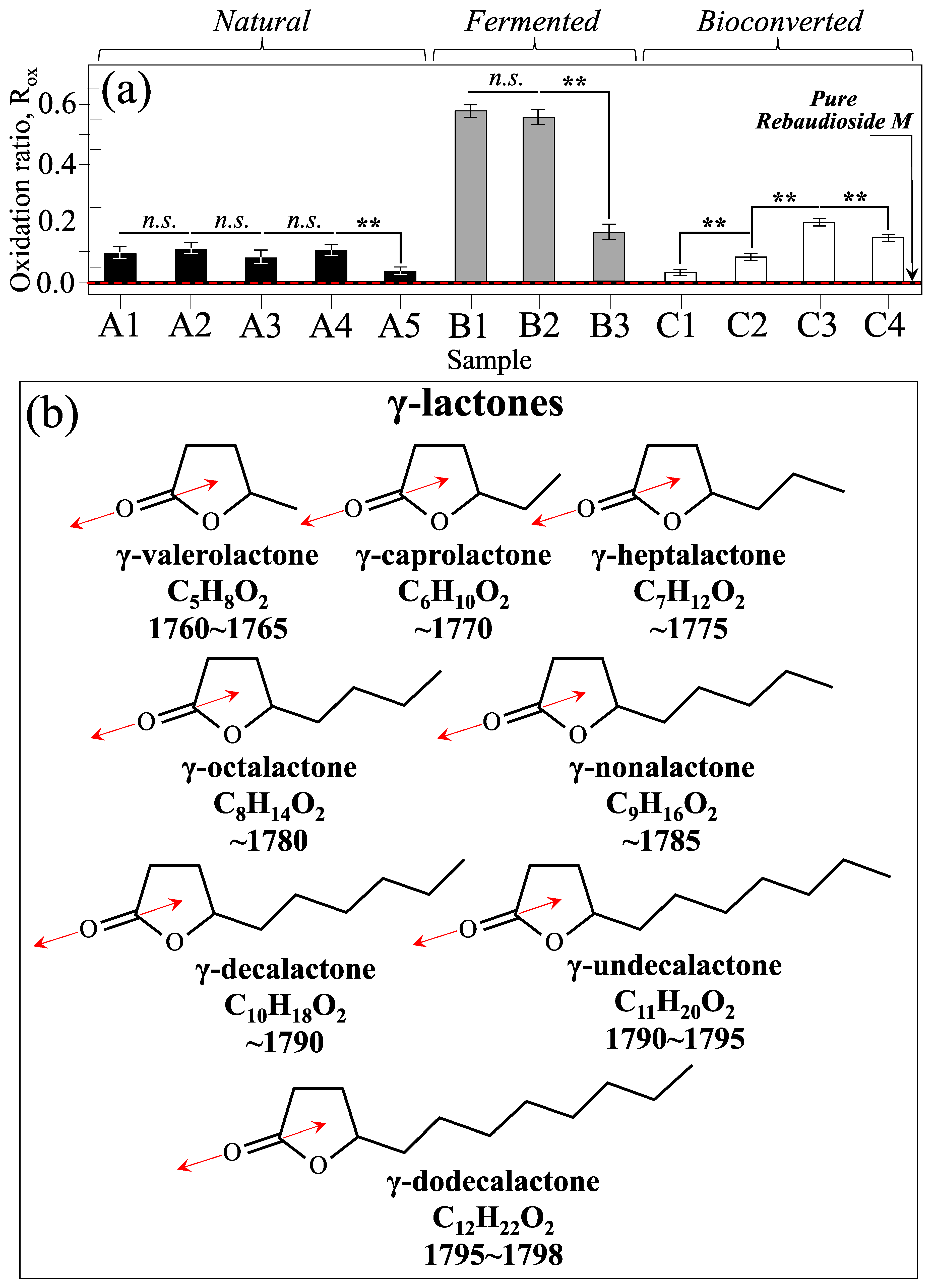
4.3. Impact of Manufacturing Procedure on Non-Glycosidic Ester Impurities
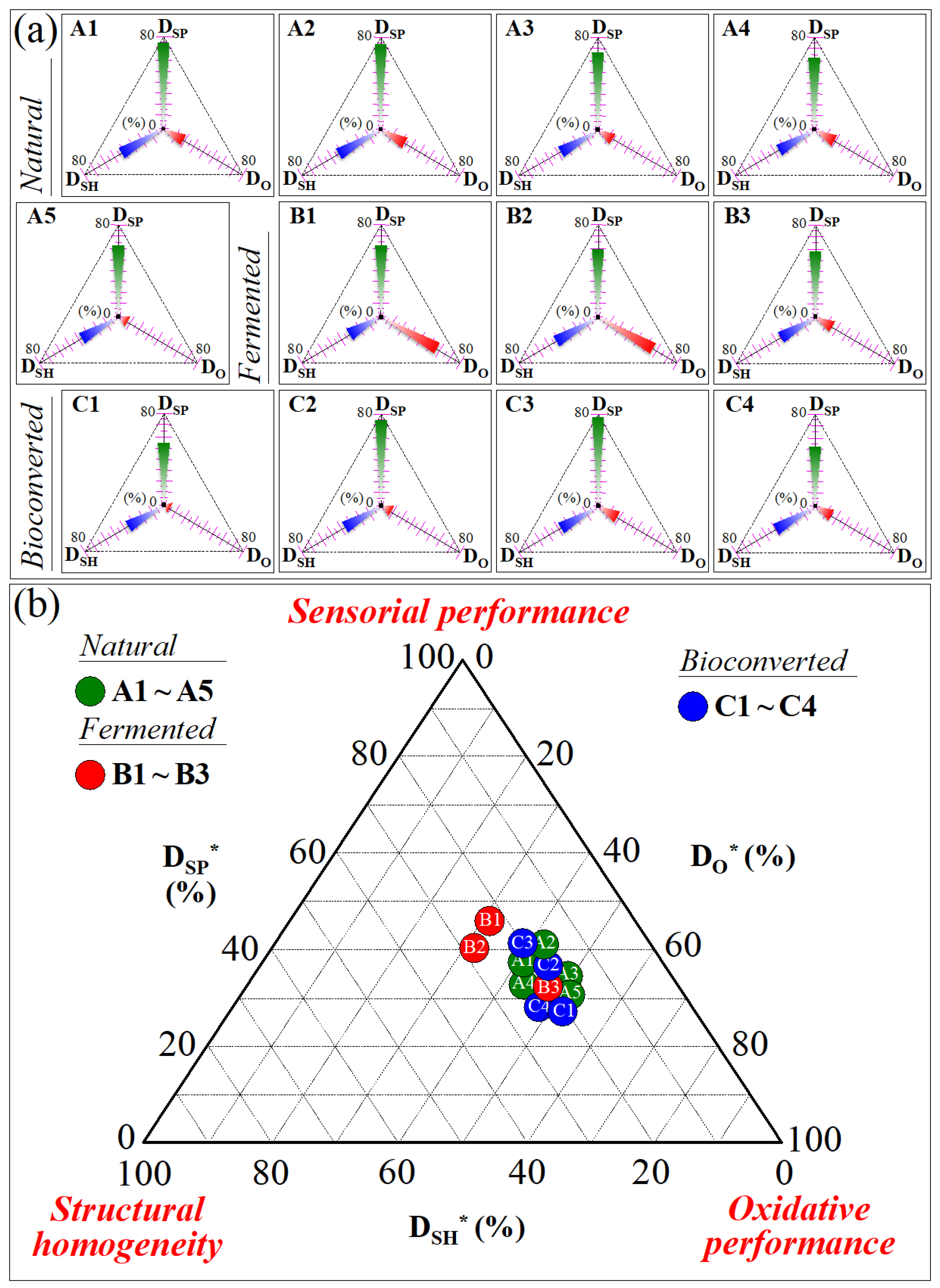
4.4. The Raman Quality Profile
4.5. The Importance of Raman Spectroscopy in Assessing Stevia Sweeteners
5. Conclusions
Supplementary Materials
Author Contributions
Funding
Institutional Review Board Statement
Informed Consent Statement
Data Availability Statement
Conflicts of Interest
References
- Malik, V.S.; Popkin, B.M.; Bray, G.A.; Despres, J.-P.; Hu, F.B. Sugar-sweetened beverages, Obesity, type 2 diabetes mellitus, and cardiovascular disease risk. Circulation 2010, 121, 1356–1364. [Google Scholar] [CrossRef]
- Sylvetsky, A.C.; Rother, K.I. Nonnutritive sweeteners in weight management and chronic disease: A review. Obesity 2018, 26, 635–640. [Google Scholar] [CrossRef]
- Brandle, J.E.; Starratt, A.N.; Gijzen, M. Stevia rebaudiana: Its agricultural, biological, and chemical properties. Can. J. Plant Sci. 1998, 78, 527–536. [Google Scholar] [CrossRef]
- Prakash, I.; Dubois, G.E.; Clos, J.F.; Wilkens, K.L.; Fosdick, L.E. Development of rebiana, a natural, non-caloric sweetener. Food Chem. Toxicol. 2008, 46, S75–S82. [Google Scholar] [CrossRef] [PubMed]
- Soejarto, D.D.; Addo, E.M.; Kinghorn, A.D. Highly sweet compounds of plant origin: From ethnobotanical observations to wide utilization. J. Ethnopharmacol. 2019, 243, 112056. [Google Scholar] [CrossRef] [PubMed]
- Hellfritsch, C.; Brockhoff, A.; Stähler, F.; Meyerhof, W.; Hofmann, T. Human psychometric and taste receptor responses to steviol glycosides. J. Agric. Food Chem. 2012, 60, 6782–6793. [Google Scholar] [CrossRef]
- Ceunen, S.; Geuns, J.M.C. Steviol glycosides: Chemical diversity, metabolism, and function. J. Nat. Prod. 2013, 76, 1201–1228. [Google Scholar] [CrossRef]
- Olsson, K.; Carlsen, S.; Semmler, A.; Simon, E.; Mikkelsen, M.D.; Moller, B.L. Microbial production of next-generation stevia sweeteners, Engineering of microbial cell factories for the production of steviol glycosides. Microb. Cell Fact. 2016, 15, 207. [Google Scholar] [CrossRef]
- Li, S.; Luo, S.; Zhao, X.; Gao, S.; Shan, X.; Lu, J.; Zhou, J. Efficient conversion of stevioside to rebaudioside M in Saccharomyces serevisiae by a engineering hydrolase system and prolonging the growth cycle. J. Agric. Food Chem. 2024, 72, 8140–8148. [Google Scholar] [CrossRef]
- Richman, A.; Swanson, A.; Humphrey, T.; Chapman, R.; McGarvey, B.; Pocs, R.; Brandle, J. Functional genomics uncovers three glucosyltransferases involved in the synthesis of the major sweet glucosides of Stevia rebaudiana. Plant J. 2005, 41, 56–67. [Google Scholar] [CrossRef]
- Prakash, I.; Bunders, C.; Devkota, K.P.; Charan, R.D.; Ramirez, C.; Snyder, T.M.; Priedermann, C.; Markosyan, A.; Jarrin, C.; Ter Halle, R. Bioconversion of Rebaudioside I from Rebaudioside A. Molecules 2014, 19, 17345–17355. [Google Scholar] [CrossRef]
- EFSA Panel on Food Additives and Flavourings (FAF); Younes, M.; Aquilina, G.; Castle, L.; Engel, K.-H.; Fowler, P.; Frutos Fernandez, M.J.; Furst, P.; Gurtler, R.; Gundert-Remy, U.; et al. Safety evaluation of steviol glycoside preparations, including rebaudioside AM, obtained by enzymatic bioconversion of highly purified stevioside and/or rebaudioside A stevia leaf extracts. EFSA J. 2021, 19, e06691. [Google Scholar] [CrossRef]
- Gardana, C.; Scaglianti, M.; Simonetti, P. Evaluation of steviol and its glycosides in Stevia rebaudiana leaves and commercial sweetener by ultra-high-performance liquid chromatography-mass spectrometry. J. Chromatogr. A 2010, 1217, 1463–1469. [Google Scholar] [CrossRef]
- Hong, C.; Shi, M.; Wang, S.; Yang, Y.; Pu, Z. Novel analysis based on Raman spectroscopy in nutrition science. Anal. Methods 2025, 9, 1977–1996. [Google Scholar] [CrossRef] [PubMed]
- Ellis, D.I.; Brewster, V.L.; Dunn, W.B.; Allwood, J.W.; Golovanov, A.P.; Goodacre, R. Fingerprinting food: Current technologies for the detection of food adulteration and contamination. Chem. Soc. Rev. 2012, 17, 5706–5727. [Google Scholar] [CrossRef] [PubMed]
- Lohumi, S.; Lee, S.; Lee, H.; Cho, B.-K. A review of vibrational spectroscopic techniques for the detection of food authenticity and adulteration. Trends Food Sci. Technol. 2024, 46, 85–98. [Google Scholar] [CrossRef]
- Pezzotti, G.; Zhu, W.; Aoki, T.; Miyamoto, A.; Fujita, I.; Nakagawa, M.; Kobayashi, T. Raman spectroscopic analysis of steviol glycosides: Spectral database and quality control algorithms. Foods 2024, 13, 3068. [Google Scholar] [CrossRef] [PubMed]
- Dale, L.M.; Thewis, A.; Boudry, C.; Rotar, I.; Dardenne, P.; Baeten, V.; Fernández Pierna, J.A. Hyperspectral imaging applications in agricolture and agro-food product quality and safety control: A review. Appl. Spectrosc. Rev. 2013, 48, 142–159. [Google Scholar] [CrossRef]
- Pezzotti, G. Raman spectroscopy in cell biology and microbiology. J. Raman Spectrosc. 2021, 52, 2348–2443. [Google Scholar] [CrossRef]
- Murphy, B.M.; Prescott, S.W.; Larson, I. Measurement of lactose crystallinity using Raman spectroscopy. J. Pharm. Biomed. Anal. 2005, 38, 186–190. [Google Scholar] [CrossRef]
- Upreti, M.; Smit, J.P.; Hagen, E.J.; Smolenskaya, V.N.; Prakash, I. Single crystal growth and structure determination of the natural “high potency” sweetener Rebaudioside A. Cryst. Growth Des. 2012, 12, 990–993. [Google Scholar] [CrossRef]
- Chandrashekar, J.; Hoon, M.A.; Ryba, N.J.P.; Zuker, C.S. The receptors and cells for mammalian taste. Nature 2006, 444, 288–294. [Google Scholar] [CrossRef]
- Behrens, M.; Meyerhof, W. Gustatory and extragustatory functions of mammalian taste receptors. Physiol. Behav. 2011, 105, 4–13. [Google Scholar] [CrossRef]
- Roper, S.D. Chemical and electrical synaptic interactions among taste bud cells. Curr. Opin. Physiol. 2021, 20, 118–125. [Google Scholar] [CrossRef]
- Meyerhof, W.; Batram, C.; Kuhn, C.; Brockhoff, A.; Chudoba, E.; Bufe, B.; Appendino, G.; Behrens, M. The molecular receptive ranges of human TAS2R bitter taste receptors. Chem. Senses 2010, 35, 157–170. [Google Scholar] [CrossRef]
- Behrens, M.; Brockhoff, A.; Kuhn, C.; Bufe, B.; Winnig, M.; Meyerhof, W. The human bitter taste receptor hTAS2R14 responds to a variety of different bitter compounds. Biochem. Biophys. Res. Commun. 2004, 319, 479–485. [Google Scholar] [CrossRef] [PubMed]
- Dagan-Wiener, A.; Di Pizio, A.; Nissim, I.; Bahia, M.S.; Dubovski, N.; Margulis, E.; Niv, M.Y. BitterDB: Taste ligands and receptors database in 2019. Nucleic Acids Res. 2019, 47, D1179–D1185. [Google Scholar] [CrossRef] [PubMed]
- Mennella, J.A.; Pepino, M.Y.; Reed, D.R. Genetic and environmental determinants of bitter perception and sweet preferences. Pediatrics 2005, 115, e216–e222. [Google Scholar] [CrossRef] [PubMed]
- Tian, X.; Zhong, F.; Xia, Y. Dynamic characteristics of sweetness and bitterness and their correlation with chemical structures for six steviol glycosides. Food Res. Int. 2022, 151, 110848. [Google Scholar] [CrossRef]
- Yuan, Y.; Yasmin, M.N.; Chen, Y.; Liu, Y.; Guan, S.; Wang, Z.; Hua, X. Computational simulations on the taste mechanism of steviol glycosides based on their interactions with receptor proteins. Int. J. Biol. Macromol. 2024, 255, 128110. [Google Scholar] [CrossRef] [PubMed]
- Prakash, I.; Markosyan, A.; Bunders, C. Development of Next Generation Stevia Sweetener: Rebaudioside M. Foods 2014, 3, 162–175. [Google Scholar] [CrossRef]
- Tancredi, T.; Pastore, A.; Salvadori, S.; Esposito, V.; Temussi, P.A. Interaction of sweet proteins with their receptor. A conformational study of peptides corresponding to loops of brazzein, monellin and thaumatin. Eur. J. Biochem. 2004, 271, 2231–2240. [Google Scholar] [CrossRef]
- DuBois, G.E.; Prakash, I. Non-caloric sweeteners, sweetness modulators, and sweetener enhancers. Annu. Rev. Food Sci. Technol. 2012, 3, 353–380. [Google Scholar] [CrossRef] [PubMed]
- Schiffman, S.S.; Booth, B.J.; Losee, M.L.; Pecore, S.D.; Warwick, Z.S. Bitterness of sweeteners as a function of concentration. Brain Res. Bull. 1995, 36, 505–513. [Google Scholar] [CrossRef]
- Galindo-Cuspinera, V.; Breslin, P.A. The liaison of sweet and savory. Chem. Senses 2006, 31, 221–225. [Google Scholar] [CrossRef]
- Woelwer-Rieck, U.; Lankes, C.; Wawrzun, A.; Wüst, M. Improved HPLC method for the evaluation of the major steviol glycosides in leaves of Stevia rebaudiana. Eur. Food Res. Technol. 2010, 231, 581–588. [Google Scholar] [CrossRef]
- Upreti, M.; Dubois, G.; Prakash, I. Synthetic study on the relationship between structure and sweet taste properties of steviol glycosides. Molecules 2012, 17, 4186–4196. [Google Scholar] [CrossRef]
- Ohta, M.; Sasa, S.; Inoue, A.; Tamai, T.; Fujita, I.; Morita, K.; Matsuura, F. Characterization of novel steviol glycosides from leaves of Stevia rebaudiana Morita. J. Appl. Glycosci. 2010, 57, 199–209. [Google Scholar] [CrossRef]
- Chain, F.; Romano, E.; Leyton, P.; Paipa, C.; Catalan, C.A.N.; Fortuna, M.A.; Brandan, S.A. An experimental study of the structural and vibrational properties of sesquiterpene lactone cnicin using FT-IR, FT-Raman, UV-visible and NMR spectroscopies. J. Mol. Struct. 2014, 1065–1066, 160–169. [Google Scholar] [CrossRef]
- Amen, Y.; Abdelwahab, G.; Heraiz, A.A.; Sallam, M.; Othman, A. Exploring sesquiterpene lactones: Structural diversity and antiviral therapeutic insights. RCS Adv. 2025, 15, 1970–1988. [Google Scholar] [CrossRef]
- Molina-Calle, M.; Priego-Capote, F.; Luque de Castro, M.D. Characterization of stevia leaves by LC-QTOF MS/MS analysis of polar and non-polar extracts. Food Chem. 2017, 219, 329–338. [Google Scholar] [CrossRef] [PubMed]
- Wang, L.; Chang, T.; Zhu, T.; Hu, W.; Wang, X.; Dong, C.; Sun, Y.; Zhang, T.; Jiang, Y.; Zhao, C.; et al. Stevia rebaudiana Bertoni as a sweet herbal medicine: Traditional uses, potential applications, and future development. Front. Pharmacol. 2025, 16, 1638147. [Google Scholar] [CrossRef]
- Sun, Y.; Zhang, S.; Bao, T.; Jiang, Z.; Huang, W.; Xu, X.; Qiu, Y.; Lei, P.; Wang, R.; Xu, H.; et al. Comprehensive new insights into sweet taste transmission mechanisms and detection methods. Foods 2025, 14, 2397. [Google Scholar] [CrossRef]
- Mayank; Jaitak, V. Interaction model of steviol glycosides from Stevia rebaudiana (Bertoni) with sweet taste receptors: A computational approach. Phytochemistry 2015, 116, 12–20. [Google Scholar] [CrossRef]
- Urai, S.; Kudo, S.; Takiyama, H. Development of Rebaudioside D polymorphs with improved solubility. Food Sci. Technol. Res. 2020, 26, 17–23. [Google Scholar] [CrossRef]
- Wu, Y.; Rodenburg, D.L.; Ibrahim, M.A.; McChesney, J.D.; Avery, M.A. Stevioside methanol tetrasolvate. Acta Cryst. 2013, E69, o410–o411. [Google Scholar] [CrossRef] [PubMed]
- Ho, T.M.; Truong, T.; Bhandari, B.R. Methods to characterize the structure of food powders—A review. Biosci. Biotechnol. Biochem. 2017, 81, 651–671. [Google Scholar] [CrossRef] [PubMed]
- Vargas Jentzsch, P.; Torrico-Vallejos, S.; Mendieta-Brito, S.; Ramos, L.A.; Ciobota, V. Detection of counterfeit stevia products using a handheld Raman spectrometer. Vibr. Spectrosc. 2016, 83, 126–131. [Google Scholar] [CrossRef]


Disclaimer/Publisher’s Note: The statements, opinions and data contained in all publications are solely those of the individual author(s) and contributor(s) and not of MDPI and/or the editor(s). MDPI and/or the editor(s) disclaim responsibility for any injury to people or property resulting from any ideas, methods, instructions or products referred to in the content. |
© 2026 by the authors. Licensee MDPI, Basel, Switzerland. This article is an open access article distributed under the terms and conditions of the Creative Commons Attribution (CC BY) license.
Share and Cite
Pezzotti, G.; Miyamoto, A.; Yamashita, T.; Fujita, I.; Maeno, A.; Zhu, W.; Nakagawa, M.; Kobayashi, T. Raman Spectroscopic Authentication of Rebaudioside M: Discriminating Natural, Fermentation-Derived, and Enzymatically Bioconverted Stevia Sweeteners. Foods 2026, 15, 1994. https://doi.org/10.3390/foods15111994
Pezzotti G, Miyamoto A, Yamashita T, Fujita I, Maeno A, Zhu W, Nakagawa M, Kobayashi T. Raman Spectroscopic Authentication of Rebaudioside M: Discriminating Natural, Fermentation-Derived, and Enzymatically Bioconverted Stevia Sweeteners. Foods. 2026; 15(11):1994. https://doi.org/10.3390/foods15111994
Chicago/Turabian StylePezzotti, Giuseppe, Akihiro Miyamoto, Takashi Yamashita, Isao Fujita, Akihiro Maeno, Wenliang Zhu, Manabu Nakagawa, and Takuya Kobayashi. 2026. "Raman Spectroscopic Authentication of Rebaudioside M: Discriminating Natural, Fermentation-Derived, and Enzymatically Bioconverted Stevia Sweeteners" Foods 15, no. 11: 1994. https://doi.org/10.3390/foods15111994
APA StylePezzotti, G., Miyamoto, A., Yamashita, T., Fujita, I., Maeno, A., Zhu, W., Nakagawa, M., & Kobayashi, T. (2026). Raman Spectroscopic Authentication of Rebaudioside M: Discriminating Natural, Fermentation-Derived, and Enzymatically Bioconverted Stevia Sweeteners. Foods, 15(11), 1994. https://doi.org/10.3390/foods15111994