Study on the Functional, Physiological, and Sensory Properties of Coffee Leaf Dark Tea Processed Using the Pile Fermentation Method of Pu-Erh Tea

 ,
,  and
and
Abstract
1. Introduction
2. Materials and Methods
2.1. Culture Starters
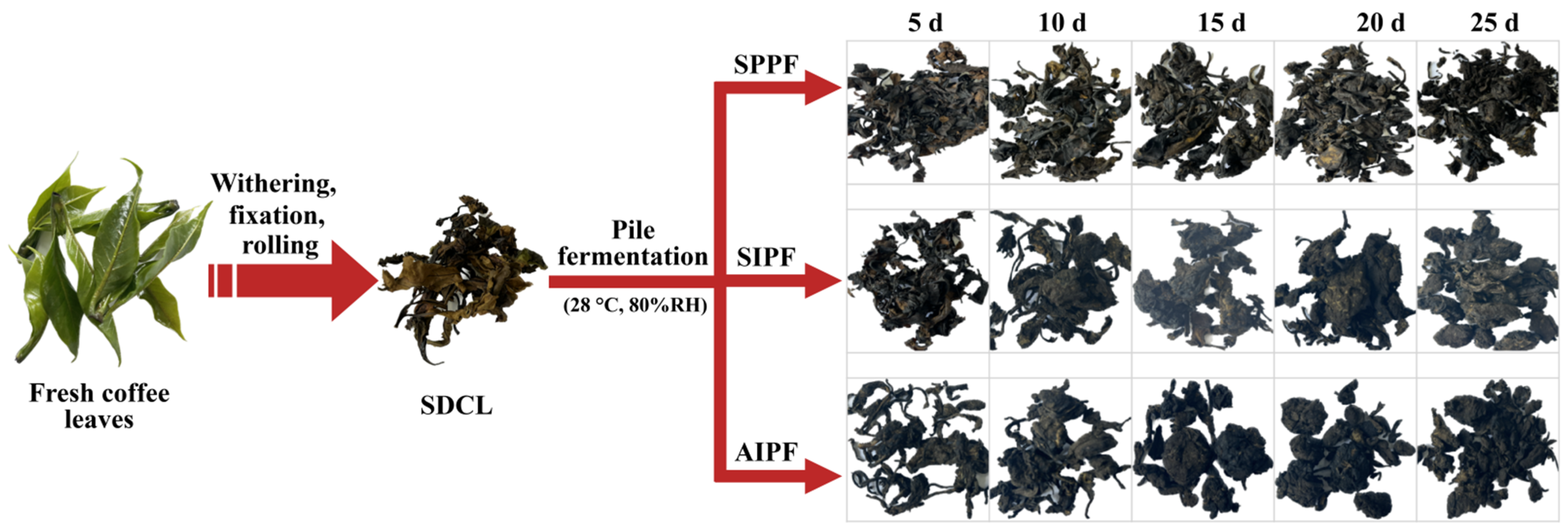
2.2. Pile Fermentation and Sample Preparation
2.3. Determination of Basic Physicochemical Components
2.4. Quantitative Analysis of Phytochemical Compounds by HPLC
2.5. Determination of Total Phenolics and Flavonoids
2.6. Antioxidant Activity Assays
2.7. Hypoglycemic Activity Assays
2.7.1. α-Amylase and α-Glucoside Inhibition Activity
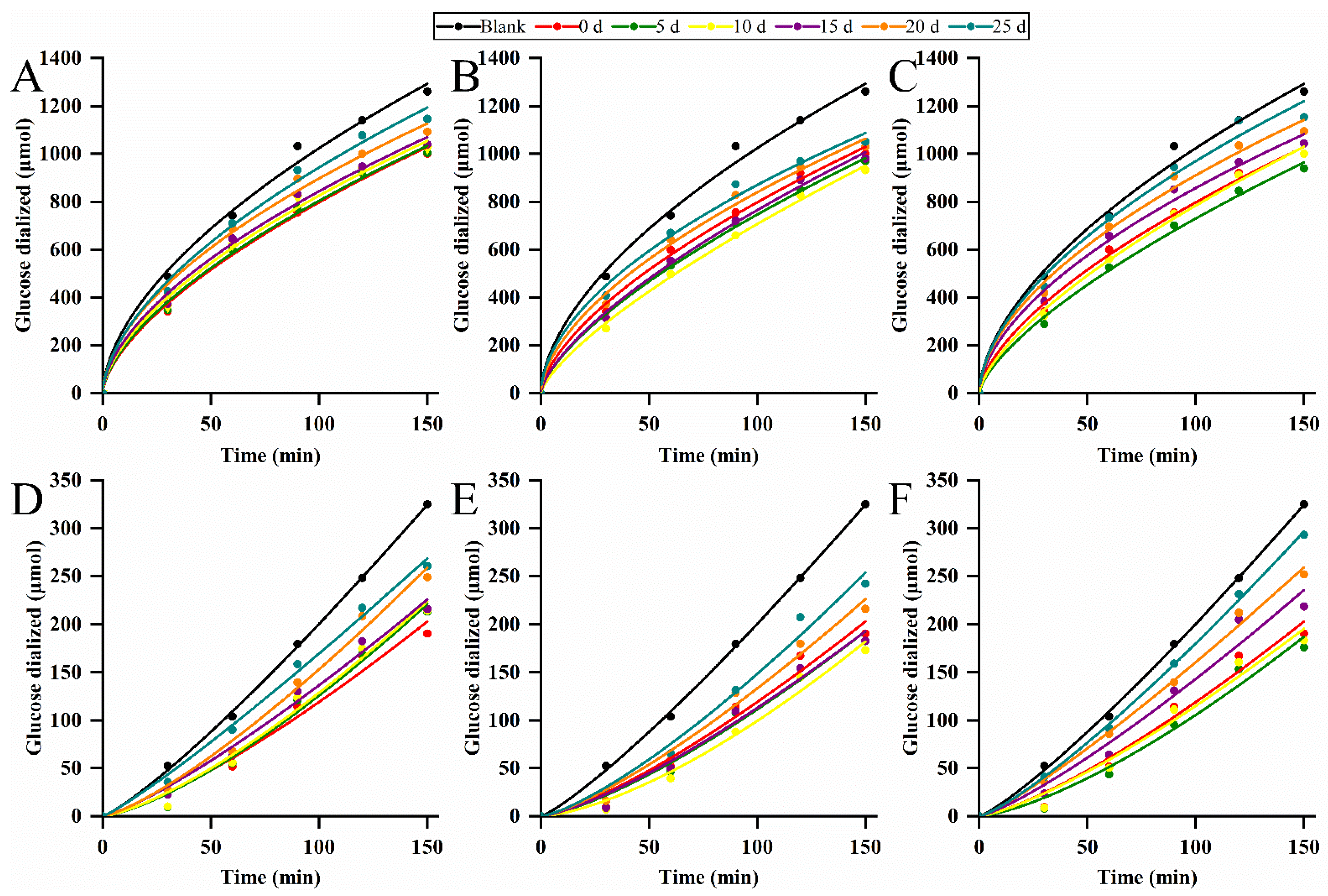
2.7.2. In Vitro Glucose Dialysis Retardation Capacity and Starch Digestibility
2.8. Hypolipidemic Activity Assays
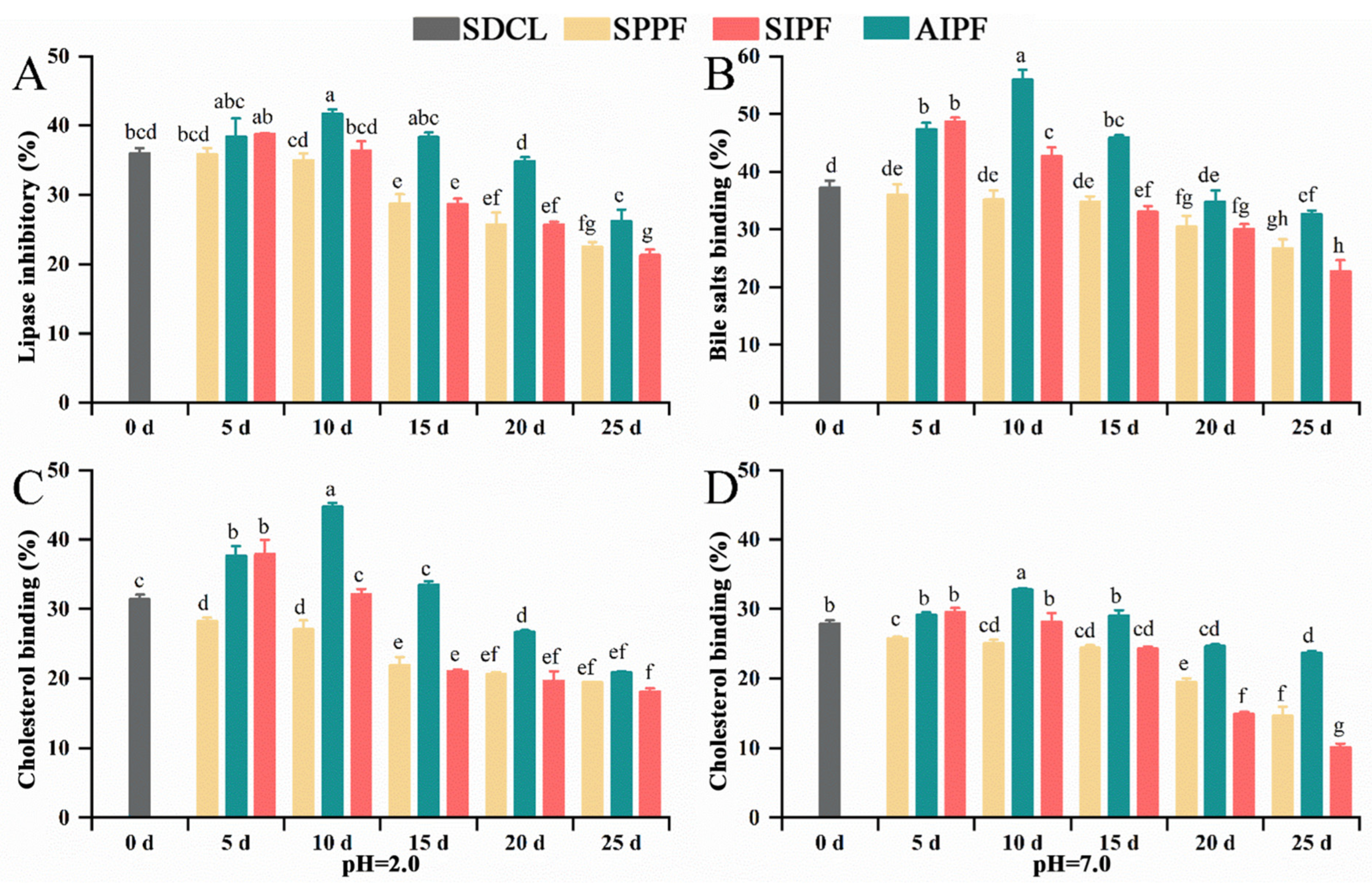
2.8.1. Evaluation of Pancreatic Lipase Inhibitory Activity
2.8.2. Sodium Cholate Binding Capacity
2.8.3. Cholesterol Binding Capacity
2.9. Sensory Evaluation
2.10. Statistical Analysis
3. Result and Discussion
3.1. Basic Chemical Compositions of Coffee Leaf Dark Tea
3.2. Tea Pigments of Coffee Leaf Dark Tea
3.3. Phytochemical Profile of Coffee Leaf Dark Tea
3.4. TPC, TFC and Antioxidant Activity of Coffee Leaf Dark Tea
3.5. Hypoglycemic Activities of Coffee Leaf Dark Tea
3.6. Hypolipidemic Activity of Coffee Leaf Dark Tea
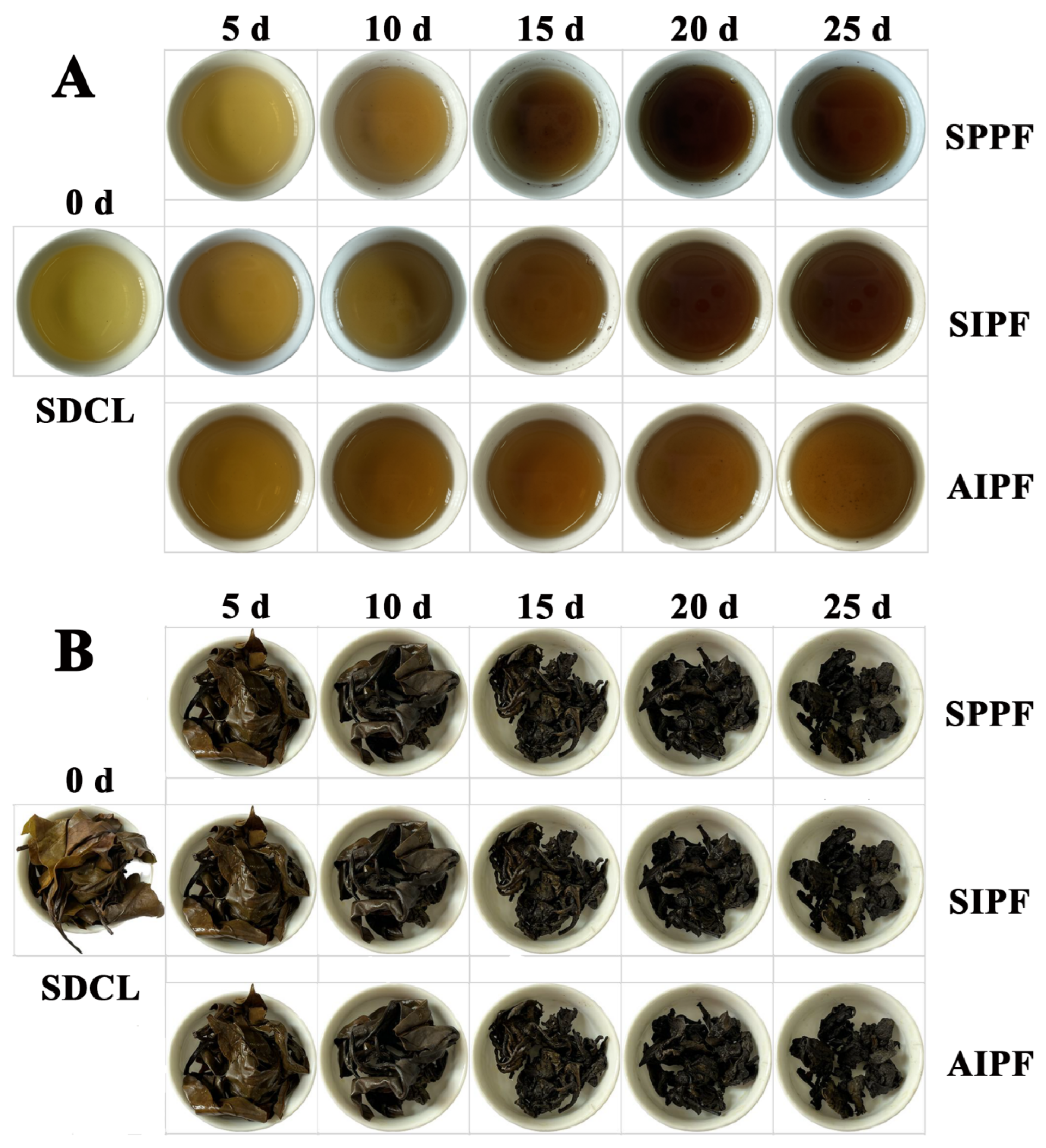
3.7. Sensory Evaluation of Coffee Leaf Dark Tea
4. Conclusions
Author Contributions
Funding
Institutional Review Board Statement
Informed Consent Statement
Data Availability Statement
Conflicts of Interest
References
- Food and Agriculture Organization of the United Nations (FAO). FAOSTAT: Products, Crops And Livestock. Available online: https://www.fao.org/faostat/ (accessed on 6 October 2025).
- Wang, X.Y.; Quan, C.X.; Liu, X.Q.; Wang, Y.B.; Bai, X.H.; Li, Y.; Liu, X.G. Quantitative lipidomics reveals the effects of roasting degree on arabica coffee beans lipid profiles. Food Control 2025, 169, 111015. [Google Scholar] [CrossRef]
- Alves, R.C.; Rodrigues, F.; Antónia Nunes, M.; Vinha, A.F.; Oliveira, M.B.P.P. State of the art in coffee processing by-products. In Handbook of Coffee Processing By-Products; Galanakis, C.M., Ed.; Academic Press: Cambridge, MA, USA, 2017; pp. 1–26. [Google Scholar]
- de Mello, V.; De Mesquita, G.A.; Alvim, J.G.E.; da Costa, J.D.; Vilela, F.M.P. Recent patent applications for coffee and coffee by-products as active ingredients in cosmetics. Int. J. Cosmet. Sci. 2023, 45, 267–287. [Google Scholar] [CrossRef]
- Murthy, P.S.; Naidu, M.M. Sustainable management of coffee industry by-products and value addition—A review. Resour. Conserv. Recycl. 2012, 66, 45–58. [Google Scholar] [CrossRef]
- Huang, Y.Y.; Sun, Y.; Cao, Q.W.; Chen, D.Y.; He, R.H.; Chen, X.M. Unveiling the impact of infrared drying on the quality of coffee leaves: A comprehensive analysis of physicochemical indices, antioxidant potential, Maillard reaction products, and aroma profile. J. Food Sci. 2025, 90, e70400. [Google Scholar] [CrossRef]
- Chen, X.M. A review on coffee leaves: Phytochemicals, bioactivities and applications. Crit. Rev. Food Sci. Nutr. 2019, 59, 1008–1025. [Google Scholar] [CrossRef]
- Patil, S.; Vedashree, M.; Murthy, P.S. Valorization of coffee leaves as a potential agri-food resource: Bio-active compounds, applications and future prospective. Planta 2022, 255, 67. [Google Scholar] [CrossRef] [PubMed]
- Chen, X.M.; Ma, Z.L.; Kitts, D.D. Effects of processing method and age of leaves on phytochemical profiles and bioactivity of coffee leaves. Food Chem. 2018, 249, 143–153. [Google Scholar] [CrossRef]
- Mei, S.H.; Ding, J.; Chen, X.M. Identification of differential volatile and non-volatile compounds in coffee leaves prepared from different tea processing steps using HS-SPME/GC-MS and HPLC-Orbitrap-MS/MS and investigation of the binding mechanism of key phytochemicals with olfactory and taste receptors using molecular docking. Food Res. Int. 2023, 168, 112760. [Google Scholar]
- Luo, Q.X.; Luo, L.B.; Zhao, J.M.; Wang, Y.T.; Luo, H. Biological potential and mechanisms of tea’s bioactive compounds: An updated review. J. Adv. Res. 2024, 65, 345–363. [Google Scholar] [CrossRef] [PubMed]
- Kong, Y.S.; Ren, H.Y.; Liu, R.; da Silva, R.R.; Aksenov, A.A.; Melnik, A.V.; Zhao, M.; Le, M.M.; Ren, Z.W.; Xu, F.Q.; et al. Microbial and nonvolatile chemical diversities of Chinese dark teas are differed by latitude and pile fermentation. J. Agric. Food Chem. 2022, 70, 5701–5714. [Google Scholar] [CrossRef] [PubMed]
- Ma, C.Q.; Ma, B.S.; Zhou, B.X.; Xu, L.J.; Hu, Z.H.; Li, X.H.; Chen, X. Pile-fermentation mechanism of ripened Pu-erh tea: Omics approach, chemical variation and microbial effect. Trends Food Sci. Technol. 2024, 146, 104379. [Google Scholar] [CrossRef]
- Wang, S.A.; Qiu, Y.; Gan, R.Y.; Zhu, F. Chemical constituents and biological properties of Pu-erh tea. Food Res. Int. 2022, 154, 110899. [Google Scholar] [CrossRef]
- Zhang, R.Y.; Li, Q.L.; Gu, Y.X.; Liao, W.L. Harnessing the power of fermented tea to improve gut microbiota and combat obesity epidemic. Biology 2024, 13, 779. [Google Scholar] [CrossRef]
- Xu, X.Y.; Zhao, C.N.; Li, B.Y.; Tang, G.Y.; Shang, A.; Gan, R.Y.; Feng, Y.B.; Li, H.B. Effects and mechanisms of tea on obesity. Crit. Rev. Food Sci. Nutr. 2023, 63, 3716–3733. [Google Scholar] [CrossRef]
- Fang, W.W.; Wang, K.F.; Wen, S.; Zhou, F.; Ouyang, J.; Zhang, S.; Zeng, H.Z.; Hara, Y.; Huang, J.A.; Liu, Z.H. Theaflavins in black tea ameliorate high-fat diet-induced obesity and inflammation via gut microbiota, AMPK-mediated metabolism, and NF-κB pathway. Phytomedicine 2025, 148, 157314. [Google Scholar] [CrossRef] [PubMed]
- Liu, S.Y.; Ai, Z.Y.; Meng, Y.; Chen, Y.Q.; Ni, D.J. Comparative studies on the physicochemical profile and potential hypoglycemic activity of different tea extracts: Effect on sucrase-isomaltase activity and glucose transport in Caco-2 cells. Food Res. Int. 2021, 148, 110604. [Google Scholar] [CrossRef]
- Shi, J.; Yang, G.Z.; You, Q.S.; Sun, S.L.; Chen, R.H.; Lin, Z.; Simal-Gandara, J.; Lv, H.P. Updates on the chemistry, processing characteristics, and utilization of tea flavonoids in last two decades (2001–2021). Crit. Rev. Food Sci. Nutr. 2023, 63, 4757–4784. [Google Scholar] [CrossRef]
- Xie, H.F.; Kong, Y.S.; Li, R.Z.; Nothias, L.F.; Melnik, A.V.; Zhang, H.; Liu, L.L.; An, T.T.; Liu, R.; Yang, Z.; et al. Feature-based molecular networking analysis of the metabolites produced by in vitro solid-state fermentation reveals pathways for the bioconversion of epigallocatechin gallate. J. Agric. Food Chem. 2020, 68, 7995–8007. [Google Scholar] [CrossRef]
- GB/T 22111–2008; Product of geographical indication—Puer tea. General Administration of Quality Supervision, Inspection and Quarantine of the People’s Republic of China: Beijing, China; Standardization Administration of China: Beijing, China, 2008.
- GB/T 8303-2013; Tea—Preparation of ground sample and determination of dry matter content. General Administration of Quality Supervision, Inspection and Quarantine of the People’s Republic of China: Beijing, China; Standardization Administration of China: Beijing, China, 2013.
- GB/T 8305-2013; Tea—Determination of Water Extracts Content. General Administration of Quality Supervision, Inspection and Quarantine of the People’s Republic of China: Beijing, China; Standardization Administration of China: Beijing, China, 2013.
- GB/T 8314-2013; Tea—Determination of free amino acids content. General Administration of Quality Supervision, Inspection and Quarantine of the People’s Republic of China: Beijing, China; Standardization Administration of China: Beijing, China, 2013.
- Wang, M.M.; Shi, R.Y.; Bai, Q.S.; Tan, C.L.; Chen, Y.Y.; Hong, Z.S.; Zhao, C.C. Exploring flavor differences and microbial community characteristics of raw Pu-erh tea from different vintages based on flavoromics and high-throughput sequencing. Food Chem. 2025, 493, 145861. [Google Scholar] [CrossRef] [PubMed]
- Wang, Q.P.; Peng, C.X.; Gong, J.S. Effects of enzymatic action on the formation of theabrownin during solid state fermentation of Pu-erh tea. J. Sci. Food Agric. 2011, 91, 2412–2418. [Google Scholar] [CrossRef]
- Chiang, S.H.; Tsou, M.F.; Chang, C.Y.; Chen, C.W. Physicochemical characteristics, sensory quality, and antioxidant properties of Paochung tea infusion brewed in cold water. Int. J. Food Prop. 2020, 23, 1611–1623. [Google Scholar] [CrossRef]
- Sun, X.Y.; Cheng, X.H.; Zhang, J.Z.; Ju, Y.L.; Que, Z.L.; Liao, X.J.; Lao, F.; Fang, Y.L.; Ma, T.T. Letting wine polyphenols functional: Estimation of wine polyphenols bioaccessibility under different drinking amount and drinking patterns. Food Res. Int. 2020, 127, 108704. [Google Scholar] [CrossRef]
- Abbas, Z.; Zhang, J.; Tong, Y.C.; Ahmad, B.; Wang, J.Y.; Zhang, H.S.; Li, Z.Z.; Wei, X.B.; Zhang, R.J.; Si, D.Y. Production and characterization of novel antioxidant peptides from mulberry leaf ferment using B. subtilis H4 and B. amyloliquefaciens LFB112. Food Chem. 2025, 482, 144022. [Google Scholar] [CrossRef]
- Zhang, B.Y.; Ren, L.K.; Lu, Y.L.; Wang, Z.J.; Zhang, G.L.; Liu, Z.W.; Wang, Y.P.; Zhu, F.L.; Li, X.P.; Jiang, Y.; et al. Novel antioxidative and hypoglycemic collagen peptides from Apostichopus japonicus: In silico preparation, functional mechanism, and structure-activity relationship study. Food Chem. 2025, 493, 145695. [Google Scholar] [CrossRef]
- Ayyash, M.; Al-Nuaimi, A.K.; Al-Mahadin, S.; Liu, S.Q. In vitro investigation of anticancer and ACE-inhibiting activity, α-amylase and α-glucosidase inhibition, and antioxidant activity of camel milk fermented with camel milk probiotic: A comparative study with fermented bovine milk. Food Chem. 2018, 239, 588–597. [Google Scholar]
- Ou, S.Y.; Kwok, K.C.; Li, Y.; Fu, L. In vitro study of possible role of dietary fiber in lowering postprandial serum glucose. J. Agric. Food Chem. 2001, 49, 1026–1029. [Google Scholar] [CrossRef]
- Benitez, V.; Rebollo-Hernanz, M.; Hernanz, S.; Chantres, S.; Aguilera, Y.; Martin-Cabrejas, M.A. Coffee parchment as a new dietary fiber ingredient: Functional and physiological characterization. Food Res. Int. 2019, 122, 105–113. [Google Scholar] [CrossRef]
- Daou, C.; Zhang, H. Functional and physiological properties of total, soluble, and insoluble dietary fibres derived from defatted rice bran. J. Food Sci. Technol. 2014, 51, 3878–3885. [Google Scholar] [CrossRef] [PubMed]
- GB/T 23776–2018; Methodology for Sensory Evaluation of Tea. General Administration of Quality Supervision, Inspection and Quarantine of the People’s Republic of China: Beijing, China; Standardization Administration of China: Beijing, China, 2018.
- GB/T 14487-2017; Tea Vocabulary for Sensory Evaluation. General Administration of Quality Supervision, Inspection and Quarantine of the People’s Republic of China: Beijing, China; Standardization Administration of China: Beijing, China.
- Wang, T.; Bo, N.G.; Guan, Y.Q.; Yang, D.H.; Chen, Q.Y.; Guan, Y.H.; Liu, S.Z.; Wang, Z.H.; Duan, H.X.; Ma, Y.; et al. An integrated flavoromics and chemometric analysis of the characteristic flavor, chemical basis and flavor wheel of ancient plant ripened pu-erh tea. Food Chem. X 2025, 26, 102278. [Google Scholar] [CrossRef] [PubMed]
- Pei, D.; He, W.; Dong, S.; Wang, M.; Xu, Y.; Wang, D. Dynamic changes in Pu-erh tea during pile fermentation: Comparing novel pile fermentation to traditional method. Appl. Food Res. 2025, 5, 101332. [Google Scholar] [CrossRef]
- Yu, Z.M.; Yang, Z.Y. Understanding different regulatory mechanisms of proteinaceous and non-proteinaceous amino acid formation in tea (Camellia sinensis) provides new insights into the safe and effective alteration of tea flavor and function. Crit. Rev. Food Sci. Nutr. 2020, 60, 844–858. [Google Scholar] [CrossRef]
- Chen, Q.Y.; Liu, M.L.; Li, R.Y.; Jiang, B.; Liu, K.Y.; Xiao, Y.Q.; Wang, Q.; Wang, T.; Zhao, L.Q.; Wang, W.T.; et al. Changes in lipids and medium- and long-chain fatty acids during the spontaneous fermentation of ripened pu-erh tea. Curr. Res. Food Sci. 2024, 9, 100831. [Google Scholar] [CrossRef] [PubMed]
- Lee, T.C.; Zang, Q.N.; Lin, K.H.; Hu, H.L.; Lu, P.Y.; Zhang, J.Y.; Kang, C.Q.; Li, Y.J.; Ko, T.H. An improved method of theabrownins extraction and detection in six major types of tea (Camellia sinensis). J. Chem. 2022, 2022, 8581515. [Google Scholar] [CrossRef]
- Zhao, L.; Zhao, C.Y.; Miao, Y.; Lei, S.W.; Li, Y.J.; Gong, J.S.; Peng, C.X. Theabrownin from Pu-erh tea improves DSS-induced colitis via restoring gut homeostasis and inhibiting TLR2 & 4 signaling pathway. Phytomedicine 2024, 132, 155852. [Google Scholar] [PubMed]
- Zhang, C.Y.; Li, M.X.; Li, L.Y.; Wan, C.P.; Xia, Y.D.; Ma, H.; Xu, J.L. Theabrownins from dark tea: Formation, gut microbiota-mediated biotransformation, health benefits, and potential in functional food applications. Food Funct. 2025, 16, 6346–6368. [Google Scholar] [CrossRef]
- Yohannis, E.; Teka, T.A.; Adebo, J.A.; Urugo, M.M.; Hossain, A.; Astatkie, T. Phytochemical constituents, ethnomedicinal uses, and applications of coffee (Coffea arabica) leaves in functional beverages. J. Food Compos. Anal. 2024, 135, 106570. [Google Scholar] [CrossRef]
- Ji, D.Y.; Wang, Q.; Lu, T.T.; Ma, H.L.; Chen, X.M. The effects of ultrasonication on the phytochemicals, antioxidant, and polyphenol oxidase and peroxidase activities in coffee leaves. Food Chem. 2022, 373, 131480. [Google Scholar] [CrossRef]
- Yang, Z.X.; Xie, Y.X.; Zhu, Y.M.; Lei, M.J.; Chen, X.M.; Jin, W.W.; Fu, C.H.; Yu, L.J. Unraveling the flavor formation process of mellow and thick-type ripened Pu-erh tea through non-targeted metabolomics and metagenomics. Food Chem. X 2025, 27, 102424. [Google Scholar] [CrossRef]
- Ye, J.H.; Ye, Y.; Yin, J.F.; Jin, J.; Liang, Y.R.; Liu, R.Y.; Tang, P.; Xu, Y.Q. Bitterness and astringency of tea leaves and products: Formation mechanism and reducing strategies. Trends Food Sci. Technol. 2022, 123, 130–143. [Google Scholar] [CrossRef]
- Li, J.M.; Shi, L.F.; Ren, Z.Y.; Weng, W.Y. Effects of dry-heating time on the physicochemical properties of abalone myofibrillar protein-polysaccharide conjugates and the antioxidant activity of their in vitro digestion products. Food Res. Int. 2025, 221, 117318. [Google Scholar] [CrossRef] [PubMed]
- Wang, Q.; Bai, Y.L.; Li, A.; Yu, T.Z.; Li, X.L.; Du, B.C.; Han, X.Y. The effect of Aspergillus cristatus fermentation on cold-region mulberry leaf tea: Functional properties, sensory quality, and metabolite composition. Food Biosci. 2025, 71, 107151. [Google Scholar] [CrossRef]
- Ma, C.Q.; Ma, B.S.; Wang, J.C.; Wang, Z.H.; Zhou, B.X.; Chen, X. Grade identification of ripened Pu-erh teas, and their differences of phenolic components, in vitro antioxidant capacity and hypoglycemic effect. Food Chem. X 2025, 27, 102421. [Google Scholar] [CrossRef] [PubMed]
- Huang, H.R.; Chen, J.J.; Chen, Y.; Xie, J.H.; Liu, S.; Sun, N.; Hu, X.B.; Yu, Q. Modification of tea residue dietary fiber by high-temperature cooking assisted enzymatic method: Structural, physicochemical and functional properties. LWT-Food Sci. Technol. 2021, 145, 111314. [Google Scholar] [CrossRef]
- Cong, S.Z.; Ji, J.; Zhang, X.X.; Sun, J.Y.; Zhao, H.J.; Liu, X.L.; Hu, N. Effect of ethanol extract of tea on the microstructural features and retrogradation characteristics of glutinous rice starch. Foods 2024, 13, 1029. [Google Scholar] [CrossRef] [PubMed]
- Sun, L.J.; Miao, M. Dietary polyphenols modulate starch digestion and glycaemic level: A review. Crit. Rev. Food Sci. Nutr. 2020, 60, 541–555. [Google Scholar] [CrossRef]
- Zhang, X.; Qin, P.Y.; Wu, D.T.; Huang, J.W.; Zhang, J.Y.; Gong, Y.Y.; Zou, L.; Hu, Y.C. Effects of microwave treatment on physicochemical attributes, structural analysis, and digestive characteristics of pea starch-tea polyphenol complexes. Foods 2024, 13, 2654. [Google Scholar] [CrossRef]
- Salau, V.F.; Olofinsan, K.A.; Mishra, A.P.; Odewole, O.A.; Ngnameko, C.R.; Matsabisa, M.G. Croton gratissimus Burch herbal tea exhibits anti-hyperglycemic and anti-lipidemic properties via inhibition of glycation and digestive enzyme activities. Plants 2024, 13, 1952. [Google Scholar] [CrossRef]
- Ma, W.J.; Shi, Y.L.; Yang, G.Z.; Shi, J.; Ji, J.P.; Zhang, Y.; Wang, J.T.; Peng, Q.H.; Lin, Z.; Lv, H.P. Hypolipidaemic and antioxidant effects of various Chinese dark tea extracts obtained from the same raw material and their main chemical components. Food Chem. 2022, 375, 131877. [Google Scholar] [CrossRef]
- Wang, X.C.; She, Z.Y.; Zhou, H.L.; An, T.T.; Teng, J.W.; Xia, N.; Zhu, P.C.; Liu, W.H.; Dong, H.X.; Tang, L.M.; et al. Characterisation of the phytochemical and bioactivity profiles of raw tea, stale-aroma, and betelnut-aroma type of Liupao tea through GC/LC-MS-based metabolomics. Anal. Methods 2025, 17, 562–575. [Google Scholar] [CrossRef]



| Sample | PF Days | Basic Chemical Compositions | Tea Pigments | ||||
|---|---|---|---|---|---|---|---|
| WE | SS | FAA | TRs | TFs | TBs | ||
| SDCL | 0 | 588.42 ± 22.20 a | 36.54 ± 0.15 i | 31.81 ± 0.43 a | 22.19 ± 0.57 a | 1.00 ± 0.01 a | 73.44 ± 2.75 f |
| SPPF | 5 | 584.95 ± 29.63 a | 36.57 ± 0.81 i | 17.25 ± 0.34 ef | 22.15 ± 0.38 a | 0.84 ± 0.03 c | 75.74 ± 5.62 f |
| 10 | 554.67 ± 11.11 abc | 35.40 ± 0.14 j | 15.91 ± 0.45 h | 15.54 ± 0.17 cd | 0.60 ± 0.01 ef | 77.25 ± 0.47 ef | |
| 15 | 496.13 ± 4.14 cdef | 34.22 ± 0.04 k | 13.77 ± 0.35 j | 15.25 ± 0.16 cd | 0.59 ± 0.01 fg | 77.84 ± 2.80 ef | |
| 20 | 480.79 ± 26.85 defg | 33.27 ± 0.15 k | 13.04 ± 0.24 j | 15.14 ± 0.44 cd | 0.51 ± 0.00 i | 86.85 ± 1.07 cd | |
| 25 | 446.13 ± 22.61 efgh | 29.56 ± 0.13 l | 11.57 ± 0.25 k | 14.28 ± 0.5 de | 0.47 ± 0.01 l | 89.90 ± 1.32 bcd | |
| SIPF | 5 | 557.06 ± 9.04 abc | 37.49 ± 0.32 hi | 18.01 ± 0.19 e | 18.34 ± 0.36 b | 0.99 ± 0.01 a | 78.15 ± 2.67 ef |
| 10 | 508.62 ± 32.69 bcde | 37.74 ± 0.93 h | 17.81 ± 0.24 e | 13.67 ± 0.62 ef | 0.73 ± 0.01 d | 87.74 ± 1.13 cd | |
| 15 | 463.76 ± 24.88 defgh | 39.81 ± 0.20 g | 16.35 ± 0.12 gh | 12.61 ± 0.27 f | 0.61 ± 0.01 ef | 91.86 ± 0.27 bc | |
| 20 | 427.82 ± 22.73 gh | 41.41 ± 0.08 f | 14.71 ± 0.14 i | 11.24 ± 0.25 gh | 0.53 ± 0.01 gh | 92.18 ± 1.02 bc | |
| 25 | 399.35 ± 14.51 h | 46.64 ± 0.04 e | 13.02 ± 0.31 j | 10.64 ± 0.60 h | 0.50 ± 0.02 ij | 112.50 ± 3.64 a | |
| AIPF | 5 | 567.89 ± 22.26 ab | 47.12 ± 0.12 e | 27.31 ± 0.34 c | 16.11 ± 0.47 c | 0.90 ± 0.01 b | 84.01 ± 2.82 de |
| 10 | 527.38 ± 7.43 abcd | 53.47 ± 0.43 d | 28.87 ± 0.41 b | 12.60 ± 0.34 f | 0.62 ± 0.01 e | 91.65 ± 2.31 bcd | |
| 15 | 488.15 ± 33.61 defg | 56.21 ± 0.31 c | 19.03 ± 0.50 d | 12.37 ± 0.84 fg | 0.60 ± 0.00 f | 96.41 ± 0.37 b | |
| 20 | 476.63 ± 15.83 defg | 67.97 ± 0.10 b | 16.80 ± 0.26 fg | 10.42 ± 0.24 h | 0.52 ± 0.00 hi | 116.16 ± 3.93 a | |
| 25 | 442.50 ± 15.52 fgh | 71.73 ± 0.24 a | 13.74 ± 0.32 j | 9.14 ± 0.51 i | 0.50 ± 0.01 jk | 120.05 ± 1.47 a | |
| Sample | PF Days | Caffeine | Trigonelline | Mangiferin | Rutin | 5-CQA | 3-CQA | 4-CQA | 3,5-CQA | 3,4-CQA |
|---|---|---|---|---|---|---|---|---|---|---|
| SDCL | 0 | 18.34 ± 0.04 abc | 9.92 ± 0.64 b | 5.08 ± 0.72 abc | 1.49 ± 0.08 bcd | 9.91 ± 0.21 a | 0.43 ± 0.01 b | 1.20 ± 0.01 a | 1.04 ± 0.03 b | 0.98 ± 0.03 d |
| SPPF | 5 | 18.15 ± 0.03 abcd | 9.87 ± 0.09 b | 4.87 ± 0.11 abc | 1.33 ± 0.04 cde | 9.68 ± 0.23 a | 0.99 ± 0.01 a | 1.97 ± 0.02 b | 1.16 ± 0.02 a | 2.32 ± 0.00 a |
| 10 | 16.37 ± 2.61 bcd | 5.41 ± 0.27 cd | 4.51 ± 0.7 bcd | 1.33 ± 0.43 cde | 1.05 ± 0.03 d | 0.33 ± 0.00 bc | 0.51 ± 0.01 c | 0.45 ± 0.04 c | 1.18 ± 0.02 c | |
| 15 | 15.07 ± 2.39 bcd | 3.62 ± 0.03 de | 4.00 ± 0.77 cd | 1.07 ± 0.25 def | 0.10 ± 0.00 e | 0.00 ± 0.00 d | 0.16 ± 0.06 d | 0.00 ± 0.00 e | 0.00 ± 0.00 f | |
| 20 | 16.13 ± 0.22 bcd | 4.30 ± 0.40 de | 3.20 ± 0.12 de | 0.95 ± 0.05 ef | 0.04 ± 0.00 e | 0.00 ± 0.00 d | 0.23 ± 0.01 e | 0.00 ± 0.00 e | 0.00 ± 0.00 f | |
| 25 | 14.63 ± 1.18 d | 1.46 ± 0.11 f | 3.07 ± 0.08 de | 0.90 ± 0.11 ef | 0.00 ± 0.00 e | 0.00 ± 0.00 d | 0.25 ± 0.04 f | 0.00 ± 0.00 e | 0.00 ± 0.00 f | |
| SIPF | 5 | 18.67 ± 1.04 ab | 10.14 ± 0.86 b | 5.73 ± 0.60 ab | 1.82 ± 0.30 abc | 8.18 ± 0.50 b | 1.24 ± 0.36 a | 1.66 ± 0.07 f | 0.97 ± 0.03 b | 1.79 ± 0.02 b |
| 10 | 18.13 ± 0.63 abcd | 9.59 ± 1.10 b | 6.06 ± 0.21 a | 2.14 ± 0.01 a | 0.34 ± 0.02 e | 0.08 ± 0.01 cd | 0.18 ± 0.02 f | 0.16 ± 0.02 d | 0.47 ± 0.02 e | |
| 15 | 18.08 ± 0.95 abcd | 8.96 ± 0.16 b | 5.17 ± 0.35 abc | 1.75 ± 0.17 abc | 0.18 ± 0.00 e | 0.11 ± 0.01 cd | 0.27 ± 0.00 fg | 0.20 ± 0.01 d | 0.47 ± 0.02 e | |
| 20 | 17.52 ± 0.4 abcd | 6.55 ± 0.63 c | 4.23 ± 0.01 cd | 1.31 ± 0.23 cde | 0.07 ± 0.01 e | 0.00 ± 0.00 d | 0.16 ± 0.02 fg | 0.00 ± 0.00 e | 0.00 ± 0.00 f | |
| 25 | 16.40 ± 1.44 bcd | 6.02 ± 0.60 c | 3.24 ± 0.04 de | 1.04 ± 0.07 def | 0.00 ± 0.00 e | 0.00 ± 0.00 d | 0.28 ± 0.03 fgh | 0.00 ± 0.00 e | 0.00 ± 0.00 f | |
| AIPF | 5 | 20.79 ± 0.32 a | 11.87 ± 0.32 a | 5.89 ± 0.04 ab | 1.94 ± 0.01 ab | 1.83 ± 0.15 c | 0.53 ± 0.02 b | 0.71 ± 0.02 fgh | 0.51 ± 0.11 c | 1.81 ± 0.19 b |
| 10 | 17.67 ± 1.47 abcd | 8.55 ± 0.04 b | 5.14 ± 0.73 abc | 1.61 ± 0.02 bc | 0.00 ± 0.00 e | 0.05 ± 0.00 d | 0.12 ± 0.03 ghi | 0.18 ± 0.01 d | 0.43 ± 0.03 e | |
| 15 | 17.32 ± 0.29 abcd | 6.45 ± 0.26 c | 3.70 ± 0.45 cd | 1.05 ± 0.12 def | 0.00 ± 0.00 e | 0.00 ± 0.00 d | 0.33 ± 0.00 hi | 0.00 ± 0.00 e | 0.00 ± 0.00 f | |
| 20 | 15.40 ± 1.40 bcd | 4.07 ± 1.01 de | 3.15 ± 0.95 de | 0.90 ± 0.07 ef | 0.00 ± 0.00 e | 0.00 ± 0.00 d | 0.27 ± 0.05 hi | 0.00 ± 0.00 e | 0.00 ± 0.00 f | |
| 25 | 14.94 ± 0.45 cd | 3.13 ± 0.02 de | 2.05 ± 0.02 e | 0.74 ± 0.01 f | 0.00 ± 0.00 e | 0.00 ± 0.00 d | 0.29 ± 0.01 i | 0.00 ± 0.00 e | 0.00 ± 0.00 f |
| Sample | PF Days | Bioactive Components | Antioxidant Activities | Hypoglycemic Activities | |||
|---|---|---|---|---|---|---|---|
| TPC (mg GAE/g) | TFC (mg RE/g) | DPPH (mg/mL) | ABTS (mg/mL) | α-Amylase (mg/mL) | α-Glucosidase (mg/mL) | ||
| Trolox | - | - | - | 2.64 ± 0.06 j | 5.24 ± 0.10 m | - | - |
| Acarbose | - | - | - | - | - | 0.54 ± 0.01 k | 0.82 ± 0.01 k |
| SDCL | 0 | 19.60 ± 1.87 bcde | 8.87 ± 0.22 cde | 37.60 ± 0.18 ef | 70.77 ± 0.39 gh | 1.82 ± 0.01 e | 1.75 ± 0.03 f |
| SPPF | 5 | 19.54 ± 0.12 bcde | 8.85 ± 0.20 de | 37.91 ± 0.31 e | 71.02 ± 0.33 gh | 1.83 ± 0.01 e | 1.75 ± 0.00 f |
| 10 | 19.25 ± 0.91 bcdef | 8.75 ± 0.06 de | 38.19 ± 0.25 e | 71.34 ± 0.19 g | 1.88 ± 0.01 d | 1.77 ± 0.01 ef | |
| 15 | 17.46 ± 0.26 defg | 7.95 ± 0.09 f | 39.69 ± 0.05 cd | 72.59 ± 0.31 f | 1.89 ± 0.01 d | 1.79 ± 0.01 de | |
| 20 | 16.88 ± 1.40 defg | 6.93 ± 0.14 h | 41.01 ± 0.10 b | 77.06 ± 0.43 d | 2.01 ± 0.02 bc | 1.87 ± 0.01 c | |
| 25 | 15.71 ± 1.87 fg | 6.55 ± 0.18 h | 43.14 ± 0.04 a | 84.89 ± 0.55 b | 2.14 ± 0.02 a | 2.03 ± 0.01 b | |
| SIPF | 5 | 21.90 ± 1.50 abc | 9.33 ± 0.06 c | 35.14 ± 0.20 h | 68.23 ± 0.04 jk | 1.74 ± 0.01 g | 1.56 ± 0.01 h |
| 10 | 23.60 ± 0.92 a | 10.65 ± 0.02 a | 33.68 ± 0.07 i | 65.75 ± 0.26 l | 1.48 ± 0.01 i | 1.15 ± 0.00 j | |
| 15 | 20.30 ± 0.84 abcd | 9.20 ± 0.11 cd | 35.82 ± 0.19 g | 69.28 ± 0.02 ij | 1.78 ± 0.01 f | 1.69 ± 0.01 g | |
| 20 | 18.28 ± 1.91 cdefg | 8.60 ± 0.30 e | 39.39 ± 0.19 d | 71.72 ± 0.58 fg | 1.89 ± 0.01 d | 1.79 ± 0.01 de | |
| 25 | 17.31 ± 1.42 defg | 7.41 ± 0.22 g | 40.77 ± 0.29 b | 76.19 ± 0.06 de | 1.98 ± 0.02 c | 1.81 ± 0.00 d | |
| AIPF | 5 | 22.44 ± 1.26 ab | 10.13 ± 0.13 b | 34.20 ± 0.06 i | 67.79 ± 0.07 k | 1.61 ± 0.01 h | 1.53 ± 0.02 i |
| 10 | 19.83 ± 0.47 bcd | 9.04 ± 0.13 cde | 37.28 ± 0.21 f | 70.04 ± 0.34 hi | 1.79 ± 0.01 ef | 1.75 ± 0.00 f | |
| 15 | 17.36 ± 0.63 defg | 7.90 ± 0.04 f | 40.08 ± 0.36 c | 75.38 ± 0.60 e | 1.92 ± 0.01 d | 1.80 ± 0.01 d | |
| 20 | 16.15 ± 0.79 efg | 6.65 ± 0.12 h | 41.21 ± 0.15 b | 81.50 ± 0.86 c | 2.03 ± 0.02 b | 2.00 ± 0.00 b | |
| 25 | 15.16 ± 1.19 g | 5.22 ± 0.01 i | 43.49 ± 0.20 a | 88.57 ± 0.33 a | 2.15 ± 0.02 a | 2.48 ± 0.01 a | |
| Sample | PF Days | Appearance (25%) | Liquor Color (10 %) | Aroma (25 %) | Taste (30 %) | Infused Leaves (10 %) | Total Score | |||||
|---|---|---|---|---|---|---|---|---|---|---|---|---|
| Properties | Score | Properties | Score | Properties | Score | Properties | Score | Properties | Score | |||
| SDCL | 0 | Light brownish-yellow; hairchested | 81.67 | Pale yellow | 73.28 | Fresh aroma | 75.67 | Bitter, astringent | 71.11 | Light yellowish-green; fully unfolded | 74.33 | 75.01 |
| SPPF | 5 | Dark brownish-yellow; thick | 78.22 | Light yellow-gold | 72.33 | Mellow | 75.22 | Fresh, brisk | 75.67 | Pale brown; mostly opened up | 77.22 | 75.72 |
| 10 | Dark brown; thick | 85.78 | Yellow-orange | 72.00 | Fruity and woody aroma | 74.11 | Slightly bitter, slightly astringent | 72.33 | Light to medium brown; not fully flat | 80.11 | 76.19 | |
| 15 | Dark brown with hints of black; thick | 80.22 | Amber | 81.11 | Ripe fruity and woody aroma | 80.00 | Mellow and smooth; after-sweetness | 77.56 | Deep brown; partially unfolded | 76.67 | 79.14 | |
| 20 | Blackish brown; thick | 78.22 | Reddish brown | 73.11 | Woody aroma | 78.22 | Rich and full-bodied | 74.33 | Dark brown; curled | 75.44 | 76.01 | |
| 25 | Very dark brown to black; tight | 82.11 | Dark brown | 72.33 | Stale woody aroma | 74.33 | Thin | 74.22 | Black; tightly curled | 77.11 | 75.83 | |
| SIPF | 5 | Dark brownish-yellow; thick | 81.00 | Light yellow-gold | 78.00 | Floral fruity | 77.22 | Slightly bitter; slightly astringent | 74.44 | Pale brown; mostly opened up | 83.56 | 77.89 |
| 10 | Dark brown; tight | 88.44 | Yellow-orange bright | 84.78 | Ripe floral fruity | 83.33 | Fresh and rich; after-sweetness | 83.56 | Light to medium brown; not fully flat | 78.44 | 84.15 | |
| 15 | Dark brown with hints of black; tight | 79.11 | Amber | 82.33 | Ripe fruity | 81.11 | Rich; after-sweetness | 81.67 | Deep brown; partially unfolded | 77.22 | 80.67 | |
| 20 | Blackish-brown; tight | 79.89 | Reddish brown | 82.11 | Qu | 80.11 | Rich | 80.44 | Dark brown; curled | 78.44 | 80.30 | |
| 25 | Very dark brown to black; tight | 86.44 | Dark brown | 73.44 | Stale-Qu | 79.89 | Smooth | 77.33 | Black; tightly curled | 83.44 | 79.82 | |
| AIPF | 5 | Dark brownish-yellow; tight | 79.33 | Light yellow-gold | 78.56 | Fruity and woody aroma | 80.33 | After-sweetness | 71.11 | Pale brown; not fully flat | 75.67 | 80.00 |
| 10 | Dark brown; tight | 88.11 | Yellow-orange bright | 86.89 | Ripe fruity and woody aroma | 85.00 | Mellow and smooth | 75.67 | Light to medium brown; partially unfolded | 89.00 | 85.97 | |
| 15 | Dark brown with hints of black; tight | 85.00 | Amber bright | 90.33 | Fruity and woody aroma | 84.56 | Pure and mellow | 72.33 | Deep brown; partially unfolded | 87.56 | 86.24 | |
| 20 | Blackish-brown; tight | 86.89 | Amber | 84.67 | Floral fruity | 83.67 | Rich | 77.56 | Dark brown; curled | 84.11 | 84.27 | |
| 25 | Very dark brown to black; tight | 81.33 | Amber | 76.67 | Stale woody aroma | 81.44 | Smooth | 74.33 | Dark brown; curled | 76.78 | 79.67 | |
Disclaimer/Publisher’s Note: The statements, opinions and data contained in all publications are solely those of the individual author(s) and contributor(s) and not of MDPI and/or the editor(s). MDPI and/or the editor(s) disclaim responsibility for any injury to people or property resulting from any ideas, methods, instructions or products referred to in the content. |
© 2026 by the authors. Licensee MDPI, Basel, Switzerland. This article is an open access article distributed under the terms and conditions of the Creative Commons Attribution (CC BY) license.
Share and Cite
Wang, Y.; Zhang, K.; Xiong, G.; Du, P.; Dong, J.; Li, J.; Liu, X.; Chen, Z. Study on the Functional, Physiological, and Sensory Properties of Coffee Leaf Dark Tea Processed Using the Pile Fermentation Method of Pu-Erh Tea. Foods 2026, 15, 1980. https://doi.org/10.3390/foods15111980
Wang Y, Zhang K, Xiong G, Du P, Dong J, Li J, Liu X, Chen Z. Study on the Functional, Physiological, and Sensory Properties of Coffee Leaf Dark Tea Processed Using the Pile Fermentation Method of Pu-Erh Tea. Foods. 2026; 15(11):1980. https://doi.org/10.3390/foods15111980
Chicago/Turabian StyleWang, Yanbing, Kun Zhang, Guosheng Xiong, Ping Du, Jianhua Dong, Jinxue Li, Xiaogang Liu, and Zhenjia Chen. 2026. "Study on the Functional, Physiological, and Sensory Properties of Coffee Leaf Dark Tea Processed Using the Pile Fermentation Method of Pu-Erh Tea" Foods 15, no. 11: 1980. https://doi.org/10.3390/foods15111980
APA StyleWang, Y., Zhang, K., Xiong, G., Du, P., Dong, J., Li, J., Liu, X., & Chen, Z. (2026). Study on the Functional, Physiological, and Sensory Properties of Coffee Leaf Dark Tea Processed Using the Pile Fermentation Method of Pu-Erh Tea. Foods, 15(11), 1980. https://doi.org/10.3390/foods15111980