Decoding the Flavor Structure of Jiang-Flavor Low-Alcohol Base Baijiu: A Machine Learning-Driven Approach to Reveal the Flavor Evolution Patterns and Key Quality Control Nodes

Abstract
1. Introduction
2. Materials and Methods
2.1. Materials and Reagents
2.2. Main Instruments and Equipment
2.3. Sensory Description Analysis
2.4. Measurement of Physical and Chemical Indicators
2.5. Analysis of Volatile Flavor Compounds
2.6. OAV Calculation
2.7. Predictive Modeling of Flavor Structure Segmentation
2.8. Data Processing and Analysis
3. Results and Analysis
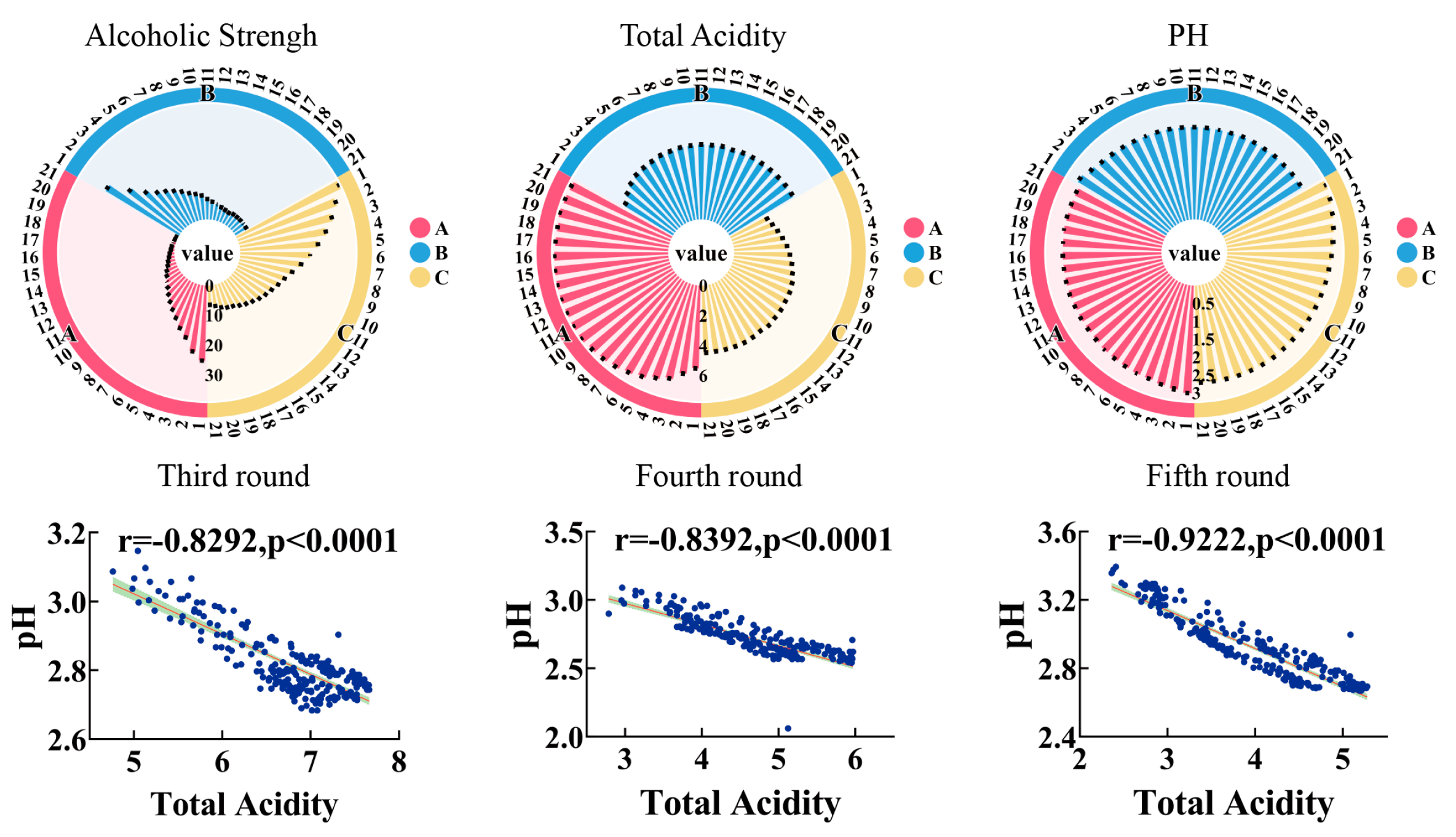
3.1. Analysis of the Dynamic Changes in Physicochemical Characteristics of Low-Alcohol Base Baijiu
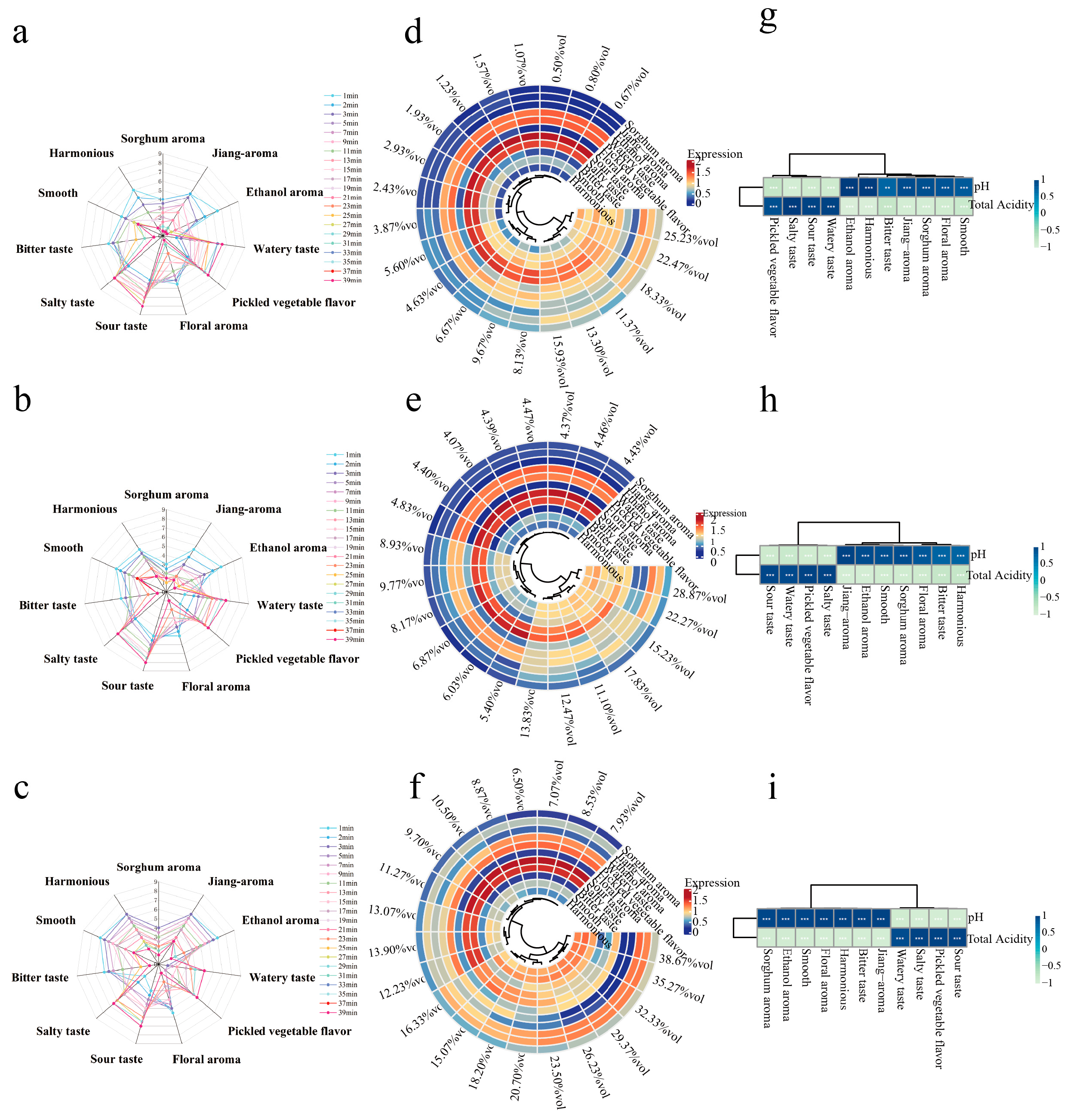
3.2. Analysis of the Dynamic Changes in Sensory Characteristics of Low-Alcohol Base Baijiu
3.3. Analysis of Volatile Flavor Compounds in Low-Alcohol Base Baijiu
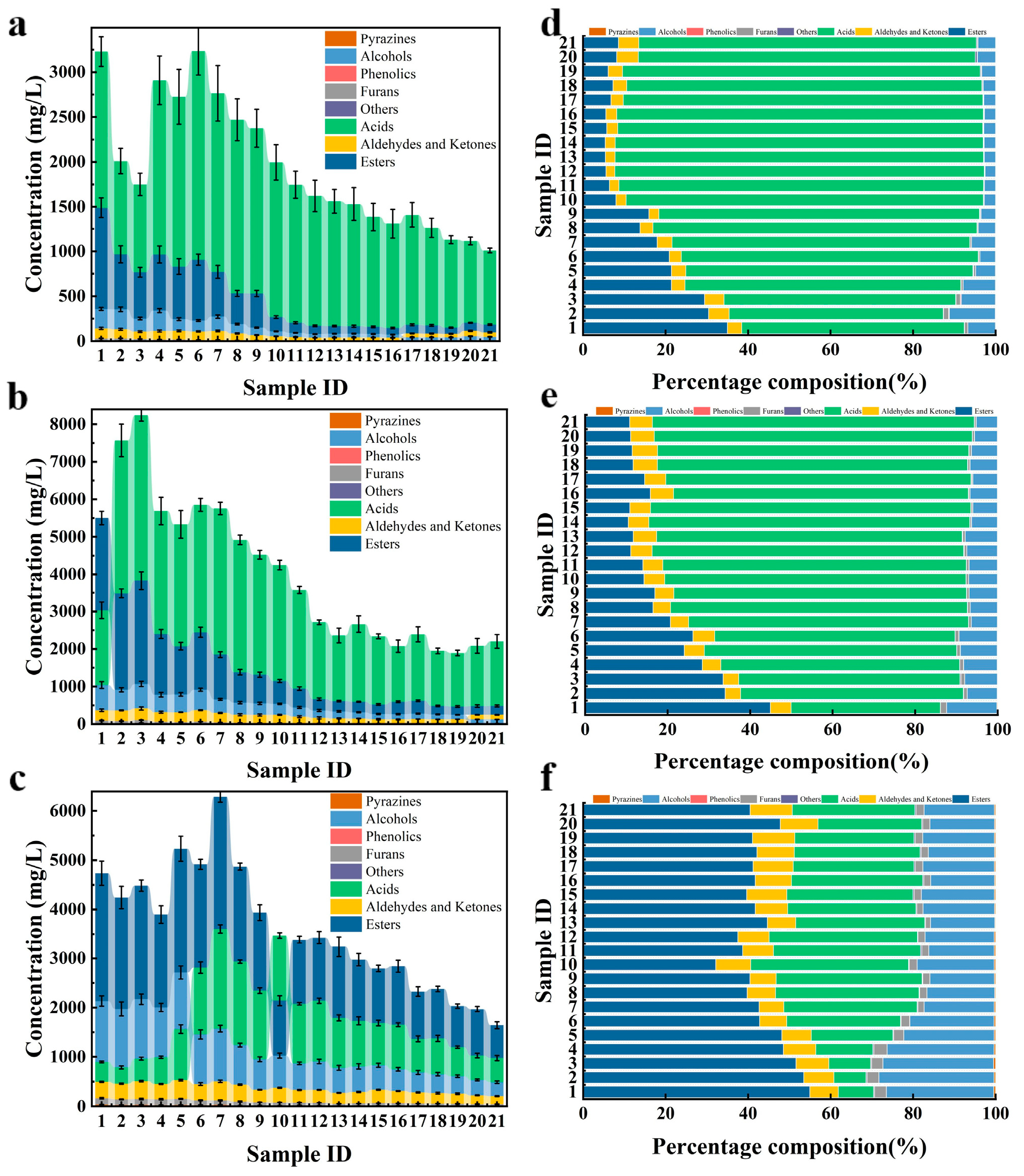
3.3.1. Analysis of the Dynamics of Volatile Flavor Compounds in Low-Alcohol Base Baijiu
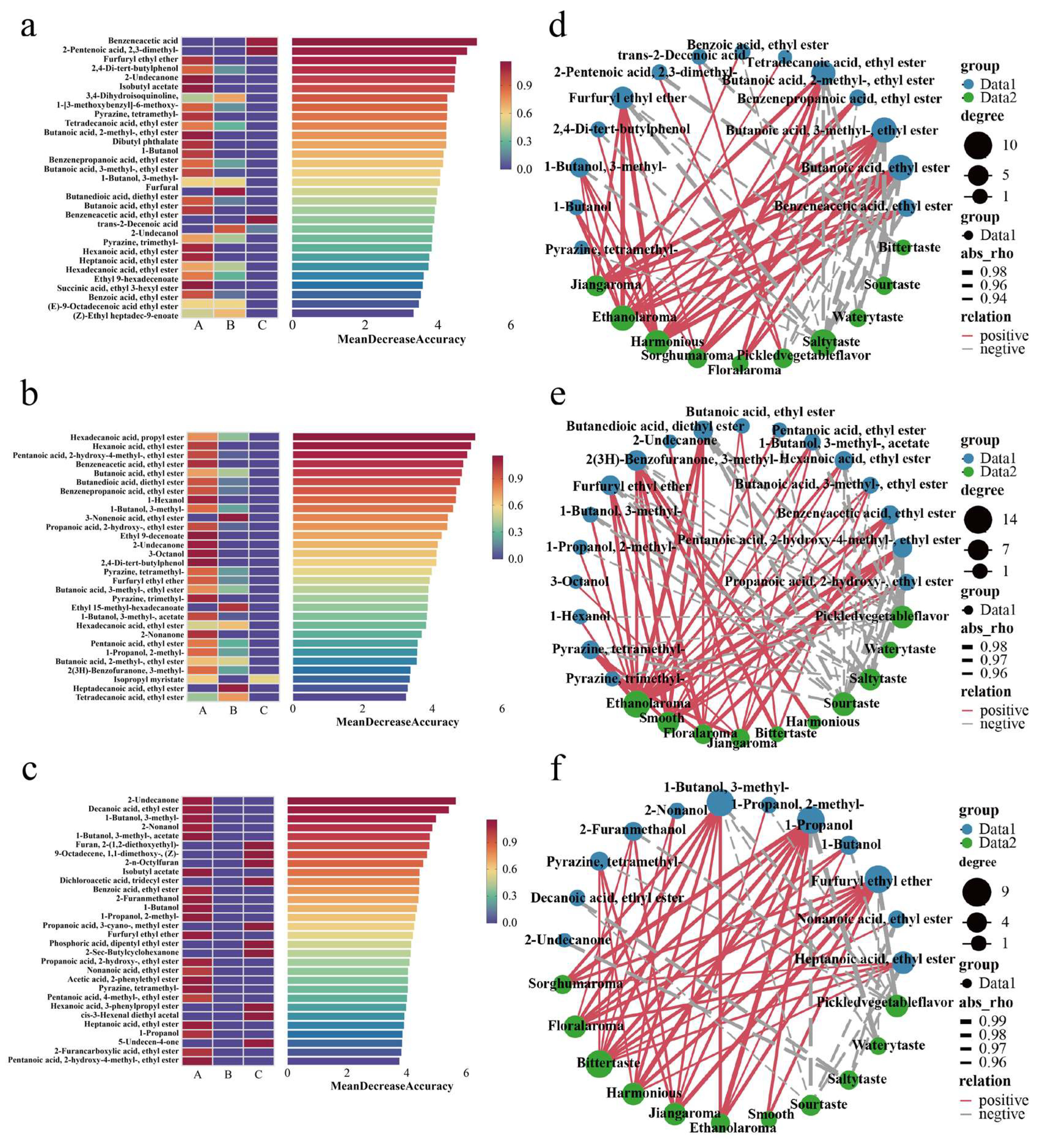
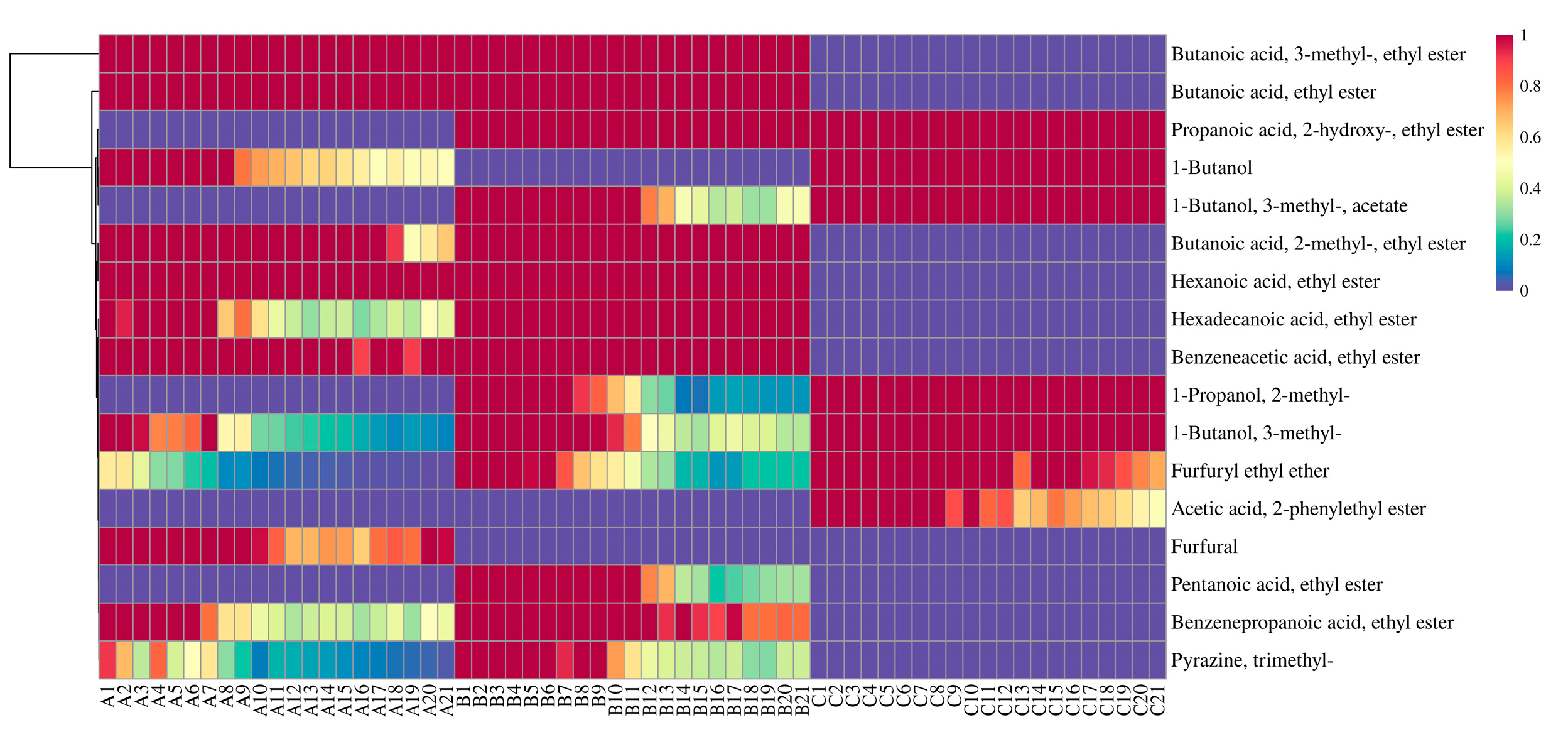
3.3.2. Characteristic Compound Analysis for Flavor Structure Classification of Low-Alcohol Base Baijiu
3.3.3. OAV Analysis of Characteristic Flavor Compounds for Flavor Structure Classification of Low-Alcohol Base Baijiu
3.4. Machine Learning-Based Flavor Structure Prediction for Low-Alcohol Base Baijiu
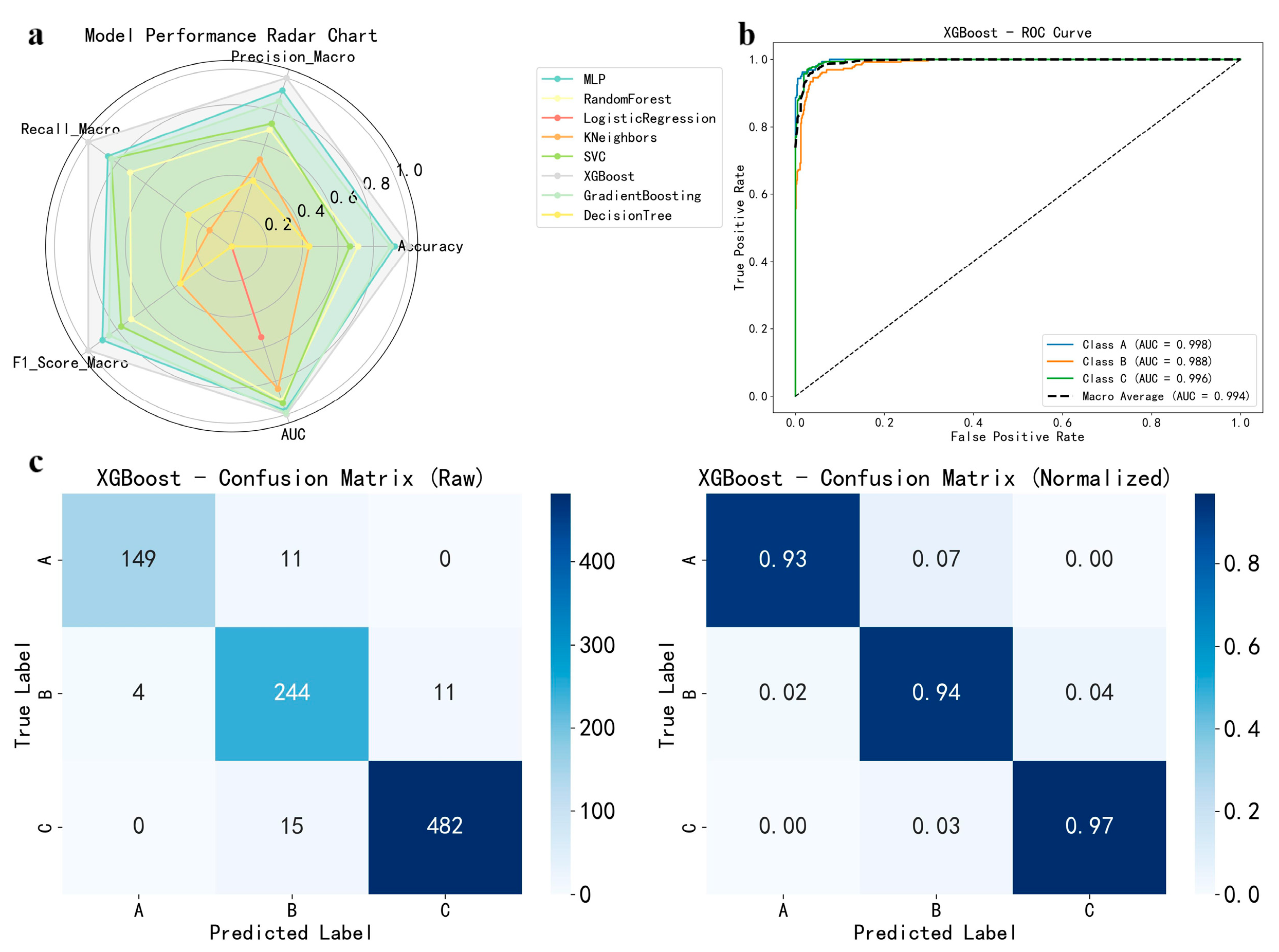
3.4.1. Machine Learning-Based Model Screening for Flavor Structure Prediction of Low-Alcohol Base Baijiu
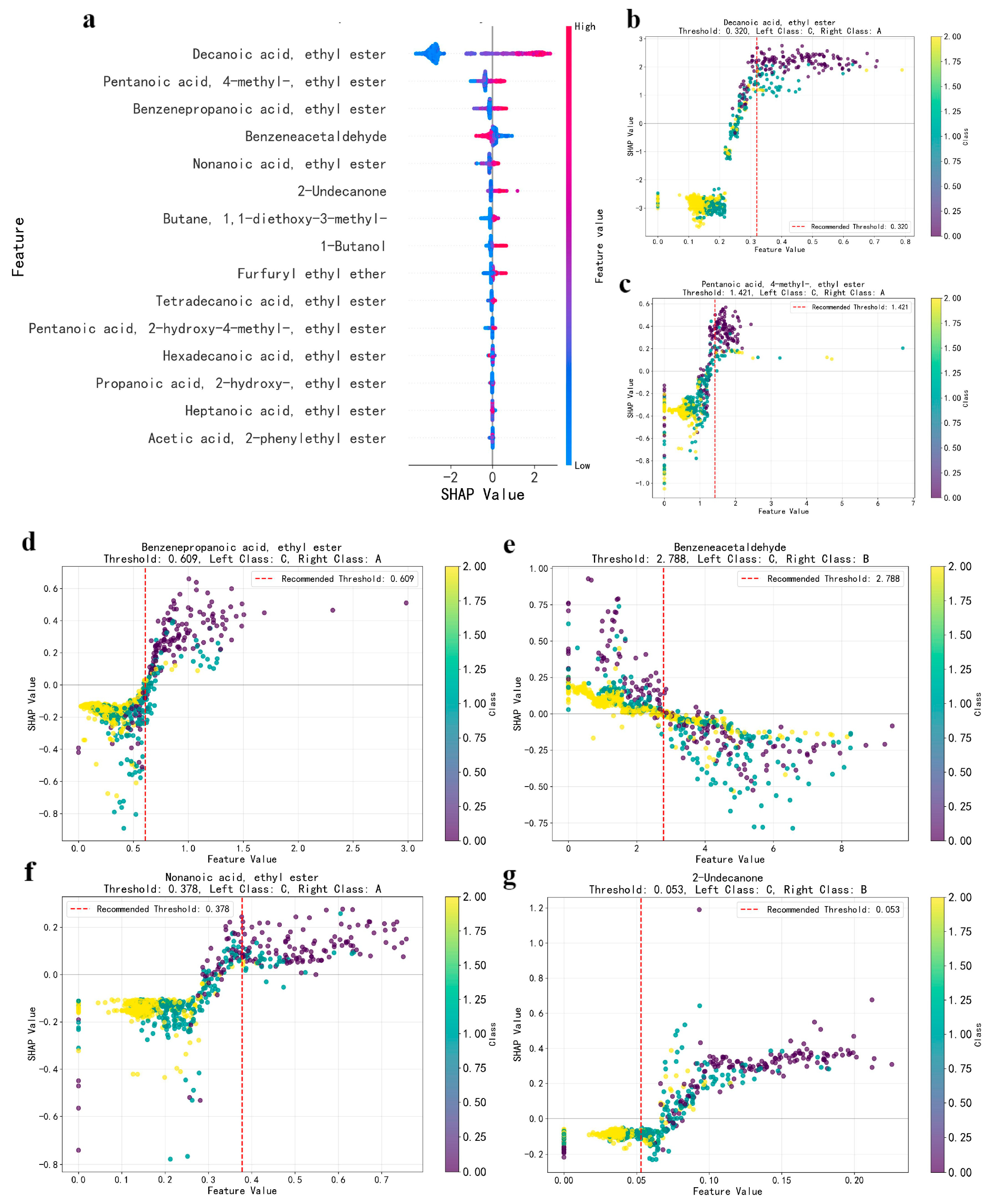
3.4.2. Shap Characterization
4. Concludes
Supplementary Materials
Author Contributions
Funding
Institutional Review Board Statement
Informed Consent Statement
Data Availability Statement
Conflicts of Interest
Abbreviations
| SHAP | Shapley Additive Explanations |
| OAV | Odor Activity Value |
References
- Li, J.; Zhang, Q.; Sun, B. Chinese Baijiu and Whisky: Research Reservoirs for Flavor and Functional Food. Foods 2023, 12, 2841. [Google Scholar] [CrossRef]
- He, F.; Duan, J.; Zhao, J.; Li, H.; Sun, J.; Huang, M.; Sun, B. Different distillation stages Baijiu classification by temperature-programmed headspace-gas chromatography-ion mobility spectrometry and gas chromatography-olfactometry-mass spectrometry combined with chemometric strategies. Food Chem. 2021, 365, 130430. [Google Scholar] [CrossRef]
- Li, W.; Zhang, H.; Wang, R.; Zhang, C.; Li, X. Temporal Profile of the Microbial Community and Volatile Compounds in the Third-Round Fermentation of Sauce-Flavor baijiu in the Beijing Region. Foods 2024, 13, 670. [Google Scholar] [CrossRef]
- Sung, J.; Frost, S.; Suh, J.H. Progress in flavor research in food: Flavor chemistry in food quality, safety, and sensory properties. Food Chem. X 2025, 25, 102071. [Google Scholar] [CrossRef] [PubMed]
- Li, Q.; Li, B.; Zhang, R.; Liu, S.; Yang, S.; Li, Y.; Li, J. Flavoromics Approach in Critical Aroma Compounds Exploration of Peach: Correlation to Origin Based on OAV Combined with Chemometrics. Foods 2023, 12, 837. [Google Scholar] [CrossRef] [PubMed]
- Gong, J.; Ma, Y.; Li, L.; Cheng, Y.; Huang, Y. Comparative characterization and contribution of key aroma compounds in the typical base liquor of Jiang-flavor Baijiu from different distributions in the Chinese Chishui River basin. Food Chem. X 2023, 20, 100932. [Google Scholar] [CrossRef]
- Ghafari, N.; Sleno, L. Challenges and recent advances in quantitative mass spectrometry-based metabolomics. Anal. Sci. Adv. 2024, 5, e2400007. [Google Scholar] [CrossRef]
- Sipos, L.; Ágoston, K.C.; Biró, P.; Bozóki, S.; Csató, L. How to measure consumer's inconsistency in sensory testing? Curr. Res. Food Sci. 2025, 10, 100982. [Google Scholar] [CrossRef] [PubMed]
- Torrico, D.D.; Mehta, A.; Borssato, A.B. New methods to assess sensory responses: A brief review of innovative techniques in sensory evaluation. Curr. Opin. Food Sci. 2023, 49, 100978. [Google Scholar] [CrossRef]
- Li, B.; Gu, Y. A Machine Learning Method for the Quality Detection of Base Liquor and Commercial Liquor Using Multidimensional Signals from an Electronic Nose. Foods 2023, 12, 1508. [Google Scholar] [CrossRef]
- Cai, D.; Li, X.; Liu, H.; Wen, L.; Qu, D. Machine learning and flavoromics-based research strategies for determining the characteristic flavor of food: A review. Trends Food Sci. Technol. 2024, 154, 104794. [Google Scholar] [CrossRef]
- Lun, Z.; Wu, X.; Dong, J.; Wu, B. Deep Learning-Enhanced Spectroscopic Technologies for Food Quality Assessment: Convergence and Emerging Frontiers. Foods 2025, 14, 2350. [Google Scholar] [CrossRef] [PubMed]
- Aguilar-Ruiz, J.S.; Michalak, M. Classification performance assessment for imbalanced multiclass data. Sci. Rep. 2024, 14, 10759. [Google Scholar] [CrossRef]
- GB/T 20821-2007; Chinese Spirits by Liquid Fermentation. Standards Press of China: Beijing, China, 2007.
- GB/T 33405-2016; Terminology of Baijiu Sensory Evaluation. Standards Press of China: Beijing, China, 2016.
- He, Y.; Liu, Z.; Qian, M.; Yu, X.; Xu, Y.; Chen, S. Unraveling the chemosensory characteristics of strong-aroma type Baijiu from different regions using comprehensive two-dimensional gas chromatography–time-of-flight mass spectrometry and descriptive sensory analysis. Food Chem. 2020, 331, 127335. [Google Scholar] [CrossRef] [PubMed]
- GB 12456-2021; National Food Safety Standard—Determination of Total Acid in Foods. Standards Press of China: Beijing, China, 2021.
- Guo, X.; Cheng, Y.; Huang, Y.; Chen, T.; Zongqi, S. Sensory Flavor Characteristics and Characteristic Volatile Compounds of Different Aroma Types of Baijiu. Food Sci. 2022, 21, 43–54. [Google Scholar] [CrossRef]
- Liu, Q.; He, D.; Ma, Y.; Wang, H.; Li, Y.; Cheng, Y.; Huang, Y. Sensory profile and the contribution of key aroma compounds in Jiang-flavor rounded-base Baijiu produced in the Chishui river basin. Lwt 2023, 189, 115474. [Google Scholar] [CrossRef]
- Duan, J.; Cheng, W.; Lv, S.; Deng, W.; Hu, X.; Li, H.; Sun, J.; Zheng, F.; Sun, B. Characterization of key aroma compounds in soy sauce flavor baijiu by molecular sensory science combined with aroma active compounds reverse verification method. Food Chem. 2024, 443, 138487. [Google Scholar] [CrossRef]
- Wang, L.; Wu, L.; Xiang, D.; Huang, H.; Han, Y.; Zhen, P.; Shi, B.; Chen, S.; Xu, Y. Characterization of key aroma compounds in aged Qingxiangxing baijiu by comparative aroma extract dilution analysis, quantitative measurements, aroma recombination, and omission studies. Food Chem. 2023, 419, 136027. [Google Scholar] [CrossRef]
- Li, C.; Yin, L.; Zhu, W.; Luo, M.; Zou, M.; Song, Y.; Zhang, Y.; Qiu, S.; Zeng, X.; Yan, Y. Characterization of Xiaoqu Qingxiangxing Baijiu by gas chromatography-olfactometry, quantitative measurements, aroma recombination, and omission experiments. Food Chem. X 2025, 28, 102591. [Google Scholar] [CrossRef]
- Li, P.; Ling, Y.; Shen, X.; Liang, C.; Tang, Y.; Chen, S.; Wang, L.Z.; Chen, S.; Li, A.; Xu, Y. Characterization of Key Aroma Compounds in Aged Chinese Nongxiangxing Baijiu Based on Sensory and Quantitative Analysis: Emphasis on the Contribution of Trace Compounds. Molecules 2025, 30, 2963. [Google Scholar] [CrossRef]
- Dong, W.; Dai, X.; Jia, Y.; Ye, S.; Shen, C.; Liu, M.; Lin, F.; Sun, X.; Xiong, Y.; Deng, B. Association between Baijiu chemistry and taste change: Constituents, sensory properties, and analytical approaches. Food Chem. 2024, 437, 137826. [Google Scholar] [CrossRef] [PubMed]
- Jia, Y.; Qiu, Y.; Deng, Q.; Han, Y.; Sun, B.; Liu, R.; Zhen, P.; Li, W.; Dong, W.; Sun, X.; et al. Predicting the low-level and extremely low-threshold compounds in Baijiu: Uniform manifold approximation and projection. Food Chem. X 2025, 29, 102645. [Google Scholar] [CrossRef] [PubMed]
- Wang, L.; Gao, Y.; Wu, L.; Chen, S.; Xu, Y. Characterization of Key Aging Aroma Compounds in Aged Jiangxiangxing Baijiu and Their Formation Influencing Factors during the Storge Process. J. Agric. Food Chem. 2024, 72, 1695–1707. [Google Scholar] [CrossRef]
- Schreurs, M.; Piampongsant, S.; Roncoroni, M.; Cool, L.; Herrera-Malaver, B.; Vanderaa, C.; Theßeling, F.A.; Kreft, Ł.; Botzki, A.; Malcorps, P.; et al. Predicting and improving complex beer flavor through machine learning. Nat. Commun. 2024, 15, 2368. [Google Scholar] [CrossRef]
- Ji, H.; Pu, D.; Yan, W.; Zhang, Q.; Zuo, M.; Zhang, Y. Recent advances and application of machine learning in food flavor prediction and regulation. Trends Food Sci. Technol. 2023, 138, 738–751. [Google Scholar] [CrossRef]
- Zeng, X.; Cao, R.; Xi, Y.; Li, X.; Yu, M.; Zhao, J.; Cheng, J.; Li, J. Food flavor analysis 4.0: A cross-domain application of machine learning. Trends Food Sci. Technol. 2023, 138, 116–125. [Google Scholar] [CrossRef]
- Ponce-Bobadilla, A.V.; Schmitt, V.; Maier, C.S.; Mensing, S.; Stodtmann, S. Practical guide to SHAP analysis: Explaining supervised machine learning model predictions in drug development. Clin. Transl. Sci. 2024, 17, e70056. [Google Scholar] [CrossRef]
- Salih, A.M.; Raisi-Estabragh, Z.; Galazzo, I.B.; Radeva, P.; Petersen, S.E.; Lekadir, K.; Menegaz, G. A Perspective on Explainable Artificial Intelligence Methods: SHAP and LIME. Adv. Intell. Syst. 2024, 7, 2400304. [Google Scholar] [CrossRef]
- Lundberg, S.M.; Erion, G.; Chen, H.; DeGrave, A.; Prutkin, J.M.; Nair, B.; Katz, R.; Himmelfarb, J.; Bansal, N.; Lee, S.-I. From local explanations to global understanding with explainable AI for trees. Nat. Mach. Intell. 2020, 2, 56–67. [Google Scholar] [CrossRef]
- De-la-Fuente-Blanco, A.; Arias-Pérez, I.; Escudero, A.; Sáenz-Navajas, M.-P.; Ferreira, V. The relevant and complex role of ethanol in the sensory properties of model wines. OENO One 2024, 58, 7864. [Google Scholar] [CrossRef]
- Ren, J.; Li, Z.; Jia, W. Key Aroma Differences in Volatile Compounds of Aged Feng-Flavored Baijiu Determined Using Sensory Descriptive Analysis and GC×GC–TOFMS. Foods 2024, 13, 1504. [Google Scholar] [CrossRef]
- Gao, Y.; Yang, Q.; Jin, G.; Yang, S.; Qin, R.; Lyu, L.; Yao, X.; Zhang, R.; Chen, S.; Xu, Y. Aroma Compound Changes in the Jiangxiangxing Baijiu Solid-State Distillation Process: Description, Kinetic Characters and Cut Point Selection. Foods 2024, 13, 232. [Google Scholar] [CrossRef]
- Chen, L.; Qin, X.; Wang, G.; Teng, M.; Zheng, Y.; Yang, F.; Du, H.; Wang, L.; Xu, Y. Oxygen influences spatial heterogeneity and microbial succession dynamics during Baijiu stacking process. Bioresour. Technol. 2024, 403, 130854. [Google Scholar] [CrossRef] [PubMed]
- Chen, X.; Wu, Y.; Zhu, H.; Wang, H.; Lu, H.; Zhang, C.; Li, X.; Xu, Y.; Li, W.; Wang, Y. Turning over fermented grains elevating heap temperature and driving microbial community succession during the heap fermentation of sauce-flavor baijiu. Lwt 2022, 172, 114173. [Google Scholar] [CrossRef]
- Zhang, H.; Wang, L.; Wang, H.; Yang, F.; Chen, L.; Hao, F.; Lv, X.; Du, H.; Xu, Y. Effects of initial temperature on microbial community succession rate and volatile flavors during Baijiu fermentation process. Food Res. Int. 2021, 141, 109887. [Google Scholar] [CrossRef]
- Li, S.; Han, Y.; Wang, L.; Zhang, Y.; Wang, F.; Ou, Y.; Li, H.; Yang, L.; Qiu, S.; Lu, J. Machine learning-enhanced flavoromics: Identifying key aroma compounds and predicting sensory quality in sauce-flavor baijiu. Food Chem. 2025, 475, 143328. [Google Scholar] [CrossRef] [PubMed]
- Ji, X.; Yu, X.; Zhang, L.; Wu, Q.; Chen, F.; Guo, F.; Xu, Y. Acidity drives volatile metabolites in the spontaneous fermentation of sesame flavor-type baijiu. Int. J. Food Microbiol. 2023, 389, 110101. [Google Scholar] [CrossRef]
- Tian, L.; Xu, P.; Qin, J.; Hou, G.; Huang, Q.; Liu, Y.; Li, Y.; Guan, T. Insights into the Flavor Profiles and Key Aroma-Active Compounds of Sichuan Xiaoqu Qingxiangxing Baijiu Across Distilling Stages. Foods 2025, 14, 2814. [Google Scholar] [CrossRef]
- He, F.; Yang, S.; Shen, Y.; Jiang, Y.; Li, R.; Shen, Y.; Li, H.; Wang, B.; Wu, J.; Zeng, X.; et al. Decoding Baijiu key sour compounds: Molecular distillation-enhanced enrichment and sensory-guided identification. Lwt 2025, 238, 118802. [Google Scholar] [CrossRef]
- He, G.; Zhou, Z.; Zhang, Z.; Meng, N.; Xiong, Y.; Ren, Q.; Ao, L.; Sun, X.; Mao, J. Characterization of key compounds influencing the lubrication properties of strong-aroma Baijiu. Food Biosci. 2025, 74, 107945. [Google Scholar] [CrossRef]
- Niu, J.; Liu, R.; Li, W.; Lang, Y.; Li, X.; Sun, W.; Sun, B. Characterize and explore the dynamic changes in the volatility profiles of sauce-flavor baijiu during different rounds by GC-IMS, GC–MS and GC×GC–MS combined with machine learning. Food Res. Int. 2025, 213, 116568. [Google Scholar] [CrossRef]
- Gao, L.; Lu, Y.; Liu, Z.; Lu, Z.; Zhang, X.; Chai, L.; Wang, S.; Chi, Y.; Shen, C.; Xu, Z. Microbial engineering for Baijiu quality enhancement: Insights and perspectives. Trends Food Sci. Technol. 2025, 163, 105166. [Google Scholar] [CrossRef]
- Huang, H.; Chen, Y.; Hou, Y.; Hong, J.; Chen, H.; Zhao, D.; Wu, J.; Li, J.; Sun, J.; Sun, X.; et al. Molecular Sensomics Combined with Random Forest Model Can Reveal the Evolution of Flavor Type of Baijiu Based on Differential Markers. Foods 2024, 13, 3034. [Google Scholar] [CrossRef] [PubMed]
- Lin, L.; Fan, W.; Xu, Y.; Zhu, D.; Yang, T.; Li, J. Characterization of Key Odorants in Chinese Texiang Aroma and Flavor Type Baijiu (Chinese Liquor) by Means of a Molecular Sensory Science Approach. J. Agric. Food Chem. 2024, 72, 1256–1265. [Google Scholar] [CrossRef]
- Labory, J.; Njomgue-Fotso, E.; Bottini, S. Benchmarking feature selection and feature extraction methods to improve the performances of machine-learning algorithms for patient classification using metabolomics biomedical data. Comput. Struct. Biotechnol. J. 2024, 23, 1274–1287. [Google Scholar] [CrossRef] [PubMed]
- Jain, K.; Kaushik, K.; Gupta, S.K.; Mahajan, S.; Kadry, S. Machine learning-based predictive modelling for the enhancement of wine quality. Sci. Rep. 2023, 13, 17042. [Google Scholar] [CrossRef]
- Yang, L.; Xian, C.; Li, S.; Wang, Y.; Wu, X.; Chen, Q.; Zhao, W.; Zhao, C.; Li, X.; He, J.; et al. Machine learning combined with GC-FID for discrimination of different categories of maotai-flavor baijiu. Food Chem. X 2025, 28, 102555. [Google Scholar] [CrossRef] [PubMed]


Disclaimer/Publisher’s Note: The statements, opinions and data contained in all publications are solely those of the individual author(s) and contributor(s) and not of MDPI and/or the editor(s). MDPI and/or the editor(s) disclaim responsibility for any injury to people or property resulting from any ideas, methods, instructions or products referred to in the content. |
© 2026 by the authors. Licensee MDPI, Basel, Switzerland. This article is an open access article distributed under the terms and conditions of the Creative Commons Attribution (CC BY) license.
Share and Cite
Geng, J.; Huang, Y. Decoding the Flavor Structure of Jiang-Flavor Low-Alcohol Base Baijiu: A Machine Learning-Driven Approach to Reveal the Flavor Evolution Patterns and Key Quality Control Nodes. Foods 2026, 15, 1891. https://doi.org/10.3390/foods15111891
Geng J, Huang Y. Decoding the Flavor Structure of Jiang-Flavor Low-Alcohol Base Baijiu: A Machine Learning-Driven Approach to Reveal the Flavor Evolution Patterns and Key Quality Control Nodes. Foods. 2026; 15(11):1891. https://doi.org/10.3390/foods15111891
Chicago/Turabian StyleGeng, Jiaxing, and Yongguang Huang. 2026. "Decoding the Flavor Structure of Jiang-Flavor Low-Alcohol Base Baijiu: A Machine Learning-Driven Approach to Reveal the Flavor Evolution Patterns and Key Quality Control Nodes" Foods 15, no. 11: 1891. https://doi.org/10.3390/foods15111891
APA StyleGeng, J., & Huang, Y. (2026). Decoding the Flavor Structure of Jiang-Flavor Low-Alcohol Base Baijiu: A Machine Learning-Driven Approach to Reveal the Flavor Evolution Patterns and Key Quality Control Nodes. Foods, 15(11), 1891. https://doi.org/10.3390/foods15111891