Article

Consumption Patterns and Product Format Preferences of Inner Beauty Functional Foods Among Korean Adults

1
Division of Beauty Arts Care, Department of Practical Arts, Graduate School of Culture and Arts, Dongguk University, Seoul 04620, Republic of Korea
2
College of General Education, Kookmin University, Seoul 02707, Republic of Korea
*
Author to whom correspondence should be addressed.
Foods 2026, 15(10), 1820; https://doi.org/10.3390/foods15101820
Submission received: 24 April 2026 / Revised: 17 May 2026 / Accepted: 19 May 2026 / Published: 21 May 2026
(This article belongs to the Section Nutraceuticals, Functional Foods, and Novel Foods)

Abstract

The inner beauty functional food sector has grown rapidly in South Korea. These products are orally consumed bioactive formulations designed to improve skin health, hair vitality, and overall wellness. However, empirical evidence on consumption patterns and product format preferences across different demographic groups remains limited. This cross-sectional study examined consumption patterns, purchase channels, and product format preferences among 502 Korean adults who had experience with inner beauty functional foods. Chi-square analysis was used to examine differences in consumption reasons, duration of use, purchase channels, and product format preferences according to socio-demographic characteristics. Results showed that skin health was the dominant consumption motivation (47.6%), particularly among younger and female consumers, while weight management and hair and nail health were more prevalent among older adults. Online purchasing dominated (57.8%), with significant age- and education-based variation; consumers in their 20s purchased online at 67.5%, declining to 44.4% among those aged 40 and above. Capsule and tablet formats were most prevalent overall (41.6%), with males, married consumers, and graduate-degree holders showing significantly stronger preference for this format, whereas gummy and chewable formats were more frequently preferred by female consumers. These findings provide practical implications for inner beauty producers, food distributors, and nutrition educators seeking to align product development and communication strategies with the heterogeneous preferences of Korean inner beauty consumers.

1. Introduction

Inner beauty functional foods are orally consumed products designed to improve skin condition, hair quality, nail health, and overall wellness [1,2]. These products have become one of the fastest-growing sectors in the global nutraceutical market [3,4,5]. Asia, particularly Japan and South Korea, has been a major driver of global demand for inner beauty products, accounting for nearly 70% of the global beauty supplement market value [6]. In South Korea specifically, the health functional food (HFF) market reached KRW 5.21 trillion in 2023, with a five-year compound annual growth rate of 9.8%, and skin health consistently ranked as a top motivator for supplement consumption across demographic groups [7,8]. Despite rapid market growth, research on inner beauty functional food consumption in South Korea remains limited. Most available studies address general functional food acceptance [9,10,11], consumer trust in health claims [12,13,14], or willingness to pay for specific ingredients such as collagen peptides, without characterizing the actual consumption patterns [15,16,17], product format preferences, and purchase channel choices that differentiate consumer subgroups [18,19]. Understanding how demographic factors influence consumption behavior is important for product development and nutrition education strategies [20,21]. Food labeling and product format characteristics function as credence attributes—qualities that consumers cannot verify through direct inspection and therefore rely on as informational signals to guide purchase decisions [22,23,24]. Research across functional food categories confirms that product format conveys implicit signals about efficacy, convenience, and legitimacy: capsule and tablet formats are commonly associated with clinical efficacy, while gummy and chewable formats are valued for palatability and ease of consumption, especially among younger demographics [25]. The divergence in format preference across age, sex, and education groups has been documented in the broader dietary supplement literature but has not been systematically examined within the inner beauty subcategory in South Korea. Purchase channel selection also varies according to demographic characteristics.
In South Korea, e-commerce accounts for approximately 68% of health functional food sales, particularly among consumers in their 30s, while older and lower-income consumers continue to rely on physical retail channels including pharmacies and large supermarkets [7,26]. Understanding how channel preferences differ across demographic groups provides useful insights for omnichannel distribution planning [27,28].
Against this background, the present study aimed to (1) describe inner beauty functional food consumption patterns including consumption reasons, duration of use, purchase channel selection, and product format preferences among Korean adults; and (2) determine how socio-demographic characteristics differentiate these patterns through chi-square analysis. The findings are intended to inform product development, distribution strategy, and nutrition education programming for the Korean inner beauty market.

2. Materials and Methods

2.1. Study Design and Participants

A cross-sectional online survey was conducted among Korean adults who had consumed inner beauty functional foods within the previous 12 months. Participants were recruited through a professional online survey panel between 15 January and 20 January 2026. Participants were eligible if they: (1) were Korean adults aged 20 years or older and (2) had consumed inner beauty functional foods at least once during the previous year. After exclusion of incomplete responses, 502 valid cases were retained. Ethical review and approval were waived for this study in accordance with Article 15 (2) of the Bioethics and Safety Act and Article 13 of its Enforcement Rules (Ministry of Health and Welfare, Republic of Korea), as this study involved an anonymous online survey and did not collect any personally identifiable or sensitive information.

2.2. Survey Instrument

The structured questionnaire collected data across five domains: (1) socio-demographic characteristics (sex, age, occupation, monthly household income, education, marital status, and region of residence); (2) primary reason for inner beauty product consumption (skin health, weight management, hair and nail health, immunity/fatigue improvement); (3) duration of consumption (less than 1 month; 1 to less than 6 months; 6 months to less than 1 year; 1 year or more); (4) primary purchase channel (online, pharmacy/drugstore, large supermarket/department store, acquaintance/word-of-mouth referral); and (5) preferred product format (capsule/tablet, gummy/chewable, powder, beverage). Examples of inner beauty functional foods, including collagen supplements, hyaluronic acid products, and beauty-oriented dietary supplements, were provided within the survey to ensure consistent participant understanding.

2.3. Statistical Analysis

Data were analyzed using SPSS WIN 28.0. Frequency analysis described distributions of all categorical variables. Chi-square (χ2) tests examined associations between socio-demographic characteristics and consumption-related outcomes. Significance was evaluated at p < 0.05 for all tests.

3. Results

3.1. Participant Characteristics

The sample comprised 502 Korean adults. The majority were female (84.9%), aged in their 30s (55.2%), and employed as office workers (68.7%). Most held a bachelor’s degree (71.7%) and were unmarried (77.3%). The most common monthly income bracket was KRW 3–4 million (43.0%). Full socio-demographic characteristics are presented in Table 1.

3.2. Consumption Patterns

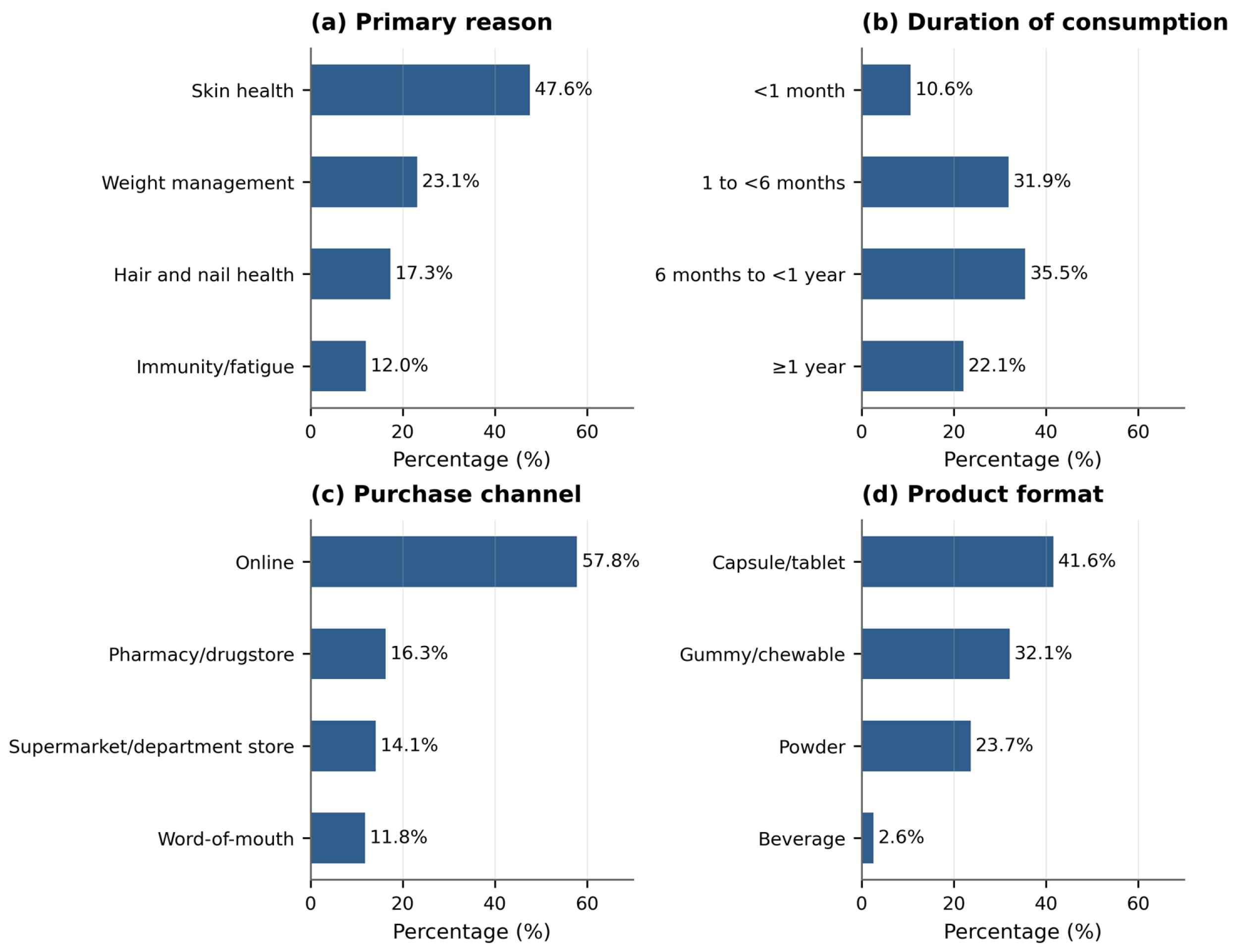
Skin health was the most frequently reported reason for inner beauty product consumption (47.6%), followed by weight management (23.1%), hair and nail health (17.3%), and immunity/fatigue improvement (12.0%). The most common duration of use was 6 months to less than 1 year (35.5%), followed by 1 to less than 6 months (31.9%), and 1 year or more (22.1%). Online channels accounted for 57.8% of purchases, followed by pharmacy/drugstore (16.3%), large supermarket/department store (14.1%), and acquaintance/word-of-mouth (11.8%). Capsule/tablet was the most frequently preferred product format (41.6%), followed by gummy/chewable (32.1%), powder (23.7%), and beverage (2.6%). Full consumption and usage patterns are provided in Table 2 and Figure 1.

3.3. Socio-Demographic Differences in Consumption Reason

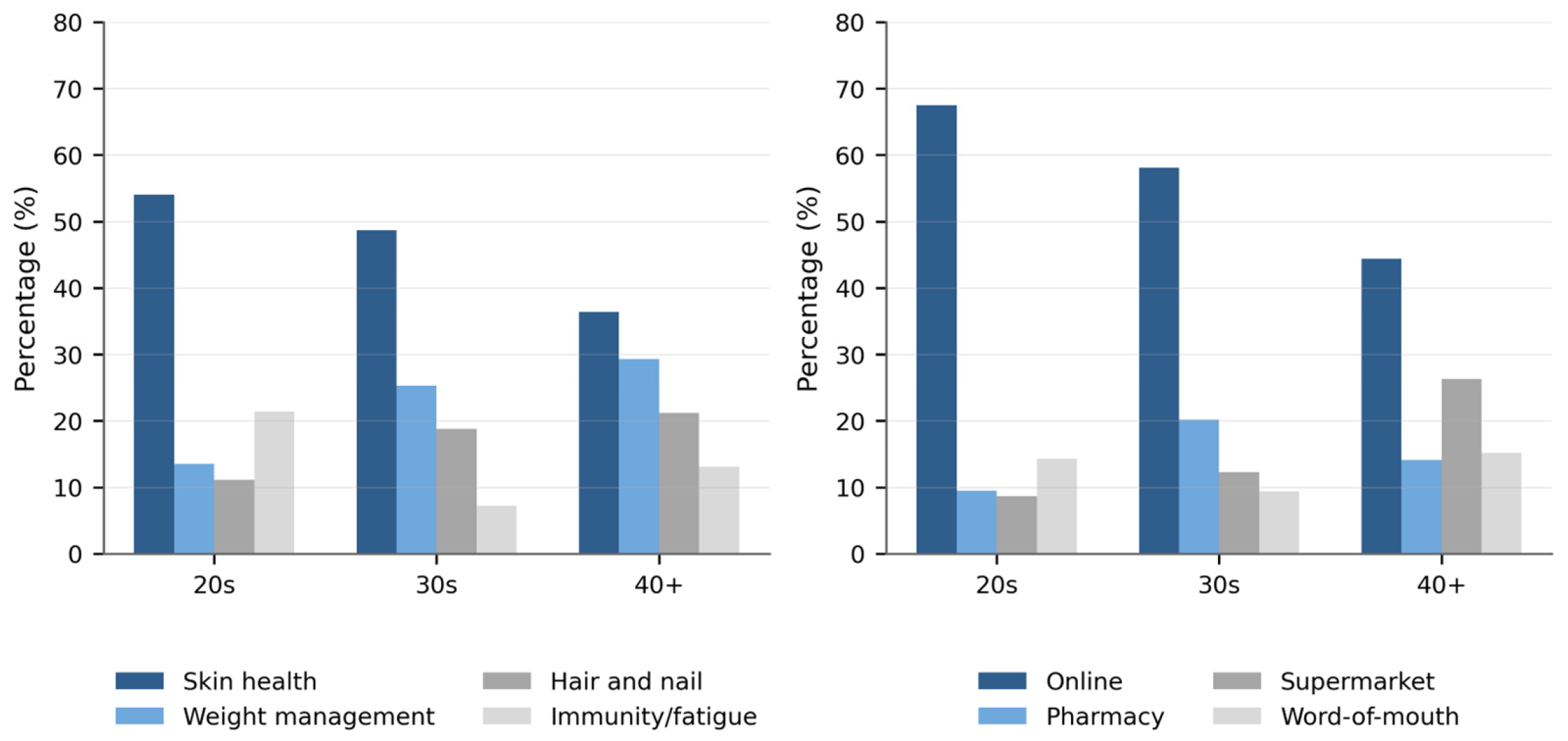
Chi-square analysis showed significant differences in consumption reasons according to socio-demographic characteristics (Table 3). Female participants were more likely than male participants to report skin health as their primary reason for consumption (49.3% vs. 38.2%; χ2 = 13.950, p = 0.003). Age was significantly associated with consumption reason (χ2 = 29.792, p < 0.001): skin health motivation was highest among consumers in their 20s (54.0%) and declined with age (40 and above: 36.4%), while weight management motivation increased progressively with age. Significant occupation-based differences were also observed (χ2 = 35.032, p < 0.001), with university students reporting the highest skin health motivation (58.1%) and professionals the lowest (27.6%). Education level was a significant predictor (χ2 = 17.630, p = 0.040), and regional differences were significant (χ2 = 26.570, p = 0.009), with Seoul/Gyeonggi-do residents more frequently citing skin health (52.2%) compared to Jeolla region residents (30.0%).

3.4. Socio-Demographic Differences in Purchase Channel

Table 4 presents chi-square results for purchase channel preference. Sex was a significant predictor (χ2 = 12.710, p = 0.005): females used pharmacies/drugstores at substantially higher rates than males (18.5% vs. 3.9%), while online purchase rates were similar between sexes. Age significantly influenced channel selection (χ2 = 28.079, p < 0.001): online purchasing declined from 67.5% among consumers in their 20s to 44.4% among those aged 40 and above, while supermarket purchasing increased with age. Education (χ2 = 24.959, p = 0.003) and marital status (χ2 = 13.152, p = 0.004) were also significant, with higher-educated and single consumers more frequently purchasing online. Region was also significantly associated with purchase channel preference (χ2 = 22.028, p = 0.037), with Seoul/Gyeonggi-do residents showing the highest online purchase rate (62.3%). Age-related differences in both consumption reason and purchase channel are illustrated in Figure 2.

3.5. Socio-Demographic Differences in Product Format Preference

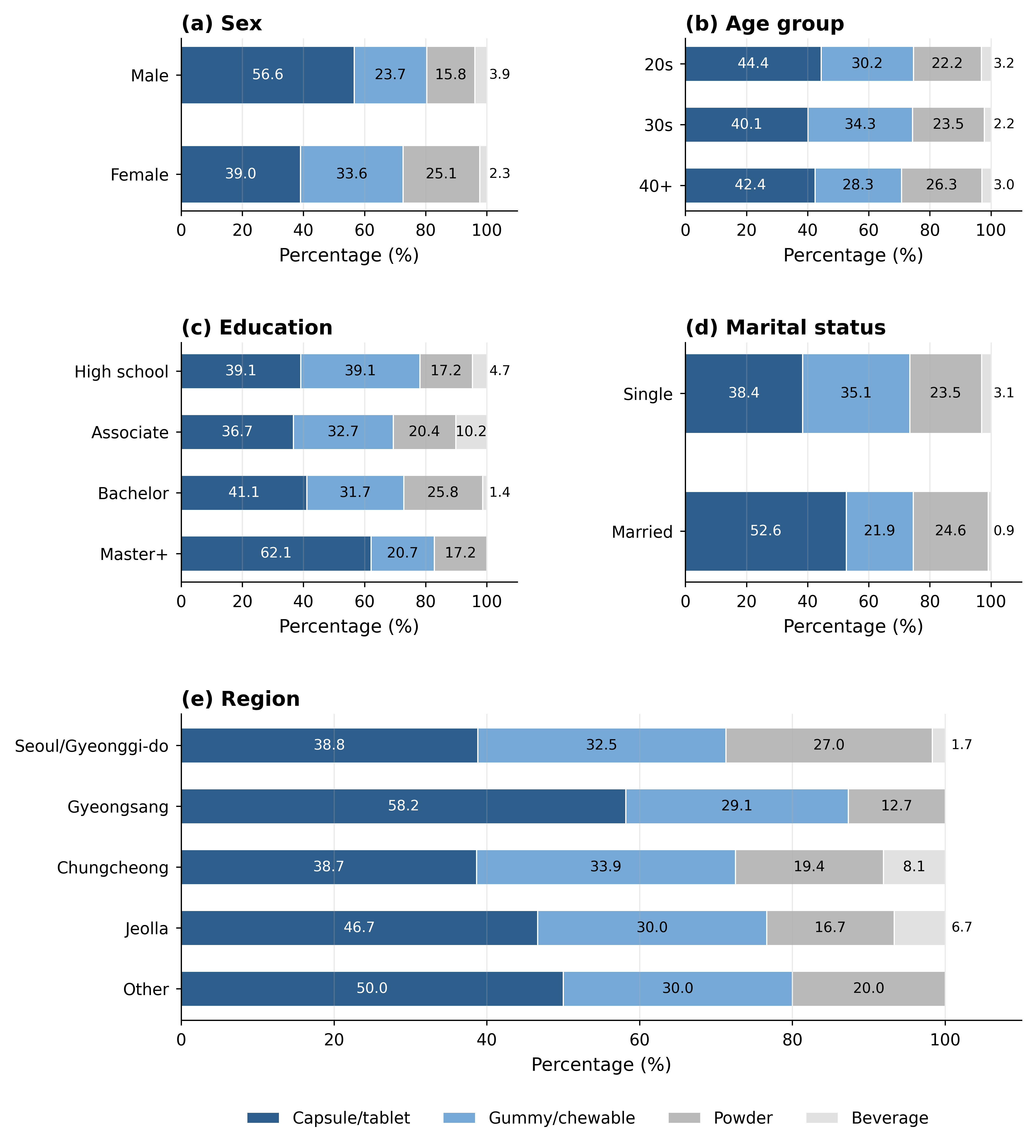
Product format preferences differed significantly across sex, education, marital status, and region, whereas age group was not significantly associated with product format preference (Table 5 and Figure 3). Sex was a significant predictor (χ2 = 9.774, p = 0.021): males showed stronger preference for capsule/tablet formats (56.6%) while females more frequently selected gummy/chewable options (33.6%). Education was a significant predictor (χ2 = 22.871, p = 0.006): graduate-degree holders showed a higher preference for capsule/tablet formats (62.1%) compared to associate degree holders (36.7%). Married consumers preferred capsule/tablet formats at higher rates than single consumers (52.6% vs. 38.4%; χ2 = 10.731, p = 0.013). Region was also significantly associated with product format preference (χ2 = 22.290, p = 0.034), with Gyeongsang residents showing the highest capsule/tablet preference (58.2%).

4. Discussion

This study provides a detailed empirical profile of inner beauty functional food consumption patterns and product format preferences among Korean adults, extending the limited existing literature on this rapidly growing market segment [29,30]. Skin health was the most common reason for consuming inner beauty functional foods (47.6%). This finding is consistent with previous studies showing that women aged 25–44 are the main consumers of beauty supplements [6]. However, the significant age-based stratification identified here adds important nuance: skin health motivation was concentrated among consumers in their 20s, while 40-and-above consumers showed a more distributed motivation profile encompassing weight management and hair and nail health. Consumption goals differed across age groups. Younger consumers focused more on skin health, whereas older consumers showed greater interest in weight management and hair and nail health. These findings are consistent with previous studies showing that health priorities change across the life course [31,32]. The strong emphasis on skin health among consumers in their 20s may reflect the increasing influence of the appearance-oriented wellness culture and preventive beauty-management behaviors among younger Korean consumers [33,34,35,36]. These findings suggest that inner beauty producers should avoid uniform product messaging and instead tailor benefit claims according to age-specific health and beauty priorities [37,38].
Online purchasing was the dominant purchasing channel (57.8%), which aligns with documented Korean HFF market trends showing the strong role of e-commerce in this market [7]. Online purchase frequency declined with age, from 67.5% among consumers in their 20s to 44.4% among those aged 40 and above. This pattern may reflect generational differences in digital commerce literacy documented in the general functional food literature [26]. Because inner beauty products are credence-oriented products whose efficacy cannot be directly verified at the time of purchase, consumers may rely on purchase channels as signals of product reliability and safety [39,40]. In addition, the higher pharmacy utilization among female consumers (18.5% vs. 3.9% for males) may reflect gender-specific product evaluation behaviors, as female consumers may more frequently seek in-person consultation and ingredient verification before purchasing inner beauty products. This supports the interpretation that pharmacy channels function as risk-reduction spaces, offering perceived professional credibility and opportunities for ingredient verification prior to purchase [39,41]. These findings suggest that omnichannel strategies combining online platforms with pharmacy-based distribution may be effective for reaching diverse consumer groups [42,43].
The findings on product format preferences provide practical implications for product development and marketing strategies [44,45,46]. Product format preferences differed significantly by sex, education level, marital status, and region. In particular, the higher preference for capsule/tablet formats among graduate-degree holders may be consistent with prior nutraceutical research suggesting that higher health literacy is associated with preference for formats with stronger clinical connotations [19,47]. Capsule and tablet formats may convey stronger perceptions of scientific legitimacy and therapeutic efficacy, particularly among highly educated consumers with greater health literacy [48]. Conversely, the higher gummy/chewable preference among female consumers reflects the ingestible beauty industry’s broader trend toward palatability-centered delivery formats, which have rapidly gained market share globally [6]. In contrast, gummy and chewable formats may reduce psychological barriers to supplement intake by increasing sensory enjoyment and convenience among younger consumers [48,49]. The significant preference for capsule/tablet formats among graduate-degree holders (62.1%) versus associate degree holders (36.7%) suggests that education-related differences in health product literacy translate directly into format preferences [50]. This finding has direct implications for how producers position and label products targeting different educational segments.
The regional variation in consumption motivation—with Seoul/Gyeonggi-do residents more frequently citing skin health and Jeolla region residents more frequently citing weight management—may reflect the influence of regional food culture, dietary exposure to specific product marketing, and demographic composition differences across Korean administrative regions [51]. Regional variation may also reflect differences in urbanization, retail accessibility, and exposure to beauty-related marketing environments [52,53]. These regional differences suggest the need for geographically differentiated marketing and distribution strategies for inner beauty producers serving diverse Korean regional markets [54,55].
Several limitations should be acknowledged. First, the online sampling methodology, while efficient, may underrepresent older and rural consumers with limited digital access. In addition, the sample was disproportionately composed of female, relatively younger, and highly educated participants, which may limit the generalizability of the findings to the broader Korean adult population. Second, consumption duration and purchase frequency data were self-reported and subject to recall bias. Third, the study did not capture information on specific product ingredients or brand preferences, limiting the precision of product format preference analysis. Fourth, the cross-sectional design precludes causal inference regarding demographic determinants of consumption patterns. Future research should employ longitudinal designs to track consumption pattern evolution across life-stage transitions, incorporate objective purchase records to validate self-reported channel and format data, and extend the analysis to rural and lower-income consumer segments currently underrepresented in the inner beauty literature. Future studies should also investigate ingredient-specific preferences and longitudinal changes in inner beauty consumption behavior across different life stages [35,38].

5. Conclusions

This study provides a comprehensive empirical characterization of inner beauty functional food consumption patterns and product format preferences among Korean adults. Skin health was the dominant consumption motivation, with significant age- and sex-based variation in motivation distribution. Online purchasing dominated across all demographic groups but showed a significant age-related decline. Product format preferences were meaningfully differentiated by sex, education, marital status, and region, with capsule/tablet formats preferred by males, more highly educated consumers, and married consumers, and gummy/chewable formats favored by female consumers.
For inner beauty producers and distributors, these findings suggest that product development and marketing strategies should be tailored according to demographic characteristics. Differentiated format portfolios that serve both the clinical-efficacy-oriented preferences of graduate consumers and the palatability-driven preferences of female consumers represent a viable product development direction. Omnichannel distribution that sustains offline pharmacy presence for female consumers while prioritizing digital platforms for younger demographics can maximize market reach across the diverse Korean inner beauty consumer landscape. Future studies should further investigate longitudinal changes in inner beauty consumption behavior and explore how evolving digital health communication environments influence consumer preferences across different demographic groups.

Author Contributions

E.P.: conceptualization, data collection, investigation, and writing—original draft. K.H.K.: methodology, formal analysis, writing—review and editing, and supervision. All authors have read and agreed to the published version of the manuscript.

Funding

This research received no external funding.

Institutional Review Board Statement

Ethical review and approval were waived for this study in accordance with Article 15 (2) of the Bioethics and Safety Act and Article 13 of its Enforcement Rules (Ministry of Health and Welfare, Republic of Korea), as this study involved an anonymous survey and did not collect any personally identifiable or sensitive information.

Informed Consent Statement

Informed consent was obtained from all subjects involved in the study.

Data Availability Statement

The data presented in this study are available on request from the corresponding author due to privacy issues.

Acknowledgments

The authors gratefully acknowledge all survey participants for their time and cooperation.

Conflicts of Interest

The authors declare no conflicts of interest.

References

  1. Muraleedharan, V.; Kamath, G.S.; Sasikumar, G.; Panicker, S.P. Advantages of functional foods in supporting and maintaining hair and skin health. In Evidence-Based Functional Foods for Prevention of Age-Related Diseases; Springer: Singapore, 2023. [Google Scholar] [CrossRef]
  2. Batovska, D.; Gerasimova, A.; Nikolova, K. Exploring the therapeutic potential of jujube (Ziziphus jujuba mill.) extracts in cosmetics: A review of bioactive properties for skin and hair wellness. Cosmetics 2024, 11, 181. [Google Scholar] [CrossRef]
  3. Pramanik, A.; Maheshwari, S.; Acharya, N.; Pathak, Y. Global future trends related to nutraceuticals. In Nutraceuticals; CRC Press: Boca Raton, FL, USA, 2026. [Google Scholar] [CrossRef]
  4. Chopra, A.S.; Lordan, R.; Horbańczuk, O.K.; Atanasov, A.G.; Chopra, I.; Horbańczuk, J.O.; Jóźwik, A.; Huang, L.; Pirgozliev, V.; Banach, M.; et al. The current use and evolving landscape of nutraceuticals. Pharmacol. Res. 2022, 175, 106001. [Google Scholar] [CrossRef]
  5. Halder, T.; Mehta, P.; Acharya, N. Trends in the functional food market and nutraceutical product development. In Nutraceuticals for Aging and Anti-Aging; CRC Press: Boca Raton, FL, USA, 2021. [Google Scholar] [CrossRef]
  6. Euromonitor International. Global Beauty Supplements Market: Regional Analysis and Consumer Trends; Euromonitor International: London, UK, 2024. [Google Scholar]
  7. Korea Health Functional Food Association (KHFA). 2024 Market and Consumer Research Report; KHFA: Seoul, Republic of Korea, 2024. [Google Scholar]
  8. Kim, Y.H.; Lee, H.J.; Oh, I. Analyzing the Competition Structure in Health Functional Food Market Using Hendry Model. Food Suppl. Biomater. Health 2025, 5, e7. [Google Scholar] [CrossRef]
  9. Frewer, L.; Scholderer, J.; Lambert, N. Consumer acceptance of functional foods: Issues for the future. Br. Food J. 2003, 105, 714–731. [Google Scholar] [CrossRef]
  10. Büyukkaragoz, A.; Bas, M.; Sağlam, D.; Cengiz, Ş.E. Consumers’ awareness, acceptance and attitudes towards functional foods in Turkey. Int. J. Consum. Stud. 2014, 38, 628–635. [Google Scholar] [CrossRef]
  11. Topolska, K.; Florkiewicz, A.; Filipiak-Florkiewicz, A. Functional food—Consumer motivations and expectations. Int. J. Environ. Res. Public Health 2021, 18, 5327. [Google Scholar] [CrossRef]
  12. Wills, J.M.; Storcksdieck Genannt Bonsmann, S.; Kolka, M.; Grunert, K.G. European consumers and health claims: Attitudes, understanding and purchasing behaviour. Proc. Nutr. Soc. 2012, 71, 229–236. [Google Scholar] [CrossRef]
  13. Arvanitoyannis, I.S.; van Houwelingen-Koukaliaroglou, M. Functional foods: A survey of health claims, pros and cons, and current legislation. Crit. Rev. Food Sci. Nutr. 2005, 45, 385–404. [Google Scholar] [CrossRef] [PubMed]
  14. Williams, P.; Ghosh, D. Health claims and functional foods. Nutr. Diet. 2008, 65, S89–S93. [Google Scholar] [CrossRef]
  15. Szakály, Z.; Kovács, S.; Pető, K.; Huszka, P.; Kiss, M. A modified model of the willingness to pay for functional foods. Appetite 2019, 138, 94–101. [Google Scholar] [CrossRef]
  16. Pasquale, J.D.; Adinolfi, F.; Capitanio, F. Analysis of consumer attitudes and consumers’ willingness to pay for functional foods. Int. J. Food Syst. Dyn. 2011, 2, 181–193. [Google Scholar] [CrossRef]
  17. Tra, P.V.; Moritaka, M.; Fukuda, S. Factors affecting consumers’ willingness to pay for functional foods in Vietnam. J. Fac. Agric. Kyushu Univ. 2011, 56, 425–429. [Google Scholar] [CrossRef] [PubMed]
  18. Baker, M.T.; Lu, P.; Parrella, J.A.; Leggette, H.R. Consumer acceptance toward functional foods: A scoping review. Int. J. Environ. Res. Public Health 2022, 19, 1217. [Google Scholar] [CrossRef] [PubMed]
  19. Tzeng, S.-Y.; Ho, T.-Y. Exploring the effects of product knowledge, trust, and distrust in the health belief model to predict attitude toward dietary supplements. SAGE Open 2022, 12, 1–13. [Google Scholar] [CrossRef]
  20. Gregson, J.; Foerster, S.B.; Orr, R.; Jones, L.; Benedict, J.; Clarke, B.; Hersey, J.; Lewis, J.; Zotz, K. System, environmental, and policy changes: Using the social-ecological model as a framework for evaluating nutrition education and social marketing programs with low-income audiences. J. Nutr. Educ. 2001, 33, S4–S15. [Google Scholar] [CrossRef]
  21. Van Phuong, N.; Mergenthaler, M.; Quynh, P.N.H. Consumer transition: Analyzing the impact of environmental and health consciousness on green food choices in Vietnam. Discov. Sustain. 2025, 6, 415. [Google Scholar] [CrossRef]
  22. Giudice, T.D.; Cavallo, C.; Vecchio, R. Credence attributes, consumers trust and sensory expectations in modern food market: Is there a need to redefine their role? Int. J. Food Syst. Dyn. 2018, 9, 307–320. [Google Scholar] [CrossRef]
  23. Tait, P.R.; Driver, T.; Saunders, C.M. Consumer Willingness to Pay for Environmental Attributes; Lincoln University Research Archive: Lincoln, New Zealand, 2020; Available online: https://hdl.handle.net/10182/14440 (accessed on 10 May 2026).
  24. Grunert, K.G.; Wills, J.M. A review of European research on consumer response to nutrition information on food labels. J. Public Health 2007, 15, 385–399. [Google Scholar] [CrossRef]
  25. Monika; Pragi; Kumar, V.; Kumar, A.; Garg, D.; Preeti; Kumar, A. A narrative review on formulation and quality attribute considerations for chewable tablets. Int. J. Curr. Pharm. Rev. Res. 2023, 15, 178–189. [Google Scholar] [CrossRef]
  26. Horská, E.; Predanócyová, K.; Šedík, P.; Grunert, K.G.; Hupková, D. Consumer perception of functional foods and determinants of functional foods consumption in the Slovak Republic. Br. Food J. 2023, 125, 2478–2492. [Google Scholar] [CrossRef]
  27. Cortiñas, M.; Chocarro, R.; Elorz, M. Omni-channel users and omni-channel customers: A segmentation analysis using distribution services. Span. J. Mark.-ESIC 2019, 23, 415–436. [Google Scholar] [CrossRef]
  28. Hübner, A.; Holzapfel, A.; Kuhn, H. Distribution systems in omni-channel retailing. Bus. Res. 2016, 9, 255–296. [Google Scholar] [CrossRef]
  29. Sgroi, F.; Sciortino, C.; Baviera-Puig, A.; Modica, F. Analyzing consumer trends in functional foods: A cluster analysis approach. J. Agric. Food Res. 2024, 15, 101041. [Google Scholar] [CrossRef]
  30. Lee, B.; Childs, M.; Lim, H.; Sneed, C.T. Unveiling local consumer segmentation: Exploring attitudes, values, and behavioral preferences in the non-food dairy value-added products market. Int. Rev. Retail Distrib. Consum. Res. 2026, 36, 169–191. [Google Scholar] [CrossRef]
  31. Darnton-Hill, I.; Nishida, C.; James, W. A life course approach to diet, nutrition and the prevention of chronic diseases. Public Health Nutr. 2004, 7, 101–121. [Google Scholar] [CrossRef]
  32. Raubenheimer, D.; Senior, A.; Mirth, C.; Cui, Z.; Hou, R.; Le Couteur, D.G.; Solon-Biet, S.M.; Léopold, P.; Simpson, S.J. An integrative approach to dietary balance across the life course. iScience 2022, 25, 104315. [Google Scholar] [CrossRef] [PubMed]
  33. Shim, J.; Woo, J.; Yeo, H.; Kang, S.; Kwon, B.; Lee, E.J.; Oh, J.; Jeong, E.; Lim, J.; Park, S.G. The Clean Beauty Trend Among Millennial and Generation Z Consumers: Assessing the Safety, Ethicality, and Sustainability Attributes of Cosmetic Products. SAGE Open 2024, 14, 21582440241255430. [Google Scholar] [CrossRef]
  34. Mironica, A.; Popescu, C.A.; George, D.; Tegzesiu, A.M.; Gherman, C.D. Social Media Influence on Body Image and Cosmetic Surgery Considerations: A Systematic Review. Cureus 2024, 16, e65626. [Google Scholar] [CrossRef]
  35. Ren, Y.; Liu, D.; Xu, B. Critical Review on Orally Administered Nutricosmetics: Food-Based Solutions Conferring Skin Health from the Inside Out. Trends Food Sci. Technol. 2025, 159, 104946. [Google Scholar] [CrossRef]
  36. Gimenez Martinez, R.J.; Rivas Garcia, F.; March Cerda, J.C.; Hernandez-Ruiz, A.; Gonzalez Castro, M.I.; Valverde-Merino, M.-I.; Huertas Camarasa, F.J.; Lloris Meseguer, F.; Lopez-Viota Gallardo, M. Bioactive Substances and Skin Health: An Integrative Review from a Pharmacy and Nutrition Perspective. Pharmaceuticals 2025, 18, 373. [Google Scholar] [CrossRef]
  37. Janzik, R.; Geppert, J.; Muller, P.; Notz, I.; Obstfeld, H.; Roth, B.; Volpers, A.-M.; Bol, G.-F. Exploring Motivations, Information Behavior, Perceptions, and Intentions among Dietary Supplement Users: A Cross-Sectional Survey Study in Germany. Front. Nutr. 2025, 12, 1663562. [Google Scholar] [CrossRef] [PubMed]
  38. Zurek, J.; Rudy, M.; Dziki, D. Consumer Choices in the Functional Food Market: A Review of Determinants of Purchasing Behavior. Foods 2026, 15, 1319. [Google Scholar] [CrossRef] [PubMed]
  39. Wu, W.; Zhang, A.; van Klinken, R.D.; Schrobback, P.; Muller, J.M. Consumer Trust in Food and the Food System: A Critical Review. Foods 2021, 10, 2490. [Google Scholar] [CrossRef]
  40. Schrobback, P.; Zhang, A.; Loechel, B.; Ricketts, K.; Ingham, A. Food Credence Attributes: A Conceptual Framework of Supply Chain Stakeholders, Their Motives, and Mechanisms to Address Information Asymmetry. Foods 2023, 12, 538. [Google Scholar] [CrossRef]
  41. Ang, J.Y.; Ooi, G.S.; Abd Aziz, F.; Tong, S.F. Risk-Taking in Consumers’ Online Purchases of Health Supplements and Natural Products: A Grounded Theory Approach. J. Pharm. Policy Pract. 2023, 16, 134. [Google Scholar] [CrossRef]
  42. Rivero Gutiérrez, L.; Samino García, R. Omnichannel strategy and consumer behavior in distribution channels: Trends in the ophthalmology sector. Front. Psychol. 2020, 11, 1142. [Google Scholar] [CrossRef]
  43. Pieriegud, J. The development of digital distribution channels in Poland’s retail pharmaceutical market. In Exploring Omnichannel Retailing: Common Expectations and Diverse Realities; Springer: Cham, Switzerland, 2018. [Google Scholar] [CrossRef]
  44. Chakravarti, A.; Thomas, M. Five steps to actionable consumer insights. In Why People (Don’t) BUY; Palgrave Macmillan: London, UK, 2015; pp. 187–202. [Google Scholar] [CrossRef]
  45. Ruiz, C.D.; Holmlund, M. Actionable marketing knowledge: A close reading of representation, knowledge and action in market research. Ind. Mark. Manag. 2017, 66, 172–180. [Google Scholar] [CrossRef]
  46. Diaz Ruiz, C.A. The insights industry: Towards a performativity turn in market research. Int. J. Mark. Res. 2022, 64, 169–186. [Google Scholar] [CrossRef]
  47. Asan, Ş.; Özakar, E.; Özakar, R.S. Gummies and gel tablets: New approaches to oral drug delivery. J. Res. Pharm. 2025, 29, 1301–1317. [Google Scholar] [CrossRef]
  48. Hauber, B.; Hand, M.V.; Hancock, B.C.; Zarrella, J.; Harding, L.; Ogden-Barker, M.; Antipas, A.S.; Watt, S.J. Patient Acceptability and Preferences for Solid Oral Dosage Form Drug Product Attributes: A Scoping Review. Patient Prefer. Adherence 2024, 18, 1281–1297. [Google Scholar] [CrossRef] [PubMed]
  49. Rodriguez-Pombo, L.; Awad, A.; Basit, A.W.; Alvarez-Lorenzo, C.; Goyanes, A. Innovations in Chewable Formulations: The Novelty and Applications of 3D Printing in Drug Product Design. Pharmaceutics 2022, 14, 1732. [Google Scholar] [CrossRef] [PubMed]
  50. Zwierczyk, U.; Sowada, C.; Duplaga, M. Eating Choices—The Roles of Motivation and Health Literacy: A Cross-Sectional Study. Nutrients 2022, 14, 4026. [Google Scholar] [CrossRef] [PubMed]
  51. Jo, G.; Park, D.; Lee, J.; Kim, R.; Subramanian, S.V.; Oh, H.; Shin, M.J. Trends in diet quality and cardiometabolic risk factors among Korean adults, 2007–2018. JAMA Netw. Open 2022, 5, e2218297. [Google Scholar] [CrossRef]
  52. Kim, H.; Kim, M.; Lee, S. Spatial Inequalities and Driving Factors in Food Accessibility: Integrating Online and Offline Grocery Services in South Korea. Appl. Geogr. 2025, 185, 103777. [Google Scholar] [CrossRef]
  53. Jeong, S.H. Study of Beauty Consumer Behavior on Social Media: The Effectiveness of Beauty Influencer Marketing Targeting Generation Z. J. Korean Soc. Cosmetol. 2025, 31, 120–127. [Google Scholar] [CrossRef]
  54. Park, Y.W.; Hong, P. Cosmetics Marketing Strategy in the Era of the Digital Ecosystem; Springer: Singapore, 2024. [Google Scholar] [CrossRef]
  55. Kim, S.M.; Park, M.J. Evaluation of cross-national global market segmentation and strategy: The case of Korean Wave for ASEAN countries. Asia Pac. Manag. Rev. 2020, 25, 207–215. [Google Scholar] [CrossRef]
Figure 1. Overall consumption patterns of inner beauty functional foods among Korean adults (n = 502). (a) Primary reason for consumption; (b) duration of consumption; (c) primary purchase channel; (d) preferred product format.
Foods 15 01820 g001
Figure 2. Age-group differences in primary consumption reason and purchase channel preference among Korean inner beauty functional food consumers (n = 502).
Foods 15 01820 g002
Figure 3. Product format preference by sex, age group, education level, marital status, and region among Korean inner beauty functional food consumers ( n = 502).
Foods 15 01820 g003
Table 1. Socio-demographic characteristics of participants (n = 502).
Variablen%
Sex  
Male7615.1
Female42684.9
Age group  
20s12625.1
30s27755.2
40 and above9919.7
Occupation  
Office worker34568.7
University student6212.4
Self-employed367.2
Full-time homemaker306.0
Professional295.8
Monthly household income (KRW)  
<KRW 1 million5611.2
KRW 1–2 million346.8
KRW 2–3 million15230.3
KRW 3–4 million21643.0
≥KRW 4 million448.8
Education  
High school graduate6412.7
Associate degree499.8
Bachelor’s degree36071.7
Master’s degree or above295.8
Marital status  
Single38877.3
Married11422.7
Total502100.0
KRW = South Korean Won.
Table 2. Inner beauty functional food consumption patterns (n = 502).
Variablen%
Primary reason for consumption  
Skin health23947.6
Weight management11623.1
Hair and nail health8717.3
Immunity/fatigue improvement6012.0
Duration of consumption  
Less than 1 month5310.6
1 to less than 6 months16031.9
6 months to less than 1 year17835.5
1 year or more11122.1
Primary purchase channel  
Online29057.8
Pharmacy/drugstore8216.3
Large supermarket/department store7114.1
Acquaintance/word-of-mouth referral5911.8
Product format  
Capsule/tablet20941.6
Gummy/chewable16132.1
Powder11923.7
Beverage132.6
Total502100.0
Table 3. Chi-square analysis of primary consumption reason by socio-demographic characteristics.
VariableSkin HealthWeight mgmt.Hair & NailImmunityχ2pCramer’s V
Sex       
Male38.2%26.3%11.8%23.7%13.9500.003 **0.167 (small)
Female49.3%22.5%18.3%9.9%   
Age group       
20s54.0%13.5%11.1%21.4%29.792<0.001 ***0.172 (small)
30s48.7%25.3%18.8%7.2%   
40 and above36.4%29.3%21.2%13.1%   
Occupation       
Office worker49.0%24.1%18.0%9.0%35.032<0.001 ***0.153 (small)
University student58.1%14.5%11.3%16.1%   
Professional27.6%20.7%31.0%20.7%   
Education       
High school graduate50.0%28.1%12.5%9.4%17.6300.040 *0.108 (small)
Master’s or above55.2%6.9%17.2%20.7%   
Region       
Seoul/Gyeonggi-do52.2%21.4%15.4%11.0%26.5700.009 **0.133 (small)
Jeolla30.0%43.3%6.7%20.0%   
* p < 0.05; ** p < 0.01; *** p < 0.001. Abbreviated rows shown; full frequencies available upon request.
Table 4. Chi-square analysis of purchase channel preference by socio-demographic characteristics.
VariableOnlinePharmacySupermarketWord-of-Mouthχ2pCramer’s V
Sex       
Male59.2%3.9%21.1%15.8%12.7100.005 **0.159 (small)
Female57.5%18.5%12.9%11.0%   
Age group       
20s67.5%9.5%8.7%14.3%28.079<0.001 ***0.167 (small)
30s58.1%20.2%12.3%9.4%   
40 and above44.4%14.1%26.3%15.2%   
Education       
High school graduate54.7%9.4%20.3%15.6%24.9590.003 **0.129 (small)
Bachelor’s degree61.4%16.7%12.2%9.7%   
Master’s or above65.5%13.8%13.8%6.9%   
Marital status       
Single61.3%16.5%11.9%10.3%13.1520.004 **0.162 (small)
Married45.6%15.8%21.9%16.7%   
Region       
Seoul/Gyeonggi-do215 (62.3%)56 (16.2%)39 (11.3%)35 (10.1%)22.0280.037 *0.121 (small)
Gyeongsang30 (54.5%)9 (16.4%)8 (14.5%)8 (14.5%)   
Chungcheong27 (43.5%)12 (19.4%)12 (19.4%)11 (17.7%)   
Jeolla12 (40.0%)5 (16.7%)10 (33.3%)3 (10.0%)   
Other6 (60.0%)0 (0.0%)2 (20.0%)2 (20.0%)   
* p < 0.05; ** p < 0.01; *** p < 0.001. Abbreviated rows shown; full frequencies available upon request.
Table 5. Chi-square analysis of product format preference by socio-demographic characteristics.
VariableCapsule/TabletGummyPowderBeverageχ2pCramer’s V
Sex       
Male56.6%23.7%15.8%3.9%9.7740.021 *0.140 (small)
Female39.0%33.6%25.1%2.3%   
Age group       
20s44.4%30.2%22.2%3.2%2.2600.8940.047 (negligible)
30s40.1%34.3%23.5%2.2%   
40 and above42.4%28.3%26.3%3.0%   
Education       
High school graduate39.1%39.1%17.2%4.7%22.8710.006 **0.123 (small)
Associate degree36.7%32.7%20.4%10.2%   
Bachelor’s degree41.1%31.7%25.8%1.4%   
Master’s or above62.1%20.7%17.2%0.0%   
Marital status       
Single38.4%35.1%23.5%3.1%10.7310.013 *0.146 (small)
Married52.6%21.9%24.6%0.9%   
Region       
Seoul/Gyeonggi-do38.8%32.5%27.0%1.7%22.2900.034 *0.122 (small)
Gyeongsang58.2%29.1%12.7%0.0%   
Chungcheong38.7%33.9%19.4%8.1%   
Jeolla46.7%30.0%16.7%6.7%   
Other50.0%30.0%20.0%0.0%   
* p < 0.05; ** p < 0.01. Abbreviated rows shown; full frequencies available upon request.
Disclaimer/Publisher’s Note: The statements, opinions and data contained in all publications are solely those of the individual author(s) and contributor(s) and not of MDPI and/or the editor(s). MDPI and/or the editor(s) disclaim responsibility for any injury to people or property resulting from any ideas, methods, instructions or products referred to in the content.