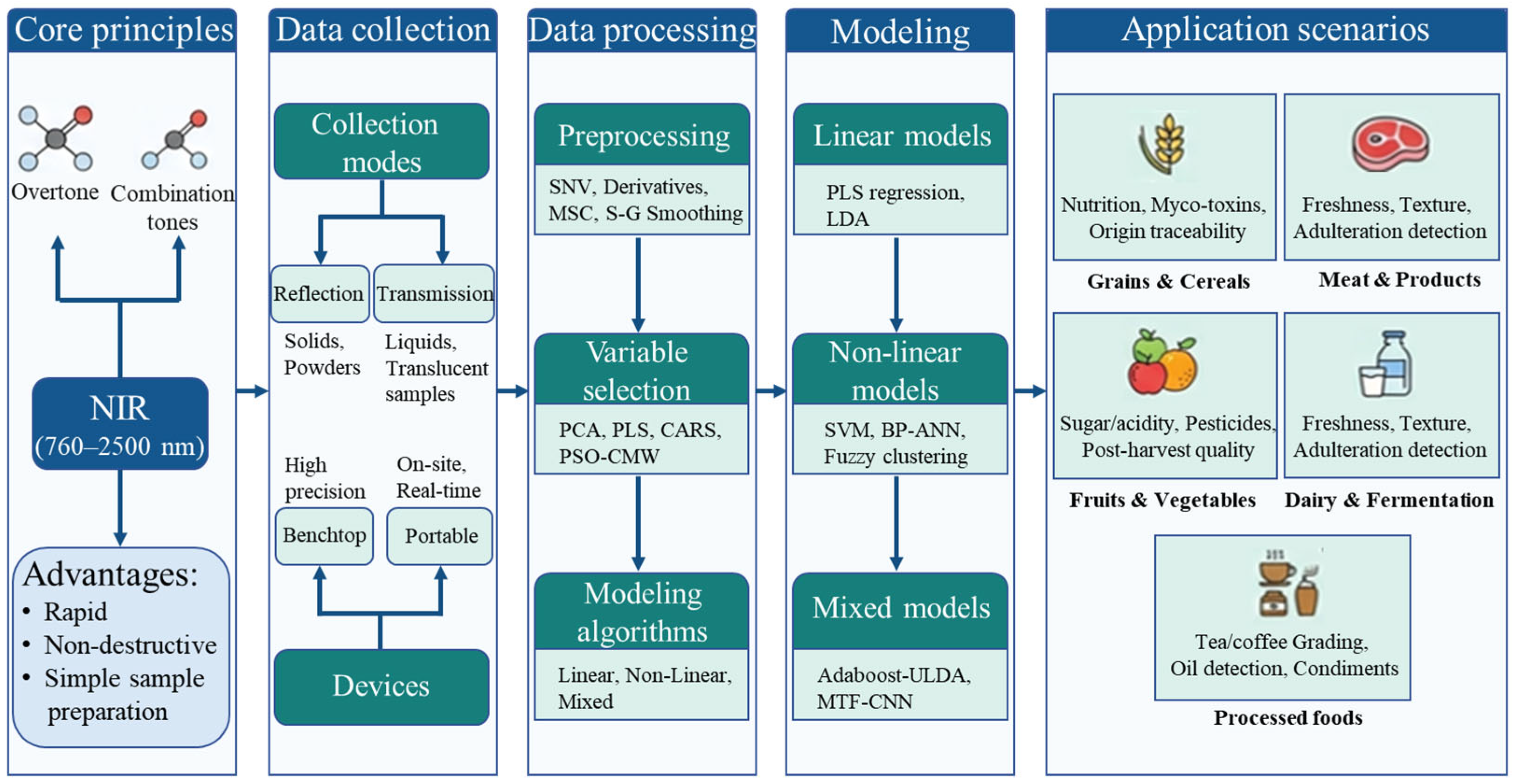
Near-Infrared Spectroscopy in Food Analysis: Applications, Chemometric Strategies, and Technological Advances


Abstract
1. Introduction
1.1. Significance of Food Quality and Safety Monitoring
1.2. Evolution and Advantages of NIR Spectroscopy in Food Science
1.3. Scope and Objectives of the Review
2. Fundamental Principles of NIR Spectroscopy in Food Analysis
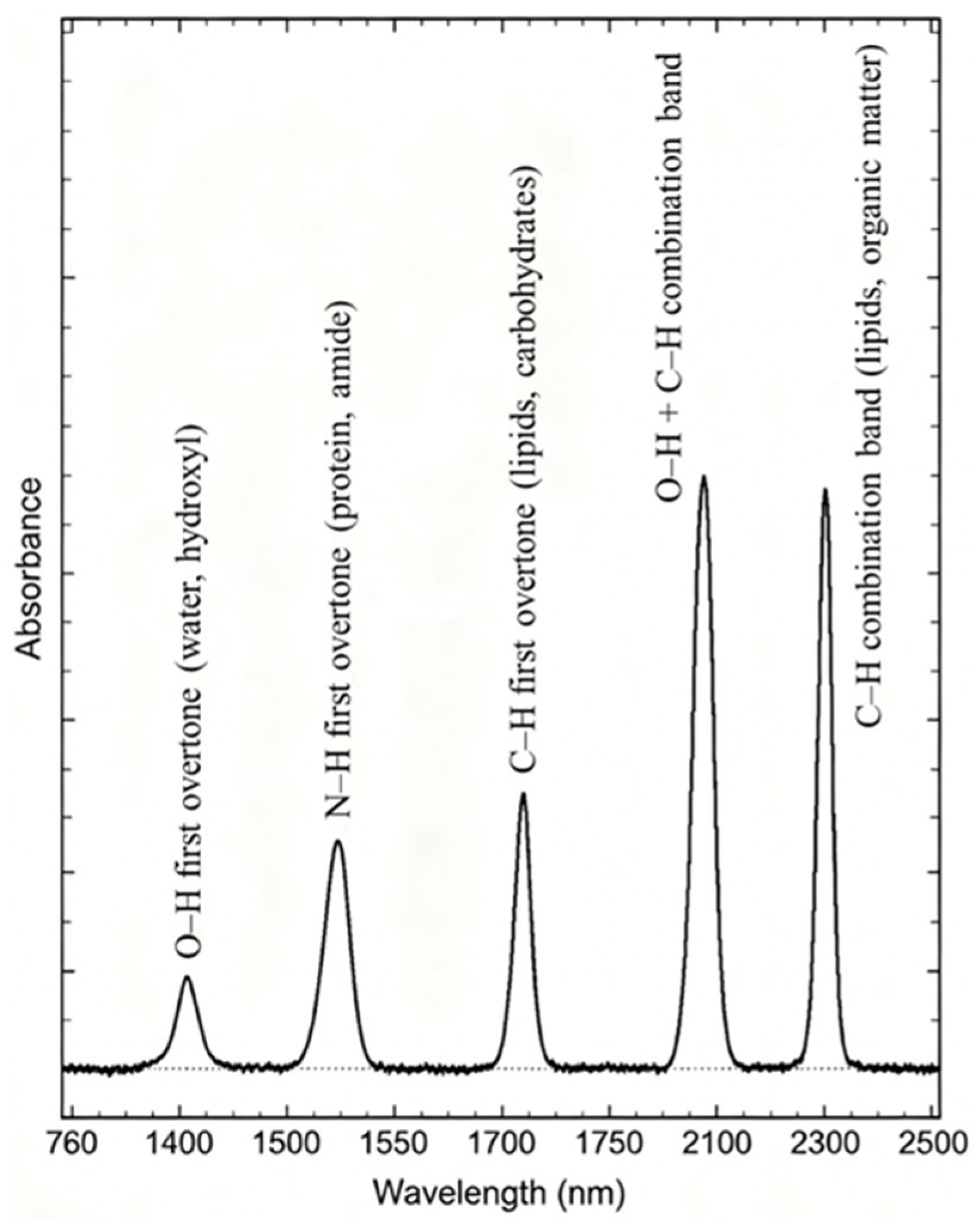
2.1. Mechanism of NIR Spectral Generation
2.2. Sampling and Measurement Techniques
2.2.1. Reflectance and Transmittance Modes
2.2.2. NIR Hyperspectral Imaging (HSI) Technique
2.2.3. Sample Preparation for Solid, Liquid, and Powdered Foods
2.3. Comparison Between NIR Spectroscopy and Conventional Analytical Methods
3. Applications of NIR Spectroscopy in Food Sectors
3.1. Cereals and Grains
3.1.1. Quantitative Analysis of Nutrients
3.1.2. Mycotoxin Detection
3.1.3. Variety and Origin Discrimination
3.2. Meat and Poultry Products
3.2.1. Freshness Evaluation
3.2.2. Tenderness and Texture Prediction
3.2.3. Adulteration Detection
3.3. Fruits and Vegetables
3.3.1. Soluble Solids Content (SSC) and Acidity Measurement
3.3.2. Pesticide Residue Screening
3.3.3. Postharvest Quality Monitoring
3.4. Dairy and Fermented Products
3.4.1. Milk Composition Analysis
3.4.2. Fermentation Stage Monitoring
3.5. Processed Foods and Beverages
3.5.1. Tea and Coffee Quality Grading
3.5.2. Quality Assessment of Nuts and Edible Oil Products
3.5.3. Beverage Fermentation and Formulation Assessment
4. Chemometric Methods for NIR Data Analysis
4.1. Spectral Preprocessing Techniques
4.1.1. Scatter Correction Methods
4.1.2. Derivative Transformations and Smoothing
4.2. Feature Extraction and Variable Selection
4.2.1. Linear Feature Extraction Methods
4.2.2. Variable Selection Algorithms
4.2.3. Hybrid and Intelligent Optimization Methods
4.3. Classification and Quantitative Models
4.3.1. Linear Models
4.3.2. Nonlinear Models
4.3.3. Hybrid Algorithms
5. Technological Challenges and Future Perspectives
5.1. Current Limitations
5.1.1. Technical Constraints of Instrumentation and Spectral Data
5.1.2. Methodological and Practical Challenges
5.2. Emerging Trends
5.2.1. Multimodal Data Fusion
5.2.2. Advanced Intelligent Algorithms
5.2.3. Portable and Online Monitoring Systems
5.3. Industrial Translation and Standardization
5.3.1. Industrial Adoption and Technological Adaptation
5.3.2. Standardization of Protocols and Calibration
6. Conclusions
Author Contributions
Funding
Institutional Review Board Statement
Informed Consent Statement
Data Availability Statement
Acknowledgments
Conflicts of Interest
Abbreviations
| 1D-CAE | One-dimensional convolutional autoencoder |
| AFB1 | Aflatoxin B1 |
| AVOA | African vulture optimization algorithm |
| BP-ANN | Backpropagation artificial neural networks |
| BPNN | Back propagation neural network |
| CARS | Competitive adaptive reweighted sampling |
| CV | Coefficient of variation |
| dCNN | Dual convolutional neural network |
| DD-SIMCA | Data-driven soft independent modeling of class analogy |
| DLDA | Direct LDA |
| ELISA | Enzyme-linked immunosorbent assay |
| FDCM | Fuzzy discriminant c-means |
| FCM | Fuzzy c-means |
| FiLDA | Fuzzy improved linear discriminant analysis |
| FMLDA | Fuzzy maximum uncertainty LDA |
| FT-NIR | Fourier transform NIR |
| HPLC | High-performance liquid chromatography |
| ICA | Independent component analysis |
| ICPA | Interval combination population analysis |
| IRIV | Iterative retained information variable |
| IVISSA | Interval variable iterative space shrinkage approach |
| KNN | K-nearest neighbor |
| LDA | Linear discriminant analysis |
| LOD | Limits of detection |
| LS-SVM | Least squares SVM |
| LTL | Longissimus thoracis et lumborum |
| MLP | Multilayer perceptron |
| MLDA | Maximum uncertainty LDA |
| MSC | Multiplicative scatter correction |
| NIR | Near-infrared |
| NSGA-II | Non-dominated sorting genetic algorithm |
| PCA | Principal component analysis |
| PC-ANN | Principal component ANN |
| PLS | Partial least squares |
| PLS-DA | PLS discriminant analysis |
| PSO-CMW | Particle swarm optimization combined with moving window |
| R | Correlation coefficient |
| R2 | Coefficient of determination |
| RC | Regression coefficients |
| RF | Random forest |
| RMSEP | Root mean square error of prediction |
| RP | Prediction correlation coefficient |
| RPD | Residual predictive deviation |
| SA-PLS | Simulated annealing PLS |
| S-G | Savitzky–Golay |
| SEP | Standard error of prediction |
| SNV | Standard normal variate |
| SPA | Successive projections algorithm |
| SSA | Sparrow search algorithm |
| SSC | Soluble solids content |
| Si-PLS | Synergy interval PLS |
| SVM | Support vector machine |
| TA | Total acidity |
| TVB-N | Total volatile basic nitrogen |
| TVC | Total viable count |
| UHT | Ultra-high temperature |
| WHC | Water-holding capacity |
| WOA | Whale optimization algorithm |
References
- Tahir, H.E.; Zou, X.; Xiao, J.; Mahunu, G.K.; Jiyong, S.; Xu, J.-L.; Sun, D.-W. Recent progress in rapid analyses of vitamins, phenolic, and volatile compounds in foods using vibrational spectroscopy combined with chemometrics: A review. Food Anal. Methods 2019, 12, 2361–2382. [Google Scholar] [CrossRef]
- Zareef, M.; Arslan, M.; Hassan, M.; Ahmad, W.; Ali, S.; Li, H.; Ouyang, Q.; Wu, X.; Hashim, M.M.; Chen, Q. Recent advances in assessing qualitative and quantitative aspects of cereals using nondestructive techniques: A review. Trends Food Sci. Technol. 2021, 116, 815–828. [Google Scholar] [CrossRef]
- Qi, W.; Tian, Y.; Lu, D.; Chen, B. Research progress of applying infrared spectroscopy technology for detection of toxic and harmful substances in food. Foods 2022, 11, 930. [Google Scholar] [CrossRef] [PubMed]
- Agyekum, A.A.; Kutsanedzie, F.Y.H.; Mintah, B.K.; Annavaram, V.; Zareef, M.; Hassan, M.; Arslan, M.; Chen, Q. Rapid and nondestructive quantification of Trimethylamine by FT-NIR coupled with chemometric techniques. Food Anal. Methods 2019, 12, 2035–2044. [Google Scholar] [CrossRef]
- Wang, J.; Wu, X.; Zheng, J.; Wu, B. Rapid identification of green tea varieties based on FT-NIR spectroscopy and LDA/QR. Food Sci. Technol. 2022, 42, e73022. [Google Scholar] [CrossRef]
- Zareef, M.; Chen, Q.; Hassan, M.; Arslan, M.; Hashim, M.M.; Ahmad, W.; Kutsanedzie, F.Y.H.; Agyekum, A.A. An overview on the applications of typical non-linear algorithms coupled with NIR spectroscopy in food analysis. Food Eng. Rev. 2020, 12, 173–190. [Google Scholar] [CrossRef]
- Kutsanedzie, F.Y.H.; Guo, Z.; Chen, Q. Advances in nondestructive methods for meat quality and safety monitoring. Food Rev. Int. 2019, 35, 536–562. [Google Scholar] [CrossRef]
- Mia, N.; Hashem, A.; Halim, A.; Tariq, S.; Ahamed, Z. Application of NIR spectroscopy with machine learning in the food industry: A comprehensive review. Food Phys. 2026, 3, 100089. [Google Scholar] [CrossRef]
- Guven, K.; Kayiş, E.Ç.; Orhan, I.E.; Aslan, M.; Boyaci, I.H.; Tamer, U. A novel approach for rapid quantification of food supplement components using NIR spectroscopy and spectral data transfer. Analyst 2025, 150, 4081–4093. [Google Scholar] [CrossRef]
- Zaukuu, J.-L.Z.; Attipoe, N.Q.; Korneh, P.B.; Mensah, E.T.; Bimpong, D.; Amponsah, L.A. Detection of bissap calyces and bissap juices adulteration with sorghum leaves using NIR spectroscopy and VIS/NIR spectroscopy. J. Food Compos. Anal. 2025, 141, 107358. [Google Scholar] [CrossRef]
- Arslan, M.; Xiaobo, Z.; Tahir, H.E.; Xuetao, H.; Rakha, A.; Zareef, M.; Seweh, E.A.; Basheer, S. NIR spectroscopy coupled chemometric algorithms for rapid antioxidants activity assessment of Chinese Dates (Zizyphus jujuba Mill.). Int. J. Food Eng. 2019, 15, 20180148. [Google Scholar] [CrossRef]
- Wei, W.; Li, H.; Haruna, S.A.; Wu, J.; Chen, Q. Monitoring the freshness of pork during storage via near-infrared spectroscopy based on colorimetric sensor array coupled with efficient multivariable calibration. J. Food Compos. Anal. 2022, 113, 104726. [Google Scholar] [CrossRef]
- Padmasri, P.; Bama, B.S. Recent advances in near infrared spectroscopy and chemometric modeling for milk quality assessment: A comprehensive review. J. Near Infrared Spectrosc. 2026, 34, 3–25. [Google Scholar] [CrossRef]
- Wu, X.; He, F.; Wu, B.; Zeng, S.; He, C. Accurate classification of chunmee tea grade using NIR spectroscopy and fuzzy maximum uncertainty linear discriminant analysis. Foods 2023, 12, 541. [Google Scholar] [CrossRef] [PubMed]
- Pezzolato, M.; Brugiapaglia, A.; Provera, R.; Gai, F.; Salvatico, J.P.; Pennisi, F.; Giaccio, N.; Greco, A.; Bozzetta, E.; Esposito, G. High-pressure processing for anisakis larvae inactivation: Fish quality changes and near-infrared spectroscopy to verify its application. Foods 2026, 15, 1218. [Google Scholar] [CrossRef] [PubMed]
- Biswas, A.; Chaudhari, S.R. Exploring the role of NIR spectroscopy in quantifying and verifying honey authenticity: A review. Food Chem. 2024, 445, 138712. [Google Scholar] [CrossRef]
- Czaja, T.P.; Engelsen, S.B. Why nothing beats NIRS technology: The green analytical choice for the future sustainable food production. Spectrochim. Acta Part A Mol. Biomol. Spectrosc. 2025, 325, 125028. [Google Scholar] [CrossRef]
- Hradecká, I.; Svobodová, K.; Vráblík, A.; Hönig, V. Comparison of NIR and Raman spectroscopy for determining used cooking oil properties using chemometric methods. Chemom. Intell. Lab. Syst. 2026, 268, 105552. [Google Scholar] [CrossRef]
- Lembo, M.; Eramo, V.; Riggi, R.; Forniti, R.; Bellincontro, A.; Botondi, R. Destructive and non-destructive evaluation of anthocyanin content and quality attributes in red kiwifruit subjected to plant spray treatment with Cis-3-Hexenyl Butyrate. Foods 2025, 14, 480. [Google Scholar] [CrossRef]
- Wu, X.; Zhou, H.; Wu, B.; Fu, H. Determination of apple varieties by near infrared reflectance spectroscopy coupled with improved possibilistic Gath–Geva clustering algorithm. J. Food Process. Preserv. 2020, 44, e14561. [Google Scholar] [CrossRef]
- Hu, C.; Xu, H.; Fu, Z.; Wu, B.; Zhang, R.; Zhi, C. Non-destructive Identification of the geographical origin of red jujube by near-infrared spectroscopy and fuzzy clustering methods. Int. J. Food Prop. 2023, 26, 3275–3290. [Google Scholar] [CrossRef]
- Lombardi, G.; Conti, F.V.; Giustizieri, C.; Pontonio, E.; Perri, G.; Manetti, C.; Rizzello, C.G.; Verni, M. Development of a novel NIR spectroscopy-based chemometric model for sourdough bread authentication. Food Chem. 2025, 493, 145758. [Google Scholar] [CrossRef] [PubMed]
- Ouyang, Q.; Liu, L.; Zareef, M.; Wang, L.; Chen, Q. Application of portable visible and near-infrared spectroscopy for rapid detection of cooking loss rate in pork: Comparing spectra from frozen and thawed pork. LWT 2022, 160, 113304. [Google Scholar] [CrossRef]
- Zhang, G.; Zhang, X.; Li, H.; Zhao, J.; Qin, Y.; Zhang, Q.; Li, M.; Yang, Y. Instrument-invariant near-infrared spectroscopy via domain adaptation for robust quantitative analysis of barley protein content. Infrared Phys. Technol. 2026, 154, 106436. [Google Scholar] [CrossRef]
- Beć, K.B.; Grabska, J.; Moll, V.; Huck, C.W. A simple scattering-descriptor framework for NIR analysis of particulate foods: The case of Arabica cultivar classification. Food Control 2026, 186, 112080. [Google Scholar] [CrossRef]
- Tessaro, L.; Mutz, Y.d.S.; de Bem, M.M.; Souza, N.d.O.; Nunes, C.A. Exploring portable NIR spectroscopy in transmittance and reflectance modes for the authentication of Brazilian coffees with geographical indications. J. Sci. Food Agric. 2026, 106, 4038–4048. [Google Scholar] [CrossRef]
- Wang, B.; Deng, J.; Jiang, H. Markov transition field combined with convolutional neural network improved the predictive performance of near-infrared spectroscopy models for determination of aflatoxin B1 in maize. Foods 2022, 11, 2210. [Google Scholar] [CrossRef]
- Guo, Z.; Barimah, A.O.; Yin, L.; Chen, Q.; Shi, J.; El-Seedi, H.R.; Zou, X. Intelligent evaluation of taste constituents and polyphenols-to-amino acids ratio in matcha tea powder using near infrared spectroscopy. Food Chem. 2021, 353, 129372. [Google Scholar] [CrossRef]
- Ding, Y.; Yan, Y.; Li, J.; Chen, X.; Jiang, H. Classification of tea quality levels using near-infrared spectroscopy based on CLPSO-SVM. Foods 2022, 11, 1658. [Google Scholar] [CrossRef]
- Guo, Z.; Wang, M.; Agyekum, A.A.; Wu, J.; Chen, Q.; Zuo, M.; El-Seedi, H.R.; Tao, F.; Shi, J.; Ouyang, Q.; et al. Quantitative detection of apple watercore and soluble solids content by near infrared transmittance spectroscopy. J. Food Eng. 2020, 279, 109955. [Google Scholar] [CrossRef]
- Sun, J.; Ge, X.; Wu, X.; Dai, C.; Yang, N. Identification of pesticide residues in lettuce leaves based on near infrared transmission spectroscopy. J. Food Process Eng. 2018, 41, e12816. [Google Scholar] [CrossRef]
- Masithoh, R.E.; Hernanda, R.A.P.; Pahlawan, M.F.R.; Kim, J.; Amanah, H.Z.; Cho, B.-K. Shortwave near infrared–hyperspectral imaging spectra to detect pork adulteration in beef using partial least square regression coupled with VIP wavelength selections method. Optics 2025, 6, 1. [Google Scholar] [CrossRef]
- Maghirang, E.B.; Yaptenco, K.F.; Cruz, C.M.V.; Nguyen, M.H.; Armstrong, P.R.; Pordesimo, L.O.; Schepler-Luu, V.; Scully, E.D. Proof of concept: NIR spectroscopy can detect rice pathogen Burkholderia glumae in artificially inoculated rice seeds. Plant Health Prog. 2026, 27, 201–209. [Google Scholar] [CrossRef]
- Pang, X.; Su, Y.; Xue, Q.; Wu, Z.; Huang, W.; Ma, Z.; Wang, S.; Yu, Y.; Li, Z. Prediction model for rheological properties of Chinese dates and donkey-hide gelatin mixed paste based on near-infrared hyperspectral imaging. J. Food Meas. Charact. 2025, 19, 6991–7001. [Google Scholar] [CrossRef]
- Wu, X.; Fu, H.; Tian, X.; Wu, B.; Sun, J. Prediction of pork storage time using Fourier transform near infrared spectroscopy and Adaboost-ULDA. J. Food Process Eng. 2017, 40, e12566. [Google Scholar] [CrossRef]
- Paz, J.E.M.; Dantas, A.M.; Fernandes, D.D.d.S.; Pontes, L.d.F.B.L.; Pontes, M.J.C. A method for quantifying and discriminating the colour index of refined sugar using a portable NIR spectrometer. Food Chem. 2025, 492, 145475. [Google Scholar] [CrossRef] [PubMed]
- Wu, B.; Tang, W.; Zhou, J.; Jia, H.; Shen, H.; Qi, Z. Near-infrared spectroscopy combined with fuzzy fast pseudoinverse linear discriminant analysis to discriminate mee tea grades. Heliyon 2024, 10, e27732. [Google Scholar] [CrossRef]
- Kumar, N.; Gupta, K.K.; Panchariya, P.C. Infrared spectroscopy and genetic algorithm based spectral feature selection for rapid honey adulteration detection. Discov. Food 2025, 5, 380. [Google Scholar] [CrossRef]
- Tahir, H.E.; Xiaobo, Z.; Jiyong, S.; Mariod, A.A.; Wiliam, T. Rapid determination of antioxidant compounds and antioxidant activity of Sudanese Karkade (Hibiscus sabdariffa L.) using near infrared spectroscopy. Food Anal. Methods 2015, 9, 1228–1236. [Google Scholar] [CrossRef]
- Fan, C.; Liu, Y.; Cui, T.; Qiao, M.; Yu, Y.; Xie, W.; Huang, Y. Quantitative prediction of protein content in corn kernel based on near-infrared spectroscopy. Foods 2024, 13, 4173. [Google Scholar] [CrossRef] [PubMed]
- Tirado-Kulieva, V.A.; Mechato, J.; Seminario-Sanz, R.S.; Castro, W. Quantification of cumin powder adulteration with rice by-products using NIR spectroscopy combined with chemometric and machine learning models. J. Food Compos. Anal. 2025, 148, 108471. [Google Scholar] [CrossRef]
- Adesokan, M.; Alamu, E.O.; Fawole, S.; Maziya-Dixon, B. Prediction of functional characteristics of gari (cassava flakes) using near-infrared reflectance spectrometry. Front. Chem. 2023, 11, 1156718. [Google Scholar] [CrossRef]
- Kljusurić, J.G.; Knights, V.; Durmishi, B.; Rizani, S.; Jankuloska, V.; Velkovski, V.; Tušek, A.J.; Benković, M.; Valinger, D.; Jurina, T. Data analyses and chemometric modeling for rapid quality assessment of enriched honey. Chemosensors 2025, 13, 246. [Google Scholar] [CrossRef]
- Carbas, B.; Sampaio, P.; Barros, S.C.; Freitas, A.; Silva, A.S.; Brites, C. Rapid screening of fumonisins in maize using near-infrared spectroscopy (NIRS) and machine learning algorithms. Food Chem. X 2025, 27, 102351. [Google Scholar] [CrossRef]
- Menevseoglu, A.; Gunes, N.; Agcam, E.; Turgut, S.S.; Pérez-Marín, D. Comprehensive chemometric and machine learning methods for determination of synthetic dyes adulteration in ceylon tea via NIR spectroscopy and hyperspectral imaging. Microchem. J. 2025, 218, 115697. [Google Scholar] [CrossRef]
- de Jesus, J.C.; Onelli, R.R.V.; Faria, P.B.; Melli, A.B.; Souza, M.F.R.; Lage, A.P.; Dorneles, E.M.S.; Barbosa Ferrão, S.P. Chemometric screening models to verify the geographical origin of traditional Brazilian cheese. Int. Dairy J. 2026, 174, 106518. [Google Scholar] [CrossRef]
- Casarin, P.; Viell, F.L.G.; Kitzberger, C.S.G.; dos Santos, L.D.; Melquiades, F.; Bona, E. Determination of the proximate composition and detection of adulterations in teff flours using near-infrared spectroscopy. Spectrochim. Acta Part A Mol. Biomol. Spectrosc. 2025, 334, 125955. [Google Scholar] [CrossRef]
- Yoshioka, M.; Katsura, J.; Maruyama, Y.; Yanaka, M.; Kato, K.; Ito, M.; Ban, Y. Estimation of cadmium concentration in wheat grain using near-infrared spectrometry and regression models. Food Anal. Methods 2026, 19, 76. [Google Scholar] [CrossRef]
- Mia, N.; Hashem, M.A. Machine learning versus laboratory metrics: A dual approach to fresh and frozen lamb meat assessment. J. Food Compos. Anal. 2026, 150, 108869. [Google Scholar] [CrossRef]
- Farenzena, S.A.; Vallese, F.D.; Vilar, W.T.S.; Simões, S.D.S.; Juan, A.; Pistonesi, M.F.; de Sousa Fernandes, D.D. Eco-efficient quantification of creatinine in chicken burgers using digital imaging, NIR spectroscopy, and data-driven modeling. Microchem. J. 2025, 219, 116205. [Google Scholar] [CrossRef]
- Dahiya, P.; Kucha, C.; Olaniyi, E.; Sial, A. Assessment of chemometric and deep learning models for blueberry authentication using visible and near-infrared spectral imaging. Food Control 2026, 184, 112027. [Google Scholar] [CrossRef]
- Ferreira, I.J.S.; Costa, D.d.S.; Rolim, L.A.; de Freitas, S.T.; de Souza, N.A.C.; Teruel, B. Monitoring pesticides with portable NIR spectroscopy in different intact fruits. J. Food Compos. Anal. 2025, 148, 108024. [Google Scholar] [CrossRef]
- Sharma, A.; Yadav, M.; Kumar, N.; Chandu, G.; Jana, R.; Pandey, P.; Kumar, R. Rapid detection of milk adulteration using AI-driven portable colorimetric spectroscopy. Discov. Food 2026, 6, 118. [Google Scholar] [CrossRef]
- Bao, H.; Rodriguez-Saona, L. Multi-component beer quality control using miniaturized Fourier transform near-infrared systems. Microchem. J. 2026, 221, 116996. [Google Scholar] [CrossRef]
- Taskaya, M.; Akiyama, R.; Kanetsuna, M.; Yigit, M.; Llave, Y.; Matsumoto, T. Identification of the geographical origins of matcha using three spectroscopic methods and machine learning. AgriEngineering 2026, 8, 21. [Google Scholar] [CrossRef]
- Ordoñez-Lozano, S.; Collazos-Escobar, G.A.; Bahamón-Monje, A.F.; Gutiérrez-Guzmán, N. Monitoring moisture content in parchment coffee beans during drying using Fourier Transform near infrared (FT-NIR) spectroscopy: A dataset for calibrating chemometric-based models for moisture prediction. Data Brief 2025, 59, 111436. [Google Scholar] [CrossRef] [PubMed]
- Menevseoglu, A.; Entrenas, J.; Gunes, N.; Dogan, M.; Pérez-Marín, D. Machine learning-assisted near-infrared spectroscopy for rapid discrimination of apricot kernels in ground almond. Food Control 2024, 159, 110272. [Google Scholar] [CrossRef]
- Mehany, T.; González-Sáiz, J.M.; Pizarro, C. Rapid monitoring and quantification of primary and secondary oxidative markers in edible oils during deep frying using near-infrared spectroscopy and chemometrics. Foods 2026, 15, 557. [Google Scholar] [CrossRef] [PubMed]
- Shen, G.; Cao, Y.; Yin, X.; Dong, F.; Xu, J.; Shi, J.; Lee, Y.-W. Rapid and nondestructive quantification of deoxynivalenol in individual wheat kernels using near-infrared hyperspectral imaging and chemometrics. Food Control 2022, 131, 108420. [Google Scholar] [CrossRef]
- Zhu, K.; Aykas, D.P.; Anderson, N.; Ball, C.; Plans, M.; Rodriguez-Saona, L. Nutritional quality screening of oat groats by vibrational spectroscopy using field-portable instruments. J. Cereal Sci. 2022, 107, 103520. [Google Scholar] [CrossRef]
- Pavas, S.; Singh, G.; Munjal, N.; Lone, J.K.; Alshehri, M.A.; Mushtaq, M.; Kamboj, U.; Sayed, S.M. Development of non-destructive method for determination of proximate compositions in pearl millet using NIR/FTIR vibrational spectroscopy and chemometric approach. J. Food Compos. Anal. 2025, 140, 107206. [Google Scholar] [CrossRef]
- Deng, J.; Jiang, H.; Chen, Q. Characteristic wavelengths optimization improved the predictive performance of near-infrared spectroscopy models for determination of aflatoxin B1 in maize. J. Cereal Sci. 2022, 105, 103474. [Google Scholar] [CrossRef]
- Liu, T.; He, J.; Yao, W.; Jiang, H.; Chen, Q. Determination of aflatoxin B1 value in corn based on Fourier transform near-infrared spectroscopy: Comparison of optimization effect of characteristic wavelengths. LWT 2022, 164, 113657. [Google Scholar] [CrossRef]
- Qi, Z.; Wu, X.; Yang, Y.; Wu, B.; Fu, H. Discrimination of the red jujube varieties using a portable nir spectrometer and fuzzy improved linear discriminant analysis. Foods 2022, 11, 763. [Google Scholar] [CrossRef]
- Li, Y.; Zou, X.; Shen, T.; Shi, J.; Zhao, J.; Mel, H. Determination of geographical origin and anthocyanin content of black goji berry (Lycium ruthenicum Murr.) using near-infrared spectroscopy and chemometrics. Food Anal. Methods 2016, 10, 1034–1044. [Google Scholar] [CrossRef]
- Wu, X.; Wu, B.; Sun, J.; Yang, N. Classification of apple varieties using near infrared reflectance spectroscopy and fuzzy discriminant c-means clustering model. J. Food Process Eng. 2016, 40, e12355. [Google Scholar] [CrossRef]
- Wei, C.; Li, X. A near-infrared spectroscopy method for the detection of texture profile analysis of Litopeneo vannamei based on partial least squares regression. J. Food Process Eng. 2022, 45, e14140. [Google Scholar] [CrossRef]
- Vasconcelos, L.; Dias, L.G.; Leite, A.; Ferreira, I.; Pereira, E.; Silva, S.; Rodrigues, S.; Teixeira, A. SVM regression to assess meat characteristics of Bísaro pig loins using NIRS methodology. Foods 2023, 12, 470. [Google Scholar] [CrossRef]
- Pirhadi, M.; Shariatifar, N.; Khaniki, G.J.; Amanlou, M.; Sadighara, P.; Molaee-Aghaee, E.; Pirhadi, S. Species identification in sausage samples using near-infrared spectroscopy and linear discriminant analysis. Discov. Sustain. 2025, 6, 499. [Google Scholar] [CrossRef]
- Bai, J.; Zang, M.; Shi, Y.; Xu, C.; Hao, J.; Li, J.; Wang, S.; Zhao, Y. Identification and quantification of adulteration in frozen-thawed meat of different breeds by NIR spectroscopy and chemometrics. J. Food Compos. Anal. 2024, 130, 106192. [Google Scholar] [CrossRef]
- Jun, S.; Yating, L.; Xiaohong, W.; Chunxia, D.; Yong, C. SSC prediction of cherry tomatoes based on IRIV-CS-SVR model and near infrared reflectance spectroscopy. J. Food Process Eng. 2018, 41, 12884. [Google Scholar] [CrossRef]
- Guo, Z.; Huang, W.; Peng, Y.; Chen, Q.; Ouyang, Q.; Zhao, J. Color compensation and comparison of shortwave near infrared and long wave near infrared spectroscopy for determination of soluble solids content of ‘Fuji’ apple. Postharvest Biol. Technol. 2016, 115, 81–90. [Google Scholar] [CrossRef]
- Sheng, R.; Cheng, W.; Li, H.; Ali, S.; Agyekum, A.A.; Chen, Q. Model development for soluble solids and lycopene contents of cherry tomato at different temperatures using near-infrared spectroscopy. Postharvest Biol. Technol. 2019, 156, 110952. [Google Scholar] [CrossRef]
- Su, C.; Che, J.; Wu, Z.; Li, K.; Sun, X.; Fang, Y.; Liu, W. Development of a dynamic multi-parameter prediction model for the maturation process of ‘Ugni Blanc’ grapes using visible and near-infrared spectroscopy. Foods 2026, 15, 475. [Google Scholar] [CrossRef] [PubMed]
- Lapcharoensuk, R.; Fhaykamta, C.; Anurak, W.; Chadwut, W.; Sitorus, A. Nondestructive detection of pesticide residue (Chlorpyrifos) on Bok Choi (Brassica rapa subsp. Chinensis) using a portable NIR spectrometer coupled with a machine learning approach. Foods 2023, 12, 955. [Google Scholar] [CrossRef]
- Zhang, M.; Xue, J.; Li, Y.; Yin, J.; Liu, Y.; Wang, K.; Li, Z. Non-destructive detection and recognition of pesticide residue levels on cauliflowers using visible/near-infrared spectroscopy combined with chemometrics. J. Food Sci. 2023, 88, 4327–4342. [Google Scholar] [CrossRef]
- Castillo-Girones, S.; Ruizendaal, J.; Salas-Valderrama, X.; Munera, S.; Blasco, J.; Polder, G. Advanced evaluation of strawberry quality, consumer preference, and cultivar discrimination through spectral imaging and neural networks. Food Control 2025, 175, 111339. [Google Scholar] [CrossRef]
- Lin, X.; Hou, C.; Yao, H.; Mo, Q.; Liang, Z.; Hong, S. Machine learning methods for mango classification based on the green technology of near-infrared spectroscopy. Curr. Anal. Chem. 2026, 22, 907–917. [Google Scholar] [CrossRef]
- Shen, T.; Zou, X.; Shi, J.; Li, Z.; Huang, X.; Xu, Y.; Chen, W. Determination geographical origin and flavonoids content of goji berry using near-infrared spectroscopy and chemometrics. Food Anal. Methods 2015, 9, 68–79. [Google Scholar] [CrossRef]
- Xia, L.; Sun, L.; Wen, J.; Liu, Y.; Chen, Y.; Li, C. NIR spectroscopic analysis for geographical traceability of winter jujube: A systematic evaluation of integrated models. J. Food Compos. Anal. 2025, 145, 107802. [Google Scholar] [CrossRef]
- Wu, X.; Wang, Y.; He, C.; Wu, B.; Zhang, T.; Sun, J. Several feature extraction methods combined with near-infrared spectroscopy for identifying the geographical origins of milk. Foods 2024, 13, 1783. [Google Scholar] [CrossRef] [PubMed]
- Suksangpanomrung, P.; Ritthiruangdej, P.; Hiriotappa, A.; Therdthai, N. Rapid, non-destructive prediction of coconut composition for sustainable UHT milk production via near-infrared spectroscopy. J. Food Compos. Anal. 2024, 128, 106009. [Google Scholar] [CrossRef]
- Khan, H.H.; Pu, Y.; McCarthy, U.; Casey, I.; O’sHea, N. Quantification of macro-components in raw milk using micro NIR sensors. J. Food Compos. Anal. 2024, 133, 106423. [Google Scholar] [CrossRef]
- Liu, S.; Contreras, F.; Alemán, R.S.; Fuentes, J.M.; Arango, O.; Castillo, M. Validation of an optical technology for the determination of pH in milk during yogurt manufacture. Foods 2024, 13, 2766. [Google Scholar] [CrossRef] [PubMed]
- Aktas, A.B.; Grassi, S.; Picozzi, C.; Alamprese, C. Purslane-fortified yogurt: In-line process control by FT-NIR spectroscopy and storage monitoring. Foods 2025, 14, 2053. [Google Scholar] [CrossRef]
- Fan, S.; Pan, T.; Li, G. Evaluation of the physicochemical content and solid-state fermentation stage of Zhenjiang aromatic vinegar using near-infrared spectroscopy. Int. J. Food Eng. 2020, 16, 20200127. [Google Scholar] [CrossRef]
- Zhang, N.; Li, Z.; Huang, X.; Shi, J.; Zou, X.; Zhang, S.; Shen, C.; Wang, S.; Hu, Y.; Wang, Q. NIR-based chemometric modeling for fermentation round classification and physicochemical indicator prediction during stacking fermentation of sauce-flavor Baijiu. Food Biosci. 2025, 73, 107680. [Google Scholar] [CrossRef]
- Wu, X.; Zhou, J.; Wu, B.; Sun, J.; Dai, C. Identification of tea varieties by mid-infrared diffuse reflectance spectroscopy coupled with a possibilistic fuzzy c-means clustering with a fuzzy covariance matrix. J. Food Process Eng. 2019, 42, e13298. [Google Scholar] [CrossRef]
- Zhou, H.; Fu, H.; Wu, X.; Wu, B.; Dai, C. Discrimination of tea varieties based on FTIR spectroscopy and an adaptive improved possibilistic c-means clustering. J. Food Process. Preserv. 2020, 44, e14795. [Google Scholar] [CrossRef]
- Guo, Z.; Barimah, A.O.; Shujat, A.; Zhang, Z.; Ouyang, Q.; Shi, J.; El-Seedi, H.R.; Zou, X.; Chen, Q. Simultaneous quantification of active constituents and antioxidant capability of green tea using NIR spectroscopy coupled with swarm intelligence algorithm. LWT 2020, 129, 109510. [Google Scholar] [CrossRef]
- Setyaningsih, W.; Prajna, D.; Larasati, I.D.; Palma, M.; Santoso, U. A non-destructive classification method of peaberry and non-peaberry coffee using near infrared spectroscopy and machine learning algorithms. J. Food Meas. Charact. 2026. [Google Scholar] [CrossRef]
- Kutsanedzie, F.Y.; Chen, Q.; Hassan, M.; Yang, M.; Sun, H.; Rahman, H. Near infrared system coupled chemometric algorithms for enumeration of total fungi count in cocoa beans neat solution. Food Chem. 2018, 240, 231–238. [Google Scholar] [CrossRef]
- Zareef, M.; Arslan, M.; Hassan, M.; Ali, S.; Ouyang, Q.; Li, H.; Wu, X.; Hashim, M.M.; Javaria, S.; Chen, Q. Application of benchtop NIR spectroscopy coupled with multivariate analysis for rapid prediction of antioxidant properties of walnut (Juglans regia). Food Chem. 2021, 359, 129928. [Google Scholar] [CrossRef]
- Martínez-Peña, R.; Castillo-Gironés, S.; Vélez, S.; Álvarez, S. HSI and ML for non-destructive pistachio quality assessment: Influence of location and irrigation on nutrient and fat composition. Food Control 2026, 184, 112011. [Google Scholar] [CrossRef]
- Deng, J.; Chen, Z.; Jiang, H.; Chen, Q. High-precision detection of dibutyl hydroxytoluene in edible oil via convolutional autoencoder compressed Fourier-transform near-infrared spectroscopy. Food Control 2025, 167, 110808. [Google Scholar] [CrossRef]
- Jiang, H.; Lin, H.; Lin, J.; Adade, S.Y.-S.S.; Chen, Q.; Xue, Z.; Chan, C. Non-destructive detection of multi-component heavy metals in corn oil using nano-modified colorimetric sensor combined with near-infrared spectroscopy. Food Control 2022, 133, 108640. [Google Scholar] [CrossRef]
- Zareef, M.; Chen, Q.; Ouyang, Q.; Arslan, M.; Hassan, M.; Ahmad, W.; Viswadevarayalu, A.; Wang, P.; Ancheng, W. Rapid screening of phenolic compounds in congou black tea (Camellia sinensis) during in vitro fermentation process using portable spectral analytical system coupled chemometrics. J. Food Process. Preserv. 2019, 43, e13996. [Google Scholar] [CrossRef]
- Zhao, S.; Jiao, T.; Wang, Z.; Adade, S.Y.-S.S.; Wu, X.; Ouyang, Q.; Chen, Q. On-line detecting soluble sugar, total acids, and bacterial concentration during kombucha fermentation based on the visible/near infrared combined meta-heuristic algorithm. J. Food Compos. Anal. 2023, 123, 105653. [Google Scholar] [CrossRef]
- Castro-Reigía, D.; Sierra, M.; García, I.; Sanllorente, S.; Sarabia, L.A.; Ortiz, M.C. Influence of a measurement procedure and evaluation of transflectance sensing system for quantifying sunflower oil adulterations in olive oil. A proof of concept. J. Chemom. 2025, 39, e70054. [Google Scholar] [CrossRef]
- Sadeghi, A.; Khani, S.; Sabourian, R.; Hajimahmoodi, M.; Ghasemi, J.B. Integrating CNNs and chemometrics for analyzing NIR spectra and RGB images in turmeric adulterant detection. J. Food Compos. Anal. 2025, 141, 107324. [Google Scholar] [CrossRef]
- Pennisi, F.; Cavallini, N.; Giraudo, A.; Esposito, G.; Geobaldo, F.; Magnani, L.; Pianezzola, A.; Savorani, F.; Pezzolato, M.; Bozzetta, E. Efficiency of NIR spectroscopy and chemometrics to assess mislabeling of fish fillets. J. Food Compos. Anal. 2026, 149, 108630. [Google Scholar] [CrossRef]
- Teye, E.; Amuah, C.L.Y.; Boadu, V.G.; Dompreh, K.A.; Asante, M.D.; Lamptey, F.P.; Narh, S.; Gamenyah, D.D.; Nkansah, G.O.; Akaba, S. Rice seed integrity evaluation: Developing a rapid onsite system to check seed fraud using a portable NIR spectroscopic device coupled with smartphone technology. Food Phys. 2025, 2, 100059. [Google Scholar] [CrossRef]
- Rodrigues, P.M.; Sousa, C. Machine learning-based spectral analyses for camellia japonica cultivar identification. Molecules 2025, 30, 546. [Google Scholar] [CrossRef]
- Kripa, S.; Jeyalakshmi, V. Optimizing chemometric spectral preprocessing profiles for hyperspectral non-destructive prediction of mango total soluble solids. J. Food Meas. Charact. 2025, 20, 2063–2082. [Google Scholar] [CrossRef]
- Rezende-De-Souza, J.H.; de Moraes-Neto, V.F.; Pallone, J.A.L.; Pflanzer, S.B. Recognition of beef aging time using a miniaturized near-infrared spectrometer in tandem with support vector machine. Food Chem. 2025, 483, 144226. [Google Scholar] [CrossRef]
- Kumar, N.; Gupta, K.K.; Prajapati, D.; Panchariya, P.C. Water as sensing probe for honey adulteration detection via extended aquaphotomics. IEEE Sens. J. 2026, 26, 871–880. [Google Scholar] [CrossRef]
- Jesubalan, N.G.; Chhabra, H.; Rathore, A.S. A prediction framework for quantification of milk adulterants using a NIR-coupled Boosting algorithm. J. Food Sci. 2026, 91, e70966. [Google Scholar] [CrossRef]
- Sitorus, A.; Arianti, N.D. Artificial intelligence-assisted NIR spectroscopy for identification of halal mislabeling in commercial meatball products. Microchem. J. 2026, 221, 116816. [Google Scholar] [CrossRef]
- Nini, M.; Nohair, M. Correlation-weighted dynamic feature fusion for multiblock regression (CW-DFF-MBR): A generalized framework for advanced chemometric modelling. J. Chemom. 2026, 40, e70118. [Google Scholar] [CrossRef]
- Ezenarro, J.; Vera-I-Valls, N.; García-Pizarro, Á.; Schorn-García, D. Detection of hazelnut rancidity inside chocolate tablets using near-infrared hyperspectral imaging. Spectrochim. Acta Part A Mol. Biomol. Spectrosc. 2026, 351, 127505. [Google Scholar] [CrossRef] [PubMed]
- Kaur, S.; Padhi, S.R.; Mithraa, T.; Singh, N.; Tomar, M.; John, R.; Kumar, A.; Verma, V.K.; Singh, M.; Tripathi, K.; et al. Protein informatics: Development and validation of a universal NIR spectroscopy-based deep learning and chemometric models for protein quantification in legume crops—A high-throughput approach for large germplasm screening. Future Foods 2026, 13, 100909. [Google Scholar] [CrossRef]
- Bidegain, M.; Pereyra, R.; Romañach, R.; Vidal, N.G.; Razuc, M. Near-infrared spectroscopy coupled with chemometrics for content determination of Ganoderma lucidum extract in chewable gels. Microchem. J. 2026, 222, 117123. [Google Scholar] [CrossRef]
- Kazempour, A.M.; Kiani, S.; Seyedi, S.R.M.; Nadamani, A.R. AI-integrated portable VIS-NIR spectroscopy for on-site authenticity evaluation and quality grading of mutton-veal minced meat. J. Food Sci. 2026, 91, e70891. [Google Scholar] [CrossRef] [PubMed]
- Mehany, T.; González-Sáiz, J.M.; Pizarro, C. An innovative protocol for polyphenol enhancement in extra virgin olive oil and NIR–PLS-DA detection of exogenous polyphenols. Microchem. J. 2026, 222, 117138. [Google Scholar] [CrossRef]
- Dorval, E.; Schwartzkopf, B. An evaluation of the accuracy and precision of predicted ages from FT-NIR spectroscopy for two small pelagic species, Pacific sardine, Sardinops sagax, and Pacific mackerel, Scomber japonicus. Mar. Freshw. Res. 2026, 77, MF25148. [Google Scholar] [CrossRef]
- Rocha-Parra, D.F.; Martínez, R.A.; Fechner, D.C. Prediction of sugar content by near-infrared spectroscopy during the fermentation of apple juice with and without the addition of pomace. Food Anal. Methods 2026, 19, 134. [Google Scholar] [CrossRef]
- Ghavidelan, M.A.; Sahari, M.A.; Banakar, A.; Minaei, S.; Zarein, M. Detection of adulteration in pure olive oil using the UV-Vis spectroscopy coupled with machine learning. Appl. Food Res. 2026, 6, 101763. [Google Scholar] [CrossRef]
- Cevoli, C.; Mingrone, M.; Fabbri, A. Hyperspectral imaging and linear and nonlinear machine learning for tracing the geographical origin of pistachios. Food Control 2026, 184, 112048. [Google Scholar] [CrossRef]
- Rodríguez-León, A.; Oblitas, J.; Quevedo-Olaya, J.L.; Vera, W.; Quispe-Santivañez, G.W.; Salvador-Reyes, R. Non-destructive detection of Elasmopalpus lignosellus infestation in fresh asparagus using vis–nir hyperspectral imaging and machine learning. Foods 2026, 15, 355. [Google Scholar] [CrossRef]
- Dai, C.; Xu, X.; Huang, W.; Yan, P.; Hou, Y.; He, R.; Ma, H. Monitoring of critical parameters in thermophilic solid-state fermentation process of soybean meal using NIR spectroscopy and chemometrics. J. Food Meas. Charact. 2022, 17, 576–585. [Google Scholar] [CrossRef]
- Lin, H.; Jiang, H.; Lin, J.; Chen, Q.; Ali, S.; Teng, S.W.; Zuo, M. Rice freshness identification based on visible near-infrared spectroscopy and colorimetric sensor array. Food Anal. Methods 2021, 14, 1305–1314. [Google Scholar] [CrossRef]
- Wang, C.; Luo, X.; Guo, Z.; Wang, A.; Zhou, R.; Cai, J. Influence of the peel on online detecting soluble solids content of pomelo using Vis-NIR spectroscopy coupled with chemometric analysis. Food Control 2025, 167, 110777. [Google Scholar] [CrossRef]
- Arslan, M.; Xiaobo, Z.; Tahir, H.E.; Xuetao, H.; Rakha, A.; Basheer, S.; Hao, Z. Near-infrared spectroscopy coupled chemometric algorithms for prediction of antioxidant activity of black goji berries (Lycium ruthenicum Murr.). J. Food Meas. Charact. 2018, 12, 2366–2376. [Google Scholar] [CrossRef]
- Niu, H.; Zhang, Y.; Hu, S.; Zhang, H.; Liu, Y. The detection of sea buckthorn juice SSC based on a portable near-infrared spectrometer combined with an MoE-CNN prediction model. Foods 2026, 15, 144. [Google Scholar] [CrossRef] [PubMed]
- Wu, J.; Zareef, M.; Chen, Q.; Ouyang, Q. Application of visible-near infrared spectroscopy in tandem with multivariate analysis for the rapid evaluation of matcha physicochemical indicators. Food Chem. 2023, 421, 136185. [Google Scholar] [CrossRef] [PubMed]
- Li, Q.; Wu, X.; Zheng, J.; Wu, B.; Jian, H.; Sun, C.; Tang, Y. Determination of pork meat storage time using near-infrared spectroscopy combined with fuzzy clustering algorithms. Foods 2022, 11, 2101. [Google Scholar] [CrossRef]
- Dong, C.; Zhu, H.; Wang, J.; Yuan, H.; Zhao, J.; Chen, Q. Prediction of black tea fermentation quality indices using NIRS and nonlinear tools. Food Sci. Biotechnol. 2017, 26, 853–860. [Google Scholar] [CrossRef]
- Fan, S.; Li, J.; Xia, Y.; Tian, X.; Guo, Z.; Huang, W. Long-term evaluation of soluble solids content of apples with biological variability by using near-infrared spectroscopy and calibration transfer method. Postharvest Biol. Technol. 2019, 151, 79–87. [Google Scholar] [CrossRef]
- Huang, L.; Zhao, J.; Chen, Q.; Zhang, Y. Nondestructive measurement of total volatile basic nitrogen (TVB-N) in pork meat by integrating near infrared spectroscopy, computer vision and electronic nose techniques. Food Chem. 2014, 145, 228–236. [Google Scholar] [CrossRef]
- Lin, H.; Kang, W.; Han, E.; Chen, Q. Quantitative analysis of colony number in mouldy wheat based on near infrared spectroscopy combined with colorimetric sensor. Food Chem. 2021, 354, 129545. [Google Scholar] [CrossRef]
- Zhu, R.; Wu, X.; Wu, B.; Gao, J. High-accuracy classification and origin traceability of peanut kernels based on near-infrared (NIR) spectroscopy using Adaboost—Maximum uncertainty linear discriminant analysis. Curr. Res. Food Sci. 2024, 8, 100766. [Google Scholar] [CrossRef] [PubMed]
- Liu, L.; Zareef, M.; Wang, Z.; Li, H.; Chen, Q.; Ouyang, Q. Monitoring chlorophyll changes during Tencha processing using portable near-infrared spectroscopy. Food Chem. 2023, 412, 135505. [Google Scholar] [CrossRef]
- Chang, X.; Huang, X.; Xu, W.; Tian, X.; Wang, C.; Wang, L.; Yu, S. Monitoring of dough fermentation during Chinese steamed bread processing by near-infrared spectroscopy combined with spectra selection and supervised learning algorithm. J. Food Process Eng. 2021, 44, e13783. [Google Scholar] [CrossRef]
- Soriano-Hernández, S.; Cruz, J.; Muñoz-Bartual, M.; Cervera, M.L.; Sáez-Hernández, R. Rapid and simultaneous quantification of cocaine and adulterants in seized samples using portable NIR spectroscopy and chemometrics. Vib. Spectrosc. 2026, 144, 103912. [Google Scholar] [CrossRef]



| Subjects | Bands (nm) | Targets | Results | References |
|---|---|---|---|---|
| Teff | 1100–2500 | Detecting adulteration | The quantitative limits are 11% (ramie), 0.68% (carbohydrates), 0.20% (lipids), 0.08% (ash), and 0.36% (protein). | [47] |
| Wheat | 570–1100 | Determining cadmium concentration | PLS regression achieved a RMSE of 0.082 mg/ kg and a RP of 0.952. | [48] |
| Lamb meat | 700–1100 | Distinguishing fresh and frozen lamb | XGBoost achieved the highest accuracy (91.2%), precision (90.1%), recall (92.6%), F1 score (91.3%), and ROC AUC (0.95). | [49] |
| Chicken meat | 1000–2500 | Detecting adulteration | The raw data model achieved a RP of 0.91, a RMSEP of 0.25 mg/g, a performance-to-deviation ratio of 2.28, and a REP of 4.63%. | [50] |
| Blueberry | 400–1000 | Identification | Full-spectrum modeling achieved the highest accuracy (97.4%) in Vis/NIR data, while LDA performs best (94.5%) in NIR data. | [51] |
| Cherry tomatoes and strawberries | 900–1700 | Testing pesticide content | In cherry tomato and strawberry samples, the ranges of the coefficient of determination, RMSECV, and RPDCV are 0.83 to 0.93, 0.61 to 0.86; 0.01 to 0.03, 0.00 to 0.10; 2.45 to 3.80, 1.61 to 2.67, respectively. | [52] |
| Milk | 410–940 | Detecting adulteration | The classification model achieved an accuracy of >= 99%, with an inference time of less than 0.15 milliseconds. | [53] |
| Beer | 1100–2500 | Evaluating quality | The model demonstrated good predictive performance for actual extracts (RPRE = 0.97), specific gravity (RPRE = 0.95), color (RPRE = 0.96), pH value (RPRE = 0.92), and total IAA content (RPRE = 0.88), with an RPD exceeding 2.5. | [54] |
| Matcha | 900–1700 | Identifying the origin | The NIR-KNN model showed a 98.7% accuracy rate in origin identification. | [55] |
| Coffee | 830–2500 | Predicting moisture content | The PCR chemometric-based model allowed for an accurate prediction of moisture content (R2 >98% and RMSE < 3.4%). | [56] |
| Almond | 908–1676 | Detecting adulteration | Using portable and benchtop spectrometers to collect NIR spectra also demonstrated superior performance in predicting apricot kernels with PLSR, with a RP > 0.96 and a prediction standard error of 3.98%. | [57] |
| Edible oil | 1100–2498 | Evaluating the oxidative capacity of cooking oil during the frying process | The optimized NIR-SELECT-OLS model demonstrated strong predictive performance across various oils (R2 > 0.90; explained variance > 85%). | [58] |
| Subjects | Bands (nm) | Chemometric Methods | Results | References |
|---|---|---|---|---|
| Honey | 680–2600 | LDA, SVM, PLS-DA | In the case of adulterated brown syrup, PLS achieved an R2 of 0.997 and an RMSECV of only 1.6593. | [106] |
| Milk | 1000–2500 | OPLS-XGBoost | The model showed high predictive performance, with RMSE, NRMSE, and CV-R2 for urea being 0.01, 0.02, and 0.97, respectively; for ammonium sulfate, 0.01, 0.02, and 0.96, respectively; for sugar, 0.07, 0.13, and 0.95, respectively; and for hydrogen peroxide, 0.01, 0.03, and 0.94, respectively. | [107] |
| Meatball | 885–1679 | PCA, PLS-DA, LDA, SVM, KNN, ANN, CNN, AlexNET, ResNET | Regardless of the features and algorithms used, halal meatball samples can be predicted and distinguished from non-halal meatball samples, with an overall prediction accuracy of up to 100%. | [108] |
| Cassava root and wheat-flour | 400–2498 and 400–2496 | CW-DFF-MBR | The proposed model provided stable predictive performance and consistent model interpretation on both datasets. | [109] |
| Chocolate bar | 950–1600 | PLS-DA | The model effectively distinguished between fresh and spoiled hazelnut chocolate bars (100% accuracy at the chocolate bar level). | [110] |
| Multiple legume species | 1100–2498 | MPLS and 1D CNN | The 1D CNN model outperformed MPLS, achieving R2 = 0.883 and RPD = 2.932, compared to MPLS with R2 = 0.814 and RPD = 2.320. | [111] |
| Chewable gel | 1000–2500 | PLS | The model demonstrated excellent predictive performance (R2 = 0.977, RPD = 6.9, RSEP = 4.1%) and high precision (RSD < 2.1%). | [112] |
| Minced meat | 400–1100 | MLP | The model achieved and of 0.879 and 0.916, respectively, in sample authenticity prediction. In quality grading, its accuracy was 92.4%, with precision, recall, and F1 score all reaching 96.2%. | [113] |
| Extra virgin olive oil | 300–4000 | PLS-DA | The model achieved 100% classification accuracy and has good predictive performance (R2 = 0.97, RMSEC = 5.90, RMSECV = 5.29). | [114] |
| Pacific sardine and mackerel | / | PLS, ANN and KNN | The model achieved a classification accuracy of ≥80% when identifying the youngest or oldest fish. | [115] |
| Cider | 1100–2300 | PLS | The model achieved R2 values of 0.81 to 0.86 in predicting the total main sugars, fructose, and glucose content. | [116] |
| Olive oil | 190–1100 | PLS and SVM | The PLS model achieved the highest predictive accuracy, with an R2 value exceeding 0.9970 and an RMSE value below 2%. | [117] |
| Pistachio | 400–1000 | PLS-DA and MLP-ANN | PLS-DA achieved high discrimination among the four sources, with an overall test set accuracy of over 98% for bulk and powdered samples, while the accuracy for individual kernels was slightly lower (86%). The MLP-ANN model confirmed the high predictive potential, with similar accuracy (>90%), especially for ground samples, where accuracy could reach 100%. | [118] |
Disclaimer/Publisher’s Note: The statements, opinions and data contained in all publications are solely those of the individual author(s) and contributor(s) and not of MDPI and/or the editor(s). MDPI and/or the editor(s) disclaim responsibility for any injury to people or property resulting from any ideas, methods, instructions or products referred to in the content. |
© 2026 by the authors. Licensee MDPI, Basel, Switzerland. This article is an open access article distributed under the terms and conditions of the Creative Commons Attribution (CC BY) license.
Share and Cite
Dai, L.; Luo, D.; Zhang, J.; Chen, Y.; Li, C. Near-Infrared Spectroscopy in Food Analysis: Applications, Chemometric Strategies, and Technological Advances. Foods 2026, 15, 1814. https://doi.org/10.3390/foods15101814
Dai L, Luo D, Zhang J, Chen Y, Li C. Near-Infrared Spectroscopy in Food Analysis: Applications, Chemometric Strategies, and Technological Advances. Foods. 2026; 15(10):1814. https://doi.org/10.3390/foods15101814
Chicago/Turabian StyleDai, Limin, Dong Luo, Jun Zhang, Yuan Chen, and Changwei Li. 2026. "Near-Infrared Spectroscopy in Food Analysis: Applications, Chemometric Strategies, and Technological Advances" Foods 15, no. 10: 1814. https://doi.org/10.3390/foods15101814
APA StyleDai, L., Luo, D., Zhang, J., Chen, Y., & Li, C. (2026). Near-Infrared Spectroscopy in Food Analysis: Applications, Chemometric Strategies, and Technological Advances. Foods, 15(10), 1814. https://doi.org/10.3390/foods15101814