The Prevalence of Microorganisms on Vegetables and Fruit from Wet Markets in Chiang Mai Province, Northern Thailand
 , ,
, ,  and
and
Abstract
1. Introduction
2. Materials and Methods
2.1. Study Design
2.2. Sample Collection
2.3. Detection of Microorganism in Food Samples
2.3.1. Microbial Culture Test (Culture-Based Method)
Detection of S. enterica
Detection of Proteus Species
Detection of Antibiotic-Resistant Microorganism
Microbial Culture Test Quality Control (QC)
2.3.2. Microbial Identification Test
2.3.3. Antimicrobial Susceptibility Test (AST)
3. Results
3.1. Detection of S. enterica, Proteus Species, and Antibiotic-Resistant Microorganisms
3.2. Antimicrobial Susceptibility Testing (AST)
4. Discussion
5. Conclusions
Author Contributions
Funding
Institutional Review Board Statement
Informed Consent Statement
Data Availability Statement
Acknowledgments
Conflicts of Interest
References
- Havelaar, A.H.; Kirk, M.D.; Torgerson, P.R.; Gibb, H.J.; Hald, T.; Lake, R.J.; Praet, N.; Bellinger, D.C.; de Silva, N.R.; Gargouri, N.; et al. World Health Organization Global Estimates and Regional Comparisons of the Burden of Foodborne Disease in 2010. PLoS Med. 2015, 12, e1001923. [Google Scholar] [CrossRef]
- World Health Organization. Food Safety. Available online: https://www.who.int/news-room/fact-sheets/detail/food-safety (accessed on 13 October 2025).
- World Health Organization. WHO Estimates of the Global Burden of Foodborne Diseases: Foodborne Disease Burden Epidemiology Reference Group 2007–2015; World Health Organization: Geneva, Switzerland, 2015.
- Li, T.; Qiang, N.; Bao, Y.; Li, Y.; Zhao, S.; Chong, K.C.; Deng, X.; Zhang, X.; Ran, J.; Han, L. Global burden of enteric infections related foodborne diseases, 1990-2021: Findings from the Global Burden of Disease Study 2021. Sci. One Health 2024, 3, 100075. [Google Scholar] [CrossRef] [PubMed]
- Jaffee, S.; Henson, S.; Unnevehr, L.; Grace, D.; Cassou, E. The Safe Food Imperative: Accelerating Progress in Low- and Middle-Income Countries; World Bank Publications; World Bank: Washington, DC, USA, 2018. [Google Scholar]
- World Health Organization. Foodborne Diseases. Available online: https://www.who.int/health-topics/foodborne-diseases (accessed on 13 October 2025).
- Duchenne-Moutien, R.A.; Neetoo, H. Climate Change and Emerging Food Safety Issues: A Review. J. Food Prot. 2021, 84, 1884–1897. [Google Scholar] [CrossRef] [PubMed]
- Onyeaka, H.; Ghosh, S.; Obileke, K.; Miri, T.; Odeyemi, O.A.; Nwaiwu, O.; Tamasiga, P. Preventing chemical contaminants in food: Challenges and prospects for safe and sustainable food production. Food Control 2024, 155, 110040. [Google Scholar] [CrossRef]
- Todd, E.C.D. Foodborne Diseases: Overview of Biological Hazards and Foodborne Diseases. Encycl. Food Saf. 2014, 1, 221–242. [Google Scholar] [CrossRef]
- Mafe, A.N.; Büsselberg, D. Impact of Metabolites from Foodborne Pathogens on Cancer. Foods 2024, 13, 3886. [Google Scholar] [CrossRef]
- Sinha, S.; Hackl, L.S.; Huey, S.L.; Lambertini, E.; Nordhagen, S.; Bennett, A.M.; Shrestha, N.; Cole, N.L.; Finkelstein, J.L.; Mehta, S. Overview of foodborne hazards associated with inflammation and metabolic health. BMC Glob. Public Health 2025, 3, 31. [Google Scholar] [CrossRef]
- Lamichhane, B.; Mawad, A.M.M.; Saleh, M.; Kelley, W.G.; Harrington, P.J.; Lovestad, C.W.; Amezcua, J.; Sarhan, M.M.; El Zowalaty, M.E.; Ramadan, H.; et al. Salmonellosis: An Overview of Epidemiology, Pathogenesis, and Innovative Approaches to Mitigate the Antimicrobial Resistant Infections. Antibiotics 2024, 13, 76. [Google Scholar] [CrossRef]
- Han, J.; Aljahdali, N.; Zhao, S.; Tang, H.; Harbottle, H.; Hoffmann, M.; Frye, J.G.; Foley, S.L. Infection biology of Salmonella enterica. EcoSal Plus 2024, 12, eesp00012023. [Google Scholar] [CrossRef]
- Abatcha, M.G.; Effarizah, M.E.; Rusul, G. Antibiotic susceptibility and molecular characterization of Salmonella enterica serovar Paratyphi B isolated from vegetables and processing environment in Malaysia. Int. J. Food Microbiol. 2019, 290, 180–183. [Google Scholar] [CrossRef]
- Sapkota, S.; Adhikari, S.; Pandey, A.; Khadka, S.; Adhikari, M.; Kandel, H.; Pathak, S. Multi-drug resistant extended-spectrum beta-lactamase producing E. coli and Salmonella on raw vegetable salads served at hotels and restaurants in Bharatpur, Nepal. BMC Res. Notes 2019, 12, 516. [Google Scholar] [CrossRef] [PubMed]
- Wang, Y.; Zhang, S.; Yu, J.; Zhang, H.; Yuan, Z.; Sun, Y.; Zhang, L.; Zhu, Y.; Song, H. An outbreak of Proteus mirabilis food poisoning associated with eating stewed pork balls in brown sauce, Beijing. Food Control 2010, 21, 302–305. [Google Scholar] [CrossRef]
- Ioannou, P.; Vougiouklakis, G. Infective endocarditis by Proteus species: A systematic review. Germs 2020, 10, 229–239. [Google Scholar] [CrossRef] [PubMed]
- Available online: https://www.ncbi.nlm.nih.gov/books/NBK442017/ (accessed on 13 October 2025).
- Murray, C.J.L.; Ikuta, K.S.; Sharara, F.; Swetschinski, L.; Aguilar, G.R.; Gray, A.; Han, C.; Bisignano, C.; Rao, P.; Wool, E.; et al. Global burden of bacterial antimicrobial resistance in 2019: A systematic analysis. Lancet 2022, 399, 629–655. [Google Scholar] [CrossRef]
- Pérez-Rodríguez, F.; Mercanoglu Taban, B. A State-of-Art Review on Multi-Drug Resistant Pathogens in Foods of Animal Origin: Risk Factors and Mitigation Strategies. Front. Microbiol. 2019, 10, 2091. [Google Scholar] [CrossRef]
- Calderaro, A.; Chezzi, C. MALDI-TOF MS: A Reliable Tool in the Real Life of the Clinical Microbiology Laboratory. Microorganisms 2024, 12, 322. [Google Scholar] [CrossRef]
- Tsuchida, S.; Umemura, H.; Nakayama, T. Current Status of Matrix-Assisted Laser Desorption/Ionization-Time-of-Flight Mass Spectrometry (MALDI-TOF MS) in Clinical Diagnostic Microbiology. Molecules 2020, 25, 4775. [Google Scholar] [CrossRef]
- Ashfaq, M.Y.; Da’na, D.A.; Al-Ghouti, M.A. Application of MALDI-TOF MS for identification of environmental bacteria: A review. J. Environ. Manag. 2022, 305, 114359. [Google Scholar] [CrossRef]
- DE Smedt, J.M.; Bolderdijk, R.F. Dynamics of Salmonella Isolation with Modified Semi-Solid Rappaport-Vassiliadis Medium. J. Food Prot. 1987, 50, 658–661. [Google Scholar] [CrossRef] [PubMed]
- Dokuta, S.; Yadoung, S.; Hongjaisee, S.; Khamnoi, P.; Manochomphu, S.; Chuttong, B.; Hongsibsong, S. Seasonal Determination of Antibiotic-Resistant Microorganisms and Ciprofloxacin Residues in Pork and Chicken Meats Collected from Fresh Markets in Chiang Mai, Northern Thailand. Foods 2025, 14, 174. [Google Scholar] [CrossRef]
- Dokuta, S.; Zhang, X.; Jeeno, P.; Hongjaisee, S.; Yadoung, S.; Khamnoi, P.; Chuttong, B.; Kai, Z.; Hongsibsong, S. ESBL-producing Enterobacterales in food and clinical samples: Antimicrobial resistance organisms and genes in Chiang Mai, Thailand. Sci. Rep. 2025, 15, 23886. [Google Scholar] [CrossRef] [PubMed]
- Clinical and Laboratory Standards Institute. M100 Performance Standards for Antimicrobial Susceptibility Testing, 32nd ed.; Clinical and Laboratory Standards Institute: Berwyn, PA, USA, 2022. [Google Scholar]
- Rawat, D.; Nair, D. Extended-spectrum β-lactamases in Gram Negative Bacteria. J. Glob. Infect. Dis. 2010, 2, 263–274. [Google Scholar] [CrossRef] [PubMed]
- Knez, M.; Mattas, K.; Gurinovic, M.; Gkotzamani, A.; Koukounaras, A. Revealing the power of green leafy vegetables: Cultivating diversity for health, environmental benefits, and sustainability. Glob. Food Secur. 2024, 43, 100816. [Google Scholar] [CrossRef]
- Martinović, T.; Andjelković, U.; Gajdošik, M.; Rešetar, D.; Josić, D. Foodborne pathogens and their toxins. J. Proteom. 2016, 147, 226–235. [Google Scholar] [CrossRef]
- Schirone, M.; Visciano, P. Trends of Major Foodborne Outbreaks in the European Union during the Years 2015–2019. Hygiene 2021, 1, 106–119. [Google Scholar] [CrossRef]
- Demirci, A.; Feng, H.; Krishnamurthy, K. Food Safety Engineering; Springer: Cham, Switherland, 2020. [Google Scholar]
- Morgado, M.E.; Jiang, C.; Zambrana, J.; Upperman, C.R.; Mitchell, C.; Boyle, M.; Sapkota, A.R.; Sapkota, A. Climate change, extreme events, and increased risk of salmonellosis: Foodborne diseases active surveillance network (FoodNet), 2004-2014. Environ. Health 2021, 20, 105. [Google Scholar] [CrossRef]
- Sarno, E.; Pezzutto, D.; Rossi, M.; Liebana, E.; Rizzi, V. A Review of Significant European Foodborne Outbreaks in the Last Decade. J. Food Prot. 2021, 84, 2059–2070. [Google Scholar] [CrossRef]
- Gong, Z.; Shi, X.; Bai, F.; He, X.; Zhang, H.; Li, Y.; Wan, Y.; Lin, Y.; Qiu, Y.; Chen, Q.; et al. Characterization of a Novel Diarrheagenic Strain of Proteus mirabilis Associated with Food Poisoning in China. Front. Microbiol. 2019, 10, 2810. [Google Scholar] [CrossRef]
- Yu, Z.; Joossens, M.; Van den Abeele, A.M.; Kerkhof, P.J.; Houf, K. Isolation, characterization and antibiotic resistance of Proteus mirabilis from Belgian broiler carcasses at retail and human stool. Food Microbiol. 2021, 96, 103724. [Google Scholar] [CrossRef]
- Ma, W.Q.; Han, Y.Y.; Zhou, L.; Peng, W.Q.; Mao, L.Y.; Yang, X.; Wang, Q.; Zhang, T.J.; Wang, H.N.; Lei, C.W. Contamination of Proteus mirabilis harbouring various clinically important antimicrobial resistance genes in retail meat and aquatic products from food markets in China. Front. Microbiol. 2022, 13, 1086800. [Google Scholar] [CrossRef]
- Yang, J.; Long, H.; Hu, Y.; Feng, Y.; McNally, A.; Zong, Z. Klebsiella oxytoca Complex: Update on Taxonomy, Antimicrobial Resistance, and Virulence. Clin. Microbiol. Rev. 2022, 35, e0000621. [Google Scholar] [CrossRef] [PubMed]
- Opportunistic Infection. Available online: https://www.sciencedirect.com/topics/medicine-and-dentistry/opportunistic-infection (accessed on 15 December 2025).
- HIV and Opportunistic Infections, Coinfections, and Conditions. Available online: https://hivinfo.nih.gov/understanding-hiv/fact-sheets/what-opportunistic-infection (accessed on 15 December 2025).
- Wang, Y.; He, T.; Shen, Z.; Wu, C. Antimicrobial Resistance in Stenotrophomonas spp. Microbiol. Spectr. 2018, 6. [Google Scholar] [CrossRef]
- Kumar, M.; Kumar, A.; Sahu, K.P.; Patel, A.; Reddy, B.; Sheoran, N.; Krishnappa, C.; Rajashekara, H.; Bhagat, S.; Rathour, R. Deciphering core-microbiome of rice leaf endosphere: Revelation by metagenomic and microbiological analysis of aromatic and non-aromatic genotypes grown in three geographical zones. Microbiol. Res. 2021, 246, 126704. [Google Scholar] [CrossRef] [PubMed]
- Chen, Q.; Song, Y.; An, Y.; Lu, Y.; Zhong, G. Soil Microorganisms: Their Role in Enhancing Crop Nutrition and Health. Diversity 2024, 16, 734. [Google Scholar] [CrossRef]
- Kivisaar, M. Narrative of a versatile and adept species Pseudomonas putida. J. Med. Microbiol. 2020, 69, 324–338. [Google Scholar] [CrossRef]
- Gu, G.; Luo, Z.; Cevallos-Cevallos, J.M.; Adams, P.; Vellidis, G.; Wright, A.; van Bruggen, A.H. Occurrence and population density of Campylobacter jejuni in irrigation ponds on produce farms in the Suwannee River Watershed. Can. J. Microbiol. 2013, 59, 339–346. [Google Scholar] [CrossRef]
- Kovačić, A.; Huljev, Ž.; Sušić, E. Ground water as the source of an outbreak of Salmonella enteritidis. J. Epidemiol. Glob. Health 2017, 7, 181–184. [Google Scholar] [CrossRef]
- Gartley, S.; Anderson-Coughlin, B.; Sharma, M.; Kniel, K.E. Listeria monocytogenes in Irrigation Water: An Assessment of Outbreaks, Sources, Prevalence, and Persistence. Microorganisms 2022, 10, 1319. [Google Scholar] [CrossRef]
- Gil, M.I.; Selma, M.V.; Suslow, T.; Jacxsens, L.; Uyttendaele, M.; Allende, A. Pre- and postharvest preventive measures and intervention strategies to control microbial food safety hazards of fresh leafy vegetables. Crit. Rev. Food Sci. Nutr. 2015, 55, 453–468. [Google Scholar] [CrossRef]
- Park, S.; Szonyi, B.; Gautam, R.; Nightingale, K.; Anciso, J.; Ivanek, R. Risk factors for microbial contamination in fruits and vegetables at the preharvest level: A systematic review. J. Food Prot. 2012, 75, 2055–2081. [Google Scholar] [CrossRef]
- Kanarek, P.; Breza-Boruta, B.; Rolbiecki, R. Microbial composition and formation of biofilms in agricultural irrigation systems—A review. Ecohydrol. Hydrobiol. 2023, 24, 583–590. [Google Scholar] [CrossRef]
- Liu, N.T.; Lefcourt, A.M.; Nou, X.; Shelton, D.R.; Zhang, G.; Lo, Y.M. Native microflora in fresh-cut produce processing plants and their potentials for biofilm formation. J. Food Prot. 2013, 76, 827–832. [Google Scholar] [CrossRef] [PubMed]
- Kanarek, P.; Breza-Boruta, B.; Bogiel, T. In the Depths of Wash Water: Isolation of Opportunistic Bacteria from Fresh-Cut Processing Plants. Pathogens 2024, 13, 768. [Google Scholar] [CrossRef] [PubMed]
- Machado, D.C.; Maia, C.M.; Carvalho, I.D.; da Silva, N.F.; André, M.C.D.P.B.; Serafini, Á.B. Microbiological Quality of Organic Vegetables Produced in Soil Treated with Different Types of Manure and Mineral Fertilizer. Braz. J. Microbiol. 2006, 37. [Google Scholar] [CrossRef]
- Yang, Y.; Luo, Y.; Millner, P.; Turner, E.; Feng, H. Assessment of Escherichia coli O157:H7 transference from soil to iceberg lettuce via a contaminated field coring harvesting knife. Int. J. Food Microbiol. 2012, 153, 345–350. [Google Scholar] [CrossRef]
- Mostafidi, M.; Sanjabi, M.; Shirkhan, F.; Tamaskani Zahedi, M. A review of recent trends in the development of the microbial safety of fruits and vegetables. Trends Food Sci. Technol. 2020, 103, 321–332. [Google Scholar] [CrossRef]
- Bai, Y.; Li, J.; Huang, M.; Yan, S.; Li, F.; Xu, J.; Peng, Z.; Wang, X.; Ma, J.; Sun, J.; et al. Prevalence and characterization of foodborne pathogens isolated from fresh-cut fruits and vegetables in Beijing, China. Int. J. Food Microbiol. 2024, 421, 110804. [Google Scholar] [CrossRef]
- Santos, M.I.S.; Marques, C.; Mota, J.; Pedroso, L.; Lima, A. Applications of Essential Oils as Antibacterial Agents in Minimally Processed Fruits and Vegetables-A Review. Microorganisms 2022, 10, 760. [Google Scholar] [CrossRef]
- Quantitative and Qualitative Microbiological Testing: It Is Quality and Quantity That Matter. Available online: https://www.eurofinsus.com/food-testing/resources/small-world-it-is-quality-and-quantity-that-matter/ (accessed on 15 December 2025).
- Dokuta, S.; Yadoung, S.; Jeeno, P.; Hongjaisee, S.; Khamnoi, P.; Manochomphu, S.; Danmek, K.; Maitip, J.; Chuttong, B.; Hongsibsong, S. Isolation and Identification of Microorganisms and Antibiotic Resistance Microorganisms from Beehives Located in Palm, Corn and Longan Plantations, Thailand. Microorganisms 2023, 11, 2855. [Google Scholar] [CrossRef]



| Type of Samples | Number of Food Material Samples Collected | |||
|---|---|---|---|---|
| Market 1 | Market 2 | Market 3 | Total (n = 203) | |
| Basil | 9 | 13 | 9 | 31 |
| Cabbage | 9 | 13 | 9 | 31 |
| Chinese Cabbage | 9 | 10 | 9 | 28 |
| Lettuce | 9 | 12 | 9 | 30 |
| Peppermint | 9 | 10 | 9 | 28 |
| Tomato | 9 | 10 | 9 | 28 |
| Grape | 9 | 9 | 9 | 27 |
| Type of Food Material Samples (n = 203) | Results of Microorganism Detected on Raw Vegetable and Fruit Samples Identified by MALDI-TOF MS (VITEK MS, bioMerieux, Marcy-l’Étoile, France) | |||||
|---|---|---|---|---|---|---|
| ESBL | CRE | MRSA | VRE | S. enterica | Proteus spp. | |
| Basil (n = 31) | Not detected (0%) | Not detected (0%) | Not detected (0%) | Not detected (0%) | Not detected (0%) | Not detected (0%) |
| Cabbage (n = 31) | Not detected (0%) | Not detected (0%) | Not detected (0%) | Not detected (0%) | Not detected (0%) | P. mirabilis = 3.23% |
| Chinese Cabbage (n = 28) | Not detected (0%) | Not detected (0%) | Not detected (0%) | Not detected (0%) | Not detected (0%) | P. mirabilis = 3.57% P. vulgaris = 7.14% |
| Lettuce (n = 30) | Not detected (0%) | Not detected (0%) | Not detected (0%) | Not detected (0%) | Not detected (0%) | P. mirabilis = 6.67% |
| Peppermint (n = 28) | Not detected (0%) | Not detected (0%) | Not detected (0%) | Not detected (0%) | Not detected (0%) | P. vulgaris = 3.57% |
| Tomato (n = 28) | K. oxytoca = 3.57% | Not detected (0%) | Not detected (0%) | Not detected (0%) | Not detected (0%) | Not detected (0%) |
| Grape (n = 27) | Not detected (0%) | Not detected (0%) | Not detected (0%) | Not detected (0%) | Not detected (0%) | Not detected (0%) |
| Type of Food Material Samples | Results of Microorganisms Detected on Raw Vegetable and Fruit Samples Identified by MALDI-TOF MS (VITEK® MS, bioMerieux, Marcy-l’Étoile, France) | ||
|---|---|---|---|
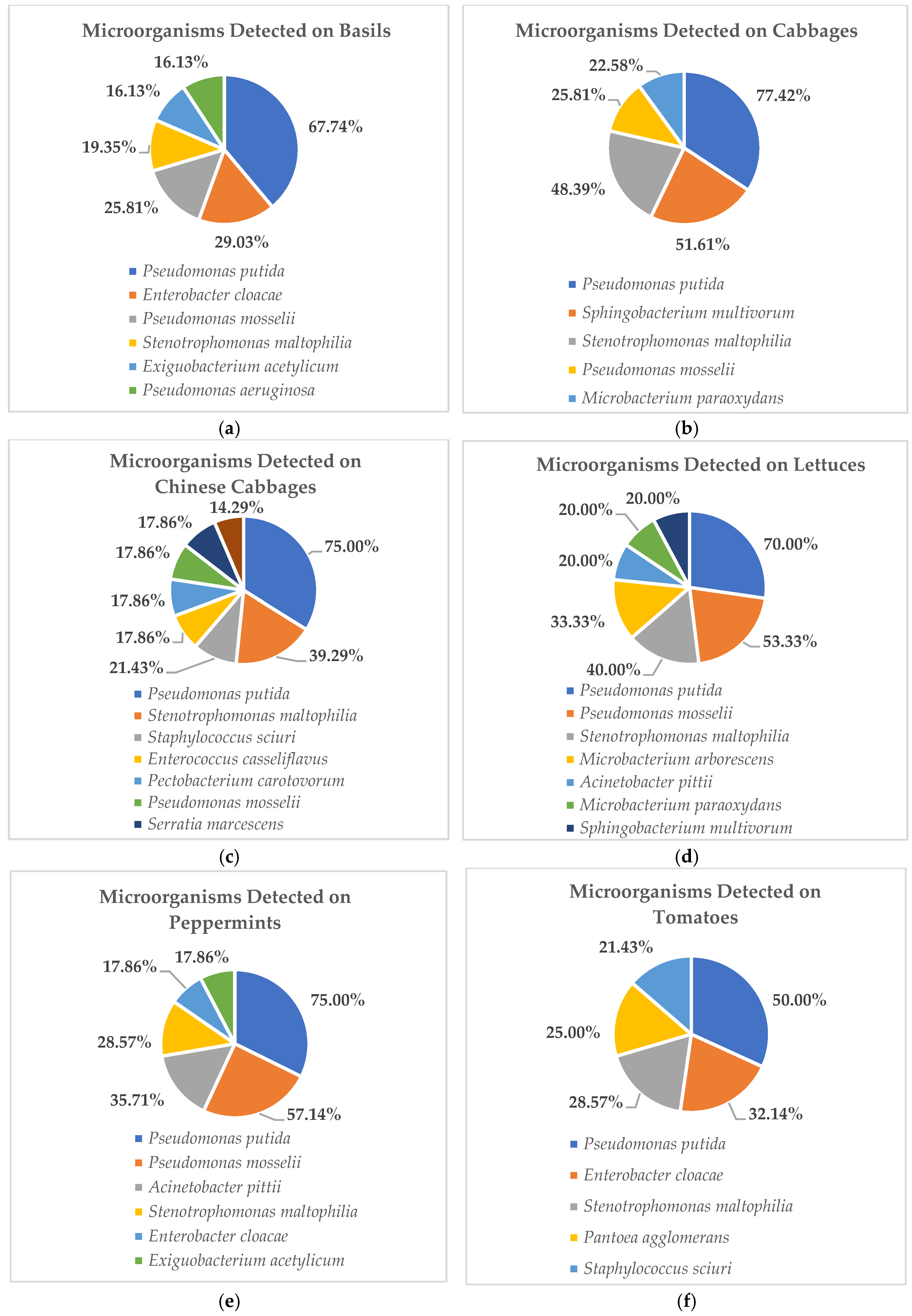
| Basil (n = 31) | Acinetobacter baumannii (9.68%) Acinetobacter pittii (12.90%) Acinetobacter radioresistens (3.23%) Aerococcus viridans (3.23%) Aeromonas punctata (caviae) (9.68%) Bacillus altitudinis/pumilus (6.45%) Bacillus cereus gr. (6.45%) Bacillus megaterium (3.23%) Chryseobacterium spp. (3.23%) Chryseobacterium gleum (3.23%) Chryseobacterium indologenes (3.23%) Comamonas testosterone (3.23%) Corynebacterium glutamicum (3.23%) Elizabethkingia anopheles (3.23%) Empedobacter brevis (12.90%) Enterobacter spp. (9.68%) Enterobacter cancerogenus (3.23%) Enterobacter cloacae (29.03%) | Enterobacter hormaechei (9.68%) Enterobacter kobei (3.23%) Enterobacter ludwigii (3.23%) Enterococcus casseliflavus (6.45%) Enterococcus faecalis (9.68%) Enterococcus gallinarum (3.23%) Exiguobacterium acetylicum (16.13%) Franconibacter pulveris (3.23%) Herbaspirillum huttiense (3.23%) Klebsiella aerogenes (3.23%) Klebsiella oxytoca (3.23%) Klebsiella pneumoniae (12.90%) Lactococcus lactis (9.68%) Leclercia adecarboxylata (3.23%) Leuconostoc lactis (3.23%) Listeria welshimeri (3.23%) Microbacterium paraoxydans (9.68%) Pantoea agglomerans (12.90%) | Pantoea dispersa (9.68%) Pectobacterium carotovorum (9.68%) Pseudomonas spp. (12.90%) Pseudomonas aeruginosa (16.13%) Pseudomonas mendocina (3.23%) Pseudomonas mosselii (25.81%) Pseudomonas putida (67.74%) Raoultella ornithionolytica (3.23%) Serratia marcescens (3.23%) Sphingobacterium multivorum (6.45%) Sphingobacterium thalpophilum (3.23%) Staphylococcus gallinarum (6.45%) Staphylococcus sciuri (3.23%) Staphylococcus xylosus (3.23%) Stenotrophomonas maltophilia (19.35%) Vagococcus fluvialis (3.23%) Weissella confusa (12.90%) |
| Cabbage (n = 31) | Achromobacter xylosoxidans (3.23%) Acinetobacter baumannii (3.23%) Acinetobacter gyllenbergii (3.23%) Acinetobacter pittii (19.35%) Aeromonas spp. (3.23%) Aeromonas punctata (caviae) (3.23%) Bacillus thermoamylovorans (3.23%) Cedecea lapagei (6.45%) Cedecea neteri (3.23%) Chryseobacterium spp. (3.23%) Chryseobacterium gleum (16.13%) Chryseobacterium indologenes (19.35%) Elizabethkingia anopheles (3.23%) Empedobacter brevis (3.23%) Enterococcus casseliflavus (3.23%) Enterobacter cloacae (6.45%) | Exiguobacterium acetylicum (6.45%) Klebsiella oxytoca (3.23%) Klebsiella pneumoniae (6.45%) Klebsiella variicola (3.23%) Lactococcus garvieae (3.23%) Lactococcus lactis (3.23%) Leclerica adecarboxylata (3.23%) Microbacterium spp. (3.23%) Microbacterium arborescens (19.35%) Microbacterium oxydans (9.68%) Microbacterium paraoxydans (22.58%) Microbacterium testaceum (9.68%) Myroides spp. (9.68%) Myroides marinus (6.45%) Pantoea agglomerans (3.23%) Pectobacterium carotovorum (9.68%) | Pseudomonas spp. (9.45%) Pseudomonas aeruginosa (3.23%) Pseudomonas chlororaphis (3.23%) Pseudomonas putida (77.42%) Pseudomonas mendocina (3.23%) Pseudomonas mosselii (25.81%) Rhizobium radiobacter (6.45%) Rothia kristinae (9.68%) Serratia marcescens (6.45%) Sphingobacterium multivorum (51.61%) Staphylococcus hominis (3.23%) Staphylococcus saprophyticus (3.23%) Staphylococcus sciuri (12.90%) Staphylococcus xylosus (3.23%) Stenotrophomonas maltophilia (48.39%) Weissella confusa (6.45%) |
| Chinese Cabbage (n = 28) | Acinetobacter baumannii (3.57%) Acinetobacter calcoaceticus (7.14%) Acinetobacter lwoffii (10.71%) Acinetobacter pittii (10.71%) Aeromonas hydrophilia (3.57%) Aeromonas media (3.57%) Bacillus cereus gr. (3.57%) Bacillus megaterium (3.57%) Chryseobacterium indologenes (3.57%) Comamonas testosterone (3.57%) Empedobacter brevis (7.14%) Enterobacter asburiae (3.57%) Enterobacter cloacae (10.71%) Enterococcus casseliflavus (17.86%) Enterococcus mundtii (3.57%) | Exiguobacterium acetylicum (10.71%) Exiguobacterium aurantiacum (3.57%) Finegoldia magna (3.57%) Herbaspirillum huttiense (3.57%) Klebsiella aerogenes (3.57%) Klebsiella oxytoca (7.14%) Klebsiella pneumoniae (7.14%) Lactococcus garvieae (3.57%) Lactococcus lactis (3.57%) Leclercia adecarboxylata (3.57%) Microbacterium arborescens (3.57%) Microbacterium paraoxydans (7.14%) Myroides spp. (7.14%) Pectobacterium carotovorum (17.86%) Pseudomonas spp. (10.71%) | Pseudomonas aeruginosa (14.29%) Pseudomonas putida (75.00%) Pseudomonas mosselii (17.86%) Pseudomonas nitroreducens (3.57%) Pseudomonas straminea (3.57%) Raoultella ornithionolytica (7.14%) Serratia marcescens (17.86%) Sphingobacterium multivorum (10.71%) Staphylococcus aureus (3.57%) Staphylococcus sciuri (21.43%) Staphylococcus xylosus (10.71%) Stenotrophomonas maltophilia (3.57%) Weissella confusa (21.43%) |
| Lettuce (n = 30) | Acinetobacter baumannii (10.00%) Acinetobacter calcoaceticus (6.67%) Acinetobacter nosocomialis (3.33%) Acinetobacter pittii (20.00%) Aeromonas punctata (caviae) (10.00%) Aeromonas sobria (3.33%) Bacillus cereus gr. (6.67%) Bacillus megaterium (3.33%) Bergeyella zoohelcum (3.33%) Cedecea lapagei (3.33%) Citrobacter koseri (3.33%) Chryseobacterium spp. (16.67%) Chryseobacterium gleum (3.33%) Chryseobacterium indologenes (10.00%) Elizabethkingia anopheles (16.67%) Empedobacter brevis (6.67%) Enterobacter cloacae (16.67%) | Escherichia coli (3.33%) Exiguobacterium acetylicum (13.33%) Klebsiella pneumoniae (13.33%) Kluyvera ascorbate (3.33%) Lactococcus lactis (3.33%) Microbacterium arborescens (33.33%) Microbacterium paraoxydans (20.00%) Myroides spp. (10.00%) Myroides marinus (3.33%) Paenibacillus lautus (3.33%) Pantoea agglomerans (10.00%) Pantoea ananatis (3.33%) Pectobacterium carotovorum (3.33%) Pseudomonas spp. (10.00%) Pseudomonas aeruginosa (6.67%) Pseudomonas alcaligenes (3.33%) Pseudomonas fluorescens (6.67%) | Pseudomonas otitidis (3.33%) Pseudomonas putida (70.00%) Pseudomonas mosselii (53.33%) Pseudomonas oleovorans (3.33%) Pseudomonas oryzihabitans (3.33%) Pseudomonas viridiflava (3.33%) Raoultella ornithionolytica (3.33%) Rhizobium radiobacter (3.33%) Sphingobacterium multivorum (20.00%) Sphingomonas parapaucimobilis (6.67%) Sphingobacterium thalpophilum (6.67%) Staphylococcus arlettae (3.33%) Staphylococcus sciuri (3.33%) Stenotrophomonas maltophilia (40.00%) Weissella confusa (6.67%) |
| Peppermint (n = 28) | Acinetobacter baumannii (14.29%) Acinetobacter gyllenbergii (3.57%) Acinetobacter pittii (35.71%) Aerococcus viridans (3.57%) Aeromonas hydrophilia (3.57%) Aeromonas punctata (caviae) (7.14%) Bacillus cereus gr. (14.29%) Bacillus megaterium (7.14%) Cedecea lapagei (3.57%) Chryseobacterium gleum (7.14%) Comamonas testosterone (3.57%) Corynebacterium glutamicum (3.57%) Delftia acidovoran (3.57%) Elizabethkingia anopheles (3.57%) Empedobacter brevis (7.14%) | Enterobacter asburiae (7.14%) Enterobacter cloacae (17.86%) Enterococcus casseliflavus (3.57%) Exiguobacterium acetylicum (17.86%) Escherichia coli (3.57%) Klebsiella aerogenes (3.57%) Klebsiella oxytoca (3.57%) Klebsiella pneumoniae (3.57%) Kocuria palustris (3.57%) Lactococcus lactis (3.57%) Microbacterium paraoxydans (7.14%) Myroides spp. (3.57%) Myroides ordoratus (3.57%) Pectobacterium carotovorum (14.29%) Pseudomonas spp. (7.14%) | Pseudomonas alcaligenes (3.57%) Pseudomonas aeruginosa (10.71%) Pseudomonas putida (75.00%) Pseudomonas mendocina (3.57%) Pseudomonas mosselii (57.14%) Raoultella ornithionolytica (7.14%) Raoultella terrigena (3.57%) Serratia marcescens (3.57%) Staphylococcus kloosii (3.57%) Staphylococcus sciuri (7.14%) Staphylococcus xylosus (3.57%) Stenotrophomonas maltophilia (28.57%) Weissella confusa (14.29%) |
| Tomato (n = 28) | Acinetobacter baumannii (10.71%) Acinetobacter pittii (10.71%) Bacillus cereus gr. (10.71%) Bacillus altitudinis/pumilus (10.71%) Bacillus subtilis/amyloliquefaciens/vallismortis (3.57%) Cedecea spp. (3.57%) Citrobacter freundii (3.57%) Chryseobacterium indologenes (3.57%) Empedobacter brevis (3.57%) Enterobacter asburiae (3.57%) Enterobacter cloacae (32.14%) Enterobacter hormaechei (3.57%) Enterococcus spp. (3.57%) Enterococcus faecalis (3.57%) Exiguobacterium acetylicum (3.57%) | Helicobacter pylori (3.57%) Klebsiella oxytoca (14.29%) Klebsiella pneumoniae (7.14%) Lactococcus lactis (17.86%) Microbacterium arborescens (3.57%) Microbacterium paraoxydans (3.57%) Paenibacillus lautus (3.57%) Paenibacillus pabuli (3.57%) Pantoea agglomerans (25.00%) Pantoea ananatis (3.57%) Pluralibacter gergoviae (3.57%) Providencia rettgeri (3.57%) Pseudomonas aeruginosa (10.71%) Pseudomonas otitidis (3.57%) Pseudomonas putida (50.00%) | Pseudomonas oryzihabitans (3.57%) Pseudomonas straminea (3.57%) Serratia rubidaea (10.71%) Sphingobacterium multivorum (14.29%) Sphingobacterium thalpophilum (3.57%) Staphylococcus ariettae (3.57%) Staphylococcus cohnii (3.57%) Staphylococcus gallinarum (3.57%) Staphylococcus haemolyticus (10.71%) Staphylococcus saprophyticus (3.57%) Staphylococcus sciuri (21.43%) Staphylococcus xylosus (14.29%) Stenotrophomonas maltophilia (28.57%) Weissella confusa (14.29%) |
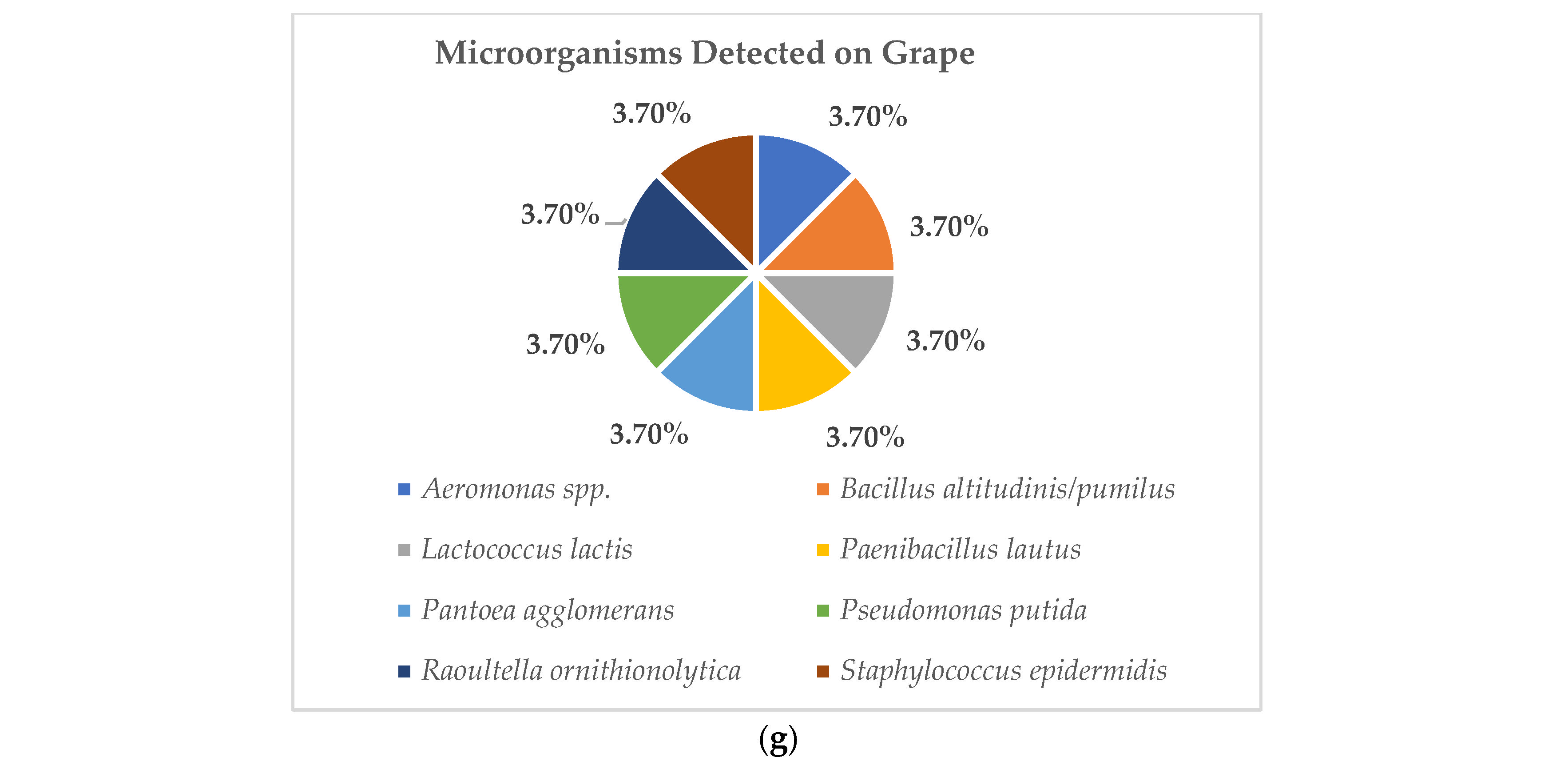
| Grape (n = 27) | Aeromonas spp. (3.70%) Bacillus altitudinis/pumilus (3.70%) Lactococcus lactis (3.70%) | Paenibacillus lautus (3.70%) Pantoea agglomerans (3.70%) Pseudomonas putida (3.70%) | Raoultella ornithionolytica (3.70%) Staphylococcus epidermidis (3.70%) |
| Colony No. | Microorganism | Source of Microorganism | Antibiotic Inhibition Zone Size (mm.) | ESBL-AST Interpretation * | |||
|---|---|---|---|---|---|---|---|
| CAZ30 | CAC30/10 | CTX30 | CEC30/10 | ||||
| 1 | K. oxytoca | Tomato | 25 | 22 | 21 | 29 | Positive |
| 2 | P. mirabilis | Cabbage | 26 | 26 | 31 | 31 | Negative |
| 3 | P. mirabilis | Chinese cabbage | 25 | 24 | 35 | 35 | Negative |
| 4 | P. mirabilis | Lettuce | 22 | 21 | 30 | 32 | Negative |
| 5 | P. mirabilis | Lettuce | 28 | 27 | 34 | 33 | Negative |
| 6 | P. vulgaris | Chinese cabbage | 21 | 20 | 25 | 24 | Negative |
| 7 | P. vulgaris | Chinese cabbage | 27 | 25 | 30 | 31 | Negative |
| 8 | P. vulgaris | Peppermint | 22 | 19 | 23 | 25 | Negative |
Disclaimer/Publisher’s Note: The statements, opinions and data contained in all publications are solely those of the individual author(s) and contributor(s) and not of MDPI and/or the editor(s). MDPI and/or the editor(s) disclaim responsibility for any injury to people or property resulting from any ideas, methods, instructions or products referred to in the content. |
© 2025 by the authors. Licensee MDPI, Basel, Switzerland. This article is an open access article distributed under the terms and conditions of the Creative Commons Attribution (CC BY) license.
Share and Cite
Dokuta, S.; Yadoung, S.; Khamnoi, P.; Hongjaisee, S.; Chuttong, B.; Hongsibsong, S. The Prevalence of Microorganisms on Vegetables and Fruit from Wet Markets in Chiang Mai Province, Northern Thailand. Foods 2026, 15, 80. https://doi.org/10.3390/foods15010080
Dokuta S, Yadoung S, Khamnoi P, Hongjaisee S, Chuttong B, Hongsibsong S. The Prevalence of Microorganisms on Vegetables and Fruit from Wet Markets in Chiang Mai Province, Northern Thailand. Foods. 2026; 15(1):80. https://doi.org/10.3390/foods15010080
Chicago/Turabian StyleDokuta, Sirikwan, Sumed Yadoung, Phadungkiat Khamnoi, Sayamon Hongjaisee, Bajaree Chuttong, and Surat Hongsibsong. 2026. "The Prevalence of Microorganisms on Vegetables and Fruit from Wet Markets in Chiang Mai Province, Northern Thailand" Foods 15, no. 1: 80. https://doi.org/10.3390/foods15010080
APA StyleDokuta, S., Yadoung, S., Khamnoi, P., Hongjaisee, S., Chuttong, B., & Hongsibsong, S. (2026). The Prevalence of Microorganisms on Vegetables and Fruit from Wet Markets in Chiang Mai Province, Northern Thailand. Foods, 15(1), 80. https://doi.org/10.3390/foods15010080