Postharvest Application of Black Mustard (Brassica nigra) Seed Derivatives in Sweet Cherry Packaging for Rot Control


Abstract
1. Introduction
2. Materials and Methods
2.1. Materials
2.2. In Vitro Antifungal Activity
2.3. In Vivo Antifungal Activity
2.4. Evaluation of AITC Effect on Packaged Sweet Cherries
- −
- Sweet cherries (Control)
- −
- Fludioxonil (2.5 mL L−1 (v/v) for 5 min; Scholar 230 SC, 230 g a.i. L−1; Syngenta, Basel, Switzerland)-treated sweet cherries (T1)
- −
- Sweet cherries + 50 mg of black mustard seeds (“Inbox” format) (T2)
- −
- Sweet cherries + 100 mg of black mustard seeds (“Inbox” format) (T3)
- −
- Fludioxonil-treated sweet cherries + 50 mg of black mustard seeds (“Inbox” format) (T4)
- −
- Fludioxonil-treated sweet cherries + 100 mg of black mustard seeds (“Inbox” format) (T5)
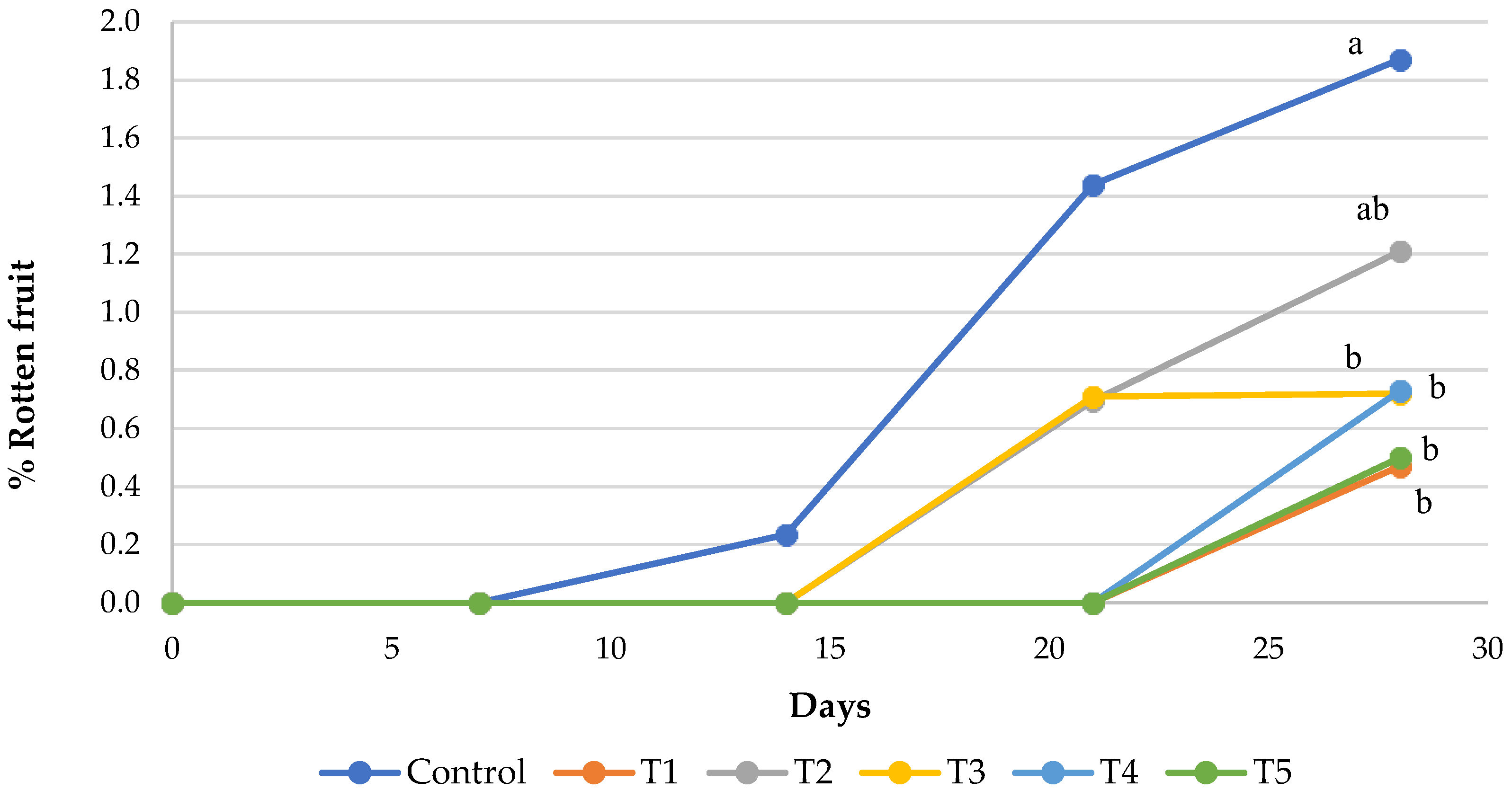
2.4.1. Weight Loss, Headspace Gas Composition and Fruit Decay
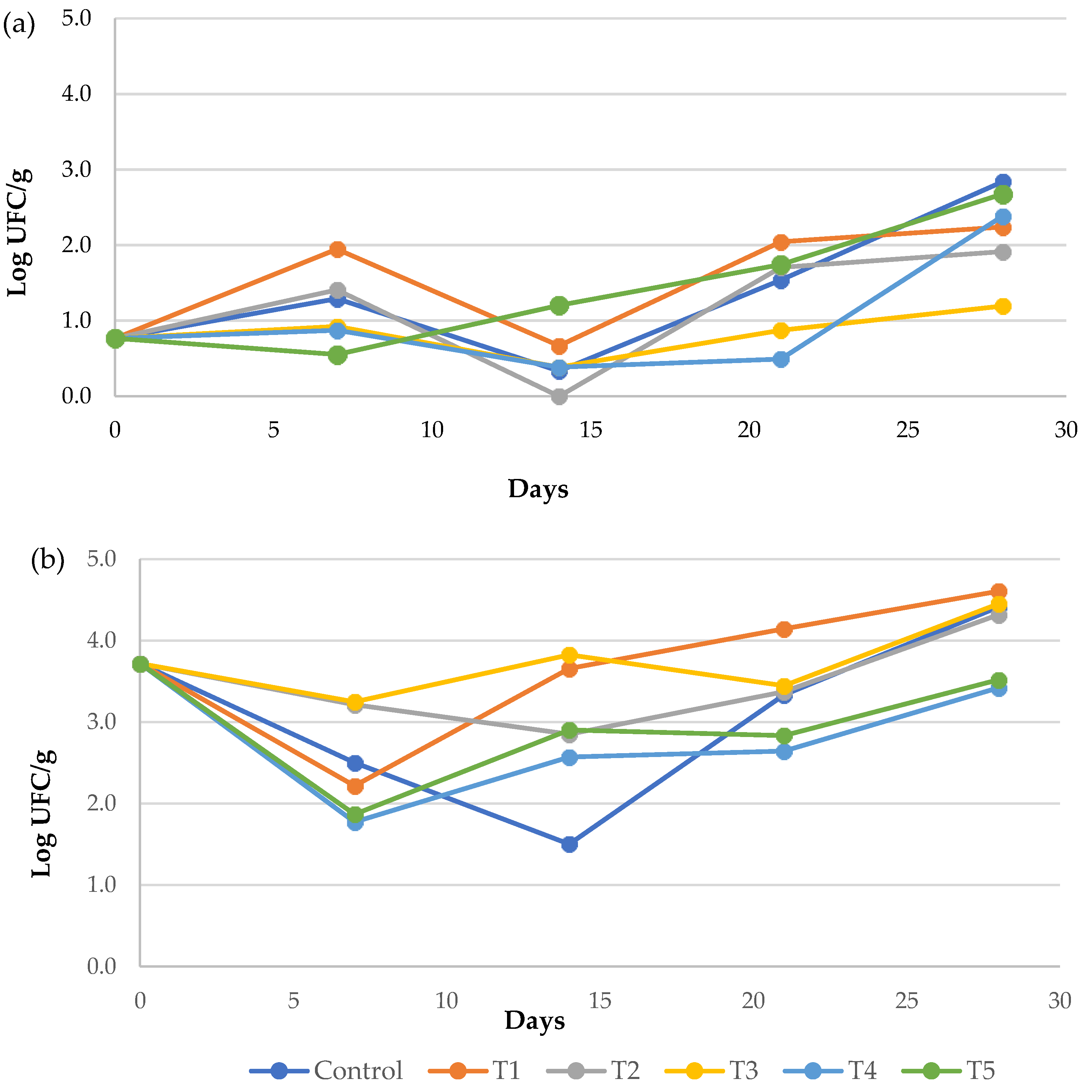
2.4.2. Microbial Counts
2.4.3. Physicochemical Analysis
2.5. Statistical Analysis
3. Results and Discussion
3.1. In Vitro Antifungal Activity
3.2. In Vivo Antifungal Activity
3.3. Evaluation of AITC Effect on Packaged Sweet Cherries
3.3.1. Weight Loss, Headspace Gas Composition and Fruit Decay
3.3.2. Microbial Counts
3.3.3. Physicochemical Characterization
4. Conclusions
Supplementary Materials
Author Contributions
Funding
Institutional Review Board Statement
Informed Consent Statement
Data Availability Statement
Acknowledgments
Conflicts of Interest
Abbreviations
| ITCs | Isothiocyanates |
| AITC | Allyl Isothiocyanate |
| RH | Relative humidity |
| PCA | Plate Count Agar |
| PDA | Potato Glucose Agar |
| TSS | Total soluble solids |
| TA | Titratable |
References
- Ricardo-Rodrigues, S.; Laranjo, M.; Agulheiro-Santos, A.C. Methods for quality evaluation of sweet cherry. J. Sci. Food Agric. 2022, 103, 463–478. [Google Scholar] [CrossRef]
- Serradilla, M.J.; Martín, A.; Ruiz-Moyano, S.; Hernández, A.; López-Corrales, M.; Córdoba, M.D.G. Physicochemical and sensorial characterisation of four sweet cherry cultivars grown in Jerte Valley (Spain). Food Chem. 2012, 133, 1551–1559. [Google Scholar] [CrossRef]
- FAO. 2023. Available online: http://www.fao.org (accessed on 17 October 2025).
- Eugui, D.; Velasco, P.; Poveda, J. Glucosinolates and their hydrolysis products as a sustainable strategy in the control of postharvest diseases in non-Brassicaceae fruits and vegetables. J. Stored Prod. Res. 2026, 115, 102825. [Google Scholar] [CrossRef]
- Xu, J.; Chen, L.; Dong, J.; Jiang, L. Overview of fruit cracking in sweet cherry (Prunus avium L.): Causes, testing methods, mitigation strategies, and research perspectives. Front. Sustain. Food Syst. 2025, 9, 1534778. [Google Scholar] [CrossRef]
- Liu, X.; Ji, D.; Cui, X.; Zhang, Z.; Li, B.; Xu, Y.; Chen, T.; Tian, S. p-Coumaric acid induces antioxidant capacity and defense responses of sweet cherry fruit to fungal pathogens. Postharvest Biol. Technol. 2020, 169, 111297. [Google Scholar] [CrossRef]
- Riva, S.C.; Opara, U.O.; Fawole, O.A. Recent developments on postharvest application of edible coatings on stone fruit: A review. Sci. Hortic. 2020, 262, 109074. [Google Scholar] [CrossRef]
- Wani, S.M.; Mohd, S.; Zehra, A.; Naseem, Z.; Bashir, I.; Hussain, S.Z.; Malik, A.R.; Amin, T.; Rasool, K.; Mustafa, S. Enhancing the postharvest quality and storage stability of sweet cherries (Prunus avium) using nano-chitosan and nano-alginate coatings enriched with pomegranate peel extract. Biocat Agr Biotech. 2025, 69, 103820. [Google Scholar] [CrossRef]
- Yang, Y.; Li, A.; Guo, M.; Kong, Y.; Zhang, J.; Wang, J.; Sun, S.; Li, X.; Zeng, X.; Gong, H.; et al. Improving the storage quality and aroma quality of sweet cherry by postharvest 3-phenyllactic acid treatment. Sci. Hortic. 2024, 338, 113661. [Google Scholar] [CrossRef]
- Firouz, M.S.; Mohi-Alden, K.; Omid, M. A critical review on intelligent and active packaging in the food industry: Research and development. Food Res. Int. 2021, 141, 110113. [Google Scholar] [CrossRef]
- Han, J.H. Antimicrobial packaging systems. In Innovations in Food Packaging; Academic Press: Cambridge, MA, USA, 2005; pp. 80–107. [Google Scholar]
- Kurek, M.; Laridon, Y.; Torrieri, E.; Guillard, V.; Pant, A.; Stramm, C.; Guillaume, C. A mathematical model for tailoring antimicrobial packaging material containing encapsulated volatile compounds. Innov. Food Sci. Emerg. Technol. 2017, 42, 64–72. [Google Scholar] [CrossRef]
- Mari, M.; Bautista-Baños, S.; Sivakumarc, D. Decay control in the postharvest system: Role of microbial and plant volatile organic compounds. Postharvest Biol. Technol. 2016, 122, 70–81. [Google Scholar] [CrossRef]
- Dai, R.Y.; Lim, L.T. Release of allyl isothiocyanate from mustard seed meal powder. J. Food Sci. 2014, 79, 47–53. [Google Scholar] [CrossRef]
- Bahmid, N.A.; Pepping, L.; Dekker, M.; Fogliano, V.; Heisinga, J. Using particle size and fat content to control the release of Allyl isothiocyanate from ground mustard seeds for its application in antimicrobial packaging. Food Chem. 2020, 308, 125573. [Google Scholar] [CrossRef]
- Calvo, P.; Blanco, M.S.; Rodríguez, M.J.; Serradilla, M.J.; Sánchez, F. Caracterización de semilla de mostaza negra (Brassica nigra) como fuente de alil-isotiocianato para su aplicación en el envasado de frutas. In Frutas y Hortalizas. Innovaciones en Pre- y Postcosecha; Serradilla, M.J., García, M.J.B., Eds.; Fundación Dialnet: La Rioja, Spain, 2018; pp. 193–196. [Google Scholar]
- Serradilla, M.J.; Villalobos, M.V.; Hernández, A.; Martín, A.; Lozano, M.; Córdoba, M.G. Study of microbiological quality of controlled atmosphere packaged ‘Ambrunés’ sweet cherries and subsequent shelf-life. Int. J. Food Microbiol. 2013, 166, 85–92. [Google Scholar] [CrossRef] [PubMed]
- Barea-Ramos, J.D.; Rodríguez, M.J.; Calvo, P.; Melendez, F.; Lozano, J.; Martín-Vertedor, D. Inhibition of Botrytis cinerea in tomatoes by allyl-isothiocyanate release from black mustard (Brassica nigra) seeds and detection by E-nose. Food Chem. 2024, 462, 137222. [Google Scholar] [CrossRef]
- Calvo, P.; Blanco, M.S.; Rodríguez, M.J.; Serradilla, M.J.; Sánchez, F. In vitro and in vivo antifungal activity of allyl isothiocyanate (AITC) against Penillicium expansum in figs (Ficus carica L.). Acta Hortic. 2021, 1310, 275–278. [Google Scholar] [CrossRef]
- Villalobos, M.C.; Serradilla, M.J.; Martín, A.; Ruiz-Moyano, S.; Pereira, C.; Córdoba, M.G. Use of equilibrium modified atmosphere packaging for preservation of ‘SanAntonio’ and ‘Banane’ breba crops (Ficus carica L.). Postharvest Biol. Technol. 2014, 98, 14–22. [Google Scholar] [CrossRef]
- Villalobos, M.C.; Serradilla, M.J.; Martín, A.; Hernández-León, A.; Ruíz-Moyano, S.; de Guía Córdoba, M. Characterization of microbial population of breba and main crops (Ficus carica) during cold storage: Influence of passive modified atmospheres (MAP) and antimicrobial extract application. Food microbiol. 2017, 63, 35–46. [Google Scholar] [CrossRef]
- Alamar, M.C.; Collings, E.; Cools, K.; Terry, L.A. Impact of controlled atmosphere scheduling on strawberry and imported avocado fruit. Postharvest Biol. Technol. 2017, 134, 76–86. [Google Scholar] [CrossRef]
- Calvo, P.; Blanco, M.S.; Rodríguez, M.J.; Sánchez, F. Estudio de liberación de alil-isotiocianato y aplicación in vitro en el control de patógenos postcosecha. In Frutas y Hortalizas. Innovaciones en Pre- y Postcosecha; Serradilla, M.J., García, M.J.B., Eds.; Caja Rural de Extremadura: Madrid, Spain, 2018; pp. 165–168. [Google Scholar]
- Manyes, L.; Luciano, F.B.; Mañes, J.; Meca, G. In vitro antifungal activity of allyl isothiocyanate (AITC) against Aspergillus parasiticus and Penicillium expansum and evaluation of the AITC estimated daily intake. Food Chem. Toxicol. 2015, 83, 293–299. [Google Scholar] [CrossRef] [PubMed]
- Maruthupandy, M.; Seo, J. Allyl isothiocyanate encapsulated halloysite covered with polyacrylate as a potential antibacterial agent against food spoilage bacteria. Mater. Sci. Eng. C. 2019, 105, 110016. [Google Scholar] [CrossRef]
- Peng, C.; Zhao, S.Q.; Zhang, J.; Huang, G.Y.; Chen, L.Y.; Zhao, F.Y. Chemical composition, antimicrobial property and microencapsulation of Mustard (Sinapis alba) seed essential oil by complex coacervation. Food Chem. 2014, 165, 560–568. [Google Scholar] [CrossRef]
- Wilson, A.E.; Bergaentzlé, M.; Bindler, F.; Marchioni, E.; Lintz, A.; Ennahar, S. In vitro efficacies of various isothiocyanates from cruciferous vegetables as antimicrobial agents against foodborne pathogens and spoilage bacteria. Food Control 2013, 30, 318–324. [Google Scholar] [CrossRef]
- Sun, Y.; Wang, Y.; Xu, Y.; Chen, T.; Li, B.; Zhang, Z.; Tian, S. Application and mechanism of benzyl-isothiocyanate, a natural antimicrobial agent from cruciferous vegetables, in controlling postharvest decay of strawberry. Postharvest Biol. Technol. 2021, 180, 111604. [Google Scholar] [CrossRef]
- Yang, B.; Li, L.; Geng, H.; Zhang, C.; Wang, G.; Yang, S.; Gao, S.; Zhao, Y.; Xing, F. Inhibitory effect of allyl and benzyl isothiocyanates on ochratoxin a producing fungi in grape and maize. Food Microbiol. 2021, 100, 103865. [Google Scholar] [CrossRef]
- Serradilla, M.J.; Falagána, F.; Bohmer, B.; Terry, L.A.; Alamar, M.C. The role of ethylene and 1-MCP in early-season sweet cherry ‘Burlat’ storage life. Sci. Hortic. 2019, 258, 108787. [Google Scholar] [CrossRef]
- Gidado, M.J.; Gunny, A.A.N.; Gopinath, S.C.B.; Ali, A.; Wongs-Aree, C.; Salleh, N.H.M. Challenges of postharvest water loss in fruits: Mechanisms, influencing factors, and effective control strategies—A comprehensive review. J. Agric. Food Res. 2024, 17, 101249. [Google Scholar] [CrossRef]
- Colussi, R.; Ferreira da Silva, W.M.; Biduski, B.; El Halal, S.L.M.; da Rosa Zavareze, E.; Guerra Dias, A.R. Postharvest quality and antioxidant activity extension of strawberry fruit using allyl isothiocyanate encapsulated by electrospun zein ultrafine fibers. LWT-Food Sci. Technol. 2021, 143, 111087. [Google Scholar] [CrossRef]
- Kahramanoglu, I. Effects of lemongrass oil application and modified atmosphere packaging on the postharvest life and quality of strawberry fruits. Sci. Hortic. 2019, 256, 108527. [Google Scholar] [CrossRef]
- Chen, H.; Gao, H.; Fang, K.; Ye, L.; Zhou, Y.; Yang, H. Effects of allyl isothiocyanate treatment on postharvest quality and the activities of antioxidant enzymes of mulberry fruit. Postharvest Biol. Technol. 2015, 108, 61–67. [Google Scholar] [CrossRef]
- Song, H.J.; Ku, K.M. Optimization of allyl isothiocyanate sanitizing concentration for inactivation of Salmonella Typhimurium on lettuce based on its phenotypic and metabolome changes. Food Chem. 2021, 364, 130438. [Google Scholar] [CrossRef]
- Kramer, B.; Wunderlich, J.; Muranyi, P. Impact of volatile allyl isothiocyanate on fresh produce. Food Packag. Shelf Life 2018, 16, 220–224. [Google Scholar] [CrossRef]
- Wang, S.Y.; Chen, C.; Yin, J. Effect of allyl isothiocyanate on antioxidants and fruit decay of blueberries. Food Chem. 2010, 120, 199–204. [Google Scholar] [CrossRef]
- Park, S.; Park, S.-Y.; Liu, K.-H.; Ku, K.-M. Optimal allyl isothiocyanate concentration on Botrytis cinerea during the postharvest storage of blackberries and mechanism of blackberry color changes at high concentration of allyl isothiocyanate. Postharvest Biol. Technol. 2023, 199, 112292. [Google Scholar] [CrossRef]
- Ugolini, L.; Martini, C.; Lazzeri, L.; D’Avino, L.; Mari, M. Control of postharvest grey mould (Botrytis cinerea Per.: Fr.) on strawberries by glucosinolate-derived allyl-isothiocyanate treatments. Postharvest Biol. Technol. 2014, 90, 34–39. [Google Scholar] [CrossRef]
- Wu, H.; Xue, N.; Hou, C.; Feng, J.; Zhang, X. Microcapsule preparation of allyl isothiocyanate and its application on mature green tomato preservation. Food Chem. 2015, 175, 344–349. [Google Scholar] [CrossRef] [PubMed]
- Chen, J.; Wei, X.; Lu, X.; Ming, R.; Huang, D.; Yao, Y.; Li, L.; Huang, R. Burkholderia cenocepacia ETR-B22 volatile organic compounds suppress postharvest grey mould infection and maintain aroma quality of tomato fruit. LWT-Food Sci. Technol. 2022, 165, 113715. [Google Scholar] [CrossRef]
- Alibrahem, W.; Nguyen, D.H.H.; Helu, N.K.; Tóth, F.; Nagy, P.T.; Posta, J.; Prokisch, J.; Oláh, C. Health Benefits, Applications, and Analytical Methods of Freshly Produced Allyl Isothiocyanate. Foods 2025, 14, 579. [Google Scholar] [CrossRef]
- Banerjee, A.; Penna, S.; Variyar, P.S. Allyl isothiocyanate enhances shelf life of minimally processed shredded cabbage. Food Chem. 2015, 183, 265–272. [Google Scholar] [CrossRef]
- Bahmid, N.A.; Dekker, M.; Fogliano, V.; Heising, J. Development of a moisture-activated antimicrobial film containing ground mustard seeds and its application on meat in active packaging system. Food Packag. Shelf Life 2021, 30, 100753. [Google Scholar] [CrossRef]
- Li, L.; Lin, Y.; Addo, K.A.; Yu, Y.; Liao, C. Effect of allyl isothiocyanate on the growth and virulence of Clostridium perfringens and its application on cooked pork. Food Res. Int. 2023, 172, 113110. [Google Scholar] [CrossRef] [PubMed]
- Abdipour, M.; Malekhossini, P.S.; Hosseinifarahi, M.; Radi, M. Integration of UV irradiation and chitosan coating: A powerful treatment for maintaining the postharvest quality of sweet cherry fruit. Sci. Hortic. 2020, 264, 109197. [Google Scholar] [CrossRef]



| Initial Values (Day 0) | Fruit Quality at 28 Days of Storage | ||||||
|---|---|---|---|---|---|---|---|
| Control | T1 | T2 | T3 | T4 | T5 | ||
| TSS | 15.9 ± 0.9 ab | 17.0 ± 1.10 a | 16.4 ± 0.8 ab | 16.2 ± 1.4 ab | 14.9 ± 0.5 bc | 14.3 ± 0.5 c | 15.2 ± 1.7 abc |
| TA | 0.59 ± 0.04 a | 0.30 ± 0.01 b | 0.28 ± 0.03 bc | 0.29 ± 0.01 b | 0.29 ± 0.01 b | 0.26 ± 0.02 c | 0.29 ± 0.04 bc |
| pH | 4.14 ± 0.14 b | 4.40 ± 0.06 a | 4.44 ± 0.08 a | 4.38 ± 0.06 a | 4.38 ± 0.04 a | 4.37 ± 0.07 a | 4.42 ± 0.09 a |
| L* | 32.4 ± 2.5 a | 27.6 ± 2.3 ef | 27.4 ± 2.9 f | 28.4 ± 3.6 de | 30.3 ± 3.1 b | 29.1 ± 2.7 c | 29.6 ± 5.0 cd |
| C* | 28.6 ± 6.2 a | 18.8 ± 9.5 d | 20.7 ± 9.9 d | 25.8 ± 11.0 bc | 27.5 ± 7.9 ab | 25.0 ± 9.3 bc | 24.8 ± 11.2 c |
| h* | 17.1 ± 3.0 ab | 16.3 ± 3.5 bc | 18.8 ± 11.4 bc | 17.1 ± 4.2 abc | 17.8 ± 3.8 a | 15.9 ± 3.3 c | 16.9 ± 4.7 bc |
| Firmness (N/mm) | 1.04 ± 0.11 ab | 1.08 ± 0.06 ab | 0.90 ± 0.03 b | 1.11 ± 0.08 ab | 1.23 ± 0.09 a | 1.10 ± 0.04 ab | 1.16 ± 0.19 ab |
Disclaimer/Publisher’s Note: The statements, opinions and data contained in all publications are solely those of the individual author(s) and contributor(s) and not of MDPI and/or the editor(s). MDPI and/or the editor(s) disclaim responsibility for any injury to people or property resulting from any ideas, methods, instructions or products referred to in the content. |
© 2026 by the authors. Licensee MDPI, Basel, Switzerland. This article is an open access article distributed under the terms and conditions of the Creative Commons Attribution (CC BY) license (https://creativecommons.org/licenses/by/4.0/).
Share and Cite
Calvo, P.; Rodríguez, M.J.; Serradilla, M.J.; Bernalte, M.J. Postharvest Application of Black Mustard (Brassica nigra) Seed Derivatives in Sweet Cherry Packaging for Rot Control. Foods 2026, 15, 161. https://doi.org/10.3390/foods15010161
Calvo P, Rodríguez MJ, Serradilla MJ, Bernalte MJ. Postharvest Application of Black Mustard (Brassica nigra) Seed Derivatives in Sweet Cherry Packaging for Rot Control. Foods. 2026; 15(1):161. https://doi.org/10.3390/foods15010161
Chicago/Turabian StyleCalvo, Patricia, M.ª José Rodríguez, Manuel J. Serradilla, and Mª Josefa Bernalte. 2026. "Postharvest Application of Black Mustard (Brassica nigra) Seed Derivatives in Sweet Cherry Packaging for Rot Control" Foods 15, no. 1: 161. https://doi.org/10.3390/foods15010161
APA StyleCalvo, P., Rodríguez, M. J., Serradilla, M. J., & Bernalte, M. J. (2026). Postharvest Application of Black Mustard (Brassica nigra) Seed Derivatives in Sweet Cherry Packaging for Rot Control. Foods, 15(1), 161. https://doi.org/10.3390/foods15010161