Next Article in Journal
Biochemical Quality Profile of Black Tea from Upper Assam and North Bank Region of Assam, India
Previous Article in Journal
Isolation of a New Acetobacter pasteurianus Strain from Spontaneous Wine Fermentations and Evaluation of Its Bacterial Cellulose Production Capacity on Natural Agrifood Sidestreams
error_outline You can access the new MDPI.com website here. Explore and share your feedback with us.
 
 
Article

Cross-National Analysis of Consumer Preferences for Organic Food in Portugal, Spain, and Greece: Socio-Demographic Drivers and Attribute Importance

1
Centre for Research and Development in Agrifood Systems and Sustainability (CISAS), Instituto Politécnico de Viana do Castelo (IPVC), 4900-347 Viana do Castelo, Portugal
2
Estação Zootécnica Nacional, Instituto Nacional de Investigação Agrária e Veterinária, 2500-424 Vale de Santarém, Portugal
3
Food of Animal Origin Laboratory, Animal Science Department, University of Thessaly, 41500 Larisa, Greece
4
Food Chemistry, Biochemistry and Technology Laboratory, Nutrition and Dietetics Department, University of Thessaly, 42132 Trikala, Greece
5
Department of Hygiene and Epidemiology, Faculty of Medicine, University of Thessaly, 41500 Larisa, Greece
6
Escola Superior de Tecnologia e Gestão (ESTG), Instituto Politécnico de Viana do Castelo (IPVC), 4900-347 Viana do Castelo, Portugal
*
Author to whom correspondence should be addressed.
Foods 2026, 15(1), 155; https://doi.org/10.3390/foods15010155
Submission received: 5 December 2025 / Revised: 22 December 2025 / Accepted: 24 December 2025 / Published: 3 January 2026
(This article belongs to the Section Sensory and Consumer Sciences)

Abstract

Consumer demand for organic products has grown substantially in Southern Europe, driven by health, environmental, and ethical concerns. Understanding cross-country differences in attribute preferences and sociodemographic influences is critical to inform marketing strategies and policy interventions targeting organic food consumption. To perform a comparative study across Portugal, Spain, and Greece, regular organic consumers were surveyed (250 per country) using a culturally adapted Best–Worst Scaling questionnaire. Socio-demographic variables and ten organic food attributes were analysed using MANOVA, Kruskal–Wallis tests, PCA, and cluster analysis. Spanish and Portuguese consumers prioritised health, environmental impact, absence of GMOs, and certification, while Greeks emphasised price, appearance, taste expectation, and nutrition. Age, gender, and education influenced attribute importance differently across countries, revealing distinct national consumption patterns and preferences. Findings highlight substantial heterogeneity: health and environmental attributes dominate in Portugal and Spain, reflecting strong certification and sustainability awareness, whereas Greek consumers focus on value, sensory qualities, and nutrition, indicating lower organic uptake and stronger price sensitivity. Older and more educated consumers valued certification and provenance, women emphasised health and environmental benefits, and men responded more to convenience and status cues. These patterns suggest that marketing and policy strategies should combine universal motivators with tailored approaches addressing national, demographic, and cultural differences to enhance organic consumption. Cross-country differences reveal the need for context-specific interventions promoting organic food while leveraging common health and sustainability drivers.

1. Introduction

Driven by a complex interplay of socio-economic, environmental, and health-related concerns, global consumer demand for organic products has witnessed a marked and sustained increase in recent years. This shift reflects broader societal trends toward sustainability and ethical consumption, necessitating the development of more resilient and environmentally responsible agri-food supply chains [1,2]. Within the European Union (EU), this trend is particularly pronounced, as evidenced by a substantial expansion in certified organic agricultural land pushed by the Common Agricultural Policy. Research has demonstrated that EU citizens support these policies [3,4]. According to Eurostat, the total organic area in the EU grew by 79% between 2012 and 2022, reaching approximately 16.9 million hectares in 2022 [5].
Southern European countries, specifically Greece, Portugal, and Spain, have played a significant role in this expansion. In Greece, the organic agricultural area nearly doubled over the decade, increasing from 462,618 ha in 2012 to 924,853 ha in 2022. Portugal demonstrated an even more pronounced growth trajectory, with organic farmland expanding from 200,833 ha to 759,977 ha over the same period. Similarly, Spain’s organic area more than doubled, rising from 1,167,362 ha in 2012 to 2,349,475 ha in 2022. These developments reflect not only domestic policy support and EU-level incentives but also a growing alignment with consumer preferences for sustainable food systems [6]. Notably, in 2022, the combined organic area of Greece, Portugal, and Spain accounted for 25.8% of the EU’s total organic farmland, underscoring their pivotal role in advancing the EU’s ecological transition in agriculture [5].
The intensification of agricultural production over recent decades has been accompanied by the widespread and, at times, indiscriminate use of herbicides, pesticides, synthetic fertilisers, genetically modified organisms (GMOs), antibiotics, and other agrochemical inputs. This trajectory has prompted significant concern within the scientific community regarding the detrimental impacts of such practices on environmental sustainability, biodiversity, soil health, and ecosystem resilience [7,8]. In response to mounting evidence and increasing global awareness, consumers are becoming more cognizant of the broader implications of their dietary choices. These evolving attitudes are reshaping consumption patterns, with a growing segment of the population actively seeking products that align with environmental sustainability principles [9,10].
Within the EU, the production, processing, and labelling of organic products are regulated by Regulation (EU) 2018/848, which establishes comprehensive standards aimed at promoting environmentally sound and socially responsible agricultural practices [11].
Many consumers perceive organic foods as healthier, safer, and more nutritious than their conventional counterparts, which significantly influences purchasing decisions [12,13,14,15]. In recent years, heightened demand for organic products has also been fuelled by recurring food safety scandals widely covered in the media, which have amplified public concern about the integrity and safety of conventional food systems [16,17]. Moreover, the COVID-19 pandemic further intensified health consciousness among consumers, leading to a discernible shift in purchasing patterns toward products perceived as more natural and less chemically intensive [18].
Beyond health and safety, several other factors shape consumer attitudes toward organic food. Sensory attributes such as taste, texture, and appearance play an important role in product selection [19,20], as does the presence of organic certification labels. The efficacy of these labels in influencing consumer behaviour largely depends on the degree of recognition and trust they command [21]. Socio-demographic and structural variables (including urbanisation, education level, age, gender, and income) also contribute to the heterogeneity of consumer preferences [22].
A range of economic and structural barriers also significantly shape consumer behaviour toward organic food in Greece, Portugal, and Spain. These include widespread mistrust in organic certification schemes [12,15,23], the relatively high price of organic products compared to the conventional alternative [24,25,26], and the limited availability of organic food items in mainstream retail outlets, particularly supermarkets [13,27,28].
By systematically examining the multifaceted cross-national differences in consumer perceptions and priorities regarding organic food in Greece, Portugal, and Spain, this study endeavours to generate comprehensive and contextually grounded insights. The knowledge, attitude [29], and practice framework is used to systematically assess what people know, how they feel, and how they behave in relation to organic food. By identifying gaps and misalignments among these three components, practitioners can design more targeted and effective interventions. This research aims to inform the design and implementation of targeted marketing strategies that resonate with diverse consumer segments, while also guiding public policy frameworks toward greater inclusivity and effectiveness.
This article seeks to consolidate and expand upon previous analyses conducted in Portugal [15], Spain [13], and Greece [14], aiming to explore the similarities and divergences in organic food consumer profiles in the three countries.

2. Materials and Methods

The questionnaires employed in these studies were meticulously translated into the respective national languages to preserve semantic accuracy and cultural appropriateness. To ensure clarity, relevance, and comprehensive understanding across diverse participant groups, a rigorous pre-testing phase was conducted in each country. This process involved pilot testing with representative samples, allowing for refinement of wording, adaptation of culturally specific references, and validation of the questionnaire’s overall comprehensibility.
Each questionnaire included a detailed informed consent section, which participants were required to review and explicitly acknowledge before proceeding with the survey. This ensured that respondents were fully aware of the study’s purpose, their rights, and the voluntary nature of their participation. Ethical approval for the study in all countries was obtained from the Department of Animal Science at the University of Thessaly, Greece (reference number 30515/24/TEZP), underscoring adherence to rigorous ethical standards in cross-national research.

2.1. Generic Description of Sample Preparation and Data Collection in Portugal, Spain, and Greece

In the three national studies, conducted in Portugal, Spain, and Greece, a quota sampling strategy was employed to ensure demographic representativeness. Quotas were established proportionally according to key variables: region of residence, age group, gender, and educational attainment.
Participants were initially invited to complete a structured online questionnaire. However, to fulfil all predefined quotas and guarantee adequate representation across demographic strata, face-to-face interviews were conducted when necessary. To maintain the focus on regular organic food consumers, individuals who reported consuming fewer than three organic products per week were excluded from the sample. A total of 750 questionnaires were administered (250 in each country) with data collection taking place between 2020 and 2023.
The questionnaire was structured in two main sections. The first section collected socio-demographic and behavioural information through six classification variables: gender, age, place of residence, education level, presence of children under 18 years old in the household, and usual place of purchase of organic products. This information is summarised in Table 1.
The second section assessed the perceived importance of ten key attributes associated with organic food products: price, more natural appearance, certification warranty, origin, expected better taste, availability, health benefits, environmental impact, nutritional value, and absence of GMOs. This evaluation was conducted using the Best–Worst Scaling (BWS) method, which allows for the identification of relative preferences by asking respondents to indicate the most and least important attributes across a series of choice sets.
According to this framework, three credence attributes were considered: health benefits (‘Health’) [30,31,32,33], environmental impact (‘Environment’) [34,35,36,37,38,39], and nutritional value (‘Nutrition’). [10,40,41,42,43,44]; one experience attribute, namely expectation of better taste (‘Expectation’) [45,46,47]; and six search attributes, which include ‘Price’ [32,40,48,49,50,51,52], more natural appearance (‘Aspect’) [1,53,54,55,56], certification warranty (‘Certification’)) [21,57,58,59,60,61,62], origin (‘Origin’) [63,64,65,66,67], availability (‘Buying easy’) [9,32,40,49,68,69], and absence of GMOs (‘NoGMO’) [1,70,71].

2.2. Best–Worst Scaling Methodology

The Best–Worst Scaling (BWS) method, also known as Maximum Difference Scaling (MaxDiff), represents a significant advance in preference elicitation techniques.
In the case of organic products specifically, BWS is particularly effective because consumer decisions often involve balancing multiple, sometimes competing, criteria. Choices between organic and conventional alternatives frequently hinge on factors such as price premiums, perceived health benefits, environmental impacts, and certification labels. BWS facilitates direct prioritisation of these factors, enabling researchers to move beyond generic ordinal measures (e.g., “highly sustainable”) to quantify trade-offs with precision. Our prior research ([13,14,15]) has confirmed the methodological advantages of BWS for analysing regional preference heterogeneity. The current comparative study across Portugal, Spain, and Greece leverages these strengths to explore cultural determinants of consumer priorities and to uncover actionable insights for advancing the organic food market in diverse socio-economic contexts.

2.3. Statistical Analysis

To verify the distribution of the different classification variables within the three countries, cross-tabulations were performed, using Pearson’s test of independence to assess significant differences.
The different organic food attributes were then tested for significant differences between countries (Greece, Portugal, Spain) with a MANOVA via Pillai’s trace test, as this was shown to be more robust in tolerating deviations from the homogeneity of variances and normal distribution of residuals. The prerequisites for the parametric tests were tested via Kolmogorov–Smirnov tests for the normal distribution of the residuals and via Levine’s test for the homogeneity of variances. As these prerequisites were constantly violated, univariate non-parametric Kruskal–Wallis tests were performed. Pairwise comparisons of medians were achieved after a Bonferroni correction for multiple tests.
To complement the univariate tests, data were also explored through multivariate analysis, namely, using principal components analysis with the production of a biplot. A cluster analysis was also performed based on the cases, with the Ward aggregation method together with the Manhattan method to calculate the linkage distances.
Finally, to contrast the key attributes with the classification variables, linear-scale response, generalised linear models were implemented using the former as dependent and the latter as independent variables. The two-way interactions between the countries and the demographic variables were also entered initially in the models. A backward stepwise procedure was implemented for the selection of variables. The models’ omnibus test used was the likelihood ratio chi-squared, and the tests of model effects, together with the hypothesis tests for the parameter estimation, were achieved via the Wald chi-squared test. The PCA and cluster analyses were performed using R for Mac OS version 4.4.2 X GUI 1.81 Big Sur Intel build (8462). All the other analyses were using IBM Corp.® SPSS® Statistics, Armonk, NY, USA. Version: 29.0.2.0 (20).

3. Results

3.1. Relationship Between Countries and Classification Variables

The relationship between the three countries, Portugal, Spain, and Greece, and the classification variables is summarised in Table 2. The tables of contingency can be consulted in Appendix A.
As can be observed, the only variable independent of ‘Country’ is the presence of children under 18 in the household. All other variables show a certain degree of association with the country. Youth and older age groups are more highly represented in Greece, whereas intermediate age groups are more prevalent in both Portugal and Spain. With respect to ‘Gender’, Greece shows a higher representation of women. Regarding ‘Education level’, lower levels of education are more common in Greece, while higher levels of education are more prevalent in Portugal. These are sociodemographic variables that are not necessarily collected in accordance with the actual population distributions within each country. Therefore, further country-specific interpretation of the results requires careful consideration, as the effect of the country may be masked by one or more of these sociodemographic variables. Preferences for ‘Places to buy’ organic products also differ between countries, with respondents in Portugal favouring markets, those in Spain preferring traditional shops, and those in Greece more frequently supermarkets.

3.2. Relationship Between Countries and the Key Attributes

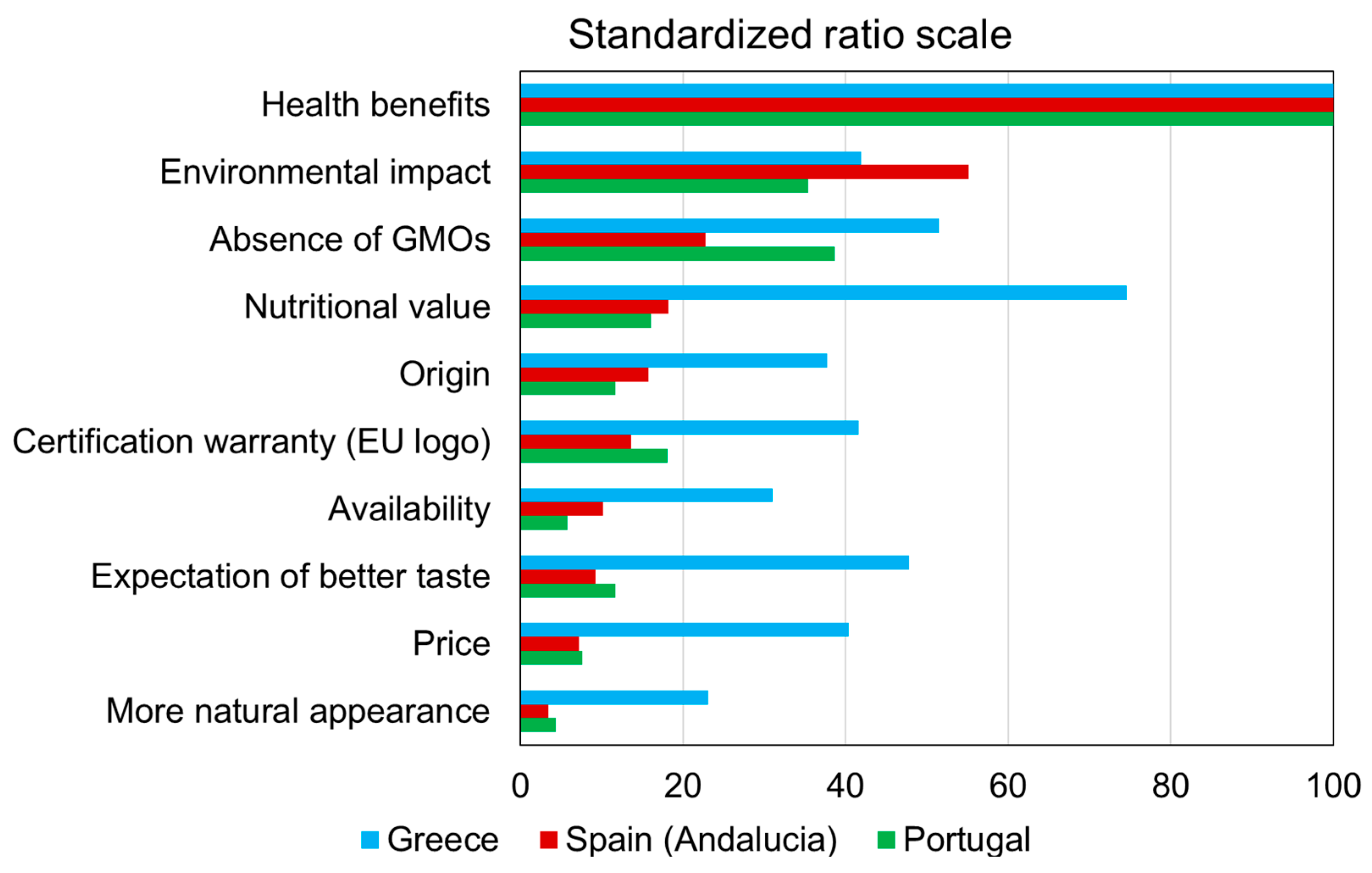
To make a comparison between the three countries and analyse the most and least preferred attributes, we use the ten attributes based on the standardised ratio scale index (Figure 1).
Consumers across the three countries consistently identified health benefits as the most salient driver of organic product consumption. With the highest-ranked attributes standardised to a reference value of 100 (as the standardised ratio scale functions as a relative indicator), the graphical representation of the remaining attributes provides a clear illustration of cross-country heterogeneity. The attributes displaying the greatest variability, in descending order, include a ‘More natural appearance’, ‘Price’, ‘Expectations of better taste’, ‘Nutritional value’, and Availability’. In contrast, minimal heterogeneity was observed for the ‘Absence of GMOs’ and ‘Environmental impact’, which appear to be more uniformly valued across countries.
Overall, the visual patterns suggest moderate heterogeneity in organic consumer preferences among Portugal, Spain, and Greece, with Greek consumers demonstrating distinct prioritisation profiles relative to their Portuguese and Spanish counterparts.
A Spearman correlation matrix was applied to the ten attributes, confirming that in 80% of cases, p < 0.05, indicating significant correlations between attributes.
The MANOVA was found to be significant (Pillai’s trace = 1.621, F(27, 2223) = 96.80, p < 0.001), clearly demonstrating differentiation between the three countries with respect to the importance assigned to the various attributes of organic food. Table 3 presents the results of the Kruskal–Wallis tests applied to each attribute to distinguish the countries’ relative positioning.
As shown in the results presented in Table 3, Greek consumers attach particular importance to Price, Aspect, Expectation, and Nutrition. Portuguese and Spanish consumers are more closely aligned with each other in their emphasis on Health, Environment, and NoGMO. The Spanish differ from the Portuguese mainly by assigning greater importance to Origin, whereas Portuguese consumers place notably high importance on Certification.
Conversely, Greek consumers attach lower levels of importance to Environment and NoGMO. Portuguese and Spanish consumers, in contrast to Greeks, assign lower importance to Price and Aspect. Compared with both Greeks and Spaniards, Portuguese consumers place less importance on Buying Easy, while Spanish consumers show lower levels of importance for Expectation relative to the other two countries.
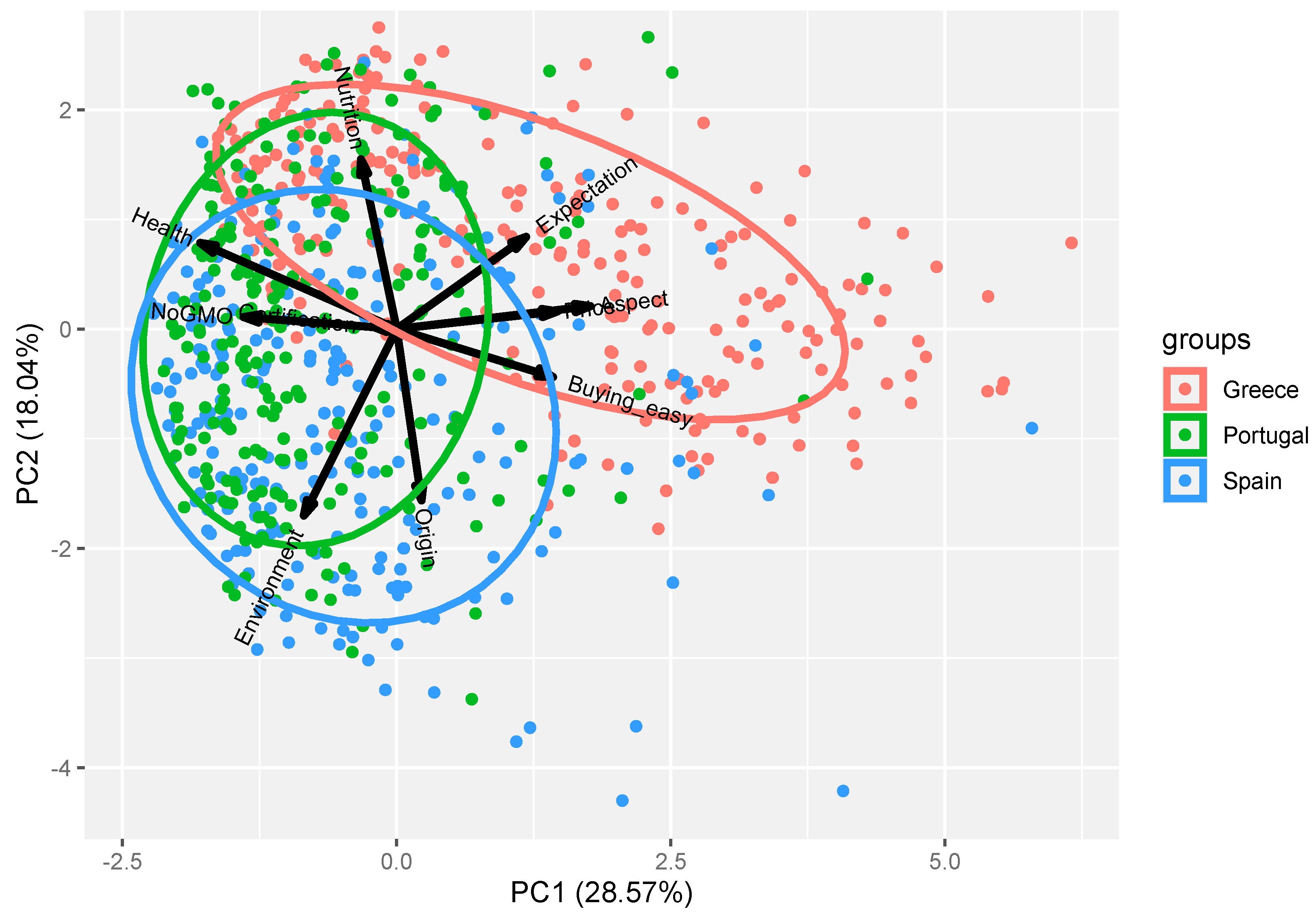
The Principal Components Analysis (PCA) enabled the extraction of two principal components, which together explain only 46.61% of the variance in the dataset (28.57% + 18.04%). Nevertheless, the projection of respondents onto this two-dimensional space reveals a clear clustering of the three countries (Figure 2).
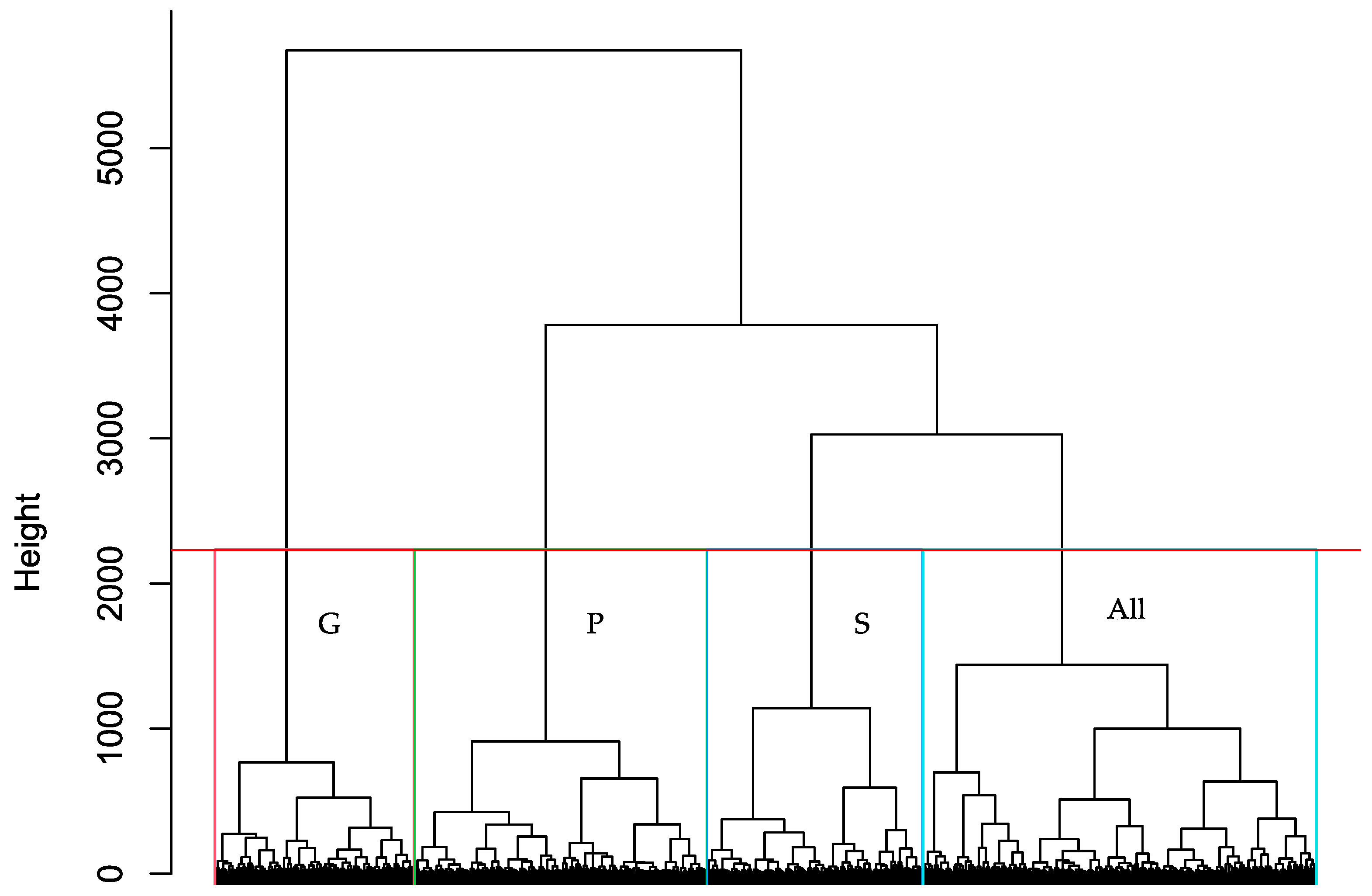
This result reinforces the patterns observed in the Kruskal–Wallis analysis, showing a clear grouping of the three countries according to the levels of importance attributed to the key organic food attributes. Furthermore, this grouping is corroborated by the cluster analysis presented in Figure 3, where three distinct clusters emerge, each predominantly composed of consumers from a single country. A fourth cluster comprises consumers from all three countries and does not exhibit a dominant representation from any of them.

3.3. Impact of the Classification Variables on the Key Attributes

The impact of the variables on the key attributes can be viewed in Table 4, Table 5, Table 6 and Table 7.
As can be observed, Price is mainly influenced by Age group and Education. Older individuals are more concerned about price than younger individuals, and those with lower levels of education also demonstrate greater sensitivity to the price of organic food. The interaction Country × Education reveals that young Greeks are the most concerned about the price of organic food, whereas older, yet still economically active, Spaniards (aged 55 to 69) are the least concerned.
With regard to Aspect, this attribute is primarily influenced by Gender and the Country × Education interaction. Men place greater value on the more natural appearance of organic food than women. This pattern is also observed among less educated Greek consumers, particularly those with only basic and/or primary schooling.
Certification is mainly influenced by Age group, the presence of children under 18 in the household, and the Country × Age group interaction. Older individuals assign the highest levels of importance to organic certification. Respondents without Children under 18 in the household also give greater importance to Certification. Greek consumers, particularly those in the older age group, assign the lowest levels of importance to Certification. Spaniards aged 35 to 54 display a similar pattern.
Regarding the country of Origin of organic food, the only significant parameter is the Country × Education interaction. No consistent trend emerges. Spaniards with only primary education show the highest levels of concern for the product’s Origin. They are followed by Greeks with primary education, as well as those with a Bachelor’s degree. Portuguese and Spaniards with a Bachelor’s degree also show heightened concern. Lower concern is observed among Portuguese consumers with basic or secondary education.
Expectation is mainly influenced by Age group, the presence of Children under 18 in the household, the preferred purchasing location, and the Country × Gender interaction. Younger individuals (up to 54 years old) assign higher levels of importance to the expectation that organic foods will taste better. Individuals without Children under 18 in the household also place greater importance on this attribute. Higher levels of importance are likewise observed when organic food is purchased through home sales or at markets.
Greek consumers (particularly men) show the highest levels of expectation regarding the taste of organic foods, whereas Spanish women exhibit the lowest levels of expectation.
Buying Easy is mainly influenced by Gender and by the Country × Gender interaction. Men place greater value on the availability and ease of purchasing organic food, particularly Spanish and Greek men.
Health is primarily influenced by Gender and the Country × Education interaction. Women attribute greater importance to the health benefits of organic foods than men. Greek consumers with lower levels of education assign the least importance to health benefits, a pattern also observed, however less markedly, among Spaniards educated up to Bachelor’s level.
Environment is mainly influenced by the Country × Gender and Country × Education interactions. Greek men, as well as Spanish men and women, show lower levels of concern regarding the environmental impact of organic food production than other combinations of country and gender. Greeks with only primary or secondary (high school) education also express lower levels of concern, whereas Spaniards with primary or secondary schooling display greater concern.
Nutrition is primarily influenced by the Country × Gender interaction. Greek consumers (particularly women) assign the highest levels of importance to the nutritional aspects of organic foods. Spanish and Portuguese consumers, especially women, place comparatively lower importance on this attribute.
The importance attributed to the absence of GMOs in organic foods is mainly influenced by Gender, Buying place, and the Country × Education interaction. Women value this attribute more than men. Lower importance is assigned to the Absence of GMOs when organic food is purchased at markets. Portuguese consumers with either basic education or a Bachelor’s degree show higher levels of concern about the Absence of GMOs, whereas Greeks generally assign lower levels of importance. Spaniards educated up to Bachelor’s level also place relatively low importance on the Absence of GMOs in organic food.

4. Discussion

The findings of this study provide new insights into the heterogeneity of consumer preferences for organic products across three Southern European countries: Portugal, Spain, and Greece. The present comparative analysis highlights both commonalities and divergences in the sociodemographic determinants and key attributes driving organic food consumption in the region.
Age exerts a consistent, yet context-sensitive, influence on organic-product preferences across Portugal, Spain and Greece. In our pooled sample, older respondents showed greater price sensitivity and placed relatively more weight on certification and provenance, whereas younger cohorts prioritised sensory expectations (taste, appearance) and, to a greater extent in some contexts, environmental and identity-related motives. These patterns align with the mixed evidence in the literature: age often moderates the trust–value relationship and alters how consumers process altruistic versus egoistic claims about food [15,72,73]
However, equality and divergence between the three countries are equally instructive. Portugal and Spain displayed similar age-linked profiles in which health and environmental credence attributes remained highly salient across most cohorts, consistent with national studies that report comparatively strong certification and environmental concerns among middle-aged and older consumers. Greece differed: price, appearance and taste expectations were especially prominent among both younger and older segments in our Greek sample. Greeks show lower overall organic uptake but stronger sensitivity to value and sensory cues [14].
Mechanisms that plausibly explain these age × country interactions include life-stage (household composition and retirement), disposable income and education (which mediate price elasticity), and cohort-specific values (e.g., stronger climate concern among younger generations) [74,75]. The COVID-19 pandemic amplified health salience across ages but did not eliminate national differences: pandemic-driven demand increased organic purchases broadly, yet price pressures and retail structure (supermarkets versus direct sales) modulated uptake differently in each country [76,77].
For policy and marketing, this implies a dual strategy: maintain pan-Mediterranean messaging that emphasises universal motivators (health, safety) while tailoring campaigns by life-stage and national context. For older and lower-income segments, particularly in Greece, messages should stress value and certification credibility; for younger cohorts, especially in Portugal and Spain, emphasise sustainability credentials, taste, and provenance as identity markers. Such segmentation is supported by broader reviews of organic-food drivers and by studies linking demographic moderators to purchase intentions [76].
Gender markedly influences motivations, attribute priorities, and purchasing behaviour for organic food. Across many contexts, women are consistently more likely to purchase organic products and to rank health- and environment-related motives higher than men [40,78]. Empirical work shows women report stronger environmental concern and health consciousness, which are mechanisms commonly invoked to explain a female “premium” for organic purchases (socialisation/role theories and ecofeminist perspectives) [79,80,81].
At the same time, several studies report that men, when they do buy organic, can display a higher willingness-to-pay for premium or convenience formats; men’s purchase decisions often respond more to status, price signalling, or situational factors than to health narratives [79]. Meta-analytic and large-sample research, therefore, depicts a nuanced picture: higher female prevalence of regular organic buying but gendered differences in the strength and nature of motives and price sensitivity [82].
Our three-country comparison aligns with these patterns but also reveals important national differences. In Portugal and Spain, female respondents place relatively greater weight on health, environment and absence of GMOs. In Greece, however, gender effects interact with education and age: Greek men in our sample gave larger emphasis to product appearance and availability, while Greek women rated nutrition highly—a pattern consonant with earlier Greek consumer literature that stresses product-type and traditional diet effects [12,83].
Policy and marketing also have implications for gender analysis choices for organic foods. Communications stressing health and environmental benefits resonate more strongly with female segments in all three countries; labelling and credible certification, therefore, remain crucial [74]. Also, because men may be more price-sensitive or oriented to convenience and status cues in some contexts, strategies that emphasise value (promotions, bundle offers) and convenience (availability in mainstream retail, ready-to-eat formats) can broaden male uptake. Finally, in terms of national tailoring matters, Greece’s stronger role of appearance/nutrition suggests that sensory and culinary messaging (taste, traditional recipes using organic ingredients) could be relatively more effective there, whereas Portugal and Spain may respond better to campaigns emphasising certification, provenance and environmental credentials [13].
Educational attainment significantly influences consumer behaviour towards organic food, with higher levels of education often correlating with increased awareness and preference for organic products. Studies indicate that individuals with higher education levels are more likely to purchase organic foods due to greater health consciousness, environmental awareness, and knowledge of food safety issues [84].
In Portugal, education plays a pivotal role in shaping organic food consumption patterns. Consumers with higher education levels exhibit a greater understanding and preference for organic products [84]. This trend is attributed to increased awareness of health and environmental benefits associated with organic foods. Additionally, educated consumers in Portugal are more likely to seek information about food origins and production methods, leading to more informed purchasing decisions [85].
Similarly, in Spain, education influences organic food consumption. Consumers in Spain with higher education levels are more willing to pay a premium for organic products, driven by concerns over health and environmental sustainability [86,87]. Furthermore, a study [87] in Tenerife revealed that educated consumers are more likely to prioritise organic food in their diets, reflecting a broader European trend
In Greece, education also impacts organic food consumption, albeit with some regional variations. Greek consumers with higher education levels place significant importance on the nutritional benefits and environmental impact of organic foods. However, factors such as product appearance and availability were also influential, indicating that education interacts with other socio-cultural factors in shaping consumption patterns.
Comparative analyses across these countries reveal that while the general trend shows that higher education levels correlate with increased organic food consumption, differences exist. In Portugal and Spain, education primarily enhances awareness and willingness to pay for organic products. In contrast, in Greece, education interacts with regional preferences and cultural factors, influencing the importance placed on various attributes of organic foods.
The presence of children under 18 in the household also significantly influences organic food preferences. In Portugal, households with children demonstrate a higher propensity to purchase organic products, driven by health considerations and concerns over pesticide exposure [13]. Similarly, Spanish families with children are more likely to prioritise organic food, reflecting a growing awareness of the nutritional benefits and safety of organic products for young consumers [15]. In contrast, Greek households with children exhibit less pronounced preferences for organic food, potentially due to economic constraints and limited availability of organic options [14]. While families with children generally show a preference for organic products, the strength of this preference varies across countries, influenced by factors such as economic conditions, cultural attitudes towards food, and the availability of organic products in the market.
Consumer preferences for organic food purchasing locations exhibit differences across the studied countries. In Portugal, a significant proportion of consumers prefer purchasing organic products from supermarkets and hypermarkets, driven by convenience, product variety, and perceived safety. Similarly, in Spain, large retail chains are popular among organic food shoppers. The Greek consumers often favour local markets and direct sales from producers, influenced by economic constraints and a stronger tradition of local food sourcing.

4.1. Study Outcomes

A key contribution of this study is the insight gained from the simultaneous comparison of Portugal, Spain and Greece, which goes beyond what can be inferred from separate national analyses. While age, gender, education and household composition emerge as important predictors in all three countries, the comparative approach shows that their influence differs systematically across contexts. For instance, age reinforces trust in certification and environmental claims in Portugal and Spain, but in Greece, it heightens sensitivity to price and sensory attributes. Similarly, gender effects that might appear broadly uniform in single-country studies are shown to interact differently with education, culture and retail structures, particularly in Greece, where appearance, availability and traditional food norms play a stronger role than in the Iberian countries.
The comparison also reveals that education and family status operate through distinct mechanisms rather than exerting uniform effects. Higher education increases willingness to pay and environmental awareness in Portugal and Spain, but in Greece, it reshapes trade-offs between nutrition, appearance and availability. Likewise, the presence of children strongly activates health-related organic purchasing in Portugal and Spain, but much less so in Greece, where economic constraints and market access limit uptake. Overall, the three-country comparison highlights context-dependent patterns that would remain hidden in national studies, strengthening both the explanatory value of the findings and their relevance for policy and marketing.
The study is important because it shows that preferences for organic food in Southern Europe are shaped not only by sociodemographic factors, but by how these interact with national contexts. Although age, gender, education and household composition influence behaviour in all three countries, the comparative analysis demonstrates that their effects differ across Portugal, Spain and Greece, helping to explain persistent differences in organic uptake that would not be evident from separate national studies.
These results can be used to inform more effective policy and market strategies. They support combining common health and safety messages with country-specific interventions, such as addressing price and availability barriers in Greece or emphasising sustainability and certification in Portugal and Spain, thereby improving the targeting and effectiveness of organic food promotion.

4.2. Study Limitations

Despite the insights provided, this study presents some limitations. The use of quota sampling, not stratified within the countries and geographically limited, combined with self-reported data, may introduce selection and reporting biases, potentially limiting the generalisability of the findings beyond regular organic consumers. Also, while the Best–Worst Scaling methodology allows robust preference elicitation, it captures stated rather than revealed behaviours, which may not fully reflect actual purchasing patterns in real-world retail environments. Another aspect is that the study focused on ten pre-selected attributes; other potentially influential factors, such as ethical production, packaging, or local origin, were not included and may affect consumer decision-making. Additionally, the cross-sectional design precludes causal inference and may not capture dynamic changes in preferences over time, particularly in response to evolving economic conditions or policy interventions. As cited during the Discussion, the pandemic years observed a duplication of organic food consumption in Europe. Finally, although the three countries provide valuable comparative insights for Southern Europe, results may not be directly transferable to other European regions with different cultural, socio-economic, or retail structures.

4.3. Future Research Directions

Future research should consider longitudinal approaches to track changes in consumer preferences, integrate observed purchasing data to validate stated choices, and expand the range of attributes to include ethical, social, and experiential dimensions. Comparative studies including additional Southern and Northern European countries could further elucidate cultural and structural determinants of organic food consumption, while segmentation analyses focusing on minority and underrepresented groups would enhance understanding of equity and inclusivity in sustainable consumption patterns.


5. Conclusions

This comparative analysis highlights the differences and context-dependent nature of organic food consumption patterns across Portugal, Spain, and Greece. While health and environmental concerns consistently emerge as significant motivators for organic food purchases in Portugal and Spain, Greek consumers exhibit a more pronounced sensitivity to price, product appearance, and sensory expectations. These differences are influenced by a complex interaction of sociodemographic factors, as well as cultural and economic contexts unique to each country.
The study highlights the importance of tailoring marketing strategies to align with the specific preferences and values of consumers in each country. In Portugal and Spain, emphasising the health and environmental benefits of organic products, along with credible certification and origin information, may appeal more effectively to consumers. In contrast, in Greece, marketing messages that focus on value, convenience, and sensory attributes could better capture consumer interest.

Author Contributions

Conceptualisation T.M., F.N., FM. and J.V.; methodology T.M. and F.N.; software F.N.; validation F.M. and J.V.; formal analysis T.M., F.N., F.M., J.V. and E.M.; investigation T.M., F.N., F.M. and J.V.; resources T.M., F.N., F.M., J.V. and E.M.; data curation T.M., F.N., F.M., M.V., A.M., M.K., E.M. and J.V.; writing—original draft preparation T.M., F.N., F.M. and J.V.; writing T.M., F.N., F.M., J.V. and E.M.; visualisation T.M., F.N., F.M., J.V. and E.M.; supervision T.M., F.N., F.M. and J.V.; project administration T.M., F.N., F.M. and J.V.; funding acquisition T.M., F.N., F.M., J.V. and E.M. All authors have read and agreed to the published version of the manuscript.

Funding

This research received no external funding.

Institutional Review Board Statement

The study was conducted in accordance with the Declaration of Helsinki and approved by the Institutional Review Board of the University of Thessaly (30515/24/TEZP, 9 November 2024).

Informed Consent Statement

Informed consent was obtained from all subjects involved in the study.

Data Availability Statement

The data used in this study are available upon reasonable request from the corresponding author only due to confidentiality restrictions.

Acknowledgments

The research was conducted in the operating framework of the University of Thessaly Innovation, Technology Transfer Unit and Entrepreneurship Center “One Planet Thessaly”, under the “University of Thessaly Grants for Scientific Publication Support” action and is funded by the Special Account of Research Grants of the University of Thessaly. The Center for Research and Development in Agrifood Systems and Sustainability is supported by the Foundation for Science and Technology. Base funding doi: 10.54499/UIDP/05937/2020 and programmatic funding doi: 10.54499/UIDB/05937/2020.

Conflicts of Interest

The authors declare no conflicts of interest.

Abbreviations

The following abbreviations are used in this manuscript:
ANOVAAnalysis of variance
dfDegrees of freedom
LSDLeast significant differences
MANOVAMultivariate analysis of variance
PCAPrincipal components analysis

Appendix A

Table A1. Table of contingency Country × Age.
Country × Age Crosstabulation
AgeTotal
15–3435–5455–6970+
N%N%N%N%N%
CountryGreece8457.1%7520.2%5731.8%3465.4%25033.3%
Spain149.5%15441.4%7139.7%1121.2%25033.3%
Portugal4933.3%14338.4%5128.5%713.5%25033.3%
Total147100.0%372100.0%179100.0%52100.0%750100.0%
Table A2. Table of contingency Country × Gender.
Country × Gender Crosstabulation
GenderTotal
MaleFemale
N%N%N%
CountryGreece11540.5%13529.0%25033.3%
Spain8329.2%16735.8%25033.3%
Portugal8630.3%16435.2%25033.3%
Total284100.0%466100.0%750100.0%
Table A3. Table of contingency Country × Education level.
Country × Education Level Crosstabulation
Education LevelTotal
PrimaryBasicHigh SchoolBScMSc/PhD
N%N%N%N%N%N%
CountryGreece12096.8%4161.2%5461.4%259.2%105.1%25033.3%
Spain43.2%2131.3%2022.7%20575.1%00.0%25033.3%
Portugal00.0%57.5%1415.9%4315.8%18894.9%25033.3%
Total124100.0%67100.0%88100.0%273100.0%198100.0%750100.0%
Table A4. Table of contingency Country × Children < 18.
Country × Childreen < 18 Crosstabulation
Children < 18Total
NoYes
N%N%N%
CountryGreece14135.1%10931.3%25033.3%
Spain12831.8%12235.1%25033.3%
Portugal13333.1%11733.6%25033.3%
Total402100.0%348100.0%750100.0%
Table A5. Table of contingency Country × Buying place.
Country × Buying Place Crosstabulation
Buying PlaceTotal
MarketsDedicated StoresSupermarketsHome SaleTraditional Stores
N%N%N%N%N%N%
CountryGreece4421.5%5934.1%8952.7%2632.9%3225.8%25033.3%
Spain5627.3%5330.6%2816.6%3746.8%7661.3%25033.3%
Portugal10551.2%6135.3%5230.8%1620.3%1612.9%25033.3%
Total205100.0%173100.0%169100.0%79100.0%124100.0%750100.0%

Appendix B

Table A6. Statistics of the key attribute models (main effects): Price, Aspect, Certification, Origin, and Expectation. The parameters of the models can be consulted in Table 4 of the main text.
Models’ Statistics (χ2, df, p-Value)
ModelPriceAspectCertificationOriginExpectation
Parameter
All Model530, 16, <0.001486, 16, <0.001731, 13, <0.001683, 13, <0.001670, 14, <0.001
Age group8.11, 3, =0.044 14, 3, =0.003 9.0, 3, =0.03
18–3416, 1, <0.001 120, 1, <0.001 17, 1, <0.001
35–5443, 1, <0.001 302, 1, <0.001 34, 1, <0.001
55–6923, 1, <0.001 123, 1, <0.001 11, 1, =0.001
≥709.2, 1, <0.001 37, 1, <0.001 5.2, 1, =0.022
Gender 7.4, 1, =0.007
Man 47, 1, <0.001
Woman 29, 1, <0.001
Education20.8, 4, <0.001
Primary13, 1, <0.001
Basic0.51, 1, 0.47
High School1.6, 1, 0.20
BSc0.05, 1, 0.82
MSc/PhDReference
Children < 18 14, 1, <0.001
Yes Reference Reference
No 10, 1, <0.001 14, 1, <0.001
Buying place 13, 4, =0.011
Markets 6.9, 1, =0.008
Dedicated stores <1, 1, > 0.05
Supermarkets 1.5, 1, > 0.05
Home sale 7.6, 1, =0.006
Traditional stores Reference
Table A7. Statistics of the key attribute models (main effects): Buying easy, Health, Environment, Nutrition, and NoGMO. The parameters of the models can be consulted in Table 5 of the main text.
Models’ Statistics (χ2, df, p-Value)
ModelBuying EasyHealthEnvironmentNutritionNoGMO
Parameter
All Model463, 6, <0.0012054, 14, <0.0012058, 16, <0.0011003, 6, <0.0011222, 18, <0.001
Age group
18–34
35–54
55–69
≥70
Gender550, 2, <0.0015.1, 1, =0.024 7.6, 1, =0.006
Man18, 1, <0.0011992, 1, <0.001 362, 1, <0.001
Woman29, 1, <0.0012987, 1, <0.001 474, 1, <0.001
Education
Primary
Basic
High School
BSc
MSc/PhD
Children < 18
Yes
No
Buying place 17.3, 4, =0.002
Markets 9.3, 1, =0.002
Dedicated stores <1, 1, > 0.05
Supermarkets 1.7, 1, > 0.05
Home sale 3.6, 1, > 0.05
Traditional stores Reference
Table A8. Statistics of the key attribute models (2-way effects Country × Demographic variables): Price, Aspect, Certification, Origin, and Expectation. The parameters of the models can be consulted in Table 6 of the main text.
Models’ Statistics (χ2, df, p-Value) Interactions
ModelPriceAspectCertificationOriginExpectation
Parameter
Country × Age group23, 8, =0.003 39, 8, <0.001
Greece × 18–346.5, 1, =0.011 5.0, 1, =0.025
Greece × 35–541.7, 1, >0.05 5.0, 1, =0.026
Greece × 55–693.3, 1, >0.05 5.3, 1, =0.022
Greece × ≥ 70<1, 1, >0.05 7.6, 1, =0.006
Spain × 18–341.2, 1, >0.05 2.1, 1, >0.05
Spain × 35–54<1, 1, >0.05 14, 1, <0.001
Spain × 55–694.1, 1, =0.042 <1, 1, >0.05
Spain × ≥ 70<1, 1, >0.05 <1, 1, >0.05
Portugal × 18–34Reference Reference
Portugal × 35–54Reference Reference
Portugal × 55–69Reference Reference
Country × Gender 84, 5, <0.001
Greece × Men 34, 1, <0.001
Greece × Women 17, 1, <0.001
Spain × Men 1.1, 1, >0.05
Spain × Women 5.4, 1, =0.02
Portugal × Men 1.0, 1, >0.05
Portugal × Women Reference
Country × Education 219,12, <0.001 1114,13, <0.001
Greece × Primary 111,1, <0.001 191, 1, <0.001
Greece × Basic 12, 1, <0.001 35, 1, <0.001
Greece × H. School 48, 1, <0.001 85, 1, <0.001
Greece × BSc 3, 1, >0.05 20, 1, <0.001
Greece × MSc <1, 1, >0.05 4, 1, =0.041
Spain × Primary <1, 1, >0.05 9, 1, =0.003
Spain × Basic 1.2, 1, >0.05 23, 1, <0.001
Spain × H. School 1.1, 1, >0.05 12, 1, <0.001
Spain × BSc 3.8, 1, >0.05 473, 1, <0.001
Portugal × Basic Reference 1.3, 1, >0.05
Portugal × H. School Reference 7.8, 1, <0.001
Portugal × BSc Reference 66, 1, <0.001
Portugal × MSc/PhD Reference 187, 1, <0.001
Table A9. Statistics of the key attribute models (2-way effects Country × Demographic variables): Buying easy, Health, Environment, Nutrition, and NoGMO. The parameters of the models can be consulted in Table 7 of the main text.
Models’ Statistics (χ2, df, p-Value) Interactions
ModelBuying EasyHealthEnvironmentNutritionNoGMO
Parameter
Country × Age group
Greece × 18–34
Greece × 35–54
Greece × 55–69
Greece × ≥70
Spain × 18–34
Spain × 35–54
Spain × 55–69
Spain × ≥70
Portugal × 18–34
Portugal × 35–54
Portugal × 55–69
Portugal × 55–69
Country × Gender71, 4, <0.001 9.7, 3, =0.0222107, 6, <0.001
Greece × Men35, 1, <0.001 139, 1, <0.001488, 1, <0.001
Greece × Women24, 1, <0.001 175, 1, <0.001689, 1, <0.001
Spain × Men18, 1, <0.001 1134, 1, <0.001160, 1, <0.001
Spain × Women27, 1, <0.001 2248, 1, <0.001310, 1, <0.001
Portugal × MenReference 1213, 1, <0.001179, 1, <0.001
Portugal × WomenReference 2458, 1, <0.001282, 1, <0.001
Country × Education 129, 12, <0.00133, 10, <0.001 175, 12, <0.001
Greece × Primary 88, 1, <0.0019.9, 1, =0.002 90, 1, <0.001
Greece × Basic 9.3, 1, =0.0021.8, 1, >0.05 37, 1, <0.001
Greece × H. School 34, 1, <0.0015.8, 1, =0.016 40, 1, <0.001
Greece × BSc 1.9, 1, >0.05<1, 1, >0.05 10, 1, =0.001
Greece × MSc <1, 1, >0.05Reference 16, 1, <0.001
Spain × Primary <1, 1, >0.05<1, 1, >0.05 <1, 1, >0.05
Spain × Basic <1, 1, >0.053.9, 1, =0.049 2.0, 1, >0.05
Spain × H. School <1, 1, >0.052.8, 1, >0.05 <1, 1, >0.05
Spain × BSc 6.1, 1, =0.013Reference 44, 1, <0.001
Portugal × Basic 1.0, 1, >0.051.1, 1, >0.05 <1, 1, >0.05
Portugal × H. School <1, 1, >0.05<1, 1, >0.05 <1, 1, >0.05
Portugal × BSc <1, 1, >0.05<1, 1, >0.05 5.9, 1, =0.015
Portugal × MSc/PhD ReferenceReference Reference

References

  1. Massey, M.; O’Cass, A.; Otahal, P. A Meta-Analytic Study of the Factors Driving the Purchase of Organic Food. Appetite 2018, 125, 418–427. [Google Scholar] [CrossRef]
  2. Golijan Pantović, J.; Dimitrijević, B. Global Organic Food Market. Acta Agric. Serbica 2018, 23, 125–140. [Google Scholar] [CrossRef]
  3. Mata, F.; Cano-Díaz, C.; Jesus, M. The European Citizens’ Stance on the Sustainability Subsidies Given to the EU Farmers. Eur. Countrys. 2024, 16, 324–336. [Google Scholar] [CrossRef]
  4. Mata, F.; Domingues, I. European Union Citizens’ Perception of the Reasons for the Cost of the Common Agricultural Policy. Eur. Countrys. 2025, 17, 137–152. [Google Scholar] [CrossRef]
  5. European Commission. Developments in Organic Farming. Available online: https://ec.europa.eu/eurostat/statistics-explained/index.php?title=Developments_in_organic_farming (accessed on 22 July 2025).
  6. Mata, F.; Barros, D.; Pereira-Pinto, R.; Pires, P. EU Citizens’ Perception of Risks Posed to the Sustainability of EU Food Security. Sustainability 2024, 16, 9840. [Google Scholar] [CrossRef]
  7. Pimentel, D. Food for Thought: A Review of the Role of Energy in Current and Evolving Agriculture. CRC Crit. Rev. Plant Sci. 2011, 30, 35–44. [Google Scholar] [CrossRef]
  8. Kopittke, P.M.; Menzies, N.W.; Wang, P.; McKenna, B.A.; Lombi, E. Soil and the Intensification of Agriculture for Global Food Security. Environ. Int. 2019, 132, 105078. [Google Scholar] [CrossRef] [PubMed]
  9. Diagourtas, G.; Kounetas, K.E.; Simaki, V. Consumer Attitudes and Sociodemographic Profiles in Purchasing Organic Food Products: Evidence from a Greek and Swedish Survey. Br. Food J. 2022, 125, 2407–2423. [Google Scholar] [CrossRef]
  10. Kamboj, S.; Matharu, M.; Gupta, M. Examining Consumer Purchase Intention towards Organic Food: An Empirical Study. Clean. Responsible Consum. 2023, 9, 100121. [Google Scholar] [CrossRef]
  11. European Parliament, Council of the European Union. European Parliament and the Council of Europe Regulation (EU) 2018/848 of the European Parliament and of the Council of 30 May 2018 on Organic Production and Labelling of Organic Products and Repealing Council Regulation (EC) No 834/2007; European Union: Brussels, Belgium, 2018. [Google Scholar]
  12. Malissiova, E.; Tsokana, K.; Soultani, G.; Alexandraki, M.; Katsioulis, A.; Manouras, A. Organic Food: A Study of Consumer Perception and Preferences in Greece. Appl. Food Res. 2022, 2, 100129. [Google Scholar] [CrossRef]
  13. Madureira, T.; Nunes, F.; Veiga, J.; Saralegui-Diez, P. Choices in Sustainable Food Consumption: How Spanish Low Intake Organic Consumers Behave. Agriculture 2021, 11, 1125. [Google Scholar] [CrossRef]
  14. Madureira, T.; Nunes, F.; Veiga, J.; Mata, F.; Alexandraki, M.; Dimitriou, L.; Meleti, E.; Manouras, A.; Malissiova, E. Trends in Organic Food Choices and Consumption: Assessing the Purchasing Behaviour of Consumers in Greece. Foods 2025, 14, 362. [Google Scholar] [CrossRef]
  15. Nunes, F.; Madureira, T.; Veiga, J. The Organic Food Choice Pattern: Are Organic Consumers Becoming More Alike? Foods 2021, 10, 983. [Google Scholar] [CrossRef]
  16. Cembalo, L.; Caso, D.; Carfora, V.; Caracciolo, F.; Lombardi, A.; Cicia, G. The “Land of Fires” Toxic Waste Scandal and Its Effect on Consumer Food Choices. Int. J. Environ. Res. Public Health 2019, 16, 165. [Google Scholar] [CrossRef]
  17. Michaelidou, N.; Hassan, L.M. The Role of Health Consciousness, Food Safety Concern and Ethical Identity on Attitudes and Intentions towards Organic Food. Int. J. Consum. Stud. 2008, 32, 163–170. [Google Scholar] [CrossRef]
  18. Sidor, A.; Rzymski, P. Dietary Choices and Habits during COVID-19 Lockdown: Experience from Poland. Nutrients 2020, 12, 1657. [Google Scholar] [CrossRef]
  19. Asioli, D.; Canavari, M.; Castellini, A.; de Magistris, T.; Gottardi, F.; Lombardi, P.; Pignatti, E.; Spadoni, R. The Role of Sensory Attributes in Marketing Organic Food: Findings from a Qualitative Study of Italian Consumers. J. Food Distrib. Res. 2011, 42, 16–21. [Google Scholar]
  20. Hemmerling, S.; Asioli, D.; Spiller, A. Core Organic Taste: Preferences for Naturalness-Related Sensory Attributes of Organic Food among European Consumers. J. Food Prod. Mark. 2016, 22, 824–850. [Google Scholar] [CrossRef]
  21. Schleenbecker, R.; Hamm, U. Consumers’ Perception of Organic Product Characteristics. A Review. Appetite 2013, 71, 420–429. [Google Scholar] [CrossRef] [PubMed]
  22. Denver, S.; Jensen, J.D. Consumer Preferences for Organically and Locally Produced Apples. Food Qual. Prefer. 2014, 31, 129–134. [Google Scholar] [CrossRef]
  23. Torres-Ruiz, F.J.; Vega-Zamora, M.; Parras-Rosa, M. False Barriers in the Purchase of Organic Foods. The Case of Extra Virgin Olive Oil in Spain. Sustainability 2018, 10, 461. [Google Scholar] [CrossRef]
  24. Abeliotis, K.; Koniari, C.; Sardianou, E. The Profile of the Green Consumer in Greece. Int. J. Consum. Stud. 2010, 34, 153–160. [Google Scholar] [CrossRef]
  25. Bernabéu, R.; Brugarolas, M.; Martínez-Carrasco, L.; Nieto-Villegas, R.; Rabadán, A. The Price of Organic Foods as a Limiting Factor of the European Green Deal: The Case of Tomatoes in Spain. Sustainability 2023, 15, 3238. [Google Scholar] [CrossRef]
  26. Guiné, R.P.F.; Florença, S.G.; Costa, D.T.V.A.; Çelik, S.; Ferreira, M.; Cardoso, A.P.; Çetin, S.; Costa, C.A. Comparative Study about the Consumption of Organic Food Products on Samples of Portuguese and Turkish Consumers under the COVID-19 Pandemic Context. Agronomy 2022, 12, 1385. [Google Scholar] [CrossRef]
  27. Pérez y Pérez, L.; Gracia, A. Consumer Preferences for Olive Oil in Spain: A Best-Worst Scaling Approach. Sustainability 2023, 15, 11283. [Google Scholar] [CrossRef]
  28. Teixeira, S.F.; Barbosa, B.; Cunha, H.; Oliveira, Z. Exploring the Antecedents of Organic Food Purchase Intention: An Extension of the Theory of Planned Behavior. Sustainability 2021, 14, 242. [Google Scholar] [CrossRef]
  29. Alqaydi, T.K.; Bedir, A.S.; Abu-Elsaoud, A.M.; El-Tarabily, K.A.; Al Raish, S.M. An Assessment of the Knowledge, Attitude, and Practice of Probiotics and Prebiotics among the Population of the United Arab Emirates. Foods 2024, 13, 2219. [Google Scholar] [CrossRef]
  30. Ditlevsen, K.; Sandøe, P.; Lassen, J. Healthy Food Is Nutritious, but Organic Food Is Healthy Because It Is Pure: The Negotiation of Healthy Food Choices by Danish Consumers of Organic Food. Food Qual. Prefer. 2019, 71, 46–53. [Google Scholar] [CrossRef]
  31. Hansen, T.; Sørensen, M.I.; Eriksen, M.-L.R. How the Interplay between Consumer Motivations and Values Influences Organic Food Identity and Behavior. Food Policy 2018, 74, 39–52. [Google Scholar] [CrossRef]
  32. Chekima, B.; Chekima, K.; Chekima, K. Understanding Factors Underlying Actual Consumption of Organic Food: The Moderating Effect of Future Orientation. Food Qual. Prefer. 2019, 74, 49–58. [Google Scholar] [CrossRef]
  33. Rana, J.; Paul, J. Health Motive and the Purchase of Organic Food: A Meta-analytic Review. Int. J. Consum. Stud. 2020, 44, 162–171. [Google Scholar] [CrossRef]
  34. Nguyen, H.V.; Nguyen, N.; Nguyen, B.K.; Lobo, A.; Vu, P.A. Organic Food Purchases in an Emerging Market: The Influence of Consumers’ Personal Factors and Green Marketing Practices of Food Stores. Int. J. Environ. Res. Public Health 2019, 16, 1037. [Google Scholar] [CrossRef]
  35. Hwang, J. Organic Food as Self-Presentation: The Role of Psychological Motivation in Older Consumers’ Purchase Intention of Organic Food. J. Retail. Consum. Serv. 2016, 28, 281–287. [Google Scholar] [CrossRef]
  36. Kushwah, S.; Dhir, A.; Sagar, M. Ethical Consumption Intentions and Choice Behavior towards Organic Food. Moderation Role of Buying and Environmental Concerns. J. Clean. Prod. 2019, 236, 117519. [Google Scholar] [CrossRef]
  37. Das, S. Impact of Organic Food and Organic Agriculture on Human Health and Ecosystem. In Organic Farming; Elsevier: Amsterdam, The Netherlands, 2023; pp. 255–289. [Google Scholar]
  38. Tandon, A.; Dhir, A.; Kaur, P.; Kushwah, S.; Salo, J. Why Do People Buy Organic Food? The Moderating Role of Environmental Concerns and Trust. J. Retail. Consum. Serv. 2020, 57, 102247. [Google Scholar] [CrossRef]
  39. Voon, T.J.P.; Ngui, K.S.; Agrawal, A. Determinants of Willingness to Purchase Organic Food: An Exploratory Study Using Structural Equation Modeling. Int. Food Agribus. Manag. Rev. 2011, 14, 103–120. [Google Scholar]
  40. Hjelmar, U. Consumers’ Purchase of Organic Food Products. A Matter of Convenience and Reflexive Practices. Appetite 2011, 56, 336–344. [Google Scholar] [CrossRef] [PubMed]
  41. Aschemann-Witzel, J.; Maroscheck, N.; Hamm, U. Are Organic Consumers Preferring or Avoiding Foods with Nutrition and Health Claims? Food Qual. Prefer. 2013, 30, 68–76. [Google Scholar] [CrossRef]
  42. Średnicka-Tober, D.; Barański, M.; Seal, C.; Sanderson, R.; Benbrook, C.; Steinshamn, H.; Gromadzka-Ostrowska, J.; Rembiałkowska, E.; Skwarło-Sońta, K.; Eyre, M. Composition Differences between Organic and Conventional Meat: A Systematic Literature Review and Meta-Analysis. Br. J. Nutr. 2016, 115, 994–1011. [Google Scholar] [CrossRef]
  43. Apaolaza, V.; Hartmann, P.; D’souza, C.; López, C.M. Eat Organic–Feel Good? The Relationship between Organic Food Consumption, Health Concern and Subjective Wellbeing. Food Qual. Prefer. 2018, 63, 51–62. [Google Scholar] [CrossRef]
  44. Grzybowska-Brzezinska, M.; Grzywinska-Rapca, M.; Zuchowski, I.; Bórawski, P. Organic Food Attributes Determing Consumer Choices. Eur. Res. Stud. J. 2017, 20, 164–176. [Google Scholar] [CrossRef]
  45. Lucas, M.R.V.; Röhrich, K.; Marreiros, C.; Fragoso, R.; Kabbert, R.; Clara, A.M.; Martins, I.; Böhm, S. Quality, Safety and Consumer Behaviour Towards Organic Food in Germany and Portugal; University of Evora: Évora, Portugal, 2008. [Google Scholar]
  46. Prada, M.; Garrido, M.V.; Rodrigues, D. Lost in Processing? Perceived Healthfulness, Taste and Caloric Content of Whole and Processed Organic Food. Appetite 2017, 114, 175–186. [Google Scholar] [CrossRef]
  47. Annunziata, A.; Agovino, M.; Mariani, A. Sustainability of Italian Families’ Food Practices: Mediterranean Diet Adherence Combined with Organic and Local Food Consumption. J. Clean. Prod. 2019, 206, 86–96. [Google Scholar] [CrossRef]
  48. Rana, J.; Paul, J. Consumer Behavior and Purchase Intention for Organic Food: A Review and Research Agenda. J. Retail. Consum. Serv. 2017, 38, 157–165. [Google Scholar] [CrossRef]
  49. Gallar Hernández, D.; Saracho-Domínguez, H.; Rivera-Ferré, M.G.; Vara-Sánchez, I. Eating Well with Organic Food: Everyday (Non-Monetary) Strategies for a Change in Food Paradigms: Findings from Andalusia, Spain. Sustainability 2019, 11, 1003. [Google Scholar] [CrossRef]
  50. Lee, H.-C.; Chang, C.-T.; Cheng, Z.-H.; Chen, Y.-T. Will an Organic Label Always Increase Food Consumption? It Depends on Food Type and Consumer Differences in Health Locus of Control. Food Qual. Prefer. 2018, 63, 88–96. [Google Scholar] [CrossRef]
  51. Wei, S.; Ang, T.; Jancenelle, V.E. Willingness to Pay More for Green Products: The Interplay of Consumer Characteristics and Customer Participation. J. Retail. Consum. Serv. 2018, 45, 230–238. [Google Scholar] [CrossRef]
  52. Katt, F.; Meixner, O. Is It All about the Price? An Analysis of the Purchase Intention for Organic Food in a Discount Setting by Means of Structural Equation Modeling. Foods 2020, 9, 458. [Google Scholar] [CrossRef] [PubMed]
  53. Kuhar, A.; Slabe, A.; Juvančič, L. Determinants of Purchasing Behaviour for Organic and Integrated Fruits and Vegetables: The Case of the Post Socialist Economy. In Organic Food and Agriculture-New Trends and Developments in the Social Sciences; Citeseer; IntechOpen: London, UK, 2012. [Google Scholar]
  54. Santhi, P.; Jerinabi, U.; Gandhi, N.M. Green Consumerism-Issues and Implications. Indian J. Mark. 2007, 37, 26–29. [Google Scholar]
  55. Rodríguez-Bermúdez, R.; Miranda, M.; Orjales, I.; Ginzo-Villamayor, M.J.; Al-Soufi, W.; López-Alonso, M. Consumers’ Perception of and Attitudes towards Organic Food in Galicia (Northern Spain). Int. J. Consum. Stud. 2020, 44, 206–219. [Google Scholar] [CrossRef]
  56. Tsakiridou, E.; Boutsouki, C.; Zotos, Y.; Mattas, K. Attitudes and Behaviour towards Organic Products: An Exploratory Study. Int. J. Retail Distrib. Manag. 2008, 36, 158–175. [Google Scholar] [CrossRef]
  57. Chryssohoidis, G.M.; Krystallis, A. Organic Consumers’ Personal Values Research: Testing and Validating the List of Values (LOV) Scale and Implementing a Value-Based Segmentation Task. Food Qual. Prefer. 2005, 16, 585–599. [Google Scholar] [CrossRef]
  58. de-Magistris, T.; Gracia, A.; Barreiro-Hurle, J. Do Consumers Care about European Food Labels? An Empirical Evaluation Using Best-Worst Method. Br. Food J. 2017, 119, 2698–2711. [Google Scholar] [CrossRef]
  59. Deliana, Y. Market Segmentation for Organic Products in Bandung West Java, Indonesia. Res. J. Recent. Sci. 2012, 2277, 2502. [Google Scholar]
  60. Ladwein, R.; Romero, A.M.S. The Role of Trust in the Relationship between Consumers, Producers and Retailers of Organic Food: A Sector-Based Approach. J. Retail. Consum. Serv. 2021, 60, 102508. [Google Scholar] [CrossRef]
  61. Vega-Zamora, M.; Torres-Ruiz, F.J.; Parras-Rosa, M. Towards Sustainable Consumption: Keys to Communication for Improving Trust in Organic Foods. J. Clean. Prod. 2019, 216, 511–519. [Google Scholar] [CrossRef]
  62. Janssen, M. Determinants of Organic Food Purchases: Evidence from Household Panel Data. Food Qual. Prefer. 2018, 68, 19–28. [Google Scholar] [CrossRef]
  63. Siegrist, M.; Hartmann, C. Impact of Sustainability Perception on Consumption of Organic Meat and Meat Substitutes. Appetite 2019, 132, 196–202. [Google Scholar] [CrossRef] [PubMed]
  64. Hempel, C.; Hamm, U. How Important Is Local Food to Organic-Minded Consumers? Appetite 2016, 96, 309–318. [Google Scholar] [CrossRef] [PubMed]
  65. Jensen, J.D.; Christensen, T.; Denver, S.; Ditlevsen, K.; Lassen, J.; Teuber, R. Heterogeneity in Consumers’ Perceptions and Demand for Local (Organic) Food Products. Food Qual. Prefer. 2019, 73, 255–265. [Google Scholar] [CrossRef]
  66. Nadricka, K.; Millet, K.; Verlegh, P.W.J. When Organic Products Are Tasty: Taste Inferences from an Organic = Healthy Association. Food Qual. Prefer. 2020, 83, 103896. [Google Scholar] [CrossRef]
  67. McFadden, J.R.; Huffman, W.E. Willingness-to-Pay for Natural, Organic, and Conventional Foods: The Effects of Information and Meaningful Labels. Food Policy 2017, 68, 214–232. [Google Scholar] [CrossRef]
  68. Caldwell, E.M.; Kobayashi, M.M.; DuBow, W.M.; Wytinck, S.M. Perceived Access to Fruits and Vegetables Associated with Increased Consumption. Public Health Nutr. 2009, 12, 1743–1750. [Google Scholar] [CrossRef]
  69. Zundel, C.; Kilcher, L. Organic Agriculture and Food Availability. In Proceedings of the International Conference on Organic Agriculture and Food Security, Rome, Italy, 3–5 May 2007. [Google Scholar]
  70. Mauracher, C.; Tempesta, T.; Vecchiato, D. Consumer Preferences Regarding the Introduction of New Organic Products. The Case of the Mediterranean Sea Bass (Dicentrarchus Labrax) in Italy. Appetite 2013, 63, 84–91. [Google Scholar] [CrossRef] [PubMed]
  71. Tenbült, P.; de Vries, N.K.; Dreezens, E.; Martijn, C. Perceived Naturalness and Acceptance of Genetically Modified Food. Appetite 2005, 45, 47–50. [Google Scholar] [CrossRef]
  72. Anisimova, T.; Vrontis, D. The Food You Can Trust: The Moderating Role of Age in the Relationship between Consumer Values and Organic Food Trust. J. Bus. Res. 2024, 182, 114803. [Google Scholar] [CrossRef]
  73. Septianto, F.; Kemper, J.A. The Effects of Age Cues on Preferences for Organic Food: The Moderating Role of Message Claim. J. Retail. Consum. Serv. 2021, 62, 102641. [Google Scholar] [CrossRef]
  74. Baş, M.; Kahriman, M.; Çakir Biçer, N.; Seçkiner, S. Results from Türkiye: Which Factors Drive Consumers to Buy Organic Food? Foods 2024, 13, 302. [Google Scholar] [CrossRef] [PubMed]
  75. Ferreira, S.; Pereira, O. Antecedents of Consumers’ Intention and Behavior to Purchase Organic Food in the Portuguese Context. Sustainability 2023, 15, 9670. [Google Scholar] [CrossRef]
  76. Timpanaro, G.; Cascone, G. Food Consumption and the Covid-19 Pandemic: The Role of Sustainability in Purchasing Choices. J. Agric. Food Res. 2022, 10, 100385. [Google Scholar] [CrossRef]
  77. European Court of Auditors (ECA). Organic Farming in the EU: Gaps and Inconsistencies Hamper the Success of the Policy; Publications Office of the European Union: Luxembourg, 2024. [Google Scholar]
  78. Hughner, R.S.; McDonagh, P.; Prothero, A.; Shultz, C.J.; Stanton, J. Who Are Organic Food Consumers? A Compilation and Review of Why People Purchase Organic Food. J. Consum. Behav. Int. Res. Rev. 2007, 6, 94–110. [Google Scholar] [CrossRef]
  79. Ureña, F.; Bernabéu, R.; Olmeda, M. Women, Men and Organic Food: Differences in Their Attitudes and Willingness to Pay. A Spanish Case Study. Int. J. Consum. Stud. 2008, 32, 18–26. [Google Scholar] [CrossRef]
  80. Olivas, R.; Cañete, R.B. Men’s and Women’s Attitudes toward Organic Food Consumption. A Spanish Case Study. Span. J. Agric. Res. 2012, 10, 281–291. [Google Scholar] [CrossRef]
  81. Diamantopoulos, A.; Schlegelmilch, B.B.; Sinkovics, R.R.; Bohlen, G.M. Can Socio-Demographics Still Play a Role in Profiling Green Consumers? A Review of the Evidence and an Empirical Investigation. J. Bus. Res. 2003, 56, 465–480. [Google Scholar] [CrossRef]
  82. Sasidharan, M.; Suresh, R.V. Systematic Literature Review (Slr) on the Antecedents and Consequences of Purchase Intention of Organic Food Products. GSB Insight J. Bus. Res. 2024, 1, 61–80. [Google Scholar]
  83. Krystallis, A.; Chryssohoidis, G. Consumers’ Willingness to Pay for Organic Food: Factors That Affect It and Variation per Organic Product Type. Br. Food J. 2005, 107, 320–343. [Google Scholar] [CrossRef]
  84. Guiné, R.P.F.; Florença, S.G.; Aparício, M.G.; Cardoso, A.P.; Ferreira, M. Food Knowledge for Better Nutrition and Health: A Study among University Students in Portugal. Healthcare 2023, 11, 1597. [Google Scholar] [CrossRef]
  85. Lemos, T.; Vasconcelos, M.; Sousa, S.; Pinho, S.; Gomes, A.M.; Pinto, E. Exploring Demand: Challenges and Opportunities for Free-from and Organic Foods in Portuguese Market. Appl. Sci. 2024, 14, 10492. [Google Scholar] [CrossRef]
  86. Gil, J.M.; Gracia, A.; Sanchez, M. Market Segmentation and Willingness to Pay for Organic Products in Spain. Int. Food Agribus. Manag. Rev. 2000, 3, 207–226. [Google Scholar] [CrossRef]
  87. Alonso González, P.; Extremo Martín, C.; Otero Enríquez, R.; de la Cruz Modino, R.; Arocha Alonso, F.N.; Rodríguez, S.G.; Parga Dans, E. Insights into Organic Food Consumption in Tenerife (Spain): Examining Consumer Profiles and Preferences. Sustainability 2025, 17, 2123. [Google Scholar] [CrossRef]
Figure 1. The 10 attributes of organic products displayed on a standardised ratio scale for the three countries.
Foods 15 00155 g001
Figure 2. Biplot projecting the consumers of the three countries in the bi-dimensional space created by the 2 two main principal components (PC) extracted from the dataset. The directional vectors related to each of the attributes are also represented. Note the overlap between the vectors ‘Aspect’ and ‘Price’, and also between ‘NoGMO’ and Certification’.
Foods 15 00155 g002
Figure 3. Cluster dendrogram with the agglomeration of the consumers. G: Greece; P: Portugal; S: Spain; All: The three countries. The cluster cut-off line indicates the 3 countries and a mixture of all.
Foods 15 00155 g003
Table 1. Structure of the sample.
Classification Variable (Factor)Level
Age group18–34
35–54
55–69
70+
GenderMan
Woman
Education levelPrimary
Basic
High School
BSc
MSc/PhD
Children < 18 in the householdYes
No
Best place to buy OrganicMarkets
Dedicated stores
Supermarkets
Home sale
Traditional stores
Table 2. Crosstabulation Person’s chi-square test of independence applied to countries and each of the classification variables. The tables of contingency resulting from this analysis can be consulted in Appendix A as indicated.
ModelPerson’s χ2dfp-ValueTable of Contingency
Country × Age group107.566<0.001Table A1
Country × Gender10.622=0.005Table A2
Country × Education level840.678<0.001Table A3
Country × Children < 181.3835=0.501Table A4
Country × Buying place119.788<0.001Table A5
Table 3. Results of the Kruskal–Wallis tests on the importance given to each of the different key attributes by the three countries: Medians with different letters in superscript are indicative of significant differences after a Bonferroni correction for multiple tests (p < 0.05). H is the test value.
Key AttributesHdfp-ValueGreecePortugalSpain
Price102.052<0.0017.20 b1.51 a1.36 a
Aspect164.582<0.0013.29 b0.47 a0.24 a
Certification14.112<0.0017.91 a10.19 b5.49 a
Origin10.592=0.0057.30 b4.76 a7.88 b
Expectation110.822<0.0019.00 b3.17 a2.24 a
Buying easy78.622<0.0014.81 b0.71 a2.45 b
Health21.732<0.00121.50 a25.81 b25.14 b
Environment214.302<0.0017.42 a13.31 b19.02 c
Nutrition53.022<0.00115.66 b8.51 a8.99 a
NoGMO101.222<0.0019.61 a21.31 b15.08 c
Table 4. Key attribute model parameters (main effects): Price, Aspect, Certification, Origin, and Expectation. The statistics of the models can be consulted in Table A6 in Appendix B.
Models’ Parameters (Significant Only)
ModelsPriceAspectCertificationOriginExpectation
Age group
18–343.416 13.186 4.117
35–543.538 11.585 4.734
55–694.507 12.716 3.103
≥707.006 17.758 2.998
Gender
Man 1.915
Woman 1.273
Education
Primary4.041
Basic0.806
High School0
BSc0
MSc/PhD0
Children < 18
Yes 0 0
No −1.964 1.838
Buying place
Markets 1.928
Dedicated stores 0
Supermarkets 0
Home sale 2.442
Traditional stores 0
Table 5. (continuation 1 of Table 4) Key attribute model parameters (main effects): Buying easy, Health, Environment, Nutrition, and NoGMO. The statistics of the models can be consulted in Table A7 in Appendix B.
Models’ Parameters (Significant Only)
ModelsBuying EasyHealthEnvironmentNutritionNoGMO
Age group
18–34
35–54
55–69
≥70
Gender
Man2.58325.539 20.382
Woman2.33026.429 21.838
Education
Primary
Basic
High School
BSc
MSc/PhD
Children < 18
Yes
No
Buying place
Markets −2.678
Dedicated stores 0
Supermarkets 0
Home sale 0
Traditional stores 0
Table 6. (continuation 2 of Table 4) Key attribute model parameters (2-way effects Country × Demographic variables): Price, Aspect, Certification, Origin, and Expectation. The statistics of the models can be consulted in Table A8 in Appendix B.
Models’ Parameters (Interactions, Significant Only)
ModelsPriceAspectCertificationOriginExpectation
Country × Age group
Greece × 18–343.462 −3.061
Greece × 35–540 −2.416
Greece × 55–690 −3.367
Greece × ≥700 −8.673
Spain × 18–340 0
Spain × 35–540 −3.266
Spain × 55–69−2.438 0
Spain × ≥700 0
Portugal × 18–340 0
Portugal × 35–540 0
Portugal × 55–690 0
Portugal × 55–690 0
Country × Gender
Greece × Men 4.564
Greece × Women 3.012
Spain × Men 0
Spain × Women −1.620
Portugal × Men 0
Portugal × Women 0
Country × Education
Greece × Primary 1.830 8.660
Greece × Basic 3.331 6.340
Greece × H. School 0 8.633
Greece × BSc 0 6.100
Greece × MSc 0 4.437
Spain × Primary 0 10.144
Spain × Basic 0 7.200
Spain × H. School 0 5.254
Spain × BSc 0 8.508
Portugal × Basic 0 3.547
Portugal × H. School 0 5.109
Portugal × BSc 0 8.508
Portugal × MSc/PhD 0 6.836
Table 7. (continuation 3 of Table 4) Key attribute model parameters (2-way effects Country × Demographic variables): Buying easy, Health, Environment, Nutrition, and NoGMO. The statistics of the models can be consulted in Table A9 in Appendix B.
Models’ Parameters (Interactions, Significant Only)
ModelsBuying EasyHealthEnvironmentNutritionNoGMO
Country × Age group
Greece × 18–34
Greece × 35–54
Greece × 55–69
Greece × ≥70
Spain × 18–34
Spain × 35–54
Spain × 55–69
Spain × ≥70
Portugal × 18–34
Portugal × 35–54
Portugal × 55–69
Portugal × 55–69
Country × Gender
Greece × Men4.673 23.34414.932
Greece × Women3.151 25.70516.377
Spain × Men3.618 23.40110.070
Spain × Women3.160 23.7699.871
Portugal × Men0 25.01010.447
Portugal × Women0 25.2719.499
Country × Education
Greece × Primary −6.705−6.284 −8.322
Greece × Basic −3.2020 −7.743
Greece × H. School −5.500−5.035 −7.329
Greece × BSc 00 −5.024
Greece × MSc 00 −9.782
Spain × Primary 01.476 0
Spain × Basic 00 0
Spain × H. School 02.379 0
Spain × BSc −1.5230 −5.153
Portugal × Basic 00 3.103
Portugal × H. School 00 0
Portugal × BSc 00 3.015
Portugal × MSc/PhD 00 0
Disclaimer/Publisher’s Note: The statements, opinions and data contained in all publications are solely those of the individual author(s) and contributor(s) and not of MDPI and/or the editor(s). MDPI and/or the editor(s) disclaim responsibility for any injury to people or property resulting from any ideas, methods, instructions or products referred to in the content.