Review

Molecular Insights into Bioactive Interactions Within Protein- and Polysaccharide-Based Colloids: Implications for Stability, Functionality, and Bioavailability

Department of Food Engineering, Faculty of Chemical and Metallurgical Engineering, Istanbul Technical University, Istanbul 34469, Türkiye
*
Author to whom correspondence should be addressed.
Foods 2026, 15(1), 112; https://doi.org/10.3390/foods15010112
Submission received: 31 October 2025 / Revised: 16 December 2025 / Accepted: 21 December 2025 / Published: 30 December 2025

Abstract

Although bioactive compounds are associated with various health-promoting effects, their practical application is limited by challenges such as low solubility, stability, and bioaccessibility. Proteins, carbohydrates, and hybrid colloidal systems are developed for various purposes, including the transport, protection, and controlled release of bioactives. These systems form the basis for the development of functional foods. The functionality of colloidal systems is driven by interactions between bioactive compounds and macromolecules. This review describes the characteristics of food colloid delivery systems; focuses on the mechanisms of colloid-bioactive compound interactions, particularly polyphenols and carotenoids; summarizes their impacts on functionality, bioaccessibility, and bioactivity; and provides insights into advanced characterization techniques. The mechanisms of interactions between food colloids and bioactive compounds are based on structural characteristics, which directly affect their functional and bioactive properties. Therefore, focusing on the latest technologies used to investigate these interactions, as well as understanding changes in component properties at both molecular and macroscopic levels, is crucial for designing more tunable and functional products in the near future.

1. Introduction

In recent years, bioactive compounds with health-promoting effects, including antioxidant, anti-aging, anti-microbial, and anti-cancer activities, have become a central focus of functional food studies [1,2]. Despite their significant health benefits, the use of bioactive compounds is limited due to issues such as low solubility, stability, and bioaccessibility, especially for compounds such as polyphenols and carotenoids. Therefore, colloidal systems are frequently utilized in transforming these ingredients into edible and durable product forms [3].
Food colloids, including suspensions [4], emulsions [5], foams [6], and gels [7], provide structural integrity and functional attributes within complex food systems. Being composite structures composed of proteins and polysaccharides, they play a critical role in transporting and integrating bioactive compounds including polyphenols and carotenoids into food systems [3]. The integration of these compounds into complex food systems is especially valuable for functional food research, which has gained increasing attention in recent years [7,8]. This is motivated by the desire to benefit from their biological impacts within food systems. Accordingly, it is not only necessary to incorporate these components into the food matrix but also to minimize their susceptibility to various environmental factors such as pH, temperature, oxygen, and light [9,10]. Simply the incorporation and delivery of bioactive compounds into colloidal systems offers a very narrow perspective. Beyond the presence of bioactive compounds in colloidal systems, it is essential to examine their functionalities. Moreover, the changes in textural and structural properties resulting from these modifications are critical determinants of the final product quality during food application [11]. These expectations are reflected in studies investigating chemical interactions between macromolecules forming colloidal systems and bioactive compounds. Therefore, understanding how colloidal systems interact with bioactive compounds at the molecular level is required to guide formulation design, enhance product functionality, and design food systems with improved quality attributes.
Previous studies have primarily focused on the delivery of bioactive compounds within colloidal delivery systems and characterization of their physical properties [12,13,14,15]. In addition, several studies have examined the mechanisms by which emulsion systems transport bioactive compounds and influence their bioactivity [16,17,18]. While these studies are valuable in emphasizing the practical importance of delivery systems, they do not focus on the molecular mechanisms of interactions among the structural units forming colloidal systems. Although interactions between polyphenols and carotenoids with colloids have been studied in terms of covalent and non-covalent interactions, these studies do not provide a holistic view of the associated molecular structural changes and modifications. Current studies mainly emphasize the transport and release of bioactives, but rarely address how these colloidal delivery systems depend on the molecular interactions between bioactive compounds and structural matrices such as proteins and polysaccharides.
The predominance of protein-polyphenol interactions in the literature largely reflects the structural compatibility between polyphenolic compounds and protein matrices, which enables diverse binding mechanisms and pronounced effects on functional and biological properties [19]. In contrast, carotenoids, due to their highly hydrophobic nature, are more commonly investigated in association with polysaccharide-based colloidal systems that provide physical entrapment and stabilization [20]. Consequently, the following section focuses on polysaccharide–carotenoid interactions as a complementary model system, reflecting the most extensively reported and representative combinations in food colloid research.
This review offers a comprehensive framework linking molecular interactions and discusses their impacts on functional and bioactive properties. Additionally, the review highlights molecular characterization techniques, including spectroscopic methods, molecular docking, and computational modeling, which are collectively addressed in a dedicated subsection. The focus on molecular-level changes, evolving characteristics, and analytical techniques enables bridging molecular interactions with macroscopic functionality, thereby contributing to the design of sustainable, innovative colloidal systems incorporating bioactive compounds.

2. Fundamentals of Colloid-Bioactive Compound Interactions

Colloidal systems used in the preservation, transport, and controlled release of bioactive components are formed by macromolecules such as proteins, polysaccharides, and lipids [12,21]. Protein- and polysaccharide-based colloidal systems are widely studied due to their unique functional properties when interacting with bioactive components. Various lipid-based colloidal systems, such as emulsions, solid lipid nanoparticles, and liposomes, are also investigated for encapsulation of hydrophobic bioactive compounds. These lipid-based systems are mostly stabilized by proteins and polysaccharides, which can influence their interfacial behavior, stability, and digestion characteristics. Therefore, focusing on protein- and polysaccharide-based colloidal interactions is critical for understanding the interactions with bioactive components.
Proteins are macromolecules formed by amino acids linked via peptide bonds. They can be obtained from animal, plant, fungi, algae, and microbial sources. This diversity causes proteins to differ in many aspects, such as amino acid type, sequence, molecular weight (MW), conformation, flexibility, and surface properties, leading to diverse functional characteristics [22]. This significantly influences the behavior of proteins in colloidal systems and their interactions with bioactive components, as structural flexibility is a contributor to the affinity of polyphenols [23]. Polysaccharides are another class of macromolecules composed of monosaccharide units linked by glycosidic bonds. Plant-derived polysaccharides such as starch, maltodextrin, pectin, and gum arabic are widely used in colloidal systems [24,25]. Each monosaccharide type, binding mode, and conformation differs, resulting in distinct properties. Lipid-based colloids are especially effective in transporting fat-soluble bioactive compounds. They are typically used in delivery systems as triglycerides and phospholipids. Triglycerides (triacylglycerols) are esters formed by three fatty acid chains (which may be saturated, e.g., palmitic, stearic acids, or unsaturated, e.g., oleic, linoleic acids) attached to a glycerol backbone. Phospholipids (e.g., phosphatidylcholine or lecithin), unlike triglycerides, are amphiphilic molecules containing two hydrophobic fatty acid chains and a hydrophilic phosphate group. These properties make phospholipids suitable as natural emulsifiers and for stabilizing emulsions [26].
Protein, polysaccharide, and lipid-based colloidal systems can form via self-assembly or be stabilized through covalent or non-covalent interactions [20]. Therefore, it would be an oversimplification to suggest that only one type of interaction dominates the structure. Colloidal systems are often grouped into liposomes, emulsions, hydrogels, microcapsules, micelles, and cyclodextrins, each with unique characteristics [27,28]. Liposomes are colloidal encapsulation techniques using animal- or plant-based phospholipids. Their structures, similar to cell membranes, make liposomes suitable for delivery purposes. Liposomes are used to increase the solubility, bioaccessibility, and controlled release of bioactive components [29]. Emulsions are colloidal systems where water and oil phases are stabilized with amphiphilic molecules. In addition to conventional surfactant-stabilized emulsions, Pickering emulsions stabilized by colloidal particles such as proteins have recently emerged. These can be water-in-oil (W/O) or oil-in-water (O/W) systems. Additionally, double or multiple emulsions (W/O/W and O/W/O) can be used for delivering bioactive compounds [30]. Nanoemulsions are particularly effective in enhancing the bioaccessibility of hydrophobic bioactive compounds due to their rapid digestion under gastrointestinal conditions, owing to their high surface area. Examples include the transport of curcumin [31], quercetin [32], and carotenoids [33] in nanoemulsion systems. Solid lipid nanoparticles (SLNs) are systems that contain small lipid particles dispersed in an aqueous environment and coated with an emulsifier, and are in a crystalline state similar to nanoemulsions, with a water-in-oil structure [34]. Hydrogels are viscoelastic three-dimensional systems containing high amounts of water, enabling the transport of bioactive components. These systems are stabilized by various proteins and polysaccharides, such as gelatin [35], casein [36], and pectin [37]. Often, they involve networks of different particles. Microcapsules, which are formed spontaneously through electrostatic interactions, are important colloidal systems. Mainly, positively charged proteins (e.g., β-lactoglobulin) and negatively charged polysaccharides (e.g., gum arabic) interact with each other, forming systems with high transport, encapsulation, and release rates via coacervation [38,39]. Layer-by-layer (LbL) assembly is another electrostatic-based colloidal application used to create multilayer microcapsules [38]. Cyclodextrins are ring-shaped oligosaccharides composed of glucose units, such as α-, β-, and γ-CD. Due to their unique structure and hydrophobic internal cavity, they can be utilized for transporting and releasing various vitamins, carotenoids, and phenolics [39].
The characteristic features specific to colloids and bioactive compounds, as well as their relative ratios, can also govern potential interactions. The molecular weight of proteins, their conformational structure, amino acid profile, and surface properties, such as hydrophobicity, are of critical importance for interactions [40,41]. Larger proteins tend to exhibit higher probabilities of interaction, whereas those with a compact structure may act as barriers to interaction; they show weak features of certain groups [42]. In a food matrix, proteins containing basic amino acids (lysine, arginine, histidine), being positively charged, can engage in ionic interactions with the negatively charged hydroxyl groups of polyphenols. Additionally, the presence of hydrophobic amino acids increases the surface hydrophobicity of the proteins, which underpins hydrophobic interactions with polyphenols [41]. External factors that influence protein-polyphenol interactions include temperature, pH, and the presence of various reagents, which can be listed as environmental factors. Temperature can cause changes in the structural properties of proteins, thereby affecting polyphenol interactions. Since protein denaturation is a process significantly influenced by temperature, it can have both positive and negative effects on these interactions. As a result of denaturation, buried hydrophobic amino acids become more accessible, facilitating hydrophobic interactions with polyphenols. On the other hand, excessive denaturation can lead to protein aggregation, negatively impacting properties such as solubility and thereby hindering interactions. Additionally, high temperatures can directly damage polyphenols [13,43]. Another external factor, pH, causes structural changes in both proteins and polyphenols similar to temperature. Some interactions are stable at acidic pH and show weak affinity at neutral pH. At this point, as pH increases, the tertiary structure of proteins changes, and binding sites may become less available. pH-Shifting colloid-bioactive compound interactions emerge as an effective parameter. Transitioning from alkaline pH to neutral pH can cause proteins to denature and partially unfold, leading to increased hydrophobic interactions [44]. Furthermore, polyphenols develop different ionization properties. Changes in salt concentration can lead to different outcomes depending on the types of polyphenols and proteins involved. The presence and type of salt ions in the environment are also considered influential parameters on these interactions. Specifically, magnesium ions (Mg2+) form weak electrostatic bonds with negatively charged regions of bovine serum albumin and enhance the binding affinity of tannic acid (TA) to proteins. Calcium ions (Ca2+), on the other hand, show high affinity with the galloyl groups of TA, thereby making hydrophobic interactions with proteins more dominant, whereas manganese ions (Mn2+) coordinate with BSA through imidazole groups in a chelation-like manner and, due to their redox properties, promote more hydrophobic binding [45]. Figure 1 represents the key parameters involved in the formation of covalent and non-covalent interactions.

3. Protein-Polyphenol Interactions

Proteins and polyphenols interact through two distinct mechanisms: covalent and non-covalent interactions. Regarding reversibility, it can be associated with the fact that non-covalent interactions, such as hydrogen bonds, hydrophobic interactions, van der Waals forces, and ionic bonds, are relatively weaker compared to covalent bonds [40,46]. In non-polar interactions, polyphenols primarily act as hydrogen donors and form hydrogen bonds with the carboxyl groups of proteins. Also, hydroxyl (-OH) groups of phenolics may interact with hydrogen (-OH) or amino groups of proteins [47]. Apart from hydrogen bonding, non-polar aromatic rings of polyphenols can interact with the hydrophobic amino acids of proteins and form hydrophobic interactions. Moreover, electrostatic interactions may occur between the negatively charged hydroxyl groups of phenolics and charged functional groups in the side chains of proteins. Finally, van der Waals forces arising from dipole–dipole attractions by the surrounding solvent on atoms further enhance these non-covalent interactions [48]. For instance, blackcurrant polyphenols interacted with milk proteins mainly through non-covalent interactions, including hydrophobic interactions and hydrogen bonds [49]. Covalent interactions, such as alkaline reactions and free radical grafting, can occur through non-enzymatic conjugations or enzymatic pathways, including phenolic oxidases, such as laccase. In both types of reactions, polyphenols rapidly oxidize and transform into semiquinone and quinone structures, creating crosslinking with nucleophilic amino acid residues (i.e., Met, Lys, Try, and Cys) [50,51].
Hydrophobic interactions typically occur between nonpolar aromatic rings in polyphenols and hydrophobic side groups (e.g., leucine, isoleucine, valine, phenylalanine, and tryptophan) in proteins [47]. Additionally, charged polyphenols can electrostatically interact with proteins, and generally, non-covalent interactions are supported by van der Waals attractive forces. The presence of these interactions significantly influences the various properties of proteins and polyphenols. Covalent conjugation, unlike non-covalent interactions, can occur through chemical methods such as Maillard reactions, free-radical grafting, and alkaline reactions, often catalyzed by enzymes including polyphenoloxidase, laccase, and tyrosinase. Phenolic compounds can interact with proteins via phenolic radicals or quinones [52,53].

3.1. Impacts of Polyphenol Interactions on the Structure and Functionality of Proteins

3.1.1. Conformational Alterations

Interactions between proteins and polyphenols include reversible non-covalent interactions and irreversible covalent interactions involving strong C-N and C-S bonds [54]. These interactions result in conformational changes in the secondary and tertiary structures of the proteins. Fourier Transform Infrared (FTIR) spectroscopy, fluorescence spectroscopy, Circular Dichroism (CD) spectroscopy, and molecular docking simulations are used for characterizing the structural changes and binding mechanisms resulting from protein-polyphenol interactions at the molecular level [55]. Each technique provides a unique perspective on these interactions and is analyzed in detail to elucidate the changes arising from the sources of the compounds.
Various studies in the literature examine structural changes in proteins and focus on the functional effects of these changes [23,56,57]. The non-covalent binding of rutin to β-casein did not cause a significant change in the protein’s secondary structure according to CD and FTIR data results; however, molecular docking and fluorescence quenching showed that the tertiary structure was altered. This observation was determined by the proximity of rutin to the tryptophans and proline-rich regions of β-casein [49]. In contrast, it has been emphasized that the covalent interaction of chickpea protein isolate with epigallocatechin gallate (EGCG) results in changes in the secondary structures of the proteins, with an increase in α-helix content and a decrease in β-sheet content [58]. In another study, myofibrillar protein (MP) extracted from Coregonus peled fish muscle interacted with four polyphenols: chlorogenic acid (CA) and gallic acid (GA), as well as epicatechin gallate (ECG) and EGCG. It was found that hydrogen bonds are the dominant type of interaction, with an emphasis also placed on hydrophobic interactions. Covalent bonds formed through oxidation at high concentrations and neutral pH were associated with a decrease in free sulfhydryl groups. The CD results also indicated that the protein denaturation involved the transformation of α-helix structures into β-sheet structures [59]. Similarly, it has been stated that covalent crosslinking of soy protein isolate with CA alters the secondary structure of the protein and causes a looser tertiary structure, with tyrosine and tryptophan residues being exposed to the hydrophilic environment [60]. In a study comparing whey protein to plant-based proteins such as pea and hemp, it was reported that the compact globular structure of β-lactoglobulin results in lower binding affinity to whey protein compared to pea and hemp proteins, due to the peptide binding regions being less accessible. The high α-helix and β-turn content in plant proteins was emphasized for its effect on flexibility and binding capacity [61].
Several studies have shown that interactions between proteins and polyphenols depend on the structural properties of the phenolics and the pH at which the interaction occurs. The complexity of protein-polyphenol interactions and their lack of a standard formation present significant research potential regarding how much they are affected by the structural features of proteins.

3.1.2. Functional Properties

Proteins exhibit a range of functional properties in food systems due to their structural characteristics, which can be summarized as solubility, gelling, foaming, and emulsification. These functional properties can be modified through interactions with polyphenols, and the type of interaction can lead to distinct functional outcomes [13]. Table 1 presents the key findings of recent studies on the covalent and non-covalent interactions of proteins and polyphenols.
Protein-polyphenol interactions notably change the surface characteristics of proteins, impacting their solubility, gel-forming, foaming, and emulsification properties. When non-covalent interactions induce partial unfolding of proteins, surface hydrophobicity and protein solubility appear as the primarily affected properties [67]. Recently, covalent interactions between polyphenols and proteins have been demonstrated by studies as an effective method to increase protein solubility [74,75]. These studies mainly emphasize that the decrease in surface hydrophobicity caused by the interaction of polyphenols with hydrophobic amino acids leads to increased solubility. Consistently, He et al. [65] found that the binding of EGCG and chlorogenic acid (CA) to peanut protein extract (PPE) increased the solubility, attributing to changes in the protein structure caused by the addition of hydroxyl groups from polyphenols during covalent interactions.
Polyphenols reduce the surface tension of proteins, creating more flexible interfacial films; this facilitates the formation of small and durable droplets. Similarly, the foaming stability (FS) properties of proteins can also be enhanced through polyphenol interactions. Study on the covalent interactions of EGCG and CA with pea protein [69] revealed improved foaming properties, suggesting deteriorated protein tertiary structure and increased surface hydrophobicity. Studies examining the non-covalent interactions of polyphenols with proteins have also yielded similar observations comparable to those found in covalent interaction research [62,76]. In a study, conjugates of whey protein isolate (WPI) and four polyphenols (EGCG, quercetin [QC], apigenin [AG], and naringenin [NG]) were prepared through free-radical grafting. The results for polyphenol binding equivalents and content of free amino and sulfhydryl groups, as well as those from sodium dodecyl sulfate–polyacrylamide gel electrophoresis, confirmed the covalent interaction between WPI and the polyphenols. FTIR spectroscopy and fluorescence spectrum analysis identified the potential binding sites of the complexes and determined changes in the protein structure. The particle size distribution and scanning electron microscopy data demonstrated increases in conjugate particle sizes and surface changes in the complexes. The conjugation process significantly increased the antioxidant properties and thermal stabilities of polyphenols, whereas surface hydrophobicity was substantially reduced. WPI-EGCG showed optimal functional properties, followed by WPI-QC, WPI-AG, and WPI-NG. In parallel, Li et al. [72] observed that foam stability significantly increased with bovine lactoferrin and procyanidin interactions compared to pure proteins, with the optimal foamability (186%) and foam stability (65%) values observed at the highest level of procyanidin complexation [72].
Gel forming is another property that is affected by interactions involving compounds that can modify hydrophilic interactions, which are expressions of the entrapment of large amounts of water. In a study examining the effects of covalent crosslinking between soy protein isolate and TA, gel hardness reached its highest value (43.33 g); however, further increases in TA concentration decreased gel hardness due to altered crosslinking [71]. Faber et al. [77] studied the effect of EGCG, GA, and TA non-covalent interactions with pea protein isolate (PPI) on the gel-forming properties of protein. It was revealed that gel-forming properties improved with increasing phenolic concentration. This finding was attributed to increased hydrogen bonding, hydrophilic interactions, and crosslinking bonds along with increasing phenolic concentrations. In addition, it has been emphasized that smaller phenolics providing fewer hydroxyl groups at the same phenolic concentration can be effective in the gel strength value [77].
Regarding emulsifying properties, proteins that interact weakly with polyphenols improve the emulsion activity index (EAI) and emulsion stability index (ESI) through the formation of more stable interfacial layers at the oil–water interface.This has been reported particularly in interactions between apple polyphenols and SPI [58]. Additionally, a study examining the effects of pH on these interactions indicated that at neutral pH, EAI and ESI values showed a significant increase, while at acidic pH, they decreased considerably. This situation is attributed to the modification of the protein structure at neutral pH, leading to an increased ratio of α-helix and β-sheet, and consequently, the formation of hydrogen and hydrophobic interactions. The protein structure became more rigid and adopted a more regular conformation. At acidic pH, the increased particle size was attributed to the reduced ability of particles to migrate and adsorb the water-oil interface [18].

3.2. Changes in Biological Properties of Polyphenols

The interactions of polyphenols with macromolecules, especially proteins, within the food matrix have been extensively studied and well characterized in recent years [78,79]. These interactions protect polyphenols against oxidation during gastrointestinal digestion while limiting their release in the digestive tract, thereby reducing their bioaccessibility [80]. Interactions of polyphenols such as blackcurrant, tea polyphenols, EGCG, and CA with plant and animal proteins are among the most frequently investigated [11,36,49,70].

3.2.1. Bioaccessibility During Gastrointestinal Digestion

Although the health-promoting properties of polyphenols are highlighted, these effects cannot be explained solely by measuring their antioxidant, antimicrobial, and anti-cancer effects [8]. Polyphenols can only exhibit these effects if they are absorbed at sufficient levels in the body and incorporated into the system. Their ability to show these effects depends on their bioaccessibility, which is expressed as their release from complex food matrices during digestion and their absorption into the bloodstream [81]. The bioaccessibility of polyphenols can be determined through in vitro and in vivo studies. For in vitro approaches, the most common method is the Caco-2 cell monolayer model, which simulates gastrointestinal digestion processes, and it is distinguished from in vivo studies by its implementation in different versions, whether static or dynamic [82].
Interactions between proteins and polyphenols significantly influence the behavior of polyphenols during digestion. In a study in which casein and whey proteins formed covalent interactions with sea buckthorn polyphenols, although the polyphenols alone exhibited high antioxidant activity, a portion of this activity was retained after complex formation with the proteins. This effect was attributed to the protective role of protein-polyphenol interactions against polyphenol oxidation. Additionally, in vitro digestion studies showed that, polyphenols interacting with casein and whey protein exhibited significantly higher bioaccessibility values (60.97–64.97%) than the free polyphenolic extracts (40.01%). Furthermore, in casein-based complexes, encapsulation of polyphenols within micellar structures resulted in lower release compared to whey protein-polyphenol complexes [36]. Similarly, after covalent interactions of milk proteins with blackcurrant polyphenols, antioxidant activity increased by 10–15% and in vitro bioaccessibility by 25–30% [49].
In addition to expressing the quantitative degree of bioaccessibility of polyphenols, how colloidal protein-polyphenol systems respond during the digestion process is also critical. Overall, the nature of protein-polyphenol interactions and the properties of the colloidal matrix strongly influence bioaccessibility. Covalent interactions result in slower release due to the strong retention of polyphenols within the protein matrix against environmental factors. Conversely, non-covalent interactions, which involve weak bonds such as hydrophobic and hydrogen bonds, tend to lead to faster polyphenol release and higher bioaccessibility due to their lower resistance to enzymatic activity and environmental pH. Furthermore, the surface properties of colloidal complexes and the charge distribution, which can be expressed through zeta potential and hydrogen bonding tendencies, increase their interaction with the intestinal mucus layer, leading to effective mucosal adhesion. Colloidal protein-polyphenol interactions play an important role in regulating intercellular transport across the intestinal epithelium [81,83].

3.2.2. Antioxidant Activity

Antioxidant activity is among the most extensively studied bioactivities of polyphenols, owing to their ability to donate electrons or hydrogen atoms and scavenge reactive oxygen species. It can be defined as neutralizing reactive oxygen species (ROS) through hydroxyl groups (-OH) or preventing free radical formation by chelating metal ions [84].
Recent studies have extensively examined how covalent and non-covalent protein-polyphenol interactions influence antioxidant activity. Complexes or conjugates formed through protein-polyphenol interactions are reported to exhibit antioxidant activity similar to that of the polyphenol itself, but at a lower level. In various studies, the decreasing antioxidant activity values are attributed to the protein hindrance effect, which prevents the radical scavenging potential [11,13,49]. In a study examining the interaction of whey proteins (WP) with EGCG and caffeic acid (CA) at different pH levels, it was found that the Folin–Ciocalteu Reducing Capacity and Oxygen Radical Absorbance Capacity (ORAC) values were higher for both phenolics at pH 3.5. Conversely, for Ferric Reducing Antioxidant Power (FRAP) values, the complexes with WP-CA were higher at pH 7, while those with WP-EGCG were higher at pH 3.5. This finding was attributed to the increased Fe2+ chelating capacity of CA due to deprotonation of its hydroxyl groups and the potential degradation of EGCG at pH 7. Additionally, it was noted that the interactions are stabilized through non-covalent forces such as hydrophobic interactions and hydrogen bonding. Also, higher antioxidant activity in EGCG was correlated with the high content of phenolic hydroxyl groups [73]. Geng et al. [70] investigated the impacts of ultrasonication on the interactions between soy protein isolate and EGCG. Results revealed that the DPPH (84.84 ± 1.34%) and ABTS (88.89 ± 1.23%) values reached their highest levels compared to the native protein. It has also been stated that the ultrasonic process facilitates the covalent binding of EGCG to the protein, reduces the molecular weight, and modifies the protein structure by decreasing the α-helix content [70]. It has been demonstrated that interactions occurring under different pH conditions can show varying effects on the antioxidant activity of polyphenols. Tea polyphenol-egg white protein interactions were found to be more stable at neutral pH, characterized by high binding affinity and antioxidant activity, and were distinct from those at acidic pH [11].
As described above, various methods are used to evaluate the antioxidant activity of polyphenol-protein complexes. It should also be noted that the antioxidant activity of the protein-polyphenol complexes needs to be compared with that of free proteins and phenolics. The primary reason is that covalent and non-covalent interactions lead to a slight decrease in radical scavenging capacity compared to free polyphenols, due to the steric hindrance effect imposed by proteins. Additionally, the high stability shown towards environmental conditions and the controlled release properties occurring in the digestive system can balance this decrease. When all these findings are considered together, the protection-release balance determined by the interaction type and colloidal organization is critical in determining the biological performance of protein-polyphenol systems, such as their antioxidant activity. Protein-polyphenol and polysaccharide–carotenoid interactions are most frequently described as pairs of biologically active substances and colloids reported in the literature. This pairing is largely due to their complementary physicochemical properties. While different mechanisms are active in the interaction of polyphenols with proteins, the high hydrophobic nature of carotenoids makes them suitable for polysaccharide-based colloidal systems. Therefore, these pairs serve as example models in the relevant literature to demonstrate interaction principles, whereas other combinations have been comparatively less studied.

4. Polysaccharide–Carotenoid Interactions

Carotenoids are lipophilic bioactive compounds that show antioxidant activity, provitamin A function, and health-promoting properties. Their application in foods, nutraceuticals, and pharmaceuticals is limited by low water solubility, chemical instability, and sensitivity to heat, light, and oxygen [85]. To overcome these challenges, carotenoids are commonly incorporated into colloidal delivery systems such as emulsions, nanoparticles, nanogels, and inclusion complexes, which protect them from environmental stress and enhance bioaccessibility [86,87].
Polysaccharides serve as versatile carriers in these systems due to their biocompatibility, tunable structures, and ability to form gels, films, or multilayer coatings, stabilizing carotenoids through hydrogen bonding, hydrophobic interactions, and electrostatic forces [21,88]. Structural attributes such as molecular weight, branching, charge density, hydrophilic-hydrophobic balance, and chain conformation critically govern polysaccharide–carotenoid interactions, influencing encapsulation efficiency, colloidal stability, and bioaccessibility [88,89,90]. Chemical modifications of polysaccharides, such as esterification, octenyl succinylation of starch, or TEMPO (2,2,6,6-Tetramethylpiperidine-1-oxyl)-mediated oxidation of cellulose, allow tuning of interfacial properties, molecular conformation, and self-assembly behavior, thereby enhancing the performance of polysaccharide carriers across diverse carotenoid delivery systems [88,91,92,93].
Native starches, primarily composed of amylose and amylopectin, exhibit limited emulsification and encapsulation capacity due to their hydrophilic nature and granular morphology. This inherent limitation highlights the need for chemical modifications to improve their amphiphilic character, enabling better stabilization of hydrophobic bioactives (Table 2) [94]. For instance, octenyl succinylation imparts amphiphilicity, allowing starch molecules to self-assemble into colloidal aggregates with distinct hydrophobic and hydrophilic domains. Wu et al. [88] demonstrated that octenylsuccinated Gastrodia elata starch formed stable spherical aggregates with enhanced β-carotene and curcumin solubility. Spectroscopic analyses revealed that β-carotene localized in the hydrophobic core, while curcumin resided near the periphery, stabilized through hydrogen bonding and hydrophobic interactions. In vitro digestion studies showed sustained release, illustrating the role of structural confinement and intermolecular interactions in controlled delivery.
Combining modified starch with other polysaccharides can further improve carotenoid stability. Zhang et al. [92] reported that wet-milling octenyl succinylated starch with β-carotene prior to tea saponin addition produced nanosuspensions with optimized particle size, zeta potential, encapsulation efficiency, and loading capacity. These octenyl succinylated-starch and tea saponin complexes reduced β-carotene crystallinity, preventing recrystallization during storage, and improved dispersion, rehydration, and digestion stability. Microscopy confirmed uniform microcapsule structures with dense polysaccharide coverage, while in vitro digestion revealed enhanced bioaccessibility due to steric and electrostatic stabilization.
Native amylose chains can form V-type inclusion complexes with hydrophobic carotenoids. Bahrololoumi et al. [89] showed that V-amylose (DP 311) complexed with canthaxanthin achieved ~90% recovery, transforming carotenoids into amorphous states, which enhanced antioxidant protection and stability. Ultrasonication (2–10 min, 200 W, 20 kHz) reduced complex size (~244 nm), improving dispersion uniformity and radical scavenging activity, emphasizing the importance of amylose conformation and crystallinity in carotenoid encapsulation and release. Cyclodextrins (α-, β-, and γ-) similarly provide hydrophobic cavities that trap carotenoids via van der Waals and inclusion interactions, enhancing solubility, photostability, and bioaccessibility.
Pectin, an anionic polysaccharide, serves as an effective matrix for the stabilization and controlled release of lipophilic carotenoids through its capacity to form viscoelastic and ionically crosslinked networks. The degree of methoxylation dictates its gelation mechanism and interfacial behavior, enabling both electrostatic and hydrophobic interactions with lipid phases [92]. Modified pectin (DM: 52%) emulsions can produce fine, negatively charged droplets (size: <1 μm, ζ: −25 to −27 mV) with high encapsulation efficiency, particularly when structured with long-chain triglycerides such as olive oil, which enhance interfacial elasticity and carotenoid retention [24]. Han et al. [33] showed that adding β-carotene to the mix slightly lowered the zeta potential due to the interactions at the interface. Olive oil-based emulsions showed higher viscosity and encapsulation efficiency (~87%), attributed to monounsaturated triglycerides enhancing network elasticity. During digestion, pectin matrices preserve emulsion integrity under gastric conditions while modulating lipid hydrolysis and carotenoid bioaccessibility (29–63%), highlighting the relationship between pectin structure and oil composition in carotenoid micellization. Similarly, Mohan et al. [95] reported that pectin concentration, oil content, and homogenization speed significantly affected droplet size and creaming stability in red palm oil Pickering emulsions. Pectin formed a natural shell around droplets, providing surfactant-free stabilization, gel-like viscoelasticity, and protection against oxidation. Thermal and FTIR analyses confirmed physical stabilization without chemical modification, and β-carotene bioaccessibility increased to 37.8% compared to 8.7% in unencapsulated oil, demonstrating the efficacy of pectin networks in enhancing solubilization and digestive release.
Alginate, a linear copolymer of β-D-mannuronic (M) and α-L-guluronic (G) acids, has become one of the most versatile polysaccharides for encapsulating and delivering carotenoids due to its ability to form ionically crosslinked networks with calcium ions (Ca2+). This Ca-alginate system relies on the “egg-box” model, where Ca2+ bridges the carboxylate groups of G-blocks, yielding hydrogels with tunable porosity, elasticity, and diffusion behavior [100]. The mannuronic-to-guluronic acid ratio (M/G ratio) and crosslinking density affect the mechanical strength and permeability of the gel, thereby controlling the entrapment efficiency and release kinetics of lipophilic bioactives [96]. Encapsulation of carotenoid-enriched oils in Ca-alginate beads achieves remarkably high encapsulation efficiencies, typically between 82% and 98%, as reported across various systems [96,97,98]. This efficiency stems from the mild gelation conditions that preserve carotenoid integrity and antioxidant activity while minimizing oxidative and thermal degradation [97,98]. The hydrophilic alginate matrix acts as a semi-permeable barrier that restricts oxygen diffusion, maintains uniform oil dispersion, and prevents phase separation, thus stabilizing sensitive carotenoids in amorphous, bioavailable forms.
The physicochemical properties of alginate hydrogels also enable controlled, site-specific release in the gastrointestinal tract. Their pH-responsive behavior, shrinking under gastric acidity and swelling in intestinal pH, allows minimal release in the stomach and gradual diffusion in the intestine, improving micellization and absorption of carotenoids [97,99]. Increasing Ca2+ concentration enhances gel compactness and elasticity, reducing acid-induced swelling and providing finer control over release profiles. Analytical and spectroscopic techniques (FTIR, DSC, SEM, Raman, and confocal microscopy) have elucidated that carotenoids are physically entrapped rather than chemically bound, ensuring biocompatibility and preserving functionality [96,98,99]. These findings indicate that alginate’s molecular conformation, ionic crosslinking capacity, and pH-sensitive swelling behavior make it an functional carrier for carotenoid encapsulation, balancing structural stability with diffusion-controlled release to protect and deliver lipophilic antioxidants efficiently.
Gum polysaccharides, including Arabic, guar, xanthan, gellan, cashew, and basil seed gums, offer versatile platforms for carotenoid stabilization and controlled release due to their structural diversity, which encompasses branching, molecular weight, charge distribution, and hydrophobic moieties (Table 3). These features facilitate emulsification, droplet stabilization, and carotenoid binding through a combination of electrostatic, hydrogen-bonding, and hydrophobic interactions, while simultaneously forming viscoelastic networks that enhance physical stability [21,90,101]. Acetylated cashew gum and fucan-coated variants, for instance, produced polymeric nanoparticles capable of encapsulating lycopene-rich guava extract with preserved antioxidant activity over prolonged storage, demonstrating how chemical modification can synergistically enhance hydrophobic interactions and electrostatic stabilization [101]. Similarly, basil seed gum-based spray-dried nanocapsules achieved high encapsulation efficiency (≈88%) and antioxidant retention (>75%), with application in food matrices such as mayonnaise, reducing lipid oxidation and sensory deterioration, highlighting the functional efficacy of gum-based colloids [87]. Comparative studies with maltodextrin-gum microcapsules indicate that Arabic gum matrices provide superior encapsulation and carotenoid preservation during storage, attributable to the formation of amorphous, oxygen-limiting polysaccharide films [102].
The rheological and structural characteristics of gums can have significant effects on droplet size, emulsion stability, and controlled release profiles. Moderate concentrations of guar gum form weak gel-like emulsions with viscoelastic behavior that slows creaming and protects β-carotene against degradation, whereas highly viscous xanthan systems may promote flocculation and faster carotenoid loss [103]. High-acyl gellan gum reduces droplet size, enhances encapsulation efficiency (~84%), and resists thermal coalescence, providing shear-thinning, stable emulsions suitable for gastrointestinal delivery [87]. Plant-derived polysaccharides with higher molecular weight and arabinose content exhibit denser droplet interfaces, increased zeta potential, and improved colloidal stability, reducing β-carotene degradation and enabling controlled release [90]. Across these systems, analytical and spectroscopic techniques, including UV-Vis, HPLC, DLS, TEM, AFM, FTIR, and rheology, have elucidated the interactions between gum matrices and carotenoids [87,101,102,103], demonstrating that molecular tailoring of polysaccharides can optimize encapsulation efficiency, oxidative protection, and site-specific delivery, establishing gums as highly adaptable carriers in advanced polysaccharide-based colloidal systems.
Cellulose-based polysaccharides, including nanofibrillated cellulose, nanocrystalline cellulose, and TEMPO-oxidized cellulose nanofibers, provide versatile platforms for carotenoid stabilization and controlled release (Table 3) due to their high-aspect-ratio fibrillar structures, which form protective networks around oil droplets in emulsions, establishing steric hindrance and electrostatic interactions that enhance stability [93]. The structural diversity among these celluloses affects emulsion characteristics and digestive behavior in such a way that nanocrystalline cellulose, with short rod-like particles, produces small, uniformly dispersed droplets that enhance β-carotene bioaccessibility, whereas nanofibrillated cellulose forms long, entangled networks that increase viscosity, promote bridging flocculation, and slow lipid digestion, thereby improving carotenoid retention during storage and processing [106,107]. Pickering nanoemulsions stabilized by nanocellulose maintain particle sizes below 250 nm over extended periods, protecting carotenoids from UV and oxidative degradation, with network density and oil fraction critically modulating release kinetics in simulated gastrointestinal conditions [86,108]. TEMPO-oxidized cellulose nanofibers further enhance encapsulation efficiency (~94%) and bioaccessibility (~60%) post-digestion, demonstrating strong interfacial adsorption and network formation around oil droplets, while maintaining structural integrity under thermal and storage stresses [91].
Beyond food applications, cellulose-based polysaccharides are adaptable for pharmaceutical formulations, demonstrated by hydroxypropyl methylcellulose-K4M/Carbomer gels for topical astaxanthin delivery, which achieve rapid release, high antioxidant activity, and favorable rheology, highlighting the potential of fibrillar polysaccharide networks [105]. Across these systems, the relationship between molecular conformation, fibrillar network formation, and electrostatic stabilization affects droplet morphology, emulsion viscosity, and carotenoid retention. Analytical techniques, including DLS, ζ-potential, microscopy, DSC, and in vitro digestion, have elucidated these structure-function relationships, confirming that nanofibrillated cellulose, nanocrystalline cellulose, and TEMPO-oxidized cellulose nanofibers enable precise modulation of encapsulation efficiency, oxidative protection, and controlled release [86,91,106,107,108]. These findings indicate that cellulose-derived colloids can be used as efficient carriers for lipophilic bioactives, due to their fibrillar structure and interfacial interactions to optimize both food and pharmaceutical delivery systems.
Multicomponent polysaccharide systems, combining chitosan, alginate, pectin, and various gums, exploit synergistic structural and physicochemical interactions to optimize carotenoid encapsulation, stabilization, and controlled release (Table 4). Unlike single-polysaccharide matrices, complex systems enable the formation of multilayered networks and dense colloidal matrices that immobilize carotenoids in amorphous states, reduce oxygen and light exposure, and modulate gastrointestinal release. Electrostatic interactions between cationic chitosan and anionic alginate or pectin, hydrogen bonding among hydroxyl and amino groups, and polymer-polymer interfacial adsorption form strong and viscoelastic networks, providing both physical entrapment and chemical protection [109,110,111,112,113,114]. These multilayered colloids transform crystalline carotenoids into amorphous, uniformly distributed phases, as evidenced by SEM, XRD, FTIR, DSC, and TGA analyses, enhancing thermal and photostability while reducing degradation during storage or processing [109,115,116].
Further, incorporation of composite polysaccharide walls or ternary systems allows tuning of network porosity, charge density, and viscoelastic properties, thereby controlling droplet morphology, release kinetics, and bioaccessibility. Chitosan-coated liposomes and alginate-chitosan nanocarriers demonstrate slow, sustained release and improve mucoadhesion, enhancing carotenoid absorption in simulated gastrointestinal models [112,114,118]. Multilayer emulsions with additional polysaccharides such as maltodextrin or guar gum further enhance oxidative protection, stabilize Pickering-type droplets, and delay astaxanthin release, achieving bioaccessibility levels up to ~70% [110,116]. These studies highlight that complex polysaccharide-based colloidal systems allow for advanced carotenoid delivery, surpassing the capabilities of single-polysaccharide formulations through improved mechanical integrity, protective microenvironments, and controlled release functionality.

5. Protein–Polysaccharide-Based Hybrid Colloidal Systems

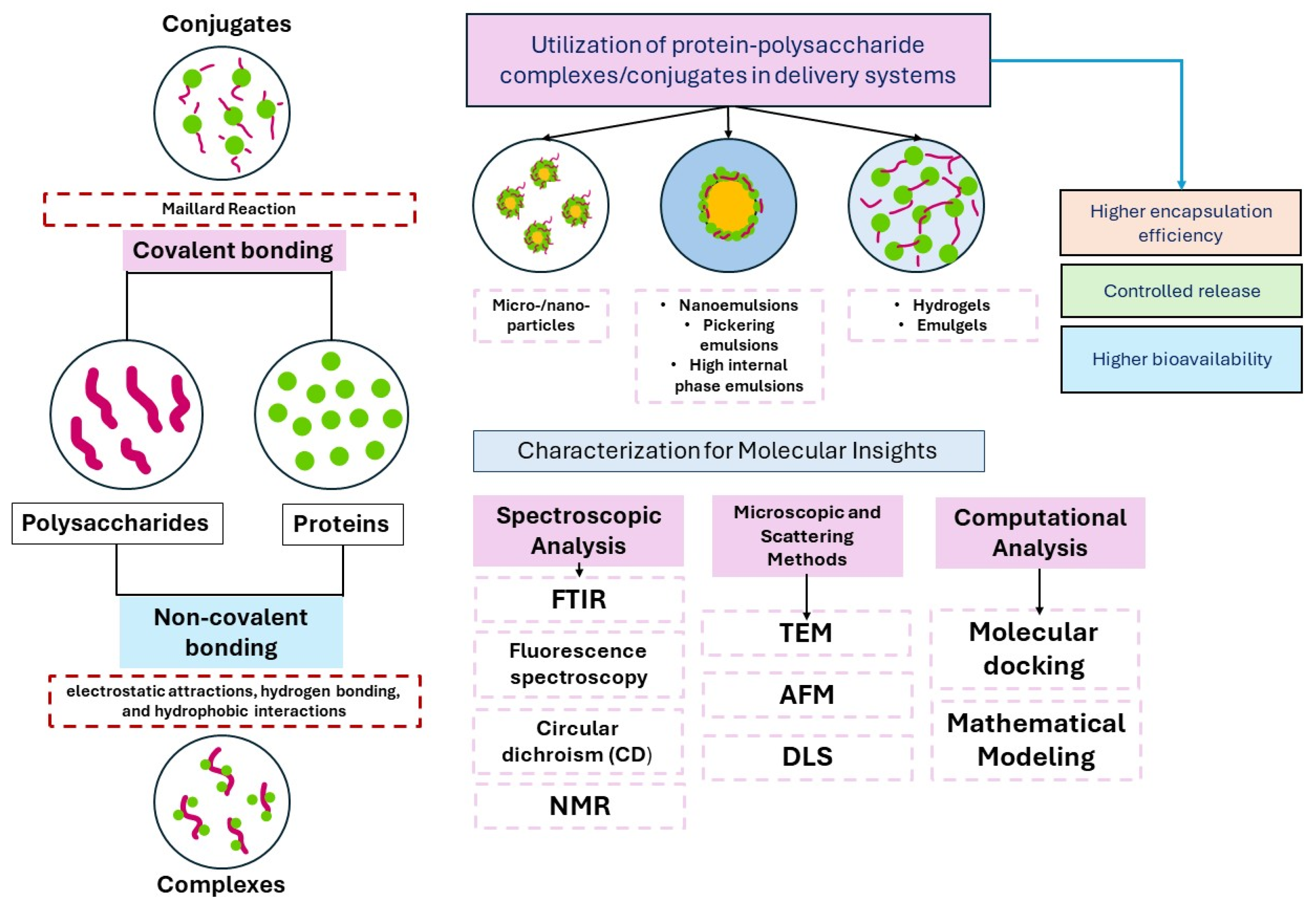
Proteins can be derived from animal-based foods (e.g., casein, whey proteins, egg protein, and gelatin) or plant-based foods (e.g., gluten, zein, pea protein, soy protein, quinoa protein, and peanut protein) [119]. The functional properties of proteins, such as emulsifying, foaming, and gelling, enable their application in the delivery of bioactive compounds [120]. However, there are limitations in using proteins alone in encapsulation systems, since proteins exhibit instability due to environmental stimuli during processing, storage, and gastrointestinal digestion [121]. Therefore, protein–polysaccharide composite delivery systems are used to minimize protein precipitation or aggregation by regulating electrostatic repulsion and steric hindrance. Protein–polysaccharide interactions can occur through non-covalent interactions (complexes) or covalent interactions (conjugates). While protein–polysaccharide complexes result from electrostatic attractions, hydrogen bonding, and hydrophobic interactions, conjugates are formed by the Maillard reaction, which includes covalent bonding between the N-glycosylamine group and carbonyl groups of polysaccharides [122]. Up to date, protein–polysaccharide complexes or conjugates have been utilized in the fabrication of a wide variety of carriers, such as micro/nanoparticles, liposomes, hydrogels, emulsions, and emulgels [123,124,125,126,127]. Figure 2 presents the formation and applications of protein–polysaccharide-based delivery systems for encapsulating bioactive compounds. A summary of recent studies on protein–polysaccharide-based encapsulation systems is presented in Table 5.
In a recent study, curcumin was loaded into ovalbumin/polysaccharide (OVA/PS) complexes. The intensification of C-O bond peaks in FTIR spectra of OVA/PS was attributed to the formation of non-covalent bonds between ovalbumin and all polysaccharides (sodium alginate, gum Arabic, and carboxymethyl cellulose). In addition, characteristic peaks of free curcumin at 963.41 cm−1, 890.12 cm−1, 860.22 cm−1, and 812.00 cm−1 disappeared in OVA and OVA/PS carriers, potentially due to interaction between curcumin and OVA or OVA/PS. Interactions between OVA/PS and curcumin through hydrogen bonding and hydrophobic interaction provided high encapsulation efficiency (>97%) [131]. The non-covalent interactions between polyphenols and proteins mainly include hydrogen bonding and hydrophobic interactions. While hydrogen bonding occurs between the hydroxyl groups of polyphenols and the carbonyl groups of proteins, hydrophobic interactions occur between the benzene ring of polyphenols and the aliphatic or aromatic amino acids of proteins [132]. In another study, hesperidin was encapsulated in SPI/chitosan, SPI/guar gum, and SPI/xanthan gum complexes. The highest EE% was tested for XG complexes as 90.22%. The UV and fluorescence spectroscopy revealed hydrophobic interactions between XG and SPI. Also, the CD spectrum of SPI and SPI complexes showed a slight decrease in α-helix content and a decrease in the β-sheet of SPI after complexation, which was attributed to primary interaction on the surface of SPI, with minimal influence on its internal conformation [133]. These findings demonstrate that non-covalent interactions, such as hydrogen bonding and hydrophobic interactions, play a crucial role in stabilizing protein–polysaccharide complexes and enhancing the encapsulation and retention of bioactive compounds.

6. Advanced Characterization Techniques

6.1. Spectroscopic Analysis

FTIR spectroscopy is widely used to identify the functional groups of bioactive compounds and to evaluate potential structural changes or molecular interactions occurring during encapsulation. FTIR enables the characterization of physical or chemical interactions between bioactive compounds and carrier polymers [134]. Shifts in FTIR peaks, along with the disappearance or reduction of characteristic bands, can indicate the entrapment of bioactive compounds within polymer matrices [16]. Recently, curcumin and EGCG were encapsulated in soy protein fibril hydrogels. FTIR analysis revealed that characteristic peaks of free Cur and EGCG disappeared or shifted upon binding to soy protein fibrils, indicating interactions between the protein fibrils and polyphenols. In addition, it was observed that the intensity of protein amide bands changed depending on EGCG concentrations, which was attributed to the conformation of protein secondary structure [135]. In another study, β-carotene was loaded in WPI-GA emulsions, followed by electrospinning. When the FTIR spectra of native WPI and GA and WPI-GA nanofibers were compared, it was revealed that various characteristic bands were displaced, which was linked to the complexation of WPI and GA via hydrogen bonding. Moreover, the main characteristic peak observed in the IR spectrum of free β-carotene appeared in the spectrum of nanofibers, which is an indication of successful entrapment within the fiber [136]. These studies highlight that FTIR analysis can confirm the incorporation of bioactive compounds within the delivery systems. Furthermore, it can enable the identification of types of interactions (e.g., hydrogen bonding, hydrophobic interactions, electrostatic interactions) between carrier polymers and the encapsulated compounds.
Fluorescence spectroscopy measures the intensity and wavelength of emitted light and is commonly used to investigate the molecular interactions between bioactive compounds and carrier materials [137,138]. The reduction of the fluorescence intensity of carrier materials can be an indication of interaction with the core material [135]. The fluorescence intensity of whey protein nanoparticles decreased after loading propolis, which was related to propolis binding to tryptophan residues of WPI [139]. Similarly, when ferulic acid, resveratrol, and rhein were encapsulated in casein nanoparticles, fluorescence intensity declined due to the quenching effect of polyphenols [138]. Moreover, when vitamins C and E were encapsulated in SPI/pectin particles, a noticeable decrease in fluorescence intensity was observed, indicating fluorescence quenching caused by vitamin binding into fluorophore groups in SPI, conformational changes in the SPI, and electrostatic interaction of SPI and pectin [140]. Fluorescence spectroscopy not only provides insights into the interactions between bioactive compounds and wall materials but also helps to understand the molecular interactions occurring among combined wall components, thereby supporting the design of more stable encapsulation systems [141].
Yeast carboxymethyl glucan (YCG) was incorporated in zein nanoparticles to enhance physicochemical stability and more effectively deliver resveratrol. Zein had a fluorescence emission peak at 304 nm, which was attributed to tryptophan residues and tyrosine residues. The incorporation of YCG increased the intensity of tryptophan emission peaks, which was explained by molecular unfolding due to interactions between the hydrophilic groups of zein and YCG [142].
CD is a commonly used technique for analyzing the structures of proteins and polysaccharides by measuring the difference in absorption between left- and right-handed circularly polarized light as it passes through a chiral molecule. It is a widely used tool to investigate the secondary structure of proteins by enabling the determination of α-helix, β-sheet, β-turn, and random coil contents [143]. A study aimed to determine the critical unfolding pH of cod proteins to enhance their binding efficiency with curcumin and improve EE. It was found that at pH 9.5, the spectrum of CP exhibited an apparent blue shift, indicating a decrease in α-helix content and protein unfolding. The critical pH for protein unfolding was determined as pH 10, which provided higher EE%. It was attributed to the formation of smaller protein particles, which exposed more functional groups for curcumin binding [10]. In another attempt, curcumin was encapsulated by casein–polysaccharide (carrageenan, chitosan, and CMC) complexes, and these complexes were characterized using CD. The α-helix, β-sheet, β-turn, and random coil contents of WPI were determined as 7.3%, 39.3%, 21.9%, and 31.6%, respectively. After the incorporation of curcumin, the α-helix content decreased while the β-sheet content increased, which is considered indicative of better protein hydration capacity and more effective entrapment of curcumin [144]. CD was also utilized for investigating the entrapment of EGCG in WPI/pectin particles. It was observed that WPI exhibited decreased β-sheet content and increased α-helix content with increased EGCG concentration, which was linked to stabilization of the α-helix structure by hydrogen bonding between WPI and EGCG [145]. Overall, these studies reveal that CD is a powerful tool for investigating structural changes in proteins upon interaction with bioactive compounds. It can be used to optimize the stability and efficiency of protein-based delivery systems, guiding the development of more efficient encapsulation strategies.
The Nuclear Magnetic Resonance (NMR) technique is based on the subjection of active nuclei by radiofrequency (RF) waves, causing their magnetic moments (spins) to transition between different energy levels. The resulting non-uniform distribution of nuclei in low and high energy states generates a measurable signal, which can be analyzed to provide detailed information on molecular structure, dynamics, and interactions [146]. NMR technology can provide detailed insights into the chemical structure, molecular dynamics, crystallinity, and mobility of encapsulation systems [147]. In a study, curcumin was encapsulated in hydroxypropyl-β-cyclodextrin (HPβCD), and CDs were incorporated in pullulan/OSA nanofibers. NMR was utilized to determine the approximate loading amount of curcumin in nanofibers. The NMR spectra of free curcumin and curcumin-loaded HPβCD showed that the characteristic peaks of curcumin were similar after the incorporation in nanofibers, which indicated the protection of curcumin structure during electrospinning. The loading capacity of curcumin was calculated as 7.8%, and the EE% as 96.9% [148]. Fish oil was encapsulated in layer-by-layer (LBL) lecithin/WPI nanogels. A blueshift of the T2 relaxation time from 114.9 to 103.5 ms was observed after fish oil was encapsulated within LBL nanogels, which was attributed to the decreased proton mobility of the fish oil with the increased glyceryl monostearate (GMS) concentration. This was also observed in thermal stability analysis, which revealed that nanogels with higher GMS exhibited better thermal stability. Also, the transition of crystalline nanogels into an amorphous state indicated the successful incorporation of fish oil in LBL nanogels [149].

6.2. Microscopic and Scattering Methods

Transmission Electron Microscopy (TEM) is used for visualizing encapsulation, aggregation, and release mechanisms, comparing the morphologies and distribution in carrier systems. Visualizing with TEM is based on the strong interactions of electrons with proteins, polysaccharides, lipid-based carriers, and other food components, which allow high-resolution images [150]. In the studies focusing on encapsulation of food bioactives, TEM is utilized for observation of the diameter, particle size, and shape of carrier systems. It is also used for the identification of interaction behavior between biopolymers, such as protein-protein and protein-polyphenol binding. Moreover, TEM revealed interactions under specific conditions and insights into the structural stability of encapsulated systems after bioactive incorporation [151,152]. Atomic Force Microscopy (AFM) is another commonly used method that enables nanoscale imaging and measurement of surface morphology and interaction forces, providing detailed insight into the interfacial properties of encapsulation systems [153]. In the study where resveratrol was encapsulated within zein–GA coacervates, AFM analysis revealed that complexation with GA increased the particle size and surface roughness, which was attributed to enhanced aggregation due to electrostatic interactions and chain entanglement. After the ultrasound treatment, the nanoparticles exhibited decreased size, more uniform dispersion, and less surface roughness, which was explained by the disassembly of large aggregates and reformation into smaller spherical particles. These structural modifications likely facilitated stronger binding interactions and improved the encapsulation efficiency of resveratrol [154]. The dynamic light scattering (DLS) technique measures particle size based on the Brownian motion of particles suspended in liquid, where smaller particles move faster than larger ones. In delivery systems, DLS is widely used for observation of size distribution, stability, and aggregation behavior of colloidal systems such as emulsions, liposomes, and nano/microcapsules. Particle size and zeta potential are key parameters influencing EE, release characteristics, and stability of delivery systems, making DLS an essential tool for characterizing carriers [155].

6.3. Computational and Integrative Approaches to Colloid-Bioactive Interactions

Computational tools such as mathematical modeling and molecular docking provide insights into colloid–bioactive interactions, enabling prediction of both macroscopic release kinetics and molecular-level interactions [133,156]. Molecular docking is a computational approach that predicts binding sites and simulates the interaction between small molecule ligands and large molecule receptors [157]. Molecular docking can be employed to investigate molecular interactions between carrier materials, as well as carrier-bioactive interactions [130,138]. Molecular docking revealed that cinnamaldehyde was successfully encapsulated within the cavities of β-CD and its modified derivatives. The binding involved hydrogen bonding and hydrophobic interactions, with binding energies ranging from −3.7 to −4.72 kcal/mol, indicating favorable complexation [158]. Three polyphenols (curcumin, quercetin, and resveratrol) were encapsulated in PPI nanocarriers. Molecular docking of 11S legumin with three polyphenols showed that quercetin exhibited the strongest binding affinity, followed by resveratrol and curcumin. All three polyphenols bound in similar sites of legumin with interactions primarily driven by hydrogen bonds, hydrophobic forces, and van der Waals interactions. These docking results were in parallel with fluorescence spectroscopy and FTIR findings, providing a molecular basis for the encapsulation and quenching effects of polyphenols in pea protein [159].
To design effective delivery systems, it is crucial to investigate colloid–bioactive interactions using both computational and experimental techniques, enabling the prediction of interaction, stability, and release behavior. Vitamin E and quercetin were encapsulated in soybean lipophilic protein (SLP)-based nanoparticles, and these nanoparticles were characterized by fluorescence spectroscopy, FTIR, CD, and molecular docking. Fluorescence spectroscopy revealed that pH-shifting combined with ultrasonication treatments changed the structure of soybean lipophilic proteins (SLP), which resulted in protein unfolding and exposing hydrophobic groups. CD and FTIR analyses revealed protein unfolding, including increased β-sheet content and enhanced hydrogen bonding. Moreover, CD and FTIR analyses confirmed complexation of SLP, vitamin E, and quercetin. Molecular docking supported these findings by revealing that vitamin E and quercetin bind to specific pockets on 7S and 11S proteins through hydrophobic interactions, hydrogen bonding, and electrostatic interactions [160]. Overall, this study demonstrates that combining molecular docking with spectroscopic analyses provides a good strategy for studying protein–bioactive complexation at both molecular and macroscopic levels.
It is also evident that understanding the interaction mechanisms of plant-based protein-polyphenol systems at a molecular level is necessary to improve the sensory quality of products. Molecular docking studies have also shown that protein-phenolic interactions are mostly stabilized by reversible non-covalent interactions (hydrogen bonds and van der Waals forces), and that the binding strength varies depending on the phenolic structure, pH conditions, and protein surface properties [76,161,162,163]. These findings demonstrate that molecular docking approaches provide a powerful complementary method for understanding aroma transfer, sensory quality, and interaction mechanisms in plant-based protein systems.

7. Effects on Nutrient Delivery and Bioactivity

Microencapsulation and nanoencapsulation techniques can be applied to enhance the stability and bioaccessibility of bioactive compounds. Encapsulation can enable protection of bioactive compounds from environmental conditions during processing, storage, and gastrointestinal digestion and their controlled release in targeted sites by entrapment in a protective matrix [164,165]. The chemical interactions between core and wall materials, as well as between wall components themselves, determine the EE and stability of delivery systems. Protein-based carriers can interact with co-carrier materials such as polysaccharides through hydrophilic or hydrophobic residues. The arrangement of polysaccharide functional groups creates hydrophilic and hydrophobic regions that facilitate polar and non-polar interactions within the encapsulation matrix [165,166]. In a recent study, astaxanthin was encapsulated in octenyl succinic anhydride starch (OSAS)/polyvinyl alcohol (PVA) nanofibers. In TEM images, it was observed that astaxanthin-loaded nanofibers exhibited a core–shell structure with a distinct internal dark area and external bright area. These observations were in parallel with FTIR spectra of astaxanthin-loaded nanofibers, which did not exhibit any characteristic peaks of free astaxanthin. In addition, when the OSAS concentration of astaxanthin fibers was increased, O-H absorption bands exhibited a redshift. It was attributed to the increased hydrogen bonding between OSAS and PVA, which provided more effective protection of astaxanthin. As expected, increased OSAS enhanced the EE% of OSAS/PVA nanofibers. Moreover, increased OSAS concentration provided increased oral release of astaxanthin in simulated saliva, potentially due to a more hydrophilic nature and higher EE% [167]. In another study, liposomes were modified by decanoic acid and stearic acid for the encapsulation of bioactive peptides. FTIR spectra of native liposomes and modified liposomes revealed that fatty acids and liposome membranes exhibited electrostatic interaction, which was an indicator of fatty acid insertion into the bilayer. Also, the incorporation of fatty acids reduced the fluorescence intensity, which was attributed to hydrogen bonding between the alkyl chains of fatty acids and phospholipid chains. However, both native and modified liposomes had low EE%, which was explained by low loading capacity due to the limited aqueous volume of liposomes and diffusion of hydrophilic bioactive peptides into the external aqueous phase. During in vitro digestion, both decanoic acid and stearic acid-modified liposomes showed lower release of bioactive peptides in SGF, potentially due to a more stable and strengthened bilayer structure [168]. These findings highlight that the structural characteristics of carrier materials, whether polymeric matrices or lipid-based systems, directly influence the EE and controlled release of bioactive compounds. Molecular interactions/modifications can enhance carrier functionality. However, these interactions do not always result in enhanced EE and bioaccessibility, since limitations of the utilized method may still cause loss of bioactive compounds.
Encapsulated bioactive compounds are incorporated into food matrices to improve their nutritional value, sensory properties, and functional performance [169,170]. The encapsulation of curcumin in the EGCG matrix did not affect its fluorescence intensity, potentially due to π-π stacking occurring at the benzene rings at both ends of the molecule, which did not affect its enol structure in aqueous solutions. In addition, molecular docking results revealed that curcumin was incorporated into EGCG nanoparticles by π-π stacking interactions between the A-ring and B-ring of EGCG with the benzene ring of curcumin [171]. In another study, after loading caffeine into blank nano-chitosomes, a new peak appeared, and most of the absorption peaks were intensified, which was linked to the interaction between caffeine and the bilayer. The EE of nano-chitosomes varied between 91.2% and 70.71%. During in vitro digestion, nano-liposomes released a total of 98.1% caffeine, while nano-chitosomes released 70.9% [172]. The stability of delivery systems can be influenced by the characteristics of food matrices, such as pH, ionic strength, and the presence of salts, sugars, polysaccharides, and proteins, which may interact with encapsulated compounds. Advanced molecular-level insights into encapsulation systems are essential for improving the gastrointestinal stability and controlled release of bioactive compounds. In addition to the investigations of encapsulated systems, it has been demonstrated that the interactions of aroma-active compounds such as aldehydes with plant proteins mainly occur through hydrophobic interactions and hydrogen bonding, with hydrophobic/aromatic amino acid residues playing a critical role in binding [173,174]. Such interactions are associated with modifications in the sensory characteristics of food products.

8. Challenges and Future Perspectives

Studying the molecular interactions between wall materials and core compounds is essential for designing effective encapsulation systems. Despite significant advancements in encapsulation systems, several challenges remain in optimizing colloid–bioactive interactions for enhanced bioactive stability and bioaccessibility. To date, the majority of studies on encapsulation systems have been limited to laboratory-scale investigations. Factors such as the structural complexity and variability of biopolymers and environmental conditions limit the reproducibility and scalability of encapsulation systems. Although spectroscopic and microscopic techniques offer significant insights, the molecular mechanisms underlying non-covalent and covalent interactions are not yet fully understood, especially under gastrointestinal conditions. In addition, high EE% does not always result in improved release characteristics or bioaccessibility.
Future research should focus on multi-scale characterization approaches that integrate advanced analytical techniques such as FTIR, fluorescence spectroscopy, TEM, and SAXS with computational modeling tools, including molecular docking, molecular dynamics, and machine learning, to unravel interaction mechanisms at both molecular and colloidal levels. Integrating these approaches with experimental data can enable the development of delivery systems tailored to specific functional and nutritional goals.

9. Conclusions

Various colloids and bioactive compounds can coexist within food matrices or carrier systems, and their molecular-level interactions are of critical importance. Interactions occurring at the molecular level result in changes in the structures of both reacting substances, enabling the formation of various complex structures. Although recent studies in this field have demonstrated the potential to explain the macro-level impacts of these interactions, the functionality and bioactivity of the resulting complexes remain uncertain. Since the interactions between colloids and bioactive components in any matrix are highly likely to occur under the influence of multiple parameters, comprehensive research into the binding mechanisms and possible structural changes is necessary. Colloid-bioactive interactions play an important role in food applications and carrier systems by influencing product quality, stability, texture, and health effects. Thus, by evaluating the chemical changes occurring at the micro level, the design of products with the desired texture, functionality, and quality can be achieved.
Although the interactions of protein- and polysaccharide-based colloidal systems with polyphenols and carotenoids have been widely investigated in recent studies, future research requires more comprehensive approaches that establish a stronger relationship between the interaction mechanism, matrix structure, and functional properties. In particular, there is limited understanding of how binding type and surface properties determine their behavior and biological effects during gastrointestinal digestion. Therefore, in subsequent studies, standardized model systems are needed to facilitate comparisons across different systems. Lastly, in the near future, computer-based studies such as molecular docking will become even more widespread, enabling the achievement of desired macroscopic properties through targeted micro-scale alterations.

Author Contributions

Conceptualization, H.C.D., N.A., D.G.-K., A.C.K. and E.C.; writing—original draft preparation, H.C.D., N.A. and D.G.-K.; writing—review and editing, A.C.K. and E.C. All authors have read and agreed to the published version of the manuscript.

Funding

This research received no external funding.

Institutional Review Board Statement

Not applicable.

Informed Consent Statement

Not applicable.

Data Availability Statement

No new data were created or analyzed in this study. Data sharing is not applicable to this article.

Conflicts of Interest

The authors declare no conflicts of interest.

References

  1. Bazana, M.T.; Codevilla, C.F.; de Menezes, C.R. Nanoencapsulation of Bioactive Compounds: Challenges and Perspectives. Curr. Opin. Food Sci. 2019, 26, 47–56. [Google Scholar] [CrossRef]
  2. Singh, A.; Prakash, A.; Choudhary, R. Bioactive Components Having Antimicrobial and Anticancerous Properties: A Review. In Bioactive Components; Springer: Singapore, 2023; pp. 271–299. [Google Scholar] [CrossRef]
  3. Liu, F.; McClements, D.J.; Ma, C.; Liu, X. Novel Colloidal Food Ingredients: Protein Complexes and Conjugates. Annu. Rev. Food Sci. Technol. 2023, 14, 35–61. [Google Scholar] [CrossRef]
  4. Cheng, F.; Chen, M.; Duan, Z.; Zou, Y.; He, Y.; Zeng, F.; Yuan, Y.; Fu, T.; Tu, H.; Li, R.; et al. Fabrication, Characterization, and Bioactivity of Self-Assembled Carrier-Free Colloidal Dispersions from Citrus × Limon ‘Rosso’ Essential Oil and Tea Polyphenols. Food Chem. 2024, 457, 140058. [Google Scholar] [CrossRef]
  5. Chen, Y.; Yao, M.; Peng, S.; Fang, Y.; Wan, L.; Shang, W.; Xiang, D.; Zhang, W. Development of Protein-Polyphenol Particles to Stabilize High Internal Phase Pickering Emulsions by Polyphenols’ Structure. Food Chem. 2023, 428, 136773. [Google Scholar] [CrossRef] [PubMed]
  6. Liu, L.; Zhang, P.; Yan, W.; Wu, Y.; Jin, G.; Song, H.; An, F.; Wu, Y.; Li, X.; Luo, P.; et al. Mechanisms of Ultrasound-Synergized Polyphenol Enhancing the Foaming Properties of Ovalbumin: Focus on Interfacial Behavior and Microstructure. Ultrason. Sonochem. 2025, 122, 107605. [Google Scholar] [CrossRef] [PubMed]
  7. Li, Y.; He, D.; Li, B.; Lund, M.N.; Xing, Y.; Wang, Y.; Li, F.; Cao, X.; Liu, Y.; Chen, X.; et al. Engineering Polyphenols with Biological Functions via Polyphenol-Protein Interactions as Additives for Functional Foods. Trends Food Sci. Technol. 2021, 110, 470–482. [Google Scholar] [CrossRef]
  8. Zhang, Z.; Li, X.; Sang, S.; McClements, D.J.; Chen, L.; Long, J.; Jiao, A.; Jin, Z.; Qiu, C. Polyphenols as Plant-Based Nutraceuticals: Health Effects, Encapsulation, Nano-Delivery, and Application. Foods 2022, 11, 2189. [Google Scholar] [CrossRef]
  9. Antony, A.; Farid, M. Effect of Temperatures on Polyphenols during Extraction. Appl. Sci. 2022, 12, 2107. [Google Scholar] [CrossRef]
  10. Wang, Y.; Shen, J.; Zou, B.; Zhang, L.; Xu, X.; Wu, C. Determination of the Critical pH for Unfolding Water-Soluble Cod Protein and Its Effect on Encapsulation Capacities. Food Res. Int. 2023, 174, 113621. [Google Scholar] [CrossRef]
  11. Sun, J.; Liu, T.; Zhang, F.; Huang, Y.; Zhang, Y.; Xu, B. Tea Polyphenols on Emulsifying and Antioxidant Properties of Egg White Protein at Acidic and Neutral pH Conditions. LWT 2022, 153, 112537. [Google Scholar] [CrossRef]
  12. Cuomo, F.; Iacovino, S.; Sacco, P.; De Leonardis, A.; Ceglie, A.; Lopez, F. Progress in Colloid Delivery Systems for Protection and Delivery of Phenolic Bioactive Compounds: Two Study Cases—Hydroxytyrosol and Curcumin. Molecules 2022, 27, 921. [Google Scholar] [CrossRef]
  13. Wang, B.; Pham, L.B.; Adhikari, B. Complexation and Conjugation between Phenolic Compounds and Proteins: Mechanisms, Characterisation and Applications as Novel Encapsulants. Sustain. Food Technol. 2024, 2, 1206–1227. [Google Scholar] [CrossRef]
  14. Yan, S.; Regenstein, J.M.; Qi, B.; Li, Y. Construction of Protein-, Polysaccharide- and Polyphenol-Based Conjugates as Delivery Systems. Crit. Rev. Food Sci. Nutr. 2025, 65, 1363–1381. [Google Scholar] [CrossRef]
  15. Ran, Y.; Li, F.; Xu, Z.; Zeng, K.; Ming, J. Recent Advances in Dietary Polyphenols (DPs): Antioxidant Activities, Nutrient Interactions, Delivery Systems, and Potential Applications. Food Funct. 2024, 15, 10213–10232. [Google Scholar] [CrossRef]
  16. Zhao, Y.; Li, H.; Wang, Y.; Zhang, Z.; Wang, Q. Preparation, Characterization and Release Kinetics of a Multilayer Encapsulated Perilla frutescens L. Essential Oil Hydrogel Bead. Int. J. Biol. Macromol. 2023, 249, 124776. [Google Scholar] [CrossRef]
  17. Cheng, Y.; Chen, X.; Lin, Q.; Wang, J.; Chen, Y.; Mo, H.; Chen, M.; Xu, Z.; Wen, L.; Jiao, Y. Improvement Effect of Different Polysaccharides on the Functional Properties of Curcumin-Loaded Rice Protein Hydrolysate Nanoparticles. LWT 2024, 204, 116471. [Google Scholar] [CrossRef]
  18. Umar, M.; Zafar, S.; Fikry, M.; Medhe, S.V.; Rungraeng, N. Non-Covalent Complexes of Plant-Based Proteins-Polysaccharides and Their Applications to Stabilize the Delivery Systems for Bioactive Compounds. Food Rev. Int. 2025, 18, 1–31. [Google Scholar] [CrossRef]
  19. Manzoor, M.; Tchameni, Z.F.N.; Bhat, Z.F.; Jaiswal, A.K.; Jaglan, S. Recent Insights on the Conformational Changes, Functionality, and Physiological Properties of Plant-Based Protein-Polyphenol Conjugates. Food Bioprocess Technol. 2024, 17, 2131–2154. [Google Scholar] [CrossRef]
  20. Ke, Y.; Deng, L.; Dai, T.; Xiao, M.; Chen, M.; Liang, R.; Liu, W.; Liu, C.; Chen, J. Effects of Cell Wall Polysaccharides on the Bioaccessibility of Carotenoids, Polyphenols, and Minerals: An Overview. Crit. Rev. Food Sci. Nutr. 2023, 63, 11385–11398. [Google Scholar] [CrossRef] [PubMed]
  21. Meng, Y.; Qiu, C.; Li, X.; McClements, D.J.; Sang, S.; Jiao, A.; Jin, Z. Polysaccharide-Based Nano-Delivery Systems for Encapsulation, Delivery, and pH-Responsive Release of Bioactive Ingredients. Crit. Rev. Food Sci. Nutr. 2024, 64, 187–201. [Google Scholar] [CrossRef]
  22. Poluri, K.M.; Gulati, K.; Sarkar, S. Structural and Functional Properties of Proteins. In Protein-Protein Interactions: Principles and Techniques: Volume I; Springer: Singapore, 2021; pp. 1–60. ISBN 978-981-16-1594-8. [Google Scholar]
  23. Horita, K.; Kameda, T.; Suga, H.; Hirano, A. Molecular Mechanism of the Interactions between Coffee Polyphenols and Milk Proteins. Food Res. Int. 2025, 202, 115573. [Google Scholar] [CrossRef] [PubMed]
  24. Liu, J.; Zhou, H.; Tan, Y.; Muriel Mundo, J.L.; McClements, D.J. Comparison of Plant-Based Emulsifier Performance in Water-in-Oil-in-Water Emulsions: Soy Protein Isolate, Pectin and Gum Arabic. J. Food Eng. 2021, 307, 110625. [Google Scholar] [CrossRef]
  25. Estupiñan-Amaya, M.; Fuenmayor, C.A.; López-Córdoba, A. Evaluation of Mixtures of Maltodextrin and Gum Arabic for the Encapsulation of Andean Blueberry (Vaccinium Meridionale) Juice by Freeze–Drying. Int. J. Food Sci. Technol. 2022, 57, 7379–7390. [Google Scholar] [CrossRef]
  26. Hashemzadeh, H.; Hanafi-Bojd, M.Y.; Iranshahy, M.; Zarban, A.; Raissi, H. The Combination of Polyphenols and Phospholipids as an Efficient Platform for Delivery of Natural Products. Sci. Rep. 2023, 13, 2501. [Google Scholar] [CrossRef]
  27. Abdullah; Liu, L.; Javed, H.U.; Xiao, J. Engineering Emulsion Gels as Functional Colloids Emphasizing Food Applications: A Review. Front. Nutr. 2022, 9, 890188. [Google Scholar] [CrossRef]
  28. Ashfaq, A.; Jahan, K.; Islam, R.U.; Younis, K. Protein-Based Functional Colloids and Their Potential Applications in Food: A Review. LWT 2022, 154, 112667. [Google Scholar] [CrossRef]
  29. Bonechi, C.; Donati, A.; Tamasi, G.; Pardini, A.; Rostom, H.; Leone, G.; Lamponi, S.; Consumi, M.; Magnani, A.; Rossi, C. Chemical Characterization of Liposomes Containing Nutraceutical Compounds: Tyrosol, Hydroxytyrosol and Oleuropein. Biophys. Chem. 2019, 246, 25–34. [Google Scholar] [CrossRef]
  30. Kalaitzaki, A.; Emo, M.; Stébé, M.J.; Xenakis, A.; Papadimitriou, V. Biocompatible Nanodispersions as Delivery Systems of Food Additives: A Structural Study. Food Res. Int. 2013, 54, 1448–1454. [Google Scholar] [CrossRef]
  31. Esperón-Rojas, A.A.; Baeza-Jiménez, R.; Santos-Luna, D.; Velasco-Rodríguez, L.D.C.; Ochoa-Rodríguez, L.R.; García, H.S. Bioavailability of Curcumin in Nanoemulsions Stabilized with Mono- and Diacylglycerols Structured with Conjugated Linoleic Acid and n-3 Fatty Acids. Biocatal. Agric. Biotechnol. 2020, 26, 101638. [Google Scholar] [CrossRef]
  32. Pool, H.; Mendoza, S.; Xiao, H.; Julian McClements, D. Encapsulation and Release of Hydrophobic Bioactive Components in Nanoemulsion-Based Delivery Systems: Impact of Physical Form on Quercetin Bioaccessibility. Food Func. 2012, 4, 162–174. [Google Scholar] [CrossRef]
  33. Han, G.; Duan, X.; Jiang, B.; Li, Y.; Li, B.; Yang, J.; Pan, S.; Liu, F. Emulsifying Properties, in Vitro Digestive Characteristics, and β-Carotene Bioaccessibility of Mandarin Peel Pectin Emulsions Prepared with Different Carrier Oil Phases. Int. J. Biol. Macromol. 2023, 242, 124961. [Google Scholar] [CrossRef]
  34. Mehnert, W.; Mäder, K. Solid Lipid Nanoparticles: Production, Characterization and Applications. Adv. Drug Deliv. Rev. 2012, 64, 83–101. [Google Scholar] [CrossRef]
  35. Andreazza, R.; Morales, A.; Pieniz, S.; Labidi, J. Gelatin-Based Hydrogels: Potential Biomaterials for Remediation. Polymers 2023, 15, 1026. [Google Scholar] [CrossRef] [PubMed]
  36. Ashwar, B.A.; Gani, A. Noncovalent Interactions of Sea Buckthorn Polyphenols with Casein and Whey Proteins: Effect on the Stability, Antioxidant Potential, and Bioaccessibility of Polyphenols. ACS Food Sci. Technol. 2021, 1, 1206–1214. [Google Scholar] [CrossRef]
  37. Inbaraj, S.; Sridhar, K.; Sharma, M.; Said, N.S.; Fola Olawuyi, I.; Lee, W.Y. Pectin Hydrogels: Gel-Forming Behaviors, Mechanisms, and Food Applications. Gels 2023, 9, 732. [Google Scholar] [CrossRef]
  38. Alkekhia, D.; Hammond, P.T.; Shukla, A. Layer-by-Layer Biomaterials for Drug Delivery. Annu. Rev. Biomed. Eng. 2020, 22, 1–24. [Google Scholar] [CrossRef]
  39. Liu, Y.; Chen, Y.; Gao, X.; Fu, J.; Hu, L. Application of Cyclodextrin in Food Industry. Crit. Rev. Food Sci. Nutr. 2022, 62, 2627–2640. [Google Scholar] [CrossRef] [PubMed]
  40. Ozdal, T.; Capanoglu, E.; Altay, F. A Review on Protein–Phenolic Interactions and Associated Changes. Food Res. Int. 2013, 51, 954–970. [Google Scholar] [CrossRef]
  41. Zhang, H.; Yu, D.; Sun, J.; Liu, X.; Jiang, L.; Guo, H.; Ren, F. Interaction of Plant Phenols with Food Macronutrients: Characterisation and Nutritional–Physiological Consequences. Nutr. Res. Rev. 2014, 27, 1–15. [Google Scholar] [CrossRef] [PubMed]
  42. Bohin, M.C.; Vincken, J.P.; Westphal, A.H.; Tripp, A.M.; Dekker, P.; Van Der Hijden, H.T.W.M.; Gruppen, H. Interaction of Flavan-3-Ol Derivatives and Different Caseins Is Determined by More than Proline Content and Number of Proline Repeats. Food Chem. 2014, 158, 408–416. [Google Scholar] [CrossRef]
  43. Yildirim-Elikoglu, S.; Erdem, Y.K. Interactions between Milk Proteins and Polyphenols: Binding Mechanisms, Related Changes, and the Future Trends in the Dairy Industry. Food Rev. Int. 2018, 34, 665–697. [Google Scholar] [CrossRef]
  44. Hu, Y.; Zhou, C.; Du, L.; Zhan, F.; Sun, Y.; Wu, Z.; Pan, D. Phenolic Structure Dependent Interaction onto Modified Goose Liver Protein Enhanced by pH Shifting: Modulations on Protein Interfacial and Emulsifying Properties. Int. J. Biol. Macromol. 2023, 253, 126810. [Google Scholar] [CrossRef]
  45. Kaspchak, E.; Goedert, A.C.; Igarashi-Mafra, L.; Mafra, M.R. Effect of Divalent Cations on Bovine Serum Albumin (BSA) and Tannic Acid Interaction and Its Influence on Turbidity and in Vitro Protein Digestibility. Int. J. Biol. Macromol. 2019, 136, 486–492. [Google Scholar] [CrossRef]
  46. Jakobek, L. Interactions of Polyphenols with Carbohydrates, Lipids and Proteins. Food Chem. 2015, 175, 556–567. [Google Scholar] [CrossRef]
  47. Quan, T.H.; Benjakul, S.; Sae-leaw, T.; Balange, A.K.; Maqsood, S. Protein-Polyphenol Conjugates: Antioxidant Property, Functionalities and Their Applications. Trends Food Sci. Technol. 2019, 91, 507–517. [Google Scholar] [CrossRef]
  48. Le Bourvellec, C.; Renard, C.M.G.C. Interactions between Polyphenols and Macromolecules: Quantification Methods and Mechanisms. Crit. Rev. Food Sci. Nutr. 2012, 52, 213–248. [Google Scholar] [CrossRef]
  49. Mao, T.; Akshit, F.N.U.; Matiwalage, I.; Sasidharan, S.; Alvarez, C.M.; Wescombe, P.; Mohan, M.S. Preferential Binding of Polyphenols in Blackcurrant Extracts with Milk Proteins and the Effects on the Bioaccessibility and Antioxidant Activity of Polyphenols. Foods 2024, 13, 515. [Google Scholar] [CrossRef] [PubMed]
  50. Liu, F.; Ma, C.; Gao, Y.; McClements, D.J. Food-Grade Covalent Complexes and Their Application as Nutraceutical Delivery Systems: A Review. Compr. Rev. Food Sci. Food Saf. 2017, 16, 76–95. [Google Scholar] [CrossRef] [PubMed]
  51. Sui, X.; Sun, H.; Qi, B.; Zhang, M.; Li, Y.; Jiang, L. Functional and Conformational Changes to Soy Proteins Accompanying Anthocyanins: Focus on Covalent and Non-Covalent Interactions. Food Chem. 2018, 245, 871–878. [Google Scholar] [CrossRef]
  52. Chao Song, Z.; Zhang, H.; Fei Niu, P.; Shi, L.S.; Yan Yang, X.; Hong Meng, Y.; Yu Wang, X.; Gong, T.; Rong Guo, Y. Fabrication of a Novel Antioxidant Emulsifier through Tuning the Molecular Interaction between Soy Protein Isolates and Young Apple Polyphenols. Food Chem. 2023, 420, 136110. [Google Scholar] [CrossRef] [PubMed]
  53. Wu, Y.; Li, Y.; Liu, H.; Li, P.; Du, B.; Xie, X.A.; Li, L. Covalent Conjugation of Inca Peanut Albumin and Polyphenols with Different Phenolic Hydroxyl Numbers through Laccase Catalysis to Improve Functional Properties. J. Sci. Food Agric. 2024, 104, 4028–4038. [Google Scholar] [CrossRef]
  54. Shahidi, F.; Dissanayaka, C.S. Phenolic-Protein Interactions: Insight from in-Silico Analyses—A Review. Food Prod. Process. Nutr. 2023, 5, 2. [Google Scholar] [CrossRef]
  55. Poklar Ulrih, N. Analytical Techniques for the Study of Polyphenol–Protein Interactions. Crit. Rev. Food Sci. Nutr. 2017, 57, 2144–2161. [Google Scholar] [CrossRef]
  56. Ma, D.; Yang, B.; Zhao, J.; Yuan, D.; Li, Q. Advances in Protein-Based Microcapsules and Their Applications: A Review. Int. J. Biol. Macromol. 2024, 263, 129742. [Google Scholar] [CrossRef]
  57. Zhou, F.; Lu, B.; Chen, X.; Jia, Z.; Tao, F.; Peng, J. Interaction of Major Tea Polyphenols with Bovine Milk Proteins and Its Effect on in Vitro Bioaccessibility of Tea Polyphenols. Food Chem. 2025, 475, 143341. [Google Scholar] [CrossRef]
  58. Zhang, Y.; Wu, C.; Shen, X.; McClements, D.J.; Liu, X.; Liu, F. Effects of Combined Hot Alkaline and pH-Shift Treatments on Structure and Functionality of Legume Protein-EGCG Conjugates: Soybean-, Pea-, and Chickpea Protein-EGCG Systems. Food Hydrocoll. 2025, 158, 110424. [Google Scholar] [CrossRef]
  59. Guo, X.; Wei, Y.; Liu, P.; Deng, X.; Zhu, X.; Wang, Z.; Zhang, J. Study of Four Polyphenol-Coregonus Peled (C. Peled) Myofibrillar Protein Interactions on Protein Structure and Gel Properties. Food Chem. X 2024, 21, 101063. [Google Scholar] [CrossRef]
  60. Shi, J.; Cui, Y.F.; Zhou, G.; Li, N.; Sun, X.; Wang, X.; Xu, N. Covalent Interaction of Soy Protein Isolate and Chlorogenic Acid: Effect on Protein Structure and Functional Properties. LWT 2022, 170, 114081. [Google Scholar] [CrossRef]
  61. Chima, B.; Mathews, P.; Morgan, S.; Johnson, S.A.; Van Buiten, C.B. Physicochemical Characterization of Interactions between Blueberry Polyphenols and Food Proteins from Dairy and Plant Sources. Foods 2022, 11, 2846. [Google Scholar] [CrossRef]
  62. Meng, Y.; Wei, Z.; Xue, C. Deciphering the Interaction Mechanism and Binding Mode between Chickpea Protein Isolate and Flavonoids Based on Experimental Studies and Molecular Simulation. Food Chem. 2023, 429, 136848. [Google Scholar] [CrossRef]
  63. Gu, M.; Shi, J.; Zhang, B.; Wang, X.; Wang, X. Covalent Modification of Soy Protein Isolates by Hydroxytyrosol: Effects on Structural and Functional Properties of Adducts. LWT 2024, 198, 116041. [Google Scholar] [CrossRef]
  64. GopikaJayaprakash; Chawla, P.; Sridhar, K.; Bains, A. Interactions of Legume Phenols-Rice Protein Concentrate towards Improving Vegan Food Quality: Development of a Protein-Phenols Enriched Fruit Smoothie. Food Res. Int. 2023, 171, 113075. [Google Scholar] [CrossRef] [PubMed]
  65. He, W.; He, K.; Liu, X.; Ye, L.; Lin, X.; Ma, L.; Yang, P.; Wu, X. Modulating the Allergenicity and Functional Properties of Peanut Protein by Covalent Conjugation with Polyphenols. Food Chem. 2023, 415, 135733. [Google Scholar] [CrossRef]
  66. Man, H.; Jia, Y.; Song, H.; Yan, X.; Zhang, D.; Huang, Y.; Qi, B.; Zhang, S.; Li, Y. Effects of κ-Carrageenan Addition and Chlorogenic Acid Covalent Crosslinking on Protein Conformation and Gelling Properties of Soy Protein Hydrogels. LWT 2023, 174, 114434. [Google Scholar] [CrossRef]
  67. Guo, K.; Zhou, G.; Lok, U.S.; Wang, X.; Jiang, L. Improving Interface-Related Functions and Antioxidant Activities of Soy Protein Isolate by Covalent Conjugation with Chlorogenic Acid. J. Food Meas. Charact. 2022, 16, 202–213. [Google Scholar] [CrossRef]
  68. Han, S.; Cui, F.; McClements, D.J.; Xu, X.; Ma, C.; Wang, Y.; Liu, X.; Liu, F. Structural Characterization and Evaluation of Interfacial Properties of Pea Protein Isolate–EGCG Molecular Complexes. Foods 2022, 11, 2895. [Google Scholar] [CrossRef]
  69. Hao, L.; Sun, J.; Pei, M.; Zhang, G.; Li, C.; Li, C.; Ma, X.; He, S.; Liu, L. Impact of Non-Covalent Bound Polyphenols on Conformational, Functional Properties and in Vitro Digestibility of Pea Protein. Food Chem. 2022, 383, 132623. [Google Scholar] [CrossRef]
  70. Geng, M.; Feng, X.; Yang, H.; Wu, X.; Li, L.; Li, Y.; Teng, F. Comparison of Soy Protein Isolate-(–)-Epigallocatechin Gallate Complexes Prepared by Mixing, Chemical Polymerization, and Ultrasound Treatment. Ultrason. Sonochem. 2022, 90, 106172. [Google Scholar] [CrossRef]
  71. Guo, Y.; Bao, Y.H.; Sun, K.F.; Chang, C.; Liu, W.F. Effects of Covalent Interactions and Gel Characteristics on Soy Protein-Tannic Acid Conjugates Prepared under Alkaline Conditions. Food Hydrocoll. 2021, 112, 106293. [Google Scholar] [CrossRef]
  72. Li, C.; Dai, T.; Chen, J.; Li, X.; Li, T.; Liu, C.; McClements, D.J. Protein-Polyphenol Functional Ingredients: The Foaming Properties of Lactoferrin Are Enhanced by Forming Complexes with Procyanidin. Food Chem. 2021, 339, 128145. [Google Scholar] [CrossRef]
  73. de Morais, F.P.R.; Pessato, T.B.; Rodrigues, E.; Peixoto Mallmann, L.; Mariutti, L.R.B.; Netto, F.M. Whey Protein and Phenolic Compound Complexation: Effects on Antioxidant Capacity before and after in Vitro Digestion. Food Res. Int. 2020, 133, 109104. [Google Scholar] [CrossRef]
  74. Shi, W.; Xie, H.; Ouyang, K.; Wang, S.; Xiong, H.; Woo, M.W.; Zhao, Q. The Effect of Rice Protein-Polyphenols Covalent and Non-Covalent Interactions on the Structure, Functionality and in Vitro Digestion Properties of Rice Protein. Food Chem. 2024, 450, 139241. [Google Scholar] [CrossRef]
  75. Huang, X.; Yan, C.; Lin, M.; He, C.; Xu, Y.; Huang, Y.; Zhou, Z. The Effects of Conjugation of Walnut Protein Isolate with Polyphenols on Protein Solubility, Antioxidant Activity, and Emulsifying Properties. Food Res. Int. 2022, 161, 111910. [Google Scholar] [CrossRef]
  76. Han, J.; Du, Y.; Yan, J.; Jiang, X.; Wu, H.; Zhu, B. Effect of Non-Covalent Binding of Phenolic Derivatives with Scallop (Patinopecten yessoensis) Gonad Protein Isolates on Protein Structure and in Vitro Digestion Characteristics. Food Chem. 2021, 357, 129690. [Google Scholar] [CrossRef]
  77. Faber, I.; Pouvreau, L.; Jan van der Goot, A.; Keppler, J. Modulating Commercial Pea Protein Gel Properties through the Addition of Phenolic Compounds. Food Hydrocoll. 2024, 154, 110123. [Google Scholar] [CrossRef]
  78. Milinčić, D.D.; Salević-Jelić, A.S.; Kostić, A.Ž.; Stanojević, S.P.; Nedović, V.; Pešić, M.B. Food Nanoemulsions: How Simulated Gastrointestinal Digestion Models, Nanoemulsion, and Food Matrix Properties Affect Bioaccessibility of Encapsulated Bioactive Compounds. Crit. Rev. Food Sci. Nutr. 2024, 64, 8091–8113. [Google Scholar] [CrossRef]
  79. Sęczyk, Ł.; Jariene, E.; Sugier, D.; Kołodziej, B. Effects of the Dose of Administration, Co-Antioxidants, Food Matrix, and Digestion-Related Factors on the in Vitro Bioaccessibility of Rosmarinic Acid—A Model Study. Food Chem. 2024, 449, 139201. [Google Scholar] [CrossRef] [PubMed]
  80. Sęczyk, Ł.; Sugier, D.; Świeca, M.; Gawlik-Dziki, U. The Effect of in Vitro Digestion, Food Matrix, and Hydrothermal Treatment on the Potential Bioaccessibility of Selected Phenolic Compounds. Food Chem. 2021, 344, 128581. [Google Scholar] [CrossRef] [PubMed]
  81. Lippolis, T.; Cofano, M.; Caponio, G.R.; De Nunzio, V.; Notarnicola, M. Bioaccessibility and Bioavailability of Diet Polyphenols and Their Modulation of Gut Microbiota. Int. J. Mol. Sci. 2023, 24, 3813. [Google Scholar] [CrossRef]
  82. Guo, F.; Peng, L.; Xiong, H.; Tsao, R.; Zhang, H.; Jiang, L.; Sun, Y. Bioaccessibility and Transport of Lentil Hull Polyphenols in Vitro, and Their Bioavailability and Metabolism in Rats. Food Res. Int. 2023, 167, 112634. [Google Scholar] [CrossRef]
  83. Reis, A.; Perez-Gregorio, R.; Mateus, N.; de Freitas, V. Interactions of Dietary Polyphenols with Epithelial Lipids: Advances from Membrane and Cell Models in the Study of Polyphenol Absorption, Transport and Delivery to the Epithelium. Crit. Rev. Food Sci. Nutr. 2021, 61, 3007–3030. [Google Scholar] [CrossRef]
  84. Bhuyan, U.; Handique, J.G. Plant Polyphenols as Potent Antioxidants: Highlighting the Mechanism of Antioxidant Activity and Synthesis/Development of Some Polyphenol Conjugates. Stud. Nat. Prod. Chem. 2022, 75, 243–266. [Google Scholar] [CrossRef]
  85. Gebregziabher, B.S.; Gebremeskel, H.; Debesa, B.; Ayalneh, D.; Mitiku, T.; Wendwessen, T.; Habtemariam, E.; Nur, S.; Getachew, T. Carotenoids: Dietary Sources, Health Functions, Biofortification, Marketing Trend and Affecting Factors—A Review. J. Agric. Food Res. 2023, 14, 100834. [Google Scholar] [CrossRef]
  86. Gao, J.; Qiu, Y.; Chen, F.; Zhang, L.; Wei, W.; An, X.; Zhu, Q. Pomelo Peel Derived Nanocellulose as Pickering Stabilizers: Fabrication of Pickering Emulsions and Their Potential as Sustained-Release Delivery Systems for Lycopene. Food Chem. 2023, 415, 135742. [Google Scholar] [CrossRef]
  87. Zhao, J.; Liu, M.; Li, S.; Gu, L. Optimization of Lycopene Spray Drying Encapsulation in Basil Seed Gum: Boosting Bioavailability and Mayonnaise Stability. Int. J. Biol. Macromol. 2024, 282, 136572. [Google Scholar] [CrossRef]
  88. Wu, Z.; Tang, X.; Liu, S.; Li, S.; Zhao, X.; Wang, Y.; Wang, X.; Li, H. Mechanism Underlying Joint Loading and Controlled Release of β-Carotene and Curcumin by Octenylsuccinated Gastrodia Elata Starch Aggregates. Food Res. Int. 2023, 172, 113136. [Google Scholar] [CrossRef] [PubMed]
  89. Bahrololoumi, S.; Khosroshahi, E.D.; Razavi, S.H.; Kiani, H. A Novel Approach for Solubility and Bioavailability Enhancement of Canthaxanthin Obtained from Dietzia Natronolimnaea HS-1 by Canthaxanthin-V-Amylose Complex. Food Bioprocess Technol. 2025, 18, 2325–2339. [Google Scholar] [CrossRef]
  90. Liu, M.; Liu, X.; Jiang, X.; Chen, J.; Bi, J. Exploring the Potential of Peach Gum Polysaccharides in β-Carotene Emulsions Encapsulation during Storage. Bioact. Carbohydr. Diet. Fibre 2024, 32, 100461. [Google Scholar] [CrossRef]
  91. Li, Y.; Fei, S.; Yu, D.; Zhang, L.; Li, J.; Liu, R.; Tan, M. Preparation and Evaluation of Undaria Pinnatifida Nanocellulose in Fabricating Pickering Emulsions for Protection of Astaxanthin. Foods 2022, 11, 876. [Google Scholar] [CrossRef]
  92. Zhang, L.; Liao, W.; Tong, Z.; Wang, Y.; Liu, J.; Mao, L.; Yuan, F.; Gao, Y. Impact of Biopolymer-Surfactant Interactions on the Particle Aggregation Inhibition of β-Carotene in High Loaded Microcapsules: Spontaneous Dispersibility and in Vitro Digestion. Food Hydrocoll. 2023, 134, 108043. [Google Scholar] [CrossRef]
  93. Zhao, Y.; Zhang, F.; Chen, M.; Liu, F.; Zheng, B.; Miao, W.; Gao, H.; Zhou, R. Cellulose Nanofibrils-Stabilized Food-Grade Pickering Emulsions: Clarifying Surface Charge’s Contribution and Advancing Stabilization Mechanism Understanding. Food Hydrocoll. 2024, 152, 109920. [Google Scholar] [CrossRef]
  94. Wang, X.; Huang, L.; Zhang, C.; Deng, Y.; Xie, P.; Liu, L.; Cheng, J. Research Advances in Chemical Modifications of Starch for Hydrophobicity and Its Applications: A Review. Carbohydr. Polym. 2020, 240, 116292. [Google Scholar] [CrossRef] [PubMed]
  95. Mohan, K.; Makebe, C.W.; Jayamurthy, P.; Nisha, P. Red Palm Oil Pickering Emulsion with Pectin Yields Improved in Vitro Beta Carotene Bioaccessibility and Oil Stability: Physicochemical Characterization and Shelf Stability Studies. J. Food Process. Preserv. 2022, 46, e16930. [Google Scholar] [CrossRef]
  96. Gajic, I.M.S.; Savic, I.M.; Gajic, D.G.; Dosic, A. Ultrasound-Assisted Extraction of Carotenoids from Orange Peel Using Olive Oil and Its Encapsulation in Ca-Alginate Beads. Biomolecules 2021, 11, 225. [Google Scholar] [CrossRef]
  97. Gherasim, C.E.; Focşan, M.; Ciont, C.; Bunea, A.; Rugină, D.; Pintea, A. Stability and Bioaccessibility of Carotenoids from Sea Buckthorn Pomace Encapsulated in Alginate Hydrogel Beads. Nutrients 2024, 16, 2726. [Google Scholar] [CrossRef]
  98. Kyriakoudi, A.; Klimantakis, K.; Kalaitzis, P.; Biliaderis, C.G.; Mourtzinos, I. Enrichment of Sunflower Oil with Tomato Carotenoids and Its Encapsulation in Ca-Alginate Beads: Preparation, Characterization and Chemical Stability upon in Vitro Digestion. Food Hydrocoll. 2024, 151, 109855. [Google Scholar] [CrossRef]
  99. Xu, P.; Song, J.; Dai, Z.; Xu, Y.; Li, D.; Wu, C. Effect of Ca2+ Cross-Linking on the Properties and Structure of Lutein-Loaded Sodium Alginate Hydrogels. Int. J. Biol. Macromol. 2021, 193, 53–63. [Google Scholar] [CrossRef]
  100. Wang, Y.; Shen, Z.; Wang, H.; Song, Z.; Yu, D.; Li, G.; Liu, X.; Liu, W. Progress in Research on Metal Ion Crosslinking Alginate-Based Gels. Gels 2024, 11, 16. [Google Scholar] [CrossRef]
  101. de Andrades, E.O.; da Costa, J.M.A.R.; de Lima Neto, F.E.M.; de Araujo, A.R.; de Oliveira Silva Ribeiro, F.; Vasconcelos, A.G.; de Jesus Oliveira, A.C.; Sobrinho, J.L.S.; de Almeida, M.P.; Carvalho, A.P.; et al. Acetylated Cashew Gum and Fucan for Incorporation of Lycopene Rich Extract from Red Guava (Psidium guajava L.) in Nanostructured Systems: Antioxidant and Antitumor Capacity. Int. J. Biol. Macromol. 2021, 191, 1026–1037. [Google Scholar] [CrossRef]
  102. González-Peña, M.A.; Lozada-Ramírez, J.D.; Ortega-Regules, A.E. Antioxidant Activities of Spray-Dried Carotenoids Using Maltodextrin-Arabic Gum as Wall Materials. Bull. Natl. Res. Cent. 2021, 45, 58. [Google Scholar] [CrossRef]
  103. Santos, J.; Trujillo-Cayado, L.A.; Barquero, M.; Calero, N. Influence of Type and Concentration of Biopolymer on β-Carotene Encapsulation Efficiency in Nanoemulsions Based on Linseed Oil. Polymers 2022, 14, 4640. [Google Scholar] [CrossRef]
  104. Meng, Y.; Hang, L.; Fang, S.; Li, Y.; Xu, X.; Zhang, F.; Chen, J. Fabrication of High-Acyl Gellan-Gum-Stabilized β-Carotene Emulsion: Physicochemical Properties and In Vitro Digestion Simulation. Foods 2022, 11, 1742. [Google Scholar] [CrossRef]
  105. Guo, Y.; Li, G.; Hao, J.; Li, J. Design of Astaxanthin Cold Application Gel Using Hydroxy Propyl Methyl Cellulose with Superior Release and Antioxidant Properties. Mater. Sci. Eng. B 2024, 299, 116982. [Google Scholar] [CrossRef]
  106. Fitri, I.A.; Mitbumrung, W.; Akanitkul, P.; Rungraung, N.; Kemsawasd, V.; Jain, S.; Winuprasith, T. Encapsulation of β-Carotene in Oil-in-Water Emulsions Containing Nanocellulose: Impact on Emulsion Properties, In Vitro Digestion, and Bioaccessibility. Polymers 2022, 14, 1414. [Google Scholar] [CrossRef]
  107. Bernice, Q.Q.L.; Chong, W.T.; Thilakarathna, R.C.N.; Tong, S.C.; Tang, T.K.; Phuah, E.T.; Lee, Y.Y. Palm-Based Nanofibrillated Cellulose (NFC) in Carotenoid Encapsulation and Its Incorporation into Margarine-like Reduced Fat Spread as Fat Replacer. J. Food Sci. 2024, 89, 5031–5046. [Google Scholar] [CrossRef]
  108. Basumatary, B.; Mahanta, C.L. Banana Rachis Nanocellulose: A Natural Stabilizer for Pickering Nanoemulsion and Its Potential as a Carrier of β-Carotene in Food Systems. J. Sci. Food Agric. 2025, 105, 3730–3741. [Google Scholar] [CrossRef]
  109. Xiao, S.; Ahn, D.U. Enhanced Lutein Stability under UV-Light and High Temperature by Loading It into Alginate-Chitosan Complex. LWT 2022, 164, 113663. [Google Scholar] [CrossRef]
  110. Yang, L.; Cao, X.; Gai, A.; Qiao, X.; Wei, Z.; Li, J.; Xu, J.; Xue, C. Chitosan/Guar Gum Nanoparticles to Stabilize Pickering Emulsion for Astaxanthin Encapsulation. LWT 2022, 165, 113727. [Google Scholar] [CrossRef]
  111. Wang, Y.; Zhou, Q.; Zheng, J.; Xiong, H.; Zhao, L.; Xu, Y.; Bai, C. Fabricating Pectin and Chitosan Double Layer Coated Liposomes to Improve Physicochemical Stability of Beta-Carotene and Alter Its Gastrointestinal Fate. Int. J. Biol. Macromol. 2023, 247, 125780. [Google Scholar] [CrossRef]
  112. Toragall, V.; Baskaran, V. Chitosan-Sodium Alginate-Fatty Acid Nanocarrier System: Lutein Bioavailability, Absorption Pharmacokinetics in Diabetic Rat and Protection of Retinal Cells against H2O2 Induced Oxidative Stress in Vitro. Carbohydr. Polym. 2021, 254, 117409. [Google Scholar] [CrossRef]
  113. Vakarelova, M.; Zanoni, F.; Donà, G.; Fierri, I.; Chignola, R.; Gorrieri, S.; Zoccatelli, G. Microencapsulation of Astaxanthin by Ionic Gelation: Effect of Different Gelling Polymers on the Carotenoid Load, Stability and Bioaccessibility. Int. J. Food Sci. Technol. 2023, 58, 2489–2497. [Google Scholar] [CrossRef]
  114. Wang, W.; Qin, Y.; Chen, K.; Gong, G.; Hou, Z.; Liu, L.; Li, C.; Zhang, G.; Yan, H.; Hu, Z.; et al. Lutein Encapsulated in Curdlan and Sodium Alginate by Emulsification/Internal Gelation: Construction, Characterization and Stability of Microcapsules. Int. J. Biol. Macromol. 2025, 318, 145313. [Google Scholar] [CrossRef]
  115. Celitan, E.; Gruskiene, R.; Kavleiskaja, T.; Sereikaite, J. β-Carotene—2-Hydroxypropyl-β-Cyclodextrin Complexes Coated with Pectin. Food Hydrocoll. 2022, 133, 107990. [Google Scholar] [CrossRef]
  116. Huang, J.; Zhang, S.; Liu, D.; Feng, X.; Wang, Q.; An, S.; Xu, M.; Chu, L. Preparation and Characterization of Astaxanthin-Loaded Microcapsules Stabilized by Lecithin-Chitosan-Alginate Interfaces with Layer-by-Layer Assembly Method. Int. J. Biol. Macromol. 2024, 268, 131909. [Google Scholar] [CrossRef]
  117. Feng, L.; Wu, J.; Cai, L.; Li, M.; Dai, Z.; Li, D.; Liu, C.; Zhang, M. Effects of Different Hydrocolloids on the Water Migration, Rheological and 3D Printing Characteristics of β-Carotene Loaded Yam Starch-Based Hydrogel. Food Chem. 2022, 393, 133422. [Google Scholar] [CrossRef]
  118. de Guzman, J.J.; Monserate, J.J.; Panajon, N.M.; Salazar, J.R.; Eugenio, P.J.G.; Sarong, M.M. Nanoencapsulation of Lycopene from Tomato Waste Using Chitosan and Alginate for Enhanced Stability and Antioxidant Activity. Int. J. Des. Nat. Ecodynamics 2024, 19, 1261–1267. [Google Scholar] [CrossRef]
  119. Chang, C.; Li, J.; Su, Y.; Gu, L.; Yang, Y.; Zhai, J. Protein Particle-Based Vehicles for Encapsulation and Delivery of Nutrients: Fabrication, Digestion, and Release Properties. Food Hydrocoll. 2022, 123, 106963. [Google Scholar] [CrossRef]
  120. Wang, Q.; Xiang, X.; Chen, B. Food Protein-Based Nanotechnology: From Delivery to Sensing Systems. Curr. Opin. Food Sci. 2024, 56, 101134. [Google Scholar] [CrossRef]
  121. Cao, T.; Wei, Z.; Xue, C. Recent Advances in Nutraceutical Delivery Systems Constructed by Protein–Polysaccharide Complexes: A Systematic Review. Compr. Rev. Food Sci. Food Saf. 2025, 24, e70115. [Google Scholar] [CrossRef] [PubMed]
  122. Zhang, Q.; Zhou, Y.; Yue, W.; Qin, W.; Dong, H.; Vasanthan, T. Nanostructures of Protein-Polysaccharide Complexes or Conjugates for Encapsulation of Bioactive Compounds. Trends Food Sci. Technol. 2021, 109, 169–196. [Google Scholar] [CrossRef]
  123. Guo, Y.; Li, L.; Yang, X. Fabrication of Mung Bean Protein-Sugar Beet Pectin Hydrogels by Duo-Induction of Heating and Laccase: Gelling Properties and Delivery of Riboflavin. Food Hydrocoll. 2025, 159, 110690. [Google Scholar] [CrossRef]
  124. Hussain, A.; Hussain, M.; Ashraf, W.; Ali, K.; Hussain, A.; Phyo, H.M.; Khalid, M.U.; Hussain, M.; Lianfu, Z. Encapsulation, Optimization, and Characterization of Lycopene Using Soy Protein Isolate-Peach Gum Conjugate as Wall Material. Food Biosci. 2024, 62, 105548. [Google Scholar] [CrossRef]
  125. Liu, Y.; Fan, X.; Yu, X.; Liu, T.; Guo, X.; Zhang, J. Enhancing Curcumin Stability and Bioavailability through Chickpea Protein Isolate–Citrus Pectin Conjugate Emulsions: Targeted Delivery and Gut Microecology Modulation. Int. J. Biol. Macromol. 2025, 300, 140295. [Google Scholar] [CrossRef]
  126. Zhang, L.; Wang, S.; Shi, S.; Wang, R.; Liu, H. Dual-Crosslinked Soy Protein–Soy Hull Polysaccharide Liposomal Gels for Targeted Lutein Delivery and Controlled Release in Vitro and in Vivo: Impact of Soy Hull Polysaccharide Concentration. Food Chem. 2025, 493, 145986. [Google Scholar] [CrossRef] [PubMed]
  127. Zhao, K.; Hao, Y.; Guo, X.; Chang, Y.; Shen, X. Development, Characterization and Underling Mechanism of 3D Printable Quinoa Protein Emulsion Gels by Incorporating of Different Polysaccharides for Curcumin Delivery. Int. J. Biol. Macromol. 2024, 280, 135648. [Google Scholar] [CrossRef]
  128. Feng, J.; Li, Z.; Huang, J.; Zhan, Z.; Feng, J.; Wu, Y.; Wei, X.; Wang, Z.; Wang, S.; Chen, Y.; et al. Quinoa Protein-Dextran Conjugates as Functional Stabilizers for Curcumin-Loaded Nanoemulsions. Food Res. Int. 2025, 219, 117107. [Google Scholar] [CrossRef]
  129. Sun, C.; Wang, S.; Wang, S.; Wang, P.; Zhang, G.; Liu, H.; Zhu, D. Characterization of High-Internal-Phase Emulsions Based on Soy Protein Isolate with Varying Concentrations of Soy Hull Polysaccharide and Their Capabilities for Probiotic Delivery: In Vivo and in Vitro Release and Thermal Stability. Food Res. Int. 2024, 186, 114371. [Google Scholar] [CrossRef] [PubMed]
  130. Li, L.; Wang, W.; Ji, S.; Xia, Q. Soy Protein Isolate-Xanthan Gum Complexes to Stabilize Pickering Emulsions for Quercetin Delivery. Food Chem. 2024, 461, 140794. [Google Scholar] [CrossRef] [PubMed]
  131. Xiao, S.; Ahn, D.U. Formulation and Characterization of Protein-Based Complexes for Nutrient Delivery: Impact of Polysaccharides on the Encapsulation of Curcumin with Ovalbumin. Food Chem. 2025, 486, 144617. [Google Scholar] [CrossRef]
  132. Xue, H.; Feng, J.; Tang, Y.; Wang, X.; Tang, J.; Cai, X.; Zhong, H. Research Progress on the Interaction of the Polyphenol–Protein–Polysaccharide Ternary Systems. Chem. Biol. Technol. Agric. 2024, 11, 95. [Google Scholar] [CrossRef]
  133. Ge, W.; Chen, J.; Wang, Y.; Hu, Z.; Wang, H. Insight on the Functionalization of Hesperidin: Encapsulated by the Complex of Soybean Protein Isolate and Polysaccharides. Food Chem. 2025, 488, 144902. [Google Scholar] [CrossRef]
  134. Tavares, L.; Santos, L.; Zapata Noreña, C.P. Bioactive Compounds of Garlic: A Comprehensive Review of Encapsulation Technologies, Characterization of the Encapsulated Garlic Compounds and Their Industrial Applicability. Trends Food Sci. Technol. 2021, 114, 232–244. [Google Scholar] [CrossRef]
  135. Ji, F.; Liu, H.; Wang, C.; Guo, N.; Shen, Y.; Luo, S.; Jiang, S.; Zheng, Z. Remodeling the Structure of Soy Protein Fibrils to Hydrogels for Co-Encapsulation of (−)-Epigallocatechin Gallate (EGCG) and Curcumin: Role of EGCG. Food Hydrocoll. 2024, 147, 109439. [Google Scholar] [CrossRef]
  136. Falsafi, S.R.; Rostamabadi, H.; Nishinari, K.; Amani, R.; Jafari, S.M. The Role of Emulsification Strategy on the Electrospinning of β-Carotene-Loaded Emulsions Stabilized by Gum Arabic and Whey Protein Isolate. Food Chem. 2022, 374, 131826. [Google Scholar] [CrossRef]
  137. Fan, C.; Feng, T.; Wang, X.; Xia, S.; John Swing, C. Liposomes for Encapsulation of Liposoluble Vitamins (A, D, E and K): Comparation of Loading Ability, Storage Stability and Bilayer Dynamics. Food Res. Int. 2023, 163, 112264. [Google Scholar] [CrossRef]
  138. Wang, X.; Chen, C.; Bao, Y.; Wang, Y.; Leonidovna Strakh, Y. Encapsulation of Three Different Types of Polyphenols in Casein Using a Customized pH-Driven Method: Preparation and Characterization. Food Res. Int. 2024, 189, 114547. [Google Scholar] [CrossRef]
  139. Shakoury, N.; Aliyari, M.A.; Salami, M.; Emam-Djomeh, Z.; Vardhanabhuti, B.; Moosavi-Movahedi, A.A. Encapsulation of Propolis Extract in Whey Protein Nanoparticles. LWT 2022, 158, 113138. [Google Scholar] [CrossRef]
  140. Geng, M.; Feng, X.; Wu, X.; Tan, X.; Liu, Z.; Li, L.; Huang, Y.; Teng, F.; Li, Y. Encapsulating Vitamins C and E Using Food-Grade Soy Protein Isolate and Pectin Particles as Carrier: Insights on the Vitamin Additive Antioxidant Effects. Food Chem. 2023, 418, 135955. [Google Scholar] [CrossRef]
  141. Zhu, Q.; Qiu, Y.; Zhang, L.; Lu, W.; Pan, Y.; Liu, X.; Li, Z.; Yang, H. Encapsulation of Lycopene in Pickering Emulsion Stabilized by Complexes of Whey Protein Isolate Fibrils and Sodium Alginate: Physicochemical Property, Structural Characterization and in Vitro Digestion Property. Food Res. Int. 2024, 191, 114675. [Google Scholar] [CrossRef]
  142. Bao, X.; Rong, S.; Fu, Q.; Liu, H.; Han, Y.; Liu, F.; Ye, Z.; Chen, S. Zein-Yeast Carboxymethyl Glucan Particles Formed by Anti-Solvent Precipitation for Encapsulating Resveratrol. Int. J. Biol. Macromol. 2023, 253, 127557. [Google Scholar] [CrossRef] [PubMed]
  143. Zhao, X.; Wang, Y.; Zhao, D. Chapter 3—Structural Analysis of Biomacromolecules Using Circular Dichroism Spectroscopy. In Advanced Spectroscopic Methods to Study Biomolecular Structure and Dynamics; Saudagar, P., Tripathi, T., Eds.; Academic Press: Cambridge, MA, USA, 2023; pp. 77–103. ISBN 978-0-323-99127-8. [Google Scholar]
  144. Yan, Y.; Tang, R.; Li, F.; Huang, L.; Chen, Y.; He, R. Spectral Analysis of the Impact of Various Polysaccharides on the Entrapment of Curcumin by Whey Protein Isolate. Food Chem. 2025, 468, 142441. [Google Scholar] [CrossRef] [PubMed]
  145. Zhang, H.; Li, Y.; Jin, Z.; Xue, C.; Wei, Z. Effect of Ultrasonication and Homogenization on Electrostatically Self-Assembled Whey Protein Isolate/Pectin Particles: EGCG Encapsulation, Stability, and Controlled Release Properties. Food Hydrocoll. 2025, 166, 111264. [Google Scholar] [CrossRef]
  146. Koshani, R.; Jafari, S.M.; van de Ven, T.G.M. Going Deep inside Bioactive-Loaded Nanocarriers through Nuclear Magnetic Resonance (NMR) Spectroscopy. Trends Food Sci. Technol. 2020, 101, 198–212. [Google Scholar] [CrossRef]
  147. El Nokab, M.E.H.; Alassmy, Y.A.; Abduljawad, M.M.; Al-shamrani, K.M.; Alnafisah, M.S.; Asgar Pour, Z.; Tucker, C.L.; Sebakhy, K.O. Solid-State NMR Spectroscopy: Towards Structural Insights into Starch-Based Materials in the Food Industry. Polymers 2022, 14, 4686. [Google Scholar] [CrossRef]
  148. Du, Z.; Lv, H.; Wang, C.; He, D.; Xu, E.; Jin, Z.; Yuan, C.; Guo, L.; Wu, Z.; Liu, P.; et al. Organic Solvent-Free Starch-Based Green Electrospun Nanofiber Mats for Curcumin Encapsulation and Delivery. Int. J. Biol. Macromol. 2023, 232, 123497. [Google Scholar] [CrossRef]
  149. Wang, C.; Wang, H.; Abd El-Aty, A.M.; Su, W.; Tan, M. Preparation of Bilayer Nano-Oleogel by Whey Protein Isolate and Soy Lecithin for Fish Oil Encapsulation and Its Application in Cookies. Food Hydrocoll. 2024, 146, 109280. [Google Scholar] [CrossRef]
  150. Rizvi, A.; Mulvey, J.T.; Carpenter, B.P.; Talosig, R.; Patterson, J.P. A Close Look at Molecular Self-Assembly with the Transmission Electron Microscope. Chem. Rev. 2021, 121, 14232–14280. [Google Scholar] [CrossRef]
  151. Chen, J.; Huang, S.; Guo, J.; Wang, J.; Yang, X. Fabrication of Stable Hydrogel Microspheres with Hydrophobic Shell Using Water-in-Water (W/W) Pickering Emulsion Template. Food Res. Int. 2024, 197, 115254. [Google Scholar] [CrossRef]
  152. Ruan, C.; Nian, Y.; Chen, Q.; Li, N.; He, X.; Li, C.; Hu, B. Higher Affinity of Polyphenol to Zein than to Amyloid Fibrils Leading to Nanoparticle-Embed Network Wall Scaffold to Construct Amyloid Fibril-Zein-EGCG Hydrogels for Coating of Beef. Food Res. Int. 2022, 156, 111187. [Google Scholar] [CrossRef] [PubMed]
  153. Ho, T.M.; Abik, F.; Mikkonen, K.S. An Overview of Nanoemulsion Characterization via Atomic Force Microscopy. Crit. Rev. Food Sci. Nutr. 2022, 62, 4908–4928. [Google Scholar] [CrossRef] [PubMed]
  154. Liu, Y.; Liang, Q.; Liu, X.; Raza, H.; Ma, H.; Ren, X. Treatment with Ultrasound Improves the Encapsulation Efficiency of Resveratrol in Zein-Gum Arabic Complex Coacervates. LWT 2022, 153, 112331. [Google Scholar] [CrossRef]
  155. Tosi, M.M.; Ramos, A.P.; Esposto, B.S.; Jafari, S.M. Chapter Six—Dynamic Light Scattering (DLS) of Nanoencapsulated Food Ingredients. In Characterization of Nanoencapsulated Food Ingredients; Jafari, S.M., Ed.; Nanoencapsulation in the Food Industry; Academic Press: Cambridge, MA, USA, 2020; Volume 4, pp. 191–211. ISBN 978-0-12-815667-4. [Google Scholar]
  156. Malekjani, N.; Jafari, S.M. Modeling the Release of Food Bioactive Ingredients from Carriers/Nanocarriers by the Empirical, Semiempirical, and Mechanistic Models. Compr. Rev. Food Sci. Food Saf. 2021, 20, 3–47. [Google Scholar] [CrossRef] [PubMed]
  157. Tao, X.; Huang, Y.; Wang, C.; Chen, F.; Yang, L.; Ling, L.; Che, Z.; Chen, X. Recent Developments in Molecular Docking Technology Applied in Food Science: A Review. Int. J. Food Sci. Technol. 2020, 55, 33–45. [Google Scholar] [CrossRef]
  158. Wu, K.; Zhang, T.; Chai, X.; Duan, X.; He, D.; Yu, H.; Liu, X.; Tao, Z. Encapsulation Efficiency and Functional Stability of Cinnamon Essential Oil in Modified β-Cyclodextrins: In Vitro and In Silico Evidence. Foods 2023, 12, 45. [Google Scholar] [CrossRef]
  159. Zhang, X.; Wang, C.; Qi, Z.; Zhao, R.; Wang, C.; Zhang, T. Pea Protein Based Nanocarriers for Lipophilic Polyphenols: Spectroscopic Analysis, Characterization, Chemical Stability, Antioxidant and Molecular Docking. Food Res. Int. 2022, 160, 111713. [Google Scholar] [CrossRef]
  160. Liu, Y.; Tan, X.; Li, L.; Xie, T.; Teng, F. Co-Encapsulation of Vitamin E and Quercetin by Soybean Lipophilic Proteins Based on pH-Shifting and Ultrasonication: Focus on Interaction Mechanisms, Structural and Physicochemical Properties. Food Chem. 2024, 460, 140608. [Google Scholar] [CrossRef]
  161. Xu, P.-W.; Yue, X.-J.; Yuan, X.-F.; Zhao, B. Non-Covalent Interaction between Hemp Seed Globulin and Two Hemp Seed Phenolic Compounds: Mechanism and Effects on Protein Structure, Bioactivity, and in Vitro Simulated Digestion. Int. J. Biol. Macromol. 2024, 255, 128077. [Google Scholar] [CrossRef] [PubMed]
  162. Chamizo-González, F.; Gordillo, B.; Heredia, F.J. Elucidation of the 3D Structure of Grape Seed 7S Globulin and Its Interaction with Malvidin 3-Glucoside: A Molecular Modeling Approach. Food Chem. 2021, 347, 129014. [Google Scholar] [CrossRef] [PubMed]
  163. Li, D.; Zhu, L.; Wu, G.; Zhang, H. The Interaction Mechanisms, Biological Activities and Digestive Properties between Tartary Buckwheat Protein and Phenolic Extract under pH-Driven Methods. Food Chem. 2023, 419, 135758. [Google Scholar] [CrossRef]
  164. Ali Redha, A.; Kodikara, C.; Cozzolino, D. Does Encapsulation Improve the Bioavailability of Polyphenols in Humans? A Concise Review Based on In Vivo Human Studies. Nutrients 2024, 16, 3625. [Google Scholar] [CrossRef]
  165. Rashwan, A.K.; Karim, N.; Xu, Y.; Xie, J.; Cui, H.; Mozafari, M.R.; Chen, W. Potential Micro-/Nano-Encapsulation Systems for Improving Stability and Bioavailability of Anthocyanins: An Updated Review. Crit. Rev. Food Sci. Nutr. 2023, 63, 3362–3385. [Google Scholar] [CrossRef]
  166. Garzón, A.G.; Cian, R.E.; Drago, S.R. Effects of Agar-Carrageenan Wall Materials and Core-to-Wall Material Ratio on Physicochemical Properties and in Vitro Bioaccessibility of Microencapsulated Bioactive Peptides. Food Hydrocoll. 2023, 139, 108570. [Google Scholar] [CrossRef]
  167. Lv, H.; Wang, C.; Xu, E.; Jin, Z.; Zhao, H.; Yuan, C.; Zhao, M.; Yu, B.; Wu, Z.; He, D.; et al. Preparation of Starch-Based Oral Fast-Disintegrating Nanofiber Mats for Astaxanthin Encapsulation and Delivery via Emulsion Electrospinning. Int. J. Biol. Macromol. 2025, 289, 136466. [Google Scholar] [CrossRef]
  168. Huang, R.; Song, H.; Wang, X.; Shen, H.; Li, S.; Guan, X. Fatty Acids-Modified Liposomes for Encapsulation of Bioactive Peptides: Fabrication, Characterization, Storage Stability and in Vitro Release. Food Chem. 2024, 440, 138139. [Google Scholar] [CrossRef]
  169. da Silva, L.C.; Castelo, R.M.; Magalhães, H.C.R.; Furtado, R.F.; Cheng, H.N.; Biswas, A.; Alves, C.R. Characterization and Controlled Release of Pequi Oil Microcapsules for Yogurt Application. LWT 2022, 157, 113105. [Google Scholar] [CrossRef]
  170. Su, X.; Xu, Y.; Xu, Z.; Hurley, K.; Feng, Y.; Yin, Y. Encapsulation of Hop (Humulus lupulus L.) Essential Oil for Controlled Release in the Non-Alcoholic Beverage Application. Food Hydrocoll. 2023, 134, 108039. [Google Scholar] [CrossRef]
  171. Lin, R.; Wang, Y.; Cheng, H.; Ye, X.; Chen, S.; Pan, H. Epigallocatechin-3-Gallate Stabilizes Aqueous Curcumin by Generating Nanoparticles and Its Application in Beverages. Food Chem. 2024, 444, 138655. [Google Scholar] [CrossRef]
  172. Shaddel, R.; Rajabi-Moghaddam, S. Encapsulation of Caffeine in Chitosan-Coated Nanoliposomes and Its Application in Drink Formulation. Food Hydrocoll. 2024, 149, 109598. [Google Scholar] [CrossRef]
  173. Jia, L.; Wang, X.; He, T.; Wang, S.; Zhang, X.; Hui, A.; Xie, F. Interaction Mechanism of Soy Protein Isolate with Aldehyde Flavor Compounds: Differences in Carbon Chain Length and Unsaturation. J. Mol. Liq. 2024, 412, 125876. [Google Scholar] [CrossRef]
  174. Ince, C.; Condict, L.; Stockmann, R.; Ashton, J.; Kasapis, S. Molecular Characterisation of Interactions between 11S Glycinin and Hexanal—An off-flavour Compound. Food Hydrocoll. 2025, 158, 110543. [Google Scholar] [CrossRef]
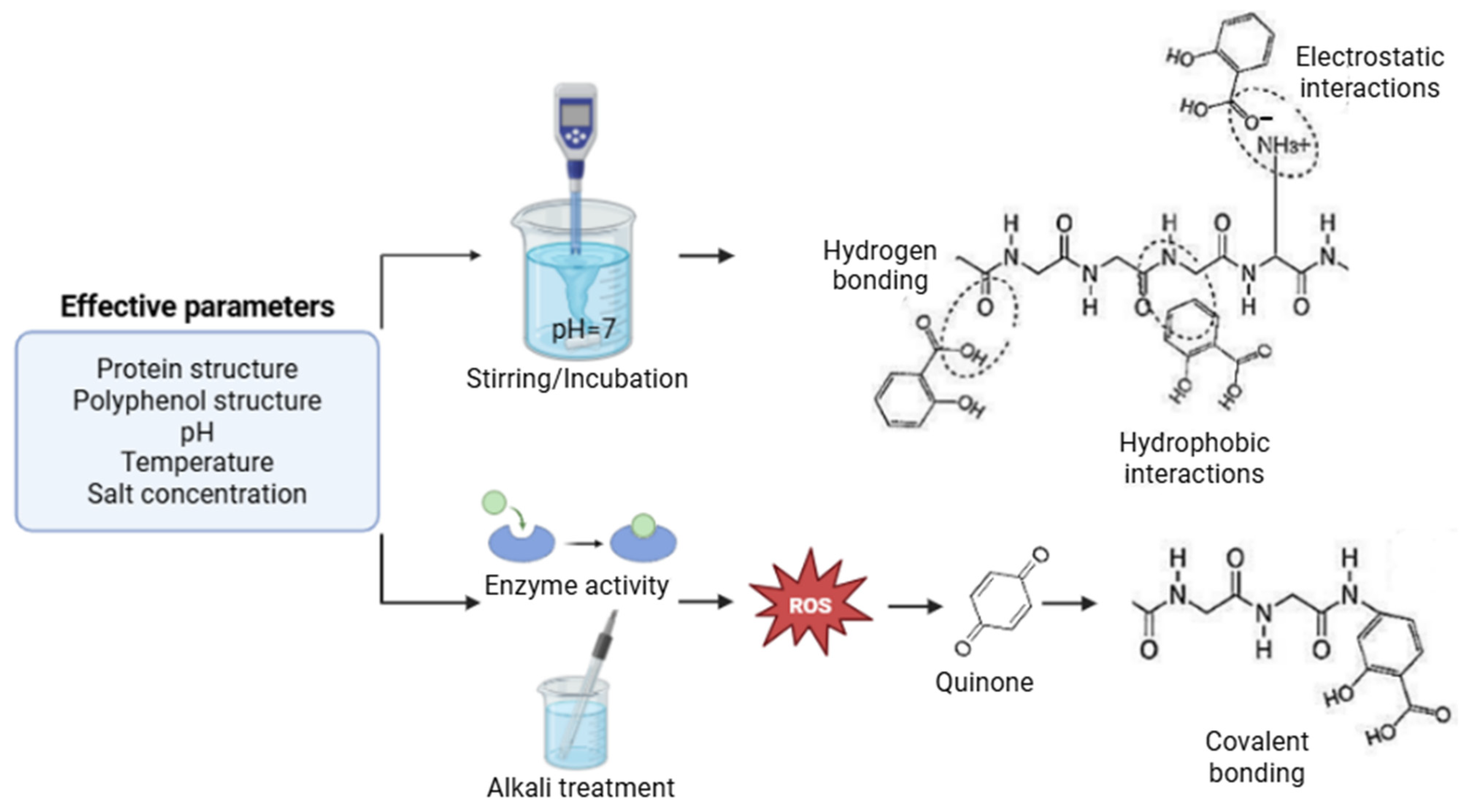
Figure 1. Key parameters influencing covalent and non-covalent protein-polyphenol interactions and their effects on interaction pathways. The arrow represents possible interaction types in complexes, providing a conceptual view of the molecular-level changes occurring during interaction formation [46,47].
Foods 15 00112 g001
Figure 2. Schematic illustration of protein–polysaccharide interactions and their application in various delivery systems for encapsulating bioactive compounds [124,126,127,128].
Foods 15 00112 g002
Table 1. Covalent and non-covalent interactions of proteins and polyphenols.
Protein-Polyphenol InteractionsInteraction Type and MethodCharacterization Techniques for InteractionsStructural Modification of ProteinAlterations in Functional PropertiesChanges in Bioaccessibility and Antioxidant Activity of PolyphenolsReferences
Milk proteins-coffee polyphenolsNon-covalent interactions through mixing at pH 7
  • Fluorescence spectroscopy
  • Change in secondary structure of protein
  • Increased solubility interactions with coffee polyphenols.
n.i. [23]
Chickpea protein isolate-epigallocatechin gallateCovalent interactions through mixing at pH 9, 26 °C for 24 h, dialyzing, and lyophilization
  • Fourier Transform Infrared (FTIR) spectroscopy
  • Fluorescence spectroscopy
  • Change in secondary structure of protein
  • Increase in α-helix content and a decrease in β-sheet content
  • Approximately 100% increase in EAI and approximately 35% decrease in ESI after EGCG conjugation.
  • Increase in solubility after EGCG conjugation for neutral and alkaline pH.
n.i. [58]
Milk proteins-blackcurrant polyphenolsNon-covalent interactions through mixing at a pH of 6.5, 28 °C for one h and lyophilization
  • FTIR spectroscopy
  • Loosened structure increased the surface hydrophobicity of casein
  • Increased β-sheet content of whey proteins
n.i.
  • Increased antioxidant activity (10–15%) and in vitro bioaccessibility (25–30%) with milk protein interactions
[49]
Chickpea protein isolate-naringenin Non-covalent interactions through mixing at pH 7
  • FTIR spectroscopy
  • Slight shifts in the amide I and II bands
  • Formation of electrostatic interactions
  • Increase in foaming capacity (FC) and foaming stability (FS) values of approximately 40% and 22%, respectively (at 0.1% NAR concentration).
  • Decrease in FC and FS values with further increase in NAR concentration.
n.i. [62]
Soy protein-hydroxytyrosol (HT)Mixing SPI and HT solutions and freeze-drying
  • Fluorescence quenching
  • FTIR spectroscopy
  • Alteration in secondary structure, decrease in α-helix content, and increase in β-sheet content
  • Increase in solubility and foaming values with increasing HT concentrations.
  • Highest solubility (52.84%) and foaming value (93.51%) at 50 μmol/g and 30 μmol/g HT concentrations, respectively.
n.i. [63]
Rice protein-legume polyphenolsCovalent interactions through mixing at 40 °C, and the pH of 8.0
  • FTIR spectroscopy
  • Formation of ester (C-O-C) and amine (C-N) bands.
  • Foaming capacity increased by 3 times, and foaming stability increased by 53.3%.
n.i. [64]
Peanut protein extract-epigallocatechin gallate, chlorogenic acidAlkali treatment method at pH 9 and lyophilization
  • Fluorescence quenching
  • FTIR spectroscopy
  • Unfolding of protein, increasing the exposure of Tryptophan (Trp) residues with polyphenol
  • Increase in ESI value from 30 min to 80 min with PPE-EGCG and PPE-CA interactions.
  • Increase in solubility of PPE from 67.8% to about 80% with PPE-EGCG complex and about 90% with PPE-EGCG complex.
n.i. [65]
Goose liver protein- catechin, quercetin, and rutinNon-covalent interactions through pH-shifting (from 11.5 to 7.0)
  • Fluorescence spectroscopy
  • Unfolding of protein structure
  • Formation of hydrophobic interaction, hydrogen bonding, and van der Waals forces
  • Improved surface hydrophobicity.
  • Larger particle size with rutin interaction due to protein aggregation.
  • Emulsion droplet size reduced to 3.78 ± 0.27 µm upon quercetin interaction
n.i. [44]
Soy protein isolate-chlorogenic acidCovalent interactions through mixing at pH 9, 25 °C for 7 h
  • Fluorescence spectroscopy
  • FTIR spectroscopy
  • The looser tertiary structure of protein.
  • Altered secondary structure and protein conformation.
  • Expose tyrosine and tryptophan residues to the hydrophilic environment.
  • Covalent crosslinking
  • Increase in solubility of SPI with covalent crosslinking with CA.
  • The highest solubility level (61.87%) at 0.05 g/g CA crosslinking.
  • Decrease in surface hydrophobicity as 20.17%, 44.61%, and 56.13% for the samples with 0.002, 0.01, and 0.05 g/g CA crosslinking, respectively.
  • Increase in gel hardness up to 0.01 g/g CA concentration.
n.i. [66]
Soy protein-chlorogenic acidMixing of SPI and CA solutions at pH = 7
  • Fluorescence spectroscopy
  • FTIR spectroscopy
  • Unfolded protein structure,
  • Altered secondary structure,
  • Decrease in α-helix and β-sheet with increase in β-turn and random coil.
  • Decrease in surface hydrophobicity with increasing CA concentration (up to 100 μmol/L).
  • The highest solubility (47.77 %), ESI (40 min), foaming ability (3000%), and foaming stability (45%) with 80 μmol/g CA conjugation.
n.i. [67]
Soybean protein isolate- apple polyphenolsNon-covalent interactions through mixing at a pH of 7
  • Circular dichroism (CD) spectroscopy
  • Altered secondary structure of proteins
  • Transition from α-helix-to-random coil structure
  • Higher EAI (55.54 m2/g) and ESI (88.17%) with polyphenol interactions.
n.i. [52]
Peanut protein-epigallocatechin gallateCovalent interactions through mixing at 25 °C and freeze-drying
  • CD spectroscopy
  • Decrease in helix and random coil contents. Formation of hydrogen bonds.
  • Improved foaming properties.
n.i. [68]
Pea protein isolate-chlorogenic acid, epigallocatechin gallate, resveratrolNon-covalent interactions through mixing overnight at 4 °C, pH of 7
  • Fluorescence spectroscopy
  • FTIR spectroscopy
  • Altered secondary structure of proteins
  • Decreased α-helix and increased β-sheet content
  • Increased foaming capacity up to around 42.2–58.2%).
  • The highest EAI (57.88 m2/g) achieved with EGCG interaction.
n.i. [69]
Egg white protein-tea polyphenolsNon-covalent interactions through mixing at pH 7 °C, for two h, and lyophilization
  • CD spectroscopy
  • Fluorescence spectroscopy
  • Modification of the protein structure at neutral pH, resulting in an increased ratio of α-helix and β-sheet, and consequently, the formation of hydrogen and hydrophobic interactions.
  • Improved emulsifying properties.
  • Increased antioxidant activity with increased polyphenol concentration.
  • Higher antioxidant activity values at neutral pH (8.31–13.46 fold) than acidic pH (9.43–13.64 fold).
[11]
Casein, whey proteins, sea buckthorn polyphenolsNon-covalent interactions through incubation at pH 2.5 °C, for one h under pH 7
  • FTIR spectroscopy
  • Fluorescence spectroscopy
  • Unfolded tertiary structure of protein
  • Decrease in the α-helix, and an increase in β-sheet content.
  • Exposure of hydrophobic groups
n.i.
  • Retained antioxidant activity through interactions with proteins.
  • Higher in vitro bioaccessibility through casein and whey protein interactions (60.97–64.97%) than free polyphenolic extract (40.01%).
[36]
Soy protein isolate- epigallocatechin gallateCovalent interactions through ultrasonication (at 300 W for 10 min, 2 s on/off)
  • Fluorescence spectroscopy
  • FTIR spectroscopy
  • Altered protein structure
  • Decreased α-helix content
n.i.
  • Highest DPPH (84.84%) and ABTS (88.89%) values with EGCG interaction compared to natural protein.
[70]
Soy protein isolate-tannic acidMixing SPI and TA solutions under alkali pH (9, 10, 11) and aerobic conditions
  • Fluorescence spectroscopy
  • CD spectroscopy
  • FTIR spectroscopy
  • Unfolded tertiary structure of protein
  • Decrease in the α-helix, and an increase in β-sheet content, β-turn, and random coil.
  • Increase in gel hardness at pH of 11 to a certain TA concentration (117 μmol/g).
  • The highest hardness level is 43.33 g.
n.i. [71]
Bovine lactoferrin-procyanidinNon-covalent interactions through mixing at pH 7
  • CD spectroscopy
  • Altered secondary structure of proteins
  • Decrease in the α-helix due to disrupted hydrogen bondings.
  • The highest foamability (186%) and foam stability (65%) values were observed at the highest level of procyanidin complexation.
n.i. [72]
Whey protein- epigallocatechin gallate, quercetin, apigenin, naringenin Covalent interactions through free radical grafting at pH 7.2
  • Fluorescence spectroscopy
  • FTIR spectroscopy
  • Altered secondary structure
  • Decreased α-helixes and random coils
n.i.
  • Improved antioxidant activity with polyphenol interactions.
[6]
Whey protein-cholorogenic acid, epigallocatechin gallateNon-covalent interactions through mixing in the dark at 25 °C for 60 min at pH 3.5 and 7
  • Fluorescence spectroscopy
  • Unfolded protein structure
  • Distortion of the tertiary quaternary structure
n.i.
  • Increased reducing capacity and FRAP values with increasing phenolic concentration
  • No significant change in ORAC values
[73]
CD, Circular Dichroism; FTIR, Fourier Transform Infrared Spectroscopy; n.i, not indicated.
Table 2. Effect of Starch-, Pectin- and Alginate-Based Carrier Mixtures on Carotenoid Encapsulation, Stability, and Release.
CaroteneEncapsulation MethodCarrierEncapsulation/Loading CapacityPhysicochemical PropertiesRelease Kinetics/BioaccessibilityReference
β-caroteneAggregation: High-speed homogenization and stirringOctenylsuccinated Gastrodia elata starch↑ Aqueous solubility of β-carotene from 1.5 × 10⁻⁶ to 58.96NMR: β-carotene located in inner domains, proton peaks disappear
UV-Vis (λmax): red shift, H/J-type aggregate structure
FTIR: all β-carotene peaks disappeared → fully encapsulated, stabilized via hydrogen bonding
XRD: Amorphous → stable aggregates
↓ Contact angle&Surface tension: Tight hydrophobic domain
  • Release profile (SGF/SIF): <15% in SGF at 120 min, slow increase in SIF
  • Release kinetics:
  • Weibull b = 1.476 → complex, super case-II transport
  • Korsmeyer-Peppas n = 0.9858 → relaxation-dominated
  • ↑ Bioaccessibility: 31.4%
[88]
β-caroteneSpray-drying: high-speed shear and homogenizationOctenyl succinic anhydride modified starch with tea saponins↑ EE and LC
↓ Particle size and ζ-potential via formation of OSA-starch-tea saponin complexes
↓ Surface tension via tea saponin level
FTIR: most β-carotene peaks disappeared → fully encapsulated, stabilized via hydrogen bonding
XRD: Amorphous structure (low relative crystallinity 2.61%) with high tea saponin level
  • ↑ Bioaccessibility: from 2.73 to 15.97%
[92]
CanthaxanthinFreeze-drying, after ultrasonication (2–10 min, 200 W, 20 kHz)V amylose (DP 311) + maltodextrinOptimum: 20 mg canthaxanthin + 400 mg V-amylose → Canthaxanthin recovery ≈ 90%TEM: Resemble spherical or oval shape after ultrasonication
XRD: Fully amorphous → canthaxanthin loses crystallinity
DSC: Canthaxanthin peaks disappeared → fully encapsulated
↑ Antioxidant activity: DPPH and ABTS
n.i. [89]
β-caroteneEmulsification with ultrasonicationMandarin peel pectinEE: 78.7–87.4%
ζ-potential: −25.7 to −27.1 mV after β-carotene loading
↑ Viscosity → higher emulsion stability and reduced β-carotene degradation
  • Bioaccessibility range: 29.20–62.97% according to oil type, highest for olive oil
[33]
β-CarotenePickering emulsionPectin↑ Pectin concentration (0.5–3%): ↓ Creaming index (more stable), ↓ Droplet size
  • Thermal stability (TGA): Three-phase mass loss: 40–100 °C (loosely bound water, 51.7%), 200–310 °C (bound water, 11.59%), 330–430 °C (oil decomposition)
  • FTIR-ATR: No new chemical bonds formed
  • Rheology: Non-Newtonian, viscoelastic behavior
  • ↑ Bioaccessibility: from 8.7 to 37.76%
[95]
Carotenoids from orange peelEmulsion and gelationSodium alginate + CaCl2Encapsulation yield: 92.3%
EE: 89.5%
  • Optical microscope: Bead size: ~0.78 mm diameter, spherical
  • ↑ Alginate concentration: I↑viscosity of continuous phase → restricted droplet movement and improved emulsion stability
  • FTIR: Physical entrapment of oil in Ca-alginate beads; minimal chemical interaction
  • Antioxidant activity (IC50): ~17 mg/mL before and after encapsulation, no significant change reported.
n.i. [96]
Sea buckthorn pomace carotene extract:Emulsification and ionic gelationSodium alginateEE: 98.4%
  • SEM/RCM-Vis: Spherical, mean diameter ≈ 700 ± 50 µm; rough outer surface with cracks Fluorescence distribution: Carotenoids evenly dispersed; higher density near bead surface
  • Storage stability for 30 days: Zeaxanthin → 46–50% retention
  • Zeaxanthin esters → 66–79% retention (more stable than free xanthophylls)
  • Carotenes → 54–72% retention
  • ↑ Bioaccessibility: 42.1%
  • Negligible release in SGF (surface carotenoids only); controlled release and micellization in SIF
[97]
Lycopene and β-caroteneIonotropic gelationSodium alginate + CaCl2Encapsulation yield: 86.3%
EE: 82.6%
  • FT-IR: New broad O–H band Raman: ↓ Peak intensity
  • Total carotenoid retention after digestion:83.3%
[98]
LuteinHydrogelationSodium alginate + Ca2+-EGTA and D-gluconolactoneLC: 770.88 μg/g
EE: 90% for nanoparticles, 99.39% for hydrogel
↑ Ca2+ concentration: ↑ Crosslinking density → better nanoparticle diffusion and higher EE
  • DSC: Disappearance of lutein melting peak → lutein exists in amorphous form
  • FTIR: Carboxyl peaks red-shifted → stronger Ca2+–alginate interaction; confirms efficient encapsulation
  • After digestion: Higher Ca2+ → stronger network, slower diffusion and reduced release
  • Lutein release: Increases then decreases for 4–20 mM Ca2+; max at 7.5 mM Ca2+ (71%)
[99]
DSC, Differential Scanning Calorimetry; EE, Encapsulation efficiency; EGTA, Ethylenebis (oxyethylenenitrilo) tetraacetic acid; LC, Loading capacity; NMR, Nuclear Magnetic Resonance; SEM, Scanning Electron Microscopy; SEM-RCM, Scanning Electron Microscopy–Reflectance Confocal Microscopy; SGF, Simulated gastric fluid; SIF, Simulated intestinal Fluid; UV–Vis, Ultraviolet–Visible Spectroscopy; XRD, X-ray Diffraction; n.i: not indicated. The symbols ↓ and ↑ denote a decrease and an increase, respectively.
Table 3. Effect of gum- or cellulose-based carrier mixtures on carotenoid encapsulation, stability, and release.
CarotenoidEncapsulation MethodCarrierEncapsulation OutcomesPhysical and Morphological CharacterizationRelease Kinetics/Bioaccessibility of CarotenoidReference
Lycopene-rich extract from red guavaNanoprecipitation/high-shear homogenizationCetylated cashew gum ± fucanParticle Size: 189 → 251 nm
EE: 8–13% for Cetylated cashew gum to ~60% with fucan
  • Thermal and storage stability: Stable for 90 days at 4 °C; retained ~60% of the lycopene content.
  • FTIR: FTIR Spectra: Shifts in C=O and S=O bands
  • TEM/AFM/NTA: spherical with smooth surfaces
  • ↑ Antioxidant Activity (ABTS/ORAC)
n.i. [101]
β-CaroteneSpray-dryingMaltodextrin + acacia gum or mesquite gumEncapsulation yield: Acacia gum → up to 85%; mesquite gum → 69%
  • Antioxidant activity (TEAC/g): Acacia gum → 49–61 mesquite gum → 22–31
  • Carotenoid Content (μg/g): Acacia gum → 23–74; mesquite gum → 16–20
n.i. [102]
LycopeneEmulsion: high-pressure homogenization and spray dryingBasil seed gumOptimized Encapsulation Conditions: ≈19.5% gum level → EE: 86.78%, Encapsulation yield: 54.94%
PDI < 0.30 (uniform dispersion);
ζ-potential: −21.37 mV
  • Antioxidant Activity (DPPH): Initially increased with gum level but later declined at high carrier concentrations
n.i. [87]
β-CaroteneEmulsification:Xanthan gum, guar gumEE: 87.2%
  • ↑ Chemical stability
n.i. [103]
β-caroteneEmulsification: high-speed shear and ultrasonic emulsificationHigh acyl gellan gumEmulsification yield: gradual increase via gum concentration (0.05–0.2%), highest 84.4% at 0.175%
Mean particle size: 4–7.2 µm
ζ-potential: between −59.0 and −52.2 mV
  • Rheology: low gum concentration → near Newtonian; higher gum concentration → pseudoplastic (shear-thinning)
  • Emulsion stability (DBS): best at 0.175% HA (minimal change in back-scattering)
  • ↑ Thermal, NaCl, pH stability
  • ↑ Bioaccessibility: 18–26.6%
[104]
β-carotenePickering emulsion: high-shear homogenization + high-pressure homogenizationPeach gum polysaccharide: MC, YQG, ZP11, TW-20EE: 71.92–89.08%
  • SEM: Homogeneous, densely distributed, regular
  • Degradation Kinetics: first-order reaction kinetics, the lowest β-carotene loss for YQG;
  • Half-life: MC 24.8 d, YQG 32.3 d, ZP11 23.5 d, TW-20 27.3 d
[90]
Natural palm mixed-carotene complexPickering emulsionNanofibrillated celluloseEE: 87–89.80%
↑ Particle size: 73.67 → 94.73 via cellulose concentration (0.2–1%)
ζ-potential: <−30 mV
n.i. n.i. [95]
LycopenePickering emulsionCellulose nanofiber from papaya peeln.i. n.i.
  • Higher oil fraction → slower intestinal release → better controlled-release
  • Release percentage in SGF: 9.8–15% and in SIF 68.2–43.2 via oil concentration (10→60%)
[86]
β-carotenePickering emulsionCellulose nanofibersEE: decreased from 94.24% at 25 °C to 57.23% at 75 °C n.i.
  • ↑ Bioaccessibility: from 35.62 to 59.74
[91]
AstaxanthinCold application gelHydroxypropyl methylcellulose, types: K1500, K250, K4M, E5Optimal HPMC-K4M dosage: 0.2 g or 107.50%
  • Antioxidant activity (DPPH): highest for K4M
  • K4M: highest in vitro release
[105]
EE, Encapsulation efficiency; LC, Loading capacity; SGF, Simulated gastric fluid; SIF, Simulated intestinal Fluid; n.i: not indicated. The symbols ↓ and ↑ denote a decrease and an increase, respectively.
Table 4. Effect of Various Polysaccharide-Based Carrier Mixtures on Carotenoid Encapsulation, Stability, and Release.
CarotenoidEncapsulation MethodCarrierEncapsulation OutcomesPhysical and Morphological CharacterizationRelease Kinetics/Bioaccessibility of CarotenoidReference
LuteinEmulsion: Gelation and centrifugal washingCurdlan ± Sodium Alginate
  • Optimumencapsulation: Curdlan/Sodium Alginate ratio → 1.97/1
  • Water-to-oil volume ratio →1:2
  • Acetic acid addition → 0.49%
  • ↑ EE, LC, particle size for complex system
  • Curdlan ± Sodium Alginate Emulsion:
  • EE: 80.19%
  • LC: 11.60%
  • SEM: Smooth and less porous
  • XRD: Sharp crystalline peaks of free lutein disappeared, encapsulation in an amorphous state
  • Reology: ↑ G′ and G″ values
  • ↑ Particle size
  • ↑Storage/light/thermal stability
  • DSC: ↑ Tg
  • Lowest SGF release (24.6%) and highest cumulative release (81.97%)
  • Degradation kinetics: Longest half-lives, highest antioxidant activity
[114]
β-Carotene:LiposomeEgg yolk phosphatidylcholine + cholesterol + chitosan ± pectin
  • ↑ EE via pectin addition from 82.34 to 84.7%
  • ↑ Mean particle size, polydispersity index, and ζ via chitosan ± pectin
  • Appropriate concentration for pectin: 0.06% for balanced size, charge, and EE
  • DSC:↑ Tm: 122.46 °C for chitosan, P-C-L: 131.81 °C) for chtiosan + pectin
  • TGA/DTG: ↑ Thermal stability
  • Chitosan + pectin liposome: Longer-term controlled release in SGF and SIF
  • Diffusion + swell
  • particles shrink and become more homogeneously dispersed
[111]
AstaxanthinIonotropic gelationPectin + sodium alginate + chitosan in oleoresin
  • ↑ EE: ≈87%
  • ↓ Oil leakage:
  • Highly spherical via alginate
  • ↓ Lipid oxidation (PV and p-AV)
  • Thermal stability for astaxanthin retention (65 °C stress test):
  • Pectin + chitosan: best retention zero-order kinetics
  • Pectin and pectin + alginate + chitosan: faster degradation, two-slope kinetics
  • No release in SGF
  • SIF: Pectin and pectin + chitosan: ~46–48% release; pectin + alginate + chitosan: ~58% release
[113]
LuteinIonic gelationChitosan (1 mg/mL) and sodium alginate (0.5 mg/mL)
  • Mean particle size: 98 nm
  • Polydispersity Index: 0.27
  • ζ: +38 mV
  • SEM/TEM:
  • Smooth, discrete, spherical
  • Male Wistar rats: ↑ Cmax and AUC, ↑ Mean residence time, prolonged half-life, and slower plasma clearance
[112]
LuteinComplex coacervationAlginate + low-molecular-weight chitosan
  • EE. 98–99.93%
  • ζ-potential: ≈11 mV
  • Thermal stability: TGA/DSC: ↑ Thermal stability, endothermic lutein peaks disappeared
  • XRD: Crystalline peaks of lutein disappeared → amorphous form in alginate + chitosan complexes
  • ↑ Thermal and Light stability
n.i. [109]
AstaxanthinPickering emulsionChitosan + Guar gum
  • ↓ Droplet size via pH (3→6)
  • Most stable: ↑ Creaming index
  • FTIR: intermolecular H-bonding
  • Droplets homogeneous, no flocculation → high stability
  • Rheology: G′ > G′′ → elastic structure
  • ↑ Storage and Oxidative stability
  • Chemical astaxanthin retention: chitosan + guar gum (85.9%) > chitosan (77.85%) > Tween 80 (66.12%)
[110]
β-Carotene:Host–guest inclusion + coating2-Hydroxypropyl-β-cyclodextrin + High- or low-metoxyl pectin or pectic acid
  • ↓ Particle size and ζ-potential: The most stable for high-methoxy pectin after 4 weeks of storage at 4 °C
  • FTIR: New hydrogen bonding in ternary complex
  • DSC: ↑ Thermal stability, highest for high-methoxy pectin
  • ↑ Thermal stability (60 and 95 °C)
  • Pectin type effect: high-methoxy pectin > low-methoxy pectin > pectic acid
n.i. [115]
β-carotene: (20% w/w)GelationYam starch + guar gum, xanthan gum, carrageenan gum, or their combinations n.i.
  • FTIR: Shifts in O–H and C–H stretching indicated stronger hydrogen bonding with chitosan and weaker with gum arabic
  • XRD: ↓ Crystallinity for all hydrocolloids; lowest for chitosan, highest for guar gum and carrageenan gum.
n.i. [117]
Lycopene: 0.5, 1.0, and 1.5Emulsion-based polyelectrolyte complexSodium alginate +
CaCl2 + chitosan
  • EE: from ~53 to 86.85%
  • Particle size: 148.7–152.8 nm
  • ↑ DPPH antioxidant activity
  • SEM: quasi-spherical, clustered particles
n.i. [118]
Astaxanthin: 0.5 gTertiary emulsion: layer-by-layer self-assemblySoy lecithin + chitosan + sodium alginate
LC: ≈ 0.56%
EE > 90%
ζ-potential: primary: −11.6 → −8.25 mV; secondary: 29.5 → 24.6 mV; tertiary: −22.7 → −18.4 mV
n.i.
  • Slower, controlled in vitro release
  • ↑ Bio-accessibility: 18% in SGF → 69–70% in SIF vs. suspension (0.2–25%).
[116]
n.i: not indicated. The symbols ↓ and ↑ denote a decrease and an increase, respectively.
Table 5. Summary of recent studies on protein–polysaccharide-based delivery systems for improving bioactive encapsulation and bioaccessibility.
Wall MaterialCore MaterialEncapsulation MethodKey FindingsReference
Chickpea protein isolate (CPI)
Citrus pectin (CP)
CurcuminEmulsion formation by high-pressure homogenization with CPI–CP conjugates
  • Emulsion stabilized with CPI-CP exhibited higher EE% (88.79) compared to CPI alone (84.30%).
  • CPI-CP emulsions provided better curcumin stability during storage at room temperature, as well as under environmental stressors.
  • Compared to CPI emulsions, CPI-CP had lower release of FFA in SGF and higher in SIF.
  • It was found that CPI-CP emulsions had higher curcumin bioaccessibility, which was 85.64%.
[125]
Quinoa protein (QP)
Inulin (INU), sodium alginate (SA), fucoidan (FU), and dextran (DX)
CurcuminEmulsion gel formation by glucono delta-lactone induced gelation using QP-polysaccharide mixtures
  • The addition of polysaccharides enhanced the EE% of curcumin compared to emulsions stabilized by QP alone.
  • QP-SA emulgels exhibited a lower release of curcumin in SGF and a slower sustained release in SIF.
  • Compared to QP, QP-INU, and QP-FU emulgels, QP-DS and QP-SA gels exhibited a controlled release profile with lower FFA release in initial gastric conditions and higher release in SIF.
  • Incorporation of FU increased the curcumin bioavailability. However, QP-DX and QP-SA emulgels had lower EE% compared to QP and QP-FU, potentially due to undigested oil droplets.
[127]
QP)-DX conjugatesCurcuminNanoemulsion formation by high-pressure microfluidization using QP–DX conjugates as stabilizers
  • Nanoemulsions stabilized by QP-DX conjugates exhibited significantly higher EE% (74.5%) compared to QP-DX complexes (67.3%).
  • A higher release of FFA occurred during the in vitro digestion of nanoemulsions stabilized by QP-DX conjugates compared to QP-DX complexes.
  • Nanoemulsions stabilized by QP-DX conjugates provided higher curcumin bioaccessibility (30.38%) compared to QP-DX complexes (22.86%).
[128]
Mung bean protein (MBP)
Sugar beet pectin (SBP)
RiboflavinMBP–SBP hydrogel formation via laccase-induced crosslinking
  • The increase in SBP resulted in increased EE% in composite hydrogels.
  • Composite hydrogels showed better stability in both SGF and SIF compared to MBP hydrogel.
  • Higher concentrations of SBP resulted in increased riboflavin release in SIF.
  • Higher concentrations of SBP provided better retention of riboflavin after 28 days of storage.
  • Composite hydrogels exhibited higher riboflavin bioaccessibility.
[123]
SPI
Soy hull polysaccharide
Lactobacillus plantarumHIPE formation by homogenization of SPI–SHP mixtures with soybean oil
  • As the SHP concentrations increased in HIPEs, L. plantarum viability gradually increased in SGF.
  • HIPEs with the highest SHP concentration provided the highest delivery efficiency in SIF, which was 71.1%.
[129]
SPI
Xanthan gum (XG)
QuercetinPickering emulsion formation by homogenization of SPI–XG mixtures with corn oil
  • In CLSM images, it was observed that oil droplet sizes of PEs decreased as the XG concentration increased, which resulted in a higher contact area with lipase.
  • In parallel to CLSM observations, PEs with the highest XG concentration exhibited increased FFA release.
  • SPI-XG PEs showed better resistance in SGF compared to SPI alone, which provided lower quercetin release.
  • The release in SIF and bioaccessibility of quercetin increased as the XG concentration increased, potentially due to increased surface area.
[130]
SPI-peach gum conjugateLycopeneMicroparticle formation by spray drying using SPI–PG Maillard conjugates
  • The highest EE% was tested for the spray-dried powders with the highest wall material concentration, which was 90.82%.
  • During the 21 days of storage at −20, 4, 25, and 50 °C, non-encapsulated lycopene rapidly degraded at all temperatures, while SPI-PG conjugate microparticles enhanced the retention of lycopene.
  • Lycopene was mostly released in SIF from SPI-PG microparticles, while free lycopene showed insignificant release throughout in vitro gastrointestinal digestion.
[124]
PPI-DX conjugatesAstaxanthinEmulsion formation by high-pressure homogenization using PPI–DX complexes and conjugates
  • Compared to PPI-DX complexes, PPI-DX conjugate stabilized nanoemulsions provided higher astaxanthin bioavailability.
  • After 28 days of storage at 4 °C, PPI-DX conjugate stabilized nanoemulsions exhibited higher astaxanthin retention (above 70%).
[105]
SPI
Soy hull polysaccharide (SHP)
LuteinLiposome formation by thin-film evaporation–sonication and incorporation into SPI–SHP hydrogel matrix
  • SPI-SHP gels had a higher EE% compared to liposomes alone. The EE% of liposomal gels increased with higher SHP concentrations.
  • During in vitro gastric digestion, liposomes released 44.44% of lutein, while SPI-SHP liposomal gels provided better protection with lower release. However, in SIF, SPI-SHP gels exhibited higher lutein release.
  • The bioavailability of lutein in SPI-SHP gels ranged between 20 and 40%, which was higher than that of liposomes alone.
[126]
CLSM, confocal laser scanning microscope; CP, citrus pectin; CPI, chickpea protein isolate; DX, dextran; EE, encapsulation efficiency; FFA, free fatty acids; FU, fucoidan; GDL, glucono delta-lactone; HIPE, high internal phase emulsion; INU, inulin; PPI, pea protein isolate; PG, peach gum; QP, quinoa protein; SA, sodium alginate; SBP, sugar beet pectin; SHP, soy hull polysaccharide; SGF, simulated gastric fluid; SIF, simulated intestinal fluid; SPI, soy protein isolate; XG, xanthan gum.
Disclaimer/Publisher’s Note: The statements, opinions and data contained in all publications are solely those of the individual author(s) and contributor(s) and not of MDPI and/or the editor(s). MDPI and/or the editor(s) disclaim responsibility for any injury to people or property resulting from any ideas, methods, instructions or products referred to in the content.