Article

The Formation and Change of Volatile Flavor Compounds During the Cooking of Sheep Bone Soup

1
College of Food Science and Light Industry, Nanjing Tech University, Nanjing 211816, China
2
School of Food and Biological Engineering, Hefei University of Technology, Hefei 230009, China
3
College of Food Engineering, Anhui Science and Technology University, Chuzhou 239000, China
*
Author to whom correspondence should be addressed.
Foods 2025, 14(6), 949; https://doi.org/10.3390/foods14060949
Submission received: 6 February 2025 / Revised: 22 February 2025 / Accepted: 6 March 2025 / Published: 11 March 2025
(This article belongs to the Section Food Physics and (Bio)Chemistry)

Abstract

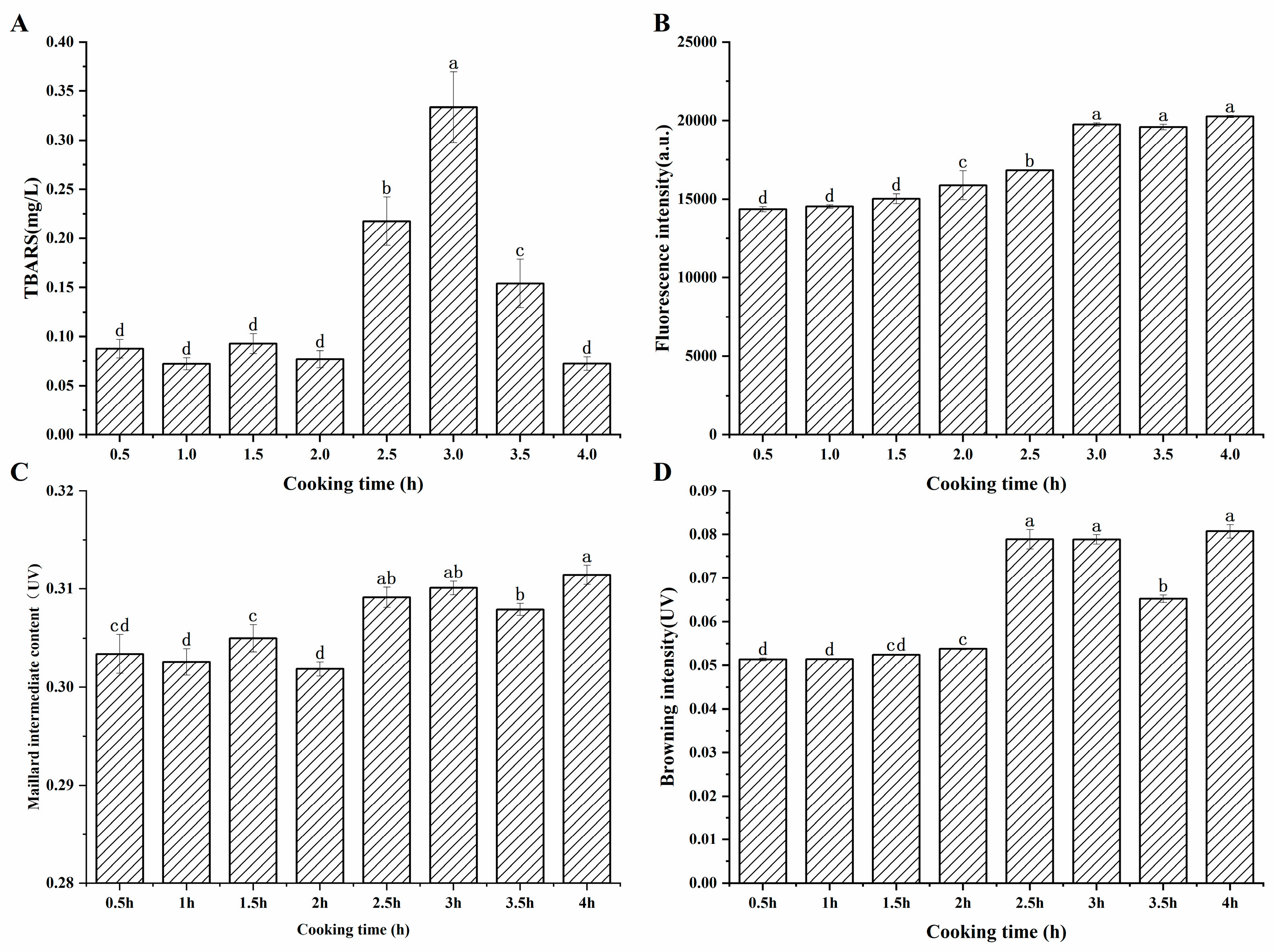
To investigate the formation of flavor compounds in sheep bone soup, E-nose, gas chromatograph (GC), and gas chromatography-mass spectrometry (GC-MS) were used to determine the changes in lipid oxidation, Maillard reaction, and volatile flavor compounds during the slow cooking process of 4 h. The thiobarbituric acid reactive substances (TBARS) value began to increase significantly (p < 0.05) after 2 h of cooking, reaching its peak in the third hour before significantly decreasing. The intensity of the Maillard reaction significantly increased after 2 h of cooking and subsequently stabilized. Thirty-nine flavor compounds were identified, primarily comprising aldehydes, ketones, alcohols, esters, aromatic compounds, and heterocyclic compounds. The formation of volatile flavor compounds in sheep bone soup was associated with lipid oxidation, particularly the oxidation of unsaturated fatty acids, and the Maillard reaction. Lipid oxidation produced a large number of volatile flavor compounds, such as aldehydes and ketones. The Maillard reaction gave sheep bone soup a certain flavor. Aldehydes were mostly influenced by cooking time, becoming the main flavor compounds in the bone soup after 2.5 h of cooking, accounting for more than half of the total volatile flavor compounds. The highest content and richest profile of volatile flavor compounds were obtained in the soup cooked for 2.5 h and 3 h. This study provides a theoretical basis for the flavor regulation of sheep bone soup.
Keywords: sheep bone soup; TBARS value; fatty acids; Maillard reaction; volatile flavor compounds sheep bone soup; TBARS value; fatty acids; Maillard reaction; volatile flavor compounds