From Ancient Fermentations to Modern Biotechnology: Historical Evolution, Microbial Mechanisms, and the Role of Natural and Commercial Starter Cultures in Shaping Organic and Sustainable Food Systems


Abstract
1. Introduction
Methodology of Literature Search
2. Fermented Food Items Through the Ages: The Cradles of Natural Starters
2.1. Fermented Cereals and Legumes
2.1.1. Sourdough Bread
2.1.2. Miso and Natto
2.1.3. Tempeh
2.1.4. Fermented Tofu
2.1.5. Douchi
2.1.6. Dosa and Idli
2.2. Fermented Dairy Products
2.2.1. Cheese
2.2.2. Fermented Dairy Beverages
2.3. Fermented Horticultural Produce
Kimchi
2.4. Fermented Beverages of Vegetable and Fruit Origin
2.4.1. Kombucha
2.4.2. Vinegar
2.5. Fermented Seafood
2.5.1. Surströmming
2.5.2. Nam Pla
2.5.3. Feseekh
2.6. Fermented Meat
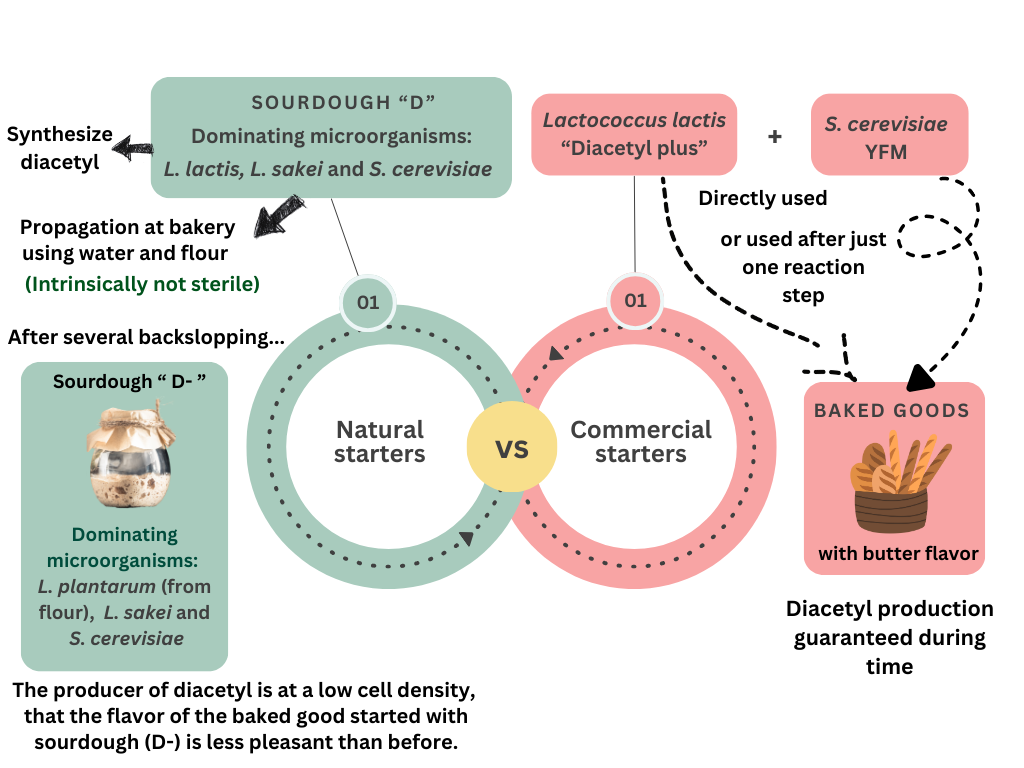
3. Microbial Mechanisms Within Natural Starters Affecting Food Quality: Sourdough as a Paradigm
4. The Shift Towards Commercial Starters
5. Starter Production: A Comparative Analysis of Natural and Commercial Starters
5.1. Natural Starters
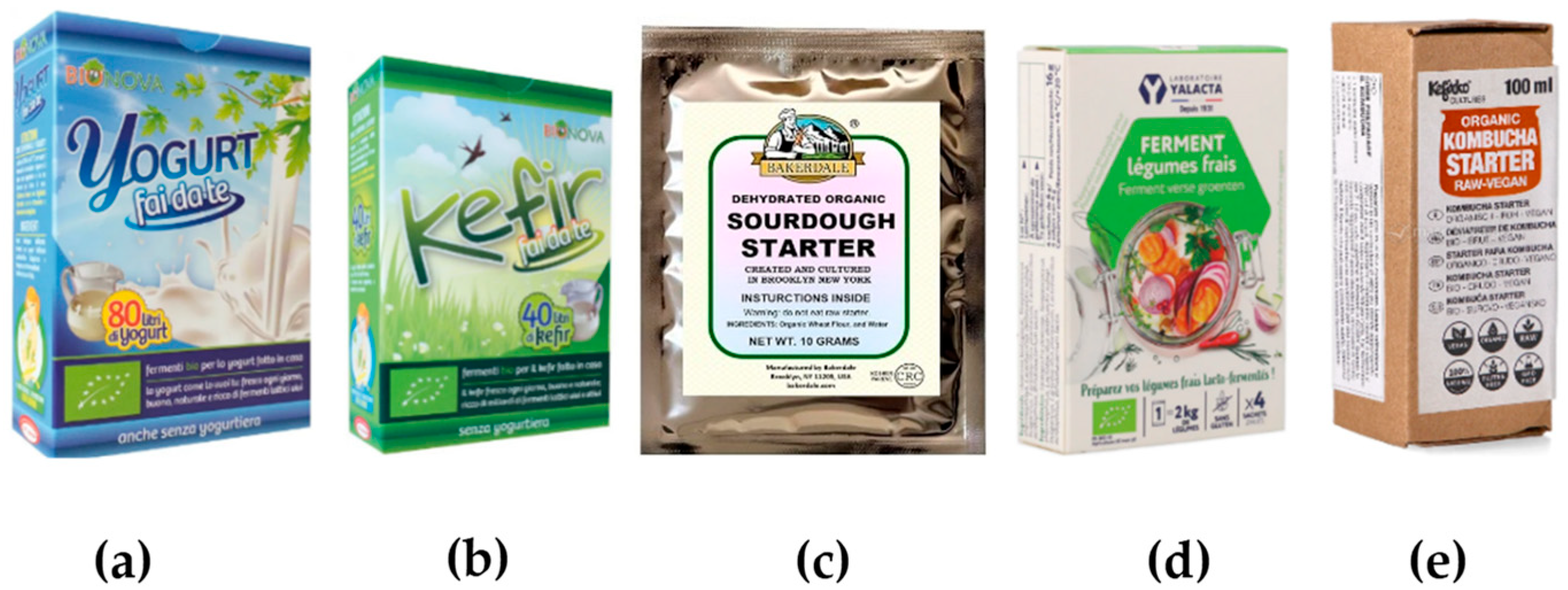
5.2. Commercial Starters
6. Fermented Food and Beverages from Organic Agriculture: How to Respect Regulation About Organic Food Using Microbial Starters
7. Embracing Nature: Harnessing the Potential of Natural Starters in Organic Food Processing
8. Challenges and Future Perspectives
8.1. Overcoming Hurdles: Identifying Limitations and Addressing Challenges in the Use of Natural Starters in Organic Food Processing
8.2. Innovating for the Future: Advancements and Future
9. Conclusions
Author Contributions
Funding
Institutional Review Board Statement
Informed Consent Statement
Data Availability Statement
Conflicts of Interest
Abbreviations
| LAB | Lactic Acid Bacteria |
| GMO | Genetically Modified Organism |
| GMM | Genetically Modified Microorganism |
| CRISPR | Clustered Regularly Interspaced Short Palindromic Repeats |
| CRISPR Cas9 | CRISPR-associated protein 9 |
References
- Rizzo, G.; Borrello, M.; Dara Guccione, G.; Schifani, G.; Cembalo, L. Organic food consumption: The relevance of the health attribute. Sustainability 2020, 12, 595. [Google Scholar] [CrossRef]
- Harper, G.C.; Makatouni, A. Consumer perception of organic food production and farm animal welfare. Br. Food J. 2002, 104, 287–299. [Google Scholar] [CrossRef]
- Hüppe, R.; Zander, K. Consumer perspectives on processing technologies for organic food. Foods 2021, 10, 1212. [Google Scholar] [CrossRef]
- Probst, L.; Aigelsperger, L.; Hauser, M. Consumer attitudes towards vegetable attributes: Potential buyers of pesticide-free vegetables in Accra and Kumasi, Ghana. Ecol. Food Nutr. 2010, 49, 228–245. [Google Scholar] [CrossRef] [PubMed]
- Johansson, E.; Hussain, A.; Kuktaite, R.; Andersson, S.C.; Olsson, M.E. Contribution of organically grown crops to human health. Int. J. Environ. Res. Public Health 2014, 11, 3870–3893. [Google Scholar] [CrossRef]
- Nicolopoulou-Stamati, P.; Maipas, S.; Kotampasi, C.; Stamatis, P.; Hens, L. Chemical pesticides and human health: The urgent need for a new concept in agriculture. Front. Public Health 2016, 4, 148. [Google Scholar] [CrossRef]
- Hansmann, R.; Baur, I.; Binder, C.R. Increasing organic food consumption: An integrating model of drivers and barriers. J. Clean. Prod. 2020, 275, 123058. [Google Scholar] [CrossRef]
- Hutkins, R.W. Fermented Vegetables. In Microbiology and Technology of Fermented Foods; Hutkins, R.W., Ed.; Wiley-Blackwell: Hoboken, NJ, USA, 2006; pp. 223–259. [Google Scholar]
- Tamang, J.P.; Watanabe, K.; Holzapfel, W.H. Diversity of microorganisms in global fermented foods and beverages. Front. Microbiol. 2016, 7, 377. [Google Scholar] [CrossRef]
- Gobbetti, M.; Di Cagno, R.; De Angelis, M. Functional microorganisms for functional food quality. Crit. Rev. Food Sci. Nutr. 2010, 50, 716–727. [Google Scholar] [CrossRef] [PubMed]
- Xiang, H.; Sun-Waterhouse, D.; Waterhouse, G.I.; Cui, C.; Ruan, Z. Fermentation-enabled wellness foods: A fresh perspective. Food Sci. Hum. Wellness 2019, 8, 203–243. [Google Scholar] [CrossRef]
- Chang, J.Y.; Chang, H.C. Improvements in the quality and shelf life of kimchi by fermentation with the induced bacteriocin-producing strain, Leuconostoc citreum GJ7 as a starter. J. Food Sci. 2010, 75, M103–M110. [Google Scholar] [CrossRef]
- Kim, J.; Bang, J.; Beuchat, L.R.; Kim, H.; Ryu, J.-H. Controlled fermentation of kimchi using naturally occurring antimicrobial agents. Food Microbiol. 2012, 32, 20–31. [Google Scholar] [CrossRef]
- Sharma, R.; Garg, P.; Kumar, P.; Bhatia, S.K.; Kulshrestha, S. Microbial fermentation and its role in quality improvement of fermented foods. Fermentation 2020, 6, 106. [Google Scholar] [CrossRef]
- Hutkins, R.W. Starter Cultures. In Microbiology and Technology of Fermented Foods; Hutkins, R.W., Ed.; Wiley-Blackwell: Hoboken, NJ, USA, 2006; pp. 32–67. [Google Scholar]
- Vogel, R.F.; Hammes, W.P.; Habermeyer, M.; Engel, K.-H.; Knorr, D.; Eisenbrand, G.; Senate Commission on Food Safety (SKLM) of the German Research Foundation (DFG). Microbial food cultures: Opinion of the Senate Commission on Food Safety (SKLM) of the German Research Foundation (DFG). Mol. Nutr. Food Res. 2011, 55, 654–662. [Google Scholar] [CrossRef]
- Gomes, F.C.O.; Silva, C.L.C.; Marini, M.M.; Oliveira, E.S.; Rosa, C.A. Use of selected indigenous Saccharomyces cerevisiae strains for the production of the traditional Cachaça in Brazil. J. Appl. Microbiol. 2007, 103, 2438–2447. [Google Scholar] [CrossRef] [PubMed]
- Kubo, Y.; Rooney, A.P.; Tsukakoshi, Y.; Nakagawa, R.; Hasegawa, H.; Kimura, K. Phylogenetic analysis of Bacillus subtilis strains applicable to natto (fermented soybean) production. Appl. Environ. Microbiol. 2011, 77, 6463–6469. [Google Scholar] [CrossRef] [PubMed]
- Batista, N.N.; Ramos, C.L.; Dias, D.R.; Pinheiro, A.C.M.; Schwan, R.F. The impact of yeast starter cultures on the microbial communities and volatile compounds in cocoa fermentation and the resulting sensory attributes of chocolate. J. Food Sci. Technol. 2016, 53, 1101–1110. [Google Scholar] [CrossRef]
- Barbosa, E.A.; Souza, M.T.; Diniz, R.H.S.; Godoy-Santos, F.; Faria-Oliveira, F.; Correa, L.F.M.; Alvarez, F.; Coutrim, M.X.; Afonso, R.J.C.F.; Castro, I.M.; et al. Quality improvement and geographical indication of Cachaça (Brazilian spirit) by using locally selected yeast strains. J. Appl. Microbiol. 2016, 121, 1038–1051. [Google Scholar] [CrossRef] [PubMed]
- Lee, L.W.; Tay, G.Y.; Cheong, M.W.; Curran, P.; Yu, B.; Liu, S.Q. Modulation of the volatile and non-volatile profiles of coffee fermented with Yarrowia lipolytica: II. Roasted coffee. LWT-Food Sci. Technol. 2017, 80, 32–42. [Google Scholar] [CrossRef]
- Geng, L.; Liu, K.; Zhang, H. Lipid oxidation in foods and its implications on proteins. Front. Nutr. 2023, 10, 1192199. [Google Scholar] [CrossRef]
- Dimidi, E.; Cox, S.R.; Rossi, M.; Whelan, K. Fermented foods: Definitions and characteristics, impact on the gut microbiota and effects on gastrointestinal health and disease. Nutrients 2019, 11, 1806. [Google Scholar] [CrossRef]
- De Vuyst, L.; Comasio, A.; Van Kerrebroeck, S. Sourdough Production: Fermentation Strategies, Microbial Ecology, and Use of Non-Flour Ingredients. Crit. Rev. Food Sci. Nutr. 2023, 63, 2447–2479. [Google Scholar] [CrossRef]
- Bassi, D.; Puglisi, E.; Cocconcelli, P.S. Comparing Natural and Selected Starter Cultures in Meat and Cheese Fermentations. Curr. Opin. Food Sci. 2015, 2, 118–122. [Google Scholar] [CrossRef]
- Corbo, M.R.; Racioppo, A.; Monacis, N.; Speranza, B. Commercial Starters or Autochthonous Strains? That Is the Question. In Starter Cultures in Food Production; Speranza, B., Bevilacqua, A., Corbo, M.R., Sinigaglia, M., Eds.; John Wiley & Sons Ltd.: Chichester, UK, 2017; pp. 174–198. [Google Scholar] [CrossRef]
- Ross, R.P.; Morgan, S.; Hill, C. Preservation and fermentation: Past, present and future. Int. J. Food Microbiol. 2002, 79, 3–16. [Google Scholar] [CrossRef] [PubMed]
- Khubber, S.; Marti-Quijal, F.J.; Tomasevic, I.; Remize, F.; Barba, F.J. Lactic acid fermentation as a useful strategy to recover antimicrobial and antioxidant compounds from food and by-products. Curr. Opin. Food Sci. 2022, 43, 189–198. [Google Scholar] [CrossRef]
- Bell, V.; Ferrão, J.; Fernandes, T. Nutritional guidelines and fermented food frameworks. Foods 2017, 6, 65. [Google Scholar] [CrossRef]
- John, P.; Wijayaratne, T.; Ekanayake, S.; Maheswari, U.; Rajan, A.; Saikia, D.; Tamang, D. Fermented foods of South Asia. In Microbial Fermentations in Nature and as Designed Processes; John Wiley & Sons: Hoboken, NJ, USA, 2023; p. 323. [Google Scholar]
- Tamang, J.P. History and culture of Indian ethnic fermented foods and beverages. In Ethnic Fermented Foods and Beverages of India: Science, History and Culture; Tamang, J.P., Ed.; Springer: Singapore, 2020; pp. 1–40. [Google Scholar] [CrossRef]
- Voidarou, C.; Antoniadou, M.; Rozos, G.; Tzora, A.; Skoufos, I.; Varzakas, T.; Lagiou, A.; Bezirtzoglou, E. Fermentative Foods: Microbiology, Biochemistry, Potential Human Health Benefits and Public Health Issues. Foods 2020, 10, 69. [Google Scholar] [CrossRef] [PubMed]
- Hutkins, R.W. Microbiology and Technology of Fermented Foods; John Wiley & Sons: Hoboken, NJ, USA, 2008. [Google Scholar]
- Surono, I.S. Ethnic Fermented Foods and Beverages of Indonesia. In Ethnic Fermented Foods and Alcoholic Beverages of Asia; Tamang, J.P., Ed.; Springer: New Delhi, India, 2016; pp. 341–382. [Google Scholar] [CrossRef]
- Blandino, A.; Al-Aseeri, M.E.; Pandiella, S.S.; Cantero, D.; Webb, C. Cereal-based fermented food and beverages. Food Res. Int. 2003, 36, 527–543. [Google Scholar] [CrossRef]
- Chavan, J.K.; Kadam, S.S. Nutritional improvement of cereals by fermentation. Crit. Rev. Food Sci. Nutr. 1989, 28, 349–400. [Google Scholar] [CrossRef]
- Campbell-Platt, G. Fermented foods—A world perspective. Food Res. Int. 1994, 27, 253–257. [Google Scholar] [CrossRef]
- Han, B.Z.; Rombouts, F.M.; Nout, M.J.R. A Chinese fermented soybean food. Int. J. Food Microbiol. 2001, 65, 1–10. [Google Scholar] [CrossRef]
- Tamang, J.P. Native microorganisms in the fermentation of kinema. Indian J. Microbiol. 2003, 43, 127–130. [Google Scholar]
- Ouoba, L.I.I.; Diawara, B.; Amoa-Awua, W.K.; Traoré, A.S.; Møller, P.L. Genotyping of starter cultures of Bacillus subtilis and Bacillus pumilus for fermentation of African locust bean (Parkia biglobosa) to produce Soumbala. Int. J. Food Microbiol. 2004, 90, 197–205. [Google Scholar] [CrossRef]
- Sekwati-Monang, B.; Gänzle, M.G. Microbiological and chemical characterisation of ting, a sorghum-based sourdough product from Botswana. Int. J. Food Microbiol. 2011, 150, 115–121. [Google Scholar] [CrossRef]
- Jang, S.J.; Kim, Y.J.; Park, J.M.; Park, Y.S. Analysis of microflora in gochujang, Korean traditional fermented food. Food Sci. Biotechnol. 2011, 20, 1435–1440. [Google Scholar] [CrossRef]
- Kohajdová, Z. Fermented cereal products. In Current Developments in Biotechnology and Bioengineering; Pandey, A., Ed.; Elsevier: Amsterdam, The Netherlands, 2017; pp. 91–117. [Google Scholar] [CrossRef]
- Fernandes, C.G.; Sonawane, S.K.; Arya, S.S. Cereal-based functional beverages: A review. J. Microbiol. Biotechnol. Food Sci. 2018, 8, 914–919. [Google Scholar] [CrossRef]
- Shiferaw Terefe, N.; Augustin, M.A. Fermentation for tailoring the technological and health-related functionality of food products. Crit. Rev. Food Sci. Nutr. 2019, 60, 2887–2913. [Google Scholar] [CrossRef]
- Tamang, J.P.; Cotter, P.D.; Endo, A.; Han, N.S.; Kort, R.; Liu, S.Q.; Mayo, B.; Westerik, N.; Hutkins, R. Fermented foods in a global age: East meets West. Compr. Rev. Food Sci. Food Saf. 2020, 19, 184–217. [Google Scholar] [CrossRef] [PubMed]
- Allwood, J.G.; Wakeling, L.T.; Bean, D.C. Fermentation and the microbial community of Japanese kōji and miso: A review. J. Food Sci. 2021, 86, 2194–2207. [Google Scholar] [CrossRef] [PubMed]
- Han, D.M.; Chun, B.H.; Kim, H.M.; Jeon, C.O. Characterization and correlation of microbial communities and metabolite and volatile compounds in doenjang fermentation. Food Res. Int. 2021, 148, 110645. [Google Scholar] [CrossRef]
- Roopashri, A.N.; Savitha, J.; Divyashree, M.S.; Mamatha, B.S.; Rani, K.U.; Kumar, A. Indian Traditional Fermented Foods: The Role of Lactic Acid Bacteria. In Lactobacillus—A Multifunctional Genus; Laranjo, M., Ed.; IntechOpen: London, UK, 2023. [Google Scholar] [CrossRef]
- Lau, S.W.; Chong, A.Q.; Chin, N.L.; Talib, R.A.; Basha, R.K. Sourdough Microbiome Comparison and Benefits. Microorganisms 2021, 9, 1355. [Google Scholar] [CrossRef]
- Motlhanka, K.; Zhou, N.; Lebani, K. Microbial and Chemical Diversity of Traditional Non-Cereal Based Alcoholic Beverages of Sub-Saharan Africa. Beverages 2018, 4, 36. [Google Scholar] [CrossRef]
- Samuel, D. Bread in archaeology. Civilis. Rev. Int. D’anthropologie Sci. Hum. 2002, 49, 27–36. [Google Scholar] [CrossRef]
- Cappelle, S.; Guylaine, L.; Gänzle, M.; Gobbetti, M. History and Social Aspects of Sourdough. In Handbook on Sourdough Biotechnology; Gobbetti, M., Gänzle, M., Eds.; Springer: New York, NY, USA, 2012; pp. 1–10. [Google Scholar] [CrossRef]
- Tamang, J.P.; Samuel, D. Dietary Cultures and Antiquity of Fermented Foods and Beverages. In Fermented Foods and Beverages of the World; Tamang, J.P., Kailasapathy, K., Eds.; CRC Press: Boca Raton, FL, USA; Taylor & Francis: Abingdon, UK, 2010; pp. 1–40. [Google Scholar] [CrossRef]
- Samuel, D. Investigation of Ancient Egyptian Baking and Brewing Methods by Correlative Microscopy. Science 1996, 273, 488–490. [Google Scholar] [CrossRef]
- Catzeddu, P. Sourdough Breads. In Flour and Breads and Their Fortification in Health and Disease Prevention, 2nd ed.; Preedy, V.R., Watson, R.R., Eds.; Academic Press: Cambridge, MA, USA, 2019; pp. 177–188. [Google Scholar] [CrossRef]
- Saeed, F.; Afzaal, M.; Shah, Y.A.; Khan, M.H.; Hussain, M.; Ikram, A.; Ateeq, H.; Noman, M.; Saewan, S.A.; Khashroum, A.O. Miso: A Traditional Nutritious & Health-Endorsing Fermented Product. Foods Sci. Nutr. 2022, 10, 4103–4111. [Google Scholar] [CrossRef]
- Shurtleff, W.; Aoyagi, A. The Book of Miso: Savory, High-Protein Seasoning; Ten Speed Press: Emeryville, CA, USA, 2001; Volume 1, Available online: https://www.cabidigitallibrary.org/doi/full/10.5555/20013170385 (accessed on 1 January 2020).
- Yamashita, H. Koji Starter and Koji World in Japan. J. Fungi 2021, 7, 569. [Google Scholar] [CrossRef] [PubMed]
- Shurtleff, W.; Aoyagi, A. History of Natto and Its Relatives (1405–2012); Soyinfo Center: Lafayette, CA, USA, 2012. [Google Scholar]
- Sumi, H.; Hamada, H.; Tsushima, H.; Mihara, H.; Muraki, H. A Novel Fibrinolytic Enzyme (Nattokinase) in the Vegetable Cheese Natto: A Typical and Popular Soybean Food in the Japanese Diet. Experientia 1987, 43, 1110–1111. [Google Scholar] [CrossRef] [PubMed]
- Ito, H.; Tong, J.; Li, Y. Chinese dauchi, from itohiki natto to nonmashed miso. Miso Sci. Technol. 1996, 44, 224–250. [Google Scholar]
- Kiuchi, K. Miso and Natto. Food Cult. 2001, 3, 7–10. Available online: https://www.kikkoman.com/jp/kiifc/foodculture/pdf_03/e_007_010.pdf (accessed on 18 November 2025).
- Ehara, A. Vegetables and the Diet of the Edo Period, Part 3: The Diet of the Common Townspeople of Edo. pp. 1–7. Available online: https://www.kikkoman.com/jp/kiifc/foodculture/pdf_1920/e_010_016.pdf (accessed on 18 November 2025).
- Chan, E.W.C.; Wong, S.K.; Kezuka, M.; Oshiro, N.; Chan, H.T. Natto and Miso: An Overview on Their Preparation, Bioactive Components and Health-Promoting Effects. Food Res. 2021, 5, 446–452. [Google Scholar] [CrossRef] [PubMed]
- Shurtleff, W.; Aoyagi, A. History of Soybeans and Soyfoods in South Asia/Indian Subcontinent (1656–2010): Extensively Annotated Bibliography and Sourcebook; Soyinfo Center: Lafayette, CA, USA, 2010; Available online: https://www.soyinfocenter.com/pdf/140/AsSo.pdf (accessed on 18 November 2025).
- Sunarti, S.; Safitri, R.A.; Aminin, A.L.; Sulchan, M.; Rahmawati, B. Antioxidant Activity of Soybean and Gembus Tempeh. Int. J. Public Health 2021, 10, 83–87. [Google Scholar] [CrossRef]
- Hartanti, A.T.; Rahayu, G.; Hidayat, I. Rhizopus species from fresh tempeh collected from several regions in Indonesia. HAYATI J. Biosci. 2015, 22, 136–142. [Google Scholar] [CrossRef]
- Shurtleff, W.; Aoyagi, A. History of Tempeh; Soyinfo Center: Lafayette, CA, USA, 2007; p. 85. [Google Scholar]
- Zhang, T.; Dou, W.; Zhang, X.; Zhao, Y.; Zhang, Y.; Jiang, L.; Sui, X. The development history and recent updates on soy protein-based meat alternatives. Trends Food Sci. Technol. 2021, 109, 702–710. [Google Scholar] [CrossRef]
- Lander, B.; DuBois, T.D. A History of Soy in China: From Weedy Bean to Global Commodity. In The Age of the Soybean: An Environmental History of Soy During the Great Acceleration; The White Horse Press: Winwick, UK, 2021. [Google Scholar]
- Ng, T.B. (Ed.) Soybean: Biochemistry, Chemistry and Physiology; BoD–Books on Demand: Norderstedt, Germany, 2011. [Google Scholar]
- Zeng, X.; Tang, Z.; Zhang, W.; He, L.; Deng, L.; Ye, C.; Fan, J. Effect of red koji as a starter culture in “Wanergao”: A traditional fermented food in China. Food Sci. Nutr. 2020, 8, 5580–5590. [Google Scholar] [CrossRef]
- Huang, X.; Yu, S.; Han, B.; Chen, J. Bacterial community succession and metabolite changes during sufu fermentation. LWT–Food Sci. Technol. 2018, 97, 537–545. [Google Scholar] [CrossRef]
- Qiao, Y.; Zhang, K.; Zhang, Z.; Zhang, C.; Sun, Y.; Feng, Z. Fermented Soybean Foods: A Review of Their Functional Components, Mechanism of Action and Factors Influencing Their Health Benefits. Food Res. Int. 2022, 158, 111575. [Google Scholar] [CrossRef]
- Yu, S.; Liu, L.; Bu, T.; Zheng, J.; Wang, W.; Wu, J.; Liu, D. Purification and characterization of hypoglycemic peptides from traditional Chinese soy-fermented douchi. Food Funct. 2022, 13, 3343–3352. [Google Scholar] [CrossRef]
- Liu, L.; Chen, X.; Hao, L.; Zhang, G.; Jin, Z.; Li, C.; Chen, B. Traditional fermented soybean products: Processing, flavor formation, nutritional and biological activities. Crit. Rev. Food Sci. Nutr. 2022, 62, 1971–1989. [Google Scholar] [CrossRef]
- Zhang, J.H.; Tatsumi, E.; Fan, J.F.; Li, L.T. Chemical components of Aspergillus-type Douchi, a Chinese traditional fermented soybean product, change during the fermentation process. Int. J. Food Sci. Technol. 2007, 42, 263–268. [Google Scholar] [CrossRef]
- Sirilun, S.; Chaiyasut, C.; Kesika, P.; Peerajan, S.; Sivamaruthi, B.S. Screening of lactic acid bacteria with immune-modulating property, and the production of lactic acid bacteria mediated fermented soymilk. Natl. J. Physiol. Pharm. Pharmacol. 2017, 7, 1397–1405. [Google Scholar] [CrossRef]
- Hemalatha, S.; Platel, K.; Srinivasan, K. Influence of germination and fermentation on bioaccessibility of zinc and iron from food grains. Eur. J. Clin. Nutr. 2007, 61, 342–348. [Google Scholar] [CrossRef]
- Leonardi, M.; Gerbault, P.; Thomas, M.G.; Burger, J. The evolution of lactase persistence in Europe: A synthesis of archaeological and genetic evidence. Int. Dairy J. 2012, 22, 88–97. [Google Scholar] [CrossRef]
- Kindstedt, P.S. The history of cheese. In Global Cheesemaking Technology: Cheese Quality and Characteristics; Wiley: Chichester, UK, 2017; pp. 3–19. [Google Scholar] [CrossRef]
- Tamime, A.Y.; Robinson, R.K. Yoghurt: Science and Technology; Pergamon Press: Oxford, UK, 1985. [Google Scholar]
- Bintsis, T.; Papademas, P. The evolution of fermented milks, from artisanal to industrial products: A critical review. Fermentation 2022, 8, 679. [Google Scholar] [CrossRef]
- Salque, M.; Radi, G.; Tagliacozzo, A.; Pino Uria, B.; Wolfram, S.; Hohhle, I.; Stäuble, H.; Whittle, A.; Hoffmann, D.; Pechtl, J.; et al. New insights into the Early Neolithic economy and management of animals in Southern and Central Europe revealed using lipid residue analyses of pottery vessels. Anthropozoologica 2012, 47, 45–62. [Google Scholar] [CrossRef]
- Salque, M.; Bogucki, P.I.; Pyzel, J.; Sobkowiak-Tabaka, I.; Grygiel, R.; Szmyt, M.; Evershed, R.P. Earliest evidence for cheese making in the sixth millennium BC in northern Europe. Nature 2013, 493, 522–525. [Google Scholar] [CrossRef] [PubMed]
- Fisberg, M.; Machado, R. History of yogurt and current patterns of consumption. Nutr. Rev. 2015, 73, 4–7. [Google Scholar] [CrossRef] [PubMed]
- Ayivi, R.D.; Ibrahim, S.A. Lactic Acid Bacteria: An Essential Probiotic and Starter Culture for the Production of Yoghurt. Int. J. Food Sci. Technol. 2022, 57, 7008–7025. [Google Scholar] [CrossRef]
- Longley Farm. The History of Yogurt. Longley Farm Blogs. 2025. Available online: https://longleyfarm.com/blogs/news/the-history-of-yogurt (accessed on 17 November 2025).
- Aryana, K.J.; Olson, D.W. A 100-Year Review: Yogurt and Other Cultured Dairy Products. J. Dairy Sci. 2017, 100, 9987–10013. [Google Scholar] [CrossRef]
- Farnworth, E.R. Kefir. J. Nutraceuticals Funct. Med. Foods 1999, 1, 57–68. [Google Scholar] [CrossRef]
- Farnworth, E.R.; Mainville, I. Kefir: A Fermented Milk Product. In Handbook of Fermented Functional Foods, 2nd ed.; CRC Press: Boca Raton, FL, USA, 2003; pp. 89–127. [Google Scholar]
- Korovkina, L.N.; Patkoul, G.M.; Maslov, A.M. Influence de la température d’acidification du lait sur les caractéristiques biochimiques et la consistance du kifir. In Proceedings of the 20e Congrès International de Laiterie, Paris, France, 26–30 June 1978; p. 852. [Google Scholar]
- Libudzisz, Z.; Piatkiewicz, A. Kefir production in Poland. Dairy Ind. Int. 1990, 55, 31–33. Avaliable online: https://www.cabidigitallibrary.org/doi/full/10.5555/19900440761 (accessed on 18 November 2025).
- John, S.M.; Deeseenthum, S. Properties and benefits of kefir—A review. Songklanakarin J. Sci. Technol. 2015, 37, 275–282. [Google Scholar]
- Devaki, C.S.; Premavalli, K.S. Fermented Vegetable Beverages. In Fermented Beverages; Yan, Y., Ed.; Woodhead Publishing: Cambridge, UK, 2019; pp. 321–367. [Google Scholar] [CrossRef]
- Jang, D.J.; Chung, K.R.; Yang, H.J.; Kim, K.S.; Kwon, D.Y. Discussion on the origin of kimchi, representative of Korean unique fermented vegetables. J. Ethn. Foods 2015, 2, 126–136. [Google Scholar] [CrossRef]
- Hongu, N.; Kim, A.S.; Suzuki, A.; Wilson, H.; Tsui, K.C.; Park, S. Korean kimchi: Promoting healthy meals through cultural tradition. J. Ethn. Foods 2017, 4, 172–180. [Google Scholar] [CrossRef]
- Surya, R.; Nugroho, D. Kimchi throughout Millennia: A Narrative Review on the Early and Modern History of Kimchi. J. Ethn. Foods 2023, 10, 5. [Google Scholar] [CrossRef]
- Baiano, A. Craft beer: An overview. Compr. Rev. Food Sci. Food Saf. 2021, 20, 1829–1856. [Google Scholar] [CrossRef]
- Liang, Z.; Zhang, P.; Zeng, X.A.; Fang, Z. The art of flavored wine: Tradition and future. Trends Food Sci. Technol. 2021, 116, 130–145. [Google Scholar] [CrossRef]
- Kim, J.; Adhikari, K. Current trends in kombucha: Marketing perspectives and the need for improved sensory research. Beverages 2020, 6, 15. [Google Scholar] [CrossRef]
- Jayabalan, R.; Malbaša, R.V.; Lončar, E.S.; Vitas, J.S.; Sathishkumar, M. A review on kombucha tea—Microbiology, composition, fermentation, beneficial effects, toxicity, and tea fungus. Compr. Rev. Food Sci. Food Saf. 2014, 13, 538–550. [Google Scholar] [CrossRef]
- Dufresne, C.; Farnworth, E. Tea, Kombucha, and Health: A Review. Food Res. Int. 2000, 33, 409–421. [Google Scholar] [CrossRef]
- Chandrakala, S.K.; Lobo, R.O.; Dias, F.O. Kombucha (Bio-Tea): An Elixir for Life? In Nutrients in Beverages; Grumezescu, A.M., Holban, A.M., Eds.; Academic Press: Cambridge, MA, USA, 2019; pp. 591–616. [Google Scholar] [CrossRef]
- Greenwalt, C.J.; Steinkraus, K.H.; Ledford, R.A. Kombucha, the fermented tea: Microbiology, composition, and claimed health effects. J. Food Prot. 2000, 63, 976–981. [Google Scholar] [CrossRef]
- Chen, C.; Liu, B.Y. Changes in major components of tea fungus metabolites during prolonged fermentation. J. Appl. Microbiol. 2000, 89, 834–839. [Google Scholar] [CrossRef]
- Dutta, H.; Paul, S.K. Kombucha Drink: Production, Quality, and Safety Aspects. In Production and Management of Beverages; Grumezescu, A.M., Holban, A.M., Eds.; Woodhead Publishing: Cambridge, UK, 2019; Volume 1, pp. 259–288. [Google Scholar] [CrossRef]
- Kapp, J.M.; Sumner, W. Kombucha: A Systematic Review of the Empirical Evidence of Human Health Benefit. Ann. Epidemiol. 2019, 30, 66–70. [Google Scholar] [CrossRef]
- Trček, J.; Toyama, H.; Czuba, J.; Misiewicz, A.; Matsushita, K. Correlation between acetic acid resistance and characteristics of PQQ-dependent ADH in acetic acid bacteria. Appl. Microbiol. Biotechnol. 2006, 70, 366–373. [Google Scholar] [CrossRef]
- Hailu, S.; Admassu, S.; Jha, K. Vinegar production technology—An overview. Beverage Food World 2012, 2, 29–32. [Google Scholar]
- Budak, N.H.; Aykin, E.; Seydim, A.C.; Greene, A.K.; Guzel-Seydim, Z.B. Functional properties of vinegar. J. Food Sci. 2014, 79, R757–R764. [Google Scholar] [CrossRef] [PubMed]
- Solieri, L.; Giudici, P. Vinegars of the World; Springer Science and Business Media LLC: Berlin/Heidelberg, Germany, 2009. [Google Scholar] [CrossRef]
- Liu, Q.; Tang, G.Y.; Zhao, C.N.; Gan, R.Y.; Li, H.B. Antioxidant activities, phenolic profiles, and organic acid contents of fruit vinegars. Antioxidants 2019, 8, 78. [Google Scholar] [CrossRef] [PubMed]
- Román-Camacho, J.J.; García-García, I.; Santos-Dueñas, I.M.; García-Martínez, T.; Mauricio, J.C. Latest trends in industrial vinegar production and the role of acetic acid bacteria: Classification, metabolism, and applications—A Comprehensive Review. Foods 2023, 12, 3705. [Google Scholar] [CrossRef] [PubMed]
- Ho, C.W.; Lazim, A.M.; Fazry, S.; Zaki, U.K.H.H.; Lim, S.J. Varieties, production, composition and health benefits of vinegars: A review. Food Chem. 2017, 221, 1621–1630. [Google Scholar] [CrossRef] [PubMed]
- Jafarirad, S.; Elahi, M.R.; Mansoori, A.; Khanzadeh, A.; Haghighizadeh, M.H. The Improvement Effect of Apple Cider Vinegar as a Functional Food on Anthropometric Indices, Blood Glucose and Lipid Profile in Diabetic Patients: A Randomized Controlled Clinical Trial. Front. Clin. Diabetes Healthc. 2023, 4, 1288786. [Google Scholar] [CrossRef]
- Martínez-Álvarez, O.; López-Caballero, M.E.; Gómez-Guillén, M.C.; Montero, P. Fermented seafood products and health. In Fermented Foods in Health and Disease Prevention; Preedy, V.R., Watson, R.R., Eds.; Academic Press: Cambridge, MA, USA, 2017; pp. 177–202. [Google Scholar] [CrossRef]
- Beddows, C.G. Fermented fish and fish products. In Microbiology of Fermented Foods; Wood, B.B., Ed.; Springer: Boston, MA, USA, 1997; pp. 416–440. [Google Scholar] [CrossRef]
- Zang, J.; Xu, Y.; Xia, W.; Regenstein, J.M. Quality, functionality, and microbiology of fermented fish: A review. Crit. Rev. Food Sci. Nutr. 2019, 60, 1228–1242. [Google Scholar] [CrossRef] [PubMed]
- Belleggia, L.; Aquilanti, L.; Ferrocino, I.; Milanović, V.; Garofalo, C.; Clementi, F.; Cocolin, L.; Mozzon, M.; Foligni, R.; Haouet, M.N.; et al. Discovering microbiota and volatile compounds of surströmming, the traditional Swedish sour herring. Food Microbiol. 2020, 91, 103503. [Google Scholar] [CrossRef]
- Skåra, T.; Axelsson, L.; Stefánsson, G.; Ekstrand, B.; Hagen, H. Fermented and ripened fish products in the northern European countries. J. Ethn. Foods 2015, 2, 18–24. [Google Scholar] [CrossRef]
- Kurlansky, M. Salt: A World History; Vintage Books: London, UK, 2002; p. 138. [Google Scholar]
- Kanchanakunjara, T.; Chantachon, S.; Koseyayothin, M.; Kuljanabhagavad, T. Traditional Curry Pastes During Sukhothai to Ratthanakosin: The Subjective Experience of the Past and Present. Asian Cult. Hist. 2014, 7, 175. [Google Scholar] [CrossRef]
- Lopetcharat, K.; Choi, Y.J.; Park, J.W.; Daeschel, M.A. Fish Sauce Products and Manufacturing: A Review. Food Rev. Int. 2001, 17, 65–88. [Google Scholar] [CrossRef]
- Chan, S.X.Y.; Fitri, N.; Mio Asni, N.S.; Sayuti, N.H.; Azlan, U.K.; Qadi, W.S.; Dawoud, E.A.D.; Kamal, N.; Sarian, M.N.; Mohd Lazaldin, M.A.; et al. A Comprehensive Review with Future Insights on the Processing and Safety of Fermented Fish and the Associated Changes. Foods 2023, 12, 558. [Google Scholar] [CrossRef]
- Mohamed, H.N.; Mustafa, S. Fermented Fish Products: A Review on the Manufacturing Process, Technological Aspect, Sensory, Nutritional Qualities and Metabolite Profiles. Int. J. Synergy Eng. Technol. 2021, 2, 16–35. [Google Scholar]
- El Sheikha, A.F.; Ray, R.; Montet, D.; Panda, S.; Worawattanamateekul, W. African Fermented Fish Products in Scope of Risks. Int. Food Res. J. 2014, 21, 425. [Google Scholar]
- Elmoghazy, M.; Omar, M. Culinary Tourism in Egypt: A Tourist Perspective. Int. Acad. J. Fac. Tour. Hotel Manag. 2016, 2, 78–99. [Google Scholar] [CrossRef]
- Pearson, A.M.; Gillett, T.A. Processed Meats; Springer Science & Business Media: Boston, MA, USA, 1996. [Google Scholar]
- Mateo, J.; Caro, I.; Figueira, A.C.; Ramos, D.; Zumalacárregui, J.M. Meat Processing in Ibero-American Countries: A Historical View. In Traditional Food Production and Rural Sustainable Development; Arfini, F., Ed.; Springer: Cham, Switzerland, 2016; pp. 121–134. [Google Scholar]
- Leroy, F.; Geyzen, A.; Janssens, M.; De Vuyst, L.; Scholliers, P. Meat Fermentation at the Crossroads of Innovation and Tradition: A Historical Outlook. Trends Food Sci. Technol. 2013, 31, 130–137. [Google Scholar] [CrossRef]
- Zapaśnik, A.; Sokołowska, B.; Bryła, M. Role of Lactic Acid Bacteria in Food Preservation and Safety. Foods 2022, 11, 1283. [Google Scholar] [CrossRef]
- Aguirre-Garcia, Y.L.; Nery-Flores, S.D.; Campos-Muzquiz, L.G.; Flores-Gallegos, A.C.; Palomo-Ligas, L.; Ascacio-Valdés, J.A.; Sepúlveda-Torres, L.; Rodríguez-Herrera, R. Lactic Acid Fermentation in the Food Industry and Bio-Preservation of Food. Fermentation 2024, 10, 168. [Google Scholar] [CrossRef]
- Ibrahim, S.A.; Ayivi, R.D.; Zimmerman, T.; Siddiqui, S.A.; Altemimi, A.B.; Fidan, H.; Esatbeyoglu, T.; Bakhshayesh, R.V. Lactic Acid Bacteria as Antimicrobial Agents: Food Safety and Microbial Food Spoilage Prevention. Foods 2021, 10, 3131. [Google Scholar] [CrossRef] [PubMed]
- Wang, Y.; Wu, J.; Lv, M.; Shao, Z.; Hungwe, M.; Wang, J.; Bai, X.; Xie, J.; Wang, Y.; Geng, W. Metabolism Characteristics of Lactic Acid Bacteria and the Expanding Applications in Food Industry. Front. Bioeng. Biotechnol. 2021, 9, 612285. [Google Scholar] [CrossRef]
- Savijoki, K.; Ingmer, H.; Varmanen, P. Proteolytic Systems of Lactic Acid Bacteria. Appl. Microbiol. Biotechnol. 2006, 71, 394–406. [Google Scholar] [CrossRef]
- Toledano, A.; Jordano, R.; López, C.; Medina, L.M. Proteolytic Activity of Lactic Acid Bacteria Strains and Fungal Biota for Potential Use as Starter Cultures in Dry-Cured Ham. J. Food Prot. 2011, 74, 826–829. [Google Scholar] [CrossRef]
- Law, B.A.; Kolstad, J. Proteolytic systems in lactic acid bacteria. Antonie Van Leeuwenhoek 1983, 49, 225–245. [Google Scholar] [CrossRef]
- Xu, D.; Zhang, Y.; Tang, K.; Hu, Y.; Xu, X.; Gänzle, M.G. Effect of Mixed Cultures of Yeast and Lactobacilli on the Quality of Wheat Sourdough Bread. Front. Microbiol. 2019, 10, 2113. [Google Scholar] [CrossRef]
- Pérez-Alvarado, O.; Zepeda-Hernández, A.; Garcia-Amezquita, L.E.; Requena, T.; Vinderola, G.; García-Cayuela, T. Role of Lactic Acid Bacteria and Yeasts in Sourdough Fermentation during Breadmaking: Evaluation of Postbiotic-Like Components and Health Benefits. Front. Microbiol. 2022, 13, 969460. [Google Scholar] [CrossRef]
- Galimberti, A.; Bruno, A.; Agostinetto, G.; Casiraghi, M.; Guzzetti, L.; Labra, M. Fermented food products in the era of globalization: Tradition meets biotechnology innovations. Curr. Opin. Biotechnol. 2021, 70, 36–41. [Google Scholar] [CrossRef] [PubMed]
- Taskila, S. Industrial Production of Starter Cultures. In Starter Cultures in Food Production; John Wiley & Sons: Hoboken, NJ, USA, 2017; pp. 79–100. [Google Scholar] [CrossRef]
- Grigg, D. Income, Industrialization and Food Consumption. Tijdschr. Econ. Soc. Geogr. 1994, 85, 3–14. [Google Scholar] [CrossRef]
- Santivarangkna, C.; Kulozik, U.; Foerst, P. Alternative Drying Processes for the Industrial Preservation of Lactic Acid Starter Cultures. Biotechnol. Prog. 2007, 23, 302–315. [Google Scholar] [CrossRef]
- Fox, P.F.; McSweeney, P.L.H. Cheese: An Overview. In Cheese; Elsevier: Amsterdam, The Netherlands, 2017; pp. 5–21. [Google Scholar] [CrossRef]
- Leroy, F.; De Vuyst, L. Lactic Acid Bacteria as Functional Starter Cultures for the Food Fermentation Industry. Trends Food Sci. Technol. 2004, 15, 67–78. [Google Scholar] [CrossRef]
- Atkins, P.J. The Industrialization of the Senses: British Cheese, 1750 to the Present 1. In Food History; Routledge: Abingdon, UK, 2021; pp. 67–78. [Google Scholar]
- Peighambardoust, S.H.; Tafti, A.G.; Hesari, J. Application of Spray Drying for Preservation of Lactic Acid Starter Cultures: A Review. Trends Food Sci. Technol. 2011, 22, 215–224. [Google Scholar] [CrossRef]
- Nielsen, J. Yeast Systems Biology: Model Organism and Cell Factory. Biotechnol. J. 2019, 14, 1800421. [Google Scholar] [CrossRef]
- Siepmann, F.B.; Ripari, V.; Waszczynskyj, N.; Spier, M.R. Overview of sourdough technology: From production to marketing. Food Bioproc. Technol. 2018, 11, 242–270. [Google Scholar] [CrossRef]
- Hertzler, S.R.; Clancy, S.M. Kefir Improves Lactose Digestion and Tolerance in Adults with Lactose Maldigestion. J. Am. Diet. Assoc. 2003, 103, 582–587. [Google Scholar] [CrossRef]
- Coppola, R.; Succi, M.; Tremonte, P.; Reale, A.; Salzano, G.; Sorrentino, E. Antibiotic susceptibility of Lactobacillus rhamnosus strains isolated from Parmigiano Reggiano cheese. Lait 2005, 85, 193–204. [Google Scholar] [CrossRef]
- Briggiler-Marco, M.; Capra, M.L.; Quiberoni, A.; Vinderola, G.; Reinheimer, J.A.; Hynes, E. Nonstarter Lactobacillus strains as adjunct cultures for cheese making: In vitro characterization and performance in two model cheeses. J. Dairy Sci. 2007, 90, 4532–4542. [Google Scholar] [CrossRef]
- Kongo, J.M. Lactic Acid Bacteria as Starter Cultures for Cheese Processing: Past, Present and Future Developments. In Lactic Acid Bacteria—R & D for Food, Health and Livestock Purposes; Kongo, J.M., Ed.; IntechOpen: Rijeka, Croatia, 2013; pp. 3–22. [Google Scholar]
- Weerkamp, A.H.; Klijn, N.; Neeter, R.; Smit, G. Properties of mesophilic lactic acid bacteria from raw milk and naturally fermented raw products. Neth. Milk Dairy J. 1996, 50, 319–322. [Google Scholar]
- Beresford, T.P.; Fitzsimons, N.A.; Brennan, N.L.; Cogan, T.M. Recent advances in cheese microbiology. Int. Dairy J. 2001, 11, 259–274. [Google Scholar] [CrossRef]
- Broome, M.C.; Powell, I.B.; Limsowtin, G.K.Y. Starter cultures: Specific properties. In Encyclopedia of Dairy Sciences; Roginski, H., Fuquay, J.W., Fox, P.F., Eds.; Academic Press: London, UK, 2003; Volume 1, pp. 269–275. [Google Scholar]
- Hugas, M.; Monfort, J.M. Bacterial starter cultures for meat fermentation. Food Chem. 1997, 59, 547–554. [Google Scholar] [CrossRef]
- Hammes, W.P.; Hertel, C. New developments in meat starter cultures. Meat Sci. 1998, 49, S125–S138. [Google Scholar] [CrossRef]
- Leroy, F.; Verluyten, J.; De Vuyst, L. Functional meat starter cultures for improved sausage fermentation. Int. J. Food Microbiol. 2006, 106, 270–285. [Google Scholar] [CrossRef] [PubMed]
- Sánchez Mainar, M.; Stavropoulou, D.; Leroy, F. Exploring the metabolic heterogeneity of coagulase-negative staphylococci to improve the quality and safety of fermented meats: A review. Int. J. Food Microbiol. 2017, 247, 24–37. [Google Scholar] [CrossRef]
- Palavecino Prpich, N.Z.; Camprubí, G.E.; Cayré, M.E.; Castro, M.P. Indigenous microbiota to leverage traditional dry sausage production. Int. J. Food Sci. 2021, 2021, 1–11. [Google Scholar] [CrossRef] [PubMed]
- Tolonen, M.; Rajaniemi, S.; Pihlava, J.M.; Johansson, T.; Saris, P.E.J.; Ryhänen, E.L. Formation of nisin, plant-derived biomolecules and antimicrobial activity in starter culture fermentations of sauerkraut. Food Microbiol. 2004, 21, 167–179. [Google Scholar] [CrossRef]
- Jang, S.; Lee, D.; Jang, I.S.; Choi, H.S.; Suh, H.J. The culture of Pediococcus pentosaceus T1 inhibits Listeria proliferation in salmon fillets and controls maturation of kimchi. Food Technol. Biotechnol. 2015, 53, 29–37. Avaliable online: https://hrcak.srce.hr/file/201844 (accessed on 18 November 2025). [CrossRef]
- Ma, C.; Lin, J.; Yang, M.; Liu, Z. Optimization of technical conditions in the fermentation of kombucha. Food Res. Dev. 2008, 29, 36–38. [Google Scholar]
- Savary, O.; Mounier, J.; Thierry, A.; Poirier, E.; Jourdren, J.; Maillard, M.B.; Penland, M.; Decamps, C.; Coton, E.; Coton, M. Tailor-made microbial consortium for kombucha fermentation: Microbiota-induced biochemical changes and biofilm formation. Food Res. Int. 2021, 147, 110549. [Google Scholar] [CrossRef]
- Karovičová, J.; Kohajdová, Z. Lactic acid fermented vegetable juices. Hortic. Sci. 2003, 30, 152–158. [Google Scholar] [CrossRef]
- Kim, S.Y. Production of fermented kale juices with Lactobacillus strains and nutritional composition. Prev. Nutr. Food Sci. 2017, 22, 231–236. [Google Scholar] [CrossRef]
- Virdis, C.; Sumby, K.; Bartowsky, E.; Jiranek, V. Lactic acid bacteria in wine: Technological advances and evaluation of their functional role. Front. Microbiol. 2021, 11, 612118. [Google Scholar] [CrossRef]
- Zhou, W.; Shu, Q.; Zhang, X.; Chen, Q. Application of mixed-culture with Lactobacillus brevis and Saccharomyces cerevisiae to Chinese yellow rice wine brewing for ethyl carbamate regulation. Food Control 2021, 122, 107821. [Google Scholar] [CrossRef]
- Thierry, A.; Deutsch, S.M.; Falentin, H.; Dalmasso, M.; Cousin, F.J.; Jan, G. New insights into physiology and metabolism of Propionibacterium freudenreichii. Int. J. Food Microbiol. 2011, 149, 19–27. [Google Scholar] [CrossRef]
- Rabah, H.; Carmo, F.L.R.D.; Jan, G. Dairy propionibacteria: Versatile probiotics. Microorganisms 2017, 5, 24. [Google Scholar] [CrossRef]
- Deptula, P.; Smolander, O.-P.; Laine, P.K.; Roberts, R.J.; Edelmann, M.; Peltola, P.; Piironen, V.; Paulin, L.; Storgårds, E.; Savijoki, K.; et al. Acidipropionibacterium virtanenii sp. nov., isolated from malted barley. Int. J. Syst. Evol. Microbiol. 2018, 68, 3175–3183. [Google Scholar] [CrossRef] [PubMed]
- Masco, L.; Huys, G.; De Brandt, E.; Temmerman, R.; Swings, J. Culture-dependent and culture-independent qualitative analysis of probiotic products claimed to contain bifidobacteria. Int. J. Food Microbiol. 2005, 102, 221–230. [Google Scholar] [CrossRef]
- Cukier de Aquino, V.; Converti, A.; Perego, P.; Caetano da Silva Lannes, S. Leavening bread dough. Curr. Nutr. Food Sci. 2012, 8, 131–138. [Google Scholar] [CrossRef]
- Bruner, J.; Fox, G. Novel Non-Cerevisiae Saccharomyces Yeast Species Used in Beer and Alcoholic Beverage. Fermentation 2020, 6, 107. [Google Scholar] [CrossRef]
- Buzzini, P.; Di Mauro, S.; Turchetti, B. Yeasts as starter cultures. In Starter Cultures in Food Production; Speranza, B., Bevilacqua, A., Corbo, M.R., Sinigaglia, M., Eds.; Wiley-Blackwell: Hoboken, NJ, USA, 2017; pp. 16–49. [Google Scholar] [CrossRef]
- Selgas, M.D.; García, M.L. Yeasts. In Handbook of Fermented Meat and Poultry, 2nd ed.; Toldrá, F., Hui, Y.H., Astiasarán, I., Sebranek, J.G., Talon, R., Eds.; Wiley-Blackwell: Hoboken, NJ, USA, 2014; pp. 139–146. [Google Scholar] [CrossRef]
- Danina, M.M.; Ivanchenko, O.B. Brettanomyces Yeast Use in Brewing. 2015, Volume 4. Available online: http://vestnikmax.ifmo.ru/file/article/14926.pdf (accessed on 15 July 2025).
- Ropars, J.; López-Villavicencio, M.; Snirc, A.; Lacoste, S.; Giraud, T. Blue cheese-making has shaped the population genetic structure of the mould Penicillium roqueforti. PLoS ONE 2017, 12, e0171387. [Google Scholar] [CrossRef] [PubMed]
- Ropars, J.; Caron, T.; Lo, Y.C.; Bennetot, B.; Giraud, T. The domestication of Penicillium cheese fungi. C. R. Biol. 2020, 343, 155–176. [Google Scholar] [CrossRef] [PubMed]
- Abe, K.; Gomi, K. Food products fermented by Aspergillus oryzae. In The Aspergilli; Goldman, G.H., Osmani, S.A., Eds.; CRC Press: Boca Raton, FL, USA, 2007; pp. 449–460. [Google Scholar]
- Future Market Insights. Starter Cultures Market. 2023. Available online: https://www.futuremarketinsights.com/reports/starter-cultures-market (accessed on 9 August 2025).
- Demarigny, Y. Fermented Food Products Made with Vegetable Materials from Tropical and Warm Countries: Microbial and Technological Considerations. Int. J. Food Sci. Technol. 2012, 47, 2469–2476. [Google Scholar] [CrossRef]
- Speranza, B.; Bevilacqua, A.; Corbo, M.R.; Sinigaglia, M. (Eds.) Starter Cultures in Food Production; Wiley-Blackwell: Chichester, UK, 2017. [Google Scholar] [CrossRef]
- Yann, D.; Pauline, G. Usefulness of Natural Starters in Food Industry: The Example of Cheeses and Bread. Food Nutr. Sci. 2014, 5, 1679–1691. [Google Scholar] [CrossRef]
- Wedajo, B. Lactic Acid Bacteria: Benefits, Selection Criteria and Probiotic Potential in Fermented Food. J. Probiotics Health 2015, 3. [Google Scholar] [CrossRef]
- Nionelli, L.; Curri, N.; Curiel, J.A.; Di Cagno, R.; Pontonio, E.; Cavoski, I.; Gobbetti, M. Exploitation of Albanian Wheat Cultivars: Characterization of the Flours and Lactic Acid Bacteria Microbiota, and Selection of Starters for Sourdough Fermentation. Food Microbiol. 2014, 44, 96–107. [Google Scholar] [CrossRef]
- Fan, M.; Rakotondrabe, T.F.; Chen, G.; Guo, M. Advances in Microbial Analysis: Based on Volatile Organic Compounds of Microorganisms in Food. Food Chem. 2023, 418, 135950. [Google Scholar] [CrossRef]
- Giraffa, G.; Chanishvili, N.; Widyastuti, Y. Importance of Lactobacilli in Food and Feed Biotechnology. Res. Microbiol. 2010, 161, 480–487. [Google Scholar] [CrossRef]
- Capozzi, V.; Fragasso, M.; Romaniello, R.; Berbegal, C.; Russo, P.; Spano, G. Spontaneous Food Fermentations and Potential Risks for Human Health. Fermentation 2017, 3, 49. [Google Scholar] [CrossRef]
- Pereira, G.V.d.M.; Neto, D.P.d.C.; Junqueira, A.C.d.O.; Karp, S.G.; Letti, L.A.J.; Magalhães Júnior, A.I.; Soccol, C.R. A Review of Selection Criteria for Starter Culture Development in the Food Fermentation Industry. Food Rev. Int. 2020, 36, 135–167. [Google Scholar] [CrossRef]
- European Food Safety Authority. Qualified Presumption of Safety (QPS). 2025. Available online: https://www.efsa.europa.eu/en/topics/topic/qualified-presumption-safety-qps (accessed on 18 November 2025).
- EFSA BIOHAZ Panel; Herman, L. Update of the List of Qualified Presumption of Safety (QPS) Recommended Microorganisms Intentionally Added to Food or Feed as Notified to EFSA. EFSA J. 2023, 21, 7747. [Google Scholar] [CrossRef]
- Navarrete-Bolaños, J.L. Improving Traditional Fermented Beverages: How to Evolve from Spontaneous to Directed Fermentation. Eng. Life Sci. 2012, 12, 410–418. [Google Scholar] [CrossRef]
- Notermans, S.; Gallhoff, G.; Zwietering, M.H.; Mead, G.C. Identification of Critical Control Points in the HACCP System with a Quantitative Effect on the Safety of Food Products. Food Microbiol. 1995, 12, 93–98. [Google Scholar] [CrossRef]
- Saffeullah, P.; Nabi, N.; Liaqat, S.; Anjum, N.A.; Siddiqi, T.O.; Umar, S. Organic Agriculture: Principles, Current Status, and Significance. In Microbiota and Biofertilizers; Springer: Cham, Switzerland, 2020; pp. 17–37. [Google Scholar] [CrossRef]
- Reque, P.M.; Brandelli, A. Encapsulation of Probiotics and Nutraceuticals: Applications in Functional Food Industry. Trends Food Sci. Technol. 2021, 114, 1–10. [Google Scholar] [CrossRef]
- García-Díez, J.; Saraiva, C. Use of Starter Cultures in Foods from Animal Origin to Improve Their Safety. Int. J. Environ. Res. Public Health 2021, 18, 2544. [Google Scholar] [CrossRef]
- Neviani, E.; Levante, A.; Gatti, M. The microbial community of natural whey starter: Why is it a driver for the production of the most famous Italian long-ripened cheeses? Fermentation 2024, 10, 186. [Google Scholar] [CrossRef]
- Laranjo, M.; Potes, M.E.; Elias, M. Role of starter cultures on the safety of fermented meat products. Front. Microbiol. 2019, 10, 853. [Google Scholar] [CrossRef]
- Pragalaki, T.; Bloukas, J.G.; Kotzekidou, P. Inhibition of Listeria monocytogenes and Escherichia coli O157:H7 in liquid broth medium and during processing of fermented sausage using autochthonous starter cultures. Meat Sci. 2013, 95, 458–464. [Google Scholar] [CrossRef]
- Borresen, E.C.; Henderson, A.J.; Kumar, A.; Weir, T.L.; Ryan, E.P. Fermented foods: Patented approaches and formulations for nutritional supplementation and health promotion. Recent Pat. Food Nutr. Agric. 2012, 4, 134–140. [Google Scholar] [CrossRef]
- Mannaa, M.; Han, G.; Seo, Y.S.; Park, I. Evolution of Food Fermentation Processes and the Use of Multi-Omics in Deciphering the Roles of the Microbiota. Foods 2021, 10, 2861. [Google Scholar] [CrossRef]
- Ramírez Rojas, A.A.; Swidah, R.; Schindler, D. Microbes of Traditional Fermentation Processes as Synthetic Biology Chassis to Tackle Future Food Challenges. Front. Bioeng. Biotechnol. 2022, 10, 982975. [Google Scholar] [CrossRef]
- Li, Y.; He, W.; Liu, S.; Hu, X.; He, Y.; Song, X.; Yin, J.; Nie, S.; Xie, M. Innovative Omics Strategies in Fermented Fruits and Vegetables: Unveiling Nutritional Profiles, Microbial Diversity, and Future Prospects. Compr. Rev. Food Sci. Food Saf. 2024, 23, e70030. [Google Scholar] [CrossRef]
- Matuszyńska, A.; Ebenhöh, O.; Zurbriggen, M.D.; Ducat, D.C.; Axmann, I.M. A New Era of Synthetic Biology—Microbial Community Design. Synth. Biol. 2024, 9, ysae011. [Google Scholar] [CrossRef]
- Yin, Z.; Li, J.; Chen, J.; Du, G.; Zhao, X. The High-Throughput Screening of Microorganisms to Eliminate Ethyl Carbamate in Chinese Liquor. Foods 2024, 13, 864. [Google Scholar] [CrossRef]
- Zioga, E.; Holdt, S.L.; Gröndahl, F.; Bang-Berthelsen, C.H. Screening Approaches and Potential of Isolated Lactic Acid Bacteria for Improving Fermentation of Saccharina latissima. BMC Biotechnol. 2025, 25, 2. [Google Scholar] [CrossRef]
- van Wyk, N.; Kroukamp, H.; Espinosa, M.I.; von Wallbrunn, C.; Wendland, J.; Pretorius, I.S. Blending Wine Yeast Phenotypes with the Aid of CRISPR DNA Editing Technologies. Int. J. Food Microbiol. 2020, 324, 108615. [Google Scholar] [CrossRef]
- Vilela, A. An Overview of CRISPR-Based Technologies in Wine Yeasts to Improve Wine Flavor and Safety. Fermentation 2021, 7, 5. [Google Scholar] [CrossRef]
- Ruffell, D. The EU Court of Justice extends the GMO Directive to gene-edited organisms. FEBS Lett. 2018, 592, 3653–3657. [Google Scholar] [CrossRef] [PubMed]
- Dederer, H.G.; Hamburger, D. Are genome-edited micro-organisms covered by Directive 2009/41/EC?—Implications of the CJEU’s judgment in the case C-528/16 for the contained use of genome-edited micro-organisms. J. Law Biosci. 2022, 9, lsab033. [Google Scholar] [CrossRef] [PubMed]
- EFSA Panel on Genetically Modified Organisms (GMO). Guidance on the risk assessment of genetically modified microorganisms and their products intended for food and feed use. EFSA J. 2011, 9, 2193. [Google Scholar] [CrossRef]
- European Commission. GMO Authorisations for Food and Feed. Available online: https://food.ec.europa.eu/plants/genetically-modified-organisms/gmo-authorisation/gmo-authorisations-food-and-feed_en (accessed on 7 October 2025).
- European Commission. EU Rules on Enzymes—Food Improvement Agents. Available online: https://food.ec.europa.eu/food-safety/food-improvement-agents/enzymes/eu-rules_en (accessed on 7 October 2025).
- Wesseler, J.; Kleter, G.; Meulenbroek, M.; Purnhagen, K.P. EU regulation of genetically modified microorganisms in light of new policy developments: Possible implications for EU bioeconomy investments. Appl. Econ. Perspect. Policy. 2023, 45, 839–859. [Google Scholar] [CrossRef]
- Rocha-Mendoza, D.; Kosmerl, E.; Krentz, A.; Zhang, L.; Badiger, S.; Miyagusuku-Cruzado, G.; Mayta-Apaza, A.; Giusti, M.; Jiménez-Flores, R.; García-Cano, I. Invited Review: Acid Whey Trends and Health Benefits. J. Dairy Sci. 2021, 104, 1262–1275. [Google Scholar] [CrossRef]
- Powell, I.B. Issues in Cheese Starter Culture Microbiology. Aust. J. Dairy Technol. 2010, 65, 40–42. [Google Scholar]
- Lopez, P.C.; Udugama, I.A.; Thomsen, S.T.; Roslander, C.; Junicke, H.; Mauricio-Iglesias, M.; Gernaey, K.V. Towards a Digital Twin: A Hybrid Data-Driven and Mechanistic Digital Shadow to Forecast the Evolution of Lignocellulosic Fermentation. Biofuels Bioprod. Biorefin. 2020, 14, 1046–1060. [Google Scholar] [CrossRef]



| Country | Product | Substrate | Microorganisms Conducting Fermentation |
|---|---|---|---|
| Albania, Turkey, Bulgaria, and Romania | Boza | Wheat, millet, maize, and other cereals | Bacteria: Lactobacillaceae (formerly Lactobacillus species) and Leuconostoc mesenteroides; yeasts: Saccharomyces cerevisiae |
| Benin, and Togo | Mawè | Maize | Bacteria: Limosilactobacillus fermentum (formerly Lactobacillus fermentum), Limosilactobacillus reuteri (formerly Lactobacillus reuteri), Levilactobacillus brevis (formerly Lactobacillus brevis), Latilactobacillus curvatus (formerly Lactobacillus curvatus), Weissella confusa, Ligilactobacillus salivarius (formerly Lactobacillus salivarius), Lactococcus lactis, Pediococcus pentosaceus, Pediococcus acidilactici, L. mesenteroides; yeasts: Pichia kudriavzevii (formerly Candida krusei), Kluyveromyces marxianus (formerly Candida kefyr), Candida glabrata, and S. cerevisiae |
| Brazil | Cachiri | Maize | Bacteria: Lactobacillaceae; yeasts: S. cerevisiae and Candida spp. |
| Fubá | Germinated and fermented maize grains | Bacteria: Lactobacillaceae; yeasts: Saccharomyces spp. | |
| Botswana | Bogobe | Sorghum | Bacteria: L. reuteri, L. fermentum, Lacticaseibacillus harbinensis (formerly Lactobacillus harbinensis), Lactiplantibacillus plantarum (formerly Lactobacillus plantarum), Lentilactobacillus parabuchneri (formerly Lactobacillus parabuchneri), Lacticaseibacillus casei (formerly Lactobacillus casei), and Loigolactobacillus coryniformis (formerly Lactobacillus coryniformis) |
| Burkina Faso | Bikalga | Roselle (Hibiscus sabdariffa) | Bacteria: Bacillus subtilis, Bacillus licheniformis, Bacillus cereus, Bacillus pumilus, Pseudobacillus badius (formerly Bacillus badius), Brevibacillus porteri (formerly Bacillus bortelensis), Lysinibacillus sphaericus (formerly Bacillus sphaericus), and Lysinibacillus fusiformis (formerly Bacillus fusiformis) |
| Soumbala | Locust bean | Bacteria: B. subtilis, B. pumilus, Priestia megaterium (formerly Bacillus megaterium) and B. licheniformis | |
| China | Chee-fan | Soybean wheat curd | Molds: Mucor spp. and Eurotium herbariorum (Formerly Aspergillus glaucus) |
| Furu/Lufu/Sufu | Soybean curd | Molds: Actinomucor, Mucor, Rhizopus, | |
| Lao-chao | Rice | Rhizopus arrhizus (formerly Rhizopus oryzae), Rhizopus microsporus var. chinensis, and Saccharomycopsis guttulate (formerly Cyniclomyces guttulatus) | |
| Yandou | Soybean | B. subtilis | |
| China and Taiwan | Douchi | Soybean | Molds: Mucor racemosus (Chlamydomucor racemosus), Aspergillus oryzae, Aspergillus egyptiacus, Rhizopus delemar (formerly Rhizopus oryzae), and R. microsporus var. oligosporus |
| Meitauza | Soybean | B. subtilis | |
| China, Taiwan, Thailand, and Philippines | Ang-kak | Red rice | Molds: Monascus purpureus |
| Congo | Poto poto | Maize | Bacteria: L. mesenteroides |
| Colombia | Champuz | Maize or rice | Lactobacillus spp. and S. cerevisiae |
| Cyprus, Greece, and Turkey | Tarhana | Sheep milk, wheat | Bacteria: Lactobacillus delbrueckii subsp. bulgaricus, Streptococcus thermophilus, L. lactis, Lactobacillus acidophilus, L. mesenteroides subsp. cremoris, and L. casei; yeasts: S. cerevisiae |
| Egypt | Kishk | Oat, barley, bulgur, wheat | Bacteria: L. plantarum, L. brevis, L. casei, and B. subtilis |
| Sourdough | Rye, wheat | Bacteria: Fructilactobacillus sanfranciscensis, L. plantarum, Lacticaseibacillus paracasei (formerly Lactobacillus paracasei), L. casei, Pediococcus pentosaceus, L. mesenteroides, Weissella cibaria, and W. confusa; yeasts: S. cerevisiae, Kazachstania humilis, Kazachstania exigua, Wickerhamomyces anomalus, Torulaspora delbrueckii, and P. kudriavzevii | |
| Ethiopia | Enjera/Injera | Tef flour, wheat | Bacteria: L. delbrueckii subsp. bulgaricus; yeasts: Meyerozyma guilliermondii (formerly Candida guilliermondii) |
| Borde | Maize, sorghum, wheat, finger millet, and barley | Bacteria: Lactobacillaceae and Leuconostoc spp.; yeasts: S. cerevisiae and Candida spp., | |
| Ghana | Banku | Maize, or maize and cassava | Lactobacillus spp. |
| Ghana | Kenkey | Maize | Bacteria: L. fermentum, L. reuteri, L. plantarum, L. brevis, P. pentosaceus, L. mesenteroides, and P. acidilactici; yeasts: S. cerevisiae, P. kudriavzevii and Scytalidium candidum |
| Koko | Maize | Bacteria: Klebsiella aerogenes (formerly Enterobacter cloacae), Acinetobacter spp., L. plantarum, and L. brevis; yeasts: S. cerevisiae and Candida vini (formerly Candida mycoderma) | |
| Ghana, and Nigeria | Dawadawa | Locust bean | Bacillus spp. |
| India | Adai | Cereals/legume | Bacteria: Pediococcus spp., Streptococcus spp., and Leuconostoc spp. |
| Ambil | Ragi flour, cooked rice, and buttermilk | Bacteria: Lactobacillus and Streptococcus species | |
| Anarshe | Rice | Lactobacillus spp. | |
| Bekang | Soybean | Bacillus spp. | |
| Bhallae | Black gram | Yeasts: Candida famata (formerly Debaryomyces hansenii), Cutaneotrichosporon curvatum (formerly Candida curvata), Tausonia pullulans (formerly Trichosporon pullulans), Ogataea polymorpha (formerly Hansenula polymorpha), and Candida parapsilosis. Bacteria: L. fermentum and L. mesenteroides. | |
| Dhokla | Bengal gram (Cicer arietinum), dehulled black gram (Phaseolus mungo), and milled rice | Bacteria: L. fermentum and L. mesenteroides; mold: Wynnella silvicola (formerly Helvella silvicola) | |
| Hawaijar | Soybean | Bacillus spp. | |
| Tungrymbai | Soybean | Bacillus spp. | |
| Vada | Cereal/legume | Bacteria: Pediococcus, Streptococcus and Leuconostoc spp. | |
| India and Himalaya | Jaanr | Millet | Yeasts: W. anomalus (formerly Hansenula anomala), and Mucor indicus (formerly Mucor rouxianus) |
| India, Nepal, and Bhutan | Kinema | Soybean | Bacteria: B. subtilis, B. licheniformis, B. cereus, Niallia circulans (formerly Bacillus circulans), Bacillus thuringiensis, L. sphaericus, and Enterococcus faecium; yeasts: C. parapsilosis and S. candidum |
| India, Nepal, and Pakistan | Jalebi | Wheat flour | Yeasts: Saccharomyces uvarum (formerly Saccharomyces bayanus) |
| India and Pakistan | Rabadi | Buffalo or cow milk and cereals, pulses | Bacteria: Bacillus and Micrococcus spp.; molds: Talaromyces acidilactici (formerly Penicillium acidilactici), |
| India and Sikkim | Bhattejaanr | Rice | Molds: Rhizopus arrhizus; Yeasts: W. anomalus |
| India, Sri Lanka, Malaysia, Singapore | Dosa | Rice and black gram or other dehusked pulses | Bacteria: L. mesenteroides, Streptococcus faecalis, and L. fermentum; yeasts: Tausonia pullulans (formerly Tricholsporon pullulans), Torulopsis (now classified under Candida and Cryptococcus), and Candida spp. |
| Idli | Rice, black gram or other dehusked pulses | Bacteria: Bacillus amyloliquefaciens (now recognized as Bacillus velezensis), L. mesenteroides, L. plantarum subsp. plantarum, Lactiplantibacillus pentosus (formerly Lactobacillus pentosus), L. lactis, and Lactiplantibacillus argentoratensis (formerly Lactobacillus plantarum subsp. argentoratensis); yeasts: Torulopsis, Candida, T. pullulans, and Pediococcus cerevisiae (now named as Pediococcus damnosus or Pediococcus acidilactici) | |
| Indonesia | Brem | Cassava, glutinous rice | Bacteria: Acetobacter aceti; yeasts: S. cerevisiae; molds: R. delemar, Monilesaurus rouxii, and A. oryzae, |
| Brembali | Rice | Yeasts and Molds: M. indicus and Candida spp. | |
| Kecap | Soybean, wheat | Bacteria: Tetragenococcus halophilus (formerly Pediococcus halophilus) | |
| Oncom Hitam (Black Oncom) and Oncom Merah (Orange Oncom) | Peanut press cake, tapioca, soybean curd starter | Molds: Chrysonilia sitophila (Neurospora sitophila) and Rhizopus microsporus var. oligosporus | |
| Tape Ketan | Glutinous rice, Ragi | LAB; Yeasts: S. cerevisiae, W. anomalus, C. glabrata, C. tropicalis, Hanseniaspora uvarum, and Pichia kudriavzevii; molds: (from starter “ragi tape”) Amylomyces rouxii, Rhizopus oryzae, M. indicus, and A. oryzae. | |
| Tauco | Soybean | Bacteria: L. delbrueckii; yeasts and molds: Hansenula spp., Zygosaccharomyces spp., and A. oryzae | |
| Japan | Miso | Soybean | Molds: A. oryzae, Clavispora lustaniae, and M. guilliermondii; Bacteria: B. velezensis, B. subtilis, Enterococcus durans, Rothia kristinae (formerly Kocuria kristinae), L. plantarum, Leuconstoc citreum, Leuconostoc pesudomesenteroids, P. acidolactici, P. pentosaceus, W. cibaria, and W. confusa |
| Natto | Soybean | Bacteria: B. subtilis | |
| Kenya, Uganda, Tanzania | Uji | Maize, sorghum, millet, cassava flour | Bacteria: L. mesenteriodes and L. plantarum |
| Korea | Chongju | Rice | Yeasts: S. cerevisiae |
| Chungkokjang (or jeonkukjang, cheonggukjang | Soybean | Bacteria: B. subtilus | |
| Doenjang | Soybean | Bacteria: Bacillus, Tetragenococcus, Staphylococcus, Enterococcus, Pediococcus, Weissella, Hyphopichia, Debaryomyces, and Wickerhamomyces spp. | |
| Gochujang | Soybean, red pepper | B. velezensis | |
| Ganjang | Soybean, meju, salt, water | Bacteria: Cobetia, Bacillus, and Chromohalobacter spp. | |
| Mexico | Pozol | Maize | LAB (mainly L. plantarum, L. casei, and L. delbrueckii) |
| Mongolia | Darassum | Millet | LAB (not specified) |
| Nepal, India | Maseura | Black gram | Bacteria: L. fermentum, L. salivarius, P. pentosaceus, and Enterococcus durans; yeasts: S. cerevisiae. |
| Nigeria | Kunu-zaki | Maize, sorghum, millet | Bacteria: Corynebacterium, Aerobacter, Lactobacillus, Pediococcus, Lactococcus, Leuconostoc, and Bifidobacterium spp. |
| Ogi | Maize, sorghum, millet | Bacteria: L. plantarum; yeasts and molds: S. cerevisiae, Kregervanrija fluxuum (formerly C. mycoderma), Rhodotorula, Cephalosporium, Fusarium, Aspergillus, and Penicillium spp. | |
| Okpehe | Seeds from Prosopis africana | Bacteria: Bacillus spp. | |
| Ugba | African oil bean (Pentaclethra macrophylla) | Bacteria: Bacillus spp. | |
| Nigeria, Benin | Iru | Locust bean | Bacteria: Staphylococcus and Bacillus spp. |
| Burukutu | Sorghum | Bacteria: Leuconostoc spp.; yeasts: S. cerevisiae | |
| Nigeria, Ghana | Busaa | Maize | Bacteria: Lactobacillus helveticus, L. salivarius, L. casei, L. brevis, L. plantarum, and Lentilactobacillus buchneri (formerly Lactobacillus buchneri); yeasts and molds: S. cerevisiae and Penicillium damnosus |
| Northern India | Dhokla | Rice or wheat and bengal gram | Bacteria: L. mesenteroides, Enterococcus faecalis; yeasts and molds: Candida spp. and Trichosporon pullulans (recently known as Guehomyces pullulans) |
| Peru | Chicha | Maize | Aspergillus and Penicillium spp., yeasts and other bacteria (unspecified) |
| Sierra Leone | Kinda | Locust bean | Bacillus spp. |
| Southern Mexico | Atole | Maize | LAB (not specified) |
| South Africa | Mahewu | Maize meal and wheat flour | Bacteria: L. plantarum and L. mesenteroides; yeasts: S. cerevisiae |
| Sudan | Kawal | Leaves of legume (Cassia sp.) | Bacteria: B. subtilis and Propionibacterium spp. |
| Kisra | Sorghum | Bacteria: Pediococcus pentosaceus, W. confusa, L. fermentum (formerly Lactobacillus cellobiosus), L. brevis, Lactobacillus amylovorus, and L. reuteri; yeasts: Sungouiella intermedia (formerly Candida intermedia), C. famata, and S. cerevisiae | |
| Merissa | Sorghum and millet | Yeasts: Saccharomyces spp. | |
| Syria, Turkestan | Busa | Rice or millet | Bacteria: Lactobacillus spp.; yeasts: Saccharomyces spp. |
| Tanzania | Togwa | Cassava, maize, sorghum, millet | Bacteria: L. plantarum, L. brevis, L. fermentum, P. pentosaceus, W. confusa; yeasts: P. kudriavzevii (formerly Issatchenkia orientalis), S. cerevisiae, Candida pelliculosa, and Candida tropicalis |
| Thailand | Khamak (Kao-mak) | Glutinous rice, Look-pang (starter) | Yeasts and molds: Rhizopus, Mucor, Saccharomyces, and Hansenula spp. |
| Thua nao | Soybean | Bacteria: B. subtilis | |
| West Africa | Pito | Maize, sorghum | Bacteria: Lactobacillus spp.; yeasts: S. candidum, and Candida spp. |
| West, East and Central Africa | Ogiri/Ogili | Melon seeds, castor oil seeds, pumpkin bean, sesame | Bacteria: B. subtilis |
| Western Ughanda | Bushera | Germinated sorghum and millet grains | Bacteria: L. brevis, Lactobacillus, Lactococcus, Leuconostoc, Enterococcus, and Streptococcus spp. |
| Zimbabwe | Chikokivana | Maize and millet | Yeasts: S. cerevisiae |
| Doro | Finger millet malt | Yeasts: S. cerevisiae, Issatchenkia occidentalis, K. marxianus, C. glabrata, Sporobolomyces holsaticus, and Rhodotorula spp. |
| Microbial Group | Application | Examples | References |
|---|---|---|---|
| LAB and staphylococci | Dairy Fermentation, Dairy-Based Beverages, and Kefir | L. acidophilus, L. casei, L. plantarum, L. lactis, S.s cremoris, L. lactis subsp. lactis biovar diacetylact, and L. mesenteroides subsp. cremoris | [152,153,154,155] |
| Cheese Making | L. lactis subsp. lactis, Lactococcus cremoris, and Streptococcus thermophilus | [156,157,158] | |
| Dry Sausages and Cured Meats | Latilactobacillus sakei, L. pentosus, L. casei, L. curvatus, L. plantarum, P.s acidilactici, P. pentosaceus, Kocuria varians (Formerly known as Micrococcus varians), Staphylococcus carnosus, Staphylococcus equorum, and Staphylococcus xylosus | [159,160,161,162,163] | |
| Sauerkraut, Kimchi, and Pickles | L. plantarum, L.mesenteroides, P. pentosaceus, and L. sakei | [164,165] | |
| Plant-Based Beverages and Kombucha | L. plantarum, Liquorilactobacillus nagelii, and Oenococcus oeni | [166,167] | |
| Fermented Vegetable Juices | L. plantarum, L. brevis, and L. sakei | [168,169] | |
| Wine Making | L. brevis | [170,171] | |
| Cutibacterium (formerly known as Propionibacterium) | Cheese Making | Propionibacterium freudenreichii and Acidipropionibacterium acidipropionici | [172,173,174] |
| Bifidobacteria | Various Dairy and Non-Dairy Products (health promoting role) | Bifidobacterium animalis and Bifidobacterium bifidum | [175] |
| Yeasts | Bread Making, pastry, and sourdough starters | S. cerevisiae (baker’s yeast) | [176] |
| Brewing (Beer and Wine) | S. cerevisiae, S. pastorianus, and S. uvarum | [177] | |
| Cheese making | C. famata and Yarrowia lipolytica | [178] | |
| Fermented sausages | C. famata and Y. lipolytica | [179] | |
| Soy Sauce and Miso Beer (Sour/Farmhouse Ales) | Brettanomyces bruxellensis | [180] | |
| Molds | Cheese Making | Penicillium roqueforti and Penicillium camemberti (Known as Penicillium candidum) | [181,182] |
| Soy Sauce and Miso | A. oryzae | [183] |
| Feature | Natural Starters | Commercial Starters |
|---|---|---|
| Microbial Diversity | High | Moderate to low |
| Consistency | Variable | High |
| Production Scale | Small-scale | From small- to large-scale |
| Production Environment | In the same place where they are used | Controlled facilities/laboratories |
| Certification | Not typically certified | Can be certified (e.g., organic) |
| Easiness of use | Depending on the starter | Yes |
| Most common application | Traditional/Artisanal foods | Industrial food production |
| Risk of pathogenic or spoilage microorganisms | From low to moderate | Tending to zero |
| Fermentation failure to due bacteriophages | Low risk | Moderate risk |
| Customization | Theoretically infinite (provided that operators with high education adapt the starter) | Relatively high |
Disclaimer/Publisher’s Note: The statements, opinions and data contained in all publications are solely those of the individual author(s) and contributor(s) and not of MDPI and/or the editor(s). MDPI and/or the editor(s) disclaim responsibility for any injury to people or property resulting from any ideas, methods, instructions or products referred to in the content. |
© 2025 by the authors. Licensee MDPI, Basel, Switzerland. This article is an open access article distributed under the terms and conditions of the Creative Commons Attribution (CC BY) license (https://creativecommons.org/licenses/by/4.0/).
Share and Cite
Muhammed, Y.M.R.; Minervini, F.; Cavoski, I. From Ancient Fermentations to Modern Biotechnology: Historical Evolution, Microbial Mechanisms, and the Role of Natural and Commercial Starter Cultures in Shaping Organic and Sustainable Food Systems. Foods 2025, 14, 4240. https://doi.org/10.3390/foods14244240
Muhammed YMR, Minervini F, Cavoski I. From Ancient Fermentations to Modern Biotechnology: Historical Evolution, Microbial Mechanisms, and the Role of Natural and Commercial Starter Cultures in Shaping Organic and Sustainable Food Systems. Foods. 2025; 14(24):4240. https://doi.org/10.3390/foods14244240
Chicago/Turabian StyleMuhammed, Yasmin Muhammed Refaie, Fabio Minervini, and Ivana Cavoski. 2025. "From Ancient Fermentations to Modern Biotechnology: Historical Evolution, Microbial Mechanisms, and the Role of Natural and Commercial Starter Cultures in Shaping Organic and Sustainable Food Systems" Foods 14, no. 24: 4240. https://doi.org/10.3390/foods14244240
APA StyleMuhammed, Y. M. R., Minervini, F., & Cavoski, I. (2025). From Ancient Fermentations to Modern Biotechnology: Historical Evolution, Microbial Mechanisms, and the Role of Natural and Commercial Starter Cultures in Shaping Organic and Sustainable Food Systems. Foods, 14(24), 4240. https://doi.org/10.3390/foods14244240