Thermal, Rheological, and Surface Properties of Brewer’s Spent Grain and Its Oligo and Polysaccharides Fractions †

 ,
,  , , ,
, , ,
Abstract
1. Introduction
2. Materials and Methods
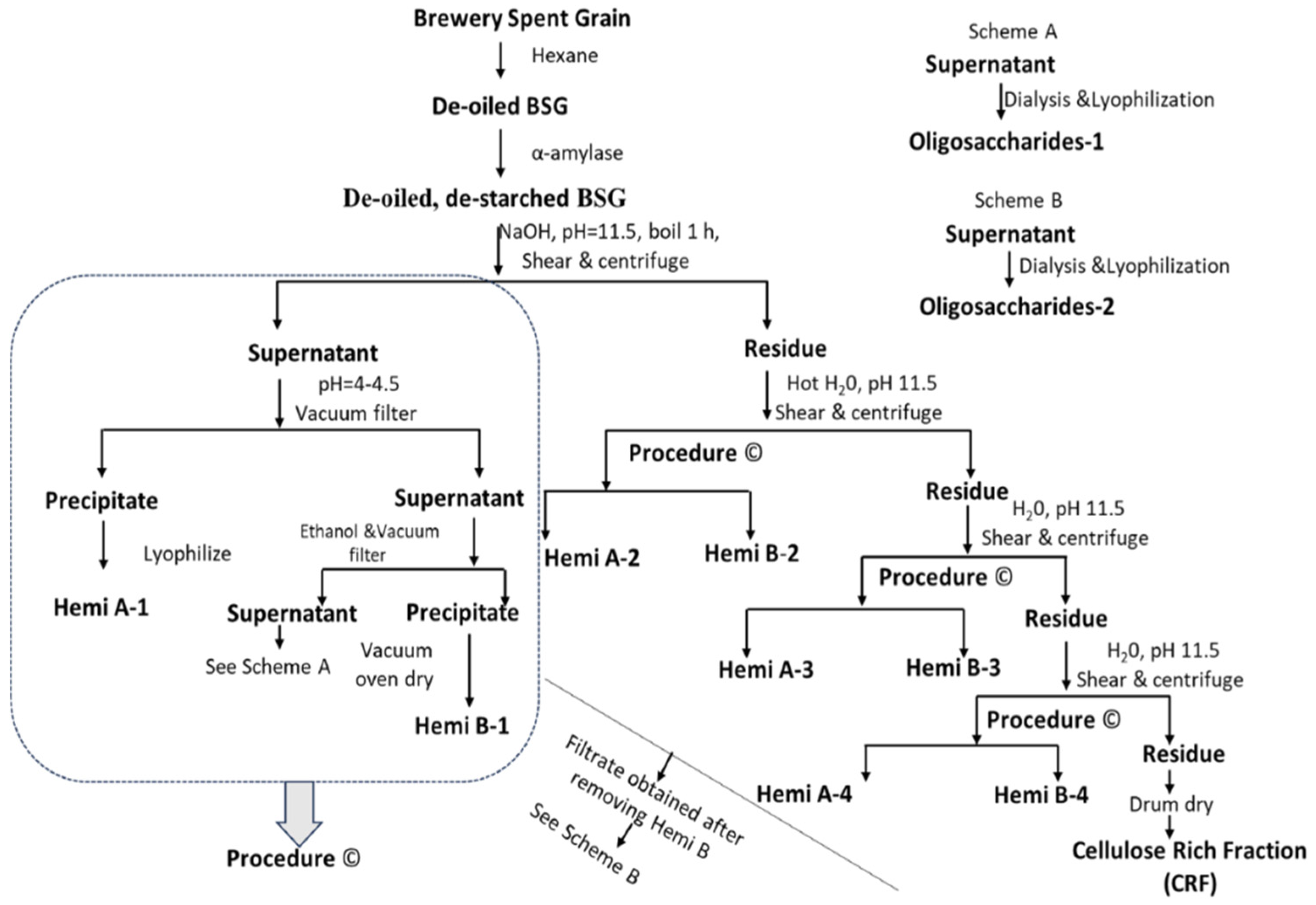
2.1. Materials
2.2. Thermal Behavior of BSG and Its Fractions
2.3. Scanning Electron Microscopy with Energy-Dispersive X-Ray Spectroscopy (SEM-EDX) Analysis
2.4. Rheological Measurement
2.5. Zeta Potential (§)
2.6. Statistical Analysis
3. Results and Discussions
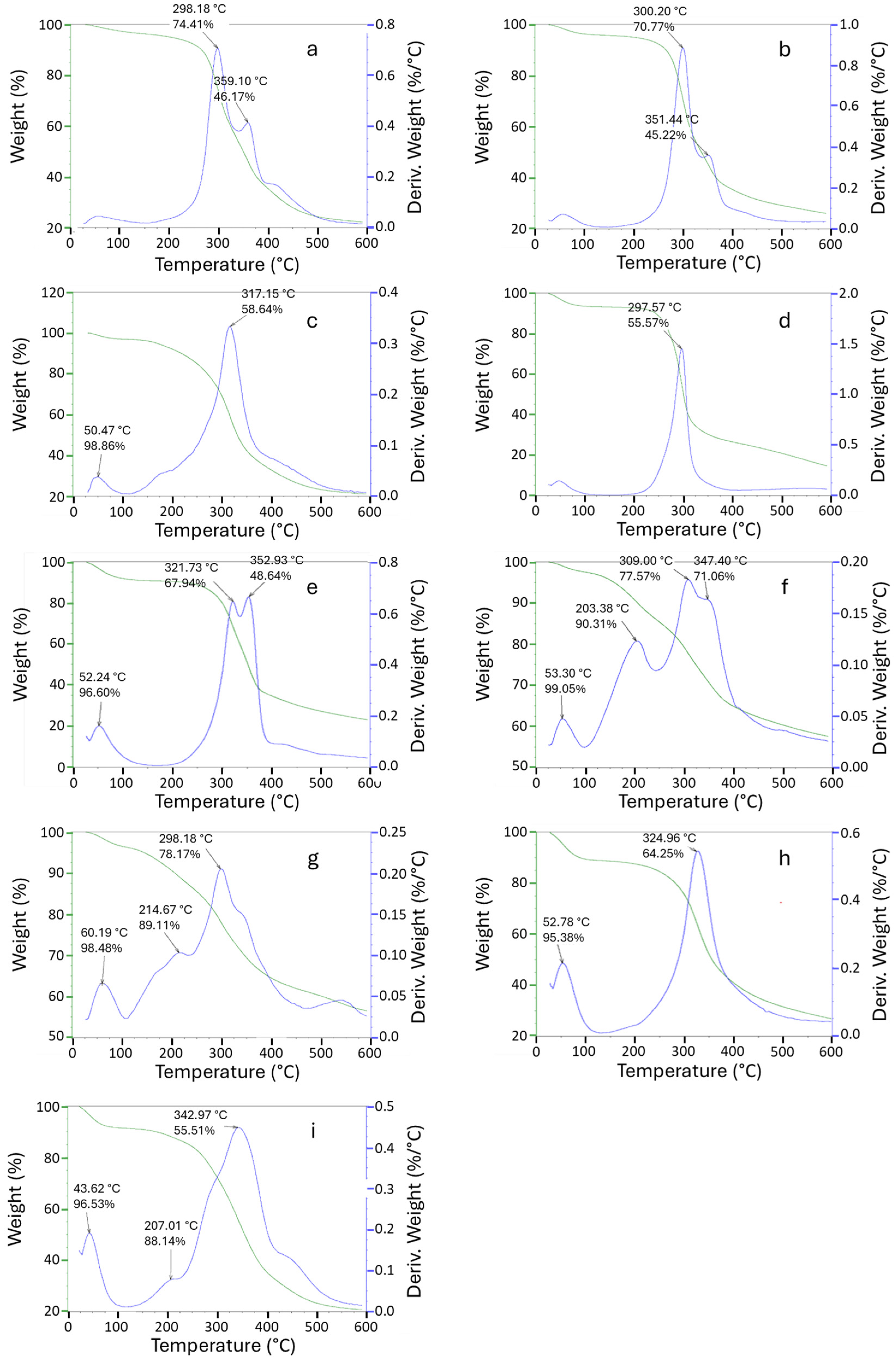
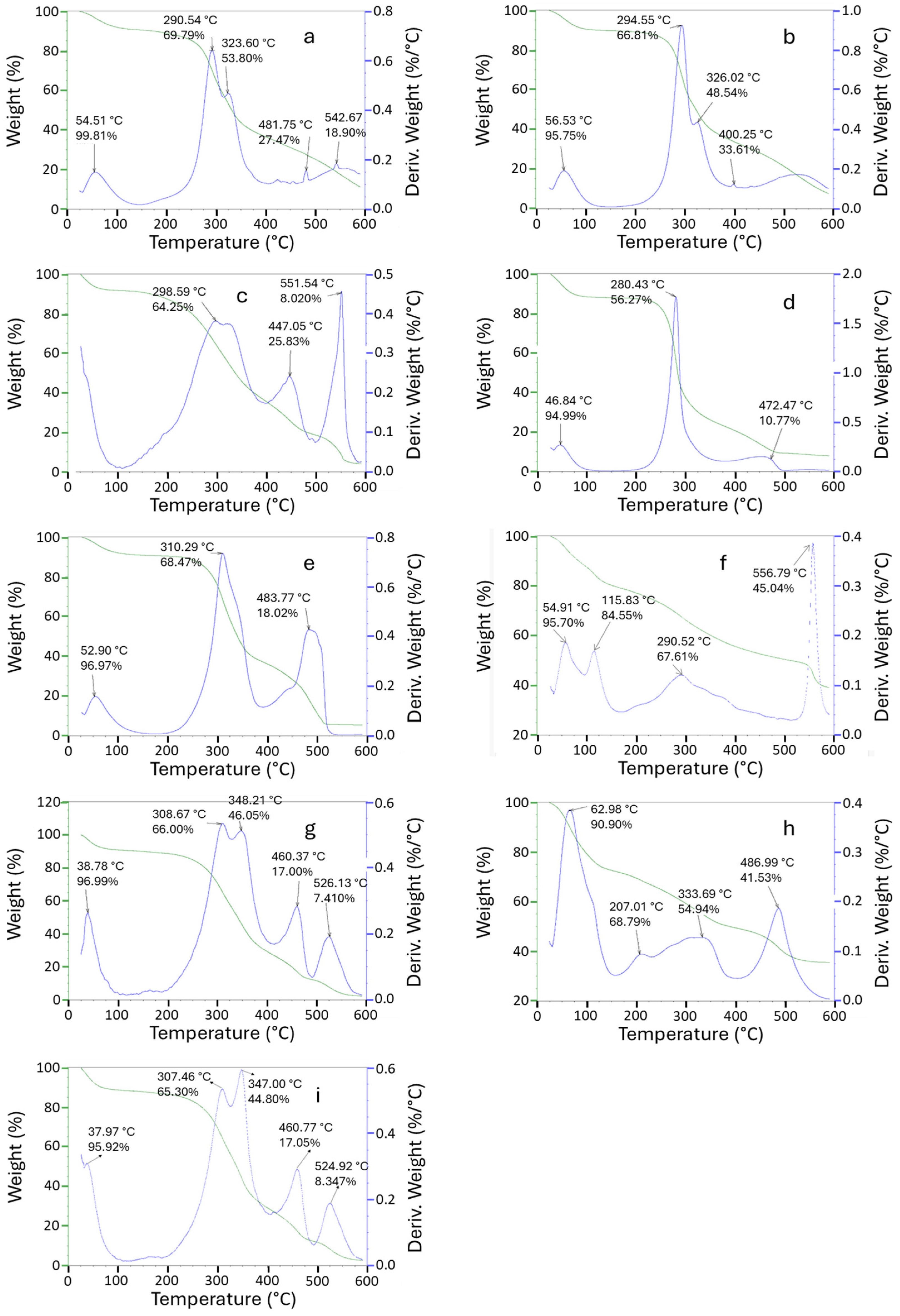
3.1. Thermogravimetric (TGA) and Derivative Thermogravimetric (DTG) Analysis
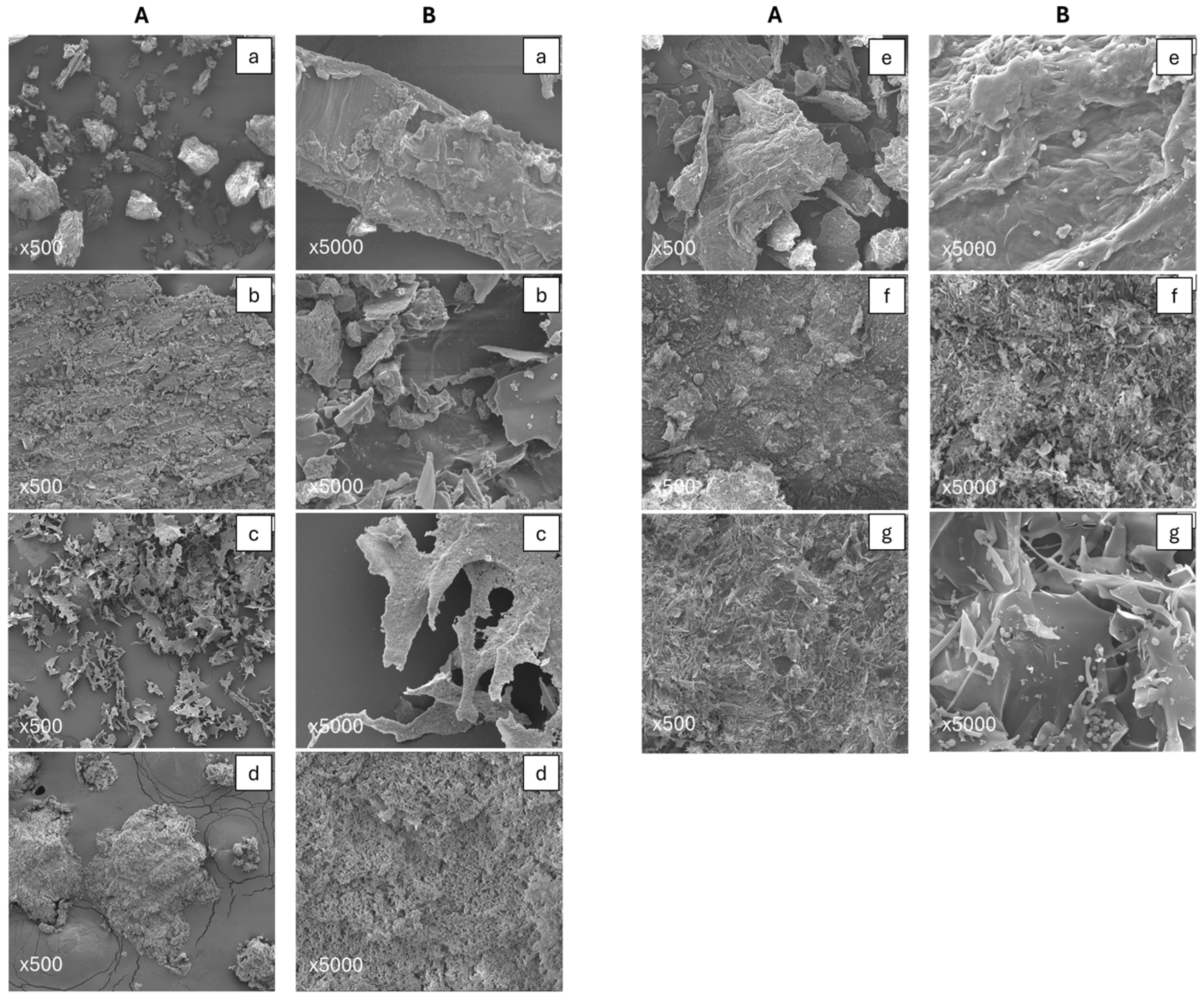
3.2. SEM-EDX Analysis
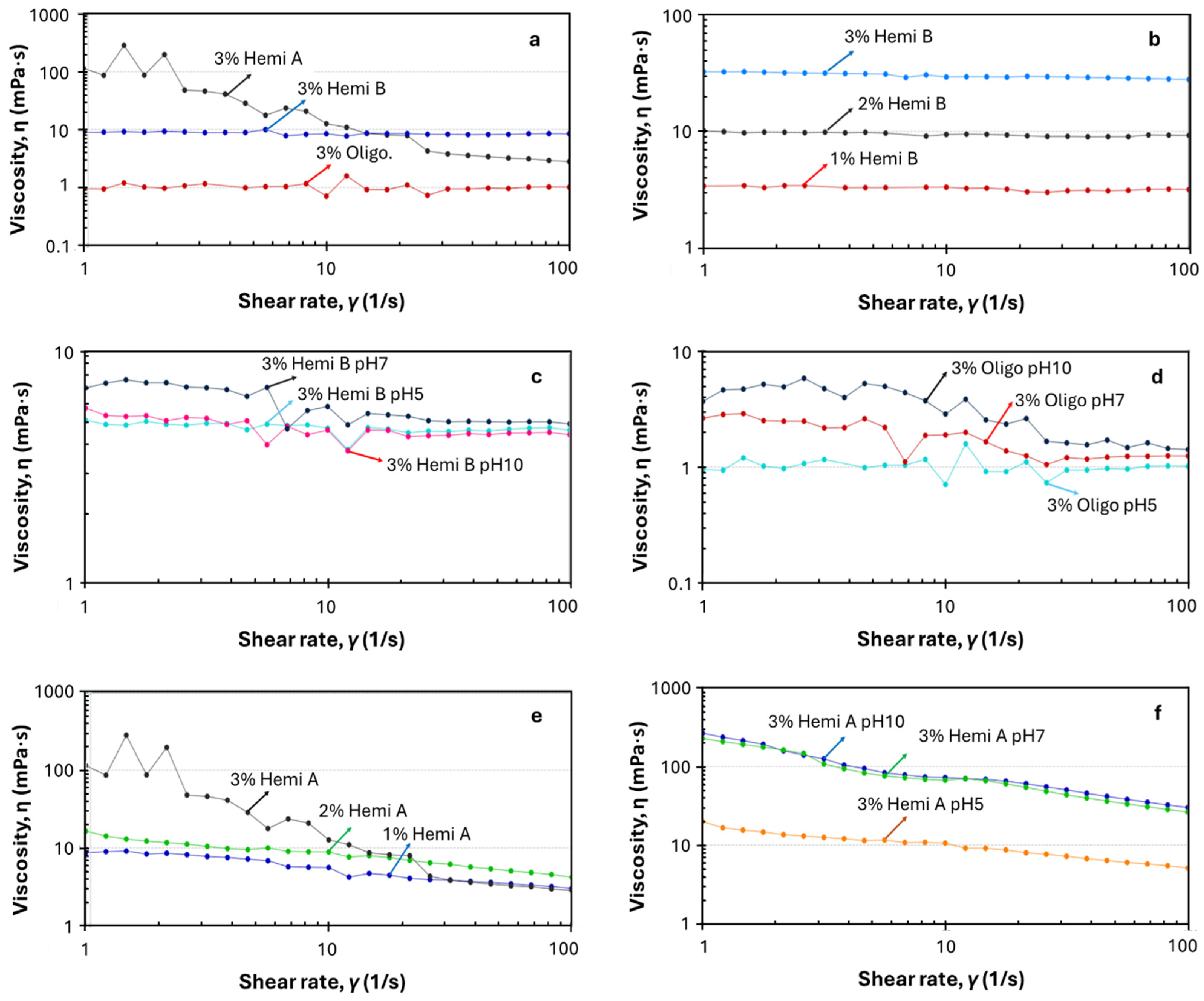
3.3. Shear Rate Dependence of Viscosity
3.4. Measurement of Zeta Potential
4. Conclusions
Supplementary Materials
Author Contributions
Funding
Institutional Review Board Statement
Informed Consent Statement
Data Availability Statement
Acknowledgments
Conflicts of Interest
References
- Arauzo, P.; Du, L.; Olszewski, M.; Zavala, M.M.; Alhnidi, M.; Kruse, A. Effect of protein during hydrothermal carbonization of brewer’s spent grain. Bioresour. Technol. 2019, 293, 122117. [Google Scholar] [CrossRef]
- Bachmann, S.A.L.; Calvete, T.; Féris, L.A. Potential applications of brewery spent grain: Critical an overview. J. Environ. Chem. Eng. 2022, 10, 106951. [Google Scholar] [CrossRef]
- Dancker, P.; Glas, K.; Gastl, M. Potential utilisation methods for brewer’s spent grain: A review. Int. J. Food Sci. Technol. 2025, 60, vvae022. [Google Scholar] [CrossRef]
- Belardi, I.; De Francesco, G.; Alfeo, V.; Bravi, E.; Sileoni, V.; Marconi, O.; Marrocchi, A. Advances in the valorization of brewing by-products. Food Chem. 2025, 465, 141882. [Google Scholar] [CrossRef]
- Bonifácio-Lopes, T.; Teixeira, J.A.; Pintado, M. Current extraction techniques towards bioactive compounds from brewer’s spent grain—A review. Crit. Rev. Food Sci. Nutr. 2020, 60, 2730–2741. [Google Scholar] [CrossRef] [PubMed]
- Zeko-Pivač, A.; Tišma, M.; Žnidaršič-Plazl, P.; Kulisic, B.; Sakellaris, G.; Hao, J.; Planinić, M. The Potential of Brewer’s Spent Grain in the Circular Bioeconomy: State of the Art and Future Perspectives. Front. Bioeng. Biotechnol. 2022, 10, 870744. [Google Scholar] [CrossRef] [PubMed]
- McCarthy, A.L.; O’Callaghan, Y.C.; Piggott, C.O.; FitzGerald, R.J.; O’Brien, N.M. Brewers’ spent grain; Bioactivity of phenolic component, its role in animal nutrition and potential for incorporation in functional foods: A review. Proc. Nutr. Soc. 2013, 72, 117–125. [Google Scholar] [CrossRef]
- Olivares-Galván, S.; Marina, M.; García, M. Extraction of valuable compounds from brewing residues: Malt rootlets, spent hops, and spent yeast. Trends Food Sci. Technol. 2022, 127, 181–197. [Google Scholar] [CrossRef]
- Olszewski, M.P.; Arauzo, P.J.; Maziarka, P.A.; Ronsse, F.; Kruse, A. Pyrolysis Kinetics of Hydrochars Produced from Brewer’s Spent Grains. Catalysts 2019, 9, 625. [Google Scholar] [CrossRef]
- Chetrariu, A.; Dabija, A. Brewer’s Spent Grains: Possibilities of Valorization, a Review. Appl. Sci. 2020, 10, 5619. [Google Scholar] [CrossRef]
- Jaeger, A.; Zannini, E.; Sahin, A.W.; Arendt, E.K. Barley Protein Properties, Extraction and Applications, with a Focus on Brewers’ Spent Grain Protein. Foods 2021, 10, 1389. [Google Scholar] [CrossRef]
- Henkin, J.M.; Mainali, K.; Sharma, B.K.; Yadav, M.P.; Ngo, H.; Sarker, M.I. A Review of Chemical and Physical Analysis, Processing, and Repurposing of Brewers’ Spent Grain. Biomass 2025, 5, 42. [Google Scholar] [CrossRef]
- Mainali, K.; Yadav, M.P.; Sharma, B.K.; Sarker, M.I.; Ngo, H.; Hotchkiss, A.; Simon, S. Isolation and Characterization of the Physiochemical Properties of Brewer’s Spent Grain. Agriculture 2024, 15, 47. [Google Scholar] [CrossRef]
- Zhang, X.; Wang, Q.; Liu, Z.; Zhi, L.; Jiao, B.; Hu, H.; Ma, X.; Agyei, D.; Shi, A. Plant protein-based emulsifiers: Mechanisms, techniques for emulsification enhancement and applications. Food Hydrocoll. 2023, 144, 109008. [Google Scholar] [CrossRef]
- Kaur, N.; Pandey, S.; Bhushan, K. Recent Developments in Extraction, Molecular Characterization, Bioactivity, and Application of Brewers Spent Grain Arabinoxylans. J. Food Sci. 2025, 90, e70239. [Google Scholar] [CrossRef]
- Almeida, A.D.R.; Geraldo, M.R.F.; Ribeiro, L.F.; Silva, M.V.; Maciel, M.V.D.O.B.; Haminiuk, C.W.I. Bioactive compounds from brewer’s spent grain: Phenolic compounds, fatty acids and in vitro antioxidant capacity. Acta Sci. Technol. 2017, 39, 269–277. [Google Scholar] [CrossRef]
- Ikram, S.; Huang, L.; Zhang, H.; Wang, J.; Yin, M. Composition and Nutrient Value Proposition of Brewers Spent Grain. J. Food Sci. 2017, 82, 2232–2242. [Google Scholar] [CrossRef]
- Qin, F.; Johansen, A.Z.; Mussatto, S.I. Evaluation of different pretreatment strategies for protein extraction from brewer’s spent grains. Ind. Crops Prod. 2018, 125, 443–453. [Google Scholar] [CrossRef]
- dos Santos Mathias, T.R.; de Mello, P.P.M.; Sérvulo, E.F.C. Solid wastes in brewing process: A review. J. Brew. Distill. 2014, 5, 1–9. [Google Scholar] [CrossRef]
- Thomas, K.R.; Rahman, P.K.S.M. Brewery wastes. Strategies for sustainability. A review. Asp. Appl. Biol. 2006, 80, 1–12. [Google Scholar]
- Awasthi, M.K.; Sar, T.; Gowd, S.C.; Rajendran, K.; Kumar, V.; Sarsaiya, S.; Li, Y.; Sindhu, R.; Binod, P.; Zhang, Z.; et al. A comprehensive review on thermochemical, and biochemical conversion methods of lignocellulosic biomass into valuable end product. Fuel 2023, 342, 127790. [Google Scholar] [CrossRef]
- Chew, K.R.; Leong, H.Y.; Khoo, K.S.; Vo, D.-V.N.; Anjum, H.; Chang, C.-K.; Show, P.L. Effects of anaerobic digestion of food waste on biogas production and environmental impacts: A review. Environ. Chem. Lett. 2021, 19, 2921–2939. [Google Scholar] [CrossRef]
- Manikandan, S.; Vickram, S.; Sirohi, R.; Subbaiya, R.; Krishnan, R.Y.; Karmegam, N.; Sumathijones, C.; Rajagopal, R.; Chang, S.W.; Ravindran, B.; et al. Critical review of biochemical pathways to transformation of waste and biomass into bioenergy. Bioresour. Technol. 2023, 372, 128679. [Google Scholar] [CrossRef]
- Damartzis, T.; Zabaniotou, A. Thermochemical conversion of biomass to second generation biofuels through integrated process design—A review. Renew. Sustain. Energy Rev. 2011, 15, 366–378. [Google Scholar] [CrossRef]
- Liu, L.Y.; Xie, G.J.; Xing, D.F.; Liu, B.F.; Ding, J.; Ren, N.Q. Biological conversion of methane to polyhydroxyalkanoates: Current advances, challenges, and perspectives. Environ. Sci. Ecotechnology 2020, 2, 100029. [Google Scholar] [CrossRef]
- Celaya, A.M.; Lade, A.T.; Goldfarb, J.L. Co-combustion of brewer’s spent grains and Illinois No. 6 coal: Impact of blend ratio on pyrolysis and oxidation behavior. Fuel Process. Technol. 2015, 129, 39–51. [Google Scholar] [CrossRef]
- Mainali, K.; Mood, S.H.; Pelaez-Samaniego, M.R.; Sierra-Jimenez, V.; Garcia-Perez, M. Production and applications of N-doped carbons from bioresources: A review. Catal. Today 2023, 423, 114248. [Google Scholar] [CrossRef]
- Jackowski, M.; Niedźwiecki, Ł.; Jagiełło, K.; Uchańska, O.; Trusek, A. Brewer’s Spent Grains—Valuable Beer Industry By-Product. Biomolecules 2020, 10, 1669. [Google Scholar] [CrossRef]
- Yadav, M.P.; Johnston, D.B.; Hotchkiss, A.T.; Hicks, K.B. Corn fiber gum: A potential gum arabic replacer for beverage flavor emulsification. Food Hydrocoll. 2007, 21, 1022–1030. [Google Scholar] [CrossRef]
- Kale, M.S.; Yadav, M.P.; Hicks, K.B.; Hanah, K. Concentration and shear rate dependence of solution viscosity for arabinoxylans from different sources. Food Hydrocoll. 2015, 47, 178–183. [Google Scholar] [CrossRef]
- Suliman, W.; Harsh, J.B.; Abu-Lail, N.I.; Fortuna, A.-M.; Dallmeyer, I.; Garcia-Perez, M. Influence of feedstock source and pyrolysis temperature on biochar bulk and surface properties. Biomass Bioenergy 2016, 84, 37–48. [Google Scholar] [CrossRef]
- Castells, B.; Amez, I.; Medic, L.; Fernandez-Anez, N.; Garcia-Torrent, J. Study of lignocellulosic biomass ignition properties estimation from thermogravimetric analysis. J. Loss Prev. Process. Ind. 2021, 71, 104425. [Google Scholar] [CrossRef]
- Shapiro, A.J.; O’dEa, R.M.; Epps, T.H. Thermogravimetric Analysis as a High-Throughput Lignocellulosic Biomass Characterization Method. ACS Sustain. Chem. Eng. 2023, 11, 17216–17223. [Google Scholar] [CrossRef]
- Azhar, S.H.M.; Abdulla, R.; Jambo, S.A.; Marbawi, H.; Gansau, J.A.; Faik, A.A.M.; Rodrigues, K.F. Yeasts in sustainable bioethanol production: A review. Biochem. Biophys. Rep. 2017, 10, 52–61. [Google Scholar] [CrossRef]
- Li, J.; Zhao, R.; Xu, Y.; Wu, X.; Bean, S.R.; Wang, D. Fuel ethanol production from starchy grain and other crops: An overview on feedstocks, affecting factors, and technical advances. Renew. Energy 2022, 188, 223–239. [Google Scholar] [CrossRef]
- Yan, J.; Jia, X.; Feng, L.; Yadav, M.; Li, X.; Yin, L. Rheological and emulsifying properties of arabinoxylans from various cereal brans. J. Cereal Sci. 2019, 90, 102844. [Google Scholar] [CrossRef]
- Bender, D.; Schmatz, M.; Novalin, S.; Nemeth, R.; Chrysanthopoulou, F.; Tömösközi, S.; Török, K.; Schoenlechner, R.; D’aMico, S. Chemical and rheological characterization of arabinoxylan isolates from rye bran. Chem. Biol. Technol. Agric. 2017, 4, 14. [Google Scholar] [CrossRef]
- Kornet, C.; Venema, P.; Nijsse, J.; van der Linden, E.; van der Goot, A.J.; Meinders, M. Yellow pea aqueous fractionation increases the specific volume fraction and viscosity of its dispersions. Food Hydrocoll. 2020, 99, 105332. [Google Scholar] [CrossRef]
- Potdar, S.B.; Landge, V.K.; Barkade, S.S.; Potoroko, I.; Sonawane, S.H. Flavor Encapsulation and Release Studies in Food. In Encapsulation of Active Molecules and Their Delivery System; Elsevier: Amsterdam, The Netherlands, 2020; pp. 293–321. [Google Scholar]
- Serrano-Lotina, A.; Portela, R.; Baeza, P.; Alcolea-Rodríguez, V.; Villarroel, M.; Ávila, P. Zeta potential as a tool for functional materials development. Catal. Today 2023, 423, 113862. [Google Scholar] [CrossRef]
- Staubmann, L.; Mistlberger-Reiner, A.; Raoui, E.M.; Brunner, G.; Sinawehl, L.; Winter, M.; Liska, R.; Pignitter, M. Combinations of hydrocolloids show enhanced stabilizing effects on cloudy orange juice ready-to-drink beverages. Food Hydrocoll. 2023, 138, 108436. [Google Scholar] [CrossRef]



| Extracted Fractions | C | O | Si | Mg | Ca | P | N |
|---|---|---|---|---|---|---|---|
| BSG | 65.7 ± 0.2 | 31.5 ± 0.2 | 2.5 ± 0.1 | 0.2 ± 0.1 | 0.2 ± 0.1 | ||
| Hexane extracted | 62.5 ± 0.1 | 26.1 ± 0.3 | 1.0 ± 0.2 | 1.4 ± 0.2 | 3.1 ± 0.4 | 6.4 ± 0.3 | |
| Hemi. A | 68.2 ± 0.3 | 17.7 ± 0.2 | 10.4 ± 0.2 | ||||
| Hemi. B | 60.7 ± 0.2 | 28.7 ± 0.4 | 0.7 ± 0.3 | 1.5 ± 0.2 | 4.2 ± 0.2 | ||
| CRF | 66.8 ± 0.3 | 29.0 ± 0.4 | 0.4 ± 0.2 | 0.9 ± 0.2 | 1.2 ± 0.1 | ||
| Oligo-1 | 63.5 ± 0.7 | 18.2 ± 0.2 | 0.6 ± 0.2 | 0.5 ± 0.1 | 1.1 ± 0.1 | 15.2 ± 0.3 | |
| Oligo-2 | 60.2 ± 0.2 | 20.8 ± 0.4 | 0.6 ± 0.2 | 0.7 ± 0.2 | 1.8 ± 0.2 | 15.3 ± 0.2 |
| Sample Name | T | ZP | Mobility | Conductivity |
|---|---|---|---|---|
| °C | mV | µmcm/Vs | mS/cm | |
| 1% Hemi B | 24.9 | −7.33 | −0.5749 | 0.384 |
| 2% Hemi B | 25.1 | −8.09 | −0.634 | 1.29 |
| 3% Hemi B | 25.0 | −8.89 | −0.6968 | 2.14 |
| 1% Hemi A | 25.0 | −7.77 | −0.609 | 2.41 |
| 2% Hemi A | 25.1 | −3.84 | −0.3009 | 1.31 |
| 3% Hemi A | 25.1 | −2.58 | −0.2022 | 1.84 |
| 3% Oligo | 24.9 | −12.50 | −0.9837 | 2.29 |
| 1% Hemi B, pH7 | 24.9 | −17.70 | −1.385 | 1.45 |
| 2% Hemi B, pH7 | 25.0 | −5.28 | −0.4138 | 2.48 |
| 3% Hemi B, pH7 | 25.0 | −12.10 | −0.9479 | 2.69 |
| 1% Hemi B, pH10 | 25.0 | −10.60 | −0.8309 | 2.22 |
| 2% Hemi B. pH10 | 24.9 | −8.13 | −0.637 | 2.5 |
| 3% Hemi B, pH10 | 24.9 | −22.70 | −1.781 | 5.78 |
| 1% Hemi B, pH5 | 24.9 | −19.90 | −1.558 | 0.896 |
| 2% Hemi B, pH5 | 24.9 | −8.05 | −0.6308 | 2.85 |
| 3% Hemi B, pH5 | 25.0 | −12.10 | −0.9462 | 2.34 |
| 1% Hemi A pH5 | 25.0 | −4.70 | −0.3682 | 1.28 |
| 2% Hemi A pH5 | 25.1 | −6.09 | −0.4773 | 1.35 |
| 3% Hemi A pH5 | 25.0 | −5.57 | −0.4368 | 1.28 |
| 1% Hemi A pH7 | 25.0 | −13.00 | −1.019 | 9.56 |
| 2% Hemi A pH7 | 25.1 | −23.30 | −1.825 | 3.02 |
| 3%Hemi A pH7 | 25.0 | −25.80 | −2.023 | 2.51 |
| 1% Hemi A pH10 | 24.9 | −16.50 | −1.294 | 3.62 |
| 2% Hemi A pH10 | 25.1 | −28.00 | −2.192 | 5.94 |
| 3%Hemi A pH10 | 25.0 | −21.00 | −1.645 | 4.09 |
| 3% Oligo pH7 | 25.0 | −16.30 | −1.275 | 2.45 |
| 3% Oligo pH10 | 25.0 | −14.80 | −1.162 | 2.57 |
Disclaimer/Publisher’s Note: The statements, opinions and data contained in all publications are solely those of the individual author(s) and contributor(s) and not of MDPI and/or the editor(s). MDPI and/or the editor(s) disclaim responsibility for any injury to people or property resulting from any ideas, methods, instructions or products referred to in the content. |
© 2025 by the authors. Licensee MDPI, Basel, Switzerland. This article is an open access article distributed under the terms and conditions of the Creative Commons Attribution (CC BY) license (https://creativecommons.org/licenses/by/4.0/).
Share and Cite
Mainali, K.; Sarker, M.I.; Sharma, B.K.; Ellison, C.; Ngo, H.; Simon, S.; Yadav, M.P. Thermal, Rheological, and Surface Properties of Brewer’s Spent Grain and Its Oligo and Polysaccharides Fractions. Foods 2025, 14, 4170. https://doi.org/10.3390/foods14244170
Mainali K, Sarker MI, Sharma BK, Ellison C, Ngo H, Simon S, Yadav MP. Thermal, Rheological, and Surface Properties of Brewer’s Spent Grain and Its Oligo and Polysaccharides Fractions. Foods. 2025; 14(24):4170. https://doi.org/10.3390/foods14244170
Chicago/Turabian StyleMainali, Kalidas, Majher I. Sarker, Brajendra K. Sharma, Candice Ellison, Helen Ngo, Stefanie Simon, and Madhav P. Yadav. 2025. "Thermal, Rheological, and Surface Properties of Brewer’s Spent Grain and Its Oligo and Polysaccharides Fractions" Foods 14, no. 24: 4170. https://doi.org/10.3390/foods14244170
APA StyleMainali, K., Sarker, M. I., Sharma, B. K., Ellison, C., Ngo, H., Simon, S., & Yadav, M. P. (2025). Thermal, Rheological, and Surface Properties of Brewer’s Spent Grain and Its Oligo and Polysaccharides Fractions. Foods, 14(24), 4170. https://doi.org/10.3390/foods14244170