Integrating Cutting-Edge Technologies in Food Sensory and Consumer Science: Applications and Future Directions


Abstract
1. Introduction
- (i)
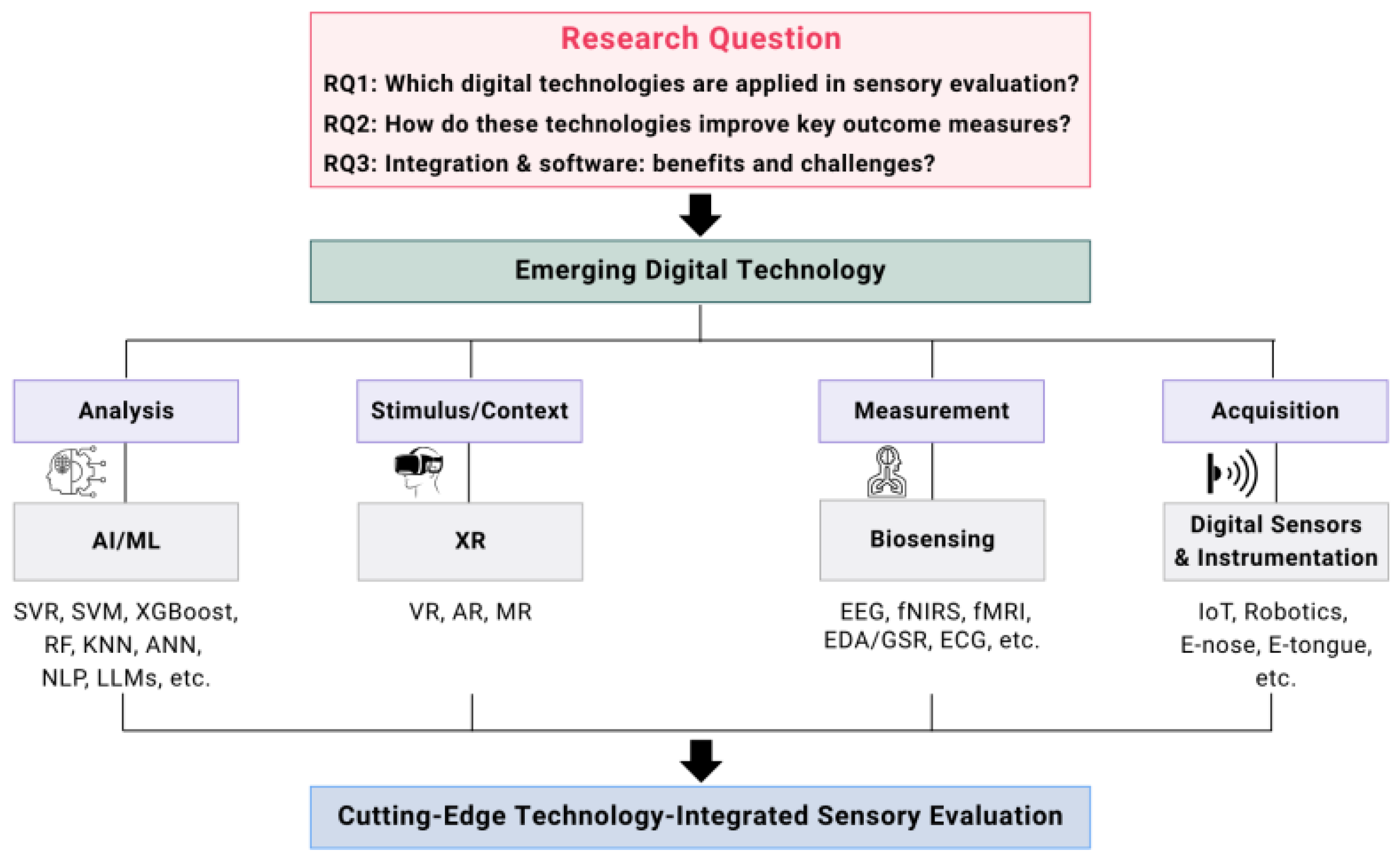
- Which major digital technologies (e.g., AI, XR, biometrics, digital sensors) are currently used in sensory and consumer evaluation, and how have they been applied in sensory studies?
- (ii)
- How do these technologies differ in their structural and functional characteristics, and in what ways do they improve key indicators in research and practice, such as predictive power, validity, and efficiency?
- (iii)
- How can the individual and integrated use of these technologies, together with sensory software, enhance resource-management efficiency and evaluation objectivity, and what ethical and practical issues arise in this process?
2. Methodology
3. Advances in Technologies for Sensory and Consumer Sciences
3.1. Artificial Intelligence and Machine Learning
3.1.1. Machine Learning Approaches for Sensory and Quality Prediction
3.1.2. Text Mining-Based Natural Language Processing and Large Language Models
3.1.3. Molecular Dynamics Simulation
3.1.4. Limitations of Artificial Intelligence and Machine Learning for Sensory and Consumer Science
3.2. Extended Reality: Virtual, Augmented and Mixed Reality
3.3. Biometrics and Physiological Measurements
3.3.1. Nerve and Brain Activity
3.3.2. Autonomic Nervous System Responses
3.3.3. Eye Movements and Visual Responses
3.3.4. Limitation of Biometric and Physiological Measures in Sensory Evaluation
3.4. Digital Sensing Technologies: IoT, Robotics, and Electronic Sensing Systems
3.4.1. Application of Robotics Technology in the Food Industry
3.4.2. Integration of Electronic Sensory Sensors and the Internet of Things
3.5. Comparison of Digital Technologies in Food Industry
4. Integrated Application of Advanced Sensory Evaluation Technologies
4.1. Digital Sensing Technologies and Machine Learning
4.2. Integrating Advanced Sensory Evaluation Technologies
5. Developments in Sensory Software
6. Ethical Considerations
6.1. AI Technology
6.2. XR (VR, AR, MR)
6.3. Biometrics Technology
6.4. Digital Sensor
7. Future Directions
8. Conclusions
Author Contributions
Funding
Institutional Review Board Statement
Informed Consent Statement
Data Availability Statement
Conflicts of Interest
Abbreviations
| AI | Artificial intelligence |
| ML | Machine learning |
| NLP | Natural language processing |
| LLMs | Large language models |
| PLS | Partial least squares |
| SVR | Support Vector Regression |
| SVM | Support Vector Machine |
| XGBoost | Extreme Gradient Boosting |
| RF | Random Forest |
| NN | Neural Network |
| KNN | K-Nearest Neighbors |
| ANN | Artificial Neural Network |
| DL | Deep Learning |
| RMSE | Root mean square error |
| DT | Decision tree |
| GC–MS | Gas chromatography–mass spectrometry |
| EEM | Excitation–Emission Matrix |
| ENR | Elastic Net Regression |
| PLS-DA | Partial least squares discriminant analysis |
| BP | Back-propagation |
| XR | Extended reality |
| VR | Virtual reality |
| AR | Augmented reality |
| MR | Mixed reality |
| HMD | Head-mounted display |
| EEG | Electroencephalogram |
| fNIRS | Functional near-infrared spectroscopy |
| fMRI | Functional magnetic resonance imaging |
| BOLD | Blood oxygenation level-dependent |
| HR | Heart rate |
| HRV | Heart rate variability |
| ANS | Autonomic nervous system |
| EDA/GSR | Electrodermal activity/Galvanic skin response |
| SC | Skin conductance |
| SCL | Skin conductance level |
| SR | Skin resistance |
| ECG | Electrocardiography |
| B.P. | Blood pressure |
| FEA | Facial expression analysis |
| EMG | Electromyography |
| IoT | Internet of Things |
| E-nose | Electronic noses |
| E-tongue | Electronic tongues |
References
- Wang, J.; Wang, J.; Qiao, L.; Zhang, N.; Sun, B.; Li, H.; Chen, H. From traditional to intelligent, a review of application and progress of sensory analysis in alcoholic beverage industry. Food Chem. X 2024, 23, 101542. [Google Scholar] [CrossRef]
- Torrico, D.D.; Mehta, A.; Borssato, A.B. New methods to assess sensory responses: A brief review of innovative techniques in sensory evaluation. Curr. Opin. Food Sci. 2023, 49, 100978. [Google Scholar] [CrossRef]
- Chen, B.; Lin, X.; Liang, Z.; Chang, X.; Wang, Z.; Huang, M.; Zeng, X.A. Advances in food flavor analysis and sensory evaluation techniques and applications: Traditional vs emerging. Food Chem. 2025, 494, 146235. [Google Scholar] [CrossRef]
- Cosme, F.; Rocha, T.; Marques, C.; Barroso, J.; Vilela, A. Innovative approaches in sensory food science: From digital tools to virtual reality. Appl. Sci. 2025, 15, 4538. [Google Scholar] [CrossRef]
- Jo, D.M.; Han, S.J.; Ko, S.C.; Kim, K.W.; Yang, D.; Kim, J.Y.; Khan, F. Application of artificial intelligence in the advancement of sensory evaluation of food products. Trends Food Sci. Technol. 2025, 165, 105283. [Google Scholar] [CrossRef]
- Kraemer, P.M.; Weilbächer, R.A.; Mechera-Ostrovsky, T.; Gluth, S. Cognitive and neural principles of a memory bias on preferential choices. Curr. Res. Neurobiol. 2022, 3, 100029. [Google Scholar] [CrossRef] [PubMed]
- Colla, K.; Keast, R.; Mohebbi, M.; Russell, C.G.; Liem, D.G. Testing the validity of immersive eating environments against laboratory and real life settings. Food Qual. Prefer. 2023, 103, 104717. [Google Scholar] [CrossRef]
- Vanaraj, R.; IP, B.; Mayakrishnan, G.; Kim, I.S.; Kim, S.C. A Systematic Review of the Applications of Electronic Nose and Electronic Tongue in Food Quality Assessment and Safety. Chemosensors 2025, 13, 161. [Google Scholar] [CrossRef]
- Queiroz, L.P.; Nogueirac, I.B.R.; Ribeiro, A.M. Flavor Engineering: A comprehensive review of biological foundations, AI integration, industrial development, and socio-cultural dynamics. Food Res. Int. 2024, 196, 115100. [Google Scholar] [CrossRef] [PubMed]
- Cui, Z.; Qi, C.; Zhou, T.; Yu, Y.; Wang, Y.; Zhang, Z.; Zhang, Y.; Wang, W.; Liu, Y. Artificial intelligence and food flavor: How AI models are shaping the future and revolutionary technologies for flavor food development. Compr. Rev. Food Sci. Food Saf. 2025, 24, e70068. [Google Scholar] [CrossRef]
- Ji, H.; Pu, D.; Yan, W.; Zhang, Q.; Zuo, M.; Zhang, Y. Recent advances and application of machine learning in food flavor prediction and regulation. Trends Food Sci. Technol. 2023, 138, 738–751. [Google Scholar] [CrossRef]
- Zou, W.; Pan, F.; Yi, J.; Peng, W.; Tian, W.; Zhou, L. Targeted prediction of sensory preference for fermented pomegranate juice based on machine learning. LWT 2024, 201, 116260. [Google Scholar] [CrossRef]
- Keydana, S.; Chollet, F.; Kalinowski, T.; Allaire, J.J. Deep Learning with R, 2nd ed.; Manning Publications: Shelter Island, NY, USA, 2022. [Google Scholar]
- Saenz-Navajas, M.P.; Ferreira, C.; Bastian, S.E.; Jeffery, D.W. Bagging and boosting machine learning algorithms for modelling sensory perception from simple chemical variables: Wine mouthfeel as a case study. Food Qual. Prefer. 2025, 129, 105494. [Google Scholar] [CrossRef]
- Su, L.; Ji, H.; Kong, J.; Yan, W.; Zhang, Q.; Li, J.; Zuo, M. Recent advances and applications of deep learning, electroencephalography, and modern analysis techniques in screening, evaluation, and mechanistic analysis of taste peptides. Trends Food Sci. Technol. 2024, 150, 104607. [Google Scholar] [CrossRef]
- Ji, H.; Pu, D.; Su, L.; Zhang, Q.; Yan, W.; Kong, J.; Zuo, M.; Zhang, Y. Computational approaches for decoding structure-saltiness enhancement and aroma perception mechanisms of odorants: From machine learning to molecular simulation. Food Res. Int. 2025, 202, 115707. [Google Scholar] [CrossRef]
- Zhu, M.; Wang, M.; Gu, J.; Deng, Z.; Zhang, W.; Pan, Z.; Luo, G.; Wu, R.; Qin, J.; Gomi, K. Machine learning-assisted aroma profile prediction in Jiang-flavor baijiu. Food Chem. 2025, 478, 143661. [Google Scholar] [CrossRef] [PubMed]
- Jiang, J.; Ji, S.; Pan, G.; Tao, X.; An, F.; Liu, Q.; Wu, J.; Wu, R. Machine learning combined with sensory evaluation and multi-sensor technology to evaluate the overall quality of commercial soybean paste in China. J. Futur. Foods 2025, 6, 554–564. [Google Scholar] [CrossRef]
- Breiman, L. Random forests. Mach. Learn. 2001, 45, 5–32. [Google Scholar] [CrossRef]
- Lu, H.; Yao, C.; An, L.; Song, A.; Ling, F.; Huang, Q.; Cai, Y.; Liu, Y.; Kang, D. Classification and identification of chicken-derived adulteration in pork patties: A multi-dimensional quality profile and machine learning-based approach. Food Control 2025, 176, 111381. [Google Scholar] [CrossRef]
- Shuai, Y.; Zhang, K.; Zhang, T.; Zhu, H.; Jin, S.; Hu, T.; Yu, Z.; Liang, X. Decoding drinking water flavor: A pioneering and interpretable machine learning approach. J. Water Process Eng. 2025, 72, 107577. [Google Scholar] [CrossRef]
- Chitra Devi, V.; Devanampriyan, R.; Kayethri, D.; Sankari, R.; Premalatha, J.; Sathish Raam, R.; Mothil, S. Optimization and Process Validation of Freeze-Structured Meat Substitute Using Machine Learning Models. J. Food Process Eng. 2025, 48, e70071. [Google Scholar] [CrossRef]
- Harris, N.; Gonzalez Viejo, C.; Zhang, J.; Pang, A.; Hernandez-Brenes, C.; Fuentes, S. Enhancing beer authentication, quality, and control assessment using non-invasive spectroscopy through bottle and machine learning modeling. J. Food Sci. 2025, 90, e17670. [Google Scholar] [CrossRef]
- Miller, C.; Hamilton, L.; Lahne, J. Sensory Descriptor Analysis of Whisky Lexicons through the Use of Deep Learning. Foods 2021, 10, 1633. [Google Scholar] [CrossRef]
- Chen, Z.; Gurdian, C.; Sharma, C.; Prinyawiwatkul, W.; Torrico, D.D. Exploring Text Mining for Recent Consumer and Sensory Studies about Alternative Proteins. Foods 2021, 10, 2537. [Google Scholar] [CrossRef]
- Asseo, K.; Niv, M.Y. Harnessing Food Product Reviews for Personalizing Sweetness Levels. Foods 2022, 11, 1872. [Google Scholar] [CrossRef]
- Achiam, J.; Adler, S.; Agarwal, S.; Ahmad, L.; Akkaya, I.; Aleman, F.L.; McGrew, B. Gpt-4 technical report. arXiv 2023, arXiv:2303.08774. [Google Scholar] [CrossRef]
- Wang, Q.J.; Pellegrino, R. Automating chemosensory creativity assessment with large language models. Food Qual. Prefer. 2025, 132, 105599. [Google Scholar] [CrossRef]
- Ilieva, I.; Terziyska, M.; Dimitrova, T. From Words to Ratings: Machine Learning and NLP for Wine Reviews. Beverages 2025, 11, 80. [Google Scholar] [CrossRef]
- Visalli, M.; Symoneaux, R.; Mursic, C.; Touret, M.; Lourtioux, F.; Coulibaly, K.; Mahieu, B. Can natural language processing or large language models replace human operators for pre-processing word and sentence based free comments sensory evaluation data? Food Qual. Prefer. 2025, 127, 105456. [Google Scholar] [CrossRef]
- Torrico, D.D. The Potential Use of ChatGPT as a Sensory Evaluator of Chocolate Brownies: A Brief Case Study. Foods 2025, 14, 464. [Google Scholar] [CrossRef]
- Thomas, A.T.; Yee, A.; Mayne, A.; Mathur, M.B.; Jurafsky, D.; Gligoric, K. What Can Large Language Models Do for Sustainable Food? arXiv 2025, arXiv:2503.04734. [Google Scholar]
- Wang, Y.M.; Zhang, Z.; Sheng, Y.; Chi, C.F.; Wang, B. A systematic review on marine umami peptides: Biological sources, preparation methods, structure-umami relationship, mechanism of action and biological activities. Food Biosci. 2024, 57, 103637. [Google Scholar] [CrossRef]
- Liu, M.; Wang, K.; Zhang, Y.; Zhou, X.; Li, W.; Han, W. Mechanistic Study of Protein Interaction with Natto Inhibitory Peptides Targeting Xanthine Oxidase: Insights from Machine Learning and Molecular Dynamics Simulations. J. Chem. Inf. Model. 2025, 65, 3682–3696. [Google Scholar] [CrossRef]
- Mao, J.; Liu, Y.; Ma, D.; Zhou, Z. Virtual screening of umami peptides during sufu ripening based on machine learning and molecular docking to umami receptor T1R1/T1R3. Food Chem. 2025, 486, 144684. [Google Scholar] [CrossRef]
- Fu, B.; Li, M.; Chang, Z.; Yi, J.; Cheng, S.; Du, M. Identification of novel umami peptides from oyster hydrolysate and the mechanisms underlying their taste characteristics using machine learning. Food Chem. 2025, 473, 142970. [Google Scholar] [CrossRef]
- Geng, H.; Xu, C.; Ma, H.; Dai, Y.; Jiang, Z.; Yang, M.; Zhu, D. In Silico Discovery and Sensory Validation of Umami Peptides in Fermented Sausages: A Study Integrating Deep Learning and Molecular Modeling. Foods 2025, 14, 2422. [Google Scholar] [CrossRef] [PubMed]
- Mei, S.; Zhang, L.; Li, Y.; Zhang, X.; Li, W.; Wu, T. Machine learning-based exploration of Umami peptides in Pixian douban: Insights from virtual screening, molecular docking, and post-translational modifications. Food Chem. 2025, 478, 143672. [Google Scholar] [CrossRef]
- Patchipala, S. Tackling data and model drift in AI: Strategies for maintaining accuracy during ML model inference. Int. J. Sci. Res. Arch. 2023, 10, 1198–1209. [Google Scholar] [CrossRef]
- Jian, C.; Gao, J.; Ao, Y. A new sampling method for classifying imbalanced data based on support vector machine ensemble. Neurocomputing 2016, 193, 115–122. [Google Scholar] [CrossRef]
- Jing, X.; Wu, F.; Dong, X.; Qi, F.; Xu, B. Heterogeneous Cross-Company Defect Prediction by Unified Metric Representation and CCA-Based Transfer Learning. In Proceedings of the 2015 10th Joint Meeting on Foundations of Software Engineering (ESEC/FSE 2015), Bergamo, Italy, 30 August–4 September 2015. [Google Scholar]
- Ryu, D.; Jang, J.I.; Baik, J. A hybrid instance selection using nearest-neighbor for cross-project defect prediction. J. Comput. Sci. Technol. 2015, 30, 969–980. [Google Scholar] [CrossRef]
- Felix, E.A.; Lee, S.P. Systematic literature review of preprocessing techniques for imbalanced data. IET Softw. 2019, 13, 479–496. [Google Scholar] [CrossRef]
- Yang, H.; Wang, Y.; Zhao, J.; Li, P.; Wang, F. A machine learning method for juice human sensory hedonic prediction using electronic sensory features. Curr. Res. Food Sci. 2023, 7, 100576. [Google Scholar] [CrossRef]
- Ferrara, E. Should ChatGPT be biased? challenges and risks of bias in large language models. arXiv 2023, arXiv:2304.03738. [Google Scholar] [CrossRef]
- Ribeiro, J.C.; Rocha, C.; Barbosa, B.; Lima, R.C.; Cunha, L.M. Sensory Analysis Performed within Augmented Virtuality System: Impact on Hedonic Scores, Engagement, and Presence Level. Foods 2024, 13, 2456. [Google Scholar] [CrossRef]
- Low, J.Y.; Diako, C.; Lin, V.H.; Yeon, L.J.; Hort, J. Investigating the relative merits of using a mixed reality context for measuring affective response and predicting tea break snack choice. Food Res. Int. 2021, 150, 110718. [Google Scholar] [CrossRef]
- Gouton, M.A.; Dacremont, C.; Trystram, G.; Blumenthal, D. Effect of perceptive enrichment on the efficiency of simulated contexts: Comparing virtual reality and immersive room settings. Food Res. Int. 2023, 165, 112492. [Google Scholar] [CrossRef]
- Lichters, M.; Möslein, R.; Sarstedt, M.; Scharf, A. Segmenting consumers based on sensory acceptance tests in sensory labs, immersive environments, and natural consumption settings. Food Qual. Prefer. 2021, 89, 104138. [Google Scholar] [CrossRef]
- Qamar, S.; Anwar, Z.; Afzal, M. A systematic threat analysis and defense strategies for the metaverse and extended reality systems. Comput. Secur. 2023, 128, 103127. [Google Scholar] [CrossRef]
- Milgram, P.; Kishino, F. A taxonomy of mixed reality visual displays. IEICE Trans. Inf. Syst. 1994, 77, 1321–1329. [Google Scholar]
- Zulkarnain, A.H.B.; Gere, A. Virtual Reality Sensory Analysis Approaches for Sustainable Food Production. Appl. Food Res. 2025, 5, 100780. [Google Scholar] [CrossRef]
- Fuentes, S.; Tongson, E.; Viejo, C.G. Novel digital technologies implemented in sensory science and consumer perception. Curr. Opin. Food Sci. 2021, 41, 99–106. [Google Scholar] [CrossRef]
- Botinestean, C.; Melios, S.; Crofton, E. Exploring Consumer Perception of Augmented Reality (AR) Tools for Displaying and Understanding Nutrition Labels: A Pilot Study. Multimodal Technol. Interact. 2025, 9, 97. [Google Scholar] [CrossRef]
- Lee, H. A conceptual model of immersive experience in extended reality. Comput. Hum. Behav. Rep. 2025, 18, 100663. [Google Scholar] [CrossRef]
- Guberman, M.A.; Sakdavong, J.C.; Galmarini, M. Modulating taste perception through color and shape: A mixed reality study on solid foods. Front. Comput. Sci. 2025, 7, 1512931. [Google Scholar] [CrossRef]
- Rokhsaritalemi, S.; Sadeghi-Niaraki, A.; Choi, S.M. A review on mixed reality: Current trends, challenges and prospects. Appl. Sci. 2020, 10, 636. [Google Scholar] [CrossRef]
- Liu, M.; Chen, Z.; Huang, J.; Wan, X. From virtual reality visuals to real food perception: Uncovering the link between food aesthetics and taste in Chinese female consumers. Food Qual. Prefer. 2025, 131, 105569. [Google Scholar] [CrossRef]
- da Silva, F.N.; Minim, L.A.; Lima Filho, T.; Costa, A.A.D.S.X.; Vidigal, M.C.T.R.; Minim, V.P.R. Immersive virtual contexts, engagement, and emotions: How do these factors influence sensory acceptance? Food Res. Int. 2025, 207, 116106. [Google Scholar] [CrossRef] [PubMed]
- Fritz, W.; Hadi, R.; Stephen, A. From tablet to table: How augmented reality influences food desirability. J. Acad. Mark. Sci. 2023, 51, 503–529. [Google Scholar] [CrossRef]
- Barker, I.; Yang, Q.; Flintham, M.; Ankeny, R.; Ford, R. Improving immersive consumption contexts using virtual & mixed reality. Sci. Talks 2024, 10, 100346. [Google Scholar] [CrossRef]
- Alba-Martínez, J.; Alcañiz, M.; Martínez-Monzó, J.; Cunha, L.M.; García-Segovia, P. Beyond Reality: Exploring the effect of different virtual reality environments on visual assessment of cakes. Food Res. Int. 2024, 179, 114019. [Google Scholar] [CrossRef]
- Zulkarnain, A.H.B.; Kókai, Z.; Gere, A. Immersive sensory evaluation: Practical use of virtual reality sensory booth. MethodsX 2024, 12, 102631. [Google Scholar] [CrossRef]
- Zulkarnain, A.H.B.; Radványi, D.; Szakál, D.; Kókai, Z.; Gere, A. Unveiling aromas: Virtual reality and scent identification for sensory analysis. Curr. Res. Food Sci. 2024, 8, 100698. [Google Scholar] [CrossRef]
- Zulkarnain, A.H.B.; Kókai, Z.; Gere, A. Assessment of a virtual sensory laboratory for consumer sensory evaluations. Heliyon 2024, 10, e25498. [Google Scholar] [CrossRef]
- Man, K.; Patterson, J.A.; Simons, C. The impact of personally relevant consumption contexts during product evaluations in virtual reality. Food Qual. Prefer. 2023, 109, 104912. [Google Scholar] [CrossRef]
- Jeganathan, K.; Szymkowiak, A. Playing with food–The effects of augmented reality on meal perceptions. Food Qual. Prefer. 2023, 111, 104969. [Google Scholar] [CrossRef]
- Mellos, I.; Probst, Y. Evaluating augmented reality for ‘real life’teaching of food portion concepts. J. Hum. Nutr. Diet. 2022, 35, 1245–1254. [Google Scholar] [CrossRef]
- Dong, Y.; Sharma, C.; Mehta, A.; Torrico, D.D. Application of augmented reality in the sensory evaluation of yogurts. Fermentation 2021, 7, 147. [Google Scholar] [CrossRef]
- Halabi, O.; Saleh, M. Augmented reality flavor: Cross-modal mapping across gustation, olfaction, and vision. Multimedia Tools Appl. 2021, 80, 36423–36441. [Google Scholar] [CrossRef] [PubMed]
- Long, J.W.; Masters, B.; Sajjadi, P.; Simons, C.; Masterson, T.D. The development of an immersive mixed-reality application to improve the ecological validity of eating and sensory behavior research. Front. Nutr. 2023, 10, 1170311. [Google Scholar] [CrossRef] [PubMed]
- Low, J.Y.; Lin, V.H.; Yeon, L.J.; Hort, J. Considering the application of a mixed reality context and consumer segmentation when evaluating emotional response to tea break snacks. Food Qual. Prefer. 2021, 88, 104113. [Google Scholar] [CrossRef]
- Fuchs, K.; Haldimann, M.; Grundmann, T.; Fleisch, E. Supporting food choices in the Internet of People: Automatic detection of diet-related activities and display of real-time interventions via mixed reality headsets. Futur. Gener. Comput. Syst. 2020, 113, 343–362. [Google Scholar] [CrossRef]
- Li, H.; Ding, Y.; Zhao, B.; Xu, Y.; Wei, W. Effects of immersion in a simulated natural environment on stress reduction and emotional arousal: A systematic review and meta-analysis. Front. Psychol. 2023, 13, 1058177. [Google Scholar] [CrossRef] [PubMed]
- Breves, P.; Stein, J.P. Cognitive load in immersive media settings: The role of spatial presence and cybersickness. Virtual Real. 2023, 27, 1077–1089. [Google Scholar] [CrossRef]
- Wen, H.; Leung, X.Y. Virtual wine tours and wine tasting: The influence of offline and online embodiment integration on wine purchase decisions. Tour. Manag. 2021, 83, 104250. [Google Scholar] [CrossRef]
- Cossio, S.; Chiappinotto, S.; Dentice, S.; Moreal, C.; Magro, G.; Dussi, G.; Galazzi, A. Cybersickness and discomfort from head-mounted displays delivering fully immersive virtual reality: A systematic review. Nurse Educ. Pr. 2025, 85, 104376. [Google Scholar] [CrossRef]
- Miguel-Alonso, I.; Checa, D.; Guillen-Sanz, H.; Bustillo, A. Evaluation of the novelty effect in immersive virtual reality learning experiences. Virtual Real. 2024, 28, 27. [Google Scholar] [CrossRef]
- Rodrigues, S.S.; Dias, L.G.; Teixeira, A. Emerging methods for the evaluation of sensory quality of food: Technology at service. Curr. Food Sci. Technol. Rep. 2024, 2, 77–90. [Google Scholar] [CrossRef]
- Cong, L.; Luan, S.; Young, E.; Mirosa, M.; Bremer, P.; Torrico, D.D. The application of biometric approaches in agri-food marketing: A systematic literature review. Foods 2023, 12, 2982. [Google Scholar] [CrossRef]
- Wagner, J.; Hort, J. A practical evaluation of biometric measures for understanding the consumer experience during direct product evaluation: Current and future perspectives. Curr. Opin. Food Sci. 2025, 63, 101311. [Google Scholar] [CrossRef]
- National Institute of Standards and Technology. Biometrics. Computer Security Resource Center Glossary. Available online: https://csrc.nist.gov/glossary/term/biometrics (accessed on 8 October 2025).
- Adhikari, K. Application of selected neuroscientific methods in consumer sensory analysis: A review. J. Food Sci. 2023, 88, 53–64. [Google Scholar] [CrossRef]
- Modesti, M.; Tonacci, A.; Sansone, F.; Billeci, L.; Bellincontro, A.; Cacopardo, G.; Sanmartin, C.; Taglieri, I.; Venturi, F. E-Senses, Panel Tests and Wearable Sensors: A Teamwork for Food Quality Assessment and Prediction of Consumer’s Choices. Chemosensors 2022, 10, 244. [Google Scholar] [CrossRef]
- Bringas Vega, M.L.; Guo, Y.; Tang, Q.; Razzaq, F.A.; Calzada Reyes, A.; Ren, P.; Valdes Sosa, P.A. An age-adjusted EEG source classifier accurately detects school-aged barbadian children that had protein energy malnutrition in the first year of life. Front. Neurosci. 2019, 13, 1222. [Google Scholar] [CrossRef]
- Wang, J.; Wang, M. Review of the emotional feature extraction and classification using EEG signals. Cogn. Robot. 2021, 1, 29–40. [Google Scholar] [CrossRef]
- Niso, G.; Romero, E.; Moreau, J.T.; Araujo, A.; Krol, L.R. Wireless EEG: A survey of systems and studies. NeuroImage 2023, 269, 119774. [Google Scholar] [CrossRef] [PubMed]
- Lopez-Gordo, M.A.; Sanchez-Morillo, D.; Valle, F.P. Dry EEG Electrodes. Sensors 2014, 14, 12847–12870. [Google Scholar] [CrossRef]
- Bazzani, A.; Ravaioli, S.; Trieste, L.; Faraguna, U.; Turchetti, G. Is EEG suitable for marketing research? A systematic review. Front. Neurosci. 2020, 14, 594566. [Google Scholar] [CrossRef]
- Ferrari, M.; Quaresima, V. A brief review on the history of human functional near-infrared spectroscopy (fNIRS) development and fields of application. Neuroimage 2012, 63, 921–935. [Google Scholar] [CrossRef]
- Gore, J.C. Principles and practice of functional MRI of the human brain. J. Clin. Investig. 2003, 112, 4–9. [Google Scholar] [CrossRef]
- Zhao, Q.; Yang, P.; Wang, X.; Ye, Z.; Xu, Z.; Chen, J.; Cheng, H. Unveiling brain response mechanisms of citrus flavor perception: An EEG-based study on sensory and cognitive responses. Food Res. Int. 2025, 206, 116096. [Google Scholar] [CrossRef] [PubMed]
- Meyerding, S.G.; He, X.; Bauer, A. Neuronal correlates of basic taste perception and hedonic evaluation using functional Near-Infrared Spectroscopy (fNIRS). Appl. Food Res. 2024, 4, 100477. [Google Scholar] [CrossRef]
- Mai, J.; Li, S.; Wei, Z.; Sun, Y. Implicit Measurement of Sweetness Intensity and Affective Value Based on fNIRS. Chemosensors 2025, 13, 36. [Google Scholar] [CrossRef]
- Fu, Y.; Wang, C.; He, G.; Fan, S.; Wang, D.; Lv, G.; Huangfu, J. Neurophysiological and multimodal sensory evaluation of baijiu and food pairing liking. Food Res. Int. 2025, 221, 117451. [Google Scholar] [CrossRef]
- Stickel, L.; Grunert, K.G.; Lähteenmäki, L. Implicit and explicit liking of a snack with health-versus taste-related information. Food Qual. Prefer. 2025, 122, 105293. [Google Scholar] [CrossRef]
- Yang, T.; Jiang, W.; Luo, C.; Hu, J.; Xu, W.; Zhang, P.; Yang, Y. Multidimensional analysis of sensory perception and neurophysiological responses to marinated beef cooked by diverse methods. Innov. Food Sci. Emerg. Technol. 2025, 103, 104058. [Google Scholar] [CrossRef]
- Artêncio, M.M.; Giraldi, J.D.M.E.; de Oliveira, J.H.C. A cup of black coffee with GI, please! Evidence of geographical indication influence on a coffee tasting experiment. Physiol. Behav. 2022, 245, 113671. [Google Scholar]
- Bilucaglia, M.; Bellati, M.; Fici, A.; Russo, V.; Zito, M. Tuning into Flavour: Predicting Coffee Sensory Attributes from EEG with Boosted-Tree Regression Models. Front. Hum. Neurosci. 2025, 19, 1661214. [Google Scholar] [CrossRef]
- Wang, G.; Wang, X.; Cheng, H.; Li, H.; Qin, Z.; Zheng, F.; Sun, B. Application of electroencephalogram (EEG) in the study of the influence of different contents of alcohol and Baijiu on brain perception. Food Chem. 2025, 462, 140969. [Google Scholar] [CrossRef]
- Monciatti, A.M.; Lapini, M.; Gemignani, J.; Frediani, G.; Carpi, F. Unpleasant odors compared to pleasant ones cause higher cortical activations detectable by fNIRS and observable mostly in females. APL Bioeng. 2025, 9, 016101. [Google Scholar] [CrossRef]
- Jezierska, K.; Cymbaluk-Płoska, A.; Zaleska, J.; Podraza, W. Gustatory-Visual Interaction in Human Brain Cortex: fNIRS Study. Brain Sci. 2025, 15, 92. [Google Scholar] [CrossRef] [PubMed]
- Suen, J.L.K.; Yeung, A.W.K.; Wu, E.X.; Leung, W.K.; Tanabe, H.C.; Goto, T.K. Effective connectivity in the human brain for sour taste, retronasal smell, and combined flavour. Foods 2021, 10, 2034. [Google Scholar] [CrossRef]
- Gómez-Carmona, D.; Muñoz-Leiva, F.; Paramio, A.; Liébana-Cabanillas, F.; Cruces-Montes, S. What do you want to eat? Influence of menu description and design on consumer’s mind: An fMRI study. Foods 2021, 10, 919. [Google Scholar] [CrossRef]
- Faridi Esfanjani, A.; Mohebbi, M. Enhancing saltiness perception by chemosensory interaction: An fMRI study. Sci. Rep. 2023, 13, 11128. [Google Scholar] [CrossRef]
- Mastinu, M.; Thaploo, D.; Warr, J.; Hummel, T. Cortical Representation of Food-Related Odors in Gustatory Areas Differs According to Their Taste Association: An fMRI Study. Brain Sci. 2025, 15, 418. [Google Scholar] [CrossRef]
- Kim, J.; André, E. Emotion recognition based on physiological changes in music listening. IEEE Trans. Pattern Anal. Mach. Intell. 2008, 30, 2067–2083. [Google Scholar] [CrossRef]
- Cox, O.D.; Munjal, A.; McCall, W.V.; Miller, B.J.; Baeken, C.; Rosenquist, P.B. A review of clinical studies of electrodermal activity and transcranial magnetic stimulation. Psychiatry Res. 2023, 329, 115535. [Google Scholar] [CrossRef]
- Cowley, B.; Filetti, M.; Lukander, K.; Torniainen, J.; Henelius, A.; Ahonen, L.; Jacucci, G. The psychophysiology primer: A guide to methods and a broad review with a focus on human–computer interaction. Found. Trends® Hum.–Comput. Interact. 2016, 9, 151–308. [Google Scholar] [CrossRef]
- Boucsein, W.; Fowles, D.C.; Grimnes, S.; Ben-Shakhar, G.; Roth, W.T.; Dawson, M.E.; Filion, D.L. Publication recommendations for electrodermal measurements. Psychophysiology 2012, 49, 1017–1034. [Google Scholar] [CrossRef]
- Benedek, M.; Kaernbach, C. A continuous measure of phasic electrodermal activity. J. Neurosci. Methods 2010, 190, 80–91. [Google Scholar] [CrossRef]
- Quigley, K.S.; Gianaros, P.J.; Norman, G.J.; Jennings, J.R.; Berntson, G.G.; de Geus, E.J. Publication guidelines for human heart rate and heart rate variability studies in psychophysiology—Part 1: Physiological underpinnings and foundations of measurement. Psychophysiology 2024, 61, e14604. [Google Scholar] [CrossRef]
- Ishaque, S.; Khan, N.; Krishnan, S. Trends in heart-rate variability signal analysis. Front. Digit. Health 2021, 3, 639444. [Google Scholar] [CrossRef]
- Borgianni, Y.; Maccioni, L. Review of the use of neurophysiological and biometric measures in experimental design research. Artif. Intell. Eng. Des. Anal. Manuf. 2020, 34, 248–285. [Google Scholar] [CrossRef]
- Tonacci, A.; Scalzini, G.; Díaz-Guerrero, P.; Sanmartin, C.; Taglieri, I.; Ferroni, G.; Venturi, F. Chemosensory analysis of emotional wines: Merging of explicit and implicit methods to measure emotions aroused by red wines. Food Res. Int. 2024, 190, 114611. [Google Scholar] [CrossRef]
- Lagast, S.; De Steur, H.; Gadeyne, S.; Hödl, S.; Staljanssens, W.; Vonck, K.; De Herdt, V. Heart rate, electrodermal responses and frontal alpha asymmetry to accepted and non-accepted solutions and drinks. Food Qual. Prefer. 2020, 82, 103893. [Google Scholar] [CrossRef]
- Spinelli, S.; Pierguidi, L.; Gavazzi, G.; Dinnella, C.; De Toffoli, A.; Prescott, J.; Monteleone, E. Skin conductance responses to oral stimuli: The role of taste quality and intensity, and personality traits. Food Qual. Prefer. 2023, 109, 104917. [Google Scholar] [CrossRef]
- Álvarez-Pato, V.M.; Sánchez, C.N.; Domínguez-Soberanes, J.; Méndoza-Pérez, D.E.; Velázquez, R. A multisensor data fusion approach for predicting consumer acceptance of food products. Foods 2020, 9, 774. [Google Scholar] [CrossRef]
- Tang, B.; Zhu, M.; Wu, Y.; Guo, G.; Hu, Z.; Ding, Y. Autonomic Responses Associated with Olfactory Preferences of Fragrance Consumers: Skin Conductance, Respiration, and Heart Rate. Sensors 2024, 24, 5604. [Google Scholar] [CrossRef]
- Stuldreher, I.V.; Van der Burg, E.; Velut, S.; Toet, A.; van Os, D.E.; Hiraguchi, H.; Brouwer, A.M. Electrodermal activity as an index of food neophobia outside the lab. Front. Neuroergon. 2024, 4, 1297722. [Google Scholar] [CrossRef]
- Larrañaga-Ayastuy, E.; Mora, M.; Romeo-Arroyo, E.; Esteban, E.; Vázquez-Araújo, L. Electrodermal response and its relationship with explicit response in controlled and real contexts: A case study with different beer styles. J. Sens. Stud. 2023, 38, e12799. [Google Scholar] [CrossRef]
- Verastegui-Tena, L.; van Trijp, H.; Piqueras-Fiszman, B. Heart rate and skin conductance responses to taste, taste novelty, and the (dis) confirmation of expectations. Food Qual. Prefer. 2018, 65, 1–9. [Google Scholar] [CrossRef]
- He, W.; De Wijk, R.A.; De Graaf, C.; Boesveldt, S. Implicit and explicit measurements of affective responses to food odors. Chem. Senses. 2016, 41, 661–668. [Google Scholar] [CrossRef]
- Samant, S.S.; Seo, H.S. Influences of sensory attribute intensity, emotional responses, and non-sensory factors on purchase intent toward mixed-vegetable juice products under informed tasting condition. Food Res. Int. 2020, 132, 109095. [Google Scholar] [CrossRef]
- Gidlöf, K.; Anikin, A.; Lingonblad, M.; Wallin, A. Looking is buying. How visual attention and choice are affected by consumer preferences and properties of the supermarket shelf. Appetite 2017, 116, 29–38. [Google Scholar] [CrossRef]
- Motoki, K.; Saito, T.; Onuma, T. Eye-tracking research on sensory and consumer science: A review, pitfalls and future directions. Food Res. Int. 2021, 145, 110389. [Google Scholar] [CrossRef]
- Hessels, R.S.; Nuthmann, A.; Nyström, M.; Andersson, R.; Niehorster, D.C.; Hooge, I.T. The fundamentals of eye tracking part 1: The link between theory and research question. Behav. Res. Methods 2024, 57, 16. [Google Scholar] [CrossRef]
- Ehinger, B.V.; Groß, K.; Ibs, I.; König, P. A new comprehensive eye-tracking test battery concurrently evaluating the Pupil Labs glasses and the EyeLink 1000. PeerJ 2019, 7, e7086. [Google Scholar] [CrossRef]
- Fontana, L.; Albayay, J.; Zurlo, L.; Ciliberto, V.; Zampini, M. Olfactory modulation of visual attention and preference towards congruent food products: An eye tracking study. Food Qual. Prefer. 2025, 124, 105373. [Google Scholar] [CrossRef]
- Mehta, A.; Serventi, L.; Kumar, L.; Torrico, D.D. Exploring the effects of packaging on consumer experience and purchase behaviour: Insights from eye tracking and facial expressions on orange juice. Int. J. Food Sci. Technol. 2024, 59, 8445–8460. [Google Scholar] [CrossRef]
- Garza, R.; Galindo, D.; Garcia, K.P.; Gutierrez, T. Ecological harshness cues modulate food preferences and visual attention: An eye-tracking study. Food Qual. Prefer. 2025, 133, 105632. [Google Scholar] [CrossRef]
- Shi, S.W. Assortment levels, pupillary response, and product preference. J. Mark. Manag. 2022, 38, 2035–2054. [Google Scholar] [CrossRef]
- Ren, Y.; Liu, Q.; Wu, G.; Loy, J.P. Consumer preferences for sugar-sweetened beverages: Evidence from online surveys and laboratory eye-tracking choice experiments. Food Policy 2025, 130, 102791. [Google Scholar] [CrossRef]
- Yasui, Y.; Tanaka, J.; Kakudo, M.; Tanaka, M. Relationship between preference and gaze in modified food using eye tracker. J. Prosthodont. Res. 2019, 63, 210–215. [Google Scholar] [CrossRef]
- Malheiros, B.A.; Spers, E.E.; Contreras Castillo, C.J.; Aroeira, C.N.; de Lima, L.M. The Role of Visual Attention and Quality Cues in Consumer Purchase Decisions for Fresh and Cooked Beef: An Eye-Tracking Study. Appl. Sci. 2025, 15, 7360. [Google Scholar] [CrossRef]
- Yang, X.; Zandstra, E.H.; Boesveldt, S. How sweet odors affect healthy food choice: An eye-tracking study. Food Qual. Prefer. 2023, 109, 104922. [Google Scholar] [CrossRef]
- Höfling, T.T.A.; Alpers, G.W. Automatic facial coding predicts self-report of emotion, advertisement and brand effects elicited by video commercials. Front. Neurosci. 2023, 17, 1125983. [Google Scholar] [CrossRef]
- Salmi, A.; Li, J.; Holtta-Otto, K. Automatic Facial Expression Analysis as a Measure of User-Designer Empathy. ASME J. Mech. Des. 2023, 145, 031403. [Google Scholar] [CrossRef]
- Shu, Y.; Gao, H.; Wang, Y.; Wei, Y. Food Emotional Perception and Eating Willingness Under Different Lighting Colors: A Preliminary Study Based on Consumer Facial Expression Analysis. Foods 2025, 14, 3440. [Google Scholar] [CrossRef]
- Danner, L.; Duerrschmid, K. Automatic facial expressions analysis in consumer science. In Methods in Consumer Research; Woodhead Publishing: Cambridge, UK, 2018; Volume 2, pp. 231–252. [Google Scholar]
- Kulke, L.; Feyerabend, D.; Schacht, A. A comparison of the Affectiva iMotions Facial Expression Analysis Software with EMG for identifying facial expressions of emotion. Front. Psychol. 2020, 11, 329. [Google Scholar] [CrossRef]
- Rahmani, D.; Loureiro, M.L.; Escobar, C.; Gil, J.M. Choice experiments with facial expression analysis: How do emotions affect wine choices? J. Choice Model. 2024, 51, 100490. [Google Scholar] [CrossRef]
- Marques, C.; Vilela, A. FaceReader Insights into the Emotional Response of Douro Wines. Appl. Sci. 2024, 14, 10053. [Google Scholar] [CrossRef]
- Sato, W.; Ishihara, S.; Ikegami, A.; Kono, M.; Nakauma, M.; Funami, T. Dynamic concordance between subjective and facial EMG hedonic responses during the consumption of gel-type food. Curr. Res. Food Sci. 2025, 10, 101107. [Google Scholar] [CrossRef]
- Rohatgi, B.; Ramadoss, R.; Nitya, K.; Sundar, S.; Selvam, S.P.; Shree, K.H. Taste perception and muscular response: EMG based experimental evaluation. J. Oral Biol. Craniofacial Res. 2025, 15, 472–477. [Google Scholar] [CrossRef]
- Galler, M.; Grendstad, Å.R.; Ares, G.; Varela, P. Capturing food-elicited emotions: Facial decoding of children’s implicit and explicit responses to tasted samples. Food Qual. Prefer. 2022, 99, 104551. [Google Scholar] [CrossRef]
- Mehta, A.; Sharma, C.; Kanala, M.; Thakur, M.; Harrison, R.; Torrico, D.D. Self-reported emotions and facial expressions on consumer acceptability: A study using energy drinks. Foods 2021, 10, 330. [Google Scholar] [CrossRef]
- Katsikari, A.; Pedersen, M.E.; Berget, I.; Varela, P. Use of face reading to measure oral processing behaviour and its relation to product perception. Food Qual. Prefer. 2024, 119, 105209. [Google Scholar] [CrossRef]
- Mena, B.; Torrico, D.D.; Hutchings, S.; Ha, M.; Ashman, H.; Warner, R.D. Understanding consumer liking of beef patties with different firmness among younger and older adults using FaceReader™ and biometrics. Meat Sci. 2023, 199, 109124. [Google Scholar] [CrossRef]
- Wakihira, T.; Morimoto, M.; Higuchi, S.; Nagatomi, Y. Can facial expressions predict beer choices after tasting? A proof of concept study on implicit measurements for a better understanding of choice behavior among beer consumers. Food Qual. Prefer. 2022, 100, 104580. [Google Scholar] [CrossRef]
- Sodhi, N.S.; Dhillon, B.; Pandey, V.K.; Rustagi, S.; Dash, K.K.; Sharma, S.; Singh, A. Applicability of electromyography (EMG) as a prospective technique for textural evaluation of different types of biscuits. J. Agric. Food Res. 2024, 16, 101089. [Google Scholar] [CrossRef]
- Wagner, J.; Wilkin, J.D.; Szymkowiak, A.; Grigor, J. Sensory and affective response to chocolate differing in cocoa content: A TDS and facial electromyography approach. Physiol. Behav. 2023, 270, 114308. [Google Scholar] [CrossRef]
- Sato, W.; Minemoto, K.; Ikegami, A.; Nakauma, M.; Funami, T.; Fushiki, T. Facial EMG correlates of subjective hedonic responses during food consumption. Nutrients 2020, 12, 1174. [Google Scholar] [CrossRef]
- D’Adamo, G.; Andreani, G.; Ardizzi, M.; Ferroni, F.; De Marco, D.; Asioli, D.; Umiltà, M.A. The physiological mechanisms underlying consumer preferences towards organic food. Appetite 2025, 207, 107865. [Google Scholar] [CrossRef]
- Van Der Mee, D.J.; Gevonden, M.J.; Westerink, J.H.; De Geus, E.J.C. Validity of electrodermal activity-based measures of sympathetic nervous system activity from a wrist-worn device. Int. J. Psychophysiol. 2021, 168, 52–64. [Google Scholar] [CrossRef]
- Viejo, C.G.; Fuentes, S.; Howell, K.; Torrico, D.D.; Dunshea, F.R. Integration of non-invasive biometrics with sensory analysis techniques to assess acceptability of beer by consumers. Physiol. Behav. 2019, 200, 139–147. [Google Scholar] [CrossRef]
- Pimpini, L.; Kochs, S.; van Zoest, W.; Jansen, A.; Roefs, A. Food captures attention, but not the eyes: An eye-tracking study on mindset and BMI’s impact on attentional capture by high-caloric visual food stimuli. J. Cogn. 2022, 5, 19. [Google Scholar] [CrossRef]
- Graham, D.J.; Jeffery, R.W. Predictors of nutrition label viewing during food purchase decision making: An eye tracking investigation. Public Health Nutr. 2012, 15, 189–197. [Google Scholar] [CrossRef]
- Minematsu, Y.; Ueji, K.; Yamamoto, T. Activity of frontal pole cortex reflecting hedonic tone of food and drink: fNIRS study in humans. Sci. Rep. 2018, 8, 16197. [Google Scholar] [CrossRef]
- Mehlhose, C.; Risius, A. Signs of warning: Do health warning messages on sweets affect the neural prefrontal cortex activity? Nutrients 2020, 12, 3903. [Google Scholar] [CrossRef]
- Wagner, R.E.; Plácido da Silva, H.; Gramann, K. Validation of a low-cost electrocardiography (ECG) system for psychophysiological research. Sensors 2021, 21, 4485. [Google Scholar] [CrossRef]
- Kappel, S.L.; Looney, D.; Mandic, D.P.; Kidmose, P. Physiological artifacts in scalp EEG and ear-EEG. Biomed. Eng. Online 2017, 16, 103. [Google Scholar] [CrossRef]
- Costa-Feito, A.; González-Fernández, A.M.; Rodríguez-Santos, C.; Cervantes-Blanco, M. Electroencephalography in consumer behaviour and marketing: A science mapping approach. Humanit. Soc. Sci. Commun. 2023, 10, 1–13. [Google Scholar] [CrossRef]
- Park, S.; Park, M.K.; Heo, J.; Hwang, J.S.; Hwang, S.; Kim, D.; Chung, S.J.; Kwak, H.S. Robot versus human barista: Comparison of volatile compounds and consumers’ acceptance, sensory profile, and emotional response of brewed coffee. Food Res. Int. 2023, 172, 113119. [Google Scholar] [CrossRef]
- Ortiz, C.; Blanes, C.; Gonzalez-Planells, P.; Rovira-Más, F. Non-Destructive Evaluation of White-Flesh Dragon Fruit Decay with a Robot. Horticulturae 2023, 9, 1286. [Google Scholar] [CrossRef]
- Ciui, B.; Martin, A.; Mishra, R.K.; Nakagawa, T.; Dawkins, T.J.; Lyu, M.; Cristina, C.; Sandulescu, R.; Wang, J. Chemical sensing at the robot fingertips: Toward automated taste discrimination in food samples. ACS Sens. 2018, 3, 2375–2384. [Google Scholar] [CrossRef]
- Subramanian, M.; Kumar, T.S.; Sowmiya, K.; Prashithaa, N. IoT-Enhanced Quality Bread Assurance System (IQBAS). In Proceedings of the 2023 Intelligent Computing and Control for Engineering and Business Systems (ICCEBS), Chennai, India, 14–15 December 2023; IEEE: Piscataway, NJ, USA, 2023. [Google Scholar] [CrossRef]
- Irfanullah; Razaullah; Aslam, S.; Muqeem, F. Internet of Things Platform for Real Time Automated Safety System Based on Multi Sensor Network and Bluetooth Module. In Proceedings of the 2022 5th Conference on Cloud and Internet of Things (CIoT), Marrakech, Morocco, 28–30 March 2022; IEEE: Piscataway, NJ, USA, 2022. [Google Scholar] [CrossRef]
- Kok, C.L.; Chew, B.K.; Chan, Y.C.; Ong, M.K.; Toh, P.L.; Teoh, S.K.; Goh, H.G. Quality and Shelf-Life Extension of Vegetables Using Precision Control Storage System. E3S Web Conf. 2025, 603, 01026. [Google Scholar] [CrossRef]
- Damdam, A.N.; Ozay, L.O.; Ozcan, C.K.; Alzahrani, A.; Helabi, R.; Salama, K.N. IoT-Enabled Electronic Nose System for Beef Quality Monitoring and Spoilage Detection. Foods 2023, 12, 2227. [Google Scholar] [CrossRef]
- Bhat, M.A.; Rather, M.Y.; Singh, P.; Hassan, S.; Hussain, N. Advances in smart food authentication for enhanced safety and quality. Trends Food Sci. Technol. 2025, 155, 104800. [Google Scholar] [CrossRef]
- Torrico, D.D.; Sharma, C.; Dong, W.; Fuentes, S.; Viejo, C.G.; Dunshea, F.R. Virtual reality environments on the sensory acceptability and emotional responses of no-and full-sugar chocolate. LWT 2021, 137, 110383. [Google Scholar] [CrossRef]
- Meijers, M.H.; Smit, E.S.; de Wildt, K.; Karvonen, S.G.; van der Plas, D.; van der Laan, L.N. Stimulating sustainable food choices using virtual reality: Taking an environmental vs. health communication perspective on enhancing response efficacy beliefs. Environ. Commun. 2022, 16, 1–22. [Google Scholar] [CrossRef]
- Otsuki, M.; Okuma, T. Development and evaluation of a restaurant virtual reality training system for enhancing awareness and priority-setting skills. Sci. Rep. 2025, 15, 18673. [Google Scholar] [CrossRef] [PubMed]
- Aliya; Liu, S.; Zhang, D.; Cao, Y.; Sun, J.; Jiang, S.; Liu, Y. Research on the Evaluation of Baijiu Flavor Quality Based on Intelligent Sensory Technology Combined with Machine Learning. Chemosensors 2024, 12, 125. [Google Scholar] [CrossRef]
- Ma, C.; Ying, Y.; Xie, L. Development of a visuo-tactile sensor for non-destructive peach firmness and contact force measurement suitable for robotic arm applications. Food Chem. 2025, 467, 142282. [Google Scholar] [CrossRef]
- Wu, H.; Gonzalez Viego, C.; Fuentes, S.; Dunshea, F.R.; Suleria, H.A. Evaluation of spontaneous fermentation impact on the physicochemical properties and sensory profile of green and roasted arabica coffee by digital technologies. Food Res. Int. 2024, 176, 113800. [Google Scholar] [CrossRef]
- Viejo, C.G.; Fuentes, S.; Howell, K.; Torrico, D.; Dunshea, F.R. Robotics and computer vision techniques combined with non-invasive consumer biometrics to assess quality traits from beer foamability using machine learning: A potential for artificial intelligence applications. Food Control 2018, 92, 72–79. [Google Scholar] [CrossRef]
- Reiners, D.; Davahli, M.R.; Karwowski, W.; Cruz-Neira, C. The combination of artificial intelligence and extended reality: A systematic review. Front. Virtual Real. 2021, 2, 721933. [Google Scholar] [CrossRef]
- Subramanian, R.R.; Krishna, G.V.; Yeswanth, G.S.; Charan, G.; Sashavali, G. Smart packaging: IoT-integrated sensors for food freshness. In Proceedings of the 2025 International Conference on Computational Robotics, Testing and Engineering Evaluation (ICCRTEE), Virudhunagar, India, 28–30 May 2025; IEEE: Piscataway, NJ, USA, 2025. [Google Scholar] [CrossRef]
- Da Silva, T.H.B.; de Almeida Neto, M.C.; da Silva, M.F.B.; Diniz, P.K.; Galvão Filho, A.R.; Andrade, C.H. Enhancing immersive technologies with olfactory IoT devices: A new sensory frontier. In Proceedings of the 1st IEEE Latin American Conference on Internet of Things (LCIoT 2025), Fortaleza, Brazil, 23–25 April 2025; IEEE: Piscataway, NJ, USA, 2025. [Google Scholar]
- Xu, J.; Ma, R.; Stankovski, S.; Liu, X.; Zhang, X. Intelligent Dynamic Quality Prediction of Chilled Chicken with Integrated IoT Flexible Sensing and Knowledge Rules Extraction. Foods 2022, 11, 836. [Google Scholar] [CrossRef]
- Nair, K.; Sekhani, B.; Shah, K.; Karamchandani, S. Expiry Prediction and Reducing Food Wastage using IoT and ML. Int. J. Electr. Comput. Eng. Syst. 2021, 12, 155–162. [Google Scholar] [CrossRef]
- Mahagan, K.T.; Garmyn, A.J.; Legako, J.F.; Miller, M.F. A Comparison of Consumer Responses Using Paper and Digital Ballots for Eating Quality Assessment of Beef Steaks. Meat Muscle Biol. 2022, 5, 12611. [Google Scholar] [CrossRef]
- Sipos, L.; Nyitrai, Á.; Hitka, G.; Friedrich, L.F.; Kókai, Z. Sensory panel performance evaluation—Comprehensive review of practical approaches. Appl. Sci. 2021, 11, 11977. [Google Scholar] [CrossRef]
- Fuentes, S.; Gonzalez Viejo, C.; Torrico, D.D.; Dunshea, F.R. Digital integration and automated assessment of eye-tracking and emotional response data using the BioSensory App to maximize packaging label analysis. Sensors 2021, 21, 7641. [Google Scholar] [CrossRef]
- Gonzalez Viejo, C.; Harris, N.; Tongson, E.; Fuentes, S. Exploring consumer acceptability of leafy greens in earth and space immersive environments using biometrics. npj Sci. Food 2024, 8, 81. [Google Scholar] [CrossRef]
- Wang, L.; Xie, J.; Wang, Q.; Hu, J.; Jiang, Y.; Wang, J.; Yang, Y. Evaluation of the quality grade of Congou black tea by the fusion of GC-E-Nose, E-tongue, and E-eye. Food Chem. X 2024, 23, 101519. [Google Scholar] [CrossRef]
- Tapia, M.A.; Lee, S.Y. Variations in consumer acceptance, sensory engagement and method practicality across three remote consumer-testing modalities. Food Qual. Prefer. 2022, 100, 104616. [Google Scholar] [CrossRef]
- Dinnella, C.; Pierguidi, L.; Spinelli, S.; Borgogno, M.; Toschi, T.G.; Predieri, S.; Monteleone, E. Remote testing: Sensory test during Covid-19 pandemic and beyond. Food Qual. Prefer. 2022, 96, 104437. [Google Scholar] [CrossRef]
- Motoki, K.; Low, J.; Velasco, C. Generative AI framework for sensory and consumer research. Food Qual. Prefer. 2025, 133, 105600. [Google Scholar] [CrossRef]
- Velasco, C.; Reinoso-Carvalho, F.; Barbosa Escobar, F.; Gustafsson, A.; Petit, O. Paradoxes, challenges, and opportunities in the context of ethical customer experience management. Psychol. Mark. 2024, 41, 2506–2524. [Google Scholar] [CrossRef]
- Raja, U.S.; Al-Baghli, R. Ethical concerns in contemporary virtual reality and frameworks for pursuing responsible use. Front. Virtual Real. 2025, 6, 1451273. [Google Scholar] [CrossRef]
- Giaretta, A. Security and privacy in virtual reality: A literature survey. Virtual Real. 2024, 29, 10. [Google Scholar] [CrossRef]
- Lythreatis, S.; Singh, S.K.; El-Kassar, A.N. The digital divide: A review and future research agenda. Technol. Forecast. Soc. Change 2022, 175, 121359. [Google Scholar] [CrossRef]
- Gerling, K.; Meiners, A.-L.; Schumm, L.; Rixen, J.; Wolf, M.; Yildiz, Z.; Alexandrovsky, D.; Opp, M. An equitable experience? How HCI research conceptualizes accessibility of virtual reality in the context of disability. ACM Trans. Access. Comput. 2025; in press. [Google Scholar] [CrossRef]
- Torrico, D.D. Novel techniques to measure the sensory, emotional, and physiological responses of consumers toward foods. Foods 2021, 10, 2620. [Google Scholar] [CrossRef] [PubMed]
- Koch, R. What Are You Looking at? Emergency Privacy Concerns with Eye Tracking in Virtual Reality. Colo. Technol. Law J. 2021, 21, 109. [Google Scholar]
- Kotwal, K.; Marcel, S. Review of demographic fairness in face recognition. IEEE Trans. Biom. Behav. Identit-Sci. 2025. [Google Scholar] [CrossRef]
- Wang, X.; Wu, Y.C.; Zhou, M.; Fu, H. Beyond surveillance: Privacy, ethics, and regulations in face recognition technology. Front. Big Data 2024, 7, 1337465. [Google Scholar] [CrossRef]
- Ólafsdóttir, B.; Rathgeb, C.; Kolberg, J. A Case Study on the Inclusiveness of Biometric Technologies for Individuals with Congenital Disabilities. In Proceedings of the 13th Nordic Conference on Human-Computer Interaction, Uppsala, Sweden, 13–16 October 2024; pp. 1–7. [Google Scholar]
- Krishnan, A.; Almadan, A.; Rattani, A. Probing fairness of mobile ocular biometrics methods across gender on VISOB 2.0 dataset. In International Conference on Pattern Recognition; Springer International Publishing: Cham, Switzerland, 2021; pp. 229–243. [Google Scholar]
- Potter, R.I.; Warren, C.A.; Lee, J.; Ross, C.F. Comparative assessment of Riesling wine fault development by the electronic tongue and a sensory panel. J. Food Sci. 2024, 89, 3006–3018. [Google Scholar] [CrossRef]
- Aamer, A.M.; Al-Awlaqi, M.A.; Affia, I.; Arumsari, S.; Mandahawi, N. The internet of things in the food supply chain: Adoption challenges. Benchmarking: Int. J. 2021, 28, 2521–2541. [Google Scholar] [CrossRef]
- Low, J.Y.; Antlej, K.; Garvey, E.C.; Wang, Q.J. Recreating digital context: Navigating the future of food sensory studies through recent advances and applications. Curr. Opin. Food Sci. 2024, 57, 101176. [Google Scholar] [CrossRef]
- Pedersen, H.; Quist, J.S.; Jensen, M.M.; Clemmensen, K.K.B.; Vistisen, D.; Jørgensen, M.E.; Finlayson, G. Investigation of eye tracking, electrodermal activity and facial expressions as biometric signatures of food reward and intake in normal weight adults. Food Qual. Prefer. 2021, 93, 104248. [Google Scholar] [CrossRef]
- Nunes, C.A.; Ribeiro, M.N.; de Carvalho, T.C.; Ferreira, D.D.; de Oliveira, L.L.; Pinheiro, A.C. Artificial intelligence in sensory and consumer studies of food products. Curr. Opin. Food Sci. 2023, 50, 101002. [Google Scholar] [CrossRef]
- Gil, M.; Rudy, M.; Duma-Kocan, P.; Stanisławczyk, R. Electronic Sensing Technologies in Food Quality Assessment: A Comprehensive Literature Review. Appl. Sci. 2025, 15, 1530. [Google Scholar] [CrossRef]
- Liang, P.P. Foundations of multisensory artificial intelligence. arXiv 2024, arXiv:2404.18976. [Google Scholar] [CrossRef]
- Zhao, Q.; Ye, Z.; Deng, Y.; Chen, J.; Chen, J.; Liu, D.; Cheng, H. An Advance in Novel Intelligent Sensory Technologies: From an Implicit-Tracking Perspective of Food Perception. Compr. Rev. Food Sci. Food Saf. 2024, 23, e13327. [Google Scholar] [CrossRef] [PubMed]



| Technology | Food | Objective | Key Findings/Summary | AI/ML Algorithms (Validation Protocol) | Reference |
|---|---|---|---|---|---|
| AI/ ML | Red wine | To predict wine sensory attribute from simple chemical data (Voltammetry, EEM, absorbance) using ML and PLS. | ML methods (RF and XGBoost) accurately predict wine mouthfeel from simple chemical data and outperform PLS (RF: R2 = 83~85%/RMSE 0.280~0.354, XGBoost: R2 = 91~92%/RMSE 0.206~0.230), offering a fast and low-cost approach for sensory prediction. | [RF, XGBoost] - DS: n = 30 - OR: RF = low/XGBoost = high (K-fold cross-validation) | [14] |
| Jiang -Flavor Baijiu (JFB) | To develop a predictive strategy for the global aroma profile of JFB, the present study integrates volatile compound data with ML algorithms. | ML(NN) showed the best performance in predicting JFB aroma (R2 > 0.99), identifying 18 key flavor compounds, which were further validated through spiking, omission tests. | [NN, DT, PLS, RF, SVM] - DS: n = 27 (dataset: n = 96) - OR: RF = low/NN, DT, PLS, SVM = high (5-fold cross- validation method) | [17] | |
| Meat | To identify pork patty samples containing different levels of chicken adulteration. using ML techniques was the aim this study. | BP-ANN demonstrated the highest accuracy in predicting chicken adulteration levels in pork patties (99.52%), and SHAP analysis identified key discriminant indicators (e.g., Thr, C *, His). | [PLS-DA, SVM, BP-ANN] - DS: n = 300 (Dataset: n = 43) - OR: PLS-DA = low to medium/SVM = medium to high/BP-ANN = high (SVM: 5-fold cross-validation method) | [20] | |
| Drinking Water | To develop a reliable predictive model for drinking water flavor by integrating diverse water quality indicators with ML techniques. | XGBoost showed the highest accuracy in predicting drinking water flavor (R2 = 0.916, RMSE = 0.482), and SHAP analysis identified key water-quality indicators. A simplified model using only 10 parameters also maintained strong performance. | [PLS, ENR, SVR, RF, DT, XGBoost] - DS: n = 78 (dataset: n = 110) - OR: PLS, ENR, RF = low /SVR = medium to high /DT, XGBoost = high (5-fold cross- validation method) | [21] | |
| Freeze- Structured Meat | To optimize the PPI-ISP-VWG blend using RSM and evaluate freeze-structured plant-based meat with chicken-like texture. | ML models accurately predicted meat analog properties, with top performance from Gradient Boosting (hardness: R2 = 0.986, RMSE = 24.698), AdaBoost (springiness = R2 = 0.940, RMSE = 0.019), and XGBoost (water activity: R2 = 0.985, RMSE = 0.002). | [DT, KNN, XGBoost, RF, Gradient Boosting, AdaBoost] - DS: n = 16 - OR: RF = low/AdaBoost = medium to high/DT, KNN, XGBoost, Gradient Boosting = high (RMSE and R2 values for cross-validation) | [22] | |
| Beer | To develop an NIR-based and ML-driven method for beer authentication, quality evaluation, and control through the bottle. | NIR spectroscopy combined with ANN models accurately authenticated beer, predicted sensory attributes and volatile compounds through unopened bottles, offering a fast, non-destructive tool for quality control and fraud detection. (model 1: 99%, model 2: R = 0.92, model 3: R = 0.94) | [ANN] - DS: n = 25 - OR: ANN = high (Neuron trimming test) | [23] | |
| Fermented pomegranate juice (FPJ) | To use ML and SHAP analysis to identify key physicochemical factors influencing sensory preference in FPJs. | Gradient Boosting achieved the highest accuracy in predicting FPJ preference, and SHAP analysis identified TSS, CD, and LAB as the key influencing features. (CPS/WPS model: R2 = 0.81) | [LR, RR, KNN, SVR, RF, AdaBoost, Gradient-boosted aggregation, ANN] - DS: n = 90 - OR: LR, RR, RF = low/ KNN, SVR, AdaBoost = medium to high/ Gradient-boosted aggregation, ANN = high (3-, 5- and 10-fold cross-validation) | [12] |
| Technology | Food | Objective | Key Findings/Summary | AI/ML Algorithms | Reference |
|---|---|---|---|---|---|
| NLP/ LLM | Madeleine | To evaluate how different FC data formats (words vs. sentences) and preprocessing methods affect the quality and reliability of results. | ChatGPT and the expert system performed well on word-based FC data but showed lower performance than human experts on sentence-based FC data, and preprocessing methods led to large differences in reproducibility and discriminative power. | [NLP, LLM] | [30] |
| Wine | To demonstrate how NLP and ML techniques can be used to analyze expert-written Bulgarian wine descriptions and extract patterns related to wine quality and style. | NLP and ML enabled automatic extraction of quality and style patterns from Bulgarian wine descriptions, with BERT-based models showing high performance in predicting wine style and ratings (R2 = 0.643~0.656). | [BERT, SVM, RF, XGBoost, MLP] - Dataset: n = 5807 | [29] | |
| Chocolate brownies | To evaluate the potential use of Chat GPT as a sensory evaluator for hypothetical chocolate brownie formulations. | ChatGPT provided highly positive and overly favorable sensory descriptions for all brownie formulations, showing sentiment bias and requiring validation against human sensory panels. | [NLP, LLM] | [31] | |
| Sustainable protein foods | To investigate how LLMs can support sustainable food development by evaluating their performance across key design and prediction tasks and integrating them with optimization methods. | LLMs, when combined with optimization techniques, can generate food choices that reduce greenhouse gas emissions by up to 79% while maintaining user satisfaction, demonstrating their potential to support sustainable food design. | [LLM] | [32] | |
| Sweetness | To analyze sweetness levels, liking, and ingredient information from online food reviews to gain insights into sensory nutrition and identify opportunities to reconcile the palatability-healthiness tension. | Oversweetness found in 7–16% of sweetness-related reviews and was consistently linked to lower liking, indicating a clear opportunity for developing reduced-sweetness product versions. (XGBoost accuracy: 79–84%) | [NLP, XGBoost] - Dataset: n (total) = about 550,000 (Sweetness - related reviews) | [26] | |
| Whisky | To identify and extract unique sensory descriptors from existing whisky reviews to build a flavor language. | LSTM and GloVe-based DL models accurately extracted whisky flavor descriptors from review texts with 99% accuracy, demonstrating that a flavor language can be programmatically learned. | [NLP, LSTM, GloVe] - Dataset: n = 8036 (English whisky reviews) | [24] |
| Technology | Food | Objective | Key Findings/Summary | AI/ML Algorithms (Validation Protocol) | Reference |
|---|---|---|---|---|---|
| ML | Oyster | To rapidly identify oyster-derived umami peptides using ML and to clarify their umami and salt-enhancing mechanisms through molecular docking and sensory analysis. | Three oyster-derived umami peptides were identified using ML, and molecular docking confirmed their binding to T1R1/T1R3 and TMC4, revealing strong umami and salt-enhancing properties. | [iUmami-SCM, Umami_YYDS, TastePeptides -DM] - Dataset: n = 159 | [36] |
| Saltiness | To predict the saltness-enhancing intensity of savory odorants using an XGBoost regression model and to elucidate their structural and receptor-binding mechanisms through SHAP analysis and molecular simulations. | XGBoost accurately predicted saltiness-enhancing intensity (R2 = 0.96), SHAP identified key structural groups (phenyl, aldehyde), and molecular simulations revealed key OR1A1/OR1D2 binding sites explaining odor-induced salt enhancement. | [XGBoost] - Dataset: n = 81 - OR: high (5-fold cross-validation) | [16] | |
| Sufu | To elucidate the formation mechanism of umami peptides during sufu fermentation and to establish a rapid screening model using peptidomics, ML, and molecular docking. | Peptidomics and ML identified 637 umami peptides, and molecular docking with sensory validation confirmed five novel peptides that bind T1R1/T1R3 and impart actual umami taste. | [Umami-MRNN, UMPred-FRL, Umami_YYDS] - Dataset: n = 637 | [35] | |
| Sausage | To develop an integrated DL-based framework combined with metagenomics and molecular docking to efficiently predict, screen, and validate potential umami peptides in fermented sausages. | Integrated DL and metagenomics enabled high-throughput screening of umami peptides, identifying top candidates that showed stable T1R1/T1R3 binding and strong umami taste validated by molecular docking, MD simulation, and sensory evaluation. (Accuracy: CNN = 82.4%, Transformer = 79.4%, LSTM = 81.4%, Attention = 81.6%) | [CNN, Transformer, LSTM, Attention architectures] - Dataset: n = 508 - OR: high (80/20 split with a balanced da taset and an all-model consensus ensemble) | [37] | |
| Pixian Doubanjiang (PXDB) | To identify umami peptides in aged PXDB using ML and molecular docking, and to elucidate their sensory mechanisms and biosynthetic pathways. | ML identified 69 potential umami peptides from PXDB, with VEGGLR confirmed to have a very low umami threshold and strong T1R1/T1R3 binding, while PTM profiling suggested regulatory roles in umami peptide biosynthesis. | [Umami-MRNN] - Dataset: n = 117 | [38] |
| Virtual Reality | Augmented Reality | Mixed Reality | |
|---|---|---|---|
| Display device | Special HMD or smart glasses required. | Smartphones, tablets, AR glasses or headsets (optional). | HMD or AR glasses (optional handheld or projection devices). |
| Image source | Computer graphics or real images produced by a computer. | Combination of computer-generated images and real-life objects. | Combination of computer-generated images and real-life objects. |
| Environment | Fully digital. | Physical surroundings with overlaid virtual content. | Real and virtual elements coexist and interact in real time |
| Perspective | Virtual objects adjust in size and position according to the user’s viewpoint in the virtual world. | Virtual objects align with the user’s real-world viewpoint. | Virtual objects align and interact with the user’s real-world viewpoint. |
| Presence | Feeling of being transported somewhere else with no sense of the real world. | Feeling of still being in the real world, but with new elements and objects superimposed. | Feeling of still being in the real world, but with new elements and objects superimposed. |
| Awareness | Highly rendered virtual objects may be indistinguishable from reality. | Highly rendered virtual objects may be indistinguishable from reality. | Virtual objects may be indistinguishable from real ones and can be manipulated as part of the physical environment. |
| Technology | Food | Objective | Key Findings/Summary | Reference |
|---|---|---|---|---|
| VR | Virtual cake | To assess the effects of VR on visual liking and hedonic responses to cakes across two immersive, photogrammetry-based contexts. | No main effect of context on liking; visual liking differed significantly by the context–cake interaction, age, and subjective hunger. | [62] |
| Chocolate biscuits, orange juice | To design a VR-based sensory booth to complement sensory evaluation and expand applications in sensory science. | Feasible VR-based sensory booth enabling multiple sensory methods for evaluation and perception research. | [63] | |
| Scent sticks | To test whether VR food imagery modulates odor identification and perception via a VR-integrated olfactory task. | Olfactory augmentation in VR heightened presence, enhanced recall, improved comfort and affect, and influenced consumer behavior. | [64] | |
| Bakery items, Scented sticks | To evaluate a VR-based sensory laboratory integrating conventional sensory methods to examine differences in consumer responses. | SSQ, virtual reality sickness questionnaire and virtual reality neuroscience questionnaire scores indicate the virtual sensory laboratory is suitable for consumer sensory evaluation. | [65] | |
| Granola bar | To assess how consumption-environment personal relevance (usage frequency) shapes perception and acceptance. | Personal relevance increased data repeatability, yielding more reliable consumer insights. | [66] | |
| Apple juice | To compare presence, liking, beverage desire, intake, and choice across real, lab, and two immersive contexts. | 360VR induced stronger café presence than a picture-based context, while liking remained comparable to laboratory ratings. | [7] | |
| Sandwich | To compare responses across different experimental setups. | Immersion ranked: real-life > simulated environments > scenario-based booth; pattern consistent with external validity. | [48] | |
| AR | Chicken meal | To assess effects of AR simulated control and environmental embedding on mental imagery, evaluation ease, liking, and purchase intention. | Environmental embedding’s effect on product liking was fully mediated by mental imagery quality (no direct effect). | [67] |
| Dessert | To assess whether AR superimposition enhances mental simulation, increasing desire and purchase intention. | AR raised mental simulation, which mediated higher desire and purchase likelihood. | [60] | |
| 10 different food images | To develop and validate an AR tool for food portion estimation. | AR improved portion-size estimation accuracy. | [68] | |
| Yogurt | To evaluate how AR environments influence consumer sensory responses to different yogurts. | Significant yogurt–environment interaction for appearance, flavor, sweetness, mouthfeel, aftertaste, and overall liking. | [69] | |
| Beverage | To build and evaluate a wearable AR–olfaction system to test how visual and scent cues modulate taste perception. | Olfaction exerted a stronger influence on flavor perception than vision. | [70] | |
| MR | Snack and real foods | To assess utility and ecological validity of an HMD-passthrough MR app for interacting with real foods. | Experts rated the virtual restaurant more acceptable than a sensory booth, but less acceptable than a real restaurant. | [71] |
| Tea break snack | To examine how consumption context—including MR—shapes consumers’ emotional responses to tea-break snacks. | Incorporating context is crucial for consumer emotional-response data collection. | [72] | |
| Tea break snack | To compare consumer affective responses to snacks across a sensory booth, an MR-evoked café, and a real café to assess MR’s ecological validity. | Affective ratings in the MR café matched the real café (p ≥ 0.10), supporting MR as an ecologically valid setting for consumer testing. | [47] | |
| Snack foods, Beverages | To develop an MR HMD–camera computer vision system to detect diet-related actions and trigger real-time visual interventions that promote healthier choices. | Current neural networks achieve high-accuracy food item detection in real-world settings. | [73] |
| Technology | Food | Objective | Key Findings/Summary | Reference |
|---|---|---|---|---|
| EEG | D-limonene, essential oils | To compare the brain’s sensory and cognitive responses to various citrus flavors using EEG. | Left-right asymmetry of alpha waves and intensity of delta waves in the prefrontal cortex showed a significant correlation with liking ratings for citrus flavors. | [92] |
| Baijiu | To evaluate the predictive validity of brainwave attentiveness and facial expressions for pairing preferences. | Sweetness and saltiness were key drivers of preference; white liquors with elegant flavors matched sweetness, while spicy ones paired well with diverse tastes (umami, saltiness, sweetness). | [95] | |
| Protein chocolate milk | To compare the effects of health- and taste-related perceptions on explicit and implicit food preferences. | EEG and fMRI results indicated that health-related perceptions reduced explicit preferences compared to taste-related perceptions, but did not affect implicit preferences. | [96] | |
| Marinated beef | To examine neural responses to different cooking methods using EEG. | High-heat cooking elicited stronger α, β, and γ activity, linked to pleasure, appetite, and cognitive engagement. | [97] | |
| Food samples with unpleasant/pleasant aromas | To integrate brainwave technology and pattern recognition techniques to provide objective, quantified physiological data reflecting responses to odor stimuli. | Developed an experimental paradigm capable of collecting olfactory EEG responses to eight distinct odors and proposed a new olfactory perception dimensional space theory. | [66] | |
| Coffee | To examine gender differences in coffee preference based on GI information using EEG analysis. | Men preferred coffee with GI information, while women favored coffee without it; EEG results contrasted with self-reported preferences. | [98] | |
| Coffee | To predict the sensory characteristics of coffee using EEG and ML technologies. | Signals from the parietal lobe, central lobe, and frontal lobe regions showed the highest predictive power. | [99] | |
| Alcohol solutions and Baijiu | To compare brain responses to white liquor and alcohol of equal concentration. | White liquor showed significantly higher brain signal activity (increased δ, α waves and heightened frontal lobe, parietal lobe, right temporal lobe). | [100] | |
| fNIRS | Sucrose solutions | To identify brain regions associated with sweetness intensity and emotional value. | As sweetness increased, the number of activated channels rose from 7 to 11; a positive correlation between participants’ self-reported sweetness intensity data and implicit data. | [94] |
| Chocolate | To confirm differences in brain activity between chocolate lovers and non-lovers. | The introduction of fNIRS to sensory evaluation demonstrated that sweetness and bitterness, respectively, decrease and increase neural activity. | [93] | |
| Thermal water, orange essential oil, mineral water | To investigate gender differences in brain responses to pleasant and unpleasant odors. | Compared with pleasant odors, unpleasant ones elicited a significantly greater increase in oxygenated hemoglobin; women showed higher fNIRS responses than men, with stronger activation to unpleasant odors. | [101] | |
| Distillate water and coffee | To examine the relationship between perceived bitterness and brain oxygenation changes. | Bitter samples showed ΔoxyHb increases in taste regions; women displayed higher ΔoxyHb for water, suggesting a link between vision and taste. | [102] | |
| fMRI | Three solutions (sour taste, mango smell, and flavor of sour taste plus mango smell) | To identify brain regions involved in the integration of taste and olfactory signals and to clarify the neural mechanism underlying their interaction. | Sour taste and odor were integrated in the anterior insula and rolandic operculum, key regions activated during taste stimulation. | [103] |
| Pleasant/unpleasant dishes | To investigate how plate design aesthetics influence consumers’ neural and emotional responses to food. | Pleasing designs enhanced product attitudes by activating reward and attention regions, while unpleasant designs triggered inhibition and rejection areas linked to negative evaluations. | [104] | |
| NaCl solutions | To examine how odor cues (MSG and cheddar cheese) affect preference for saltiness and related brain activation. | Saltiness preference increased with these odors; high-salt stimuli activated the rolandic operculum, while preference-related activation appeared in the rectus gyrus, medial orbitofrontal cortex, and substantia nigra. | [105] | |
| Marshmallow, caramel, grapefruit, quinine | To explore brain activation induced by odor stimuli related to taste perception. | Odors activated the insula and frontal operculum; sour odors showed stronger activity in the angular gyrus, orbitofrontal cortex, caudate, and nucleus accumbens. | [106] |
| Technology | Food | Objective | Key Findings/Summary | Reference |
|---|---|---|---|---|
| EDA/GSR | Sweet gums | To assess food acceptance by integrating FER, GSR, and heart rate measurements. | Integrating FER, GSR, and heart rate improved prediction of food acceptance; GSR and pulse enhanced accuracy beyond FER alone. | [118] |
| Peppermint, jasmine, sweet orange, and lavender essential oils | To examine physiological responses to olfactory preferences using EDA. | EDA collected SC, respiration, and HR; olfactory preference affected respiration and HR, but not skin conductance. | [119] | |
| Hotdog, tofu | To investigate the relationship between food neophobia and physiological responses using SCR. | SCR positively correlated with food neophobia; elevated pre-presentation signals indicated expectancy toward food. | [120] | |
| Beer | To determine whether samples can be distinguished using EDA-derived skin conductance data. | Skin conductance alone distinguished samples; explicit symbolism and value showed negative correlation with EDA measures. | [121] | |
| ECG | Red wine | To examine the relationship between ECG-measured emotions and sensory attributes. | ECG-measured emotions highly correlated with quantitative and hedonic sensory attributes; specific aromatic molecules induced positive or negative emotions. | [115] |
| Universally/personally accepted/non-accepted solutions | To enhance understanding of consumers’ food experiences using HR, HRV, SC, and EEG measurements. | HR, HRV, SC, and EEG clarified food experience responses; non-accepted solutions increased HR and shortened SC response latency. | [116] | |
| Sucrose, quinine | To investigate physiological responses to expectation confirmation and violation during tasting. | HR decreased during second tasting; expectation-confirming tastes increased HR, while expectation-violating tastes decreased it; SC unaffected and lower in second session. | [122] | |
| Skin temperature | Mushroom, fish, chocolate, caramel, cucumber, orange, apple | To examine how early facial and autonomic responses reflect olfactory arousal. | Early facial and ANS responses reflected olfactory arousal; explicit measures linked to conscious processing and odor salience. | [123] |
| Vegetable juice | To analyze emotional and physiological indicators influencing purchase intention. | Significant differences in state anxiety inventory, negative sensory feedback, emotional quotient, and FE related to purchase behavior; negative emotions low and positive emotions high in self-reports and FE. | [124] |
| Technology | Food | Objective | Key Findings/Summary | Reference |
|---|---|---|---|---|
| Eye-tracking | Orange juice | To investigate how packaging elements influence visual attention and purchase intent. | Visual attention focused on nutritional information, but purchase intent mainly driven by New Zealand logo. | [130] |
| Sugar-sweetened beverages | To examine the relationship between nutritional awareness, visual attention, and purchase intention for beverages. | As awareness of nutrition has increased, visual attention to product attributes has mediated a growing preference for reduced or no sugar beverages. | [133] | |
| Test food on a tray | To investigate eye movement patterns and consumption behavior across age groups. | Total fixation time and frequency increased according to food preference, with the highest intake observed across all age groups. | [134] | |
| Beef | To assess how visual and informational attributes of beef affect consumer attention and purchase intent. | Deep red color increased purchase intent; brown color and Nellor breed decreased it; color, breed, marbling, and price affected fixation metrics. | [135] | |
| Apple, honey melon, chocolate, caramel | To examine how odor stimuli influence attention and food choice behavior. | More frequent selection of healthy foods regardless of odor; Longer initial attention span under healthy odor stimuli. | [136] |
| Technology | Food | Objective | Key Findings/Summary | Reference |
|---|---|---|---|---|
| FEA | Added sugar and surprise flavor | To evaluate facial emotion decoding as a tool for distinguishing food samples. | Facial decoding distinguished samples through anger and disgust; it uniquely identified the effect of added sugar; and emotions were reflected in explicit evaluations. | [146] |
| Energy drinks | To compare explicit and implicit emotional responses to different energy drinks. | Positive emotions were observed in both beverages; Energy Drink A elicited greater implicit emotional engagement than Energy Drink B. | [147] | |
| Oat bread | To analyze oral response patterns to different bread types using facial recognition. | Bread type affected chewing duration and frequency; facial recognition data aligned with explicit satiety results. | [148] | |
| Beef patty | To compare age-related differences in facial expressiveness during sensory evaluation. | Younger consumers showed greater facial expressiveness; blank expression most frequent, with age-related differences observed. | [149] | |
| Beer | To validate FE measurement for predicting beer selection. | FE metrics predicted beer choice; ‘Lip suck’ negatively and ‘Lip press’ positively influenced selection. | [150] | |
| Orange juice | To analyze the relationship between visual attention and purchase intention using FE and eye-tracking data. | Nutritional information captured most attention, but New Zealand logo determined purchase intent, showing attention and liking were misaligned. | [147] | |
| EMG | Biscuits | To assess the feasibility of using EMG signals to evaluate chewing behavior and texture in biscuits. | EMG replicated chewing behavior; chewing time reflected texture attributes, suggesting utility for texture evaluation in baking. | [151] |
| Chocolate | To analyze facial muscle activity in response to different taste profiles and chocolate preferences. | Facial muscle activity differed between bitter and sweet segments; activity varied by preferred cocoa content during consumption. | [152] | |
| Gel-type solid food | To investigate the relationship between muscle activity and subjective responses to solid food. | Preference, desire, and value for solid food negatively correlated with masseter muscle EMG activity. | [153] | |
| Pear juice | To examine the effect of organic labeling on muscle activation and consumer response. | Hyoid muscle activation observed during pre-observation of organic-labeled products; shorter reaction times for organic juices indicated label influence on preference. | [154] |
| Technology | Food | Objective | Key Findings/Summary | Reference |
|---|---|---|---|---|
| Robot | Coffee | To compare volatile compounds (GC–MS), consumer acceptance, sensory profiles, and emotional responses between robot- and human-brewed coffee. | The study suggested that robot baristas could serve as an efficient alternative to human baristas, and indicated the potential expansion of human–robot collaborative models across the coffee and broader food industries. | [164] |
| White- flesh dragon | To develop and validate a robot-based sensor system for non-destructive evaluation of texture degradation in dragon fruit. | The robot-based measurement method estimated the internal decay of dragon fruit with about 84% accuracy, demonstrating the potential for integrating robotics with sensory evaluation techniques. | [165] | |
| Food | To implement an automate taste system by integrating chemical sensors into a robotic finger, enabling rapid discrimination of food flavors and additives. | The robotic finger successfully distinguished various tastes from food samples, enabling rapid evaluation and suggesting the potential of robots to replace human sensory assessment. | [166] |
| Technology | Food | Objective | Key Findings/Summary | Reference |
|---|---|---|---|---|
| IoT | Lettuce | To design and evaluate an IoT-based temperature and humidity control storage system to reduce postharvest losses and extend the shelf life of lettuce. | Application of the IoT-based smart storage system improved the shelf life and consumer preference of lettuce, suggesting its potential contribution to quality management and food loss reduction. | [169] |
| IoT, E-nose | Beef | To evaluate volatile organic compound (VOC) concentrations for identifying beef spoilage levels, an IoT-based E-nose system was proposed. | The correlation between bacterial growth and VOC generation in beef spoilage evaluation was identified, demonstrating that the IoT-based E-nose system can serve as a real-time tool for food spoilage detection. | [170] |
| IoT | Bread | To control bread production quality, an integrated system combining various sensors and IoT technologies was proposed. | The integrated system combining various sensors and IoT technologies enabled faster and more efficient quality control and real-time monitoring compared to traditional food production management methods. | [167] |
| Technology | Strengths | Limitations | Applications | Reference |
|---|---|---|---|---|
| AI | Rapid analysis of large-scale data, capability to predict food taste, ability to interpret unstructured consumer expressions, analysis of consumer preference-sensory interactions. | Overfitting risk, domain shift, drift, lower accuracy with single-method data, limits of text-based review analysis, not fully representative. | Consumer preference prediction, food quality prediction, consumer data analysis, peptide screening for taste perception. | [9,10,11,24,25,26,39,40,41,42,43] |
| XR | Higher ecological validity, realistic consumption contexts, greater engagement and immersion, flexible context design. | HMD-induced fatigue/cybersickness, cognitive overload, novelty effects, high cost and low scalability. | Immersive sensory/consumer tests, eating-environment effects, virtual food-choice environments, VR-based food/nutrition training. | [39,45,47,55,57,71,72,172,173,174] |
| Biometrics | High temporal or spatial resolution, objective physiological indicators, sensitivity to subtle sensory differences, enhanced prediction of liking and choice. | Awareness of monitoring, restricted movement, intake-related artifacts, small participant cohorts, limited of wired devices, external influence susceptibility. | Measurement emotional responses, physiological-neural reactions, attention and perception, formulation-related responses, integrated experience, and measurements to predict choice behavior. | [73,77,78,80,86,87,89,90,91,102,109,117,118,120,135,149,150,151,152,153,154,155,156,157,158] |
| Digital sensor | Complements human sensory evaluation, reduces production time, improves quality control, enables system automation. | Cannot rely on data alone, cannot fully replace human sensory evaluation, high cost. | Sensory/consumer test, food quality monitoring and management. | [164,165,166,167,169,170] |
| Technology | Food | Objective | Key Findings/Summary | AI/ML Algorithms (Validation Protocol) | Reference |
|---|---|---|---|---|---|
| Digital sensing technologies/ML | Soybean | To establish correlations between human sensory evaluations and multi-sensor instrument data using ML models, based on various commercial soybean paste products. | Using multi-sensor data and ML, the SVR model achieved the best performance (prediction set: R2 = 0.997, RMSE = 0.536), accurately predicting and distinguishing the sensory quality of commercial soybean pastes. | [SVR, RF, XGBoost, BRR, RR, KNN, ANN] - DS: n = 99 (Using a grid search methodology combined with 10-fold cross validation) | [18] |
| Peaches | To design an integrated visuo-tactile sensing system and composite DL model capable of non-destructively predicting peach firmness while incorporating markers to improve contact-force estimation. | The visuo-tactile sensor enabled non-destructive prediction of peach firmness (R2 = 0.878, RMSE = 0.732) and contact force (R2 = 0.942, RMSE = 1.115), demonstrating strong feasibility for robotic-arm-based agricultural applications. | [SVR, KNR, CNN, CNN-LSTM] - DS: n = 1660 (Validation-set protocol) | [176] | |
| Coffee | To assess volatile and sensory differences between fermented and unfermented coffee using digital sensors (NIR, E-nose) and to build ML models predicting aroma compounds and sensory intensities. | Digital sensing combined with ANN models accurately predicted volatile compounds (R(1) up to 0.98) and sensory descriptor intensities (R(1) = 0.91), effectively distinguishing fermented from unfermented coffee across roasting levels. | [ANN] - DS: n = 16 (Validation-set protocol, Bayesian regularization, and neuron trimming) | [177] | |
| Baijiu | To integrate E-nose/E-tongue data with human sensory evaluations to develop ML models for predicting and classifying the flavor quality of strong-aroma Baijiu. | E-nose/E-tongue data combined with ML enabled highly accurate Baijiu flavor prediction (R2 > 0.999) and 100% classification accuracy, effectively distinguishing 42 strong-aroma Baijiu samples across origins, alcohol levels, and grades. | [LR, DT, RF, GBT, SVR, K NN, SVM, Naive Bayes] - DS: n = 42 (Test-set validation and model ensembling) | [175] | |
| Fruit juice | To fuse electronic sensory features with ANNs to model and predict human sensory attributes and hedonic responses to fruit juice. | Fused e-sensory features combined with ANN accurately predicted human sensory hedonic responses to fruit juice (best model R2 = 0.95, RMSE = 0.04), demonstrating strong potential to supplement human sensory evaluation. | [ANN] - DS: n = 287 (H yperparameter optimization) | [44] | |
| Beer | To evaluate consumer acceptance and perceived quality of beer based on visual foam characteristics and to develop an ANN model predicting liking using biometric and physical parameters. | Biometric and physical metrics integrated with visual foam attributes enabled accurate prediction of beer liking (ANN accuracy 82%), effectively distinguishing consumer preference for different beer types. | [ANN] - DS: n = 15 (70-15-15 train/validation/test split and cross-entropy validation) | [178] |
| Technology | Food | Objective | Key Findings/Summary | Reference |
|---|---|---|---|---|
| MIP, ML, IoT | Foods | To describe an IoT, MIP sensor, and ML integrated solution for improving the performance of a food spoilage detection system. | The MIP sensor detected VOCs related to food spoilage, and ML models classified freshness with up to 95% accuracy. An IoT framework enabled real-time freshness prediction and spoilage alerts. | [180] |
| IoT, AI, VR, Biometric sensor | Olfactory | To implement an immersive experience that synchronizes olfactory and visual stimuli through olfactory virtual reality system integrating VR, IoT, and AI technologies. | Cat-Seg, MAFT, and YOLOv11m-seg models performed odor classification; Cat-Seg showed the best results. An IoT device controlled chemical release, and biofeedback dynamically adjusted olfactory stimuli. | [181] |
| IoT, AI | Chicken | To develop a quality prediction model for the cold chain of chilled chicken, IoT and flexible sensors were integrated. | Environmental and physicochemical indicators (e.g., temperature, humidity, color, TVB-N) were analyzed with sensory data. Knowledge rule–based analysis enabled real-time food quality prediction. | [182] |
| E-nose, IoT, ML | Banana | To detect food spoilage and determine shelf life, an IoT and ML—based E-nose system was developed. | A low-cost E-nose with IoT connectivity (ESP8266, MOS-based sensors) detected fruit ripeness and spoilage. The SVC model achieved 97.05% accuracy in freshness classification. | [183] |
Disclaimer/Publisher’s Note: The statements, opinions and data contained in all publications are solely those of the individual author(s) and contributor(s) and not of MDPI and/or the editor(s). MDPI and/or the editor(s) disclaim responsibility for any injury to people or property resulting from any ideas, methods, instructions or products referred to in the content. |
© 2025 by the authors. Licensee MDPI, Basel, Switzerland. This article is an open access article distributed under the terms and conditions of the Creative Commons Attribution (CC BY) license (https://creativecommons.org/licenses/by/4.0/).
Share and Cite
Lee, D.; Jeon, H.; Kim, Y.; Lee, Y. Integrating Cutting-Edge Technologies in Food Sensory and Consumer Science: Applications and Future Directions. Foods 2025, 14, 4169. https://doi.org/10.3390/foods14244169
Lee D, Jeon H, Kim Y, Lee Y. Integrating Cutting-Edge Technologies in Food Sensory and Consumer Science: Applications and Future Directions. Foods. 2025; 14(24):4169. https://doi.org/10.3390/foods14244169
Chicago/Turabian StyleLee, Dongju, Hyemin Jeon, Yoonseo Kim, and Youngseung Lee. 2025. "Integrating Cutting-Edge Technologies in Food Sensory and Consumer Science: Applications and Future Directions" Foods 14, no. 24: 4169. https://doi.org/10.3390/foods14244169
APA StyleLee, D., Jeon, H., Kim, Y., & Lee, Y. (2025). Integrating Cutting-Edge Technologies in Food Sensory and Consumer Science: Applications and Future Directions. Foods, 14(24), 4169. https://doi.org/10.3390/foods14244169