Natural Volatile Compounds as Antifungal Agents Against Monilinia fructicola In Vitro and in Composite Edible Coatings for Sustainable Disease Reduction and Fruit Quality Preservation During Prolonged Cold Storage of Fresh Japanese Plums

 ,
,  , and
, and 
Abstract
1. Introduction
2. Materials and Methods
2.1. Antifungal Agents and Coating Materials
2.2. Preparation of Monilinia fructicola Inoculum
2.3. In Vitro Antifungal Activity of Natural Compounds
2.4. Preparation of Composite Edible Coatings (CECs) with Antifungal Properties
2.5. Plum Fruit
2.6. In Vivo Effect of Antifungal CECs on Brown Rot Development
2.7. Impact of Selected CECs on Brown Rot and Quality of Cold-Stored Plums
2.7.1. Brown Rot Control on Coated Plums During Cold Storage
2.7.2. Quality of Coated Plums During Cold Storage
2.8. Statistical Analysis
3. Results
3.1. In Vitro Antifungal Activity of Natural Compounds Against M. fructicola
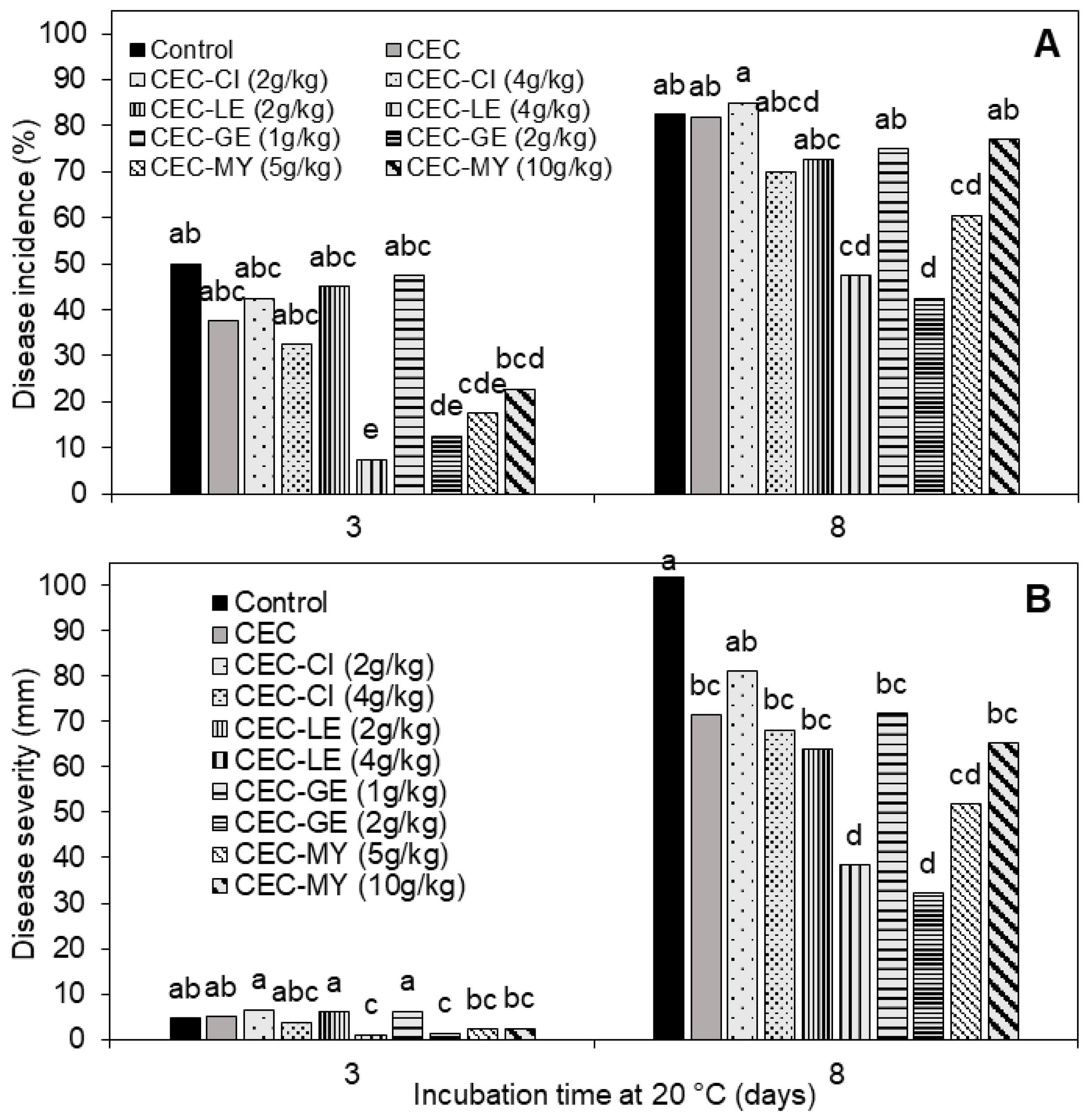
3.2. In Vivo Effect of Antifungal CECs on Brown Rot Development
3.3. Effect of CECs on Brown Rot and Quality of Cold-Stored Plums
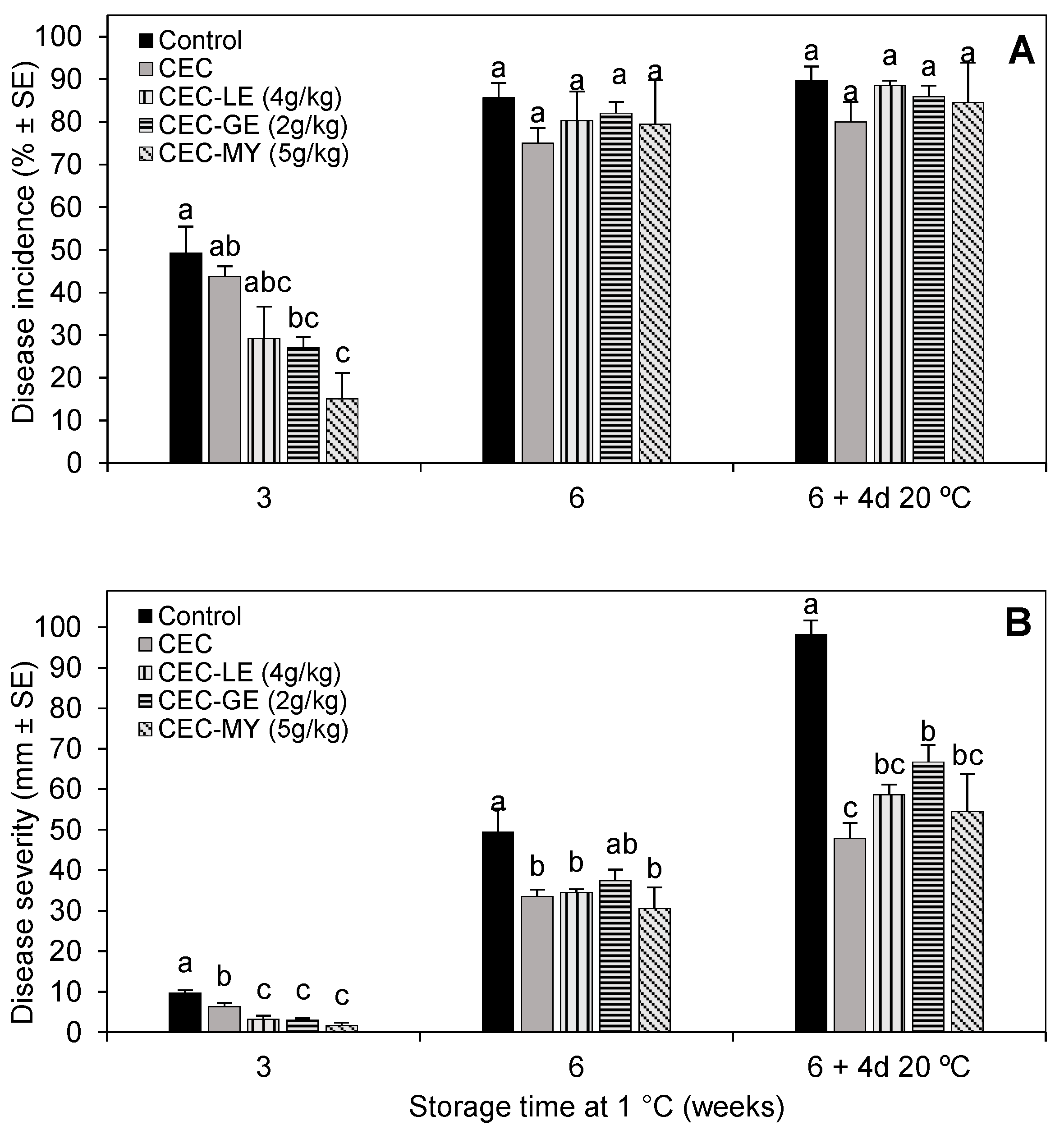
3.3.1. Impact on Brown Rot Development
3.3.2. Impact on Postharvest Quality Parameters
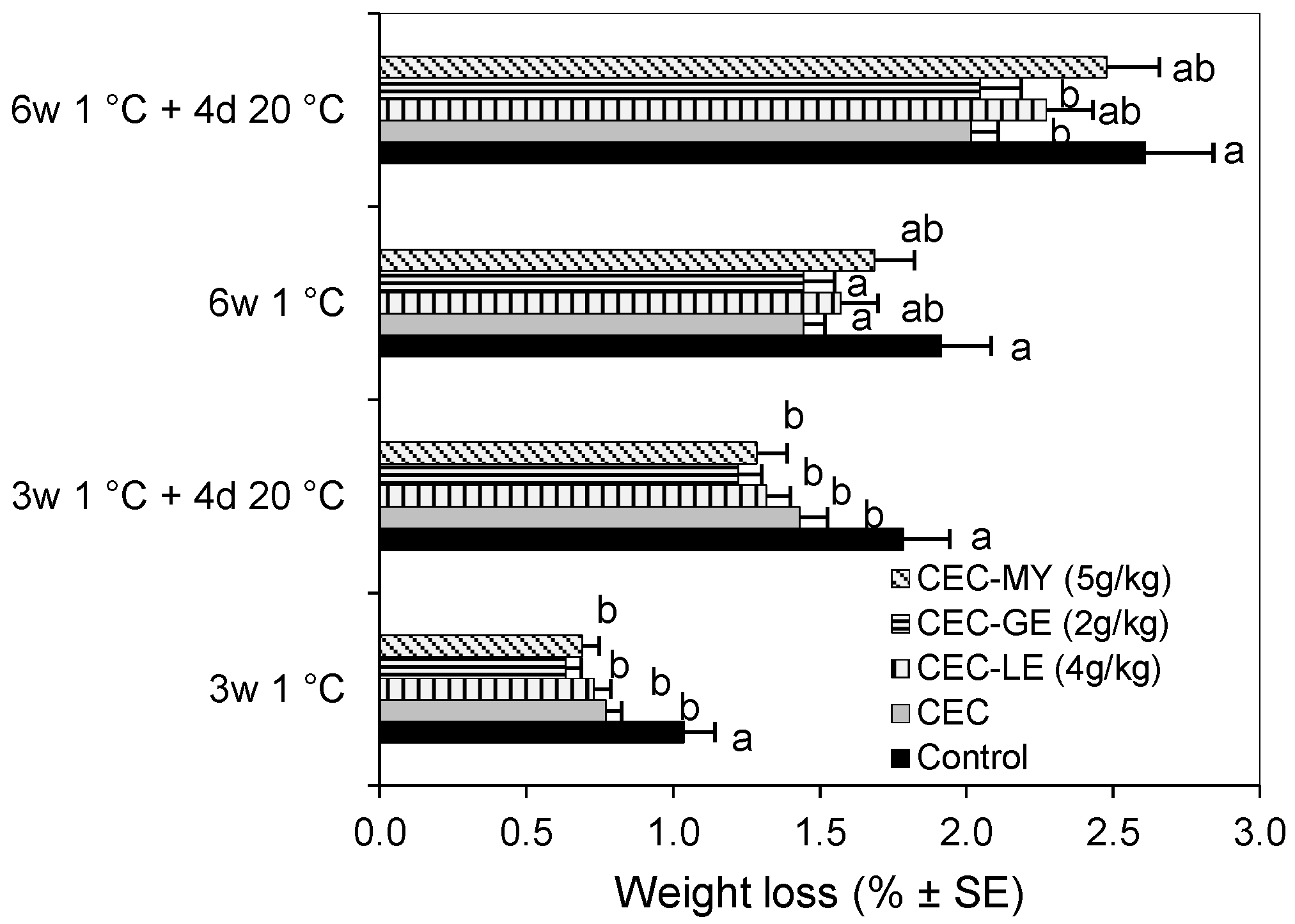
Weight Loss, Flesh Firmness, and Peel Color of Treated Plums
Internal Physicochemical Quality and Volatile Content
Physiological Disorders and Sensory Quality
4. Discussion
5. Conclusions
Author Contributions
Funding
Institutional Review Board Statement
Informed Consent Statement
Data Availability Statement
Conflicts of Interest
References
- Wan, X.; Lin, X.; Zhang, Y.; Luo, D.; Peng, J.; Huang, H.; Ding, X.; Dong, X. Revealing the crucial role of cuticular wax components in postharvest chilling injury of plums (Prunus salicina Lindl.). Sci. Hortic. 2024, 338, 113843. [Google Scholar] [CrossRef]
- Crisosto, C.H.; Mitchell, F.G.; Ju, Z. Susceptibility to chilling injury of peach, nectarine, and plum cultivars grown in California. HortScience 1999, 34, 1116–1118. [Google Scholar] [CrossRef]
- Usall, J.; Casals, C.; Sisquella, M.; Palou, L.; De Cal, A. Alternative technologies to control postharvest diseases of stone fruits. Stewart Postharv. Rev. 2015, 11, 1–6. [Google Scholar] [CrossRef]
- Martini, C.; Mari, M. Monilinia fructicola, Monilinia laxa (Monilinia Rot, Brown Rot). In Postharvest Decay: Control Strategies; Bautista-Baños, S., Ed.; Elsevier Inc.: Amsterdam, The Netherlands, 2014; pp. 233–265. [Google Scholar]
- Lopez-Reyes, J.G.; Spadaro, D.; Prelle, A.; Garibaldi, A.; Gullino, M.L. Efficacy of plant essential oils on postharvest control of rots caused by fungi on different stone fruits in vivo. J. Food Prot. 2013, 76, 631–639. [Google Scholar] [CrossRef]
- Hassani, A.; Fathi, Z.; Ghosta, Y.; Abdollahi, A.; Meshkatalsadat, M.H.; Marandi, R.J. Evaluation of plant essential oils for control of postharvest brown and gray mold rots on apricot. J. Food Saf. 2012, 32, 94–101. [Google Scholar] [CrossRef]
- Min, D.; Wu, H.; Xu, M.; Leng, P.; Sun, J.; Liu, Y.-G. Antifungal and mechanism of rose essential oil against Monilinia fructicola caused brown rot of peach fruit. Postharvest Biol. Technol. 2025, 222, 113398. [Google Scholar] [CrossRef]
- El Khetabi, A.; Lahlali, R.; Askarne, L.; Ezrari, S.; El Ghadaroui, L.; Tahiri, A.; Hrustić, J.; Amiri, S. Efficacy assessment of pomegranate peel aqueous extract for brown rot (Monilinia spp.) disease control. Physiol. Mol. Plant Pathol. 2020, 110, 101482. [Google Scholar] [CrossRef]
- Lazar-Baker, E.E.; Hetherington, S.D.; Ku, V.V.; Newman, S.M. Evaluation of commercial essential oil samples on the growth of postharvest pathogen Monilinia fructicola (G. Winter) Honey. Lett. Appl. Microbiol. 2011, 52, 227–232. [Google Scholar] [CrossRef]
- Garello, M.; Schiavon, G.; Spadaro, D. Efficacy of biofumigation with essential oils in the control of postharvest rots on nectarines. Acta Hortic. 2023, 1363, 237–242. [Google Scholar] [CrossRef]
- Santoro, K.; Maghenzani, M.; Chiabrando, V.; Bosio, P.; Gullino, M.L.; Spadaro, D.; Giacalone, G. Thyme and savory essential oil vapor treatments control brown rot and improve the storage quality of peaches and nectarines, but could favor gray mold. Foods 2018, 7, 7. [Google Scholar] [CrossRef]
- Sánchez-Silva, J.M.; López-García, U.M.; Gutierrez-Martinez, P.; Flores-Ramírez, A.Y.; Ramos-Bell, S.; Moreno-Hernández, C.; Rivas-García, T.; González-Estrada, R.R. Bionanocomposite coating film technologies for disease management in fruits and vegetables. Horticulturae 2025, 11, 832. [Google Scholar] [CrossRef]
- Karaca, H.; Pérez-Gago, M.B.; Taberner, V.; Palou, L. Evaluating food additives as antifungal agents against Monilinia fructicola in vitro and in hydroxypropyl methylcellulose-lipid composite edible coatings for plums. Int. J. Food Microbiol. 2014, 179, 72–79. [Google Scholar] [CrossRef]
- Asgarian, Z.S.; Palou, L.; Souza, R.F.L.D.; Quintanilla, P.G.; Taberner, V.; Karimi, R.; Pérez-Gago, M.B. Hydroxypropyl methylcellulose and gum Arabic composite edible coatings amended with geraniol to control postharvest brown rot and maintain quality of cold-stored plums. Foods 2023, 12, 2978. [Google Scholar] [CrossRef] [PubMed]
- More, P.R.; Pegu, K.; Arya, S.S. Post-harvest application of micellar pomegranate peel extract (MPPE) enriched starch-casein composite coating to preserve the plum (Prunus salicina L.) fruit during cold and ambient storage. J. Food Process. Preserv. 2022, 46, e17226. [Google Scholar] [CrossRef]
- Martínez-Romero, D.; Zapata, P.J.; Guillén, F.; Paladines, D.; Castillo, S.; Valero, D.; Serrano, M. The addition of rosehip oil to Aloe gels improves their properties as postharvest coatings for maintaining quality in plum. Food Chem. 2017, 217, 585–592. [Google Scholar] [CrossRef]
- Andrade, S.C.A.; Baretto, T.A.; Arcanjo, N.M.O.; Madruga, M.S.; Meireles, B.; Cordeiro, Â.M.T.; Barbosa de Lima, M.A.; de Souza, E.L.; Magnani, M. Control of Rhizopus soft rot and quality responses in plums (Prunus domestica L.) coated with gum arabic, oregano and rosemary essential oils. J. Food Process. Preserv. 2017, 41, e13251. [Google Scholar] [CrossRef]
- Kim, I.H.; Lee, H.; Kim, J.E.; Song, K.B.; Lee, Y.S.; Chung, D.S.; Min, S.C. Plum coatings of lemongrass oil-incorporating carnauba wax-based nanoemulsion. J. Food Sci. 2013, 78, E1551–E1559. [Google Scholar] [CrossRef]
- Choi, W.S.; Singh, S.; Lee, Y.S. Characterization of edible film containing essential oils in hydroxypropyl methylcellulose and its effect on quality attributes of ‘Formosa’ plum (Prunus salicina L.). LWT 2016, 70, 213–222. [Google Scholar] [CrossRef]
- Fawole, O.A.; Riva, S.C.; Opara, U.L. Efficacy of edible coatings in alleviating shrivel and maintaining quality of Japanese plum (Prunus salicina Lindl.) during export and shelf life conditions. Agronomy 2020, 10, 1023. [Google Scholar] [CrossRef]
- Jenneker, N.; Silué, Y.; Julia Meitz-Hopkins, J.C.; Lennox, C.L.; Opara, U.L.; Fawole, O.A. Gum Arabic-incorporated thymol/salicylic acid composite coatings control grey mould and brown rot in ‘Angeleno’ plums. Eur. J. Plant Pathol. 2024, 170, 943–954. [Google Scholar] [CrossRef]
- Alvarez, M.V.; Palou, L.; Taberner, V.; Fernández-Catalán, A.; Argente-Sanchis, M.; Pitta, E.; Pérez-Gago, M.B. Natural pectin-based edible composite coatings with antifungal properties to control green mold and reduce losses of ‘Valencia’ oranges. Foods 2022, 11, 1083. [Google Scholar] [CrossRef] [PubMed]
- Alvarez, M.V.; Pérez-Gago, M.B.; Taberner, V.; Settier-Ramírez, L.; Martínez-Blay, V.; Palou, L. Postharvest application of novel bio-based antifungal composite edible coatings to reduce sour rot and quality losses of ‘Valencia’ oranges. Coatings 2023, 13, 1412. [Google Scholar] [CrossRef]
- Sellamuthu, P.S.; Sivakumar, D.; Soundy, P. Antifungal activity and chemical composition of thyme, peppermint and citronella oils in vapor phase against avocado and peach postharvest pathogens. J. Food Saf. 2013, 33, 86–93. [Google Scholar] [CrossRef]
- Gunaydin, S.; Karaca, H.; Palou, L.; De La Fuente, B.; Pérez-Gago, M.B. Effect of hydroxypropyl methylcellulose-beeswax composite edible coatings formulated with or without antifungal agents on physicochemical properties of plums during cold storage. J. Food Qual. 2017, 8573549. [Google Scholar] [CrossRef]
- Moradinezhad, F.; Ranjbar, A. Advances in postharvest diseases management of fruits and vegetables: A review. Horticulturae 2023, 9, 1099. [Google Scholar] [CrossRef]
- Álvarez-García, S.; Moumni, M.; Romanazzi, G. Antifungal activity of volatile organic compounds from essential oils against the postharvest pathogens Botrytis cinerea, Monilinia fructicola, Monilinia fructigena, and Monilinia laxa. Front. Plant Sci. 2023, 14, 1274770. [Google Scholar] [CrossRef]
- Tsao, R.; Zhou, T. Antifungal activity of monoterpenoids against postharvest pathogens Botrytis cinerea and Monilinia fructicola. J. Essent. Oil Res. 2000, 12, 113–121. [Google Scholar] [CrossRef]
- Elshafie, H.S.; Mancini, E.; Camele, I.; Martino, L.D.; De Feo, V. In vivo antifungal activity of two essential oils from Mediterranean plants against postharvest brown rot disease of peach fruit. Ind. Crops Prod. 2015, 66, 11–15. [Google Scholar] [CrossRef]
- Chang, Y.; Boukari, W.; Riley, S.S.; Harmon, P.F.; Sarkhosh, A.; Brecht, J.K. In Vitro antifungal activity of white thyme, oregano, and savory oils against five Monilinia fructicola isolates from the Southeastern United States. Plant Health Prog. 2024, 25, 262–269. [Google Scholar] [CrossRef]
- Combrinck, S.; Regnier, T.; Kamatou, G.P.P. In vitro activity of eighteen essential oils and some major components against common postharvest fungal pathogens of fruit. Ind. Crops Prod. 2011, 33, 344–349. [Google Scholar] [CrossRef]
- Verdeguer, M.; Roselló, J.; Castell, V.; Llorens, J.A.; Santamarina, M.P. Cherry tomato and persimmon kaki conservation with a natural and biodegradable film. Curr. Res. Food Sci. 2020, 2, 33–40. [Google Scholar] [CrossRef]
- de Lira, M.H.P.; de Andrade, F.P., Jr.; Moraes, G.F.Q.; Macena, G.d.S.; Pereira, F.d.O.; Lima, I.O. Antimicrobial activity of geraniol: An integrative review. J. Essent. Oil Res. 2020, 32, 187–197. [Google Scholar] [CrossRef]
- Khalil, A.A.; Rahman, U.U.; Khan, M.R.; Sahar, A.; Mehmood, T.; Khan, M. Essential oil eugenol: Sources, extraction techniques and nutraceutical perspectives. RSC Adv. 2017, 7, 32669–32681. [Google Scholar] [CrossRef]
- Zhou, L.; Zhang, Z.; Wei, M.; Xie, Y.; He, S.; Shi, H.; Lin, Z. Evaluation of the antifungal activity of individual and combined monoterpenes against Rhizopus stolonifer and Absidia coerulea. Environ. Sci. Pollut. Res. 2019, 26, 7804–7809. [Google Scholar] [CrossRef]
- Chutia, M.; Deka Bhuyan, P.; Pathak, M.G.; Sarma, T.C.; Boruah, P. Antifungal activity and chemical composition of Citrus reticulata Blanco essential oil against phytopathogens from North East India. LWT-Food Sci. Technol. 2009, 42, 777–780. [Google Scholar] [CrossRef]
- Perveen, K.; Bokhari, N.A.; Siddique, I.; Al-Rashid, S.A.I. Antifungal activity of essential oil of Commiphora molmol oleo gum resin. J. Essent. Oil Bear. Plants 2018, 21, 667–673. [Google Scholar] [CrossRef]
- Yang, J.; Chen, Y.Z.; Wu, Y.-X.; Li, T.; Zhang, Y.-D.; Wang, S.R.; Zhang, G.C.; Zhang, J. Inhibitory effects and mechanisms of vanillin on gray mold and black rot of cherry tomatoes. Pestic. Biochem. Physiol. 2021, 175, 104859. [Google Scholar] [CrossRef]
- Spadaro, D.; Banani, H.; Santoro, K.; Garibaldi, A.; Gullino, M.L. Essential oils to control postharvest diseases of apples and peaches: Elucidation of the mechanism of action. Acta Hortic. 2021, 1323, 35–41. [Google Scholar] [CrossRef]
- Lian, H.; Shi, J.; Zhang, X.; Peng, Y.; Meng, W.; Pei, L. Effects of different kinds of polysaccharides on the properties and inhibition of Monilinia fructicola of the thyme essential oil-chitosan based composite films. Food Sci. Technol. 2022, 42, e57420. [Google Scholar] [CrossRef]
- Heidary, L.; Nourbakhsh, H.; Javanmardi, Z.; Saba, M.K. Biopolymer-enhanced nanoemulsions for controlled release of thyme: Impact on strawberry shelf life and quality. J. Agric. Food Res. 2025, 21, 101796. [Google Scholar] [CrossRef]
- Xiao, R.; Feng, Y.; Zhang, X.; Jiang, Z.; Chen, W.; Ding, X.; Yang, G.; Yang, L. Using encapsulated essential oils to control food spoilage: Encapsulation techniques, release methods, and preservation strategies—A comprehensive review. Food Control 2025, 180, 111679. [Google Scholar] [CrossRef]
- Navarro-Tarazaga, M.L.; Sothornvit, R.; Pérez-Gago, M.B. Effect of plasticizer type and amount on hydroxypropyl methylcellulose- beeswax edible film properties and postharvest quality of coated plums (Cv. Angeleno). J. Agric. Food Chem. 2008, 56, 9502–9509. [Google Scholar] [CrossRef] [PubMed]
- Valero, D.; Díaz-Mula, H.M.; Zapata, P.J.; Guillén, F.; Martínez-Romero, D.; Castillo, S.; Serrano, M. Effects of alginate edible coating on preserving fruit quality in four plum cultivars during postharvest storage. Postharvest Biol. Technol. 2013, 77, 1–6. [Google Scholar] [CrossRef]
- Riva, S.C.; Opara, U.O.; Fawole, O.A. Recent developments on postharvest application of edible coatings on stone fruit: A review. Sci. Hortic. 2020, 262, 109071. [Google Scholar] [CrossRef]
- Johnston, J.W.; Gunaseelan, K.; Pidakala, P.; Wang, M.; Schaffer, R.J. Co-ordination of early and late ripening events in apples is regulated through differential sensitivities to ethylene. J. Exp. Bot. 2009, 60, 2689–2699. [Google Scholar] [CrossRef]
- Pech, J.C.; Bouzayen, M.; Latché, A.J.P.S. Climacteric fruit ripening: Ethylene-dependent and independent regulation of ripening pathways in melon fruit. Plant Sci. 2008, 175, 114–120. [Google Scholar] [CrossRef]



| Volatile Exposure Method | Agar Dilution Method | ||||||
|---|---|---|---|---|---|---|---|
| Agent 1 | Dose (µL) | Mycelial Growth Inhibition (%) 2 | Agent 1 | Dose (g/kg) | Mycelial Growth Inhibition (%) 2 | ||
| EU | 5 | 100.0 ± 0.0 | a # 3 | GT | 5.00 | 0.0 ± 0.0 | f |
| 10 | 100.0 ± 0.0 | a # | 10.00 | 47.0 ± 0.4 | e | ||
| GE | 5 | 100.0 ± 0.0 | a # | 20.00 | 66.0 ± 0.5 | d | |
| 10 | 100.0 ± 0.0 | a # | VA 4 | 0.31 | 100.0 ± 0.0 | a # 3 | |
| CI | 5 | 100.0 ± 0.0 | a # | 0.62 | 100.0 ± 0.0 | a # | |
| 10 | 100.0 ± 0.0 | a # | 1.25 | 100.0 ± 0.0 | a # | ||
| LE | 5 | 100.0 ± 0.0 | a # | MY 4 | 0.62 | 93.8 ± 1.2 | c |
| 10 | 100.0 ± 0.0 | a # | 1.25 | 95.7 ± 0.7 | b | ||
| SA | 5 | 100.0 ± 0.0 | a # | 2.50 | 99.0 ± 0.6 | a # | |
| 10 | 100.0 ± 0.0 | a # | |||||
| Physical Properties | Storage Conditions | Treatment 1 | |||||
|---|---|---|---|---|---|---|---|
| Control | CEC | CEC-LE (4 g/kg) | CEC-GE (2 g/kg) | CEC-MY (5 g/kg) | |||
| Firmness (N) 2 | At harvest | 17.13 ± 1.10 | |||||
| 3 weeks 1 °C + 4 days 20 °C | 16.44 ± 0.81 a | 16.93 ± 0.97 a | 15.43 ± 1.05 a | 14.63 ± 0.89 a | 14.56 ± 1.01 a | ||
| 6 weeks 1 °C + 4 days 20 °C | 12.00 ± 0.93 c | 14.72 ± 0.64 ab | 15.66 ± 0.66 a | 13.21 ± 0.55 bc | 16.76 ± 1.00 a | ||
| Peel Color 2 | L* | At harvest | 30.79 ± 0.70 | ||||
| 3 weeks 1 °C + 4 days 20 °C | 28.94 ± 0.45 a | 25.17 ± 0.27 b | 25.01 ± 0.35 b | 25.78 ± 0.46 b | 25.20 ± 0.41 b | ||
| 6 weeks 1 °C + 4 days 20 °C | 28.28 ± 0.37 a | 25.01 ± 0.28 b | 24.99 ± 0.23 b | 24.62 ± 0.12 b | 24.78 ± 0.26 b | ||
| a* | At harvest | 6.37 ± 0.35 | |||||
| 3 weeks 1 °C + 4 days 20 °C | 10.79 ± 1.24 | 9.63 ± 0.99 | 9.55 ± 1.31 | 10.43 ± 1.36 | 8.10 ± 0.82 ns | ||
| 6 weeks 1 °C + 4 days 20 °C | 5.46 ± 0.83 b | 8.61 ± 0.76 a | 8.22 ± 0.90 a | 7.04 ± 0.49 ab | 7.82 ± 0.82 a | ||
| b* | At harvest | −2.82 ± 0.31 | |||||
| 3 weeks 1 °C + 4 days 20 °C | 0.13 ± 0.70 b | 1.38 ± 0.42 ab | 2.08 ± 0.65 a | 2.10 ± 0.75 a | 1.01 ± 0.34 ab | ||
| 6 weeks 1 °C + 4 days 20 °C | −2.56 ± 0.40 b | 0.81 ± 0.24 a | 1.20 ± 0.34 a | 0.67 ± 0.16 a | 0.95 ± 0.29 a | ||
| C* | At harvest | 7.15 ± 0.28 | |||||
| 3 weeks 1 °C + 4 days 20 °C | 11.37 ± 1.17 | 9.81 ± 1.04 | 9.87 ± 1.43 | 10.81 ± 1.49 | 8.22 ± 0.86 ns | ||
| 6 weeks 1 °C + 4 days 20 °C | 6.54 ± 0.72 | 8.69 ± 0.78 | 8.35 ± 0.95 | 7.10 ± 0.49 | 7.91 ± 0.85 ns | ||
| h° | At harvest | 335.36 ± 3.11 | |||||
| 3 weeks 1 °C + 4 days 20 °C | 351.38 ± 5.29 b | 5.15 ± 1.71 a | 7.93 ± 1.70 a | 5.45 ± 2.69 a | 4.89 ± 1.52 a | ||
| 6 weeks 1 °C + 4 days 20 °C | 327.45 ± 4.59 b | 3.69 ± 1.26 a | 5.67 ± 1.37 a | 4.66 ± 1.43 a | 4.57 ± 1.24 a | ||
| Juice Quality 2 | Storage Conditions | Treatment 1 | ||||
|---|---|---|---|---|---|---|
| Control | CEC | CEC-LE (4 g/kg) | CEC-GE (2 g/kg) | CEC-MY (5 g/kg) | ||
| Titratable Acidity (TA; g/L malic acid) | At harvest | 8.62 ± 0.26 | ||||
| 3 weeks 1 °C + 4 days 20 °C | 8,37 ± 0.17 a | 8.49 ± 0.20 a | 8.08 ± 0.04 a | 7.45 ± 0.13 b | 7.25 ± 0.20 b | |
| 6 weeks 1 °C + 4 days 20 °C | 7.21 ± 0.07 | 6.54 ± 0.23 | 6.91 ± 0.16 | 6.43 ± 0.24 | 7.04 ± 0.15 ns | |
| Soluble Solids Content (SSC; °Brix) | At harvest | 14.67 ± 0.23 | ||||
| 3 weeks 1 °C + 4 days 20 °C | 14.33 ± 0.24 | 14.20 ± 0.05 | 14.32 ± 0.22 | 14.05 ± 0.21 | 14.75 ± 0.28 ns | |
| 6 weeks 1 °C + 4 days 20 °C | 14.23 ± 0.65 | 12.82 ± 0.02 | 13.25 ± 0.28 | 12.73 ± 0.16 | 14.18 ± 0.79 ns | |
| Maturity Index (MI = SSC/TA) | At harvest | 17.07 ± 0.76 | ||||
| 3 weeks 1 °C + 4 days 20 °C | 17.13 ± 0.10 c | 16.75 ± 0.44 c | 17.71 ± 0.23 bc | 18.87 ± 0.41 b | 20.36 ± 0.60 a | |
| 6 weeks 1 °C + 4 days 20 °C | 20.56 ± 0.35 | 19.66 ± 0.71 | 19.18 ± 0.18 | 19.83 ± 0.56 | 20.13 ± 0.83 ns | |
| Volatile content 2 | ||||||
| Ethanol (mg/L) | At harvest | ND | ||||
| 3 weeks 1 °C + 4 days 20 °C | 8.6 ± 3.8 c | 7.4 ± 2.6 c | 34.3 ± 2.6 a | 8.5 ± 0.6 c | 14.3 ± 2.0 b | |
| 6 weeks 1 °C + 4 days 20 °C | 6.5 ± 2.1 c | 37.4 ± 10.3 c | 311.9 ± 53.6 a | 242.7 ± 34.6 a | 130.5 ± 11.0 b | |
| Acetaldehyde (mg/L) | At harvest | 1.0 ± 0.1 | ||||
| 3 weeks 1 °C + 4 days 20 °C | 2.6 ± 0.5 | 1.5 ± 0.2 | 2.2 ± 0.5 | 2.4 ± 0.2 | 1.9 ± 0.2 ns | |
| 6 weeks 1 °C + 4 days 20 °C | 2.3 ± 0.8 c | 4.4 ± 0.8 bc | 7.7 ± 1.1 a | 4.8 ± 0.5 b | 4.2 ± 0.4 bc | |
| Physiological Disorders 2,3 | Storage Conditions | Treatment 1 | ||||
|---|---|---|---|---|---|---|
| Control | CEC | CEC-LE (4 g/kg) | CEC-GE (2 g/kg) | CEC-MY (5 g/kg) | ||
| Flesh Browning Index | At harvest | 1.00 ± 0.00 | ||||
| 3 weeks 1 °C + 4 days 20 °C | 1.00 ± 0.00 | 1.00 ± 0.00 | 1.00 ± 0.00 | 1.00 ± 0.00 | 1.00 ± 0.00 ns | |
| 6 weeks 1 °C + 4 days 20 °C | 1.27 ± 0.12 | 1.07 ± 0.03 | 1.00 ± 0.00 | 1.03 ± 0.03 | 1.10 ± 0.10 ns | |
| Flesh Bleeding Index | At harvest | 1.00 ± 0.00 | ||||
| 3 weeks 1 °C + 4 days 20 °C | 1.07 ± 0.03 | 1.00 ± 0.00 | 1.00 ± 0.00 | 1.00 ± 0.00 | 1.00 ± 0.00 ns | |
| 6 weeks 1 °C + 4 days 20 °C | 1.50 ± 0.12 | 1.17 ± 0.04 | 1.00 ± 0.00 | 1.17 ± 0.08 | 1.24 ± 0.12 ns | |
| Sensory attributes 2,4 | ||||||
| Visual Quality (whole fruit) | At harvest | 2.88 ± 0.13 | ||||
| 3 weeks 1 °C + 4 days 20 °C | 2.70 ± 0.15 | 2.70 ± 0.15 | 2.70 ± 0.15 | 2.90 ± 0.10 | 2.70 ± 0.21 ns | |
| 6 weeks 1 °C + 4 days 20 °C | 2.80 ± 0.11 | 2.78 ± 0.15 | 2.89 ± 0.11 | 2.89 ± 0.11 | 2.89 ± 0.11 ns | |
| Overall Flavor | At harvest | 7.50 ± 0.38 | ||||
| 3 weeks 1 °C + 4 days 20 °C | 6.78 ± 0.33 | 6.30 ± 0.33 | 6.67 ± 0.37 | 6.56 ± 0.37 | 6.40 ± 0.37 ns | |
| 6 weeks 1 °C + 4 days 20 °C | 6.11 ± 0.35 | 6.11 ± 0.45 | 6.33 ± 0.33 | 6.33 ± 0.29 | 6.22 ± 0.22 ns | |
| Off-Flavor | At harvest | 1.00 ± 0.00 | ||||
| 3 weeks 1 °C + 4 days 20 °C | 1.20 ± 0.13 | 1.10 ± 0.10 | 1.10 ± 0.10 | 1.20 ± 0.13 | 1.40 ± 0.22 ns | |
| 6 weeks 1 °C + 4 days 20 °C | 1.11 ± 0.11 | 1.22 ± 0.22 | 1.11 ± 0.11 | 1.11 ± 0.11 | 1.00 ± 0.00 ns | |
| Eating Firmness | At harvest | 3.63 ± 0.18 | ||||
| 3 weeks 1 °C + 4 days 20 °C | 3.40 ± 0.16 | 4.10 ± 0.18 | 3.50 ± 0.17 | 3.90 ± 0.23 | 3.30 ± 0.26 ns | |
| 6 weeks 1 °C + 4 days 20 °C | 3.11 ± 0.31 | 3.33 ± 0.24 | 3.00 ± 0.29 | 3.22 ± 0.22 | 3.67 ± 0.17 ns | |
| Gloss Rank 1 | Storage Conditions | |||
|---|---|---|---|---|
| 3 Weeks 1 °C + 4 Days 20 °C | 6 Weeks 1 °C + 4 Days 20 °C | |||
| Glossiest Fruit | CEC-LE (4 g/kg) | a | CEC-GE (2 g/kg) | a |
| CEC | a | CEC-LE (4 g/kg) | a | |
| CEC-GE (2 g/kg) | a | CEC-MY (5 g/kg) | a | |
| CEC-MY (5 g/kg) | a | CEC | a | |
| Least Glossy Fruit | Control | b | Control | b |
Disclaimer/Publisher’s Note: The statements, opinions and data contained in all publications are solely those of the individual author(s) and contributor(s) and not of MDPI and/or the editor(s). MDPI and/or the editor(s) disclaim responsibility for any injury to people or property resulting from any ideas, methods, instructions or products referred to in the content. |
© 2025 by the authors. Licensee MDPI, Basel, Switzerland. This article is an open access article distributed under the terms and conditions of the Creative Commons Attribution (CC BY) license (https://creativecommons.org/licenses/by/4.0/).
Share and Cite
Alvarez, M.V.; Palou, L.; Taberner, V.; Pérez-Gago, M.B. Natural Volatile Compounds as Antifungal Agents Against Monilinia fructicola In Vitro and in Composite Edible Coatings for Sustainable Disease Reduction and Fruit Quality Preservation During Prolonged Cold Storage of Fresh Japanese Plums. Foods 2025, 14, 4088. https://doi.org/10.3390/foods14234088
Alvarez MV, Palou L, Taberner V, Pérez-Gago MB. Natural Volatile Compounds as Antifungal Agents Against Monilinia fructicola In Vitro and in Composite Edible Coatings for Sustainable Disease Reduction and Fruit Quality Preservation During Prolonged Cold Storage of Fresh Japanese Plums. Foods. 2025; 14(23):4088. https://doi.org/10.3390/foods14234088
Chicago/Turabian StyleAlvarez, María Victoria, Lluís Palou, Verònica Taberner, and María Bernardita Pérez-Gago. 2025. "Natural Volatile Compounds as Antifungal Agents Against Monilinia fructicola In Vitro and in Composite Edible Coatings for Sustainable Disease Reduction and Fruit Quality Preservation During Prolonged Cold Storage of Fresh Japanese Plums" Foods 14, no. 23: 4088. https://doi.org/10.3390/foods14234088
APA StyleAlvarez, M. V., Palou, L., Taberner, V., & Pérez-Gago, M. B. (2025). Natural Volatile Compounds as Antifungal Agents Against Monilinia fructicola In Vitro and in Composite Edible Coatings for Sustainable Disease Reduction and Fruit Quality Preservation During Prolonged Cold Storage of Fresh Japanese Plums. Foods, 14(23), 4088. https://doi.org/10.3390/foods14234088