


Article

Physicochemical and Functional Properties of Black Walnut and Sycamore Syrups

1
Agricultural & Environmental Research Station, West Virginia State University, Institute, WV 25112, USA
2
Department of Biology, West Virginia State University, Institute, WV 25112, USA
3
Shared Research Facilities, West Virginia University, Morgantown, WV 26505, USA
*
Author to whom correspondence should be addressed.
Foods 2024, 13(17), 2780; https://doi.org/10.3390/foods13172780
Submission received: 12 August 2024 / Revised: 29 August 2024 / Accepted: 30 August 2024 / Published: 31 August 2024
(This article belongs to the Section Nutraceuticals, Functional Foods, and Novel Foods)

Abstract

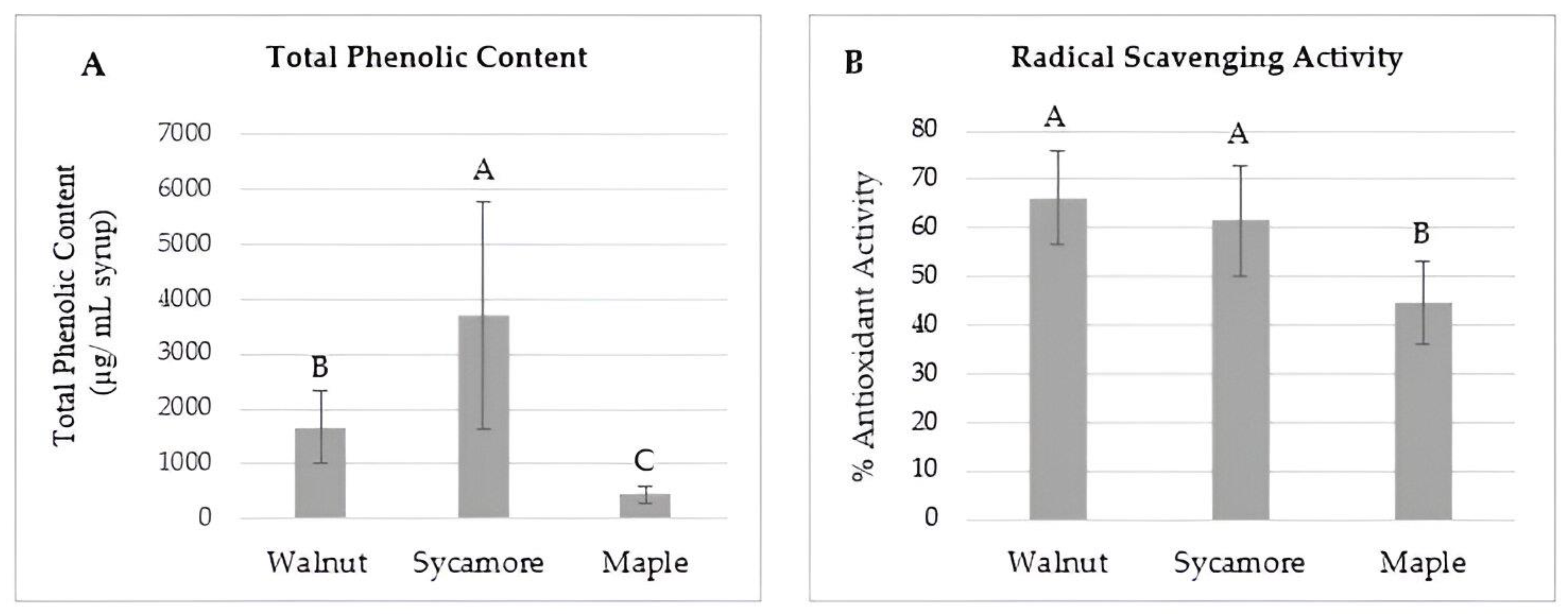
Historically, tree sap has been used globally for medicinal purposes, in fermented beverages, and for syrup production. Maple tree sap is notably concentrated into syrup and is valued as a natural sweetener rich in phenolic compounds and minerals compared to refined sugar. Recently, syrups from other trees like black walnut (Juglans nigra) and sycamore (Platanus occidentalis) have gained popularity, yet their properties are not well understood scientifically. To address this gap, we collected sycamore, black walnut, and maple syrup samples and analyzed their physicochemical and functional properties. Our findings showed significant differences among the syrups in pH, browning intensity, and water activity (p < 0.05). Sycamore syrup had the highest total phenolic content, followed by black walnut and maple syrups. Both black walnut and sycamore syrups exhibited similar antioxidant activity, significantly higher than maple syrup (p < 0.05). High-resolution mass spectrometry identified 54 phenolic acids and 22 flavonoids in these syrups, including Acetylsalicylic acid, 3,5-Dihydroxybenzoic acid, and syringic acid, known for their antioxidant and anti-inflammatory properties. Additionally, sycamore syrups and most black walnut syrups displayed varying degrees of antimicrobial activity against Gram-positive and/or Gram-negative microorganisms. This study offers insights into the properties and potential health benefits of these specialty tree syrups.
Keywords: black walnut syrup; sycamore syrup; physicochemical; antioxidant activity; phenolics; antimicrobial activity black walnut syrup; sycamore syrup; physicochemical; antioxidant activity; phenolics; antimicrobial activity

