Article

Nutritive Value of 11 Bee Pollen Samples from Major Floral Sources in Taiwan
1
Department of Entomology, College of Agriculture and Natural Resources, National Chung Hsing University, Taichung 402202, Taiwan
2
Miaoli District Agricultural Research and Extension Station, Council of Agriculture, Executive Yuan, Miaoli 363201, Taiwan
3
College of Life Sciences, National Chung Hsing University, Taichung 402202, Taiwan
*
Author to whom correspondence should be addressed.
Foods 2021, 10(9), 2229; https://doi.org/10.3390/foods10092229
Submission received: 5 August 2021 / Revised: 2 September 2021 / Accepted: 17 September 2021 / Published: 20 September 2021
(This article belongs to the Section Food Nutrition)

Abstract

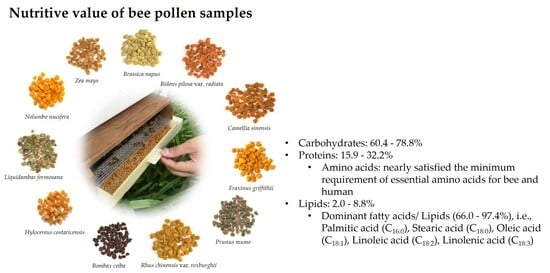
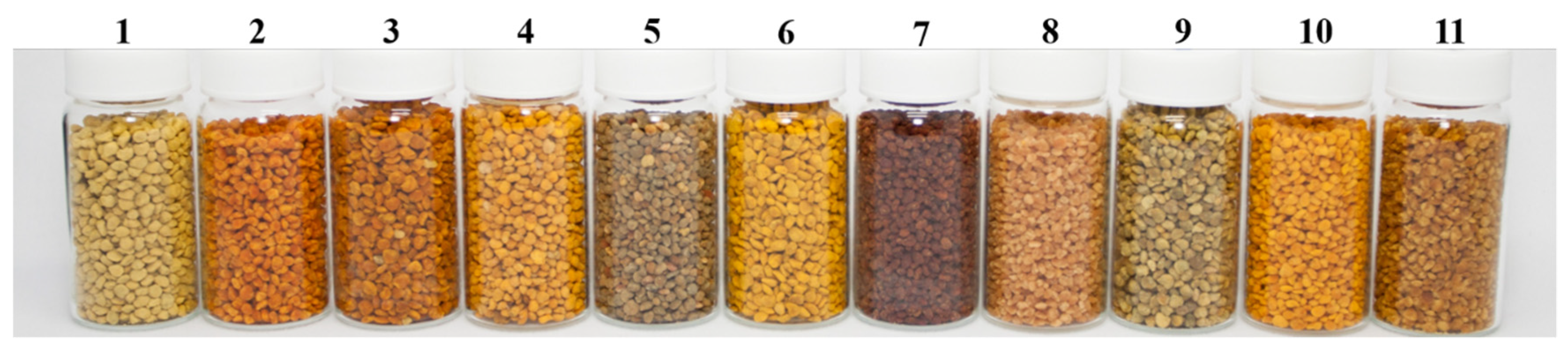
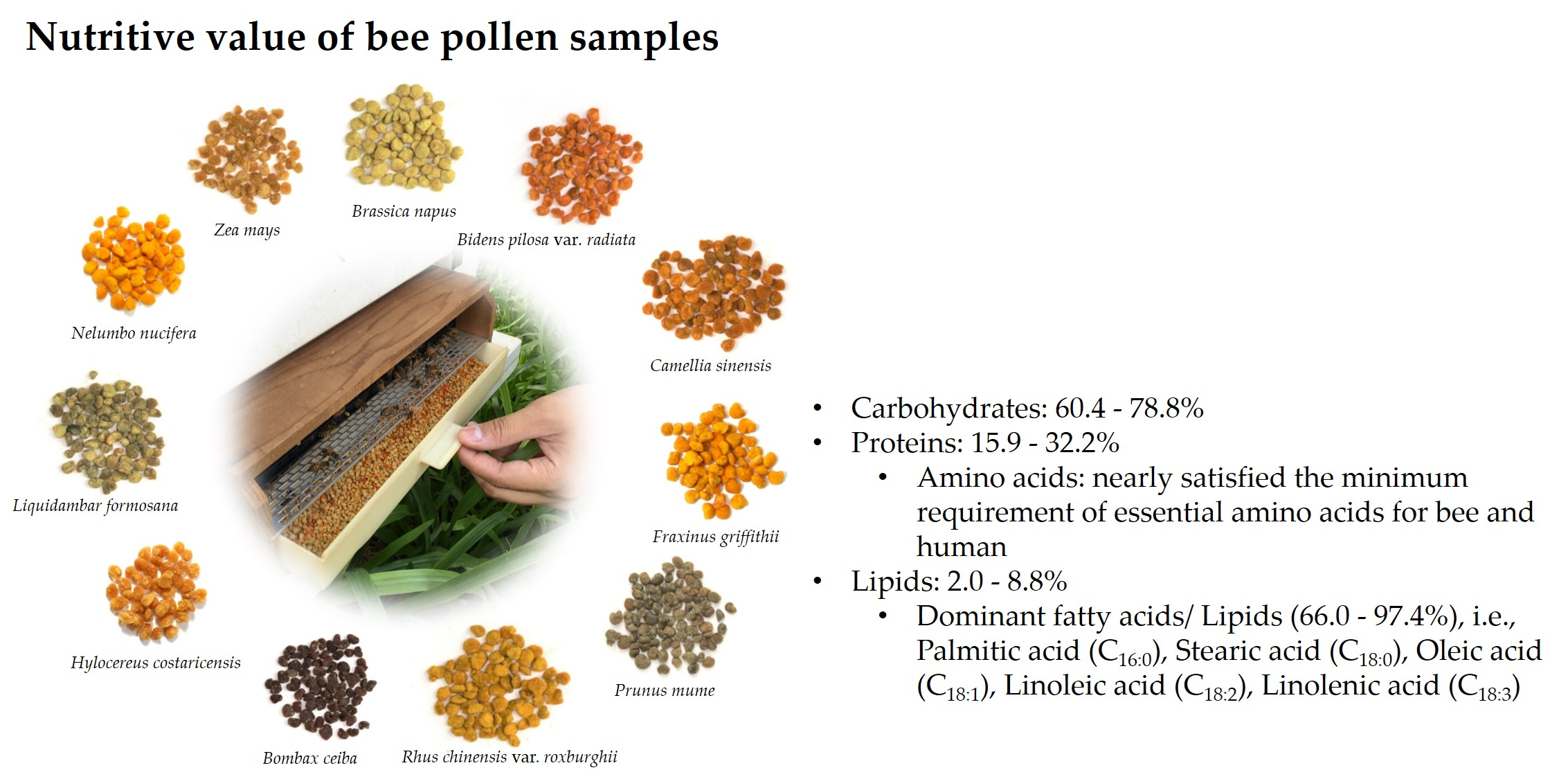
Bee pollen is a nutrient-rich food that meets the nutritional requirements of honey bees and supports human health. This study aimed to provide nutritive composition data for 11 popular bee pollen samples (Brassica napus (Bn), Bidens pilosa var. radiata (Bp), Camellia sinensis (Cs), Fraxinus griffithii (Fg), Prunus mume (Pm), Rhus chinensis var. roxburghii (Rc), Bombax ceiba (Bc), Hylocereus costaricensis (Hc), Liquidambar formosana (Lf), Nelumbo nucifera (Nn), and Zea mays (Zm)) in Taiwan for the global bee pollen database. Macronutrients, such as carbohydrates, proteins, and lipids, were analyzed, which revealed that Bp had the highest carbohydrate content of 78.8 g/100 g dry mass, Bc had the highest protein content of 32.2 g/100 g dry mass, and Hc had the highest lipid content of 8.8 g/100 g dry mass. Only the bee pollen Hc completely met the minimum requirements of essential amino acids for bees and humans, and the other bee pollen samples contained at least 1–3 different limiting essential amino acids, i.e., methionine, tryptophan, histidine, valine, and isoleucine. Regarding the fatty acid profile of bee pollen samples, palmitic acid (C16:0), stearic acid (C18:0), oleic acid (C18:1), linoleic acid (C18:2), and linolenic acid (C18:3) were predominant fatty acids that accounted for 66.0–97.4% of total fatty acids. These data serve as an indicator of the nutritional quality and value of the 11 bee pollen samples.
Keywords: bee pollen; macronutrients; amino acid; fatty acid bee pollen; macronutrients; amino acid; fatty acid
Graphical Abstract