


Abstract
Food fraud is a criminal intent motivated by economic gain to adulterate or misrepresent food ingredients and packaging. The development of a reliable food supply system is at great risk under globalization, but Food Business Operators (FBOs) have a legal obligation to implement and maintain food traceability and quality at all stages of food production, processing, and distribution. Incidents of food fraud have a strong negative impact on consumer confidence in the food industry. Therefore, local and international regulatory mechanisms are established to prevent or mitigate food fraud. This review brings new perspectives linking EU and US legislation, as well as new definitions and descriptions of the criminal aspect of food fraud incidents. It also describes certain new insights into the application of state-of-the-art methods and techniques that provide valuable tools for geographic, botanical, or other chemical markers of food authenticity. The review also provides an overview of the most common cases of food fraud worldwide from 2010 to 2020. Further research is needed to support the development of predictive models for innovative approaches to adulteration, especially when some valuable nutrients are replaced by toxic ingredients. A possible solution to minimize food fraud incidents is to increase the level of risk-based inspections, establish more productive monitoring and implementation of food protection systems in the supply chain, and implement better ingredient control and certification. National and international (e.g., regional) police offices for food fraud should be introduced, possessing knowledge and skills in food, food safety, food processing, and food products, as initial positive results have emerged in some countries.
1. Introduction
Even in ancient times, food traders sought to make greater profits by manipulating the quality of food, disguising the origin of the product, or concealing the expiration date for consumption. Our everyday life is stocked full of numerous cases of adulteration, counterfeiting, and dilution, as well as substitution of ingredients in ready-to-eat dietary products. According to general food legislation, a food is defined in Reg. 2002/178/EC as: “any substance or product whether processed, partially processed or unprocessed, intended to be or reasonably expected to be ingested by humans” [1].
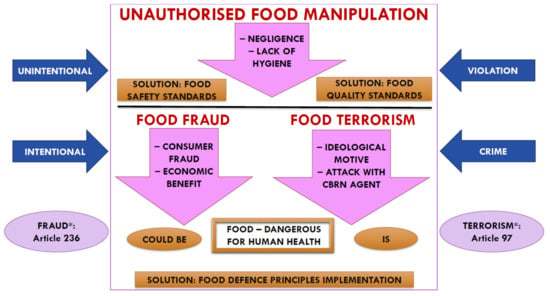
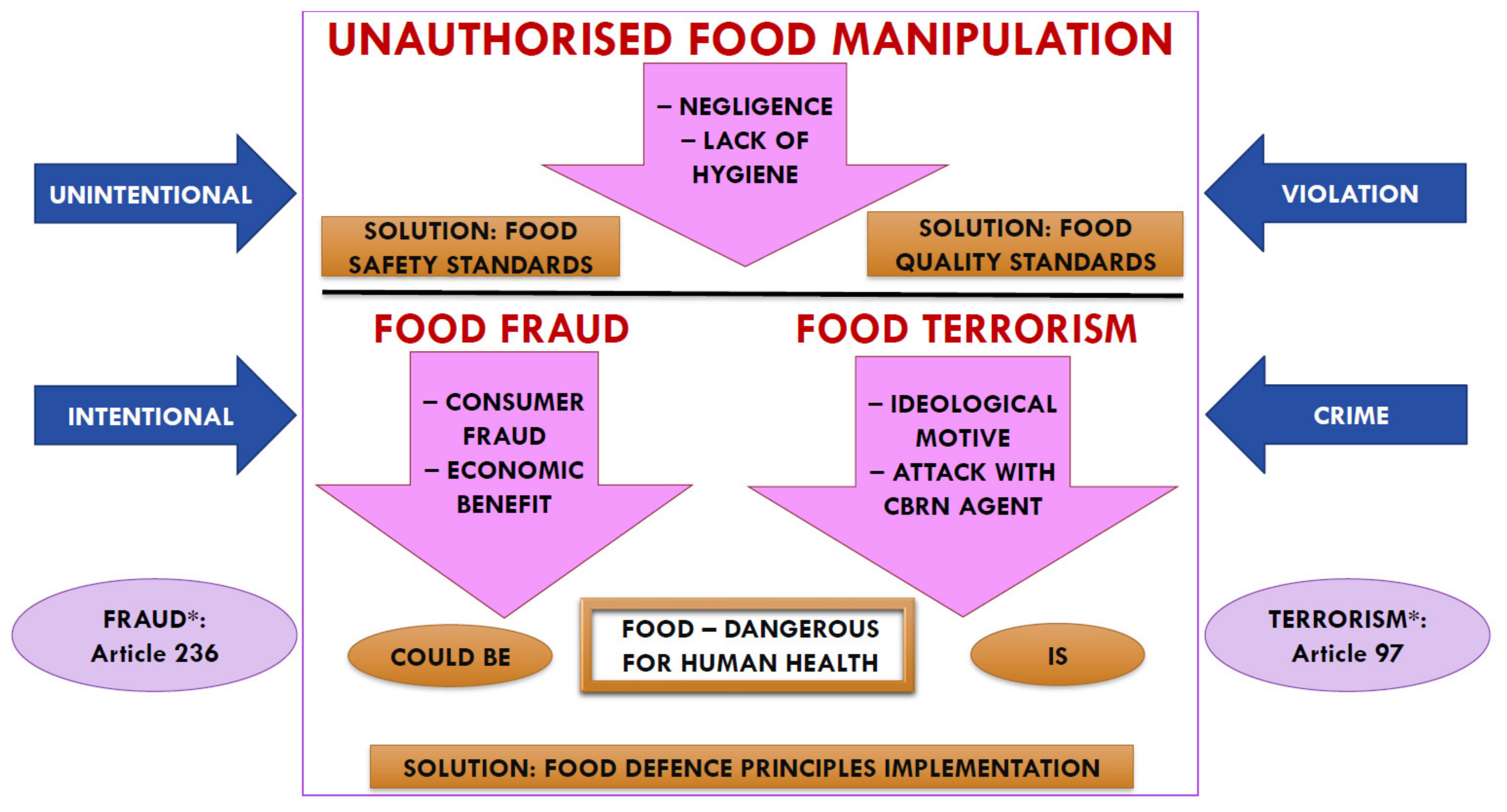
Food business operators (FBOs) have a legal obligation to comply with food hygiene requirements, and to establish and maintain traceability and quality (of food for human and animal consumption, as well as ingredients used in food) at all stages of production, processing, and distribution. They are also responsible for developing a reliable food supply system, with the ultimate goal of providing consumers with a safe food product. The implementation and certification of basic food safety standards (HACCP, ISO 22000), as well as extended standards (FSSC 22000, IFS, BRC) at FBOs, makes this possible. Therefore, the food safety approach should protect the food supply chain from unintentional contamination, while food defence protects the food supply chain from intentional adulteration that can cause harm [2], as well as from unauthorized food manipulation (UFM) (Figure 1).
Figure 1.
Unauthorized food manipulations (UFMs), law violations, and criminal offenses. * As defined by Croatian Criminal Law (NN 125/11, 144/12, 56/15, 61/15, 101/17, 118/18, 126/19, 84/21).
A crime is an illegal act or offense punishable by law (i.e., unlawful; contrary to law; act directly prohibited by law). Food crime is an activity with the motivation to deceive or to harm consumers, organized by individuals or groups [3,4]. Spink et al. [5] defined food crime as any type of food fraud that is conducted on a large scale and with serious potential repercussions for public safety or with a significant financial loss for consumers or businesses.
Any criminal activity that may occur during food production, processing, retailing, or distribution can be broadly referred to as UFM. It is a type of crime primarily because it is committed with clear intent and motives. Common motives for committing fraud include making economic profits from a particular food product by using (i.e., substituting with) cheaper ingredients or by tampering with the food product in a way that alters its usual characteristics (Figure 1). If the committed food fraud causes human casualties, it falls under another type of criminal offense (homicide/murder) or more criminal offenses combined into one act (e.g., fraud, production and marketing a food product harmful to human health, endangering of life and property by a generally dangerous act or medium, and murder/homicide). Unfortunately, many incidents of food fraud go unnoticed, because the perpetrators’ main goal is to gain financial benefit and not to cause a health hazard [6].
The European Union (EU) has the criterion that some cases could be fraud if certain conditions are met (as defined in Section 2.1., third paragraph).
Regarding food fraud in the United States (US), the Food and Drug Administration (FDA) has legally defined food adulteration and mislabelling (misbranding) as criminal offenses [7]. The terms food fraud and economically motivated adulteration (EMA) are synonyms according to the available literature [1,8]. Some US authors have subdivided EMAs into individual acts that include adulteration, tampering, theft, diversion, simulation, counterfeiting, and misleading information. However, regardless of the definitions used, both sides point to the same problem, which is fraud against consumers to gain an economic advantage. Croatian national criminal legislation (there is no European general criminal law) defines certain general terms such as fraud, processing and marketing of food harmful to human health, or endangering life and property by generally dangerous acts or media [9].
Nowadays, fraudulent approaches have become more sophisticated and target the molecular level. Therefore, in order to determine the interference in a food product, it is necessary to use analytical forensic methods, which are currently undergoing extensive development. There are already many standardized and mostly specialized analytical laboratory methods, some of which are in the rapid-development phase, with the main objective of detecting the fraudulent activities and providing correct answers. However, analytical methods to date do not give complete solutions for all food fraud activities.
As incidents up to 2010 have been well documented and described in a review paper by Everstine et al. [8], this article aims to provide an overview of the legal framework and terms for the most common cases and methods of food fraud detection between 2010 and 2020 for the EU and USA.
2. Legal Framework
In Europe, according to Reg. 2002/178/EC, food also includes beverages, chewing gums, and any substance, including water, intentionally added to food during its manufacturing, preparation, or treatment [1].
An authentic food product is a food that has been produced or grown in such a way that it has a characteristic feature (e.g., nutritional value, sensory properties, specific composition, health-promoting properties) and/or has been produced under certain conditions (e.g., traditional, technologically advanced, or under intellectual property rights). Food authenticity is displayed on the original product packaging and labelled with a text or trademark. Food authenticity refers to product quality and characteristics which depend on food processing and environmental factors (e.g., geolocation, climate, soil type) [10]. Authenticity provides a higher economic value of the product, as it is equal to the additional value of a product.
2.1. Definitions and Legislation of Food Fraud in the EU
As already mentioned, it is generally accepted in the EU that food fraud includes cases where EU food law violations exist, and the act is committed intentionally in order to gain economic or financial advantage by deceiving consumers. Food fraud became an important object of interest in 2013, when the horsemeat scandal first emerged [11].
The EU Commission has described food fraud in Reg. 178/2002/EC [1], which provides a specific legal framework to protect consumers. Indeed, Article 8 aims to prevent food fraud or deceptive practices, food adulteration, and other practices that may mislead the consumer. In addition, Article 18 of this Regulation provides information on how to present and label food and feed correctly and not misleadingly.
For an incident to be classified as food fraud in the EU, it must meet the following four criteria [11]. Firstly, there must be a breach of one or more regulations related to food and feed safety legislation. Secondly, there must be an intention to substitute high-quality ingredients with low-quality ingredients (for large quantities of products). This must be verified against numerous factors that provide strong evidence that certain non-compatibilities are not incidental. In fact, some possible impurities in production, when ingredients are substituted for non-essential ingredients, could indicate an intent to deceive (i.e., imply adulteration). Thirdly, the existence of significant economic profits that follow from the addition of non-compatibilities to the product must be established. Fourthly, there must be an element of deception of the consumer, which is the final criterion linking all the other factors to food fraud. This implies that some form of deception, such as color or label changes, has concealed the true quality of the product (or, in worst-case scenarios, even the hazardous nature of the food). For instance, the element of food fraud can often imply concern for public health by hiding some actual harmful product characteristics (e.g., allergenicity, toxicity).
At the member state level, food safety and food fraud were addressed by Reg. 852/2004/EC [12] for food hygiene, while Reg. 178/2002/EC [1] introduced the concepts of crisis management and the obligation to adopt a General Food Crisis Management Plan with the European Food Safety Authority (EFSA). Reg. 178/2002/EC, Article 14 [1] prohibits the placing on the market of unsafe or harmful food, or anything that is unsuitable for human consumption (taking into account additives and pesticides at concentrations above maximum residue levels (MRLs)) according to Reg. 396/2005/EC [13].
The Reg. 510/2006/EC serves the protection of geographical origin and designations of origin of agricultural products and foodstuffs [14]. Many foods and beverages in the EU are protected by geographical origin schemes, such as protected geographical indications (PGI), where at least one of the stages of production, processing, or preparation must take place in a specific region, and protected designations of origin (PDO), where all steps must take place in the same specific region [15].
The European Food Fraud Network (EU FFN) was established in response to the horsemeat scandal, and it helps EU countries to operate in accordance with Reg. 625/2017/EC regarding official control. The Directorate General for Health and Food Safety (DG SANTE)—Unit G5 is responsible for communication regarding food fraud incidents.
2.2. Definitions and Legislation of Economically Motivated Adulteration in the US
The US FDA defines EMAs as the false, intentional substitution or addition of compounds to increase apparent product value or reduce production costs, and includes food, supplements, tobacco, cosmetics, medications, medical devices, and equipment [16]. EMA in the food industry can occur through manipulation within the original food composition, ingredient substitution or disapproved food processing, and mislabelling of food. Food fraud can include misrepresentation, theft, diversion, simulation, smuggling, counterfeiting, and anything that can be classified as forgery, as described by the FDA, so it is not just the addition or substitution of raw materials [17]. Most commonly, criminal manipulation with food occurs in the form of adulteration and misbranding (mislabelling), as defined in Sections 342 and 343 of the Federal Food, Drug, and Cosmetic Act [16].
According to the US literature, economically motivated food adulteration (e.g., adulteration of food or introduction of other materials and ingredients) is most similar to the EU concept of food fraud, with both sides emphasizing the intent to commit a food crime. Moreover, economically motivated food fraud or adulteration is much more common than intentional contamination of food/water. For example, there were 200 reported cases of economically motivated food adulteration in the US between 1980 and 2010 [18]. Such EMA incidents can cause serious harm to public health and are certainly a serious challenge to all of the parties involved, such as the food industry, inspection agencies, and the legal system, as these acts are committed in a manner intended to avoid or minimize food fraud detection [8]. Food Safety Systems (USA) and the current Quality Assurance Methodology (QA) are not designed to detect new non-authentic ingredient adulterants or low levels of non-toxic diluents, and funding for such inspections is limited, even though they pose a serious threat to food systems [8].
3. Types of UFM
Responsibility for food adulteration and other food crimes lies with FBOs and the governmental administration [19,20], and internal quality control systems as well as legal monitoring systems are relied upon. In research conducted in Croatia and Serbia, the three main groups of food fraud types were mislabelling (35.8%), adulteration (18.9%), and substitution (13.2%) [19].
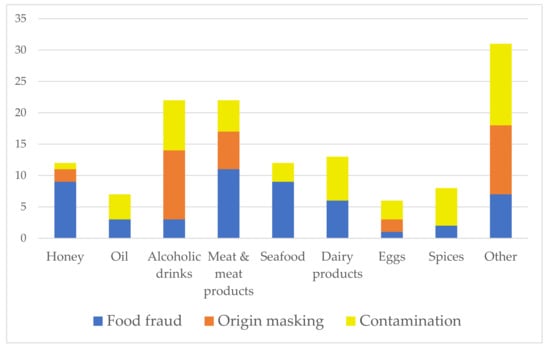
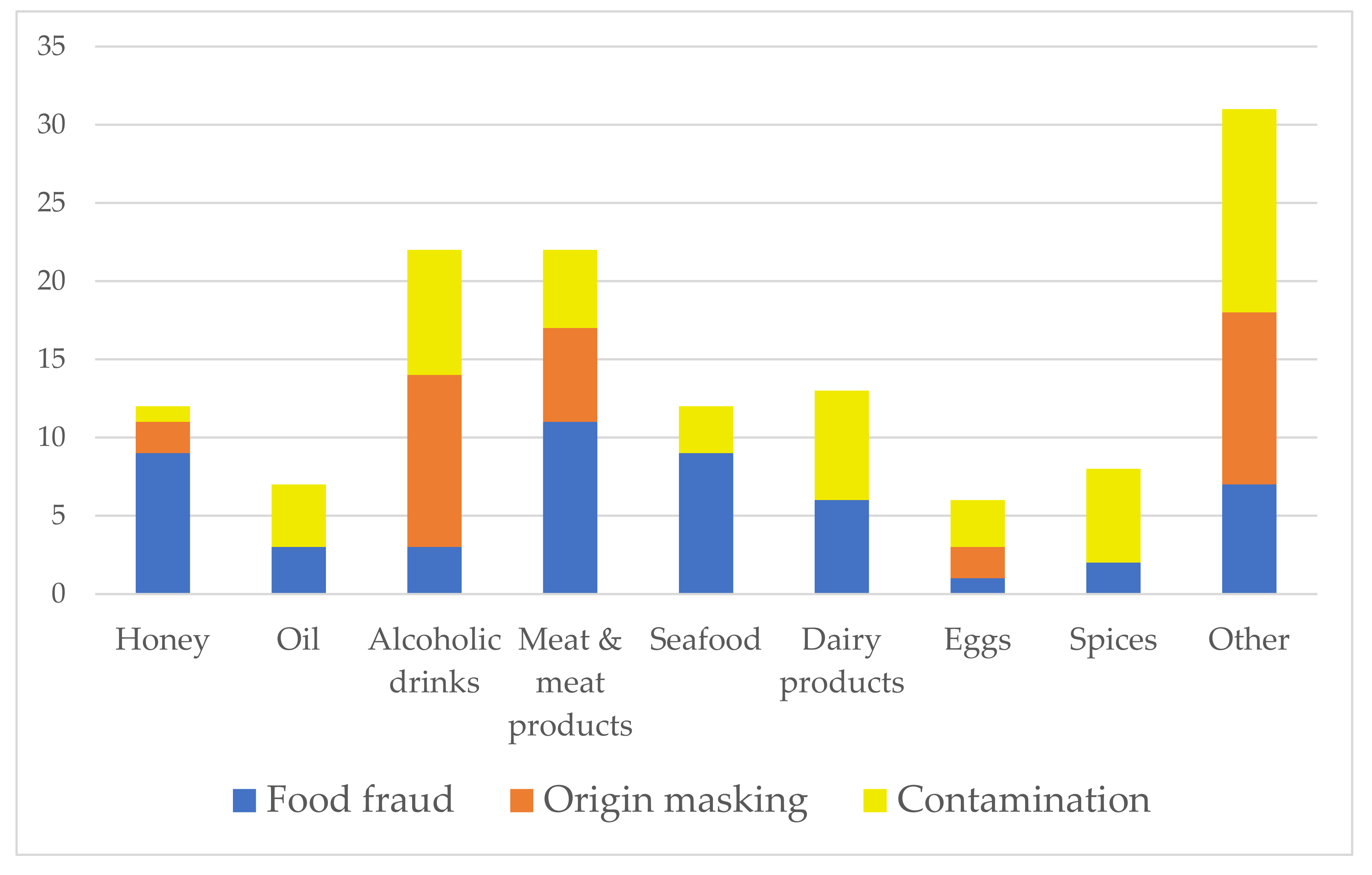
Looking at the overall state of food, the most frequent adulterations are done in powders and liquids (e.g., olive oils, alcoholic beverages, fish, seasonings, sauces, cereals, and flours) and much less in whole and fresh foods. In terms of food type, meat and meat products, fish and fish products, milk and dairy products, fruits, juices, and honey are the most susceptible to fraud [19,21]. Table 1, Table 2 and Table 3 give a detailed overview of the UFM regarding food fraud cases identified from 2010 to 2020. A summary of the tables is given in Figure 2 and Figure 3.
Figure 2.
Food products that are most often subjected to unauthorized food manipulation (UFM) (2010–2020). Food fraud—mislabelling, deceiving practices, and ingredients replacement. Origin masking—food authenticity changed (counterfeiting). Contamination—harmful adulterant incorporated into food.
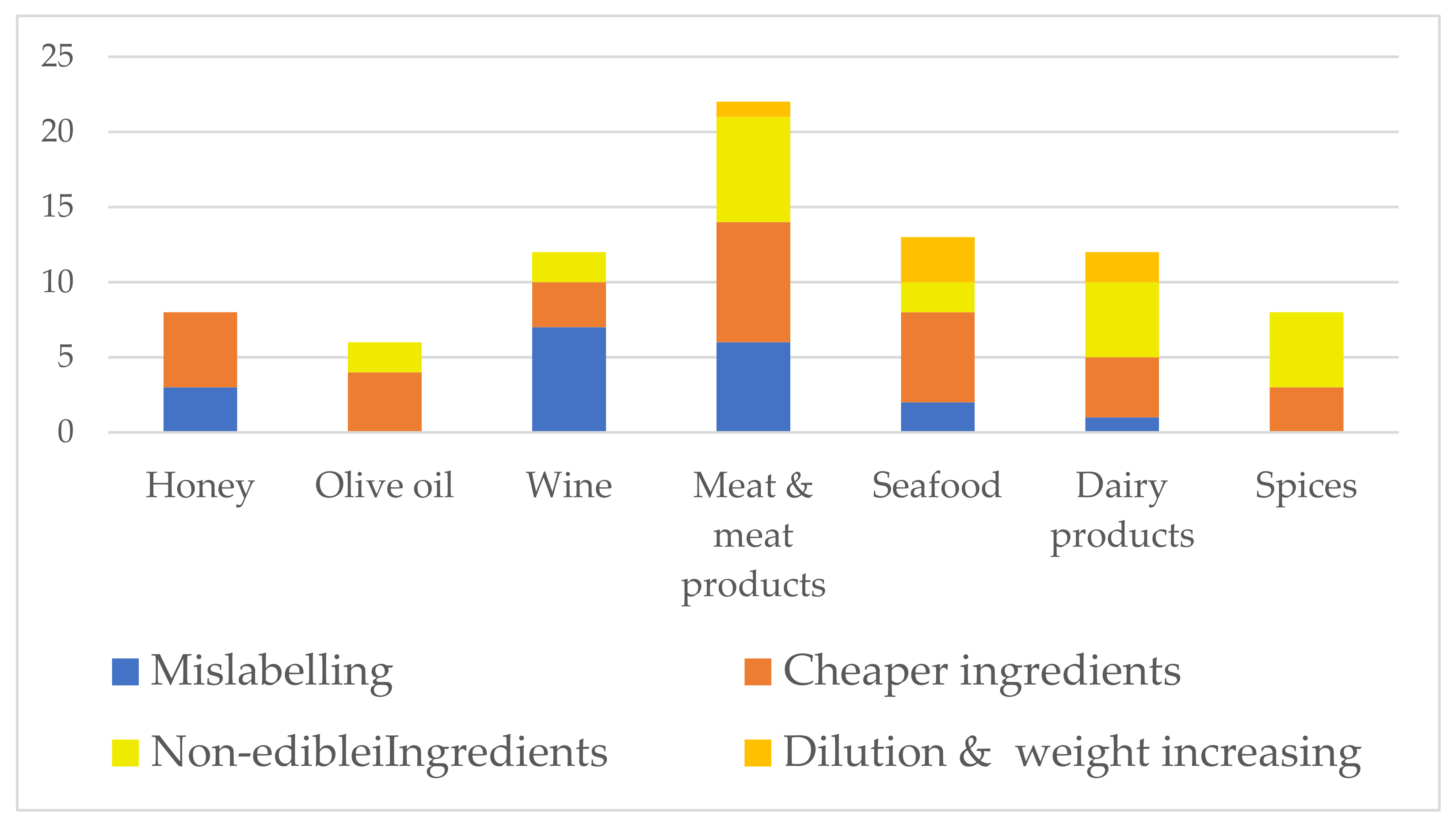
Figure 3.
Types of unauthorized food manipulation (UFM) that occur most often in particular food groups (2010–2020).
Adulteration of meat and seafood products involves substitution with species of low commercial value. Although the motivation is mainly economic, it can also affect health; for instance, when meat with low allergenic potential is substituted with meat products with high allergenic potential by adding, for example, soy, gluten, or milk proteins [22,23]. Common frauds also include increasing product weight by adding excessive water to frozen products, changing the stated country of origin, and using illegal chemicals in production [8]. Adulteration of dairy products involves addition of water (e.g., to increase the volume of milk), starch, vegetable oils, and wheat flour to increase the thickness and viscosity of milk. Chemicals such as calcium hydroxide, sodium hydroxide, or formalin are used to increase shelf life, while detergents are used to maintain the frothy appearance that decreases when the milk is diluted with water. Urea is added to impart whiteness and falsely increase nitrogen content, or in other words, to achieve a similar effect to melamine [22,24]. Olive oil is often adulterated by the addition of other oils of lesser commercial value, which usually do not have the same functional properties as olive oil (e.g., vegetable oil). It is even not uncommon to use oils that are not intended for human consumption, such as lampante olive oil [22]. Cheap wines and alcoholic beverages are often labelled as more expensive. While labelling a cheaper wine as more expensive does not pose a risk to human health, alcoholic beverages that may contain methanol are still highly toxic [8]. The main frauds in coffee production are the addition of barley, corn, or rice, or substitution with cheaper coffee of lower quality [23]. Spices often contain toxic adulterants that threaten public health; for instance, spices are colored with lead chromate, azo dyes, and triphenylmethane dyes [22]. Honey is usually adulterated with cheaper sweeteners, such as high-fructose corn syrup, corn sugar syrup, invert sugar syrup, cane sugar syrup, rice syrup, and so on. Additional substitutions may also include cheap low-quality honeys [25].
As noted above, UFM as a legal term describes a broader concept of food fraud that encompasses all possible fraudulent offenses: adulteration and tampering/mislabelling (e.g., green-colored sunflower oil labelled as extra virgin olive oil, sale of flower honey labelled as acacia honey), substitution (maple syrup diluted with cheaper table syrup (sugar), low-quality wine blended with high-quality wine), dilution (diluting milk with water), and deceitful practices (beef substituted for horse meat) (Table 1). The term UFM is used to clarify and define all types of fraudulent acts committed. Fraudulent acts related to the false presentation of food products with PDO (e.g., other grape varieties used for the production of Aceto di Modena) or PGI (e.g., inferior wine labelled as PGI wine from Tuscany) are also part of the UFM (Table 2). Similarly, sometimes impurities are used as adulterants that can cause serious health problems due to their toxicity (e.g., rice wine contaminated by methanol) or allergenic properties (a hazelnut product contaminated with peanuts), as shown in Table 3.
Table 1.
Unauthorized food manipulation regarding food fraud cases, 2010–2020.
Table 2.
Unauthorized Food Manipulation regarding origin masking, 2010–2020.
Table 3.
Unauthorized Food Manipulation regarding contamination in food products, 2010–2020.
Regarding our data from 2010 to 2020, the most frequent UFMs are conducted in meat and meat products, alcoholic drinks, honey, and dairy products. Food fraud was the most common in meat and meat products, seafood, and honey; origin masking in alcohol drinks and meat and meat products; and contamination in alcohol drinks, dairy products, and spices (Figure 2).
Regarding our data from 2010 to 2020, the most frequent UFM in wine, meat and meat products, and honey was mislabelling. Cheaper ingredients were incorporated predominantly in meat and meat products, seafood, honey, olive oil, and dairy products, while non-edible ingredients were added in meat and meat products, dairy products, and spices. Dilution and weight-increasing were the predominant UFMs in seafood and dairy products (Figure 3).
Spink and Moyer [17] delved into all of the possible areas of food crime. Typical examples of what constitutes a food crime are adulteration of ingredients in the final food product that have been altered (e.g., melamine added to milk, high fructose or glucose syrup added to honey). Next is tampering, meaning legitimate food products and food packaging used in a false manner (e.g., changed expiration date, setting another false declaration). A step further in the wrong direction is the over-run of a legitimate food product made from agreed quantities of the products but with insufficient product declarations, as it could stem from the black market. Another is the theft of a legitimate food product that has been stolen and released back into the legal market. In addition, there is diversion, which is the sale or distribution of legitimate food products outside of targeted or agreed upon stores (e.g., the finished food product is redirected to a market where there is no retail support). Another is simulation, which is a non-legitimate copy of a real food product designed to resemble a food product as legitimately as possible (e.g., a popular food product that has not been manufactured in compliance with all food safety procedures). Finally, there is counterfeiting, which is a broader concept of food adulteration, as it involves the theft of intellectual property and combines all aspects of product counterfeiting and packaging replication (e.g., a copy of a popular food product that has not been manufactured in compliance with all food safety procedures).
Manning and Soon [3] added a few more concepts of food fraud, namely the following: misleading information, that is, use of words such as “natural” or “traditional,” or the use of images or package design that do not reflect the contents or production methods; incorrect packaging, that is, the use of oversized packaging; as well as hazardous and malicious poisoning, bioterrorism, or sabotage, which is intentional food poisoning with the aim of causing fear and provoking terror.
In the US, a powerful response to food crime incidents was made in 1992 through establishing the Office of Criminal Investigation (OCI) by the Special Prosecutor and the Ministry of the Interior. The OCI is responsible for investigating criminal activity and legal violations within the FDA’s jurisdiction (i.e., food, cosmetics, damaged medical equipment, mislabelling of products, manufacturing and sale of counterfeit/unapproved drugs, product substitution, product damage, healthcare fraud, fraud involving the use of unapproved drugs, crimes involving the national blood supply, crimes involving false clinical studies, cybercrimes involving products within the FDA’s jurisdiction).
Any evidence of UFM or tampering or adulteration of a food product in the US must be reported to the OCI, while all of the received food fraud information has to be forwarded to the relevant OCI field office. On the other hand, the Croatian Ministry of the Interior to this day does not have a similar unit or office to find and collect evidence and prosecute food crimes. Establishing a food crime office should be based on good experiences from the US, coupled with modern laboratory equipment and analytical methods including highly specialized technical bodies in the field of veterinary, food technology, agronomy, and sanitary engineering with practical experience. Other possibilities include close cooperation of certified and official public health or veterinary institutes with accredited (ISO 17025) analytical methods to detect food fraud (Figure 2). The best method for preventing food criminal manipulation is to improve the overall traceability of foods [19], as well as the implementation of a food defence system through food quality systems (FSSC 22,000 [77], BRC Food Standard 8 [78], PAS 96 [79], IFS Food Version 6.1 [80], SQF Quality Code [81], and Reg. 178/2002/EC [1]).
4. Laboratory Techniques for Food Fraud Detection
The development and implementation of food authentication is strenuous multidisciplinary work involving analytical methods combined with informatics, mathematics, and statistics [10].
The large number of substances that can be used for food fraud and the inability to evaluate them make conventional analytical methods inadequate for this purpose. New highly sensitive methods are capable of detecting illicit substances even if they are present only in trace amounts. The development of such methods is moving in the direction of implementing faster and more reliable analytical methods. The specificity of the methods is one of the basic requirements. The melamine incident, for example, occurred because the analytical method for determining protein content was not specific enough to distinguish protein from non-protein nitrogen [82].
The US Pharmacopeia (2012) favours an approach that tests food ingredients for authenticity rather than determining the absence of specific patterns. Well-known qualitative methods used for routine laboratory tasks are currently on the rise and are attracting greater interest, primarily because of their screening potential.
Qualitative methods can be classified using a variety of criteria, but in all cases, they are used for questions that require binary responses (e.g., yes/no answers). When the answer is obtained from multiple non-specific signals, a multivariate classification strategy is required, also known as non-targeted screening [83]. This resource provides an overview of multivariate qualitative methods for food fraud detection, with examples and samples of adulterated foods. Some state-of-the-art methods and techniques, such as isotope-ratio mass spectrometry (IRMS), stable isotope analysis, genomics, and proteomics, should definitely be included in the methods to successfully confirm/or reject food authenticity. The application of these analytical methods provides insight into the accuracy and veracity of information about a product, primarily considering its chemical composition, origin, or production technology [10].
To reach the right conclusions, it is often necessary to interpret the results of the analysis using statistical (chemometric) methods [84]. Occasionally, problems can only be solved by using additional instrumental techniques that provide complementary information. Data fusion is an approach to obtain a single result from more than one source. There are three types of data fusion: low-level, mid-level, and high-level data fusion. The basis of each of these types is described in the literature [85,86], while Callao and Ruisánchez [83] summarized a set of studies on data fusion strategies in some food and quality-control processes.
Hong et al. [87] highlighted some important food categories with a high incidence of adulteration in their literature search. The food categories were grouped into six: ‘animal origin and seafood’, ‘oils and fats’, ‘beverages’, ‘spices and sweeteners’, ‘grain-based food’, and ‘others’ for organic food and dietary supplements. Mass spectrometry (MS) is the most frequently used method in the analysis of spices and grain-based food. Liquid chromatography (LC) and gas chromatography (GC) are also frequently used for spices, oils, and organic foods. Nuclear magnetic resonance (NMR) is used frequently to discriminate the authenticity of oils, cereals, grains, and beverages. PCR is the predominant detection technology used for the analysis of meat and meat products, fish and seafood, and milk and milk products. Most applications addressed authentication issues and, to a lesser extent, adulteration. The analytical methods used to detect food frauds are categorized in the next sections.
4.1. Chromatographic Methods
Frequently used techniques for food fraud detection include chromatographic analysis. Examples are thin-layer chromatography (TLC; e.g., high-performance liquid chromatography, HPLC; and GC) and MS-based methods (e.g., LC-MS/MS, GC/MSD) [87].
These methods allow rapid and reliable separation of similar chemical substances and, together, are considered one of the most important methods for food analysis. The methodology is based on the principle of establishing a unique chemical profile, making it possible to determine differences in the chemical composition of samples or to identify specific markers. Gas chromatography is used to analyse volatile compounds, while liquid chromatography is used to evaluate carbohydrates, proteins, vitamins, phenolic compounds, amino acids, and pigments. By combining these chromatographic methods with mass spectrometry, it is possible to obtain structural information that cannot be obtained by other analyses. Chromatographic methods are most commonly used in the analysis of honey, wine, oil, coffee, milk, cheese and mushrooms to determine fatty acids, triglycerides, sterols, hydrocarbons, tocopherols, and alcohol, as these compounds define the specific chemical profile of the product [10]. Other applications with HPLC and LC techniques are used for fruits, fruit juices, and sweeteners, while LC and GC are also used to a significant degree for spices, oils, and organic foods [87].
Mass spectrometry (MS) accounted for the largest proportion at 20.6%, PCR for 18.5%, and LC for 11.6%. It is interesting how MS is used extensively in most food categories, being also the most frequently used method in the analysis of spices, extracts, cereals, grains, and pulses, as well as accounting for the greatest proportion in Asian countries and South Korea (20.7% and 38.1%, respectively) [87].
4.2. Spectroscopic Analysis
Infrared spectroscopy is a fast and non-destructive method by which functional groups in a molecule can be identified. It operates in the range of electromagnetic radiation of 2.5–15.0 μm and is based on the absorption of light whose frequency coincides with the vibration frequency of the bonds in a molecule. Nuclear magnetic spectroscopy works on the principle of absorbing the energy of the nucleus in the field of radio waves. These methods allow the collection of spectroscopic and structural information, which is then used to verify the authenticity of the product [88]. They are used, for example, to detect melamine in milk and identify soy protein in meat products. Other authors described how NMR is frequently used to discriminate the authenticity of oils, cereals, grains, alcoholic beverages, and fruit juices [87].
4.3. Stable Isotope Analysis
One of the most promising and popular state-of-the-art techniques for the protection and discrimination of geographical origin (the Protected Designation of Origin (PDO)) and avoidance of fraudulent labelling of milk and dairy products has been using multi-element and multi-isotope-ratio analysis with isotope-ratio mass spectrometry (IRMS), inductively coupled plasma mass spectrometry (ICP-MS), and ICP-AES [89,90]. Some important results have demonstrated that stable isotope ratios of C, N, O, S, and Sr of milk and cheese were linked to their territories of origin, as a result of variations in the type of vegetation and the environment [91].
Improved detection of water addition in fruit juices was developed by conducting an analysis of the isotopic ratios of oxygen (18O/16O) of ethanol derived from the sugars in orange juice using the preparation steps of the SNIF-NMR method followed by IRMS [92].
The geographical origin of premium long-grain rice can be analysed using IRMS, but also using ICP-MS [93].
For identifying the addition of low-cost commercial sugar syrups (beet and cane syrup) to pure apple juices and related products, an improved procedure for determining 13C and 2H isotope ratios using gas chromatography-isotope ratio mass spectrometry (GC-IRMS) has been developed [94].
Hydrogen and oxygen (originating from water used by animals and plants) have light and heavy isotopes, and their ratio is a unique marker of the climatic and geographical area. Carbon and nitrogen isotopes can be used to distinguish plants that feed animals, and therefore their geographical origin can be determined. The design of isotopic maps of Europe is underway so that the authenticity of regional products (e.g., champagne and Scottish salmon) can be verified more easily [95].
4.4. Molecular Methods
Restriction fragment length polymorphism polymerase chain reaction (PCR-RFLP) and real-time single or multiple polymerase chain reaction (RT-PCR) are based on DNA fragment amplification and hybridization with specific assays to identify different origins of meats in the samples. DNA barcoding (DNA sequencing using a validated protocol) is a powerful technique in the analysis of meat and fish products, as long as the DNA is preserved in the samples. It is effective in determining the origins of raw products and detecting adulterated foods (e.g., mixing products of different taxonomies such as rice and ginseng). Recently, the method has been advanced to next-generation sequencing and DNA-meta-barcoding, so it is possible to identify meat types in the mixtures [88]. Some authors determined PCR as the predominant detection technology used for the food categories fish and seafood, and milk and milk products [87].
4.5. Immunological Methods
These methods are based on the reactions between the antibodies and the antigens. The use of these methods is quite widespread given that they are fast, sensitive, highly specific, and easy to perform. Currently, the most common method for the analysis of meat, dairy, and fish products is the enzyme-linked immunosorbent assay (ELISA).
Since the detection and discrimination of cereal contamination in gluten-free foods is essential for celiac disease patients, some ELISA methods have been established for the specific discrimination of wheat, rye, barley, and oats in gluten-free food (apart from more expensive and less user-friendly methods with real-time PCR and quantitative competitive (QC)-PCR) [96,97]. Recently, food fraud in cereal food products derived from a ready-to-eat powder (e.g., Sunsik) has been a great concern for regulatory authorities and consumers, especially the mislabelling or incorrect labelling of allergenic constituents in Korea. Thus, specific primers for each species have been developed based on sequence polymorphisms in chloroplast rpoC2m, and multiplex PCR can detect components of commercial flow-mixed products [98].
IR spectroscopy, Raman, immunosorbent assays (e.g., ELISA), and biosensors are used less compared to the other detection methods for food authenticity [87].
5. Preventive Measures
Food safety hazards are defined as “biological, chemical or physical hazards or a food condition with the potential to cause adverse health effects” [3,99]. Food hazards can be physical (e.g., glass, metal, foreign objects), biological (e.g., bacteria or parasites), and chemical (e.g., unapproved additives, banned chemicals, antibiotics, pesticides).
In food processing, introducing fraudulent raw materials into food (e.g., through adulteration or counterfeiting or intellectual property theft), or to use those raw materials in an inferior quality, affects the product itself. In addition, in poorly controlled production facilities, especially with institutionalized food (e.g., hotels, restaurants, nursing homes), falsifying packaging (e.g., through tampering or simulation) during distribution or prior to purchase of a final food product can occur [100]. Dilution of the product with water, mixing it with cheaper raw materials, or using illicit additives and chemical agents to improve sensory properties can occur at any point in the food supply chain. Food products may contain residues of pesticides and antibiotics, exceeding MRL levels at any part of the production or at any stage of the food chain (from farm to fork).
The widespread and fragmented food supply chain of today is increasingly vulnerable to fraud, which can occur anytime and in every part of food supply chain [101]. Since food production ingredients nowadays come from all over the world, food fraud could happen in one country if fraudulent ingredients were added in another country. Food ingredients can be adulterated at any stage of the food chain, whether they are the basic ingredient or merely raw material. They can occur during cultivation, harvest, slaughter, processing, storage, or transportation. Therefore, to prevent malicious food contamination, criminal and UFM, food protection principles should be considered in every part of the supply chain or processing [102].
The answer to preventing food fraud with ingredients required for the food’s production is in quality management (QM) that contains food defence systems (FSCC 22000, BRC Food Standard 8, PAS 96, IFS Food Version 6.1, SQF Quality Code) in FBO facilities, as well as food defence certification on packaging or during the determination of traceability. Food safety guidance has also been issued by the FDA to all food manufacturers, food processors, and transporters, importers, bottlers, grocery stores, and restaurants, as well as dairy and cosmetic processors and transporters [103].
Food Fraud Preventive Activities
Food defence is the answer to protecting products from UFM (Figure 1). To assess the risk/benefit ratio of the food system in relation to the occurrence of criminal events, the Threat Assessment of Critical Control Points (TACCP) and the Vulnerability Assessment of Critical Control Points (VACCP) are used.
There are three basic elements that need to be considered when protecting the food chain, namely event prevention, event response, and event recovery [104]. In terms of preventive measures, the food business management structure should develop a preventive strategy for the possibility of malicious food contamination or UFM, facility control measures, product withdrawal procedures, investigation of suspicious activities, and evaluation of implemented procedures. Vulnerability assessment should be conducted through critical control points (VACCP) of the food-processing facility and the entire supply chain before a food defence system is established [105].
Points in the food processing facility that contain specific stages where ingredients are added and mixed into a food product are often identified as high risk, as is accessibility to open ingredients. Similarly, points where liquid ingredients are handled or stored are often identified as high risk. Care must be taken in the design of risk mitigation strategies at these important stages [100].
To assess vulnerability and rank critical issues, the FDA has provided an application that calculates the CAV (Criticality + Accessibility + Vulnerability) score, which is the shorter version of the CARVER software. This simplifies and standardizes vulnerability assessments and points out exposure and potential hazards by making the investigation simple and independent to investigate. The program allows quantification of vulnerabilities for each of the characteristics. It also examines the economic, psychological, and public health consequences of potential food attacks [106]. The vulnerability analysis is carried out differently depending on whether the possible origin of the fraud is the raw materials, packaging material, processing at FBO, or in their distribution. When assessing food product vulnerabilities, a few factors have to be taken into account: history of product fraud incidents, economic factors, ease of fraudulent activity, supply chain complexity, current control measures, and supplier confidence [107,108].
The mitigation strategy is a practice that FBOs must implement with the goal of significantly reducing or eliminating the critical control points previously identified in the vulnerability assessment. It can be implemented throughout the food production process, farming and livestock, through food processing, distribution, storage, and retail. The general and focused mitigation strategy protects against unwanted criminal food manipulation or intentional food contamination. There is software available for developing a mitigation strategy for consequences of an attack on the food supply chain, which was also developed by the FDA.
6. Response to Food Accidents and Difficulties in Controlling Fraud
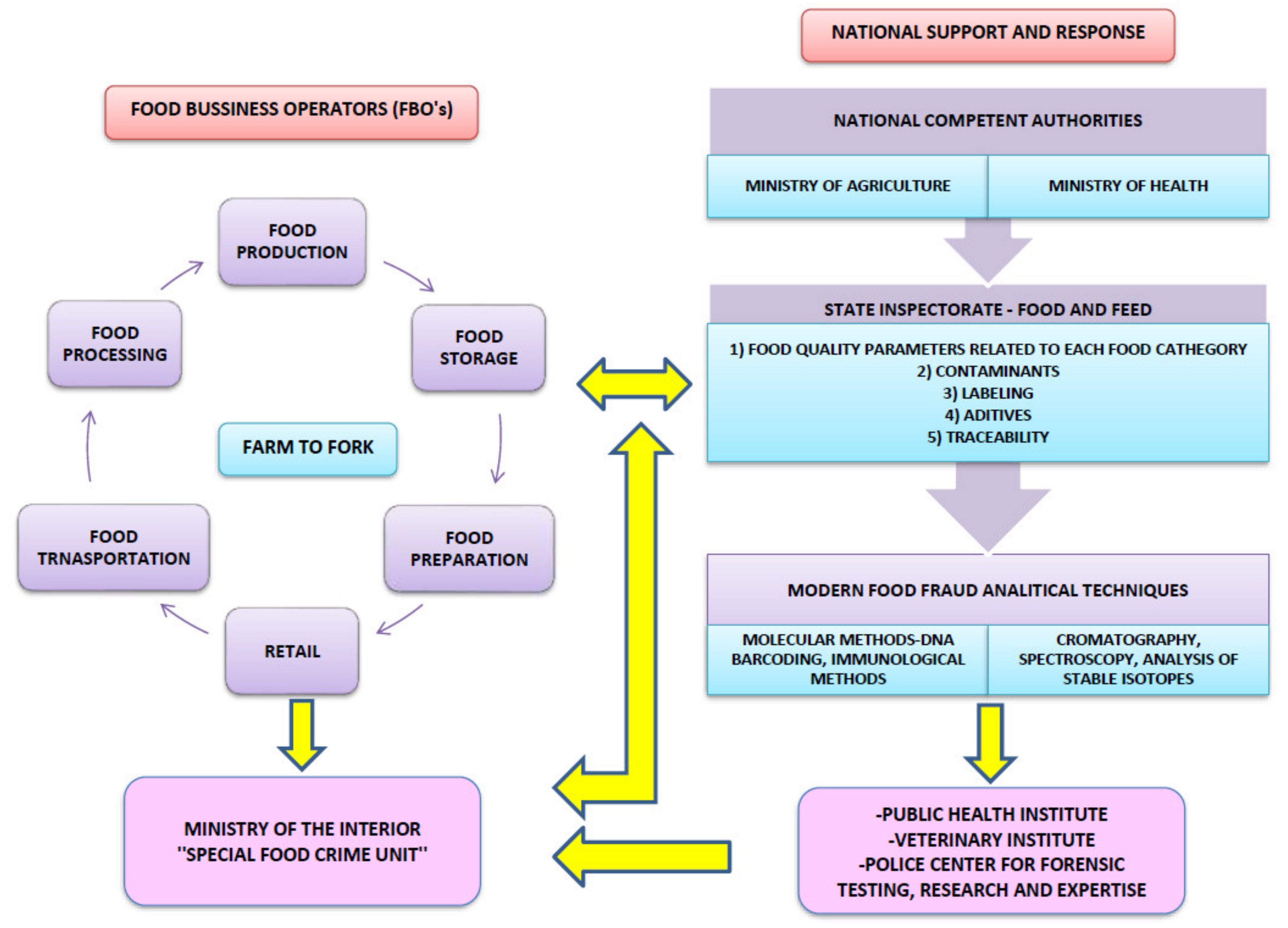
The response plan should contain contact information (the police, the state inspectorate, ministry of agriculture, ministry for health) in case of a fraudulent incident or intentional contamination in the food supply chain (Figure 4).
Figure 4.
Responding to food fraud activities (Croatian system).
The left part of the picture shows some of the most important steps within which every FBO should internally ensure high-quality traceability, to later facilitate official supervisors’ insight into the business, from raw material procurement to the marketing of the finished product. The left picture reveals a complex institutional structure that needs to provide effective support as well as inspection of FBOs and food in warehouses and retail. It is evident that the key to preventing food fraud in the market is good cooperation and well-coordinated activities between all official institutions that need to communicate frequently and effectively. It is necessary to employ state-of-the-art analytical techniques to ensure adequate completion of official controls, as well as adequate sampling that must be representative and sufficiently frequent. Considering that it is most important that there is no food on the market that could endanger the health of consumers, methods for the presence of food contaminants should be implemented: for example, hidden pharmacological substances, polycyclic aromatic hydrocarbons (PAHs), dioxins, and polychlorinated biphenyls (PCBs). The food quality parameters related to each food category, on the other side, should detect deceptions that are not dangerous to the health of the consumer but that diminish its nutritional value (e.g., by replacing olive oil with cheaper substitutions by adding chlorophyll, adding water or apple juice to red berry juices, sugar syrups to honey, etc.). In order to successfully detect these food frauds, official laboratories need to have data from the sampling site, but more than that, modern analytical techniques, applicable for food fraud detection. Unfortunately, many of them are very expensive and require special knowledge and education, while some require the creation of their own databases, which is a very time consuming and expensive process (e.g., isotope ratio mass spectrometry; IRMS).
State institutions should have procedures for food emergency cases. For instance, Article 19 within the EU General Food Law (Reg (EC) 178/2002) [1] listed all responsibilities for FBOs, and when food should be withdrawn from the market. Some of the most important highlights are set in several bullet-points, such as:
“1. If a FBO considers or has reason to believe that a food which it has imported, produced, processed, manufactured or distributed is not in compliance with the food safety requirements, it shall immediately initiate procedures to withdraw the food in question from the market where the food has left the immediate control of that initial food business operator and inform the competent authorities thereof. Where the product may have reached the consumer, the operator shall effectively and accurately inform the consumers of the reason for its withdrawal, and if necessary, recall from consumers products already supplied to them when other measures are not sufficient to achieve a high level of health protection.
2. FBOs responsible for retail or distribution activities which do not affect the packaging, labelling, safety or integrity of the food shall, within the limits of its respective activities, initiate procedures to withdraw from the market products not in compliance with the food-safety requirements and shall participate in contributing to the safety of the food by passing on relevant information necessary to trace a food, cooperating in the action taken by producers, processors, manufacturers and/or the competent authorities.
3. The FBO shall immediately inform the competent authorities if it considers or has reason to believe that a food which it has placed on the market may be injurious to human health. Operators shall inform the competent authorities of the action taken to prevent risks to the final consumer and shall not prevent or discourage any person from cooperating, in accordance with national law and legal practice, with the competent authorities, where this may prevent, reduce or eliminate a risk arising from a food.
4. The FBO shall collaborate with the competent authorities on action taken to avoid or reduce risks posed by a food which they supply or have supplied (Reg (EC) 178/2002).”
After the incident, FBOs should restart food manufacturing and gain consumers’ confidence that their products are not adulterated, which is a very demanding process, but still possible with time. The question is whether this will be profitable after economic losses and possible human casualties (major poisonings). Therefore, the food system recoverability (time for system recovery) could be scored in the food defence plan evaluation in this criteria: >1 year, 9–10; 6 months to 1 year, 7–8; 3–6 months, 5–6; 1–3 months, 3–4; <1 month, 1–2 [106].
7. Conclusions
Food fraud is an increasingly problematic phenomenon, whose presence may be significantly reduced by FBOs, by implementing a food quality management system and food defence principles within production (FSCC 22000, BRC Food Standard 8, PAS 96, IFS Food Version 6.1, SQF Quality Code), in order for manufacturers that have an interest to retain the quality of the final food product, as well as consumers’ trust. Respectable food industries have already implemented such food quality systems, and the final products are made from certified ingredients. However, less considerate parties inside the food chain could have different aims, as their goal might be to use cheaper components, so they change products in their most important attributes. Hence, they might lie about the ingredients/composition on packaging or give false and misleading statements on labels. The general purpose of such behaviour is to gain economic profit, which is a necessary component of food fraud, and food crime as well. Finally, such violations of food law are criminal offenses that must be prosecuted by the police and the court. Police work involves gathering material evidence and prosecuting perpetrators in front of the court, but the police office for food fraud should have knowledge of food safety, processing, and production.
The possible subsequent improvements regarding food fraud prevention could be education and development of awareness of potential food crime that could be committed with UFM, as well as more extensive institutional monitoring and penalisation.
Any evidence of UFM or tampering or adulteration of a food product in the US must be reported to the OCI, while all of the received food fraud information has to be forwarded to the competent OCI field office. On the other hand, the Croatian Ministry of the Interior to this day does not have a similar unit or office to find and collect evidence and prosecute food crimes. Establishing the Food Crime Office should be based on good experiences from the US, coupled with modern laboratory equipment and analytical methods including highly specialized technical bodies in the field of veterinary, food technology, agronomy, and sanitary engineering with practical experience. Other possibilities include close cooperation with certified and official public health or veterinary institutes with accredited (ISO 17025) analytical methods to detect food fraud.
Possible challenges are expensive and demanding analytical techniques, analysing large datasets, and perhaps a lack of food-related regulations, which should be addressed in the near future. Intentional adulteration or UFM could cause serious consequences to public health or economy. Therefore, the general public could lose confidence in food safety at the global level, but also in the government’s ability to protect them. The solution is in increasing the levels of risk-based inspections, monitoring and implementation of food defence systems throughout the entire food supply chain, and better control of ingredients and their certifications. Prevention of fraud in the food chain and promotion of authentic food products are undoubtedly key elements in the successful placement of food products on the world market.
Author Contributions
Conceptualization, K.J. and I.B.K.; investigation, K.J., I.B.K., D.L., D.B.K. and P.P.; writing—original draft preparation, K.J. and I.B.K.; writing—review and editing, D.L., D.B.K. and P.P. All authors have read and agreed to the published version of the manuscript.
Funding
P.P. and D.B.K. wish to thank the Croatian Science Foundation for the funding of the “Hurdle Technology and 3D Printing for Sustainable Fruit Juice Processing and Preservation” project, number “IP-2019-04-2105”.
Conflicts of Interest
The authors declare no conflict of interest.
References
- EC Regulation No 2002/178/EC. The General Principles and Requirements of Food Law, Establishing the European Food Safety Authority and Laying Down Procedures in Matters of Food Safety. Available online: https://eur-lex.europa.eu/legal-content/EN/TXT/PDF/?uri=CELEX:32002R0178&from=EN (accessed on 14 February 2021).
- Food Safety and Inspection Service. Food Safety and Food Defense—Information for In-Commerce Firms. May 2014 USDA. Available online: https://www.fsis.usda.gov/food-safety/food-defense-and-emergency-response/food-defense (accessed on 14 February 2021).
- Manning, L.; Soon, J.M. Food safety, food fraud, and food defense: A fast evolving literature. J. Food Sci. 2016, 81, R823–R834. [Google Scholar] [CrossRef] [Scilit]
- Jurica, K. Food Terror and Food Defence; Ministry of the Interior of the Republic of Croatia, Police Academy: Zagreb, Croatia, 2021.
- Spink, J.; Bedard, B.; Keogh, J.; Moyer, D.C.; Scimeca, J.; Vasan, A. International survey of food fraud and related terminology: Preliminary results and discussion. J. Food Sci. 2019, 84, 2705–2718. [Google Scholar] [CrossRef] [Scilit] [PubMed]
- Ulberth, F. Tools to combat food fraud—A gap analysis. Food Chem. 2020, 330, 127044. [Google Scholar] [CrossRef] [Scilit]
- Robson, K.; Dean, M.; Haughey, S.; Elliott, C. A comprehensive review of food fraud terminologies and food fraud mitigation guides. Food Control 2021, 120, 107516. [Google Scholar] [CrossRef] [Scilit]
- Everstine, K.; Spink, J.; Kennedy, S. Economically motivated adulteration (EMA) of food: Common characteristics of EMA incidents. J. Food Prot. 2013, 76, 723–735. [Google Scholar] [CrossRef] [Scilit] [PubMed]
- OG Kazneni Zakon [Criminal Law, in Croatian]. Official Gazette 56/2013. 2013. Available online: https://www.zakon.hr/z/98/Kazneni-zakon (accessed on 22 October 2021).
- Gvozdanović, K.; Margeta, P.; Margeta, V. Application of analytical methods for food authentification. Stočarstvo 2017, 71, 29–38. [Google Scholar] [CrossRef] [Scilit]
- EC European Commision. The EU Food Fraud Network and the System for Administrative Assistance & Food Fraud, Annual Report 2017; EC European Commision: Luxembourg, 2017. [Google Scholar]
- EC Regulation No 852/2004. The Hygiene of the Foodstuffs. Available online: https://eur-lex.europa.eu/legal-content/EN/TXT/PDF/?uri=CELEX:32004R0852&from=HR (accessed on 14 February 2021).
- EC Regulation No 396/2005. Maximum Residue Levels of Pesticides in or on Food and Feed of Plant and Animal Origin. Available online: https://eur-lex.europa.eu/legal-content/EN/TXT/PDF/?uri=CELEX:32005R0396&from=EN (accessed on 14 February 2021).
- EC Regulation No 510/2006. The Protection of Geographical Indications and Designations of Origin for Agricultural Products and Foodstuffs. Available online: https://eur-lex.europa.eu/legal-content/EN/TXT/PDF/?uri=CELEX:32006R0510&from=EN (accessed on 14 February 2021).
- EU Quality Food and Drink. Discover European Food and Drinks Protected by Geographical Indication Schemes. Available online: https://ec.europa.eu/info/food-farming-fisheries/food-safety-and-quality/certification/quality-labels/eu-quality-food-and-drink_en (accessed on 2 February 2021).
- Food and Drug Administration (FDA). Chapter 9—Federal Food, Drug, and Cosmetic Act (Sections 301–399d); FDA U.S.: Silver Spring, MD, USA, 1992.
- Spink, J.; Moyer, D.C. Defining the public health threat of food fraud. J. Food Sci. 2011, 76, 1–7. [Google Scholar] [CrossRef] [Scilit] [PubMed]
- Johnson, R. Food Fraud and “Economically Motivated Adulteration” of Food and Food Ingredients; Congressional Research Service: Washington, DC, USA, 2014.
- Djekic, I.; Režek Jambrak, A.; Djugum, J.; Rajkovic, A. How the food industry experiences and perceives food fraud. Qual. Assur. Saf. Crop. Foods 2018, 10, 325–333. [Google Scholar] [CrossRef] [Scilit]
- Kyrova, V.; Surmanova, P.; Ostry, V.; Rehurkova, I.; Ruprich, J.; Jechova, M. Sea fish fraud? A confirmation of Gadoid species food labelling. Br. Food J. 2017, 119, 122–130. [Google Scholar] [CrossRef] [Scilit]
- NSF. Risk Modelling of Food Fraud Motivation: ‘NSF Fraud Protection Model’ Intelligent Risk Model Scoping Project FS 246004: Final Report; The National Science Foundation (NSF): Alexandria, VA, USA, 2014.
- Dos Santos, C.S.; Sakugawa Shinohara, N.K.; Estolano Macedo, I.M.; Coutinho de Souza, M.D.L. Fraud in food produts. Res. Soc. Dev. 2020, 9, e3289108692. [Google Scholar] [CrossRef] [Scilit]
- Tibola, C.S.; da Silva, S.A.; Dossa, A.A.; Patrício, D.I. Economically motivated food fraud and adulteration in Brazil: Incidents and alternatives to minimize occurrence. J. Food Sci. 2018, 83, 2028–2038. [Google Scholar] [CrossRef] [Scilit]
- Francis, A.; Dhiman, T.; Mounya, K.S. Adulteration of milk: A review. J. Sci. Technol. 2020, 5, 37–41. [Google Scholar] [CrossRef] [Scilit]
- Fakhlaei, R.; Selamat, J.; Khatib, A.; Razis, A.F.A.; Sukor, R.; Ahmad, S.; Babadi, A.A. The toxic impact of honey adulteration: A review. Foods 2020, 9, 1538. [Google Scholar] [CrossRef] [Scilit]
- Leeder, J. Honey Laundering: The Sour Side of Nature’s Golden Sweetener. Available online: https://www.theglobeandmail.com/technology/science/honey-laundering-the-sour-side-of-natures-golden-sweetener/article562759 (accessed on 14 February 2021).
- JRC. Monthly Summary of Articles on Food Fraud and Adulteration—November 2017. Available online: https://ec.europa.eu/jrc/sites/default/files/food_fraud_summary_11.2017.pdf (accessed on 14 February 2021).
- JRC. Monthly Summary of Articles on Food Fraud and Adulteration—November 2018. Available online: https://knowledge4policy.ec.europa.eu/publication/food-fraud-summary-november-2018_en (accessed on 14 February 2021).
- JRC. Monthly Summary of Articles on Food Fraud and Adulteration—July/August 2019. Available online: https://knowledge4policy.ec.europa.eu/publication/food-fraud-summary-july-august-2019_en (accessed on 14 February 2021).
- JRC. Monthly Summary of Articles on Food Fraud and Adulteration—March 2020. Available online: https://knowledge4policy.ec.europa.eu/publication/food-fraud-summary-march-2020_en (accessed on 14 February 2021).
- JRC. Monthly Summary of Articles on Food Fraud and Adulteration—May 2019. Available online: https://knowledge4policy.ec.europa.eu/publication/food-fraud-summary-may-2019_en (accessed on 14 February 2021).
- JRC. Monthly Summary of Articles on Food Fraud and Adulteration—November 2020. Available online: https://knowledge4policy.ec.europa.eu/publication/food-fraud-summary-november-2020_en (accessed on 14 February 2021).
- JRC. Monthly Summary of Articles on Food Fraud and Adulteration—November 2016. Available online: https://knowledge4policy.ec.europa.eu/food-fraud-quality/food-fraud-summary-november-2016_en (accessed on 14 February 2021).
- JRC. Monthly Summary of Articles on Food Fraud and Adulteration—February 2019. Available online: https://knowledge4policy.ec.europa.eu/publication/food-fraud-summary-february-2019_en (accessed on 14 February 2021).
- JRC. Monthly Summary of Articles on Food Fraud and Adulteration—July/August 2020. Available online: https://knowledge4policy.ec.europa.eu/publication/food-fraud-summary-july-august-2020_en (accessed on 14 February 2021).
- The Rapid Alert System for Food and Feed (RASFF). 2013 Annual Report. 2014. Available online: https://op.europa.eu/en/publication-detail/-/publication/a2cda8f4-cd64-4604-ab3b-5f8a5f698d50 (accessed on 14 February 2021).
- Jourdan, A. Wal-Mart Recalls Donkey Product in China After Fox Meat Scandal. Available online: https://www.reuters.com/article/us-walmart-china-idUSBREA0103O20140102 (accessed on 14 February 2021).
- JRC. Monthly Summary of Articles on Food Fraud and Adulteration—May 2017. Available online: https://knowledge4policy.ec.europa.eu/publication/food-fraud-summary-may-2017_en (accessed on 14 February 2021).
- JRC. Monthly Summary of Articles on Food Fraud and Adulteration—July/August 2018. Available online: https://knowledge4policy.ec.europa.eu/publication/food-fraud-summary-july-august-2018_en (accessed on 14 February 2021).
- JRC. Monthly Summary of Articles on Food Fraud and Adulteration—October 2018. Available online: https://knowledge4policy.ec.europa.eu/publication/food-fraud-summary-october-2018_en (accessed on 14 February 2021).
- JRC. Monthly Summary of Articles on Food Fraud and Adulteration—February 2018. Available online: https://ec.europa.eu/jrc/sites/default/files/jrc-food-fraud-summary-february-2018.pdf (accessed on 14 February 2021).
- JRC. Monthly Summary of Articles on Food Fraud and Adulteration—September 2019. Available online: https://knowledge4policy.ec.europa.eu/publication/food-fraud-summary-september-2019_en (accessed on 14 February 2021).
- JRC. Monthly Summary of Articles on Food Fraud and Adulteration—June 2019. Available online: https://knowledge4policy.ec.europa.eu/publication/food-fraud-summary-june-2019_en (accessed on 14 February 2021).
- FFN. Illegal Treatment of Tuna: From Canning Grade to Sushi Grade 2017. Available online: https://ec.europa.eu/food/system/files/2018-04/food-fraud_succ-coop_tuna.pdf (accessed on 14 February 2021).
- JRC. Monthly Summary of Articles on Food Fraud and Adulteration—January 2018. Available online: https://knowledge4policy.ec.europa.eu/sites/default/files/jrc-food-fraud-summary-january-2018.pdf (accessed on 14 February 2021).
- JRC. Monthly Summary of Articles on Food Fraud and Adulteration—May 2018. Available online: https://knowledge4policy.ec.europa.eu/publication/food-fraud-summary-may-2018_en (accessed on 14 February 2021).
- JRC. Monthly Summary of Articles on Food Fraud and Adulteration—September 2018. Available online: https://ec.europa.eu/jrc/sites/default/files/jrc-food-fraud-summary-september-2018.pdf (accessed on 14 February 2021).
- JRC. Monthly Summary of Articles on Food Fraud and Adulteration—December 2018. Available online: https://knowledge4policy.ec.europa.eu/publication/food-fraud-summary-december-2018_en (accessed on 14 February 2021).
- JRC. Monthly Summary of Articles on Food Fraud and Adulteration—December 2017. Available online: https://ec.europa.eu/jrc/sites/default/files/food_fraud_summary_12.2017.pdf (accessed on 14 February 2021).
- JRC. Monthly Summary of Articles on Food Fraud and Adulteration—March 2018. Available online: https://ec.europa.eu/jrc/sites/default/files/jrc-food-fraud-summary-march-2018.pdf (accessed on 14 February 2021).
- JRC. Monthly Summary of Articles on Food Fraud and Adulteration—November/December 2019. Available online: https://knowledge4policy.ec.europa.eu/publication/food-fraud-summary-november-december-2019_en (accessed on 14 February 2021).
- JRC. Monthly Summary of Articles on Food Fraud and Adulteration—October 2019. Available online: https://knowledge4policy.ec.europa.eu/publication/food-fraud-summary-october-2019_en (accessed on 14 February 2021).
- JRC. Monthly Summary of Articles on Food Fraud and Adulteration—October 2017. Available online: https://knowledge4policy.ec.europa.eu/publication/food-fraud-summary-october-2017_en (accessed on 14 February 2021).
- JRC. Monthly Summary of Articles on Food Fraud and Adulteration—February 2020. Available online: https://knowledge4policy.ec.europa.eu/publication/food-fraud-summary-february-2020_en (accessed on 14 February 2021).
- JRC. Monthly Summary of Articles on Food Fraud and Adulteration—December 2016. Available online: https://ec.europa.eu/jrc/sites/default/files/jrc-food-fraud-summary-december-2016.pdf (accessed on 14 February 2021).
- JRC. Monthly Summary of Articles on Food Fraud and Adulteration—March 2019. Available online: https://knowledge4policy.ec.europa.eu/publication/food-fraud-summary-march-2019_en (accessed on 14 February 2021).
- JRC. Monthly Summary of Articles on Food Fraud and Adulteration—January 2020. Available online: https://knowledge4policy.ec.europa.eu/publication/food-fraud-summary-january-2020_en (accessed on 14 February 2021).
- JRC. Monthly Summary of Articles on Food Fraud and Adulteration—October 2020. Available online: https://knowledge4policy.ec.europa.eu/publication/food-fraud-summary-october-2020_en (accessed on 14 February 2021).
- JRC. Monthly Summary of Articles on Food Fraud and Adulteration—February 2017. Available online: https://ec.europa.eu/jrc/sites/default/files/jrc-food-fraud-summary-february-2017.pdf (accessed on 14 February 2021).
- JRC. Monthly Summary of Articles on Food Fraud and Adulteration—June 2018. Available online: https://knowledge4policy.ec.europa.eu/publication/food-fraud-summary-june-2018_en (accessed on 14 February 2021).
- EFSA. Risk Assessment of Beeswax Adulterated with Paraffin and/or Stearin/Stearic Acid when Used in Apiculture and As Food (Honeycomb); EFSA: Parma, Italy, 2020. [Google Scholar]
- Yan, Z.; Yin, C. 32 Held in “Gutter Oil” Crackdown. Available online: www.chinadaily.com.cn/bizchina/2011-09/14/content_13681222.htm (accessed on 14 February 2021).
- Mika, O.J.; Weissmannova-Dolezalova, H.; Fiserova, L. Mass methanol poisonings in the Czech Republic. Toxin Rev. 2014, 33, 101–106. [Google Scholar] [CrossRef] [Scilit]
- JRC. Monthly Summary of Articles on Food Fraud and Adulteration—October 2016. Available online: https://ec.europa.eu/jrc/sites/default/files/jrc-food-fraud-summary-october-2016.pdf (accessed on 14 February 2021).
- JRC. Monthly Summary of Articles on Food Fraud and Adulteration—July/August 2017. Available online: https://knowledge4policy.ec.europa.eu/publication/food-fraud-summary-july-august-2017_en (accessed on 14 February 2021).
- JRC. Monthly Summary of Articles on Food Fraud and Adulteration—May 2020. Available online: https://knowledge4policy.ec.europa.eu/publication/food-fraud-summary-may-2020_en (accessed on 14 February 2021).
- JRC. Monthly Summary of Articles on Food Fraud and Adulteration—March 2017. Available online: https://knowledge4policy.ec.europa.eu/publication/food-fraud-summary-march-2017_en (accessed on 14 February 2021).
- EC. Fipronil in Eggs: Public Health Risk? Available online: https://ec.europa.eu/food/sites/food/files/safety/docs/food-fraud_succ-coop_fipronil-eggs.pdf (accessed on 14 February 2021).
- EUROPOL. Operation Opson VII. 2018. Available online: https://www.europol.europa.eu/sites/default/files/documents/opson_viii_report_public_version.pdf (accessed on 14 February 2021).
- JRC. Monthly Summary of Articles on Food Fraud and Adulteration—April 2018. Available online: https://knowledge4policy.ec.europa.eu/publication/food-fraud-summary-april-2018_en (accessed on 14 February 2021).
- JRC. Monthly Summary of Articles on Food Fraud and Adulteration—September 2020. Available online: https://knowledge4policy.ec.europa.eu/publication/food-fraud-summary-september-2020_en (accessed on 14 February 2021).
- JRC. Monthly Summary of Articles on Food Fraud and Adulteration—January 2017. Available online: https://knowledge4policy.ec.europa.eu/publication/food-fraud-summary-january-2017_en (accessed on 14 February 2021).
- Associated Press. Tainted Bean Sprouts Latest Food Scare in China. Available online: https://www.nbcnews.com/health/health-news/tainted-bean-sprouts-latest-food-scare-china-flna1C9461925 (accessed on 14 February 2021).
- Yang, F. Toxic Vegetables Expose Hidden Practices, Loopholes. Available online: https://english.dbw.cn/system/2012/05/08/000504855.shtml (accessed on 14 February 2021).
- EC. Rhodamine B in Natural Pickled Turnip from Lebanon. Available online: https://ec.europa.eu/food/sites/food/files/safety/docs/food-fraud_turnips_presentation.pdf (accessed on 14 February 2021).
- EC. Substitution Hazelnuts by Peanuts. Available online: https://ec.europa.eu/food/sites/food/files/safety/docs/food-fraud_hazelnuts_presentation.pdf (accessed on 14 February 2021).
- Food Safety System Certification (FSSC). FSSC 22000 Version 4.1: July 2017, Foundation FSSC 22000, The Netherland [Displayed 25 October 2019]. Available online: https://www.fssc22000.com/ (accessed on 14 February 2021).
- The British Retail Consortium (BRC). BRC Global Standard Food Safety. 2018. Available online: www.brcglobalstandards.com (accessed on 14 February 2021).
- British Standard Institution (BSI). PAS 96:2017, Guide to Protecting and Defending Food and Drink from Deliberate Attack. 2017. Available online: https://www.food.gov.uk/sites/default/files/media/document/pas962017_0.pdf (accessed on 14 February 2021).
- International Featured Standard (IFS). IFS FOOD VERSION 6.1. 2017. Available online: https://www.procert.ch/admin/data/files/publication_file/file_en/34/ifs_food_v6_1_en.pdf?lm=1512663544 (accessed on 14 February 2021).
- SQF. Quality Code 8.1 Edition. 2019. Available online: https://www.sqfi.com/resource-center/draft-sqf-code-downloads-edition-8-1/ (accessed on 14 February 2021).
- Gossner, C.M.E.; Schlundt, J.; Embarek Ben, P.; Hird, S.; Lo-Fo-Wong, D.; Beltran, J.J.O.; Teoh, K.N.; Tritscher, A. The melamine incident: Implications for international food and feed safety. Environ. Health Perspect. 2009, 117, 1803–1808. [Google Scholar] [CrossRef] [Scilit] [PubMed]
- Callao, M.P.; Ruisánchez, I. An overview of multivariate qualitative methods for food fraud detection. Food Control 2018, 86, 283–293. [Google Scholar] [CrossRef] [Scilit]
- Granato, D.; Putnik, P.; Bursać Kovačević, D.; Santos, J.S.; Calado, V.; Rocha, R.S.; da Cruz, A.G.; Jarvis, B.; Rodionova, O.Y.; Pomerantsev, A. Trends in Chemometrics: Food Authentication, Microbiology, and Effects of Processing. Compr. Rev. Food Sci. Food Saf. 2018, 17, 663–677. [Google Scholar] [CrossRef] [Scilit] [PubMed]
- Borràs, E.; Ferré, J.; Boqué, R.; Mestres, M.; Aceña, L.; Busto, O. Data fusion methodologies for food and beverage authentication and quality assessment—A review. Anal. Chim. Acta 2015, 891, 1–14. [Google Scholar] [CrossRef] [Scilit]
- Márquez, C.; López, M.I.; Ruisánchez, I.; Callao, M.P. FT-Raman and NIR spectroscopy data fusion strategy for multivariate qualitative analysis of food fraud. Talanta 2016, 161, 80–86. [Google Scholar] [CrossRef] [Scilit] [PubMed]
- Hong, E.; Lee, S.Y.; Jeong, J.Y.; Park, J.M.; Kim, B.H.; Kwon, K.; Chun, H.S. Modern analytical methods for the detection of food fraud and adulteration by food category. J. Sci. Food Agric. 2017, 97, 3877–3896. [Google Scholar] [CrossRef] [Scilit]
- Cavin, C.; Cottenet, G.; Cooper, K.M.; Zbinden, P. Meat vulnerabilities to economic food adulteration require new analytical solutions. Chimia 2018, 72, 697–703. [Google Scholar] [CrossRef] [Scilit]
- Bontempo, L.; Larcher, R.; Camin, F.; Hölzl, S.; Rossmann, A.; Horn, P.; Nicolini, G. Elemental and isotopic characterisation of typical Italian alpine cheeses. Int. Dairy J. 2011, 21, 441–446. [Google Scholar] [CrossRef] [Scilit]
- Sacco, D.; Brescia, M.A.; Sgaramella, A.; Casiello, G.; Buccolieri, A.; Ogrinc, N.; Sacco, A. Discrimination between Southern Italy and foreign milk samples using spectroscopic and analytical data. Food Chem. 2009, 114, 1559–1563. [Google Scholar] [CrossRef] [Scilit]
- Drivelos, S.A.; Georgiou, C.A. Multi-element and multi-isotope-ratio analysis to determine the geographical origin of foods in the European Union. TrAC Trends Anal. Chem. 2012, 40, 38–51. [Google Scholar] [CrossRef] [Scilit]
- Jamin, E.; Guérin, R.; Rétif, M.; Lees, M.; Martin, G.J. Improved detection of added water in orange juice by simultaneous determination of the oxygen-18/oxygen-16 isotope ratios of water and ethanol derived from sugars. J. Agric. Food Chem. 2003, 51, 5202–5206. [Google Scholar] [CrossRef] [Scilit] [PubMed]
- Kelly, S.; Baxter, M.; Chapman, S.; Rhodes, C.; Dennis, J.; Brereton, P. The application of isotopic and elemental analysis to determine the geographical origin of premium long grain rice. Eur. Food Res. Technol. 2002, 214, 72–78. [Google Scholar] [CrossRef] [Scilit]
- Kelly, S.D.; Rhodes, C.; Lofthouse, J.H.; Anderson, D.; Burwood, C.E.; Dennis, M.J.; Brereton, P. Detection of sugar syrups in apple juice by δ2H‰ and δ13C‰ analysis of hexamethylenetetramine prepared from fructose. J. Agric. Food Chem. 2003, 51, 1801–1806. [Google Scholar] [CrossRef] [Scilit] [PubMed]
- Manning, L.; Soon, J.M. Developing systems to control food adulteration. Food Policy 2014, 49, 23–32. [Google Scholar] [CrossRef] [Scilit]
- Sandberg, M.; Lundberg, L.; Ferm, M.; Malmheden Yman, I. Real Time PCR for the detection and discrimination of cereal contamination in gluten free foods. Eur. Food Res. Technol. 2003, 217, 344–349. [Google Scholar] [CrossRef] [Scilit]
- Dahinden, I.; Von Büren, M.; Lüthy, J. A quantitative competitive PCR system to detect contamination of wheat, barley or rye in gluten-free food for coeliac patients. Eur. Food Res. Technol. 2001, 212, 228–233. [Google Scholar] [CrossRef] [Scilit]
- Moon, J.C.; Kim, J.H.; Jang, C.S. Development of multiplex PCR for species-specific identification of the Poaceae family based on chloroplast gene, rpoC2. Appl. Biol. Chem. 2016, 59, 201–207. [Google Scholar] [CrossRef] [Scilit]
- BSI. BS EN ISO 22000. Food Safety Management Systems—Requirements for Any Organization in the Food Chain; BSI: London, UK, 2018. [Google Scholar]
- Jurica, K. Food Fraud and Food Defence, 1st ed.; Ministry of the Interior of the Republic of Croatia, Police Academy: Zagreb, Croatia, 2021.
- Wang, C.S.; van Fleet, D.D.; Mishra, A.K. Food integrity: A market-based solution. Br. Food J. 2017, 119, 7–19. [Google Scholar] [CrossRef] [Scilit]
- Puhač Bogadi, N.; Banović, M.; Babić, I. Food defence system in food industry: Perspective of the EU countries. J. Fur Verbrauch. Und Leb. 2016, 11, 217–226. [Google Scholar] [CrossRef] [Scilit]
- FDA Food Defense. Available online: https://www.fda.gov/food/food-defense (accessed on 14 February 2021).
- Jurica, K.; Vrdoljak, J.; Brčić Karačonji, I. Food defence systems as an answer to food terrorism. Arh. Hig. Rada Toksikol. 2019, 70, 242–265. [Google Scholar] [CrossRef] [Scilit] [PubMed]
- Yadav, V.; Sharma, A. A free software for food industries to ensure food safety: CARVER + Shock. Compr. Rev. Food Sci. Food Saf. 2011, 10, 109–117. [Google Scholar] [CrossRef] [Scilit]
- Food and Drug Administration (FDA). Carver+Shock Software. Available online: https://www.fda.gov/food/food-defense-programs/carver-shock-primer (accessed on 14 February 2021).
- Tromp, S.; Séchet, B. IFS Standards Product Fraud; IFS Management GmbH: Berlin, Germany, 2018. [Google Scholar]
- Gorna, J. Evaluation of raw materials and their suppliers as a defence against food fraud. Sci. Pap. Silesian Univ. Technol. 2020, 143, 97–105. [Google Scholar] [CrossRef] [Scilit]
Publisher’s Note: MDPI stays neutral with regard to jurisdictional claims in published maps and institutional affiliations. |
© 2021 by the authors. Licensee MDPI, Basel, Switzerland. This article is an open access article distributed under the terms and conditions of the Creative Commons Attribution (CC BY) license (https://creativecommons.org/licenses/by/4.0/).