Quality Differences between Fresh and Dried Buckwheat Noodles Associated with Water Status and Inner Structure




Abstract
1. Introduction
2. Materials and Methods
2.1. Materials
2.2. Noodles Preparation
2.3. Colour of Buckwheat Noodles
2.4. Cooking Properties of Buckwheat Noodles
2.5. Textural Properties of Buckwheat Noodles
2.6. Sensory Properties of Buckwheat Noodles
2.7. Water Status and Distribution in Uncooked Buckwheat Noodles
2.8. Scanning Electron Microscopy (SEM) Analysis
2.9. Statistical Analysis
3. Results
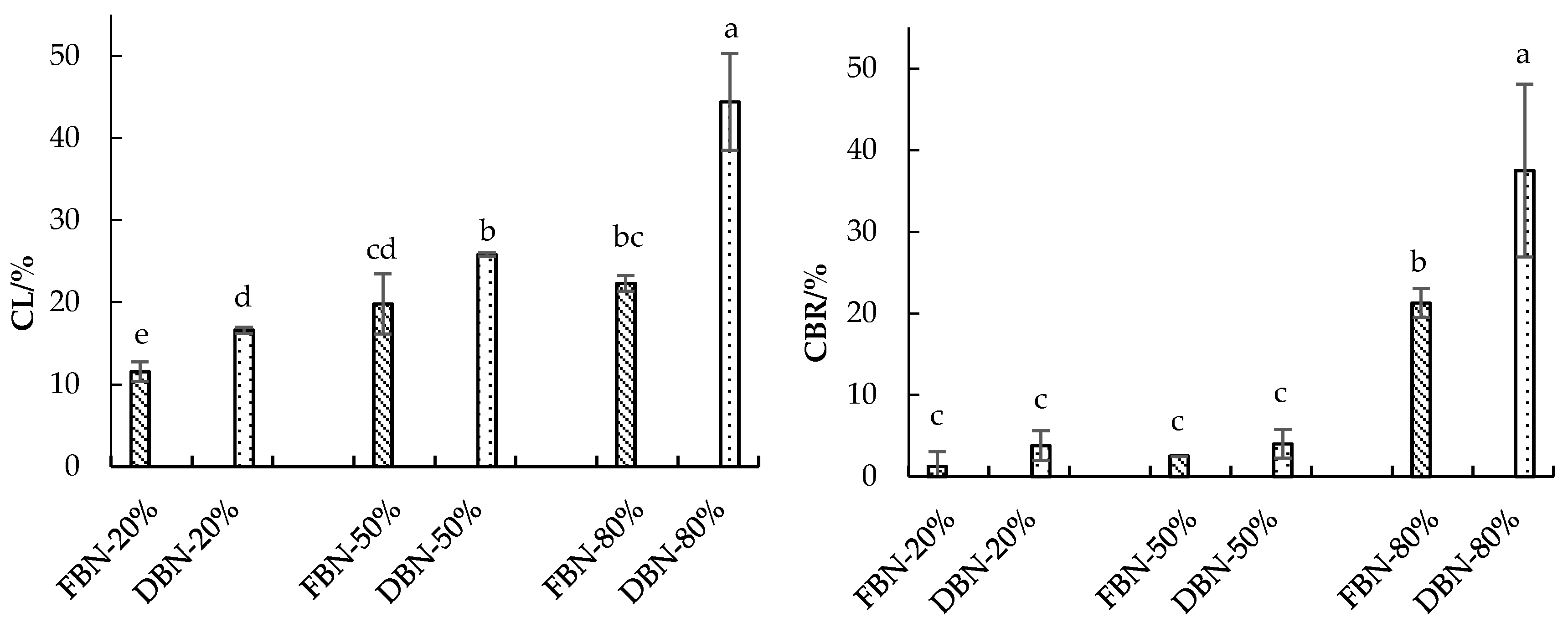
3.1. Cooking Properties
3.2. Textural Properties
3.3. Colour of Uncooked FBN and DBN
3.4. Sensory Properties
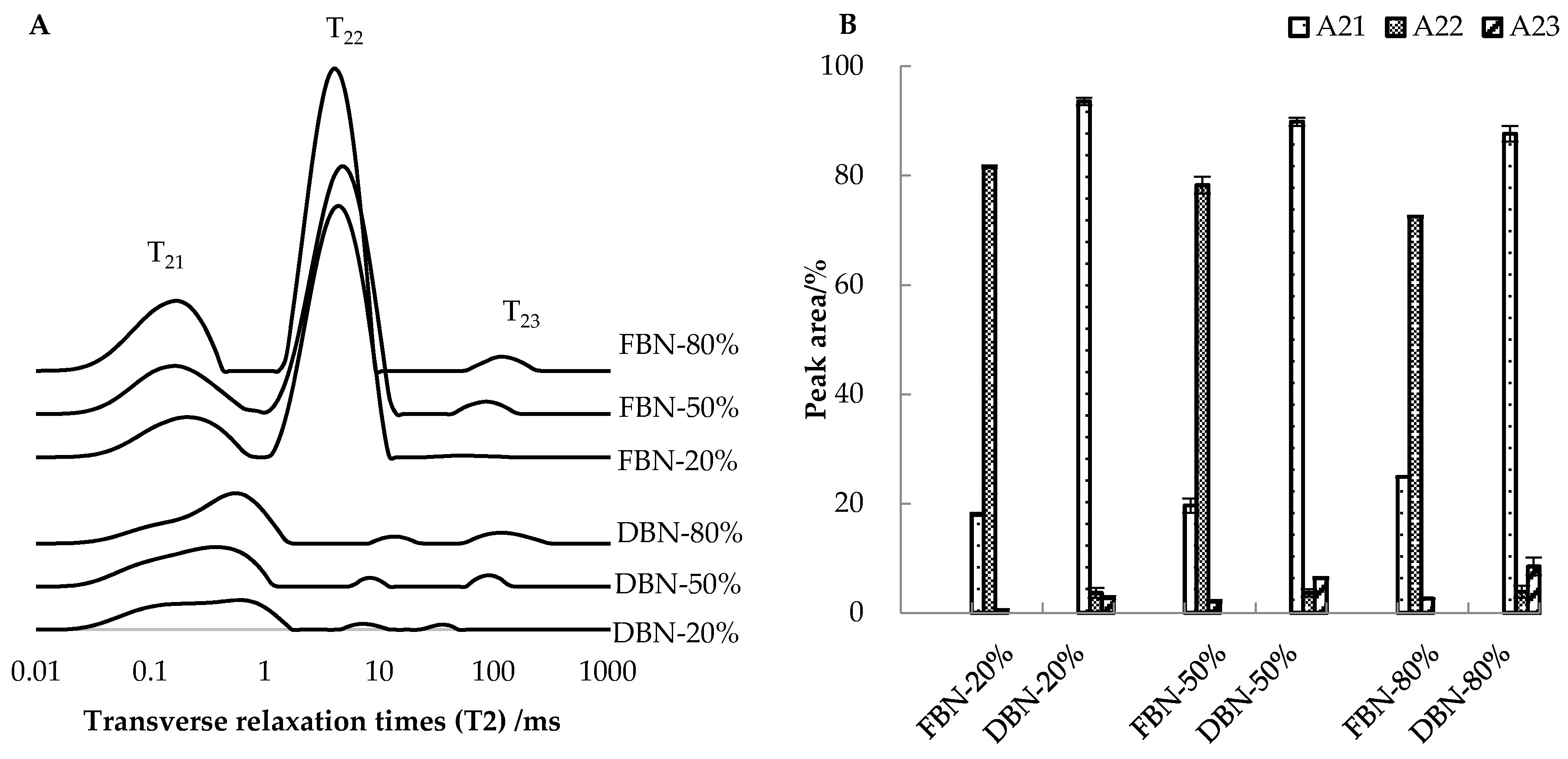
3.5. Water Status and Distribution
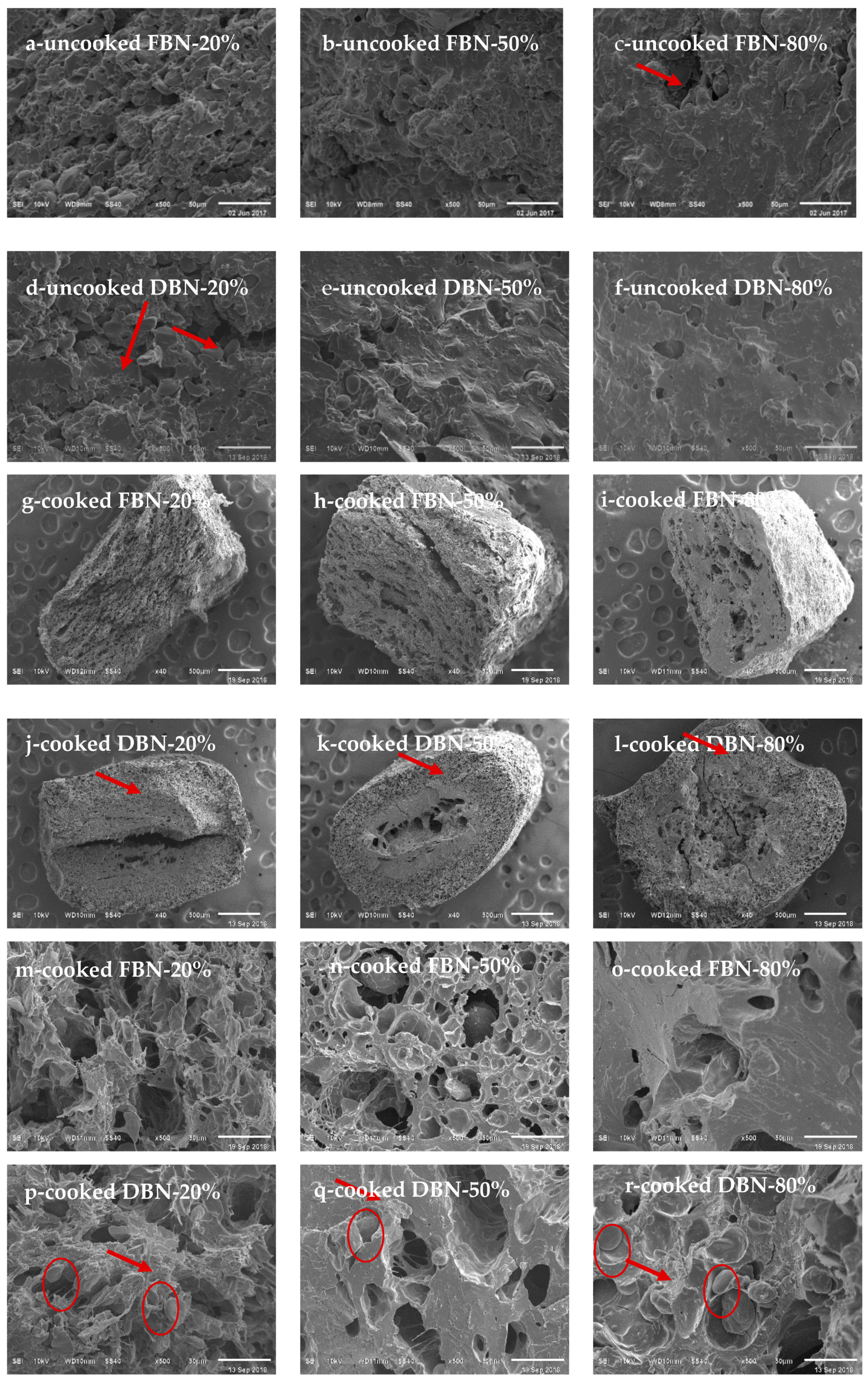
3.6. Morphology
4. Discussion
4.1. Roles of Water Status/Distribution and Internal Structure on the Cooking Properties of FBN and DBN
4.2. Roles of Water Status/Distribution and Internal Structure on the Textural Properties of FBN and DBN
5. Conclusions
Supplementary Materials
Author Contributions
Funding
Data Availability Statement
Acknowledgments
Conflicts of Interest
Abbreviations
| FBN | fresh buckwheat noodles |
| DBN | dried buckwheat noodles |
| TBW | tightly bound water |
| SBW | Softly bound water |
| FW | free water |
| T21 | the transverse relaxation time of tightly bound water |
| T22 | softly bound water |
| T23 | free water |
| A21 | the proportion of tightly bound water |
| A22 | softly bound water |
| A23 | free water |
| OCT | optimal cooking time |
| CL | cooking loss |
| CBR | cooking breakage ratio |
| MC | moisture content |
References
- Pomeranz, Y.; Robbins, G.S. Amino acid composition of buckwheat. J. Agric. Food Chem. 1972, 20, 270–274. [Google Scholar] [CrossRef]
- Yu, X.; Wang, Z.; Zhang, Y.; Wadood, S.A.; Wei, Y. Study on the water state and distribution of Chinese dried noodles during the drying process. J. Food Eng. 2018, 233, 81–87. [Google Scholar] [CrossRef]
- Wang, R.; Li, M.; Chen, S.; Hui, Y.; Tang, A.; Wei, Y. Effects of flour dynamic viscosity on the quality properties of buckwheat noodles. Carbohydr. Polym. 2019, 207, 815–823. [Google Scholar] [CrossRef]
- Wu, N.N.; Tian, X.H.; Liu, X.; Li, H.H.; Liang, R.P.; Zhang, M.; Liu, M.; Wang, L.P.; Zhai, X.T.; Tan, B. Cooking Quality, Texture and Antioxidant Properties of Dried Noodles Enhanced with Tartary Buckwheat Flour. Food Sci. Technol. Res. 2017, 23, 783–792. [Google Scholar] [CrossRef]
- Han, L.; Lu, Z.; Hao, X.; Cheng, Y.; Li, L. Impact of Calcium Hydroxide on the Textural Properties of Buckwheat Noodles. J. Texture Stud. 2012, 43, 227–234. [Google Scholar] [CrossRef]
- Schoenlechner, R.; Drausinger, J.; Ottenschlaeger, V.; Jurackova, K.; Berghofer, E. Functional properties of gluten-free pasta produced from amaranth, quinoa and buckwheat. Plant Foods Hum. Nutr. 2010, 65, 339–349. [Google Scholar] [CrossRef]
- Ikeda, K.; Asami, Y. Mechanical characteristics of buckwheat noodles. Fagopyrum 2000, 17, 67–72. [Google Scholar]
- Li, M.; Zhu, K.X.; Sun, Q.J.; Amza, T.; Guo, X.N.; Zhou, H.M. Quality characteristics, structural changes, and storage stability of semi-dried noodles induced by moderate dehydration: Understanding the quality changes in semi-dried noodles. Food Chem. 2016, 194, 797–804. [Google Scholar] [CrossRef]
- Padalino, L.; Caliandro, R.; Chita, G.; Conte, A.; Del Nobile, M.A. Study of drying process on starch structural properties and their effect on semolina pasta sensory quality. Carbohydr. Polym. 2016, 153, 229–235. [Google Scholar] [CrossRef]
- Ling, X.; Tang, N.; Zhao, B.; Zhang, Y.; Guo, B.; Wei, Y.M. Study on the water state, mobility and textural property of Chinese noodles during boiling. Int. J. Food Sci. Technol. 2020, 55, 1716–1724. [Google Scholar] [CrossRef]
- Bilgiçli, N. Utilization of buckwheat flour in gluten-free egg noodle production. J. Food Agric. Environ. 2008, 6, 113–115. [Google Scholar]
- Drechsler, K.C.; Bornhorst, G.M. Modeling the softening of carbohydrate-based foods during simulated gastric digestion. J. Food Eng. 2018, 222, 38–48. [Google Scholar] [CrossRef]
- Chillo, S.; Laverse, J.; Falcone, P.M.; Protopapa, A.; Del Nobile, M.A. Influence of the addition of buckwheat flour and durum wheat bran on spaghetti quality. J. Cereal Sci. 2008, 47, 144–152. [Google Scholar] [CrossRef]
- Chen, J. Food oral processing-A review. Food Hydrocoll. 2009, 23, 1–25. [Google Scholar] [CrossRef]
- Doona, C.J.; Baik, M.-Y. Molecular mobility in model dough systems studied by time-domain nuclear magnetic resonance spectroscopy. J. Cereal Sci. 2007, 45, 257–262. [Google Scholar] [CrossRef]
- Bosmans, G.M.; Lagrain, B.; Deleu, L.J.; Fierens, E.; Hills, B.P.; Delcour, J.A. Assignments of proton populations in dough and bread using NMR relaxometry of starch, gluten, and flour model systems. J. Agric. Food Chem. 2012, 60, 5461–5470. [Google Scholar] [CrossRef]
- Chen, Y.; Zhang, Y.; Jiang, L.; Chen, G.; Yu, J.; Li, S.; Chen, Y. Moisture molecule migration and quality changes of fresh wet noodles dehydrated by cold plasma treatment. Food Chem. 2020, 328, 127053. [Google Scholar] [CrossRef]
- Li, M.; Dhital, S.; Wei, Y. Multilevel Structure of Wheat Starch and Its Relationship to Noodle Eating Qualities. Compr. Rev. Food Sci. Food Saf. 2017, 16, 1042–1055. [Google Scholar] [CrossRef]
- Fukuzawa, S.; Ogawa, T.; Nakagawa, K.; Adachi, S. Moisture profiles of wheat noodles containing hydroxypropylated tapioca starch. Int. J. Food Sci. Technol. 2016, 51, 1516–1522. [Google Scholar] [CrossRef]
- Assifaoui, A.; Champion, D.; Chiotelli, E.; Verel, A. Characterization of water mobility in biscuit dough using a low-field 1H NMR technique. Carbohydr. Polym. 2006, 64, 197–204. [Google Scholar] [CrossRef]
- Li, M.; Hasjim, J.; Xie, F.; Halley, P.J.; Gilbert, R.G. Shear degradation of molecular, crystalline, and granular structures of starch during extrusion. Starch Stärke 2014, 66, 595–605. [Google Scholar] [CrossRef]
- Li, Q.; Liu, S.; Obadi, M.; Jiang, Y.; Zhao, F.; Jiang, S.; Xu, B. The impact of starch degradation induced by pre-gelatinization treatment on the quality of noodles. Food Chem. 2020, 302, 125267. [Google Scholar] [CrossRef] [PubMed]
- Resmini, P.; Pagani, M.A. Ultrastructure Studies of Pasta—A Review. Food Microstruct. 1983, 2, 1–12. [Google Scholar]
- Meyers, K.O.; Bye, M.; Merrill, E. Model Silicone Elastomer Networks of High Juction Functionality: Synthesis, Tensile Behavior, Swelling Behavior, and Comparison with Molecular Theories of Rubber Elasticity. Macromolecules 1980, 13, 1045–1053. [Google Scholar] [CrossRef]
- Zhang, L.; Huang, X.; Miao, S.; Zeng, S.; Zhang, Y.; Zheng, B. Influence of ultrasound on the rehydration of dried sea cucumber (Stichopus japonicus). J. Food Eng. 2016, 178, 203–211. [Google Scholar] [CrossRef]



| Noodles | OCT/s | Hardness/g | Elasticity | Cohesiveness | Chewiness | Resilience |
|---|---|---|---|---|---|---|
| FBN-20% | 140 | 167.01 ± 16.22 b | 0.99 ± 0.02 a | 0.61 ± 0.01 e | 100.28 ± 8.94 d | 0.46 ± 0.02 c |
| DBN-20% | 320 | 192.60 ± 4.05 a | 0.69 ± 0.12 c | 0.99 ± 0.03 c | 139.4 ± 15.90 b | 0.62 ± 0.02 b |
| FBN-50% | 180 | 145.42 ± 10.84 c | 0.98 ± 0.02 a | 0.62 ± 0.01 d,e | 88.79 ± 7.35 d,e | 0.47 ± 0.01 c |
| DBN-50% | 320 | 150.68 ± 15.98 c | 0.88 ± 0.04 b | 1.18 ± 0.04 b | 156.35 ± 14.07 a | 0.67 ± 0.01 a |
| FBN-80% | 160 | 120.08 ± 11.04 d | 1.03 ± 0.05 a | 0.64 ± 0.01 d | 79.10 ± 7.92 e | 0.42 ± 0.03 c |
| DBN-80% | 330 | 101.05 ± 8.85 e | 0.97 ± 0.02 a | 1.28 ± 0.02 a | 125.35 ± 14.53 c | 0.61 ± 0.01 b |
| Noodles | L* | a* | b* | ΔE |
|---|---|---|---|---|
| FBN-20% | 76.52 ± 0.46 a | −1.68 ± 0.08 e | 21.87 ± 0.94 b | 28.79 ± 0.90 f |
| DBN-20% | 65.93 ± 0.91 b | 3.72 ± 0.08 c | 20.59 ± 0.52 c | 36.56 ± 0.76 e |
| FBN-50% | 62.75 ± 0.56 c | 1.83 ± 0.26 d | 24.74 ± 0.72 a | 41.32 ± 0.79 d |
| DBN-50% | 51.65 ± 1.70 d | 5.96 ± 0.31 b | 21.62 ± 0.22 b | 49.92 ± 1.55 c |
| FBN-80% | 48.80 ± 0.24 e | 7.22 ± 0.17 a | 22.75 ± 0.26 b | 53.11 ± 0.31 b |
| DBN-80% | 41.83 ± 0.72 f | 7.21 ± 0.18 a | 20.61 ± 0.57 c | 58.81 ± 0.54 a |
| Noodles | Colour | Appearance | Hardness | Elasticity | Stickiness | Smoothness | Flavour | Total Score |
|---|---|---|---|---|---|---|---|---|
| FBN-20% | 6.67 ± 1.37 a | 7.67 ± 0.82 a | 17.50 ± 0.84 a | 18.50 ± 2.88 a | 15.67 ± 2.58 a | 7.83 ± 1.33 a | 3.17 ± 0.41 a | 77.00 ± 8.07 a |
| DBN-20% | 5.02 ± 1.05 a | 6.68 ± 1.32 a,b | 13.43 ± 1.48 b | 15.56 ± 1.26 a | 13.45 ± 3.55 a | 6.88 ± 1.52 a | 4.07 ± 0.48 a | 62.07 ± 7.22 b |
| FBN-50% | 3.50 ± 1.87 b | 5.33 ± 1.03 b,c | 13.33 ± 1.97 b | 15.33 ± 5.57 a | 15.17 ± 2.14 a | 6.67 ± 1.63 a | 3.50 ± 1.22 a | 62.83 ± 9.97 b |
| DBN-50% | 3.22 ± 1.54 b | 6.26 ± 1.12 b | 16.94 ± 1.07 a | 16.36 ± 4.72 a | 14.07 ± 4.02 a | 6.76 ± 1.27 a | 3.66 ± 1.31 a | 67.27 ± 9.84 a |
| FBN-80% | 2.83 ± 1.47 b | 5.00 ± 2.00 c | 13.83 ± 3.31 b | 17.67 ± 4.46 a | 14.83 ± 3.31 a | 6.83 ± 1.94 a | 3.67 ± 1.37 a | 64.67 ± 11.64 a,b |
| DBN-80% | 2.77 ± 1.32 b | 5.02 ± 1.66 c | 11.22 ± 1.71 b | 18.26 ± 3.74 a | 11.52 ± 2.93 a | 5.65 ± 1.71 a | 3.58 ± 1.72 a | 58.02 ± 5.41 b |
| Noodles | T21/ms | T22/ms | T23/ms | Moisture Content/% |
|---|---|---|---|---|
| FBN-20% | 0.21 ± 0.02 c | 4.87 ± 0.40 b,c | 47.44 ± 13.84 c | 65.68 ± 0.10 a |
| DBN-20% | 0.48 ± 0.08 b | 6.60 ± 1.78 b | 30.30 ± 6.63 c | 66.64 ± 0.59 a |
| FBN-50% | 0.19 ± 0.03 c,d | 4.87 ± 0.40 c | 100.65 ± 14.01 a | 65.64 ± 0.37 a |
| DBN-50% | 0.32 ± 0.09 b | 7.19 ± 1.60 b | 70.00 ± 15.31 b | 64.96 ± 0.47 a |
| FBN-80% | 0.16 ± 0.00 d | 4.04 ± 0.00 d | 127.31 ± 21.37 a | 59.03 ± 0.53 b |
| DBN-80% | 0.66 ± 0.09 a | 17.34 ± 3.79 a | 126.45 ± 9.94 a | 66.83 ± 0.04 a |
| Correlation Coefficient | CBR | CL | Hardness/g | Elasticity | Cohesiveness | Chewiness/g | Resilience | |
|---|---|---|---|---|---|---|---|---|
| T21 | FBN | −0.938 | −0.916 | 0.998 * | −0.826 | −0.997 * | 0.987 | 0.826 |
| DBN | 0.881 | 0.682 | −0.572 | 0.349 | 0.373 | −0.996 | −0.92 | |
| T22 | FBN | −0.998 * | −0.681 | 0.888 | −0.982 | −0.945 | 0.840 | 0.982 |
| DBN | 0.999 * | 0.961 | −0.91 | 0.779 | 0.795 | −0.812 | −0.59 | |
| T23 | FBN | 0.974 | 0.858 | −0.981 | 0.890 | 0.999 * | −0.958 | −0.89 |
| DBN | 0.914 | 0.996 | −0.999 * | 0.954 | 0.962 | −0.542 | −0.254 | |
| A21 | FBN | 0.986 | 0.827 | −0.968 | 0.915 | 0.994 | −0.940 | −0.915 |
| DBN | −0.787 | −0.943 | 0.981 | −0.998 * | −1.000 * | 0.321 | 0.010 | |
| A22 | FBN | −0.951 | −0.900 | 0.994 | −0.847 | −0.999 * | 0.980 | 0.847 |
| DBN | 0.997 | 0.970 | −0.925 | 0.802 | 0.817 | −0.789 | −0.559 | |
| A23 | FBN | 0.716 | 1.000 ** | −0.939 | 0.525 | 0.880 | −0.968 | −0.525 |
| DBN | 0.791 | 0.945 | −0.982 | 0.998 * | 0.999 * | −0.326 | −0.016 | |
| MC | FBN | −0.999 * | −0.684 | 0.891 | −0.981 | −0.947 | 0.843 | 0.981 |
| DBN | 0.574 | 0.281 | −0.141 | −0.111 | −0.085 | −0.929 | −0.998 * | |
Publisher’s Note: MDPI stays neutral with regard to jurisdictional claims in published maps and institutional affiliations. |
© 2021 by the authors. Licensee MDPI, Basel, Switzerland. This article is an open access article distributed under the terms and conditions of the Creative Commons Attribution (CC BY) license (http://creativecommons.org/licenses/by/4.0/).
Share and Cite
Wang, R.; Li, M.; Wei, Y.; Guo, B.; Brennan, M.; Brennan, C.S. Quality Differences between Fresh and Dried Buckwheat Noodles Associated with Water Status and Inner Structure. Foods 2021, 10, 187. https://doi.org/10.3390/foods10010187
Wang R, Li M, Wei Y, Guo B, Brennan M, Brennan CS. Quality Differences between Fresh and Dried Buckwheat Noodles Associated with Water Status and Inner Structure. Foods. 2021; 10(1):187. https://doi.org/10.3390/foods10010187
Chicago/Turabian StyleWang, Ruibin, Ming Li, Yimin Wei, Boli Guo, Margaret Brennan, and Charles Stephen Brennan. 2021. "Quality Differences between Fresh and Dried Buckwheat Noodles Associated with Water Status and Inner Structure" Foods 10, no. 1: 187. https://doi.org/10.3390/foods10010187
APA StyleWang, R., Li, M., Wei, Y., Guo, B., Brennan, M., & Brennan, C. S. (2021). Quality Differences between Fresh and Dried Buckwheat Noodles Associated with Water Status and Inner Structure. Foods, 10(1), 187. https://doi.org/10.3390/foods10010187