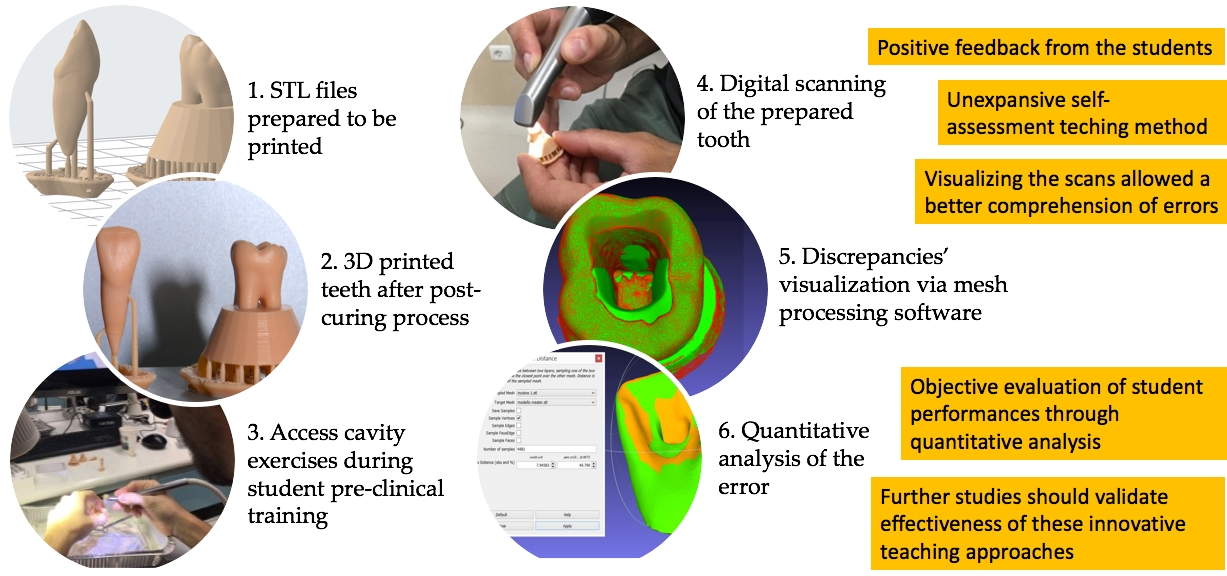

A Novel Self-Assessment Method for Training Access Cavity on 3D Printed Endodontic Models

 ,
,  , ,
, ,  and
and Abstract
Share and Cite
Meglioli, M.; Mergoni, G.; Artioli, F.; Ghezzi, B.; Manfredi, M.; Macaluso, G.M.; Lumetti, S. A Novel Self-Assessment Method for Training Access Cavity on 3D Printed Endodontic Models. Dent. J. 2023, 11, 152. https://doi.org/10.3390/dj11060152
Meglioli M, Mergoni G, Artioli F, Ghezzi B, Manfredi M, Macaluso GM, Lumetti S. A Novel Self-Assessment Method for Training Access Cavity on 3D Printed Endodontic Models. Dentistry Journal. 2023; 11(6):152. https://doi.org/10.3390/dj11060152
Chicago/Turabian StyleMeglioli, Matteo, Giovanni Mergoni, Francesco Artioli, Benedetta Ghezzi, Maddalena Manfredi, Guido Maria Macaluso, and Simone Lumetti. 2023. "A Novel Self-Assessment Method for Training Access Cavity on 3D Printed Endodontic Models" Dentistry Journal 11, no. 6: 152. https://doi.org/10.3390/dj11060152
APA StyleMeglioli, M., Mergoni, G., Artioli, F., Ghezzi, B., Manfredi, M., Macaluso, G. M., & Lumetti, S. (2023). A Novel Self-Assessment Method for Training Access Cavity on 3D Printed Endodontic Models. Dentistry Journal, 11(6), 152. https://doi.org/10.3390/dj11060152