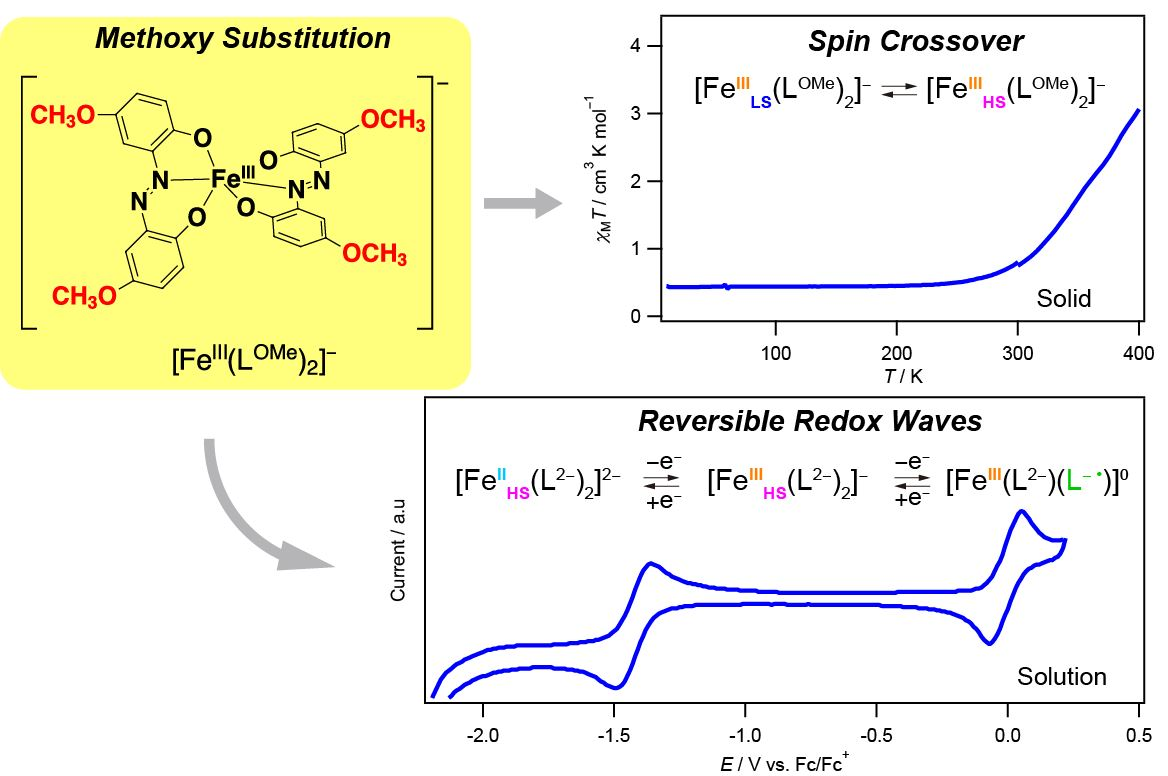

2,2′-Azobisphenolate Ligand Bearing Electron-Donating Methoxy Substituents: Spin-Crossover Ligand Field for a Fe(III) Complex and Stabilization of Ligand-Centered Oxidation Species Due to Its Resonance Effect

 ,
,  ,
,
Abstract
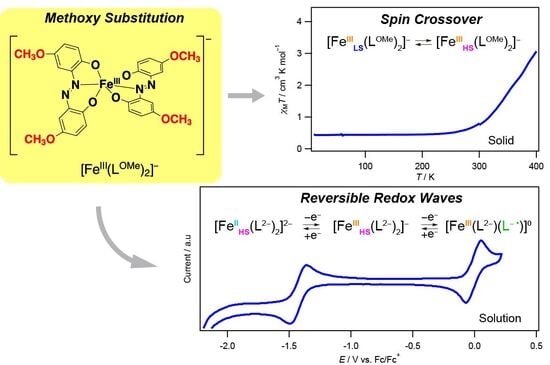
1. Introduction
2. Results and Discussion
2.1. Synthesis and Characterization of H2LOMe
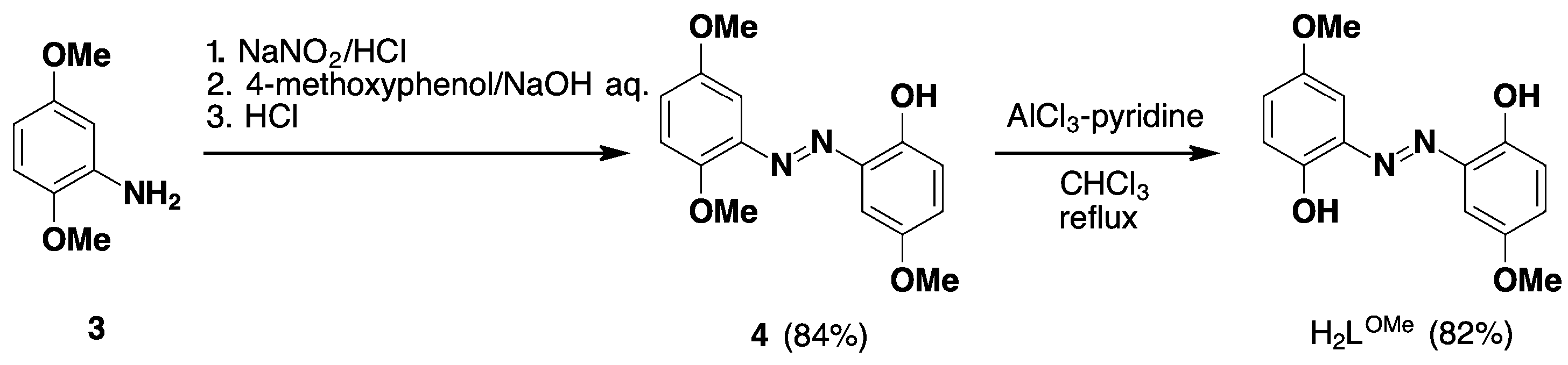
2.1.1. Synthesis of H2LOMe
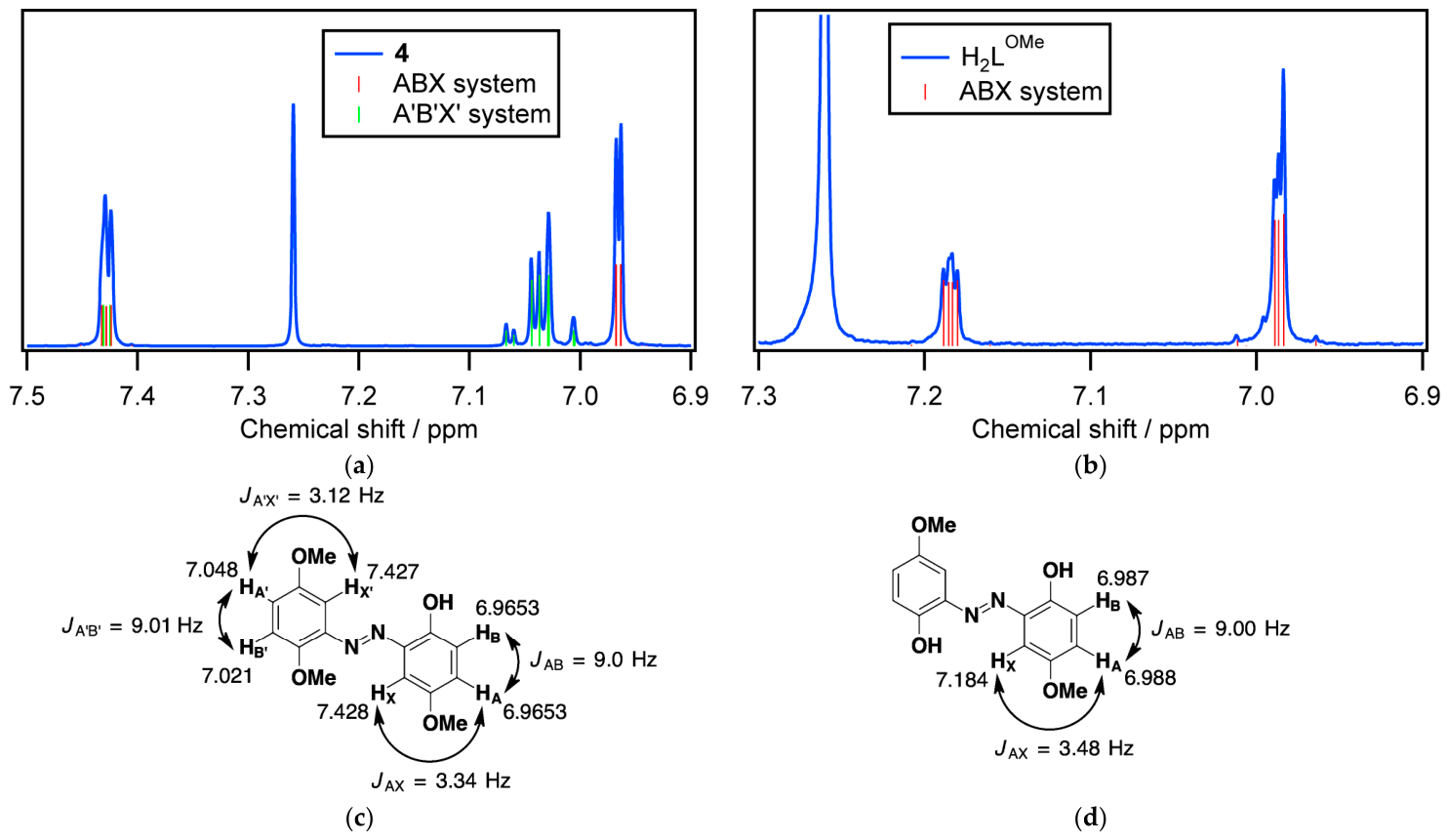
2.1.2. NMR Spectra of 4 and Ligand H2LOMe
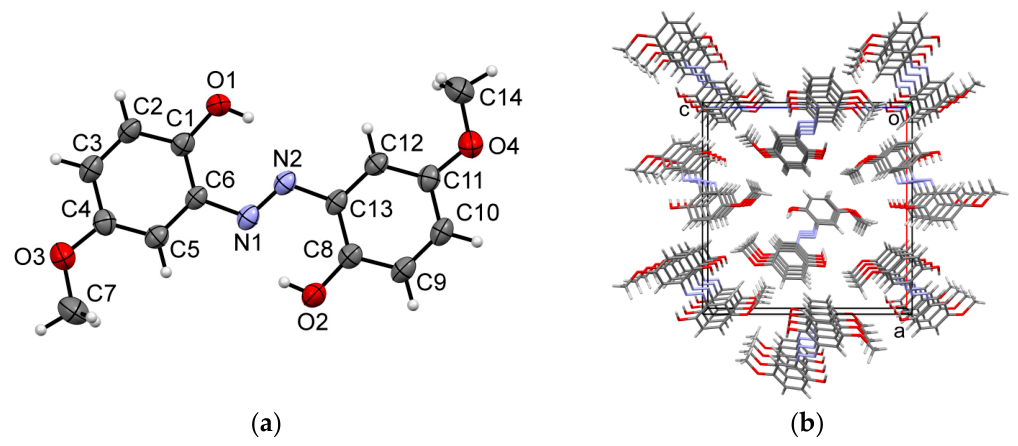
2.1.3. Crystal Structure of H2LOMe
2.2. Synthesis and Characterization of MIII Complexes (MIII = FeIII and AlIII) with Electron-Donating Ligands
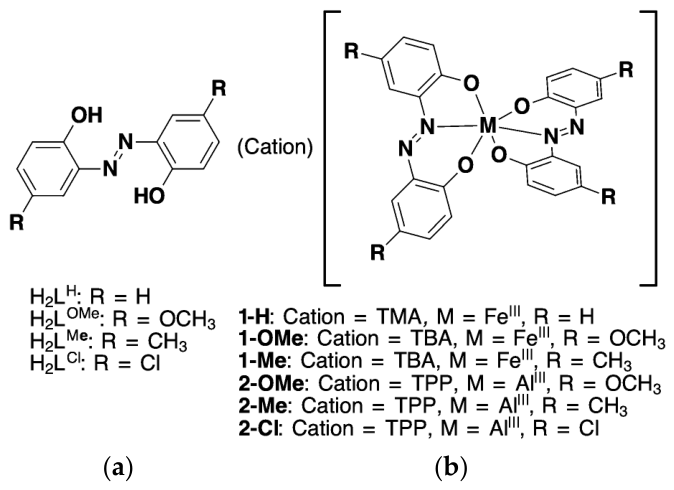
2.2.1. Synthesis of MIII Complexes with H2LOMe and H2LMe (MIII = FeIII and AlIII)
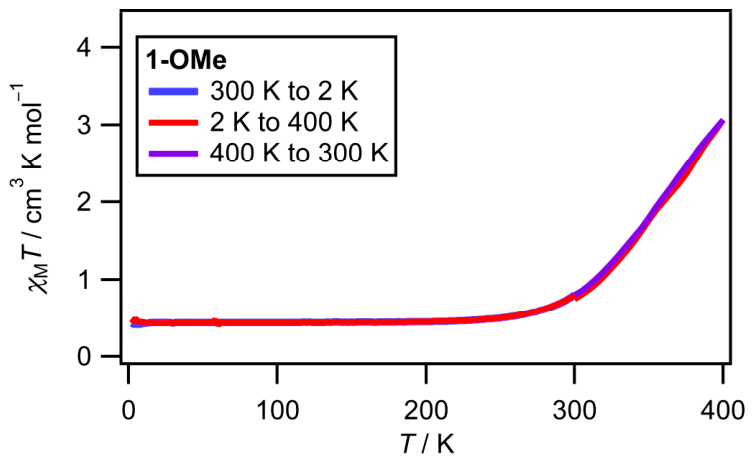
2.2.2. Magnetic Susceptibility of the FeIII Complexes 1-OMe and 1-Me
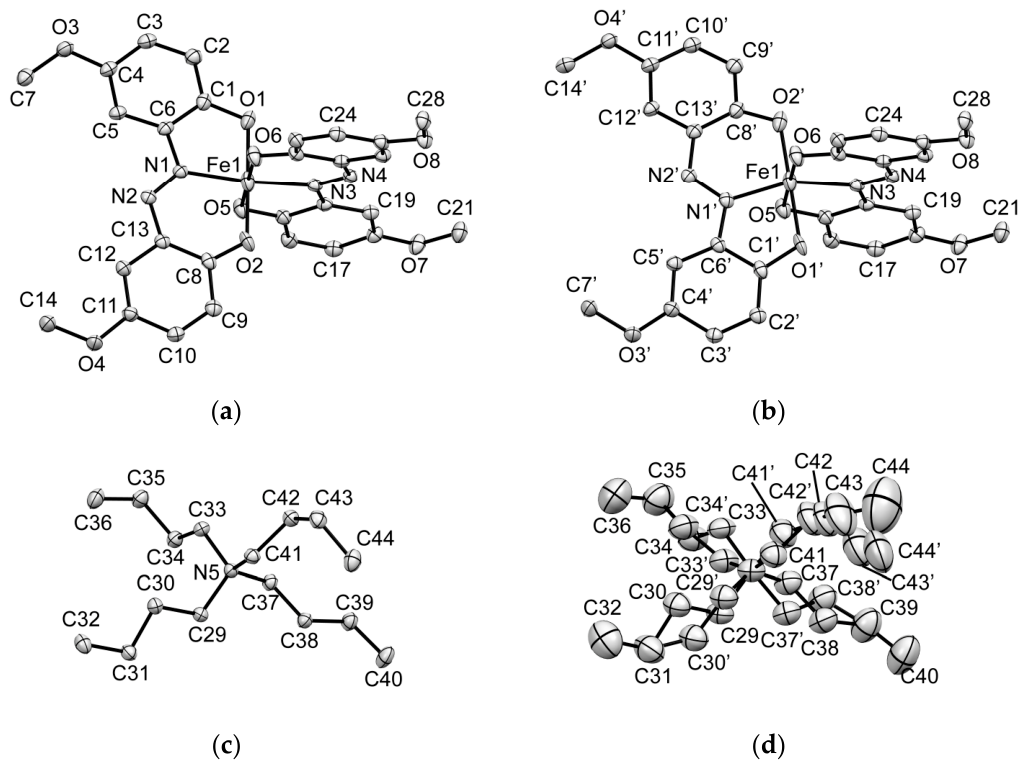
2.2.3. Single-Crystal Structure Analysis
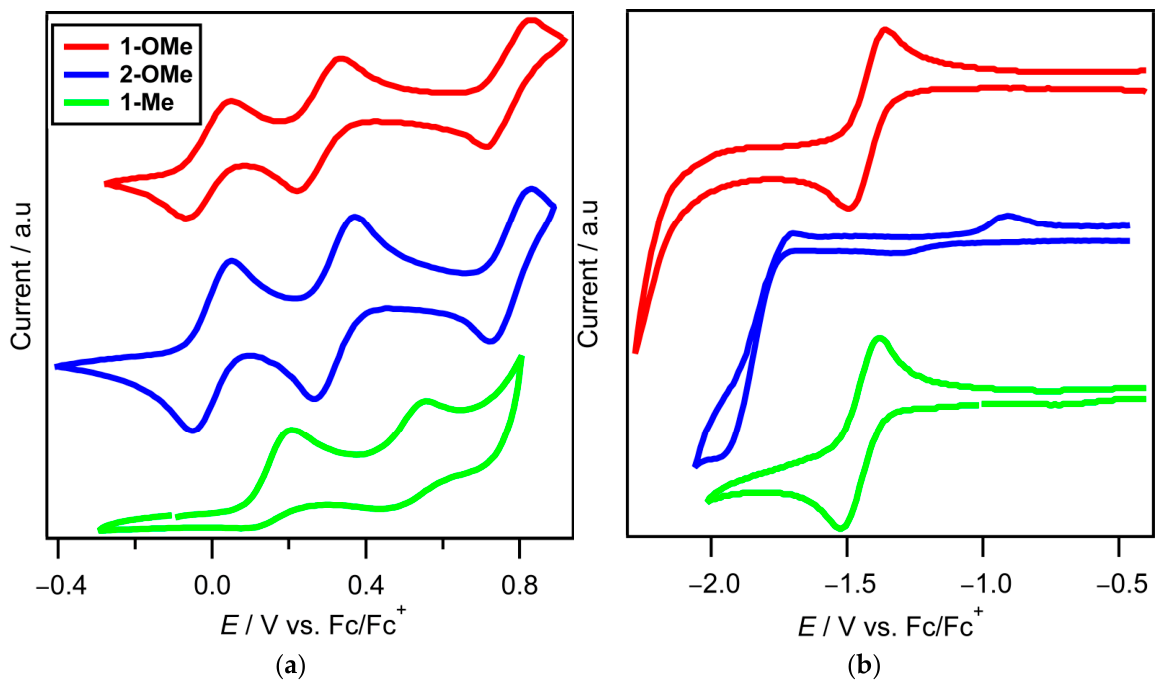
2.2.4. Cyclic Voltammetry
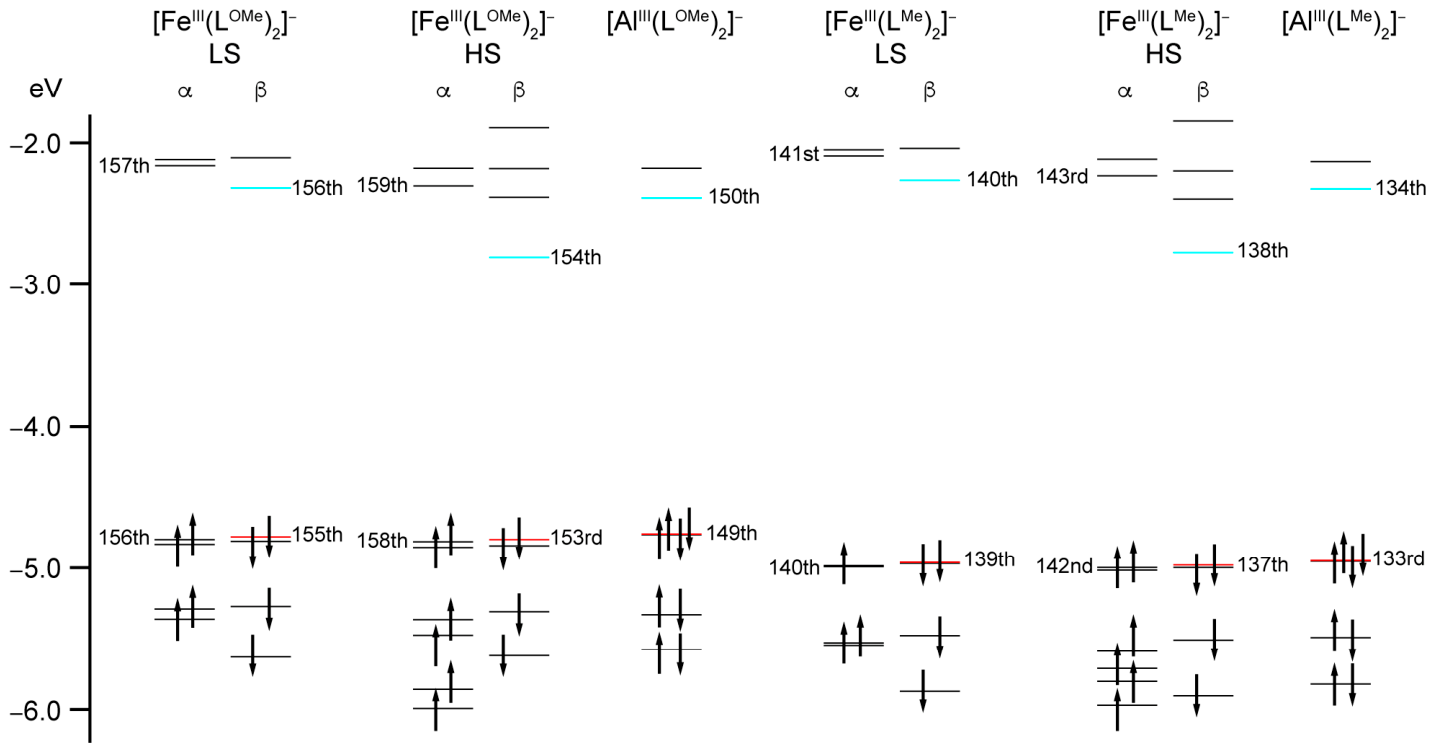
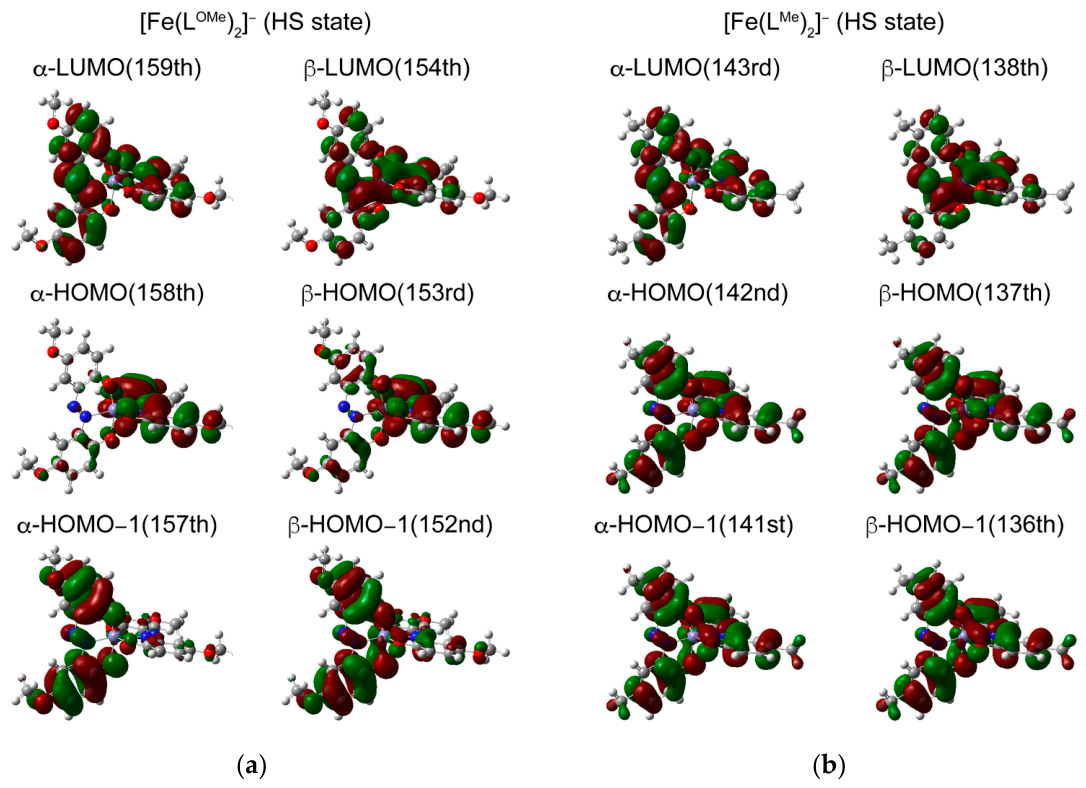
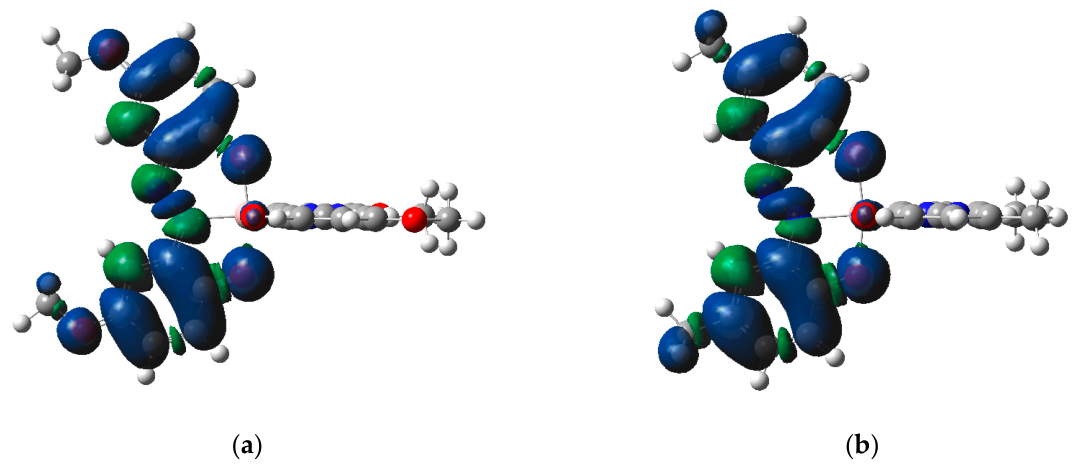
2.2.5. Density Functional Theory Calculations
3. Discussion
4. Materials and Methods
4.1. Synthesis of Ligand
4.1.1. 1-(2-Hydroxy-5-methoxyphenyl)-2-(2,5-dimethoxyphenyl)diazene (4)
4.1.2. 1,2-bis(2-Hydroxy-5-methoxyphenyl)diazene (H2LOMe)
4.2. Synthesis of Trivalent Metal Complexes
4.2.1. TBA[FeIII(LOMe)2] (1-OMe)
4.2.2. TBA[FeIII(LMe)2]·2acetone (1-Me·2acetone)
4.2.3. TPP[AlIII(LOMe)2]·Et2O·CH3OH (2-OMe·Et2O·CH3OH)
4.3. NMR Spectrum Fitting
4.4. Magnetic Susceptibility Measurements
4.5. Crystal Structure Determinations
4.6. Cyclic Voltammetry
4.7. Density Functional Theory (DFT) Calculations
5. Conclusions
Supplementary Materials
Author Contributions
Funding
Data Availability Statement
Acknowledgments
Conflicts of Interest
References
- Sato, O. Dynamic Molecular Crystals with Switchable Physical Properties. Nat. Chem. 2016, 8, 644–656. [Google Scholar] [CrossRef] [Scilit] [PubMed]
- Gütlich, P.; Goodwin, H.A. (Eds.) Spin Crossover in Transition Metal Compounds I–III; Springer: Berlin/Heidelberg, Germany, 2004. [Google Scholar]
- Halcrow, M.A. (Ed.) Spin-Crossover Materials; John Wiley & Sons, Ltd.: Oxford, UK, 2013. [Google Scholar]
- Gütlich, P.; Gaspar, A.B.; Garcia, Y. Spin State Switching in Iron Coordination Compounds. Beilstein J. Org. Chem. 2013, 9, 342–391. [Google Scholar] [CrossRef] [Scilit] [PubMed]
- Nicolazzi, W.; Bousseksou, A. Thermodynamical Aspects of the Spin Crossover Phenomenon. Comptes Rendus Chim. 2018, 21, 1060–1074. [Google Scholar] [CrossRef] [Scilit]
- Takahashi, K. (Ed.) Spin-Crossover Complexes; MDPI: Basel, Switzerland, 2018. [Google Scholar]
- Kitazawa, T. (Ed.) Synthesis and Applications of New Spin Crossover Compounds; MDPI: Basel, Switzerland, 2019. [Google Scholar]
- Tezgerevska, T.; Alley, K.G.; Boskovic, C. Valence Tautomerism in Metal Complexes: Stimulated and Reversible Intramolecular Electron Transfer between Metal Centers and Organic Ligands. Coord. Chem. Rev. 2014, 268, 23–40. [Google Scholar] [CrossRef] [Scilit]
- Chegerev, M.G.; Starikova, A.A. Electronic Lability of Quinonoid-Bridged Dinuclear 3d-Metal Complexes with Tetradentate N-Donor Bases. Eur. J. Inorg. Chem. 2021, 2021, 2684–2695. [Google Scholar] [CrossRef] [Scilit]
- Nadurata, V.L.; Boskovic, C. Switching metal complexes via intramolecular electron transfer: Connections with solvatochromism. Inorg. Chem. Front. 2021, 8, 1840–1864. [Google Scholar] [CrossRef] [Scilit]
- Takahashi, K.; Cui, H.-B.; Okano, Y.; Kobayashi, H.; Einaga, Y.; Sato, O. Electrical Conductivity Modulation Coupled to a High-Spin−Low-Spin Conversion in the Molecular System [FeIII(qsal)2][Ni(dmit)2]3·CH3CN·H2O. Inorg. Chem. 2006, 45, 5739–5741. [Google Scholar] [CrossRef] [Scilit] [PubMed]
- Takahashi, K.; Cui, H.-B.; Okano, Y.; Kobayashi, H.; Mori, H.; Tajima, H.; Einaga, Y.; Sato, O. Evidence of the Chemical Uniaxial Strain Effect on Electrical Conductivity in the Spin-Crossover Conducting Molecular System: [FeIII(qnal)2][Pd(dmit)2]5·Acetone. J. Am. Chem. Soc. 2008, 130, 6688–6689. [Google Scholar] [CrossRef] [Scilit] [PubMed]
- Phan, H.; Benjamin, S.M.; Steven, E.; Brooks, J.S.; Shatruk, M. Photomagnetic Response in Highly Conductive Iron(II) Spin-Crossover Complexes with TCNQ Radicals. Angew. Chem. Int. Ed. 2015, 54, 823–827. [Google Scholar] [CrossRef] [Scilit] [PubMed]
- Ishikawa, R.; Ueno, S.; Nifuku, S.; Horii, Y.; Iguchi, H.; Miyazaki, Y.; Nakano, M.; Hayami, S.; Kumagai, S.; Katoh, K.; et al. Simultaneous Spin-Crossover Transition and Conductivity Switching in a Dinuclear Iron(II) Coordination Compound Based on 7,7′,8,8′-Tetracyano-p-Quinodimethane. Chem. Eur. J. 2020, 26, 1278–1285. [Google Scholar] [CrossRef] [Scilit] [PubMed]
- Wang, M.; Li, Z.Y.; Ishikawa, R.; Yamashita, M. Spin Crossover and Valence Tautomerism Conductors. Coord. Chem. Rev. 2021, 435, 213819. [Google Scholar] [CrossRef] [Scilit]
- Nihei, M.; Tahira, H.; Takahashi, N.; Otake, Y.; Yamamura, Y.; Saito, K.; Oshio, H. Multiple Bistability and Tristability with Dual Spin-State Conversions in [Fe(dpp)2][Ni(mnt)2]2·MeNO2. J. Am. Chem. Soc. 2010, 132, 3553–3560. [Google Scholar] [CrossRef] [Scilit] [PubMed]
- Ohkoshi, S.; Imoto, K.; Tsunobuchi, Y.; Takano, S.; Tokoro, H. Light-Induced Spin-Crossover Magnet. Nat. Chem. 2011, 3, 564–569. [Google Scholar] [CrossRef] [Scilit] [PubMed]
- Ababei, R.; Pichon, C.; Roubeau, O.; Li, Y.-G.; Bréfuel, N.; Buisson, L.; Guionneau, P.; Mathonière, C.; Clérac, R. Rational Design of a Photomagnetic Chain: Bridging Single-Molecule Magnets with a Spin-Crossover Complex. J. Am. Chem. Soc. 2013, 135, 14840–14853. [Google Scholar] [CrossRef] [Scilit] [PubMed]
- Fukuroi, K.; Takahashi, K.; Mochida, T.; Sakurai, T.; Ohta, H.; Yamamoto, T.; Einaga, Y.; Mori, H. Synergistic Spin Transition between Spin Crossover and Spin-Peierls-like Singlet Formation in the Halogen-Bonded Molecular Hybrid System: [Fe(Iqsal)2][Ni(dmit)2]⋅CH3CN⋅H2O. Angew. Chem. Int. Ed. 2014, 53, 1983–1986. [Google Scholar] [CrossRef] [Scilit] [PubMed]
- Jiang, Y.; Hayes, S.; Bittmann, S.; Sarracini, A.; Liu, L.C.; Müller-Werkmeister, H.M.; Miyawaki, A.; Hada, M.; Nakano, S.; Takahashi, R.; et al. Direct Observation of Photoinduced Sequential Spin Transition in a Halogen-Bonded Hybrid System by Complementary Ultrafast Optical and Electron Probes. Nat. Commun. 2024, 15, 4604. [Google Scholar] [CrossRef] [Scilit] [PubMed]
- Ohkoshi, S.I.; Takano, S.; Imoto, K.; Yoshikiyo, M.; Namai, A.; Tokoro, H. 90-Degree Optical Switching of Output Second-Harmonic Light in Chiral Photomagnet. Nat. Photonics 2014, 8, 65–71. [Google Scholar] [CrossRef] [Scilit]
- Lochenie, C.; Schötz, K.; Panzer, F.; Kurz, H.; Maier, B.; Puchtler, F.; Agarwal, S.; Köhler, A.; Weber, B. Spin-Crossover Iron(II) Coordination Polymer with Fluorescent Properties: Correlation between Emission Properties and Spin State. J. Am. Chem. Soc. 2018, 140, 700–709. [Google Scholar] [CrossRef] [Scilit] [PubMed]
- Egger, C.; Piguet, C. Spin-Crossover Modulated Luminescence in Materials and Molecular Complexes. Helv. Chim. Acta 2026, 109, e00180. [Google Scholar] [CrossRef] [Scilit]
- Jornet-Mollá, V.; Duan, Y.; Giménez-Saiz, C.; Tang, Y.-Y.Y.; Li, P.-F.F.; Romero, F.M.; Xiong, R.-G.G. A Ferroelectric Iron(II) Spin Crossover Material. Angew. Chem. Int. Ed. 2017, 56, 14052–14056. [Google Scholar] [CrossRef] [Scilit] [PubMed]
- Akiyoshi, R.; Hirota, Y.; Kosumi, D.; Tsutsumi, M.; Nakamura, M.; Lindoy, L.F.; Hayami, S. Ferroelectric Metallomesogens Composed of Achiral Spin Crossover Molecules. Chem. Sci. 2019, 10, 5843–5848. [Google Scholar] [CrossRef] [Scilit] [PubMed]
- Wu, S.-Q.; Su, S.-Q.; Kanegawa, S.; Sato, O. Active Polarization Engineering between Symmetry Inequivalent Polar States Using Electron Transfer: A Nonferroelectric Approach. Acc. Chem. Res. 2025, 58, 1284–1295. [Google Scholar] [CrossRef] [Scilit] [PubMed]
- Shepherd, H.J.; Gural’Skiy, I.A.; Quintero, C.M.; Tricard, S.; Salmon, L.; Molnár, G.; Bousseksou, A. Molecular Actuators Driven by Cooperative Spin-State Switching. Nat. Commun. 2013, 4, 2607. [Google Scholar] [CrossRef] [Scilit] [PubMed]
- Manrique-Juarez, M.D.; Rat, S.; Mathieu, F.; Saya, D.; Séguy, I.; Leïchlé, T.; Nicu, L.; Salmon, L.; Molnár, G.; Bousseksou, A. Microelectromechanical Systems Integrating Molecular Spin Crossover Actuators. Appl. Phys. Lett. 2016, 109, 061903. [Google Scholar] [CrossRef] [Scilit]
- Manrique-Juarez, M.D.; Mathieu, F.; Shalabaeva, V.; Cacheux, J.; Rat, S.; Nicu, L.; Leïchlé, T.; Salmon, L.; Molnár, G.; Bousseksou, A. A Bistable Microelectromechanical System Actuated by Spin-Crossover Molecules. Angew. Chem. Int. Ed. 2017, 56, 8074–8078. [Google Scholar] [CrossRef] [Scilit] [PubMed]
- Dei, A.; Gatteschi, D.; Pardi, L.; Russo, U. Tetraoxolene Radical Stabilization by the Interaction with Transition-Metal Ions. Inorg. Chem. 1991, 30, 2589–2594. [Google Scholar] [CrossRef] [Scilit]
- Min, K.S.; DiPasquale, A.; Rheingold, A.L.; Miller, J.S. Room-Temperature Spin Crossover Observed for [(TPyA)FeII(DBQ2− )FeII(TPyA)]2+ [TPyA = Tris(2-pyridylmethyl)amine; DBQ2- = 2,5-Di-tert-butyl-3,6-dihydroxy-1,4-benzoquinonate]. Inorg. Chem. 2007, 46, 1048–1050. [Google Scholar] [CrossRef] [Scilit] [PubMed]
- Sadhukhan, P.; Wu, S.Q.; Long, J.I.; Nakanishi, T.; Kanegawa, S.; Gao, K.; Yamamoto, K.; Okajima, H.; Sakamoto, A.; Baker, M.L.; et al. Manipulating Electron Redistribution to Achieve Electronic Pyroelectricity in Molecular [FeCo] Crystals. Nat. Commun. 2021, 12, 4836. [Google Scholar] [CrossRef] [Scilit] [PubMed]
- Takahashi, K.; Kawamukai, K.; Okai, M.; Mochida, T.; Sakurai, T.; Ohta, H.; Yamamoto, T.; Einaga, Y.; Shiota, Y.; Yoshizawa, K. A New Family of Anionic FeIII Spin Crossover Complexes Featuring a Weak-Field N2O4 Coordination Octahedron. Chem. Eur. J. 2016, 22, 1253–1257. [Google Scholar] [CrossRef] [Scilit] [PubMed]
- Murata, S.; Takahashi, K.; Sakurai, T.; Ohta, H.; Yamamoto, T.; Einaga, Y.; Shiota, Y.; Yoshizawa, K. The Role of Coulomb Interactions for Spin Crossover Behaviors and Crystal Structural Transformation in Novel Anionic Fe(III) Complexes from a π-Extended ONO Ligand. Crystals 2016, 6, 49. [Google Scholar] [CrossRef] [Scilit]
- Hirota, M.; Murata, S.; Sakurai, T.; Ohta, H.; Takahashi, K. The Relationship Between Spin Crossover (SCO) Behaviors, Cation and Ligand Motions, and Intermolecular Interactions in a Series of Anionic SCO Fe(III) Complexes with Halogen-Substituted Azobisphenolate Ligands. Molecules 2024, 29, 5473. [Google Scholar] [CrossRef] [Scilit] [PubMed]
- Murata, S.; Takahashi, K.; Mochida, T.; Sakurai, T.; Ohta, H.; Yamamoto, T.; Einaga, Y. Cooperative Spin-Crossover Transition from Three-Dimensional Purely π-Stacking Interactions in a Neutral Heteroleptic Azobisphenolate FeIII Complex with a N3O3 Coordination Sphere. Dalton Trans. 2017, 46, 5786–5789. [Google Scholar] [CrossRef] [Scilit] [PubMed]
- Miyawaki, A.; Mochida, T.; Sakurai, T.; Ohta, H.; Takahashi, K. The Impact of the Next-Nearest Neighbor Dispersion Interactions on Spin Crossover Transition Enthalpy Evidenced by Experimental and Computational Analyses of Neutral π-Extended Heteroleptic Fe(III) Complexes. Inorg. Chem. 2020, 59, 12295–12303. [Google Scholar] [CrossRef] [Scilit] [PubMed]
- Miyawaki, A.; Eda, K.; Mochida, T.; Sakurai, T.; Ohta, H.; Nakajima, T.; Takahashi, K. Spin-Crossover-Triggered Linkage Isomerization by the Pedal-like Motion of the Azobenzene Ligand in a Neutral Heteroleptic Iron(III) Complex. Inorg. Chem. 2021, 60, 12735–12739. [Google Scholar] [CrossRef] [Scilit] [PubMed]
- Phonsri, W.; Lewis, B.A.I.; Jameson, G.N.L.; Murray, K.S. Double Spin Crossovers: A New Double Salt Strategy to Improve Magnetic and Memory Properties. Chem. Commun. 2019, 55, 14031–14034. [Google Scholar] [CrossRef] [Scilit] [PubMed]
- Smékal, Z.; Novák, P.; Zeller, M.; Antal, P.; Čižmár, E.; Herchel, R. Synthesis, Crystal Structure, 57Fe Mössbauer Spectroscopy and Magnetic Properties of High-Spin Iron(III) Anionic Complexes [Fe(azp)2]- (H2azp = 2,2′-dihydroxyazobenzene) with Organic Cations. Polyhedron 2022, 212, 115586. [Google Scholar] [CrossRef] [Scilit]
- Fan, Z.-X.; Lian, K.-T.; Liao, P.-Y.; Ruan, Z.-Y.; Ni, Z.-P.; Tong, M.-L. Synergetic Spin Crossover and Fluorescence in a Mononuclear Iron(III) Complex. Chem. Commun. 2024, 60, 13227–13230. [Google Scholar] [CrossRef] [Scilit] [PubMed]
- Takahashi, K.; Noguchi, T.; Ueda, K.; Miyawaki, A.; Murata, S. Molecular Structures and Redox Properties of Homoleptic Aluminum(III) Complexes with Azobisphenolate (Azp) Ligands. Inorganics 2022, 10, 84. [Google Scholar] [CrossRef] [Scilit]
- Schetty, G.; Steiner, E. Untersuchungen Der Symmetrieverhältnisse in Äquatorial Koordinierten 2:1-Arylazo-CoIII-Komplexen Mit Hilfe Der Protonenresonanz. Helv. Chim. Acta 1972, 55, 1509–1532. [Google Scholar] [CrossRef] [Scilit]
- Pople, J.A.; Schneider, W.G.; Bernstein, H.J. High-Resolution Nuclear Magnetic Resonance; McGraw-Hill Book Company, Inc.: New York, NY, USA; Toronto, ON, Canada; London, UK, 1959; pp. 132–138. [Google Scholar]
- Bondi, A. van der Waals Volumes and Radii. J. Phys. Chem. 1964, 68, 441–451. [Google Scholar] [CrossRef] [Scilit]
- Martin, J.P.; Zarembowitch, J.; Bousseksou, A.; Dworkin, A.; Haasnoot, J.G.; Varret, F. Solid State Effects on Spin Transitions: Magnetic, Calorimetric, and Möessbauer-Effect Properties of [FexCo1-x(4,4′-Bis-1,2,4-Triazole)2(NCS)2]·H2O Mixed-Crystal Compounds. Inorg. Chem. 1994, 33, 6325–6333. [Google Scholar] [CrossRef] [Scilit]
- Shannon, R.D. Revised Effective Ionic Radii and Systematic Studies of Interatomic Distances in Halides and Chalcogenides. Acta Cryst. 1976, A32, 751–767. [Google Scholar] [CrossRef] [Scilit]
- Feldberg, S.W. Electroanalytical Chemistry, Volume 3; Bard, A.J., Ed.; Marcel Dekker, INC.: New York, NY, USA, 1969; pp. 199–296. [Google Scholar]
- Bard, A.J.; Faulkner, L.R. Electrochemical Methods, Fundamentals and Applications, 2nd ed.; Appendix B; Wiley: New York, NY, USA, 2000. [Google Scholar]
- Tomasi, J.; Mennucci, B.; Cammi, R. Quantum mechanical continuum solvation models. Chem. Rev. 2005, 105, 2999–3093. [Google Scholar] [CrossRef] [Scilit] [PubMed]
- Schubert, E.M. Utilizing the Evans Method with a Superconducting NMR Spectrometer in the Undergraduate Laboratory. J. Chem. Educ. 1992, 69, 62. [Google Scholar] [CrossRef] [Scilit]
- König, E. Landolt-Börnstein Neue Serie Gruppe II; Hellwege, K.-H., Hellwege, A.M., Eds.; Springer: Berlin/Heidelberg, Germany, 1966; Volume 2, pp. 1-16–1-18. [Google Scholar]
- Becke, A.D. Density-functional thermochemistry. III. The role of exact exchange. J. Chem. Phys. 1993, 98, 5648–5652. [Google Scholar] [CrossRef] [Scilit]
- Lee, C.; Yang, W.; Parr, R.G. Development of the Colle-Salvetti Correlation-Energy Formula into a Functional of the Electron Density. Phys. Rev. B 1988, 37, 785–789. [Google Scholar] [CrossRef] [Scilit] [PubMed]
- Frisch, M.J.; Trucks, G.W.; Schlegel, H.B.; Scuseria, G.E.; Robb, M.A.; Cheeseman, J.R.; Scalmani, G.; Barone, V.; Petersson, G.A.; Nakatsuji, H.; et al. Gaussian 16, Revision C.01; Gaussian, Inc.: Wallingford, CT, USA, 2016. [Google Scholar]
- Krishnan, R.; Binkley, J.S.; Seeger, R.; Pople, J.A. Self-consistent Molecular Orbital Methods. XX. A Basis Set for Correlated Wave Functions. J. Chem. Phys. 1980, 72, 650–654. [Google Scholar] [CrossRef] [Scilit]
- Clark, T.; Chandrasekhar, J.; Spitznagel, G.W.; Schleyer, P.V.R. Efficient Diffuse Function-Augmented Basis Sets for Anion Calculations. III. The 3-21+G Basis Set for First-Row Elements. Li-F. J. Comput. Chem. 1983, 4, 294–301. [Google Scholar] [CrossRef] [Scilit]
- McLean, A.D.; Chandler, G.S. Contracted Gaussian Basis Sets for Molecular Calculations. I. Second Row Atoms, Z =11–18. J. Chem. Phys. 1980, 72, 5639–5648. [Google Scholar] [CrossRef] [Scilit]
- Francl, M.M.; Pietro, W.J.; Hehre, W.J.; Binkley, J.S.; Gordon, M.S.; DeFrees, D.J.; Pople, J.A. Self-consistent Molecular Orbital Methods. XXIII. A Polarization-type Basis Set for Second-row Elements. J. Chem. Phys. 1982, 77, 3654–3665. [Google Scholar] [CrossRef] [Scilit]
- Spitznagel, G.W.; Clark, T.; von Ragué Schleyer, P.; Hehre, W.J. An Evaluation of the Performance of Diffuse Function-Augmented Basis Sets for Second Row Elements, Na-Cl. J. Comput. Chem. 1987, 8, 1109–1116. [Google Scholar] [CrossRef] [Scilit]
- Wachters, A.J.H. Gaussian Basis Set for Molecular Wavefunctions Containing Third-Row Atoms. J. Chem. Phys. 1970, 52, 1033–1036. [Google Scholar] [CrossRef] [Scilit]
- Hay, P.J. Gaussian Basis Sets for Molecular Calculations. The Representation of 3 d Orbitals in Transition-metal Atoms. J. Chem. Phys. 1977, 66, 4377–4384. [Google Scholar] [CrossRef] [Scilit]



| Complex | 1-OMe | 1-Me | 2-OMe | 1-H | |||
|---|---|---|---|---|---|---|---|
| Temp. (K) | 90 | 296 | 400 | 296 | 90 | 90 | 293 |
| M1-O1 (Å) | 1.941(2) | 1.982(5) | 1.978(5) | 1.997(4) | 1.942(3) | 1.9233(15) | 1.975(2) |
| M1-O2 (Å) | 1.842(2) | 1.829(5) | 1.889(5) | 1.945(4) | 1.807(5) | 1.8593(16) | 1.947(2) |
| M1-N1 (Å) | 1.920(2) | 1.943(4) | 2.083(5) | 2.168(3) | 2.005(3) | 1.9523(16) | 2.166(2) |
| M1-O5 (Å) | 1.9312(16) | 1.954(4) | 1.967(4) | 1.997(4) a | 1.896(2) | 1.9217(13) | 1.9836(19) |
| M1-O6 (Å) | 1.8586(16) | 1.854(3) | 1.898(4) | 1.945(4) a | 1.845(2) | 1.8898(13) | 1.942(2) |
| M1-N3 (Å) | 1.9153(17) | 1.941(4) | 2.087(4) | 2.168(3) a | 2.005(2) | 1.9220(14) | 2.1537(19) |
| Σ (°) b | 31.4(4) | 39.5(8) | 65.1(9) | 86.2(6) | 34.4(5) | 39.4(3) | 89.6(3) |
| Θ (°) c | 42.4(4) | 40.3(9) | 104.8(10) | 170.5(7) | 74.4(6) | 53.2(3) | 169.6(4) |
| L1 occupancy | 74.6(3)% | 68.8(5)% | 64.4(6)% | 82.5(5)% | 72.8(5)% | 86.7% | 86.7% |
| L2 occupancy | 91.9(3)% | 83.2(5)% | 81.9(6)% | 82.5(5)% a | 100% | 100% | 100% |
| Cation occupancy | 100% | 85.5(3)% | 58.0(3)% | 50.4(3)% | 100% | 100% | 100% |
| Spin-state | LS | LS | HS | HS | — | LS | HS |
| Reference | This work | This work | This work | This work | This work | [33] | [33] |
| Complex | First Cathodic Couple | First Anodic Couple | Second Anodic Couple | Third Anodic Couple | ||||||||
|---|---|---|---|---|---|---|---|---|---|---|---|---|
| Epa | Epc | Emid b | Epa | Epc | Emid b | Epa | Epc | Emid b | Epa | Epc | Emid b | |
| 1-OMe | −1.36 | −1.50 | −1.43 | 0.05 | −0.07 | −0.01 | 0.34 | 0.22 | 0.28 | 0.83 | 0.71 | 0.77 |
| 2-OMe | −1.70 c | −1.93 d | −1.82 | 0.05 | −0.05 | 0.00 | 0.37 | 0.27 | 0.32 | 0.83 | 0.72 | 0.78 |
| 1-Me | −1.38 | −1.53 | −1.45 | 0.21 | 0.08 c | 0.14 | 0.56 | 0.45 c | 0.50 | — | — | — |
| 2-Me e | −1.73 c | −1.96 | −1.85 | 0.24 | 0.11 | 0.18 | 0.60 | 0.50 | 0.55 | — | — | — |
| 2-Cl e | −1.50 | −1.62 | −1.56 | 0.57 | 0.40 c | 0.49 | 0.90 d | — | — | — | — | — |
| Anion | [FeIII(LOMe)2]− | [AlIII(LOMe)2]− | [FeIII(LMe)2]− | [AlIII(LMe)2]− a | ||||||
|---|---|---|---|---|---|---|---|---|---|---|
| Spin-State | LS | HS | — | LS | HS | — | ||||
| α | β | α | β | α | β | α | β | |||
| LUMO + 1 | −2.117 | −2.105 | −2.179 | −2.382 | −2.178 | −2.050 | −2.039 | −2.116 | −2.395 | −2.132 |
| LUMO | −2.161 | −2.315 | −2.303 | −2.805 | −2.388 | −2.128 | −2.262 | −2.231 | −2.770 | −2.324 |
| HOMO | −4.796 | −4.777 | −4.811 | −4.795 | −4.757 | −4.985 | −4.959 | −4.997 | −4.979 | −4.946 |
| HOMO − 1 | −4.830 | −4.810 | −4.852 | −4.841 | −4.762 | −4.992 | −4.967 | −5.016 | −4.998 | −4.953 |
Disclaimer/Publisher’s Note: The statements, opinions and data contained in all publications are solely those of the individual author(s) and contributor(s) and not of MDPI and/or the editor(s). MDPI and/or the editor(s) disclaim responsibility for any injury to people or property resulting from any ideas, methods, instructions or products referred to in the content. |
© 2026 by the authors. Licensee MDPI, Basel, Switzerland. This article is an open access article distributed under the terms and conditions of the Creative Commons Attribution (CC BY) license.
Share and Cite
Takahashi, K.; Kasazaki, T.; Tsuchiya, S.; Ueda, K.; Miyawaki, A.; Murata, S.; Sakurai, T.; Ohta, H.; Osakai, T. 2,2′-Azobisphenolate Ligand Bearing Electron-Donating Methoxy Substituents: Spin-Crossover Ligand Field for a Fe(III) Complex and Stabilization of Ligand-Centered Oxidation Species Due to Its Resonance Effect. Inorganics 2026, 14, 223. https://doi.org/10.3390/inorganics14090223
Takahashi K, Kasazaki T, Tsuchiya S, Ueda K, Miyawaki A, Murata S, Sakurai T, Ohta H, Osakai T. 2,2′-Azobisphenolate Ligand Bearing Electron-Donating Methoxy Substituents: Spin-Crossover Ligand Field for a Fe(III) Complex and Stabilization of Ligand-Centered Oxidation Species Due to Its Resonance Effect. Inorganics. 2026; 14(9):223. https://doi.org/10.3390/inorganics14090223
Chicago/Turabian StyleTakahashi, Kazuyuki, Taisei Kasazaki, Shogo Tsuchiya, Keiji Ueda, Atsuhiro Miyawaki, Suguru Murata, Takahiro Sakurai, Hitoshi Ohta, and Toshiyuki Osakai. 2026. "2,2′-Azobisphenolate Ligand Bearing Electron-Donating Methoxy Substituents: Spin-Crossover Ligand Field for a Fe(III) Complex and Stabilization of Ligand-Centered Oxidation Species Due to Its Resonance Effect" Inorganics 14, no. 9: 223. https://doi.org/10.3390/inorganics14090223
APA StyleTakahashi, K., Kasazaki, T., Tsuchiya, S., Ueda, K., Miyawaki, A., Murata, S., Sakurai, T., Ohta, H., & Osakai, T. (2026). 2,2′-Azobisphenolate Ligand Bearing Electron-Donating Methoxy Substituents: Spin-Crossover Ligand Field for a Fe(III) Complex and Stabilization of Ligand-Centered Oxidation Species Due to Its Resonance Effect. Inorganics, 14(9), 223. https://doi.org/10.3390/inorganics14090223