Article

Synthesis, Luminescent Properties and Photo-Oxidation Catalysis of Brominated Boron Pyridine Hydrazone Fluorenones and Their σ-Platinum Complexes


Fachbereich Chemie, Universität Konstanz, Universitätsstraße 10, D-78457 Konstanz, Germany
*
Author to whom correspondence should be addressed.
Inorganics 2026, 14(8), 197; https://doi.org/10.3390/inorganics14080197
Submission received: 11 June 2026 / Revised: 17 July 2026 / Accepted: 20 July 2026 / Published: 24 July 2026
(This article belongs to the Special Issue State-of-the-Art Inorganic Chemistry in Germany, 2nd Edition)

Abstract

Three new isomeric pyridone fluorenone hydrazone-based boron complexes, 3-BrN to 5-BrN, with bromination at the 3-, 4-, or 5-position of the pyridone ring and their corresponding σ-platinum complexes trans-Pt(PEt3)2(n-N)X (n = 3, 4, or 5; X = Cl, Br, I) resulting from oxidative addition of the aryl-Br bond of n-BrN to Pt(PEt3)2 and, for X = Cl, I, subsequent substitution of the halogenide ligand, were synthesized and characterized by NMR, UV–Vis absorption, and photoluminescence spectroscopy. The molecular structures of dyes 3-BrN to 5-BrN and of seven complexes, including the cis-isomer of the bromo complex resulting from 3-BrN, were established by single X-ray diffraction. The nearly orthogonal orientation of the Pt coordination plane with respect to the plane of the dye ligand limits intermolecular π-stacking interactions in the crystalline state while giving rise to extensive C-H···halogen and C-H···π interactions, resulting in intricate packing patterns. Electronic absorption spectra of dyes 3-BrN to 5-BrN show a prominent HOMO-LUMO absorption band at ca. 520 nm, which is red-shifted and intensifies on platination. All compounds are dual fluorescence and phosphorescence emitters in the range of 520 to 670 nm, or at ca. 1000 nm, both at room temperature and at 77 K. The population of an excited triplet state and their photostability even towards continuous light irradiation renders these compounds efficient sensitizers for singlet oxygen generation and catalysts for the photo-oxidation of triphenylphosphine.

1. Introduction

Phosphorescence is the radiative deactivation of a molecule from an electronically excited triplet state to the singlet ground state. Owing to their relatively long lifetimes, usually in the range of tens to hundreds of microseconds, excited triplet states are capable of energy or charge transfer processes with substrates, hence triggering reactions that ultimately convert the intermittently stored photonic energy into chemical or electrical energy. Such photoinitiated energy transfer schemes are widely used for generating reactive 1O2 from relatively inert 3O2 [1], which can then be used in photo-oxidations [2,3,4,5,6] or for medical purposes, e.g., in bioimaging or in photodynamic therapy [7,8,9,10,11,12,13,14,15,16,17,18,19,20,21]. In contrast to fluorescent dyes, molecules with emissive triplet states can utilize excitons of the singlet and triplet manifolds, which makes them attractive for dye-sensitized solar cells (DSSCs) and organic light-emitting devices (OLEDs) [22,23,24,25,26,27,28,29]. Populating an excited triplet state from a singlet ground state requires a spin flip known as intersystem crossing (ISC) [30,31]. Among the different pathways to overcome the quantum chemically forbidden nature of ISC, the so-called heavy atom effect (HAE) draws on the entanglement between the magnetic moments resulting from the electron spin and the orbital angular momentum [32], or, according to the rule of El Sayed, the change in orbital type during an electronic transition [33]. The scaling of the ISC rate constant kISC with the atomic number Z of the nucleus with the power of eight, i.e., kISCZ8, and the propensity of transition metal ions to engage in charge-transfer absorptions where charge is either shifted from metal dπ into π* orbitals of the ligand (metal-to-ligand charge-transfer, MLCT) or from a π orbital of the ligand into an unoccupied metal dπ-orbital (ligand-to-metal charge-transfer, LMCT), explain why complexes with metal ions of the 5d-elements, in particular platinum [34,35,36,37], iridium [34,38], or gold [39,40], hold prominent positions in this field [41].
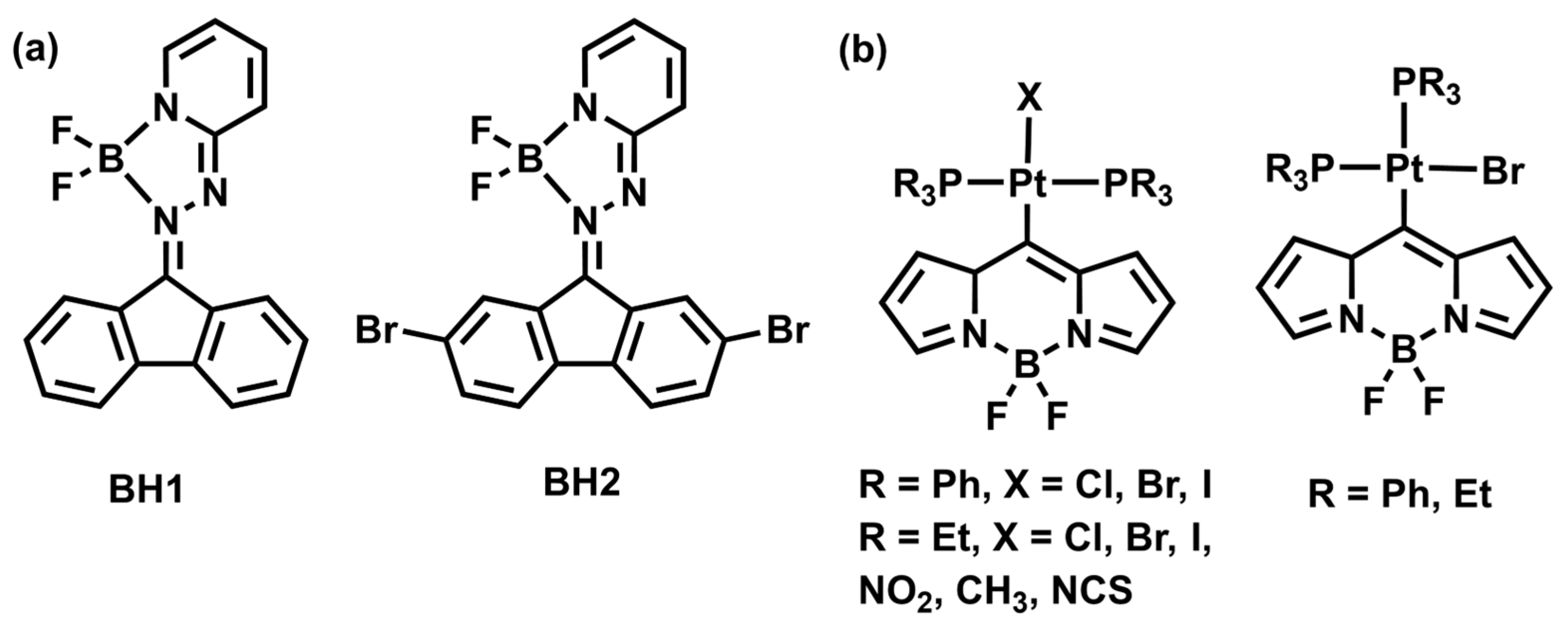
In 2023, Feringa and coworkers published on the pyridine-functionalized fluorenone hydrazine boron difluoride complexes BH1 and BH2 of Figure 1. Quite intriguingly, these molecules display efficient ISC even without an incorporated heavy atom [2]. With an onset of phosphorescence emission at ca. 820 nm, the triplet energy is sufficiently high to render triplet energy transfer to dissolved oxygen exergonic, so that the two compounds exhibit remarkably high quantum yields ΦΔ of 0.41 and 0.46 for singlet-oxygen generation and partially quenched fluorescence emission (Φfl = 0.07 to 0.33). Under irradiation with green light (λirr = 514 nm), they achieve efficient photo-oxidation of triphenylphosphine, 1,3-diphenylisobenzofuran, and 2-furoic acid with molecular oxygen [2].
The monoanionic N^N -BF2 chelate of complexes BH1 and BH2 can be viewed as a variation of the well-known boron dipyrromethene (BODIPY) motif [44], which holds a pivotal role in the field of molecular emitters and photosensitizers, offering highly favourable properties such as high luminescence quantum yields, narrow emissions, excellent photostability, and rich potential for further functionalization [45,46,47,48,49,50,51]. We and others have reported on emissive platinum-BODIPY complexes with either direct attachment of a Pt(PR3)2(X) complex entity to the BODIPY core or its attachment via an alkynyl linker. Both kinds of complexes are competent in promoting ISC and display dual fluorescence and phosphorescence emissions from excited BODIPY 1ππ* and 3ππ* states [3,42,43,52,53,54,55,56,57,58]. The emission properties of such complexes depend on the choice of the anionic ligand X, the stereochemistry at the Pt ion with either a cis or trans arrangement of the PR3 ligands, and the site of platinum attachment [3,42,43,52,53,54,55,56,57]. Complexes with an additional dye-based ligand X often show intricate energy transfer phenomena that may give rise to several different photoexcited and emissive states [43,52,57,59]. Moreover, Pt-BODIPY complexes where the Pt ion is attached to the BODIPY meso position are efficient photo-oxidation catalysis, with up to nearly unitarian quantum yield for 1O2 sensitization. This prompted us to prepare and study Pt complexes of fluorenone hydrazone ligands akin to BH1, where a Pt(PEt3)2(X) complex entity (X = Cl, Br or I) is attached to position 3, 4, or 5 of the pyridone ring. The results of this endeavour are reported herein.

2. Results and Characterization

2.1. Synthesis and Characterization

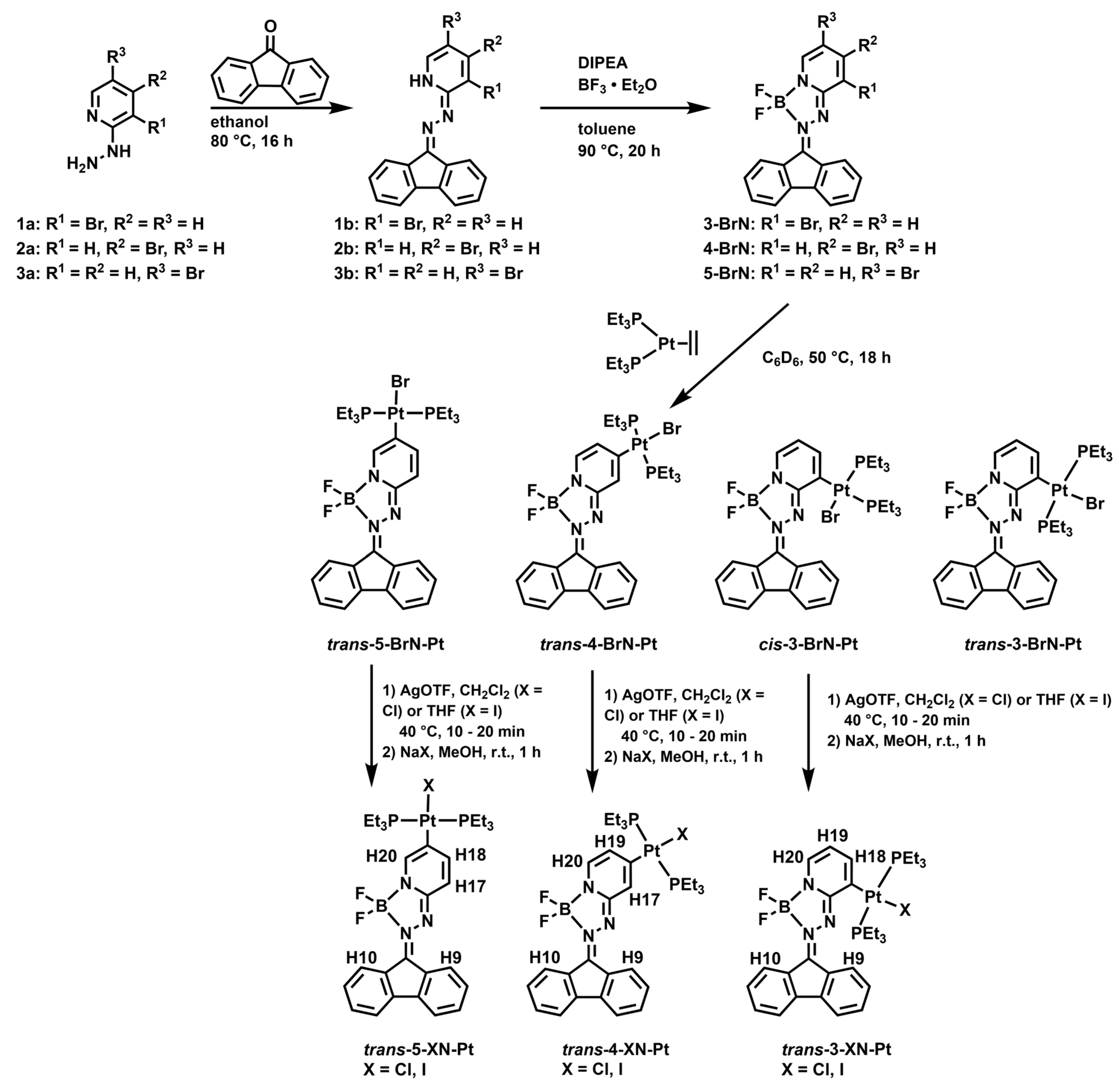
As the site of platinum attachment as well as the halide ligand were found to have a strong impact on the photophysical properties of Pt-BODIPY complexes [42], we prepared and investigated three out of the four possible isomers of platinated 2-pyridone fluorenone hydrazone-BF2 complexes with the Pt complex entity residing at the six-membered pyridone ring, and with chloride, bromide, or iodide as the halide ligand. Brominated proligands 1b–3b and the derived BF2 complexes 3-BrN to 5-BrN were synthesized by condensing the respective hydrazinylpyridine [60,61,62] with 9H-fluoren-9-one and subsequent treatment with BF3 etherate in the presence of the non-nucleophilic base DIPEA in toluene (Scheme 1). Details of the synthesis and purification procedures can be found in the Experimental Section. The corresponding NMR spectra are shown as Figure S1.1–S1.5, S1.7–S1.13, S1.55–S1.59, S1.61–S1.67, S1.99–S1.103 and S1.105–S1.111 of the Supplementary Materials. The Pt complexes were then obtained from in situ generated cis-Pt(η2-C2H4)(PEt3)2 [3,63], which underwent smooth oxidative addition with 3-BrN5-BrN by overnight stirring at 50 °C. Only in the case of 3-BrN-Pt, the cis-configured complex cis-3-BrN-Pt was isolated as the kinetic product of oxidative addition, whereas in all other cases the initially formed cis-products rearranged readily to the thermodynamically more stable trans-isomers. When subjected to a sequence of bromide substitution with AgOTf (OTf = CF3SO3) and treatment of the respective triflato complex with a sodium halide NaX in methanol as the solvent, cis-3-BrN-Pt as well as trans-4/5-BrN-Pt reacted cleanly to complexes trans-3-XN-Pt (X = Cl, I) and trans-4/5-XN-Pt (X = Cl, I) in good to moderate overall yields. One should note that the use of CH2Cl2 or chloroform as a solvent inevitably led to the respective chloride complexes as byproducts, even when an excess of another halide NaX was present. Chlorinated solvents must therefore be avoided throughout the synthesis and purification procedures of the bromo and iodo complexes (Scheme 1).
All trans-configured complexes show only one singlet resonance in their 31P-NMR spectra with platinum satellites. Chemical shifts and coupling constants JPt-P decrease in the order Cl > Br > I, i.e., 12.73–14.11 ppm and 2620–2661 Hz in the chloro, 10.90–12.03 ppm and 2595–2633 Hz in the bromo, and 6.60–8.51 ppm and 2555–2607 Hz in iodo complexes, paralleling the decrease in electronegativity of the halide ligand (see Figures S1.143–S1.146). Consistent trends are also observed with respect to the positioning of the Pt ion at the pyridine ring, with the most low-field shifted resonance and the smallest value JPt-P for the 5-isomer. Independent of the halogenide ligand and the substitution pattern, protons H9 and H10 at the fluorenone ring give the most downfield shifted resonances, appearing in the range of 9.83 to 9.56 ppm (H9), or 9.11 to 9.04 ppm (H10) (see the bottom of Scheme 1 for atomic numbering). These resonances are shifted downfield by ca. 0.6 ppm when compared to the brominated ligands. The ordering of resonance shifts of the protons at the uninegatively charged pyridone imine ring vary between the different isomers (i.e., H18 > H20 > H19 for the 3-isomers, H17 > H20 > H19 for the 4-isomers, H20 > H18 > H17 for the 5-isomers), with only minor variations for different halide ligands X. In 13C NMR spectra, the platinated C atom uniformly produces the most downfield shifted resonance signal, showing up in the range of 171.9 to 158.4 ppm, and in the ordering 4-Pt > 3-Pt > 5-Pt complexes.
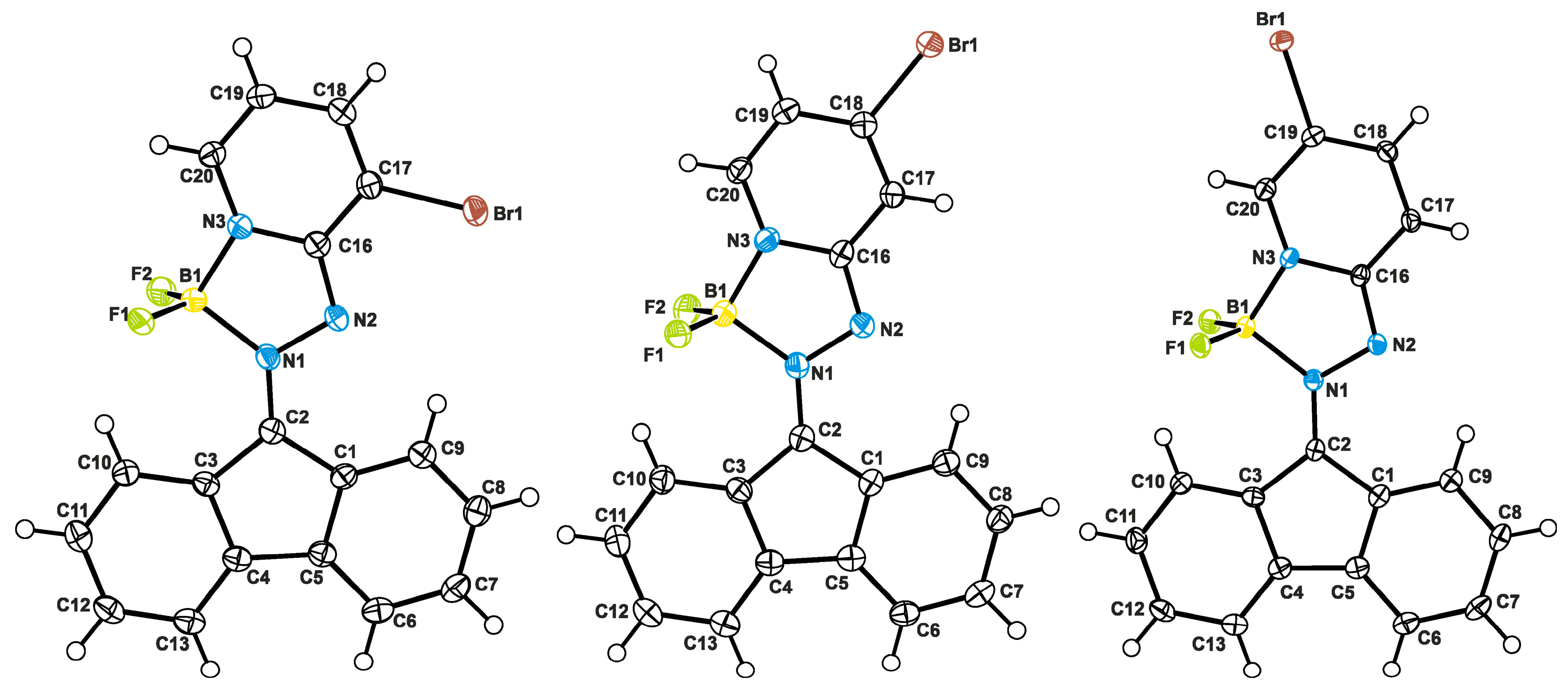
Single crystals of all three bromo-substituted BF2 chelates 3-BrN to 5-BrN that were suitable for single X-ray diffraction were obtained by slow diffusion of n-pentane into a concentrated solution of the respective compound in CH2Cl2. Compounds 4-BrN and 5-BrN crystallized in the monoclinic space group P21/n, while 3-BrN crystallized in the orthorhombic space group Pbca. Crystallographic details and relevant information on the structure solution and refinement are provided in the Supplementary Materials, along with comparative compilations of selected bond lengths, interatomic bond angles, and dihedral angles, as well as full listings of bonding parameters.
ORTEPs of their molecular structures are shown in Figure 2 and Figure 3. Molecules 3-BrN to 5-BrN possess nearly planar π-conjugated backbones with only the fluorine atoms of the BF2 moiety protruding out of the molecule plane, as indicated by torsion angles B1-N1-C2-C3 of −7.3(4)° to 5.9(4)° and N2-N1-C2-C1 of −3.8(3)° to 1.3(3)°, and interplanar angles of 3.65(5)–6.66(4)° between the fluorenone ring and the pyridine-BF2 chelate. The tight five-membered chelate confines the bond angle N1-B1-N3 to values of 95.57(13)° to 95.71(16)°, which in turn leads to an opening of all other interatomic angles at the boron atom to 111.35(17)° to 112.92(19)°. Bond lengths at the hydrazone structural increment agree with C=N double and N-N single bonds, and are close to those in the parent compound [2]. B-N bond lengths to the anionic pyridone donor atom N3 of 1.551(3) to 1.554(3) Å are consistently shorter than those to the neutral imine donor N1 of 1.606(3) to 1.610(3) Å. Short B-N bond lengths of less than 1.64 Å indicate that the BF2 complexes should be stable towards light irradiation [2,64]. In all three structures, intramolecular C-H···F hydrogen bonding interactions with the close hydrogen atom H10 of the cis-disposed benzene ring of the fluorenone moiety are observed, with the closer contact in the range of 2.3582(12) to 2.4347(16) Å and the longer one in the range of 2.4423(13) to 2.5723(12) Å.
In the crystal lattice, close intermolecular contacts between individual molecules through π-stacking and hydrogen bonding interactions lead to intricate packing motifs. Illustrative diagrams and views of intermolecular interactions as well as brief discussions of the packing motifs can be found in the Supplementary Materials.
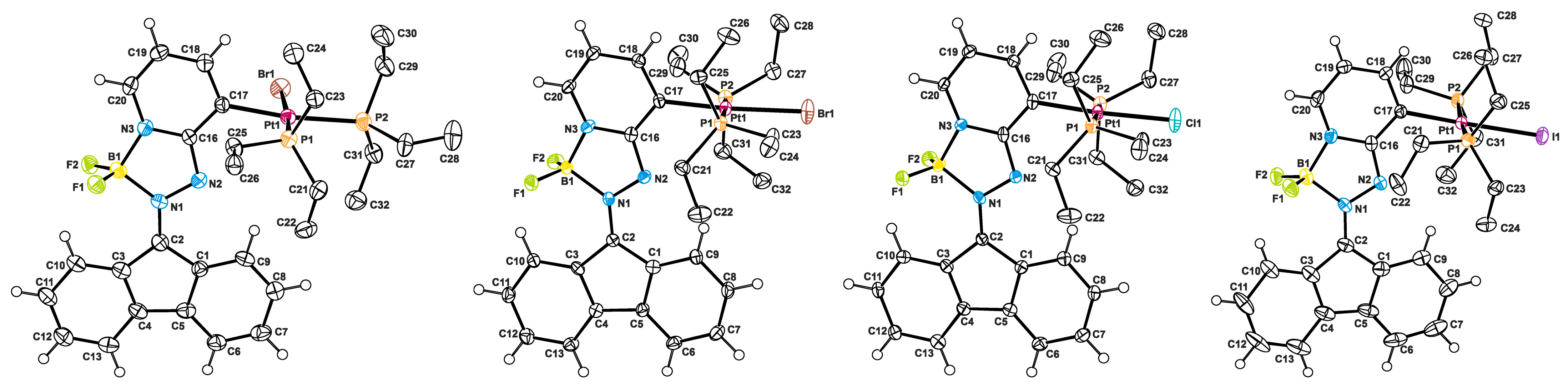
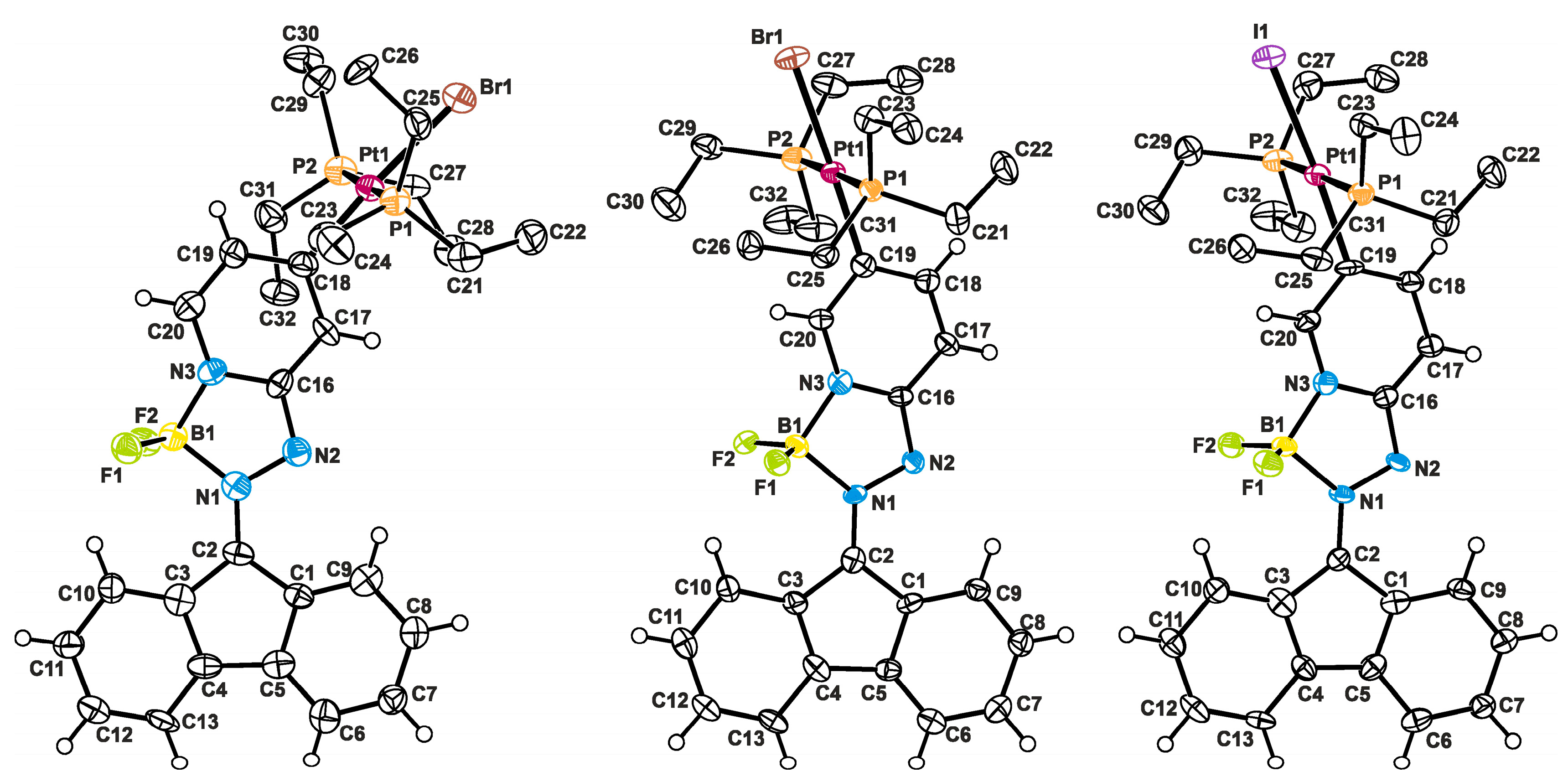
In addition to the brominated precursors, single crystals of all four of the Pt complexes derived from 3-BrN, as well as complexes trans-4-BrN-Pt, trans-5-BrN-Pt, and trans-5-IN-Pt that were suitable for single X-ray diffraction were obtained by recrystallization from toluene, diffusion of n-pentane into concentrated solutions of the complexes in THF or benzene, or by recrystallization from ethanol (see the Supplementary Materials for further details). Figure 3 and Figure 4 provide ORTEPs of their molecular structures. cis-3-BrN-Pt co-crystallizes with one molecule of toluene which is omitted in Figure 3 for clarity reasons. The crystal of trans-3-IN-Pt contains two crystallographically independent molecules in the asymmetric unit, only one of which is shown in Figure 3.
All complexes except trans-4-BrN-Pt, which crystallized in the orthorhombic space group Pca21, crystallized in the monoclinic crystal system, in space groups P21/c for cis-3-BrN-Pt, trans-3-BrN-Pt, and trans-3-ClN-Pt, P21/n for trans-3-IN-Pt, and P21 for trans-5-BrN-Pt and trans-5-IN-Pt. Platinum attachment has no notable influence on the lengths of the B-F and the B-N bonds or the bond angles at the boron atom when compared to the bromo precursors, irrespective of the site of attachment. In particular, the B-N bond lengths to the anionic N donor atom N3 remain 0.045 to 0.090 Å shorter than those to the neutral imine donor N1, and the N1-B1-N3 chelate bite angles are all acute, falling in the range of 95.8(4) to 96.4(3)°. Like in their brominated precursors, the five-membered chelate ring and the annulated pyridone ring are slightly inclined at an angle of 2.25(18)° to 4.2(2)°, with torsion angles B1-N1-C2-C3 in the range of 7.6(16) to −8.2(8)° (see Table 1 and Table 2). In all instances, the platinum coordination plane is nearly perpendicular to the plane of the pyridone ring, as heralded by interplane angles of 76.4(6) to 93.10(12)°.
The cisoid arrangement of the bulky PEt3 ligands in cis-3-BrN-Pt opens the P1-Pt-P2 angle to a value of 99.55(6)°, which in turn compresses the angles Br1-Pt-P2 and Br1-Pt-C17 to 85.47(5) and 84.45(18)°, while the angle P1-Pt-C17 is ideal at 90.39(19)°. As a consequence of the larger trans-influence of the aryl donor, the bond length Pt-P2 of 2.3416(18) Å is appreciably longer than the Pt-P1 bond of 2.2306(16) Å. Conversely, the Pt-C bond in cis-3-BrN-Pt is slightly longer than in the other two complexes, where the carbyl donor is trans to the bromo ligand, which has the smallest trans-influence of all ligands present.
In all six trans-configured complexes, the bond angles P1-Pt1-P2 and C17-Pt-X are slightly smaller than the ideal value of 180°, ranging from 175.02(4)° to 177.94(5)° or 172.47(14)° to 177.43(14)°, respectively, while the cis-angles are all close to 90°. In agreement with the stronger σ-trans influence of an iodo as compared to a bromo or chloro ligand, the bond Pt-Cipso in the iodo complexes trans-3-IN-Pt and trans-5-IN-Pt is slightly longer than in the other four complexes. Bonding parameters at the Pt coordination centre and the N2BF2 chelate closely resemble those in related σ-BODIPY platinum complexes [3,42].
As a recurring motif found in all seven structures, the nearly perpendicular arrangement of the Pt coordination plane to the pyridone ring restricts π-stacking interactions between individual molecules to the benzene rings of the fluorenone imine units. Besides π-stacking, complex molecules associate by a rich variety of intermolecular interactions that involve C-H···F, C-H···π, and, in some cases, C-H···X hydrogen bonds with methylene or methyl protons of the PEt3 ligands or protons at the fluorenone hydrazone as H-bond donors. Views of the resulting packing motifs and details of intermolecular interactions as well as brief discussions can be found in the Supplementary Materials.

2.2. Photophysical Properties

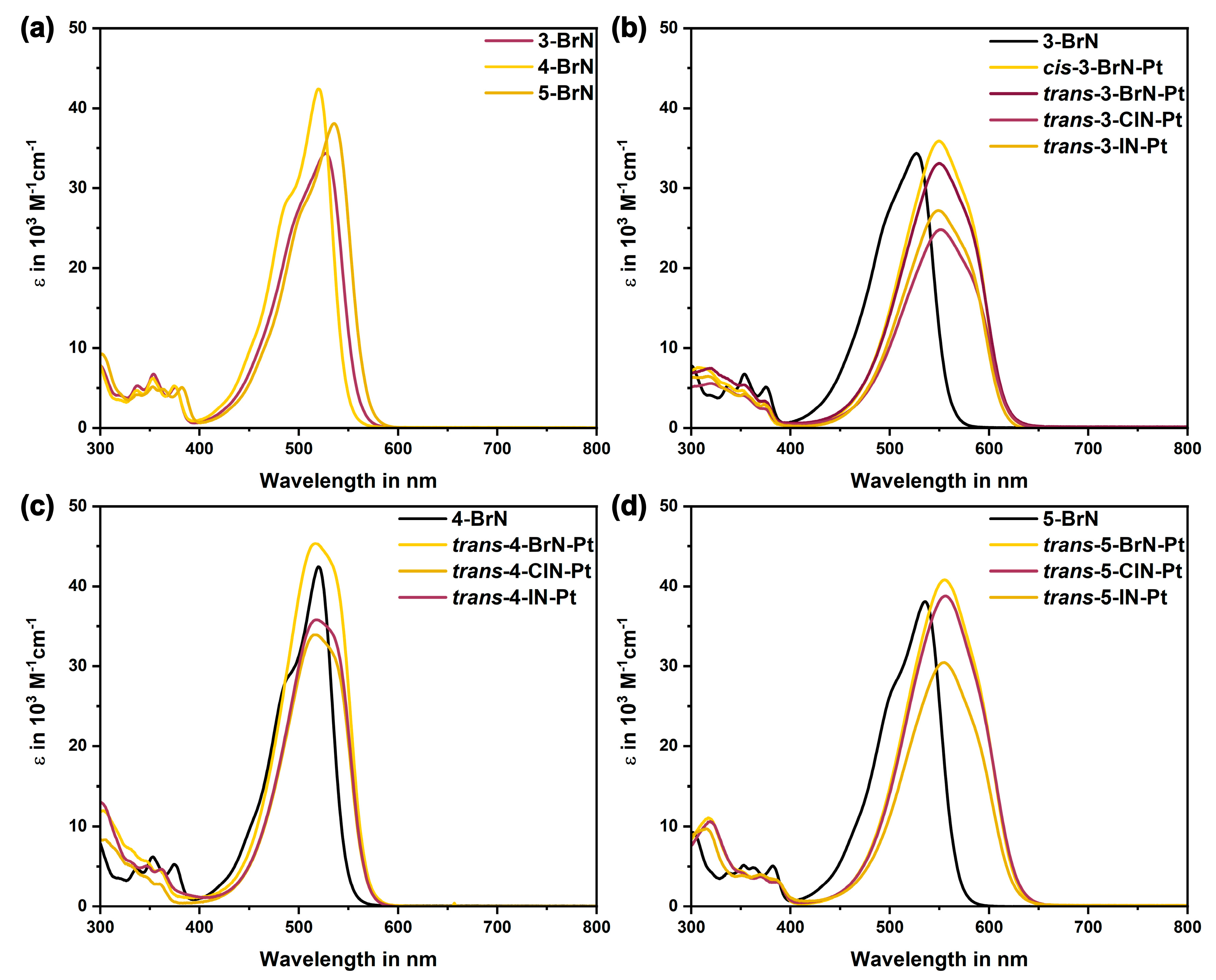
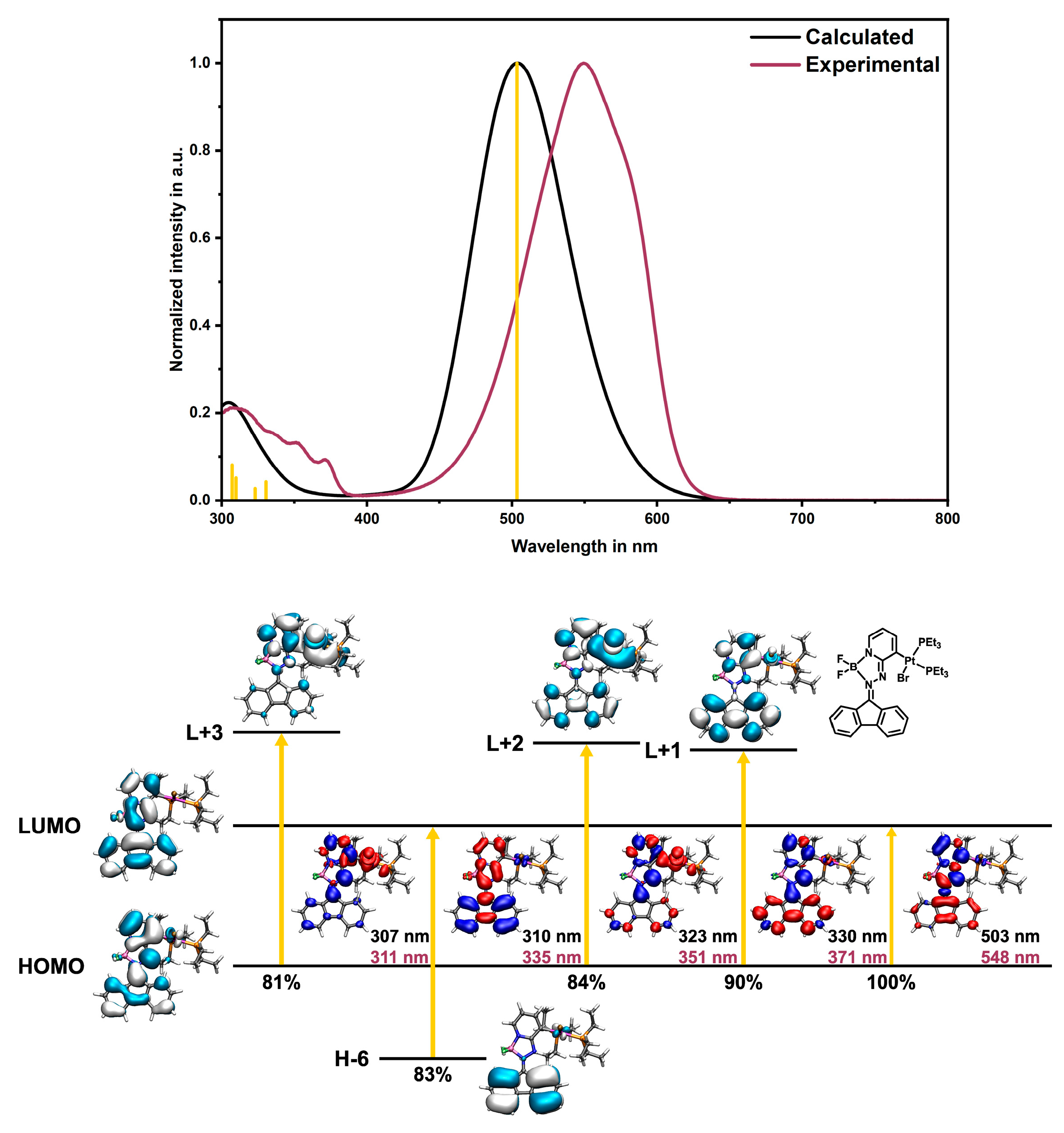
UV–Vis absorption spectra of the brominated fluorenone pyridine hydrazones and the derived platinum complexes show one prominent band with partially resolved vibrational structuring at the high-energy side, which is located at 520–536 nm in the organic dyes, red-shifted to ca. 550 nm in the 3- and 5-platinated complexes, and slightly blue-shifted in the 4-isomers. Extinction coefficients are of the order of ca. 4·104 M−1cm−1 for the precursors (see Table 3). They remain almost unchanged upon metalation, with maximum values for the bromo complexes. A second, significantly weaker, vibrationally structured absorption band is observed at ca. 350 nm. Figure 5 compares the spectra of the brominated dyes (5a), the Pt complexes cis/trans-3-XN-Pt derived from 3-BrN (5b), the Pt complexes trans-4-XN-Pt derived from 4-BrN (5c), and the Pt complexes trans-5-XN-Pt derived from 5-BrN (5d). TD-DFT calculations on geometry-optimized ground-state structures reproduce the general absorption pattern very well, but overestimate excitation energies by ca. 1900 cm−1, a well-known problem for BODIPY and its derivatives and other cyanine dyes [65,66,67]. According to our calculations, the prominent absorption band results from the transition between the energetically highest occupied and lowest unoccupied molecular orbitals HOMO and LUMO. As both MOs are delocalized over the entire molecule, the corresponding excitation comes with only a slight shift in electron density from the pyridone to the fluorenone imine moieties (Figure 6). The modest positive solvatochromism, i.e., band shift to lower energy at increasing solvent polarity, agrees with this result while indicating a more polar photoexcited state (see the Supplementary Materials). The same applies to the band near 350 nm, which corresponds with the excitation from the HOMO-1 to the LUMO, or from the HOMO to the LUMO+1, LUMO+2, and LUMO+3 for the Pt complexes. Both transitions receive no notable contributions from the appended Pt complex entity so that its impact on the absorption spectrum reduces to that of a remote electron donor.
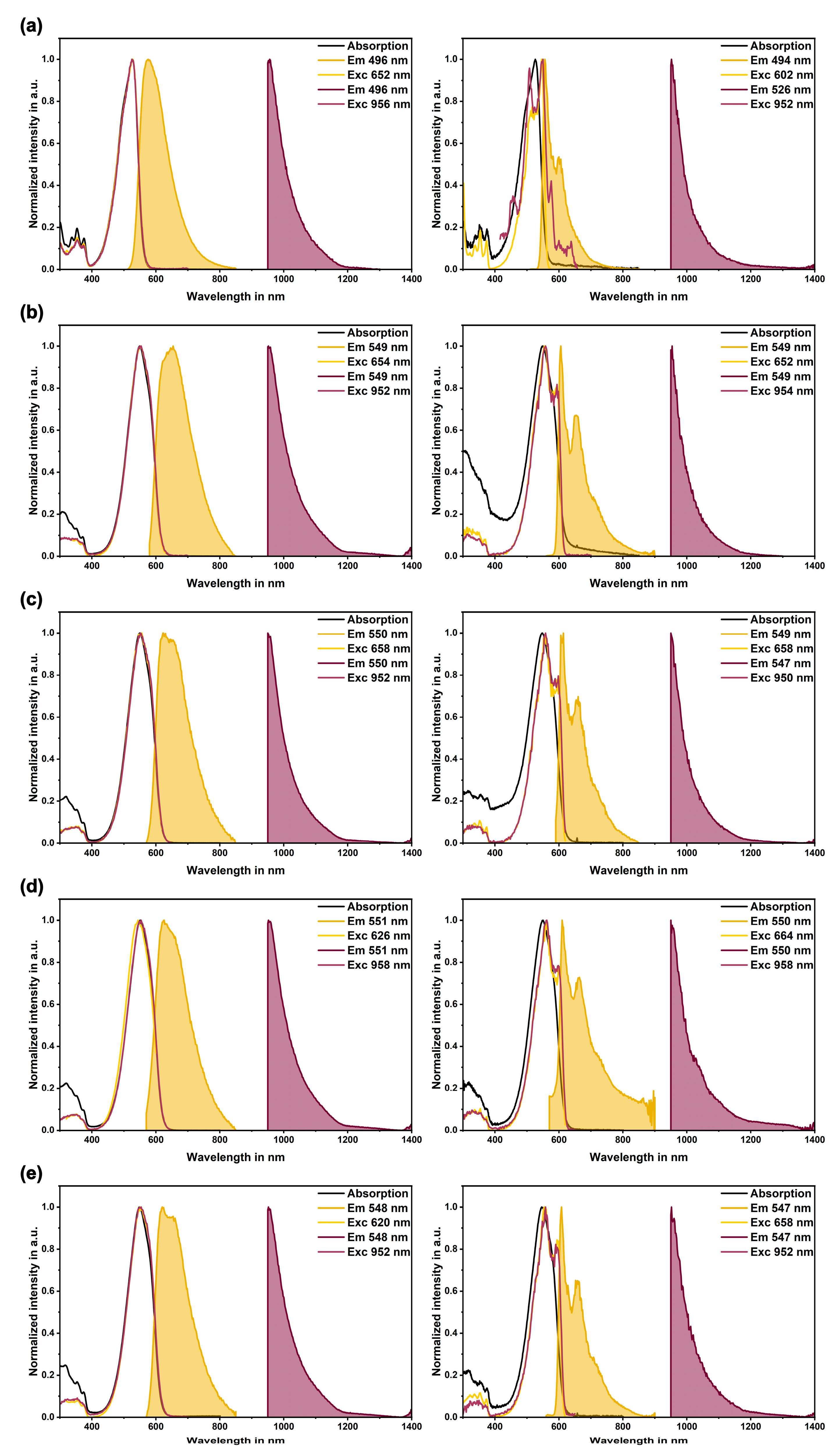
Like Feringa’s BH1 and BH2 [2], all compounds of the present study are dually emissive, showing red to deep-red fluorescence and near-infrared (NIR) phosphorescence, both at room temperature in THF and as glassy frozen solutions in 2-MeTHF at 77 K. Figure 7 displays the emission and excitation spectra of the compounds of the present study, while Table 4 compiles the relevant data. For most compounds, the maximum of the phosphorescence emission falls into a blind spot between the Vis and the NIR detectors of our setup so that only the low-energy tail is recorded. This unfortunately precludes us from determining the lifetimes and the quantum yields for the phosphorescence emissions.
Room-temperature excitation spectra are superimposable with absorption spectra while they appear slightly blue-shifted in the glassy frozen state (see the Supplementary Materials). The small magnitude of this rigidochromic shift indicates only minimal structural changes between the ground and the Franck–Condon excited state. Stokes shifts between the wavelengths of maximum absorption and the fluorescence emission of boron complexes n-BrN range from 1310 to 1650 cm−1 while they assume larger values of 1880 to 3125 cm−1 in the platinum complexes, with the ordering 5-isomer > 3-isomer > 4-isomer. Fluorescence quantum yields of the brominated ligands are in the range of 20% for the 3- and 4-isomers, but are lowered to 8.6% for the 5-isomer, in the ordering 4-BrN > 3-BrN > 5-BrN. Bromination at the pyridone ring decreases, hence causes a similar decrease in the quantum yield with respect to the parent compound (Φfl = 33%) as bromination at the fluorenone imine entity [2]. Fluorescence lifetimes group in a narrow range from 2.3 to 2.5 ns. In glassy frozen matrices of 2-MeTHF at 77 K, the ligands become very strongly emissive with quantum yields of 67.8 to 88.9%, and with a doubling of fluorescence lifetimes. Fluorescence emissions from the Pt complexes follow the same trends as the free ligands, yet with more distinct differences between the congeners of the trans-4-XN-Pt series (Φfl, 298K = 20%, Φfl, 77K 60.7–67.4%) and their 3- or 5-substituted isomers (Φfl, 298K = 0.2–3.0%, Φfl, 77K 3.0–13.0%), yet with the same ordering as for the brominated dyes and with only slightly lower lifetimes. For every series, the wavelength of the emission maximum and the quantum yield vary only slightly with the identity of the halogenide ligand.
Our DFT calculations position the first excited triplet state T1 of the brominated dyes and the Pt complexes by 1.14 to 1.28 eV below the first excited singlet state S1, and by 1.06 to 1.46 eV that is, by 8550 to 11,775 cm−1—above the ground state S0, in good qualitative agreement with the observed NIR emission of ca. 950 nm (10,500 cm−1) (see Table S6.4 of the Supplementary Materials). The spin density is almost evenly distributed over the ligand with only minor contributions from the halide ligand X and/or the Pt complex entity (see the Supplementary Materials). In all cases, the triplet state adopts a twisted structure around the fluorenone–imine bond C2-N1 with the concomitant loss of planarity.

2.3. Photo-Oxidation of Triphenylphosphine

An important asset of the pyridone fluorenone hydrazones is their ability to generate singlet oxygen on irradiation with visible light by energy transfer from the excited triplet state to molecular oxygen, and to oxidize triphenylphosphine to triphenylphosphine oxide. Bromination at the fluorenone increment led to better performance as a result of more effective intersystem crossing [2]. We conceived the present complexes with the hope that the directly attached platinum complex entities would further enhance their photocatalytic capabilities, as was observed for complexes with directly attached BODIPY dyes [3,42,68]. Indeed, all of the ligands and the derived Pt complexes are capable of producing singlet oxygen (1O2). Quantum yields ΦΔ, as measured by monitoring the intensity of the singlet oxygen phosphorescence emission relative to 5,10,15,20-tetraphenyl-21H,23H-porphin (TPP, ΦΔ = 0.62), tend to be slightly higher for the Pt complexes than for the free dyes (see Table 4) [69,70].
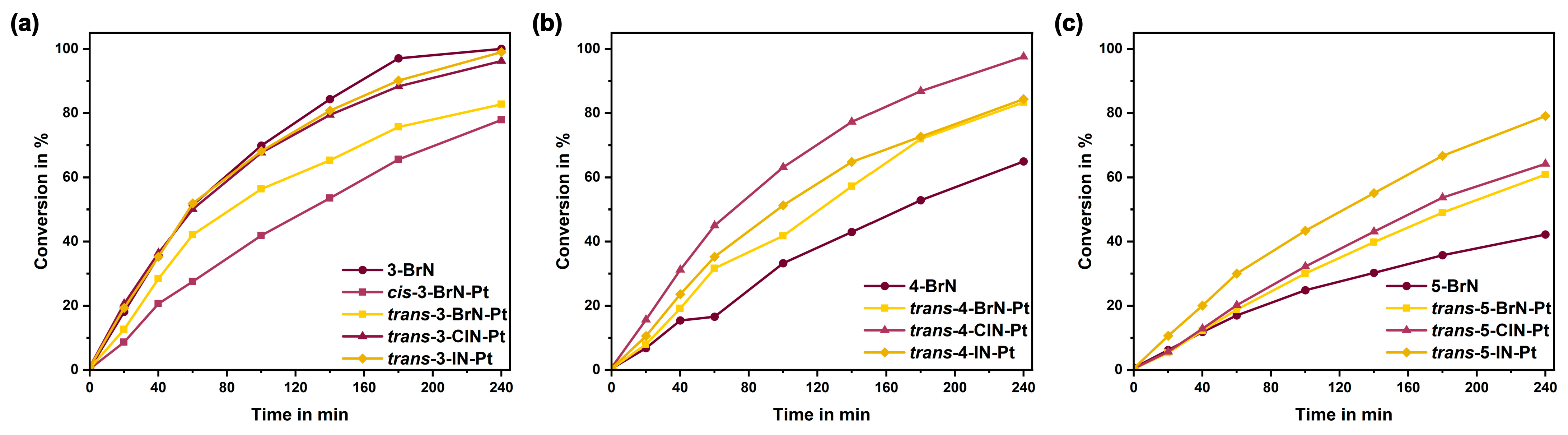
When irradiating solutions containing PPh3 and 5 mol% of the respective sensitizer in C6D6 (0.6 mL) for 4 h under a static oxygen atmosphere with LEDs (λirr = 505 nm), all investigated compounds showed smooth conversion of PPh3 to OPPh3 as shown by periodic monitoring of the reaction progress by means of 31P NMR spectroscopy (see the Supplementary Materials). No such conversion was observed when the reaction was performed under identical conditions, but in the absence of the photosensitizer, where the conversion remained below 2%, or in the presence of the catalyst, but in the dark (see the Supplementary Materials). Rewardingly, the complex photocatalysts remained stable, with no encounters of PEt3 substitution or ligand or complex degradation detected over 4 h of continuous irradiation. The 3-isomers proved to be the most active catalysts with hardly any differences between 3-BrN and complexes trans-3-XN-Pt. The 4- and 5-isomers of the Pt complexes, and in particular the dyes 4-BrN and 5-BrN, tend to be less active, particularly the 5-isomers. In these cases, the Pt complexes outperformed the organic dyes by a factor of ca. 1.5 to 2, with particularly good performance for trans-4-ClN-Pt, which also attains near-quantitative conversion within 4 h (Figure 8). The photocatalytic performances of the compounds grossly follow the ordering of ΦΔ values.

3. Materials and Methods

General Procedures: The synthesis of the complexes and the ligands were performed under dinitrogen atmosphere. Workup and the cis-to-trans isomerizations were conducted under air. C6D6, CDCl3, and CD2Cl2 were supplied by Eurisotop. C6D6 was stored under dinitrogen, while CDCl3 was stored over molecular sieves. All other chemicals were used as received. NMR and mass spectra of all compounds can be found in the Supplementary Materials.
NMR Spectroscopy: 1H-NMR (400/800 MHz), 13C{1H}-NMR (101/201 MHz), 11B-NMR (128 MHz), 19F{1H}-NMR (376/753 MHz), 31P{1H}-NMR (162MHz), and 195Pt-NMR (86 MHz) spectra were recorded in CDCl3, CD2Cl2, or C6D6 at 300 K using a Bruker Avance III 400 or 600 or a Bruker Avance Neo 800 spectrometer. The NMR spectra were referenced to residual solvent signals (1H) or to the solvent signal itself (13C). 19F{1H}-, 31P{1H}-, and 11B-NMR spectra were referenced to an external reference of the spectrum (CFCl3, H3PO4, or BF3∙OEt2). The assignment of the signals in the 1H- and 13C{1H}-NMR spectra is based on 2D NMR spectra.
Mass Spectrometry: Mass spectra were measured in positive mode on an ESI-calibrated LTQ Orbitrap velos (Thermo Scientific) or on a 6546LC/Q-TOF (Agilent, flow rate: 0.5 mL min−1, source temperature: 320 °C, capillary voltage: 3500 V) in DCM. The substances were filtered over a column (EC-C18, 21 × 5 mm) with 100% acetonitrile and 0.1% formic acid prior to the measurement.
X-Ray Crystallography: Single crystals were measured with a Stoe idps-II image plate diffractometer equipped with a Mo-Kα radiation source (λ = 0.71073 Å) at 100 K. The programme X-Area was used for data processing. Using Olex2 [71], all structures were solved with SHELXT [72]. All hydrogen atoms were refined anisotropically. Packing patterns and intramolecular and intermolecular hydrogen bonds were analyzed using OLEX2 programme packages.
TD-DFT calculations: The electronic ground state and the energetically lowest-lying triplet state of the ligands and the complex molecules were calculated by density functional theory (DFT) [73] methods using Gaussian 16 programme packages [74]. Geometry optimization and the subsequent vibrational analysis were performed in solvent media. Quasi-relativistic Wood–Boring small-core pseudopotentials (MWBs) [75] with optimized basis sets for platinum [76] and iodine, and 6–31G(d)-polarized double-ζ basis set [77], or Def2SVP basis set [78] for the remaining atoms were used, combined with Perdew–Burke–Ernzerhof exchange and correlation functional (PBE1PBE) [79]. Solvent effects were modelled in the framework of the polarizable conductor continuum model (PCM) with standard parameters for THF. Time-dependent density functional theory (TD-DFT) [80] calculations employed the same functionals and basis sets. The results were analyzed with the GaussSum program package [81]. Graphical representations of the molecular orbitals and the EDDMs were generated with the help of GNU Parallel [82], and were plotted using the vmd programme package [83] combined with POV-Ray [84].
UV–Vis Spectroscopy: UV–Vis spectra of the ligands and the complexes were recorded as THF solutions with a TIDAS diode array spectrometer by j&m Analytik AG. The absorption coefficients were determined with the use of quartz cuvettes with a pathlength of d = 1 or 2 mm by hellma.
Photoluminescence Studies: Emission spectra were acquired in dry THF at room temperature. For the measurements at 77 K, dry 2-MeTHF was used. The measurements were performed with a FluoTime300 spectrometer by Picoquant. Time-resolved measurements were performed with TimeHarp 260 PICO Single TCSPC PC-card with a resolution of 25 ps using laser diodes LDH-P-C-375, LDH-P-C-420, and LDH-P-C-485.
Synthesis of 1b: 9H-Fluoren-9-one (1.07 g, 5.91 mmol, 1.00 eq) and 3-bromo-2-hydrazinylpyridine (3.26 g, 17.4 mmol, 2.94 eq) were dissolved in ethanol (20 mL). The mixture was heated to reflux for 23 h. The solvent was removed under reduced pressure, and the crude product was purified via column chromatography (CH2Cl2 as eluent, silica). 1b was obtained as a red solid in a yield of 96% (1.98 g, 5.66 mmol). 1H-NMR (CDCl3, 400 MHz) δ [ppm] = 9.71 (s, 1H, H21), 8.43 (dd, 3JHH = 4.7 Hz, 4JHH = 1.3 Hz, 1H, H20), 8.14–8.05 (m, 2H, H9, H13), 7.83 (dd, 3JHH = 7.8 Hz, 4JHH = 1.3 HZ, 1H, H18), 7.80 (d, 3JHH = 7.6 Hz, 1H, H6), 7.69–7.62 (m, 1H, H10), 7.50 (td, 3JHH = 7.5 Hz, 4JHH = 1.0 Hz, 1H, H8), 7.47–7.29 (m, 3H, H7, H11, H12), 6.83 (dd, 3JHH = 7.8 Hz, 4JHH = 4.7 Hz, 1H, H19). 13C{1H}-NMR (CDCl3, 101 MHz) δ [ppm] = 150.98 (C16), 148.24 (C23), 146.34 (C2), 142.28 (C1), 140.80 (C18), 138.96 (C5), 137.33 (C3), 130.72 (C8), 130.04 (C4), 129.49 (C12), 128.20 (C7), 128.18 (C11), 125.11 (C9), 122.61 (C13), 121.05 (C6), 119.66 (C10), 117.86 (C19), and 105.51 (C17). HR ESI-MS (m/z) in CH2Cl2: calculated for C18H13BrN3+: 349.0266; found: 350.0305.
Synthesis of 3-BrN: Compound 1b (0.97 g, 2.77 mmol, 1.00 eq) was dissolved in dry toluene (28 mL) and was heated to 90 °C. BF3∙Et2O (1.8 mL, 2.02 g, 14.20 mmol, 5.13 eq) and DIPEA (1.4 mL, 1.06 g, 8.23 mmol, 2.97 eq) were added and the mixture was heated to reflux for 24 h. The reaction mixture was poured onto a silica plug (toluene as eluent) followed by washing with toluene until the filtrate was colourless. The crude product was purified via column chromatography (PE/EA 5:1-0:1 v/v, silica) and recrystallized from toluene. 3-BrN was obtained as a dark red solid in a yield of 43% (468 mg, 1.18 mmol). 1H-NMR (CD2Cl2, 400 MHz) δ [ppm] = 9.11 (d, 3JHH = 7.7 Hz, 1H, H9), 8.36 (dt, 3JHH = 7.9 Hz, 4JHH = 1.1 Hz, 1H, H10), 7.80 (dd, 3JHH = 7.4 Hz, 4JHH = 1.3 Hz, 1H, H18), 7.69–7.61 (m, 3H, H8, H12, H20), 7.50 (td, 3JHH = 7.5 Hz, 4JHH = 1.2 Hz, 1H, H7), 7.42 (dtd, 3JHH = 11.3 Hz, 3JHH = 7.6 Hz, 4JHH = 1.1 Hz, 2H, H6, H11), 7.30 (td, 3JHH = 7.7 Hz, 4JHH = 1.2 Hz, 1H, H13), and 6.43 (dd, 3JHH = 7.4 Hz, 3JHH = 6.1 Hz, 1H, H19). 13C{1H}-NMR (CD2Cl2, 101 MHz) δ [ppm] = 144.30 (C18), 142.34 (C2), 142.28 (C16), 135.30 (C20), 133.31 (C7), 132.91 (C9), 132.63 (C1), 132.32 (C11), 131.37 (C4), 129.39 (C6), 128.79 (C13), 126.90 (C5), 126.80 (C10), 126.71 (C3), 120.67 (C8), 120.25 (C12), 111.58 (C19), and 107.59 (C17). 19F{1H}-NMR (CD2Cl2, 376 MHz) δ [ppm] = −148.52 (dd, 3JFF = 63.5 Hz, 2JFB = 31.6 Hz). 11B-NMR (CDCl3, 128 MHz) δ [ppm] = 5.01 (t, 1JBF = 31.9 Hz). HR ESI-MS (m/z) in CH2Cl2: calculated for C18H12BBrF2N3+: 398.0270; found: 398.0254.
Synthesis of 2b: 9H-Fluoren-9-one (0.70 g, 3.88 mmol, 1.00 eq.) and 4-bromo-2-hydrazinylpyridine (2.17 g, 11.54 mmol, 2.97 eq.) were dissolved in ethanol (14 mL). The solution was heated to reflux for 18 h. After cooling down to room temperature, the solvent was removed under vacuum, and the crude product was purified via column chromatography (CH2Cl2, silica gel) and recrystallization from ethanol. The product was filtered and washed with cold ethanol. 2b was obtained as a yellow, fibrous solid in a yield of 58% (789 mg, 2.25 mmol). 1H-NMR (CDCl3, 400 MHz) δ [ppm] = 9.31 (s, 1H, H21), 8.04 (d, 3JHH = 5.3 Hz, 1H, H20), 7.98 (dt, 3JHH = 7.6 Hz, 4JHH = 0.9 Hz, 1H, H9), 7.96–7.86 (m, 1H, H13), 7.80 (d, 4JHH = 1.8 Hz, 1H, H17), 7.78 (dt, 3JHH = 7.6 Hz, 4JHH = 0.9 Hz, 1H, H6), 7.72–7.61 (m, 1H, H10), 7.47 (td, 3JHH = 7.6 Hz, 4JHH = 0.9 Hz, 1H, H8), 7.43–7.30 (m, 3H, H7, H11, H12), and 7.05 (dd, 3JHH = 5.3 Hz, 4JHH = 1.8 Hz, 1H, H19). 13C{1H}-NMR (CDCl3, 101 MHz,) δ [ppm] = 157.43 (C16), 148.56 (C20), 142.82 (C2), 141.81 (C1), 138.69 (C4), 137.38 (C3), 134.56 (C18), 130.33 (C8), 129.97 (C5), 129.09 (C12), 128.06 (C7), 127.87 (C11), 125.08 (C9), 121.33 (C13), 120.84 (C6), 120.41 (C19), 119.71 (C10), and 110.87 (C17). HR ESI-MS (m/z) in CH2Cl2: calculated for C18H13BrN3+: 350.0287; found: 350.0286.
Synthesis of 4-BrN: Compound 2b (0.50 g, 1.44 mmol, 1.00 eq) and toluene (14.5 mL) were heated to 90 °C. BF3∙Et2O (0.9 mL, 1.01 g, 7.10 mmol, 4.93 eq) and DIPEA (0.7 mL, 0.53 g, 4.12 mmol, 2.86 eq) were added and the mixture was heated to reflux for 24 h. The reaction mixture was poured on a silica plug and eluted with toluene until the filtrate was colourless. The crude product was purified via column chromatography (PE/EA, 5:1-0:1 v/v, silica). 4-BrN was obtained as a dark red solid in a yield of 58% (322 mg, 0.83 mmol). 1H-NMR (CD2Cl2, 400 MHz) δ [ppm] = 8.98 (d, 3JHH = 7.7 Hz, 1H, H9), 8.35 (dt, 3JHH = 7.9 Hz, 3JHH = 1.2 Hz, 1H, H10), 7.63 (ddt, 3JHH = 7.5 Hz, 3JHH = 6.5 Hz, 4JHH = 1.0 Hz, 2H, H6, H13), 7.47 (td, 3JHH = 7.5 Hz, 4JHH = 1.2 Hz, 2H, H7, H20), 7.41 (td, 3JHH = 7.5 Hz, 4JHH = 1.0 Hz, 1H, H11), 7.35 (td, 3JHH = 7.7 Hz, 4JHH = 1.2 Hz, 1H, H8), 7.29 (td, 3JHH = 7.7 Hz, 4JHH = 1.2 Hz, 1H, H12), 7.15 (d, 4JHH = 1.6 Hz, 1H, H17), 6.61 (dd, 3JHH = 6.6 Hz, 4JHH = 1.6 Hz, 1H, H19). 13C{1H}-NMR (CD2Cl2, 101 MHz) δ [ppm] = 142.13 (C2), 138.07 (C16), 136.52 (C20), 133.12 (C7), 132.64 (C1), 132.48 (C9), 132.11 (C11), 131.46 (C4), 129.07 (C18), 128.74 (C12), 128.34 (C8), 126.85 (C5), 126.75 (C10), 126.66 (C3), 120.62 (C13), 120.22 (C6), 116.32 (C17), and 115.06 (C19). 19F{1H}-NMR (CD2Cl2, 376 MHz) δ [ppm] = −149.77 (dd, 3JFF = 62.9, 1JFB = 31.2 Hz). 11B-NMR (CDCl3, 128 MHz) δ [ppm] = 4.50 (t, 1JBF = 31.7 Hz). HR ESI-MS (m/z) in CH2Cl2: calculated for C18H12BBrF2N3+: 398.0270; found: 398.0284.
Synthesis of 3b: 5-Bromo-2-hydrazinylpyridine (481 mg, 2.56 mmol, 3.00 eq) and 9H-Fluoren-9-one (154 mg, 0.85 mmol, 1.00 eq) were dissolved in ethanol (6 mL) and heated to 85 °C overnight. After cooling to room temperature, the reaction mixture was purified via column chromatography over silica, using CH2Cl2 as the eluent. Compound 3b was obtained in a quantitative yield (300 mg, 0.85 mmol). 1H-NMR (CDCl3, 400 MHz) δ [ppm] = 9.29 (s, 1H, H21), 8.27 (d, 4JHH = 2.3 Hz, 1H, H20), 7.97 (d, 3JHH = 7.4 Hz, 1H, H9), 7.86 (d, 3JHH = 7.1 Hz, 1H, H13), 7.80–7.75 (m, 2H, H17, H6), 7.65 (d, 3JHH = 6.9 Hz, 1H, H10), 7.53 (d, 3JHH = 8.60 Hz, 1H, H18), 7.46 (vct, 3JHH = 7.5 Hz, 1H, H8), and 7.40–7.30 (m, 3H, H11, H12, H7). 13C{1H}-NMR (CDCl3, 101 MHz) δ [ppm] = 155.55 (C16), 148.62 (C20), 142.54 (C2), 141.85 (C1), 140.85 (C17), 138.77 (C4), 137.59 (C3), 130.35 (C8), 130.14 (C5), 129.10 (C12), 128.12 (C11), 128.00 (C7), 125.15 (C9), 121.28 (C13), 120.95 (C6), 119.85 (C10), 11.81 (C19), and 109.33 (C18). HR ESI-MS (m/z) in CH2Cl2: calculated for C18H12BBrF2N3+: 398.0270; found: 398.0296.
Synthesis of 5-BrN: Compound 3b (300 mg, 0.86 mmol, 1.00 eq) was dissolved in dry toluene (8.5 mL) and heated to 90 °C. BF3∙Et2O (0.55 mL, 616 mg, 4.34 mmol. 5.04 eq) and DIPEA (0.45 mL, 342 mg, 2.64 mmol, 3.07 eq) were added and the reaction mixture was stirred at 90 °C for 20 h. The reaction mixture was poured onto a silica plug. Using toluene as the eluent and washing until the filtrate was colourless, the title compound was obtained in a yield of 75% (258 mg, 0.65 mmol). 1H-NMR (CD2Cl2, 400 MHz) δ [ppm] = 9.00 (d, 3JHH = 7.8 Hz, 1H, H9), 8.35 (d, 3JHH = 8.1 Hz, 1H, H10), 7.72 (s, 1H, H20), 7.63 (vt, 3JHH = 7.12 Hz, 2H, H13, H6), 7.55 (dd, 3JHH = 9.8 Hz, 4JHH = 2.1 Hz, 1H, H17), 7.47 (vt, 3JHH = 7.4 Hz, 1H, H12), 7.41 (vt, 3JHH = 7.5 Hz, 1H, H7), 7.35 (vt, 3JHH = 7.7 Hz, 1H, H11), 7.29 (vt, 3JHH = 7.7 Hz, 1H, H8), and 6.86 (d, 3JHH = 9.8 Hz, 1H, H18). 13C{1H}-NMR (CD2Cl2, 101 MHz) δ [ppm] = 144.69 (C17), 1422.15 (C4), 142.12 (C5) 136.54 (C20), 133.14 (C12), 132.47 (C9), 132.12 (C7), 131.47 (C2), 129.06 (C11), 128.77 (C8), 126.47 (C10), 126.36 (C3), 126.17 (C1), 120.64 (C6), 120.24 (C13), 115.32 (C18), and 104.01 (C19). 19F{1H}-NMR (CD2Cl2, 376 MHz), −149.45 (dd, 2JFF = 63.4 Hz, 1JBF = 31.3 Hz). 11B-NMR (CD2Cl2, 128 MHz) δ [ppm] = 4.49 (t, 1JBF = 31.3 Hz). HR ESI-MS (m/z) in CH2Cl2: calculated for C18H12BBrF2N3+: 398.0270; found: 398.0273.
General procedure for the synthesis of the dye bromo complexes via oxidative addition: Pt(PEt3)2Et2 was dissolved in C6D6 (0.7 mL) in a J. Young tube inside a glovebox. The reaction mixture was heated at 120 °C for 2 h in vacuum. The respective brominated ligand was added and the reaction mixture was warmed to 50 °C overnight.
Synthesis of cis-3-BrN-Pt: The solvent was removed under reduced pressure from the crude reaction mixture, and the solid residue was purified via column chromatography (toluene/PE 5:1 to EA v/v, silica) followed by crystallization from THF and n-pentane. Starting from 74 mg (0.151 mmol, 1.00 eq) of Pt(PEt3)2Et2 and 65 mg (0.164 mmol, 1.09 eq) of 3-BrN, crystalline cis-3-BrN-Pt was obtained in a 12% crystalline yield (16 mg, 0.019°mmol). 1H-NMR (C6D6, 800 MHz) δ [ppm] = 9.71 (d, 3JHH = 7.7 Hz, 1H, H9), 9.11 (d, 3JHH = 7.9 Hz, 1H, H10), 7.68 (td, 3JHH = 6.9 Hz, 4JHH = 1.4 Hz, 1H, H18), 7.39–7.37 (m, 1H, H6), 7.33–7.31 (m, 1H, H13), 7.27–7.24 (m, 2H, H8, H20), 7.22 (td, 3JHH = 7.4 Hz, 4JHH = 1.2 Hz, 1H, H7), 7.10–7.07 (m, 1H, H11), 7.06–7.04 (m, 1H, H12), 6.02–6.00 (m, 1H, H19), 1.82–1.72 (m, 5H, CH3), 1.80–1.73 (m, 6H, CH2), 1.37–1.24 (m, 6H, CH2), 1.03–0.97 (m, 9H, CH3), and 0.69–0.63 (m, 9 H, CH3). 13C{1H}-NMR (C6D6, 201 MHz) = 148.65 (C18), 141.17 (C2), 140.47 (C1), 133.58 (C5), 132.87 (C4), 132.17 (C9), 130.99 (C8/C20), 130.17 (C7), 129.36 (C3), 126.36 (C10), 119.91 (C13), 119.38 (C6), 113.545 (C19), 17.61 (CH2), 17.42 (CH2), 15.20 (CH2), 15.06 (CH2), 8.49 (CH3), and 8.19 (CH3). The resonance signals of C atoms 11 and 12 are superimposed by resonances of the solvent and were not detected. 31P{1H}-NMR (CD2Cl2, 162 MHz) δ [ppm] = 9.67 (d, 2JPP = 17.8 Hz with satellites, JPPt = 1849 Hz) and 2.50 (d 2JPP = 17.8 Hz with satellites, JPPt = 3936 Hz). 195Pt-NMR (CD2Cl2, 192 MHz) δ [ppm] = −4464 (dd, 1JPtP = 1849 Hz, 1JPtP = 3936 Hz). 19F{1H}-NMR (C6D6, 753 MHz) δ [ppm] = −147.79 (td, 1JBF = 33.6 Hz, 2JHH = 71.7 Hz) and −151.85–−152.02 (m). 11B-NMR (CD2Cl2, 128 MHz) δ [ppm] = 4.98 (t, 1JBF = 33.6 Hz). HR ESI-MS (m/z) in CH2Cl2: calculated for C30H42BClF2N3P2Pt+: 785.2246; found: 785.2259.
Synthesis of trans-3-BrN-Pt: The solvent was removed under reduced pressure, and the resulting solid was dissolved in THF and layered with n-pentane. Starting from 53 mg (0.108 mmol, 1.00 eq) of Pt(PEt3)2Et2 and 65 mg (0.164 mmol, 1.09 eq) of 3-BrN, trans-3-BrN-Pt was obtained in a yield of 48% (43 mg, 0.052 mmol). 1H-NMR (C6D6, 600 MHz) δ [ppm] = 9.80–9.77 (m, 1H, H9), 9.04 (vt, 3JHH = 7.0 Hz, 1H, H10), 7.47 (d, with satellites, 3JPtH = 77.5 Hz, 3JHH = 6.7 Hz, 1H, H18), 7.38–7.34 (m, 1H, H8), 7.28 (d, 3JHH = 7.1 Hz, 2H, H6, H20), 7.21 (d, 3JHH = 7.5 Hz, H13), 7.04 (vt, 3JHH = 7.5 Hz, H11), 6.96 (td, 3JHH = 7.5 Hz, 4JHH = 0.8 Hz, 1H, H12), 5.91–5.87 (m, 1H, H19), 1.69–1.57 (m, 12H, CH2), and 0.88 (quin, 3JHH = 7.7 Hz, 18H, CH3). The resonances of hydrogen atom H7 are hidden under the solvent peak. 13C{1H}-NMR (C6D6, 201 MHz) = 164.23 (C16), 146.94 (C18), 145.24 (C2), 141.00 (C1), 140.70 (C3), 132.73 (C5), 132.56 (C9), 132.07 (C4), 131.10 (C7), 129.77 (C12), 129.49 (C20), 128.96 (t, 3JPC = 10.2 Hz, C17), 128.21 (C8), 126.04 (t, 5JFC = 8.5 Hz, C10), 119.80 (C13), 119.31 (C6), 112.52 (s with satellites, 3JPtC = 75 Hz, C19), 15.06 (t, 1JPC = 17 Hz, CH2), and 7.74 (CH3). The resonance of carbon atom C11 is hidden under the solvent peak. 31P{1H}-NMR (C6D6, 243 MHz) δ [ppm] = 10.43 (s with satellites, JPtP = 2614 Hz). 195Pt-NMR (CD2Cl2, 128 MHz) δ [ppm] = −4446 (t, 1JPtP = 2614 Hz). 19F{1H}-NMR (C6D6, 565 MHz) δ [ppm] = −149.66 (dd, 1JBF = 31.4 Hz, 2JHH = 64.9 Hz). 11B-NMR (C6D6, 193 MHz) δ [ppm] = 5.71 (t, 1JBF = 31.4 Hz). HR ESI-MS (m/z) in CH2Cl2: calculated for C30H42BClF2N3P2Pt+: 785.2246; found: 785.2269.
Synthesis of trans-3-ClN-Pt: cis-3-BrN-Pt (38 mg, 0.046 mmol, 1.00 eq) and AgOTf (18 mg, 0.070 mmol, 1.52 eq) were dissolved in CH2Cl2 (0.8 mL) and stirred for 15 min at 40 °C. The filtered solution was added to a solution of sodium chloride (5 mg, 0.086 mmol, 1.87 eq) in methanol (2.6 mL). The reaction mixture was stirred at room temperature for 1 h. The compound was purified via column chromatography (DCM to EA over neutral alumina) and recrystallization from ethanol. trans-3-ClN-Pt was obtained in a 52% yield (19 mg, 0.024 mmol). 1H-NMR (C6D6, 600 MHz) δ [ppm] = 9.83 (d, 3JHH = 7.7 Hz, 1H, H9), 9.07 (d, 3JHH = 7.9 Hz, 1H, H10), 7.49 (d, 3JHH = 6.8 Hz, 1H, H18), 7.40–7.36 (m, 1H, H8), 7.31–7.27 (m, 2H, H20, H7), 7.22 (d, 3JHH = 7.4 Hz, 1H, H13), 7.07–7.02 (m,1H, H11), 6.98–6.93 (m, 1H, H12), 5.89 (t, 3JHH = 6.2 Hz, 1H, H19), 1.89–1.71 (m, 12H, CH2), and 1.20–1.09 (m, 18H, CH3). The resonance signals of H atom 7 is superimposed by resonances of the solvent and was not detected. 13C{1H}-NMR (C6D6, 151 MHz) = 164.79 (C17), 147.64 (C18), 145.40 (C2), 141.35 (C3), 141.00 (C1), 132.79 (C9), 131.36 (C4), 130.05 (C12), 129.70 (C20), 126.38 (C10), 120.14 (C13), 119.67 (C7), 112.96 (C19), 14.36 (t, 1JPC = 16.6 Hz, CH2), and 8.02 (CH3). The resonance signals of C atoms 11, 8, and 6 are superimposed by resonances of the solvent and were not detected. 31P{1H}-NMR (C6D6, 243 MHz) δ [ppm] = 12.73 (s with satellites, JPtP = 2639 Hz). 195Pt-NMR (C6D6, 192 MHz) δ [ppm] = −4312 (t, 1JPtP = 2639 Hz). 19F{1H}-NMR (C6D6, 565 MHz) δ [ppm] = −149.64 (dd, 1JBF = 32.1 Hz, 2JHH = 66.2 Hz). 11B-NMR (C6D6, 193 MHz) δ [ppm] = 5.77 (t, 1JBF = 32.1 Hz). HR ESI-MS (m/z) in DCM: calculated for C30H42BClF2N3P2Pt+: 785.2246; found: 785.227.
Synthesis of trans-3-IN-Pt: cis-3-BrN-Pt (40 mg, 0.048 mmol, 1.00 eq) and AgOTf (18 mg, 0.070 mmol, 1.45 eq) were dissolved in THF (0.8 mL) and stirred for 10 min at 40 °C. The filtered solution was added to a solution of sodium iodide (16 mg, 0.107 mmol, 2.23 eq) in methanol (2.6 mL). The reaction mixture was stirred at room temperature for 1 h. The compound was purified via column chromatography (PE/EA 2:1 v/v, neutral alumina) and recrystallization from THF and n-pentane. Crystalline trans-3-IN-Pt was obtained in a 75% yield (32 mg, 0.036 mmol). 1H-NMR (C6D6, 600 MHz) δ [ppm] = 9.75 (d, 3JHH = 7.7 Hz, 1H, H9), 9.05 (d, 3JHH = 8.0 Hz, 1H, H10), 7.41 (d, 2JHH = 6.8 Hz, 1H, H18), 7.37 (t, 2JHH = 7.7 Hz, 1H, H8), 7.28 (d, 2JHH = 5.7 Hz, 1H, H20), 7.27 (d, 3JHH = 7.4 Hz, 1H, H7), 7.20 (d, 3JHH = 7.5 Hz, 1H, H13), 7.04–7.02 (m, 1H, H11), 6.96–6.93 (m, 1H, H12), 5.89 (t, 3JHH = 6.6 Hz, 1H, H19), 1.79–1.67 (m, 12H, CH2), and 0.87–0.82 (m, 18H, CH3). The resonance signal of hydrogen atom H6 is hidden under the solvent peak. 13C{1H}-NMR (C6D6, 151 MHz) δ [ppm] = 164.46 (C17), 146.86 (C18), 145.87 (C2), 141.37 (C1), 141.10 (C3), 133.07 (C5), 133.00 (C4), 132.71 (C9), 132.38 (C16), 131.55 (C6), 130.20 (C12), 130.06 (C20), 128.24 (C8), 126.42 (C10), 120.16 (C13), 119.63 (C7), 112.69 (C19), and 15.99 (t, 1JPC = 17.3 Hz, CH2), 8.13 (CH3). The resonance of carbon atom C11 is hidden under the solvent peak. 31P{1H}-NMR (C6D6, 126 MHz) δ [ppm] = 6.60 (s with satellites, JPtP = 2562 Hz). 195Pt-NMR (C6D6, 128 MHz) δ [ppm] = −4681 (t, 1JPtP = 2562 Hz). 19F{1H}-NMR (C6D6, 753 MHz) δ [ppm] = −149.64 (dd, 1JBF = 33.9 Hz, 2JFF = 67.7 Hz). 11B-NMR (C6D6, 193 MHz) δ [ppm] = 5.66 (t, 1JBF = 33.9 Hz). HR ESI-MS (m/z) in DCM: calculated for C30H42BIF2N3P2Pt+: 877.1602; found: 877.1629.
Synthesis of trans-4-BrN-Pt: From the reaction mixture that was obtained by following the general protocol for complex synthesis, the solvent was removed under reduced pressure. The resulting solid was dissolved in benzene and n-pentane was slowly added. The mixture was cooled to −20 °C, which led to the formation of crystalline material. Starting from 73 mg (0.150 mmol, 1.00 eq) of Pt(PEt3)2Et2 and 65 mg (0.164 mmol, 1.09 eq) of 4-BrN, trans-4-BrN-Pt was obtained in a yield of 37% (47 mg, 0.056 mmol). 1H-NMR (C6D6, 600 MHz) δ [ppm] = 9.58 (d, 3JHH = 7.7 Hz, 1H, H9), 9.10 (d, 3JHH = 7.7 Hz, 1H, H10), 7.41 (s with satellites, 3JPtH = 75 Hz, 1H, H17), 7.23–7.18 (m, 2H, H6, H13), 7.13–7.05 (m, 3H, H8, H11, H20), 7.03 (t, 3JHH = 7.6 Hz, 1H, H7), 6.97 (t, 3JHH = 7.3 Hz, 1H, H12), 6.56 (d, 3JHH = 6.3 Hz, with satellietes 3JHH = 58.2 Hz, 1H, H19), 1.66–1.50 (m, 12H, CH2), and 0.82–0.75 (m, 18H, CH3). 13C{1H}-NMR (C6D6, 201 MHz) δ [ppm] = 168.86 (t, 2JPC = 8.0 Hz, with satellietes 2JPtC = 956 Hz, C18), 159.29 (C16), 145.96 (C2), 141.38 (C1), 141.06 (C3), 133.31 (C5), 132.42 (C4), 131.67 (C9), 131.45 (C8/C11), 131.22 (C7), 130.15 (C12), 126.58 (C10), 123.84 (C19), 120.71 (C17), 120.10 (C13/C6), 119.17 (C13/C6), 14.25 (t, 1JPC = 17.1 Hz, CH2), 7.79 (CH3). The resonance of carbon atom C20 is hidden under the solvent peak. 31P{1H}-NMR (C6D6, 162 MHz) δ [ppm] = 10.90 (s with satellites, JPtP = 2633 Hz). 195Pt-NMR (C6D6, 128 MHz) δ [ppm] = −4320 (t, 1JPtP = 2633 Hz). 19F-{1H}NMR (C6D6, 565 MHz) δ [ppm] = −14,916 (dd, 2JFF = 65.9 Hz, 1JBF = 32.6 Hz). 11B-NMR (C6D6, 193 MHz) δ [ppm] = 5.55 (t, 2JBF = 32.6 Hz). HR ESI-MS (m/z) in CH2Cl2: calculated for C30H42BBrF2N3P2Pt+: 830.1741; found: 830.1761.
Synthesis of trans-4-ClN-Pt: Compound trans-4-BrN-Pt (38 mg, 0.046 mmol, 1.00 eq) and AgOTf (18 mg, 0.07 mmol, 1.40 eq) were dissolved in CH2Cl2 (0.7 mL) and warmed to 40 °C for 10 min. The filtered solution was added to a solution of sodium chloride (5 mg, 0.08 mmol, 2.20 eq) in methanol (2.6 mL). The reaction mixture was stirred at room temperature for one hour. The solvent was removed under reduced pressure and the remaining solid was washed with diethyl ether. The solvent was removed and the solid residue was filtered over a plug of neutral alumina with CH2Cl2 as the eluent. trans-4-ClN-Pt was obtained in a 52% yield (19 mg, 0.024 mmol). 1H-NMR (C6D6, 800 MHz) δ [ppm] = 9.60 (d, 3JHH = 7.7 Hz, 1H, H9), 9.11 (d, 3JHH = 8.1 Hz, 1H, H10), 7.43 (s, with satellites, 3JPtH = 71 Hz, 1H, H17), 7.22 (t, 3JHH = 7.3 Hz, 2H, H6, H13), 7.12–7.09 (m, 2H, H8, H20), 7.08–7.05 (m, 1H, H11), 7.03 (td, 3JHH = 7.4 Hz, 4JHH = 0.9 Hz, 1H, H7), 6.97 (td, 3JHH = 7.5 Hz, 4JHH = 0.7 Hz, 1H, H12), 6.58 (d, 3JHH = 6.2 Hz, 1H, H19), 1.56–1.45 (m, 12H, CH2), and 0.82–0.77 (m, 18H, CH3). 13C{1H}-NMR (C6D6, 201 MHz) δ [ppm] = 167.45 (C18), 159.30 (C16), 145.75 (C2), 141.35 (C1), 141.02 (C3), 133.34 (C5), 132.45 (C4), 131.61 (C9), 131.38 (C20), 131.16 (C7), 130.08 (C12), 128.00 (C11), 126.56 (C10), 124.30 (C19), 120.98 (C17), 120.08 (C13), 119.66 (C6), 13.70 (t, 1JPC = 16.7 Hz, CH2), and 7.78 (CH3). The resonance signal of C atom 8 is superimposed by resonances of the solvent and was not detected. 31P{1H}-NMR (C6D6, 324 MHz) δ [ppm] = 13.43 (s with satellites, JPPt = 2661 Hz). 195Pt-NMR (C6D6, 128 MHz) δ [ppm] = −4193 (t, 1JPtP = 2661 Hz). 19F{1H}-NMR (C6D6, 376 MHz) δ [ppm] = −149.23 (dd, 2JFF = 64.0 Hz, 1JBF = 28.2 Hz). 13B-NMR (C6D6, 193 MHz) δ [ppm] = 5.57 (t, 1JBF = 28.2 Hz). HR ESI-MS (m/z) in CH2Cl2: calculated for C30H42BClF2N3P2Pt+: 785.2246; found: 785.2275.
Synthesis of trans-4-IN-Pt: Compound trans-4-BrN-Pt (58 mg, 0.070 mmol, 1.00 eq) and AgOTf (25 mg, 0.098 mmol, 1.40 eq) were dissolved in THF (0.7 mL) and warmed to 40 °C for 20 min. The filtered solution was added to a solution of sodium iodide (21 mg, 0.14 mmol, 2.00 eq) in methanol (2.6 mL). The reaction mixture was stirred at room temperature for 1 h and filtered. The solvent was removed under reduced pressure and the remaining solid was dissolved in THF and layered with n-pentane. Overnight storing at −20 °C produced red crystals of trans-4-IN-Pt in a 53% isolated yield (32 mg, 0.037 mmol). 1H-NMR (C6D6, 600 MHz) δ [ppm] = 9.56 (d, 3JHH = 7.7 Hz, H9), 9.10 (d, 3JHH = 7.8 Hz, H10), 7.36 (s, 1H, H17), 7.20 (d, 3JHH = 7.5 Hz, 2H, H6, H13), 7.11 (d, 3JHH = 6.2 Hz, 1H, H20), 7.05–7.00 (m, 2H, H8, H11), 7.02 (td, 3JHH = 7.5 Hz, 4JHH = 1.1 Hz, 1H, H12), 6.97 (td, 3JHH = 7.4 Hz, 4JHH = 0.6, 1H, H7), 6.50 (d, 3JHH = 6.2 Hz, 1H, H19), 1.73–1.56 (m, 12H, CH2), and 0.74–0.67 (m, 18H, CH3). 13C{1H}-NMR (C6D6, 151 MHz) δ [ppm] = 171.93 (C18), 159.27 (C16), 146.25 (C2), 141.42 (C1), 141.12 (C3), 133.28 (C4), 132.39 (C5), 131.73 (C9), 131.49 (C20), 131.28 (C12), 130.23 (C7), 128.01 (C11/C8), 126.62 (C10), 123.22 (C19), 120.42 (C17), 120.10 (C13), 119.67 (C6), 15.40 (t, 1JPtC = 17.4 Hz, CH2), and 7.70 (CH3). 31P{1H}-NMR (C6D6, 162 MHz) δ [ppm] = 6.79 (s with satellites, JPPt = 2607 Hz). 195Pt-NMR (C6D6, 128 MHz) δ [ppm] = −4540 (t, 1JPtP = 2607 Hz). 19F{1H}-NMR (C6D6, 565 MHz) δ [ppm] = −149.11 (dd, 2JFF = 66.3 Hz, 1JBF = 27.4 Hz). 13B-NMR (C6D6, 193 MHz) δ [ppm] = 5.52 (t, 1JBF = 27.4 Hz). HR ESI-MS (m/z) in CH2Cl2: calculated for C30H42BIF2N3P2Pt+: 877.1602; found: 877.1636.
Synthesis of trans-5-BrN-Pt: After following the general protocol for the oxidative addition step, the solvent was removed under reduced pressure. The resulting solid was dissolved in THF, and n-pentane was slowly added. Overnight cooling to −20 °C produced crystalline trans-5-BrN-Pt, which was obtained in a 30% yield (41 mg, 0.049 mmol) starting with 73 mg (0.150 mmol) of Pt(PEt3)2Et2 and 65 mg (0.164 mmol, 1.09 eq of 5-BrN). 1H-NMR (C6D6, 800 MHz) δ [ppm] = 9.57 (d, 3JHH = 7.7 Hz, 1H, H9), 9.06 (d, 3JHH = 7.8 Hz, 1H, H10), 7.73 (s with satellites, 3JHPt = 53.7 Hz, 1H, H20), 7.45 (dd, 3JHH = 8.7 Hz, 4JHH = 1.52 Hz, 1H, H18), 7.27 (d, 3JHH = 7.3 Hz, 1H, H6), 7.24 (d, 3JHH = 7.3 Hz, 1H, H13), 7.19 (td, 3JHH = 7.5 Hz, 4JHH = 0.9 Hz, 1H, H8), 7.09 (t, 3JHH = 7.3 Hz, 1H, H7), 7.05–7.02 (m, 1H, H11), 6.97 (t, 3JHH = 7.3 Hz, 1H, H12), 6.74 (d, 3JHH = 8.7 Hz, 1 H, H17), 1.66–1.45 (m, 12H, CH2), and 0.86–0.76 (m, 18H, CH3). 13C{1H}-NMR (C6D6, 151 MHz) δ [ppm] = 158.68 (C19), 152.18 (C18), 145.09 (C2), 141.35 (C1), 140.95 (C3), 138.69 (C20), 133.38 (C5), 132.45 (C4), 131.47 (C7), 131.12 (C9), 129.99 (C12) 126.24 (C10), 120.13 (C13) 120.06 (C16), 119.71 (C6), 113.06 (C17), 14.75 (CH2), and 7.81 (CH3). The resonances of carbon atoms C8 and C11 are hidden under the solvent peak. 31P{1H}-NMR (C6D6, 243 MHz) δ [ppm] = 12.03 (s with satellites, JPPt = 2595 Hz). 195Pt-NMR (C6D6, 128 MHz) δ [ppm] = −4420 (t, 1JPtP = 2595 Hz). 19F-{1H} NMR (C6D6, 565 MHz) δ [ppm] = −149.64 (dd, 1JBF = 28.2 Hz, 2JFF = 66.4 Hz). 11B-NMR (C6D6, 193 MHz) δ [ppm] = 5.64 (t, 1JBF = 28.2 Hz). HR ESI-MS (m/z) in DCM: calculated for C30H42BBrF2N3P2Pt+: 830.1741; found: 830.1746.
Synthesis of trans-5-ClN-Pt: Compound trans-5-BrN-Pt (30 mg, 0.036 mmol, 1.00 eq) and AgOTf (14 mg, 0.05 mmol, 1.40 eq) were dissolved in CH2Cl2 (0.8 mL) and warmed to 40 °C for 10 min. The filtered solution was added to a solution of sodium chloride (4 mg, 0.07 mmol, 2.00 eq) in methanol (2.6 mL). The reaction mixture was stirred at room temperature for one hour. The solvent was removed under reduced pressure and the solid was washed with diethyl ether. The solvent was removed and the remaining solid was purified via column chromatography over neutral alumina (CH2Cl2 to EA). trans-5-ClN-Pt was obtained in a 70% yield (22 mg, 0.028 mmol). 1H-NMR (C6D6, 800 MHz) δ [ppm] = 9.58 (d, 3JHH = 7.8 Hz, 1H, H9), 9.07 (d, 3JHH = 7.9 Hz, 1H, H10), 7.76 (s, 1H, H20) 7.48 (dd, 3JHH = 8.7 Hz, 4JHH = 1.5 Hz, 1H, H18), 7.28 (d, 3JHH = 7.5 Hz, 1H, H6), 7.24 (d, 3JHH = 8.5 Hz, 1H, H13), 7.20 (td, 3JHH = 7.6 Hz, 4JHH = 1.1 Hz, 1H, H8), 7.10 (td, 3JHH = 7.5 Hz, 4JHH = 1.0 Hz, 1H, H7), 7.06–7.03 (m, 1H, H11), 6.97 (td, 3JHH = 7.4 Hz, 4JHH = 0.8 Hz, 1H, H12), 6.74 (d, 3JHH = 8.7 Hz, 1H, H17), 1.56–1.49 (m, 6H, CH2), 1.48–1.42 (m, 6H, CH2), and 0.85–0.80 (m, 18H, CH3). 13C{1H}-NMR (C6D6, 201 MHz) δ [ppm] = 158.64 (C19), 152.62 (C18), 144.88 (C2), 141.32 (C1), 140.92 (C3), 139.04 (C20), 133.40 (C5), 132.49 (C4), 131.43 (C9), 131.05 (C7), 129.92 (C12) 126.22 (C10), 120.12 (C13), 119.70 (C6), 118.16 (C16), 113.02 (C17), 14.13 (CH2), and 7.78 (CH3). The resonances of carbon atoms C8, C11 are hidden under the solvent peak. 31P{1H}-NMR (C6D6, 324 MHz) δ [ppm] = 14.11 (s with satellites, JPPt = 2620 Hz). 195Pt-NMR (C6D6, 128 MHz) δ [ppm] = −4288 (t, 1JPtP = 2620 Hz). 19F{1H}-NMR (C6D6, 753 MHz) δ [ppm] = −149.64 (dd, 1JBF = 28.0 Hz, 2JFF = 67.8 Hz). 11B-NMR (C6D6, 193 MHz) δ [ppm] = 5.66 (t, 2JBF = 28.0 Hz). HR ESI-MS (m/z) in CH2Cl2: calculated for C30H42BClF2N3P2Pt+: 785.2246; found: 785.2275.
Synthesis of trans-5-IN-Pt: trans-5-BrN-Pt (22 mg, 0.027 mmol) and AgOTf (10 mg, 0.04 mmol, 1.40 eq) were dissolved in THF (0.7 mL) and warmed to 40 °C for 20 min. The filtered solution was added to a methanolic solution (2.6 mL) of sodium iodide (10 mg, 0.07 mmol, 2.60 eq) and was stirred at room temperature for one hour. The solution was filtered and the solvent was removed under reduced pressure. The resulting solid was dissolved in THF. Layering with n-pentane and overnight cooling to −20 °C produced trans-5-IN-Pt in a 41% yield (10 mg, 0.011 mmol). 1H-NMR (C6D6, 600 MHz) δ [ppm] = 9.56 (d, 3JHH = 7.9 Hz, 1H, H9), 9.04 (d, 3JHH = 7.8 Hz, 1H, H10), 7.76 (s, 1H, H20) 7.39 (dd, 3JHH = 8.7 Hz, 4JHH = 1.1 Hz, 1H, H18), 7.26 (d, 3JHH = 7.4 Hz, 1H, H6), 7.23 (d, 3JHH = 7.4 Hz, 1H, H13), 7.20–7.18 (m, 1H, H8), 7.11–7.07 (m, 1H, H7), 7.05–7.02 (m, 1H, H11), 6.98–6.95 (m, 1H, H12), 6.74 (d, 3JHH = 8.7 Hz, 1H, H17), 1.77–1.66 (m, 6H, CH2), 1.66–1.55 (m, 6H, CH2), and 0.81–0.75 (m, 18H, CH3). 13C{1H}-NMR (C6D6, 151 MHz) δ [ppm] = 158.38 (C19), 151.24 (C18), 145.00 (C2), 141.03 (C1), 140.64 (C3), 137.89 (C20), 133.00 (C5), 132.06 (C4), 131.15 (C9), 130.81 (C7), 129.70 (C12), 125.90 (C10), 123.38 (C16), 119.76 (C13), 119.35 (C6), 112.71 (C17), 15.63 (CH2), and 7.44 (CH3). The resonances of carbon atoms C8 and C11 are hidden under the solvent peak. 31P{1H}-NMR (C6D6, 162 MHz) δ [ppm] = 8.51 (s with satellites, JPPt = 2555 Hz). 195Pt-NMR (C6D6, 128 MHz) δ [ppm] = −4651 (t, 1JPtP = 2555 Hz). 19F{1H}-NMR (C6D6, 565 MHz) δ [ppm] = −149.63 (dd, 1JBF = 28.7 Hz, 2JFF = 65.6 Hz). 11B-NMR (C6D6, 193 MHz) δ [ppm] = 5.62 (t, 2JBF = 28.7 Hz). HR ESI-MS (m/z) in CH2Cl2: calculated for C30H42BIF2N3P2Pt+: 877.16022; found: 877.1629.
Photo-oxidation: Triphenylphosphine (1.0 eq) and 0.05 eq. of the respective photosensitizer were dissolved in benzene-d6 (0.6 mL, 0.1 M), which was saturated with oxygen for 30 min. The NMR tube was set under oxygen and was irradiated with LEDs (λirr = 505 nm). At regular intervals, NMR spectra were measured in order to monitor the conversion by 31P{1H} NMR spectroscopy.

4. Summary and Conclusions

In summary, we have prepared three new pyridone fluorenone hydrazone-based BF2 chelates with bromo substituents at the 3-, 4-, or 5-position at the pyridone ring and their corresponding platinum complexes trans-3/4/5-XN-Pt (X = Cl, Br, I), where the dye is attached to the Pt ion via a direct Pt-C σ-bond. The molecular structures of the brominated precursors and seven of the complexes were established by X-ray diffraction on single crystals. Apart from showing a nearly orthogonal orientation of the coordination plane and the plane of the chromophore, these studies revealed a large variety of intermolecular C-H···X hydrogen bonding (X = F, halide X, CAryl) as well as π-stacking interactions in the crystal lattice. In concert, they produce intriguing packing patterns in the crystalline state.
All compounds absorb strongly in the green to yellow regions of the visible spectrum and less so in the UV. Irrespective of the excitation wavelength, all three ligands 3-BrN, 4-BrN, and 5-BrN show dual fluorescence and NIR phosphorescence at both room temperature and 77 K. In spite of a lack of platinum contributions to the involved molecular orbitals, platination shifted the absorption and emissions to lower energies and shortened the fluorescence lifetimes, likely as a result of accelerated intersystem crossing. All ligands and complexes are stable towards continued irradiation with visible light. Their capability of producing singlet oxygen under air makes them oxygenation catalysts, as probed by the photo-oxidation of triphenyl phosphine to triphenylphosphine oxide.

Supplementary Materials

The following supporting information can be downloaded at: https://www.mdpi.com/article/10.3390/inorganics14080197/s1, Figures S1.1–S1.6: 1H-, 13C{1H}-, COSY-, HSQC-, HMBC NMR and mass spectra of 1b. Figures S1.7–S1.14: 1H-, 19F{1H}-, 11B-, 13C{1H}-, COSY-, HSQC-, HMBC NMR and mass spectra of 3-BrN. Figures S1.15–S1.24: 1H-, 31P{1H}-, 195Pt-, 19F{1H}-, 11B-, 13C{1H}-, COSY-, HSQC-, HMBC NMR and mass spectra of cis-3-BrN-Pt. Figures S1.25–S1.34: 1H-, 31P{1H}-, 195Pt-, 19F{1H}-, 11B-, 13C{1H}-, COSY-, HSQC-, HMBC NMR and mass spectra of trans-3-BrN-Pt. Figures S1.35–S1.44: 1H-, 31P{1H}-, 195Pt-, 19F{1H}-, 11B-, 13C{1H}-, COSY-, HSQC-, HMBC NMR and mass spectra of trans-3-ClN-Pt. Figures S1.45–S1.54: 1H-, 31P{1H}-, 195Pt-, 19F{1H}-, 11B-, 13C{1H}-, COSY-, HSQC-, HMBC NMR and mass spectra of trans-3-IN-Pt. Figures S1.55–S1.60: 1H-, 13C{1H}-, COSY-, HSQC-, HMBC NMR and mass spectra of 2b. Figures S1.61–S1.68: 1H-, 19F{1H}-, 11B-, 13C{1H}-, COSY-, HSQC-, HMBC NMR and mass spectra of 4-BrN. Figures S1.69–S1.78: 1H-, 31P{1H}-, 195Pt-, 19F{1H}-, 11B-, 13C{1H}-, COSY-, HSQC-, HMBC NMR and mass spectra of trans-4-BrN-Pt. Figures S1.79–S1.88: 1H-, 31P{1H}-, 195Pt-, 19F{1H}-, 11B-, 13C{1H}-, COSY-, HSQC-, HMBC NMR and mass spectra of trans-4-ClN-Pt. Figures S1.89–S1.98: 1H-, 31P{1H}-, 195Pt-, 19F{1H}-, 11B-, 13C{1H}-, COSY-, HSQC-, HMBC NMR and mass spectra of trans-4-IN-Pt. Figures S1.99–S1.104: 1H-, 13C{1H}-, COSY-, HSQC-, HMBC NMR and mass spectra of 3b. Figures S1.105–S1.112: 1H-, 19F{1H}-, 11B-, 13C{1H}-, COSY-, HSQC-, HMBC NMR and mass spectra of 5-BrN. Figures S1.113–S1.122: 1H-, 31P{1H}-, 195Pt-, 19F{1H}-, 11B-, 13C{1H}-, COSY-, HSQC-, HMBC NMR and mass spectra of trans-5-BrN-Pt. Figures S1.123–S1.132: 1H-, 31P{1H}-, 195Pt-, 19F{1H}-, 11B-, 13C{1H}-, COSY-, HSQC-, HMBC NMR and mass spectra of trans-5-ClN-Pt. Figures S1.133–S1.142: 1H-, 31P{1H}-, 195Pt-, 19F{1H}-, 11B-, 13C{1H}-, COSY-, HSQC-, HMBC NMR and mass spectra of trans-5-IN-Pt. Figures S1.143–S1.146: Comparison of 31P{1H}-NMR spectra of the different complexes. Figure S2.1: Packing pattern of 3-BrN viewed along the a axis of the unit cell. Figure S2.2: Hydrogen bonding between three molecules in 3-BrN. Figure S2.3: π-stacking and CH···F interactions between molecules of 3-BrN. Figures S2.4 and S2.5: Packing pattern of 4-BrN. Figure S.6: Intra- and intermolecular hydrogen C-H···F and C-H···Br bonding interactions in crystalline 4-BrN. Figure S2.7: π-stacking interactions between molecules of 4-BrN. Figure S2.8: Packing pattern of 5-BrN viewed along the a axis of the unit cell. Figure S2.9: Intra- and intermolecular hydrogen bonding between two adjacent molecules of 5-BrN. Figure S2.10: π-stacking interactions between parallel displaced molecules of 5-BrN. Figure S.11: Packing pattern of molecules of cis-3-BrN-Pt viewed along the c axis of the unit cell. Figure S2.12: Three pairs of weakly π-stacked dimers of complex cis-3-BrN-Pt and their mutual interactions through C-H···π bonds involving the methylene protons of PEt3 ligands. Figure S2.13: Packing of molecules of trans-3-BrN-Pt viewed along the b axis of the unit cell. Figure S2.14: Packing of molecules of trans-3-BrN-Pt viewed along the c axis of the unit cell. Figure S2.15: Packing of molecules of trans-3-ClN-Pt viewed along the b axis of the unit cell. Figure S2.16: Packing of molecules of trans-3-IN-Pt viewed along the a axis of the unit cell. Figure S2.17: Packing of molecules of trans-4-BrN-Pt viewed along the a axis of the unit cell. Figure S2.18: Packing of individual molecules of trans-5-BrN-Pt when viewed along the a axis of the unit cell. Weak hydrogen bonding interactions are indicated by dashed lines. Figure S2.19: Packing of molecules of trans-5-IN-Pt viewed along the a axis of the unit cell. Figure S3.1: Test for solvatochromism of 3-BrN with different solvents. The solvents were sorted by their polarity. Figure S3.2: Test for solvatochromism of 4-BrN with different solvents. The solvents were sorted by their polarity. Figure S3.3: Test for solvatochromism of 5-BrN with different solvents. The solvents are sorted by their polarity. Figure S4.1: Comparison of the experimental and calculated electronic spectra of 3-BrN, the mainly contributing molecular orbitals and the electron density difference maps (EDDMs). Figure S4.2: Comparison of the experimental and calculated electronic spectra of trans-3-BrN-Pt, the mainly contributing molecular orbitals and the electron density difference maps (EDDMs). Figure S4.3: Comparison of the experimental and calculated electronic spectra of trans-3-ClN-Pt, the mainly contributing molecular orbitals and the electron density difference maps (EDDMs). Figure S4.4: Comparison of the experimental and calculated electronic spectra of trans-3-IN-Pt, and the mainly contributing molecular orbitals and the electron density difference maps (EDDMs). Figure S4.5: Comparison of the experimental and calculated electronic spectra of 4-BrN, the mainly contributing molecular orbitals and the electron density difference maps (EDDMs). Figure S4.6: Comparison of the experimental and calculated electronic spectra of trans-4-BrN-Pt, the mainly contributing molecular orbitals and the electron density difference maps (EDDMs). Figure S4.7: Comparison of the experimental and calculated electronic spectra of trans-4-ClN-Pt, the mainly contributing molecular orbitals and the electron density difference maps (EDDMs). Figure S4.8: Comparison of the experimental and calculated electronic spectra of trans-4-IN-Pt, the mainly contributing molecular orbitals and the electron density difference maps (EDDMs). Figure S4.9: Comparison of the experimental and calculated electronic spectra of 5-BrN, the mainly contributing molecular orbitals and the electron density difference maps (EDDMs). Figure S4.10: Comparison of the experimental and calculated electronic spectra of trans-5-BrN-Pt, the mainly contributing molecular orbitals and the electron density difference maps (EDDMs). Figure S4.11: Comparison of the experimental and calculated electronic spectra of trans-5-ClN-Pt, the mainly contributing molecular orbitals and the electron density difference maps (EDDMs). Figure S4.12: Comparison of the experimental and calculated electronic spectra of trans-5-IN-Pt, the mainly contributing molecular orbitals and the electron density difference maps (EDDMs). Figure S5.1: Luminescence spectra of a ca. 10−7 M solution of (a) 4-BrN at room temperature in THF (left) and at 77 K in MeTHF (right); (b) trans-4-BrN-Pt at room temperature in THF (left) and at 77 K in MeTHF (right); (c) trans-4-ClN-Pt at room temperature in THF (left) and at 77 K in MeTHF (right); (d) trans-4-IN-Pt at room temperature in THF (left) and at 77 K in MeTHF (right). Absorption spectra are depicted in black, emission and excitation spectra in and of the UV/Vis region is depicted in yellow, emission and excitation spectra in and of the NIR region is depicted in purple. Figure S5.2: Luminescence spectra of a ca. 10−7 M solution of (a) 5-BrN at room temperature in THF (left) and at 77 K in MeTHF (right); (b) trans-5-BrN-Pt at room temperature in THF (left) and at 77 K in MeTHF (right); (c) trans-5-ClN-Pt at room temperature in THF (left) and at 77 K in MeTHF (right); (d) trans-5-IN-Pt at room temperature in THF (left) and at 77 K in MeTHF (right). Absorption spectra are depicted in black, emission and excitation spectra in and of the UV/Vis region is depicted in yellow, emission and excitation spectra in and of the NIR region is depicted in purple. Figure S5.3: Lifetime of the 576 nm emission of 3-BrN in THF at r.t. Figure S5.4: Lifetime of the 556 nm emission of 3-BrN in MeTHF at 77 K. Figure S5.5: Lifetime of the 654 nm emission of cis-3-BrN-Pt in THF at r.t. Figure S5.6: Lifetime of the 606 nm emission of cis-3-BrN-Pt in MeTHF at 77K. Figure S5.7: Lifetime of the 622 nm emission of trans-3-BrN-Pt in THF at r.t. Figure S5.8: Lifetime of the 610 nm emission of trans-3-BrN-Pt in MeTHF at 77 K. Figure S5.9: Lifetime of the 626 nm emission of trans-3-ClN-Pt in THF at r.t. Figure S5.10: Lifetime of the 610 nm emission of trans-3-ClN-Pt in MeTHF at 77 K. Figure S5.11: Lifetime of the 622 nm emission of trans-3-IN-Pt in THF at r.t. Figure S5.12: Lifetime of the 608 nm emission of trans-3-IN-Pt in MeTHF at 77 K. Figure S5.13: Lifetime of the 558 nm of 4-BrN in THF at r.t. Figure S5.14: Lifetime of the 542 nm emission of 4-BrN in MeTHF at 77 K. Figure S5.15: Lifetime of the 578 nm emission of trans-4-BrN-Pt in THF at r.t. Figure S5.16: Lifetime of the 558 nm emission of trans-4-BrN-Pt in MeTHF at 77K. Figure S5.17: Lifetime of the 576 nm emission of trans-4-ClN-Pt in THF at r.t. Figure S5.18: Lifetime of the 560 nm emission of trans-4-ClN-Pt in MeTHF at 77K. Figure S5.19: Lifetime of the 574 nm emission of trans-4-IN-Pt in THF at r.t. Figure S5.20: Lifetime of the 560 nm emission of trans-4-IN-Pt in MeTHF at 77K. Figure S5.21: Lifetime of the 582 nm emission of 5-BrN in THF at r.t. Figure S5.22: Lifetime of the 564 nm emission of 5-BrN in MeTHF at 77 K. Figure S5.23: Lifetime of the 674 nm emission of trans-5-BrN-Pt in THF at r.t. Figure S5.24: Lifetime of the 620 nm emission of trans-5-BrN-Pt in MeTHF at 77K. Figure S5.25: Lifetime of the 650 nm emission of trans-5-ClN-Pt in THF at r.t. Figure S5.26: Lifetime of the 624 nm emission of trans-5-ClN-Pt in MeTHF at 77 K. Figure S5.27: Lifetime of the 674 nm emission of trans-5-IN-Pt in THF at r.t. Figure S5.28: Lifetime of the 618 nm emission of trans-5-IN-Pt in MeTHF at 77K. Figure S6.1: Spin density distribution of the first excited triplet state T1 of the ligand 3-BrN and the corresponding complexes. Figure S6.2: Spin density distribution of the first excited triplet state T1 of the ligand 4-BrN and the corresponding complexes. Figure S6.3: Spin density distribution of the first excited triplet state T1 of the ligand 5-BrN and the corresponding complexes. Figure S7.1: Emission spectrum of the LED, with the maximum at 496 nm. Figure S7.2: 31P{1H}-NMR (C6D6) spectra recorded at the indicated time intervals during the photo-oxidation of triphenylphosphine to triphenylphosphine oxide in C6D6 with 3-BrN with λ = 505 nm. Figure S7.3: 31P{1H}-NMR (C6D6) spectra recorded at the indicated time intervals during the photo-oxidation of triphenylphosphine to triphenylphosphine oxide in C6D6 with 4-BrN with λ = 505 nm. Figure S7.4: 31P{1H}-NMR (C6D6) spectra recorded at the indicated time intervals during the photo-oxidation of triphenylphosphine to triphenylphosphine oxide in C6D6 with 5-BrN with λ = 505 nm. Figure S7.5: 31P{1H}-NMR (C6D6) spectra recorded at the indicated time intervals during the photo-oxidation of triphenylphosphine to triphenylphosphine oxide in C6D6 with cis-3-BrN-Pt with λ = 505 nm. Figure S7.6: 31P{1H}-NMR (C6D6) spectra recorded at the indicated time intervals during the photo-oxidation of triphenylphosphine to triphenylphosphine oxide in C6D6 with trans-3-BrN-Pt with λ = 505 nm. Figure S7.7: 31P{1H}-NMR (C6D6) spectra recorded at the indicated time intervals during the photo-oxidation of triphenylphosphine to triphenylphosphine oxide in C6D6 with trans-3-ClN-Pt with λ = 505 nm. Figure S7.8: 31P{1H}-NMR (C6D6) spectra recorded at the indicated time intervals during the photo-oxidation of triphenylphosphine to triphenylphosphine oxide in C6D6 with trans-3-IN-Pt with λ = 505 nm. Figure S7.9: 31P{1H}-NMR (C6D6) spectra recorded at the indicated time intervals during the photo-oxidation of triphenylphosphine to triphenylphosphine oxide in C6D6 with trans-4-BrN-Pt with λ = 505 nm. Figure S7.10: 31P{1H}-NMR (C6D6) spectra recorded at the indicated time intervals during the photo-oxidation of triphenylphosphine to triphenylphosphine oxide in C6D6 with trans-4-ClN-Pt with λ = 505 nm. Figure S7.11: 31P{1H}-NMR (C6D6) spectra recorded at the indicated time intervals during the photo-oxidation of triphenylphosphine to triphenylphosphine oxide in C6D6 with trans-4-IN-Pt with λ = 505 nm. Figure S7.12: 31P{1H}-NMR (C6D6) spectra recorded at the indicated time intervals during the photo-oxidation of triphenylphosphine to triphenylphosphine oxide in C6D6 with trans-5-BrN-Pt with λ = 505 nm. Figure S7.13: 31P{1H}-NMR (C6D6) spectra recorded at the indicated time intervals during the photo-oxidation of triphenylphosphine to triphenylphosphine oxide in C6D6 with trans-5-ClN-Pt with λ = 505 nm. Figure S7.14: 31P{1H}-NMR (C6D6) spectra recorded at the indicated time intervals during the photo-oxidation of triphenylphosphine to triphenylphosphine oxide in C6D6 with trans-5-IN-Pt with λ = 505 nm. Figure S7.15: 31P{1H}-NMR (C6D6) spectra recorded at the indicated time intervals during the photo-oxidation of triphenylphosphine to triphenylphosphine oxide in C6D6 with 3-BrN without light. Figure S7.16: 31P{1H}-NMR (C6D6) spectra recorded at the indicated time intervals during the photo-oxidation of triphenylphosphine to triphenylphosphine oxide in C6D6 with 3-BrN without oxygen. Figure S7.17: 31P{1H}-NMR (C6D6) spectra recorded at the indicated time intervals during the photo-oxidation of triphenylphosphine to triphenylphosphine oxide in C6D6 with oxygen and under irradiation. Table S2.1: Crystal data and structure refinement for 3-BrN. Table S2.2: Bond lengths [Å] for 3-BrN. Table S2.3: Bond angles [°] for 3-BrN. Table S2.4: Torsion angles [°] for 3-BrN. Table S2.5: Crystal data and structure refinement for 4-BrN. Table S2.6: Bond lengths [Å] for 4-BrN. Table S2.7: Bond angles [°] for 4-BrN. Table S2.8: Torsion angles [°] for 4-BrN. Table S2.9: Crystal data and structure refinement for 5-BrN. Table S2.10: Bond lengths [Å] for 5-BrN. Table S2.11: Bond angles [°] for 5-BrN. Table S2.12: Torsion angle [°] for 5-BrN. Table S2.13: Comparative compilation of selected bond lengths [Å] and angles [°] of 3-BrN, 4-BrN and 5-BrN with their standard deviations. Table S2.14: Inter- and intramolecular hydrogen bonding and π-stacking interactions in 3-BrN. Table S2.15: Inter- and intramolecular hydrogen bonding and π-stacking interactions in 4-BrN. Table S2.16: π-stacking interactions and hydrogen bonding interactions in 5-BrN. Table S.17: Crystal data and structure refinement of cis-3-BrN-Pt. Table S2.18: Bond lengths [Å] for cis-3-BrN-Pt. Table S2.19: Bond angles [°] for cis-3-BrN-Pt. Table S2.20: Torsion angles [°] for cis-3-BrN-Pt. Table S2.21: Hydrogen bonding and π-staking interactions in cis-3-BrN-Pt. Table S2.22: Crystal data and structure refinement for trans-3-BrN-Pt. Table S2.23: Bond lengths [Å] for trans-3-BrN-Pt. Table S2.24: Bond angles [°] for trans-3-BrN-Pt. Table S2.25: Torsion angles [°] for trans-3-BrN-Pt. Table S2.26: Hydrogen bonding and π-staking interactions in trans-3-BrN-Pt. Table S2.27: Crystal data and structure refinement for trans-3-ClN-Pt. Table S2.28: Bond lengths [Å] for trans-3-ClN-Pt. Table S2.29: Bond angles [°] for trans-3-ClN-Pt. Table S2.30: Torsion angles [°] for trans-3-ClN-Pt. Table S2.31: Hydrogen bonding and C-C interactions in trans-3-ClN-Pt. Table S2.32: Crystal data and structure refinement for trans-3-IN-Pt. Table S2.33: Bond lengths [Å] for trans-3-IN-Pt. Table S2.34: Bond angles [°] for trans-3-IN-Pt. Table S2.35: Torsion angles [°] for trans-3-IN-Pt. Table S2.36: Hydrogen bonding and C-C interactions of trans-3-IN-Pt. Table S2.37: Crystal data and structure refinement for trans-4-BrN-Pt. Table S2.38: Bond lengths [Å] for trans-4-BrN-Pt. Table S2.39: Bond angles [°] for trans-4-BrN-Pt. Table S2.40: Torsion angles [°] for trans-4-BrN-Pt. Table S2.41: Hydrogen bonding and C-C-interactions in trans-4-BrN-Pt. Table S2.42: Crystal data and structure refinement for trans-5-BrN-Pt. Table S2.43: Bond lengths [Å] for trans-5-BrN-Pt. Table S2.44: Bond angles [°] for trans-5-BrN-Pt. Table S2.45: Torsion angles [°] for trans-5-BrN-Pt. Table S2.46: Hydrogen bonding and C-C interactions in trans-5-BrN-Pt. Table S2.47: Crystal data and structure refinement for trans-5-IN-Pt. Table S2.48: Bond lengths [Å] for trans-5-IN-Pt. Table S2.49: Bond angles [°] for trans-5-IN-Pt. Table S2.50: Torsion angles [°] for trans-5-IN-Pt. Table S2.51: Hydrogen bonding and C-C interactions in trans-5-IN-Pt. Table S6.1: DFT-calculated spin densities for the T1 state of 3-BrN and the derived Pt complexes. Table S6.2: DFT-calculated spin densities for the T1 state of 4-BrN and the derived Pt complexes. Table S6.3: DFT-calculated spin densities for the T1 state of 5-BrN and the derived Pt complexes. Table S6.4: DFT-calculated electronic energy of the energetically lowest-lying triplet state and TD-DFT calculated energy of the first excited singlet state S1 of the dyes 3-BrN, 4-BrN, 5-BrN and the derived Pt complexes. Table S7.1: Calculated linear slope of the conversion of TPP and the investigated compounds. Table S7.2: Conversion of PPh3 to OPPh3 over the course of 240 min with 3-BrN and cis/trans-3-XN-Pt. The conversion was calculated using the ratio of the integrals. Table S7.3: Conversion of PPh3 to OPPh3 over the course of 240 min with 4-BrN and trans-4-XN-Pt. The conversion was calculated using the ratio of the integrals. Table S7.4: Conversion of PPh3 to OPPh3 over the course of 240 min with 5-BrN and trans-5-XN-Pt. The conversion was calculated using the ratio of the integrals. Crystal data were deposited under CCDC 2561017 (3-BrN), 2561018 (4-BrN), 2561020 (5-BrN), 2561019 (cis-3-BrN-Pt), 2561026 (trans-3-BrN-Pt), 2561024 (trans-3-ClN-Pt), 2561025 (trans-3-IN-Pt), 2561021 (trans-4-BrN-Pt), 2561022 (trans-5-BrN-Pt), and 2561023 (trans-5-IN-Pt), which contains the supplementary crystallographic data for this paper. These data can be obtained free of charge via http://www.ccdc.cam.ac.uk/conts/retrieving.html, or from the CCDC, 12 Union Road, Cambridge CB2 1EZ, UK; Fax: +44 1223 336033; E-mail: deposit@ccdc.cam.ac.uk.

Author Contributions

Conceptualization, L.B. and R.F.W.; methodology, L.B. and M.L.; crystal structure analysis, M.L.; synthesis and investigation, L.B., D.J.S., and M.L.; resources, R.F.W.; data curation, L.B., D.J.S., and M.L.; writing—original draft preparation, L.B. and R.F.W.; writing—review and editing, L.B. and R.F.W.; visualization, L.B.; supervision, R.F.W. and M.L.; project administration, R.F.W.; funding acquisition, R.F.W. All authors have read and agreed to the published version of the manuscript.

Funding

This research received no external funding.

Data Availability Statement

Data are contained within the article or in the Supplementary Materials.

Acknowledgments

We wish to thank the NMR Core Facility and the Scientific Compute Cluster SCCKN of the University of Konstanz as well as the state of Baden-Württemberg for support of this work. Tristan Kölsch, Madeleine-Sophie Keller, and Lea Schneider are acknowledged for the resynthesis of 3-BrN and 4-BrN as part of their student labs. We want to thank Malin Bein for measuring the high-resolution mass spectra and Katharina L. Deuter and Moritz Nau for assistance with the single X-ray crystal diffraction experiments. We also want to thank Anja Rehse for her support during writing and help with the photocatalysis experiments.

Conflicts of Interest

The authors declare no conflicts of interest.

Abbreviations

The following abbreviations are used in this manuscript:
HOMOHighest occupied molecule orbital
LUMOLowest occupied molecule orbital
DSSCDye-sensitized solar cell
OLEDOrganic light-emitting diode
ISCIntersystem crossing
HAEHeavy atom effect
MLCTMetal-to-ligand charge-transfer
LMCTLigand-to-metal charge-transfer
BODIPY5,5-difluoro-5H-4λ5-dipyrrolo[1,2-c:2′,1′-f][1,3,2]diazaborinin-4-ylium-5-ide
DIPEAN,N-diisopropylethylamine
ORTEPOak Ridge Thermal Ellipsoid Plot
TPP5,10,15,20-tetraphenyl-21H,23H-porphin
THFTetrahydrofuran
UV–VisUltraviolet/Visible
TD-DFTTime-dependent density functional theory
LEDLight-emitting diode
NMRNuclear magnetic resonance
EDDMElectron density difference map
DCMDichloromethane
PCMPolarizable continuum model
PEPetrol ether
EAEthyl acetate

References

  1. Borisov, S.M. Fundamentals of Quenched Phosphorescence O2 Sensing and Rational Design of Sensor Materials. In Quenched-phosphorence Detection of Molecular Oxygen; Papkovsky, D.B., Dmitriev, R.I., Eds.; Chapter 1; RSC Detection Science Series; Royal Society of Chemistry: London, UK, 2018; pp. 1–18. [Google Scholar]
  2. van Vliet, S.; Hermens, J.G.H.; Fu, Y.; Pfeifer, L.; Feringa, B.L. Hydrazone-based boron difluoride complexes as triplet photosensitizers for singlet oxygen generation. Chem. Commun. 2023, 59, 884–887. [Google Scholar] [CrossRef] [Scilit] [PubMed]
  3. Irmler, P.; Winter, R.F. Complexes trans-Pt(BODIPY)X(PEt3)2: Excitation energy-dependent fluorescence and phosphorescence emissions, oxygen sensing and photocatalysis. Dalton Trans. 2016, 45, 10420–10434. [Google Scholar] [CrossRef] [Scilit] [PubMed]
  4. Larsen, C.B.; Wenger, O.S. Photoredox Catalysis with Metal Complexes Made from Earth-Abundant Elements. Chem. Eur. J. 2018, 24, 2039–2058. [Google Scholar] [CrossRef] [Scilit] [PubMed]
  5. Prier, C.K.; Rankic, D.A.; Macmillan, D.W.C. Visible Light Photoredox Catalysis with Transition Metal Complexes: Applications in Organic Synthesis. Chem. Rev. 2013, 113, 5322–5363. [Google Scholar] [CrossRef] [Scilit] [PubMed]
  6. Narayanam, J.M.R.; Stephenson, C.R.J. Visible light photoredox catalysis: Applications in organic synthesis. Chem. Soc. Rev. 2011, 40, 102–113. [Google Scholar] [CrossRef] [Scilit] [PubMed]
  7. Alvarez, N.; Sevilla, A. Current Advances in Photodynamic Therapy (PDT) and the Future Potential of PDT-Combinatorial Cancer Therapies. Int. J. Mol. Sci. 2024, 25, 1023. [Google Scholar] [CrossRef] [Scilit]
  8. Chávez Hernández, C.; Palacios, Y.B.; Gonzalez Lopez, E.J.; Lopez, M.; Durantini, E.N.; Durantini, A.M.; Agazzi, M.L.; Heredia, D.A. BOPHY Derivatives as Phototherapeutic Agents for the Photodynamic Inactivation of Microorganisms. ChemPhotoChem 2024, 8, e202400077. [Google Scholar] [CrossRef] [Scilit]
  9. Tang, Y.; Li, Y.; Li, B.; Song, W.; Qi, G.; Tian, J.; Huang, W.; Fan, Q.; Liu, B. Oxygen-independent organic photosensitizer with ultralow-power NIR photoexcitation for tumor-specific photodynamic therapy. Nat. Commun. 2024, 15, 2530. [Google Scholar] [CrossRef] [Scilit] [PubMed]
  10. Walter, E.R.H.; Leung, P.K.-K.; Lee, L.C.-C.; Lo, K.K.-W.; Long, N.J. Potent BODIPY-based photosensitisers for selective mitochondrial dysfunction and effective photodynamic therapy. J. Mater. Chem. B 2024, 12, 10409–10415. [Google Scholar] [CrossRef] [Scilit] [PubMed]
  11. Wang, H.; Lai, Y.; Li, D.; Karges, J.; Zhang, P.; Huang, H. Self-Assembly of Erlotinib-Platinum(II) Complexes for Epidermal Growth Factor Receptor-Targeted Photodynamic Therapy. J. Med. Chem. 2024, 67, 1336–1346. [Google Scholar] [CrossRef] [Scilit] [PubMed]
  12. Wang, S.; Gai, L.; Chen, Y.; Ji, X.; Lu, H.; Guo, Z. Mitochondria-targeted BODIPY dyes for small molecule recognition, bio-imaging and photodynamic therapy. Chem. Soc. Rev. 2024, 53, 3976–4019. [Google Scholar] [CrossRef] [Scilit] [PubMed]
  13. Wang, X.; Peng, J.; Meng, C.; Feng, F. Recent advances for enhanced photodynamic therapy: From new mechanisms to innovative strategies. Chem. Sci. 2024, 15, 12234–12257. [Google Scholar] [CrossRef] [Scilit] [PubMed]
  14. Pobłocki, K.; Drzeżdżon, J.; Kostrzewa, T.; Jacewicz, D. Coordination Complexes as a New Generation Photosensitizer for Photodynamic Anticancer Therapy. Int. J. Mol. Sci. 2021, 22, 8052. [Google Scholar] [CrossRef] [Scilit]
  15. Wu, Y.; Li, S.; Chen, Y.; He, W.; Guo, Z. Recent advances in noble metal complex based photodynamic therapy. Chem. Sci. 2022, 13, 5085–5106. [Google Scholar] [CrossRef] [Scilit] [PubMed]
  16. Pham, T.C.; Nguyen, V.-N.; Choi, Y.; Lee, S.; Yoon, J. Recent Strategies to Develop Innovative Photosensitizers for Enhanced Photodynamic Therapy. Chem. Rev. 2021, 121, 13454–13619. [Google Scholar] [CrossRef] [Scilit] [PubMed]
  17. Monro, S.; Colón, K.L.; Yin, H.; Roque, J.; Konda, P.; Gujar, S.; Thummel, R.P.; Lilge, L.; Cameron, C.G.; McFarland, S.A. Transition Metal Complexes and Photodynamic Therapy from a Tumor-Centered Approach: Challenges, Opportunities, and Highlights from the Development of TLD1433. Chem. Rev. 2019, 119, 797–828. [Google Scholar] [CrossRef] [Scilit] [PubMed]
  18. Chang, B.; Chen, J.; Bao, J.; Sun, T.; Cheng, Z. Molecularly Engineered Room-Temperature Phosphorescence for Biomedical Application: From the Visible toward Second Near-Infrared Window. Chem. Rev. 2023, 123, 13966–14037. [Google Scholar] [CrossRef] [Scilit] [PubMed]
  19. Lee, L.C.-C.; Lo, K.K.-W. Luminescent and Photofunctional Transition Metal Complexes: From Molecular Design to Diagnostic and Therapeutic Applications. J. Am. Chem. Soc. 2022, 144, 14420–14440. [Google Scholar] [CrossRef] [Scilit] [PubMed]
  20. Chelushkin, P.S.; Shakirova, J.R.; Kritchenkov, I.S.; Baigildin, V.A.; Tunik, S.P. Phosphorescent NIR emitters for biomedicine: Applications, advances and challenges. Dalton Trans. 2022, 51, 1257–1280. [Google Scholar] [CrossRef] [Scilit] [PubMed]
  21. Luo, S.; Zhang, E.; Su, Y.; Cheng, T.; Shi, C. A review of NIR dyes in cancer targeting and imaging. Biomaterials 2011, 32, 7127–7138. [Google Scholar] [CrossRef] [Scilit] [PubMed]
  22. Mahajan, U.; Prajapat, K.; Dhonde, M.; Sahu, K.; Shirage, P.M. Natural dyes for dye-sensitized solar cells (DSSCs): An overview of extraction, characterization and performance. Nano-Struct. Nano-Objects 2024, 37, 101111. [Google Scholar] [CrossRef] [Scilit]
  23. Sasikumar, R.; Thirumalaisamy, S.; Kim, B.; Hwang, B. Dye-sensitized solar cells: Insights and research divergence towards alternatives. Renew. Sustain. Energy Rev. 2024, 199, 114549. [Google Scholar] [CrossRef] [Scilit]
  24. Saud, P.S.; Bist, A.; Kim, A.A.; Yousef, A.; Abutaleb, A.; Park, M.; Park, S.-J.; Pant, B. Dye-sensitized solar cells: Fundamentals, recent progress, and Optoelectrical properties improvement strategies. Opt. Mater. 2024, 150, 115242. [Google Scholar] [CrossRef] [Scilit]
  25. Lee, D.-H.; Choi, J.S.; Chae, H.; Chung, C.-H.; Cho, S.M. Highly efficient phosphorescent polymer OLEDs fabricated by screen printing. Displays 2008, 29, 436–439. [Google Scholar] [CrossRef] [Scilit]
  26. Sekine, C.; Tsubata, Y.; Yamada, T.; Kitano, M.; Doi, S. Recent progress of high performance polymer OLED and OPV materials for organic printed electronics. Sci. Technol. Adv. Mater. 2014, 15, 034203. [Google Scholar] [CrossRef] [Scilit] [PubMed]
  27. Shin, M.-G.; Kim, S.O.; Park, H.T.; Park, S.J.; Yu, H.S.; Kim, Y.-H.; Kwon, S.-K. Synthesis and characterization of ortho-twisted asymmetric anthracene derivatives for blue organic light emitting diodes (OLEDs). Dye. Pigm. 2012, 92, 1075–1082. [Google Scholar] [CrossRef] [Scilit]
  28. Wei, Y.-C.; Wang, S.F.; Hu, Y.; Liao, L.-S.; Chen, D.-G.; Chang, K.-H.; Wang, C.-W.; Liu, S.-H.; Chan, W.-H.; Liao, J.-L.; et al. Overcoming the energy gap law in near-infrared OLEDs by exciton–vibration decoupling. Nat. Photonics 2020, 14, 570–577. [Google Scholar] [CrossRef] [Scilit]
  29. Dos Santos, P.L.; Stachelek, P.; Takeda, Y.; Pander, P. Recent advances in highly-efficient near infrared OLED emitters. Mater. Chem. Front. 2024, 8, 1731–1766. [Google Scholar] [CrossRef] [Scilit]
  30. Montalti, M.; Credi, A.; Prodi, L.; Gandolfi, M.T. Handbook of Photochemistry; CRC Press: Boca Raton, FL, USA, 2006. [Google Scholar]
  31. Marian, C.M. Understanding and Controlling Intersystem Crossing in Molecules. Annu. Rev. Phys. Chem. 2021, 72, 617–640. [Google Scholar] [CrossRef] [Scilit] [PubMed]
  32. Chou, P.-T.; Chi, Y.; Chung, M.-W.; Lin, C.-C. Harvesting luminescence via harnessing the photophysical properties of transition metal complexes. Coord. Chem. Rev. 2011, 255, 2653–2665. [Google Scholar] [CrossRef] [Scilit]
  33. Marian, C.M. Spin–orbit coupling and intersystem crossing in molecules. WIREs Comp. Mol. Sci. 2012, 2, 187–203. [Google Scholar] [CrossRef] [Scilit]
  34. Amouri, H. Luminescent Complexes of Platinum, Iridium, and Coinage Metals Containing N-Heterocyclic Carbene Ligands: Design, Structural Diversity, and Photophysical Properties. Chem. Rev. 2023, 123, 230–270. [Google Scholar] [CrossRef] [Scilit] [PubMed]
  35. Huo, S.; Carroll, J.; Vezzu, D.A.K. Design, Synthesis, and Applications of Highly Phosphorescent Cyclometalated Platinum Complexes. Asian J. Org. Chem. 2015, 4, 1210–1245. [Google Scholar] [CrossRef] [Scilit]
  36. Cebrián, C.; Mauro, M. Recent advances in phosphorescent platinum complexes for organic light-emitting diodes. Beilstein J. Org. Chem. 2018, 14, 1459–1481. [Google Scholar] [CrossRef] [Scilit] [PubMed]
  37. Wei, Y.-C.; Kuo, K.-H.; Chi, Y.; Chou, P.-T. Efficient Near-Infrared Luminescence of Self-Assembled Platinum(II) Complexes: From Fundamentals to Applications. Acc. Chem. Res. 2023, 56, 689–699. [Google Scholar] [CrossRef] [Scilit] [PubMed]
  38. Aoki, S.; Yokoi, K.; Hisamatsu, Y.; Balachandran, C.; Tamura, Y.; Tanaka, T. Post-complexation Functionalization of Cyclometalated Iridium(III) Complexes and Applications to Biomedical and Material Sciences. Top. Curr. Chem. 2022, 380, 36. [Google Scholar] [CrossRef] [Scilit] [PubMed]
  39. Malmberg, R.; Venkatesan, K. Conceptual advances in the preparation and excited-state properties of neutral luminescent (C^N) and (C^C*) monocyclometalated gold(III) complexes. Coord. Chem. Rev. 2021, 449, 214182. [Google Scholar] [CrossRef] [Scilit]
  40. Tang, M.-C.; Chan, M.-Y.; Yam, V.W.-W. Molecular Design of Luminescent Gold(III) Emitters as Thermally Evaporable and Solution-Processable Organic Light-Emitting Device (OLED) Materials. Chem. Rev. 2021, 121, 7249–7279. [Google Scholar] [CrossRef] [Scilit] [PubMed]
  41. Li, K.; Chen, Y.; Wang, J.; Yang, C. Diverse emission properties of transition metal complexes beyond exclusive single phosphorescence and their wide applications. Coord. Chem. Rev. 2021, 433, 213755. [Google Scholar] [CrossRef] [Scilit]
  42. Irmler, P.; Winter, R.F. σ-Pt-BODIPY Complexes with Platinum Attachment to Carbon Atoms C2 or C3: Spectroscopic, Structural, and (Spectro)Electrochemical Studies and Photocatalysis. Organometallics 2018, 37, 235–253. [Google Scholar] [CrossRef] [Scilit]
  43. Geist, F.; Jackel, A.; Irmler, P.; Linseis, M.; Malzkuhn, S.; Kuss-Petermann, M.; Wenger, O.S.; Winter, R.F. Directing Energy Transfer in Panchromatic Platinum Complexes for Dual Vis–Near-IR or Dual Visible Emission from σ-Bonded BODIPY Dyes. Inorg. Chem. 2017, 56, 914–930. [Google Scholar] [CrossRef] [Scilit] [PubMed]
  44. Treibs, A.; Kreuzer, F.H. Difluorboryl-Komplexe von Di- und Tripyrrylmethenen. Liebigs Ann. Chem. 1968, 718, 208–223. [Google Scholar] [CrossRef] [Scilit]
  45. Loudet, A.; Burgess, K. BODIPY Dyes and Their Derivatives:  Syntheses and Spectroscopic Properties. Chem. Rev. 2007, 107, 4891–4932. [Google Scholar] [CrossRef] [Scilit] [PubMed]
  46. Rey, Y.P.; Abradelo, D.G.; Santschi, N.; Strassert, C.A.; Gilmour, R. Quantitative Profiling of the Heavy-Atom Effect in BODIPY Dyes: Correlating Initial Rates, Atomic Numbers, and 1O2 Quantum Yields. Eur. J. Org. Chem. 2017, 2017, 2170–2178. [Google Scholar] [CrossRef] [Scilit]
  47. Ulrich, G.; Ziessel, R.; Harriman, A. The Chemistry of Fluorescent Bodipy Dyes: Versatility Unsurpassed. Angew. Chem. Int. Ed. 2008, 47, 1184–1201. [Google Scholar] [CrossRef] [Scilit] [PubMed]
  48. Boens, N.; Verbelen, B.; Dehaen, W. Postfunctionalization of the BODIPY Core: Synthesis and Spectroscopy. Eur. J. Org. Chem. 2015, 2015, 6577–6595. [Google Scholar] [CrossRef] [Scilit]
  49. Durantini, A.M.; Heredia, D.A.; Durantini, J.E.; Durantini, E.N. BODIPYs to the rescue: Potential applications in photodynamic inactivation. Eur. J. Med. Chem. 2018, 144, 651–661. [Google Scholar] [CrossRef] [Scilit] [PubMed]
  50. Turksoy, A.; Yildiz, D.; Akkaya, E.U. Photosensitization and controlled photosensitization with BODIPY dyes. Coord. Chem. Rev. 2019, 379, 47–64. [Google Scholar] [CrossRef] [Scilit]
  51. Kaur, P.; Singh, K. BODIPY-Based Molecular Probes: A Journey Through their Application in Photocatalysis, Singlet Oxygen Generation and White Light Emission. Chem. Rec. 2025, 26, e202500256. [Google Scholar] [CrossRef] [Scilit] [PubMed]
  52. Irmler, P.; Gogesch, F.S.; Larsen, C.B.; Wenger, O.S.; Winter, R.F. Four different emissions from a Pt(Bodipy)(PEt3)2(S-Pyrene) dyad. Dalton Trans. 2019, 48, 1171–1174. [Google Scholar] [CrossRef] [Scilit] [PubMed]
  53. Wu, W.; Zhao, J.; Guo, H.; Sun, J.; Ji, S.; Wang, Z. Long-Lived Room-Temperature Near-IR Phosphorescence of BODIPY in a Visible-Light-Harvesting N^C^N Pt(II)-Acetylide Complex with a Directly Metalated BODIPY Chromophore. Chem. Eur. J. 2012, 18, 1961–1968. [Google Scholar] [CrossRef] [Scilit] [PubMed]
  54. Liu, L.; Guo, S.; Ma, J.; Xu, K.; Zhao, J.; Zhang, T. Broadband Visible-Light-Harvesting trans-Bis(alkylphosphine) Platinum(II)-Alkynyl Complexes with Singlet Energy Transfer between BODIPY and Naphthalene Diimide Ligands. Chem. Eur. J. 2014, 20, 14282–14295. [Google Scholar] [CrossRef] [Scilit] [PubMed]
  55. Yang, W.; Karatay, A.; Zhao, J.; Song, J.; Zhao, L.; Xing, Y.; Zhang, C.; He, C.; Yaglioglu, H.G.; Hayvali, M.; et al. Near-IR Broadband-Absorbing trans-Bisphosphine Pt(II) Bisacetylide Complexes: Preparation and Study of the Photophysics. Inorg. Chem. 2015, 54, 7492–7505. [Google Scholar] [CrossRef] [Scilit] [PubMed]
  56. Zhong, F.; Karatay, A.; Zhao, L.; Zhao, J.; He, C.; Zhang, C.; Yaglioglu, H.G.; Elmali, A.; Küçüköz, B.; Hayvali, M. Broad-Band NN Pt(II) Bisacetylide Visible Light Harvesting Complex with Heteroleptic Bodipy Acetylide Ligands. Inorg. Chem. 2015, 54, 7803–7817. [Google Scholar] [CrossRef] [Scilit] [PubMed]
  57. Li, G.; Zhang, X.; Zhao, W.; Zhao, W.; Li, F.; Xiao, K.; Yu, Q.; Liu, S.; Zhao, Q. Stable and Well-Organized Near-Infrared Platinum(II)–Acetylide-Based Metallacycles-Mediated Cancer Phototherapy. ACS Appl. Mater. Interfaces 2020, 12, 20180–20190. [Google Scholar] [CrossRef] [Scilit] [PubMed]
  58. Geist, F.; Jackel, A.; Winter, R.F. Ligand Based Dual Fluorescence and Phosphorescence Emission from BODIPY Platinum Complexes and Its Application to Ratiometric Singlet Oxygen Detection. Inorg. Chem. 2015, 54, 10946–10957. [Google Scholar] [CrossRef] [Scilit] [PubMed]
  59. Wang, P.; Koo, Y.H.; Kim, W.; Yang, W.; Cui, X.; Ji, W.; Zhao, J.; Kim, D. Broadband Visible Light Harvesting N^N Pt(II) Bisacetylide Complex with Bodipy and Naphthalene Diimide Ligands: Förster Resonance Energy Transfer and Intersystem Crossing. J. Phys. Chem. C 2017, 121, 11117–11128. [Google Scholar] [CrossRef] [Scilit]
  60. Maxwell, B.D.; Bonacorsi, S.J. The synthesis and analysis of [phenyl-14C(U)]BMS-770767 and [13C6]BMS-770767 for use in discovery biotransformation, human ADME and bioanalytical studies. J. Label. Comp. Radiopharm. 2016, 59, 657–664. [Google Scholar] [CrossRef] [Scilit] [PubMed]
  61. Cui, L.; Deyama, K.; Ichiki, T.; Konishi, Y.; Horioka, A.; Harada, T.; Ishibashi, K.; Hisaeda, Y.; Ono, T. Color-tuning and boosting circularly polarized luminescence performance of axially chiral tetra-BF2 complexes by post-modifications. J. Mater. Chem. C 2023, 11, 2574–2581. [Google Scholar] [CrossRef] [Scilit]
  62. Alekseyev, R.; Amirova, S.; Terenin, V. Preparation of 2,3-Disubstituted 5-Bromo-1H-pyrrolo [2,3-b]pyridine Framework by Fischer Cyclization. Synthesis 2015, 47, 3169–3178. [Google Scholar] [CrossRef] [Scilit]
  63. McCarthy, T.J.; Nuzzo, R.G.; Whitesides, G.M. Mechanisms of thermal decomposition of diethylbis(triethylphosphine)platinum(II). J. Am. Chem. Soc. 1981, 103, 3396–3403. [Google Scholar] [CrossRef] [Scilit]
  64. Yang, Y.; Hughes, R.P.; Aprahamian, I. Visible Light Switching of a BF2-Coordinated Azo Compound. J. Am. Chem. Soc. 2012, 134, 15221–15224. [Google Scholar] [CrossRef] [Scilit] [PubMed]
  65. Chibani, S.; Le Guennic, B.; Charaf-Eddin, A.; Maury, O.; Andraud, C.; Jacquemin, D. On the Computation of Adiabatic Energies in Aza-Boron-Dipyrromethene Dyes. J. Chem. Theory Comput. 2012, 8, 3303–3313. [Google Scholar] [CrossRef] [Scilit] [PubMed]
  66. Jacquemin, D.; Zhao, Y.; Valero, R.; Adamo, C.; Ciofini, I.; Truhlar, D.G. Verdict: Time-Dependent Density Functional Theory “Not Guilty” of Large Errors for Cyanines. J. Chem. Theory Comput. 2012, 8, 1255–1259. [Google Scholar] [CrossRef] [Scilit] [PubMed]
  67. Moore, B.; Autschbach, J. Longest-Wavelength Electronic Excitations of Linear Cyanines: The Role of Electron Delocalization and of Approximations in Time-Dependent Density Functional Theory. J. Chem. Theory Comput. 2013, 9, 4991–5003. [Google Scholar] [CrossRef] [Scilit] [PubMed]
  68. Wang, Y.; Wang, S.; Wang, Q.; Tang, W.; Lin, L.; Zhang, T.; Hu, M.; Wang, X. Identification of a luminescent platinum(II) complex with BODIPY derivative as novel photodynamic therapy agent for triple negative breast cancer cells. J. Inorg. Biochem. 2023, 242, 112160. [Google Scholar] [CrossRef] [Scilit] [PubMed]
  69. Lutkus, L.V.; Rickenbach, S.S.; McCormick, T.M. Singlet oxygen quantum yields determined by oxygen consumption. J. Photochem. Photobiol. A Chem. 2019, 378, 131–135. [Google Scholar] [CrossRef] [Scilit]
  70. Wilkinson, F.; Helman, W.P.; Ross, A.B. Quantum Yields for the Photosensitized Formation of the Lowest Electronically Excited Singlet State of Molecular Oxygen in Solution. J. Phys. Chem. Ref. Data 1993, 22, 113–262. [Google Scholar] [CrossRef] [Scilit]
  71. Dolomanov, O.V.; Bourhis, L.J.; Gildea, R.J.; Howard, J.A.K.; Puschmann, H. OLEX2: A complete structure solution, refinement and analysis program. J. Appl. Crystallogr. 2009, 42, 339–341. [Google Scholar] [CrossRef] [Scilit]
  72. Sheldrick, G.M. Crystal structure refinement with SHELXL. Acta Crystallogr. C 2015, 71, 3–8. [Google Scholar] [CrossRef] [Scilit] [PubMed]
  73. Bretonnet, J.-L. Basics of the density functional theory. AIMS Mater. Sci. 2017, 4, 1372–1405. [Google Scholar] [CrossRef] [Scilit]
  74. Frisch, M.J.; Trucks, G.W.; Schlegel, H.B.; Scuseria, G.E.; Robb, M.A.; Cheeseman, J.R.; Scalmani, G.; Barone, V.; Petersson, G.A.; Nakatsuji, H.; et al. Gaussian 16; Rev. C.01; Gaussian, Inc.: Wallingford, CT, USA, 2016. [Google Scholar]
  75. Dolg, M.; Stoll, H.; Preuss, H. Energy-adjusted ab initio pseudopotentials for the rare earth elements. J. Chem. Phys. 1989, 90, 1730–1734. [Google Scholar] [CrossRef] [Scilit]
  76. Andrae, D.; Häußermann, U.; Dolg, M.; Stoll, H.; Preuß, H. Energy-adjustedab initio pseudopotentials for the second and third row transition elements. Theor. Chem. Acc. 1990, 77, 123–141. [Google Scholar] [CrossRef] [Scilit]
  77. Hariharan, P.C.; Pople, J.A. The influence of polarization functions on molecular orbital hydrogenation energies. Theor. Chim. Acta 1973, 28, 213–222. [Google Scholar] [CrossRef] [Scilit]
  78. Hellweg, A.; Rappoport, D. Development of new auxiliary basis functions of the Karlsruhe segmented contracted basis sets including diffuse basis functions (def2-SVPD, def2-TZVPPD, and def2-QVPPD) for RI-MP2 and RI-CC calculations. Phys. Chem. Chem. Phys. 2015, 17, 1010–1017. [Google Scholar] [CrossRef] [Scilit] [PubMed]
  79. Perdew, J.P.; Burke, K.; Ernzerhof, M. Generalized Gradient Approximation Made Simple. Phys. Rev. Lett. 1996, 77, 3865–3868, Erratum in Phys. Rev. Lett. 1997, 78, 1396. [Google Scholar] [CrossRef] [Scilit] [PubMed]
  80. Runge, E.; Gross, E.K.U. Density-Functional Theory for Time-Dependent Systems. Phys. Rev. Lett. 1984, 52, 997–1000. [Google Scholar] [CrossRef] [Scilit]
  81. O’Boyle, N.M.; Tenderholt, A.L.; Langner, K.M. cclib: A Library for Package-Independent Computational Chemistry Algorithms. J. Comput. Chem. 2008, 29, 839–845. [Google Scholar] [CrossRef] [Scilit] [PubMed]
  82. Tange, O. GNU Parallel—The command-line power tool. USENIX Mag. 2011, 36, 42–47. [Google Scholar] [CrossRef] [Scilit]
  83. Humphrey, W.; Dalke, A.; Schulten, K. VMD: Visual molecular dynamics. J. Mol. Graph. 1996, 14, 33–38. [Google Scholar] [CrossRef] [Scilit] [PubMed]
  84. Machert, T. (Ed.) Theorie und Praxis Fotorealistischer Computergrafiken: Eine Praxisorientierte Einführung in Raytracing, Modellierung und Animation Inklusive Software und Beispielen auf CD-ROM; Vieweg+Teubner Verlag: Wiesbaden, Germany, 1997; p. 1, online resource. [Google Scholar]
Figure 1. (a) Fluorenone hydrazone-based boron difluoride complexes BH1 and BH2 [2]; (b) Pt-BODIPY complexes with direct Pt attachment to the meso-position of BODIPY [3,42,43].
Inorganics 14 00197 g001
Scheme 1. Complex synthesis.
Inorganics 14 00197 sch001
Figure 2. ORTEPs of the molecular structures of 3-BrN, 4-BrN, and 5-BrN. Ellipsoids are displayed at the 50% probability level.
Inorganics 14 00197 g002
Figure 3. ORTEPs of the molecular structures of cis-3-BrN-Pt, trans-3-IN-Pt, trans-3-ClN-Pt, and trans-3-IN-Pt. Ellipsoids are displayed at the 50% probability level. The hydrogen atoms of the phosphine ligands are omitted for reasons of clarity. For trans-3-IN-Pt, only one of the two independent molecules of the unit cell is displayed.
Inorganics 14 00197 g003
Figure 4. ORTEPs of the molecular structures of trans-4-BrN-Pt, trans-5-BrN-Pt, and trans-5-IN-Pt. Ellipsoids are displayed at the 50% probability level. The hydrogen atoms of the phosphine ligands are omitted for reasons of clarity.
Inorganics 14 00197 g004
Figure 5. UV–Vis absorption spectra of the ligands (a), and the complexes cis/trans-3-XN-Pt (b), trans-4-XN-Pt (c), and trans-5-XN-Pt (d) in a ca. 10−6 M THF solution at 298 K.
Inorganics 14 00197 g005
Figure 6. Comparison of the experimental and TD-DFT-calculated electronic absorption spectra of cis-3-BrN-Pt with the respective calculated oscillator strengths (vertical lines), the main contributing molecular orbitals, and the electron density difference maps (EDDMs). Red colour indicates gain of electron density and blue colour indicates loss of electron density during the corresponding excitation.
Inorganics 14 00197 g006
Figure 7. Luminescence spectra of ca. 10−7 M solutions of (a) 3-BrN at room temperature in THF (left) and at 77 K in MeTHF (right); (b) cis-3-BrN-Pt at room temperature in THF (left) and at 77 K in MeTHF (right); (c) trans-3-BrN-Pt at room temperature in THF (left) and at 77 K in MeTHF (right); (d) trans-3-ClN-Pt at room temperature in THF (left) and at 77 K in MeTHF (right); and (e) trans-3-IN-Pt at room temperature in THF (left) and at 77 K in MeTHF (right). Absorption spectra are depicted in black, emission and excitation spectra in the UV–Vis region are depicted in yellow, and emission and excitation spectra in and of the NIR region are depicted in purple.
Inorganics 14 00197 g007
Figure 8. Conversion of PPh3 to OPPh3 under a static oxygen atmosphere over the course of 240 min with (a) 3-BrN and cis/trans-3-XN-Pt, (b) 4-BrN and trans-4-XN-Pt, and (c) 5-BrN and trans-5-BrN-Pt as the photocatalyst.
Inorganics 14 00197 g008
Table 1. Selected bond lengths [Å] and bond angles [°] with their standard deviations in cis-3-BrN-Pt, trans-3-BrN-Pt, and trans-3-ClN-Pt, and the two independent molecules in the unit cell of trans-3-IN-Pt.
Bond Lengths [Å]cis-3-BrN-Pttrans-3-BrN-Pttrans-3-ClN-Pttrans-3-IN-Pt
Molecule 1Molecule 2
F1–B11.367(9)1.378(6)1.375(6)1.375(6)1.377(7)
F2–B1 1.383(8)1.383(5)1.376(5)1.373(6)1.367(7)
N1–B11.604(9)1.596(6)1.599(6)1.607(7)1.605(7)
N3–B11.544(9)1.536(6)1.537(6)1.546(7)1.540(7)
N1–C21.308(8)1.322(5)1.312(6)1.320(6)1.322(6)
C17–Pt12.041(6)2.014(4)2.012(4)2.030(5)2.022(5)
Pt1–P12.2306(16)2.3096(11)2.3142(11)2.3167(13)2.3117(13)
Pt1–P22.3416(18)2.3256(11)2.3016(11)2.3084(13)2.3073(13)
Pt1–X12.4986(8)2.4950(5)2.3699(11)2.6856(4)2.6744(4)
Bond angles [°]
F1–B1–F2111.7(6)111.6(4)111.7(4)112.3(4)111.9(4)
N3–B1–N196.1(5)96.4(3)96.4(3)95.8(4)96.3(4)
N3–B1–F1112.9(5)112.5(4)112.2(4)111.7(4)111.8(4)
N3–B1–F2110.9(5)112.7(4)112.5(4)113.3(4)112.8(4)
P1–Pt1–P299.55(6)175.02(4)175.26(4)175.14(5)177.94(5)
X1–Pt1–P285.47(5)89.87(3)93.08(4)89.94(3)88.39(3)
X1–Pt1–P1174.48(5)93.56(3)89.40(4)88.47(3)90.01(3)
P2–Pt1–C17 169.30(18)87.93(12)89.37(13)91.51(14)91.01(13)
P1–Pt1–C1790.39(19)88.89(12)88.40(13)89.91 (14)90.7(13)
X1–Pt1–C1784.45(18)175.55(13)175.81(16)177.43(14)172.47(14)
Dihedral/interplanar angles [°]
B1–N1–C2–C33.0(11)−3.7(7)−3.4(7)−0.8(8)−8.2(8)
N2–N1–C2–C1−1.7(9)0.5(6)0.2(6)−3.4(7)−6.3(7)
Fluo–CN3B (a)6.43(19)1.20(14)1.14(15)3.50(15)8.02(15)
CN3B–pyr (b)4.2(2)2.64(16)2.72(16)3.7(2)2.25(18)
PtL4–pyr (c)96.58(15)80.88(10)80.88(10)93.10(12)83.21(12)
(a) Angle between the best planes of the fluorenone and the five-membered CN3B chelate rings. (b) Angle between the best planes of the pyridone and the five-membered CN3B chelate rings. (c) Angle between the best planes of the pyridone ring and the Pt coordination plane.
Table 2. Selected bond lengths [Å] and bond angles [°] with their standard deviation in trans-4-BrN-Pt and trans-5-IN-Pt.
Bond Lengths [Å]trans-4-BrN-Pttrans-5-BrN-Pttrans-5-IN-Pt
F1–B11.38 (2)1.359(13)1.398(19)
F2–B1 1.39(2)1.360(12)1.34(2)
N1–B11.60(3)1.610(14)1.61(2)
N3–B11.51(2)1.565(13)1.54(2)
N1–C21.34(2)1.327(14)1.336(19)
Pt-Cipso (a)2.016(17)2.014(11)2.054(14)
Pt1–P12.310(5)2.298(3)2.311(4)
Pt1–P22.325(5)2.303(3)2.312(4)
Pt1–X12.5299(19)2.5063(13)2.6740(11)
Bond angles [°]
F1–B1–F2111.1(15)112.9(8)111.6(13)
N3–B1–N196.1(13)95.1(7)95.7(11)
N3–B1–F1113.6(14)112.5(9)111.6(13)
N3–B1–F2113.0(17)112.9(8)113.7(13)
P1–Pt1–P2177.13(18)177.85(12)176.60(16)
X1–Pt1–P287.88(13)88.63(8)89.40(10)
X1–Pt1–P191.98(14)93.52(8)93.85(11)
P2–Pt1–Cipso (a) 91.2(6)90.7(3)90.9(4)
P1–Pt1–Cipso (a)89.1(6)87.2(3)85.9(4)
X1–Pt1–Cipso (a)175.9(5)178.4(3)176.4(5)
Dihedral/interplanar angles [°]
B1–N1–C2–C37(3)7.6(16)2(3)
N2–N1–C2–C12(3)5.7(15)8(2)
Fluo–CN3B (b)3.3(5)11.7(3)10.6(5)
CN3B–pyr (c)4.4(6)2.5(5)2.9(7)
PtL4–pyr (d)76.4(5)90.3(3)89.7(4)
(a) Cipso = C18 for the 4- and C19 for the 5-isomers. (b) Angle between the best planes of the fluorenone and the five-membered CN3B chelate rings. (c) Angle between the best planes of the pyridone and the five-membered CN3B chelate rings. (d) Angle between the best planes of the pyridone ring and the Pt coordination plane.
Table 3. Electronic absorption data of 3-BrN, 4-BrN, and 5-BrN and the respective Pt complexes as 10−6 M solutions in THF at 298 K.
λmax [nm] (ε × 10−3 [M−1 cm−1])
3-BrN335 (5), 352 (7), 376 (5), 527 (34)
4-BrN336 (5), 353 (6), 374 (5), 520 (42)
5-BrN300 (9), 337 (4), 352 (5), 362 (5), 381 (5), 536 (38)
cis-3-BrN-Pt311 (8), 351 (5), 371 (3), 548 (36)
trans-3-BrN-Pt319 (7), 353 (5), 375 (3), 549 (33)
trans-3-ClN-Pt320 (6), 354 (4), 375 (2), 551 (25)
trans-3-IN-Pt318 (6), 355 (4), 376 (3), 548 (27)
trans-4-BrN-Pt302 (12), 346 (6), 359 (4), 516 (45)
trans-4-ClN-Pt305 (8), 344 (4), 360 (3), 516 (34)
trans-4-IN-Pt301 (13), 346 (5), 361 (5), 518 (36)
trans-5-BrN-Pt318 (11), 369 (4), 386 (3), 554 (41)
trans-5-ClN-Pt319 (11), 367 (4), 387 (3), 556 (39)
trans-5-IN-Pt315 (10), 370 (4), 386 (3), 554 (30)
Table 4. Photoluminescence data of dyes 3-BrN, 4-BrN, and 5-BrN, and their respective complexes (St. shift = Stokes shift).
THF, r.t. 2-MeTHF, 77 K
λexc [nm]λem [nm]
(St. shift [cm−1])
τFl [ns]ΦFl [%]ΦΔ [%]λexc [nm]λem [nm]
(St. shift [cm−1])
τFl [ns]ΦFl [%]
3-BrN526F: 576 (1650)
P: 956 (8550)
2.520.610548F: 556 (260)
P: 952 (7740)
4.967.8
4-BrN520F: 558 (1310)
P: 954 (8750)
2.323.54536F: 542 (210)
P: 958 (8220)
4.788.9
5-BrN534F: 582 (1540)
P: 954 (8240)
2.38.64550F: 566 (510)
P: 950 (7660)
4.669.1
cis-3-BrN-Pt549F: 654 (2920)
P: 952 (7710)
1.12.59558F: 606 (1420)
P: 954 (7440)
1.613.0
trans-3-BrN-Pt550F: 622 (2100)
P: 952 (7710)
0.83.515558F: 610 (1530)
P: 950 (7400)
1.715.8
trans-3-ClN-Pt551F: 626 (2170)
P: 958 (7710)
1.92.525560F: 610 (1460)
P: 958 (7420)
2.28.9
trans-3-IN-Pt548F: 622 (2170)
P: 956 (7790)
1.83.023558F: 608 (1470)
P: 952 (7420)
1.211.3
trans-4-BrN-Pt516F: 578 (2080)
P: 954 (8900)
2.120.15546F: 558 (390)
P: 954 (7830)
3.560.7
trans-4-ClN-Pt516F: 576 (2020)
P: 960 (8960)
2.119.99544F: 560 (530)
P: 954 (7900)
3.565.7
trans-4-IN-Pt518F: 574 (1880)
P: 954 (8820)
2.319.77544F: 560 (530)
P: 954 (7900)
3.667.4
trans-5-BrN-Pt554F: 670 (3130)
P: 956 (7590)
1.30.76564F: 620 (1600)
P: 954 (7250)
2.93.9
trans-5-ClN-Pt556F: 670 (3060)
P: 956 (7530)
1.31.07564F: 624 (1710)
P: 954 (7250)
1.43.0
trans-5-IN-Pt554F: 648 (2620)
P: 952 (7550)
<10.213562F: 622 (1720)
P: 956 (7330)
3.44.7
Disclaimer/Publisher’s Note: The statements, opinions and data contained in all publications are solely those of the individual author(s) and contributor(s) and not of MDPI and/or the editor(s). MDPI and/or the editor(s) disclaim responsibility for any injury to people or property resulting from any ideas, methods, instructions or products referred to in the content.