Design, Synthesis, and Characterization of Novel Phosphorescent Iridium Complexes with Pyrone Auxiliary Ligands and ppy/dfppy/piq Cyclometalating Ligands


Abstract
1. Introduction
2. Results and Discussion
2.1. Synthesis of the Target Products
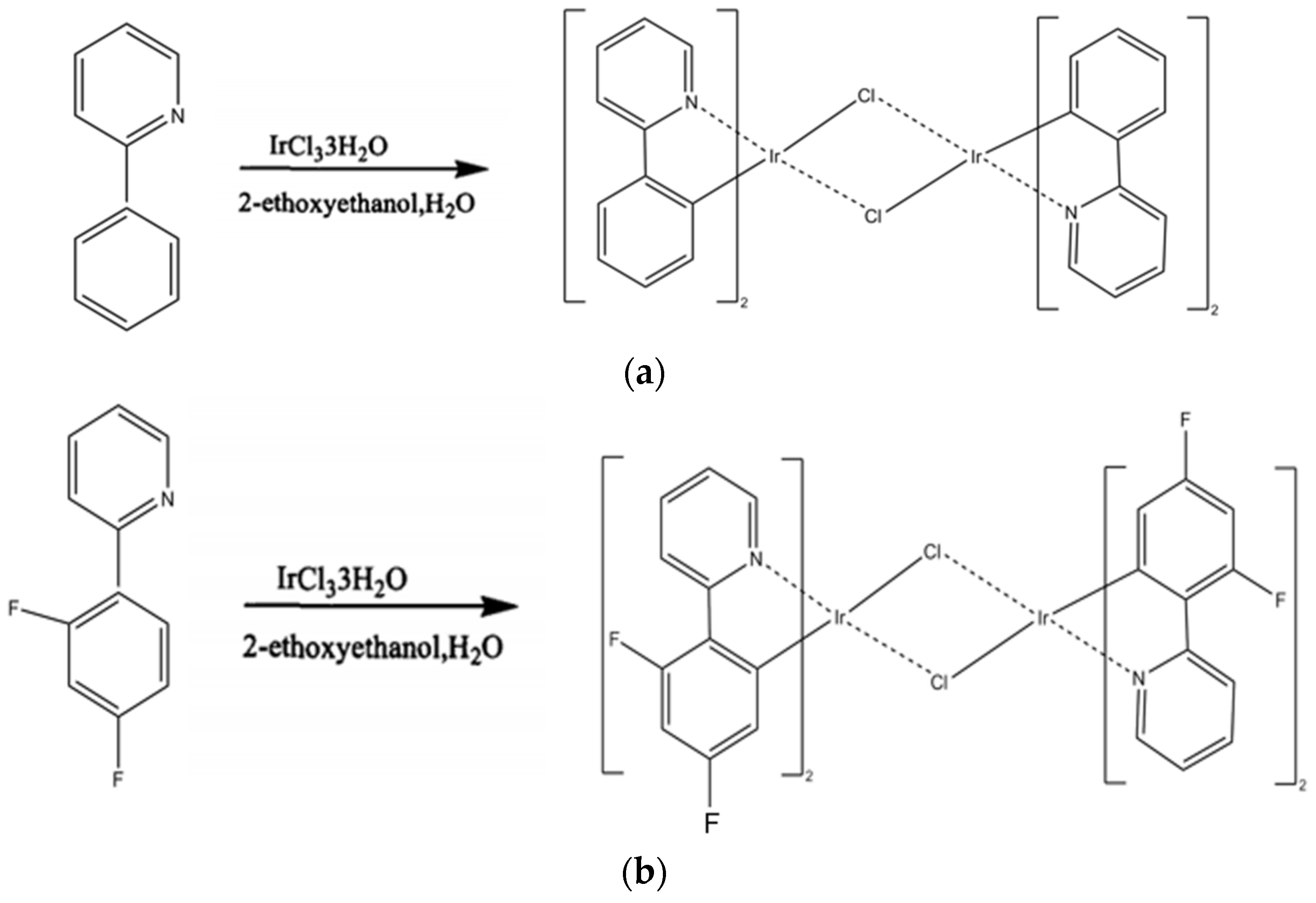
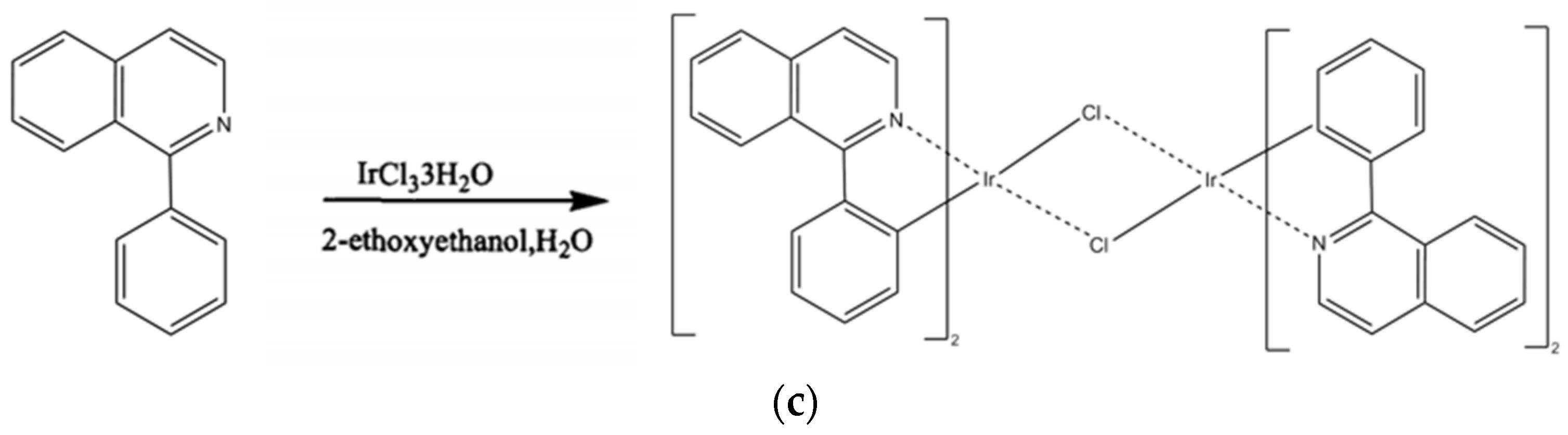
- Dimer Formation: Iridium(III) chloride was reacted with cyclometalating ligands (2-phenylpyridine, 2-(2,4-difluorophenyl)pyridine, or 1-phenylisoquinoline) in a 1:2.2 molar ratio under argon atmosphere to form chloro-bridged dimers. The specific synthetic route is illustrated in Figure 1.
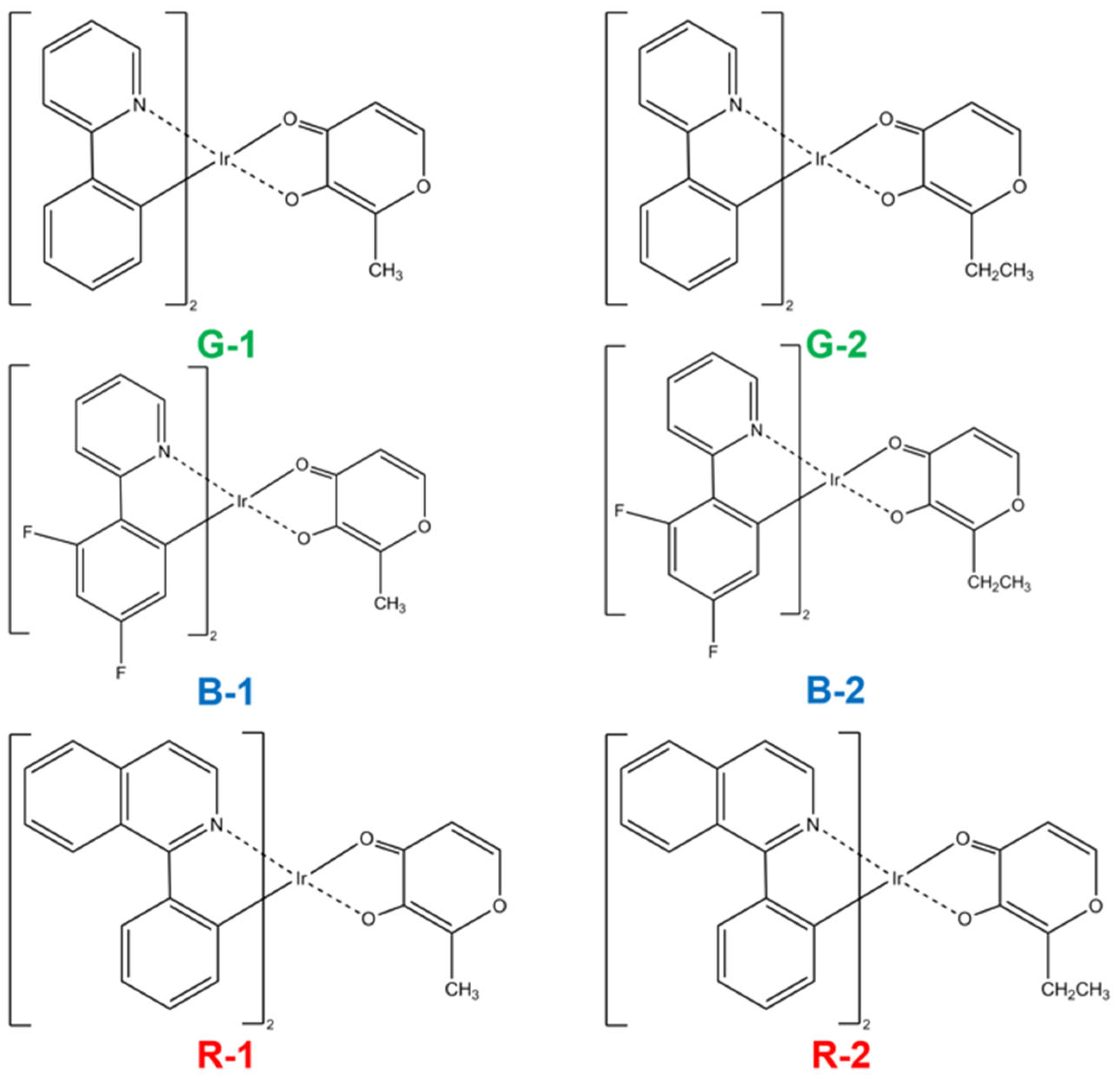
- Complexation with Pyranone Ligands: The resulting dimers were further reacted with 3-hydroxy-2-methyl-4-pyrone or 3-hydroxy-2-ethyl-4-pyrone in the presence of sodium carbonate, yielding six target complexes (G-1, G-2, B-1, B-2, R-1, R-2). The synthesis methods of G-series and R-series complexes refer to the optimized steps we reported previously [25,26]. The B-series complexes are designed and synthesized for the first time, and the specific synthesis steps are shown in the experimental section. The molecular structures and corresponding sample labels are presented in Figure 2.
2.2. Crystal Structures
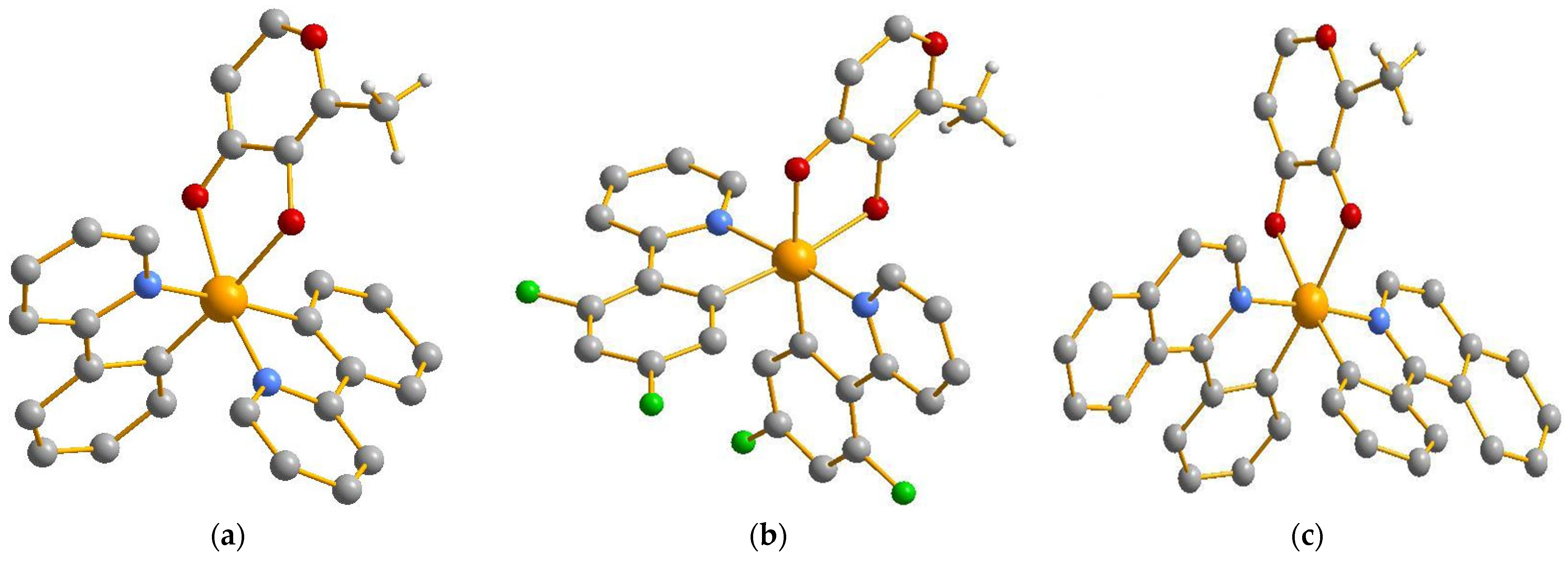
- G-1: Ir–C bond lengths are 2.036(13) Å and1.980(16) Å, Ir–N lengths are2.012(16) Å and1.910(4) Å, while Ir–O lengths are2.180(2) Å and2.249(2) Å;
- B-1: Ir–C (1.995(11) Å), Ir–N (2.049(9) Å) are shorter than Ir–O (2.163(8) Å);
- R-1: Ir–C (1.972(8) Å), Ir–N (2.040(6) Å) are shorter than Ir–O (2.148(6) Å).
- G-1 displays varying lengths: Ir–C (2.036(13) vs. 1.980(16) Å), Ir–N (2.012(16) vs. 1.910(4) Å), Ir–O (2.180(2) vs. 2.249(2) Å);
- B-1 shows consistent bond lengths across both ligands: Ir–C (1.995(11) Å), Ir–N (2.049(9) Å), Ir–O (2.163(8) Å);
- R-1 also has uniform values: Ir–C (1.972(8) Å), Ir–N (2.040(6) Å), Ir–O (2.148(6) Å).
- G-1 exhibits a range of angles: C–Ir–O from 88.7(8)° to 171.6(10)°, N–Ir–O from 90.4(13)° to 169.7(9)°, C–Ir–N from 80.0(16)° to 98.6(12)°;
- B-1 has consistent angles: C–Ir–O (173.0(4)°), N–Ir–O (93.9(4)°), C–Ir–N (96.4(4)°);
- R-1 shows uniform angles: C–Ir–O (174.67(17)°), N–Ir–O (96.48(19)°), C–Ir–N (80.1(2)°).
2.3. Photophysical Properties
2.4. Theoretical Calculations
2.5. Electrochemical Performance
2.6. Electroluminescence Devices
3. Materials and Methods
3.1. Synthesis of Iridium Complexes
3.1.1. General Synthetic Procedures
3.1.2. Synthesis of Chloro-Bridged Dimers
3.1.3. Synthesis of Target Complexes
3.2. Detection Methods
3.2.1. Structural Characterization of the Materials
3.2.2. Electrochemical Performance Testing
3.2.3. DFT Calculations
3.2.4. Photophysical Property Tests
3.2.5. Device Preparation and Testing
- (1)
- ITO substrate pre-treatment: The ITO film (15 Ω/square)(Xinyan Technology, Shekou, China) was etched from the substrate and sequentially ultrasonicated in deionized water, detergent solution, acetone, and methanol for 5–10 min each. The substrates were then thoroughly scrubbed until the ITO surface was free of contaminants. Subsequently, the cleaned ITO was treated in a UV–ozone cleaner (Novascan, Boone, IA, USA) for 15 min to enhance its surface work function.
- (2)
- Device fabrication: The pre-treated ITO substrates were immediately transferred into a vacuum evaporation chamber (Zhenheng Technology, Shenyang, China). When the base pressure fell below 3 × 10⁻⁵ Pa, the organic functional layers and the metal cathode were sequentially deposited according to the device design. During the deposition of the doped host–guest emissive layer, the vacuum level was carefully maintained, and consistency was ensured throughout the concentration adjustment and layer deposition processes.
- (3)
- Device testing: Following device fabrication, current density–voltage (J–V) characteristics were measured using an HP4140B picoammeter (Agilent Technologies, Palo Alto, CA, USA). Brightness, electroluminescence (EL) spectra, and CIE chromaticity coordinates were obtained using a Minolta LS-110 spectrophotometer (Konica Minolta, Tokyo, Japan) and an Ocean Optics USB-4000 spectrometer (Ocean Insight, Orlando, FL, USA). The external quantum efficiency was derived from the emission spectrum, brightness, and current density. Transient EL spectra were measured using a KEYSIGHT DSO1012A (Keysight Technologies, Santa Rosa, CA, USA) oscilloscope in conjunction with a LINI-UTP3313TFL-11 stabilized DC power supply (Longwei Instruments, Shenzhen, China) and a VICTOR DDS signal generator counter (Victor High Technology, Shenzhen, China).
- (4)
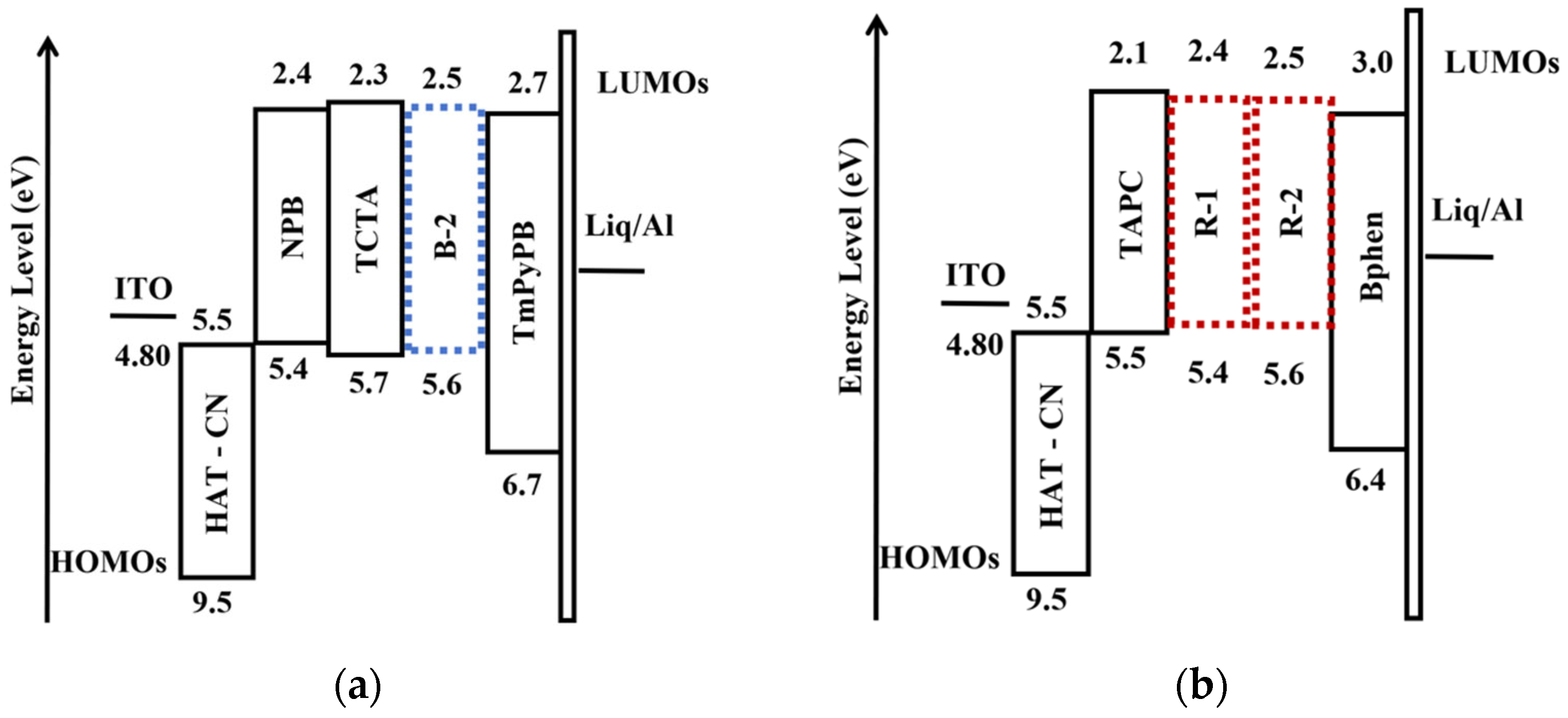
- Functional layer materials and device structures: The optimized device structure for B-2 was ITO/HAT-CN (3 nm)/NPB (40 nm)/TCTA (10 nm)/TCTA: dopant (8%, 15 nm)/TmPyPB (50 nm)/Liq (1 nm)/Al (100 nm). The optimized structure for R-1 and R-2 was ITO/HAT-CN (3 nm)/TAPC (40 nm)/NPB:Bphen:dopant (6%, 10 nm)/Bphen (50 nm)/Liq (1 nm)/Al (100 nm).
4. Conclusions
Supplementary Materials
Author Contributions
Funding
Institutional Review Board Statement
Informed Consent Statement
Data Availability Statement
Acknowledgments
Conflicts of Interest
References
- Baldo, M.A.; O’Brien, D.F.; You, Y.; Shoustikov, A.; Sibley, S.; Thompson, M.E.; Forrest, S.R. Highly Efficient Phosphorescent Emission from Organic Electroluminescent Devices. Nature 1998, 395, 151–154. [Google Scholar] [CrossRef]
- Maduwantha, K.; Yamada, S.; Koswattage, K.R.; Konno, T.; Hosokai, T. Excited-State Dynamics of Room-Temperature Phosphorescent Organic Materials Based on Monobenzil and Bisbenzil Frameworks. Materials 2020, 13, 3904. [Google Scholar] [CrossRef]
- Díaz-García, M.E.; Fernández-González, A.; Badía-Laíño, R. The Triplet State: Emerging Applications of Room Temperature Phosphorescence Spectroscopy. Appl. Spectrosc. Rev. 2007, 42, 605–624. [Google Scholar] [CrossRef]
- Jou, J.-H.; Sahoo, S.; Dubey, D.K.; Yadav, R.A.K.; Swayamprabha, S.S.; Chavhan, S.D. Molecule-Based Monochromatic and Polychromatic OLEDs with Wet-Process Feasibility. J. Mater. Chem. C 2018, 6, 11492–11518. [Google Scholar] [CrossRef]
- You, Y.; Park, S.Y. Phosphorescent Iridium(III) Complexes: Toward High Phosphorescence Quantum Efficiency through Ligand Control. Dalton Trans. 2009, 8, 1267–1282. [Google Scholar] [CrossRef]
- Mróz, W.; Ragni, R.; Galeotti, F.; Mesto, E.; Botta, C.; Cola, L.D.; Farinola, G.M.; Giovanella, U. Influence of Electronic and Steric Effects of Substituted Ligands Coordinated to Ir(III) Complexes on the Solution Processed OLED Properties. J. Mater. Chem. C 2015, 3, 7506–7512. [Google Scholar] [CrossRef]
- Niu, Y.; Zhang, F.; Li, T.; Li, Y.; Han, H.; Wei, D.; Zhai, B.; Wei, B. Synthesis, Structure and Optoelectronic Properties of Iridium(III) Complexes Bearing a Four-Membered Ir-N-CN Chelate Structure. J. Mol. Struct. 2024, 1301, 137355. [Google Scholar] [CrossRef]
- Wu, H.; Yang, T.; Zhao, Q.; Zhou, J.; Li, C.; Li, F. A Cyclometalated Iridium(III) Complex with Enhanced Phosphorescence Emission in the Solid State (EPESS): Synthesis, Characterization and Its Application in Bioimaging. Dalton Trans. 2011, 40, 1969–1976. [Google Scholar] [CrossRef]
- Ma, D.; Tsuboi, T.; Qiu, Y.; Duan, L. Recent Progress in Ionic Iridium(III) Complexes for Organic Electronic Devices. Adv. Mater. 2017, 29, 1603253. [Google Scholar] [CrossRef]
- Monti, F.; Baschieri, A.; Sambri, L.; Armaroli, N. Excited-State Engineering in Heteroleptic Ionic Iridium(III) Complexes. Acc. Chem. Res. 2021, 54, 1492–1505. [Google Scholar] [CrossRef] [PubMed]
- Yoon, S.; Gray, T.G.; Teets, T.S. Enhanced Deep-Red Phosphorescence in Cyclometalated Iridium Complexes with Quinoline-Based Ancillary Ligands. Inorg. Chem. 2023, 62, 7898–7905. [Google Scholar] [CrossRef]
- Monti, N.; Previati, E.; Vigarani, G.; Cocchi, M.; Tinti, F.; Raiteri, P.; Zacchini, S.; Giorgini, L.; Massi, M.; Stagni, S.; et al. Fine Color-Tuning of Ir(III) Tetrazolato Complexes: Synthesis, Photophysical Properties and OLED Device Fabrication. Dalton Trans. 2025, 54, 10304–10317. [Google Scholar] [CrossRef]
- Sohn, S.; Cheon, H.J.; Hong, J.; Ahn, H.; Jung, S.; Nam, S.Y.; Kim, Y.-H. Highly Efficient Warm White OLEDs Based on Phenyl Group Substitution with 2-Phenylpyridine Ancillary Ligands. Chem. Eng. J. 2025, 507, 159913. [Google Scholar] [CrossRef]
- Zhang, Z.; Li, L.; Zhou, W.; Zeng, Q.; Gong, Y.; Guo, S.; Xie, G.; Liu, Y. Anthraquinonyl Isoquinoline-Based Deep-Red Emissive Neutral Iridium(III) Complexes for Solution-processed Organic Light-emitting Diodes. Inorg. Chem. Commun. 2024, 166, 112616. [Google Scholar] [CrossRef]
- Cao, S.; Hao, L.; Lai, W.-Y.; Zhang, H.; Yu, Z.; Zhang, X.; Liu, X.; Huang, W. Distinct Phosphorescence Enhancement of Red-Emitting Iridium(III) Complexes with Formyl-Functionalized Phenylpyridine Ligands. J. Mater. Chem. C 2016, 4, 4709–4718. [Google Scholar] [CrossRef]
- Hashemzadeh, T.; Christofferson, A.J.; White, K.F.; Barnard, P.J. Experimental and Theoretical Studies of pH-Responsive Iridium(III) Complexes of Azole and N-Heterocyclic Carbene Ligands. Dalton Trans. 2024, 53, 8478–8493. [Google Scholar] [CrossRef]
- Martínez-Vollbert, E.; Philouze, C.; Cavignac, T.; Latouche, C.; Loiseau, F.; Lanoë, P.-H. Neutral 2-Phenylbenzimidazole-Based Iridium(III) Complexes with Picolinate Ancillary Ligand: Tuning the Emission Properties by Manipulating the Substituent on the Benzimidazole Ring. Dalton Trans. 2024, 53, 4705–4718. [Google Scholar] [CrossRef] [PubMed]
- Feng, Z.; Yu, Y.; Yang, X.; Zhong, D.; Song, D.; Yang, H.; Chen, X.; Zhou, G.; Wu, Z. Isomers of Coumarin-Based Cyclometalated Ir(III) Complexes with Easily Tuned Phosphorescent Color and Features for Highly Efficient Organic Light-Emitting Diodes. Inorg. Chem. 2019, 58, 7393–7408. [Google Scholar] [CrossRef] [PubMed]
- Cao, H.-T.; Ding, L.; Yu, J.; Shan, G.-G.; Wang, T.; Sun, H.-Z.; Gao, Y.; Xie, W.-F.; Su, Z.-M. Manipulating Phosphorescence Efficiencies of Orange Iridium(III) Complexes through Ancillary Ligand Control. Dyes Pigm. 2019, 160, 119–127. [Google Scholar] [CrossRef]
- Kamecka, A.; Kapturkiewicz, A.; Pipczyński, Ł. Heteroleptic Luminescent [Ir(C^N)2(N^N)]+ Complexes Containing 1-Phenyl-1H-Pyrazole or 1-(2,4-Difluorophenyl)-1H-Pyrazole as Cyclometalating and α-Diimines as Ancillary Ligands. Inorg. Chem. Commun. 2021, 131, 108764. [Google Scholar] [CrossRef]
- Li, C.; Zhang, F.; Li, T.; Li, Y.; Wei, D.; Zhai, B.; Niu, Y.; Wei, B. Luminescent Color Control and Electroluminescent Characteristics of Iridium(III) Complexes Containing a Four-Membered Chelating Ring from Ancillary Ligand. Inorg. Chim. Acta 2024, 568, 122102. [Google Scholar] [CrossRef]
- Zhu, W.; Liu, S.; Wang, Z.; Shi, C.; Zhang, Q.; Wu, Z.; Li, G.; Zhu, D. An AIE Metal Iridium Complex: Photophysical Properties and Singlet Oxygen Generation Capacity. Molecules 2023, 28, 7914. [Google Scholar] [CrossRef]
- Yang, X.; Cheng, L.; Zhao, Y.; Ma, H.; Song, H.; Yang, X.; Wang, K.-N.; Zhang, Y. Aggregation-Induced Emission-Active Iridium (III)-Based Mitochondria-Targeting Nanoparticle for Two-Photon Imaging-Guided Photodynamic Therapy. J. Colloid Interface Sci. 2024, 659, 320–329. [Google Scholar] [CrossRef]
- Lino, V.; Prontera, C.T.; Maglione, M.G.; Borriello, C.; Tassini, P.; Manini, P. New Strategies to Improve the Efficiency of Curcumin-Based Iridium Complexes for OLED Devices. Eur. J. Org. Chem. 2024, 27, e202400288. [Google Scholar] [CrossRef]
- Jiang, W.; Hou, W.; Yan, C.; Nie, Z.; Chang, Q.; Li, X.; Liu, W. Synthesis and Performance of Deep-Red Phosphorescent Iridium Complexes with Pyrone as an Auxiliary Ligand. Molecules 2024, 29, 3183. [Google Scholar] [CrossRef]
- Xu, H.; Li, X.; Nie, Z.; Yang, L.; Chang, Q.; Yan, C.; Jiang, W. Synthesis, Structure and Properties of Green-Emitting Iridium (III) Complexes. J. Wuhan Univ. Technol.-Mater. Sci. Ed. 2025, 40, 836–841. [Google Scholar] [CrossRef]
- Han, D.; Ji, X.; Zhao, L.; Pang, C. Theoretical Insight on Electronic Structure and Photophysical Properties of a Series of Cyclometalated Iridium(III) Complexes Bearing the Substituted Phenylpyrazole with Different Electron-Donating or Electron-Accepting Groups. Photochem. Photobiol. Sci. 2021, 20, 1487–1495. [Google Scholar] [CrossRef]
- Chen, T.; Han, D.; Gao, J.; Li, J.; Shang, X. A Theoretical Study on the Electronic Structure and Phosphorescence Properties of Two Series of Iridium(III) Complexes with a Four-Membered Ir–S–C–S Chelating Ring. New J. Chem. 2020, 44, 2749–2754. [Google Scholar] [CrossRef]
- Yang, C.-H.; Li, S.-W.; Chi, Y.; Cheng, Y.-M.; Yeh, Y.-S.; Chou, P.-T.; Lee, G.-H.; Wang, C.-H.; Shu, C.-F. Heteroleptic Cyclometalated Iridium(III) Complexes Displaying Blue Phosphorescence in Solution and Solid State at Room Temperature. Inorg. Chem. 2005, 44, 7770–7780. [Google Scholar] [CrossRef] [PubMed]
- Liu, S.; Wang, M.; Wang, Y.; Hou, T.; Shen, X. Novel Deep Red to Near-Infrared Phosphorescent Iridium(III) Complexes Bearing Pyrenyl: Syntheses, Structures and Modulation of the Photophysical Properties. Inorg. Chem. Commun. 2023, 150, 110460. [Google Scholar] [CrossRef]
- Zhang, S.; Si, Y.; Wu, Z. Theoretical Study on the Effect of Different Substituents on the Electronic Structures and Photophysical Properties of Phosphorescent Ir(III) Complexes. RSC Adv. 2014, 4, 15849–15855. [Google Scholar] [CrossRef]
- Liu, Z.; Zhang, S.-W.; Zhang, M.; Wu, C.; Li, W.; Wu, Y.; Yang, C.; Kang, F.; Meng, H.; Wei, G. Highly Efficient Phosphorescent Blue-Emitting [3+2+1] Coordinated Iridium (III) Complex for OLED Application. Front. Chem. 2021, 9, 730620. [Google Scholar] [CrossRef]
- Lai, P.-N.; Brysacz, C.H.; Alam, M.K.; Ayoub, N.A.; Gray, T.G.; Bao, J.; Teets, T.S. Highly Efficient Red-Emitting Bis-Cyclometalated Iridium Complexes. J. Am. Chem. Soc. 2018, 140, 10198–10207. [Google Scholar] [CrossRef]
- Yan, C.; Li, Y.; Chang, Q.; Jiang, J.; Liu, W.; Chen, J. Batch Synthesis, Characterization and Light-Physical Properties of Bis (2-phenylpyridine) (acetylacetonate) Iridium (III). Chin. J. Rare Met. 2015, 39, 8. [Google Scholar]
- Yan, C.; Chang, Q.; Li, J.; Jiang, J.; Ye, Q.; Yu, J.; Chen, J.; Qiu, H. Synthesis, Characterization and Light-physical Property of Blue Phosphorescent Iridium Complexes. Precious Met. 2016, 37, 13–18. [Google Scholar]
- Su, Y.-J.; Huang, H.-L.; Li, C.-L.; Chien, C.-H.; Tao, Y.-T.; Chou, P.-T.; Datta, S.; Liu, R.-S. Highly Efficient Red Electrophosphorescent Devices Based on Iridium Isoquinoline Complexes: Remarkable External Quantum Efficiency Over a Wide Range of Current. Adv. Mater. 2003, 15, 884–888. [Google Scholar] [CrossRef]
- Yan, C.; Li, J.; Jiang, J.; Chen, J.; Liu, W.; Chang, Q. Synthesis, characterization and photophysical property of bis(2-phenylquinolyl-N,C2′)(acetylacetonate)iridium(III). J. Funct. Mater. 2017, 48, 6. [Google Scholar]
- Chang, Q.; Chen, Z.; Wang, Z.; Jiang, J.; Yu, J.; Liu, W.; Yan, C.; Chen, L. Iridium Phosphorescent Complexes Based on Modified Phenylquinoline Ligand and Their High-Efficiency Pure Red Organic Electroluminescent Device. Chin. J. Lumin. 2022, 43, 1583–1591. [Google Scholar] [CrossRef]
- Maity, A.; Sinha, D.; Rajak, K.K. Experimental and Theoretical Studies of Structural and Photophysical Properties of a Novel Heteroleptic Cyclometalated Iridium(III) Complex with 8-Hydroxyquinoline-Phenylazo Ligand. J. Mol. Struct. 2018, 1158, 122–132. [Google Scholar] [CrossRef]
- Song, M.-X.; Li, Y.; Xu, D.; Deng, R.-P.; Bai, F.-Q.; Qin, Z.-K. New Exploration towards Dinuclear Iridium(II) Complexes Materials under Chlorine-Bridged Precursor. RSC Adv. 2016, 6, 68960–68963. [Google Scholar] [CrossRef]
- Kim, J.-H.; Kim, S.-Y.; Cho, D.W.; Son, H.-J.; Kang, S.O. Influence of Bulky Substituents on the Photophysical Properties of Homoleptic Iridium(III) Complexes. Phys. Chem. Chem. Phys. 2019, 21, 6908–6916. [Google Scholar] [CrossRef]
- Henwood, A.F.; Pal, A.K.; Cordes, D.B.; Slawin, A.M.Z.; Rees, T.W.; Momblona, C.; Babaei, A.; Pertegás, A.; Ortí, E.; Bolink, H.J.; et al. Blue-Emitting Cationic Iridium(III) Complexes Featuring Pyridylpyrimidine Ligands and Their Use in Sky-Blue Electroluminescent Devices. J. Mater. Chem. C 2017, 5, 9638–9650. [Google Scholar] [CrossRef]
- Sunesh, C.D.; Chitumalla, R.K.; Subeesh, M.S.; Shanmugasundaram, K.; Jang, J.; Choe, Y. Photophysical, Electrochemical, and Quantum Chemical Properties of Cationic Iridium Complexes with Tunable Emission Color. J. Electroanal. Chem. 2016, 780, 249–256. [Google Scholar] [CrossRef]
- Howarth, A.J.; Patia, R.; Davies, D.L.; Lelj, F.; Wolf, M.O.; Singh, K. Elucidating the Origin of Enhanced Phosphorescence Emission in the Solid State (EPESS) in Cyclometallated Iridium Complexes. Eur. J. Inorg. Chem. 2014, 2014, 3657–3664. [Google Scholar] [CrossRef]
- Poirot, A.; Vanucci-Bacqué, C.; Delavaux-Nicot, B.; Meslien, C.; Saffon-Merceron, N.; Serpentini, C.-L.; Bedos-Belval, F.; Benoist, E.; Fery-Forgues, S. Using a Diphenyl-Bi-(1,2,4-Triazole) Tricarbonylrhenium(i) Complex with Intramolecular π–π Stacking Interaction for Efficient Solid-State Luminescence Enhancement. Dalton Trans. 2023, 52, 5453–5465. [Google Scholar] [CrossRef]
- Li, G.; Li, N.; Cao, Y.; Shi, C.; Liu, X.; Zeng, R.; Wu, M.; Li, Q.; Yang, C.; Yuan, A. Deep-Red/Near-Infrared to Blue-Green Phosphorescent Iridium(III) Complexes Featuring Three Differently Charged (0, −1, and −2) Ligands: Structures, Photophysics, and Organic Light-Emitting Diode Application. Inorg. Chem. 2022, 61, 10548–10556. [Google Scholar] [CrossRef] [PubMed]
- Kim, J.; Lee, K.H.; Lee, S.J.; Lee, H.W.; Kim, Y.K.; Kim, Y.S.; Yoon, S.S. Red Phosphorescent Bis-Cyclometalated Iridium Complexes with Fluorine-, Phenyl-, and Fluorophenyl-Substituted 2-Arylquinoline Ligands. Chem. Eur. J. 2016, 22, 4036–4045. [Google Scholar] [CrossRef] [PubMed]
- Ludwig, G.; Ranđelović, I.; Dimić, D.; Komazec, T.; Maksimović-Ivanić, D.; Mijatović, S.; Rüffer, T.; Kaluđerović, G.N. (Pentamethylcyclopentadienyl)Chloridoiridium(III) Complex Bearing Bidentate Ph2PCH2CH2SPh-κP,κS Ligand. Biomolecules 2024, 14, 420. [Google Scholar] [CrossRef]
- Oh-e, M.; Nagasawa, A. Advancing the a Posteriori Quest for Deep-Blue Phosphorescence: Quantifying Excitation-Induced Metal-to-Ligand Charge Transfer as a Guiding Indicator. Organometallics 2020, 39, 3951–3960. [Google Scholar] [CrossRef]
- Feng, Z.; Yu, Y.; Yang, X.; Sun, Y.; Zhong, D.; Deng, X.; Zhou, G.; Wu, Z. Manipulating MLCT Transition Character with Ppy-Type Four-Coordinate Organoboron Skeleton for Highly Efficient Long-Wavelength Ir-Based Phosphors in Organic Light-Emitting Diodes. J. Mater. Chem. C 2021, 9, 12650–12660. [Google Scholar] [CrossRef]
- Janeoo, S.; Reenu; Kumar Samal, S.; Naidu, B.S.; Kumar, R.; Kaur, H. 2,3-Diarylquinoline -Based Iridium (III) Complexes: Synthesis, Photophysical Properties and DFT Studies. J. Photochem. Photobiol. A Chem. 2023, 445, 115034. [Google Scholar] [CrossRef]
- Witkowska, E.; Wiosna-Salyga, G.; Glowacki, I.; Orwat, B.; Oh, M.; Kownacki, I.; Kubicki, M.; Gierczyk, B.; Dutkiewicz, M.; Cieszko, P.; et al. Effect of Fluorine Substitution of the β-Ketoiminate Ancillary Ligand on Photophysical Properties and Electroluminescence Ability of New Iridium(III) Complexes. J. Mater. Chem. C 2018, 6, 8688–8708. [Google Scholar] [CrossRef]
- Ha, Y.H.; Sohn, S.; Han, S.-H.; Kim, B.G.; Ahn, H.; Jung, S.; Kwon, S.-K.; Kim, Y.-H. New Blue Phosphorescence from Trifluorosulfonyl-Substituted Iridium Complexes. Dyes Pigm. 2019, 163, 684–691. [Google Scholar] [CrossRef]
- Lin, M.; Tang, Q.; Xing, G.; Li, D.; Zeng, H.; Ling, Q. The Synthesis and Luminescent Properties of Trichromatic Iridium Complexes Based on 2-(4-Bromophenyl)-1-Hydrogen-Benzimidazole. Synth. Met. 2017, 223, 87–93. [Google Scholar] [CrossRef]
- Ding, Y.; Liu, D.; Li, J.; Li, H.; Ma, H.; Li, D.; Niu, R. Saturated Red Phosphorescent Iridium(III) Complexes Containing Phenylquinoline Ligands for Efficient Organic Light-Emitting Diodes. Dyes Pigm. 2020, 179, 108405. [Google Scholar] [CrossRef]
- Skórka, Ł.; Filapek, M.; Zur, L.; Małecki, J.G.; Pisarski, W.; Olejnik, M.; Danikiewicz, W.; Krompiec, S. Highly Phosphorescent Cyclometalated Iridium(III) Complexes for Optoelectronic Applications: Fine Tuning of the Emission Wavelength through Ancillary Ligands. J. Phys. Chem. C 2016, 120, 7284–7294. [Google Scholar] [CrossRef]
- Baschieri, A.; Sambri, L.; Mazzanti, A.; Carlone, A.; Monti, F.; Armaroli, N. Iridium(III) Complexes with Fluorinated Phenyl-Tetrazoles as Cyclometalating Ligands: Enhanced Excited-State Energy and Blue Emission. Inorg. Chem. 2020, 59, 16238–16250. [Google Scholar] [CrossRef] [PubMed]
- Humphrey, W.; Dalke, A.; Schulten, K. VMD: Visual Molecular Dynamics. J. Mol. Graph. 1996, 14, 33–38. [Google Scholar] [CrossRef] [PubMed]



| Parameter | G-1 | B-1 | R-1 |
|---|---|---|---|
| Formula | C28H22IrN2O3 | C28H17F4IrN2O3 | C36H25IrN2O3 |
| Formula weight | 626.67 | 697.64 | 725.78 |
| Crystal system | monoclinic | orthorhombic | monoclinic |
| Space group | P21/c | Pccn | C2/c |
| a [Å] | 17.0084(9) | 7.2752(3) | 11.4553(5) |
| b [Å] | 13.0338(7) | 15.8317(7) | 15.4613(6) |
| c [Å] | 10.6853(5) | 20.6395(9) | 20.2487(7) |
| α [0] | 90 | 90 | 90 |
| β [0] | 93.189(4) | 90 | 101.138(2) |
| γ [0] | 90 | 90 | 90 |
| V [Å 3] | 2365.1(2) | 2377.23(18) | 3518.78(20) |
| Z | 4 | 4 | 4 |
| ρcalc [g/cm3] | 1.760 | 1.949 | 1.370 |
| Reflections collected | 14,048 | 28,595 | 11,912 |
| Independent reflections | 4514 | 2427 | 3228 |
| RF, Rw(F2) (all data) | 0.1098 | 0.0792 | 0.0500 |
| RF, Rw(F2) [I > 2σ(I)] | 0.0756 | 0.0597 | 0.0426 |
| GOF | 1.055 | 1.232 | 1.108 |
| Compound | Ir–C | Ir–N | Ir–O | C–Ir–C | N–Ir–N | O–Ir–O | C–Ir–O | N–Ir–O | C–Ir–N |
|---|---|---|---|---|---|---|---|---|---|
| G-1 | 2.036(13) | 2.012(16) | 2.180(2) | 96.0(14) | 95.5(12) | 76.9(9) | 171.6(10) | 169.7(9) | 88.6(14) |
| 1.980(16) | 1.910(4) | 2.249(2) | 96.3(11) | 92.8(10) | 80.0(16) | ||||
| 93.9(8) | 90.4(13) | 98.6(12) | |||||||
| 88.7(8) | 91.9(13) | 80.2(7) | |||||||
| B-1 | 1.995(11) | 2.049(9) | 2.163(8) | 86.7(6) | 175.5(5) | 78.0(5) | 173.0(4) | 93.9(4) | 96.4(4) |
| 1.995(11) | 2.049(9) | 2.163(8) | 173.0(4) | 93.9(4) | 96.4(4) | ||||
| 97.9(4) | 89.6(3) | 80.3(4) | |||||||
| 97.9(4) | 89.6(3) | 80.3(4) | |||||||
| R-1 | 1.972(8) | 2.040(6) | 2.148(6) | 87.4(4) | 175.5(2) | 78.4(3) | 174.67(17) | 96.48(19) | 80.1(2) |
| 1.972(8) | 2.040(6) | 2.148(6) | 174.67(17) | 96.48(19) | 80.1(2) | ||||
| 97.1(3) | 87.05(19) | 96.6(2) | |||||||
| 97.1(3) | 87.05(19) | 96.6(2) |
| Complex | Λabs 1 (nm) | Λem 1 (nm) | Φp 2 (%) | Λem 3 (nm) | Φp 3 (%) | τ 1 (μs) |
|---|---|---|---|---|---|---|
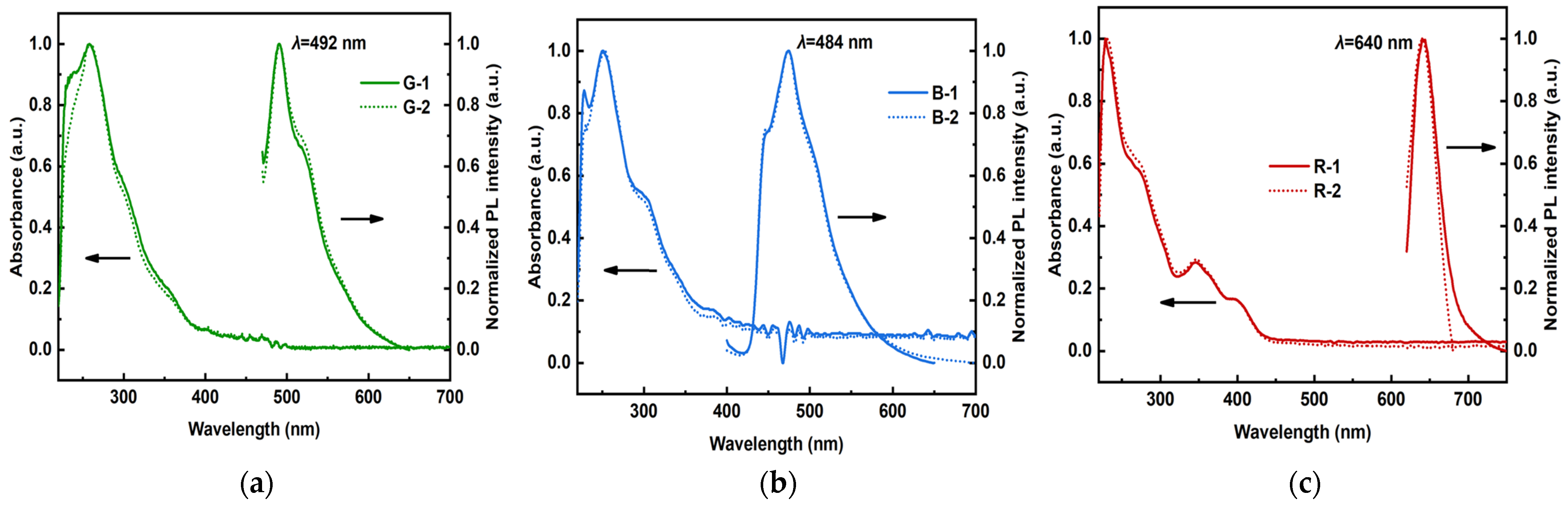
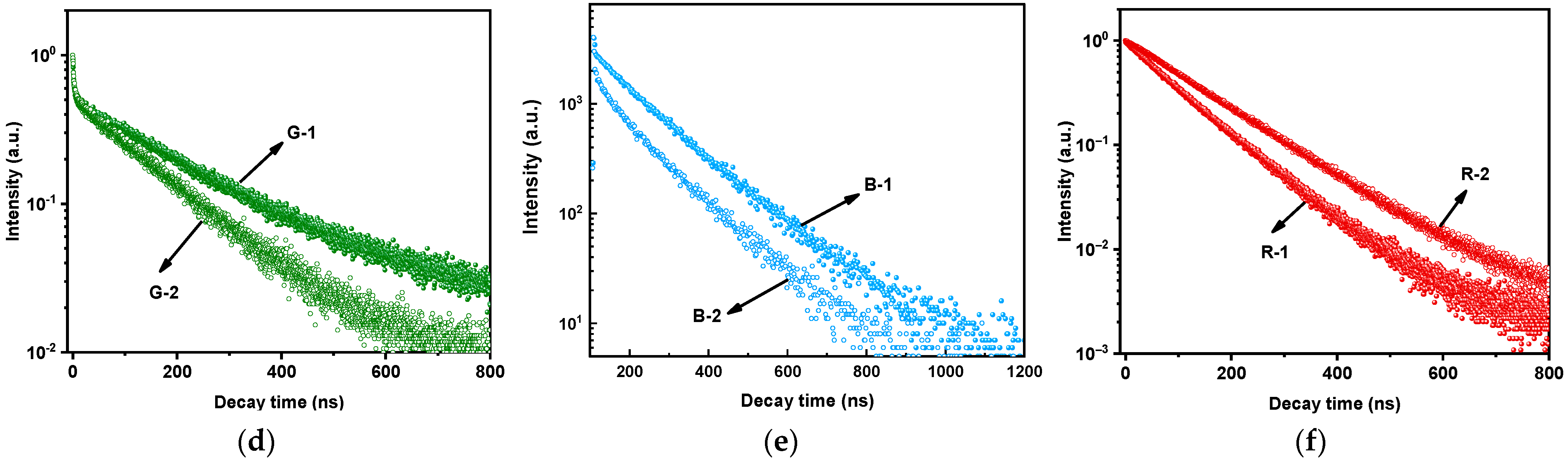
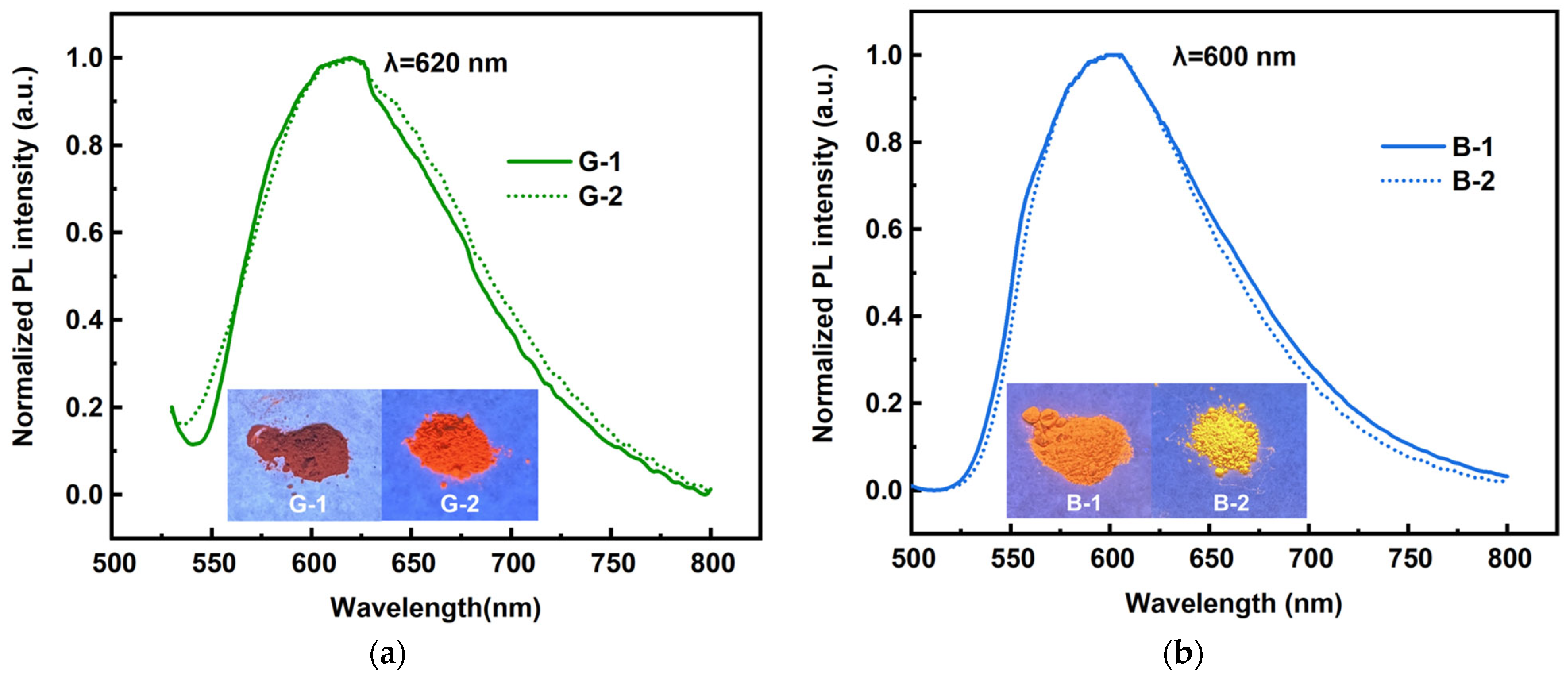
| G-1 | 261, 300, 355, 402 | 492 | - | 620 | 3.4 | 0.21 |
| G-2 | 261, 301, 356, 401 | 492 | - | 620 | 5.5 | 0.15 |
| B-1 | 251, 301, 382 | 484 | - | 600 | 12.7 | 0.16 |
| B-2 | 251, 301, 383 | 484 | - | 600 | 25.8 | 0.25 |
| R-1 | 229, 270, 346, 397 | 640 | 64 | - | - | 0.13 |
| R-2 | 232, 273, 345, 398 | 640 | 55 | - | - | 0.13 |
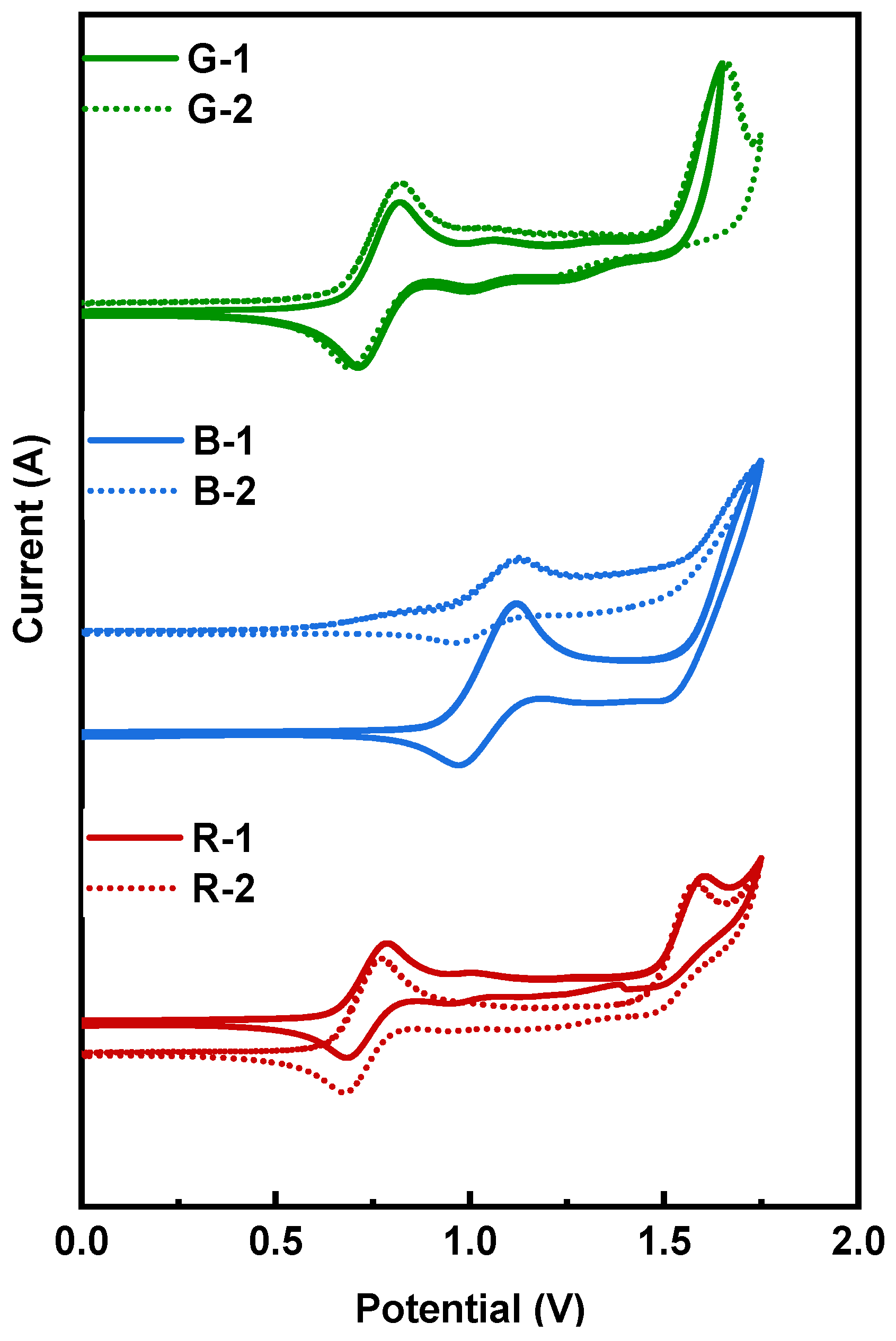
| Complex | (V) | EHOMO (eV) | ELUMO (eV) | Eg (eV) |
|---|---|---|---|---|
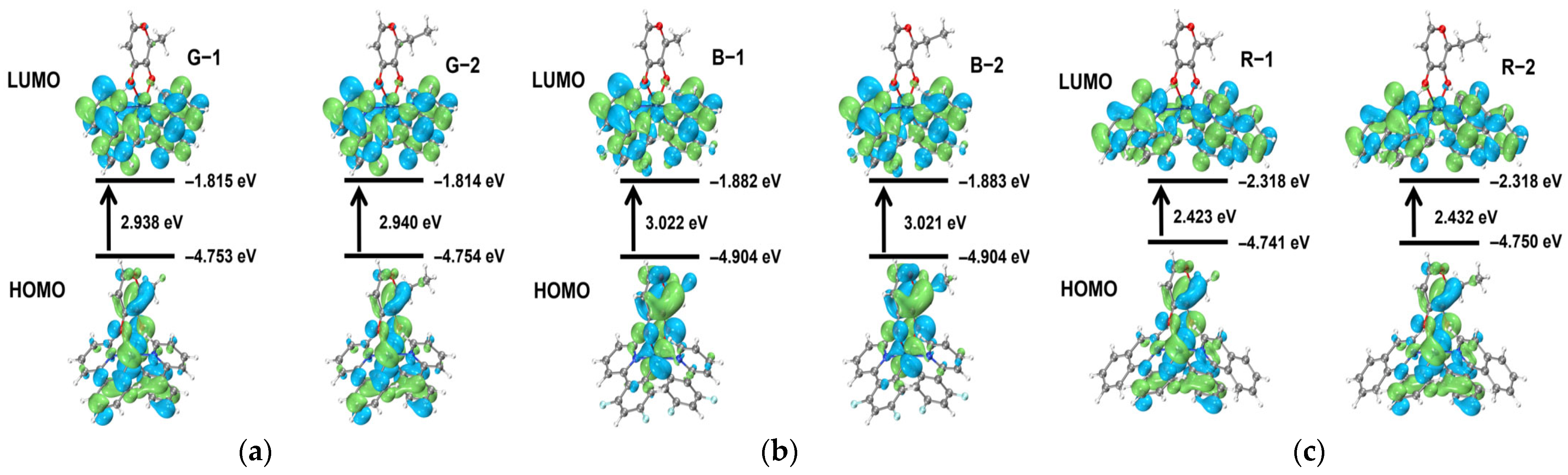
| G-1 | 0.54 | −4.94 | −2.14 | 2.80 |
| G-2 | 0.54 | −4.94 | −2.18 | 2.76 |
| B-1 | 0.68 | −5.08 | −2.21 | 2.87 |
| B-2 | 0.68 | −5.08 | −2.2 | 2.88 |
| R-1 | 0.5 | −4.90 | −2.75 | 2.15 |
| R-2 | 0.46 | −4.86 | −2.18 | 2.05 |
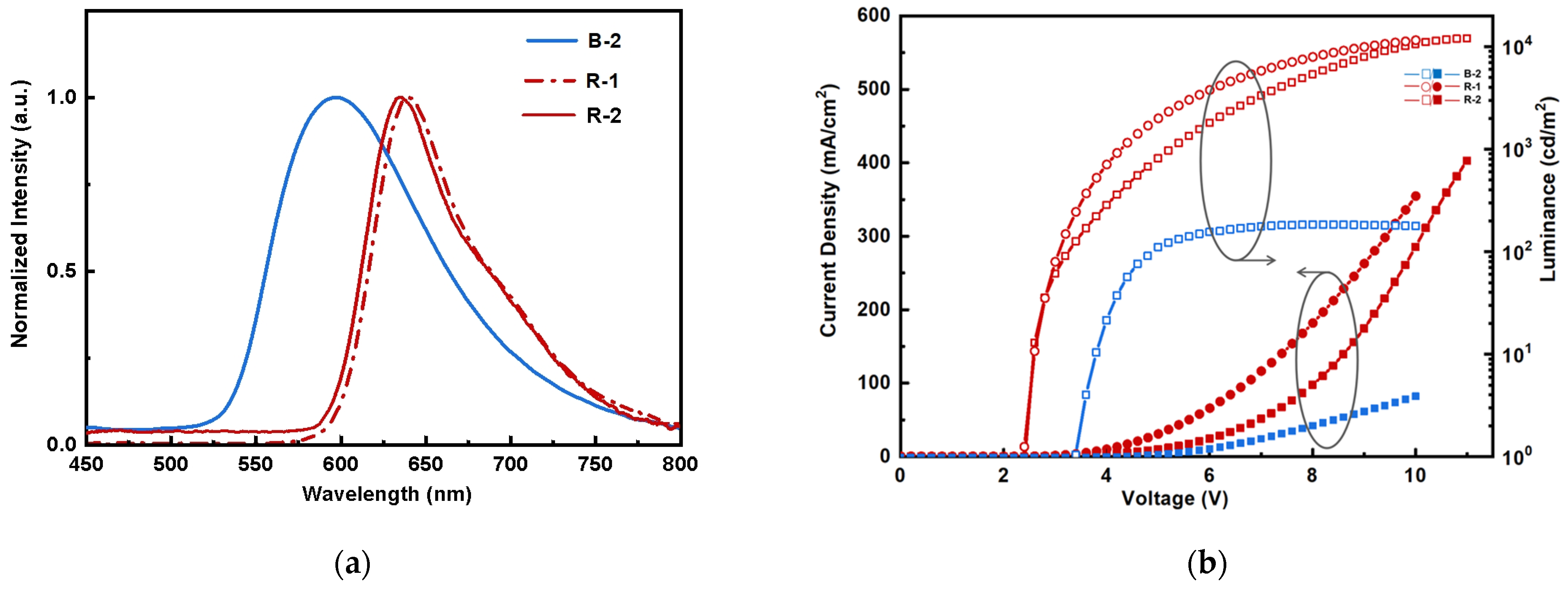
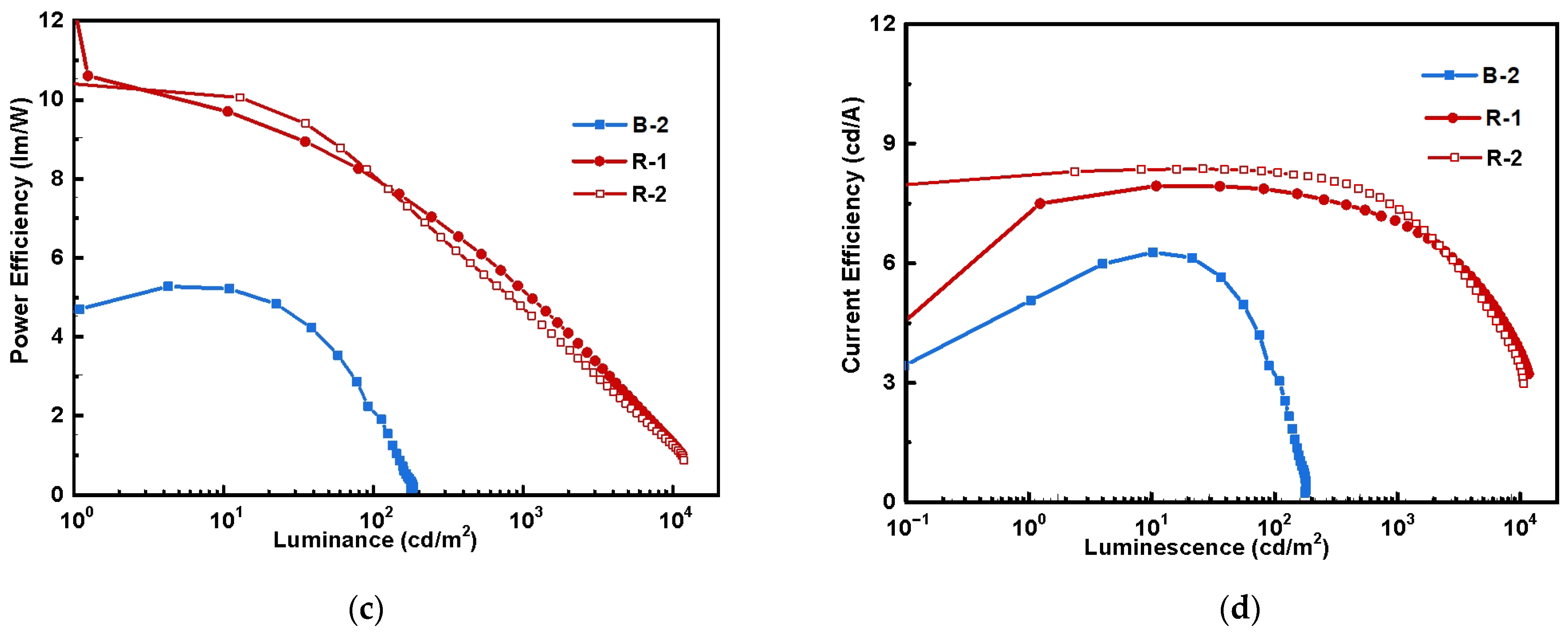
| Devices | Von 1 (V) | Lmax (cd/m2) | ηc,max (cd/A) | ηp,max (lm/W) | Hext 2 (%) | λem (nm) | CIE(x, y) |
|---|---|---|---|---|---|---|---|
| B-2 | 3.4 | 179 | 6.31 | 5.25 | 5.36/2.02 | 597 | 0.59, 0.42 |
| R-1 | 2.4 | 12,188 | 8.10 | 10.65 | 13.4/11.51 | 641 | 0.69, 0.30 |
| R-2 | 2.4 | 13,298 | 8.37 | 10.05 | 11.1/9.63 | 640 | 0.69, 0.30 |
Disclaimer/Publisher’s Note: The statements, opinions and data contained in all publications are solely those of the individual author(s) and contributor(s) and not of MDPI and/or the editor(s). MDPI and/or the editor(s) disclaim responsibility for any injury to people or property resulting from any ideas, methods, instructions or products referred to in the content. |
© 2026 by the authors. Licensee MDPI, Basel, Switzerland. This article is an open access article distributed under the terms and conditions of the Creative Commons Attribution (CC BY) license.
Share and Cite
Jiang, W.; Wang, L.; Li, X.; Yan, C.; Chang, Q. Design, Synthesis, and Characterization of Novel Phosphorescent Iridium Complexes with Pyrone Auxiliary Ligands and ppy/dfppy/piq Cyclometalating Ligands. Inorganics 2026, 14, 95. https://doi.org/10.3390/inorganics14040095
Jiang W, Wang L, Li X, Yan C, Chang Q. Design, Synthesis, and Characterization of Novel Phosphorescent Iridium Complexes with Pyrone Auxiliary Ligands and ppy/dfppy/piq Cyclometalating Ligands. Inorganics. 2026; 14(4):95. https://doi.org/10.3390/inorganics14040095
Chicago/Turabian StyleJiang, Wen, Leyuan Wang, Xiangguang Li, Caixian Yan, and Qiaowen Chang. 2026. "Design, Synthesis, and Characterization of Novel Phosphorescent Iridium Complexes with Pyrone Auxiliary Ligands and ppy/dfppy/piq Cyclometalating Ligands" Inorganics 14, no. 4: 95. https://doi.org/10.3390/inorganics14040095
APA StyleJiang, W., Wang, L., Li, X., Yan, C., & Chang, Q. (2026). Design, Synthesis, and Characterization of Novel Phosphorescent Iridium Complexes with Pyrone Auxiliary Ligands and ppy/dfppy/piq Cyclometalating Ligands. Inorganics, 14(4), 95. https://doi.org/10.3390/inorganics14040095