Next Article in Journal
Facile Synthesis of High-Purity Nanostructured Hafnium Carbide via Pectin-Assisted Carbothermal Reduction: Structural Evolution and Morphological Insight
Previous Article in Journal
Effect of Doping Inorganic Acid Radical Ions on Electrochemical Properties of Polyaniline/Graphite Carbon Paper Electrodes
 
 
Due to scheduled maintenance work on our servers, there may be short service disruptions on this website between 11:00 and 12:00 CEST on March 28th.
Article

Design, Synthesis, and Investigation of the Photoelectric Properties of Glaucine Derivatives in Sensitized Solar Cells


by
Anatolii S. Burlov
1,
Anastasia A. Shiryaeva
2,
Valery G. Vlasenko
2,
Yurii V. Koshchienko
1,
Alexander A. Zubenko
3,
Oleg P. Demidov
4,
Bogdan V. Chaltsev
1,
Alexandra A. Polyanskaya
1,
Alexey N. Gusev
5,
Elena V. Braga
5 and
Wolfgang Linert
6,*
1
Institute of Physical and Organic Chemistry, Southern Federal University, Stachki ave. 194/2, Rostov-on-Don 344090, Russia
2
Research Institute of Physics, Southern Federal University, Stachki ave. 194, Rostov-on-Don 344090, Russia
3
North-Caucasus Zonal Scientific Research Veterinary Institute—Branch of the Federal State Budget, Novocherkassk 346406, Russia
4
Department of Chemistry, North Caucasus Federal University, Pushkin st. 1, Stavropol 355017, Russia
5
General Chemistry Department, Crimean Federal University V.I. Vernadsky, Simferopol 295007, Russia
6
Institute of Applied Physics, Vienna University of Technology, Wiedner Hauptstraße 8-10, 1040 Vienna, Austria
*
Author to whom correspondence should be addressed.
Inorganics 2026, 14(4), 91; https://doi.org/10.3390/inorganics14040091
Submission received: 22 February 2026 / Revised: 12 March 2026 / Accepted: 18 March 2026 / Published: 25 March 2026
(This article belongs to the Section Coordination Chemistry)

Abstract

Two Zn(II) coordination compounds based on glaucine-derived Schiff bases were synthesized and investigated as potential materials for dye-sensitized solar cells (DSSCs). The structures of all compounds were established by X-ray diffraction analysis and quantum chemical modeling (DFT/TD-DFT). Their photophysical properties (absorption and luminescence spectra in solution and the solid state), electrochemical characteristics, and photovoltaic parameters in DSSC devices were studied. The highest power conversion efficiency (PCE ~5.18%) was demonstrated by the free ligands, which is attributed to their favorable absorption spectrum and optimal alignment of energy levels relative to the conduction band of TiO2 and the redox couple of the electrolyte. The Zn(II) coordination compounds exhibited significantly lower efficiency (~2.1%). Impedance spectroscopy results indicated more efficient charge transfer at the TiO2/dye/electrolyte interface for the organic derivatives.

1. Introduction

The need for environmentally friendly and renewable energy sources capable of meeting humanity’s growing energy demands is one of the most pressing challenges of our time. Solar energy, based on the direct conversion of solar radiation into electricity, plays a central role in addressing this challenge [1,2]. Despite the dominance of silicon-based photovoltaic technologies (first generation), their widespread adoption is limited by the high cost of materials and the energy-intensive production processes for high-purity silicon [3]. This has driven the development of alternative approaches, including thin-film solar cells (second generation) and emerging third-generation photovoltaic technologies [4].
The latter includes dye-sensitized solar cells (DSSCs), first reported by O’Regan and Grätzel in 1991 [5]. Their operating principle differs fundamentally from classical semiconductor p–n junctions. In DSSCs, the functions of light absorption and charge transport are separated: a photon is absorbed by a sensitizer molecule adsorbed onto the surface of a mesoporous oxide electrode (typically TiO2), after which the excited electron is injected into the conduction band of the semiconductor. The oxidized dye is regenerated by a redox couple in the electrolyte (traditionally I/I3), which is in turn reduced at the counter electrode [6,7]. Key advantages of DSSCs include the relatively low cost of materials and fabrication, the ability to operate under diffuse light conditions, and the potential for flexible, semi-transparent, and aesthetically appealing device architectures—offering opportunities for integration into building materials (BIPV) and wearable electronics [8].
The power conversion efficiency of a DSSC depends directly on the sensitizer’s ability to efficiently absorb sunlight over a broad spectral range and to inject electrons into the semiconductor. The energy levels of the sensitizer—the highest occupied molecular orbital (HOMO) and the lowest unoccupied molecular orbital (LUMO)—must be optimally aligned with the conduction band of the semiconductor and the redox potential of the electrolyte [9]. Historically, the most efficient sensitizers have been ruthenium complexes and porphyrins, achieving PCEs exceeding 11–14% [10,11]. In recent years, however, research focus has shifted toward fully organic (metal-free) sensitizers. These materials contain no scarce or expensive metals, exhibit high molar extinction coefficients, and allow fine-tuning of their optical and electronic properties through molecular design—typically employing donor–π–bridge–acceptor (D–π–A) architectures [12,13,14]. Parallel efforts are intensively pursuing the improvement of other DSSC components: the replacement of conventional iodide-based electrolytes with more efficient cobalt or copper complexes to increase open-circuit voltage (Voc); the development of solid-state and gel-based hole-transport materials to address evaporation and leakage issues; and the design of novel photoanode and counter-electrode materials with enhanced morphological and charge-transport characteristics.
Of particular interest for the development of new DSSCs are molecules with natural or biomimetic structures, which may combine synthetic accessibility, unique optical properties, and potential for further functionalization. The alkaloid glaucine, possessing an extended aromatic system and sites amenable to functionalization, represents a promising chromophoric core for the design of a new class of sensitizers.
A comprehensive assessment of the practical potential of new materials requires moving beyond their initial laboratory characteristics and studying their behavior under real-world operating conditions. Environmental factors have a critical impact on the long-term stability of organic sensitizers. As highlighted in recent studies, the urban microclimate and local anthropogenic heat emissions create complex thermal landscapes that can significantly accelerate material degradation [15]. In this context, understanding the nonlinear mechanisms of heat accumulation becomes a prerequisite for predicting the spatiotemporal durability of organic photovoltaic devices in diverse geographical settings [16]. Furthermore, the development of environmentally benign dye derivatives is of key importance for implementing carbon footprint reduction strategies, particularly in their integration into facade systems designed to improve the energy efficiency of residential buildings [17].
The aim of the present work is the synthesis of a series of novel glaucine derivatives, investigation of their photophysical and electrochemical characteristics, and evaluation of their performance as sensitizers in DSSCs. The obtained data will enable the establishment of structure–property relationships for this class of compounds and identification of the most promising directions for their further optimization in the context of developing efficient and cost-effective photovoltaic devices.

2. Results and Discussion

2.1. The IR and 1H NMR Spectra

1H NMR spectra of azomethines 1, 2 and their zinc(II) complexes 3, 4 allowed for the complete assignment of all proton signals (Figures S5–S8). For 1, the NH proton signal is observed at 11.66 ppm, and the CH=N proton signals appear at 8.93 and 9.12 ppm. For 2, the OH proton signal appears at 11.60 ppm, and the CH=N proton signals are observed at 9.18 and 9.22 ppm. Upon formation of zinc complexes 3 and 4, the signals corresponding to the NH and OH protons of the ligands, respectively, disappear. The CH=N proton signals in the zinc complexes are observed at 9.05, 9.15 ppm (for 3) and 9.11, 9.20 ppm (for 4) and remain essentially unchanged compared to those of the free ligands.
The IR spectra of compounds 1 and 2 (Figures S10 and S11) exhibit characteristic absorption bands, cm−1: 2990 w (NH), 1597 s (CH=N), 1345 s (SO2), 1168 s (SO2) for 1; and 2928 w (OH), 1618 s, 1304 m (Ph–O) for 2. The zinc complexes 3 and 4 obtained from these ligands have a ZnL2 composition according to elemental analysis. Their IR spectra (Figures S12 and S13) show characteristic changes indicative of chelate formation: the ν(C=N) absorption bands are slightly shifted to lower frequencies—1594 cm−1 for 3 and 1603 cm−1 for 4. The νas(SO2) band in zinc complex 3 shifts to 1298 cm−1, and the ν(SO2) band to 1129 cm−1. The ν(C=N) absorption band of zinc complex 4 is shifted by 15 cm−1 to lower frequency relative to 2, appearing at 1603 cm−1.

2.2. Single-Crystal X-Ray Characterization

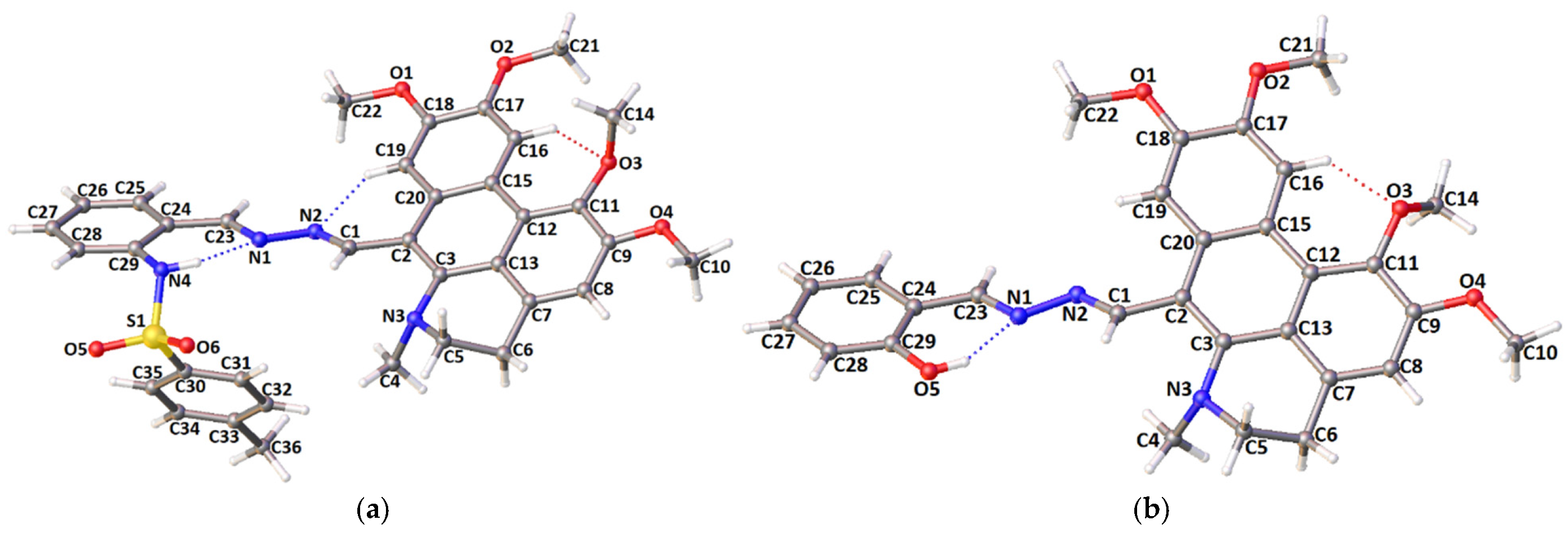
Both compounds 1 and 2 are molecular organic crystals (Figure 1). Compound 1 crystallizes in the triclinic system, space group P 1 ¯ (2), while compound 2 crystallizes in the monoclinic system, space group P 2 1 / n (14). The core of both molecules 1 and 2 consists of four fused rings forming a rigid planar framework. The six-membered ring C3C13C7C6C5N3 adopts an «armchair» conformation, with atom C5 displaced from the mean plane of the ring by 0.767 Å in 1 and 0.683 Å in 2. Four methoxy groups (–OCH3) are attached to the aromatic rings at positions C9, C11, C17, and C18 and are not coplanar with the aromatic system. The phenyl rings (C24–C29) of the aldehyde moiety are twisted relative to the glaucine skeleton by 27.30° and 32.29° in 1 and 2, respectively. Selected bond lengths and angles for 1 and 2 are listed in Table 1. The data in Table 1 clearly show that these geometric parameters are similar for the central fragment of the molecules, which contains the azomethine bond (CH=N).
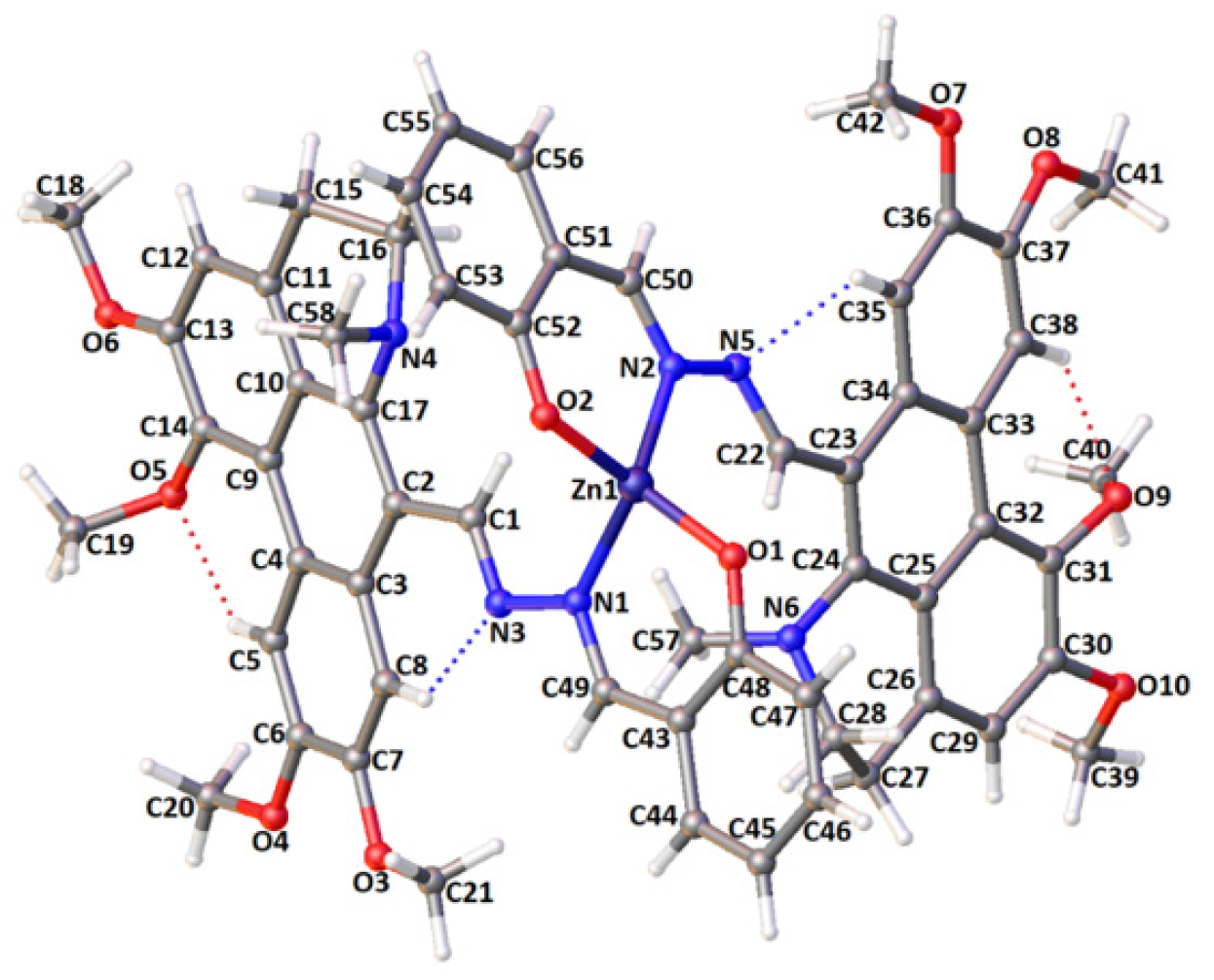
Compound 4 is a monomeric zinc(II) complex bearing two molecules of the glaucine derivative 2. The zinc atom in 4 is coordinated by two nitrogen and two oxygen atoms from two different bidentate ligands, forming six-membered chelate rings (Figure 2).
The resulting coordination polyhedron ZnN2O2 is close to a slightly distorted tetrahedron, as can be seen from the geometric index τ4 = 0.93 [18], which was determined by Formula (1):
τ 4 = 360 ° ( α + β ) 360 ° 2 θ
where α and β are the largest bond angles at the coordination center, and ϴ ≈ 109.5° is the tetrahedral angle. The bond lengths and bond angles at the coordination center are given in Table 2. The average Zn–N and Zn–O distances are 2.006 Å and 1.912 Å, respectively, which are in good agreement with the data reported for analogous zinc complexes based on salicylaldehyde derivatives [19,20,21,22].
Density functional theory (DFT) calculations were performed to obtain optimized structures of compounds 1, 2, and 4, which were compared with X-ray diffraction data (Table 1 and Table 2). Correlation plots between the experimental and calculated structures for compounds 1, 2, and 4 are shown in Figures S1–S3 in the Supporting Information.
The comparison demonstrates that the computational method reproduces the crystallographic structures with high accuracy. A strong correlation between experimental and calculated bond lengths is observed (Figures S1–S3), with correlation coefficients R2 = 0.9873 for 1, 0.9947 for 2, and 0.9633 for 4. Good agreement was also achieved for bond angles, with R2 = 0.9408 (1), 0.9639 (2), and 0.8037 (4). The mean absolute deviations between calculated and experimental values for bond lengths and bond angles in compounds 1 and 2 are approximately 0.02 Å and 0.6°, respectively. For complex 4, these values are slightly larger, amounting to 0.05 Å and 1.6°.
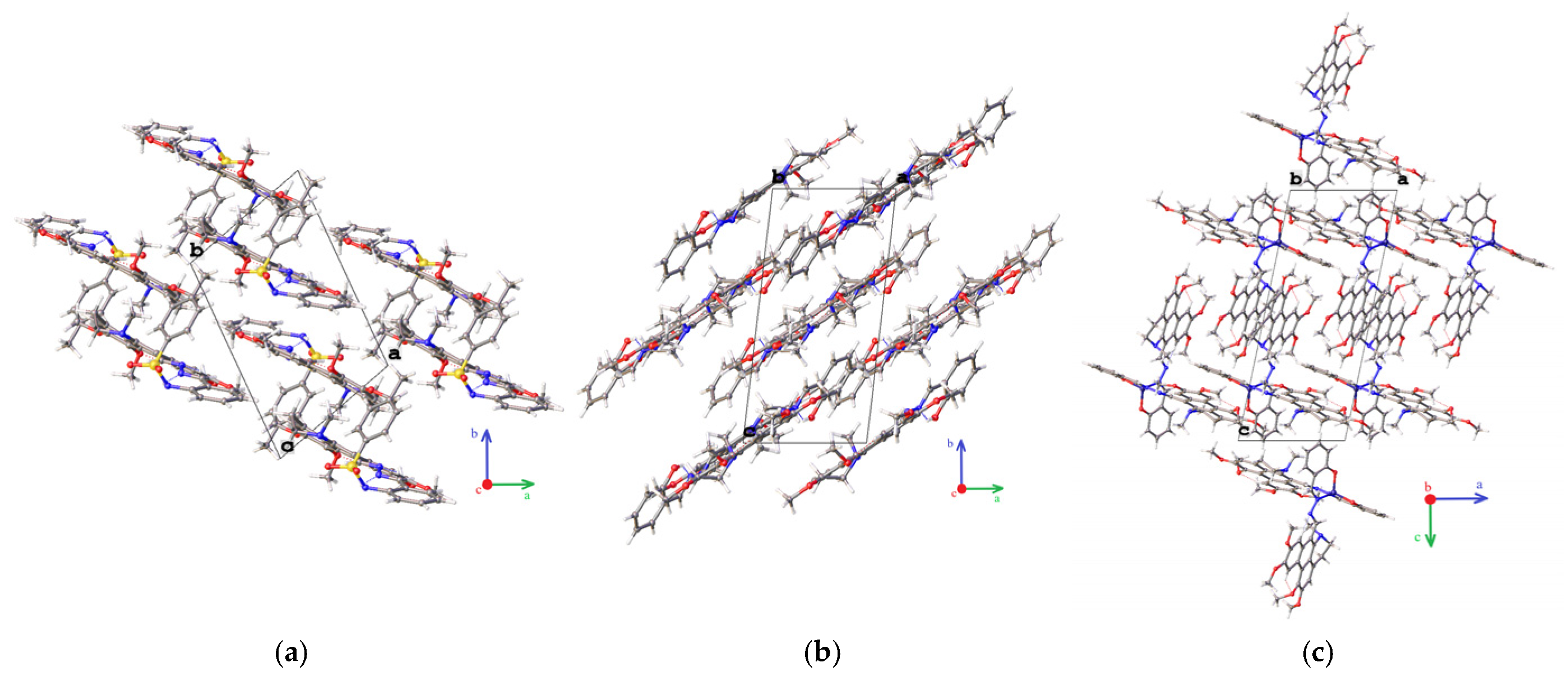
The crystal structures of all compounds feature an extensive network of intermolecular hydrogen bonds (Figure 3). The characteristics of intra- and intermolecular hydrogen bonds are summarized in Table 3. In compound 1, intramolecular hydrogen bonds N4–H4⋯N1, C19–H19⋯N2, and C16–H16⋯O3 play a key role in stabilizing the molecular conformation. In compound 2, strong intramolecular hydrogen bonds O5–H5⋯N1 and C16–H16⋯O3 serve an analogous function. Complex 4 also retains these hydrogen bonds characteristic of compound 2. These interactions contribute significantly to the flattened shape of the molecules. Such a planar conformation of molecules 1, 2 and 4 facilitates the formation of a layered crystal packing via intermolecular hydrogen bonds, as shown in Figure 3.
Intermolecular interactions in compounds 1, 2, and 4 were further analyzed by calculating the corresponding Hirshfeld surfaces [23,24,25,26]. Key topological parameters of the molecules—molecular volume (V), surface area (S), sphericity (G), and asphericity (Ω)—are listed in Table 4.
According to the data in Table 4, the formation of complex 4 leads to a substantial increase in both molecular volume (by a factor of 2.02) and surface area (by a factor of 1.78) compared to azomethine 2. This increase is due to the incorporation of the Zn(II) ion and the ligands of its coordination sphere into the structure. Although azomethine 1 has larger absolute dimensions (V and S) than azomethine 2, it exhibits a different steric organization, which is reflected in its shape parameters. The sphericity parameter G reflects the evolution of geometric compactness. The higher G value for 2 (0.674) compared to azomethine 1 (0.651) indicates greater isotropy and more efficient space filling. In complex 4, the G value decreases to 0.604, suggesting the formation of a structure with an increased surface area-to-volume ratio. This is characteristic of a less dense molecular packing, which may offer greater potential for the formation of intermolecular contacts. The most significant transformation is observed for the asphericity parameter Ω. The high asphericity values of azomethines 2 (Ω = 0.268) and 1 (Ω = 0.208) are indicative of pronounced shape anisotropy and may lead to the formation of a specific type of packing arrangement, such as bilayer structures. Coordination results in a dramatic decrease in Ω for complex 4, down to 0.020, pointing to a transition toward a quasi-spherical, highly isotropic geometry. This is a direct consequence of the symmetric coordination sphere of the metal, which effectively compensates for the inherent elongation of azomethine 2.
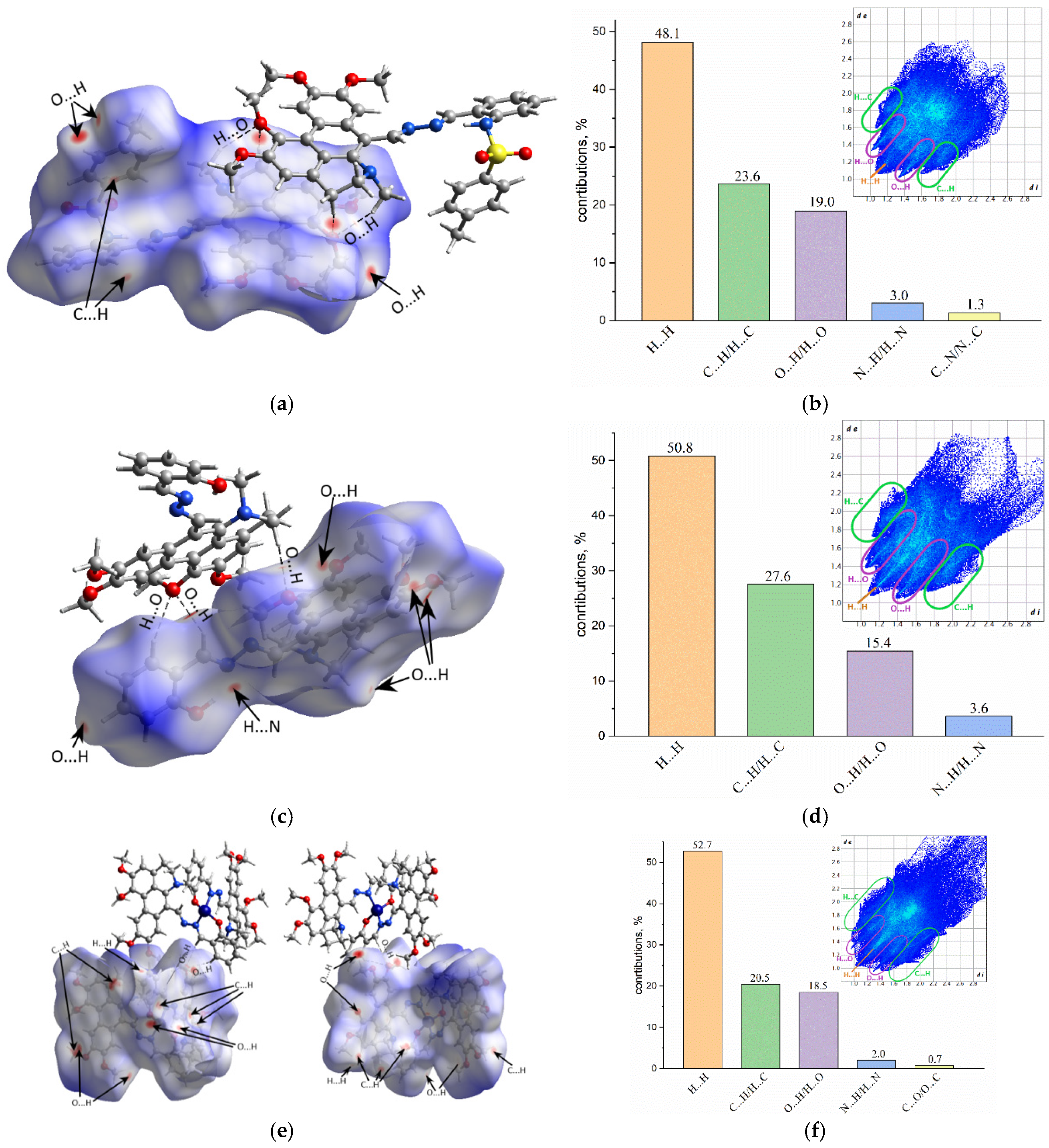
Figure 4 shows the Hirshfeld surfaces (dnorm) mapped for molecules 1, 2, and 4. Different types of intermolecular contacts are indicated by color coding: contacts corresponding to the sum of van der Waals radii are shown in white; short hydrogen bonds are shown in red; and long, weak interactions are shown in blue.
Fingerprint plot analysis revealed that H⋯H contacts account for 48.1% (1), 50.8% (2), and 52.7% (4) of the total surface area, while C⋯H/H⋯C and O⋯H/H⋯O contacts contribute approximately 23.9% and 17.6%, respectively, for all complexes. These interactions make a significant contribution to the stability of the molecular structure and crystal packing (Figure 4).
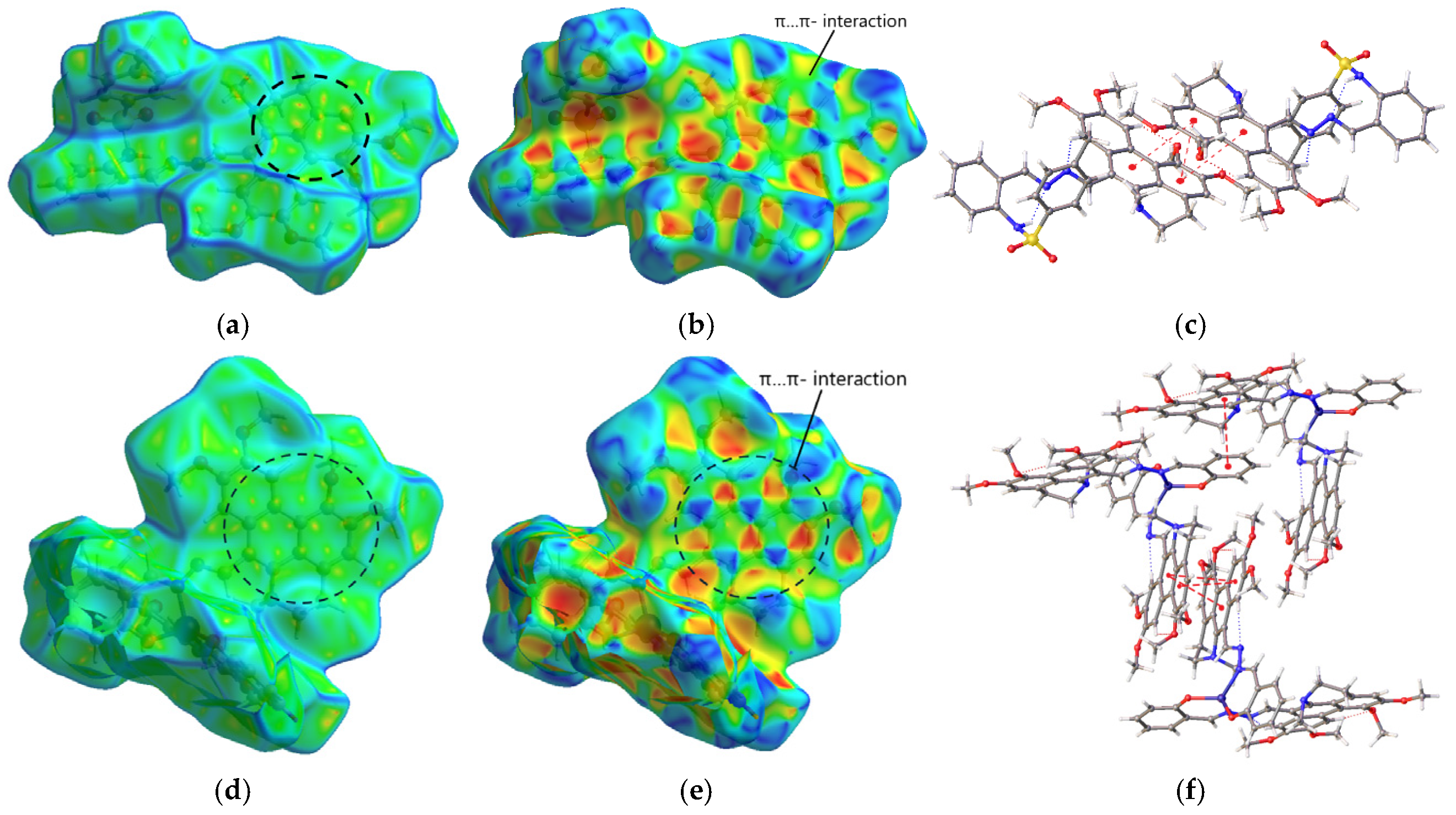
In the aromatic systems of compounds 1 and 4, intermolecular π–π stacking interactions were identified and quantitatively characterized (Table 5, Figure 5c,f). In structure 1, dimerization of the aromatic systems is observed, with three centroid–centroid (Cg⋯Cg) distances between the rings of the glaucine skeleton of 3.559 and 3.977 Å (Table 5, Figure 5c). In complex 4, four stacking interactions are present, also involving the rings of the glaucine skeleton, forming complex layered structures that contribute to the stabilization of the crystal lattice (Table 5, Figure 5f).
For complexes 1 and 4, the Hirshfeld surface curvature (Figure 5a,d) is characterized by extensive green flat regions, indicating a planar molecular arrangement. On the shape-index maps for complexes 1 and 4 (Figure 5b,e), pairs of red and blue triangles corresponding to these flat regions can be visualized, confirming the presence of strong π–π interactions (Table 5).

2.3. Electronic Absorption Spectra of Compounds

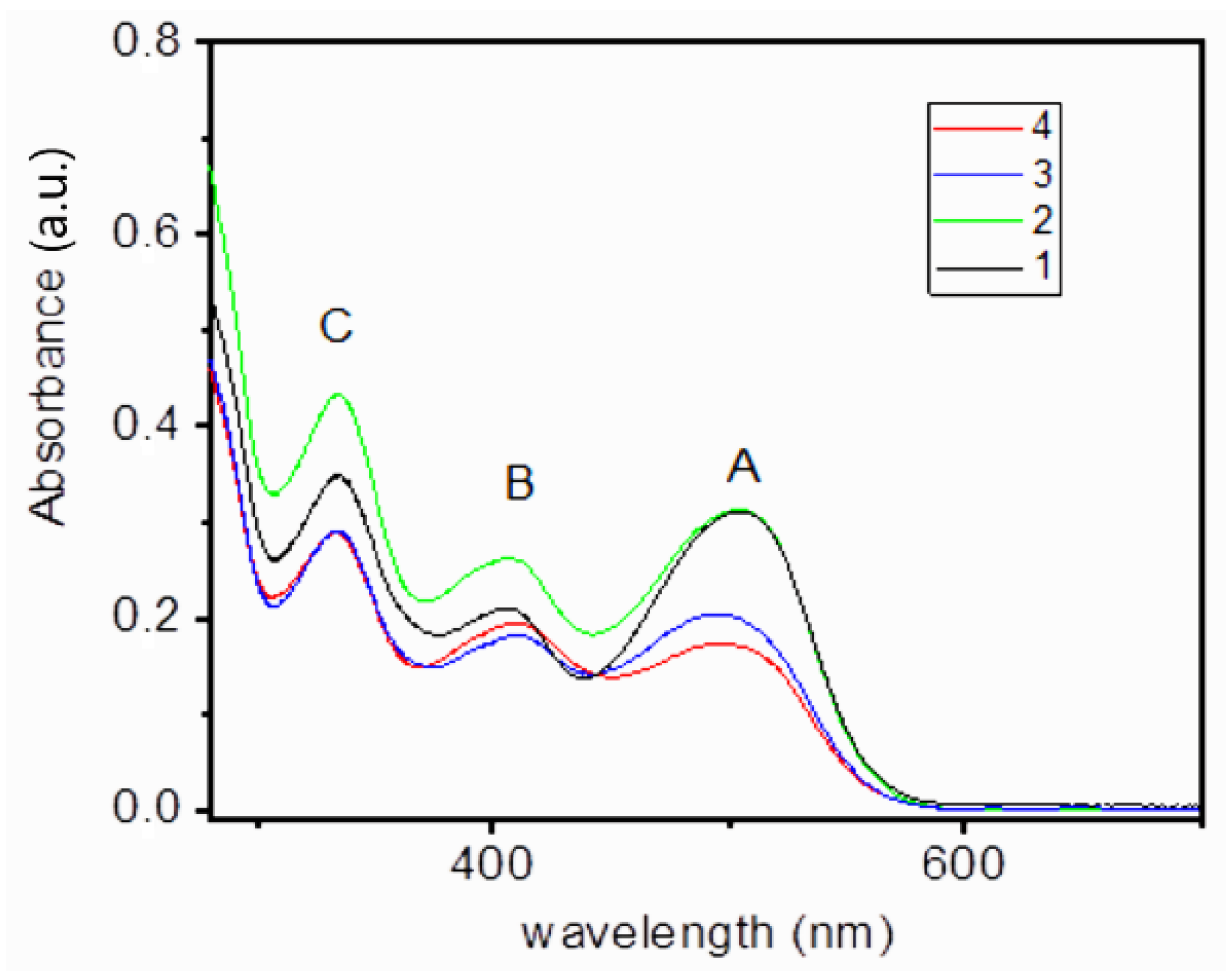
The UV–Vis absorption spectra of compounds 14 were examined both experimentally and theoretically using time-dependent density functional theory (TD-DFT). All compounds exhibit three distinct absorption bands in the ultraviolet and visible regions (Figure 6, Table 6). TD-DFT calculations, performed with an implicit solvation model for dichloromethane (CH2Cl2), enabled reliable assignment of the electronic transitions underlying each absorption feature.
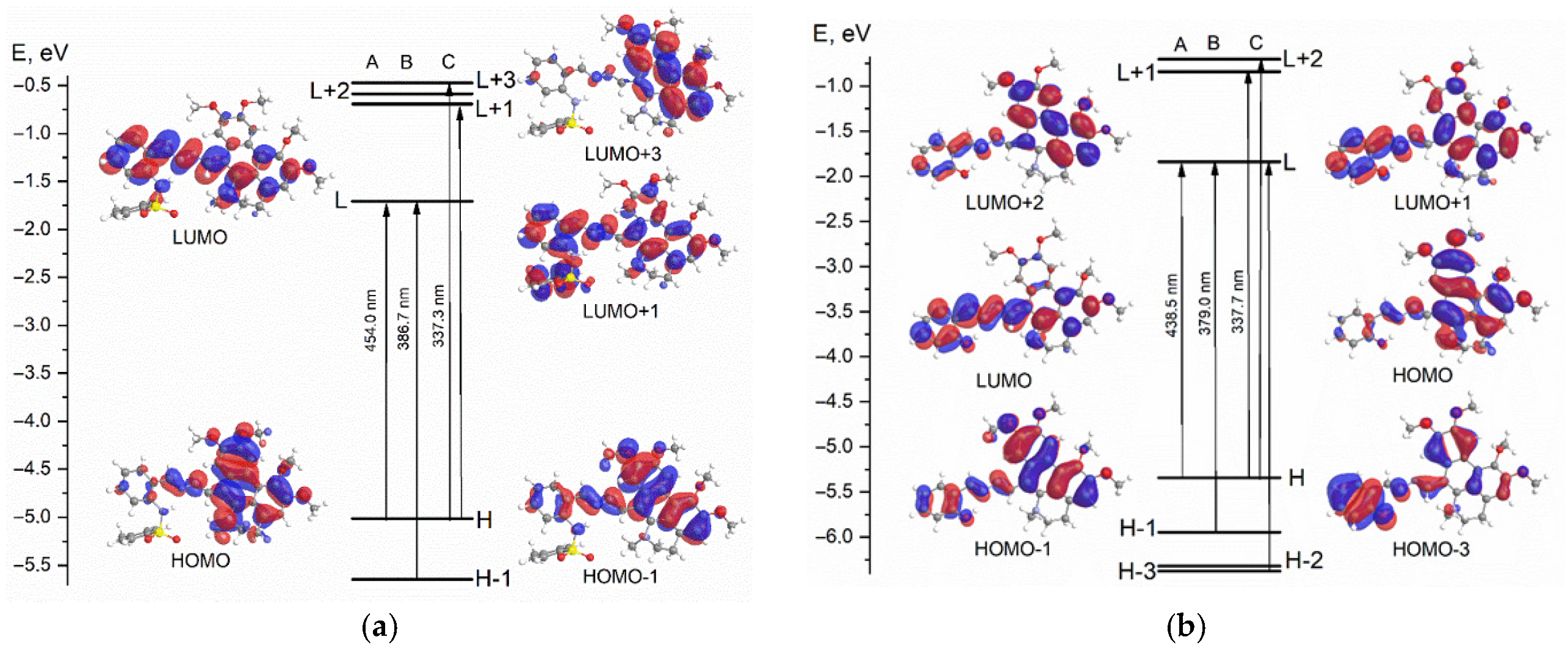
The low-energy band (A, ~436–443 nm) in the spectra of the free ligands 1 and 2 corresponds to the HOMO→LUMO electronic transition. Analysis of the frontier orbital shapes (Figure 7a,b) indicates that this transition is an intra-ligand charge transfer (ILCT) of π→π type. The electron density is redistributed from a π-orbital delocalized over the aromatic ring system of the glaucine moiety to a π*-orbital localized predominantly on the aldehyde part of the ligand. The bands in the mid-UV region (B, ~336–340 nm) also arise from π→π* transitions. The higher-energy bands (C) have a mixed character, involving n→π* and π→π* transitions within the aromatic or heterocyclic fragments of the molecular framework.
Despite the similarity of the electronic absorption spectra of all compounds, the long-wavelength band A in the spectra of zinc complexes 3 and 4 undergoes a slight hypsochromic shift of about 10 nm relative to the corresponding band in the spectra of the free ligands, which is attributed to complexation.
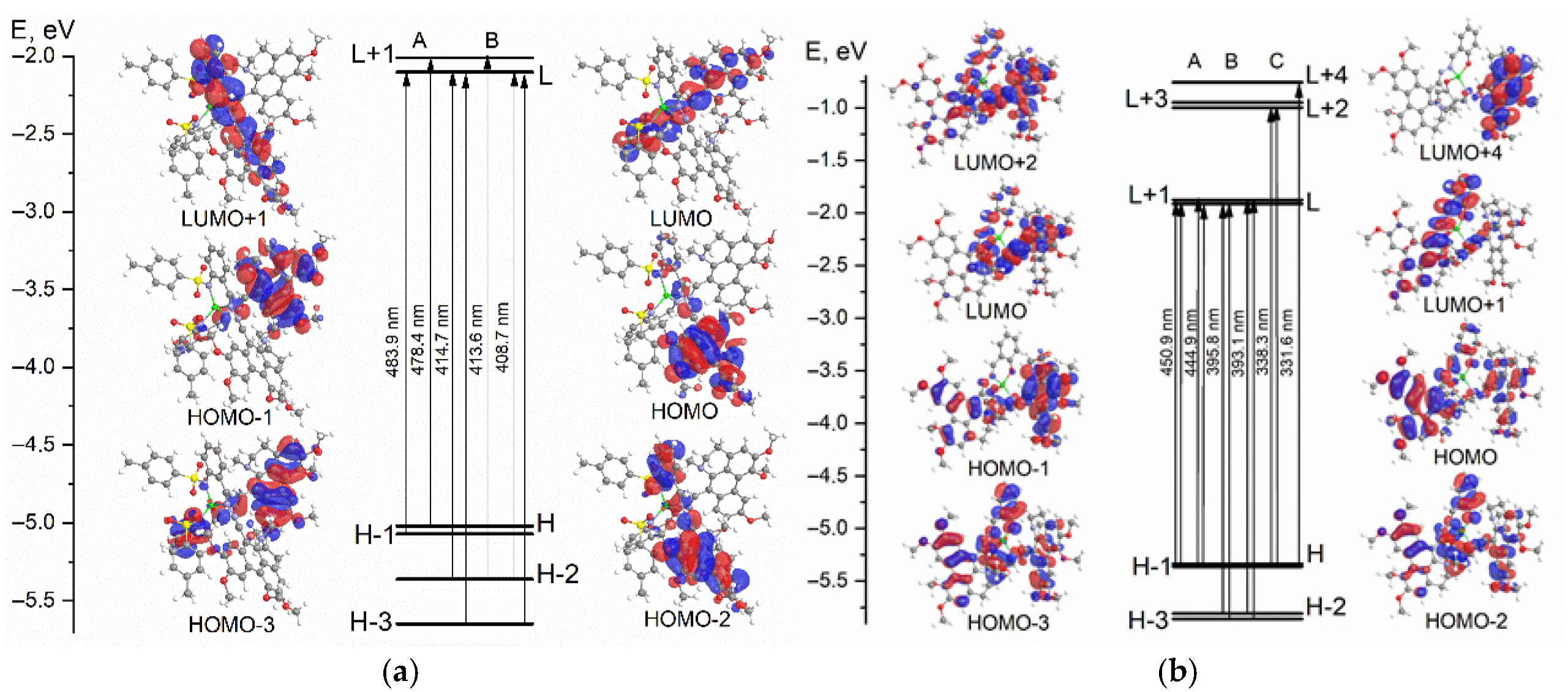
TD-DFT calculations predict several electronic transitions in the visible and UV regions of the spectra for zinc complexes 3 and 4 (Table 7). The most intense bands in the visible region (~495–497 nm) correspond to electronic transitions from the HOMO (HOMO, HOMO–1) to the LUMO (LUMO, LUMO+1). Analysis of the molecular orbital isosurfaces (Figure 8) indicates that these transitions are predominantly of interligand charge transfer (LLCT, π→π*) character. The absence of significant metal-to-ligand charge transfer (MLCT) transitions is expected, as the Zn(II) ions have a d10 configuration.
Analysis of the energy levels and shapes of the frontier orbitals (HOMO, LUMO) for 14 (Figure 7 and Figure 8) shows that, in general, the HOMO is localized on the glaucine fragment, while the LUMO is centered on the azomethine and aldehyde moieties of the ligand. This confirms that the low-energy electronic transitions occur with significant involvement of intra-ligand charge transfer between the donor (glaucine) and acceptor (azomethine fragment) modules of the molecule.

2.4. Photoluminescent Properties of the Compounds

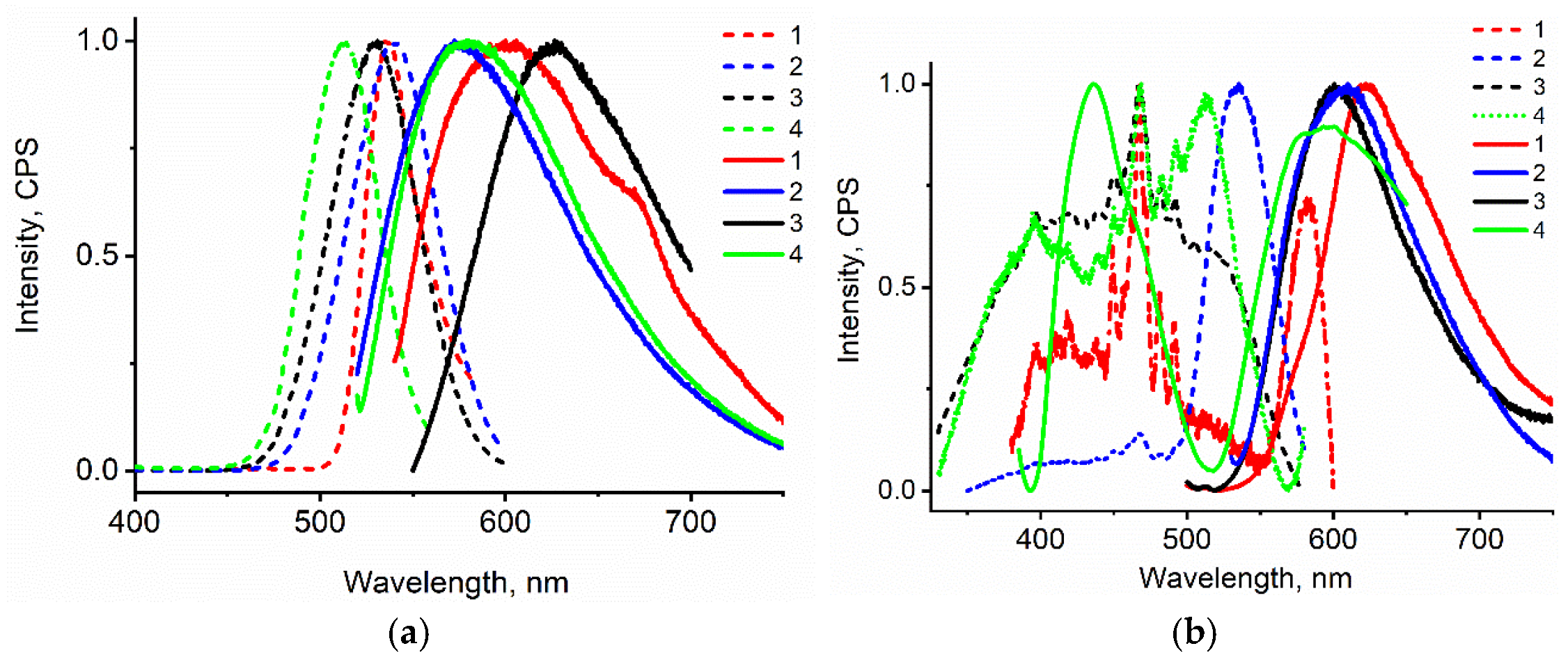
The fluorescence maxima for compounds 1 and 3 in CH2Cl2 solution lie in the orange region (600, 625 nm), while those for compounds 2 and 4 lie in the yellow region (572, 581 nm) of the spectrum, respectively (Table 6, Figure 9).
For solid samples, a red shift (~20–30 nm) of the luminescence spectra is observed compared to solution. An exception is complex 3, for which a hypsochromic shift of 21 nm was recorded. The red shift of the fluorescence maxima in solid samples relative to solution is typically attributed to aggregation effects. For all compounds, both in solution and in the solid state, the fluorescence lifetimes are approximately 1.6–1.9 ns, which is characteristic of allowed singlet–singlet fluorescent transitions. The similarity of fluorescence lifetime values for compounds in different aggregation states is an important finding, indicating that intermolecular interactions in the solid state do not introduce new efficient excited-state quenching channels. Fluorescence quantum yields are noticeably higher (almost twofold) for compounds in the solid state compared to solutions, with the exception of 4, for which these values are close (1.3 and 1.6). It can also be noted that the quantum yields for the free ligands are higher than those for the zinc complexes, both in solution and in the solid state. The increase in quantum yield in the solid state for most samples is most likely associated with the restriction of molecular motions and the reduction of non-radiative relaxation.

2.5. Investigation of Photosensitization in Solar Cells

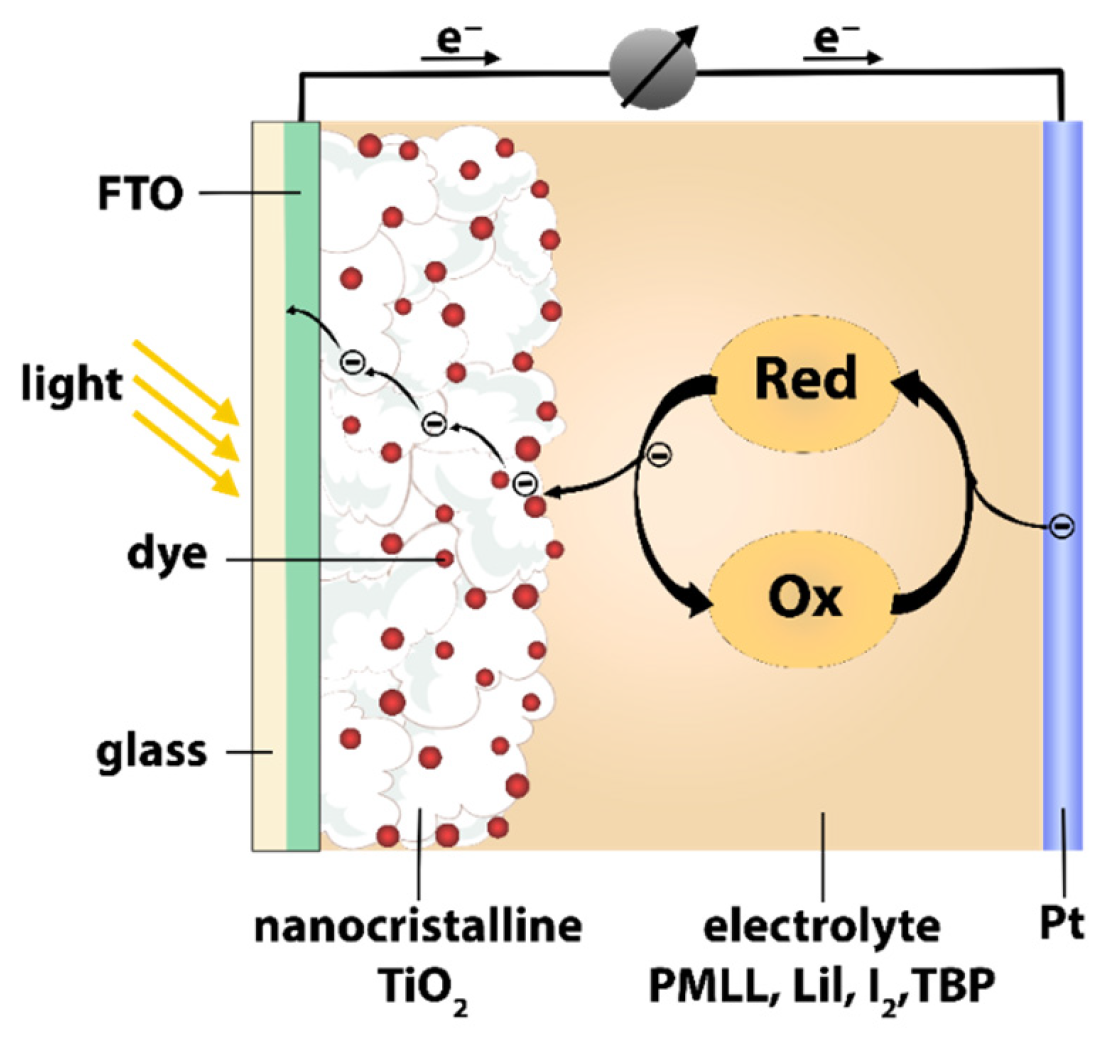
Based on the obtained photophysical and electronic properties, compounds 14 exhibit key characteristics that make them promising candidates for application as sensitizers in dye-sensitized solar cells (DSSCs). To evaluate the photovoltaic performance of the studied compounds 14, conventional DSSCs were fabricated (Figure 10).
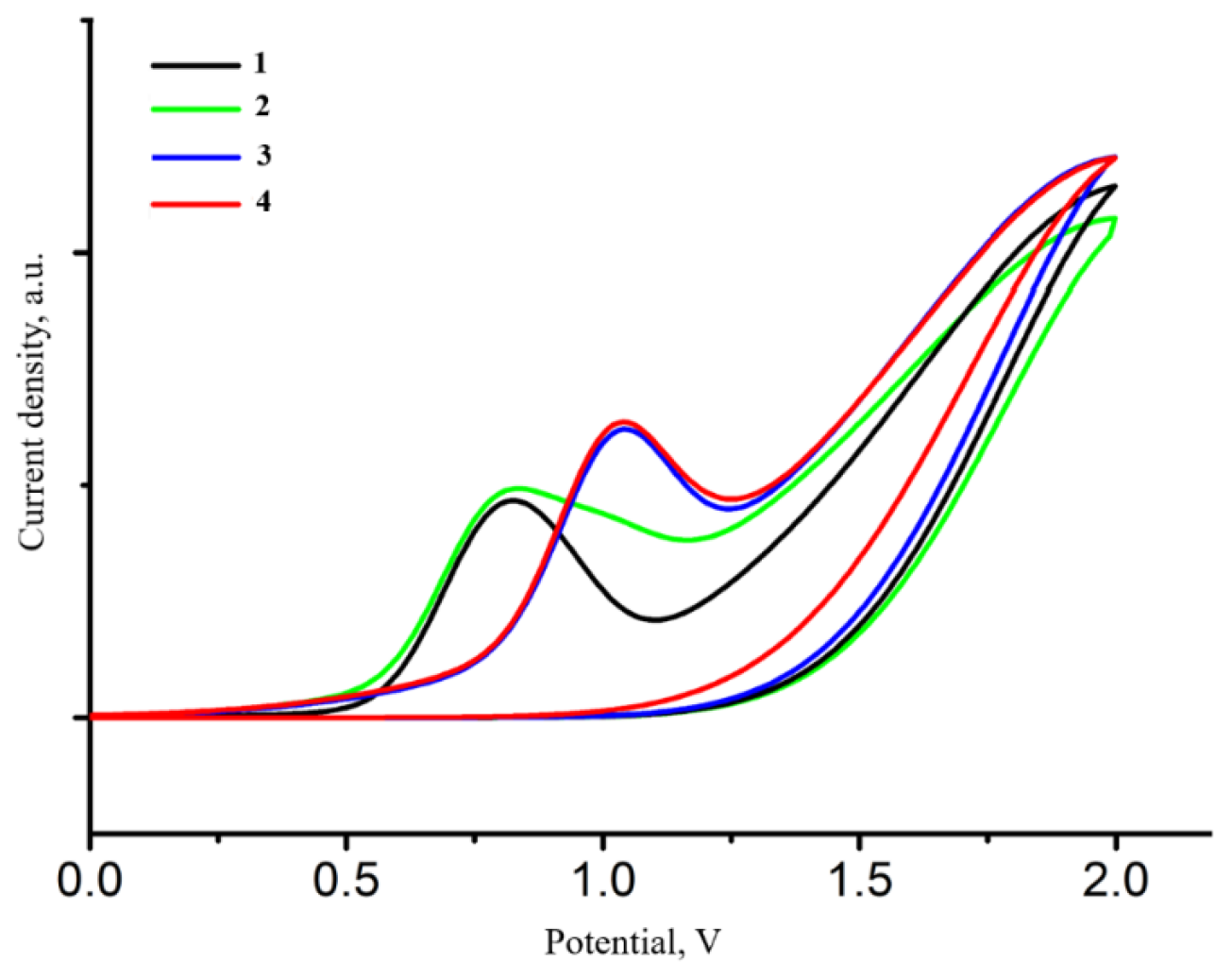
For the fundamental assessment of the applicability of new organic compounds as photosensitizers, a comprehensive analysis of their redox and optical properties was performed (Figure 11). The key objective was the experimental determination of the energy positions of HOMO and LUMO relative to the energy levels of the semiconductor photoanode (TiO2) and the redox electrolyte couple. The frontier orbital energy values and electrochemical properties of the synthesized dyes are summarized in Table 8.
The first oxidation potential (Eox) recorded by cyclic voltammetry (Figure 11) corresponds to the removal of an electron from the HOMO of the dye. For conversion to the absolute energy scale (eV), the relationship EHOMO = −(Eox + 4.5)eV was used, correlating the potential relative to the standard hydrogen electrode with the energy level relative to vacuum.
The optical band gap (Δ), corresponding to the HOMO→LUMO transition, was determined from the long-wavelength edge of the absorption band in the UV-Vis region (Figure 6) using the formula ΔE = 1240/λedge (nm). The obtained Δ values ranged from 2.17 to 2.31 eV (Table 8), corresponding to an absorption edge in the visible region (~535–570 nm), characteristic of efficient sensitizers. The LUMO energy was calculated within the Franck–Condon model: ELUMO = EHOMO + Δ.
A critical condition for the operation of a dye-sensitized solar cell is the exothermicity of all charge transfer steps. Specifically, for efficient regeneration of the oxidized dye (D+) by the I/I3 redox couple, the EHOMO level of the dye must be more positive (lower in energy) than the redox potential of this couple. For all studied dyes 14, the EHOMO levels lie in the range from −5.19 to −5.55 eV, which is below the accepted value of Eredox (I/I3) = –4.80 –4.80 eV relative to vacuum. The more negative (lower) EHOMO(D/D+) values for 1–4 relative to the redox potential of I/I3 provide a positive thermodynamic driving force (Δ Greg > 0.3 eV) for the reduction of the oxidized dye (D+ + I → D + I3). This condition promotes rapid dye regeneration, minimizing the accumulation of D+ and reducing recombination losses.
For successful electron injection from the excited state of the dye (D*) into the conduction band (CB) of TiO2, the ELUMO level of the dye must lie above the conduction band edge of TiO2 (−4.00 eV). As can be seen from Table 8, the condition ELUMO(D/D*) > ECB(TiO2) is satisfied for all dyes 14. The energy margin (ΔGinj) ranges from ~0.7 to 1.0 eV, which is sufficient for efficient injection.
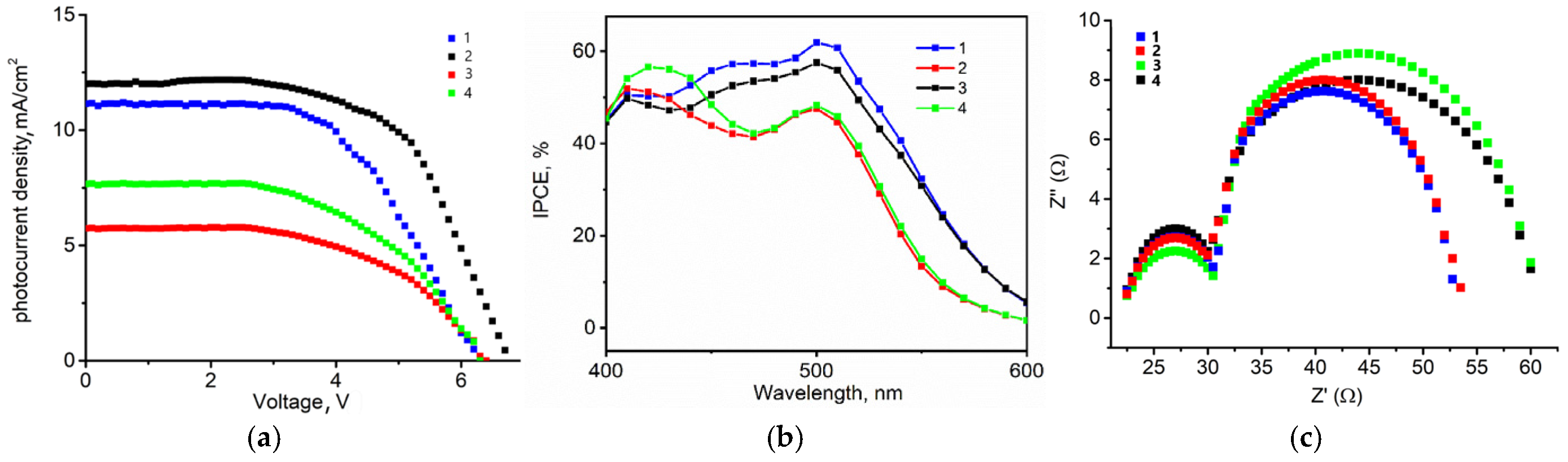
Thus, based on the electrochemical and spectral data, all studied dyes 14 meet the fundamental requirements for application in DSSCs. To finally evaluate their performance, photovoltaic characteristics (J–V curves, IPCE) were measured for the fabricated DSSCs. Figure 12a shows typical J–V curves, and Table 9 summarizes their photovoltaic parameters.
The obtained photovoltaic data allow for a quantitative assessment of DSSC functionality and reveal performance differences among the various sensitizers (organic molecules 1, 2 and zinc coordination compounds 3, 4). As seen in Figure 12a and Table 9, organic sensitizers 1 (11.24 mA/cm2) and 2 (12.18 mA/cm2) exhibit significantly higher Jsc values compared to zinc coordination complexes 3 (5.74 mA/cm2) and 4 (7.61 mA/cm2), indicating their superior light-harvesting efficiency (LHE) within the working spectral range of solar radiation. The higher Voc value of 2 (675 mV) compared to the other sensitizers (~630 mV) may suggest a more optimal alignment of its HOMO level relative to the redox potential of the electrolyte, minimizing thermodynamic losses during oxidized dye regeneration, as well as possible suppression of recombination processes between injected electrons and the oxidized form of the electrolyte or oxidized dye (e.g., due to molecular structure creating a spatial barrier). One of the main findings is the substantially higher (more than twofold) overall power conversion efficiency (PCE, η %) of the organic sensitizers compared to the zinc coordination complexes (4.83% and 5.18% vs. ~2.1%), owing to their superiority in both Jsc and Voc. The improved photovoltaic performance of DSSCs with organic dyes (1, 2) relative to coordination compounds (3, 4) can be attributed to stronger absorption in the long-wavelength region of the spectrum (>550 nm), enabling organic sensitizers to utilize a larger portion of solar photons, and to a more favorable HOMO level alignment with the redox potential of the I/I3 couple, facilitating rapid and efficient regeneration of the oxidized dye while minimizing recombination losses.
The incident photon-to-current efficiency (IPCE) spectra shown in Figure 12b characterize the wavelength-dependent efficiency of DSSCs in converting incident photons into electrons. The high maximum IPCE values (up to ~60%) observed for the fabricated DSSCs in the 400–500 nm region indicate high overall efficiency of the elementary processes—photon absorption, electron injection into the TiO2 conduction band, and subsequent charge collection—suggesting favorable injection kinetics and minimal recombination losses in this spectral range. The IPCE spectra of all DSSCs show good agreement with the absorption spectra of the corresponding sensitizers in solution, confirming their key role in photocurrent generation and their effective adsorption onto the TiO2 surface. The decline in IPCE in the long-wavelength region (>550 nm) correlates with the absorption band edge of the dyes and is attributed to their decreased molar extinction coefficient, and consequently lower LHE(λ), at these wavelengths. For the organic sensitizers 1 and 2, the shift of the absorption edge—and correspondingly the IPCE spectrum edge—to longer wavelengths compared to 3 and 4 directly accounts for their higher short-circuit current density (Jsc) under full solar illumination.
While the PCE of 5.18% for dye 2 demonstrates the potential of the glaucine core, it is notably lower than that of benchmark organic sensitizers like Y123 (>13%) or ruthenium complexes like N719 (11–12%) under similar conditions [27,28]. This lower efficiency is primarily attributed to the limited spectral response of our dyes, with an absorption onset below 600 nm, as evidenced by the IPCE spectra in Figure 12b. This restricts light harvesting in the red/near-IR region, where solar photon flux is significant. Furthermore, the absence of strong anchoring groups such as carboxylic or phosphonic acids in the molecular structure of 1 and 2 may lead to suboptimal electronic coupling with the TiO2 surface and less stable dye adsorption, potentially affecting both electron injection efficiency and long-term device stability.
The dynamics of charge carriers under conditions of quasi-stationary electron injection into the mesoporous TiO2 layer were investigated by electrochemical impedance spectroscopy. The obtained Nyquist plots (−Im(Z) vs. Re(Z)) (Figure 12c) exhibit two distinct semicircles, which is characteristic of DSSCs. These arcs correspond to different relaxation processes with distinct time constants and can be described by a Randles equivalent circuit with two-time constants. The first (high-frequency) semicircle (103–105 Hz) reflects the electrochemical process at the Pt/electrolyte interface. This process is associated with: RCT1—the charge transfer resistance for the reduction of I3 to I at the catalytic surface of the platinum counter electrode. Its value is estimated from the diameter (chord) of the first semicircle. CPt—the capacitance related to the redistribution of electrolyte ions at the Pt electrode surface.
The second (low-frequency) semicircle (0.1–103 Hz) corresponds to the charge transfer process at the TiO2/dye/electrolyte interface. This process is associated with: Rrec—the recombination resistance of injected electrons in the TiO2 conduction band with oxidized species in the electrolyte (primarily I3). The diameter of this semicircle is directly proportional to the magnitude of Rrec. A smaller diameter indicates lower resistance, meaning a faster charge transfer (recombination) process; Cμ—the chemical capacitance associated with the accumulation of electrons in the mesoporous TiO2 film (change in the electron chemical potential). The characteristic frequency at the maximum of this semicircle allows estimation of the electron lifetime; Rs—the series resistance, determined by the intercept of the plot with the Re(Z) axis in the high-frequency region. It includes the ohmic resistance of the FTO glass, contacts, wires, and the ionic resistance of the electrolyte.
As can be seen from Figure 12c, the radius of the mid-frequency semicircle in the impedance spectra (Rrec), which characterizes the recombination resistance at the TiO2/electrolyte interface, progressively decreases when going from the coordination complexes (3, 4) to the organic sensitizers (1, 2). This reduction in Rrec indicates a decrease in the energy barrier and/or an increase in the recombination rate of injected electrons with the oxidized species in the electrolyte (I3). The observed effect can be explained by the following factors:
  • Influence on the conduction band: The organic dyes likely induce a more positive shift of the TiO2 conduction band edge (due to surface dipoles or a different adsorption mechanism), which lowers the energy barrier for electron transfer to I3.
  • Surface passivation: Although organic molecules might more effectively block recombination-active sites on the TiO2 surface, in this case, this effect does not compensate for the dominant factor of the band shift.
The concurrent decrease in RPt indicates improved catalytic activity of the counter electrode in these cells. This factor is crucial because an enhanced reduction rate of I3 at the cathode facilitates more efficient regeneration of the oxidized dye (D+) by I ions, accelerating the entire charge transfer cycle.
It can be concluded that the increase in overall efficiency (PCE) of DSSCs with organic sensitizers is achieved despite faster recombination (smaller Rrec). The key factor is the significant increase in photocurrent density (Jsc), resulting from improved optical properties (broader and more intense absorption band) and possibly faster dye regeneration. This creates a balance where the gain from enhanced electron injection outweighs the losses due to somewhat faster recombination. Thus, impedance spectroscopy confirms the significant influence of the sensitizer nature on the kinetics of interfacial processes in the fabricated DSSCs. As for the stability of the devices, upon exploring resulting cells, the efficiency parameters remained stable within the margin of error for one to two weeks while the measurements were being carried out. High stability also corresponds to the high thermal stability of the studied compounds (up to a temperature of 250 °C) (Figure S17).
To contextualize the performance of our glaucine-based sensitizers within the broader landscape of modern photovoltaics, it is instructive to benchmark them against state-of-the-art inorganic and hybrid thin-film technologies. While direct comparisons are complicated by differing device architectures and operational principles, such an analysis highlights the unique advantages and current limitations of our materials.
The power conversion efficiency (PCE) of our best-performing organic dye, compound 2 (5.18%), is significantly lower than that of leading flexible perovskite solar cells (FPSCs), which have recently achieved certified efficiencies exceeding 23–25% [29,30]. These FPSCs benefit from the direct bandgap, exceptionally high absorption coefficients, and long carrier diffusion lengths inherent to metal halide perovskites. However, as extensively reviewed, the commercialization of FPSCs is hindered by concerns over operational stability, sensitivity to ambient conditions, and the toxicity of lead, necessitating stringent and costly encapsulation. In contrast, our DSSCs, while less efficient, operate robustly under diffuse light and ambient conditions without such demanding protection, offering a potential advantage in specific low-power, indoor, or building-integrated applications where longevity and environmental safety are paramount.
A more pertinent benchmark for eco-friendly innovation is provided by copper-based thin-film technologies, which are considered environmentally friendlier than CdTe and silicon-based solar cells due to their chemical stability and absence of toxic heavy metals [31]. Among these, the most widely used are ternary copper chalcogenides (CIS), quaternary copper chalcogenides (CIGS), and kesterites (CZTS), with bandgaps ranging from 1.0 to 1.2 eV [32], making them ideal for photoactive layers due to their high hole mobility, high absorption coefficient, and tunable bandgaps.
CIGS-based solar cells have achieved impressive efficiencies of around 23% at the cell level and approximately 19% at the module level [33], with the highest confirmed PCE of 23.35% demonstrated using cadmium-free buffer layers based on zinc sulfide (ZnS), which replace traditional CdS layers and provide better optical and electrical properties [34]. This achievement is particularly relevant in the context of our work, which emphasizes environmentally sustainable materials. However, CIS-based cells face efficiency limitations not exceeding 19% due to impurity issues caused by copper vacancies or antisite defects, which lower charge transport properties. Improving crystal quality, morphology control, larger grain size, and denser surfaces can enhance CIS PCE by up to 9% by reducing charge recombination and improving Voc and FF.
Kesterite CZTS cells, formed by the reaction of ternary copper chalcogenides with ZnS or ZnSe, exhibit moderate PCE around 12% [32]. The reason for their lower efficiency is Voc losses due to non-radiative recombination caused by defects in the bulk and film surface. As with CIS, larger grain sizes, uniform morphology, and higher crystallinity result in lower charge recombination and help restrict secondary phase formation in the photoactive layer.
This challenge of defect management in copper-based technologies is fundamentally analogous to the need for interfacial engineering in our DSSCs to suppress charge recombination at the TiO2/dye/electrolyte interface. Although our organic dyes yield a higher short-circuit current density (Jsc ~11–12 mA/cm2) than typical CIS or CZTS devices, the superior charge-carrier dynamics of the inorganic absorber, once defects are passivated, result in a higher overall PCE. This comparison underscores that for our molecular dyes to compete, future design must not only broaden their absorption spectrum but also focus on minimizing recombination losses, potentially by incorporating stronger anchoring groups for better surface passivation and improved charge transport.
Finally, even when compared to mature thin-film technologies like flexible CIGS, which demonstrate commercial module efficiencies of 16–20% and excellent stability, our glaucine derivatives occupy a distinct niche. CIGS faces cost and scarcity issues with indium and gallium, while the use of cadmium in traditional buffer layers raises environmental concerns that are successfully addressed by transitioning to cadmium-free alternatives such as ZnS. Our purely organic sensitizers offer a pathway toward a more sustainable and potentially lower-cost alternative, albeit one that is currently at an earlier stage of development.
The performance gap relative to these advanced technologies can also be partially attributed to the charge transport layers used. Our DSSCs employ a standard I/I3 redox electrolyte. The EIS data (Figure 12c) show that the charge transfer resistance at the Pt counter electrode (RPt) is lower for the organic dyes, indicating reasonably efficient dye regeneration kinetics. However, state-of-the-art FPSC and CIGS technologies leverage highly engineered transport layers and buffer layers—such as ZnS replacing CdS in CIGS, providing better optical and electrical properties, as well as doped PEDOT:PSS, NiOx, or SnO2 in perovskite cells—that are often processed at low temperatures to enhance charge extraction and passivate interfacial defects. The record efficiencies in these systems are frequently enabled by interfacial modifiers that reduce trap-state density and improve energy level alignment. Furthermore, it is well-established that interfacial engineering, such as the use of co-adsorbents to form a blocking layer, or the application of core–shell structures on the TiO2 photoanode to create an energy barrier, can further suppress charge recombination and enhance the net charge separation efficiency. These strategies represent promising avenues for future optimization of the devices based on the organic dyes 1 and 2. This suggests a clear direction for future work on our glaucine-based DSSCs: moving beyond simple dye optimization to a holistic device engineering approach. Exploring alternative redox couples (e.g., cobalt complexes) and employing interfacial passivation strategies on the TiO2 photoanode, inspired by advances in cadmium-free buffer layers and advanced transport layers, could significantly enhance charge separation and boost overall device performance.

3. Materials and Methods

3.1. Starting Materials and General Characterization

The following commercially available solvents were used in this work: dimethylformamide, MeOH, EtOH, CH2Cl2, n-PrOH. The reagents used were: 7-formyldehydroglaucine (CAS 80941-67-9) prepared according to the procedure [35], zinc acetate dihydrate (CAS 5970-4-6), hydrazine hydrate (CAS 7803-57-6), 2-hydroxybenzaldehyde (CAS 90-02-8); 2-(N-tosylamino)benzaldehyde was synthesized according to the procedure [36].
Elemental analysis (C, H, N, and other elements) was performed on a Carlo Erba TCM 480 instrument (Cornaredo, Italy) using sulfanilamide as a reference standard. Metal content was determined gravimetrically at the analytical laboratory of the Institute of Physical and Organic Chemistry (Southern Federal University, Rostov-on-Don, Russia). Melting points were measured using the Kofler method.
Infrared spectra were recorded on a Varian Excalibur-3100 FT-IR spectrophotometer (Palo Alto, CA, USA) for powdered compounds. 1H NMR spectra were measured on a Bruker Avance-300 spectrometer (Billerica, MA, USA, 300 MHz) at ambient temperature in DMSO-d6, with the residual 2H solvent signal used as an internal standard.
Cyclic voltammetry (CV) measurements were performed in an anhydrous aprotic solvent (acetonitrile) containing a supporting electrolyte (tetrabutylammonium hexafluorophosphate, TBAPF6). A platinum electrode was used as the working electrode, and the potentials were calibrated relative to a saturated calomel (silver chloride) electrode (n.c.e./h.c.e.), followed by conversion to the absolute vacuum energy scale

3.2. Synthesis

3.2.1. Synthetic Procedure for Hydrazone of 7-Formyldehydroglaucine

Hydrazone of 7-formyldehydroglaucine. A mixture of 3.81 g (0.01 mol) of 7-formyldehydroglaucine, 5 mL of hydrazine hydrate and 6 mL of n-propyl alcohol was boiled for 1 h. The precipitate that formed upon cooling was collected by filtration, washed with n-PrOH (3 × 2 mL), and dried in a vacuum oven at 100 °C. White powder, yield 2.65 g (67%), m.p. 153–155 °C. Found, %: C 66.90, H 6.35, N 10.54. For C22H25N3O4 calculated, %: C 66.82, H 6.37, N 10.63. 1H NMR, DMSO-d6, 300 MHz, δ (ppm): 2.75 (d, 3H, 3J = 8.7 Hz, N-CH3), 3.10–3.13 (m, 2H, CH2), 3.25–3.29 (m, 2H, CH2), 3.80 (s, 3H, OCH3), 3.86 (s, 3H, OCH3), 3.89 (s, 3H, OCH3), 3.95 (s, 3H, OCH3), 6.18 (s, 1H, CAr-H), 6.70 (s, 1H, CAr-H), 7.13 (s, 0.4H, NH2, E- or Z-isomer), 7.26 (d, 3H, 4J = 2.4 Hz, CAr-H), 7.60 (0.4H, NH2, E- or Z-isomer), 8.37 (s, 0.6H, NH2, Z- or E-isomer), 8.89 (s, 0.6H, NH2, Z- or E-isomer), 9.09 (s, 0.4H, CH=N, E- or Z-isomer), 9.14 (s, 0.6H, CH=N, Z- or E-isomer). IR spectrum, selected bands, cm−1: 3392 (NH2), 2930, 2824 (CH2), 1595 (CH=N), 1521, 1496, 1460, 1446, 1425, 1395, 1380, 1353, 1311, 1293, 1248, 1224, 1204, 1188, 1168, 1122, 1095, 1054, 1041, 1007, 984, 965, 925, 878, 863, 849, 837, 819, 790, 762, 744, 690, 655, 640, 619, 596, 574, 529, 511, 485, 466, 428. It was then used without additional purification to obtain azomethines 1 and 2. The 1H NMR- and IR- spectra are presented in Supplementary Material (Figures S4 and S9).

3.2.2. Azomethines and Zn(II) Complexes Synthesis

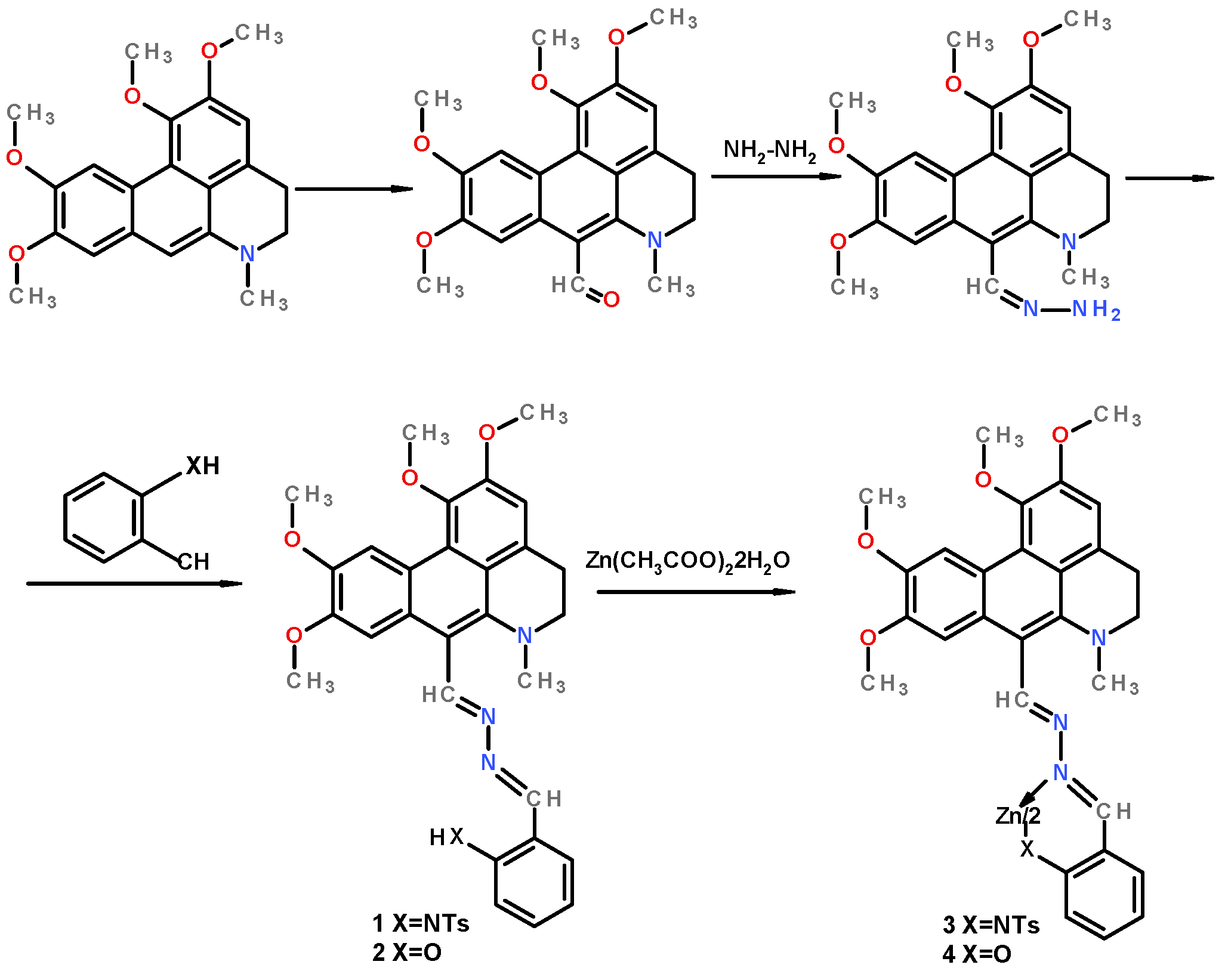
A solution of 1.38 g (0.005 mol) 2-(N-tosylamino)benzaldehyde or 0.61 g (0.005 mol) of 2-hydroxybenzaldehyde in 20 mL of MeOH was added to a solution of 1.98 g (0.005 mol) of the hydrazone 7-formyldehydroglaucine in 10 mL of MeOH and the mixture was boiled for 1 h. The precipitates were filtered and recrystallized from a mixture of CH2Cl2: MeOH (1:2) (Scheme 1).
4-methyl-N-[2-[(E)-[(E)-(4,5,15,16-tetramethoxy-10-methyl-10-azatetracyclo [7.7.1.02,7.013,17]heptadeca-1(16),2,4,6,8,13(17),14-heptaen-8-yl)methylenehydrazono]methyl]phenyl]benzenesulfonamide (1). Orange crystals, yield: 2.88 g (85%). Tpl 208–209 °C. Anal. Calc. for C36H36N4O6S: C, 66.24; H, 5.56; N, 8.58. Found: C, 66.30; H, 5.62; N, 8.64%. 1H NMR, DMSO-d6, 300 MHz, δ (ppm): 2.26 (s, 3H, C-CH3), 3.08 (s, 3H, N-CH3), 3.15–3.19 (m, 2H, CH2), 3.34–3.46 (m, 2H, CH2), 3.81 (s, 3H, OCH3), 3.82 (s, 3H, OCH3), 3.95 (s, 3H, OCH3), 3.95 (s, 3H, OCH3), 7.19–7.25 (m, 1H), 7.30–7.33 (m, 1H), 7.38–7.45 (m, 2H), 7.65 (d, 2H, J = 8.4 Hz, CAr-H), 7.81 (d, 1H, J = 8.4 Hz, CAr-H), 8.93 (s, 1H, CH=N), 9.12 (s, 1H, CH=N), 9.20 (s, 1H, CAr-H), 9.24 (s, 1H, CAr-H), 11.66 (s, 1H, NH). IR spectrum, selected bands, cm−1: 3065, 2990, 2936, 2824, 1597, 1575, 1523, 1495, 1464, 1449, 1426, 1413, 1396, 1345, 1309, 1253, 1226, 1219, 1195, 1168, 1160, 1132, 1118, 1088, 1069, 1041, 1012, 983, 954, 885, 863, 836, 812, 799, 758, 722, 703, 660, 644, 621, 564, 547, 534, 509, 476, 455.
2-[(E)-[(E)-(4,5,15,16-tetramethoxy-10-methyl-10-azatetracyclo[7.7.1.02,7.013,17]heptadeca-1(16),2,4,6,8,13(17),14-heptaen-8-yl)methylenehydrazono]methyl]phenol (2). Orange crystals, yield: 2.00 g (80%). Tpl 181–182 °C. Anal. Calc. for C29H29N3O5: C, 69.72; H, 5.85; N, 8.41. Found: C, 69.68; H, 5.79; N, 8.48. 1H NMR, DMSO-d6, 300 MHz, δ (ppm): 3.00 (s, 3H, NCH3), 3.14–3.17 (m, 2H, CH2), 3.39–3.42 (m, 2H, CH2), 3.80 (s, 3H, OCH3), 3.91 (s, 3H, OCH3), 3.94 (s, 3H, OCH3), 3.98 (s, 3H, OCH3), 6.95–7.00 (m, 2H, CAr-H), 7.30 (s, 1H, CAr-H), 7.36 (t, 1H, 3J = 4.8 Hz, CAr-H), 7.71 (dd, 1H, 3J = 8.1 Hz, CAr-H), 9.05 (s, 1H, CAr-H), 9.11 (s, 1H, CAr-H), 9.18 (s, 1H, CH=N), 9.22 (s, 1H, CH=N), 11.60 (s, 1H, OH). IR spectrum, selected bands, cm−1: 3853, 3751, 3734, 3689, 3628, 3175, 3048, 2983, 2928, 2901, 2829, 1618, 1595, 1576, 1520, 1492, 1462, 1426, 1413, 1395, 1378, 1351, 1305, 1250, 1200, 1174, 1155, 1129, 1085, 1065, 1038, 1009, 975, 860, 834, 762, 724, 648, 618, 574, 561, 408.
To a solution of 0.65 g (0.001 mol) of azomethine 1 or 0.5 g (0.001 mol) 2 in 30 mL of MeOH, respectively, 0.11 g (0.0005 mol) of zinc acetate dihydrate in 10 mL of MeOH was added and boiled for 2 h. The precipitates of the complexes were filtered and recrystallized from a mixture of CH2Cl2:MeOH (1:2). Dried in a vacuum drying cabinet at 150 °C (Scheme 1).
bis[N-(p-tolylsulfonyl)-2-[(E)-[(E)-(4,5,15,16-tetramethoxy-10-methyl-10-azatetracyclo[7.7.1.02,7.013,17]heptadeca-1(16),2,4,6,8,13(17),14-heptaen-8-yl)methylenehydrazono]methyl]anilino]zinc (3). Orange crystals, yield: 0.60 g (87%). Tpl > 250 °C. Anal. Calc. for C72H70N8O12S2Zn: C, 63.17; H, 5.15; N, 8.19. Found: C, 63.21; H, 5.12; N, 8.21%. 1H NMR, DMSO-d6, 300 MHz, δ (ppm): 2.01 (s, 3H, CH3), 2.44–2.48 (m, 1H, CH2), 2.67 (s, 3H, NCH3), 2.71–2.76 (m, 2H, CH2), 2.97–3.01 (m, 1H, CH2), 3.78 (s, 3H, OCH3), 3.87 (s, 3H, OCH3), 3.89 (s, 3H, OCH3), 3.93 (s, 3H, OCH3), 6.65 (br.s, 2H, CAr-H), 6.95–7.00 (m, 1H, CAr-H), 7.20 (m, 1H, CAr-H), 7.27–7.35 (m, 2H, CAr-H), 7.65 (d, 2H, 3J = 7.5 Hz, CAr-H), 7.92 (d, 1H, 3J = 7.5 Hz, CAr-H), 9.05 (s, 1H, CH=N), 9.15 (s, 1H, CH=N), 9.30 (s, 1H, CAr-H), 9.62 (s, 1H, CAr-H). IR spectrum, selected bands, cm−1: 3592, 3517, 3127, 2934, 2822, 1594, 1563, 1521, 1462, 1445, 1394, 1298, 1289, 1253, 1227, 1199, 1129, 1084, 1066, 1040, 1008, 938, 900, 873, 858, 833, 811, 751, 661, 640, 578, 567, 545.
bis[2-[[(E)-(4,5,15,16-tetramethoxy-10-methyl-10-azatetracyclo[7.7.1.02,7.013,17]heptadeca-1(16),2,4,6,8,13(17),14-heptaen-8-yl)methylenehydrazono]methyl]phenoxy]zinc (4). Orange crystals, yield: 0.45 g (85%). Tpl > 250 °C. Anal. Calc. for C58H56N6O10Zn: C, 65.57; H, 5.31; N, 7.91. Found: C, 65.60; H, 5.30; N, 8.02%. 1H NMR, DMSO-d6, 300 MHz, δ (ppm): 2.69 (s, 3H, NCH3), 2.71–2.74 (m, 2H, CH2), 2.88–2.90 (m, 2H, CH2), 3.73 (s, 3H, OCH3), 3.77 (s, 3H, OCH3), 3.84 (s, 3H, OCH3), 3.93 (s, 3H, OCH3), 6.70 (t, 1H, 3J = 7.4 Hz, CAr-H), 6.79 (d, 1H, 3J = 8.4 Hz, CAr-H), 7.20 (s, 1H, CAr-H), 7.35–7.38 (m, 1H, CAr-H), 7.62 (dd, 1H, 3J = 8.1 Hz, 4J = 1.5 Hz, CAr-H), 8.94 (s, 1H, CAr-H), 9.00 (s, 1H, CAr-H), 9.11 (s, 1H, CH=N), 9.20 (s, 1H, CH=N). IR spectrum, selected bands, cm−1: 3628, 3536, 3171, 3143, 3061, 2987, 2931, 2831, 2654, 1603, 1588, 1561, 1522, 1495, 1461, 1439, 1426, 1414, 1394, 1380, 1347, 1329, 1308, 1251, 1226, 1206, 1187, 1147, 1131, 1084, 1064, 1034, 1006, 983, 963, 882, 862, 738, 626, 579, 448.
The 1H NMR (Figures S4–S8) and IR (Figure S9–S13) spectra of 14 are presented in Supplementary Material.
The phase purity of the synthesized compounds was confirmed by Powder X-ray Diffraction (PXRD). The experimental PXRD patterns for compounds 1, 2, and 4 showed excellent correspondence with the patterns simulated from their respective single-crystal structures (see Supplementary Materials, Figures S14–S16), confirming the high purity and crystallinity of the bulk samples.

3.3. Single-Crystal X-Ray Diffraction

Crystallographic data for compounds 1, 2, and 4 were obtained on an Agilent SuperNova diffractometer using a microfocus X-ray source with a copper anode and a two-dimensional Atlas S2 CCD detector. The reflections were collected and the unit cell parameters were determined and refined using a specialized software package called Chrysalispro (ver. 1.171.33.66) [37]. The structures were deciphered using the ShelXT program [38] and refined using the ShelXL program [39]. Hydrogen atoms are included in the refinement in the “rider” model in the isotropic approximation with dependent thermal parameters. Molecular graphics for structures 1, 2, and 4 were performed using the Olex2 software package (version 1.5) [40]. Crystal data and parameters for clarifying the structure of compounds 1, 2, and 4 are given in Table 10.

3.4. Quantum-Chemical Calculations

All calculations were carried out in Gaussian 09W package [41] at the DFT level of theory. The molecular geometries of isolated molecules of the complexes were optimized by the DFT using Becke’s three-parameter exchange functional [42], Lee-Yang—Parr correlation functional (B3LYP) [43] and standard split-valence polarized 6–311G(d,p) basis set [44]. Stationary points were confirmed to correspond to minima of the potential energy surfaces, with no presence of imaginary frequencies or negative eigenvalues. The electronic UV spectra were simulated in CH2Cl2 by means of TD-DFT calculations, employing the B3LYP functional and the 6–31G(d,p) basis set, with solvent effects accounted for by the PCM model.

3.5. Fabrication of DSSCs

The fabrication procedure for DSSC devices comprised the following key steps:
  • Preparation of the Photoanode. Fluorine-doped tin oxide (FTO)-coated glass was used as the conductive substrate. A TiO2 nanoparticle paste (Solaronix T/SP, Aubonne, Switzerland, 15–20 nm particle size) was deposited onto the substrate by screen printing. The small particle size yields a highly porous mesostructure with a large specific surface area, essential for subsequent adsorption of a sensitizer monolayer. A scattering layer consisting of TiO2 particles >100 nm in size was deposited atop the active layer; these larger particles efficiently scatter photons in the long-wavelength region, increasing the optical path length and the probability of light absorption within the active layer, thereby enhancing the overall external quantum efficiency of the device. The deposited layers were subjected to stepwise sintering in a muffle furnace under ambient atmosphere. An initial annealing step (250 °C, 45 min) served to remove organic dispersants and plasticizers from the paste, preventing film cracking. Subsequent high-temperature treatment (600 °C, 30 min) ensured sintering of the TiO2 nanocrystals into a continuous mesoporous network with improved interparticle electron transport. Concurrently, crystallization of the amorphous TiO2 phase into the predominantly anatase phase occurred, which possesses a favorable conduction band position for DSSCs and high electron mobility. After sintering and cooling to room temperature, the photoanodes were immersed in a 0.01 M solution of the dye under study in anhydrous dichloromethane (CH2Cl2) for 24 h. This prolonged dark incubation ensured equilibrium chemisorption of the dye molecules onto the TiO2 surface. The resulting films were rinsed with acetone to remove unbound dye and then dried at 50 °C for 30 min. The active area and thickness of the photoanodes were 0.320 cm2 and 10–12 µm, respectively.
  • Counter Electrodes. Counter electrodes were fabricated on FTO substrates by thermal decomposition of chloroplatinic acid (H2PtCl6) at 450 °C. The resulting thin film of Pt nanoparticles serves as a highly active and stable catalyst for the regeneration of the redox couple in the electrolyte (converting of triiodide (I3) to iodide (I)).
  • Assembly of the Photoelectrochemical Cell. The photoanode and Pt counter electrode were hermetically sealed along the perimeter using a thermoplastic polymer film (Surlyn). This film provides both electrical insulation and mechanical adhesion, preventing electrolyte leakage.
  • Electrolyte Injection. The redox electrolyte was introduced into the interelectrode space through a pre-drilled hole in the counter electrode. The hole was subsequently sealed with a thin glass cover slip (0.5 mm thickness) to prevent solvent evaporation and moisture ingress.
  • Electrolyte Composition. The electrolyte composition was standard for the iodide/triiodide redox couple and included: 1-methyl-3-propylimidazolium iodide (PMII, 0.5 M) as the primary source of I ions and organic cations, forming an ionic liquid; lithium iodide (LiI, 0.1 M) to enhance ionic conductivity; in addition, Li+ cations contribute to charge screening on the TiO2 surface, positively influencing the photovoltage; iodine (I2, 0.05 M) as the oxidized form of the redox couple (electron acceptor at the cathode); 4-(tert-butyl)pyridine (TBP, 0.5 M), which passivates surface states on TiO2 and adsorbs onto its surface to suppress recombination of injected electrons with the oxidized electrolyte species (I3), thereby increasing the open-circuit voltage; and guanidinium nitrate, which enhances the photovoltage via a positive shift of the TiO2 conduction band and suppression of recombination. Acetonitrile was used as the solvent.
The photovoltaic current density–voltage (J–V) characteristics of the fabricated DSSCs were measured using a potentiostat/galvanostat (K3000 LAB, McScience, Suwon, Republic of Korea). The cells were illuminated with a class AAA xenon solar simulator (Model 96000, Newport, Irvine, CA, USA) calibrated to the standard AM 1.5G spectrum (air mass 1.5, global) at an intensity of 100 mW/cm2 (1 sun). The use of a solar simulator ensures reproducible test conditions comparable to standard measurement protocols. To eliminate errors arising from scattered light and parasitic photocurrent originating from active areas outside the designated region, and to precisely define the incident power, a black opaque mask with an aperture of 0.320 cm2 was placed over the cell surface. To ensure reliability and statistical significance of the results, three identical cells were fabricated and characterized. The averaged values of the key parameters (Jsc, Voc, FF, PCE) are reported, enabling assessment of the reproducibility of the fabrication procedure and minimizing the influence of random errors.
Electrochemical impedance spectroscopy of the fabricated DSSCs was performed in a two-electrode configuration (working electrode: photoanode; counter electrode: Pt) under standard illumination from a solar simulator (AM 1.5G, 100 mW/cm2). Measurements were carried out at a constant forward bias of −0.75 V, corresponding to the operating potential range of the DSSC near the maximum power point (Vmp), where a steady-state photocurrent is established within the cell.

4. Conclusions

In this work, new Schiff base derivatives of the alkaloid glaucine (1, 2) and their corresponding zinc(II) coordination compounds (3, 4) were synthesized, structurally characterized, and investigated as sensitizers for TiO2-based solar cells. The structures of the compounds were established by X-ray diffraction analysis and quantum chemical modeling (DFT/TD-DFT). The organic derivatives (1, 2) are molecules with a planar conjugated skeleton, facilitating intermolecular π–π interactions in the crystal. In complex 4, the zinc atom adopts a tetrahedral coordination environment, coordinated by two nitrogen atoms and two oxygen atoms from two different bidentate ligands. All compounds exhibit intense absorption in the visible region (maxima ~436–506 nm), arising from intraligand (ILCT, for 1, 2) or interligand (LLCT, for 3, 4) charge transfer transitions. The HOMO and LUMO energy levels, determined by cyclic voltammetry, satisfy the key thermodynamic criteria for DSSC operation for both organic and coordination compounds: the LUMO level lies above the TiO2 conduction band (−4.00 eV), providing thermodynamic driving force for electron injection, while the HOMO level lies below the redox potential of the I/I3 electrolyte couple (−4.80 eV), ensuring exothermic dye regeneration.
The highest power conversion efficiencies (PCE) were demonstrated by the organic dyes 1 (4.83%) and 2 (5.18%). The zinc coordination complexes 3 and 4 exhibited significantly lower efficiency (~2.1%). The advantage of the organic derivatives stems from their higher short-circuit current density (Jsc ~11–12 mA/cm2 vs. ~5.7–7.6 mA/cm2 for the complexes), which correlates with their superior light-harvesting ability in the 400–550 nm region, as confirmed by IPCE spectra, and possibly more effective adsorption onto the TiO2 surface.
Impedance spectroscopy results revealed that devices based on organic sensitizers exhibit lower recombination resistance (Rrec) at the TiO2/electrolyte interface compared to those with complexes, indicating somewhat accelerated recombination of injected electrons. Nevertheless, the efficiency gain from the significantly increased Jsc in organic dyes outweighs these losses. Additionally, cells with organic sensitizers showed lower charge transfer resistance for I3 reduction at the platinum counter electrode (RPt), indicating improved dye regeneration kinetics in this system.
This comprehensive study allows the conclusion that glaucine derivatives possess significant potential as sensitizers for DSSCs. The highest efficiency was achieved for the organic derivatives, highlighting the promise of this approach in molecular design. The obtained results contribute substantially to the fundamental basis for developing new efficient and cost-effective organic dyes for photovoltaic applications.

Supplementary Materials

The following supporting information can be downloaded at: https://www.mdpi.com/article/10.3390/inorganics14040091/s1, Figure S1: DFT vs. XRD bond length (a) and angle (b) correlations for complex 1; Figure S2: DFT vs. XRD bond length (a) and angle (b) correlations for complex 2; Figure S3: DFT vs. XRD bond length (a) and angle (b) correlations for complex 4; Figure S4: 1H NMR spectra of hydrazone of 7-formyldehydroglaucine; Figure S5: 1H NMR spectra of compound 1; Figure S6: 1H NMR spectra of compound 2; Figure S7: 1H NMR spectra of compound 3; Figure S8: 1H NMR spectra of compound 4; Figure S9: IR spectrum of hydrazone of 7-formyldehydroglaucine; Figure S10: IR spectrum of compound 1; Figure S11: IR spectrum of compound 2; Figure S12: IR spectrum of compound 3; Figure S13: IR spectrum of compound 4; Figure S14: PXRD of compound 1; Figure S15: PXRD of compound 2; Figure S16: PXRD of compound 4; Figure S17: TGA curves of compounds 14.

Author Contributions

Conceptualization, A.S.B.; methodology, A.S.B.; software, A.A.S.; validation, A.S.B.; formal analysis, V.G.V., A.N.G. and W.L.; investigation, Y.V.K., O.P.D., A.A.Z., B.V.C., A.A.P., E.V.B. and W.L.; data curation, V.G.V., Y.V.K., O.P.D., A.A.Z., B.V.C., A.A.P., E.V.B. and W.L.; writing—original draft preparation, A.A.S.; writing—review and editing, A.A.S., V.G.V. and A.N.G.; visualization, A.A.S. and E.V.B.; supervision, A.S.B. All authors have read and agreed to the published version of the manuscript.

Funding

The research was carried out with the financial support of the Ministry of Science and Higher Education of the Russian Federation (State assignment in the field of scientific activity 2026, FENW-2026-0018).

Institutional Review Board Statement

Not applicable.

Informed Consent Statement

Not applicable.

Data Availability Statement

CCDC No. 2524036, 2524292, 2524297 contain the supplementary crystallographic data for this paper. These data can be obtained free of charge via https://www.ccdc.cam.ac.uk/structures/ (accessed on on 8 March 2026) or from the CCDC, 12 Union Road, Cambridge CB2 1EZ, UK; Fax: +44-1223-336033; e-mail: deposit@ccdc.cam.ac.uk.

Conflicts of Interest

The authors declare no conflicts of interest. The funders had no role in the design of this study; in the collection, analyses, or interpretation of data; in the writing of this manuscript; or in the decision to publish the results.

References

  1. Saud, P.S.; Bist, A.; Kim, A.A.; Yousef, A.; Abutaleb, A.; Park, M.; Park, S.-J.; Pant, B. Dye-sensitized solar cells: Fundamentals, recent progress, and Optoelectrical properties improvement strategies. Opt. Mater. 2024, 150, 115242. [Google Scholar] [CrossRef]
  2. Korir, B.K.; Kibet, J.K.; Ngari, S.M. A review on the current status of dye-sensitized solar cells: Toward sustainable energy. Energy Sci. Eng. 2024, 12, 3188–3226. [Google Scholar] [CrossRef]
  3. Baranoff, E.; Yum, J.-H.; Graetzel, M.; Nazeeruddin, M.K. Cyclometallated iridium complexes for conversion of light into electricity and electricity into light. J. Organomet. Chem. 2009, 694, 2661–2670. [Google Scholar] [CrossRef]
  4. Bekele, E.T.; Sintayehu, Y.D. Recent Progress, Advancements, and Efficiency Improvement Techniques of Natural Plant Pigment-Based Photosensitizers for Dye-Sensitized Solar Cells. J. Nanomater. 2022, 1024100, 35. [Google Scholar] [CrossRef]
  5. O’Regan, B.; Grätzel, M. A low-cost, high-efficiency solar cell based on dye-sensitized colloidal TiO2 films. Nature 1991, 353, 737–740. [Google Scholar] [CrossRef]
  6. Sharma, K.; Sharma, V.; Sharma, S.S. Dye-Sensitized Solar Cells: Fundamentals and Current Status. Nanoscale Res. Lett. 2018, 13, 381. [Google Scholar] [CrossRef]
  7. Alhamed, M.; Issa, A.S.; Doubal, A.W. Studying of Natural Dyes Properties As Photo-Sensitizer for Dye Sensitized Solar Cells (DSSC). J. Electron. Devices 2012, 16, 1370–1383. [Google Scholar]
  8. Nanostructured Materials for Solar Energy Conversion; Soga, T., Ed.; Elsevier: Amsterdam, The Netherlands, 2006; pp. 3–600. [Google Scholar] [CrossRef]
  9. Chouk, R.; Aguir, C.; Haouanoh, D.; Bergaoui, M.; Tala-Ighil, R.; Stathatos, E.; Khalfaoui, M. A first-principles computational and experimental investigation on Schiff base cobalt complex towards designing solar cells. J. Mol. Struct. 2019, 1196, 676–684. [Google Scholar] [CrossRef]
  10. Wang, Q.; Ito, S.; Grätzel, M.; Fabregat-Santiago, F.; Mora-Sero, I.; Bisquert, J.; Bessho, T.; Imai, H. Characteristics of High efficiency Dye-Sensitized Solar Cells. J. Phys. Chem. B 2006, 110, 25210–25221. [Google Scholar] [CrossRef]
  11. Gao, F.; Wang, Y.; Shi, D.; Zhang, J.; Wang, M.; Jing, X.; Hummphy-Baker, R.; Wang, P.; Zakeeruddin, S.M.; Grätzel, M. Enhance the Optical Absorptivity of Nanocrystalline TiO2 Film with High Molar Extinction Coefficient Ruthenium Sensitizers for High Performance Dye-sensitized Solar Cells. J. Am. Chem. Soc. 2008, 130, 10720–10728. [Google Scholar] [CrossRef]
  12. Lüthi, E.; Cortés, P.A.F.; Prescimone, A.; Constable, E.C.; Housecroft, C.E. Schiff Base Ancillary Ligands in Bis(diimine) Copper(I) Dye-Sensitized Solar Cells. Int. J. Mol. Sci. 2020, 21, 1735. [Google Scholar] [CrossRef]
  13. Lu, J.; Liu, S.; Wang, M. Push-Pull Zinc Porphyrins as Light-Harvesters for Efficient Dye-Sensitized Solar cells. Front. Chem. 2018, 6, 541. [Google Scholar] [CrossRef]
  14. Wu, Y.; Zhu, W. Organic Sensitizers from D-π-A to D-A-π-A: Effect of the internal electron-withdrawing units on molecular absorption, energy levels and photovoltaic performances. Chem. Soc. Rev. 2013, 42, 2039–2058. [Google Scholar] [CrossRef] [PubMed]
  15. Chen, Y.; Wang, Y.; Zhou, D.; Luo, X. Regression-based predictive modeling of summer urban microclimate: Quantifying contributions from urban design and urban heat emissions. Urban Clim. 2025, 62, 102550. [Google Scholar] [CrossRef]
  16. An, Q.; Dong, Y.; Dong, W.; Xiao, S. Spatiotemporal dynamics and nonlinear landscape-driven mechanisms of urban heat islands in a winter city: A case study of Harbin, China. Sustain. Cities Soc. 2025, 133, 106842. [Google Scholar] [CrossRef]
  17. Yang, Y.; Li, X.; Yao, Z.; Yu, A.; Wang, M. Impact of Facade Photovoltaic Retrofit on Building Carbon Emissions for Residential Buildings in Cold Regions. Buildings 2025, 15, 3762. [Google Scholar] [CrossRef]
  18. Yang, L.; Powell, D.R.; Houser, R.P. Structural variation in copper(I) complexes with pyridylmethylamide ligands: Structural analysis with a new four-coordinate geometry index, τ4. Dalton Trans. 2007, 9, 955–964. [Google Scholar] [CrossRef]
  19. Burlov, A.S.; Vlasenko, V.G.; Koshchienko, Y.V.; Milutka, M.S.; Mal’tsev, E.I.; Dmitriev, A.V.; Lypenko, D.A.; Nekrasova, N.V.; Kolodina, A.A.; Makarova, N.I.; et al. Synthesis, structure, photo- and electroluminescent properties of zinc(II) complexes with bidentate azomethine ligands. Appl. Organomet. Chem. 2021, 35, e6107. [Google Scholar] [CrossRef]
  20. Burlov, A.S.; Vlasenko, V.G.; Koshchienko, Y.V.; Makarova, N.I.; Zubenko, A.A.; Drobin, Y.D.; Fetisov, L.N.; Kolodina, A.A.; Zubavichus, Y.V.; Trigub, A.L.; et al. Synthesis, characterization, luminescent properties and biological activities of zinc complexes with bidentate azomethine Schiff-base ligands. Polyhedron 2018, 154, 65–76. [Google Scholar] [CrossRef]
  21. Milutka, M.S.; Burlov, A.S.; Vlasenko, V.G.; Koshchienko, Y.V.; Korshunova, E.V.; Uraev, A.I.; Trigub, A.L.; Zubenko, A.A.; Klimenko, A.I.; Gusev, A.N. Zinc(II) Complexes with Azomethines of 2,4,6-Trimethylaniline and Halogen-Substituted Salicylaldehyde. Russ. J. Gen. Chem. 2022, 92, 1297–1308. [Google Scholar] [CrossRef]
  22. Burlov, A.S.; Vlasenko, V.G.; Koshchienko, Y.V.; Makarova, N.I.; Zubenko, A.A.; Drobin, Y.D.; Borodkin, G.S.; Metelitsa, A.V.; Zubavichus, Y.V.; Garnovskii, D.A. Complexes of zinc(II) with N-[2-(hydroxyalkyliminomethyl)phenyl]-4-methylbenzenesulfonamides: Synthesis, structure, photoluminescence properties and biological activity. Polyhedron 2018, 144, 249–258. [Google Scholar] [CrossRef]
  23. McLean, A.D.; Chandler, G.S. Contracted Gaussian basis sets for molecular calculations. I. Second row atoms, Z = 11–18. J. Chem. Phys. 1980, 72, 5639–5648. [Google Scholar] [CrossRef]
  24. Spackman, M.A.; Jayatilaka, D. Hirshfeld surface analysis. CrystEngComm 2009, 11, 19–32. [Google Scholar] [CrossRef]
  25. Spackman, P.R.; Turner, M.J.; McKinnon, J.J.; Wolff, S.K.; Grimwood, D.J.; Jayatilaka, D. CrystalExplorer: A program for Hirshfeld surface analysis, visualization and quantitative analysis of molecular crystals. J. Appl. Crystallogr. 2021, 54, 1006–1011. [Google Scholar] [CrossRef] [PubMed]
  26. Shiryaeva, A.A.; Vlasenko, V.G.; Uraev, A.I.; Demidov, O.P.; Burlov, A.S.; Garnovskii, D.A. Crystal structure and Hirshfeld surface analysis of copper(II) β-aminovinyl ketone complexes. Struct. Chem. 2025, 36, 1913–1923. [Google Scholar] [CrossRef]
  27. Barichello, J.; Gullace, S.; Cusimano, A.; Di Marco, G.; Matteocci, F.; Calogero, G. A Photoelectrochemical Study of Hybrid Organic and Donor–Acceptor Dyes as Sensitizers for Dye-Sensitized Solar Cells. Appl. Sci. 2022, 12, 3159. [Google Scholar] [CrossRef]
  28. Badawy, S.A.; Abdel-Latif, E.; Fadda, A.A.; Elmorsy, M.R. Synthesis of innovative triphenylamine-functionalized organic photosensitizers outperformed the benchmark dye N719 for high-efficiency dye-sensitized solar cells. Sci. Rep. 2022, 12, 12885. [Google Scholar] [CrossRef]
  29. Maoz, M.; Abbas, Z.; Shah, S.A.B.; Lughi, V. Recent Advances in Flexible Solar Cells; Materials, Fabrication, and Commercialization. Sustainability 2025, 17, 1820. [Google Scholar] [CrossRef]
  30. Wang, X.; Gao, Z.; Gao, X.; Song, P.; Sun, Z.; Jin, Z. Recent advances and optoelectronic applications of Cu–Ag–Bi–I quaternary lead-free perovskites. Semicond. Sci. Technol. 2025, 40, 043002. [Google Scholar] [CrossRef]
  31. Ramanujam, J.; Bishop, D.M.; Todorov, T.K.; Gunawan, O.; Rath, J.; Nekovei, R.; Artegiani, E.; Romeo, A. Flexible CIGS, CdTe and a-Si:H based thin film solar cells: A review. Prog. Mater. Sci. 2020, 110, 100619. [Google Scholar] [CrossRef]
  32. Xing, C.; Lei, Y.; Liu, M.; Wu, S.; He, W.; Zheng, Z. Environment-friendly Cu-based thin film solar cells: Materials, devices and charge carrier dynamics. Phys. Chem. Chem. Phys. 2021, 23, 16469–16487. [Google Scholar] [CrossRef] [PubMed]
  33. Elhady, F.; Abdolkader, T.M.; Fedawy, M. Simulation of new thin film Zn(O,S)/CIGS solar cell with bandgap grading. Eng. Res. Express 2023, 5, 025027. [Google Scholar] [CrossRef]
  34. Nakamura, M.; Yamaguchi, K.; Kimoto, Y.; Yasaki, Y.; Kato, T.; Sugimoto, H. Cd-Free Cu(In,Ga)(Se,S)2 Thin-Film Solar Cell with Record Efficiency of 23.35%. IEEE J. Photovolt. 2019, 9, 1863–1867. [Google Scholar] [CrossRef]
  35. Philipov, S.; Petrov, O.; Mollov, N. Über die Enaminreaktionsfahigkeit von Dehydroglaucin. Arch. Pharm. 1981, 314, 1034–1040. [Google Scholar]
  36. Chernova, N.I.; Ryabokobylko, Y.S.; Brudz’, V.G.; Bolotin, B.M. 2-Tosylaminobenzaldehyde and its derivatives. Zh. Org. Khim. 1971, 7, 1680–1687. [Google Scholar]
  37. CrysAlisPro, version 1.171.38.41; Rigaku Oxford Diffraction: Oxford, UK, 2015.
  38. Sheldrick, G.M. SHELXT—Integrated space-group and crystal-structure determination. Acta Crystallogr. Sect. A Found. Adv. 2015, 71, 3–8. [Google Scholar] [CrossRef]
  39. Sheldrick, G.M. Crystal structure refinement with SHELXL. Acta Crystallogr. Sect. C Struct. Chem. 2015, 71, 3–8. [Google Scholar] [CrossRef]
  40. McKinnon, J.J.; Jayatilaka, D.; Spackman, M.A. Towards quantitative analysis of intermolecular interactions with Hirshfeld surfaces. Chem. Commun. 2007, 37, 3814–3816. [Google Scholar] [CrossRef]
  41. Frisch, M.J.; Trucks, G.W.; Schlegel, H.B.; Scuseria, G.E.; Robb, M.A.; Cheeseman, J.R.; Scalmani, G.; Barone, V.; Mennucci, B.; Petersson, G.A.; et al. Gaussian 09, Revision; Gaussian, Inc.: Wallingford, CT, USA, 2009. [Google Scholar]
  42. Becke, A.D. Density-functional thermochemistry. III. The role of exact exchange. J. Chem. Phys. 1993, 98, 5648. [Google Scholar] [CrossRef]
  43. Lee, C.; Yang, W.; Parr, R.G. Development of the Colle-Salvetti Correlation-Energy Formula into a Functional of the Electron Density. Phys. Rev. B 1988, 37, 785. [Google Scholar] [CrossRef]
  44. Krishnan, R.; Binkley, J.S.; Seeger, R.; Pople, J.A. Self-consistent molecular orbital methods. XX. A basis set for correlated wave functions. J. Chem. Phys. 1980, 72, 650–654. [Google Scholar] [CrossRef]
Figure 1. The molecular structures of compounds 1 (a) and 2 (b).
Inorganics 14 00091 g001
Figure 2. The molecular structures of compounds 4.
Inorganics 14 00091 g002
Figure 3. Crystal packing of compounds 1 (a), 2 (b) along the c axis and 4 (c) along the b axis.
Inorganics 14 00091 g003
Figure 4. Map of the Hirshfeld surface for compounds 1 (a), 2 (c) and 4 (e). The contributions of various intermolecular contacts to the Hirshfeld surface area (in %) for compounds 1 (b), 2 (d) and 4 (f) in the inset are 2D fingerprint plots of the entire Hirshfeld surface.
Inorganics 14 00091 g004
Figure 5. Curvature (a,d), shape index (b,e) of the Hirshfeld surface, and π-π stacking (c,f) for 1 and 2.
Inorganics 14 00091 g005
Figure 6. UV-vis spectra of compounds 14 in solution CH2Cl2.
Inorganics 14 00091 g006
Figure 7. The energy level diagram and isosurfaces of the frontier molecular orbitals of 1 (a) and 2 (b) and main orbital electronic transitions.
Inorganics 14 00091 g007
Figure 8. The energy level diagram and isosurfaces of the frontier molecular orbitals of complexes 3 (a) and 4 (b) and main orbital electronic transitions.
Inorganics 14 00091 g008
Figure 9. Excitation and emission spectra of compounds 14 in dichloromethane (a) and in the solid state (b).
Inorganics 14 00091 g009
Figure 10. DSSC architecture.
Inorganics 14 00091 g010
Figure 11. Cyclic voltammograms (oxidation region) of dyes 1 (black line), 2 (green line), 3 (blue line) and 4 (red line).
Inorganics 14 00091 g011
Figure 12. J–V curves for DSSCs based on co-sensitized photoelectrodes under illumination (a); IPCE spectra of DSSCs with different sensitizers 14 (b); Electrochemical impedance spectra (Nyquist plots) of the DSSCs (c).
Inorganics 14 00091 g012
Scheme 1. Synthesis of free ligands 1, 2 and zinc(II) complexes 3, 4.
Inorganics 14 00091 sch001
Table 1. Experimental and theoretical bond lengths (Å) and angles (º) in complexes 1 and 2.
Compound12
Bond Lengths, Å
BondExp.TheoryExp.Theory
C1–C21.464(2)1.4511.467(2)1.458
C1–N21.288(2)1.2961.276(2)1.291
N1–N21.414(2)1.3871.405(1)1.388
N1–C231.289(2)1.2881.281(2)1.291
C23–C241.464(2)1.4581.451(2)1.448
N4–C29/O5–C291.426(2)1.4041.350(2)1.341
Angles, degr.
N1–C23–C24125.0(1)123.5122.0(1)122.2
N2–N1–C23109.9(1)115.2111.6(1)114.2
C1–N2–N1112.9(1)110.9112.9(1)112.2
C2–C1–N2124.6(1)127.9123.3(1)118.9
H6⋯N1–N2/H5⋯N1–N2153.7143.3150.6146.1
H6⋯N1–C23/H5⋯N1–C2396.3101.097.699.7
Table 2. Experimental and theoretical bond lengths (Å) and angles (°) in complex 4.
Bond Lengths, ÅAngles, Degr.
BondExp.Theory Exp.Theory
Zn1–N12.010(1)2.030N1–Zn1–N2116.88(5)132.6
Zn1–N22.002(1)2.030N1–Zn1–O196.43(5)93.8
Zn1–O11.906(1)1.938N1–Zn1–O2114.64(5)109.3
Zn1–O21.917(1)1.943N2–Zn1–O1121.38(5)111.0
N1–N31.402(1)1.394N2–Zn1–O296.41(5)93.8
N2–N51.411(2)1.395O1–Zn1–O2112.29(5)118.5
Table 3. Parameters of selected hydrogen bonds in 1, 2 and 4.
H-BondsA⋯H, ÅD–A, ÅD–H⋯A, Degr.Symmetry Code
1
N4–H⋯N12.0932.797137.2x,y,z
C14–H⋯O32.0812.784129.6x,y,z
C19–H⋯N22.1642.863129.5x,y,z
C28–H⋯O52.4472.947112.7x,y,z
C14–H⋯O42.4993.010112.2x,y,z
2
O5–H⋯N11.9392.658146.1x,y,z
C19–H⋯N22.2632.905125.7x,y,z
C16–H⋯O32.0962.777129.0x,y,z
C14–H⋯O42.2952.861117.0x,y,z
4
C8–H⋯N32.1142.816129.5x,y,z
C5–H⋯O52.0642.769129.7x,y,z
C38–H⋯O92.1022.785127.5x,y,z
C40–H⋯O102.3452.905115.5x,y,z
C35–H⋯N52.2132.878126.5x,y,z
C19–H⋯O62.4462.972113.2x,y,z
Table 4. Hirshfeld surface shape characteristics for 1, 2 and 4.
CompoundsV, Å3S, Å2GΩ
1772.83625.450.6510.208
2634.15529.840.6740.268
41283.57945.300.6040.020
Table 5. Parameters of π⋯π- interactions in crystal packaging 1 and 4 (Cgi—the centroid of the phenyl cycle; Cg-Perp—shortest distance from Cgi to j- planes of the neighboring cycle, α—the angle between the vector Cgi–Cgj and normal to j- plane, the shift is the distance between Cgi and perpendicular projection Cgj on the i- plane).
Interactions Cgi⋯CgjCgi⋯Cgj, ÅCg-Perp, Åα, degr.Shift, ÅSymmetryi
1
Cg(C7–C9, C11–C13)⋯Cg(C7–C9, C11–C13)i3.5593.5050.00.6181 − x, 2 − y, −z
Cg(C7–C9, C11–C13)⋯Cg(C2–C3, C12–C13, C15, C20)i3.9773.5175.91.8561 − x, 2 − y, −z
4
Cg(C33–C38)⋯Cg(C25, C26, C29–C32)i3.6693.5446.31.332−x, −y, 1 − z
Cg(C43–C48)⋯Cg(C2–C4, C9, C10, C17)i3.7833.61812.61.779−1 + x, y, z
Cg(C23–C25, C32–C34)⋯Cg(C23–C25, C32–C34)i3.7873.4730.01.511−x, −y, 1 − z
Cg(C23–25, C32–C34)⋯Cg(C33–C38)i3.9113.5394.61.666−x, −y, 1 − z
Table 6. Parameters of optical properties of compounds 14 in solution and the solid state.
Comp.Absorption, CH2Cl2Luminescence
Solution in CH2Cl2Solid Samples
λ, nmλ, nm Lifetime, ns Quantum Yield, %λ, nm Lifetime, ns Quantum Yield, %
1334, 406, 5056001.74.86231.88.8
2335, 410, 4956251.71.96041.92.7
3335, 406, 5065721.85.96091.910.6
4336, 410, 4975811.71.6436, 6011.61.3
Table 7. The experimental wavelengths (λexp), calculated wavelengths (λcal), energies (E), and oscillator strengths (f), involved molecular orbitals and their contributions for different electronic transitions in compounds 14 according to TD-DFT calculations.
Compoundλexp, nmλ, nmE, eVElectronic Transitions, (Contribution, %)fCharacter
1505 (A)454.02.73H→L (97%)0.58πGl→π*Ald,N
406 (B)386.73.21H-1→L(92%)0.33πGl→π*Ald,N
334 (C)337.33.68H→L + 3(43%)
H→L + 1(20%)
0.40n→π*Gl
πGl,N→π*Ald,N
2506 (A)438.52.83H→L (96%)0.59πGl→π*Ald,N
406 (B)379.03.27H-1→L(91%)0.37πGl→π*Ald,N
335 (C)337.73.67H→L(34%)
H→L + 2(33%)
H-3→L(33%)
0.39πGl→π*Ald,N
πGl→π*Ald
πAld→π*Gl,N
3495 (A)483.92.56H-1→L(92%)0.41πGl1→π*Ald1
478.42.59H→L + 1(95%)0.34πGl2→π*Ald2
410 (B)414.72.99H-3→L(54%)
H-2→L(37%)
0.18πGl1,Ald1→π*Ald2, Gl2
πGl1,Ald1→π*Ald2, Gl2
413.63.00H-2→L + 1(89%)0.31πGl2,Ald2→π*Ald1, Gl1
408.73.03H-2→L(72%)
H-3→L (34%)
0.15πGl1,Ald1→π*Ald2, Gl2
πGl1,Ald1→π*Ald2, Gl2
335 (C)329.13.77H-8→L (58%)0.11πGl1,2→π*Ald1,2
4497 (A)451.02.75H→L (45%)
H-1→L(30%)
0.41πGl1→π*Ald2,Gl2
πGl1,2→π*Ald1,2
444.82.79H→L + 1 (64%)
H-1→L(28%)
0.81πGl1→π*Ald1
πGl1,2→π*Ald1,2
410 (B)395.83.13H-2→L (58%)
H-3→L (58%)
0.24πGl1,Ald1→π*Ald2, Gl2
πGl1,Ald1→π*Ald2, Gl2
393.13.15H-2→L + 1 (49%)
H-3→L + 1 (27%)
0.30πGl2,Ald2→π*Ald1, Gl1
πGl2,Ald2→π*Ald1, Gl1
336 (C)338.33.67H→L + 2 (32%)
H-1→L + 2 (23%)
0.17πGl1→π*Ald2,Gl2
πGl1,2→π*Ald1,2
331.63.74H-1→L + 4 (46%)0.15πGl1,Ald2→π*Gl2
Table 8. HOMO and LUMO energy levels for compounds 14 determined by cyclic voltammetry.
CompoundsEox, VEnergy HOMO, eVΔ, eVEnergy LUMO, eV
10.79−5.192.17−3.02
21.04−5.542.27−3.27
30.81−5.212.21−3.00
41.05−5.552.31−3.24
Table 9. The photovoltaic parameters of the DSSCs. JSC—short-circuit current density, VOC—open-circuit voltage, η—overall power conversion efficiency, FF- Fill Factor, Ohmic series resistance (RS), charge transfer resistance (RCT1) and recombination resistance (Rrec).
CompoundsShort-Circuit Current Density, JSC (mA cm−2)Open-Circuit Voltage Voc (mV)Overall Power Conversion Efficiency, η %FF
%
Rrec
(Ω cm2)
RCT1
(Ω cm2)
Rs
(Ω cm2)
111.246334.8372.211.744.8821.44
212.186755.1873.811.904.7521.31
35.746282.1270.722.514.2621.80
47.616342.0870.424.954.2021.74
Table 10. Crystallographic parameters and structure refinement statistics for compounds 1, 2 and 4.
124
CCDC number252403625242922524297
Empirical formulaC36H36N4O6SC29H29N3O5C58H56N6O10Zn
Formula weight652.75499.551062.45
Temperature [K]99.99(10)293(2)100.15
Crystal systemtriclinicmonoclinictriclinic
Space group (number) P 1 ¯ (2) P 2 1 / n (14) P 1 ¯ (2)
a [Å]8.22130(10)7.08920(10)9.57540(10)
b [Å]12.6384(2)24.9263(2)12.33220(10)
c [Å]16.6049(3)14.64120(10)22.8711(2)
α [°]74.420(2)9097.2080(10)
β [°]78.6330(10)96.6410(10)100.5220(10)
γ [°]71.7100(10)9098.2200(10)
Volume [Å3]1565.92(5)2569.85(5)2595.97(4)
Z242
ρcalc [gcm−3]1.3841.2911.359
μ [mm−1]1.3720.7261.203
F(000)68810561112
Crystal size [mm3]0.146 × 0.251 × 0.3490.062 × 0.212 × 0.3850.061 × 0.074 × 0.245
Crystal colouryelloworangeyellow
Crystal shapeprismplateprism
RadiationCu Kα (λ = 1.54184 Å)Cu Kα (λ = 1.54184 Å)CuKα (λ = 1.54184 Å)
2θ range [°]5.57 to 151.927.04 to 151.967.33 to 152.54
Index ranges−9 ≤ h ≤ 10
−14 ≤ k ≤ 15
−20 ≤ l ≤ 20
−8 ≤ h ≤ 8
−31 ≤ k ≤ 31
−18 ≤ l ≤ 18
−11 ≤ h ≤ 12
−15 ≤ k ≤ 15
−28 ≤ l ≤ 28
Reflections collected45,63237,70473,562
Independent reflections6499
Rint = 0.0406
Rsigma = 0.0224
5343
Rint = 0.0242
Rsigma = 0.0148
10,811
Rint = 0.0453
Rsigma = 0.0215
Completeness to
θ = 67.684°
100.0%100.0%100.0%
Data/Restraints/Parameters6499/0/4345343/0/34210,811/0/686
Absorption correction Tmin/Tmax (method)0.558/1.000
(gaussian)
0.521/1.000
(gaussian)
0.751/1.000
(gaussian)
Goodness-of-fit on F21.0461.0591.065
Final R indexes
[I ≥ 2σ(I)]
R1 = 0.0403
wR2 = 0.1084
R1 = 0.0390
wR2 = 0.1099
R1 = 0.0336
wR2 = 0.0854
Final R indexes
[all data]
R1 = 0.0430
wR2 = 0.1118
R1 = 0.0424
wR2 = 0.1135
R1 = 0.0346
wR2 = 0.0861
Largest peak/hole [eÅ−3]0.63/−0.530.21/−0.200.37/−0.54
Disclaimer/Publisher’s Note: The statements, opinions and data contained in all publications are solely those of the individual author(s) and contributor(s) and not of MDPI and/or the editor(s). MDPI and/or the editor(s) disclaim responsibility for any injury to people or property resulting from any ideas, methods, instructions or products referred to in the content.