


Abstract
To optimize the oxygen reduction reaction activity and long-term stability of the PrBaFe2O6-δ (PBF) cathode for protonic ceramic fuel cell (PCFC), this study employed the sol–gel method to dope Sc at the Fe-site of PBF, preparing a novel PrBaFe1.8Sc0.2O6-δ (PBFS) cathode. The effects of different sintering temperatures on the phase composition, microstructure, and electrochemical performance of the PBFS cathode were systematically studied. Results showed that the PBFS cathode sintered at 1000 °C formed a single cubic perovskite structure, exhibiting excellent chemical compatibility with the electrolyte. Sc doping induced Fe in the cathode to exhibit a mixed valence state of Fe2+/Fe3+/Fe4+, thus significantly increasing the oxygen vacancy concentration. The single cell assembled achieved a peak power density of 1.303 W·cm−2 and a polarization resistance as low as 0.035 Ω·cm2 with H2 as the fuel at 700 °C. Moreover, after 100 h of long-term operation at 650 °C, the power density decayed by only 5.23%, thus demonstrating excellent long-term stability. This study offers an efficient cobalt-free cathode candidate for PCFC.
1. Introduction
As environmental problems caused by fossil fuels become increasingly prominent, sustainable clean energy technologies have emerged as a research hotspot. Fuel cells have garnered significant attention due to directly converting chemical energy into electrical energy [1]. Among the various fuel cells, solid oxide fuel cells (SOFCs) have shown promising application prospects owing to the solid structure and fuel flexibility [2]. Based on the type of electrolyte, SOFC can be categorized into oxygen ion-conductive (O-SOFC) and proton-conductive (PCFC) types [3]. Compared to O-SOFC, PCFC can eliminate fuel dilution caused by anode water evaporation [4]. Additionally, the electrolytes exhibit higher conductivity and lower activation energy, enabling PCFC to maintain peak power density (PPD) [5]. However, the low activity of the cathode oxygen reduction reaction (ORR) at medium temperatures leads to increased polarization resistance (Rp), which directly limits the overall efficiency and durability of PCFC [6]. Therefore, the development of a high-performance cathode has become the focus of research.
The double perovskite oxide PrBaFe2O6-δ (PBF) exhibits excellent chemical stability, low cost, high oxygen surface exchange capacity, and a high in-plane oxygen diffusion rate. These properties make it a promising cobalt-free cathode material for PCFC [7]. However, the intrinsic ORR catalytic activity of iron-based perovskites is substantially lower than that of conventional cobalt-based materials [8]. Doping at the B-site is a key strategy for tuning the electronic structure, defect concentration, and electrochemical performance [9]. In recent years, researchers have extensively explored B-site doping modifications of PBF. Different dopants can alter material properties through distinct mechanisms. Liu et al. [10] reported a PBF cathode doped with 0.2 mol of Ta, achieving a Rp of 0.171 Ω·cm2 at 800 °C and PPD 68% higher than that of the undoped sample. However, as a high-valent element, Ta may induce severe lattice distortion. Yin et al. [9] systematically investigated the effects of B-site doping with transition metals (Ni, Co, Cu, Zn, and Mn) on the performance of PBF. They found that each doping system exhibits inherent limitations. Zn doping readily forms impurity phases. Cu doping fails to improve electrochemical performance because it does not increase oxygen vacancies (). Mn doping cannot compensate for the poor ORR activity. Ni doping risks carbon deposition at high temperatures. Co doping, while significantly boosting cell output, contradicts the goal of developing a cobalt-free cathode. Moreover, Co doping suffers from thermal expansion mismatch and long-term instability due to volatilization at high temperatures. Therefore, existing B-site doping strategies for PBF face a common bottleneck: the difficulty of balancing ORR activity and structural stability. There is an urgent need to develop a doping strategy that simultaneously achieves lattice compatibility, high catalytic activity, and long-term stability.
Sc is a transition metal in the same period as Fe. Its ionic radius (Sc3+, 0.745 Å) is close to those of Fe3+ (0.645 Å) and Fe4+ (0.58 Å). Sc not only exhibits good lattice compatibility but also commonly adopts a stable +3 oxidation state in the perovskite structure [11]. This property is expected to preserve the cubic perovskite structure and modulate the concentration and ORR activity without inducing significant structural distortion [12]. Preliminary studies have confirmed the beneficial effects of Sc doping in PCFC cathodes. Yang et al. [13] investigated Sc-doped Ba0.5Sr0.5Co0.8Fe0.2O3-δ materials with Sc occupying different crystallographic sites as PCFC cathodes. The results showed that Sc doping at the Fe site moderately reduced the concentration, increased hydration, and lowered the proton migration barrier. Zhang et al. [14] synthesized a cathode material, Sr2Fe1.5Mo0.5Sc0.2O6-δ (SFMSc), by partially substituting Mo with Sc in Sr2Fe1.5Mo0.5O6-δ (SFM). The cell incorporating the SFMSc cathode achieved a higher performance than that with the Sc-free SFM cathode, delivering 1258 mW·cm−2 at 700 °C. Dai et al. [15] doped Sc ions at the Mn site of La0.5Sr0.5MnO3-δ (LSM), effectively reducing the oxygen formation energy and hydration energy while enhancing the ORR activity. At 700 °C, the resulting fuel cell delivered a PPD of 1221 mW·cm−2, which was approximately 75% higher than that of the cell with the Sc-free LSM cathode. Therefore, appropriate Sc doping can enhance the performance of cathode materials. However, the phase compatibility, electrochemical performance, and long-term stability of B-site Sc-doped PBF double perovskites in the PCFC system have not yet been systematically evaluated.
The doping modification of perovskite cathodes depends not only on the choice of dopant element but also critically on its concentration. A low doping level may fall below the threshold required for a measurable effect, whereas excessive doping can disrupt the balance between the perovskite structure and its electrochemical performance [16,17]. Ivanov et al. [18] investigated Ni doping at the B-site of PBF cathodes and found that when the doping amount exceeded 0.2 mol, the material transformed from a single cubic phase to a tetragonal phase, thereby destabilizing the crystal structure. Ma et al. [19] systematically studied Ni-doped PBF and found that at a doping amount of 0.2 mol, the material exhibited the lowest Rp (0.11 Ω·cm2) and the best electrochemical performance (485 mW·cm−2). When the doping amount was increased to 0.4 mol, the performance deteriorated (0.15 Ω·cm2, 426 mW·cm−2). Gao et al. [20] synthesized SrSxCo1-xO3-δ (SSxCO, x = 0, 0.1, 0.2, 0.3) perovskites using the solid-state reaction method and employed them as fuel cell cathodes. The results further indicated that the material with a Sc doping level of 0.2 mol achieved the highest PPD of 748 mW·cm−2 and the lowest Rp of 0.35 Ω·cm2 at 550 °C, significantly outperforming other doping concentrations and demonstrating excellent ORR catalytic activity. In summary, x = 0.2 lies within the optimal range for B-site doping of PBF perovskites, achieving a balanced trade-off among lattice solubility, structural stability, defect tunability, and ORR catalytic activity.
Based on the above background, this study employed the sol–gel method to prepare PrBaFe1.8Sc0.2O6-δ (PBFS) cathode materials at various sintering temperatures. The phase structure, microstructure, chemical compatibility with the electrolyte, and electrochemical performance were systematically investigated. The results showed that the PBFS cathode sintered at 1000 °C possessed both an optimal perovskite structure and excellent high-temperature chemical compatibility with the electrolyte, thereby providing a structural foundation for long-term stable cell operation. Furthermore, Sc doping effectively regulates the valence distribution of Fe and significantly increases the concentration in the PBF cathode. The PCFC single cell using PBFS as the cathode achieved a PPD of 1.303 W·cm−2 and Rp as low as 0.035 Ω·cm2 at 700 °C. Moreover, the single cell operated under a constant voltage at 650 °C for 100 h, showing a power density degradation rate of only 5.23%. This demonstrates excellent ORR activity and long-term stability. This study provides both theoretical and experimental support for the development of high-performance, cobalt-free cathode materials for PCFC.
2. Results and Discussion
2.1. Phase Composition and Microstructure
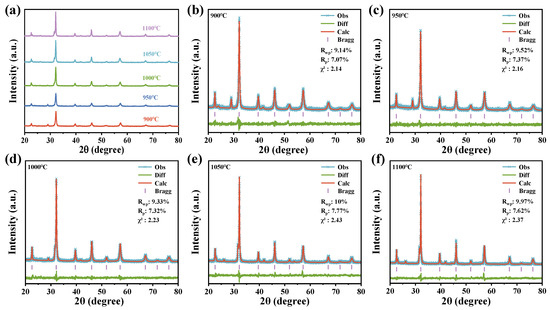
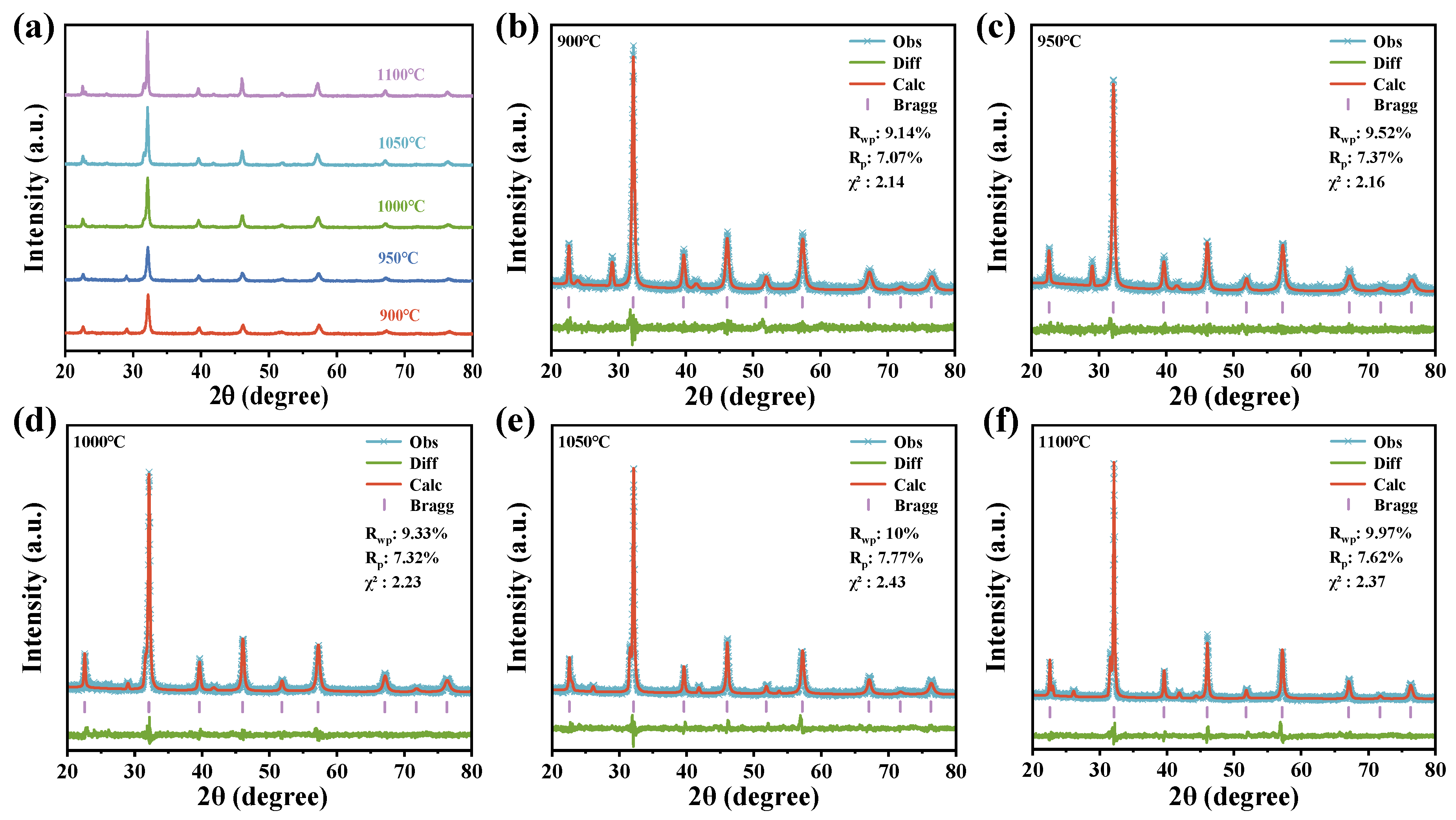
Figure 1a presents the X-ray diffraction (XRD) patterns of PBFS samples calcined at different sintering temperatures (900–1100 °C) for 2 h. As shown in the figure, all samples mainly exhibited a perovskite structure within this temperature range. Among these patterns, the main diffraction peak around 32° corresponded to the (100) crystal plane of the PBF cubic perovskite structure [9,21]. At 900 and 950 °C, weak impurity peaks appeared around 28° in the spectra, indicating that the samples had not fully converted into the target cubic perovskite structure. When the temperature reached 1000 °C or higher, this heteropeak disappeared, indicating that the sample had transformed into a stable perovskite structure. To further investigate the influence of sintering temperature on the cathode structure of PBFS, Rietveld refinement was performed. As shown in Figure 1b–f, the observed XRD patterns were in good agreement with the calculated patterns. Here, Rwp is the weighted residual factor, Rp is the residual factor, and χ2 is the goodness-of-fit [22]. From the figures, when the temperature exceeded 1000 °C, new diffraction peaks began to appear around 25°. In addition, as the sintering temperature increased, the grain size gradually increased from 20.87 to 47.43 nm, while the full width at half maximum of the main diffraction peak decreased from 0.39° to 0.17°. Generally, the sintering phase formation temperature of the material should be set at the lowest temperature that can fully form the desired phase [23]. An excessively high temperature will cause the particles to grow excessively, significantly reducing the specific surface area and the number of active sites, thereby affecting the overall performance of the cathode. By analyzing the XRD patterns at different temperatures, the optimal phase formation temperature of the PBFS cathode was determined to be 1000 °C. This temperature ensures phase purity, inhibits abnormal particle growth, and guarantees high reactivity of the material [24]. All subsequent characterization and performance tests used the cathode prepared at this temperature.
Figure 1.
XRD and Rietveld refinement spectra of the PBFS cathode under different sintering temperatures: (a) XRD pattern of the cathode at 900–1100 °C; (b) Rietveld refinement spectra of the cathode at 900 °C; (c) Rietveld refinement spectra of the cathode at 950 °C; (d) Rietveld refinement spectra of the cathode at 1000 °C; (e) Rietveld refinement spectra of the cathode at 1050 °C; (f) Rietveld refinement spectra of the cathode at 1100 °C.
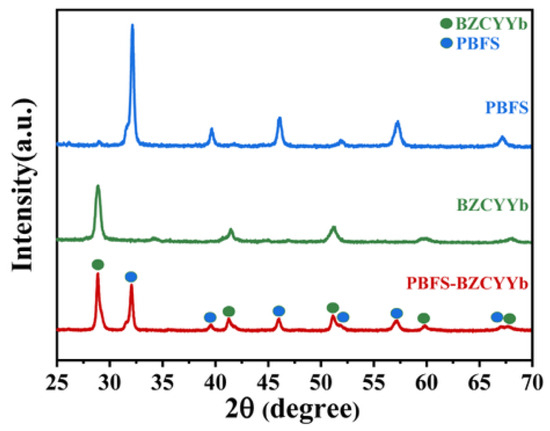
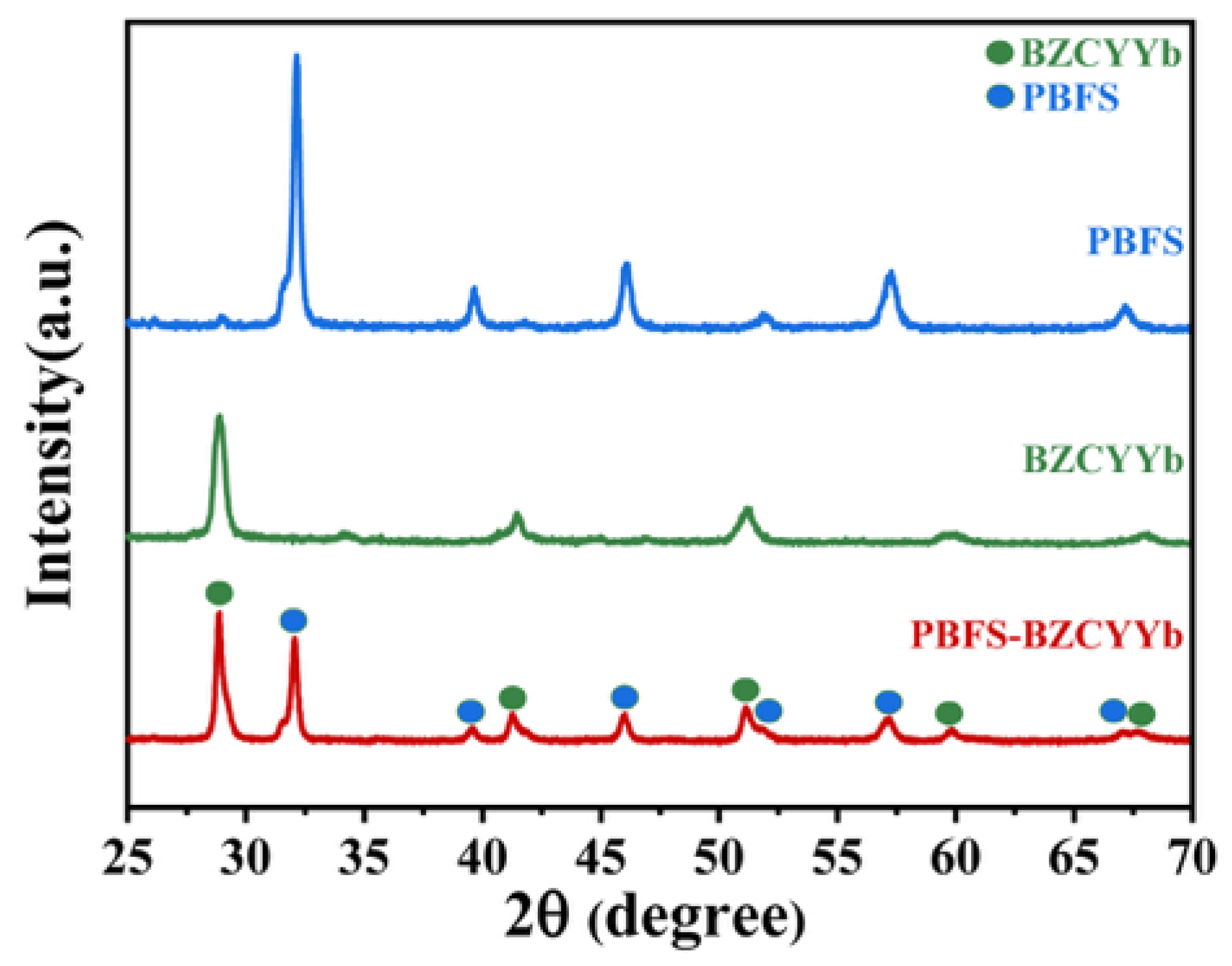
The interfacial compatibility between the cathode and electrolyte directly determines the structural and long-term stability of the single cell [23]. Therefore, the high-temperature chemical compatibility of the PBFS cathode with the BZCYYb electrolyte requires evaluation. PBFS and BZCYYb were mixed at a mass ratio of 1:1, ground for 1 h to achieve uniformity, then pressed into molds and calcined at 1000 °C in a muffle furnace for 10 h. The phase composition of the calcined product was analyzed by XRD (Figure 2). The results indicate that the XRD characteristic peaks of the calcined mixture were completely consistent with those of the two original materials, and no new reaction phase diffraction peaks were detected. This suggests that PBFS and BZCYYb only undergo physical mixing at high temperatures rather than forming new compounds, thus confirming that the PBFS cathode and BZCYYb electrolyte exhibit good chemical compatibility and structural stability.
Figure 2.
The chemical compatibility of PBFS and BZCYYb.
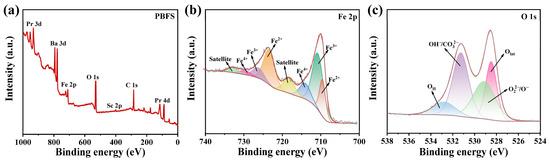
Figure 3a presents the full X-ray photoelectron spectroscopy (XPS) spectrum of the PBFS cathode, which clearly shows the characteristic peaks of Pr, Ba, Fe, Sc, and O. All XPS spectra were calibrated for binding energy using the C 1s peak (C-C bond, 284.8 eV). The valence state of Fe and are key factors affecting the ORR activity of the cathode [25]. Therefore, high-resolution XPS graphs of Fe 2p and O 1s were analyzed. Figure 3b shows the high-resolution Fe 2p spectrum, which exhibits a typical double-peak structure of Fe 2p3/2 and Fe 2p1/2. After peak fitting, the spectrum can be decomposed into three characteristic peaks corresponding to Fe2+ (709.57, 723.44 eV), Fe3+ (710.79, 726.27 eV), and Fe4+ (714.08, 729.68 eV). Additionally, the satellite peaks at 718.31 and 732.93 eV further confirm the mixed valence state of Fe ions. This mixed valence state can maintain charge balance via redox reactions and provide electron transfer sites for the ORR process, thereby facilitating the improvement in catalytic kinetic performance [26]. As the core active sites of the ORR process in PCFC cathodes, directly determines the oxygen adsorption, dissociation capabilities, and ion transport efficiency of the material [9]. Figure 3c presents the high-resolution O 1s spectrum. After peak fitting, four characteristic peaks were obtained, corresponding to lattice oxygen (Olat, 528.49 eV), oxygen vacancy-adsorbed oxygen (O22−/O−, 531.27 eV), surface hydroxyl/carbonate species (OH−/CO32−, 531.27 eV), and adsorbed hydroxyl groups (OH, 532.79 eV). The ratio of the peak area of O22−/O− to that of Olat is commonly used to characterize the concentration of . A higher ratio shows stronger oxygen adsorption–desorption capabilities, which can effectively reduce the energy barrier of the ORR process [23]. The test results indicate that the ratio of the PBFS sample was 1.3, which was significantly higher than the ratio (0.52) previously studied by our research team for the PBF cathode [21]. Results fully demonstrate that Sc doping can effectively regulate the crystal structure of PBF, significantly increase the content, optimize the distribution of active sites, and lay a foundation for the subsequent enhancement of electrochemical performance.
Figure 3.
The XPS full spectrum graph of the PBFS cathode (a); Fe 2p fine spectrum (b); O 1s fine spectrum (c).
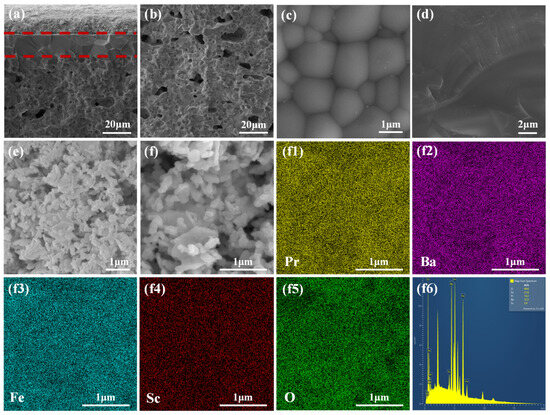
Figure 4a presents the cross-sectional scanning electron microscope (SEM) morphology of the single cell, showing a distinct and dense three-layer structure. Each layer interface is tightly bonded without obvious cracks, providing a structural guarantee for the rapid transport of protons and oxygen ions [5]. Figure 4b shows the morphology of the anode, which exhibits an irregular porous structure. This structure can provide unobstructed channels for H2 diffusion, increase the contact area between H2 and the anode active sites [27]. Figure 4c,d presents the morphologies of the electrolyte surface and cross-section, which exhibited a dense, pore-free structure. This structure can effectively isolate the anode fuel from the cathode air and enhance the energy conversion efficiency [6]. Figure 4e shows the morphology of the cathode, where a composite structure consisting of a perovskite-type grain skeleton and nanoparticles is formed, exhibiting a loose and three-dimensionally interconnected configuration. The interconnected pores can reduce the oxygen diffusion resistance inside the cathode, ensuring that oxygen molecules rapidly reach the catalytic active sites [28]. Figure 4f–(f5) presents the EDS elemental distribution maps of the PBFS cathode, where Pr, Ba, Fe, Sc and O elements are uniformly and continuously distributed throughout the cathode, without local enrichment, segregation, or vacancies. Meanwhile, the elemental composition of PBFS is basically consistent with its designed chemical formula (Figure 4(f6)), confirming the successful and uniform doping of Sc and that the synthesized product meets the design specifications.
Figure 4.
Cross-sectional diagram of a single cell (a); anode morphology diagram (b); electrolyte surface and cross-sectional view (c,d); cathode morphology image and EDS spectrum (e–(f6)).
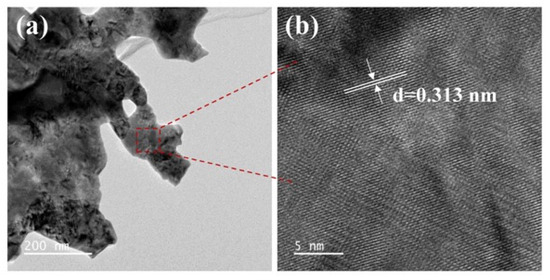
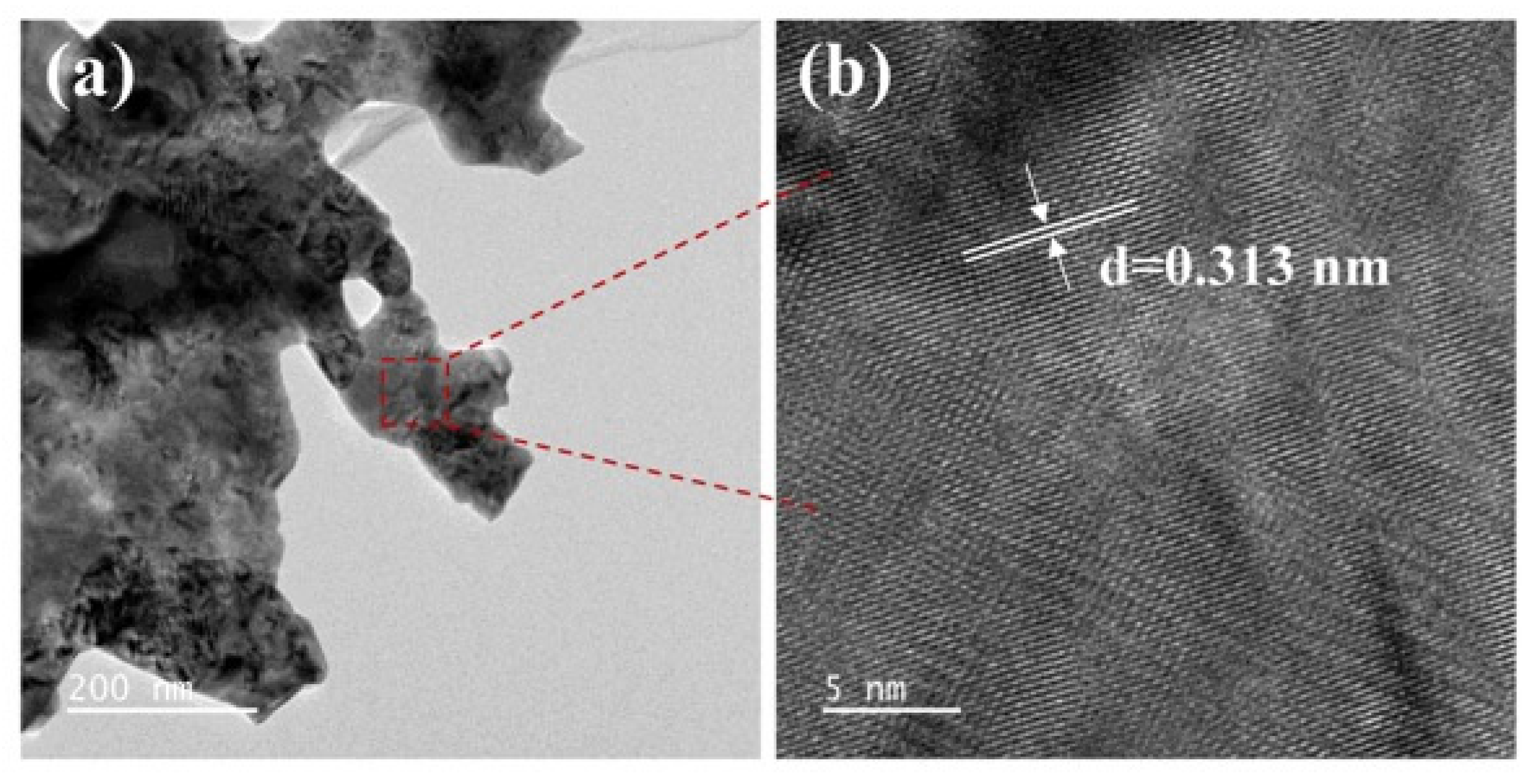
To further investigate the crystal microstructure of the PBFS cathode, high-resolution transmission electron microscopy (HR-TEM) was employed for characterization (Figure 5). Results indicate that the PBFS cathode had high crystallinity, with clear and distinguishable lattice fringes. The measured lattice spacing was 0.313 nm, which corresponded to the (100) crystal plane of the cubic perovskite structure [9,20,21]. This further confirms that after Sc doping, the PBFS cathode forms a stable, complete cubic perovskite crystal structure, providing microstructural support for the stability and electrochemical performance of the material.
Figure 5.
Microstructure diagram of the PBFS cathode: (a) Microscopic morphology of the PBFS cathode; (b) The lattice stripes of the PBFS cathode.
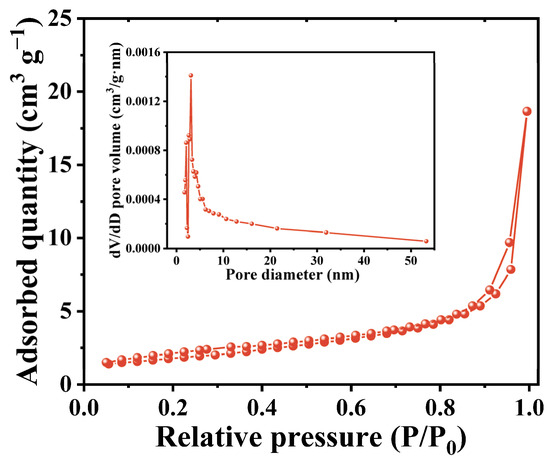
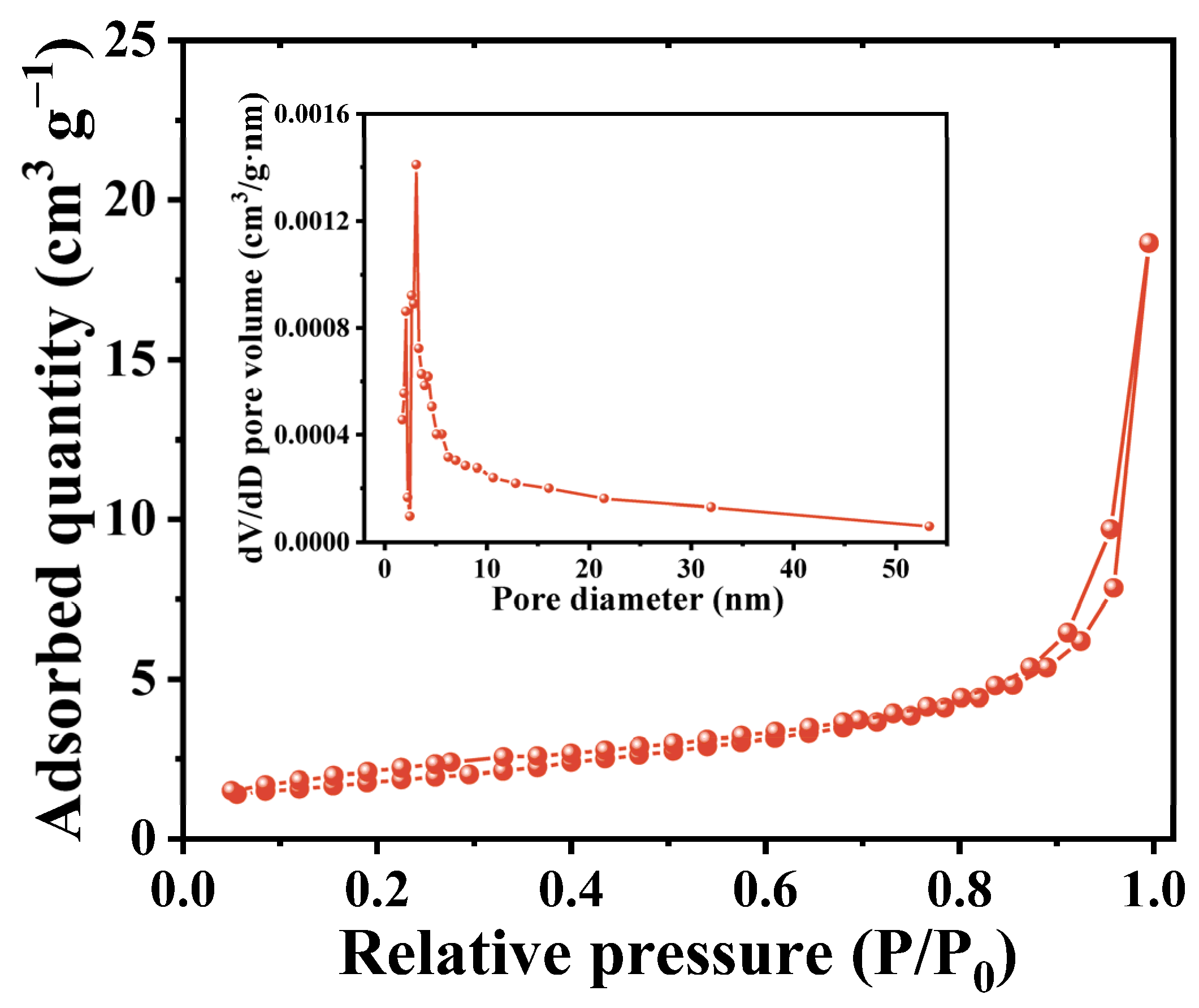
As shown in Figure 6, the pore structure of the PBFS cathode was characterized via nitrogen adsorption–desorption isotherm measurements. In the low-pressure region (P/P0 < 0.1), the adsorption capacity increased gently from 1.5 to 2.5 cm3/g, with a minor increment. In the medium-pressure region (0.1 < P/P0 < 0.8), the adsorption capacity increased nearly linearly with the relative pressure, with no distinct inflection point or adsorption plateau observed. In the high-pressure region (P/P0 > 0.8), the adsorption capacity increased sharply. These features match the typical Type III isotherm [29], indicating a moderate-strength interaction between nitrogen molecules and the PBFS surface. Further quantitative analysis of the pore structure parameters shows that the PBFS cathode had a specific surface area of 6.32 m2/g, with an average pore diameter of 16.07 nm, which falls within the standard mesopore size range (2–50 nm). This pore structure feature enables efficient gas diffusion and transport within the cathode, ensuring sufficient oxygen supply to the active sites and thus boosting the kinetics of the ORR.
Figure 6.
Nitrogen adsorption–desorption isotherm of the PBFS cathode.
2.2. Electrochemical Performance
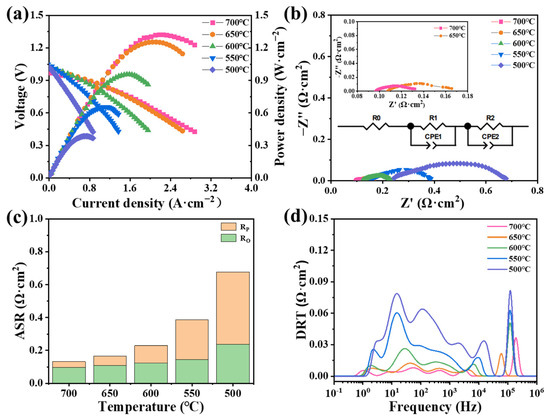
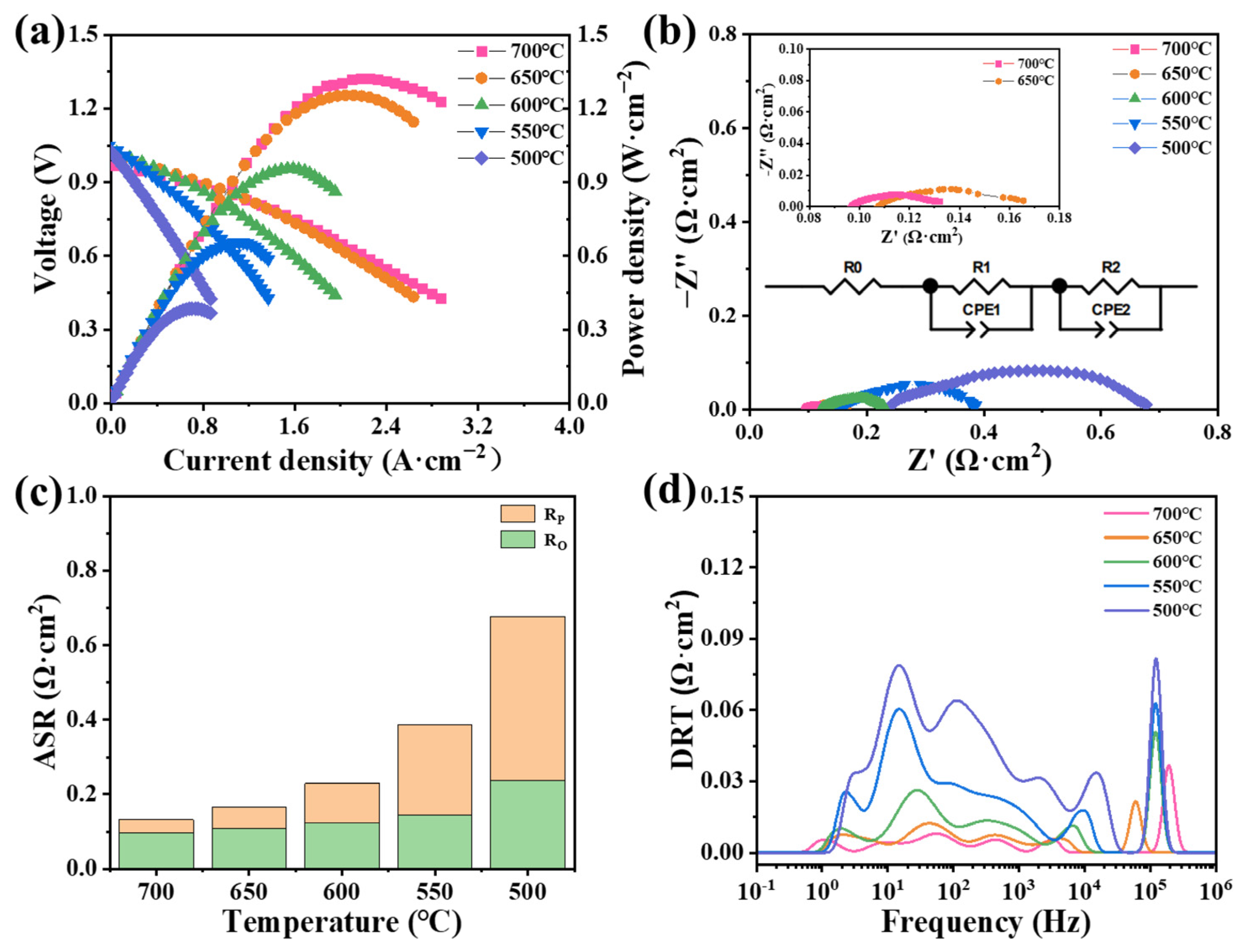
An anode-supported PCFC single cell was fabricated with PBFS as the cathode, BZCYYb as the dense electrolyte, and NiO-BZCYYb as the anode support. H2 was supplied as the fuel, and ambient air was used as the oxidant. The electrochemical output performance and polarization mechanism of the as-fabricated single cell were systematically characterized, with the results presented in Figure 7. As shown in Figure 7a, within the test temperature range of 500–700 °C, the PPD of the single cell reached 0.385, 0.656, 0.955, 1.254, and 1.303 W·cm−2, respectively, demonstrating excellent and stable electrochemical output performance in the medium-to-low temperature range. To further clarify the polarization mechanism of the cell, the electrochemical process at different temperatures was cross-validated by combining Nyquist plots, area-specific resistance (ASR), and relaxation time distribution (DRT) analysis. The results are shown in Figure 7b–d. First, the electrochemical impedance spectroscopy (EIS) data from the Nyquist plots were fitted using the equivalent circuit model inset in Figure 7b, with the error of all fitting results controlled below 20%. Ro denotes the ohmic resistance, which corresponds to the high-frequency intercept of the Nyquist curve on the real axis, and mainly originates from the ionic resistance of the BZCYYb electrolyte and the contact resistance at the electrode–electrolyte interface [19]. The (R1/CPE1) and (R2/CPE2) units correspond to the two characteristic impedance arcs in the mid-frequency and low-frequency regions, respectively, reflecting the polarization processes occurring in the corresponding frequency ranges [21]. The low-frequency intercept of the Nyquist curve on the real axis corresponds to the total resistance (Rt) of the single cell, and the difference between the high and low frequency intercepts is defined as the total polarization resistance Rp. The magnitude of Rp directly reflects the kinetic resistance of the ORR, which covers key rate-limiting steps including oxygen adsorption and dissociation, charge transfer, and oxygen ion bulk transport [30].
Figure 7.
The PBFS cathode corresponds to the voltage–current–power density curves of a single cell (a); Nyquist plot (b), ASR spectrum (c) and DRT curve (d).
To accurately resolve the contribution and physical origin of each polarization process in different frequency intervals, ASR quantification and DRT analysis were performed on the EIS data, with the results presented in Figure 7c,d. The sharp characteristic peaks in the ultra-high-frequency region (104–106 Hz) correspond to Ro in the equivalent circuit, with the peak area decreasing slightly with increasing temperature. This trend is fully consistent with the variation of Ro in the Nyquist and ASR plots, directly verifying the accuracy of the Ro extraction. The dominant peak cluster in the mid-frequency region (101–104 Hz) corresponds to the (R1/CPE1) unit in the equivalent circuit and the mid-frequency impedance arc in the Nyquist plot, and is the dominant contributor to the Rp [10]. This peak cluster reflects the core ORR kinetic processes on the PBFS cathode surface, including oxygen adsorption and dissociation, charge transfer at the cathode–electrolyte interface, and bulk transport of oxygen ions and protons [31]. The broad, weak peaks in the low-frequency region (10−1–101 Hz) correspond to the (R2/CPE2) unit in the equivalent circuit and the low-frequency impedance arc in the Nyquist plot, which are ascribed to gas-phase diffusion and concentration polarization within the porous cathode [32]. The peak area decreases markedly at elevated temperatures, indicating that the contribution of gas diffusion resistance to the Rt is negligible under high-temperature operating conditions [16]. As shown in Figure 7b,c, the Ro and Rp values of the PBFS cathode single cell decreased gradually with increasing temperature. In the temperature range of 500–700 °C, the Ro values were 0.238, 0.145, 0.123, 0.108, and 0.097 Ω·cm2, while the corresponding Rp values were 0.439, 0.242, 0.106, 0.057, and 0.035 Ω·cm2. All relevant electrochemical parameters are summarized in Table 1, and the observed variation trend was fully cross-validated with the DRT analysis results. As temperature decreases, the peak area of the mid-frequency ORR dominant peak increases markedly, and the peak position shifts to lower frequencies. This indicates a significant deceleration of the ORR kinetic rate, which is the dominant cause of the increase in Rp. Meanwhile, the area of the low-frequency diffusion peak increases synchronously, indicating an enhanced contribution of gas diffusion resistance to the total polarization at low temperatures. Compared with previously reported cobalt-free cathode materials for PCFC [10,15,21], the Rp of the PBFS cathode not only remained lower across the entire test temperature range, but also exhibited a slower growth rate as the temperature decreased. This demonstrates that the PBFS cathode retains excellent ORR catalytic activity at medium-to-low temperatures, which is in excellent agreement with the power density test results. This excellent performance originates from the synergistic modulation effect of Sc doping on the PBFS cathode. The porous structure of the cathode and the optimized concentration avoid a sharp rise in ionic migration resistance at low temperatures, while the Fe2+/Fe3+/Fe4+ mixed-valence state constructs a continuous electron conduction pathway, effectively suppressing the rapid increase in Rp as the temperature decreases.
Table 1.
Summary of the electrochemical performance data for a single cell with PBFS cathode.
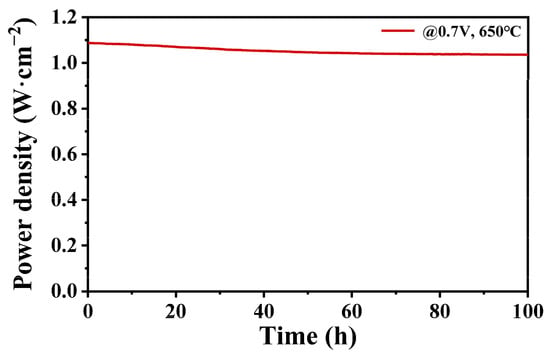
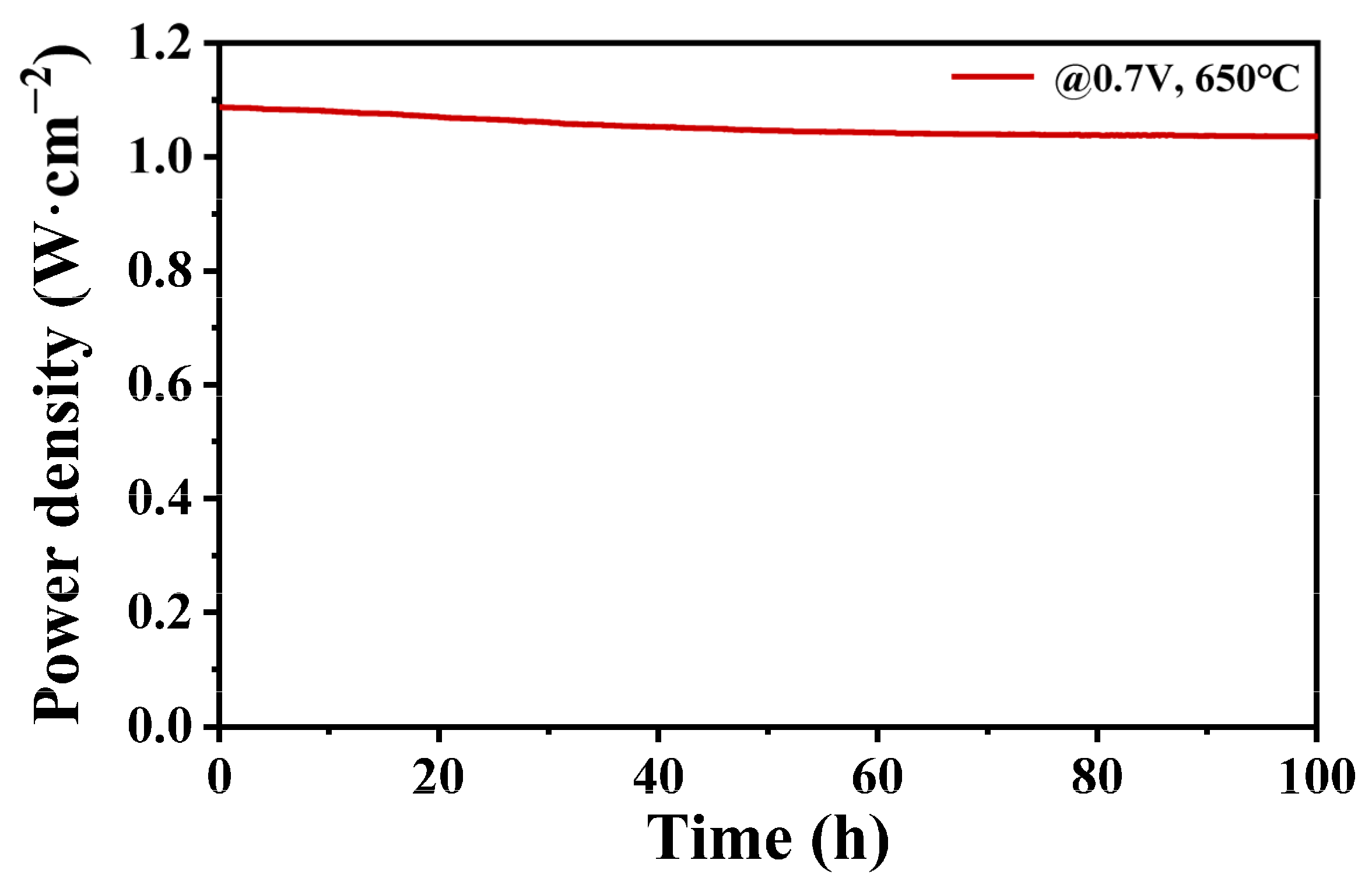
The single cell also exhibited good long-term operational stability. As shown in Figure 8, after continuous operation at 650 °C for 100 h, the PPD the single cell decreased from 1.088 W·cm−2 to 1.036 W·cm−2. The attenuation rate was only 5.23%, which demonstrates excellent long-term serviceability and confirms that the PBFS cathode has good practical application potential.
Figure 8.
The long-term stability of the PBFS cathode corresponds to a single cell.
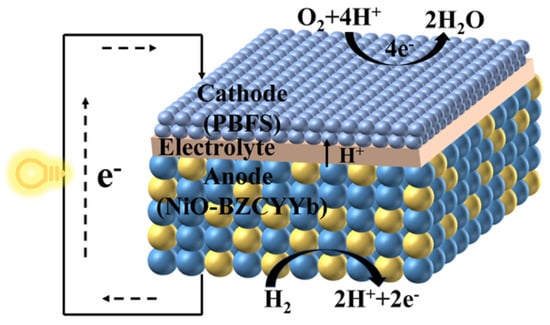
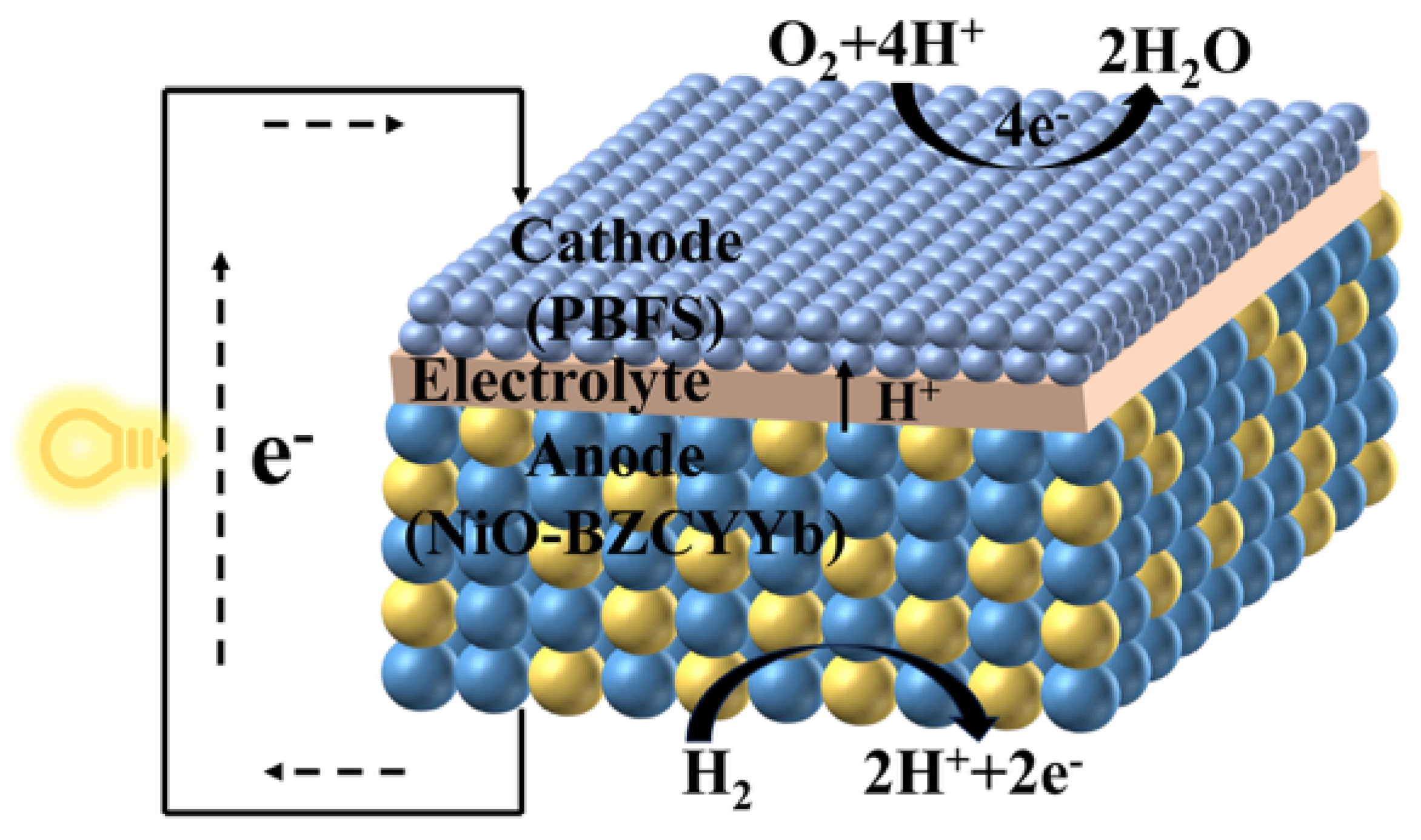
Figure 9 schematically illustrates the working principle and reaction mechanism of the anode-supported PCFC fabricated in this work. Specifically, H2 is fed to the anode side, where it is oxidized at the active sites of the Ni-BZCYYb anode to generate protons (H+) and electrons (e−) [33]. The generated protons migrate across the dense BZCYYb electrolyte to the cathode–electrolyte interface, while electrons are transported to the cathode via the external circuit, forming a continuous electron flow to output electrical power. At the cathode, the transported H+ and e− react with the inflowing O2 at the three-phase boundary to produce H2O as the final product, releasing heat during the reaction [1]. During the ORR process, Sc doping induces the formation of Fe2+/Fe3+/Fe4+ mixed-valence states at the B-site Fe sites of the perovskite lattice. This constructs a continuous electron conduction network and generates a high concentration of , synergistically optimizing the proton-electron-oxygen ion mixed conduction capability of the PBFS cathode. Meanwhile, the abundant provides sufficient active sites for the adsorption and activation of O2, while the mixed-valence states offer continuous redox centers for the coupled electron–proton transfer process during ORR. These two effects work synergistically to significantly reduce the energy barrier of the ORR, enabling the PBFS cathode to maintain an extremely low Rp across the 500–700 °C operating temperature range. Furthermore, the excellent lattice compatibility derived from the well-matched ionic radii of Sc3+ and Fe3+ stabilizes the cubic perovskite structure during long-term high-temperature operation, ensuring the durable retention of the catalytic activity of the PBFS cathode.
Figure 9.
The PBFS cathode corresponds to the mechanism of a single cell.
3. Materials and Methods
3.1. Experimental Materials
The reagents used in this experiment and their specifications are listed as follows: Pr(NO3)3∙6H2O (99%, Maclyn Biochemical Co., Ltd., Shanghai, China); Ba(NO3)2 (analytical purity, Guanghua Science and Technology Co., Ltd., Shantou, Guangdong, China); Fe(NO3)3∙9H2O (99%, Maclyn Biochemical Co., Ltd., Shanghai, China); Sc(NO3)3∙H2O (99%, Maclyn Biochemical Co., Ltd., Shanghai, China); Zr(NO3)4∙5H2O (analytical purity, Guanghua Science and Technology Co., Ltd., Shantou, Guangdong, China); Ce(NO3)3∙6H2O (analytical purity, Maclyn Biochemical Co., Ltd., Shanghai, China); Y(NO3)3∙6H2O (99.5%, Maclyn Biochemical Co., Ltd., Shanghai, China); Yb(NO3)3∙5H2O (99.9%, Maclyn Biochemical Co., Ltd., Shanghai, China); C6H8O7∙H2O (CA, analytical purity, National Pharmaceutical Group Chemical Reagents Co., Ltd., Shanghai, China); C10H16N2O8 (EDTA, analytical purity, National Pharmaceutical Group Chemical Reagents Co., Ltd., Shanghai, China); NH3∙H2O (analytical purity, National Pharmaceutical Group Chemical Reagents Co., Ltd., Shanghai, China); NiO (99%, National Pharmaceutical Group Chemical Reagents Co., Ltd., Shanghai, China); (C6H10O5)n (starch, analytical purity, Aladdin Chemical Reagents Co., Ltd., Shanghai, China); C8nH14n+2O2n (polyvinyl alcohol formaldehyde, analytical purity, Aladdin Chemical Reagents Co., Ltd., Shanghai, China); Ethocel (ethyl cellulose, chemical purity, Aladdin Chemical Reagents Co., Ltd., Shanghai, China); C10H18O (limonene, 95%, Aladdin Chemical Reagents Co., Ltd., Shanghai, China); conductive silver paste (DAD-87, 99.5%, Shanghai Synthetic Resin Research Institute, Shanghai, China); and C2H6O (ethanol, analytical purity, National Pharmaceutical Group Chemical Reagents Co., Ltd., Shanghai, China). All reagents were used directly without further purification.
3.2. Experimental Procedure
3.2.1. Preparation of PBFS Cathode Powder and Slurry
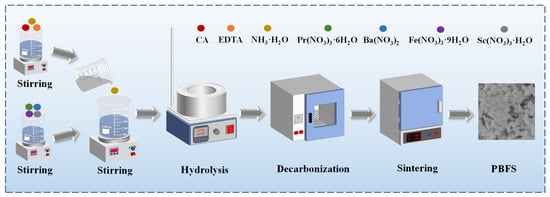
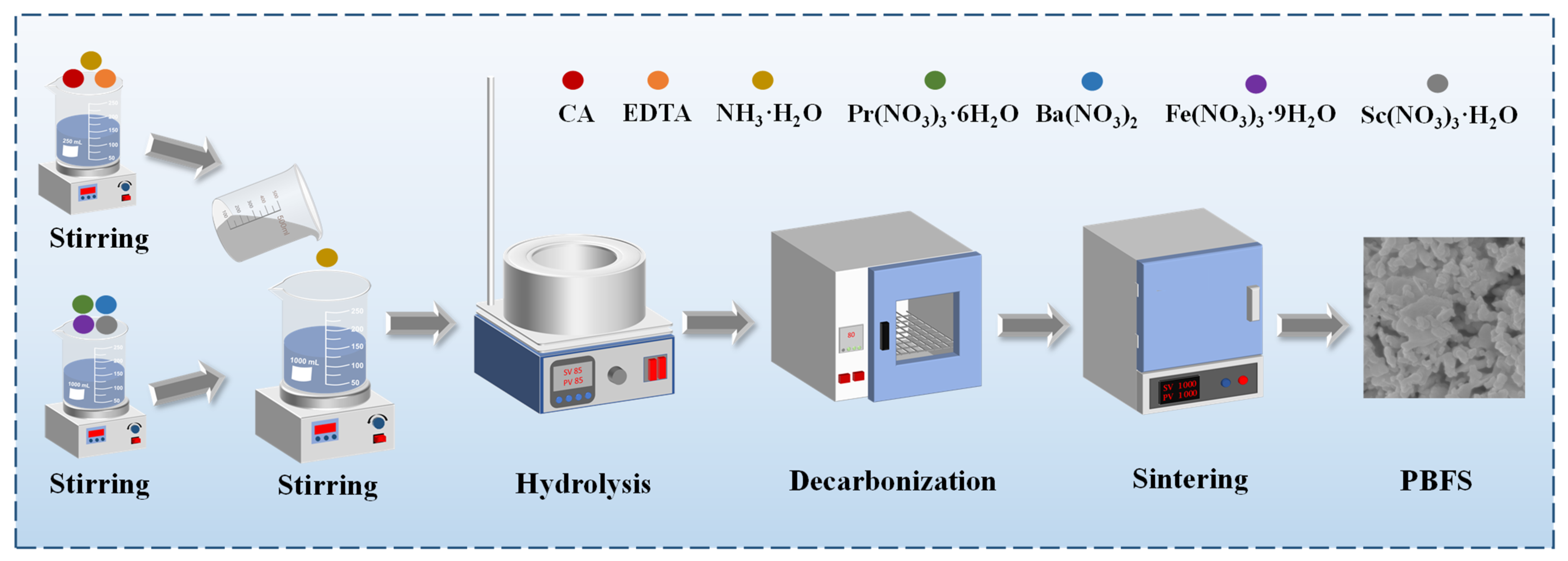
As shown in Figure 10, Pr(NO3)3∙6H2O, Ba(NO3)2, Fe(NO3)3∙9H2O, and Sc(NO3)3 were weighed and dissolved in distilled water. CA and EDTA were employed as complexing agents with a metal ion:EDTA:CA molar ratio of 1:1:2. NH3∙H2O was added dropwise to adjust the pH until a clear solution was obtained. Subsequently, the complexing solution was slowly added to the nitrate solution, followed by continuous stirring and heating to form wet gel. It was pre-calcined at 250 °C for 5 h, followed by sintering at 900, 950, 1000, 1050, and 1100 °C for 2 h in an air atmosphere to obtain PBFS cathode powder. A total of 1 g of PBFS cathode powder, 0.2 g of ethyl cellulose, and 1.8 g of camphor alcohol were placed in a ball milling jar, followed by planetary ball milling at 400 rpm for 12 h to obtain a uniformly dispersed cathode slurry.
Figure 10.
The preparation flowchart of the PBFS cathode.
3.2.2. Preparation of the Electrolyte Powder
Ba(NO3)2, Zr(NO3)4∙5H2O, Ce(NO3)3∙6H2O, Y(NO3)3∙6H2O, and Yb(NO3)3∙5H2O were weighed and dissolved in distilled water. The same complexing system as that used for cathode powder preparation was adopted, and NH3∙H2O was added dropwise to adjust the pH until a clear and transparent solution was achieved. Subsequently, the solution was poured into the nitrate solution, with continuous stirring and heating to form a wet gel. This was pre-calcined at 250 °C for 5 h, followed by sintering at 1100 °C for 5 h in an air atmosphere to obtain the BaZr0.1Ce0.7Y0.1Yb0.1O3-δ (BZCYYb) electrolyte powder.
3.2.3. Preparation of NiO-BZCYYb Composite Anode Powder
NiO was mixed with BZCYYb at a mass ratio of 3:2. Additionally, 10 wt% soluble starch and polyvinyl butyral were added to the mixture. The mixture was milled in a ball milling jar, and ball-milled at 400 rpm for 1 h. The mixture was dried at 80 °C for 6 h, followed by grinding and sieving to obtain the NiO-BZCYYb composite anode powder.
3.2.4. Preparation of Anode-Supported Cell
The anode-supported half-cell was first prepared via the co-pressing and co-sintering method. A total of 0.5 g of anode powder was placed in a mold with a diameter of 15 mm and pressed at 100 MPa for 1 min to form the anode substrate. Subsequently, 0.015 g of electrolyte powder was uniformly spread on the surface of the anode substrate and pressed at 300 MPa for 1 min to obtain a double-layer green sheet. Then, the green sheet was sintered at 1450 °C for 5 h to obtain the anode-supported half-cell. A cathode slurry was coated on one side of the half-cell electrolyte via screen printing, with the effective area of the cathode controlled at approximately 0.28 cm2. After drying, the coated half-cell was sintered at 1000 °C for 2 h to obtain a single cell.
3.2.5. Characterization
The phase composition of the PBFS cathode was characterized using XRD (Smartlab SE, Rigaku, Osaka, Japan). The test parameters were a copper target, wavelength 1.541826 Å, voltage 40 kV, and current 40 mA. The elemental composition and chemical valence of the cathode were characterized using XPS (AXIS SUPRA+, Shimadzu, Kyoto, Japan). The test parameters were an aluminum target, accelerating voltage 15 kV, full-spectrum current 5 mA, and fine-spectrum current 10 mA. The cross-sectional and surface microstructures were observed using SEM (CLARA, Prague, Czech). The crystal structure of the cathode was further analyzed using TEM (Talos L120C, Thermo Fisher, Waltham, MA, USA). The specific surface area and pore structure of the PBFS cathode were analyzed using an automatic specific surface and porosity analyzer (ASAP2460, Malvern Panalytical Ltd., Malvern, UK). The electrochemical performance of the single cell was tested using an electrochemical workstation (CS2350M, Wuhan Costar Instrument Co., Ltd., Wuhan, China) combined with a tubular furnace (OTF-1200X, Hefei Kexing Materials Technology Co., Ltd., Hefei, China). Under a H2 atmosphere, the current–voltage curves, electrochemical impedance spectroscopy, and constant–voltage discharge stability curve of the single cell were measured over a temperature range of 500–700 °C.
4. Conclusions
In this study, PBFS cathodes were successfully fabricated by doping Sc at the Fe sites of the PBF cathode with a 0.2 molar ratio, followed by systematic characterization and performance testing. Results indicated that 1000 °C was the optimal sintering temperature for the PBFS cathode. At this temperature, the material formed a single-phase cubic perovskite structure and exhibited good chemical compatibility with the BZCYYb electrolyte. Furthermore, Sc doping effectively optimized the microstructure and surface activity of the material, inducing the Fe element to form a Fe2+/Fe3+/Fe4+ mixed valence state and significantly increasing the concentration. Meanwhile, it formed a uniform elemental distribution and a complete electron conduction network. The PCFC single cell with PBFS as the cathode achieved a PPD of 1.303 W·cm−2 at 700 °C, with an Rp as low as 0.035 Ω·cm2. During 100 h of long-term operation at 650 °C, the PPD attenuation rate was only 5.23%, demonstrating excellent electrochemical performance and long-term operational stability. This study provided valuable reference for the development of efficient cobalt-free cathode materials for PCFC.
Author Contributions
Conceptualization, J.L., F.L. and P.X.; methodology, E.Z. and Y.N.; software, W.Z., E.Z. and Y.N.; validation, E.Z.; formal analysis, J.L.; investigation, E.Z.; resources, W.Z., F.L. and P.X.; data curation, E.Z.; writing—original draft preparation, E.Z.; writing—review and editing, J.L.; visualization, Y.N.; supervision, F.L.; project administration, F.L.; funding acquisition, J.L. and P.X. All authors have read and agreed to the published version of the manuscript.
Funding
This research was funded by the Excellent Youth Funding of Hunan Provincial Education Department (24B0526) and the Natural Science Foundation of Hunan Province (2025JJ70041, 2025JJ70593).
Institutional Review Board Statement
Not applicable.
Informed Consent Statement
Not applicable.
Data Availability Statement
The original contributions presented in the study are included in the article, and further inquiries can be directed to the corresponding authors.
Conflicts of Interest
The authors declare no conflicts of interest.
References
- Kim, K.; Al-Musawi, A.; Wagner, K.; Lee, C.-Y.; Swiegers, G.F.; Wallace, G.G. The Prospects of Developing Ultrahigh Energy Efficiency Hydrogen–Oxygen Fuel Cells. Energy Fuels 2025, 39, 16078–16099. [Google Scholar] [CrossRef] [Scilit]
- Gu, X.; Zhou, M.; Yan, X.; Zou, G.; Wu, Q.; Ye, Z.; Li, Q.; Liu, J. A high-performance solid oxide fuel cell directly operating with solid carbon as fuel. Electrochim. Acta 2025, 549, 147918. [Google Scholar] [CrossRef] [Scilit]
- Guo, Z.; Xu, L.; Ling, Y.; Wang, P.; Wei, K.; Qiu, P. A perspective on cathode materials for proton-conducting solid oxide fuel cells. Int. J. Hydrogen Energy 2025, 106, 52–64. [Google Scholar] [CrossRef] [Scilit]
- Waghmare, A.M.; Gaikar, P.S.; Cui, C.; Kim, J.M.; Bulakhe, R.N.; Nagare, B.J. A review of developments and challenges in advanced anode materials for solid oxide fuel cells. J. Power Sources 2025, 663, 238853. [Google Scholar] [CrossRef] [Scilit]
- Liu, Z.; Tao, M.; Xiao, M.; Li, J.; Xu, R.; Chen, B.; Li, T.; Yang, G.; Zhang, Y.; Shi, N.; et al. Direct ammonia protonic ceramic fuel cells through heterogeneous interface engineering. Chem. Catal. 2025, 5, 101365. [Google Scholar] [CrossRef] [Scilit]
- Cheng, P.-C.; Wu, J.-E.; Lin, C.-H.; Lee, K.-R.; Lan, P.-K.; Osman, N.; Lee, S.-W.; Tseng, C.-J. Enhancing power density in protonic ceramic fuel cells with porous interlayer. Int. J. Hydrogen Energy 2025, 140, 911–919. [Google Scholar] [CrossRef] [Scilit]
- Lee, H.J.; Son, S.J.; Kim, S.K.; Choi, S.; Kim, M.K.; Shin, T.H.; Joo, J.H. A-site and B-site co-doped PrBaFe2O5+δ double perovskite as a symmetrical electrode of solid oxide fuel cell with potential of CO2 electrolysis. J. Power Sources 2024, 595, 234032. [Google Scholar] [CrossRef] [Scilit]
- Xue, K.; Cai, C.; Xie, M.; Li, S.; An, S.; Yang, H. Effect of Mg-doping on electrochemical performance of PrBaFe2O5+δ cathode materials for solid oxide fuel cells. J. Rare Earths 2024, 43, 2238–2247. [Google Scholar] [CrossRef] [Scilit]
- Yin, Y.; Zhang, S.; Wang, A.; Yan, D.; Li, J.; Jia, L. Rational design of PrBaFe2O6−δ-based cathodes for protonic ceramic fuel cells. J. Adv. Ceram. 2024, 13, 1600–1610. [Google Scholar] [CrossRef] [Scilit]
- Liu, C.; Wang, F.; Ni, Y.; Wang, S.; Qian, B.; Ni, Q.; Zheng, Y.; Chen, H.; Ge, L. Ta-doped PrBaFe2O5+δ double perovskite as a high-performance electrode material for symmetrical solid oxide fuel cells. Int. J. Hydrogen Energy 2023, 48, 9812–9822. [Google Scholar] [CrossRef] [Scilit]
- Li, Y.; Wu, S.; Wang, C.; Du, D.; Gu, Y.; Bi, L. Sc-doping strategy for LaNi0.5Fe0.5O3-δ cathode to boost the performance of proton-conducting solid oxide fuel cells. Int. J. Hydrogen Energy 2024, 50, 124–133. [Google Scholar] [CrossRef] [Scilit]
- Hu, W.; Huang, H.; Wang, Y.; Gu, Y.; Bi, L. Sc and Fe co-doped BaZrO3 cathode with improved electrochemical performance for proton-conducting solid oxide fuel cells. Ceram. Int. 2025, 51, 36223–36232. [Google Scholar] [CrossRef] [Scilit]
- Yang, X.; Wang, Z.; Li, G.; Zhou, Y.; Sun, C.; Bi, L. Sc-doped Ba0.5Sr0.5Co0.8Fe0.2O3-δ cathodes for protonic ceramic fuel cells. Ceram. Int. 2024, 50, 40375–40383. [Google Scholar] [CrossRef] [Scilit]
- Zhang, L.; Yin, Y.; Xu, Y.; Yu, S.; Bi, L. Tailoring Sr2Fe1.5Mo0.5O6−δ with Sc as a new single-phase cathode for proton-conducting solid oxide fuel cells. Sci. China Mater. 2022, 65, 1485–1494. [Google Scholar] [CrossRef] [Scilit]
- Dai, H.; Yin, Y.; Li, X.; Ma, C.; Chen, Z.; Hua, M.; Bi, L. A new Sc-doped La0.5Sr0.5MnO3-δ cathode allows high performance for proton-conducting solid oxide fuel cells. Sustain. Mater. Technol. 2022, 32, e00409. [Google Scholar] [CrossRef] [Scilit]
- Tang, S.; Fu, M.; Qin, Z.; Gao, Y.; Tao, Z. Topological ion optimized composite cathode for proton-conducting solid oxide fuel cells. Adv. Funct. Mater. 2025, 35, 2501995. [Google Scholar] [CrossRef] [Scilit]
- Wan, B.; Liu, T.; Chang, Y.; Fu, M.; Tao, Z.; Zhou, H. Thermodynamic NiO exsolution for durable and efficient cobalt-free cathodes in proton-conducting solid oxide fuel cells. J. Adv. Ceram. 2024, 15, 9221199. [Google Scholar] [CrossRef] [Scilit]
- Ivanov, A.; Kolotygin, V.; Tsipis, E.; Bredikhin, S.; Kharton, V. Electrical conductivity, thermal expansion and electrochemical properties of perovskites PrBaFe2–xNixO5+δ. Russ. J. Electrochem. 2018, 54, 533–540. [Google Scholar] [CrossRef] [Scilit]
- Ma, Y.; Li, M.; Yan, Z.; Qiao, H.; Liu, Y.; An, S.; Zhang, G.; Qu, S.; Li, S. Ni-Doped PrBaFe2O5+δ as Cobalt-Free Cathode for IT–SOFCs: Enhanced Electrochemical Performance via Oxygen Vacancy Engineering. ACS Appl. Energy Mater. 2025, 8, 11237–11247. [Google Scholar] [CrossRef] [Scilit]
- Gao, J.; Huang, H.; Chen, H.; Zheng, D.; Yin, Y.; Wang, H.; Wang, B. Sc-doped SrCoO3-δ cathode with enhanced oxygen reduction reaction catalytic activity and stability for low -temperature solid oxide fuel cell. J. Power Sources 2025, 646, 237247. [Google Scholar] [CrossRef] [Scilit]
- Nie, Y.; Liu, J.; Chen, Y.; Chen, H.; Zhou, W. A novel cobalt-free double perovskite PrBaFe2O6-δ cathode for direct ammonia proton ceramic fuel cells. J. Alloys Compd. 2025, 1039, 183117. [Google Scholar] [CrossRef] [Scilit]
- Zhang, W.; Wang, S.; Yang, C.; Yu, J.; Guo, Y.; Zhang, S.; Song, Y.; Zhang, X.; Wang, G.; Bao, X. Dual-Donor Doped Perovskite as Bifunctional Oxygen Electrode Catalyst for Reversible Protonic Ceramic Electrochemical Cell. J. Am. Chem. Soc. 2025, 147, 43584–43593. [Google Scholar] [CrossRef] [Scilit] [PubMed]
- Nie, Y.; Qian, G.; Chen, Y.; He, J.; Zhou, W.; Xiao, H. A novel Sc-doped La0.6Sr0.4CoO3−δ cathode for proton ceramic fuel cells. J. Solid State Electrochem. 2025, 29, 5247–5255. [Google Scholar] [CrossRef] [Scilit]
- Yildirim, F.; Timurkutluk, C.; Timurkutluk, B. Investigation and optimization of infiltration parameters for nanostructured cathode electrodes in solid oxide fuel cells. Int. J. Hydrogen Energy 2025, 114, 172–185. [Google Scholar] [CrossRef] [Scilit]
- Qi, J.; Liu, C.; Li, S.; Xie, L.; Chen, H.; Ge, L.; Zheng, Y. Enhancing the catalytic activity of PrBaFe2O5+δ double perovskite with BaCoO3-δ modification as an electrode material for symmetrical solid oxide fuel cells. Int. J. Hydrogen Energy 2024, 71, 259–267. [Google Scholar] [CrossRef] [Scilit]
- Qi, J.; Yuan, C.; Ye, H.; Shan, P.; Li, S.; He, S.; Chen, H.; Ge, L.; Zheng, Y. Tailoring the catalytic activity of PrBaFe2O5+δ cathode material with non-transition metal In-doping for solid oxide fuel cells. J. Eur. Ceram. Soc. 2025, 45, 117057. [Google Scholar] [CrossRef] [Scilit]
- Sharma, A.; Shimada, H.; Yamaguchi, Y.; Momai, M.; Sumi, H.; Fujioka, M. Simultaneous electrolyte densification and anode porosity control in BZYb-based protonic ceramic fuel cells via BaCO3 addition. J. Power Sources 2026, 661, 238649. [Google Scholar] [CrossRef] [Scilit]
- Fu, M.; Gao, Y.; Zhang, M.; Shi, N.; Tao, Z.; Shao, Z. Vanadium-assisted surface engineering of heterostructured cathode for enhanced protonic ceramic fuel cell performance. Chem. Eng. J. 2025, 505, 159722. [Google Scholar] [CrossRef] [Scilit]
- Zhu, X.; Zhou, E.; Tai, X.; Zong, H.; Yi, J.; Yuan, Z.; Zhao, X.; Huang, P.; Xu, H.; Jiang, Z. g-C3N4S-scheme homojunction through van der waals interface regulation by intrinsic polymerization tailoring for enhanced photocatalytic H2 evolution and CO2 reduction. Angew. Chem. Int. Ed. 2025, 64, e202425439. [Google Scholar] [CrossRef] [Scilit]
- Gong, J.; Hou, J. B-site high-entropy tailoring K2NiF4 oxide as an effective cathode for proton-conducting solid oxide fuel cells. J. Mater. Sci. Technol. 2024, 186, 158–163. [Google Scholar] [CrossRef] [Scilit]
- Hou, J.; Gong, J.; Luo, J. Constructing highly active surface-nanostructured core/bi-shell La1.2Sr0.8Ni0.5Mn0.5O4+δ cathode for protonic ceramic fuel cells. Chem. Eng. J. 2023, 459, 141459. [Google Scholar] [CrossRef] [Scilit]
- Jeong, H.J.; Chang, W.; Seo, B.G.; Choi, Y.S.; Kim, K.H.; Kim, D.H.; Shim, J.H. High-performance ammonia protonic ceramic fuel cells using a Pd inter-catalyst. Small 2023, 19, 2208149. [Google Scholar] [CrossRef] [Scilit]
- Chen, M.; Zhao, K.; Li, J.; Lin, G.; Banham, D.; Du, L.; Chen, M. Separation of hydrogen isotopes using a protonic ceramic fuel cell. J. Mater. Chem. A 2025, 13, 7687–7691. [Google Scholar] [CrossRef] [Scilit]

Disclaimer/Publisher’s Note: The statements, opinions and data contained in all publications are solely those of the individual author(s) and contributor(s) and not of MDPI and/or the editor(s). MDPI and/or the editor(s) disclaim responsibility for any injury to people or property resulting from any ideas, methods, instructions or products referred to in the content. |
© 2026 by the authors. Licensee MDPI, Basel, Switzerland. This article is an open access article distributed under the terms and conditions of the Creative Commons Attribution (CC BY) license.