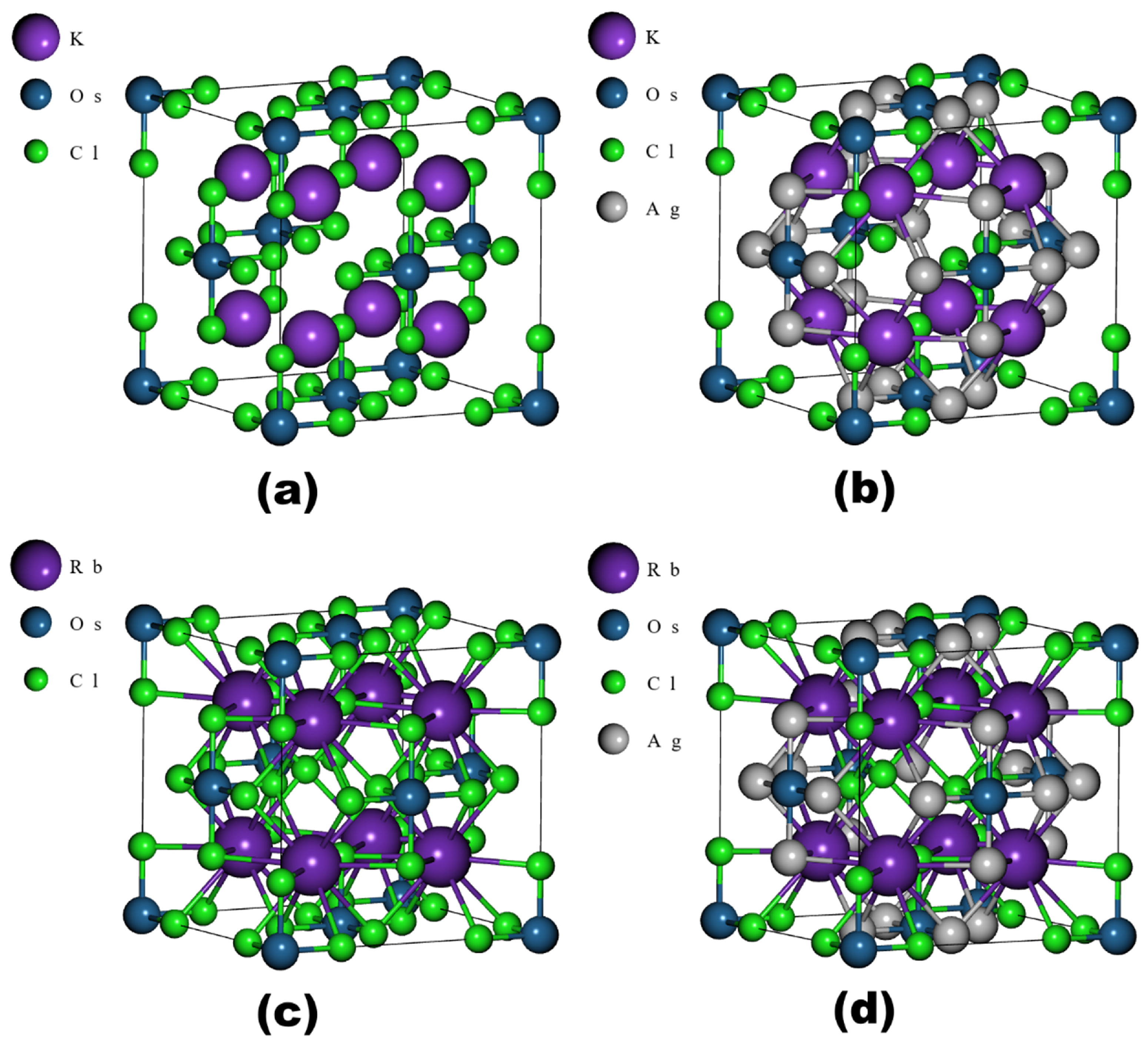
2.1. Structural Properties
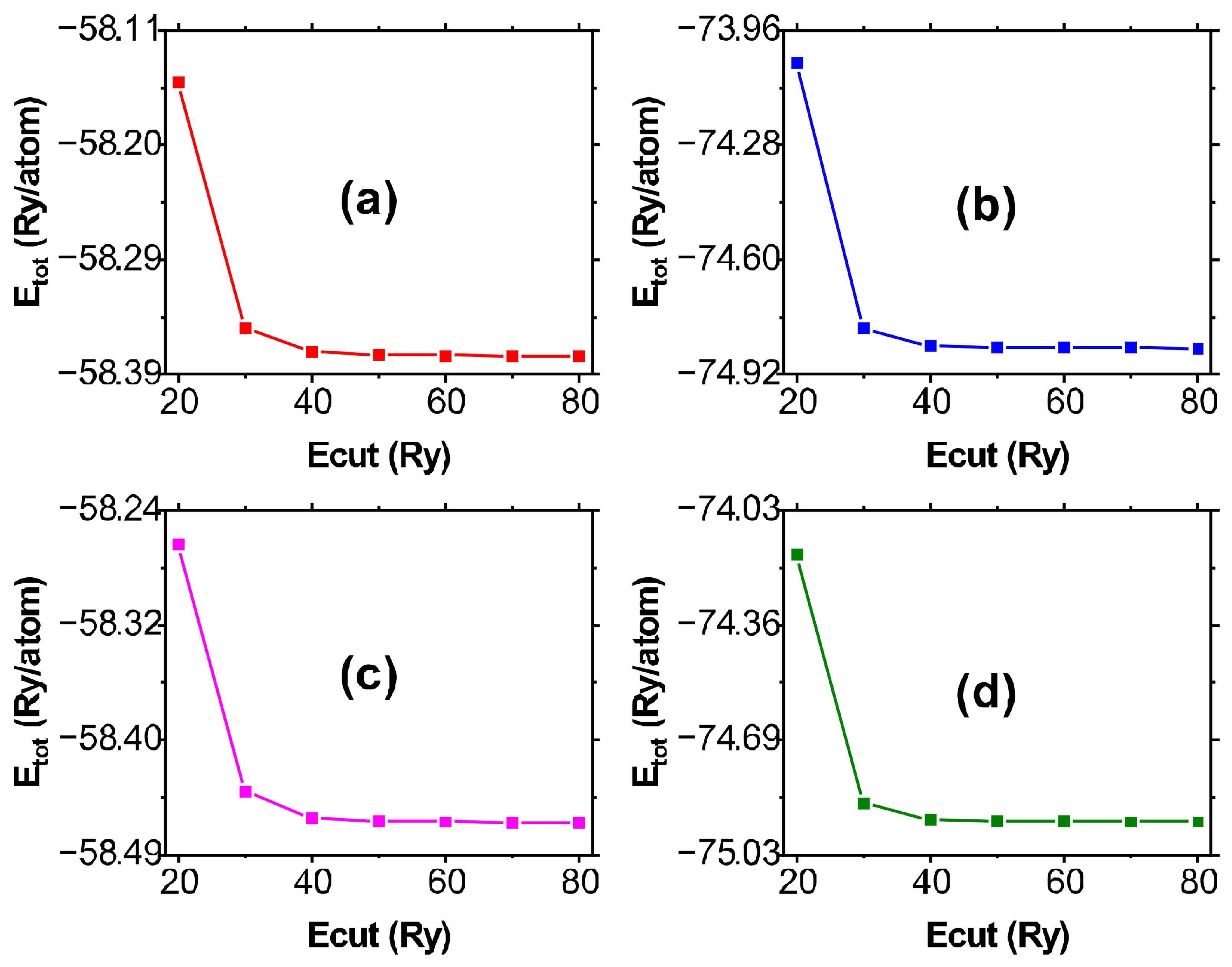
A lower total energy as depicted in
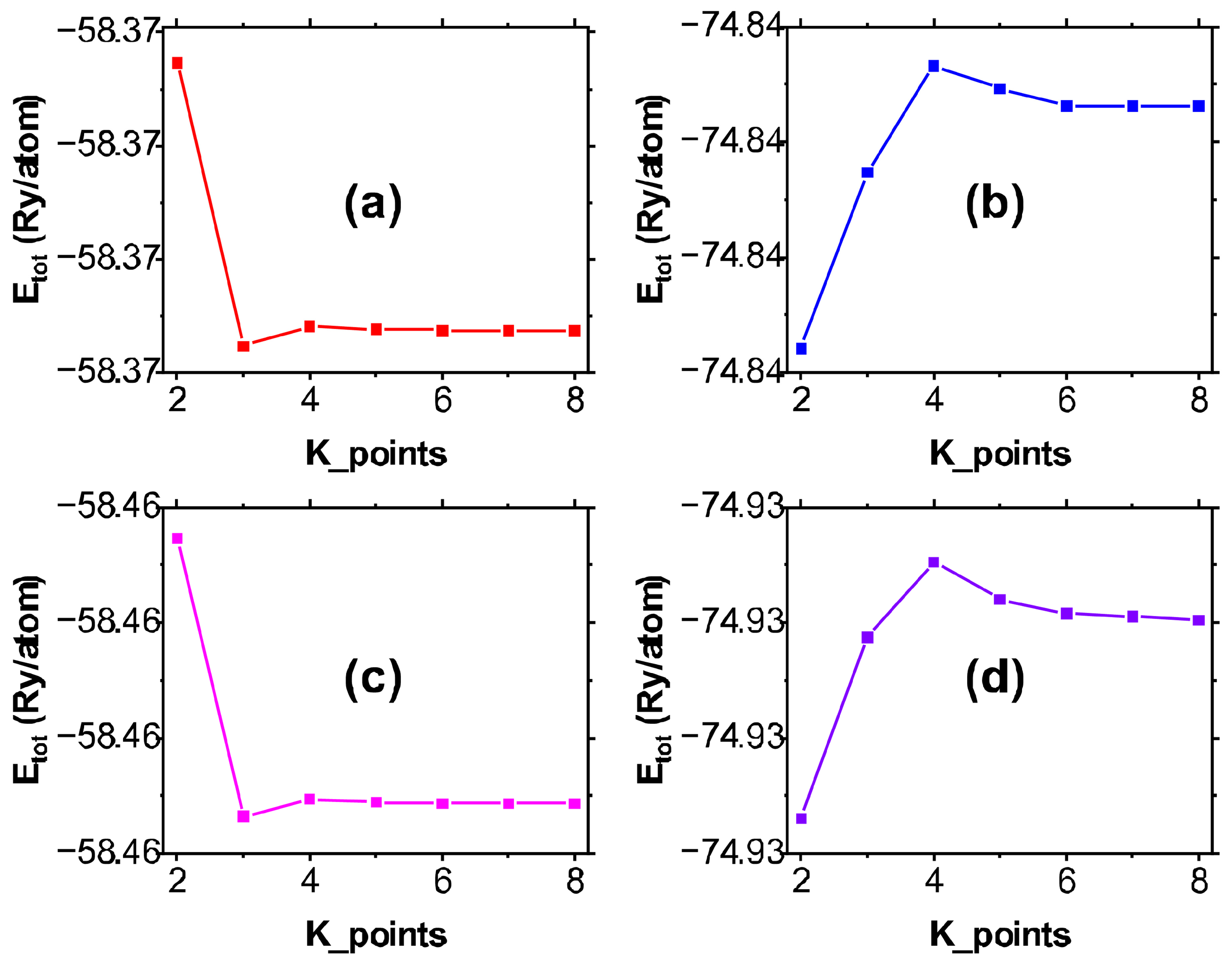
Figure 1b,d, and also in
Figure 2b,d, shows that the novel materials (K
2OsCl
3Ag
3 and Rb
2OsCl
3Ag
3) modeled in this study are more thermodynamically stable than the K
2OsCl
6 and Rb
2OsCl
6 samples (
Figure 1a,c and
Figure 2a,c).
Figure 1 shows that the optimum kinetic energy cut-off (ecut) value was obtained at the 50 Ry (where the curves become flat) for all the four samples, with an accuracy of ×10
−4 Ry. Structural, electronic, and mechanical properties, such as lattice constants, band gaps, and elastic moduli, all depend on the accuracy of the total energy calculation. The structural properties of materials are fundamental to understanding and optimizing their behavior in various applications. These properties influence a material’s mechanical, thermal, electrical, and chemical performance, as they serve as the foundation for tailoring material performance in order to meet specific requirements [
18].
The optimum k-points were likewise obtained at the 5 × 5 × 5 value (
Figure 2), with an accuracy of ×10
−4 Ry. Higher ecut and k-points ensure that more plane waves are included, leading to better accuracy in representing the wave functions. This directly affects the precision of the total energy calculation. However very high values of these parameters require more computational resources (leading more computational cost), with the k-point having a bigger impact than the ecut. The determined accuracies obtained in this study are, however, sufficient for ensuring accuracy in the calculations.
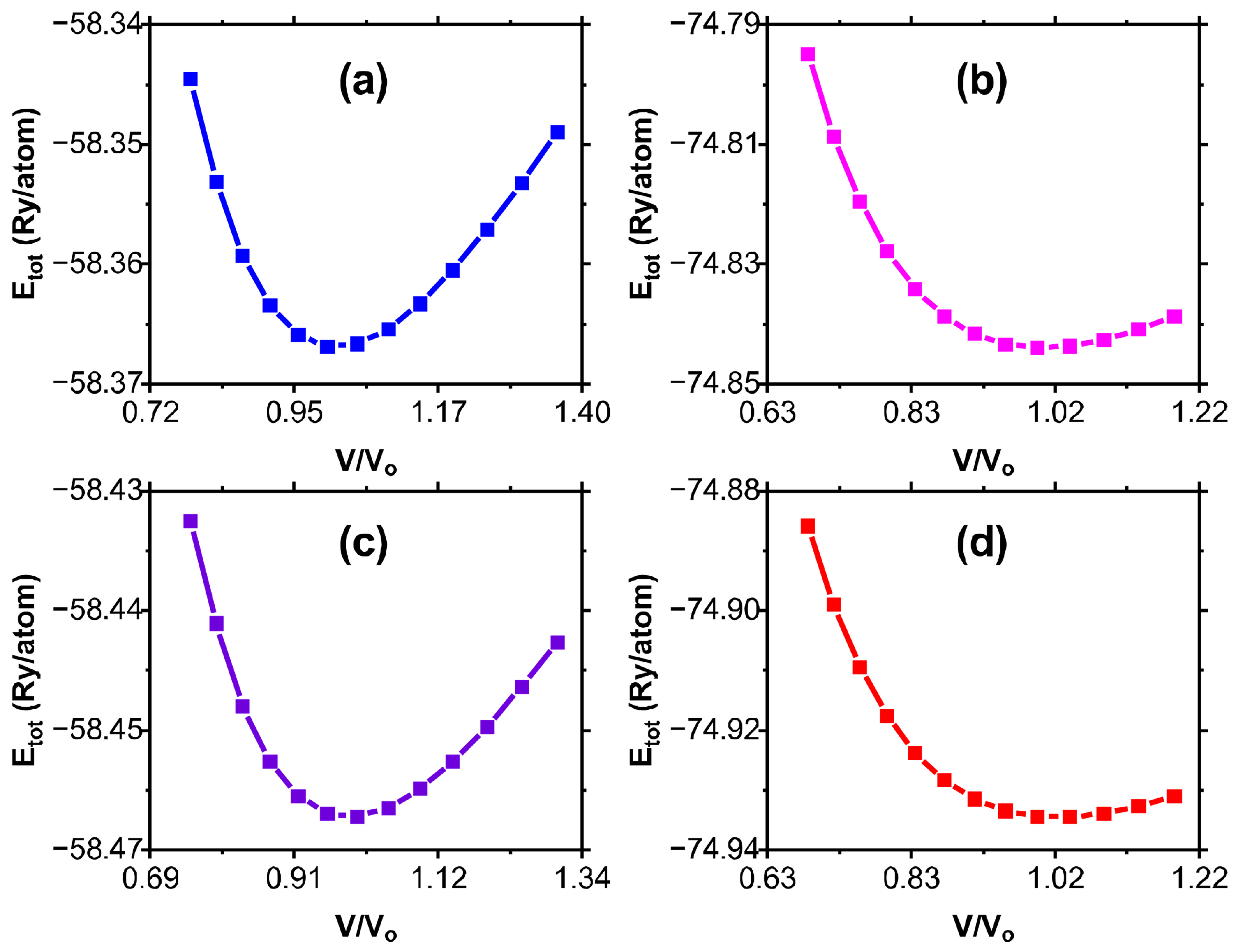
The variation in the total energy with the volumes of the unit cells (
Figure 3) shows that the volumes of all the four samples exhibit parabolic curves (as is expected). The figure also shows that the novel materials exhibited the lowest total energies (
Figure 3b,d) compared to the other two samples (
Figure 3a,c). The optimum values of the volumes (from where the lattice parameters were obtained) are depicted in
Table 1. The lattice parameters were obtained by fitting the volumes data into the second order Birch–Murnaghan isothermal equation of state [
19], which describes the relationship between the pressure, volume, and bulk modulus of a material under compression at constant temperature.
The computed lattice parameter of K
2OsCl
6 obtained in this work agrees very well with some published work (less than 2% deviation), including the theoretical work by McCullough [
20] and the experimental work by Ullah et al. [
14]. However, the values for the novel materials are lower than that of K
2OsCl
6, implying that both K
2OsCl
6 and Rb
2OsCl
6 cells contracted upon the substitution. The computed pressure derivative of the bulk modulus of K
2OsCl
6 is also in agreement (5% lower) with the work by Ullah et al. [
14]. The higher densities of K
2OsCl
3Ag
3 and Rb
2OsCl
3Ag
3 imply that they have better crystal packing and reduced porosity. Although the density of K
2OsCl
6 is not readily available in the literature for comparison, the higher densities of the novel materials formed by adding silver make them suitable for a wide range of advanced applications. High density in perovskite materials is often associated with enhanced mechanical, optical, and electronic properties. They can serve as cathode or solid electrolyte materials, providing improved energy density and stability. Moreover, their dense structures enhance charge storage capacity and durability, which is suitable for use in supercapacitors, as well as in hydrogen storage [
21].
High-density perovskites can also improve photon absorption, leading to higher efficiencies in perovskite solar cells, in addition to improving their ability to handle high optical intensities, which make them suitable for concentrated photovoltaic systems. This is because a denser material has a higher optical absorption coefficient, implying that it can absorb more photons over a shorter distance, which leads to the generation of more electron–hole pairs (more photocurrent). This leads to improved power conversion efficiency. High-density perovskites are structurally more robust and better at tolerating intense photon flux without degrading or overheating, resulting in reduced likelihood of photo-induced damage (like ion migration, thermal breakdown, or phase transitions). This makes them better candidates for concentrated photovoltaic systems, where low-density materials might degrade or lose performance under intense sunlight. Catalysis is also an area of application of dense perovskites, where they are ideal for oxygen evolution reactions and hydrogen evolution reactions in fuel cells and water-splitting systems, in addition to being efficient for degrading pollutants and converting harmful gases in catalytic converters. In comparison, the densities of the common materials for optoelectronic applications have lower densities. For instance, methylammonium lead iodide (MAPbI
3) has a density of 4100 kg/m
3 [
22].
The formation energy of a material is a critical parameter in determining its structural stability and overall feasibility for practical applications. It serves as a measure of how energetically favorable the structure is. Since a negative formation energy indicates that a compound is thermodynamically stable (meaning it is more energetically favorable than the individual elements or competing phases), all the samples investigated in this study are therefore structurally stable. However, as
Table 1 depicts, the novel materials are the least stable, since the more negative the formation energy, the greater the material’s tendency to exist in its synthesized form under standard conditions.
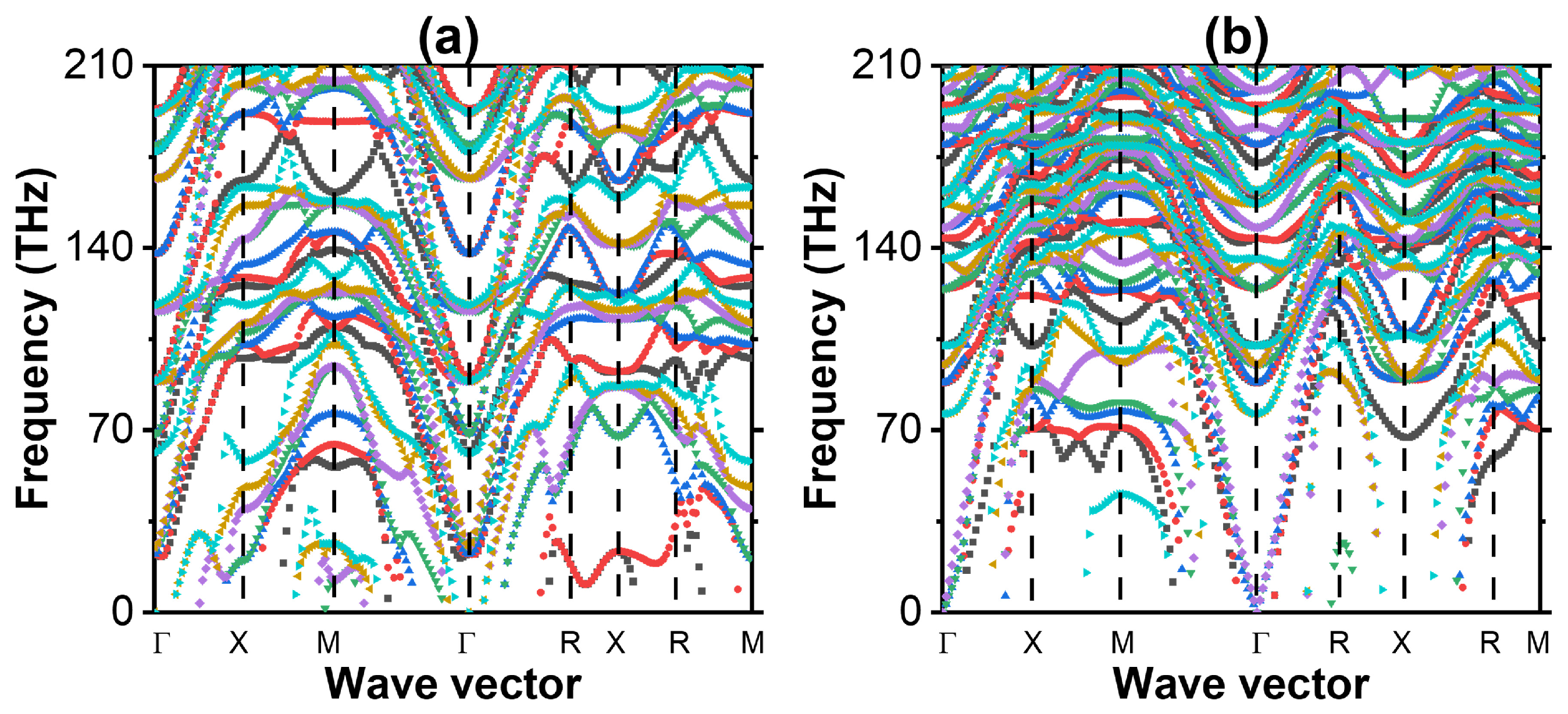
The calculated phonon dispersion curves for both the novel samples (
Figure 4a,b) exhibit no imaginary frequencies across the entire Brillouin zone, confirming their dynamical stability, which is in accord with the formation energy results (
Table 1). In
Figure 4a, the phonon branches for K
2OsCl
3Ag
3 are relatively smooth and well separated, with a clear distinction between the acoustic and optical modes. The acoustic branches display a linear behavior near the Γ-point, indicative of well-defined lattice vibrations and strong elastic response. In contrast,
Figure 4b shows a significantly more complex dispersion profile, characterized by dense phonon branches, frequent crossings, and enhanced band mixing. This increased complexity suggests that Rb
2OsCl
3Ag
3 has a larger primitive cell (which is in agreement with the lattice parameters in
Table 1) and/or reduced symmetry.
2.2. Electronic Properties
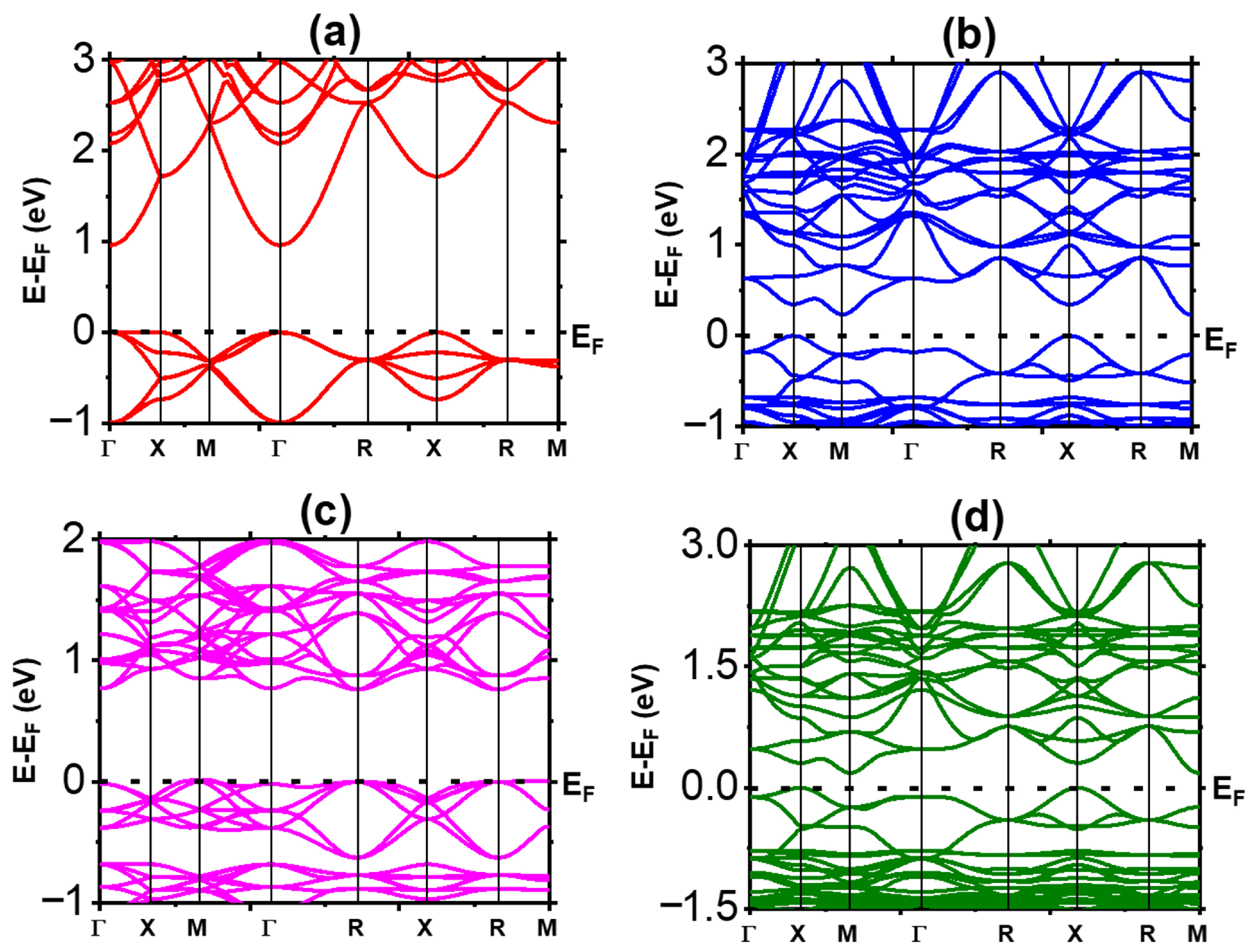
Band structure plays a crucial role in tailoring perovskites for diverse applications, particularly in optoelectronics, energy devices, and catalysis. All the materials investigated in this work are semiconductors, owing to the existence of band gaps (
Figure 5). However, while K
2OsCl
6 and Rb
2OsCl
6 exhibited direct band gaps along the Γ–Γ and R–R points respectively (
Figure 5a,c), the novel samples (K
2OsCl
3Ag
3 and Rb
2OsCl
3Ag
3), as observed in
Figure 5b,d, exhibited both direct band gaps (along the X–X point) and indirect band gaps (along the X–M points).
Perovskites with both direct and indirect band gaps (such as the novel materials obtained in this work) are significant due to their unique combination of properties that make them suitable for a variety of applications. The coexistence of these band gaps in perovskites, depending on their composition and structural variations, allows them to balance efficiency in light absorption, emission, and charge transport. Direct band gaps allow strong absorption of photons, making these perovskites excellent candidates for solar cells and photodetectors. Indirect band gaps on the other hand, facilitate efficient charge transport due to reduced recombination rates of charge carriers (electrons and holes), improving the material’s performance in optoelectronic devices. Thus, perovskites with both direct and indirect band gaps represent a versatile class of materials that combine strong light absorption and efficient charge transport. Their dual nature allows them to excel in a wide range of applications, from high-efficiency solar cells and durable LEDs to advanced photocatalysis and quantum technologies. Their significance lies in their ability to balance competing properties, providing a powerful platform for next-generation materials innovation. In comparison, MAPbI
3 has a direct band gap of 1.5–1.6 [
22].
The band gap values obtained using the PBE–HSE hybrid functional are significantly larger than those computed using the standard GGA approach (
Table 2). This difference arises from the well-known limitation of GGA functionals, which tend to underestimate band gaps due to self-interaction errors and the absence of exact exchange. In contrast, hybrid functionals incorporate a fraction of the Hartree–Fock exchange, leading to improved descriptions of the electronic structure, particularly for systems involving localized d orbitals such as Os-5d states. The relatively large HSE band gap obtained for K
2OsCl
6 can therefore be attributed to the enhanced localization of the Os-d and Cl-p orbitals and the correction of the band gap underestimation inherent in GGA calculations. Similar trends have been reported in previous studies of halide and oxide perovskites, where hybrid functionals yield larger and more accurate band gaps compared to GGA results [
16].
The computed PBE–HSE band gap of K
2OsCl
6 is quite in agreement with the value reported by Ullah et al. [
14], who employed GGA + U. They also reported the direct band gap of K
2OsCl
6 along the Γ–Γ point. The novel materials have much lower band gaps compared to the other two, which are in the range of that of MAPbI
3 [
22]. This can be attributed to the fact that the substitution of chlorine atoms by silver atoms introduces localized energy states within the band gap of the K
2OsCl
6 semiconductor. These states act as intermediate levels that reduce the effective energy difference between the valence band maximum and the conduction band minimum. The presence of these states makes it easier for electrons to transition between the valence and the conduction bands, effectively reducing the band gap. Moreover, silver substitution at the chlorine sites modifies the local electronic environment and introduces additional states near the band edges [
23].
It should be noted that spin–orbit coupling (SOC) effects were not explicitly included in the present calculations. Since the investigated compounds contain relatively heavy elements such as osmium and silver, SOC could introduce additional band splitting and slightly modify the band edges. However, previous studies have shown that the overall electronic trends and qualitative properties of the band structure in similar double perovskites can still be reasonably captured within scalar-relativistic DFT approaches. The hybrid PBE–HSE functional employed in this work was primarily used to improve the band gap description, while SOC effects may be considered in future studies for further refinement of the electronic structure [
24].
A narrower band gap has several advantages, including the fact that it allows perovskites to absorb photons from a broader range of the solar spectrum, including infrared light, which improves light-harvesting efficiency. For solar cells, the ideal band gap is around 1.1–1.6 eV. Narrow band gaps close to this range (as observed in the novel samples in this study) enhance energy conversion by reducing unused infrared photons. High carrier densities can cause band gap renormalization, where the interactions among charge carriers lead to a reduction in the band gap due to many-body effects. Moreover, silver is a transition metal, which has partially filled d orbitals that overlap with the conduction or valence bands of the host material. This overlap introduces new states that narrow the band gap [
25].
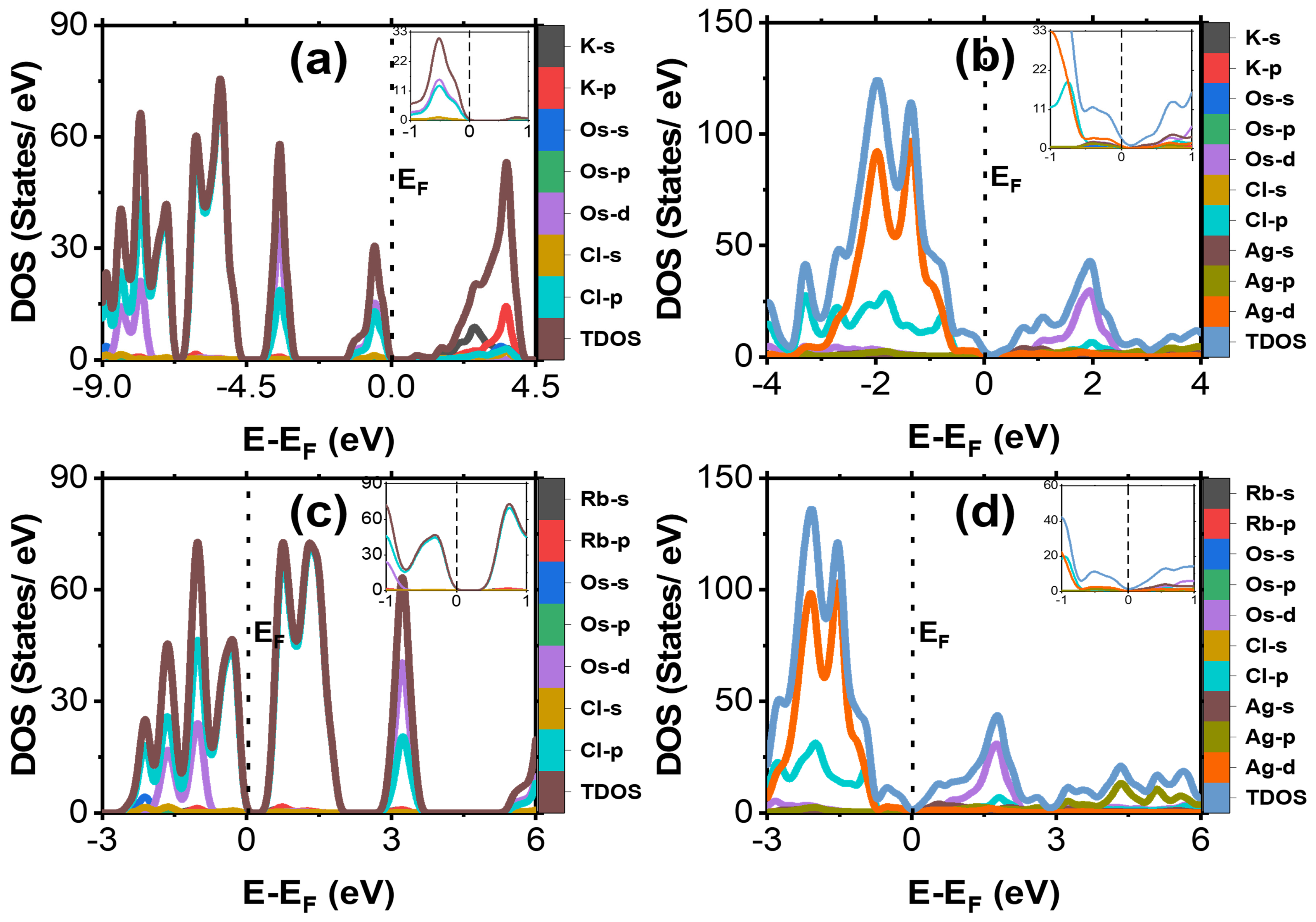
Figure 6 shows the computed density of states of all the samples. As
Figure 6a depicts, the valence band edge of K
2OsCl
6 is dominated by the Os-d orbital, while the hybridization of the K-s and K-p dominate the valence band. This is unlike in the Rb
2OsCl
6 sample, where both the valence band and conduction band edges are dominated by the Cl-p orbital, while the Os-d orbital is located deep in the conduction band. For both novel materials, however, the valence bands are dominated by the Ag-d orbital, while the conduction bands are dominated by the Os-d orbital. This justifies the contribution of silver in the modification of the band structure (and hence, the band gaps) of the novel materials. In doped systems, electron density redistribution around Ag leads to more delocalized bonding charges between Ag and Cl compared to Os–Cl. Thus, Ag–Cl bonds show increased electron sharing between Ag and Cl atoms, indicating partial covalency. On the other hand, Os–Cl bonds show localized electron density around Cl, which is consistent with ionic bonding. Metal substitutes affect the density of states by introducing impurity states, modifying the band gap and band edges, increasing or redistributing the density of states near the Fermi level, and creating localized or delocalized states, depending on the interactions between the host and the substituting elements, which directly influence the material’s electronic, magnetic, and optical properties. These result in materials suitable for applications like thermoelectrics, photovoltaics, catalysis, and electronics [
26].
However, the substitution of silver atoms at the chlorine sites represents a non-conventional atomic replacement from a purely ionic perspective, since chlorine typically acts as an anion while silver commonly appears as a cation in many compounds. This phenomenon is called anti-site defect [
27], and mainly occurs in complex halide perovskites, where the bonding is not purely ionic and often exhibits significant covalent character. Consequently, the effective charge states are determined by the self-consistent redistribution of electrons within the crystal lattice. The DFT calculations employed in this work inherently account for this charge redistribution. The calculated density of states indicates hybridization between Ag-d, Cl-p, and Os-d orbitals, suggesting that the electronic structure adjusts to maintain overall charge neutrality. Moreover, the negative formation energies, as well as the phonon spectra, obtained for the novel structures indicate that the new structures are energetically favorable within the theoretical framework and, therefore, represent potentially metastable compounds that may be accessible under suitable synthesis conditions.
2.3. Thermoelectric Properties
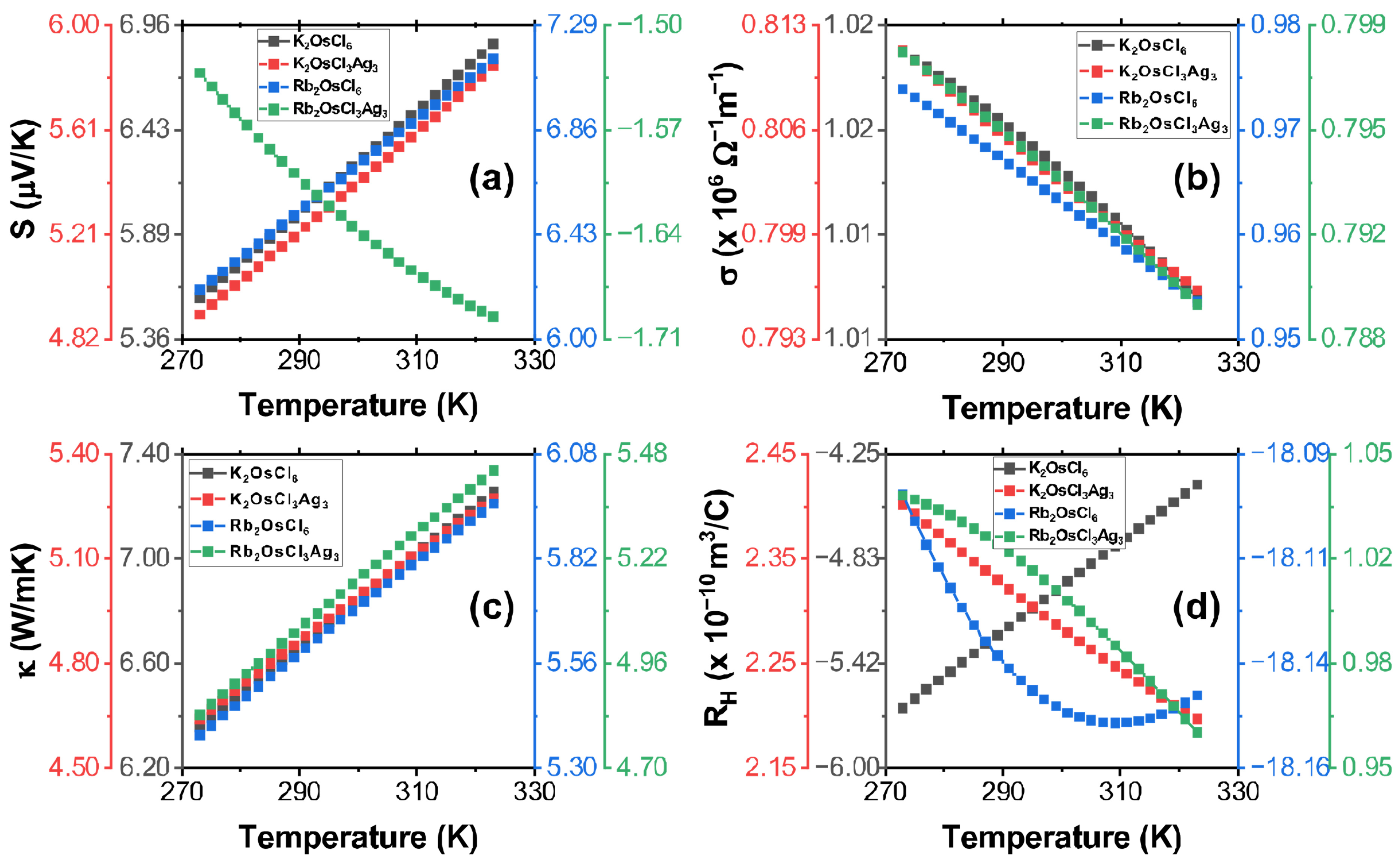
Figure 7a and
Table 3 show that the Seebeck coefficients of all the materials are positive, except that of Rb
2OsCl
3Ag
3. A positive Seebeck coefficient indicates that the charge carriers in the material are holes (positive charge carriers), which is typical of p-type materials. This property is particularly significant for perovskites because it affects their thermoelectric performance and determines their behavior in various electronic and energy-related applications, including thermoelectrics, solar cells, and energy-efficient devices. This property also allows for the tuning and optimization of perovskite materials for specific applications, particularly in energy harvesting and sustainable energy systems [
28].
A negative Seebeck coefficient in perovskites on the other hand (as observed in the rest of the materials in this study), is good for n-type conduction, making these materials suitable for thermoelectric power generation, efficient electron transport in solar cells, and other energy-efficient technologies. It enhances the performance of thermoelectric devices, photovoltaic applications, and waste heat recovery systems. The computed values of the Seebeck coefficient obtained in this study are in agreement with those from previous studies (
Table 3), although they are small compared to those of the well-known thermoelectric materials such as bismuth telluride at 225 μV/K [
29]. A low Seebeck coefficient in perovskites typically suggests weak thermoelectric performance, reducing the material’s effectiveness in energy conversion applications such as in thermoelectric generators. However, it may be advantageous in applications that require high electrical conductivity or carrier mobility without a strong thermoelectric effect. Additionally, low Seebeck perovskites may be useful in hybrid thermoelectric systems, electronic devices, and applications where thermal management or charge transport is more critical than thermoelectric conversion efficiency, which include systems where heat dissipation, electrical conductivity, or device stability takes precedence over energy harvesting through the Seebeck effect. Examples of such devices are heat speakers in electronics, battery electrodes, and collectors.
Figure 7a shows the variation in the Seebeck coefficient with temperature for all the investigated materials. In general, the magnitude of the Seebeck coefficient increases slightly with increasing temperature for most of the compounds. This behavior is typical of semiconductors and is mainly attributed to the increase in carrier excitation and redistribution of charge carriers as temperature rises [
30]. At higher temperatures, more charge carriers gain sufficient thermal energy to move from the valence band to the conduction band, which enhances the entropy per carrier and consequently increases the thermopower. The positive Seebeck coefficients observed for K
2OsCl
6, K
2OsCl
3Ag
3, and Rb
2OsCl
6 indicate that holes are the dominant charge carriers, confirming their p-type semiconducting behavior. In contrast, Rb
2OsCl
3Ag
3 exhibits a negative Seebeck coefficient, indicating that electrons dominate the transport process, resulting in n-type conductivity. Therefore, the temperature dependence of the Seebeck coefficient reflects the semiconductor nature of the materials and the dominant type of charge carriers responsible for electrical transport in each compound.
The high electrical conductivity of the perovskites, as exhibited by the materials in this study, is a significant property that enhances their performance as well as broadening their range of applications in various fields, from energy generation to electronic devices, as it plays a critical role in enhancing their efficiency and performance in a wide range of applications. It improves the performance of thermoelectrics, photovoltaics, and electronics by facilitating fast charge transport, reducing resistive losses, and ensuring stability in harsh operating conditions.
Table 3 shows that the computed electrical conductivity of K
2OsCl
6 in this work is in agreement with values in the literature. However, the values for the novel materials are relatively lower.
A drop in electrical conductivity with increasing temperature as observed in all the samples in this study (
Figure 7b) is a significant phenomenon in perovskites and is often linked to their semiconductor-like behavior [
31]. This trend can provide insights into the electronic structure, charge carrier dynamics, and potential applications of the material, where balancing electrical conductivity with other properties (such as the Seebeck coefficient) is crucial for optimizing performance. Additionally, it guides the development of perovskite-based devices, from energy harvesting systems to temperature sensors and thermoelectric converters, ensuring efficient and stable operation across temperature ranges.
As
Table 3 depicts, the computed thermal conductivity of all the samples in this work is low, which is a highly significant property, especially in the context of thermoelectric and energy-related applications. It plays a crucial role in optimizing the performance of these materials in various technological settings. It enhances their performance in thermoelectric devices, solar cells, energy storage, and high-temperature systems. By minimizing heat flow, these materials improve the efficiency of thermoelectric energy conversion and cooling systems, stabilize temperature gradients, and enhance the durability and long-term performance of devices. Additionally, perovskites with low thermal conductivity can be used in thermal insulation and energy-saving technologies, making them versatile materials for a range of energy-related and thermal management applications [
32].
Table 3 shows that the novel materials have the lowest thermal conductivities, which are ideal for the aforementioned applications.
Figure 7c shows an increase in the thermal conductivities of all the materials with temperature, a property that can have both positive and negative implications, depending on the specific application and the role of thermal conductivity in the desired performance. For thermoelectric materials, it is generally detrimental, as it reduces the efficiency of energy conversion. In contrast, for solar cells, LEDs, or electronics, a higher thermal conductivity at elevated temperatures can be advantageous for effective heat management and device stability.
The novel materials modeled in this study have positive values of the Hall coefficient (
Table 3 and
Figure 7d), unlike the other two that have negative values. The Hall coefficient is an important parameter in the study of charge carriers in materials, since it indicates the type and density of charge carriers (electrons or holes) in a material. A negative Hall coefficient (as obtained in this study by K
2OsCl
6 and Rb
2OsCl
6) indicates the dominance of negative charge carriers in the materials; which is significant for perovskites in that it indicates n-type semi conductivity, a property that is crucial for optimizing perovskite materials for a wide range of applications such as thermoelectrics, photovoltaics, photoelectrochemical devices, electronic devices, and spintronics.
Conversely, a positive Hall coefficient in perovskites, as observed in K
2OsCl
3Ag
3 and Rb
2OsCl
3Ag
3, suggests p-type conductivity, since it indicates that holes make up the majority of the material’s charge carriers. Among the applications of the materials with positive Hall coefficient are the design of p–n junctions, p-leg of thermocouples, optoelectronic devices (like LEDs and photodetectors), and photoelectrochemical cells, and it can reveal information about the material’s electronic and thermoelectric behavior. The creation of high-performance devices for energy conversion, solar cells, and spintronic technologies is made possible by the positive Hall coefficient, which also aids in enhancing charge transport and electrical conductivity [
33].
Figure 7d shows the variation in the Hall coefficient with temperature for all the investigated compounds. In general, the Hall coefficient decreases in magnitude with increasing temperature for most of the materials. This behavior is typical of semiconductors and can be attributed to the increase in thermally generated charge carriers as temperature rises. As the temperature increases, more electrons or holes are excited across the band gap, leading to a higher carrier concentration. Since the Hall coefficient is inversely proportional to the carrier concentration, an increase in the number of charge carriers results in a decrease in the magnitude of the Hall coefficient. In addition, increased lattice vibrations at higher temperatures enhance carrier scattering, which also affects carrier mobility and the overall Hall response.
Depending on the particular application and the mechanisms affecting the material’s behavior, a decrease in the Hall coefficient with rising temperature in perovskites (as shown in all the materials except K
2OsCl
6) can have both beneficial and detrimental effects. For example, solar cells, thermoelectric devices (provided the Seebeck coefficient is maintained), and high-temperature electronics are among the applications that benefit from increased carrier concentration and enhanced conductivity. Therefore, the two novel materials are suitable for these applications. However, they are not suitable for applications like precision sensors or specific thermoelectric generators where low noise, mobility stability, or a balance between the carrier concentration and the Seebeck coefficient are crucial. These applications require an increase in the Hall coefficient with temperature [
34].
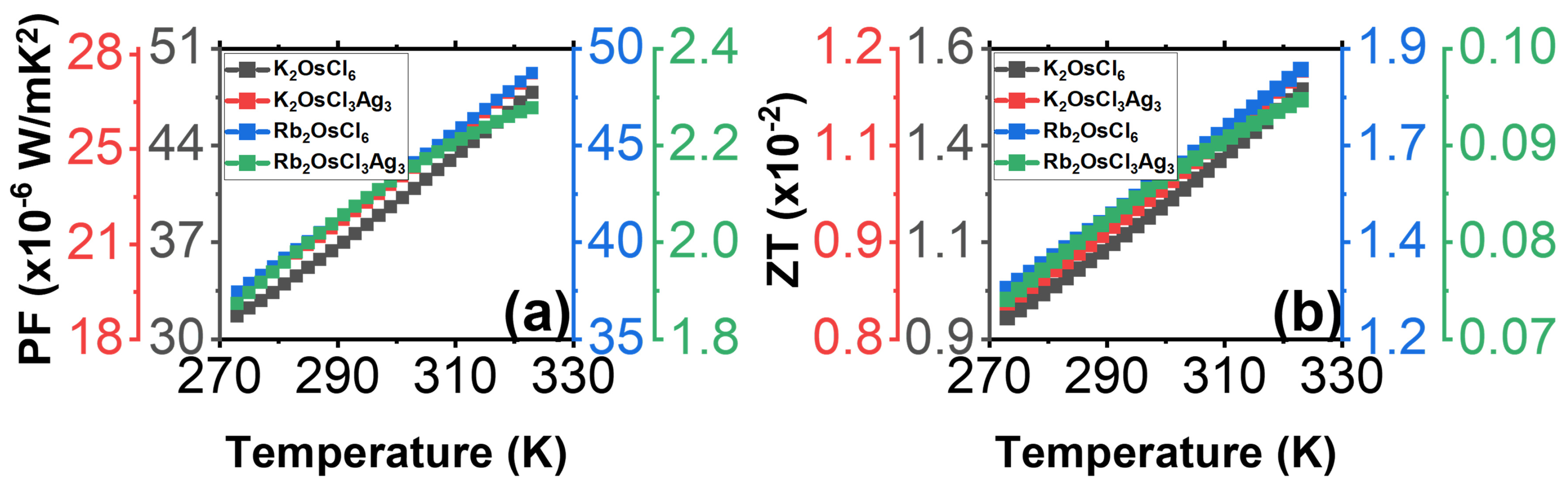
Figure 8a depicts the power factors of all the samples, which show an increase with temperature. This is a highly desirable property for thermoelectric materials, particularly for high-temperature applications. It reflects enhanced efficiency, robust material properties, and suitability for energy conversion systems. Thus, all the materials investigated in this work are good in this regard. However, the design must ensure that the accompanying thermal conductivity does not increase, thus preserving a high figure of merit and maximizing thermoelectric performance. A higher power factor (as observed for K
2OsCl
6 and Rb
2OsCl
6 in this study, in
Table 3) enhances the material’s ability to generate electricity from heat or provide efficient cooling, making it essential for applications in energy harvesting, waste heat recovery, and cooling systems. A lower power factor on the other hand (as observed for K
2OsCl
3Ag
3 and Rb
2OsCl
3Ag
3 in
Table 3) is generally undesirable for thermoelectric and electronic applications because it reduces the material’s efficiency in energy conversion and transport. However, its impact must be considered in the context of the specific application [
35].
For perovskites used in thermoelectric devices like thermoelectric generators and thermoelectric coolers, the figure of merit is important because it determines the efficiency by which a material can convert heat into electricity or vice versa. Since the figure of merit is an indicator of the thermoelectric performance of perovskite materials, a higher value (as obtained for K
2OsCl
6 and Rb
2OsCl
6) is critical for advancing thermoelectric materials and technologies. It signifies better efficiency in converting heat to electricity and vice versa, making materials more viable for a range of applications, from waste heat recovery to sustainable energy systems and advanced electronics. The figure of merit of K
2OsCl
3Ag
3 is very close to one and is considered moderately efficient for practical thermoelectric applications such as thermoelectric coolers, mini-refrigerators, and electronic component cooling. The much lower figure of merit of Rb
2OsCl
3Ag
3 generally limits its effectiveness for thermoelectric applications, reducing its appeal for energy conversion technologies. However, it highlights areas for material improvement and optimization. Perovskites with a low figure of merit may still have value in other applications where thermoelectric performance is not the primary focus [
36]. These applications include methylammonium lead iodide in perovskite solar cells, where the focus is on light absorption, carrier lifetime, and open-circuit voltage. Another example is CsPbBr
3, whose performance depends on radiative recombination, bandgap engineering, and quantum efficiency, and not heat-to-electricity conversion [
37,
38].