
Article

Development of Modified Zeolites for Methane Separation from Diluted Streams
1
Inorganic Membranes and Membrane Reactors, Sustainable Process Engineering, Department of Chemical Engineering and Chemistry, Eindhoven University of Technology, De Rondom 70, 5612 AP Eindhoven, The Netherlands
2
Eindhoven Institute for Renewable Energy Systems (EIRES), Eindhoven University of Technology, P. O. Box 513, 5600 MB Eindhoven, The Netherlands
*
Author to whom correspondence should be addressed.
Inorganics 2026, 14(3), 80; https://doi.org/10.3390/inorganics14030080

Submission received: 1 February 2026 / Revised: 2 March 2026 / Accepted: 3 March 2026 / Published: 12 March 2026
(This article belongs to the Section Inorganic Materials)

Abstract

Methane (CH4) is the second-largest contributor to climate change after carbon dioxide (CO2) and has a global warming potential about 72 times greater than CO2 over a 20-year timescale. A possible solution to mitigate CH4 emissions from diluted sources is direct removal of CH4 through tailored sorbents. In this work, ion-exchanged zeolites have been investigated, owing to their low cost, excellent chemical stability, and ease of production. The impact of barium, lithium, and nickel exchange was investigated, along with one, three, and five ion-exchange sequences. XRD analysis confirmed that the structure remained intact after ion exchange. However, nitrogen physisorption revealed that nickel- and barium-exchanged zeolites had reduced pore volume and surface area compared to the parent zeolite, possibly due to mesopore formation from lattice strain relaxation. ICP-OES and SEM-EDX confirmed the successful incorporation of metals into the zeolite. Finally, breakthrough experiments were carried out to assess the saturation capacity of the synthesized sample. The results demonstrated that the lithium-exchanged samples provided the highest saturation capacity, namely 1.58 ± 0.05 mmol g−1 for the Li-13X-3 and 1.76 ± 0.07 mmol g−1 for the Li-SAPO34-5 over 10 adsorption cycles. Furthermore, the stability of the Li-SAPO34-5 was confirmed over 100 adsorption cycles.

1. Introduction

Methane (CH4) is a major contributor to the greenhouse effect, as it is responsible for an estimated 30% of the current rise in global temperature [1]. Over a 20-year period, methane’s global warming potential (GWP) is approximately 72 times that of carbon dioxide (CO2) [2]. Furthermore, methane emissions have grown by more than 150% since pre-industrial times, rising from 700 parts per billion (ppb) to well over 1800 ppb in recent years [3,4]. Over 60% of methane emissions come from human activities, including rice farming, livestock, landfills, composting, wastewater treatment, natural gas refining, and coal mining. In particular, CH4 emissions from the livestock sector have a substantial environmental impact, with potential adverse effects on the health of farm workers, animals, and nearby communities [5]. Moreover, climate change further accelerates emissions; for instance, permafrost thaw releases stored methane. At the same time, increased productivity drives higher CH4 production, particularly in wetlands and agriculture [6]. Thus, mitigation strategies are needed for the primary sources of methane emissions.
Capturing methane from dilute sources, such as ambient air and industrial emissions, presents several technical and economic challenges. Methane is often found in low concentrations, and as a result, conventional methods, like cryogenic distillation and amine absorption, are energy-intensive and less effective [7]. On the other hand, adsorption techniques can be considered as one of the most promising routes for methane capture from diluted streams [8]. However, methane’s nonpolar nature results in weak interactions with most adsorbents, necessitating specific functional groups or pore structures to enhance capture [9]. Various sorbents, including zeolites, metal–organic frameworks (MOFs), and activated carbons have been explored for methane capture. MOFs, also referred to as porous coordination polymers (PCPs), are a novel class of porous materials composed of inorganic metal centres coordinated with organic ligands. Their high surface area, well-ordered pore structure, tuneable pore size, and easy-to-functionalize framework surface make them highly suitable for applications in gas adsorption [10]. However, MOFs can be unstable under humid conditions and expensive to produce [11]. Alternatively, activated carbons are affordable and have relatively high adsorption capacity. However, their flammability is a significant concern. In air, carbon oxidation typically begins at temperatures above 247 °C. However, fire incidents in carbon adsorption facilities have been reported even at lower temperatures, highlighting the need for careful handling and safety measures [12].
Recently, zeolites, which are microporous aluminosilicate material, have emerged as suitable sorbents for methane separation, thanks to their proven gas storage capabilities, high specific surface area, excellent thermal and chemical stability, and cost-effectiveness [13,14]. However, the adsorption capacity for methane using conventional zeolites (e.g., 4A, 5A, and mordenite) is relatively low, making efficient separation challenging [15,16]. To enhance their performance, various modifications have been explored, including optimized shaping methods, ion-exchange methods, Si-Al ratio adjustments, and composite modifications [17]. For instance, Tang et al. developed a hydrothermal and ultrasound-assisted method to synthesize K-KFI zeolite with nano/micro-scale crystals, obtaining a CH4 adsorption capacity of 1.05 mmol g−1 [18]. In addition, functionalizing zeolites can improve their methane adsorption capacity and selectivity by altering their framework. The ion-exchange method replaces native cations, such as Na+ or K+, with other metal cations, modifying the surface chemistry, charge distribution, and consequently, their adsorption properties [19]. The type of exchanged cation plays a crucial role in adjusting the charge distribution within the zeolite surface, directly impacting methane interactions and overall adsorption performance. For instance, Sethia et al. studied the adsorption of CO, CH4, and N2 on zeolite-X exchanged with alkaline earth metal ions. The authors found that the adsorption capacity increased upon ion-exchange and CH4 adsorption was similar for Ca2+-, Sr2+-, and Ba2+-exchanged zeolites [20]. Yang et al. investigated methane adsorption on small-pore zeolites with different exchanged cations. Li+ and Na+ increased CH4 adsorption, while larger K+ caused channel congestion [21]. More specifically, zeolite 13X, known for its well-defined pore structure and high surface area, and SAPO34 (SiAlPO-34), with narrow pore openings and interconnected channels, have also been investigated for methane adsorption. Studies show that 13X has high methane storage capacity, especially at moderate pressures (0.5–1 Mpa), and modifications can potentially further enhance its adsorption ability [22]. Meanwhile, previous studies demonstrate that SAPO34 exhibits a higher methane adsorption capacity compared to other zeolites, due to its unique pore structure and enhanced interactions with methane molecules [17]. However, a comprehensive study on the functionalization of zeolite 13X and SAPO34 and the impact of multiple ion-exchange sequences is still lacking in the available literature. Another critical gap is the lack of reusability studies over a substantial number of adsorption cycles, which is essential for assessing the feasibility of industrial applications. To address these gaps, this study explores the impact of the ion-exchange process with different metal cations (i.e., Ba, Li, Fe and X) within zeolite 13X and SAPO34, and the number of ion exchange cycles (i.e., one, three and five) on methane adsorption, providing insights into how these modifications influence adsorption capacity. Furthermore, the stability of the best-performing ion-exchanged zeolite was assessed after 100 cycles.

2. Results

2.1. Characterizations of 13X-Based Samples

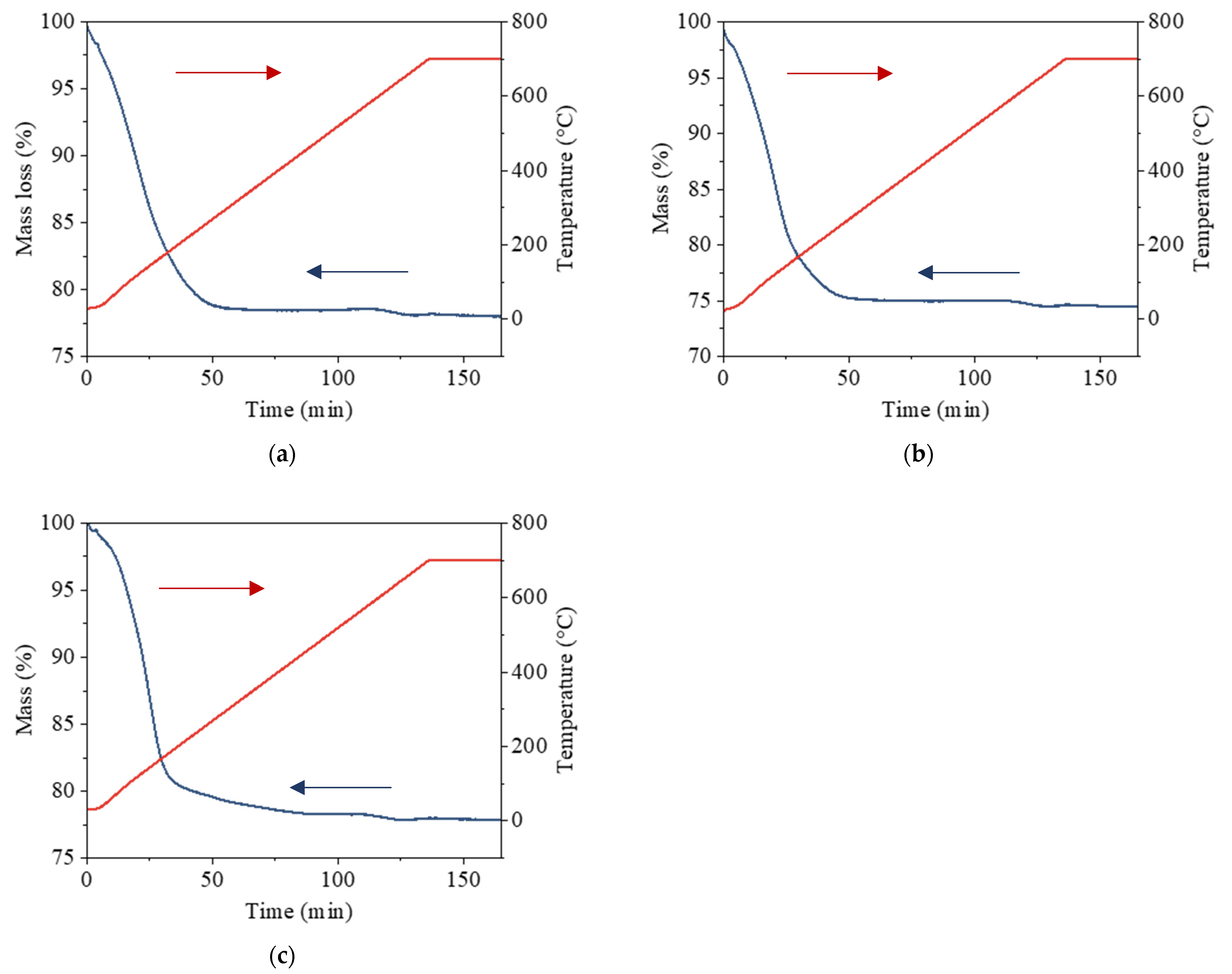
The TGA curves of the as-synthesized cation-exchanged zeolites in the temperature range of 25–700 °C are shown in Figure 1. All the samples display a mass loss in the range 20–25% in the range of temperatures 25–300 °C. Li+-exchanged samples exhibit a sharp initial loss around 75–90 °C due to weakly bound water and CO2, followed by gradual desorption from micropores and coordinated sites. Ba2+-exchanged samples display a slightly broader and higher-temperature desorption profile (100–300 °C), consistent with stronger water binding to the larger, more polarizable Ba2+ ions. Ni2+-exchanged samples show a gradual, nearly linear mass loss over 80–280 °C, indicative of continuous desorption from both surface and coordinated water, likely due to Ni2+–water interactions. The final stabilization temperature is similar for all samples. This broad temperature range can be attributed to the hydrophilic nature of zeolites, which results from multiple interactions between water molecules and the solid surface, as also suggested in the work of Moura et al. [13].
Adsorption is primarily due to interactions of guest molecules with atoms of the adsorbent walls. Hence, a high surface area either per unit mass or per unit volume plays a crucial role for high gas uptake. Therefore, the specific surface area and the pore volume of the synthesized materials, determined from nitrogen physisorption, are measured and reported in Table 1. The specific surface area of the samples ranging from 396 to 616 m2·g−1 is in line with the values reported in the literature [14,23]. Based on these measurements, a decrease in t-plot micropore volume and surface area is observed when comparing the results of both nickel and barium ion-exchanged zeolite samples to the one of bare zeolite. This observed decrease in pore volume might be attributed several factors; for instance, Gęsikiewicz-Puchalska et al. suggest the possible formation of mesopores, which arise from the relaxation of lattice strain when divalent cations are introduced into the zeolite structure [24]. In addition, the introduction of divalent cations into the zeolite structure can lead to blockage of existing pores, resulting in a significant reduction in micropore volume. In turn, this could explain the observed decrease in BET surface area with an increased degree of ion-exchange, as the blocking of micropores by divalent cations reduces the available surface area. On the other hand, the surface area for samples ion-exchanged with lithium did not show major changes. This can be attributed to several key factors. Specifically, Li+ is a monovalent cation, and it has a smaller ionic radius (0.76 Å) compared to Na+ (1.02 Å). During the ion exchange process, Li ions occupy sites within the zeolite framework without causing substantial structural distortion. This allows the framework to maintain its integrity, with minimal pore blocking or framework collapse. At higher doping levels, the framework might experience strain due to excessive ion exchange.
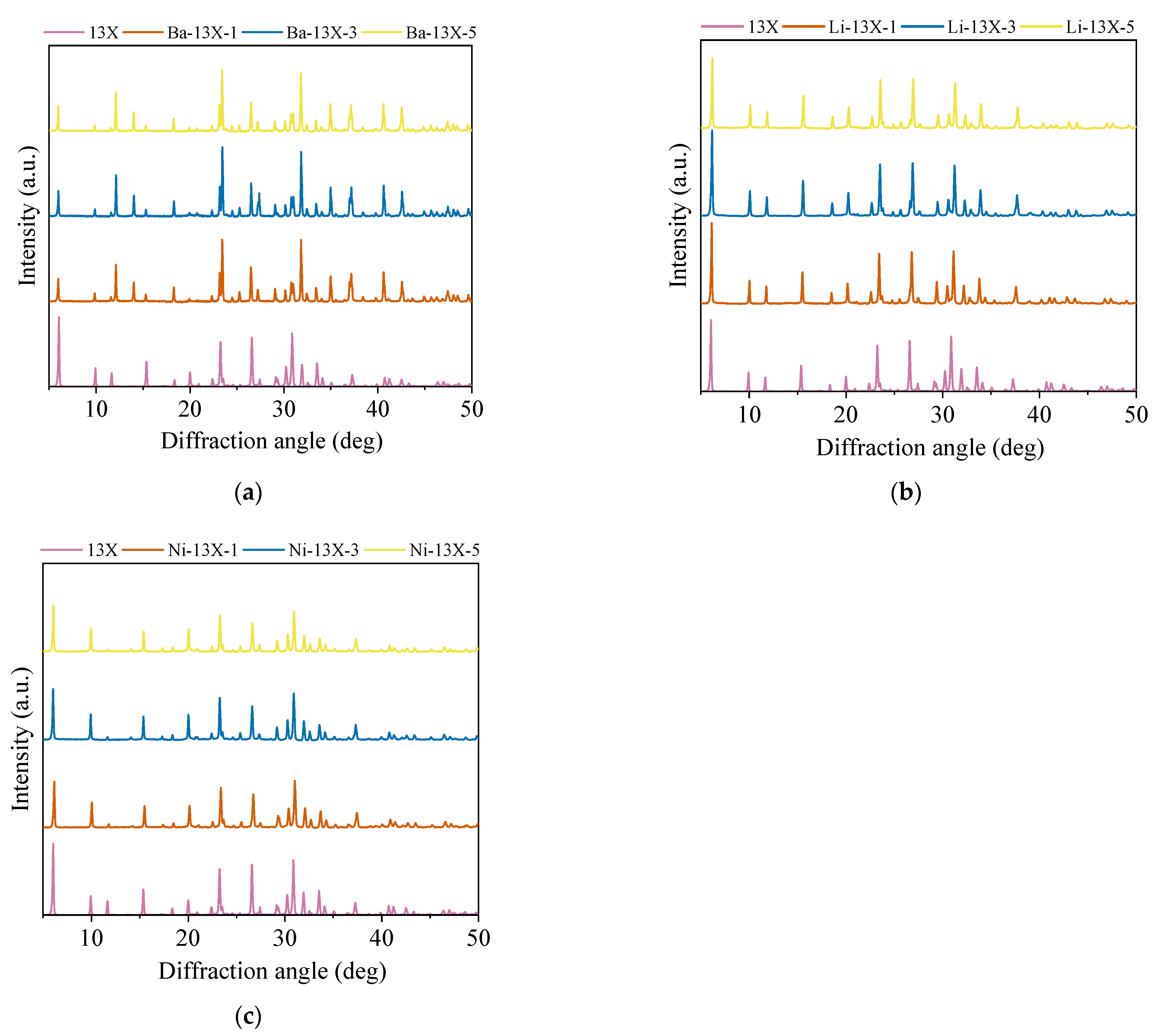
The crystal structure of the sample was investigated by powder XRD, reported in Figure 2. The samples show the characteristic angles of diffraction for bare zeolite 13X, as follows: 6.1°, 10.0°, 11.73°, 15.4°, 18.4°, 20.1°, 23.3°, 26.7°, 29.2°, 30.3°, 30.9°, 31.9°, 33.6° and 37.3° [25]. The crystallite size has been determined via Scherrer’s equation and reported in Table 1.
The XRD patterns for barium-exchanged samples exhibit a minor shift to lower diffraction angle values, in addition to the peak broadening observed in samples Ba-13X-3 and Ba-13X-5, suggesting microstrain or partial amorphization. These findings point to structural changes in the zeolite framework, likely due to the partial replacement of Na+ with Ba2+ ions, which appears to induce lattice expansion, a decrease in crystallinity, and the potential formation of structural defects.
In Figure 2b, the lithium XRD patterns exhibit a shift toward higher diffraction angles with each subsequent immersion. Notably, the step size of this shift decreases progressively, with the most significant shift occurring between the bare sample and the first immersion, while the third and fifth immersion series show a less pronounced shift. The shift to higher diffraction angles might be linked to the smaller ionic radius, corresponding to a reduced lattice constant in lithium as a monovalent cation. In fact, the replacement of larger cations with smaller ones reduces the unit cell size through reduction in the interplanar spacing which causes the diffraction peaks to occur at higher two-thetas. Therefore, the XRD results suggest that ion exchange was successful in lithium-exchanged samples.
The XRD results of Figure 2c show that the nickel ion exchanged zeolites exhibit a minor shift in the diffraction peaks. In addition, the figure shows that the diffraction peaks broaden with increasing ion-exchange. This broadening is caused by the presence of strain and may therefore indicate that mesopores are formed as the concentration of Ni2+ in the zeolite structure increases.

2.2. Characterizations of SAPO and Ion-Exchanged SAPO34 Samples

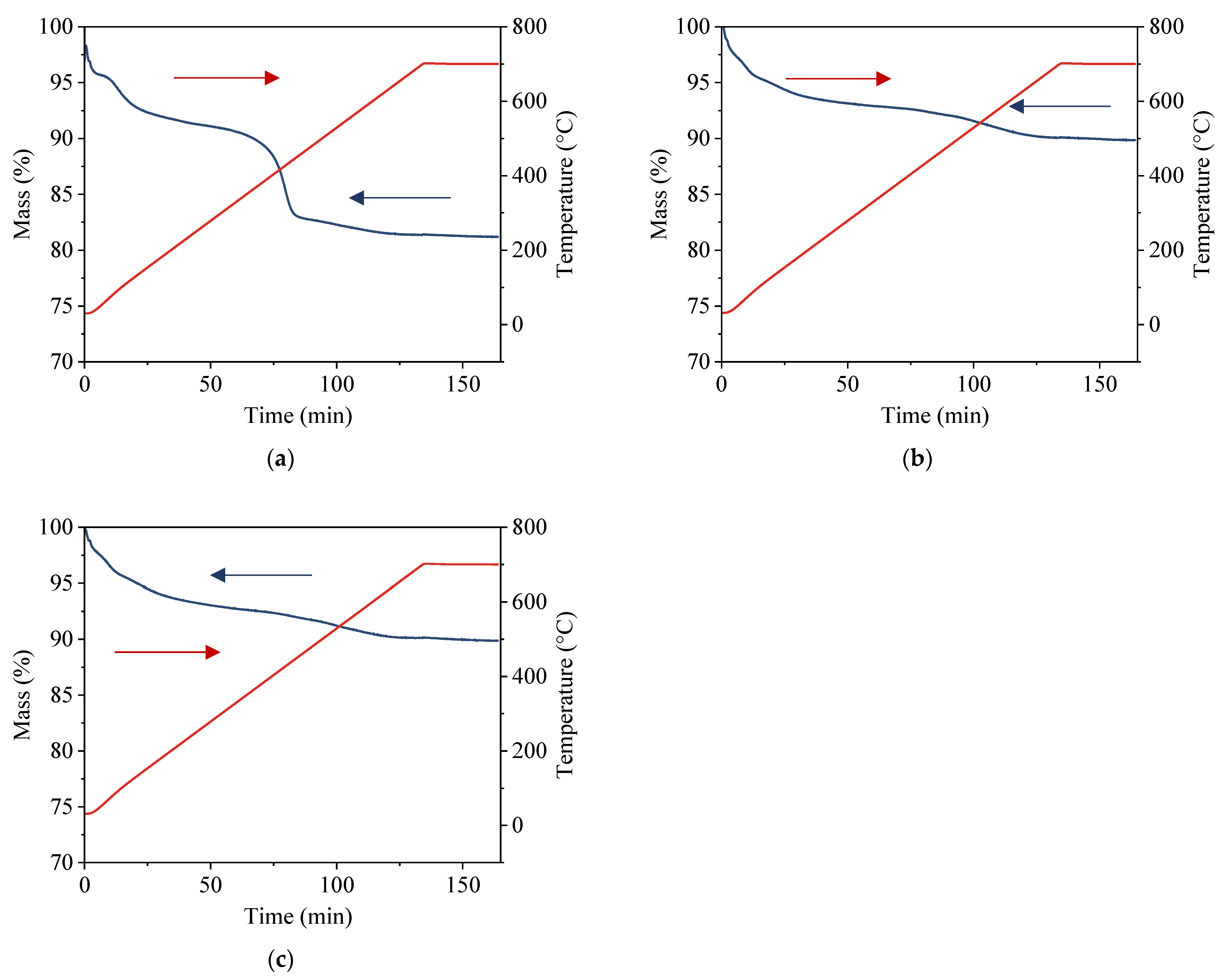
The TGA profiles of the SAPO34 samples are shown in Figure 3, revealing two distinct mass loss steps. The first step, occurring below 200 °C, corresponds to the desorption of adsorbed water. The second step, observed between 200 and 600 °C, could be associated with the decomposition of the template, as also reported in the studies by Jadav et al. and Álvaro-Muñoz et al. [26,27]. All the samples display an overall mass loss lower than 20%. The lower mass loss, as compared to zeolite 13X-based samples, could be connected to SAPO34’s moderate to high hydrophobicity, as also reported by Usman et al. and Zhao et al. [28,29]. Ba-SAPO-34 exhibits a slightly higher mass loss compared with Li- or Ni-exchanged samples. This can be attributed to the large ionic radius and polarizing power of Ba2+, which result in retention of more physisorbed water.
The specific surface area and the pore volume of the SAPO34 zeolites are reported in Table 2. The surface area of the samples is in the range of 477 to 353 m2·g−1 and is in line with the values reported in the literature [30,31]. From the results in Table 2, a decrease in surface area can be observed for both Ni-SAPO34-5 and Ba-SAPO34-5 samples compared to the bare SAPO34. Similarly, as already observed in the 13X-derived samples, this reduction may be attributed to mesopore formation, which arises from lattice strain relaxation when divalent cations are introduced into the zeolite structure, causing blockage of existing pores and significantly reducing micropore volume. In contrast, Li-SAPO34-5 did exhibit a slight reduction in surface area.
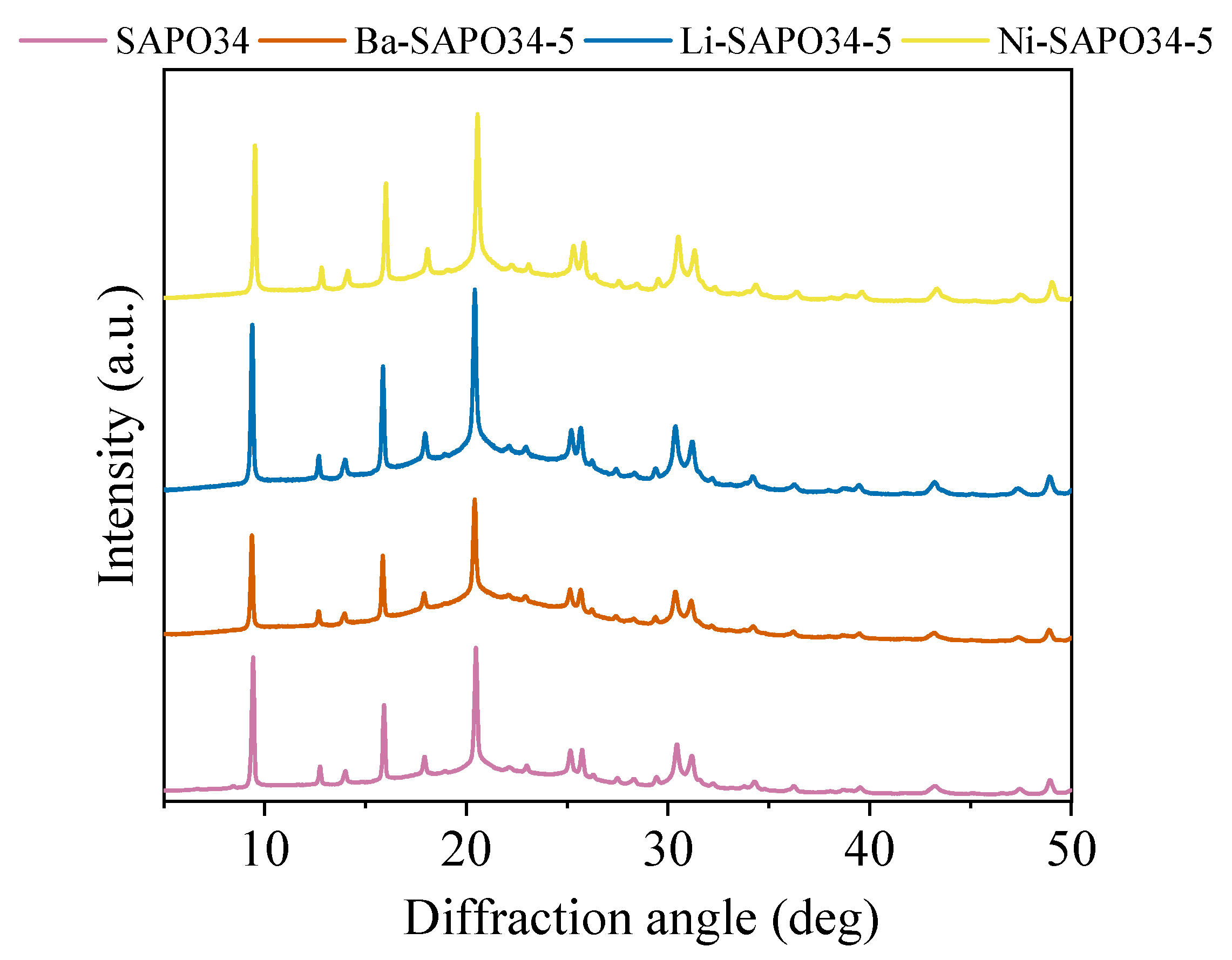
Figure 4 displays the XRD patterns for the samples SAPO34, Ba-SAPO34-5, Li-SAPO34-5, and Ni-SAPO34-5 obtained through the ion-exchange procedure. XRD analysis was conducted to assess the crystallinity of SAPO34-based materials before and after modification. The figures demonstrate that all the synthesized samples match well with those of SAPO34 structures reported in the literature, with diffraction peaks located at 2θ equal to 9.4°, 12.8°, and 15.9° [32,33], respectively. No new diffraction peaks appear, confirming that the ions were incorporated into the existing structure rather than forming separate phases. Overall, the XRD results indicate that the crystal framework remains largely unchanged after the ion-exchange procedure. The crystallite size was determined and reported in Table 3. XRD data showed a minor reduction in crystallite size.
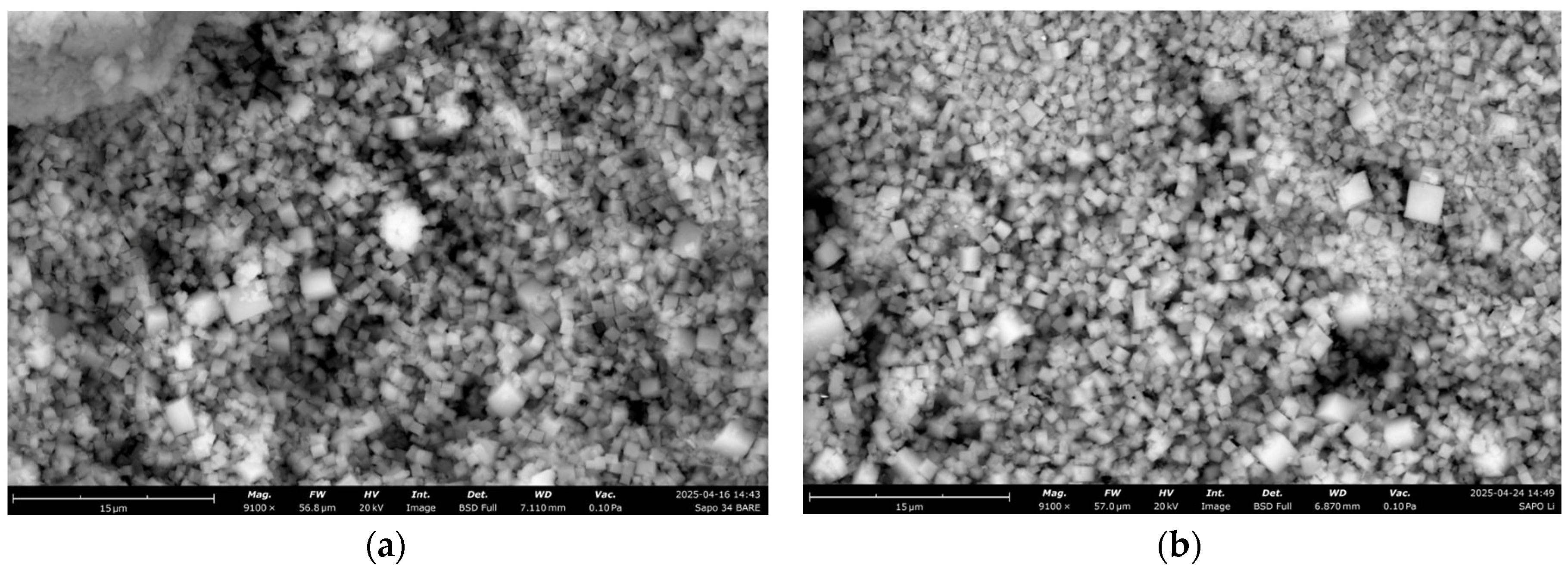
Moreover, SEM images presented in Figure 5a,b show no structural degradation due to the lithium exchange. Both SAPO34 and Li-SAPO34-5 exhibit a typical cubic-like morphology, and no major changes were observed after the consecutive ion-exchange procedure.

2.3. Methane Adsorption Tests

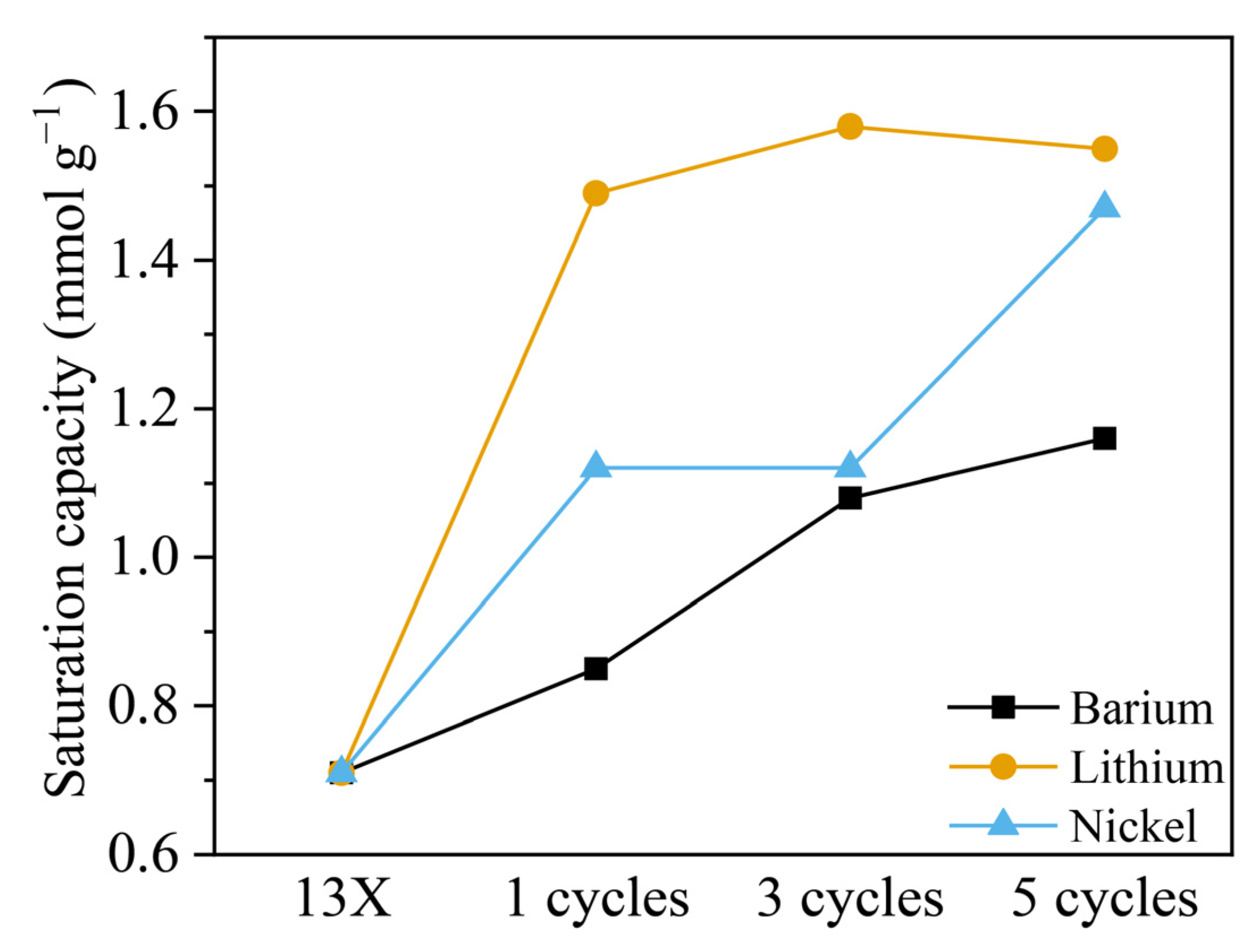
The total saturation capacity ( S c ) of the ion exchanged zeolites is reported in Figure 6. Compared to the parent zeolite, all samples produced via ion-exchange exhibited an enhanced saturation capacity. However, the best results were obtained with the lithium ion-exchanged zeolites. This can be explained looking at the methane molecule itself. CH4 lacks both a dipole and a quadrupole moment but has a high polarizability (2.448 Å3), making field-induced dipole interactions predominant [34]. Therefore, the dispersion interaction potential for CH4 increases with the polarizability of surface ions. The polarizing capacity of a cation is proportional to the ratio of its charge to its size, with Li+ exhibiting the highest polarizing power among alkali metal ions. Consequently, for alkali metal cations with the same charge (+1), smaller cations interact more strongly with methane. Of note, the polarization power of barium ions is less than that of sodium ions; however, barium-exchanged zeolite showed increased methane adsorption capacity. This could be related to the fact that the smaller sodium cation is shielded by the first few methane molecules within a cavity (the first shell of adsorbate), limiting its interaction with additional methane molecules. In contrast, the larger barium cations might experience less shielding, allowing it to influence a greater number of methane molecules in the outer shell, despite exerting a weaker potential than the smaller sodium cation, as also suggested by Senthia et al. [35]. Additionally, while CH4 is inherently nonpolar, its asymmetric vibrations impart some polar characteristics. When CH4 molecules are in close proximity to the cation and framework oxygen atoms, they induce a temporary shift in the time-averaged neutral electrostatic field of CH4 [36]. This induced polarity further contributes to a high adsorption capacity.
Performing consecutive ion-exchange sequences with lithium further enhances the saturation capacity, likely due to the progressive increase in ion-exchanged metal content, as confirmed by ICP-OES measurements, reported in Table 4. As reported in [37], the table also presents the data for the parent zeolite. This suggests that additional exchange cycles allow for a more thorough incorporation of lithium ions into the material, leading to an improved performance. The metal content, as determined via ICP-OES analysis, provides quantitative insight into the effect of repeated ion-exchange steps. In addition to the increase in target metal loading, ion exchange is also confirmed by a decrease in the sodium content of the zeolites after the procedure, indicating the successful and gradual replacement of native Na+ ions by the target metal cations. This reduction indicates that some of the Na+ cations originally present in the sorbent structure had been replaced by the target cations, further validating the effectiveness of the ion-exchange process.
Table 3. Weight composition of ion-exchanged samples and bare zeolites, as determined via ICP-OES.
SampleNaLiAlSiSi/Al Ratio
(wt%)(wt%)(wt%)(wt%)(-)
13X *14.2-17.322.21.3
Li-13X-10.732.712.220.41.7
Li-13X-30.353.612.020.21.6
Li-13X-50.264.213.022.71.6
* Data from [37].
Table 4. Weight composition of ion-exchanged samples and bare zeolites, as determined via SEM-EDX.
SampleNaOAlSiSi/Al Ratio
(wt%)(wt%)(wt%)(wt)%(-)
13X1051.116.322.61.4
Li-13X-31.555.017.426.11.5
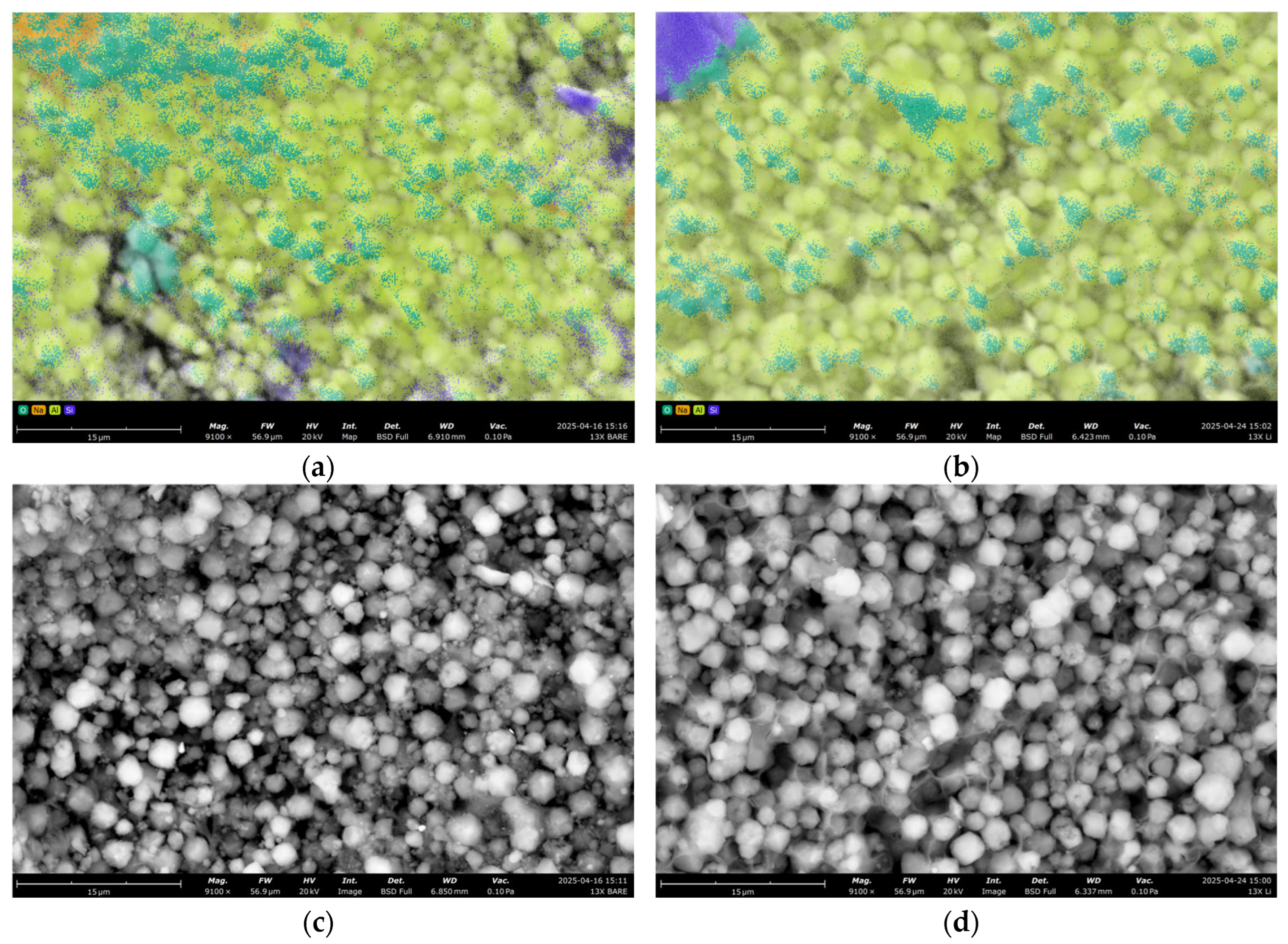
The replacement of sodium cations was also confirmed by SEM-EDX analysis, reported in Figure 7. In Figure 7a, the presence of sodium ions is clearly observed in the 13X sample in orange shade. However, in the sample that has undergone ion-exchange with lithium, the sodium signal is noticeably reduced (Figure 7b). This suggests that the ion-exchange process was effective in partially replacing sodium ions with lithium ions, resulting in a lower sodium content in the final material. Interestingly, despite this chemical modification, the SEM images did not reveal any noticeable differences in the morphology or overall structure of the samples (Figure 7c,d). The Li-13X-3 sample showed a particle arrangement and surface texture closely resembling that of the parent 13X sample. No substantial differences in particle size distribution or shape were observed between the two samples. This indicates that the ion exchange process did not significantly affect the physical integrity of the materials.
In Table 4, the EDX weight composition for both bare 13X and Li-13X-3 samples are reported.
The parent 13X sample showed the presence of oxygen, sodium, aluminum, and silicon. Following Li+ exchange, a substantial decrease in Na+ content is observed. While lithium was not detected due to the instrument’s limitation in identifying light elements such as lithium, the marked reduction in Na+ content strongly suggests that ion exchange has occurred, corroborating the ICP-OES results.
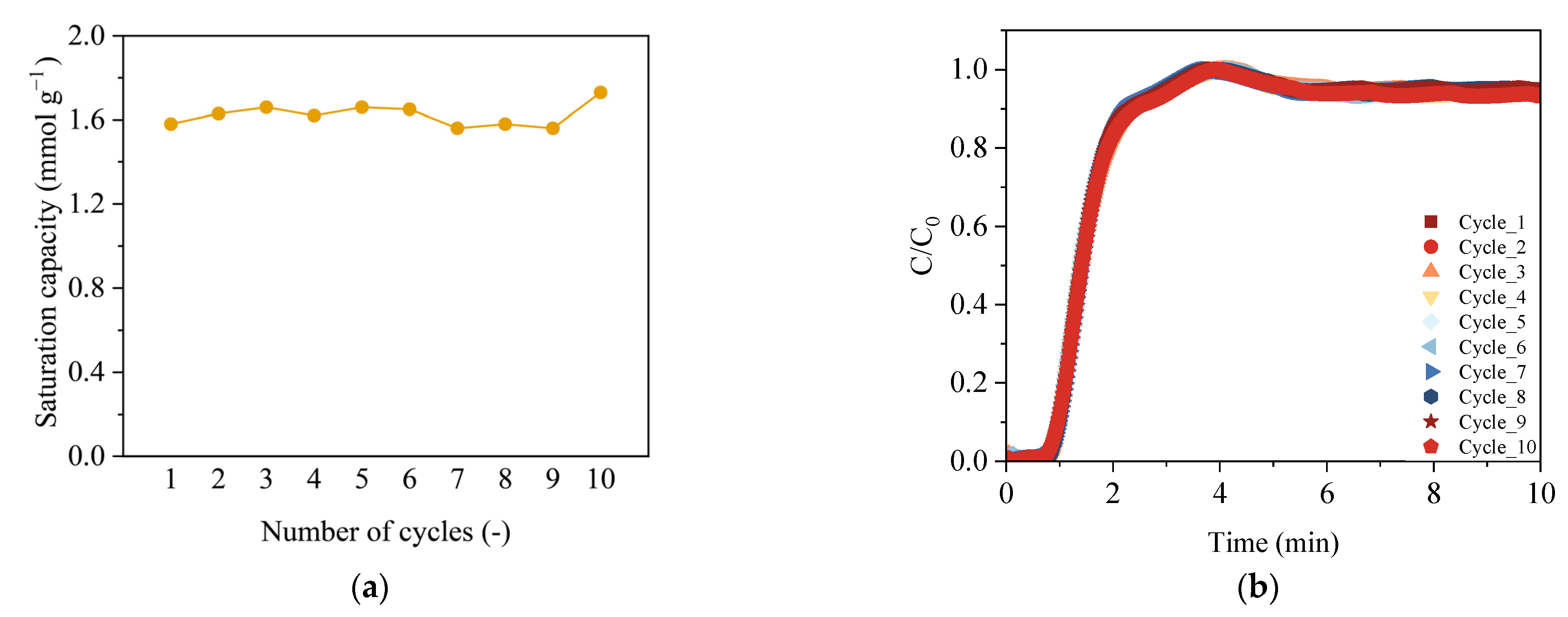
The stability of the Li-13X-3 sample performance was tested by 10 subsequent cycles of adsorption and desorption, the results of which are shown in Figure 8a,b. The performance of the zeolite was highly stable: the saturation capacity in the 1st cycle was 1.58 mmol g−1 and remained virtually constant with no deterioration.
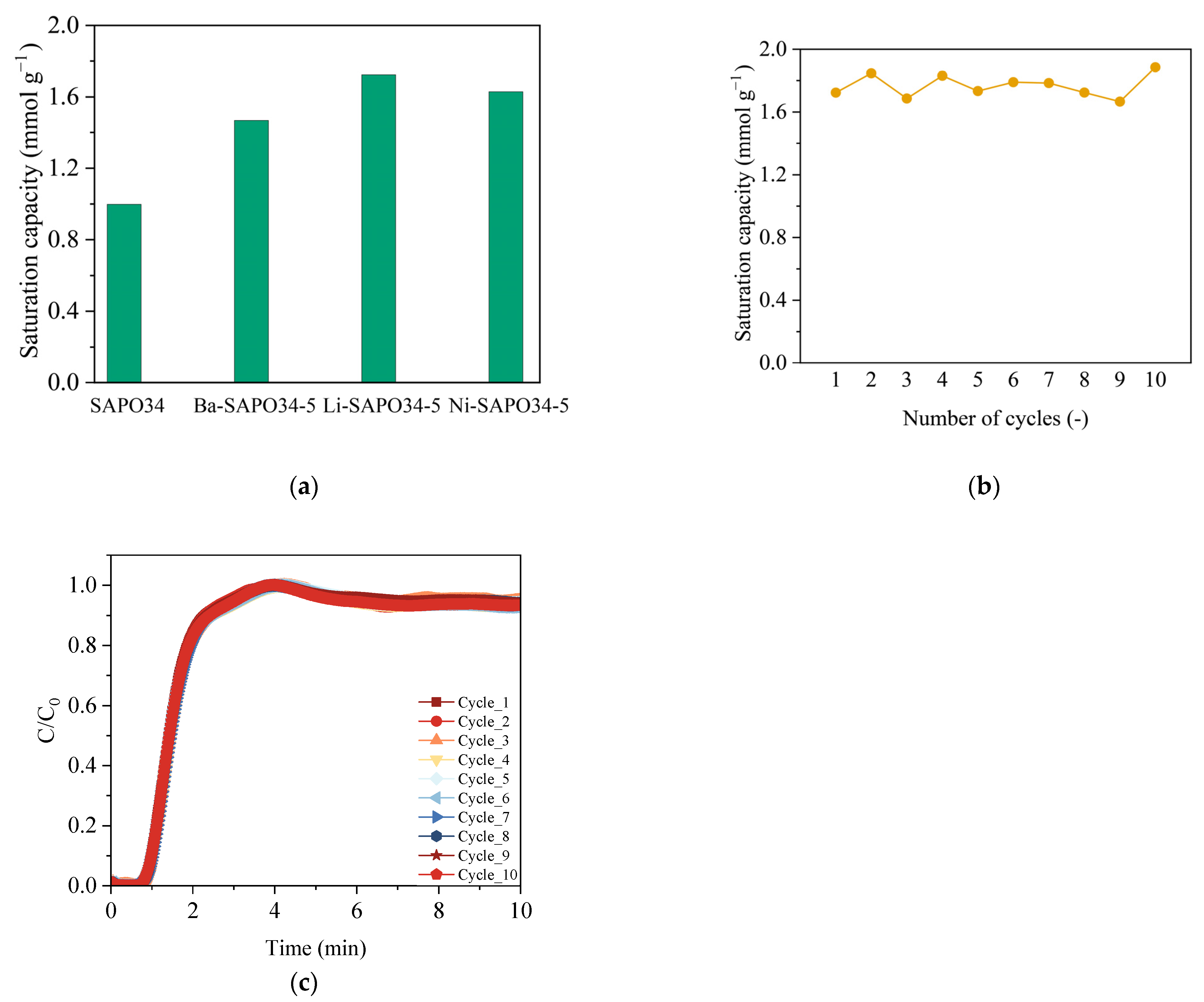
SAPO34 and ion-exchanged SAPO34 samples were tested for methane adsorption. Interestingly, the bare SAPO34 exhibits a higher adsorption capacity than 13X (Figure 9a), highlighting the intrinsic properties of the framework that contribute to its superior performance. 13X has pore diameters larger than gas molecules (1 nm), allowing gas diffusion [38]. However, when pore sizes are similar to or smaller than gas molecules, as in the case of SAPO34, the adsorption phenomenon might improve. More specifically, SAPO34 is a molecular sieve with a CHA-type cationic framework, featuring eight-ring channels with a pore diameter of 0.38 nm and ellipsoidal cages measuring 0.67 nm × 1 nm [39]. This framework closely matches the dimensions of methane, which may explain the superior adsorption performance of SAPO34 compared to 13X. Furthermore, SAPO34 is generally considered as a solid with mild acidity. Previous ammonia temperature-programmed desorption (NH3-TPD) studies have revealed two distinct desorption peaks. The low-temperature peak is attributed to weak acid sites, typically associated with surface POH, SiOH, or AlOH groups. In contrast, the high-temperature peak corresponds to moderately strong acid sites, primarily in the form of bridging hydroxyl groups [40,41]. These acid sites can enhance the adsorbent–adsorbate interactions, resulting in higher methane adsorption capacities compared to 13X.
Similarly to what was observed for 13X, the best adsorption performance for SAPO34 was also achieved with lithium-exchanged samples (Figure 9a). This can be attributed to the synergistic effect of lithium’s small ionic radius and strong interactions with the zeolite framework. Small-pore zeolites, with cage-like structures, offer narrow windows that enhance the interaction with metal cations, promoting adsorption capacity [21]. The sample Li-SAPO34-5 confirmed the stable performance over 10 cycles (Figure 9b,c), with a saturation capacity of 1.76 ± 0.07 mmol g−1.
The incorporation of lithium in the SAPO34 zeolite was confirmed via ICP-OES and the results reported in Table 5.
Given its superior adsorption performance over 10 cycles, Li-SAPO34-5 was subjected to 100 adsorption cycles. The Li-SAPO34-5 sample maintained a consistent adsorption capacity (1.77 ± 0.22 mmol g−1) throughout the tested 100 cycles, indicating no loss of performance over repeated use. To the best of the authors’ knowledge, the adsorption capacity achieved in this work represents the highest performance compared to the ones found in the literature for zeolite-based materials.

3. Materials and Methods

3.1. Ion Exchange Procedure

Zeolite 13X, in the form of 4–8-mesh-size beads, was purchased from Sigma Aldrich®, Stationsplein 4-E, 3331 LR Zwijndrecht (The Netherlands). The beads were first crushed, then sieved using a Vibratory Sieve Shaker (ANALYSETTE 3 SPARTAN®, BENELUX SCIENTIFIC B.V. Bonnetstraat 3 NL-6718 XN Ede (The Netherlands)) to obtain particles in the 250–355 μm size range. Ion exchange functionalization was performed on the 13X zeolite with various metal cations. The procedure involved immersing 2 g of 13X zeolite in approximately 50 mL of a 1 M metal salt solution. Each 50 mL of metal salt solution was prepared by dissolving BaCl2, LiCl, Ni(NO3)2·6H2O, or Fe(NO3)3·9H2O in ultrapure deionized water to prepare Li+, Ba2+, or Ni2+ cation solutions, respectively. The solution was then placed in a shaker (BEUN-DE RONDE B.V.®) for 3 h at 25 °C. Subsequently, the particles were filtered and washed three times with ultrapure deionized water. After each wash, the sample was centrifuged for 10 min (Eppendorf® 5810R) at 3900 rpm and 20 °C. The samples were then dried at room temperature overnight. The ion-exchange procedure was repeated once, thrice, and five times. Finally, the prepared samples were calcinated at 400 °C for 4 h. To ensure controlled incorporation of metal cations while preserving the structural integrity of the framework, ion exchange was stepwise rather than a single step at higher concentration. Preliminary trials using more concentrated metal salt solutions led to partial degradation of the zeolite phase, indicating that overly aggressive conditions can damage the framework.
A SAPO34 molecular sieve, Type B, was purchased from ACS MATERIAL®. The powder form of the zeolite was pelletized using a manual hydraulic press (Specac® Atlas 15T) and a 20 mm die set. The pelletized zeolite was crushed and then sieved using a Vibratory Sieve Shaker (ANALYSETTE 3 SPARTAN®) to produce particles in the 250–355 μm size range. The ion-exchange and calcination procedure were then performed as previously described for zeolite 13X.
Since multiple samples were produced, this paper uses the notation M-ZEOLITE-n for clarity, where M represents the cation under investigation (Li+, Ba2+, or Ni2+), ZEOLITE denotes the type of parent zeolite (13X or SAPO34), and n indicates the number of immersion and washing cycles (one, three, or five) used during the synthesis.

3.2. Characterizations

The samples were characterized using various techniques. Thermogravimetric analysis (TGA) was performed on an STA 449 F3 Jupiter (NETZSCH, Eindhoven, The Netherlands®) to assess the thermal stability of the samples. The sample (10 mg) was placed in a crucible and transferred into the instrument, where it was gradually heated to 700 °C under an airflow with 5 °C min−1 heating ramp, while its weight was continuously recorded.
X-Ray Diffraction (XRD) analysis in the 2θ range 10–40 degrees was performed on the samples with a MiniFlex600 (Rigaku®) operating with a Ni β-filtered Cu-Kα radiant at 40 kV and 15 mA, with a step size of 0.01° (θ/2θ) and a scan speed of 0.5 deg min−1. XRD samples were prepared by crushing the ion-exchanged zeolites and pressing the resulting powder onto XRD specimen holders. From Scherrer’s equation, (Equation (1)) [42], the crystallite size was determined, where λ is the wavelength of the X-rays, θ is the diffraction angle, FWHM is the full width at half maximum of the diffraction peak, and K is a constant (0.9):
D l = K · λ F W H M · cos θ .
In order to determine the specific surface area of the materials, nitrogen adsorption (−196 °C) was measured. Approximately 100 mg of the sample was weighted and prepared by degassing to remove any impurities such as moisture or prior adsorbed gases. The degassing was conducted at 200 °C with a heating rate of 10 °C min−1. The specific surface area was calculated using the Brunauer–Emmett–Teller (BET) method, while the pore volume was determined as the average of the Barrett–Joyner–Halenda (BJH) cumulative adsorption and desorption data, as well as using the t-plot method. A SmartPrep unit (Micromeritics®) was used for the degassing step, and a 3Flex surface characterization analyser (Micromeritics®) was used for nitrogen physisorption analysis. Inductively Coupled Plasma combined with Optical Emission Spectrometry (ICP-OES) was used to measure the zeolites’ composition via an iCAP™ PRO system and the data were analyzed through the Qtegra Intelligent Data Solution software v1 (Thermo Scientific™). Prior to the analysis, the instrument was calibrated using ICP standard solutions. More specifically, silicium ICP standard 1000 mg L−1 (Sigma Aldrich®), aluminum ICP standard 1000 mg L−1 Al in 2–3% HNO3 aqueous solution (Certipur® grade, Supelco®), sodium ICP standard 1000 mg L−1 Na in 2–5% HNO3 aqueous solution (Aristar®), and lithium ICP standard 1000 mg L−1 Li in HNO3 aqueous solution (Sigma Aldrich®) were employed to obtain a 5-points calibration line for all the components under investigation.
Firstly, the samples were dried overnight. Then, the samples were prepared by digesting the dry-weighted zeolite powder in 1.5 mL of an equivolumetric acid mixture containing hydrofluoric acid (40 wt%), nitric acid (65 wt%), and chloridric acid (37 wt%) in a polypropylene Erlenmeyer flask. The digested sample solutions were then diluted with deionized water from which a portion were analyzed by the ICP-OES system. The set of wavelengths used for quantification is listed in Table 6. Multiple wavelengths were selected for each element. The iCAP™ PRO ICP-OES system allowed an error in data collection below 2%.
Scanning Electron Microscopy (SEM) images were acquired using a Phenom Pharos G2 Desktop FEG-SEM (Thermo ScientificTM) operated at an accelerating voltage of 20 kV, with a working distance of 7.1 mm. A Backscattered Electron Detector (BSD Full) was employed for imaging. The field width was approximately 57 µm, and magnifications were adjusted accordingly to capture representative crystal morphology and surface features of the ion-exchanged samples.

3.3. Methane Adsorption Tests

The total sorption capacity of the samples, defined as the maximum CH4 amount per unit mass of sorbent, along with their adsorption cyclability, was investigated through lab-scale fixed-bed adsorption experiments carried out in the Autochem III (Micromeritics®). Before each experiment, the samples were degassed in situ to remove any surface contaminants. The preparation was performed by increasing the sample temperature up to 200 °C at a heating rate of 10 °C min−1 under a nitrogen flow rate of 25 mL min−1, holding for 2 h, and finally cooling down to ambient conditions.
Following degassing, adsorption experiments were conducted by exposing the sample to a gas mixture containing 1 vol.% methane in nitrogen. The thermal conductivity detector (TCD) signal was recorded over time, providing information on the methane concentration at the outlet of the packed bed of sorbent. The TCD was calibrated prior to each experiment with methane/nitrogen mixtures of known composition. From the TCD data, breakthrough curves were generated and employed to determine the saturation capacity ( S c ) of each sorbent, according to Equation (2) [37]. The S c was calculated from the total area above the breakthrough curve, corrected for the background, according with Equation (2):
S c   = 0 t e n d C C H 4 , b l a n k t C C H 4 ( t ) · Q I N M M C H 4 · m d t
where t e n d is the adsorption time, C C H 4 is the concentration of methane, Q I N is the total flow rate at the inlet of the packed bed of sorbent, M M C H 4 is the molar mass of methane, and m is the total mass of sorbent sample. The desorption procedure was conducted by increasing the temperature up to 200 °C at a heating rate of 10 °C min−1 under a continuous nitrogen flow of 25 mL min−1, holding for 2 h.

4. Conclusions

Ion-exchanged zeolites incorporating different cations were successfully synthesized and characterized using a range of analytical techniques to assess their textural and structural properties. ICP-OES and SEM analysis confirms that the Na+ (for 13X) and H+ (for SAPO34) can be successfully substituted by various cations through the ion-exchange process. Moreover, the XRD results confirmed that the ion-exchange process effectively preserved the original zeolite framework, while enabling a progressive increase in the loading of target metal cations. Notably, lithium-based samples exhibited the highest methane adsorption capacity, with Li-SAPO34-5 achieved a value of 1.76 ± 0.07 mmol g−1 over 10 cycles. Additionally, adsorption performance was found to improve with an increase in number of ion-exchange cycles, indicating enhanced cation incorporation. Finally, long-term stability tests over 100 cycles demonstrated that the synthesized zeolites maintained their structural integrity and adsorption capacity (1.77 ± 0.22 mmol g−1), confirming their potential for practical applications.

Author Contributions

Conceptualization, G.D.F. and F.G.; Methodology, G.D.F.; Formal analysis, D.R.; Investigation, G.D.F., D.R. and N.A.T.; Resources, F.G.; Writing —original draft, G.D.F., D.R. and N.A.T.; Writing—review & editing, G.A. and F.G.; Supervision, F.G.; Funding acquisition, F.G. All authors have read and agreed to the published version of the manuscript.

Funding

The work is part of the project “Removing non-CO2 greenhouse gas emissions to support ambitious climate transitions (REPAIR)” (Project number: 101069905) funded by the European Commission via the European Climate, Infrastructure and Environment Executive Agency (CINEA) within the Horizon Europe framework.

Institutional Review Board Statement

Not applicable.

Informed Consent Statement

Not applicable.

Data Availability Statement

The original contributions presented in this study are included in the article. Further inquiries can be directed to the corresponding author.

Conflicts of Interest

The authors declare no conflicts of interest.

References

  1. International Energy Agency. Global Methane Tracker_Documentation—2024 Version. 2024. Available online: https://iea.blob.core.windows.net/assets/d42fc095-f706-422a-9008-6b9e4e1ee616/GlobalMethaneTracker_Documentation.pdf (accessed on 31 January 2026).
  2. Stolaroff, J.K.; Bhattacharyya, S.; Smith, C.A.; Bourcier, W.L.; Cameron-Smith, P.J.; Aines, R.D. Review of Methane Mitigation Technologies with Application to Rapid Release of Methane from the Arctic. Environ. Sci. Technol. 2012, 46, 6455–6469. [Google Scholar] [CrossRef]
  3. Bessagnet, B.; Belis, C.A.; Crippa, M.; Dentener, F.; van Dingenen, R.; Thunis, P. Trends of Methane Emissions and Their Impact on Ozone Concentrations at the European and Global Levels; Publications Office of the European Union: Luxembourg, 2024. [Google Scholar]
  4. Zeng, G.; Lu, W.; Wang, Y.; Peng, H.; Chen, P.; Weng, X.; Chen, J.; Zhang, L.; Du, H.; Luo, W.; et al. Methane Sink of Subterranean Space in an Integrated Atmosphere-Soil-Cave System. Environ. Res. 2024, 252, 118904. [Google Scholar] [CrossRef]
  5. Ngwabie, N.M.; Jeppsson, K.H.; Nimmermark, S.; Swensson, C.; Gustafsson, G. Multi-Location Measurements of Greenhouse Gases and Emission Rates of Methane and Ammonia from a Naturally-Ventilated Barn for Dairy Cows. Biosyst. Eng. 2009, 103, 68–77. [Google Scholar] [CrossRef]
  6. La, H.; Hettiaratchi, J.P.A.; Achari, G.; Dunfield, P.F. Biofiltration of Methane. Bioresour. Technol. 2018, 268, 759–772. [Google Scholar] [CrossRef]
  7. Su, S.; Beath, A.; Guo, H.; Mallett, C. An Assessment of Mine Methane Mitigation and Utilisation Technologies. Prog. Energy Combust. Sci. 2005, 31, 123–170. [Google Scholar] [CrossRef]
  8. Ursueguía, D.; Díaz, E.; Ordóñez, S. Effect of Water and Carbon Dioxide on the Performance of Basolite Metal-Organic Frameworks for Methane Adsorption. Energy Fuels 2023, 37, 14836–14844. [Google Scholar] [CrossRef]
  9. Xu, X.; Zhao, X.; Sun, L.; Liu, X. Adsorption Separation of Carbon Dioxide, Methane, and Nitrogen on Hβ and Na-Exchanged β-Zeolite. J. Nat. Gas Chem. 2008, 17, 391–396. [Google Scholar] [CrossRef]
  10. Su, D.; Chen, P.; Li, C.; Yan, Y.; Zhao, R.; Yue, Q.; Qiao, Y. Research Progress in Microporous Materials for Selective Adsorption and Separation of Methane from Low-Grade Gas. Molecules 2024, 29, 4404. [Google Scholar] [CrossRef] [PubMed]
  11. Roohollahi, H.; Zeinalzadeh, H.; Kazemian, H. Recent Advances in Adsorption and Separation of Methane and Carbon Dioxide Greenhouse Gases Using Metal-Organic Framework-Based Composites. Ind. Eng. Chem. Res. 2022, 61, 10555–10586. [Google Scholar] [CrossRef]
  12. Tsivadze, A.Y.; Aksyutin, O.E.; Ishkov, A.G.; Men’shchikov, I.E.; Fomkin, A.A.; Shkolin, A.V.; Khozina, E.V.; Grachev, V.A. Porous Carbon-Based Adsorption Systems for Natural Gas (Methane) Storage. Russ. Chem. Rev. 2018, 87, 950–983. [Google Scholar] [CrossRef]
  13. Moura, P.A.S.; Bezerra, D.P.; Vilarrasa-Garcia, E.; Bastos-Neto, M.; Azevedo, D.C.S. Adsorption Equilibria of CO2 and CH4 in Cation-Exchanged Zeolites 13X. Adsorption 2016, 22, 71–80. [Google Scholar] [CrossRef]
  14. Khoramzadeh, E.; Mofarahi, M.; Lee, C.H. Equilibrium Adsorption Study of CO2 and N2 on Synthesized Zeolites 13X, 4A, 5A, and Beta. J. Chem. Eng. Data 2019, 64, 5648–5664. [Google Scholar] [CrossRef]
  15. Jensen, N.K.; Rufford, T.E.; Watson, G.; Zhang, D.K.; Chan, K.I.; May, E.F. Screening Zeolites for Gas Separation Applications Involving Methane, Nitrogen, and Carbon Dioxide. J. Chem. Eng. Data 2012, 57, 106–113. [Google Scholar] [CrossRef]
  16. Mohr, R.J.; Vorkapic, D.; Rao, M.B.; Sircar, S. Pure and Binary Gas Adsorption Equilibria and Kinetics of Methane and Nitrogen on 4A Zeolite by Isotope Exchange Technique. Adsorption 1999, 5, 145–158. [Google Scholar] [CrossRef]
  17. Wang, Q.; Yu, Y.; Li, Y.; Min, X.; Zhang, J.; Sun, T. Methane Separation and Capture from Nitrogen Rich Gases by Selective Adsorption in Microporous Materials: A Review. Sep. Purif. Technol. 2022, 283, 120206. [Google Scholar] [CrossRef]
  18. Tang, X.; Liu, J.; Shang, H.; Wu, L.; Yang, J. Gas Diffusion and Adsorption Capacity Enhancement via Ultrasonic Pretreatment for Hydrothermal Synthesis of K-KFI Zeolite with Nano/Micro-Scale Crystals. Microporous Mesoporous Mater. 2020, 297, 110036. [Google Scholar] [CrossRef]
  19. Anh, L.K.; Long, N.Q. Ion-Exchanged Commercial-Zeolites for O2 Production and CO2 Capture by Swing Adsorption Technology: A Brief Review. Int. J. Environ. Sci. Technol. 2024, 21, 9251–9264. [Google Scholar] [CrossRef]
  20. Sethia, G.; Somani, R.S.; Chand Bajaj, H. Adsorption of Carbon Monoxide, Methane and Nitrogen on Alkaline Earth Metal Ion Exchanged Zeolite-X: Structure, Cation Position and Adsorption Relationship. RSC Adv. 2015, 5, 12773–12781. [Google Scholar] [CrossRef]
  21. Yang, J.; Zhao, Q.; Xu, H.; Li, L.; Dong, J.; Li, J. Adsorption of CO2, CH4, and N2 on Gas Diameter Grade Ion-Exchange Small Pore Zeolites. J. Chem. Eng. Data 2012, 57, 3701–3709. [Google Scholar] [CrossRef]
  22. Mentasty, L. Adsorption Science and Technology. Adsorpt. Sci. Technol. 1994, 11, 123–133. [Google Scholar] [CrossRef]
  23. Bezerra, D.P.; Oliveira, R.S.; Vieira, R.S.; Cavalcante, C.L.; Azevedo, D.C.S. Adsorption of CO2 on Nitrogen-Enriched Activated Carbon and Zeolite 13X. Adsorption 2011, 17, 235–246. [Google Scholar] [CrossRef]
  24. Gęsikiewicz-Puchalska, A.; Zgrzebnicki, M.; Michalkiewicz, B.; Kałamaga, A.; Narkiewicz, U.; Morawski, A.W.; Wrobel, R. Changes in Porous Parameters of the Ion Exchanged x Zeolite and Their Effect on CO2 Adsorption. Molecules 2021, 26, 7520. [Google Scholar] [CrossRef]
  25. Garshasbi, V.; Jahangiri, M.; Anbia, M. Equilibrium CO2 Adsorption on Zeolite 13X Prepared from Natural Clays. Appl. Surf. Sci. 2017, 393, 225–233. [Google Scholar] [CrossRef]
  26. Jadav, D.; Bandyopadhyay, R.; Bandyopadhyay, M. Synthesis of Hierarchical SAPO-5 & SAPO-34 Materials by Post-Synthetic Alkali Treatment and Their Enhanced Catalytic Activity in Transesterification. Eur. J. Inorg. Chem. 2020, 2020, 847–853. [Google Scholar] [CrossRef]
  27. Álvaro-Muñoz, T.; Márquez-Álvarez, C.; Sastre, E. Use of Different Templates on SAPO-34 Synthesis: Effect on the Acidity and Catalytic Activity in the MTO Reaction. Catal. Today 2012, 179, 27–34. [Google Scholar] [CrossRef]
  28. Usman, M.; Ghanem, A.S.; Niaz Ali Shah, S.; Garba, M.D.; Yusuf Khan, M.; Khan, S.; Humayun, M.; Laeeq Khan, A. A Review on SAPO-34 Zeolite Materials for CO2 Capture and Conversion. Chem. Rec. 2022, 22, e202200039. [Google Scholar] [CrossRef] [PubMed]
  29. Zhao, H.; Yang, X.; Guillet-Nicolas, R.; Yasnou, V.; Valtchev, V. Evaluating Different Types of Microporous Materials for Energy-Saving Atmospheric Water Harvest. Microporous Mesoporous Mater. 2024, 369, 113043. [Google Scholar] [CrossRef]
  30. Venna, S.R.; Carreon, M.A. Synthesis of SAPO-34 Crystals in the Presence of Crystal Growth Inhibitors. J. Phys. Chem. B 2008, 112, 16261–16265. [Google Scholar] [CrossRef] [PubMed]
  31. Najafi, N.; Askari, S.; Halladj, R. Hydrothermal Synthesis of Nanosized SAPO-34 Molecular Sieves by Different Combinations of Multi Templates. Powder Technol. 2014, 254, 324–330. [Google Scholar] [CrossRef]
  32. Arévalo-Hidalgo, A.G.; Almodóvar-Arbelo, N.E.; Hernández-Maldonado, A.J. Sr2+-SAPO-34 Prepared via Coupled Partial Detemplation and Solid State Ion Exchange: Effect on Textural Properties and Carbon Dioxide Adsorption. Ind. Eng. Chem. Res. 2011, 50, 10259–10269. [Google Scholar] [CrossRef]
  33. Askari, S.; Halladj, R. Ultrasonic Pretreatment for Hydrothermal Synthesis of SAPO-34 Nanocrystals. Ultrason. Sonochem. 2012, 19, 554–559. [Google Scholar] [CrossRef]
  34. Mousavi, S.H.; Chen, K.; Yao, J.; Zavabeti, A.; Liu, J.Z.; Li, G.K. Screening of Alkali Metal-Exchanged Zeolites for Nitrogen/Methane Separation. Langmuir 2023, 39, 1277–1287. [Google Scholar] [CrossRef]
  35. Sethia, G.; Somani, R.S.; Bajaj, H.C. Sorption of Methane and Nitrogen on Cesium Exchanged Zeolite-X: Structure, Cation Position and Adsorption Relationship. Ind. Eng. Chem. Res. 2014, 53, 6807–6814. [Google Scholar] [CrossRef]
  36. Ferrari, A.M.; Neyman, K.M.; Huber, S.; Knözinger, H.; Rösch, N. Density Functional Study of Methane Interaction with Alkali and Alkaline-Earth Metal Cations in Zeolites. Langmuir 1998, 14, 5559–5567. [Google Scholar] [CrossRef]
  37. Cechetto, V.; Struijk, C.L.; Di Felice, L.; de Leeuw den Bouter, A.W.N.; Gallucci, F. Adsorbents Development for Hydrogen Cleanup from Ammonia Decomposition in a Catalytic Membrane Reactor. Chem. Eng. J. 2023, 455, 140762. [Google Scholar] [CrossRef]
  38. David, E. Evaluation of Na-13X Zeolites Activity in the Catalytic Pyrolysis of Rapeseed Oil Cake to Produce Bio-Oil. Appl. Catal. A Gen. 2021, 617, 118126. [Google Scholar] [CrossRef]
  39. Rimaz, S.; Kosari, M.; Zarinejad, M.; Ramakrishna, S. A Comprehensive Review on Sustainability-Motivated Applications of SAPO-34 Molecular Sieve. J. Mater. Sci. 2022, 57, 848–886. [Google Scholar] [CrossRef]
  40. Kang, M. Methanol Conversion on Metal-Incorporated SAPO-34s (MeAPSO-34s). J. Mol. Catal. A Chem. 2000, 160, 437–444. [Google Scholar] [CrossRef]
  41. Shen, W.; Li, X.; Wei, Y.; Tian, P.; Deng, F.; Han, X.; Bao, X. A Study of the Acidity of SAPO-34 by Solid-State NMR Spectroscopy. Microporous Mesoporous Mater. 2012, 158, 19–25. [Google Scholar] [CrossRef]
  42. De Felice, G.; Li, S.; Anello, G.; Petit, C.; Gallucci, F.; Rebrov, E. Plasma Assisted Non-Oxidative Methane Coupling over Ni-Fe Mixed Metal Oxides. Catal. Today 2024, 440, 114832. [Google Scholar] [CrossRef]
Figure 1. TGA results for (a) Ba-13X-1, (b) Li-13X-1, and (c) Ni-13X-1.
Inorganics 14 00080 g001
Figure 2. XRD patterns for (a) Barium-exchanged zeolites, (b) Lithium-exchanged zeolites, and (c) Nickel-exchanged zeolites.
Inorganics 14 00080 g002
Figure 3. TGA results for (a) Ba-SAPO34-5, (b) Li-SAPO34-5, and (c) Ni-SAPO34-5.
Inorganics 14 00080 g003
Figure 4. XRD patterns for SAPO34, Ba-SAPO34-5, Li-SAPO34-5, and Ni-SAPO34-5.
Inorganics 14 00080 g004
Figure 5. SEM images of (a) SAPO34 and (b) Li-SAPO34-5.
Inorganics 14 00080 g005
Figure 6. Saturation capacity for the 13X modified zeolites synthesized in this work.
Inorganics 14 00080 g006
Figure 7. EDX mapping and SEM images of (a,c) 13X and (b,d) Li-13X-3.
Inorganics 14 00080 g007
Figure 8. (a) Saturation capacity and (b) breakthrough curves for 10 cycles of the sample Li-13X-3.
Inorganics 14 00080 g008
Figure 9. (a) Saturation capacity for the SAPO34 modified zeolites synthesized in this work, (b) saturation capacity, and (c) breakthrough curves for 10 adsorption/desorption cycles for the sample Li-SAPO34-5.
Inorganics 14 00080 g009
Table 1. Specific surface area, pore volume and crystallite size for the prepared materials.
SampleBET Surface Area (m2·g−1)BJH Pore Volume (cm3·g−1)t-Plot Micropore Volume (cm3·g−1)Crystallite Size (nm)
13X5860.180.2551.6
Ba-13X-15330.170.2357.9
Ba-13X-35180.170.2248.8
Ba-13X-53960.120.1761.3
Li-13X-16160.120.2653.8
Li-13X-35830.120.2545.6
Li-13X-56010.120.2547.4
Ni-13X-15610.100.2343.2
Ni-13X-34930.140.1854.3
Ni-13X-54740.180.1651.6
Table 2. Specific surface area, pore volume and crystallite size for the prepared materials.
SampleBET Surface Area (m2·g−1)BJH Pore Volume (cm3·g−1)t-Plot Micropore Volume (cm3·g−1)Crystallite Size (nm)
SAPO344770.070.2033.9
Ba-SAPO34-54180.090.1628.1
Li-SAPO34-54420.060.1929.7
Ni-SAPO34-53530.070.1826.7
Table 5. Weight composition of ion-exchanged samples and bare zeolites, as determined via ICP-OES.
SampleLiAlSiSi/Al Ratio
(wt%)(wt%)(wt%)(-)
SAPO34-30.46.30.21
Li-SAPO34-50.2429.66.00.20
Table 6. Summary of the wavelengths used for each element in ICP-OES measurements.
ElementWavelengths
Al167.079309.271 
Si212.412251.611 
Na588.995589.592 
Li323.263460.286670.776
Disclaimer/Publisher’s Note: The statements, opinions and data contained in all publications are solely those of the individual author(s) and contributor(s) and not of MDPI and/or the editor(s). MDPI and/or the editor(s) disclaim responsibility for any injury to people or property resulting from any ideas, methods, instructions or products referred to in the content.